lock DATSUN B110 1973 Service Owner's Manual
[x] Cancel search | Manufacturer: DATSUN, Model Year: 1973, Model line: B110, Model: DATSUN B110 1973Pages: 513, PDF Size: 28.74 MB
Page 64 of 513
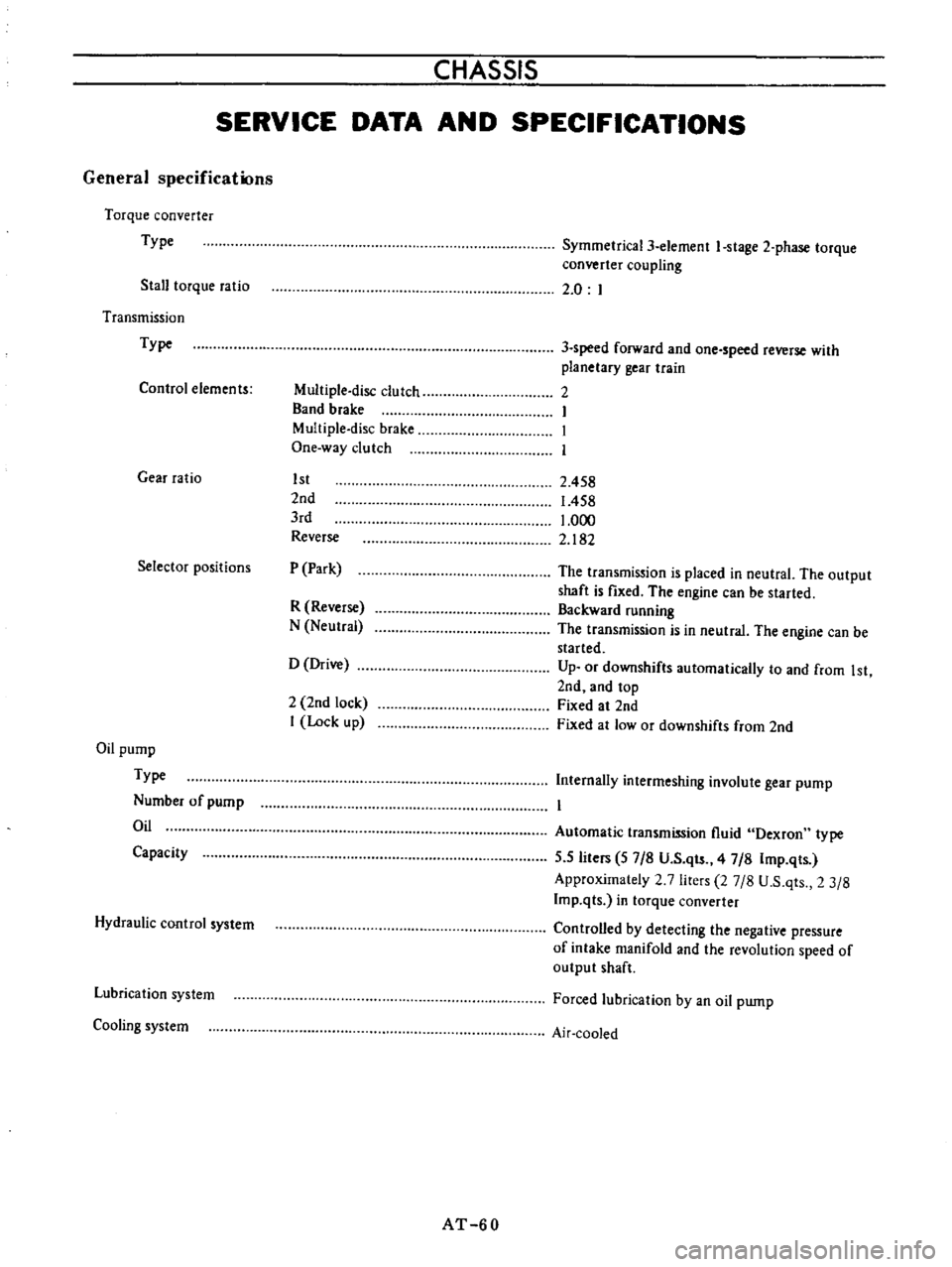
CHASSIS
SERVICE
DATA
AND
SPECIFICATIONS
General
specifications
Torque
converter
Type
Stall
torque
ratio
Transmission
Type
Control
elements
Gear
ratio
Selector
positions
Oil
pump
Type
Number
of
pump
Oil
Capacity
Hydraulic
control
system
Lubrication
system
Cooling
system
Multiple
disc
clutch
Band
brake
Multiple
disc
brake
One
way
clutch
1st
lnd
3rd
Reverse
P
Park
R
Reverse
N
Neutral
D
Drive
1
lnd
lock
I
Lock
up
AT
60
Symmetrical3
element
I
stage
l
phase
torque
converter
coupling
2
0
I
3
speed
forward
and
one
speed
reverse
with
planetary
gear
train
1
I
I
I
2
458
1
458
1
000
2
182
The
transmission
is
placed
in
neutral
The
output
shaft
is
fixed
The
engine
can
be
started
Backward
running
The
transmission
is
in
neutral
The
engine
can
be
started
Up
or
downshifts
automatically
to
and
from
1st
lnd
and
top
Fixed
at
2nd
Fixed
at
low
or
downshifts
from
2nd
Internally
intermeslting
involute
gear
pump
Automatic
transmission
fluid
Dexron
type
5
5
liters
57
8
U
S
qts
47
8
Imp
qts
Approximately
1
7
liters
27
8
U
S
qts
2
3
8
Imp
qts
in
torque
converter
Controlled
by
detecting
the
negative
pressure
of
intake
manifold
and
the
revolution
speed
of
output
shaft
Forced
lubrication
by
an
oil
pwnp
Air
cooled
Page 66 of 513
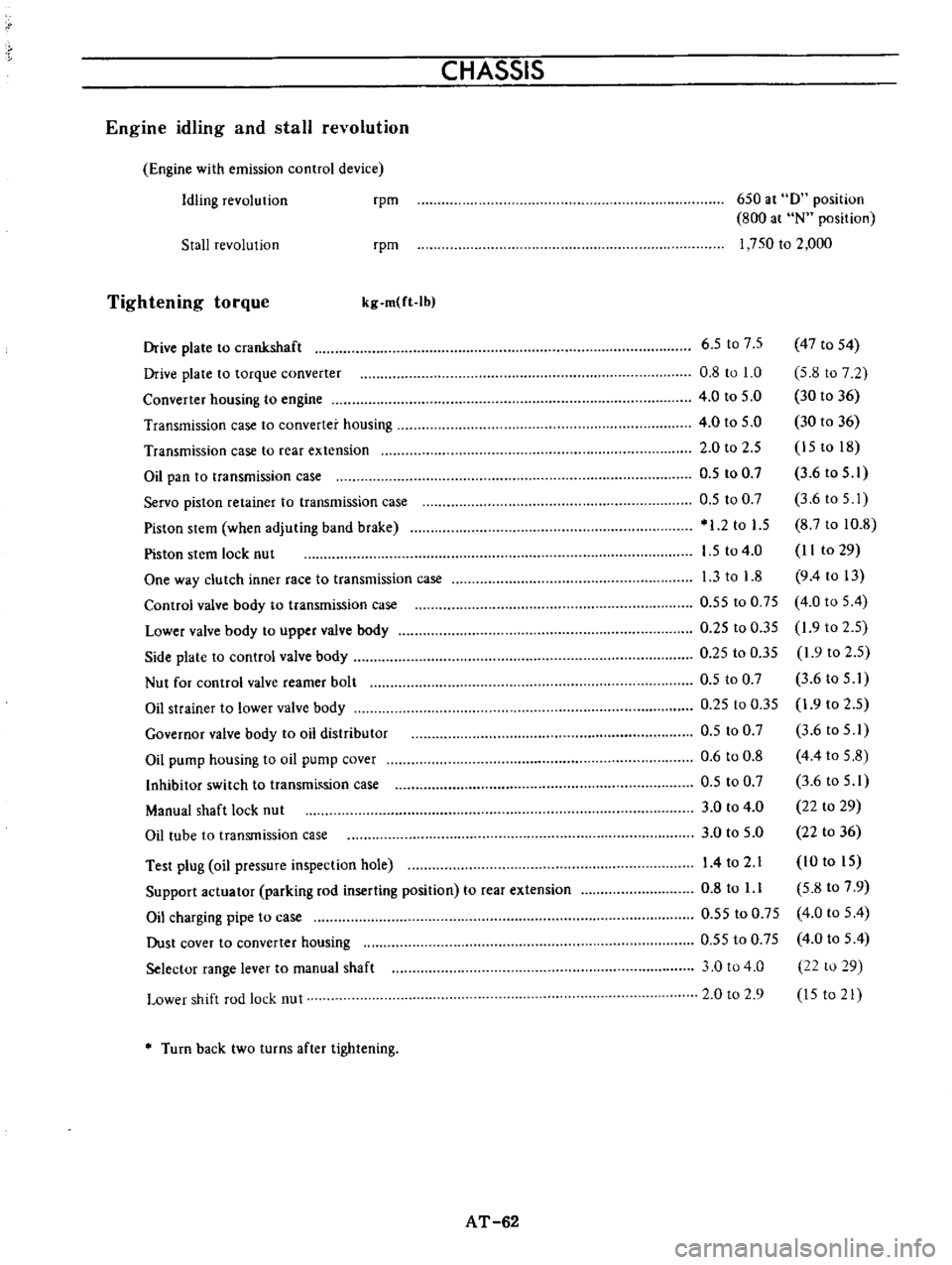
CHASSIS
Engine
idling
and
stall
revolution
Engine
with
emission
control
device
Idling
revolution
rpm
650
at
0
position
800
at
N
position
1
750
to
2
000
Stall
revolution
rpm
Tightening
torque
kg
m
ft
Ib
Test
plug
oil
pressure
inspection
hole
Support
actuator
parking
rod
inserting
position
to
rear
extension
Oil
charging
pipe
to
case
Dust
cover
to
converter
housing
Selector
range
lever
to
manual
shaft
Lower
shift
rod
lock
nut
6
5
t07
5
47
to
54
0
8
to
1
0
5
8
to
7
2
4
0
to
5
0
30
to
36
4
0
to
5
0
30
to
36
2
0
to
2
5
15
to
18
0
5
to
0
7
3
6
to
5
1
0
5
to
0
7
3
6toS
I
1
2
to
1
5
8
7
to
10
8
1
5
to
4
0
II
to
29
1
3
to
1
8
9
4
to
13
0
55
to
0
75
4
0
to
5
4
0
25
to
0
35
1
9
to
2
5
0
25
to
0
35
1
9
to
2
5
0
5
to
0
7
3
6
to
5
I
0
25
to
0
35
1
9
to
2
5
0
5
to
0
7
3
6
to
5
1
0
6
to
0
8
4
4
to
5
8
0
5
to
0
7
3
6
to
5
1
3
0
to
4
0
22
to
29
3
0
to
5
0
22
to
36
14
to
2
1
10
to
15
0
8
to
l
l
5
8
to
7
9
0
55
to
0
75
4
0
to
5
4
0
55
to
0
75
4
0
to
5
4
3
0
to
4
0
22
to
29
2
0
to
2
9
15
to
21
Drive
plate
to
crankshaft
Drive
plate
to
torque
converter
Converter
housing
to
engine
Transmission
case
to
converter
housing
Transmission
case
to
rear
extension
Oil
pan
to
transmission
case
Servo
piston
retainer
to
transmission
case
Piston
stem
when
adjuting
band
brake
Piston
stem
lock
nut
One
way
clutch
inner
race
to
transmission
case
Control
valve
body
to
transmission
case
Lower
valve
body
to
upper
valve
body
Side
plate
to
control
valve
body
Nut
for
control
valve
reamer
bolt
Oil
strainer
to
lower
valve
body
Governor
valve
body
to
oil
distributor
Oil
pump
housing
to
oil
pump
cover
Inhibitor
switch
to
transmh
sion
case
Manual
shaft
lock
nut
Oil
tube
to
transmission
case
Turn
back
two
turns
after
tightening
AT
62
Page 68 of 513
PROPELLER
SHAFT
DIFFERENTIAL
CARRIER
PROPELLER
SHAFT
AND
UNIVERSAL
JOINT
CONTENTS
DESC
R
I
PTI
ON
REMOVAL
DISASSEMBL
Y
INSPECTION
ASSEMBL
Y
PD
PD
2
PD
2
PD
2
PD
2
SERVICE
DATA
AND
SPECIFICATIONS
TROUBLE
DIAGNOSES
AND
CORRECTIONS
PD
3
PD
3
j
j
lI
ID
1
Assembly
yoke
sleeve
2
As
mbly
journal
with
lever
3
Ring
snap
bearing
race
4
Assembly
race
bearing
5
Assembly
journal
with
bearing
6
Yoke
flange
7
Ring
snap
bearing
race
8
Assembly
race
bearing
9
Bolt
10
Washer
lock
11
Nut
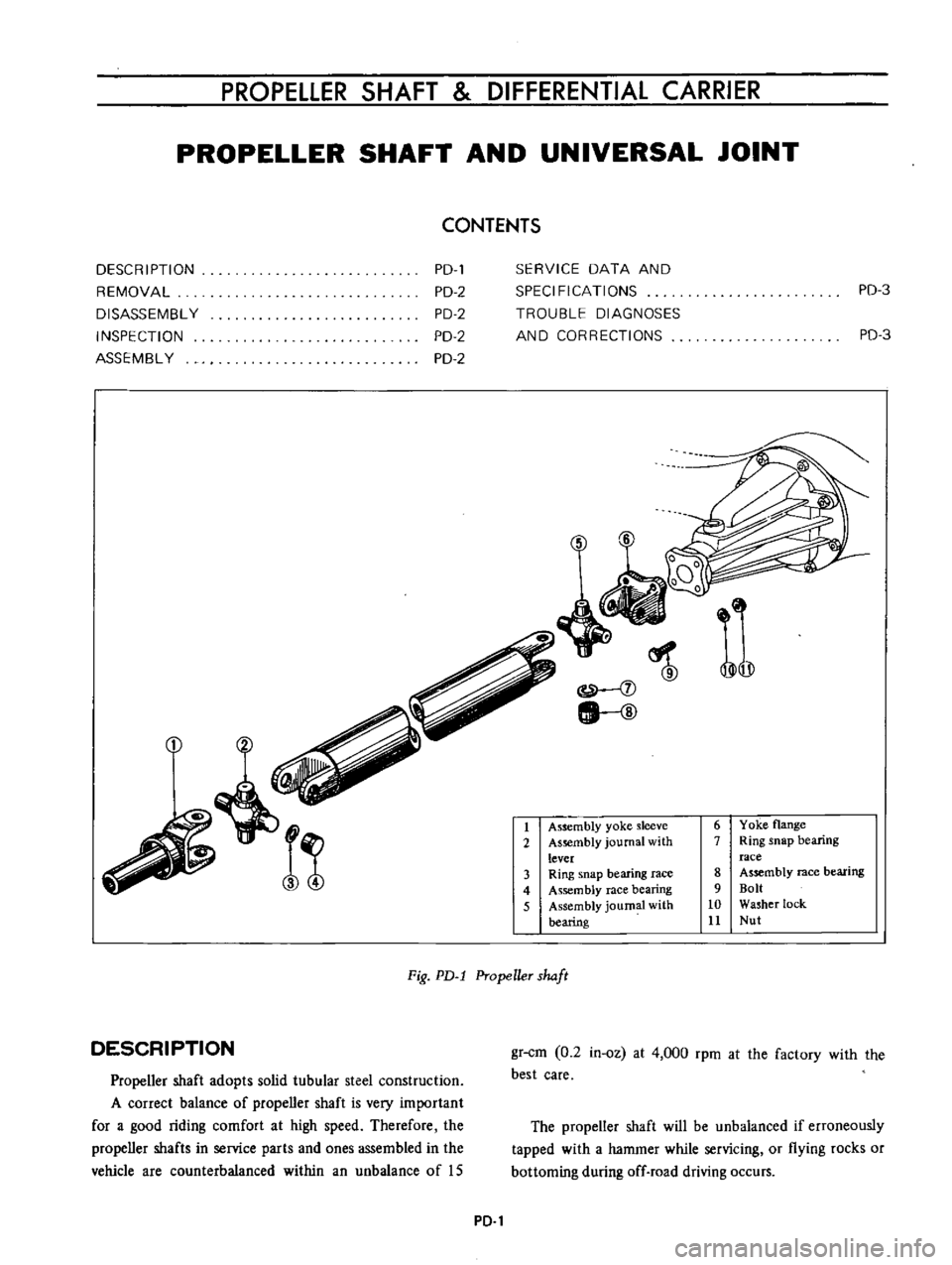
Fig
PD
l
Propeller
shaft
DESCRIPTION
Propeller
shaft
adopts
solid
tubular
steel
construction
A
correct
balance
of
propeller
shaft
is
very
important
for
a
good
riding
comfort
at
high
speed
Therefore
the
propeller
shafts
in
service
parts
and
ones
assembled
in
the
vehicle
are
counterbalanced
within
an
unbalance
of
IS
gr
cm
0
2
in
oz
at
4
000
rpm
at
the
factory
with
the
best
care
The
propeller
shaft
will
be
unbalanced
if
erroneously
tapped
with
a
hammer
while
servicing
or
flying
rocks
or
bottoming
during
off
road
driving
occurs
PD
1
Page 73 of 513
CHASSIS
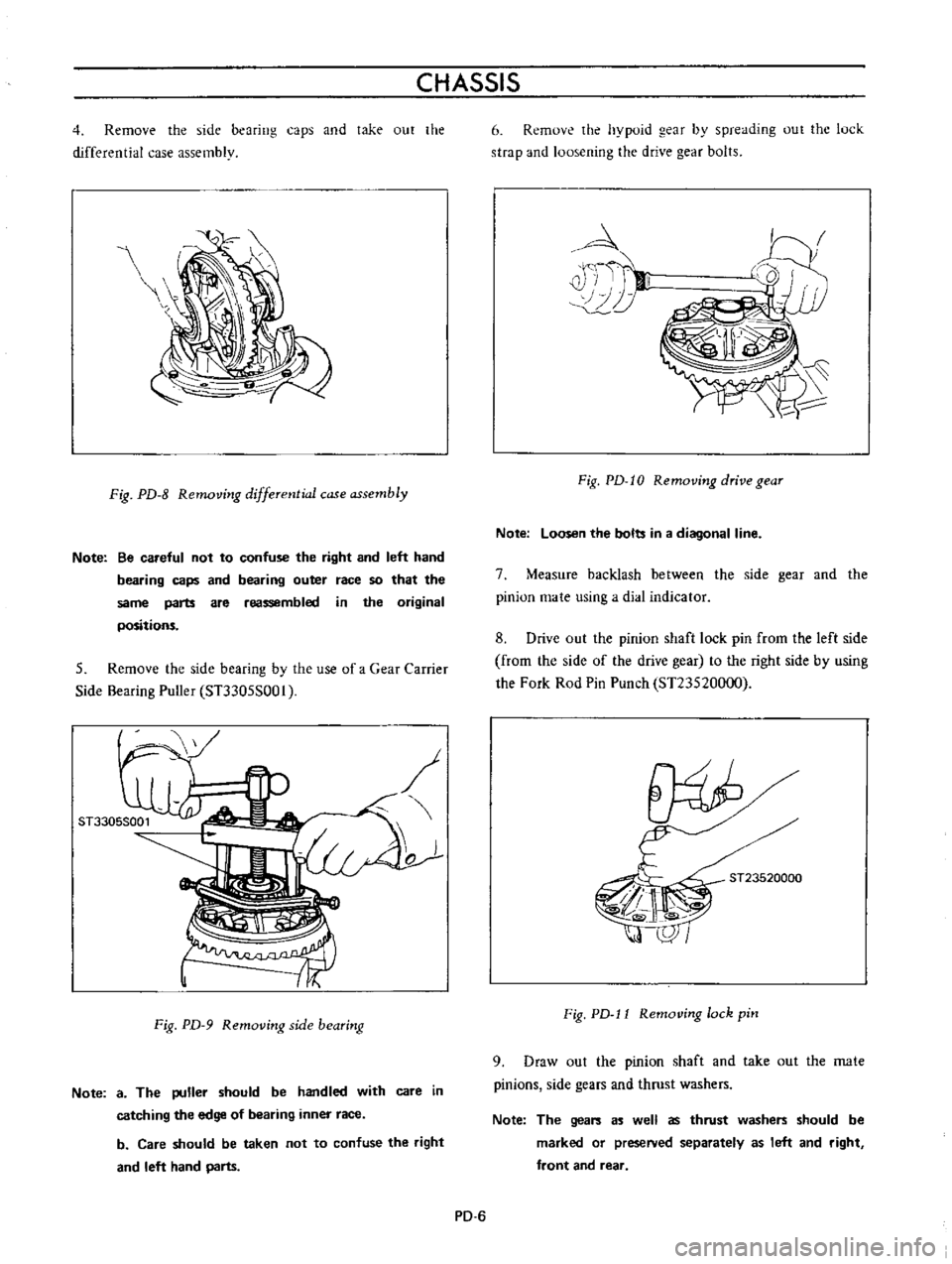
4
Remove
the
side
bearing
caps
and
take
out
the
differential
case
assembly
Fig
PD
8
Removing
differential
case
assembly
Note
Be
careful
not
to
confuse
the
right
and
left
hand
bearing
caps
and
bearing
outer
race
so
that
the
same
parts
are
reassembled
in
the
original
positions
5
Remove
the
side
bearing
by
the
use
of
a
Gear
Carrier
Side
Bearing
Puller
ST3305S001
o
Fig
PD
9
Removing
side
bearing
Note
a
The
puller
should
be
handled
with
care
in
catching
the
edge
of
bearing
inner
race
b
Care
should
be
taken
not
to
confuse
the
right
and
left
hand
parts
6
Remove
the
hypoid
gear
by
spreading
out
the
luck
strap
and
loosening
the
drive
gear
bolts
4
i
T
II
10
Fig
PD
I0
Removing
drive
gear
Note
Loosen
the
bolts
in
a
diagonal
line
7
Measure
backlash
between
the
side
gear
and
the
pinion
mate
using
a
dial
indicator
8
Drive
out
the
pinion
shaft
lock
pin
from
the
left
side
from
the
side
of
the
drive
gear
to
the
right
side
by
using
the
Fork
Rod
Pin
Punch
ST23520000
ST23520000
Fig
PD
l1
Removing
lock
pin
9
Draw
out
the
pinion
shaft
and
take
out
the
mate
pinions
side
gears
and
thrust
washers
Note
The
gears
as
well
as
thrust
washers
should
be
marked
or
preseNed
separately
as
left
and
right
front
and
rear
PD
6
Page 74 of 513
PROPELLER
SHAFT
DIFFERENTIAL
CARRIER
10
Measure
the
initial
turning
torque
drive
pinion
gear
by
using
Drive
Pinion
Preload
Gauge
Sn127S000
11
Remove
the
drive
pinion
nut
and
draw
out
the
companion
flange
assembly
Note
Use
the
Drive
Pinion
Flange
Wrench
to
hold
the
companion
flange
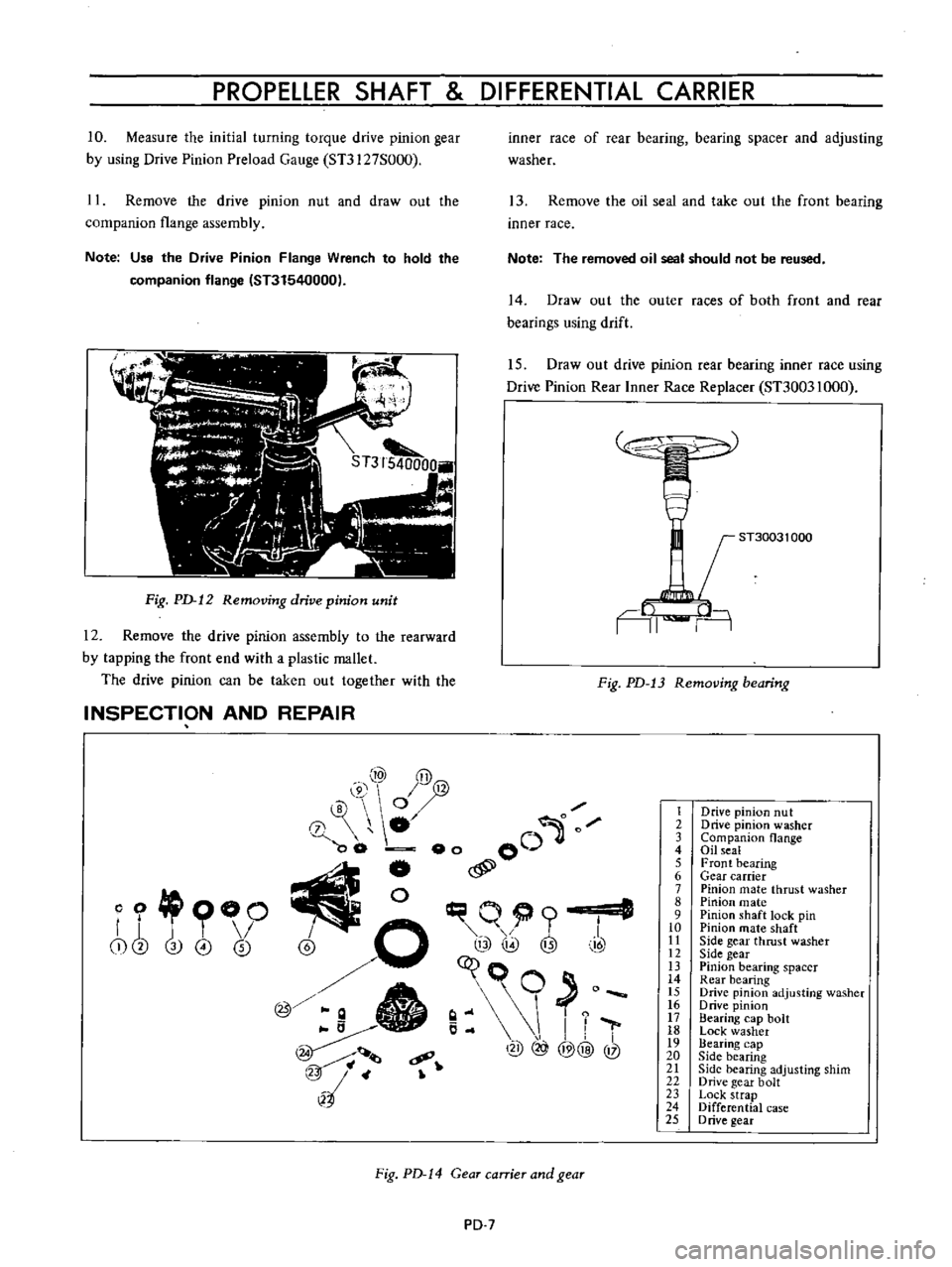
IST31540000
Fig
PD
12
Removing
drive
pinion
unit
12
Remove
the
drive
pinion
assembly
to
the
rearward
by
tapping
the
front
end
with
a
plastic
mallet
The
drive
pinion
can
be
taken
out
together
with
the
INSPECTION
AND
REPAIR
inner
race
of
rear
bearing
bearing
spacer
and
adjusting
washer
13
Remove
the
oil
seal
and
take
out
the
front
bearing
inner
race
Note
The
removed
oil
seal
should
not
be
reused
14
Draw
out
the
outer
races
of
both
front
and
rear
bearings
using
drift
15
Draw
out
drive
pinion
rear
bearing
inner
race
using
Drive
Pinion
Rear
Inner
Race
Replacer
ST30031000
ST30031
000
AI
n
Fig
PD
13
Removing
bearing
10
y@
@
0
0
0
00
eo
00
j
l
I
@
o
q@
@
t
I
7
c9
@
@@
@
l2
4
o
OO
r
j
T
I
i
cb
3
0
0
Fig
PD
14
Gear
carrier
and
gear
PD
7
1
2
3
4
S
6
7
8
9
10
II
12
IJ
14
IS
16
17
18
19
20
21
22
23
24
25
Drive
pinion
nut
Drive
pinion
washer
Companion
flange
Oil
seal
Front
bearing
Gear
carrier
Pinion
mate
thrust
washer
Pinion
mate
Pinion
shaft
lock
pin
Pinion
mate
shaft
Side
gear
thrust
washer
Side
gear
Pinion
bearing
spacer
Rear
bearing
Drive
pinion
adjusting
washer
o
rive
pinion
Bearing
cap
bolt
Lock
washer
Bearing
cap
Side
bearing
Side
bearing
adjusting
shim
Drive
gear
bolt
Lock
strap
Differential
case
D
rive
gear
Page 76 of 513
PROPELLER
SHAFT
DIFFERENTIAL
CARRIER
Reassemble
the
differential
carrier
in
reverse
order
of
disassembly
The
following
instructions
for
adjustment
and
usage
of
special
tuols
are
essential
to
obtain
perfect
differential
operation
Assembling
differential
gear
case
1
Assemble
the
pinion
mate
side
gear
and
thrust
washer
in
the
differential
case
2
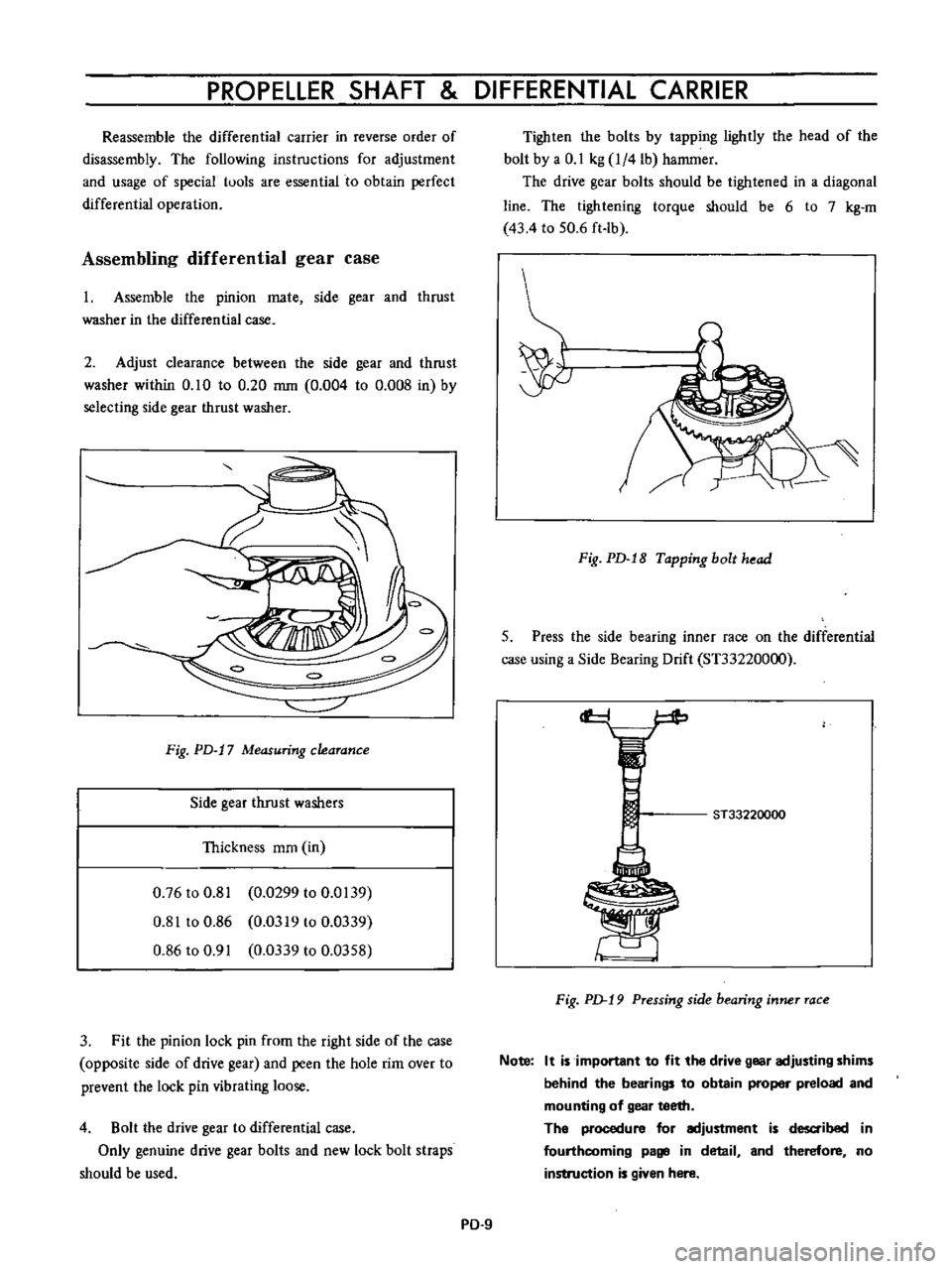
Adjust
clearance
between
the
side
gear
and
thrust
washer
within
0
10
to
0
20
mm
0
004
to
0
008
in
by
selecting
side
gear
thrust
washer
Fig
PD
17
Measuring
clearance
Side
gear
thrust
washers
Thickness
mm
in
0
76
to
0
81
0
0299
to
0
0139
0
81
to
0
86
0
0319
to
0
0339
0
86
to
0
91
0
0339
to
0
0358
3
Fit
the
pinion
lock
pin
from
the
right
side
of
the
case
opposite
side
of
drive
gear
and
peen
the
hole
rim
over
to
prevent
the
lock
pin
vibrating
loose
4
Bolt
the
drive
gear
to
differential
case
Only
genuine
drive
gear
bolts
and
new
lock
bolt
straps
should
be
used
Tighten
the
bolts
by
tapping
lightly
the
head
of
the
bolt
by
a
0
1
kg
l
4lb
hammer
The
drive
gear
bolts
should
be
tightened
in
a
diagonal
line
The
tightening
torque
should
be
6
to
7
kg
m
43
4
to
50
6
ft
lb
Fig
PD
18
Tapping
bolt
head
5
Press
the
side
bearing
inner
race
on
the
differential
case
using
a
Side
Bearing
Drift
ST33220000
cf
ST33220000
F
ig
p
19
Pressing
side
bearing
inner
race
Note
It
is
important
to
fit
the
drive
gear
adjusting
shims
behind
the
bearings
to
obtain
proper
preload
and
mounting
of
gear
teeth
The
procedure
for
adjustment
is
d
ibed
in
fourthcoming
page
in
detail
and
therefore
no
instruction
is
given
here
PD
9
Page 77 of 513
CHASSIS
Setting
and
adjusting
drive
pinion
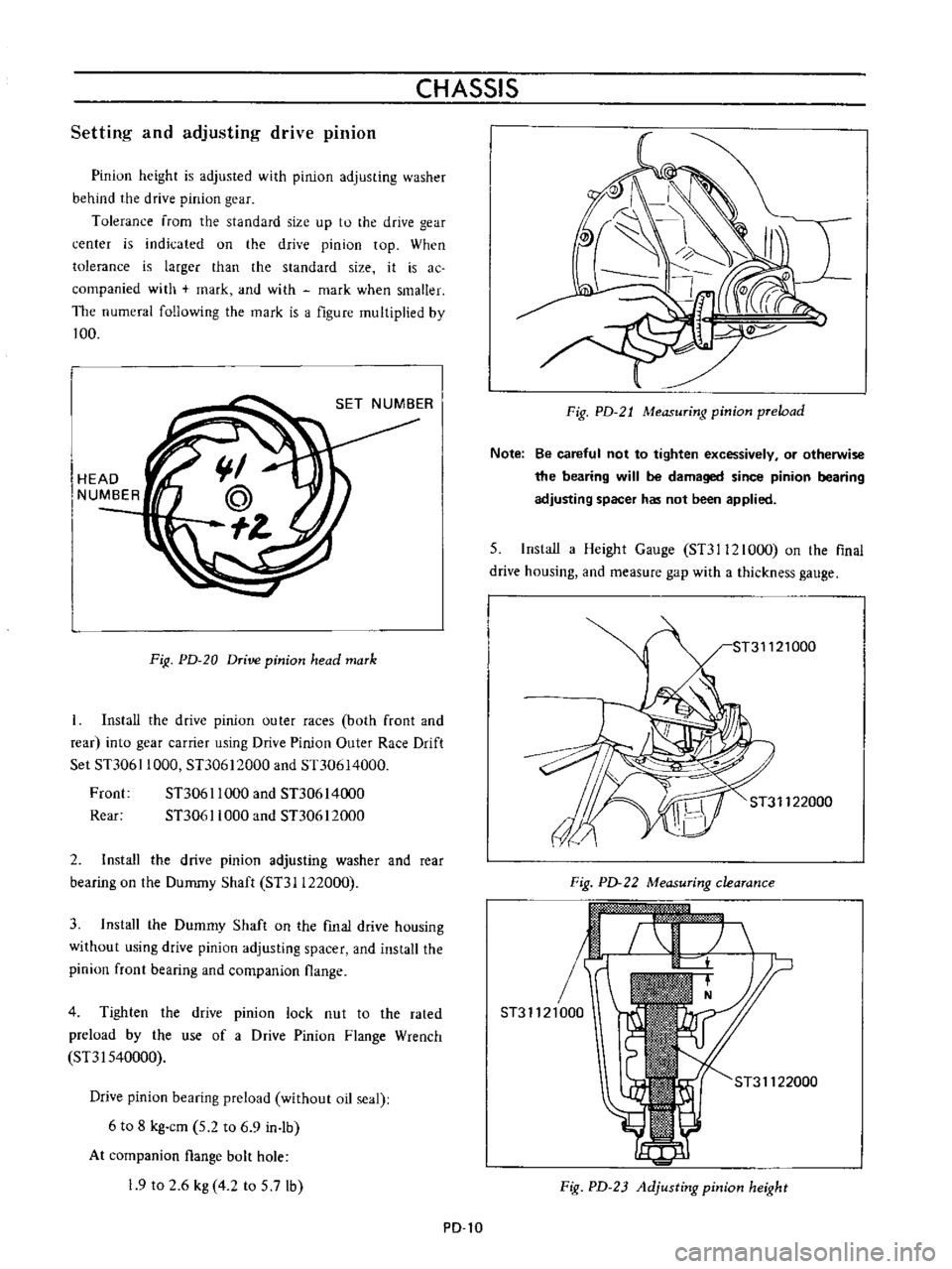
Pinion
height
is
adjusted
with
pinion
adjusting
washer
behind
the
drive
pinion
gear
Tolerance
from
the
standard
size
up
to
the
drive
gear
center
is
indicated
on
the
drive
pinion
top
When
tolerance
is
larger
than
the
standard
size
it
is
ac
companied
with
mark
and
with
mark
when
smaller
The
numeral
following
the
mark
is
a
figure
multiplied
by
100
HEAD
NUMBER
FiR
PD
20
Drive
pinion
head
mark
Install
the
drive
pinion
outer
races
both
front
and
rear
into
gear
carrier
using
Drive
Pinion
Outer
Race
Drift
Set
STJ061
1000
STJ0612000
and
Sn0614000
Froot
STJ061
1000
and
STJ0614000
Rear
STJ061
1000
and
STJ0612000
2
Install
the
drive
pinion
adjusting
washer
and
rear
bearing
on
the
Dummy
Shaft
STJI122000
3
Install
the
Dummy
Shaft
on
the
fmal
drive
housing
without
using
drive
pinion
adjusting
spacer
and
install
the
pinion
front
bearing
and
companion
flange
4
Tighten
the
drive
pinion
lock
nut
to
the
rated
preload
by
the
use
of
a
Drive
Pinion
Flange
Wrench
SnI540000
Drive
pinion
bearing
preload
without
oil
seal
6
to
8
kg
cm
5
2
to
6
9
in
lb
At
companion
flange
bolt
hole
19
to
2
6
kg
4
2
to
5
7lb
PD
l0
Fig
PD
21
Measuring
pinion
preload
Note
Be
careful
not
to
tighten
excessively
or
otherwise
the
bearing
will
be
damaged
since
pinion
bearing
adjusting
spacer
has
not
been
applied
5
Install
a
Height
Gauge
STJI12l000
on
the
flnal
drive
housing
and
measure
gap
with
a
thickness
gauge
ST31122000
Fig
PD
22
Measuring
clearance
r
ST31121000
ST31122000
Fig
PD
23
Adjusting
pinion
height
Page 89 of 513
FRONT
AXLE
FRONT
SUSPENSION
FRONT
AXLE
AND
SUSPENSION
ASSEMBLY
Removal
1
Jack
up
the
vehicle
and
support
the
vehicle
with
stands
See
the
Section
GL
2
Remove
the
hub
nuts
and
remOve
the
wheel
3
Remove
the
splash
board
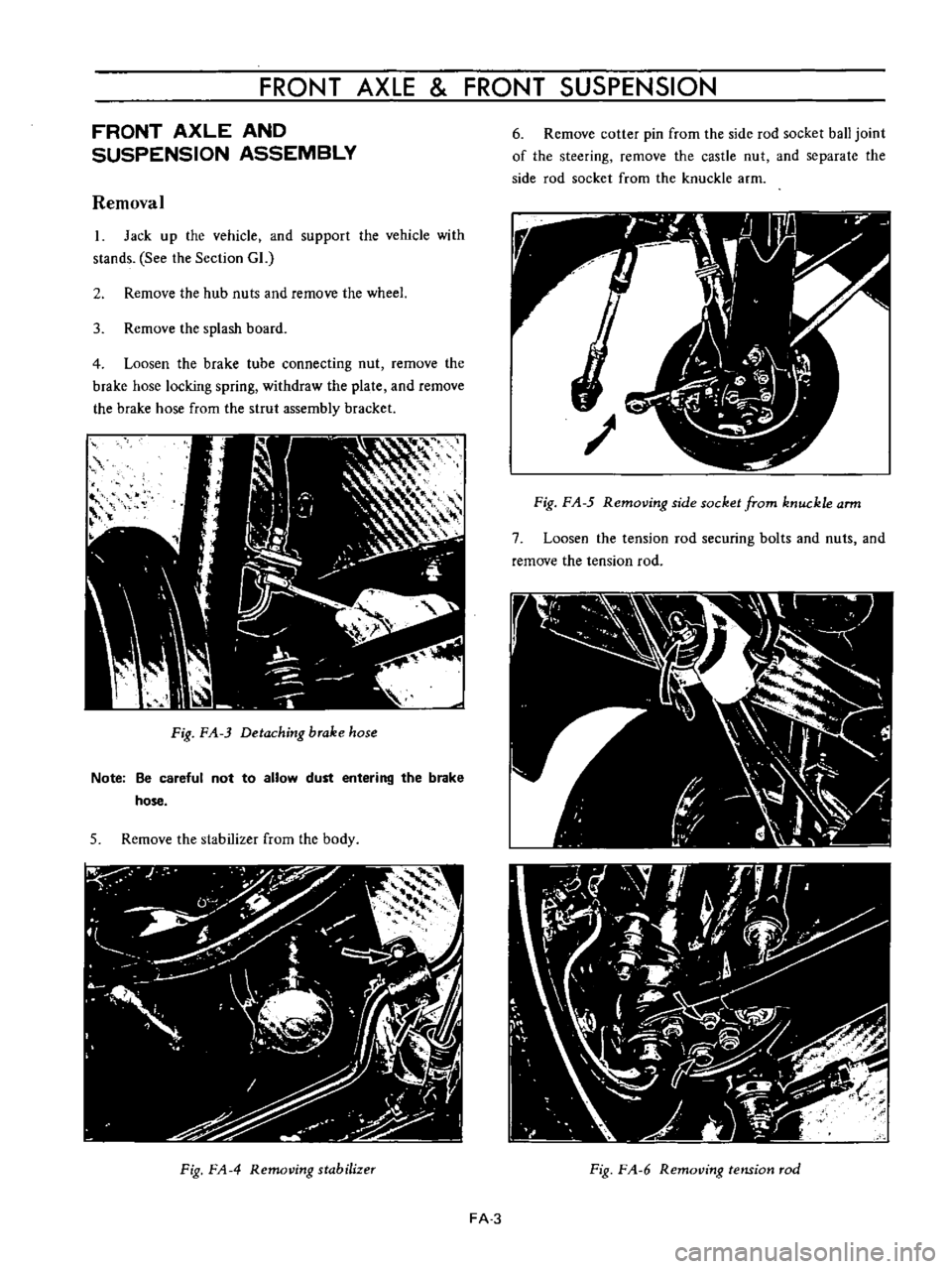
4
Loosen
the
brake
tube
connecting
nut
remove
the
brake
hose
locking
spring
withdraw
the
plate
and
remOve
the
brake
hose
from
the
strul
assembly
bracket
Fig
FA
3
Detaching
brake
hose
Note
Be
careful
not
to
allow
dust
entering
the
brake
hose
5
Remove
the
stabilizer
from
the
body
Fig
FA
4
Removing
stabilizer
6
Remove
cotter
pin
from
the
side
rod
socket
ball
joint
of
the
steering
remove
the
castle
nut
and
separate
the
side
rod
socket
from
the
knuckle
arm
Fig
F
A
5
Removing
side
socket
from
knuckle
arm
7
Loosen
the
tension
rod
securing
bolts
and
nuts
and
remove
the
tension
rod
Fig
F
A
6
RemotJing
tension
rod
FA
3
Page 90 of 513
CHASSIS
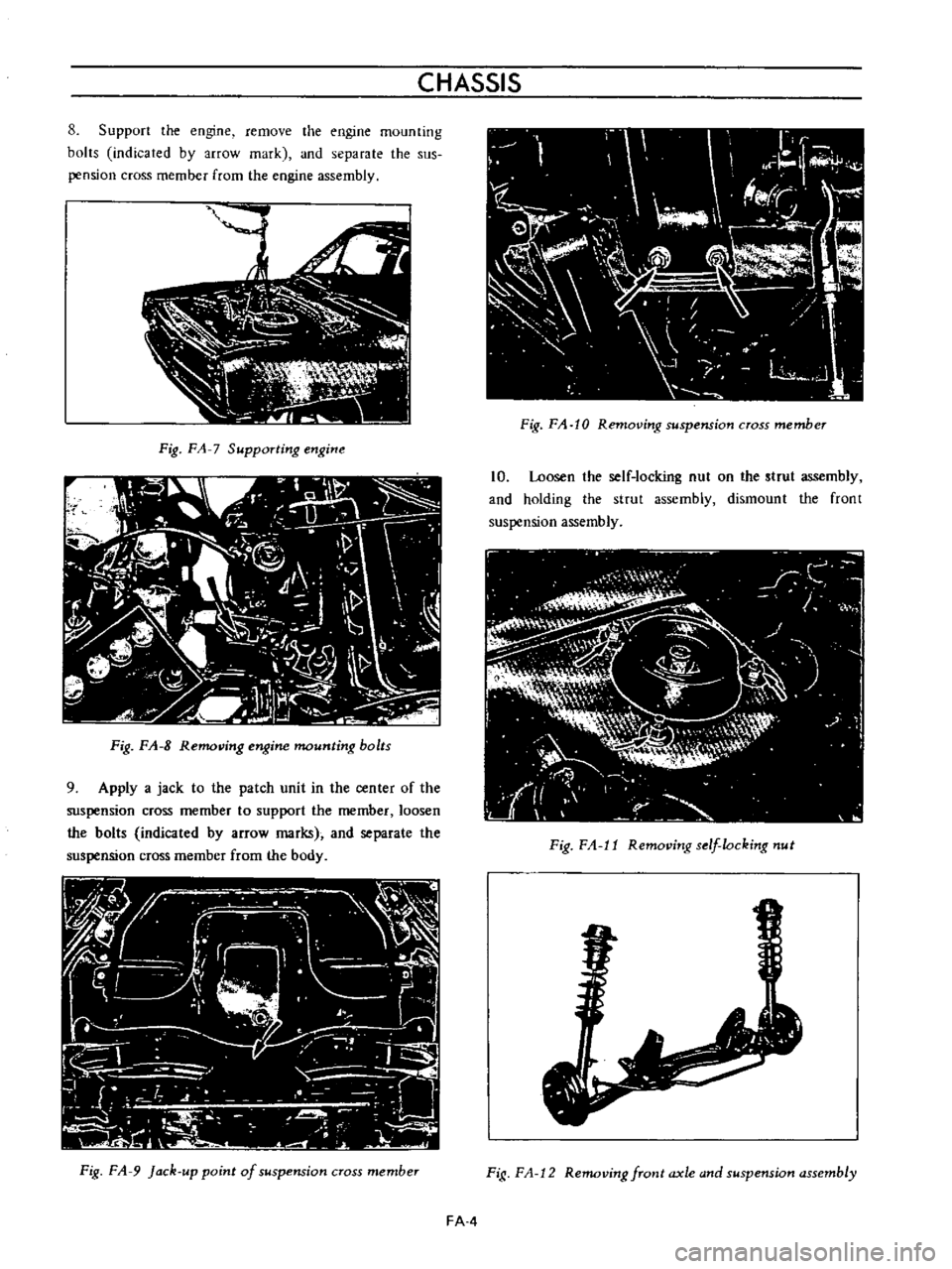
8
Support
the
engine
remove
the
engine
mounting
bolts
indicated
by
arrow
mark
and
separate
the
sus
pension
cross
member
from
the
engine
assembly
Ij
i
1
C
w
ii
lJ
c
l
I
N
r
1
a
n
h
JI
Fig
FA
7
Supporting
engine
I
IV
U
II
G
11J
r
j
F
l
I
IV
I
iL
I
0
I
l
tt
I
i
L
I
It
v
i
1
0
b
c
Ii
irti
J
I
I
1
1
Zi
J
l
ll
c
h
f
J
f
C
Fig
FA
8
Removing
engine
mounting
bolts
9
Apply
a
jack
to
the
patch
unit
in
the
center
of
the
suspension
cross
member
to
support
the
member
loosen
the
bolts
indicated
by
arrow
marks
and
separate
the
suspension
cross
member
from
the
body
Fig
FA
9
Jack
up
point
of
suspension
cross
member
Fig
FA
10
Removing
suspension
cross
member
10
Loosen
the
self
locking
nut
on
the
strut
assembly
and
holding
the
strut
assembly
dismount
the
front
suspension
assembly
Fig
F
1
11
Removing
s
flocking
nut
Fig
F
A
12
Removing
front
axle
and
suspension
assembly
FAA
Page 92 of 513
CHASSIS
Tightening
torque
of
front
suspension
cross
member
and
body
is
3
2
to
4
0
kg
m
23
1
to
28
9
ft
Ib
5
Tightening
torque
of
bolt
used
to
secure
the
upper
portion
of
the
strut
assembly
on
the
body
is
1
6
to
2
1
kg
m
11
6
to
15
2ft
lb
FRONT
AXLE
Removal
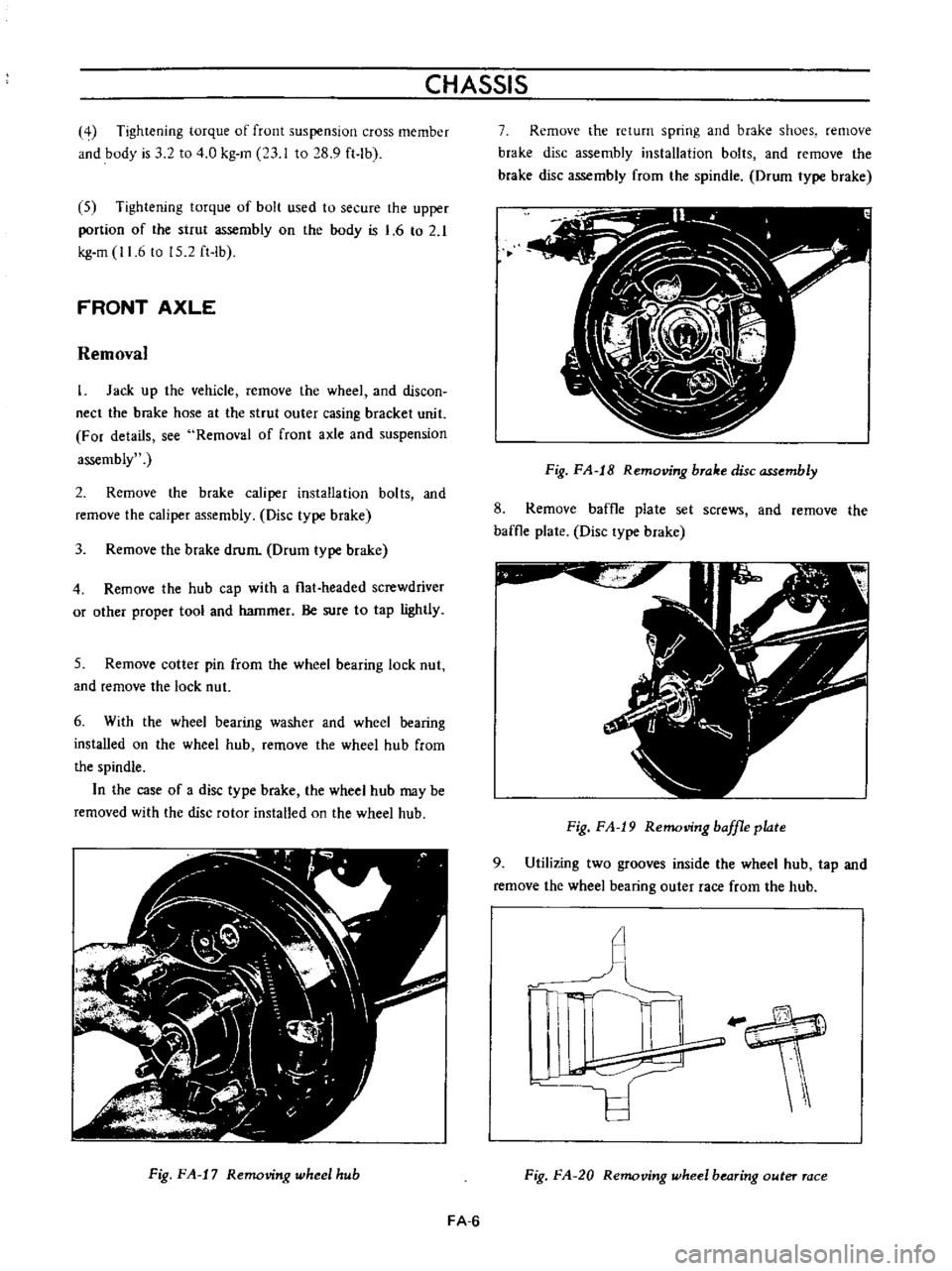
I
Jack
up
the
vehicle
remove
the
wheel
and
discon
nect
the
brake
hose
at
the
strut
outer
casing
bracket
unit
For
details
see
Removal
of
front
axle
and
suspension
assembly
2
Remove
the
brake
caliper
installation
bolts
and
remove
the
caliper
assembly
Disc
type
brake
3
Remove
the
brake
druOL
Drum
type
brake
4
Remove
the
hub
cap
with
a
flal
headed
screwdriver
or
other
proper
tool
and
hammer
Be
sure
to
tap
lightly
5
Remove
cotter
pin
from
the
wheel
bearing
lock
nut
and
remove
the
lock
nut
6
With
the
wheel
bearing
washer
and
wheel
bearing
installed
on
the
wheel
hub
remove
the
wheel
hub
from
the
spindle
In
the
case
of
a
disc
type
brake
the
wheel
hub
may
be
removed
with
the
disc
rotor
installed
on
the
wheel
hub
Fig
FA
17
Removing
wheel
hub
7
Remove
the
return
spring
and
brake
shoes
remove
brake
disc
assembly
installation
bolts
and
remove
the
brake
disc
assembly
from
the
spindle
Drum
type
brake
Fig
FA
IS
Removing
brake
disc
a
ssembly
8
Remove
baffle
plate
set
screws
and
remove
the
baffle
plate
Disc
type
brake
Fig
FA
19
Removingbaffleplate
9
Utilizing
two
grooves
inside
the
wheel
hub
tap
and
remove
the
wheel
bearing
outer
race
from
the
hub
Fig
FA
20
Removing
wheel
bearing
outer
race
FA
6