wheel DATSUN B110 1973 Service Manual PDF
[x] Cancel search | Manufacturer: DATSUN, Model Year: 1973, Model line: B110, Model: DATSUN B110 1973Pages: 513, PDF Size: 28.74 MB
Page 297 of 513
GENERAL
INFORMATION
MODEL
VARIATION
Model
Engine
model
Transmission
type
Brake
type
model
Front
Rear
LBllOTRU
Manual
transmission
Disc
Drum
F4W56L
2
door
Sedan
LBllOARU
Automatic
transmission
Disc
Drum
3N71B
AI2
KLBllOU
Manual
transmission
Disc
Drum
F4W56L
Coupe
Automatic
transmission
KLBllOAU
3N71B
Disc
Drum
Model
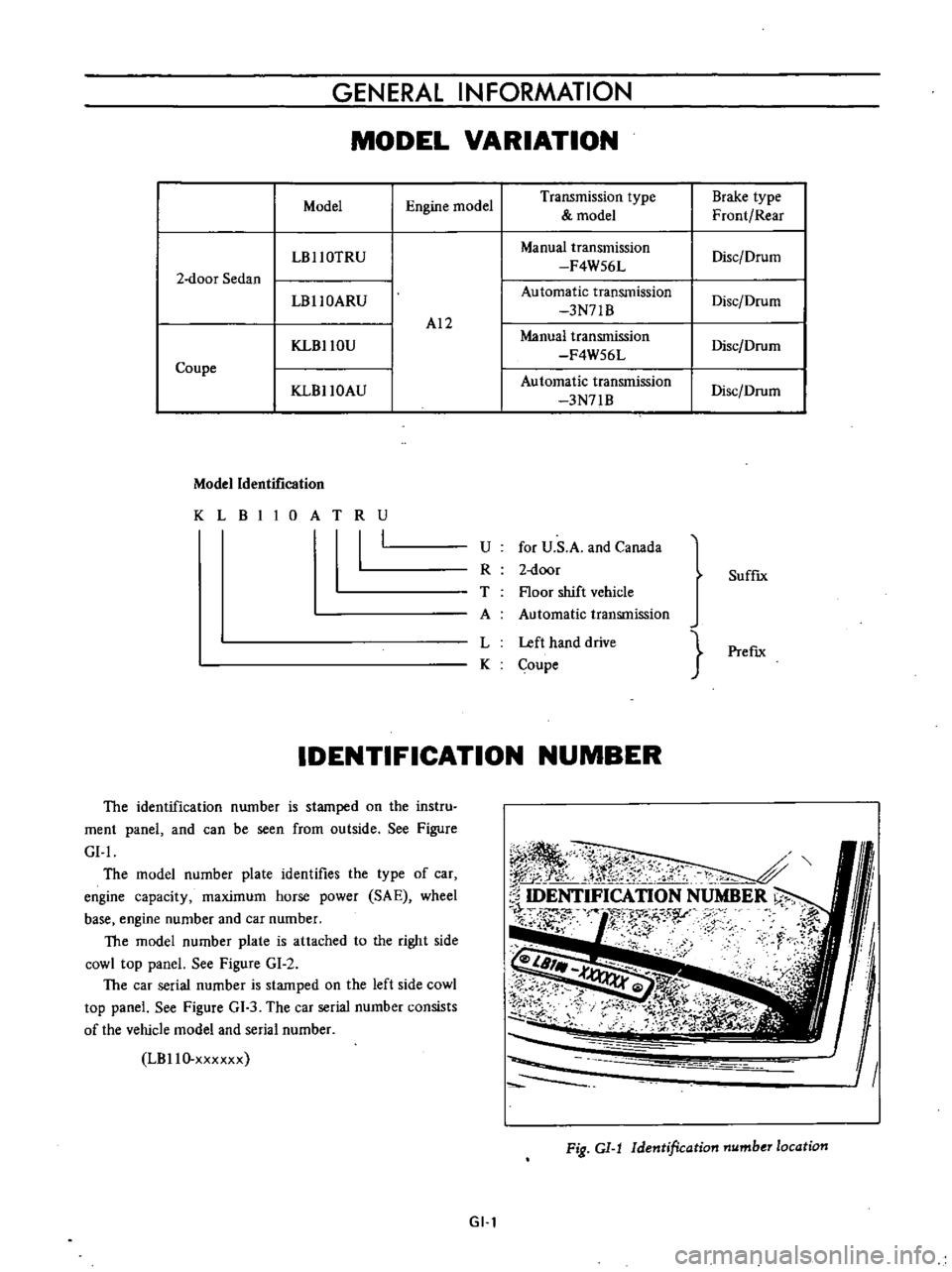
Identification
KLBIIOATRU
I
U
for
U
S
A
and
Canada
R
2
door
T
Floor
shift
vehicle
A
Automatic
transmission
L
Left
hand
drive
K
Coupe
SuffIx
PrefIx
IDENTIFICATION
NUMBER
The
identification
number
is
stamped
on
the
instru
ment
panel
and
can
be
seen
from
outside
See
Figure
GI
I
The
model
number
plate
identifles
the
type
of
car
engine
capacity
maximum
horse
power
SA
E
wheel
base
engine
number
and
car
number
The
model
number
plate
is
attached
to
the
right
side
cowl
top
panel
See
Figure
GI
2
The
car
serial
number
is
stamped
on
the
left
side
cowl
top
panel
See
Figure
GI
3
The
car
serial
number
consists
of
the
vehicle
model
and
serial
number
LBllO
xxxxxx
I
ll
r
N
t
0
S
k
j
c
ftr
o
l
l
r
2
0
IDENTIFICATION
NUMBER
l
r
f
N
s
r
F
i
u
I
Fig
GI
J
Identification
number
location
GI
l
Page 300 of 513
GENERAL
INFORMATION
spring
etc
support
the
rear
cruss
member
with
stands
In
other
cases
support
both
ends
of
the
rear
axle
housing
with
stands
Fig
CI
9
Rear
jacking
point
Fig
C
J
0
Rear
supportable
point
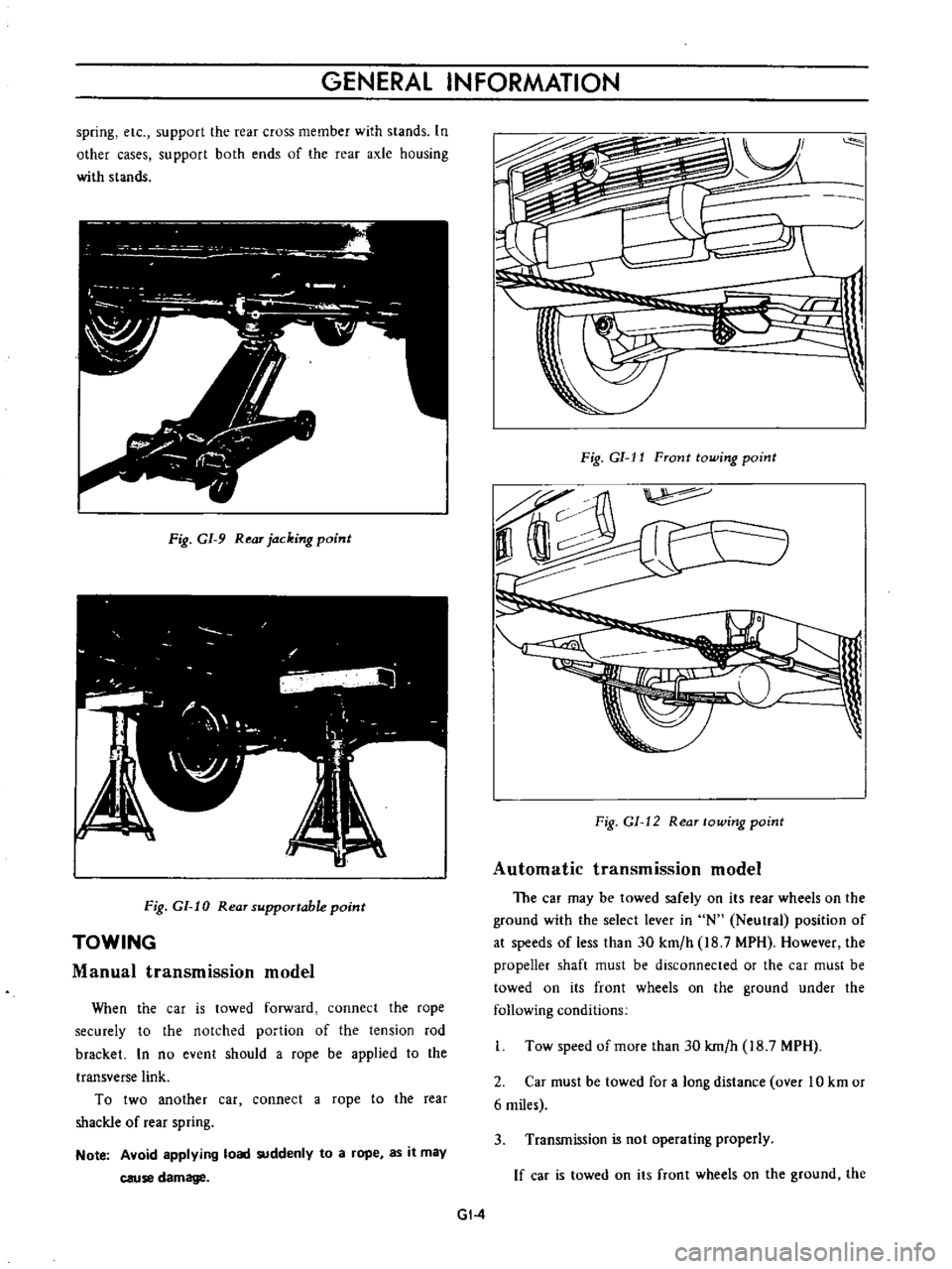
TOWING
Manual
transmission
model
When
the
car
is
towed
forward
connect
the
rope
securely
to
the
notched
portion
of
the
tension
rod
bracket
In
no
event
should
a
rope
be
applied
to
the
transverse
link
To
two
another
car
connect
a
rope
to
the
rear
shackle
of
rear
spring
Note
Avoid
applying
load
suddenly
to
a
rope
as
it
may
cause
damage
Fig
GI
l1
Front
towing
point
Fig
GI
12
Rear
towing
point
Automatic
transmission
model
The
car
may
be
towed
safely
on
its
rear
wheels
on
the
ground
with
the
select
lever
in
N
Neutral
position
of
at
speeds
of
less
than
30
km
h
18
7
MPH
However
the
propeller
shaft
must
be
disconnected
or
the
car
must
be
towed
on
its
front
wheels
on
the
ground
under
the
following
conditions
Tow
speed
of
more
than
30
kro
h
18
7
MPH
2
Car
must
be
towed
for
a
long
distance
over
10
km
or
6
miles
3
Transmission
is
not
operating
properly
If
car
is
towed
on
its
front
wheels
on
the
ground
the
GI
4
Page 301 of 513
GENERAL
INFORMATION
steering
wheel
should
be
secured
to
maintain
a
straight
ahead
position
TIE
DOWN
The
front
tie
down
hook
is
used
the
both
front
end
of
tension
rod
Do
not
apply
the
hook
at
the
center
of
tension
rod
or
suspension
member
The
rear
tie
down
hook
is
used
the
both
front
shackle
of
rear
spring
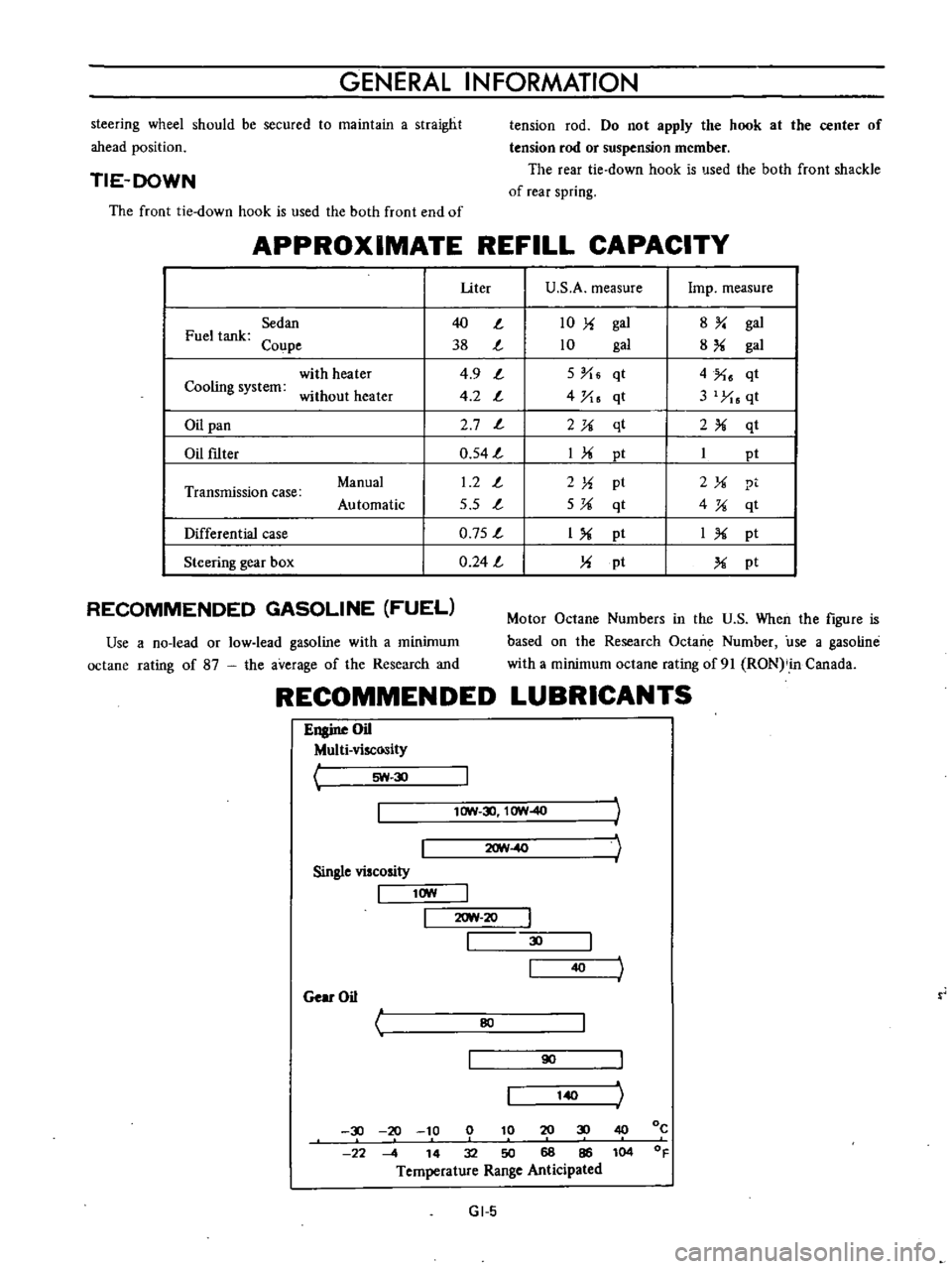
APPROXIMATE
REFILL
CAPACITY
Liter
U
S
A
measure
I
Imp
measure
Sedan
Fuel
tank
Coupe
with
heater
Cooling
system
without
heater
40
L
38
L
4
9
L
4
2
L
2
7
L
0
54
L
1
2
L
5
5
L
0
75
L
0
24
L
Oil
pan
Oilf1lter
Transmission
case
Manual
Automatic
Differential
case
Steering
gear
box
RECOMMENDED
GASOLINE
FUEL
Use
a
no
lead
or
low
lead
gasoline
with
a
minimum
octane
rating
of
87
the
average
of
the
Research
and
1O
gal
8Y
gal
10
gal
8
gal
5
v
qt
4
M
qt
4
Y
6
qt
3
Y
qt
2Ji
qt
2
qt
1
pt
I
pt
2
pt
2
pt
5Ji
qt
4
qt
1
pt
1
pt
pt
pi
Motor
Octane
Numbers
in
the
U
S
When
the
figure
is
based
on
the
Research
Octane
Number
use
a
gasoline
with
a
minimum
octane
rating
of
91
RON
in
Canada
RECOMMENDED
LUBRICANTS
GI
5
r
Page 313 of 513
ENGINE
Adjusting
carburetor
idle
rpm
mixture
ratio
Idle
mixture
adjustment
requires
the
use
of
a
CO
meter
When
preparing
to
adjust
idle
mixture
it
is
essential
to
have
the
meter
thoroughly
warmed
and
calibrated
Warm
up
the
engine
sufficiently
2
Continue
engine
operation
for
one
minute
under
idling
speed
3
Adjust
throttle
adjusting
screw
so
that
engine
speed
is
800
rpm
in
NO
position
for
automatic
transmission
4
Check
ignition
timing
if
necessary
adjust
it
to
the
specifications
Ignition
timing
SO
800
rpm
S
Adjust
idle
adjusting
screw
so
that
CO
percentage
is
1
5
t
O
S
6
Repeat
the
adjustments
as
described
in
steps
3
and
S
above
so
that
CO
percentage
is
I
i
t
O
S
at
800
rpm
Cautions
a
On
automatic
transmission
equipped
model
check
must
be
done
in
the
0
position
Be
sure
to
apply
parking
brake
and
to
lock
both
front
and
rear
wheels
with
wheel
chocks
b
Hold
brake
pedal
while
stepping
down
on
accelerator
pedal
Otherwise
car
will
rush
out
dangerously
7
On
automatic
transmission
equipped
model
make
sure
that
the
adjustment
has
been
made
with
the
selector
lever
in
N
position
And
then
check
the
specifications
with
the
lever
in
D
position
Insure
that
CO
percent
and
idle
speed
are
as
follows
Idle
rpm
CO
percentage
with
lever
in
D
position
6S0
I
S
t
O
S
If
necessary
adjust
by
progressively
turning
throttle
adjusting
screw
and
idle
adjusting
screw
until
correct
adjustments
are
made
Notes
a
Do
not
attempt
to
screw
down
the
idle
adjusting
screw
completely
to
avoid
damage
to
the
tip
which
will
tend
to
cause
malfunctions
b
After
idle
adjustment
has
been
made
shift
the
lever
to
N
or
p
position
for
automatic
transmission
c
Remove
wheel
chocks
before
starting
the
car
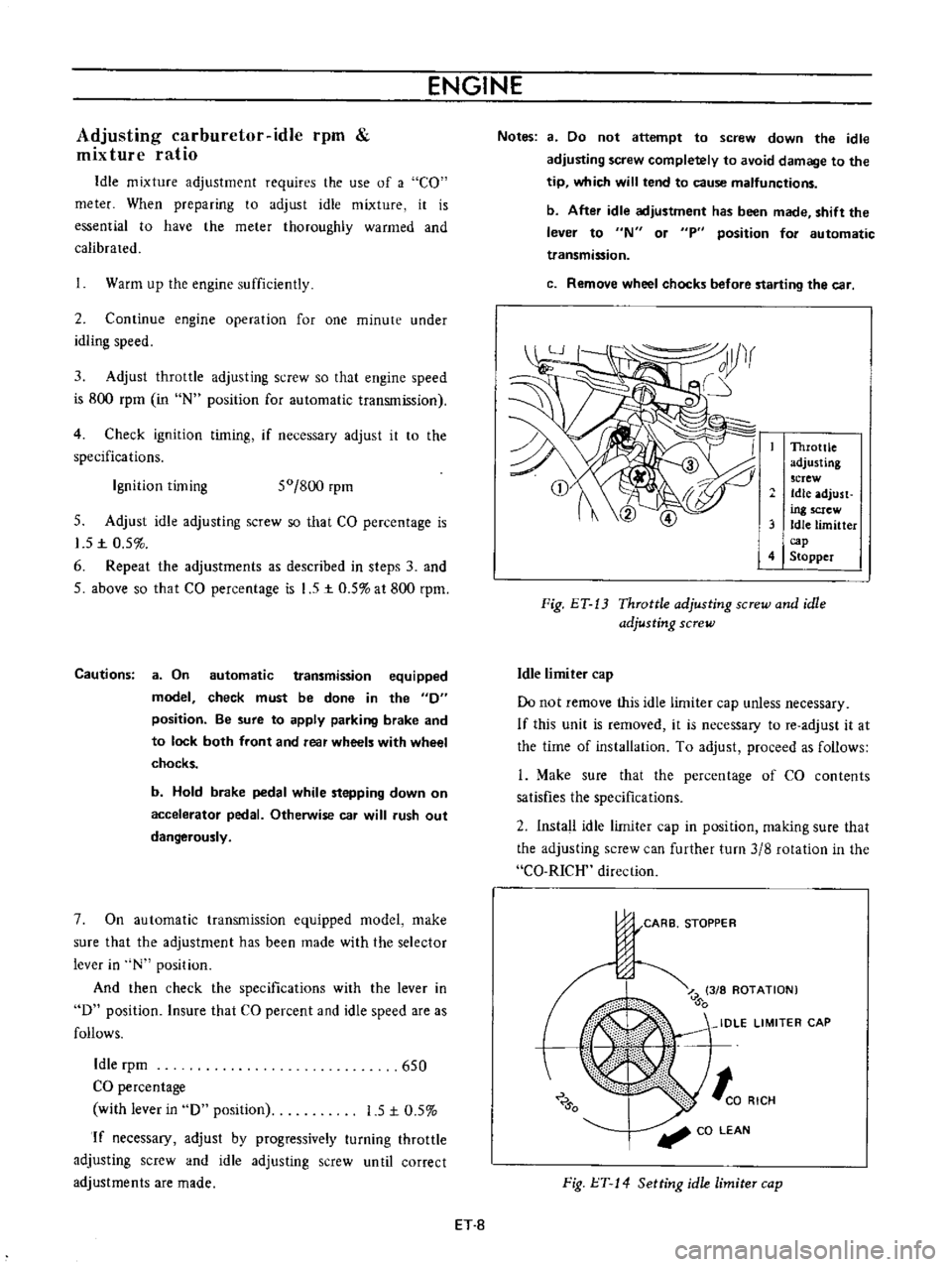
Throttle
adjusting
screw
Idle
adjust
ing
screw
3
Idle
limitter
cap
4
Stopper
Fig
ET
13
Throttle
adjusting
screw
and
idle
adjusting
screw
Idle
limiter
cap
Do
not
remove
this
idle
limiter
cap
unless
necessary
If
this
unit
is
removed
it
is
necessary
to
re
adjust
it
at
the
time
of
installation
To
adjust
proceed
as
follows
L
Make
sure
that
the
percentage
of
CO
contents
satisfies
the
specifications
2
Install
idle
limiter
cap
in
position
making
sure
that
the
adjusting
screw
can
further
turn
3
8
rotation
in
the
CO
RICH
direction
CARB
STOPPER
J
Z
3
8
ROTATION
0
IDLE
LIMITER
CAP
0
to
RICH
CO
LEAN
Fig
l
T
14
Setting
idle
limiter
cap
ET
8
Page 325 of 513
ENGINE
Caution
lock
the
front
and
rear
wheels
by
fully
pulling
the
parking
brake
lever
before
con
ducting
this
test
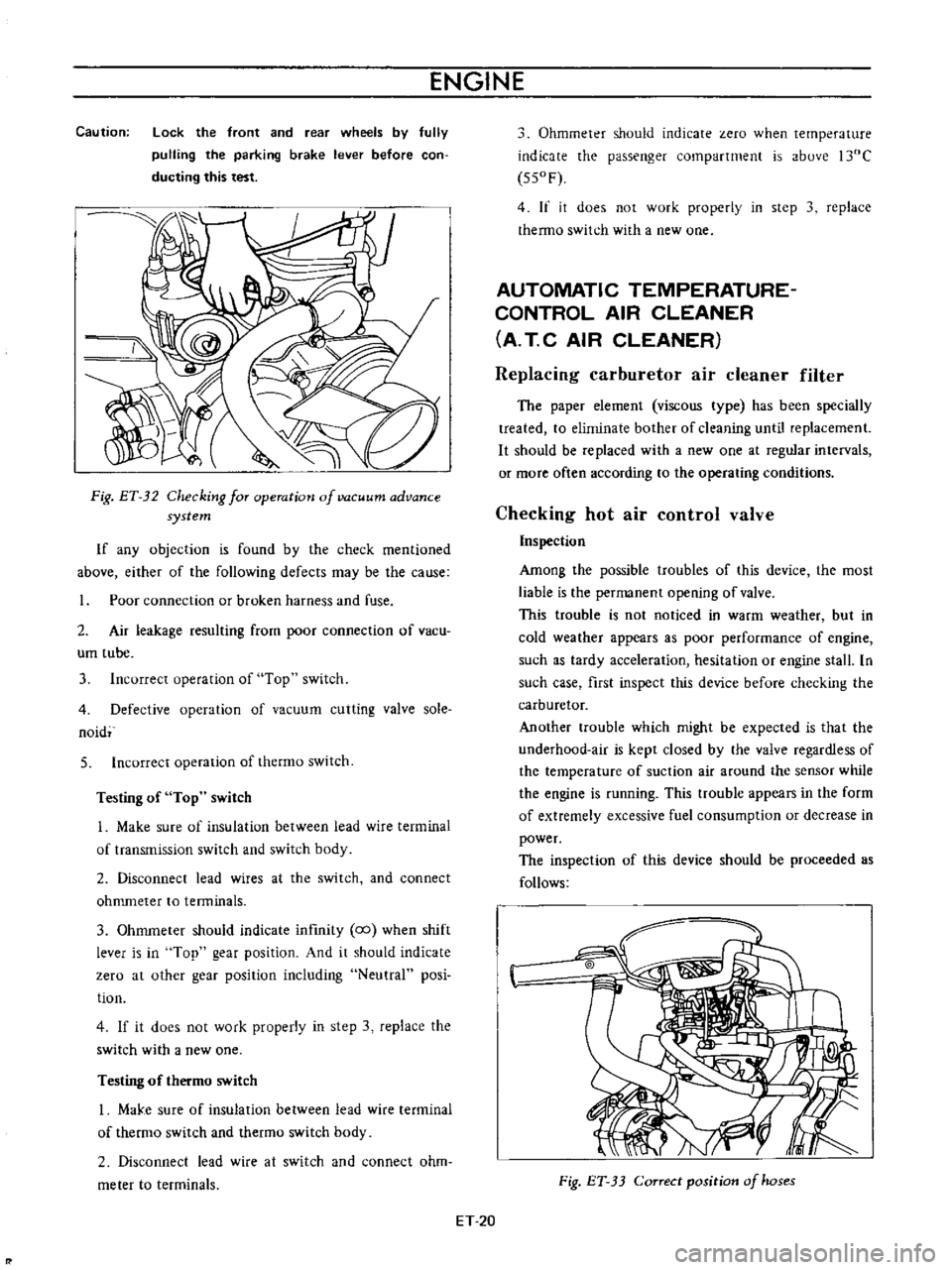
Fig
ET
32
Checking
for
operation
of
vacuum
advance
system
If
any
objection
is
found
by
the
check
mentioned
above
either
of
the
following
defects
may
be
the
cause
Poor
connection
or
broken
harness
and
fuse
2
Air
leakage
resulting
from
poor
connection
of
vacu
um
tube
3
Incorrect
operation
of
Top
switch
4
Defective
operation
of
vacuum
cutting
valve
sole
naid
5
Incorrect
operation
of
thermo
switch
Testing
of
Top
switch
1
Make
sure
of
insulation
between
lead
wire
terminal
of
transmission
switch
and
switch
body
2
Disconnect
lead
wires
at
the
switch
and
connect
ohmmeter
to
tenninals
3
Ohmmeter
should
indicate
infmity
co
when
shift
lever
is
in
Top
gear
position
And
it
should
indicate
zero
at
other
gear
position
including
Neutral
posi
tion
4
If
it
does
not
work
properly
in
step
3
replace
the
switch
with
a
new
one
Testing
of
thermo
switch
I
MaJ
e
sure
of
insulation
between
lead
wire
terminal
of
thermo
switch
and
thetmo
switch
body
2
Disconnect
lead
wire
at
switch
and
connect
ohm
meter
to
terminals
Ohmmeter
should
indicate
zero
when
temperature
indicate
the
passenger
compartment
is
above
l30C
550F
4
If
it
does
not
work
properly
in
step
3
replace
thermo
switch
with
a
new
one
AUTOMATIC
TEMPERATURE
CONTROL
AIR
CLEANER
A
T
C
AIR
CLEANER
Replacing
carburetor
air
cleaner
filter
The
paper
element
viscous
type
has
been
specially
treated
to
eliminate
bother
of
cleaning
until
replacement
It
should
be
replaced
with
a
new
one
at
regular
intervals
or
more
often
according
to
the
operating
conditions
Checking
hot
air
control
valve
Inspection
Among
the
possible
troubles
of
this
device
the
most
liable
is
the
permanent
opening
of
valve
This
trouble
is
not
noticed
in
warm
weather
but
in
cold
weather
appears
as
poor
performance
of
engine
such
as
tardy
acceleration
hesitation
or
engine
stall
In
such
case
first
inspect
this
device
before
checking
the
carburetor
Another
trouble
which
might
be
expected
is
that
the
underhood
air
is
kept
closed
by
the
valve
regardless
of
the
temperature
of
suction
air
around
the
sensor
while
the
engine
is
running
This
ttOuble
appears
in
the
form
of
extremely
excessive
fuel
consumption
or
decrease
in
power
The
inspection
of
this
device
should
be
proceeded
as
follows
Fig
ET
33
Correct
position
of
hoses
ET
20
Page 347 of 513
ENGINE
MECHANICAL
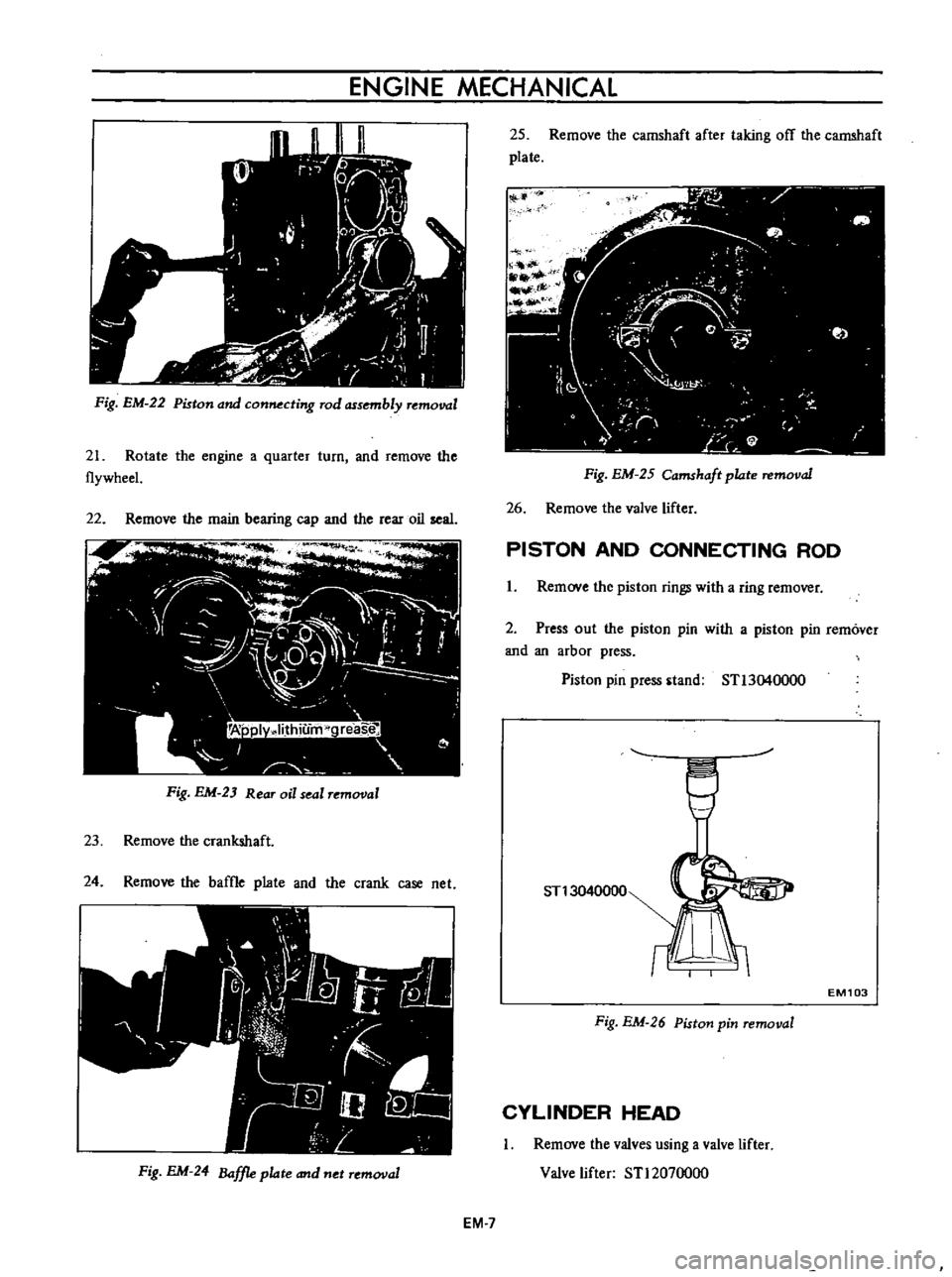
Fig
EM
22
Piston
and
conMcting
rod
assembly
removal
21
Rotate
the
engine
a
quarter
turn
and
remove
the
flywheeL
22
Remove
the
main
bearing
cap
and
the
rear
oil
seal
Fig
EM
2J
Rear
oil
seal
removal
23
Remove
the
crankshaft
24
Remove
the
baffie
plate
and
the
crank
case
net
Fig
EM
24
Baffle
plate
and
net
removal
25
Remove
the
camshaft
after
taking
ofT
the
camshaft
plate
Fig
EM
25
Camshaft
plate
removal
26
Remove
the
valve
lifter
PISTON
AND
CONNECTING
ROD
1
Remove
the
piston
rings
with
a
ring
remover
2
Press
out
the
piston
pin
with
a
piston
pin
remover
and
an
arbor
press
Piston
pin
press
oland
STl3040000
ST13040000
EM103
Fig
EM
26
Piston
pin
removal
CYLINDER
HEAD
Remove
the
valves
using
a
valve
lifter
Valve
lifter
STl2070000
EM
Page 348 of 513
ENGINE
J
I
r
I
I
J
fj
7
L
j
8
if
d1
I
ilfi
3
c
7
I
t
j
v
1
Ji
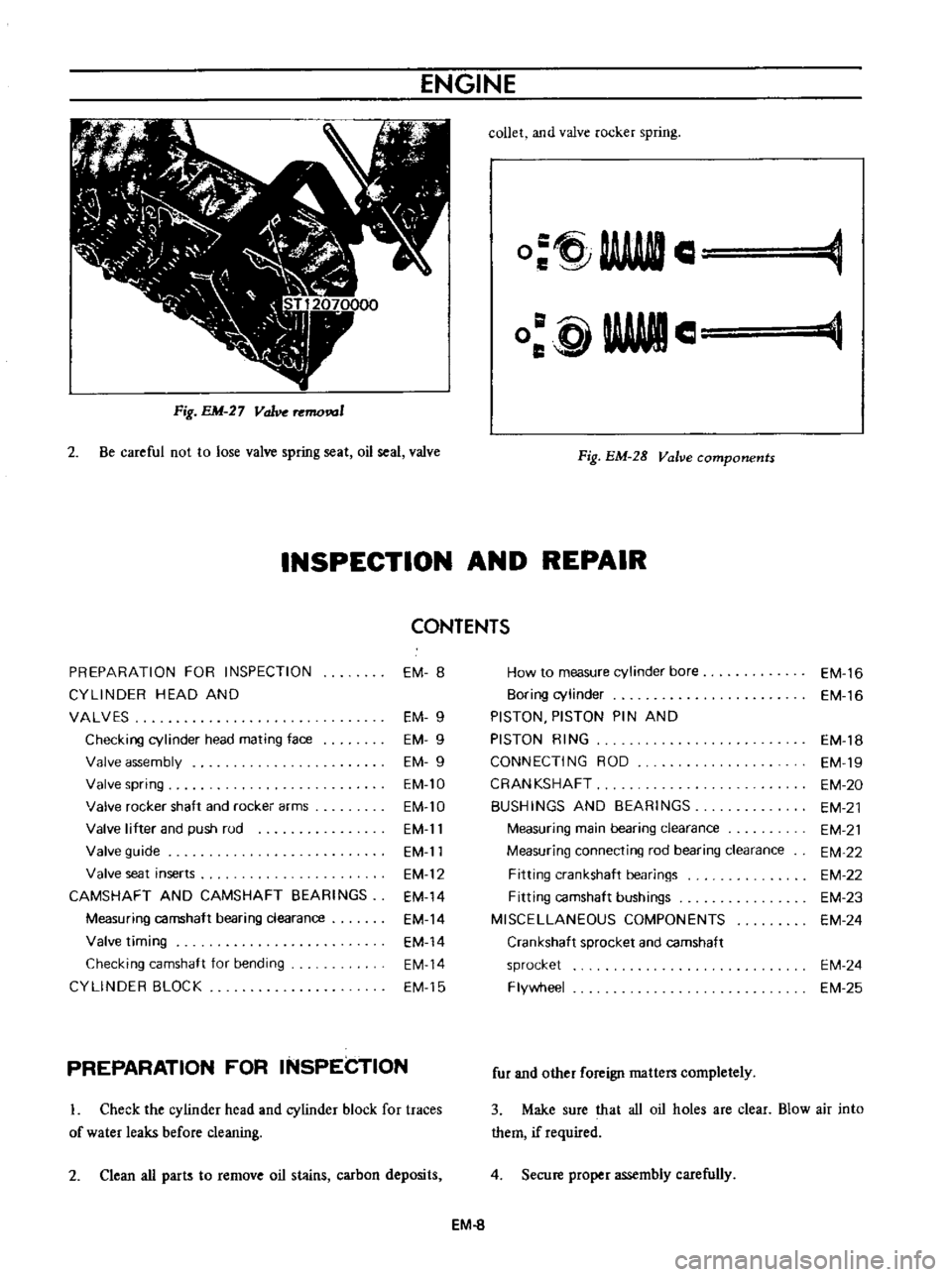
Fig
EM
27
Valve
mo
1
2
Be
careful
not
to
lose
valve
spring
seat
oil
seal
valve
collet
and
valve
rocker
spring
O
tj
AAAftIl
C
e
WWII
o
glAWle
Fig
EM
28
Valve
components
INSPECTION
AND
REPAIR
CONTENTS
PREPARATION
FOR
INSPECTION
EM
8
How
to
measure
cylinder
bore
EM
16
CYLlNOER
HEAD
AND
80ring
cylinder
EM
16
VALVES
EM
9
PISTON
PISTON
PIN
AND
Checking
cylinder
head
mating
face
EM
9
PISTON
RING
EM
18
Valve
assembly
EM
9
CONNECTING
ROD
EM
19
Valve
spring
EM
10
CRANKSHAFT
EM
20
Valve
rocker
shaft
and
rockei
arms
EM
lO
BUSHINGS
AND
BEARINGS
EM
21
Valve
lifter
and
push
rud
EM
11
Measuring
main
bearing
clearance
EM
21
Valve
guide
EM
11
Measuring
connecting
rod
bearing
clearance
EM
22
Valve
seat
inserts
EM
12
Fitting
crankshaft
bearings
EM
22
CAMSHAFT
AND
CAMSHAFT
BEARINGS
EM
14
Fitting
camshaft
bushings
EM
23
Measuring
camshaft
bearing
clearance
EM
14
MISCELLANEOUS
COMPONENTS
EM
24
Valve
timing
EM
14
Crankshaft
sprocket
and
camshaft
Checking
camshaft
for
bending
EM
14
sprocket
EM
24
CYLlNOER
BLOCK
EM
15
Flywheel
EM
25
PREPARATION
FOR
INSPECTION
L
Check
the
cylinder
head
and
cylinder
block
for
traces
of
water
leaks
before
cleaning
2
Clean
all
parts
to
remove
oil
stains
carbon
deposits
fur
and
other
foreign
matters
completely
3
Make
sure
that
all
oil
holes
are
clear
Blow
air
into
them
if
required
4
Secure
proper
assembly
carefully
EM
8
Page 365 of 513
ENGINE
MECHANICAL
Standard
mm
in
Camshaft
sprocket
run
out
Thrust
deviation
O
OIS
0
0006
Locating
plate
thrust
clearance
0
02
to
0
08
0
0008
to
0
003
Wear
limit
mm
in
less
than
0
0
0039
O
OS
0
0020
0
1
0
0039
3
Check
the
chain
for
damage
excessive
wear
and
stretch
at
its
roller
links
Replace
chain
if
defective
Flyw
heel
I
Check
the
clutch
disc
contact
surface
of
the
flywheel
for
damage
and
wear
Repair
or
replace
if
necessary
2
Measure
deviation
of
the
clutch
disc
contact
surface
with
a
dial
gauge
If
it
exceeds
0
2
mm
0
0079
in
replace
it
3
Check
tooth
surfaces
of
the
ring
gear
for
flaw
and
wear
Replace
if
necessary
Note
Replace
the
ring
gear
at
about
180
to
2000C
356
to
3920
Fl
ENGINE
ASSEMBLY
PRECAUTION
CYLINDER
HEAD
PRECAUTION
CONTENTS
EM
25
EM
25
Use
thoroughly
cleaned
parts
Particularly
make
sure
that
oil
holes
are
clear
of
foreign
matter
2
When
installing
sliding
parts
such
as
bearings
be
sure
to
apply
engine
oil
to
them
3
Use
new
packings
and
oil
seals
4
Keep
tools
and
work
benches
clean
S
Keep
the
necessary
parts
and
tools
near
at
hand
6
Be
sure
to
follow
specified
tightening
torque
and
orders
CYLINDER
HEAD
Assembly
of
valve
and
valve
spring
Set
the
valve
spring
seat
in
position
and
fit
the
valve
guide
with
the
oil
lip
seal
Assemble
the
parts
in
order
valve
spring
spring
retainer
valve
collet
and
valve
rocker
guide
PISTON
AND
CONNECTING
ROO
ASSEMBLING
ENGINE
EM
25
EM
26
I
I
11
00
I
I
I
t
I
J
ftr
J
J
1
l
J
r
N
1
n
r
VI
I
I
C
I
L
I
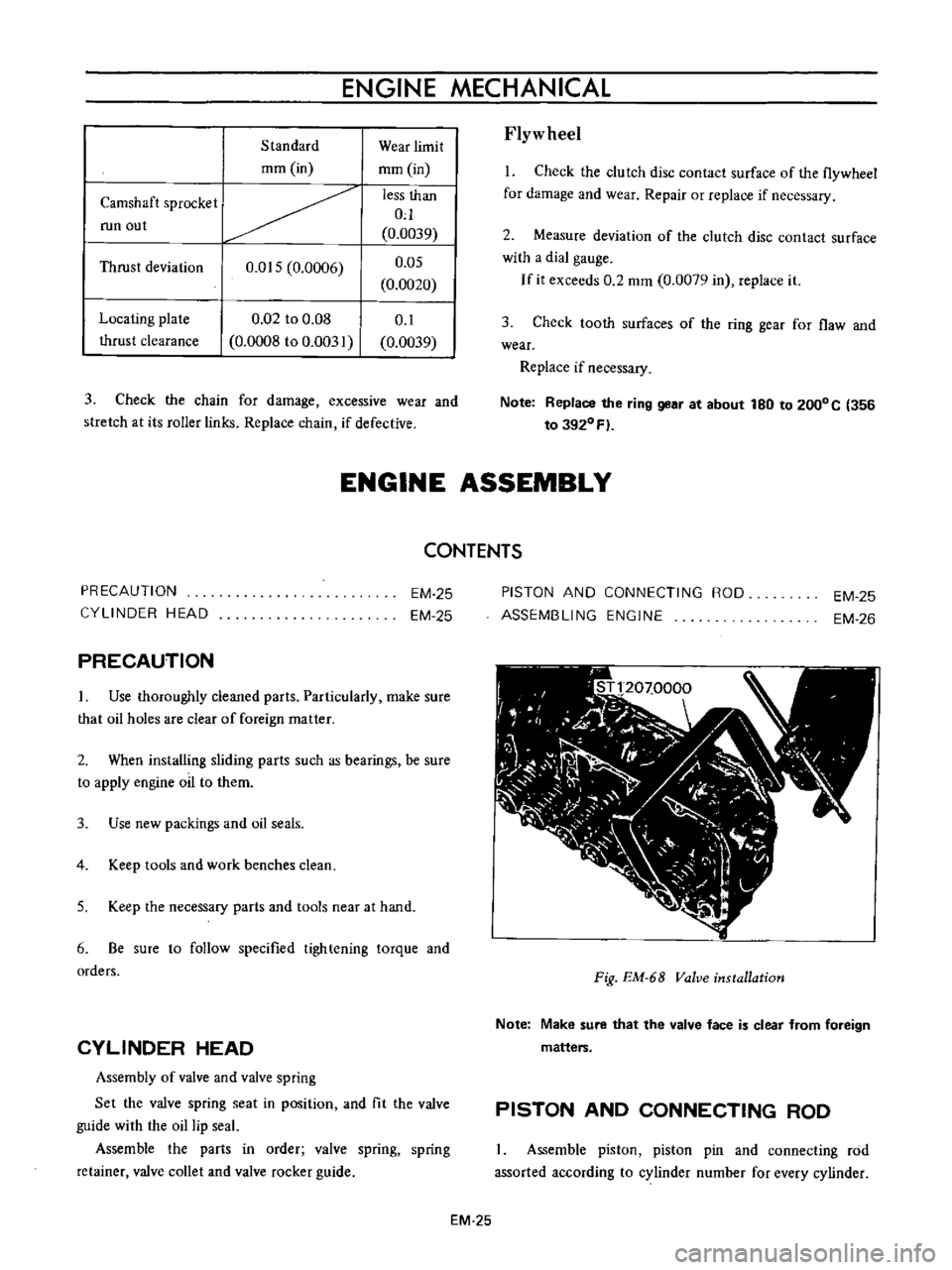
Fig
EM
68
Valve
installation
Note
Make
sure
that
the
valve
face
is
clear
from
foreign
matters
PISTON
AND
CONNECTING
ROD
Assemble
piston
piston
pin
and
connecting
rod
assorted
according
to
cylinder
number
for
every
cylinder
EM
25
Page 367 of 513
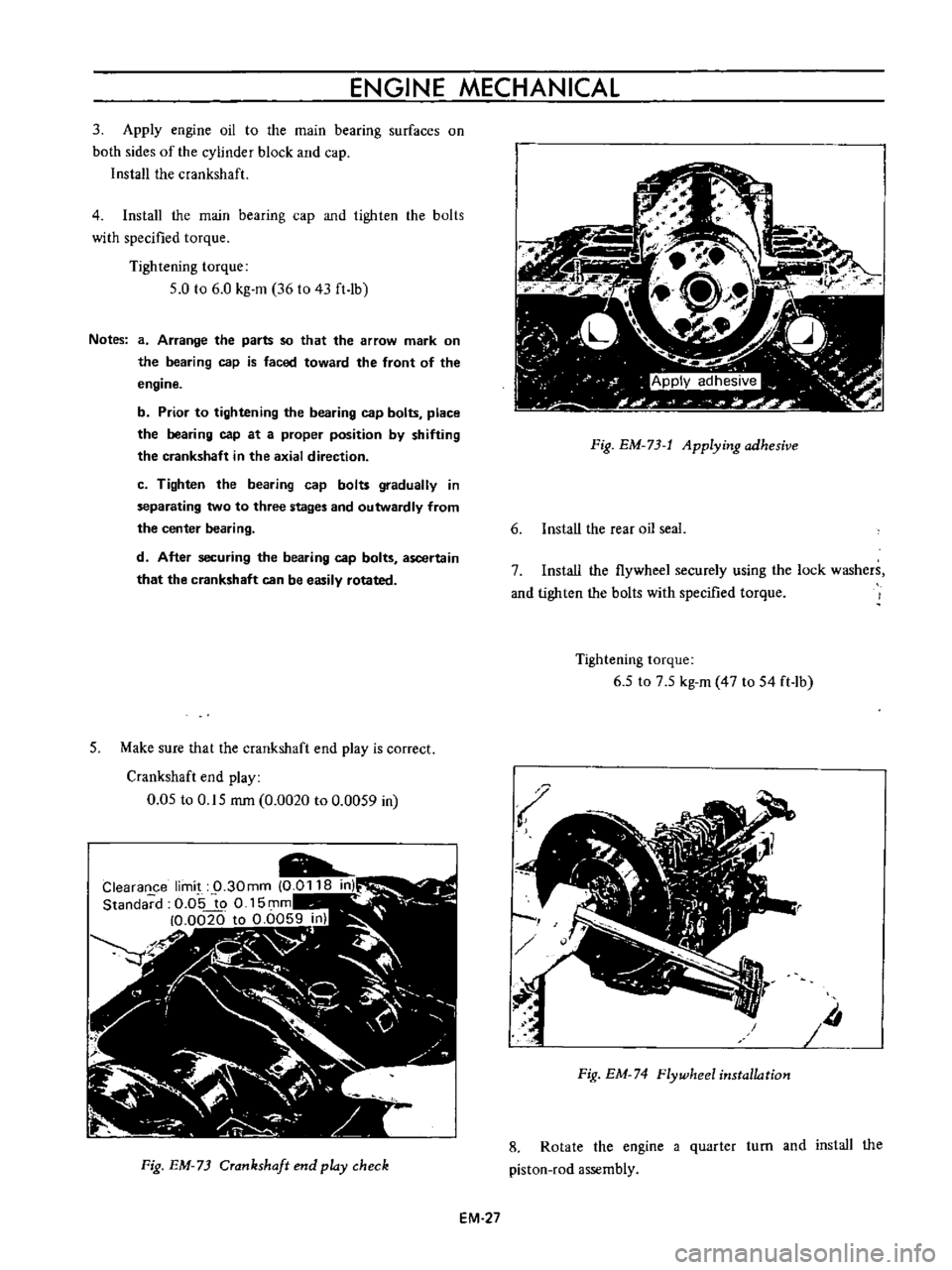
ENGINE
MECHANICAL
3
Apply
engine
oil
to
the
main
bearing
surfaces
on
both
sides
of
the
cylinder
block
and
cap
Install
the
crankshaft
4
Install
the
main
bearing
cap
and
tighten
the
bolts
with
specified
torque
Tightening
torque
5
0
to
6
0
kg
m
36
to
43
ft
lb
Notes
a
Arrange
the
parts
so
that
the
arrow
mark
on
the
bearing
cap
is
faced
toward
the
front
of
the
engine
b
Prior
to
tightening
the
bearing
cap
bolts
place
the
bearing
cap
at
a
proper
position
by
shifting
the
crankshaft
in
the
axial
direction
c
Tighten
the
bearing
cap
bolts
gradually
in
separating
two
to
three
stages
and
outwardly
from
the
center
beari
ng
d
After
securing
the
bearing
cap
bolts
ascertain
that
the
crankshaft
can
be
easily
rotated
5
Make
sure
that
the
crankshaft
end
play
is
correct
Crankshaft
end
play
0
05
to
0
15
rom
0
0020
to
0
0059
in
Fig
EM
73
Crankshaft
end
play
check
EM
27
Fig
EM
73
t
Applying
adhesive
6
Install
the
rear
oil
seal
7
Install
the
flywheel
securely
using
the
lock
washers
and
tighten
the
bolts
with
specified
torque
Tightening
torque
6
5
to
7
5
kg
m
47
to
54
ft
lb
Iii
Fig
EM
74
Flywheel
installation
8
Rotate
the
engine
a
quarter
turn
and
install
the
piston
rod
assembly
Page 373 of 513
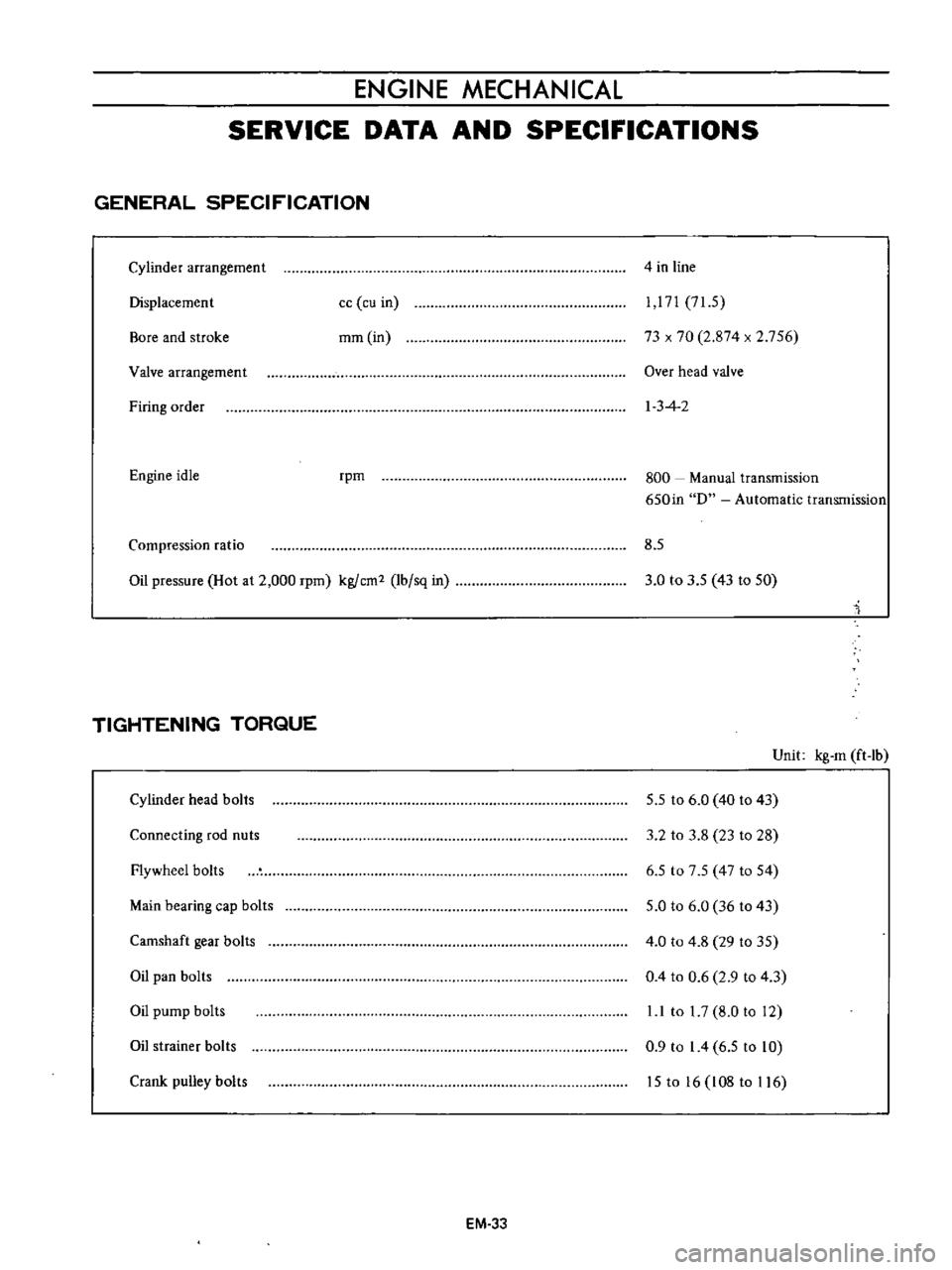
ENGINE
MECHANICAL
SERVICE
DATA
AND
SPECIFICATIONS
GENERAL
SPECIFICATION
Cylinder
arrangement
4
in
line
Displacement
cc
cu
in
mm
in
1
171
71
5
73
x
70
2
874
x
2
756
Bore
and
stroke
Valve
arrangemen
t
Over
head
valve
Firing
order
I
3
4
2
Engine
idle
rpm
800
Manual
transmission
650in
D
Automatic
transmission
Compression
ratio
8
5
Oil
pressure
Hot
at
2
000
rpm
kgfcm2
Ibfsq
in
3
0
to
3
5
43
to
50
TIGHTENING
TORQUE
Unit
kg
m
ft
lb
Cylinder
head
bolts
Flywheel
bolts
5
5
to
6
0
40
to
43
3
2
to
3
8
23
to
28
6
5
to
7
5
47
to
54
5
0
to
6
0
36
to
43
4
0
to
4
8
29
to
35
0
4
to
0
6
2
9
to
4
3
l
l
to
I
7
8
0
to
12
0
9
to
I
4
6
5
to
10
15
to
16
108
to
116
Connecting
rod
nuts
Main
bearing
cap
bolts
Camshaft
gear
bolts
Oil
pan
bolts
Oil
pump
bolts
Oil
strainer
bolts
Crank
pulley
bolts
EM
33