wheel DATSUN B110 1973 Service Manual Online
[x] Cancel search | Manufacturer: DATSUN, Model Year: 1973, Model line: B110, Model: DATSUN B110 1973Pages: 513, PDF Size: 28.74 MB
Page 405 of 513
ENGINE
AD
JUSTMENT
Idling
adjustment
Idle
mixture
adjustment
requires
the
use
of
a
CO
meter
When
preparing
to
adjust
idle
mixture
it
is
essential
to
have
the
meter
thoroughly
warmed
and
calibrated
Warm
up
the
engine
sufficiently
2
Continue
engine
operation
for
one
minute
under
idling
speed
3
Adjust
throttle
adjusting
screw
so
that
engine
speed
is
800
rpm
in
N
position
for
automatic
transmission
4
Check
ignition
timing
if
necessary
adjust
it
to
the
specifications
Ignition
timing
50
800
rpm
5
Adjust
idle
adjusting
screw
so
that
ca
percentage
is
1
5
t
0
5
6
Repeat
the
adjustments
as
described
in
steps
3
and
5
above
so
that
ca
percentage
is
1
5
to
5
at
800
rpm
Cautions
a
On
automatic
transmission
equipped
model
check
must
be
done
in
the
0
position
Be
sure
to
apply
parking
brake
and
to
lock
both
front
and
rear
wheels
with
wheel
chocks
b
Hold
brake
pedal
while
stepping
down
on
accelerator
pedal
Otherwise
car
will
rush
out
dangerously
7
On
automatic
transmission
equipped
model
make
sure
that
the
adjustment
has
been
made
with
the
selector
lever
in
N
position
And
then
check
the
specifications
with
the
lever
in
D
position
Insure
that
CO
percent
and
idle
speed
are
as
follows
Idle
rpm
650
ca
percentage
with
lever
in
D
position
15
to
5
If
necessary
adjust
by
progressively
turning
throttle
adjusting
screw
and
idle
adjusting
screw
until
correct
adjustments
are
made
Notes
a
Do
not
attempt
to
screw
down
the
id
Ie
adjusting
screw
completely
to
avoid
damage
to
the
EF
14
tip
which
will
tend
to
cause
malfunctions
b
After
idle
adjustment
has
been
made
shift
the
lever
to
N
or
p
position
for
automatic
transmission
c
Remove
wheel
chocks
before
starting
the
car
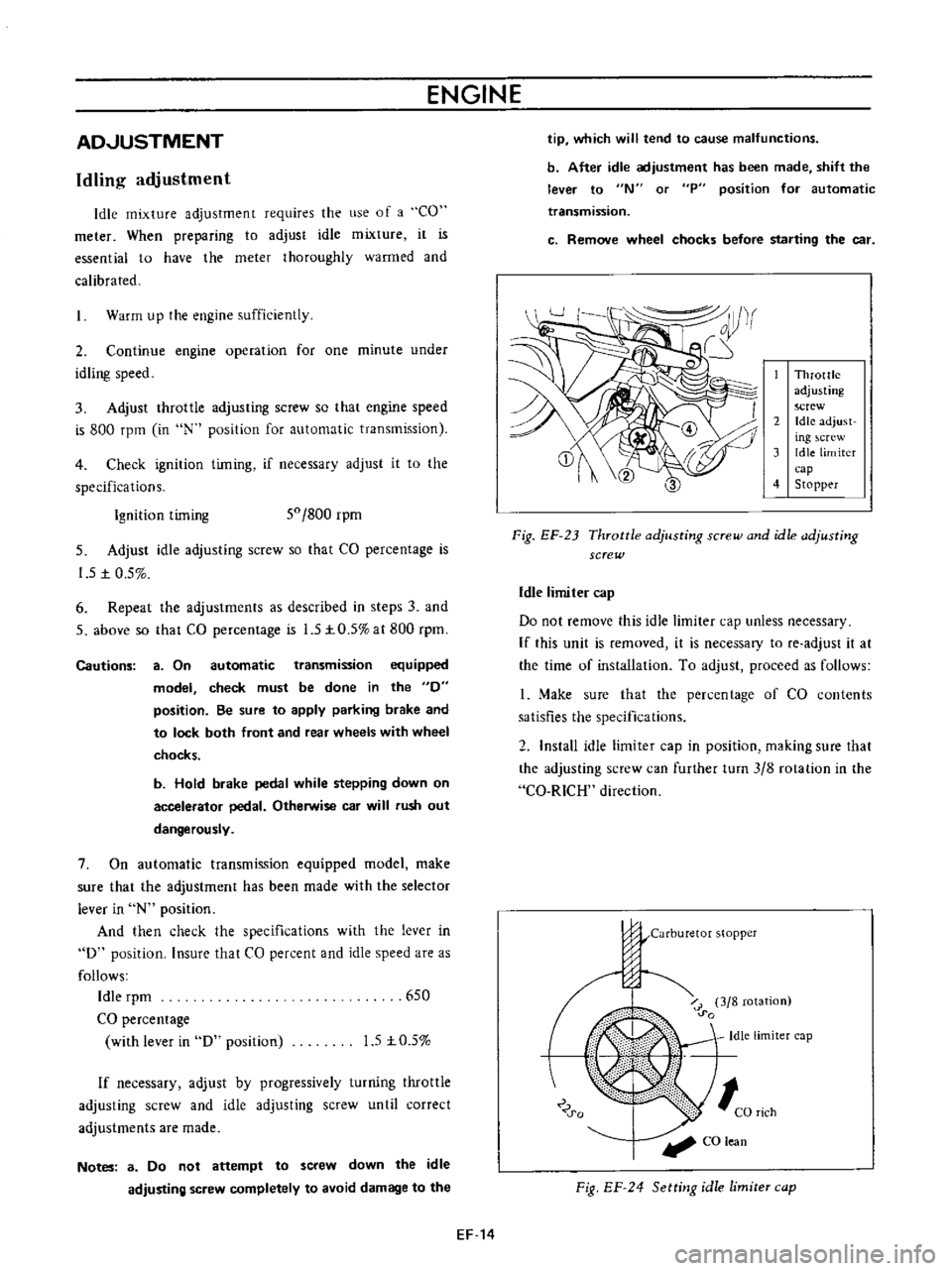
Throttle
adjusting
screw
2
Idle
adjust
ing
crew
3
Idle
limiter
cap
4
Stopp
r
Fig
EF
23
Throttle
adjusting
screw
and
idle
adjusting
screw
Idle
limiter
cap
Do
not
remove
this
idle
limiter
cap
unless
necessary
If
this
unit
is
removed
it
is
necessary
to
fe
adjust
it
at
the
time
of
installation
To
adjust
proceed
as
follows
1
Make
sure
that
the
percentage
of
CO
contents
satisfies
the
specifications
2
Install
idle
limiter
cap
in
position
making
sure
that
the
adjusting
screw
can
further
turn
3
8
rotation
in
the
Ca
RICH
direction
j
j
Carburetor
stopper
o
u
o
i
r
3
8
rotation
0
0
Idle
limiter
cap
0
0
CO
lean
Fig
EF
24
Setting
idle
limite
cap
Page 423 of 513
ENGINE
ElECTRICAL
SYSTEM
5
If
the
specific
gravity
is
above
1
260
200C
or
680F
after
charging
adjust
it
by
adding
distilled
water
6
Keep
any
open
flame
away
from
the
place
where
the
battery
is
being
charged
7
Replace
vent
plugs
and
clean
the
upper
face
of
the
battery
after
charging
BATTERY
FREEZING
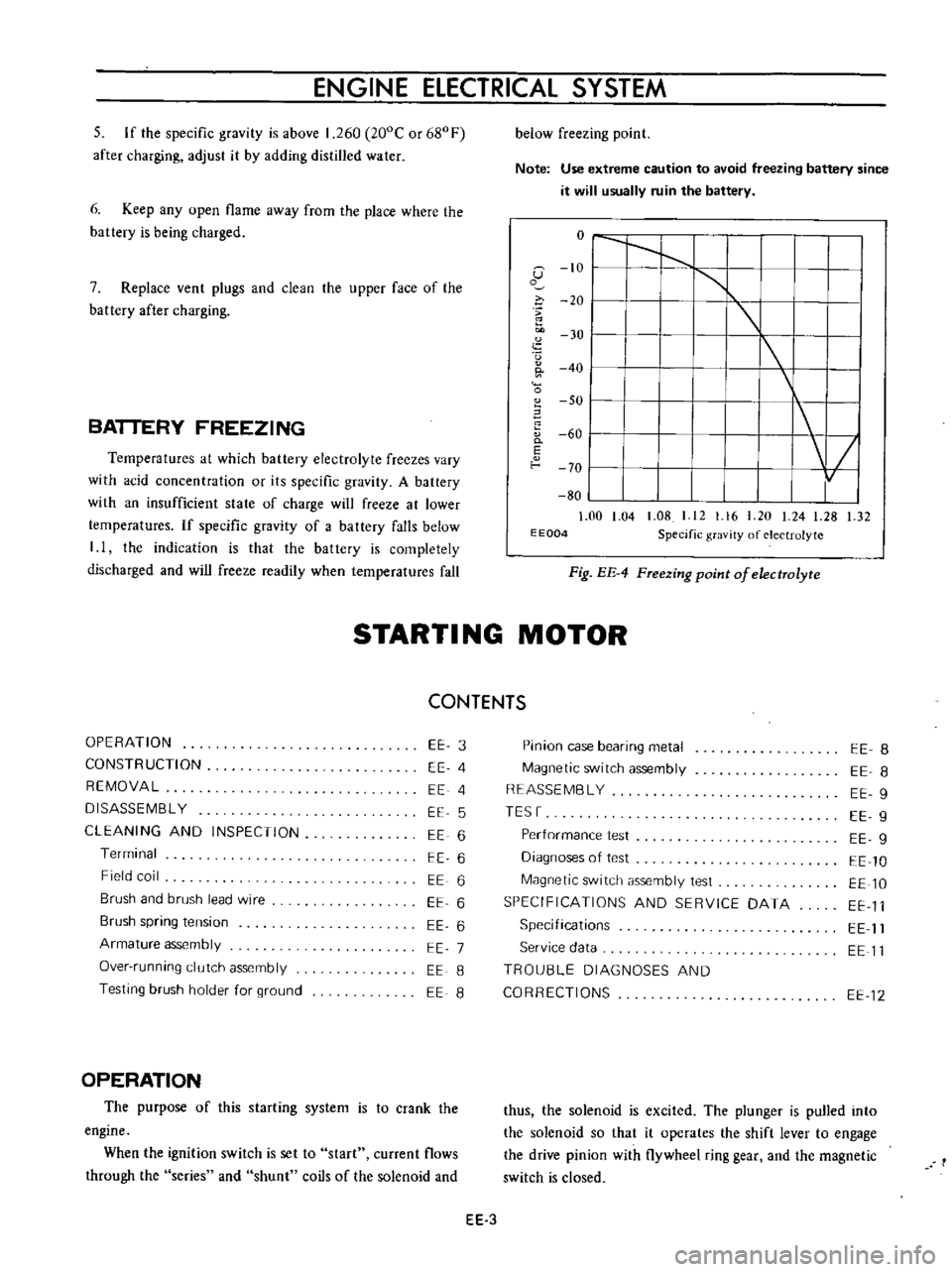
Temperatures
at
which
battery
electrolyte
freezes
vary
with
acid
concentration
or
its
specific
gravity
A
battery
with
an
insufficient
state
of
charge
will
freeze
at
lower
temperatures
If
specific
gravity
of
a
battery
falls
below
I
I
the
indication
is
that
the
battery
is
completely
discharged
and
will
freeze
readily
when
temperatures
fall
below
freezing
point
Note
Use
extreme
caution
to
avoid
freezing
battery
since
it
will
usually
ruin
the
battery
o
I
I
1
G
10
I
1
o
i
20
I
u
30
I
I
0
40
I
0
SO
I
60
0
I
E
f
o
70
I
80
1
00
1
04
1
08
I
12
1
16
20
24
1
28
1
32
E
E004
Specific
gravity
of
electrolyte
Fig
EE
4
FTeezing
point
of
electrolyte
STARTI
NG
MOTOR
CONTENTS
OPERATION
CONSTRUCTION
REMOVAL
DISASSEMBL
Y
CLEANING
AND
INSPECTION
Terminal
Field
coil
Brush
and
brush
lead
wire
Brush
spring
tension
Armature
assembly
Over
running
clutch
assembly
Testing
brush
holder
for
ground
EE
3
EE
4
EE
4
EE
5
EE
6
EE
6
EE
6
EE
6
EE
6
EE
7
EE
8
EE
8
OPERATION
The
purpose
of
this
starting
system
is
to
crank
the
engine
When
the
ignition
switch
is
set
to
start
current
flows
through
the
series
and
shunt
coils
of
the
solenoid
and
Pinion
case
bearing
metal
Magnetic
switch
assembly
REASSEMBL
Y
TESr
Performance
test
Diagnoses
of
test
Magnetic
switch
assembly
test
SPECIFICATIONS
AND
SERVICE
DATA
Specifications
Service
data
TROU8LE
DIAGNOSES
AND
CORRECTIONS
EE
8
EE
8
EE
9
EE
9
EE
g
EE
10
EE
10
EE
11
EE
11
EE
11
EE
12
thus
the
solenoid
is
excited
The
plunger
is
pulled
into
the
solenoid
so
that
it
operates
the
shift
lever
to
engage
the
drive
pinion
with
flywheel
ring
gear
and
the
magnetic
switch
is
closed
EE
3
Page 428 of 513
ENGINE
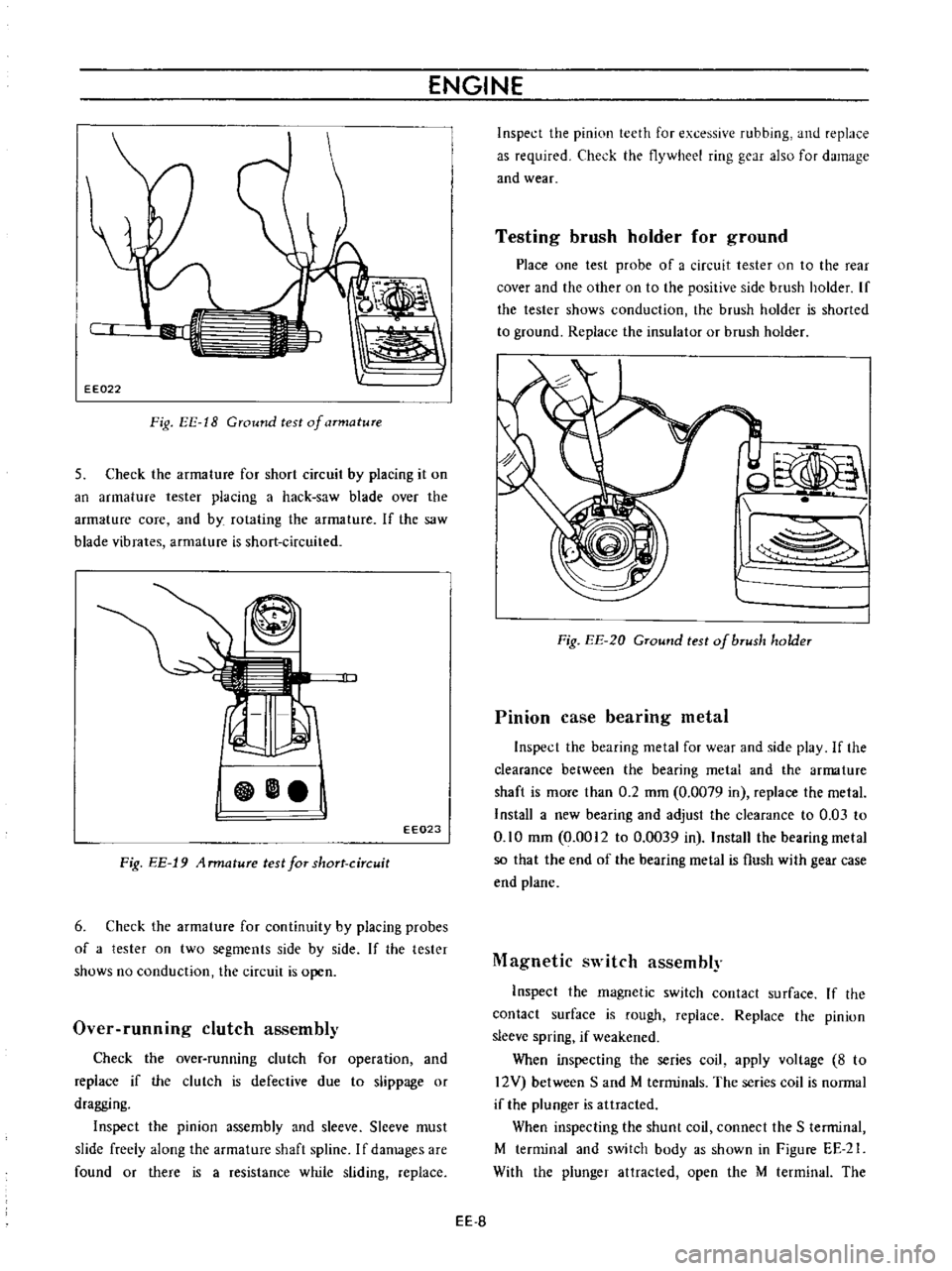
EE022
Fig
EE
18
Ground
test
of
armature
5
Check
the
armature
for
short
circuit
by
placing
it
on
an
armature
tester
placing
a
hack
saw
blade
over
the
armature
core
and
by
rotating
the
armature
If
the
saw
blade
vibrates
armature
is
short
circuited
EE023
Fig
EE
19
4
rmature
test
for
short
circuit
6
Check
the
armature
for
continuity
by
placing
probes
of
a
tester
on
two
segments
side
by
side
If
the
tester
shows
no
conduction
the
circuit
is
open
Over
runnmg
clutch
assembly
Check
the
over
running
clutch
for
operation
and
replace
if
the
clutch
is
defective
due
to
slippage
or
dragging
Inspect
the
pinion
assembly
and
sleeve
Slceve
must
slide
freely
along
the
armature
shaft
spline
I
f
damages
are
found
or
there
is
a
resistance
while
sliding
replace
Inspect
the
pinion
teeth
for
excessive
rubbing
and
replace
as
required
Check
the
flywheel
ring
gear
also
for
damage
and
wear
Testing
brush
holder
for
ground
Place
one
test
probe
of
a
circuit
tester
on
to
the
rear
cover
and
the
other
on
to
the
positive
side
brush
holder
If
the
tester
shows
conduction
the
brush
holdcr
is
shorted
to
ground
Replace
the
insulator
or
brush
holder
od
l
Fig
EE
20
GTound
test
of
bTush
holder
Pinion
case
bearing
metal
Inspect
the
bearing
metal
for
wear
and
sidc
play
If
the
clearance
between
the
bearing
metal
and
the
arma
ture
shaft
is
mOTe
than
0
2
mm
0
0079
in
replace
the
metal
Install
a
new
bearing
and
adjust
the
clearance
to
0
03
to
0
10
mm
0
0012
to
0
0039
in
Install
the
bearing
metal
so
that
the
end
of
the
bearing
metal
is
flush
with
gear
case
end
plane
Magnetic
switch
assembly
Inspect
the
magnetic
switch
contact
surface
If
the
contact
surface
is
rough
replace
Replace
the
pinion
sleeve
spring
if
weakened
When
inspecting
the
series
coil
apply
voltagc
8
to
12V
between
Sand
M
terminals
The
series
coil
is
normal
if
the
plunger
is
attracted
When
inspecting
the
shunt
coil
connect
the
S
terminal
M
terminal
and
switch
body
as
shown
in
Figure
EE
21
With
the
plunger
attracted
open
the
M
terminal
The
EE
S
Page 472 of 513
CHASSIS
REMOVAL
The
clutch
assembly
is
dismounted
primarily
in
the
same
manner
as
the
engine
assembly
Thus
when
dis
mounting
the
clutch
assembly
refer
to
the
Section
TM
Transmission
Removal
and
other
relative
sections
W
II
11
I
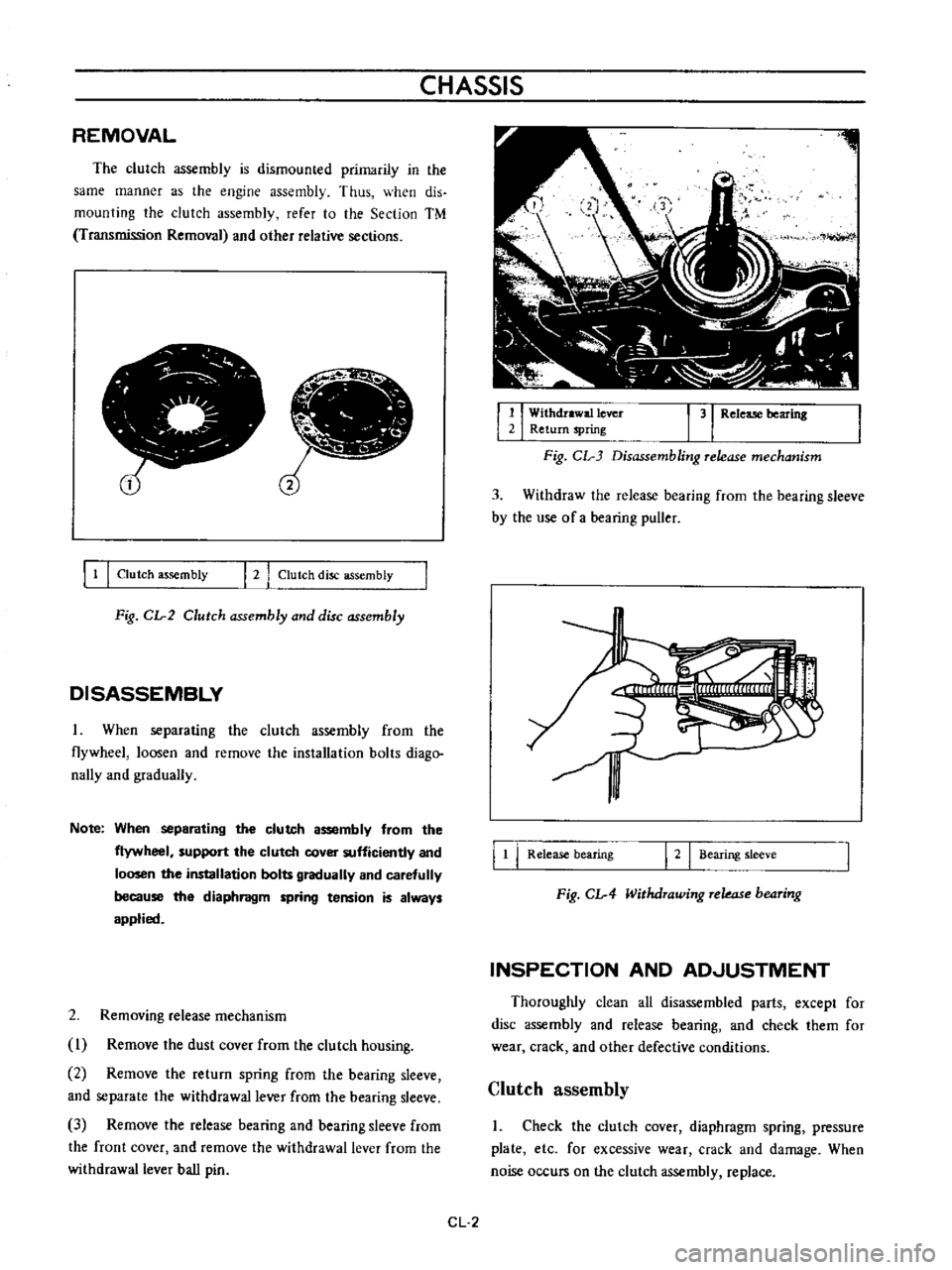
Clutch
assembly
I
2
I
Clutch
disc
assembly
Fig
CIr2
Clutch
assembly
and
disc
assembly
DISASSEMBLY
When
separating
the
clutch
assembly
from
the
flywheel
loosen
and
remove
the
installation
bolts
diago
nally
and
gradually
Note
When
separating
the
clutch
assembly
from
the
flywheel
support
the
clutch
cover
sufficiently
and
loosen
the
installation
bolts
gradually
and
carefully
because
the
diaphragm
spring
tension
is
always
applied
2
Removing
release
mechanism
I
Remove
the
dust
cover
from
the
clutch
housing
2
Remove
the
return
spring
from
the
bearing
sleeve
and
separate
the
withdrawal
lever
from
the
bearing
sleeve
3
Remove
the
release
bearing
and
bearing
sleeve
from
the
front
cover
and
remove
the
withdrawal
lever
from
the
withdrawal
lever
ball
pin
1
I
Withdrawal
lever
3
Release
bearing
2
Return
spring
Fig
CL
3
Disassembling
release
mechanism
3
Withdraw
the
release
bearing
from
the
bearing
sleeve
by
the
use
of
a
bearing
puller
I
t
I
Release
bearing
I
2
I
Bearing
sleeve
Fig
CIr4
Withdrawing
rekas
b04ring
INSPECTION
AND
ADJUSTMENT
Thoroughly
clean
all
disassembled
parts
except
for
disc
assembly
and
release
bearing
and
check
them
for
wear
crack
and
other
defective
conditions
Clutch
assembly
I
Check
the
clutch
cover
diaphragm
spring
pressure
plate
etc
for
excessive
wear
crack
and
damage
When
noise
occurs
on
the
clutch
assembly
replace
CL
2
Page 475 of 513
CLUTCH
J
I
I
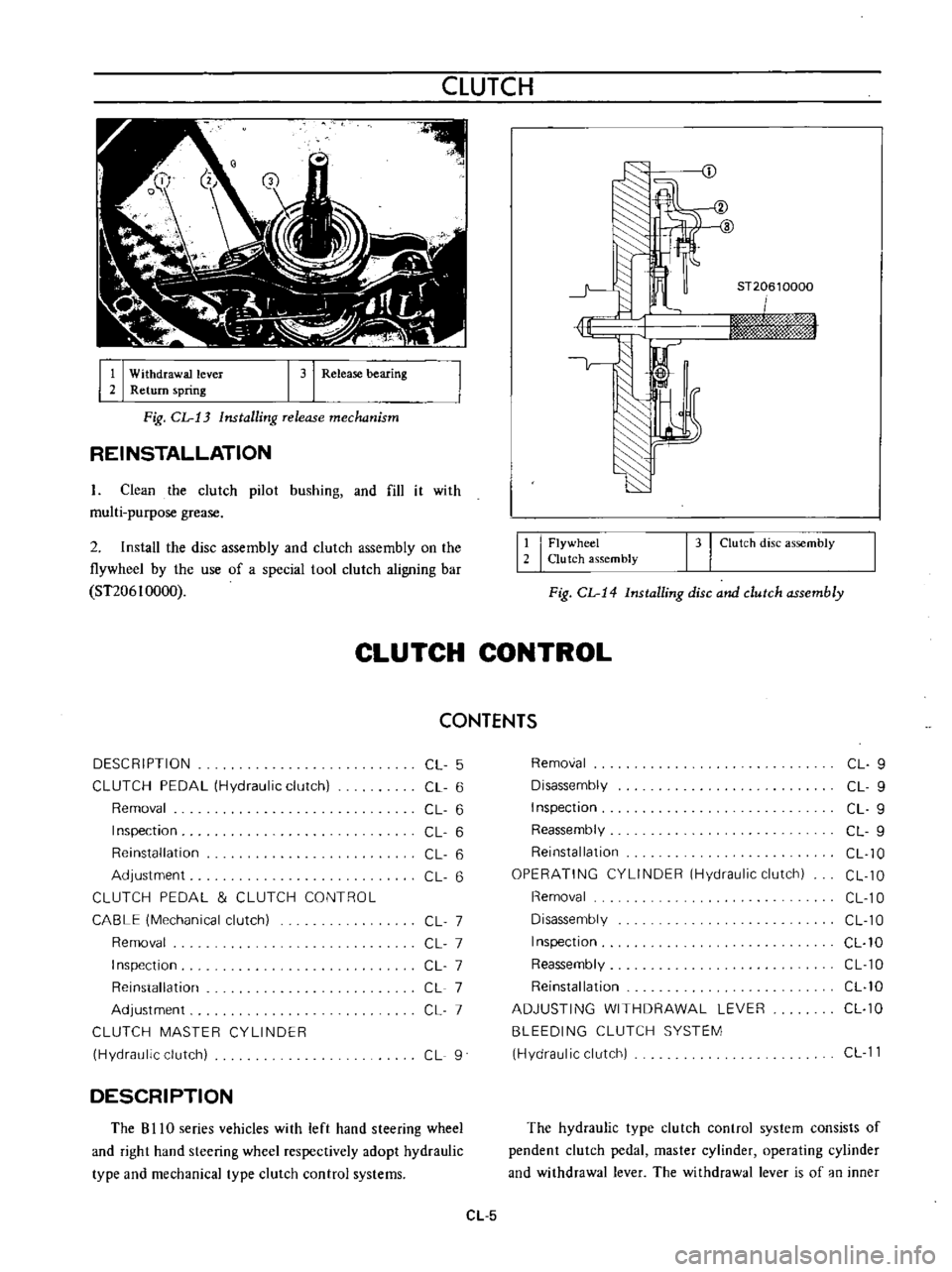
Withdrawal
lever
2
Return
spring
I
31
Release
bearing
ST20610000
iwn
rm
hj
sf
W
Fig
CL
13
Installing
release
mechanism
REINSTALLATION
L
Clean
the
clutch
pilot
bushing
and
fill
it
with
multi
purpose
grease
2
Install
the
disc
assembly
and
clutch
assembly
on
the
flywheel
by
the
use
of
a
special
tool
clutch
aligning
bar
ST206
I
0000
12
I
Flywheel
Clutch
assembly
131
Clutch
disc
assembly
Fig
CL
14
Installing
disc
and
clutch
assembly
CLUTCH
CONTROL
CONTENTS
DESCRIPTION
CL
5
Removal
CL
9
CLUTCH
PEDAL
Hydraulic
clutch
CL
6
Disassembly
CL
9
Removal
CL
6
Inspection
CL
9
Inspection
CL
6
Reassembly
CL
9
Reinstallation
CL
6
Reinstallation
CL
10
Adjustment
CL
6
OPERATING
CYLINDER
Hydraulic
clutch
CL
10
CLUTCH
PEDAL
CLUTCH
CONTROL
Removal
CL
10
CABLE
Mechanical
clutch
CL
7
Disassembly
CL
10
Removal
CL
7
Inspection
CL
10
Inspection
CL
7
Reassembly
CL
10
Reinstallation
CL
7
Reinstallation
CL
10
Adjustment
CL
7
ADJUSTING
WITHDRAWAL
LEVER
CL
10
CLUTCH
MASTER
CYLINDER
BLEEDING
CLUTCH
SYSTEM
Hydraulic
clutch
CL
9
Hydraulic
clutch
CL
11
DESCRIPTION
The
B
I
IO
series
vehicles
with
left
hand
steering
wheel
and
right
hand
steering
wheel
respectively
adopt
hydraulic
type
and
mechanical
type
clutch
control
systems
The
hydraulic
type
clutch
control
system
consists
of
pendent
clutch
pedal
master
cylinder
operating
cylinder
and
withdrawal
lever
The
withdrawal
lever
is
of
an
inner
CL
5
Page 482 of 513
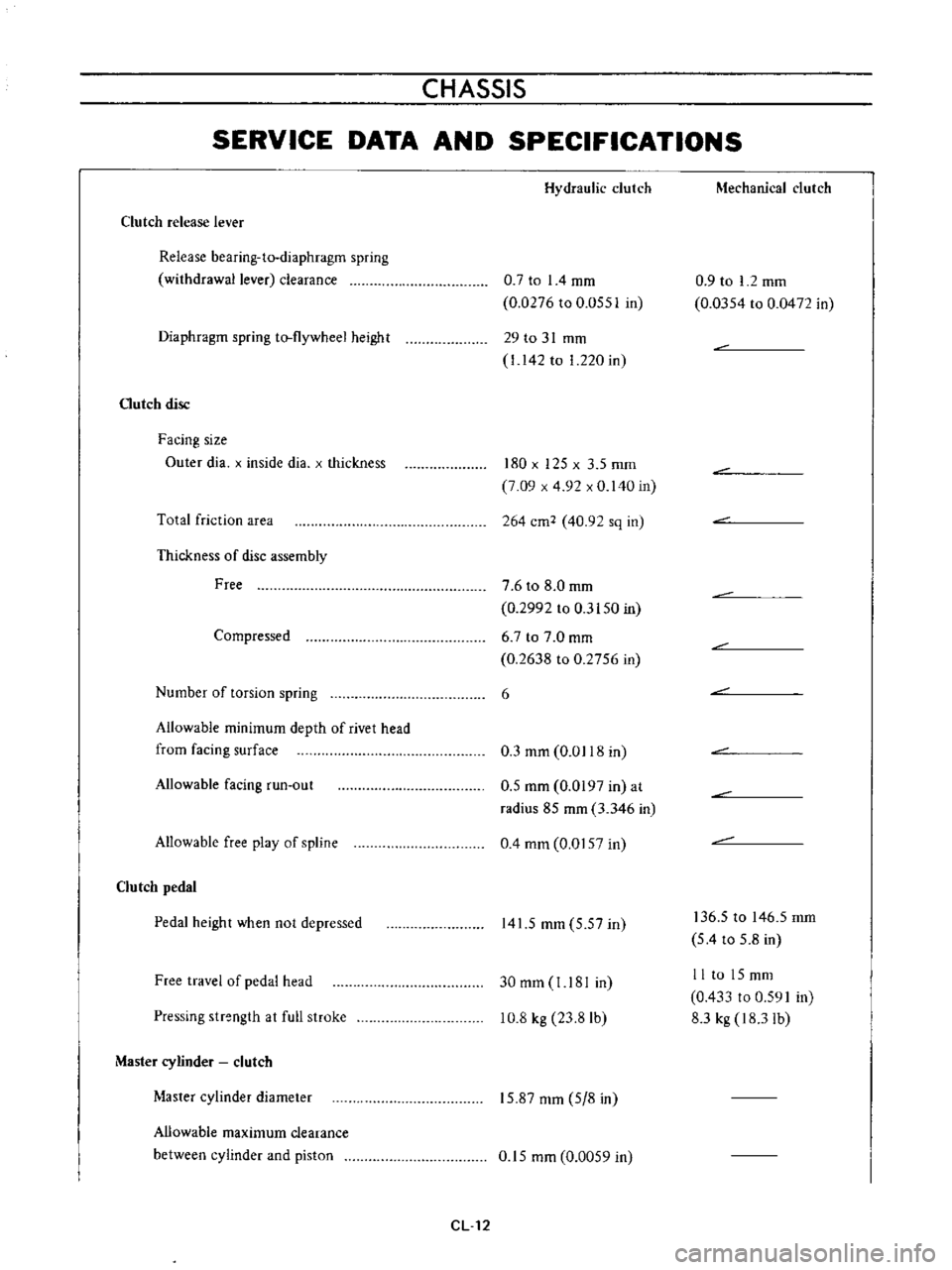
CHASSIS
SERVICE
DATA
AND
SPECIFICATIONS
Clutch
release
lever
Release
bearing
ta
diaphragm
spring
withdrawal
lever
clearance
Diaphragm
spring
to
flywheel
height
Gutch
disc
Facing
size
Outer
dia
x
inside
dia
x
thickness
Total
friction
area
Thickness
of
disc
assembly
Free
Compressed
Number
of
torsion
spring
Allowable
minimum
depth
of
rivet
head
from
facing
surface
Allowable
facing
run
out
Allowable
free
play
of
spline
Clutch
pedal
Pedal
height
when
not
depressed
Free
travel
of
pedal
head
Pressing
strength
at
full
stroke
Master
cylinder
clutch
Master
cylinder
diameter
Allowable
maximum
clearance
between
cylinder
and
piston
Hydraulic
clutch
0
7
to
I
4
mm
0
0276
to
0
055
in
29
to
31
mm
I
142
to
1
220
in
180
x
125
x
3
5
mm
7
09
x
4
92
x
0
140
in
264
cm2
40
92
sq
in
7
6
to
8
0
mm
0
2992
to
0
3150
in
6
7
to
7
0
mm
0
2638
to
0
2756
in
6
0
3
mm
0
0118
in
0
5
mm
0
0197
in
at
radius
85
mm
3
346
in
0
4
mm
0
0157
in
141
5
mm
5
57
in
30
mm
J
181
in
10
8
kg
23
8
Ib
15
87
mm
5
8
in
0
15
mm
0
0059
in
CL12
Mechanical
clutch
0
9
to
I
2
mm
0
0354
to
0
0472
in
136
5
to
146
5
mm
5
4
to
5
8
in
II
to
15mm
0
433
to
0
591
in
8
3
kg
18
31b
Page 483 of 513
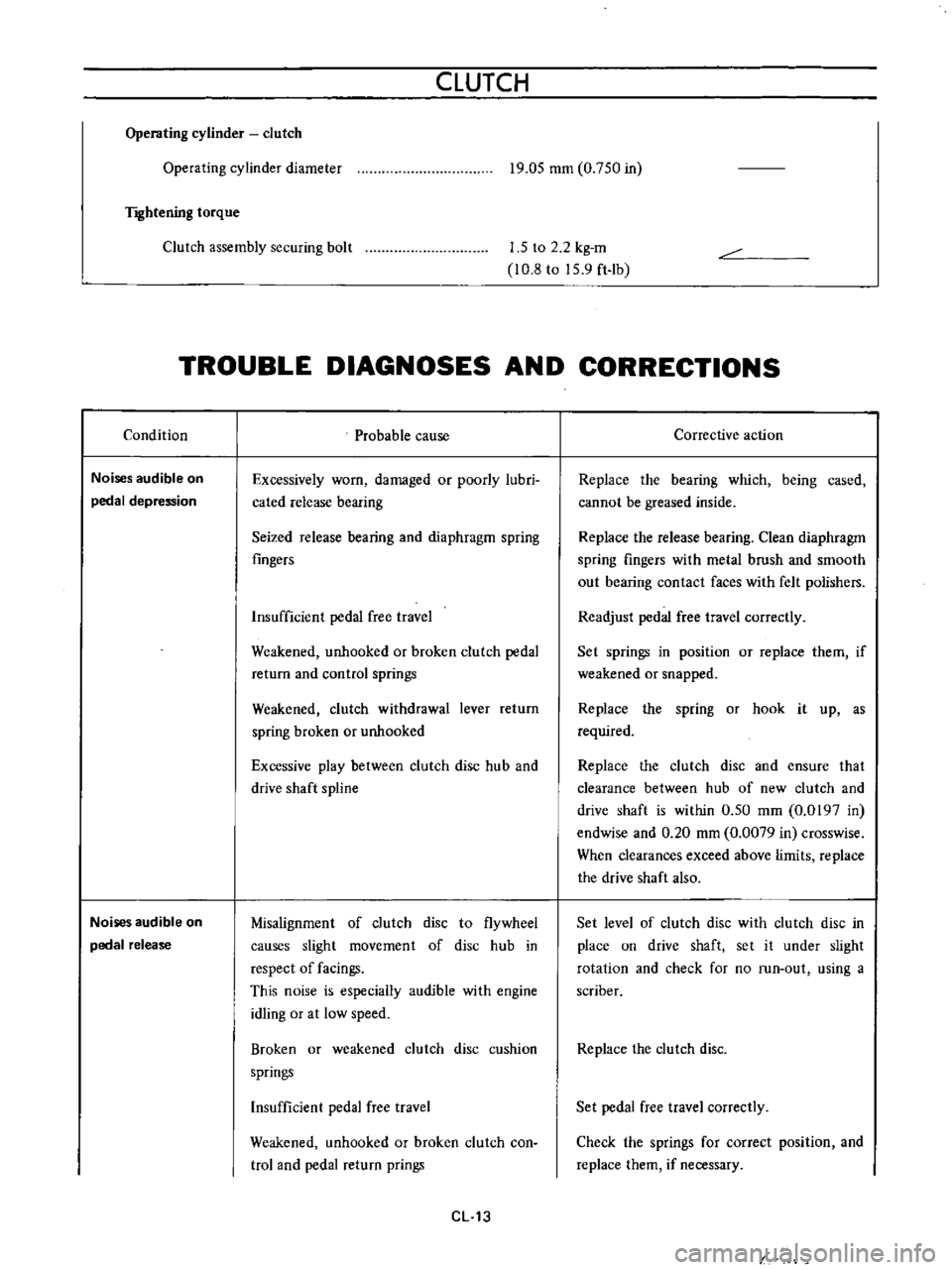
CLUTCH
Operating
cylinder
clutch
Operating
cylinder
diameter
T
Ilhtening
torque
19
05
mm
0
750
in
Clutch
assembly
securing
bolt
1
5
to
2
2
kg
m
10
8
to
15
9
ft
Ib
TROUBLE
DIAGNOSES
AND
CORRECTIONS
Condition
Noises
audible
on
pedal
depression
Noises
audible
on
pedal
release
Probable
cause
Excessively
worn
damaged
or
poorly
lubri
cated
release
bearing
Seized
release
bearing
and
diaphragm
spring
fingers
Insufficient
pedal
free
travel
Weakened
unhooked
or
broken
clutch
pedal
return
and
control
springs
Weakened
clutch
withdrawal
lever
return
spring
broken
or
unhooked
Excessive
play
between
clutch
disc
hub
and
drive
shaft
spline
Misalignment
of
clutch
disc
to
flywheel
causes
slight
movement
of
disc
hub
in
respect
of
facings
This
noise
is
especially
audible
with
engine
idling
or
at
low
speed
Broken
or
weakened
clutch
disc
cushion
springs
Insufficient
pedal
free
travel
Weakened
unhooked
or
broken
clutch
con
trol
and
pedal
return
prings
CL
13
Corrective
action
Replace
the
bearing
which
being
cased
cannot
be
greased
inside
Replace
the
release
bearing
Clean
diaphragm
spring
fingers
with
metal
brush
and
smooth
out
bearing
contact
faces
with
felt
polishers
Readjust
pedal
free
travel
correctly
Set
springs
in
position
or
replace
them
if
weakened
or
snapped
Replace
the
spring
or
hook
it
up
as
required
Replace
the
clutch
disc
and
ensure
that
clearance
between
hub
of
new
clutch
and
drive
shaft
is
within
0
50
mm
0
0197
in
endwise
and
0
20
mm
0
0079
in
crosswise
When
clearances
exceed
above
limits
replace
the
drive
shaft
also
Set
level
of
clutch
disc
with
clutch
disc
in
place
on
drive
shaft
set
it
under
slight
rotation
and
check
for
no
run
out
using
a
scriber
Replace
the
clutch
disc
Set
pedal
free
travel
correctly
Check
the
springs
for
correct
position
and
replace
them
if
necessary
Page 484 of 513
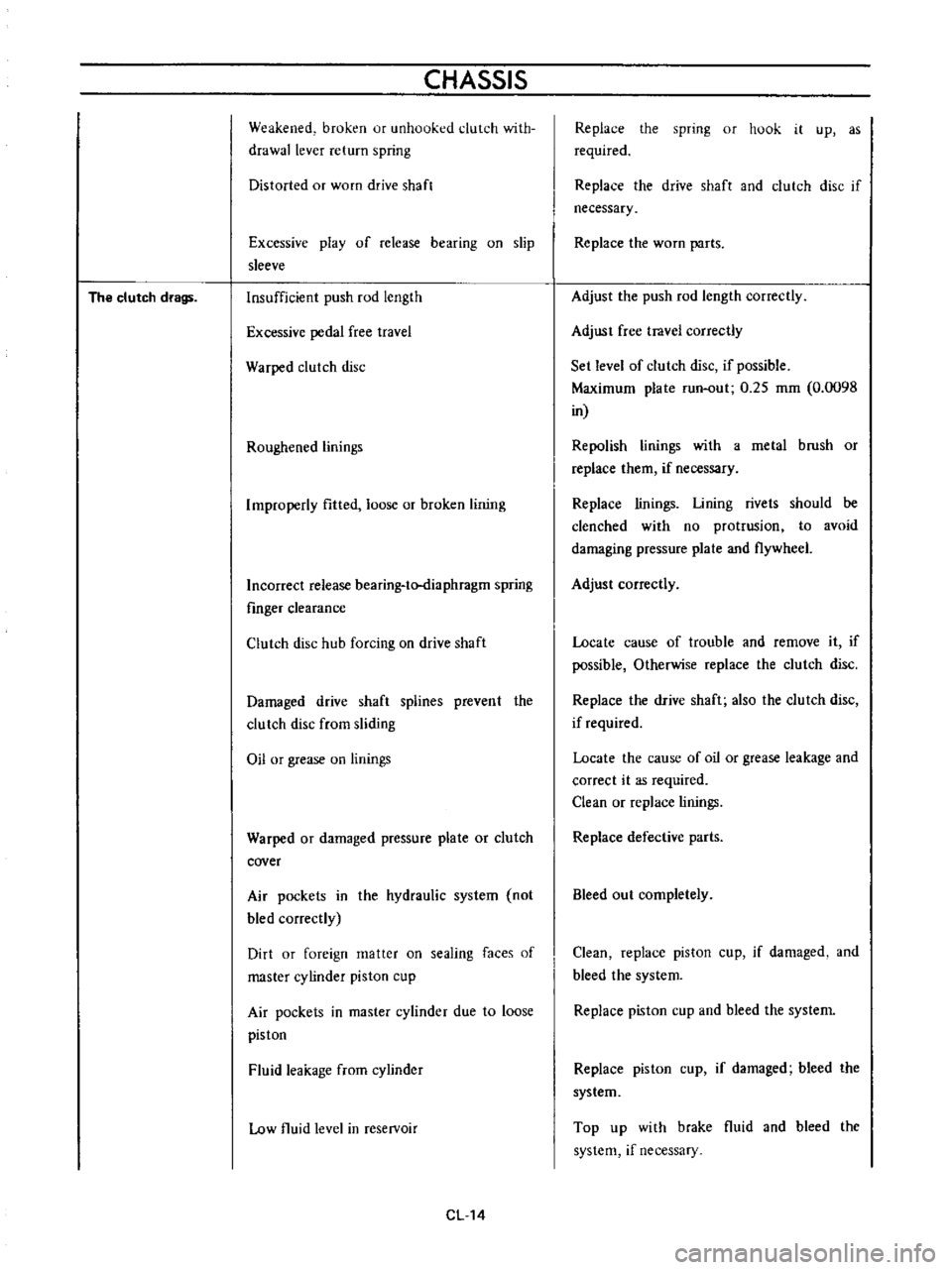
The
clutch
drags
CHASSIS
Weakened
broken
ur
unhooked
clutch
with
drawallever
return
spring
Distorted
or
worn
drive
shaft
Excessive
play
of
release
bearing
on
slip
sleeve
Insufficient
push
rod
length
Excessive
pedal
free
travel
Warped
clutch
disc
Roughened
linings
Improperly
fitted
loose
or
broken
lining
Incorrect
release
bearing
to
diaphragm
spring
fmger
clearance
Clutch
disc
hub
forcing
on
drive
shaft
Damaged
drive
shaft
splines
prevent
the
clutch
disc
from
sliding
Oil
or
grease
on
linings
Warped
or
damaged
pressure
plate
or
clutch
cover
Air
pockets
in
the
hydraulic
system
not
bled
correctly
Dirt
or
foreign
matter
on
sealing
faces
of
master
cylinder
piston
cup
Air
pockets
in
master
cylinder
due
to
loose
piston
Fluid
leakage
from
cylinder
Low
fluid
level
in
reservoir
CL14
Replace
the
spring
or
hook
it
up
as
required
Replace
the
drive
shaft
and
clutch
disc
if
necessary
Replace
the
worn
parts
Adjust
the
push
rod
length
correctly
Adjust
free
travel
correctly
Set
level
of
clutch
disc
if
possible
Maximum
plate
run
out
0
25
mm
0
0098
in
Repolish
linings
with
a
metal
brush
or
replace
them
if
necessary
Replace
linings
Lining
rivets
should
be
clenched
with
no
protrusion
to
avoid
damaging
pressure
plate
and
flywheel
Adjust
correctly
Locate
cause
of
trouble
and
remove
it
if
possible
Otherwise
replace
the
clutch
disc
Replace
the
drive
shaft
also
the
clutch
disc
if
required
Locate
the
cause
of
oil
or
grease
leakage
and
correct
it
as
required
Clean
or
replace
linings
Replace
defective
parts
Bleed
out
completely
Clean
replace
piston
cup
if
damaged
and
bleed
the
system
Replace
piston
cup
and
bleed
the
system
Replace
piston
cup
if
damaged
bleed
the
system
Top
up
with
brake
fluid
and
bleed
the
system
if
necessary
Page 485 of 513
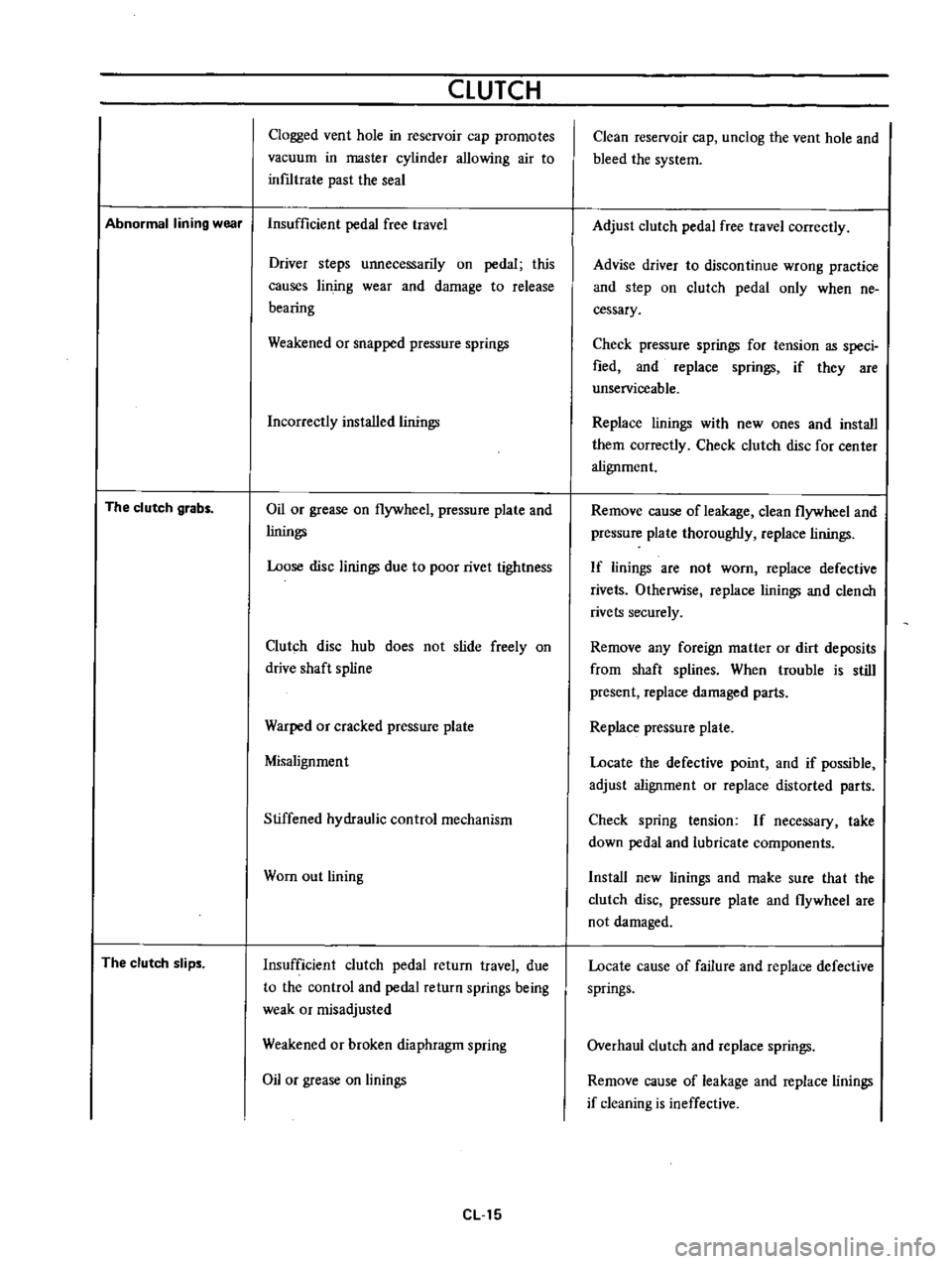
CLUTCH
Clogged
vent
hole
in
reservoir
cap
promotes
vacuum
in
master
cylinder
allowing
air
to
inf1ltrate
past
the
seal
Abnormal
lining
wear
Insufficient
pedal
free
travel
The
clutch
grabs
The
clutch
slips
Driver
steps
unnecessarily
on
pedal
this
causes
lin
jog
wear
and
damage
to
release
bearing
Weakened
or
snapped
pressure
springs
Incorrectly
installed
linings
Oil
or
grease
on
flywheel
pressure
plate
and
linings
Loose
disc
linings
due
to
poor
rivet
tightness
Clutch
disc
hub
does
not
slide
freely
on
drive
shaft
spline
Warped
or
cracked
pressure
plate
Misalignment
Stiffened
hydraulic
control
mechanism
Wom
out
lining
Insufficient
clutch
pedal
return
travel
due
to
the
control
and
pedal
return
springs
being
weak
or
misadjusted
Weakened
or
broken
diaphragm
spring
Oil
or
grease
on
linings
eLl5
Clean
reservoir
cap
unclog
the
vent
hole
and
bleed
the
system
Adjust
clutch
pedal
free
travel
correctly
Advise
driver
to
discontinue
wrong
practice
and
step
on
clutch
pedal
only
when
ne
cessary
Check
pressure
springs
for
tension
as
speci
fied
and
replace
springs
if
they
are
unserviceable
Replace
linings
with
new
ones
and
install
them
correctly
Check
clutch
disc
for
center
alignment
Remove
cause
of
leakage
clean
flywheel
and
pressure
plate
thoroughly
replace
linings
If
linings
are
not
worn
replace
defective
rivets
Otherwise
replace
linings
and
clench
rivets
securely
Remove
any
foreign
matter
or
dirt
deposits
from
shaft
splines
When
trouble
is
still
present
replace
damaged
parts
Replace
pressure
plate
Locate
the
defective
point
and
if
possible
adjust
alignment
or
replace
distorted
parts
Check
spring
tension
If
necessary
take
down
pedal
and
lubricate
components
Install
new
linings
and
make
sure
tha
t
the
clutch
disc
pressure
plate
and
flywheel
are
not
damaged
Locate
cause
of
failure
and
replace
defective
springs
Overhaul
clutch
and
replace
springs
Remove
cause
of
leakage
and
replace
linings
if
cleaning
is
ineffective
Page 504 of 513
TRANSMISSION
COLUMN
SHIFT
CONTROL
SYSTEM
Removal
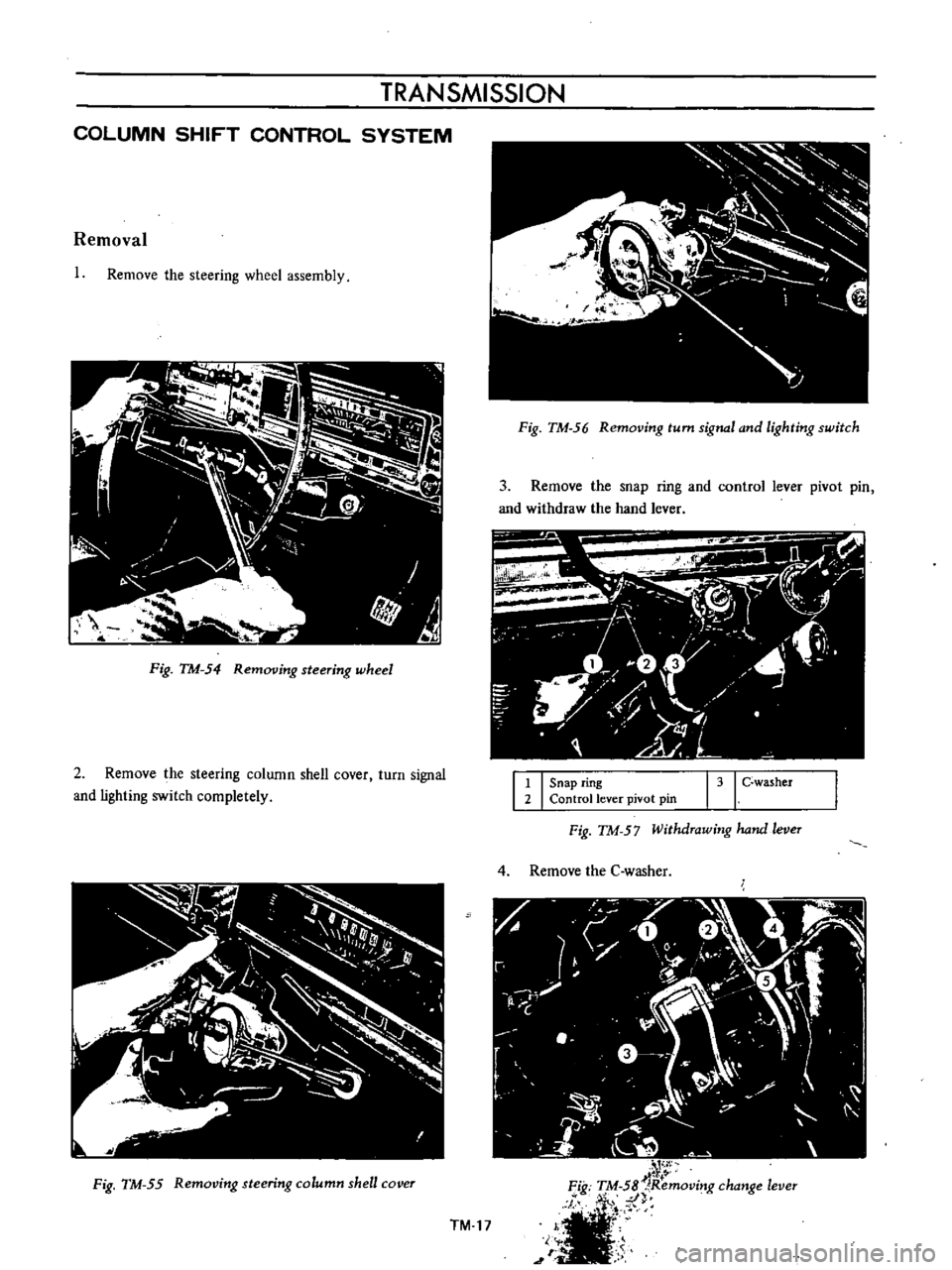
Remove
the
steering
wheel
assembly
Fig
TM
54
Rem01
ing
steering
wheel
2
Remove
the
steering
column
shell
cover
turn
signal
and
lighting
switch
completely
Fig
TM
55
Removing
steering
column
shell
cover
Fig
TM
56
Removing
turn
signal
and
lighting
switch
3
Remove
the
snap
ring
and
control
lever
pivot
pin
and
withdraw
the
hand
lever
A
A
V
l
Y
e
f
I
1
I
V
e
tl
f
r
4
2i
L
1
I
Snap
ring
2
Control
lever
pivot
pin
I
3
I
C
washer
Fig
TM
57
Withdrawing
hand
ever
4
Remove
the
C
washer
TM
17
i
MI
ig
r
M
5J
emOVing
change
lever
J
y
Ji
1
r
oJ