ad blue DATSUN PICK-UP 1977 Service Manual
[x] Cancel search | Manufacturer: DATSUN, Model Year: 1977, Model line: PICK-UP, Model: DATSUN PICK-UP 1977Pages: 537, PDF Size: 35.48 MB
Page 181 of 537
Engine
Electrical
System
B
v
W
WR
WL
L2
VOLTAGE
REGULATOR
co
LW
I
P
B
r
FUSIBLE
LINK
m
I
WLI
LW
cJ
I
B
t
EARTH
POINT
m
WR
WR
CHARGE
g
00
WARNING
lAMP
00000
Equipped
with
cooler
I
I
I
I
TjT
m
CLB
W
WB
B
YWR
I
I
I
I
1
W
B
rn
ALTERNATOR
I
l
LW
BW
j
J
M
IG
I
W
BwtIl
IGNITION
SWITCH
COLOR
CODE
B
Black
OW
Black
with
white
stripe
W
White
WB
White
with
black
stripe
WR
White
with
red
stripe
WL
White
with
blue
stripe
LO
Blue
with
black
stripe
LW
Blue
with
white
stripe
Y
Yellow
lOA
C
o
0
0
0
o
0
0
FUSE
BLOCK
M
0
0
0
lOA
Ii
California
models
E
E492
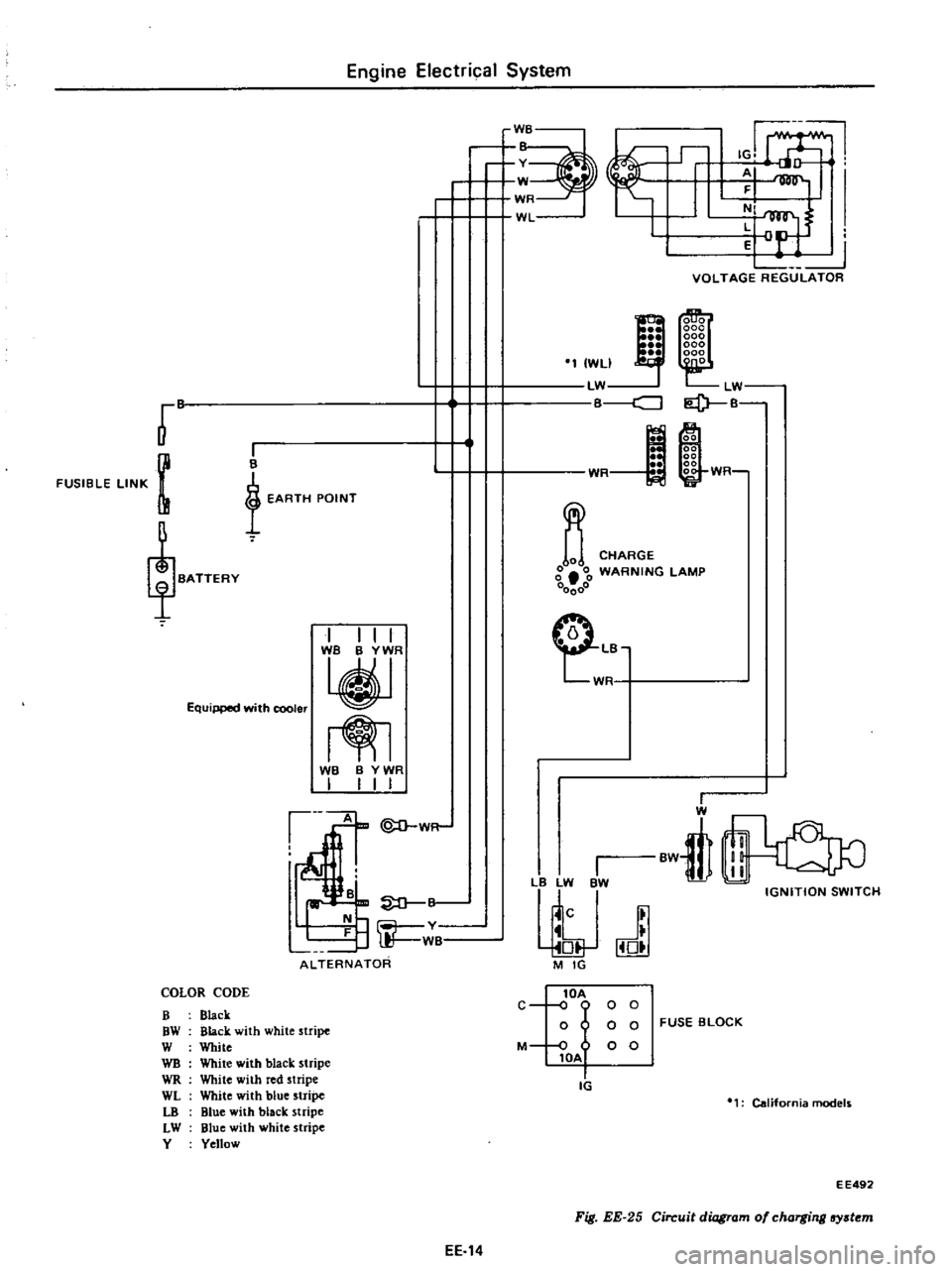
Fig
EE
25
Circuit
diagram
of
charging
lfY
t
m
EE
14
Page 194 of 537
FUSIBLE
LtNK
m
Engine
Electrical
System
E
CJI2t
Bf
o
00
00
fOl
R
BL
I
ti
L
oj
L
C
J
RESISTOR
IGNITION
COIL
COLOR
CODE
B
Black
OW
Black
with
white
stripe
DR
Black
with
red
stripe
aL
Black
with
blue
stripe
W
White
W
R
Wj
BW
BR
IGNITION
SWtTCH
DISTRtBUTOR
jjj
SPARK
PLUGS
EE493
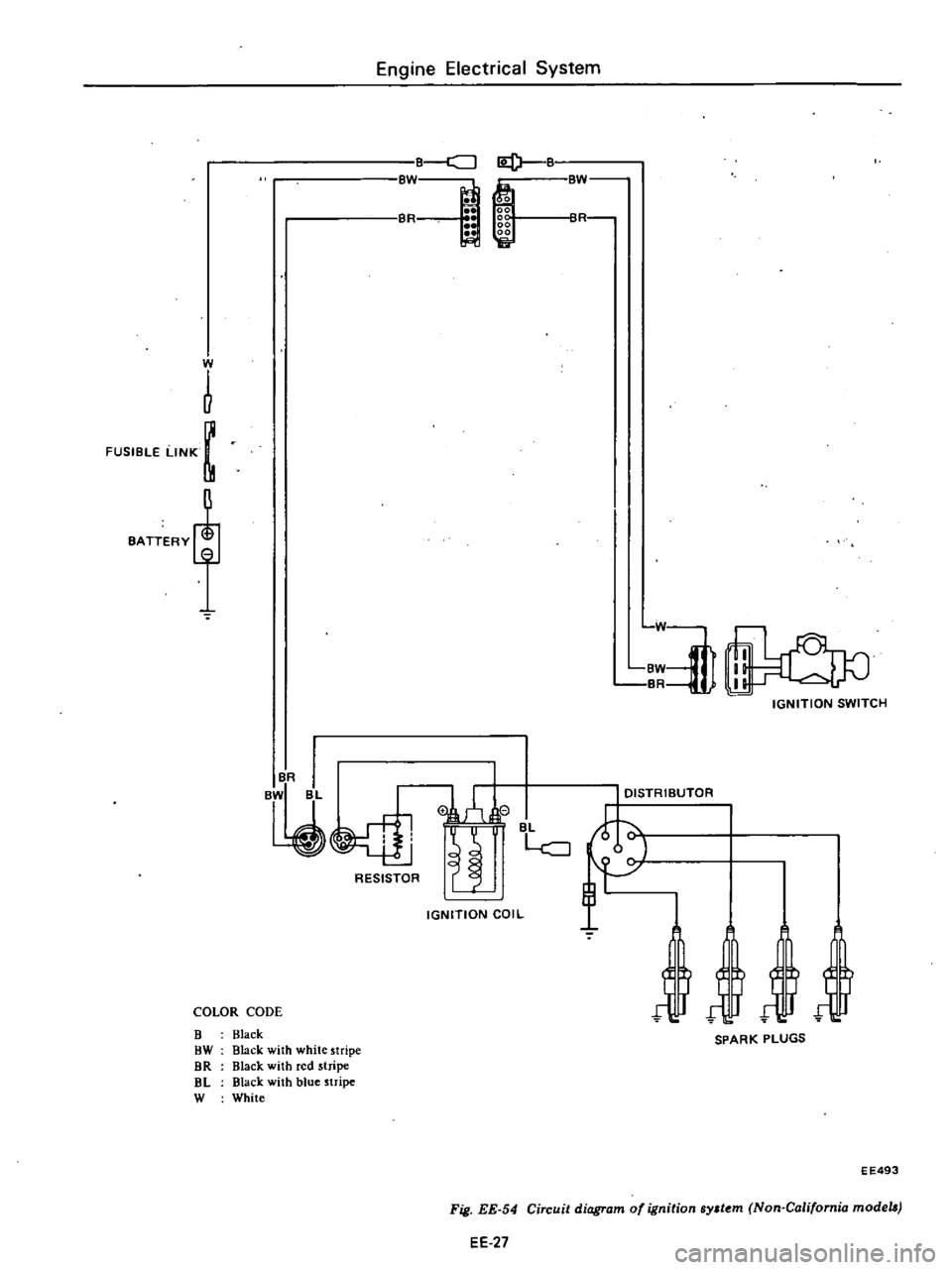
EE
27
Fig
EE
54
Circuit
diagram
of
ignition
ByJt
m
Non
California
models
Page 196 of 537
EARTH
POINT
r
W
b
FUSIBLE
LINK
BATTERY
L
d
l
ilR
j
i
BW
@
c
RESISTOR
COLOR
CODE
8
Black
OW
Black
with
white
stripe
DR
Black
with
red
stripe
W
White
L
Blue
R
Red
G
Green
Engine
Electrical
System
TRANSISTOR
IGNITION
UNIT
IHIIl
II
II
BW
BBV
RG
111
I
I
TERMINAL
BLOCK
r
c
IGNITION
COIL
BW
B
ml
BR
lliJ
LldJ0
IGNITION
SWITCH
EE
29
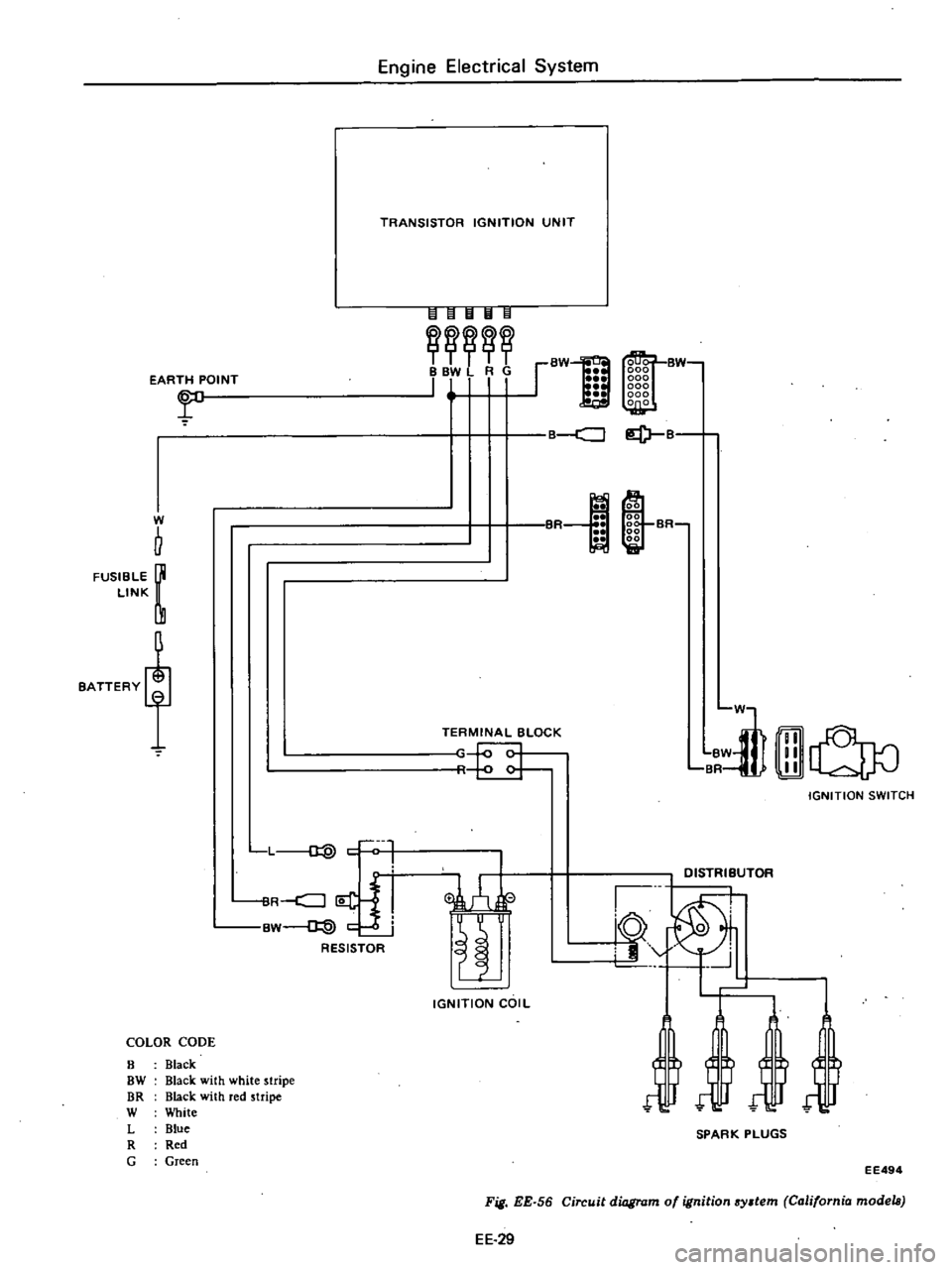
Fig
EE
56
Circuit
diagram
of
ignition
system
California
models
EE494
a
B
lof1
@
00
00
00
SR
00
00
Et
liiI
in
D1STRliUTOR
10
0
i9
J
SPARK
PLUGS
Page 331 of 537
PROPELLER
SHAFT
DIFFERENTIAL
CARRIER
Watch
for
oil
leakage
from
trans
mission
end
Notes
a
Remove
propeller
shaft
carefully
so
as
not
to
damage
spline
sleeve
yoke
and
rear
oil
seal
b
Plug
up
the
opening
in
the
rear
of
rear
extension
housing
to
prevent
oil
from
flowing
out
To
install
reverse
the
foregoing
removal
procedure
1
Align
propeller
shaft
with
com
panion
flange
using
reference
marks
prescribed
in
removal
procedure
and
assemble
with
bolts
Tightening
torque
2
4
to
3
3
kg
m
17
to
24
ft
Ib
2
Insert
bolts
through
the
holes
of
center
beariug
bracket
and
torque
nuts
to
retain
center
bearing
on
cross
member
Tightening
torque
1
6
to
2
2
kg
m
12
to
16
ft
Ib
DISASSEMBLY
AND
ASSEMBLY
Primarily
do
not
disassemble
pro
peller
shaft
because
it
is
balanced
as
an
assembly
However
check
propeller
shaft
with
journal
for
movement
When
journal
does
not
move
smoothly
dis
assemble
1
Mark
propeller
shaft
and
journal
so
that
the
original
combination
can
be
restored
at
assembly
2
Remove
snap
ring
with
a
standard
screwdriver
3
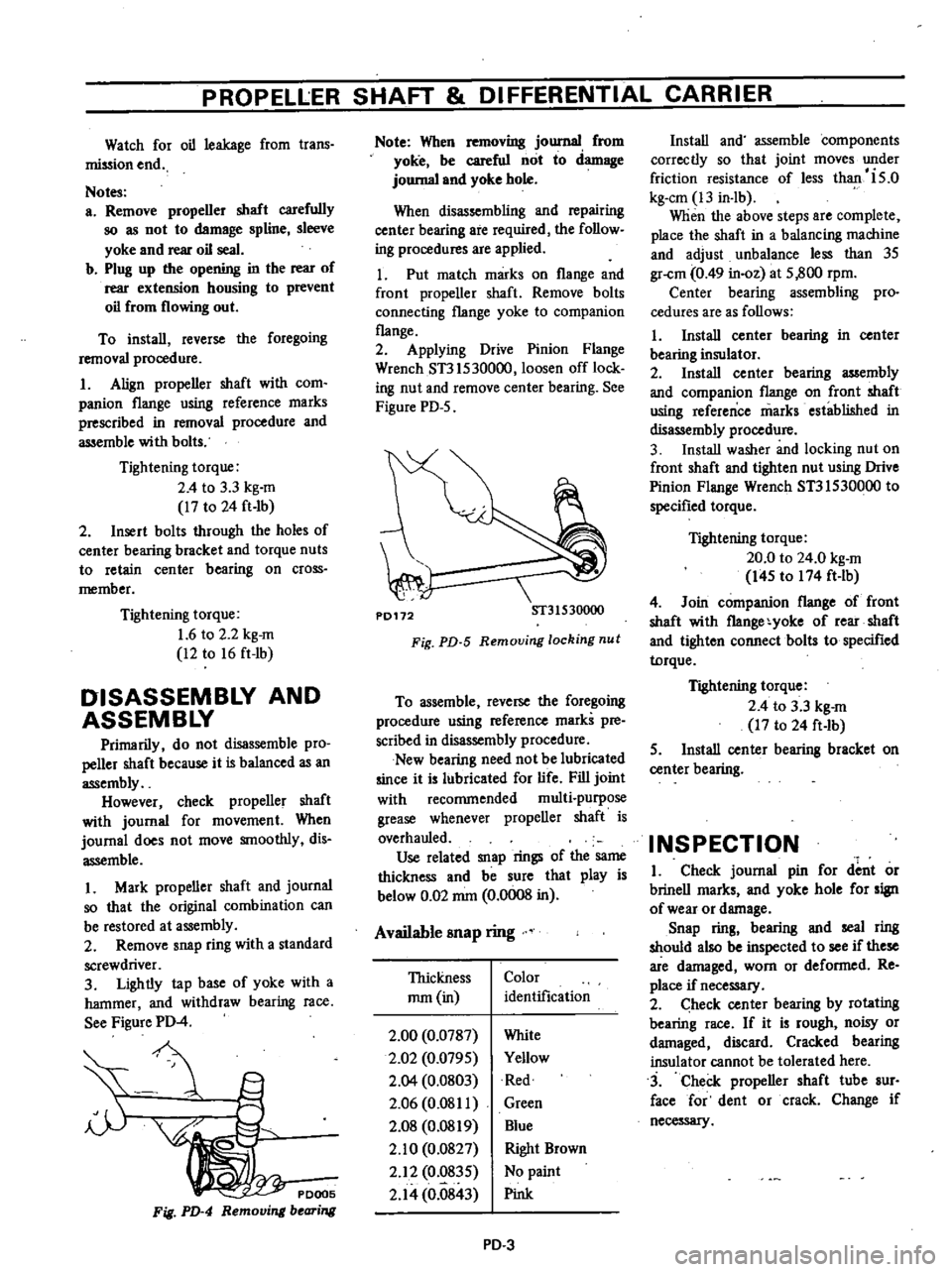
Lightly
tap
base
of
yoke
with
a
hammer
and
withdraw
bearing
race
See
Figure
PD
4
PDOO5
Fig
PD
4
Remo
i
bearing
Note
When
removing
journal
from
yoke
be
careful
not
to
damage
journal
and
yoke
bole
When
disassembling
and
repairing
center
bearing
are
required
the
follow
ing
procedures
are
applied
1
Put
match
marks
on
flange
and
front
propeller
shaft
Remove
bolts
connecting
flange
yoke
to
companion
flange
2
Applying
Drive
Pinion
Flange
Wrench
ST3lS30000
loosen
off
lock
ing
nut
and
remove
center
bearing
See
Figure
PD
5
P0172
ST31530000
Fig
PD
5
Remouing
locking
nut
To
assemble
reverse
the
foregoing
procedure
using
reference
marks
pre
scribed
in
disassembly
procedure
New
bearing
need
not
be
lubricated
since
it
is
lubricated
for
life
Fill
joint
with
recommended
multi
purpose
grease
whenever
propeller
shaft
is
overhauled
Use
related
snap
rings
of
the
same
thickness
and
be
sure
that
play
is
below
0
02
mm
0
0008
in
Available
snap
ring
Thickness
mm
in
Color
identification
2
00
0
0787
2
02
0
079S
2
Q4
0
0803
2
06
0
08
II
2
08
0
0819
2
10
0
0827
2
12
0
83S
2
14
0
0843
White
Yellow
Red
Green
Blue
Right
Brown
No
paint
Pink
PD
3
Install
and
assemble
components
correctly
so
that
joint
moves
under
friction
resistance
of
less
than
is
o
kg
em
13
in
lb
When
the
above
steps
are
complete
place
the
shaft
in
a
balancing
machine
and
adjust
unbalance
less
than
3S
gr
cm
0
49
in
oz
at
S
800
rpm
Center
bearing
assembling
pro
cedures
are
as
follows
I
Install
center
bearing
in
center
bearing
insulator
2
Install
center
bearing
assembly
and
companion
flange
on
front
shaft
usiug
reference
marks
established
in
disassembly
procedure
3
Install
washer
and
locking
nut
on
front
shaft
and
tighten
nut
using
Drive
Pinion
Flange
Wrench
ST3IS30000
to
specified
torque
Tightening
torque
20
0
to
24
0
kg
m
I4S
to
174
ft
lb
4
Join
companion
flange
of
front
shaft
with
f1ange
yoke
of
rear
shaft
and
tighten
connect
bolts
to
specified
torque
Tightening
torque
2
4
to
3
3
kg
m
17
to
24
ft
Ib
S
Install
center
bearing
bracket
on
center
bearing
INSPECTION
I
Check
journal
pin
for
dent
or
brinell
marks
and
yoke
hole
for
sign
of
wear
or
damage
Snap
ring
bearing
and
seal
ring
should
also
be
inspected
to
see
if
these
are
damaged
worn
or
deformed
Re
place
if
necessary
2
heck
center
bearing
by
rotating
bearing
race
If
it
is
rough
noisy
or
damaged
discard
Cracked
bearing
insulator
cannot
be
tolerated
here
3
Check
propeller
shaft
tube
sur
face
for
dent
or
crack
Change
if
necessary
Page 447 of 537
DESCRIPTION
Cables
are
covered
with
color
coded
vinyl
for
easy
identification
In
the
wiring
diagram
colors
are
indicated
by
one
or
two
alphabetical
letters
It
is
recommended
that
the
battery
be
disconnected
before
performing
any
electrical
service
other
than
bulb
or
fuse
replacement
In
addition
to
fuses
a
fusible
link
has
been
installed
to
protect
wiring
The
fusible
link
functions
almost
the
same
as
a
fuse
though
its
eharac
teristics
are
slightly
different
than
normal
fuses
CABLE
COLORS
Cable
colors
are
indicated
by
one
or
two
alphabetical
letters
B
Black
Be
Brown
G
Green
L
Blue
Lg
Light
green
R
Red
W
White
Y
Yellow
The
main
cable
is
generally
coded
with
a
single
color
The
others
are
coded
with
a
two
tone
color
as
follows
BW
Black
with
white
stripe
gR
Light
green
with
red
stripe
INSPECTION
Inspect
all
electrical
circuits
refer
ring
to
wiring
or
circuit
diagrams
Circuits
should
be
tested
for
conti
nuity
or
short
circuit
with
a
conven
tional
test
lamp
or
low
reading
volt
meter
Before
inspection
of
circuit
ensure
that
I
Each
electrical
component
part
or
cable
is
securely
fastened
to
its
con
nector
or
terminal
2
Each
connection
is
firmly
in
place
and
free
from
rust
and
dirt
3
No
cable
covering
shows
any
evidence
of
cracks
deterioration
or
other
damage
4
Each
terminal
is
at
a
safe
distance
away
from
any
adjacent
metal
parts
5
Each
cable
is
fastened
to
its
proper
connector
or
terminal
Body
Electrical
System
BODY
ELECTRICAL
WIRING
6
Each
grounding
bolt
is
firmly
pbnted
7
Wiring
is
kept
away
from
any
adjacent
parts
with
sharp
edges
or
high
temperature
parts
such
as
exhaust
pipe
8
Wiring
is
kept
away
from
any
rotating
or
working
parts
fan
pulley
fan
belt
etc
9
Cables
between
ftxed
portions
and
moving
parts
are
long
enough
to
withstand
shocks
and
vibratory
forces
Notes
a
Before
starting
to
inspect
and
repair
any
part
of
electrical
system
or
other
parts
which
may
lead
to
a
short
circuit
disconnect
cables
at
battery
terminals
as
follows
Disconnect
cable
at
negative
terminal
and
then
disconnect
cable
at
positive
terminal
Before
connecting
cables
to
battery
terminal
be
sure
to
clean
terminals
with
a
rag
Fasten
cable
at
positive
terminal
and
then
ground
cable
at
negative
terminal
Apply
grease
to
top
of
these
terminals
to
prevent
rust
from
developing
on
them
b
Never
use
a
screwdriver
or
senrice
tool
to
conduct
a
continuity
test
Use
test
leads
c
Never
ground
an
open
circuit
or
circuits
under
no
load
Use
a
test
lamp
12V
3W
or
circuit
tester
as
a
load
FUSE
AND
FUSIBLE
LINK
DESCRIPTION
The
fuse
and
fusible
link
are
protec
tive
devices
used
in
an
electrical
cir
cuit
When
current
increases
beyond
rated
amperage
fusible
metal
melts
and
the
circuit
is
broken
BE
2
MAINTENANCE
INSTRUCTIONS
Fuse
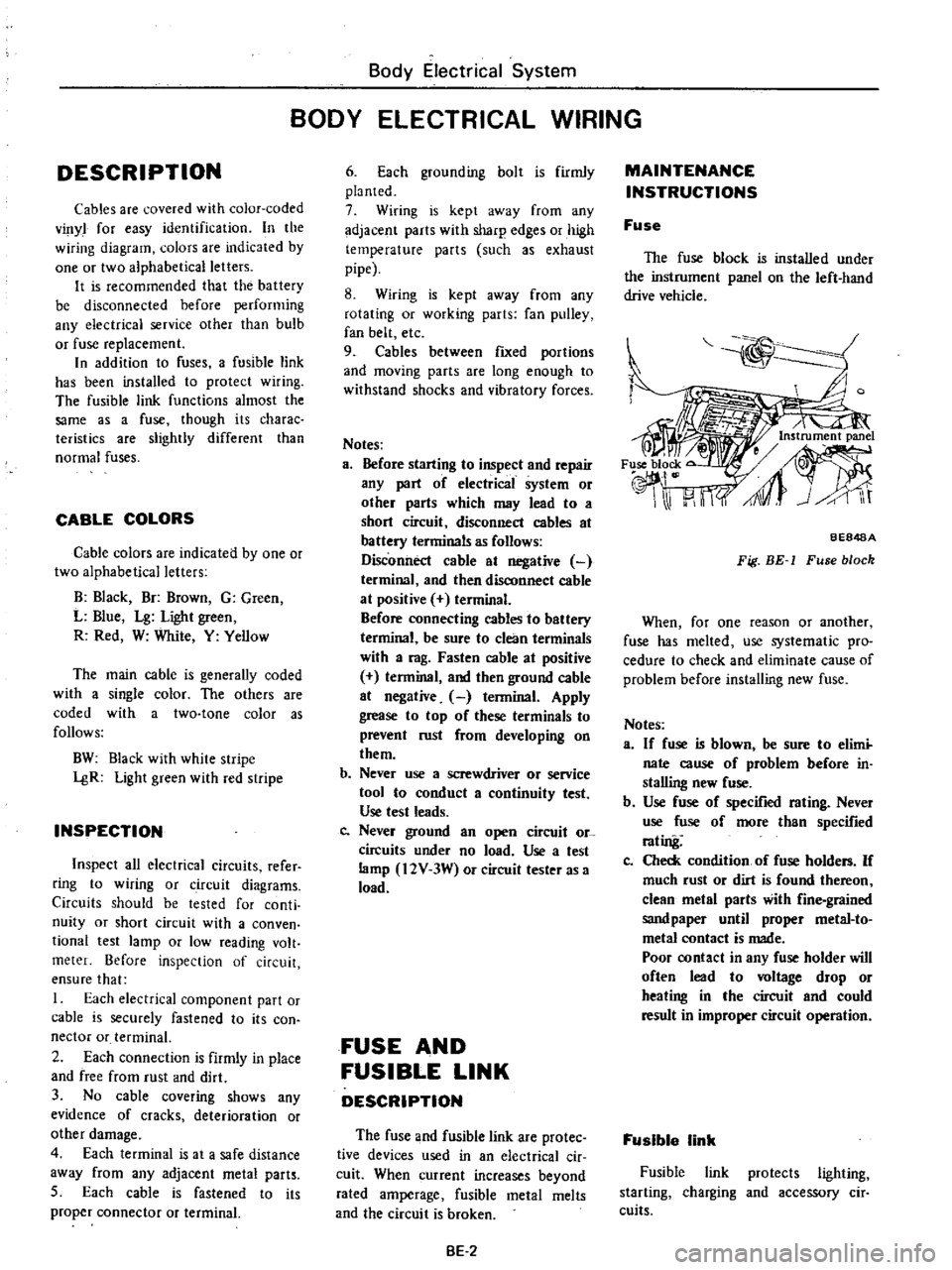
The
fuse
block
is
installed
under
the
instrument
panel
on
the
left
hand
drive
vehicle
BE848A
Fig
BE
1
Fuse
block
When
for
one
reason
or
another
fuse
has
melted
use
systematic
pro
cedure
to
check
and
eliminate
cause
of
problem
before
installing
new
fuse
Notes
a
If
fuse
is
blown
be
sure
to
elimi
nate
cause
of
problem
before
in
stalling
new
fuse
b
Use
fuse
of
specified
rating
Never
use
fuse
of
more
than
specified
rating
Co
Check
condition
of
fuse
holders
If
much
rust
or
dirt
is
found
thereon
clean
metal
parts
with
fine
grained
sandpaper
until
proper
metal
to
metal
contact
is
made
Poor
contact
in
any
fuse
holder
will
often
lead
to
voltage
drop
or
heating
in
the
circuit
and
could
result
in
improper
circuit
operation
Fusible
link
Fusible
link
protects
lighting
starting
charging
and
accessory
cir
cuits
Page 469 of 537
Body
Electrical
System
tive
terminal
or
B
terminal
and
blue
red
wire
terminal
in
wiring
connector
plug
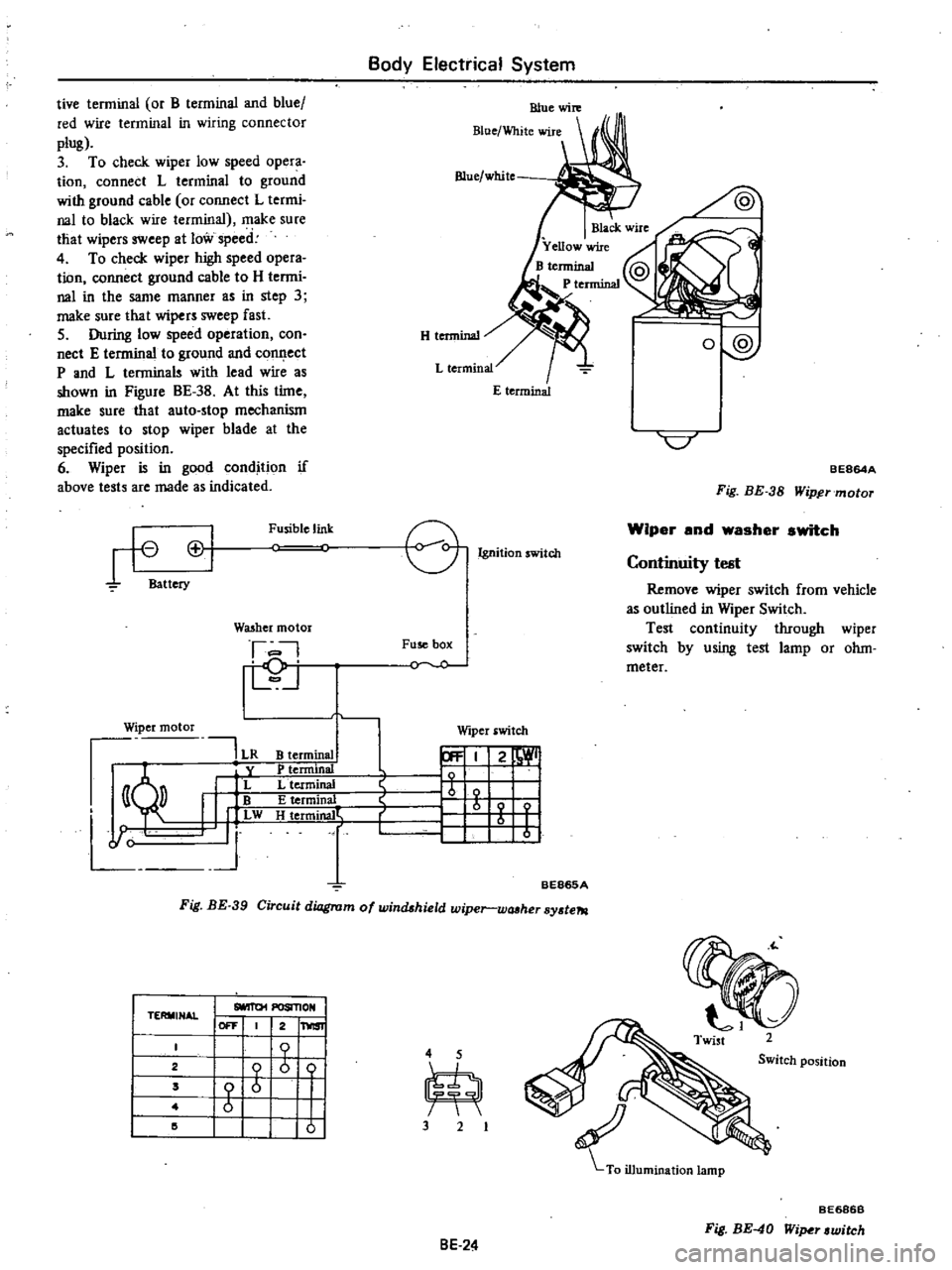
3
To
check
wiper
low
speed
opera
tion
connect
L
terminal
to
ground
with
ground
cable
or
connect
L
termi
nal
to
black
wire
terminal
make
sure
that
wipers
sweep
at
low
speed
4
To
check
wiper
high
speed
opera
tion
connect
ground
cable
to
H
termi
nal
in
the
same
manner
as
in
step
3
make
sure
that
wipers
sweep
fast
5
During
low
speed
operation
con
nect
E
terminal
to
ground
and
conl
ect
P
and
L
terminals
with
lead
wire
as
shown
in
Figure
BE
38
At
this
time
make
sure
that
auto
stop
mechanism
actuates
to
stop
wiper
blade
at
the
specified
position
6
Wiper
is
in
good
condition
if
above
tests
are
made
as
indicated
H
tenninal
Blue
white
o
@
C
BE864A
Fig
BE
38
Wipftrmotor
rt
Cl
Battery
Fusible
link
e
Ignition
witch
Wiper
and
washer
switch
I
D
j
Fuse
box
Y
O
Continuity
test
Remove
wiper
switch
from
vehicle
as
outlined
in
Wiper
Switch
Test
continuity
through
wiper
switch
by
using
test
lamp
or
ohm
meter
WQ5hcr
motor
Wiper
motor
191
LR
y
I
L
I
w
J
Wiper
switch
B
terminal
P
tenninal
L
terminal
E
terminal
H
t
rmjrW
r
21
1
b
I
r
1
I
I
BE865A
Fig
BE
39
Circuit
diagram
of
windshield
wiper
wtUher
sy
te7tl
TERMINAL
I
SlOIT01
POSIl10N
I
I
OFF
2
1
1
2
I
b
ii
4
5
Switch
position
2
I
Z
m
Z
I
I
I
I
I
I
I
10
I
3
2
BE686B
Fig
BE
40
Wi
r
witch
8E
24
Page 484 of 537

m
W
D
to
l
l
0
c
l
l
s
Q
3
For
Automatic
Transmission
LB
B
For
Manual
Transmission
m
For
Automatic
Transmission
COLOR
CODE
B
Black
BI
Brown
G
Green
L
Blue
Lg
Light
green
R
Red
W
White
Y
Yellow
BW
Black
with
white
stripe
LgR
Light
green
with
red
stripe
BY
RB
RB
B
WB
RB
YB
2
RB
I
B
1
BW
r
BY
LB
For
Automatic
Transmission
to
o
c
m
r0
O
O
Dl
For
Manual
Transmission
@
CJ
lti
3
RB
fB
BY
YB
RB@RB
YB
BY
1
To
kickdown
solenoid
fOT
Automatic
Transmission
2
To
reverse
switch
for
Manual
Tranmission
3
To
inhibitor
switch
for
Automatic
Transmission
4
To
oil
pressure
switch
5
To
starter
motor
6
To
engine
room
harness
for
Manual
Transmission
7
To
engine
room
harness
for
Automatic
Transmission
Page 495 of 537

1
I
6
I
BA
RY
i
Air
Conditioning
BW
c
J
BW
n
B
m
00
L
ELECTRIC
FUEL
PUMP
oB
tl
b@
L
t
FROM
LIGHT
SWITCH
c
J
LW
2
L
rRL
fZP
W
I
FUSE
15A
J
D
CJ
B
1
COMPRESSOR
RELAY
B
GL
I
lL
GL1J
ILLUMINATION
CONTROL
RHEOSTAT
3
ILLUMINATION
LAMP
I
I
MAIN
RELAY
FAN
SWITCH
I
r
1
UE
H
I
I
THERMO
SWITCH
COLOR
CODE
@
IC
PRESSU
1
rlTCH
D
D
G
c
J
oc
I
m
f
F
I
C
D
SOLENOID
COMPRESSOR
FUSE
LR
I
BW
O
W
ov
J
I
IG
0
0
OVJ
AC
6
B
BW
L
LW
LR
W
G
GL
RL
Black
Black
with
white
stripe
Blue
Blue
with
white
stripe
Blue
with
red
stripe
White
Green
Green
with
blue
stripe
Red
with
blue
stripe
IG
BW
t
1
n
L
IGNITION
SWITCH
AC727
Fig
A
C
B
Wiring
diagram
of
air
conditioner
system
Page 504 of 537

7
After
the
specified
amount
of
refrigerant
has
been
charged
into
sys
tem
close
manifold
gauge
valves
Then
detach
charging
hoses
from
service
valves
of
system
Be
sure
to
install
valve
cap
to
service
valve
8
Confirm
that
there
are
no
leaks
in
system
by
checking
with
a
leak
detec
tor
Refer
to
Checking
for
Leaks
Note
Conducting
a
performance
test
prior
to
removing
manifold
gauge
is
a
good
sen
ice
operation
Refer
to
Performance
Test
CHECKING
FOR
LEAKS
Conduct
a
leak
test
whenever
leak
age
of
refrigerant
is
suspected
and
when
conducting
service
operations
which
are
accompanied
by
disassembly
Dr
loosening
of
connection
fittings
Air
Conditioning
Refrigerant
is
a
colorless
odorless
gas
and
leakage
from
system
is
diffi
cult
to
detect
Accordingly
the
use
of
a
leak
detector
facilitates
check
for
leaks
Two
methods
of
checking
are
available
one
employs
a
halide
leak
detector
which
burns
propane
gas
or
butane
gas
and
the
other
is
an
electric
type
leak
detector
HALIDE
LEAK
DETECTOR
Since
the
propane
leak
detector
and
butane
leak
detector
are
the
same
in
respect
to
their
operation
this
section
describes
the
operation
of
the
propane
leak
detector
The
copper
screen
is
heated
by
the
burning
of
propane
Refrigerant
gas
decomposes
to
color
the
flame
when
it
contacts
the
heated
screen
The
gas
to
be
checked
is
drawn
into
the
sampling
tube
and
sent
out
to
the
burner
A
refrigerant
leak
can
clearly
be
detected
by
variations
in
the
color
of
the
flame
Propane
type
NO
LEAK
SMALL
LEAK
LARGE
LEAK
Greenish
blue
Yellow
Purple
AC010
1
Copper
reaction
plate
2
Flame
adjusting
lines
3
Burner
4
Sampling
tube
5
Strainer
6
Gas
bomb
7
Flame
adjuster
Fig
A
C
25
Checking
for
leak
Butane
type
Pale
blue
Bright
blue
Vivid
green
AC
15
I
Discharge
refrigerant
in
one
or
two
seconds
to
ascertain
that
system
has
a
sufficient
pressure
needed
for
leak
detection
Charge
with
04
kg
I
lb
of
refrigerant
if
necessary
2
Light
leak
detector
Adjust
the
height
of
the
ilame
between
flame
adjusting
lines
at
the
top
and
bottom
of
combustion
tube
A
reaction
plate
will
immediately
become
red
hot
3
Place
the
end
of
sampling
tube
near
the
point
of
the
suspected
leak
in
system
Notes
a
Since
refrigerant
gas
is
heavier
than
air
small
leaks
can
b
easily
detect
ed
by
placing
sampling
tube
direct
ly
below
the
check
point
b
Suitable
ventilation
is
required
If
refrigerant
gas
is
mixed
with
the
surrounding
air
leak
detector
will
always
indicate
a
response
and
detection
of
the
actual
leak
will
be
difficult
c
Never
bold
leak
detector
at
an
angle
Cautions
a
Never
inhale
the
fumes
produced
by
combustion
of
refrigerant
gas
since
they
are
toxic
b
Never
use
halide
torch
in
a
place
where
combustible
or
explosive
gas
is
present
4
The
ilame
will
be
almost
colorless
when
there
is
no
refrigerant
gas
being
burned
When
there
is
a
small
refriger
ant
gas
leak
the
ilame
will
be
green
or
yellowgreen
When
refrigerant
gas
leak
age
is
large
the
ilame
will
be
brilliant
blue
or
purple
Since
the
color
of
the
ilame
will
be
yellow
when
dust
is
being
burned
Or
there
is
aging
scale
on
copper
reaction
plate
always
keep
the
strainer
of
sampling
tube
and
reaction
plate
clean
5
Major
check
points
I
Compressor
Compressor
shaft
seal
rotate
the
compressor
by
hand
Oil
filler
plug
Flexible
hose
connections
Rear
cover
and
side
cover
gaskets
Service
valve
2
Condenser
Condenser
pipe
fitting
Condenser
inlet
and
outlet
pipe
connections
I
Page 513 of 537

Air
Conditioning
BLOWER
MOTOR
DIAGNOSES
Blower
motor
inoperative
Check
fuse
In
fuse
block
15A
W
Single
fuse
15A
at
cooling
unit
I
j
If
OK
Check
the
continuity
and
fitting
of
fan
switch
I
I
If
OK
I
I
Connect
fan
switch
to
wiring
harness
2
Turn
the
ignition
switch
ON
IG
3
Set
fan
switch
at
ON
1
2
or
3
position
Check
the
voltage
for
blower
motor
Blue
lead
wire
is
poweI
source
Blue
wire
with
white
stripe
is
for
grounding
I
I
Voltage
I
I
Check
the
continuity
and
fitting
of
resistance
on
cooling
unit
I
I
If
OK
If
damaged
I
I
Replace
blower
motor
Replace
resistance
AC
24
mown
fuse
Replace
fuse
j
If
damaged
I
I
Replace
fan
switch
No
voltage
Replace
main
relay