parking brake DODGE AVENGER 2008 User Guide
[x] Cancel search | Manufacturer: DODGE, Model Year: 2008, Model line: AVENGER, Model: DODGE AVENGER 2008Pages: 467, PDF Size: 7.16 MB
Page 279 of 467
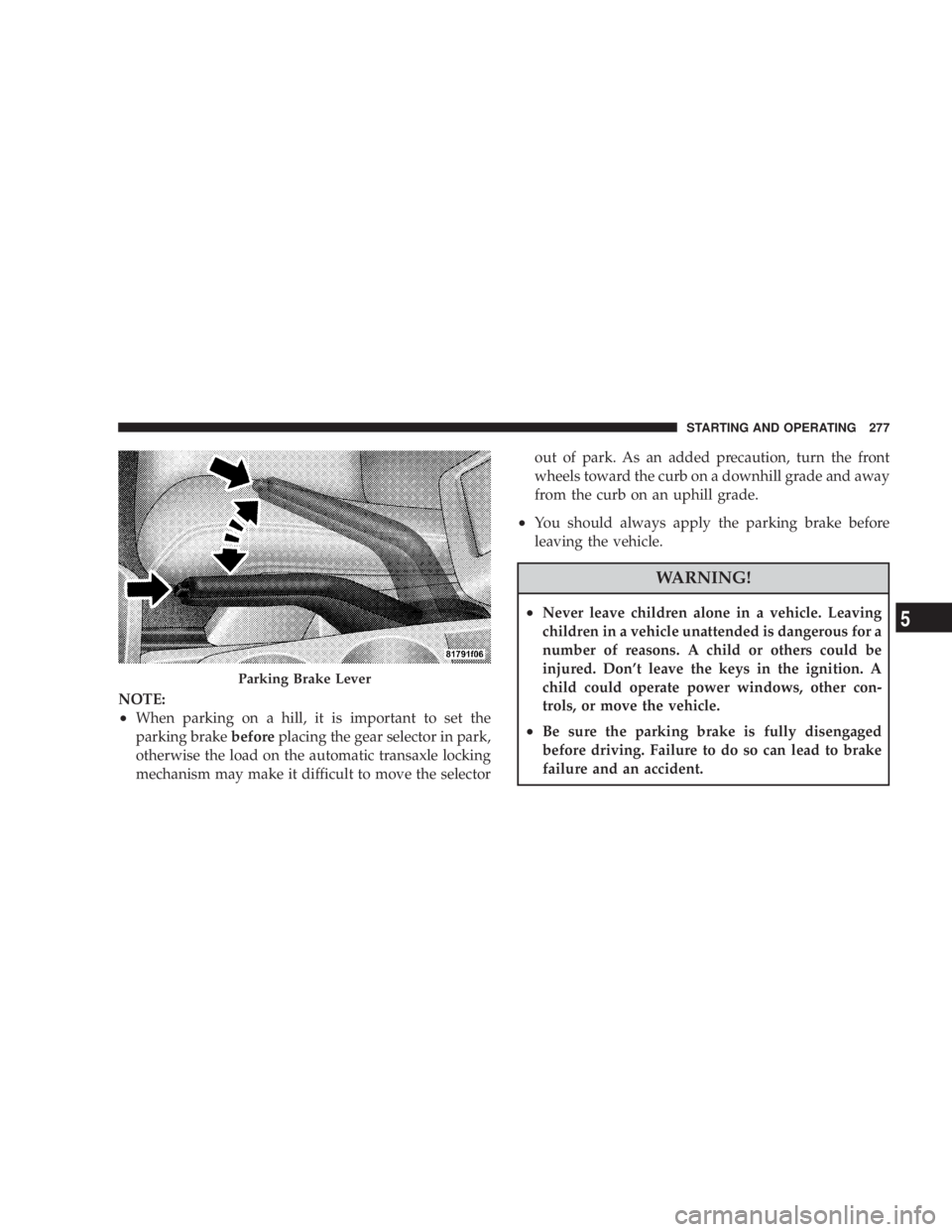
NOTE:
² When parking on a hill, it is important to set the
parking brake before placing the gear selector in park,
otherwise the load on the automatic transaxle locking
mechanism may make it difficult to move the selector out of park. As an added precaution, turn the front
wheels toward the curb on a downhill grade and away
from the curb on an uphill grade.
² You should always apply the parking brake before
leaving the vehicle.
WARNING!² Never leave children alone in a vehicle. Leaving
children in a vehicle unattended is dangerous for a
number of reasons. A child or others could be
injured. Don't leave the keys in the ignition. A
child could operate power windows, other con-
trols, or move the vehicle.
² Be sure the parking brake is fully disengaged
before driving. Failure to do so can lead to brake
failure and an accident.Parking Brake Lever STARTING AND OPERATING 277
5
Page 280 of 467
BRAKE SYSTEM
Your vehicle is equipped with power assisted brakes as
standard equipment. In the event power assist is lost for
any reason (i.e., repeated brake applications with the
engine off) the brakes will still function. However, the
effort required to brake the vehicle will be much greater
than that required with the power system operating.
WARNING!Riding the brakes can lead to brake failure and
possibly an accident. Driving with your foot resting
or riding on the brake pedal can result in abnormally
high brake temperatures, excessive lining wear, and
possible brake damage. You wouldn't have your full
braking capacity in an emergency. This light monitors various brake functions,
including brake fluid level and parking brake
application. If the brake light turns on, it may
indicate that the parking brake is applied, that
the brake fluid level is low, or that there is a problem with
the anti-lock brake system.
WARNING!Driving a vehicle with the brake light on is danger-
ous. A significant decrease in braking performance or
vehicle stability during braking may occur. It will
take you longer to stop the vehicle or will make your
vehicle harder to control. You could have an accident.
Have the vehicle checked immediately.278 STARTING AND OPERATING
Page 342 of 467
WARNING!Improper towing can lead to an injury accident.
Follow these guidelines to make your trailer towing
as safe as possible:
Make certain that the load is secured in the trailer
and that it will not shift during travel. When traile-
ring cargo that is not fully secured, dynamic load
shifts can occur that may be difficult for the driver to
control. You could lose control of your vehicle and
have an accident.
² When hauling cargo, or towing a trailer, do not
overload your vehicle or trailer. Overloading can cause
a loss of control, poor performance, or damage to
brakes, axle, engine, transaxle, steering, suspension,
chassis structure, or tires. ² Safety chains must always be used between your
vehicle and trailer. Always connect the chains to the
frame or hook retainers of the vehicle hitch. Cross the
chains under the trailer tongue and allow enough
slack for turning corners.
² Vehicles with trailers should not be parked on a grade.
When parking, apply the parking brake on the tow
vehicle. Put the tow vehicle automatic transaxle in
PARK. Always, block or 9 chock 9 the trailer wheels.
² GCWR must not be exceeded.
² Total weight must be distributed between the tow
vehicle and the trailer such that the following four
ratings are not exceeded:
1. GVWR
2. GTW
3. GAWR340 STARTING AND OPERATING
Page 354 of 467
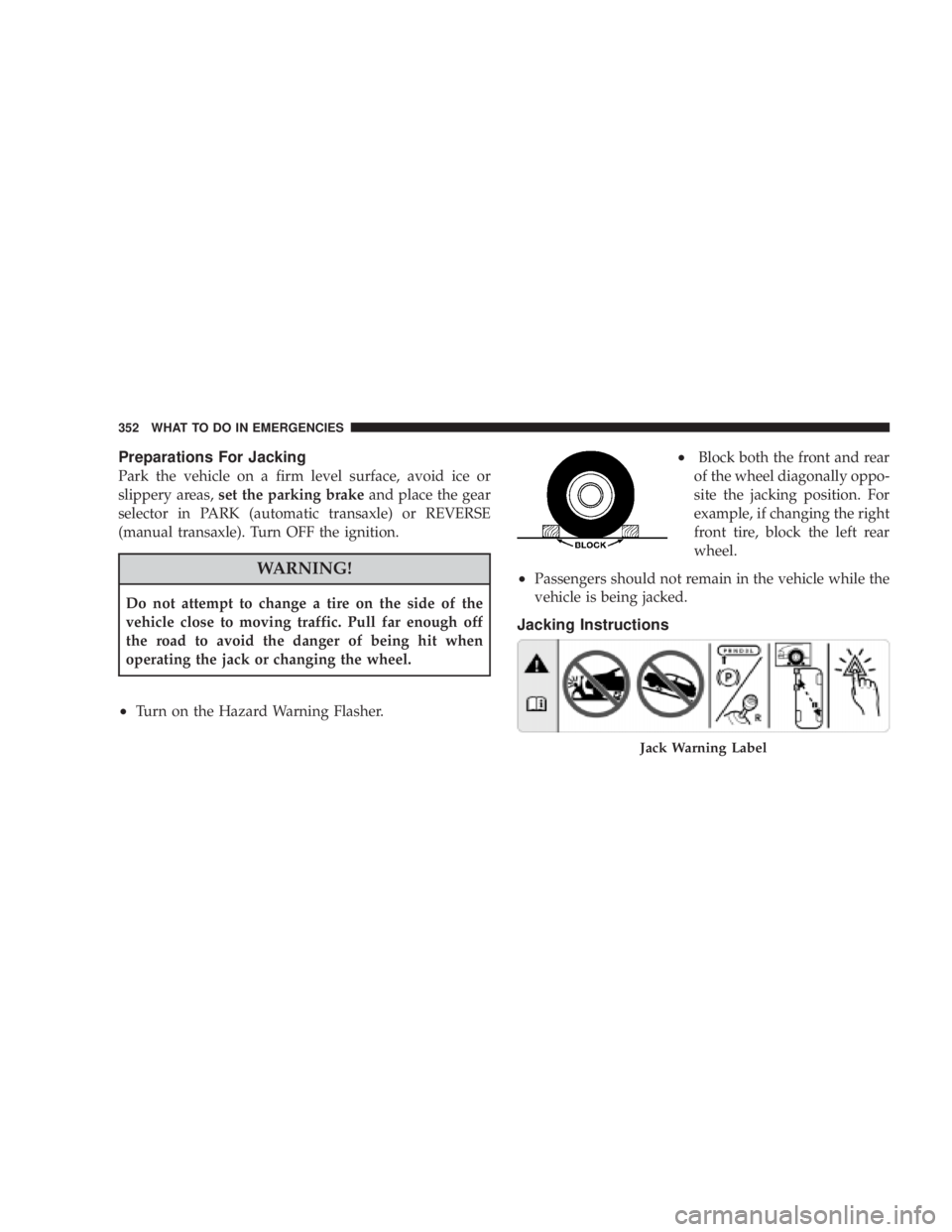
Preparations For Jacking
Park the vehicle on a firm level surface, avoid ice or
slippery areas, set the parking brake and place the gear
selector in PARK (automatic transaxle) or REVERSE
(manual transaxle). Turn OFF the ignition.
WARNING!Do not attempt to change a tire on the side of the
vehicle close to moving traffic. Pull far enough off
the road to avoid the danger of being hit when
operating the jack or changing the wheel.
² Turn on the Hazard Warning Flasher. ² Block both the front and rear
of the wheel diagonally oppo-
site the jacking position. For
example, if changing the right
front tire, block the left rear
wheel.
² Passengers should not remain in the vehicle while the
vehicle is being jacked.
Jacking Instructions
Jack Warning Label352 WHAT TO DO IN EMERGENCIES
Page 355 of 467
WARNING!Carefully follow these tire changing warnings to
help prevent personal injury or damage to your
vehicle:
² Always park on a firm, level surface as far from
the edge of the roadway as possible before raising
the vehicle.
² Block the wheel diagonally opposite the wheel to
be raised.
² Set the parking brake firmly and set an automatic
transmission in park; a manual transmission in
reverse.
² Do not let anyone sit in the vehicle when it is on a
jack. 1. Remove the scissors jack and lug wrench from the
spare wheel as an assembly. Turn the jack screw to the left
to loosen the lug wrench, and remove the wrench from
the jack assembly. WHAT TO DO IN EMERGENCIES 353
6
Page 361 of 467
1. Wear eye protection and remove any metal jewelry
such as watchbands or bracelets that might make an
inadvertent electrical contact.
2. When boosting from a battery in another vehicle, park
that vehicle within booster cable reach, but without
allowing the vehicles to touch. Set parking brake, place
automatic transaxle in PARK and turn ignition to LOCK
for both vehicles.
WARNING!Do not permit vehicles to touch each other as this
could establish a ground connection and personal
injury could result.
3. Turn off the heater, radio, and all unnecessary electri-
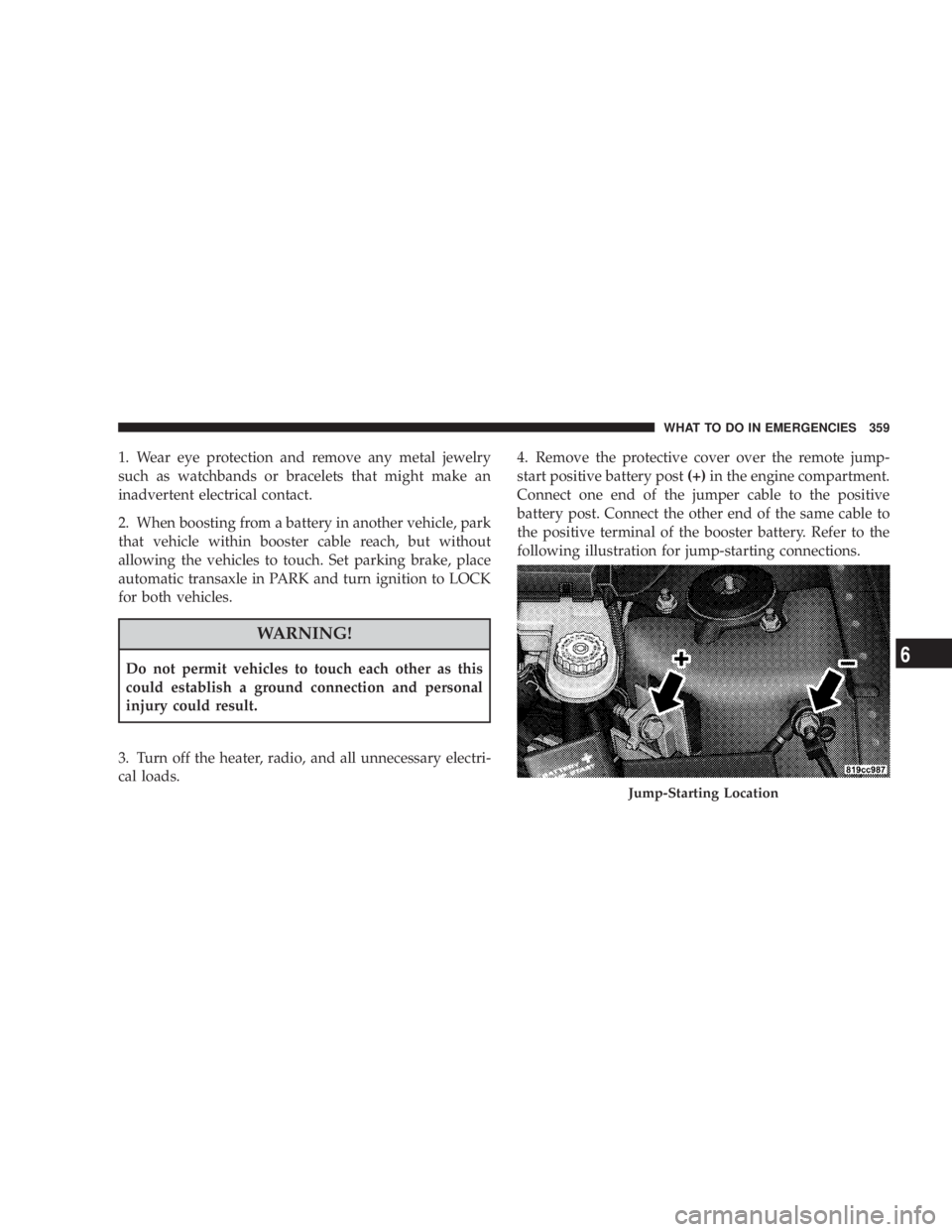
cal loads. 4. Remove the protective cover over the remote jump-
start positive battery post (+) in the engine compartment.
Connect one end of the jumper cable to the positive
battery post. Connect the other end of the same cable to
the positive terminal of the booster battery. Refer to the
following illustration for jump-starting connections.
Jump-Starting Location WHAT TO DO IN EMERGENCIES 359
6
Page 366 of 467
TOWING WITHOUT POWER Ð OVERRIDE
TRANSAXLE INTERLOCK SYSTEM
Special care must be taken when the vehicle is towed
with the ignition in the LOCK position. A dolly should be
used under the front wheels if the rear wheels are raised.
Proper towing equipment is necessary to prevent dam-
age to the vehicle.
Battery power is required to release the brake/transaxle
interlock system. There is an override system that allows
you to shift out of PARK in case of loss of power. To
activate the override system: ² Firmly apply the parking brake.
² Insert the ignition key and rotate it to the ON position.
² Remove the cupholder liner.
² Insert a key, screwdriver, or similar object into the
front hole then push and hold the manual override
release lever forward.
² While holding the release lever forward, move the
shift lever from PARK to NEUTRAL.
² Release the override.364 WHAT TO DO IN EMERGENCIES
Page 400 of 467
Fluid Level Check Ð Vehicles with 2.4L and 2.7L
Engines
Use the following procedure to check the automatic
transaxle fluid level properly:
1. Park the vehicle on level ground.
2. Run the engine at curb idle speed for a minimum of 60
seconds.
3. Apply the parking brake fully.
4. Place the gear selector momentarily in each gear
position ending with the lever in PARK.
5. Wipe the area around the dipstick clean to eliminate
the possibility of dirt entering the transaxle.
6. Remove the dipstick and determine if the fluid is hot
or cold. Hot fluid is approximately 180 F (82 C), which is
the normal operating temperature after the vehicle is driven at least 15 mi (24 km). Hot fluid cannot be held
comfortably between the fingertips. Cold fluid is at a
temperature below 80 F (27 C).
7. Wipe the dipstick clean and reinsert until seated. Then,
remove dipstick and note the reading.
a. If the fluid is hot, the reading should be in the
crosshatched area marked ªHOTº (between the upper
two holes in the dipstick).
b. If the fluid is cold, the fluid level should be between
the lower two holes in the area marked ªCOLD.º
If the fluid level is low, add sufficient fluid through the
filler (dipstick) tube to bring it to the proper level. Do not
overfill.398 MAINTAINING YOUR VEHICLE
Page 447 of 467
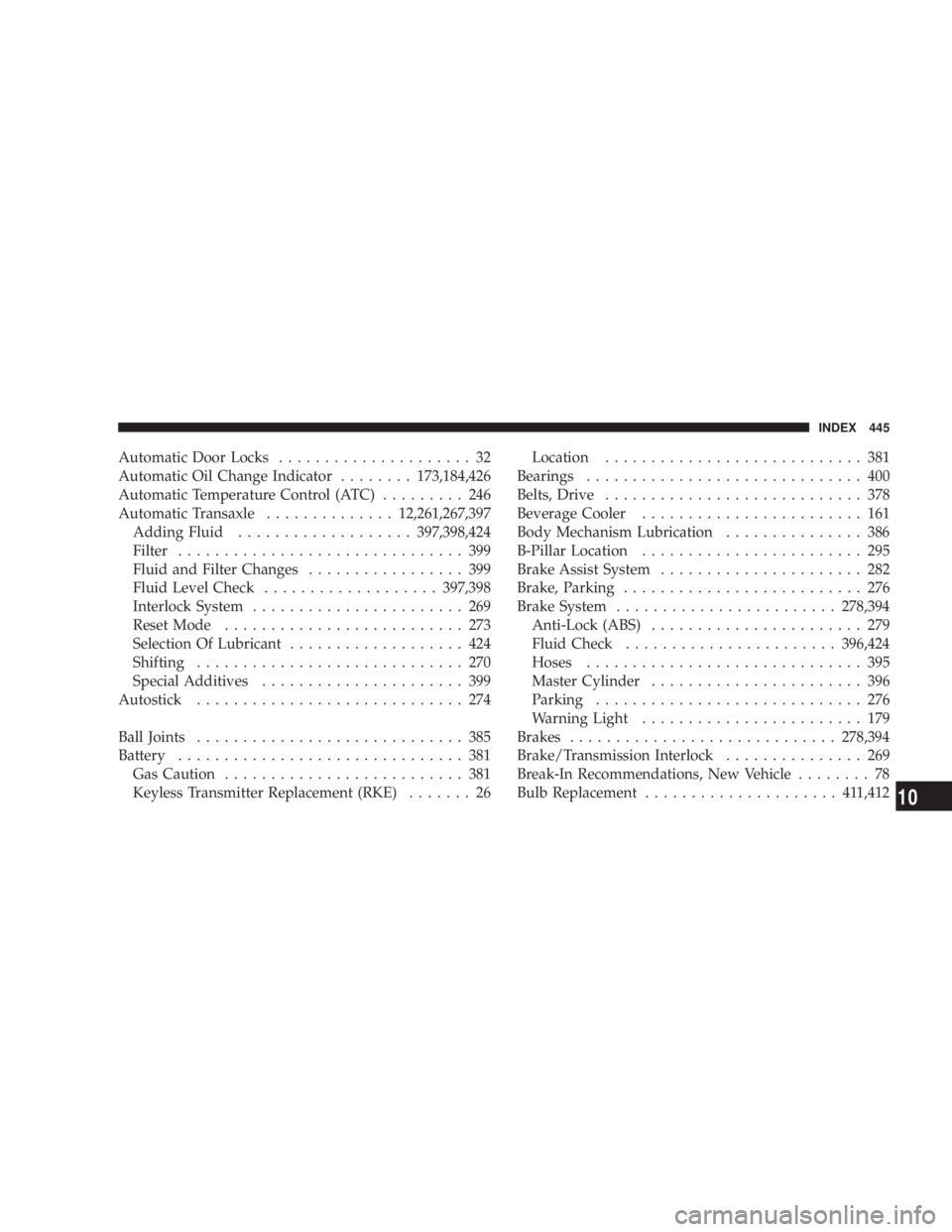
Automatic Door Locks ..................... 32
Automatic Oil Change Indicator ........ 173,184,426
Automatic Temperature Control (ATC) ......... 246
Automatic Transaxle .............. 12,261,267,397
Adding Fluid ................... 397,398,424
Filter ............................... 399
Fluid and Filter Changes ................. 399
Fluid Level Check ................... 397,398
Interlock System ....................... 269
Reset Mode .......................... 273
Selection Of Lubricant ................... 424
Shifting ............................. 270
Special Additives ...................... 399
Autostick ............................. 274
Ball Joints ............................. 385
Battery ............................... 381
Gas Caution .......................... 381
Keyless Transmitter Replacement (RKE) ....... 26 Location ............................ 381
Bearings .............................. 400
Belts, Drive ............................ 378
Beverage Cooler ........................ 161
Body Mechanism Lubrication ............... 386
B-Pillar Location ........................ 295
Brake Assist System ...................... 282
Brake, Parking .......................... 276
Brake System ........................ 278,394
Anti-Lock (ABS) ....................... 279
Fluid Check ....................... 396,424
Hoses .............................. 395
Master Cylinder ....................... 396
Parking ............................. 276
Warning Light ........................ 179
Brakes ............................. 278,394
Brake/Transmission Interlock ............... 269
Break-In Recommendations, New Vehicle ........ 78
Bulb Replacement ..................... 41 1,412 INDEX 445
10
Page 458 of 467
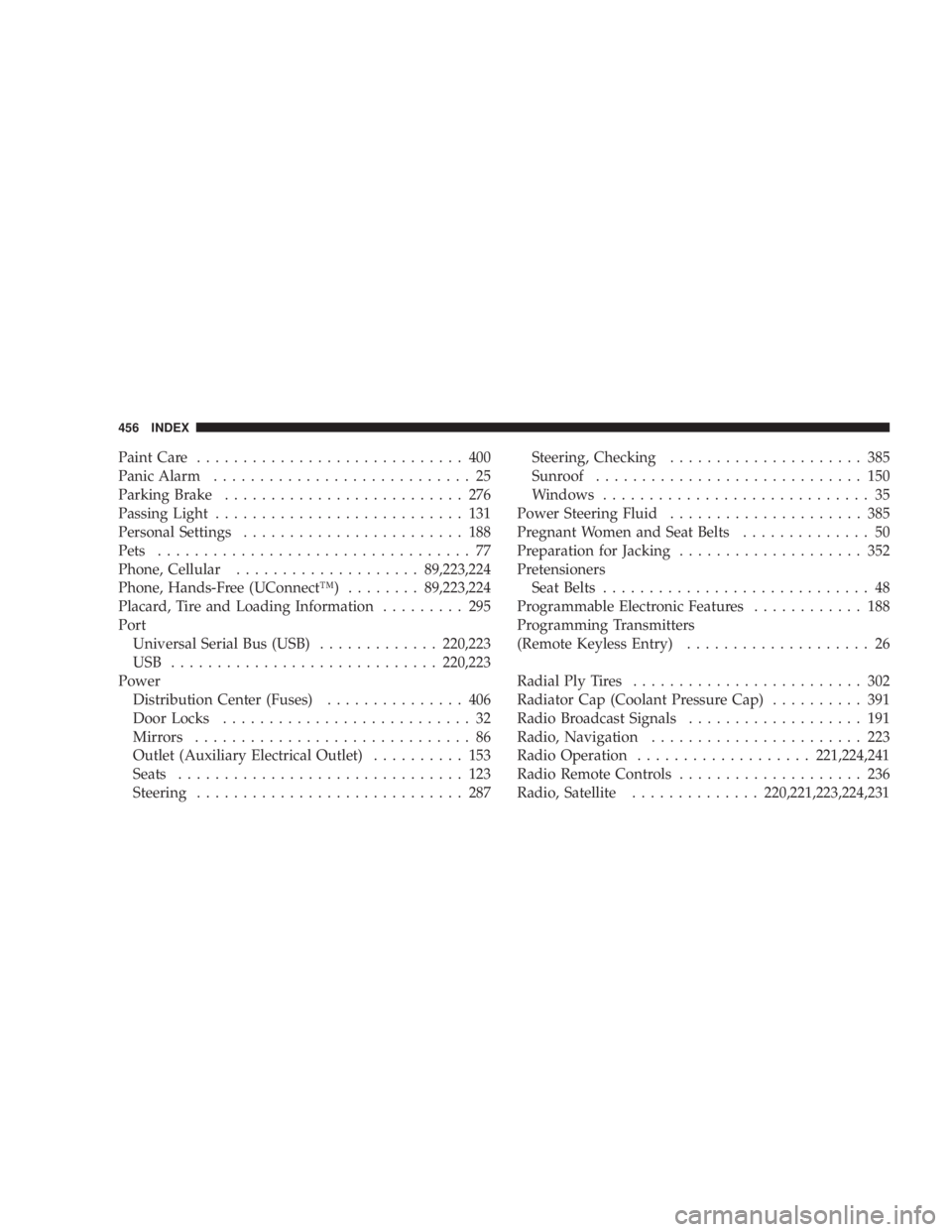
Paint Care ............................. 400
Panic Alarm ............................ 25
Parking Brake .......................... 276
Passing Light ........................... 131
Personal Settings ........................ 188
Pets .................................. 77
Phone, Cellular .................... 89,223,224
Phone, Hands-Free (UConnectŸ) ........ 89,223,224
Placard, Tire and Loading Information ......... 295
Port
Universal Serial Bus (USB) ............. 220,223
USB ............................. 220,223
Power
Distribution Center (Fuses) ............... 406
Door Locks ........................... 32
Mirrors .............................. 86
Outlet (Auxiliary Electrical Outlet) .......... 153
Seats ............................... 123
Steering ............................. 287 Steering, Checking ..................... 385
Sunroof ............................. 150
Windows ............................. 35
Power Steering Fluid ..................... 385
Pregnant Women and Seat Belts .............. 50
Preparation for Jacking .................... 352
Pretensioners
Seat Belts ............................. 48
Programmable Electronic Features ............ 188
Programming Transmitters
(Remote Keyless Entry) .................... 26
Radial Ply Tires ......................... 302
Radiator Cap (Coolant Pressure Cap) .......... 391
Radio Broadcast Signals ................... 191
Radio, Navigation ....................... 223
Radio Operation ................... 221,224,241
Radio Remote Controls .................... 236
Radio, Satellite .............. 220,221,223,224,231456 INDEX