key DODGE GRAND CARAVAN 2009 5.G Workshop Manual
[x] Cancel search | Manufacturer: DODGE, Model Year: 2009, Model line: GRAND CARAVAN, Model: DODGE GRAND CARAVAN 2009 5.GPages: 535, PDF Size: 18.61 MB
Page 335 of 535
Automatic Transaxle Ignition Interlock SystemFor electrical system malfunctions, there is an override
for the interlock system. In order to override this system,
remove the cover located to the top right of the shift lever
in the instrument panel. The override can be activated by
pressing the white-colored tab, which can be accessed
through the hole in the instrument panel. While the
override is pressed, the shift lever can be moved out of
the PARK position without pressing the brake pedal.
After operation, return the cover to its original position.
This system prevents the key from being removed unless
the shift lever is in PARK. It also prevents moving the
shift lever out of PARK, unless the key is in the ACC/ON
position, and the brake pedal is pressed.
NOTE:
If a malfunction occurs, the system will trap the
key in the ignition cylinder to warn you that this safety
feature is inoperable. The engine can be started and
stopped but the key cannot be removed until you obtain
service.
Four-Speed or Six-Speed Automatic Transaxle
NOTE: Under extreme cold temperatures (-6°F (-21°C)
and when in DRIVE, transmission operation may be
briefly limited to only second gear operation. Normal
operation will resume once the transmission temperature
has risen to a suitable level (four–speed models only).
The electronically-controlled transaxle provides a precise
shift schedule. The transaxle electronics are self-
calibrating; therefore, the first few shifts on a new vehicle
may be somewhat abrupt. This is a normal condition, and
precision shifts will develop within a few hundred miles
(kilometers).
The transaxle has only PRND shift positions. Downshifts
are carried out by an Electronic Range Select (ERS) by
moving the lever—/ + while in the DRIVE position, the
instrument cluster will display transaxle gear selection as
6, 5, 4, 3, 2, 1 for six-speed, and 4, 3, 2, 1 for four-speed
transaxles.
STARTING AND OPERATING 333 5
Page 336 of 535
Gear RangesDo not race the engine when moving the shift lever from
PARK or NEUTRAL positions into another gear range.
PARK
This range supplements the parking brake by locking the
transaxle. The engine can be started in this gear. Never
attempt to use PARK while the vehicle is in motion.
Apply the parking brake when leaving the vehicle in this
gear.
When parking on a flat surface, place the shift lever in the
PARK position first, and then apply the parking brake.
When parking on a hill, it is important to set the parking
brake before placing the shift lever in PARK, otherwise
the load on the transaxle locking mechanism may make it
difficult to move the shift lever out of PARK. As an added
precaution, turn the front wheels toward the curb on a
downhill grade, and away from the curb on an uphill
grade.
WARNING!
Never use the PARK position as a substitute for
the parking brake. Always apply the parking
brake fully when parked to guard against vehicle
movement and possible injury or damage.
Unintended movement of a vehicle could injure
those in and near the vehicle. As with all vehicles,
you should never exit a vehicle while the engine is
running. Before exiting a vehicle, you should
always move the shift lever into PARK, remove the
key from the ignition, and apply the parking
brake. Once the key is removed from the ignition,
the shift lever is locked in the PARK position,
securing the vehicle against unwanted movement.
Furthermore, you should never leave unattended
children or pets inside a vehicle.
334 STARTING AND OPERATING
Page 347 of 535
WARNING! (Continued)
Never leave children alone in a vehicle. Leaving
unattended children in a vehicle is dangerous for a
number of reasons. A child or others could be
seriously or fatally injured. Do not leave the key in
the ignition. A child could operate power win-
dows, other controls, or move the vehicle
When parking on a hill, turn the front wheels toward the
curb on a downhill grade, and away from the curb on an
uphill grade.
The parking brake should always be applied whenever
the driver is not in the vehicle.
ANTI-LOCK BRAKE SYSTEM (ABS)
The Anti-Lock Brake System (ABS) provides increased
vehicle stability and brake performance under most
braking conditions. The system operates with a separate computer to modulate hydraulic pressure to prevent
wheel lock-up and help avoid skidding on slippery
surfaces.
ABS is activated during braking under certain road or
stopping conditions. ABS-inducing conditions can in-
clude ice, snow, gravel, bumps, railroad tracks, loose
debris, or panic stops.
You may experience the following when the brake system
goes into anti-lock:
The ABS motor running (it may continue to run for a
short time after the stop)
A clicking sound of solenoid valves
Brake pedal pulsations
A slight drop or fall away of the brake pedal at the end
of the stop
STARTING AND OPERATING 345 5
Page 375 of 535
The Basic TPMS consists of the following components:
Receiver Module
Four Tire Pressure Monitoring Sensors
TPMS Telltale Warning Light
Tire Pressure Monitoring Low Tire Pressure
Warnings
The “TPMS Telltale Warning Light” will illu-
minate in the instrument cluster, and an au-
dible chime will be activated when one or more
of the four active road tire pressures are low.
Should this occur, you should stop as soon as possible,
check the inflation pressure of each tire on your vehicle,
and inflate each tire to the vehicle’s recommended cold
tire pressure value (located on the placard on the
driver’s-side B-Pillar). The system will automatically
update and the “TPMS Warning Lamp” will extinguish
once the updated tire pressures have been received. NOTE:
The vehicle may need to be driven for up to
20 minutes above 15 mph (25 km/h) to receive this
information.
The “TPMS Warning Lamp” will flash on and off for
75 seconds, and remain on solid when a system fault is
detected. The system fault will also sound a chime. If the
ignition key is cycled, this sequence will repeat, provid-
ing the system fault still exists. The “TPMS Warning
Lamp” will turn off when the fault condition no longer
exists. A system fault can occur with any of the following
scenarios:
1. Jamming due to electronic devices or driving next to
facilities emitting the same radio frequencies as the TPMS
sensors.
2. Installing some form of aftermarket window tinting
that affects radio wave signals. STARTING AND OPERATING 373
5
Page 376 of 535
3. Accumulation of excessive snow and/or ice around
the wheels or wheel housings.
4. Using tire chains on the vehicle.
5. Using wheels/tires not equipped with TPMS sensors.
Vehicles with Compact Spare
1. The compact spare tire (if equipped) does not have a
TPMS sensor. Therefore the TPMS will not monitor the
pressure in the compact spare tire.
2. If you install the compact spare tire in place of a road
tire that has a pressure below the low-pressure warning
limit, upon the next ignition key cycle, a chime will
sound and the “TPMS Telltale Warning Light” will turn
on.
3. After driving for up to 20 minutes above 15 mph
(25 km/h), the “TPMS Telltale Warning Light” will flash
on and off for 75 seconds and then remain on solid.4. For each subsequent ignition key cycle, a chime will
sound and the “TPMS Telltale Warning Light” will re-
main on solid.
5. Once you repair or replace the original road tire and
reinstall it on the vehicle in place of the compact spare
tire, the TPMS will automatically update, and the “TPMS
Telltale Warning Light” will turn off as long as no tire
pressure is below the low-pressure warning limit in any
of the four active road tires. The vehicle may need to be
driven for up to 20 minutes above 15 mph (25 km/h) for
the TPMS to receive this information.
Premium System — If Equipped
The TPMS uses wireless technology with wheel rim-
mounted electronic sensors to monitor tire pressure lev-
els. Sensors mounted to each wheel as part of the valve
stem transmit tire pressure readings to the Receiver
Module.
374 STARTING AND OPERATING
Page 378 of 535
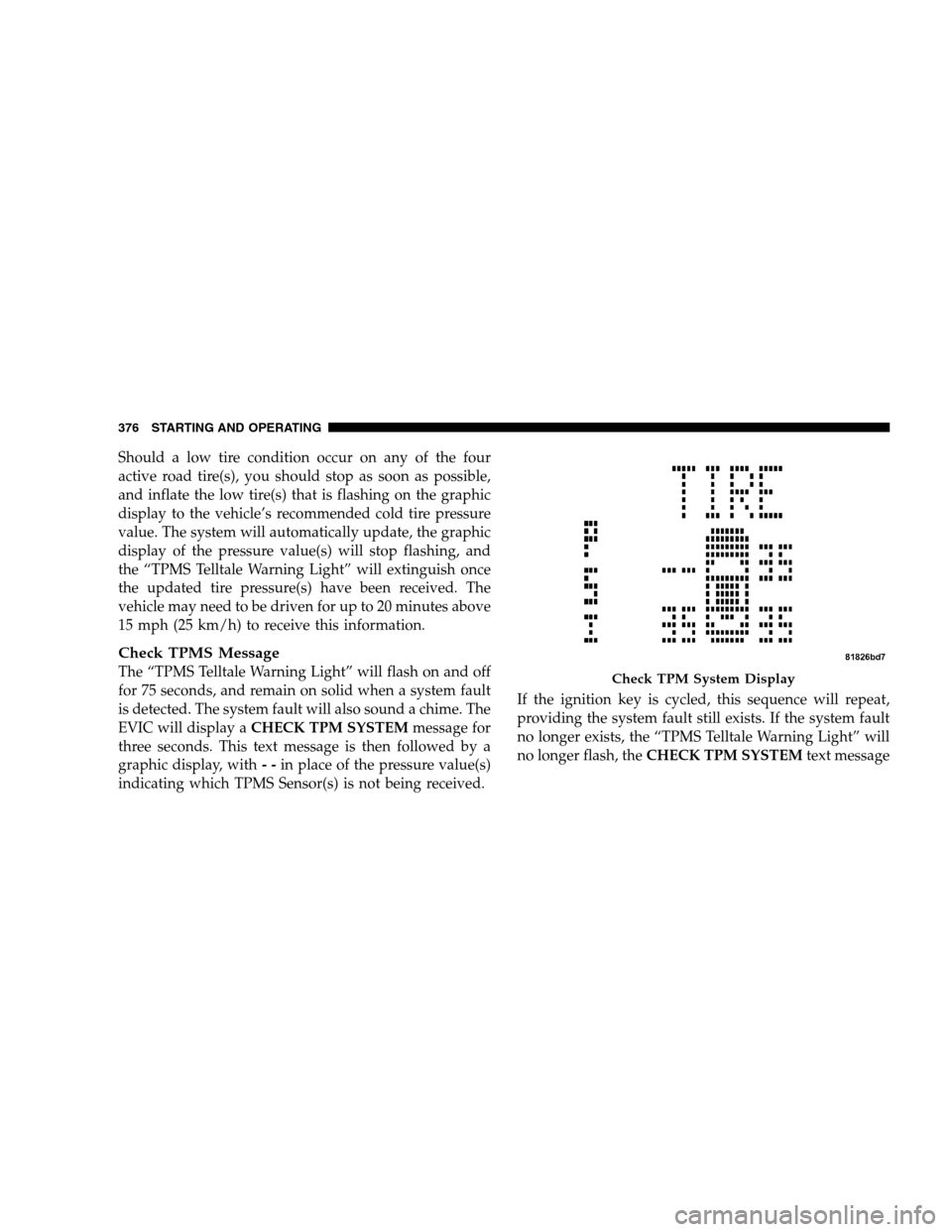
Should a low tire condition occur on any of the four
active road tire(s), you should stop as soon as possible,
and inflate the low tire(s) that is flashing on the graphic
display to the vehicle’s recommended cold tire pressure
value. The system will automatically update, the graphic
display of the pressure value(s) will stop flashing, and
the “TPMS Telltale Warning Light” will extinguish once
the updated tire pressure(s) have been received. The
vehicle may need to be driven for up to 20 minutes above
15 mph (25 km/h) to receive this information.
Check TPMS Message
The “TPMS Telltale Warning Light” will flash on and off
for 75 seconds, and remain on solid when a system fault
is detected. The system fault will also sound a chime. The
EVIC will display aCHECK TPM SYSTEM message for
three seconds. This text message is then followed by a
graphic display, with - -in place of the pressure value(s)
indicating which TPMS Sensor(s) is not being received. If the ignition key is cycled, this sequence will repeat,
providing the system fault still exists. If the system fault
no longer exists, the “TPMS Telltale Warning Light” will
no longer flash, the
CHECK TPM SYSTEM text message Check TPM System Display
376 ST
ARTING AND OPERATING
Page 379 of 535
will not be present, and a pressure value will be dis-
played instead of dashes. A system fault can occur by any
of the following scenarios:
1. Jamming due to electronic devices or driving next to
facilities emitting the same radio frequencies as the TPMS
sensors.
2. Installing some form of aftermarket window tinting
that affects radio wave signals.
3. Accumulation of excessive snow and/or ice around
the wheels or wheel housings.
4. Using tire chains on the vehicle.
5. Using wheels/tires not equipped with TPMS sensors.
Vehicles with Compact Spare
1. The compact spare tire (if equipped) does not have a
TPMS. Therefore, the TPMS will not monitor the pressure
in the compact spare tire.2. If you install the compact spare tire in place of a road
tire that has a pressure below the low-pressure warning
limit, upon the next ignition key cycle, the “TPMS Telltale
Warning Light” will remain on, a chime will sound, and
the EVIC will still display a flashing pressure value in the
graphic display.
3. After driving the vehicle for up to 20 minutes above
15 mph (25 km/h), the “TPMS Telltale Warning Light”
will flash on and off for 75 seconds and then remain on
solid. In addition, the EVIC will display a CHECK TPM
SYSTEM message for three seconds and then display
dashes (- -) in place of the pressure value.
4. For each subsequent ignition key cycle, a chime will
sound, the “TPMS Telltale Warning Light” will flash on
and off for 75 seconds and then remain on solid, and the
EVIC will display a CHECK TPM SYSTEM message for
three seconds and then display dashes (- -) in place of the
pressure value.
STARTING AND OPERATING 377 5
Page 411 of 535
WHAT TO DO IN EMERGENCIESCONTENTS
m
Hazard Warning Flasher . . . . . . . . . . . . . . . 410
m If Your Engine Overheats . . . . . . . . . . . . . . . 410
m Jacking And Tire Changing . . . . . . . . . . . . . . 411
▫ Jack Location . . . . . . . . . . . . . . . . . . . . . . 412 m
Jump-Starting Procedure . . . . . . . . . . . . . . . 424
m Freeing A Stuck Vehicle . . . . . . . . . . . . . . . . 427
m Towing A Disabled Vehicle . . . . . . . . . . . . . . 427
▫ Towing With The Ignition Key . . . . . . . . . . 427 6
Page 429 of 535
FREEING A STUCK VEHICLEIf your vehicle becomes stuck in mud, sand or snow, it
can often be moved by a rocking motion. Turn your
steering wheel right and left to clear the area around the
front wheels. Then move the shift lever back and forth
between REVERSE and DRIVE. Using minimal accelera-
tor pedal pressure to maintain the rocking motion, with-
out spinning the wheels, is most effective.
WARNING!
Fast spinning tires can be dangerous. Forces gener-
ated by excessive wheel speeds may cause tire dam-
age or failure. A tire could explode and injure some-
one. Do not spin your vehicle’s wheels faster than
35 mph (55 km/h) when you are stuck. Do not let
anyone near a spinning wheel, no matter what the
speed. CAUTION!
Revving the engine or spinning the wheels too fast
may lead to transmission overheating and failure. It
can also damage the tires. Do not spin the wheels
above 35 mph (55 km/h).
TOWING A DISABLED VEHICLE
Towing With The Ignition Key
Your vehicle may be towed under the following condi-
tions:
The shift lever must be in NEUTRAL.
The distance to be traveled must not exceed 100 miles
(160 km).
The towing speed must not exceed 44 mph (72 km/h).
WHAT TO DO IN EMERGENCIES 427
6
Page 431 of 535
If it is necessary to use the accessories while being towed
(wipers, defrosters, etc.), the key must be in the ON
position, not the ACC position. Make certain the trans-
mission remains in NEUTRAL.
Towing Without The Ignition Key
Special care must be taken when the vehicle is towed
with the ignition in the OFF position. The only approved
method of towing without the ignition key is with a
flatbed truck. Proper towing equipment is necessary to
prevent damage to the vehicle.
Towing This Vehicle Behind Another Vehicle (Flat
Towing With All Four Wheels On The Ground)
Flat towing of vehicles equipped with an automatic
transmission, is only permitted within the limitations
described in this section.
Towing This Vehicle Behind Another Vehicle With
A Tow Dolly
The manufacturerdoes not recommend that you tow a
front wheel drive vehicle on a tow dolly. Vehicle damage
may occur.
WHAT TO DO IN EMERGENCIES 429 6