tow DODGE GRAND CARAVAN 2020 Workshop Manual
[x] Cancel search | Manufacturer: DODGE, Model Year: 2020, Model line: GRAND CARAVAN, Model: DODGE GRAND CARAVAN 2020Pages: 380, PDF Size: 14.92 MB
Page 191 of 380
STARTING AND OPERATING189
Towing Requirements — Trailer Lights And
Wiring
Whenever you pull a trailer, regardless of the
trailer size, stoplights and turn signals on the
trailer are required for motoring safety.
The Trailer Tow Package may include a four- and
seven-pin wiring harness. Use a factory
approved trailer harness and connector.
NOTE:
Do not cut or splice wiring into the vehicle’s
wiring harness.
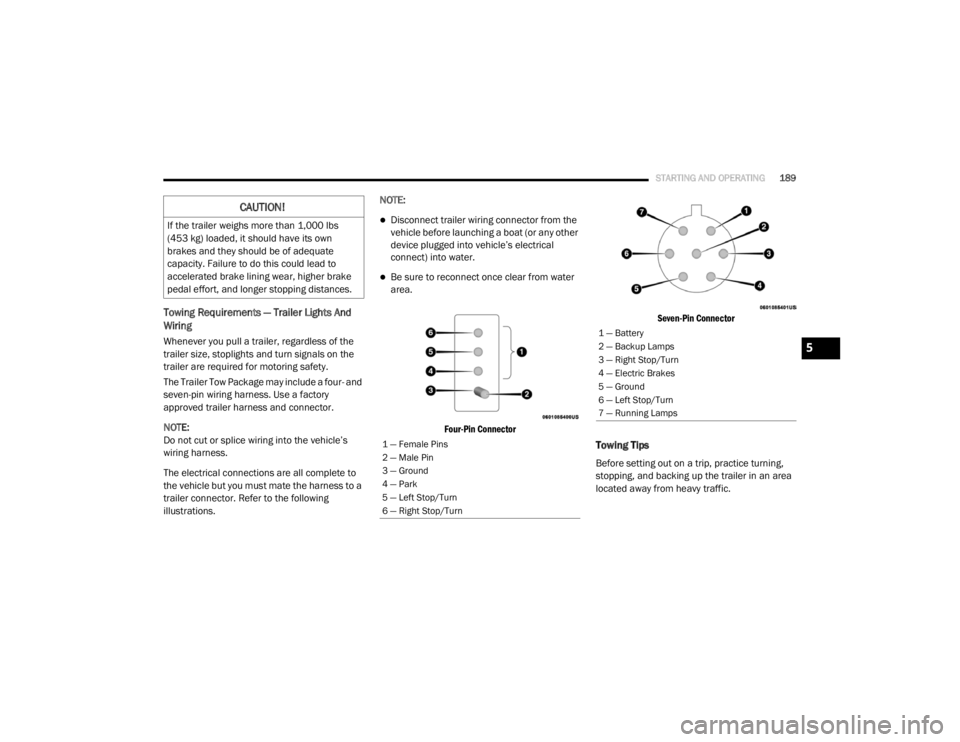
The electrical connections are all complete to
the vehicle but you must mate the harness to a
trailer connector. Refer to the following
illustrations. NOTE:
Disconnect trailer wiring connector from the
vehicle before launching a boat (or any other
device plugged into vehicle’s electrical
connect) into water.
Be sure to reconnect once clear from water
area.
Four-Pin Connector Seven-Pin Connector
Towing Tips
Before setting out on a trip, practice turning,
stopping, and backing up the trailer in an area
located away from heavy traffic.
CAUTION!
If the trailer weighs more than 1,000 lbs
(453 kg) loaded, it should have its own
brakes and they should be of adequate
capacity. Failure to do this could lead to
accelerated brake lining wear, higher brake
pedal effort, and longer stopping distances.
1 — Female Pins
2 — Male Pin
3 — Ground
4 — Park
5 — Left Stop/Turn
6 — Right Stop/Turn
1 — Battery
2 — Backup Lamps
3 — Right Stop/Turn
4 — Electric Brakes
5 — Ground
6 — Left Stop/Turn
7 — Running Lamps
5
20_RT_OM_EN_USC_t.book Page 189
Page 192 of 380

190STARTING AND OPERATING
Automatic Transmission
The DRIVE range can be selected when towing.
However, if frequent shifting occurs while in
DRIVE, use the Electronic Range Select (ERS)
shift control to manually select a lower gear
range.
NOTE:
Using a lower gear range while operating the
vehicle under heavy loading conditions, will
improve performance and extend transmission
life by reducing excessive shifting and heat
buildup. This action will also provide better
engine braking.
If you REGULARLY tow a trailer for more than
45 minutes of continuous operation, then
change the transmission fluid and filter as
specified for "police, taxi, fleet, or frequent
trailer towing." Refer to the “Maintenance Plan”
for the proper maintenance intervals. Electronic Range Select (ERS)When using the ERS shift control, select the
highest gear that allows for adequate perfor
-
mance and avoids frequent downshifts. For
example, choose “4” if the desired speed can
be maintained. Choose “3” or “2” if needed
to maintain the desired speed.
To prevent excess heat generation, avoid
continuous driving at high RPM. Reduce
vehicle speed as necessary to avoid
extended driving at high RPM. Return to a
higher gear range or vehicle speed when
grade and road conditions allow.
Speed Control — If Equipped
Do not use on hilly terrain or with heavy
loads.
When using the Speed Control, if you experi -
ence speed drops greater than 10 mph
(16 km/h), disengage until you can get back
to cruising speed.
Use Speed Control in flat terrain and with
light loads to maximize fuel efficiency.
Cooling System
To reduce potential for engine and transmission
overheating, take the following actions:
City Driving
In city traffic — while stopped, place the trans -
mission in NEUTRAL, but do not increase
engine idle speed.
Highway Driving
Reduce speed.
Temporarily turn off air conditioning.
20_RT_OM_EN_USC_t.book Page 190
Page 193 of 380

STARTING AND OPERATING191
(Continued)
RECREATIONAL TOWING (BEHIND MOTORHOME, ETC.)
Towing This Vehicle Behind Another Vehicle
NOTE:
When towing your vehicle, always follow applicable state and provincial laws. Contact state and provincial Highway Safety offices for additional details.
Recreational Towing — All Models
Recreational towing is allowed ONLY if the front
wheels are OFF the ground. This may be
accomplished using a tow dolly or vehicle
trailer. If using a tow dolly, follow this procedure:
1. Properly secure the dolly to the tow vehicle, following the dolly manufacturer's
instructions.
2. Drive the front wheels onto the tow dolly.
3. Firmly apply the parking brake. Place the
transmission in PARK.
4. Properly secure the front wheels to the dolly, following the dolly manufacturer's
instructions.
5. Release the parking brake.
Towing Condition Wheels OFF The GroundAll
Models
Flat Tow
NONE NOT
ALLOWED
Dolly Tow Front
OK
Rear NOT
ALLOWED
On Trailer ALLBEST
METHOD
CAUTION!
DO NOT flat tow this vehicle. Damage to the
drivetrain will result. If this vehicle requires
towing, make sure the drive wheels are OFF
the ground.
5
20_RT_OM_EN_USC_t.book Page 191
Page 194 of 380

192STARTING AND OPERATING
DRIVING TIPS
Driving On Slippery Surfaces
Information in this section will aid in safe
controlled launches in adverse conditions.
Acceleration
Rapid acceleration on snow covered, wet, or
other slippery surfaces may cause the driving
wheels to pull erratically to the right or left. This
phenomenon occurs when there is a difference
in the surface traction under the front (driving)
wheels.
Traction
When driving on wet or slushy roads, it is
possible for a wedge of water to build up
between the tire and road surface. This is
hydroplaning and may cause partial or
complete loss of vehicle control and stopping
ability. To reduce this possibility, the following
precautions should be observed:
Slow down during rainstorms or when the
roads are slushy.
Slow down if the road has standing water or
puddles.
Replace the tires when tread wear indicators
first become visible.
Keep tires properly inflated.
Maintain sufficient distance between your
vehicle and the vehicle in front of you to avoid
a collision in a sudden stop.
Driving Through Water
Driving through water more than a few
inches/centimeters deep will require extra
caution to ensure safety and prevent damage to
your vehicle.
Flowing/Rising Water
Towing this vehicle in violation of the above
requirements can cause severe transmis -
sion damage. Damage from improper
towing is not covered under the New
Vehicle Limited Warranty.
Do not use a bumper mounted clamp-on
tow bar on your vehicle. The bumper face
bar will be damaged.
CAUTION! (Continued)WARNING!
Rapid acceleration on slippery surfaces is
dangerous. Unequal traction can cause
sudden pulling of the front wheels. You could
lose control of the vehicle and possibly have a
collision. Accelerate slowly and carefully
whenever there is likely to be poor traction
(ice, snow, wet, mud, loose sand, etc.).
WARNING!
Do not drive on or across a road or path
where water is flowing and/or rising (as in
storm run-off). Flowing water can wear away
the road or path's surface and cause your
vehicle to sink into deeper water.
Furthermore, flowing and/or rising water can
carry your vehicle away swiftly. Failure to
follow this warning may result in injuries that
are serious or fatal to you, your passengers,
and others around you.
20_RT_OM_EN_USC_t.book Page 192
Page 202 of 380

200IN CASE OF EMERGENCY
J2120 Amp Blue –Front/Rear Washer
J22 25 Amp Clear –Sunroof Module
M1 –15 Amp Blue Rear Center Brake Lamp/Brake Switch
M2 –20 Amp Yellow Front Fog Lamps
M3 –20 Amp Yellow Vacuum Pump Motor
M5 –25 Amp Clear Inverter
M6 –20 Amp Yellow Power Outlet #1 (ACC), Rain Sensor, Cigar Lighter
(Instrument Panel or with Console Rear)
M7 –20 Amp Yellow Power Outlet #2 (BATT/ACC SELECT) – Center Seat or with
Console Rear
M8 –20 Amp Yellow Front Heated Seat — If Equipped
M9 –20 Amp Yellow Rear Heated Seat — If Equipped
M10 –15 Amp BlueIgnition Off Draw — Video System, Satellite Radio, DVD,
Hands-Free Module, Universal Garage Door Opener, Vanity
Lamp, Streaming Video Module — If Equipped
M11 –10 Amp Red Climate Control System
M12 –30 Amp Green Amplifier/Radio
M13 –20 Amp Yellow Instrument Cluster, SIREN, Clock Module, Multifunction
Control Switch – If Equipped
M14 –20 Amp Yellow Trailer Tow — If Equipped
M15 –20 Amp Yellow Rear View Mirror, Instrument Cluster, Multifunction Control
Switch, Tire Pressure Monitor
Cavity
Cartridge Fuse Mini-Fuse Description
20_RT_OM_EN_USC_t.book Page 200
Page 205 of 380
IN CASE OF EMERGENCY203
Jack Location
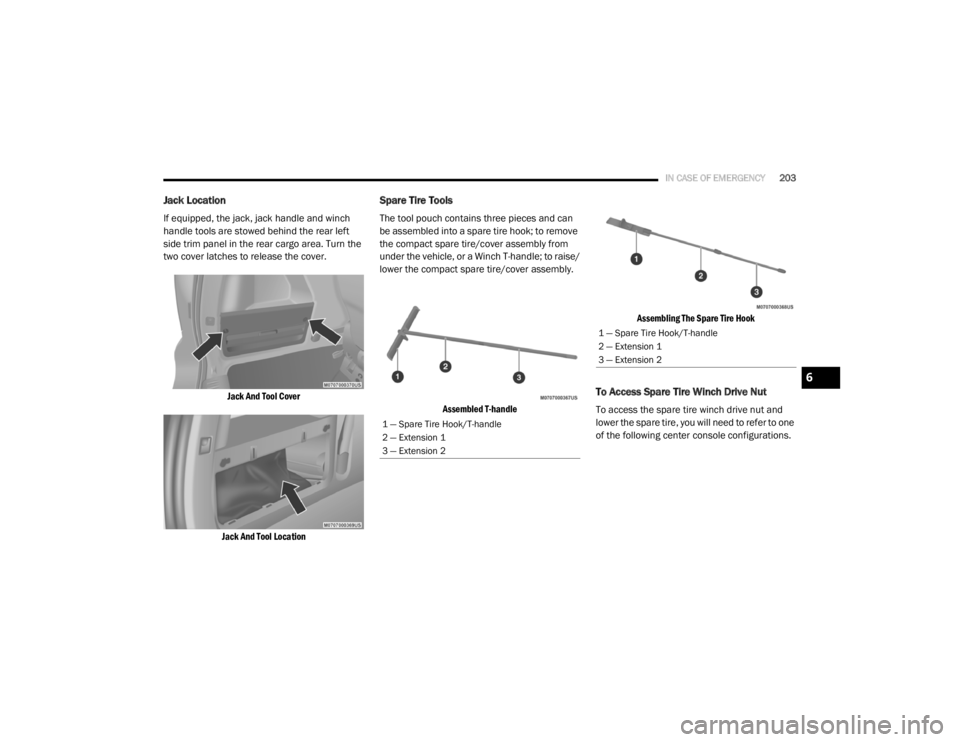
If equipped, the jack, jack handle and winch
handle tools are stowed behind the rear left
side trim panel in the rear cargo area. Turn the
two cover latches to release the cover.
Jack And Tool Cover
Jack And Tool Location
Spare Tire Tools
The tool pouch contains three pieces and can
be assembled into a spare tire hook; to remove
the compact spare tire/cover assembly from
under the vehicle, or a Winch T-handle; to raise/
lower the compact spare tire/cover assembly.
Assembled T-handle Assembling The Spare Tire Hook
To Access Spare Tire Winch Drive Nut
To access the spare tire winch drive nut and
lower the spare tire, you will need to refer to one
of the following center console configurations.
1 — Spare Tire Hook/T-handle
2 — Extension 1
3 — Extension 2
1 — Spare Tire Hook/T-handle
2 — Extension 1
3 — Extension 2
6
20_RT_OM_EN_USC_t.book Page 203
Page 207 of 380
IN CASE OF EMERGENCY205
Spare Tire Removal
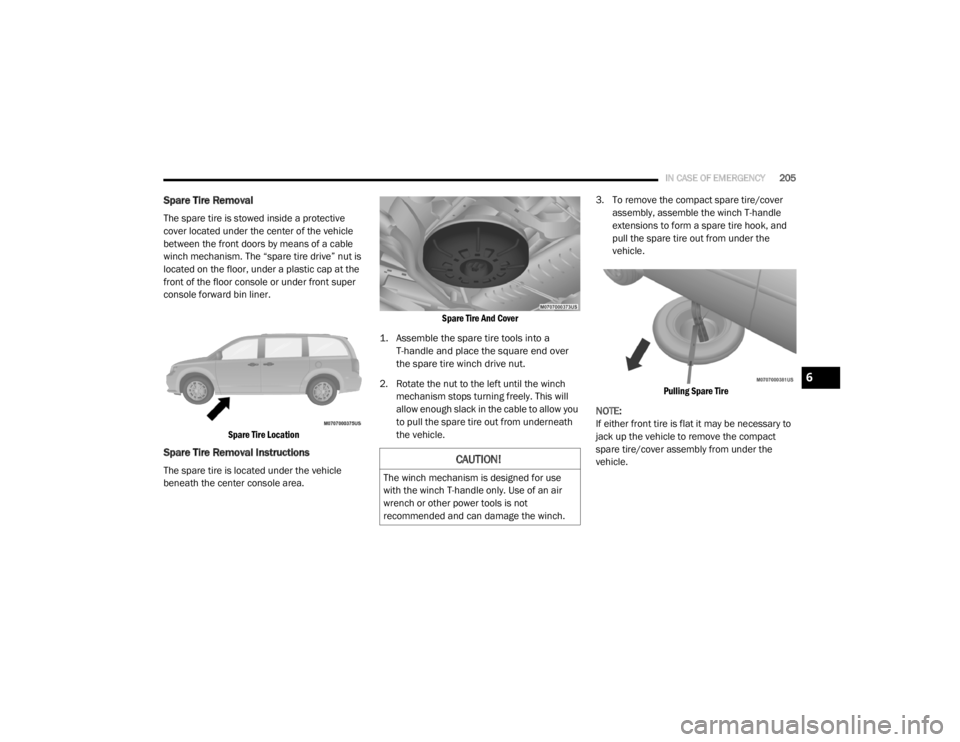
The spare tire is stowed inside a protective
cover located under the center of the vehicle
between the front doors by means of a cable
winch mechanism. The “spare tire drive” nut is
located on the floor, under a plastic cap at the
front of the floor console or under front super
console forward bin liner.
Spare Tire Location
Spare Tire Removal Instructions
The spare tire is located under the vehicle
beneath the center console area.
Spare Tire And Cover
1. Assemble the spare tire tools into a T-handle and place the square end over
the spare tire winch drive nut.
2. Rotate the nut to the left until the winch mechanism stops turning freely. This will
allow enough slack in the cable to allow you
to pull the spare tire out from underneath
the vehicle. 3. To remove the compact spare tire/cover
assembly, assemble the winch T-handle
extensions to form a spare tire hook, and
pull the spare tire out from under the
vehicle.
Pulling Spare Tire
NOTE:
If either front tire is flat it may be necessary to
jack up the vehicle to remove the compact
spare tire/cover assembly from under the
vehicle.CAUTION!
The winch mechanism is designed for use
with the winch T-handle only. Use of an air
wrench or other power tools is not
recommended and can damage the winch.
6
20_RT_OM_EN_USC_t.book Page 205
Page 209 of 380
IN CASE OF EMERGENCY207
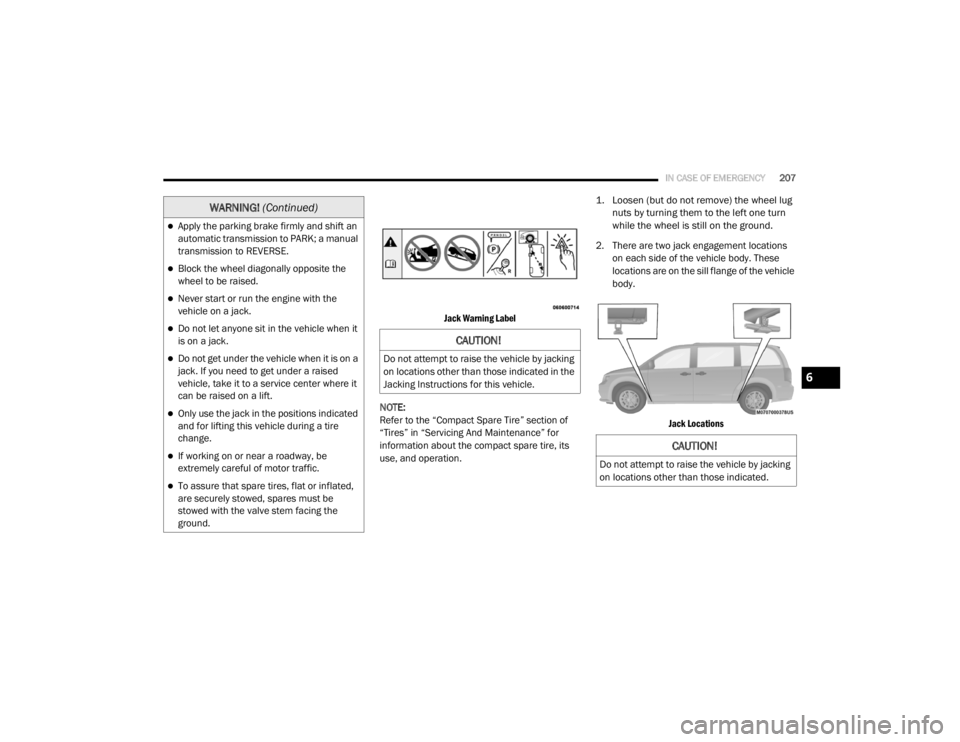
Jack Warning Label
NOTE:
Refer to the “Compact Spare Tire” section of
“Tires” in “Servicing And Maintenance” for
information about the compact spare tire, its
use, and operation.
1. Loosen (but do not remove) the wheel lug
nuts by turning them to the left one turn
while the wheel is still on the ground.
2. There are two jack engagement locations on each side of the vehicle body. These
locations are on the sill flange of the vehicle
body.
Jack Locations
Apply the parking brake firmly and shift an
automatic transmission to PARK; a manual
transmission to REVERSE.
Block the wheel diagonally opposite the
wheel to be raised.
Never start or run the engine with the
vehicle on a jack.
Do not let anyone sit in the vehicle when it
is on a jack.
Do not get under the vehicle when it is on a
jack. If you need to get under a raised
vehicle, take it to a service center where it
can be raised on a lift.
Only use the jack in the positions indicated
and for lifting this vehicle during a tire
change.
If working on or near a roadway, be
extremely careful of motor traffic.
To assure that spare tires, flat or inflated,
are securely stowed, spares must be
stowed with the valve stem facing the
ground.
WARNING! (Continued)
CAUTION!
Do not attempt to raise the vehicle by jacking
on locations other than those indicated in the
Jacking Instructions for this vehicle.
CAUTION!
Do not attempt to raise the vehicle by jacking
on locations other than those indicated.
6
20_RT_OM_EN_USC_t.book Page 207
Page 211 of 380
IN CASE OF EMERGENCY209
5. Remove the wheel lug nuts. For vehicles
with wheel covers, remove the cover from
the wheel by hand by holding down the
wheel and pulling on convenient features
on the cover. Do not pry the wheel cover off.
Then pull the wheel off the hub.
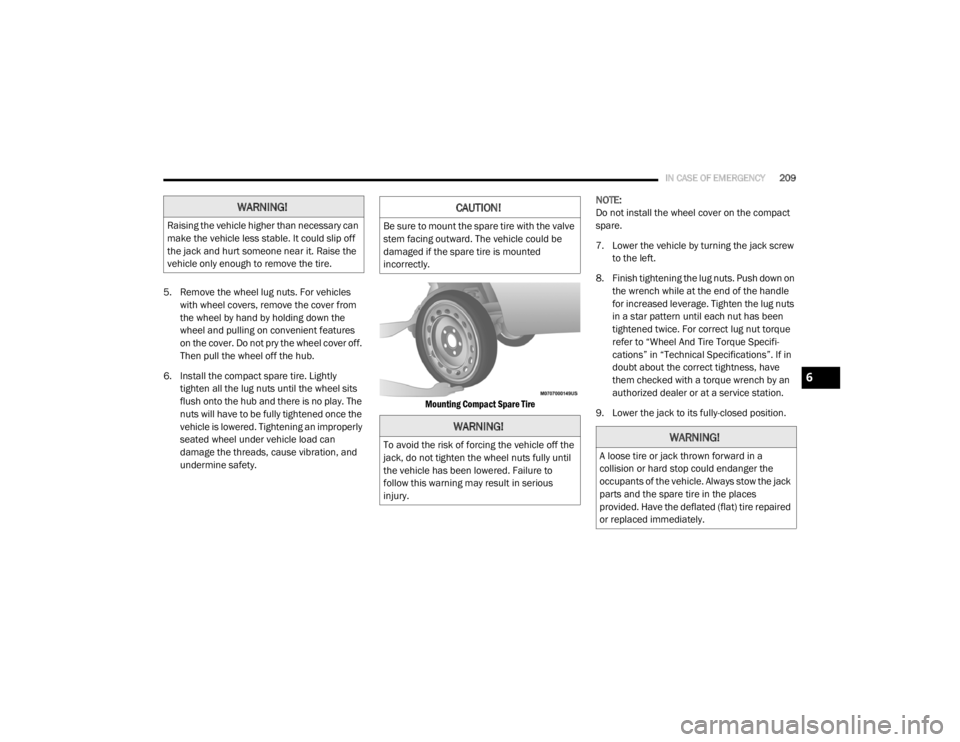
6. Install the compact spare tire. Lightly tighten all the lug nuts until the wheel sits
flush onto the hub and there is no play. The
nuts will have to be fully tightened once the
vehicle is lowered. Tightening an improperly
seated wheel under vehicle load can
damage the threads, cause vibration, and
undermine safety.
Mounting Compact Spare Tire
NOTE:
Do not install the wheel cover on the compact
spare.
7. Lower the vehicle by turning the jack screw
to the left.
8. Finish tightening the lug nuts. Push down on the wrench while at the end of the handle
for increased leverage. Tighten the lug nuts
in a star pattern until each nut has been
tightened twice. For correct lug nut torque
refer to “Wheel And Tire Torque Specifi -
cations” in “Technical Specifications”. If in
doubt about the correct tightness, have
them checked with a torque wrench by an
authorized dealer or at a service station.
9. Lower the jack to its fully-closed position.
WARNING!
Raising the vehicle higher than necessary can
make the vehicle less stable. It could slip off
the jack and hurt someone near it. Raise the
vehicle only enough to remove the tire.
CAUTION!
Be sure to mount the spare tire with the valve
stem facing outward. The vehicle could be
damaged if the spare tire is mounted
incorrectly.
WARNING!
To avoid the risk of forcing the vehicle off the
jack, do not tighten the wheel nuts fully until
the vehicle has been lowered. Failure to
follow this warning may result in serious
injury.WARNING!
A loose tire or jack thrown forward in a
collision or hard stop could endanger the
occupants of the vehicle. Always stow the jack
parts and the spare tire in the places
provided. Have the deflated (flat) tire repaired
or replaced immediately.
6
20_RT_OM_EN_USC_t.book Page 209
Page 212 of 380

210IN CASE OF EMERGENCY
10. Place the deflated (flat) tire and compact
spare tire cover assembly in the rear cargo
area. Do not stow the deflated tire in the
compact spare tire location. Have the
full-sized tire repaired or replaced, as soon
as possible.
11. Stow the cable and wheel spacer before driving the vehicle. Reassemble the winch
handle extensions to form a “T” and fit the
winch T-handle over the drive nut. Rotate
the nut to the right until the winch
mechanism clicks at least three times.
NOTE:
Refer to the “Spare Tire Tools” section for
instructions on assembling the T-handle.
12. Stow the jack, jack handle and winch handle tools back in the stowage
compartment.
13. Check the compact spare tire pressure as soon as possible. Correct the tire pressure,
as required.Securing The Compact Spare Tire
1. Assemble the winch handle extensions to form a T-handle and fit the winch T-handle
over the drive nut. Rotate the nut to the left
until the winch mechanism stops turning
freely. This will allow enough slack in the
cable to allow you to pull the wheel spacer
out from under the vehicle.
2. Assemble the winch handle extensions to form the spare tire hook, and pull the wheel
spacer from under the vehicle. 3. Turn the compact spare tire so that the
valve stem is down, and place the tire into
the compact spare tire/cover assembly.
Slide the wheel spacer through the center of
the wheel and compact spare tire/cover
assembly, so that the two retainer tabs
snap out and engage the compact spare tire
cover on the opposite side.
WARNING!
A loose compact spare tire/cover assembly,
thrown forward in a collision or hard stop
could endanger the occupants of the vehicle.
Always stow the compact spare tire with the
cover assembly in the place provided.
CAUTION!
The winch mechanism is designed for use
with the winch T-handle only. Use of an air
wrench or other power tools is not
recommended and can damage the winch.
WARNING!
Verify that both retainer tabs of the wheel
spacer have been properly extended through
the center of the wheel and compact spare
tire/cover assembly. Failure to properly
engage both retainer tabs could result in loss
of the compact spare tire and cover
assembly, which will cause vehicle damage
and may cause loss of vehicle control and
serious personal injury.
CAUTION!
The compact spare tire/cover assembly must
be used when the compact spare tire is
stored. Failure to use this cover could
drastically reduce the life of the compact
spare tire.
20_RT_OM_EN_USC_t.book Page 210