lock DODGE MAGNUM SRT 2007 1.G Repair Manual
[x] Cancel search | Manufacturer: DODGE, Model Year: 2007, Model line: MAGNUM SRT, Model: DODGE MAGNUM SRT 2007 1.GPages: 380, PDF Size: 6.63 MB
Page 194 of 380
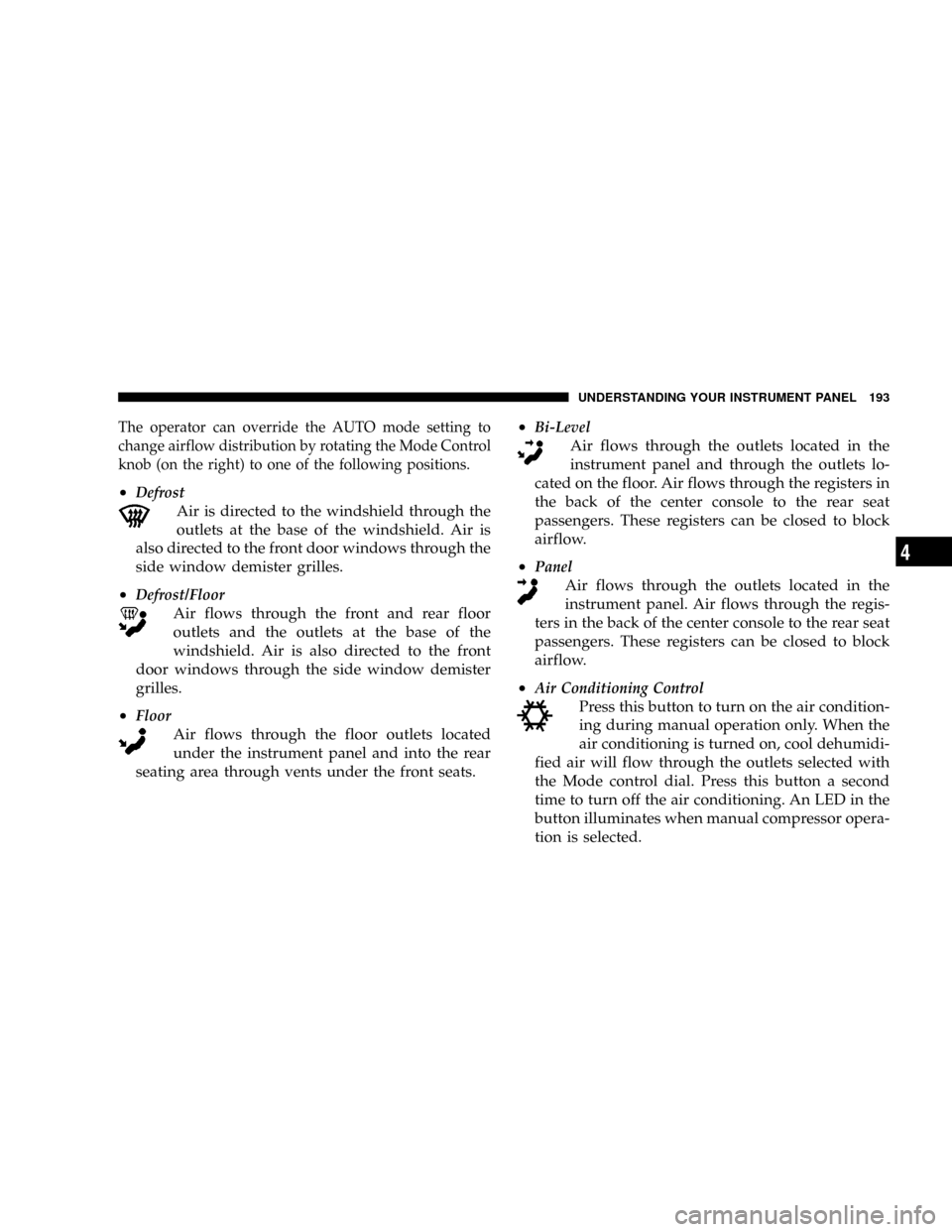
The operator can override the AUTO mode setting to
change airflow distribution by rotating the Mode Control
knob (on the right) to one of the following positions.
²Defrost
Air is directed to the windshield through the
outlets at the base of the windshield. Air is
also directed to the front door windows through the
side window demister grilles.
²
Defrost/Floor
Air flows through the front and rear floor
outlets and the outlets at the base of the
windshield. Air is also directed to the front
door windows through the side window demister
grilles.
²
Floor
Air flows through the floor outlets located
under the instrument panel and into the rear
seating area through vents under the front seats.²
Bi-Level
Air flows through the outlets located in the
instrument panel and through the outlets lo-
cated on the floor. Air flows through the registers in
the back of the center console to the rear seat
passengers. These registers can be closed to block
airflow.
²
Panel
Air flows through the outlets located in the
instrument panel. Air flows through the regis-
ters in the back of the center console to the rear seat
passengers. These registers can be closed to block
airflow.
²
Air Conditioning Control
Press this button to turn on the air condition-
ing during manual operation only. When the
air conditioning is turned on, cool dehumidi-
fied air will flow through the outlets selected with
the Mode control dial. Press this button a second
time to turn off the air conditioning. An LED in the
button illuminates when manual compressor opera-
tion is selected.
UNDERSTANDING YOUR INSTRUMENT PANEL 193
4
Page 195 of 380
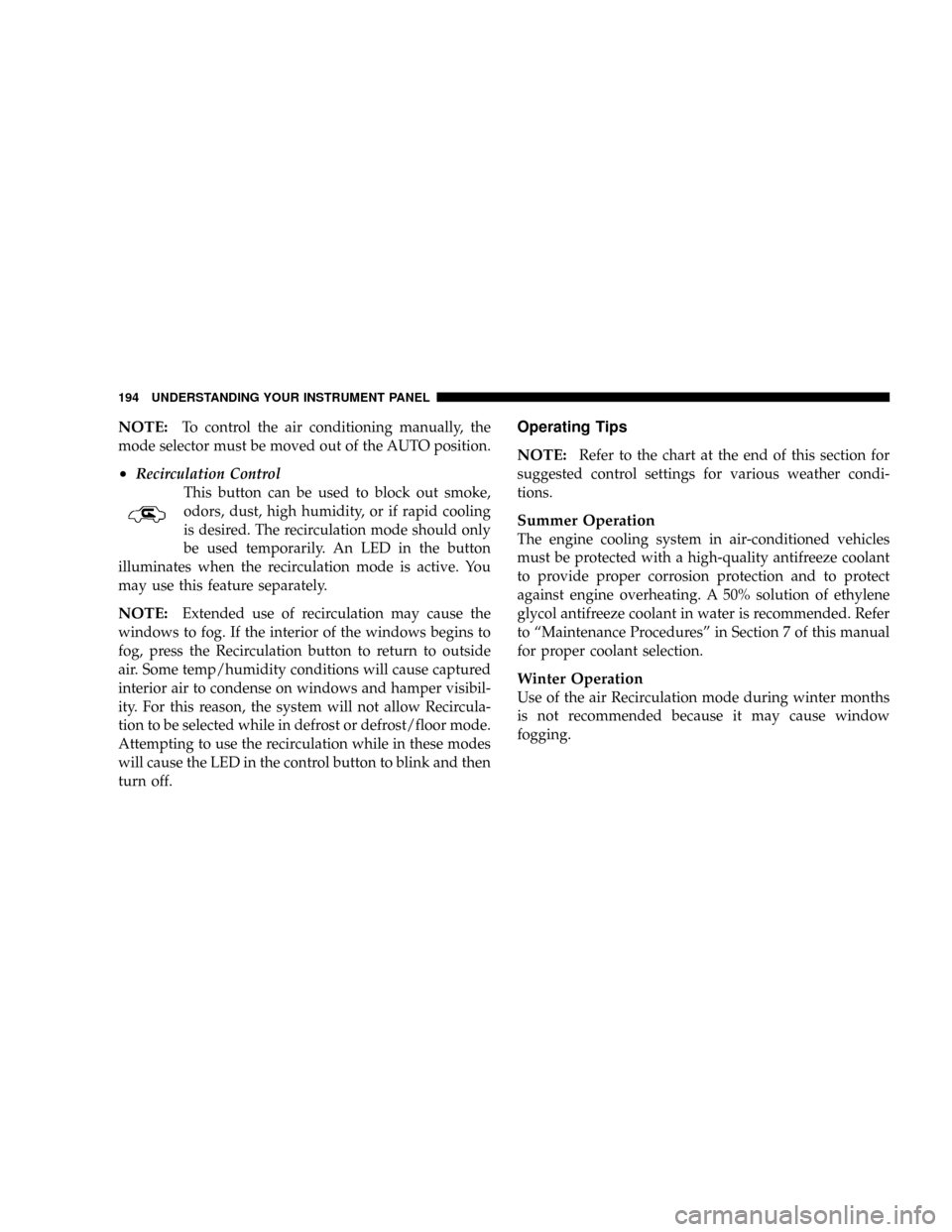
NOTE:To control the air conditioning manually, the
mode selector must be moved out of the AUTO position.
²Recirculation Control
This button can be used to block out smoke,
odors, dust, high humidity, or if rapid cooling
is desired. The recirculation mode should only
be used temporarily. An LED in the button
illuminates when the recirculation mode is active. You
may use this feature separately.
NOTE:Extended use of recirculation may cause the
windows to fog. If the interior of the windows begins to
fog, press the Recirculation button to return to outside
air. Some temp/humidity conditions will cause captured
interior air to condense on windows and hamper visibil-
ity. For this reason, the system will not allow Recircula-
tion to be selected while in defrost or defrost/floor mode.
Attempting to use the recirculation while in these modes
will cause the LED in the control button to blink and then
turn off.
Operating Tips
NOTE:
Refer to the chart at the end of this section for
suggested control settings for various weather condi-
tions.
Summer Operation
The engine cooling system in air-conditioned vehicles
must be protected with a high-quality antifreeze coolant
to provide proper corrosion protection and to protect
against engine overheating. A 50% solution of ethylene
glycol antifreeze coolant in water is recommended. Refer
to ªMaintenance Proceduresº in Section 7 of this manual
for proper coolant selection.
Winter Operation
Use of the air Recirculation mode during winter months
is not recommended because it may cause window
fogging.
194 UNDERSTANDING YOUR INSTRUMENT PANEL
Page 202 of 380
STARTING AND OPERATING
CONTENTS
mStarting Procedures....................204
NAutomatic Transmission................205
NNormal Starting......................205
NExtremely Cold Weather
(Below220ÉF Or229ÉC)................205
NIf Engine Fails To Start.................205
NAfter Starting........................206
mEngine Block Heater Ð If Equipped........207
mAutomatic Transmission.................207
NAutomatic Transmission Ð General
Information.........................208
NBrake/Transmission Shift Interlock System . . . 210N5 Speed Automatic Transmission..........211
mAutoStickt...........................215
NAutoSticktOperation..................215
NAutoSticktGeneral Information...........216
mDriving On Slippery Surfaces.............216
NAcceleration.........................216
NTraction............................216
mParking Brake.........................217
mBrake System.........................219
NAnti-Lock Brake System................219
mPower Steering........................221
5
Page 203 of 380
mElectronic Brake Control System...........222
NABS (Anti-Lock Brake System)............222
NTCS (Traction Control System)............223
NBAS (Brake Assist System)...............223
NESP (Electronic Stability Program).........224
NSynchronizing ESP....................227
NESP/BAS Malfunction Indicator Light And
ESP/TCS Indicator Light................227
mTire Safety Information..................228
NTire Markings........................228
NTire Identification Number (TIN)..........232
NTire Loading And Tire Pressure...........233
mTires Ð General Information..............237
NTire Pressure.........................237
NTire Inflation Pressures.................238
NRadial-Ply Tires......................240NTire Spinning........................240
NTread Wear Indicators..................241
NLife Of Tire.........................241
NReplacement Tires.....................242
NAlignment And Balance.................243
mTire Chains...........................243
mSnow Tires...........................244
mTire Rotation Recommendations...........245
NTire Rotation Ð Standard Tires............245
NTire Rotation Ð All Season Tires..........246
mTire Pressure Monitor System (TPMS) Ð If
Equipped
............................246
NBase System Ð If Equipped..............249
NPremium System Ð If Equipped..........250
NGeneral Information...................253
mFuel Requirements.....................253
202 STARTING AND OPERATING
Page 206 of 380
Automatic Transmission
The gear selector must be in the NEUTRAL or PARK
position before you can start the engine. Apply the brakes
before shifting into any driving gear.
Normal Starting
Normal Starting of either a cold or a warm engine is
obtained without pumping or depressing the accelerator
pedal. Turn the key to the ªSTARTº position and release
when the engine starts. If the engine has not started
within 3 seconds, slightly depress the accelerator pedal
while continuing to crank. If the engine fails to start
within 15 seconds, turn the key to the ªLOCKº position,
wait 10 to 15 seconds, then repeat the normal starting
procedure.
Extremely Cold Weather (below220ÉF or229ÉC)
To insure reliable starting at these temperatures, use of an
externally powered electric engine block heater (available
from your dealer) is recommended.
If Engine Fails To Start
If the engine fails to start after you have followed the
ªNORMAL STARTINGº procedure, it may be flooded.
Push the accelerator pedal all the way to the floor and
hold it there while cranking the engine. This should clear
any excess fuel in case the engine is flooded.
CAUTION!
To prevent damage to the starter, do not crank the
engine for more than 15 seconds at a time. Wait 10 to
15 seconds before trying again.
STARTING AND OPERATING 205
5
Page 208 of 380
ENGINE BLOCK HEATER Ð IF EQUIPPED
The engine block heater warms engine coolant and
permits quicker starts in cold weather. Connect the cord
to a standard 110-115 volt AC electrical outlet with a
grounded, three-wire extension cord.
The engine block heater cord is routed under the hood on
the driver side of the vehicle. It has a removable cap that
is located on the driver side of the Integrated Power
Module.
WARNING!
Remember to disconnect the cord before driving.
Damage to the 110-115 volt electrical cord could
cause electrocution.
AUTOMATIC TRANSMISSION
CAUTION!
Damage to the transmission may occur if the follow-
ing precautions are not observed:
²Shift into PARK only after the vehicle has come to
a complete stop.
²Shift into or out of REVERSE only after the
vehicle has come to a complete stop and the
engine is at idle speed.
²Do not shift from REVERSE, PARK, or NEUTRAL
into any forward gear when the engine is above
idle speed.
²Before shifting into any gear, make sure your foot
is firmly on the brake pedal.
STARTING AND OPERATING 207
5
Page 209 of 380
WARNING!
It is dangerous to shift the selector lever out of ªPº or
ªNº if the engine speed is higher than idle speed. If
your foot is not firmly on the brake pedal, the
vehicle could accelerate quickly forward or in re-
verse. You could lose control of the vehicle and hit
someone or something. Only shift into gear when
the engine is idling normally and when your right
foot is firmly on the brake pedal.
Automatic Transmission Ð General Information
The automatic transmission selects individual gears au-
tomatically, dependent upon:
²Altitude
²Vehicle Loading
²Driving Style
²Selector lever position
²Accelerator position
²Vehicle speedThe gear shifting process is continuously adapted, de-
pendent on the driving style, the driving situation and
the road characteristics.
NOTE:
²
After selecting any driving position, wait a moment to
allow the gear to engage fully before accelerating,
especially when the engine is cold.
²If there is a need to restart the engine, be sure to cycle
the key to the LOCK position before restarting. Trans-
mission engagement may be delayed up to 10 seconds
after restart if the key is not cycled to the LOCK
position first.
²The electronically controlled transmission provides a
precise shift schedule. The transmission electronics are
self-calibrating. Therefore, the first few shifts on a new
vehicle may be somewhat abrupt or soft until after the
break-in period. This is a normal condition, and pre-
cision shifts will develop within a few shift cycles.
208 STARTING AND OPERATING
Page 210 of 380
The selector lever is automatically locked while in the P
(Park) position. To move the selector lever out of the P
(Park) position, the brake pedal must be firmly depressed
before the shift lock will release.
Shift the selector lever to the desired position only when
the engine is idling normally and the brake pedal is
applied. Do not release the brake until ready to drive. The
vehicle may otherwise accelerate quickly when the selec-
tor lever is in D (Drive) or R (Reverse) position.WARNING!
Unintended movement of a vehicle could injure
those in and near the vehicle. As with all vehicles,
you should never exit a vehicle while the engine is
running. Before exiting a vehicle, you should always
shift the vehicle into P (Park), remove the key from
the ignition, and apply the parking brake. Once the
key is removed from the ignition, the transmission
selector lever is locked in the P (Park) position,
securing the vehicle against unwanted movement.
Furthermore, you should never leave children unat-
tended inside a vehicle.
Over Temperature Mode
The transmission electronics constantly monitor the
transmission oil temperature. If the transmission exceeds
normal operating temperature, the transmission will
change the way it shifts to help control the condition.
This may result in a slightly different feeling or response
during normal operation in D (Drive) position. After the
transmission cools down, it will return to normal opera-
tion.
STARTING AND OPERATING 209
5
Page 211 of 380
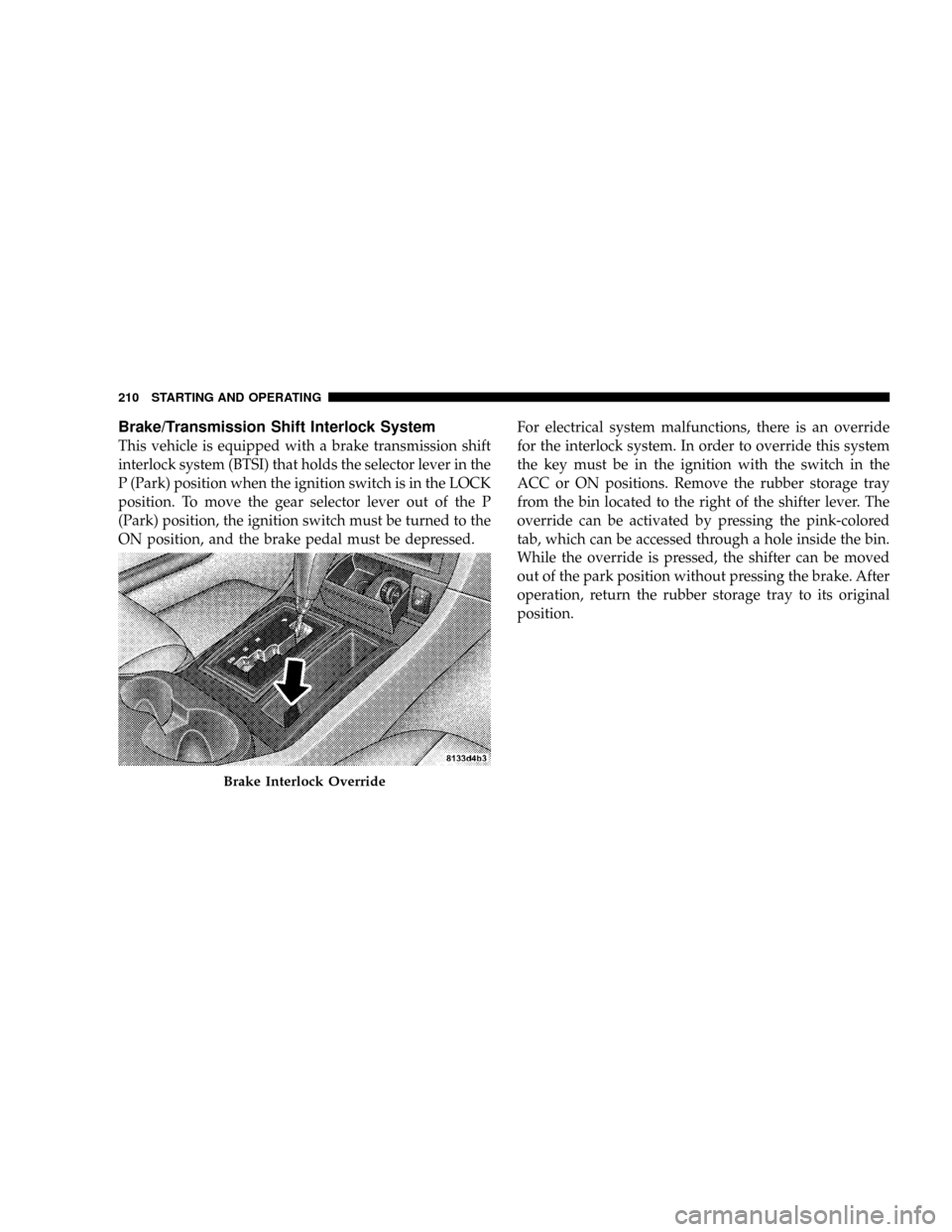
Brake/Transmission Shift Interlock System
This vehicle is equipped with a brake transmission shift
interlock system (BTSI) that holds the selector lever in the
P (Park) position when the ignition switch is in the LOCK
position. To move the gear selector lever out of the P
(Park) position, the ignition switch must be turned to the
ON position, and the brake pedal must be depressed.For electrical system malfunctions, there is an override
for the interlock system. In order to override this system
the key must be in the ignition with the switch in the
ACC or ON positions. Remove the rubber storage tray
from the bin located to the right of the shifter lever. The
override can be activated by pressing the pink-colored
tab, which can be accessed through a hole inside the bin.
While the override is pressed, the shifter can be moved
out of the park position without pressing the brake. After
operation, return the rubber storage tray to its original
position.
Brake Interlock Override
210 STARTING AND OPERATING
Page 212 of 380
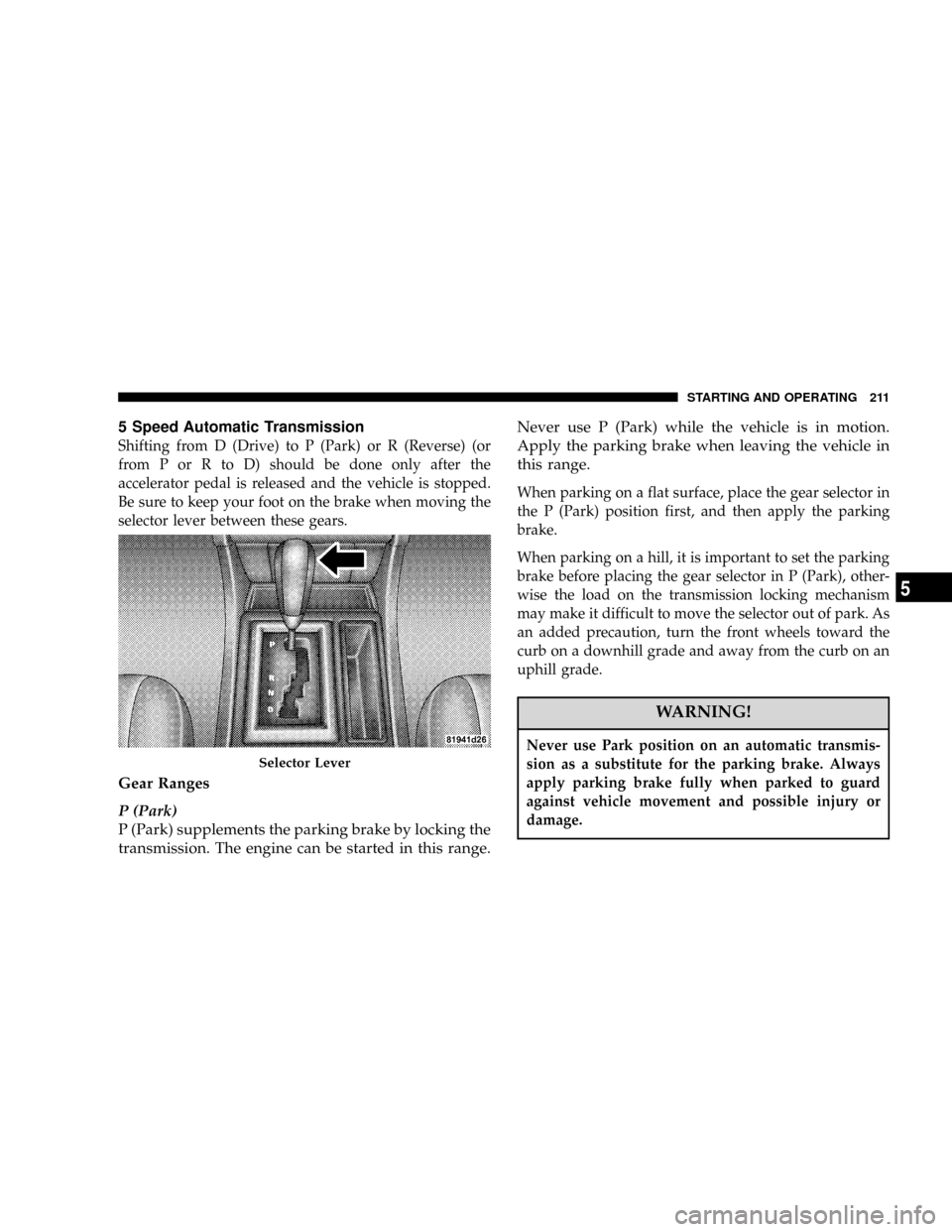
5 Speed Automatic Transmission
Shifting from D (Drive) to P (Park) or R (Reverse) (or
from P or R to D) should be done only after the
accelerator pedal is released and the vehicle is stopped.
Be sure to keep your foot on the brake when moving the
selector lever between these gears.
Gear Ranges
P (Park)
P (Park) supplements the parking brake by locking the
transmission. The engine can be started in this range.Never use P (Park) while the vehicle is in motion.
Apply the parking brake when leaving the vehicle in
this range.
When parking on a flat surface, place the gear selector in
the P (Park) position first, and then apply the parking
brake.
When parking on a hill, it is important to set the parking
brake before placing the gear selector in P (Park), other-
wise the load on the transmission locking mechanism
may make it difficult to move the selector out of park. As
an added precaution, turn the front wheels toward the
curb on a downhill grade and away from the curb on an
uphill grade.
WARNING!
Never use Park position on an automatic transmis-
sion as a substitute for the parking brake. Always
apply parking brake fully when parked to guard
against vehicle movement and possible injury or
damage.
Selector Lever
STARTING AND OPERATING 211
5