torque DODGE NEON 1999 Service Repair Manual
[x] Cancel search | Manufacturer: DODGE, Model Year: 1999, Model line: NEON, Model: DODGE NEON 1999Pages: 1200, PDF Size: 35.29 MB
Page 860 of 1200
(6) From the engine compartment, pull the throttle
cable out of the dash panel grommet. The grommet
should remain in the dash panel.
INSTALLATION
(1) From the engine compartment, push the hous-
ing end fitting into the dash panel grommet.
(2) Install cable housing (throttle body end) into
the cable mounting bracket on the engine.
(3) From inside the vehicle, hold up pedal and feed
throttle cable core wire through hole in upper end of
the pedal shaft. Install cable retainer (Fig. 36).
(4) Install cable retainer clip.
(5) From the engine compartment, rotate the
throttle lever forward to the wide open position and
install cable clasp (Fig. 41).
(6) Install throttle control shield (Fig. 37). Tighten
to 5.6 N´m (50 in. lbs.).
SPECIFICATIONS
TORQUE
DESCRIPTION TORQUE
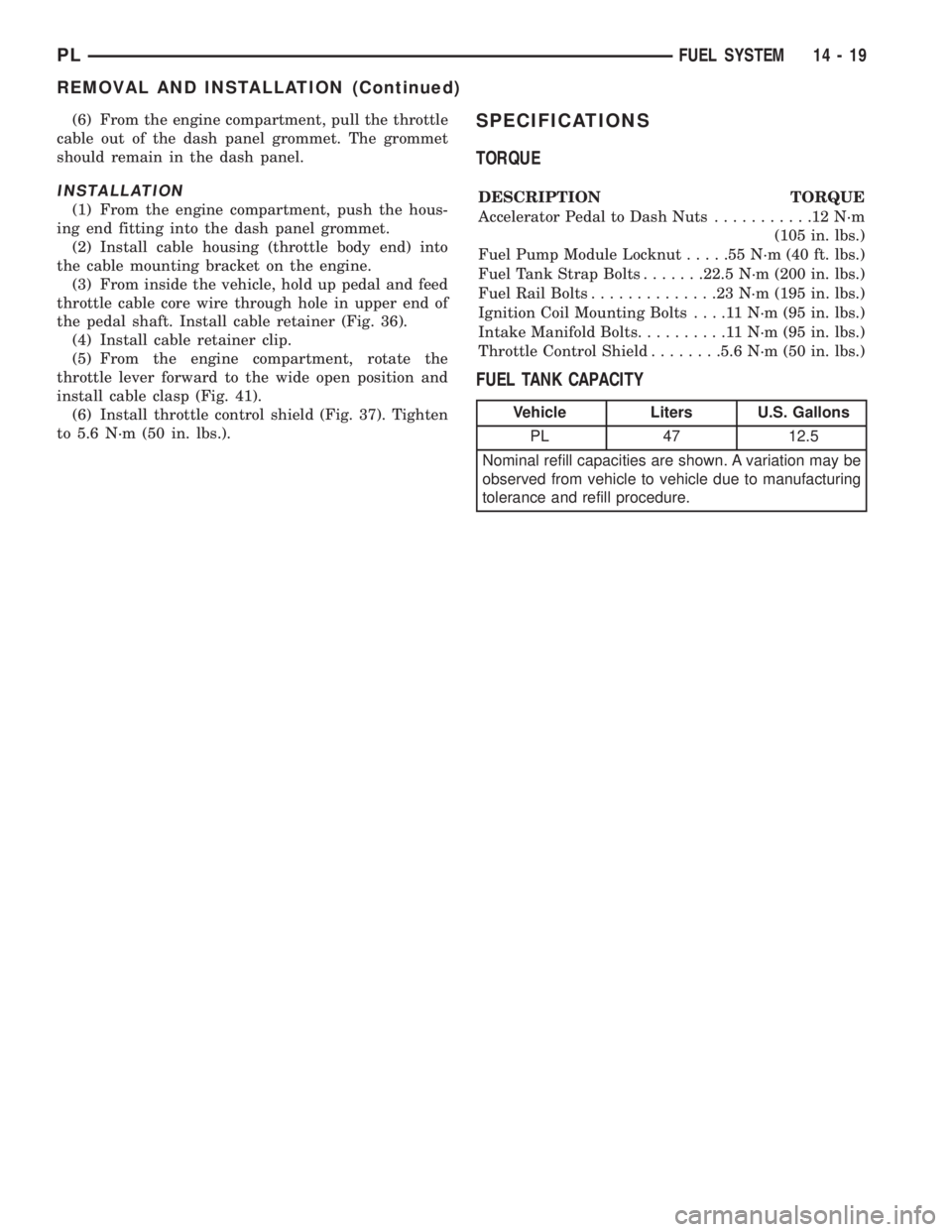
Accelerator Pedal to Dash Nuts...........12N´m
(105 in. lbs.)
Fuel Pump Module Locknut.....55N´m(40ft.lbs.)
Fuel Tank Strap Bolts.......22.5 N´m (200 in. lbs.)
Fuel Rail Bolts..............23N´m(195 in. lbs.)
Ignition Coil Mounting Bolts....11N´m(95in.lbs.)
Intake Manifold Bolts..........11N´m(95in.lbs.)
Throttle Control Shield........5.6 N´m (50 in. lbs.)
FUEL TANK CAPACITY
Vehicle Liters U.S. Gallons
PL 47 12.5
Nominal refill capacities are shown. A variation may be
observed from vehicle to vehicle due to manufacturing
tolerance and refill procedure.
PLFUEL SYSTEM 14 - 19
REMOVAL AND INSTALLATION (Continued)
Page 861 of 1200
FUEL INJECTION SYSTEM
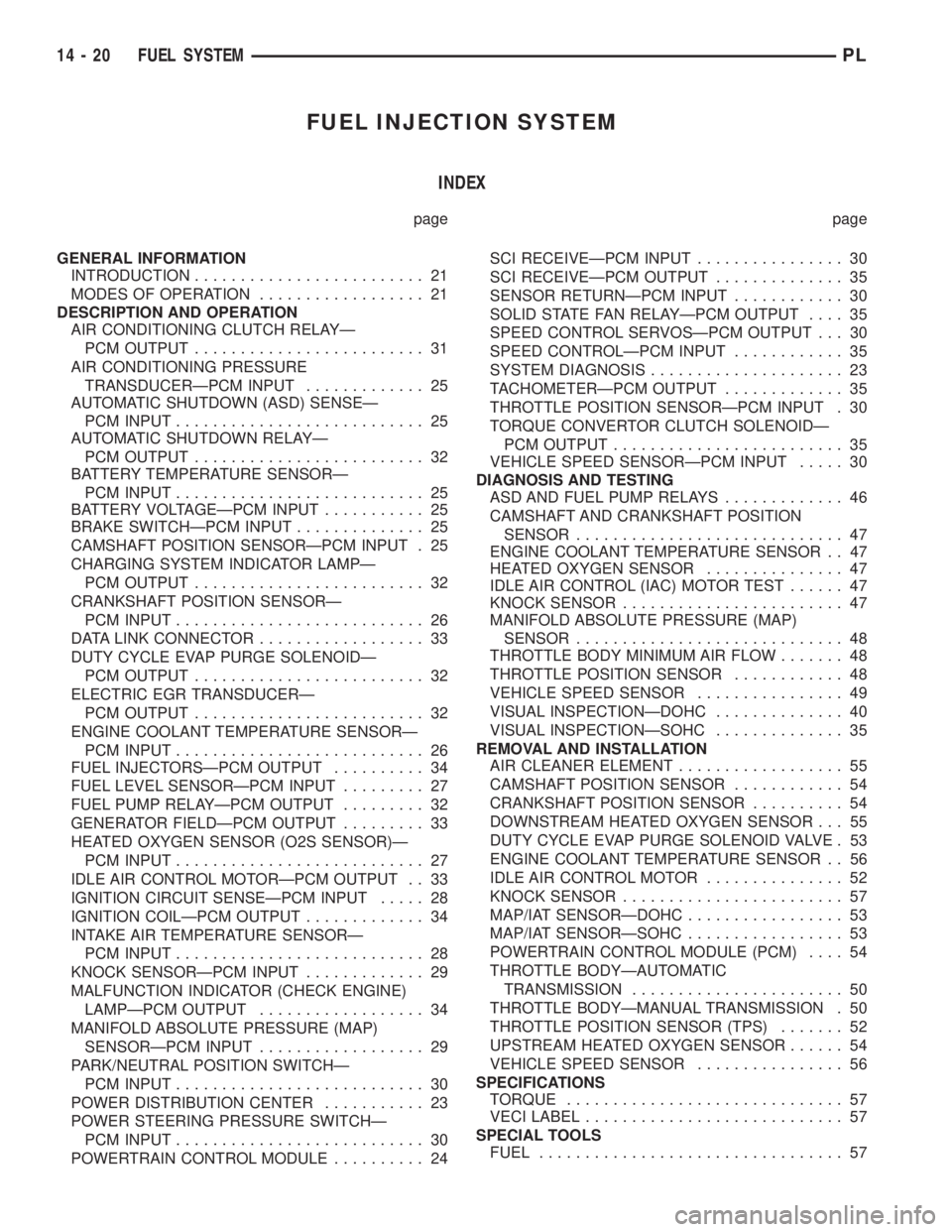
INDEX
page page
GENERAL INFORMATION
INTRODUCTION......................... 21
MODES OF OPERATION.................. 21
DESCRIPTION AND OPERATION
AIR CONDITIONING CLUTCH RELAYÐ
PCM OUTPUT......................... 31
AIR CONDITIONING PRESSURE
TRANSDUCERÐPCM INPUT............. 25
AUTOMATIC SHUTDOWN (ASD) SENSEÐ
PCM INPUT........................... 25
AUTOMATIC SHUTDOWN RELAYÐ
PCM OUTPUT......................... 32
BATTERY TEMPERATURE SENSORÐ
PCM INPUT........................... 25
BATTERY VOLTAGEÐPCM INPUT........... 25
BRAKE SWITCHÐPCM INPUT.............. 25
CAMSHAFT POSITION SENSORÐPCM INPUT . 25
CHARGING SYSTEM INDICATOR LAMPÐ
PCM OUTPUT......................... 32
CRANKSHAFT POSITION SENSORÐ
PCM INPUT........................... 26
DATA LINK CONNECTOR.................. 33
DUTY CYCLE EVAP PURGE SOLENOIDÐ
PCM OUTPUT......................... 32
ELECTRIC EGR TRANSDUCERÐ
PCM OUTPUT......................... 32
ENGINE COOLANT TEMPERATURE SENSORÐ
PCM INPUT........................... 26
FUEL INJECTORSÐPCM OUTPUT.......... 34
FUEL LEVEL SENSORÐPCM INPUT......... 27
FUEL PUMP RELAYÐPCM OUTPUT......... 32
GENERATOR FIELDÐPCM OUTPUT......... 33
HEATED OXYGEN SENSOR (O2S SENSOR)Ð
PCM INPUT........................... 27
IDLE AIR CONTROL MOTORÐPCM OUTPUT . . 33
IGNITION CIRCUIT SENSEÐPCM INPUT..... 28
IGNITION COILÐPCM OUTPUT............. 34
INTAKE AIR TEMPERATURE SENSORÐ
PCM INPUT........................... 28
KNOCK SENSORÐPCM INPUT............. 29
MALFUNCTION INDICATOR (CHECK ENGINE)
LAMPÐPCM OUTPUT.................. 34
MANIFOLD ABSOLUTE PRESSURE (MAP)
SENSORÐPCM INPUT.................. 29
PARK/NEUTRAL POSITION SWITCHÐ
PCM INPUT........................... 30
POWER DISTRIBUTION CENTER........... 23
POWER STEERING PRESSURE SWITCHÐ
PCM INPUT........................... 30
POWERTRAIN CONTROL MODULE.......... 24SCI RECEIVEÐPCM INPUT................ 30
SCI RECEIVEÐPCM OUTPUT.............. 35
SENSOR RETURNÐPCM INPUT............ 30
SOLID STATE FAN RELAYÐPCM OUTPUT.... 35
SPEED CONTROL SERVOSÐPCM OUTPUT . . . 30
SPEED CONTROLÐPCM INPUT............ 35
SYSTEM DIAGNOSIS..................... 23
TACHOMETERÐPCM OUTPUT............. 35
THROTTLE POSITION SENSORÐPCM INPUT . 30
TORQUE CONVERTOR CLUTCH SOLENOIDÐ
PCM OUTPUT......................... 35
VEHICLE SPEED SENSORÐPCM INPUT..... 30
DIAGNOSIS AND TESTING
ASD AND FUEL PUMP RELAYS............. 46
CAMSHAFT AND CRANKSHAFT POSITION
SENSOR............................. 47
ENGINE COOLANT TEMPERATURE SENSOR . . 47
HEATED OXYGEN SENSOR............... 47
IDLE AIR CONTROL (IAC) MOTOR TEST...... 47
KNOCK SENSOR........................ 47
MANIFOLD ABSOLUTE PRESSURE (MAP)
SENSOR............................. 48
THROTTLE BODY MINIMUM AIR FLOW....... 48
THROTTLE POSITION SENSOR............ 48
VEHICLE SPEED SENSOR................ 49
VISUAL INSPECTIONÐDOHC.............. 40
VISUAL INSPECTIONÐSOHC.............. 35
REMOVAL AND INSTALLATION
AIR CLEANER ELEMENT.................. 55
CAMSHAFT POSITION SENSOR............ 54
CRANKSHAFT POSITION SENSOR.......... 54
DOWNSTREAM HEATED OXYGEN SENSOR . . . 55
DUTY CYCLE EVAP PURGE SOLENOID VALVE . 53
ENGINE COOLANT TEMPERATURE SENSOR . . 56
IDLE AIR CONTROL MOTOR............... 52
KNOCK SENSOR........................ 57
MAP/IAT SENSORÐDOHC................. 53
MAP/IAT SENSORÐSOHC................. 53
POWERTRAIN CONTROL MODULE (PCM).... 54
THROTTLE BODYÐAUTOMATIC
TRANSMISSION....................... 50
THROTTLE BODYÐMANUAL TRANSMISSION . 50
THROTTLE POSITION SENSOR (TPS)....... 52
UPSTREAM HEATED OXYGEN SENSOR...... 54
VEHICLE SPEED SENSOR................ 56
SPECIFICATIONS
TORQUE.............................. 57
VECI LABEL............................ 57
SPECIAL TOOLS
FUEL................................. 57
14 - 20 FUEL SYSTEMPL
Page 865 of 1200
POWERTRAIN CONTROL MODULE
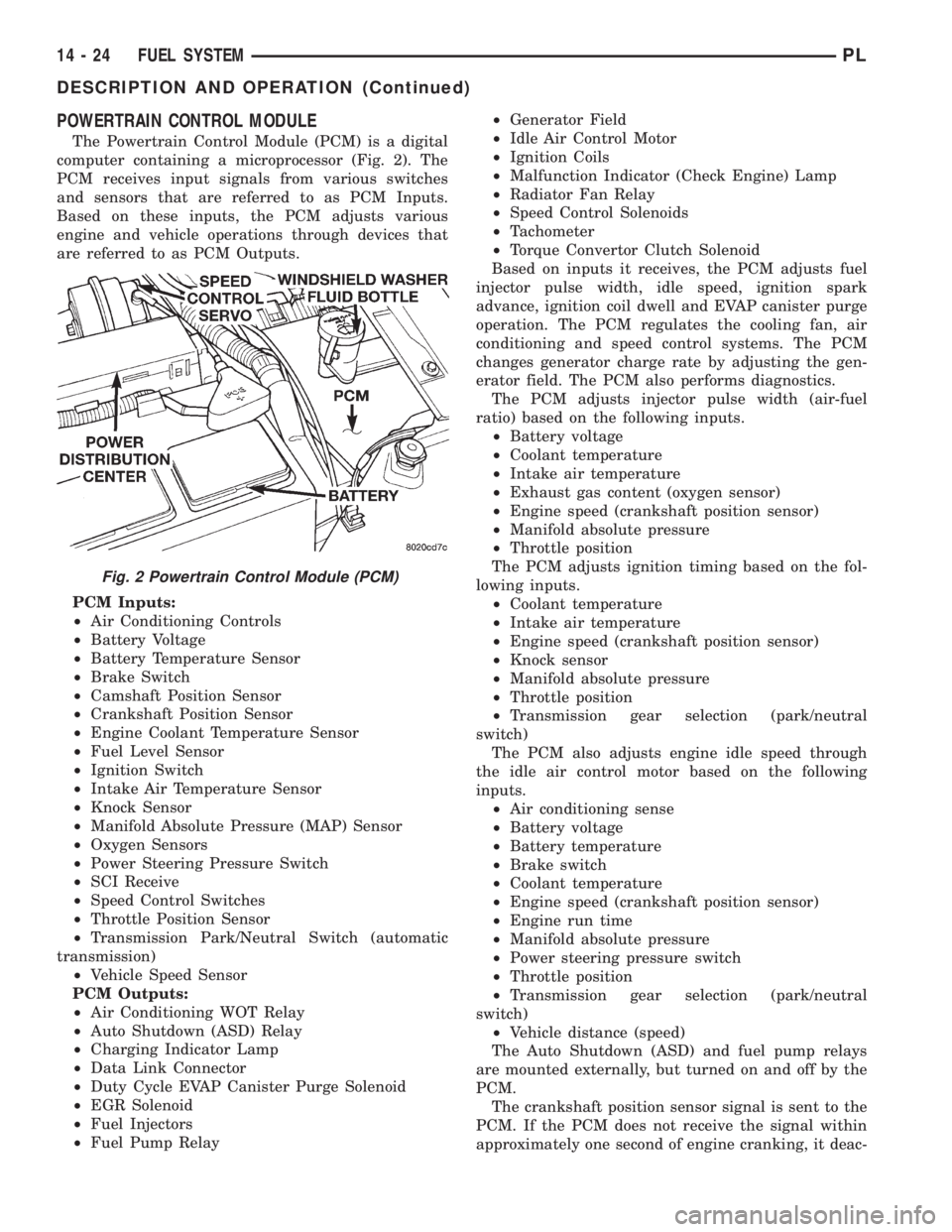
The Powertrain Control Module (PCM) is a digital
computer containing a microprocessor (Fig. 2). The
PCM receives input signals from various switches
and sensors that are referred to as PCM Inputs.
Based on these inputs, the PCM adjusts various
engine and vehicle operations through devices that
are referred to as PCM Outputs.
PCM Inputs:
²Air Conditioning Controls
²Battery Voltage
²Battery Temperature Sensor
²Brake Switch
²Camshaft Position Sensor
²Crankshaft Position Sensor
²Engine Coolant Temperature Sensor
²Fuel Level Sensor
²Ignition Switch
²Intake Air Temperature Sensor
²Knock Sensor
²Manifold Absolute Pressure (MAP) Sensor
²Oxygen Sensors
²Power Steering Pressure Switch
²SCI Receive
²Speed Control Switches
²Throttle Position Sensor
²Transmission Park/Neutral Switch (automatic
transmission)
²Vehicle Speed Sensor
PCM Outputs:
²Air Conditioning WOT Relay
²Auto Shutdown (ASD) Relay
²Charging Indicator Lamp
²Data Link Connector
²Duty Cycle EVAP Canister Purge Solenoid
²EGR Solenoid
²Fuel Injectors
²Fuel Pump Relay²Generator Field
²Idle Air Control Motor
²Ignition Coils
²Malfunction Indicator (Check Engine) Lamp
²Radiator Fan Relay
²Speed Control Solenoids
²Tachometer
²Torque Convertor Clutch Solenoid
Based on inputs it receives, the PCM adjusts fuel
injector pulse width, idle speed, ignition spark
advance, ignition coil dwell and EVAP canister purge
operation. The PCM regulates the cooling fan, air
conditioning and speed control systems. The PCM
changes generator charge rate by adjusting the gen-
erator field. The PCM also performs diagnostics.
The PCM adjusts injector pulse width (air-fuel
ratio) based on the following inputs.
²Battery voltage
²Coolant temperature
²Intake air temperature
²Exhaust gas content (oxygen sensor)
²Engine speed (crankshaft position sensor)
²Manifold absolute pressure
²Throttle position
The PCM adjusts ignition timing based on the fol-
lowing inputs.
²Coolant temperature
²Intake air temperature
²Engine speed (crankshaft position sensor)
²Knock sensor
²Manifold absolute pressure
²Throttle position
²Transmission gear selection (park/neutral
switch)
The PCM also adjusts engine idle speed through
the idle air control motor based on the following
inputs.
²Air conditioning sense
²Battery voltage
²Battery temperature
²Brake switch
²Coolant temperature
²Engine speed (crankshaft position sensor)
²Engine run time
²Manifold absolute pressure
²Power steering pressure switch
²Throttle position
²Transmission gear selection (park/neutral
switch)
²Vehicle distance (speed)
The Auto Shutdown (ASD) and fuel pump relays
are mounted externally, but turned on and off by the
PCM.
The crankshaft position sensor signal is sent to the
PCM. If the PCM does not receive the signal within
approximately one second of engine cranking, it deac-
Fig. 2 Powertrain Control Module (PCM)
14 - 24 FUEL SYSTEMPL
DESCRIPTION AND OPERATION (Continued)
Page 876 of 1200
send incorrect signals. The PCM substitutes for the
incorrect signals with inputs from other sensors.
If the PCM detects active engine misfire severe
enough to cause catalyst damage, it flashes the MIL.
At the same time the PCM also sets a Diagnostic
Trouble Code (DTC).
For signals that can trigger the MIL (Check
Engine Lamp) refer to Group 25, On-Board
Dianostics.
SOLID STATE FAN RELAYÐPCM OUTPUT
The radiator fan runs when coolant temperature
and A/C system pressure demand cooling. The radia-
tor fan circuit contains a Solid State Fan Relay
(SSFR). Refer to the Group 8W for a circuit sche-
matic.
A 5 volt signal is supplied to the SSFR. The PCM
provides a pulsed ground for the SSFR. Depending
upon the amount of pulse on time, the SSFR puts out
a proportional voltage to the fan motor at the lower
speed. For instance, if the on time is 30 percent, then
the voltage to the fan motor will be 3.6 volts.
When engine coolant reaches approximately 99ÉC
(210ÉF) the PCM grounds the SSFR relay. When the
PCM grounds the relay it operates at a 30% duty
cycle and immediately ramps up to 100% duty cycle.
The PCM de-energizes the SSFR relay when coolant
temperature drops to approximately 93ÉC (199ÉF).
Also, when the air conditioning pressure switch
closes, the PCM grounds the SSFR. The air condi-
tioning switch closes at 285 psi610 psi. When air
conditioning pressure drops approximately 40 psi, the
pressure switch opens and the fan turns off.
The SSFR relay is located on the left front inner
frame just behind the radiator.
SPEED CONTROLÐPCM INPUT
The speed control system provides five separate
voltages (inputs) to the Powertrain Control Module
(PCM). The voltages correspond to the ON/OFF, SET,
RESUME and CANCEL.
The speed control ON voltage informs the PCM
that the speed control system has been activated.
The speed control SET voltage informs the PCM that
a fixed vehicle speed has been selected. The speed
control RESUME voltage indicates the previous fixed
speed is requested. The speed control CANCEL volt-
age tells the PCM to deactivate but retain set speed
in memory (same as depressing the brake pedal). The
speed control OFF voltage tells the PCM that the
speed control system has deactivated. Refer to Group
8H for more speed control information.
SCI RECEIVEÐPCM OUTPUT
SCI Receive is the serial data communication
receive circuit for the DRB scan tool. The Powertrain
Control Module (PCM) receives data from the DRB
through the SCI Receive circuit.
TACHOMETERÐPCM OUTPUT
The PCM operates the tachometer on the instru-
ment panel. The PCM calculates engine RPM from
the crankshaft position sensor input.
TORQUE CONVERTOR CLUTCH SOLENOIDÐPCM
OUTPUT
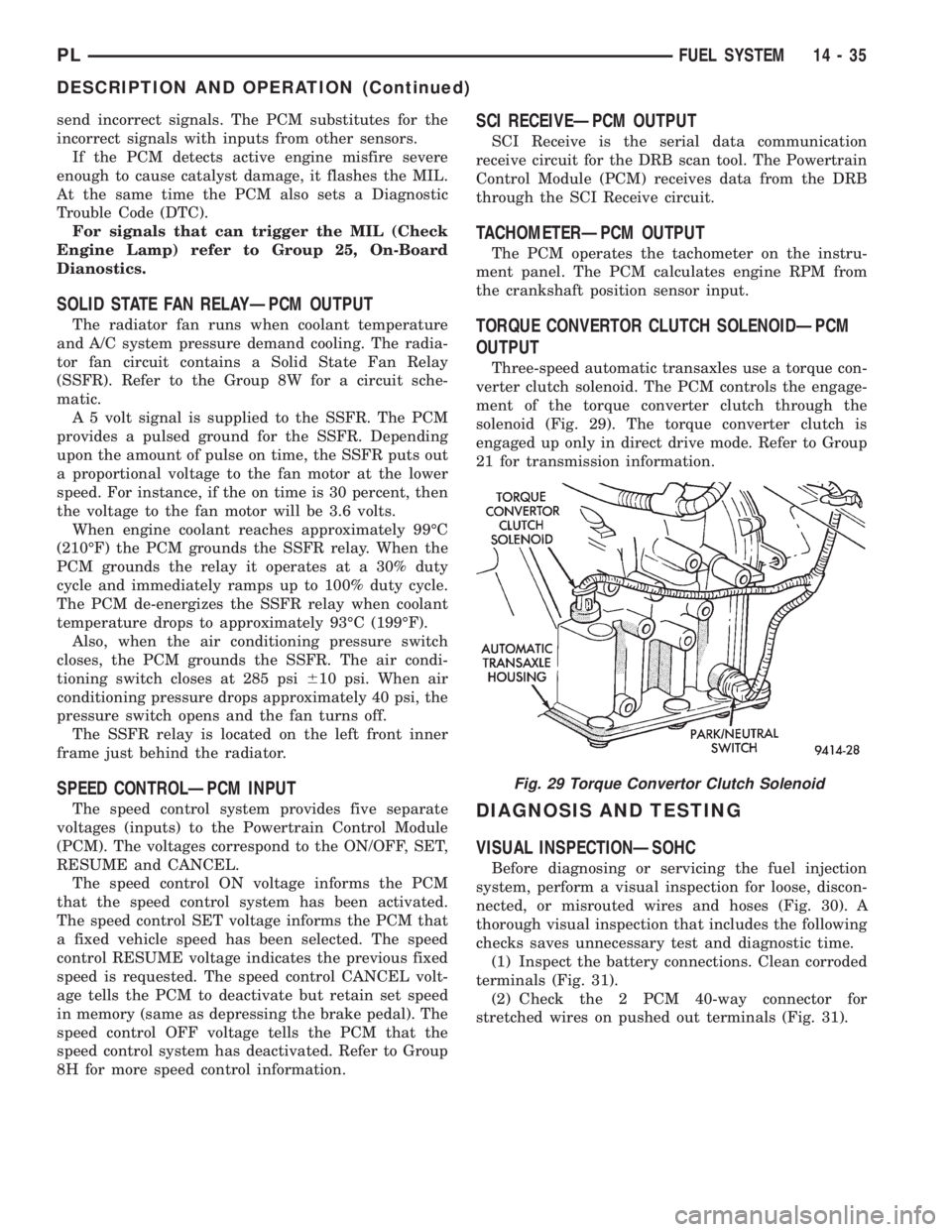
Three-speed automatic transaxles use a torque con-
verter clutch solenoid. The PCM controls the engage-
ment of the torque converter clutch through the
solenoid (Fig. 29). The torque converter clutch is
engaged up only in direct drive mode. Refer to Group
21 for transmission information.
DIAGNOSIS AND TESTING
VISUAL INSPECTIONÐSOHC
Before diagnosing or servicing the fuel injection
system, perform a visual inspection for loose, discon-
nected, or misrouted wires and hoses (Fig. 30). A
thorough visual inspection that includes the following
checks saves unnecessary test and diagnostic time.
(1) Inspect the battery connections. Clean corroded
terminals (Fig. 31).
(2) Check the 2 PCM 40-way connector for
stretched wires on pushed out terminals (Fig. 31).
Fig. 29 Torque Convertor Clutch Solenoid
PLFUEL SYSTEM 14 - 35
DESCRIPTION AND OPERATION (Continued)
Page 880 of 1200
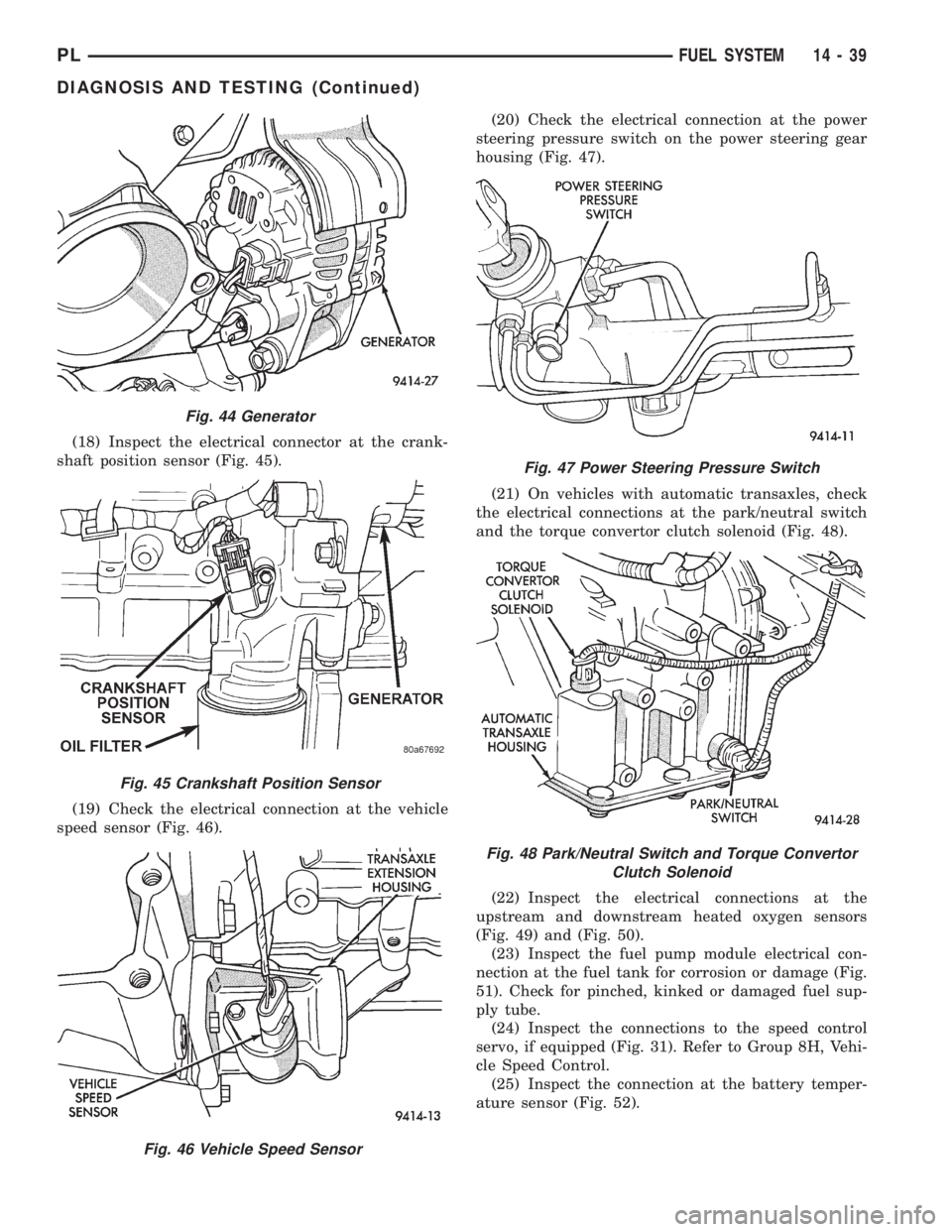
(18) Inspect the electrical connector at the crank-
shaft position sensor (Fig. 45).
(19) Check the electrical connection at the vehicle
speed sensor (Fig. 46).(20) Check the electrical connection at the power
steering pressure switch on the power steering gear
housing (Fig. 47).
(21) On vehicles with automatic transaxles, check
the electrical connections at the park/neutral switch
and the torque convertor clutch solenoid (Fig. 48).
(22) Inspect the electrical connections at the
upstream and downstream heated oxygen sensors
(Fig. 49) and (Fig. 50).
(23) Inspect the fuel pump module electrical con-
nection at the fuel tank for corrosion or damage (Fig.
51). Check for pinched, kinked or damaged fuel sup-
ply tube.
(24) Inspect the connections to the speed control
servo, if equipped (Fig. 31). Refer to Group 8H, Vehi-
cle Speed Control.
(25) Inspect the connection at the battery temper-
ature sensor (Fig. 52).
Fig. 44 Generator
Fig. 45 Crankshaft Position Sensor
Fig. 46 Vehicle Speed Sensor
Fig. 47 Power Steering Pressure Switch
Fig. 48 Park/Neutral Switch and Torque Convertor
Clutch Solenoid
PLFUEL SYSTEM 14 - 39
DIAGNOSIS AND TESTING (Continued)
Page 886 of 1200
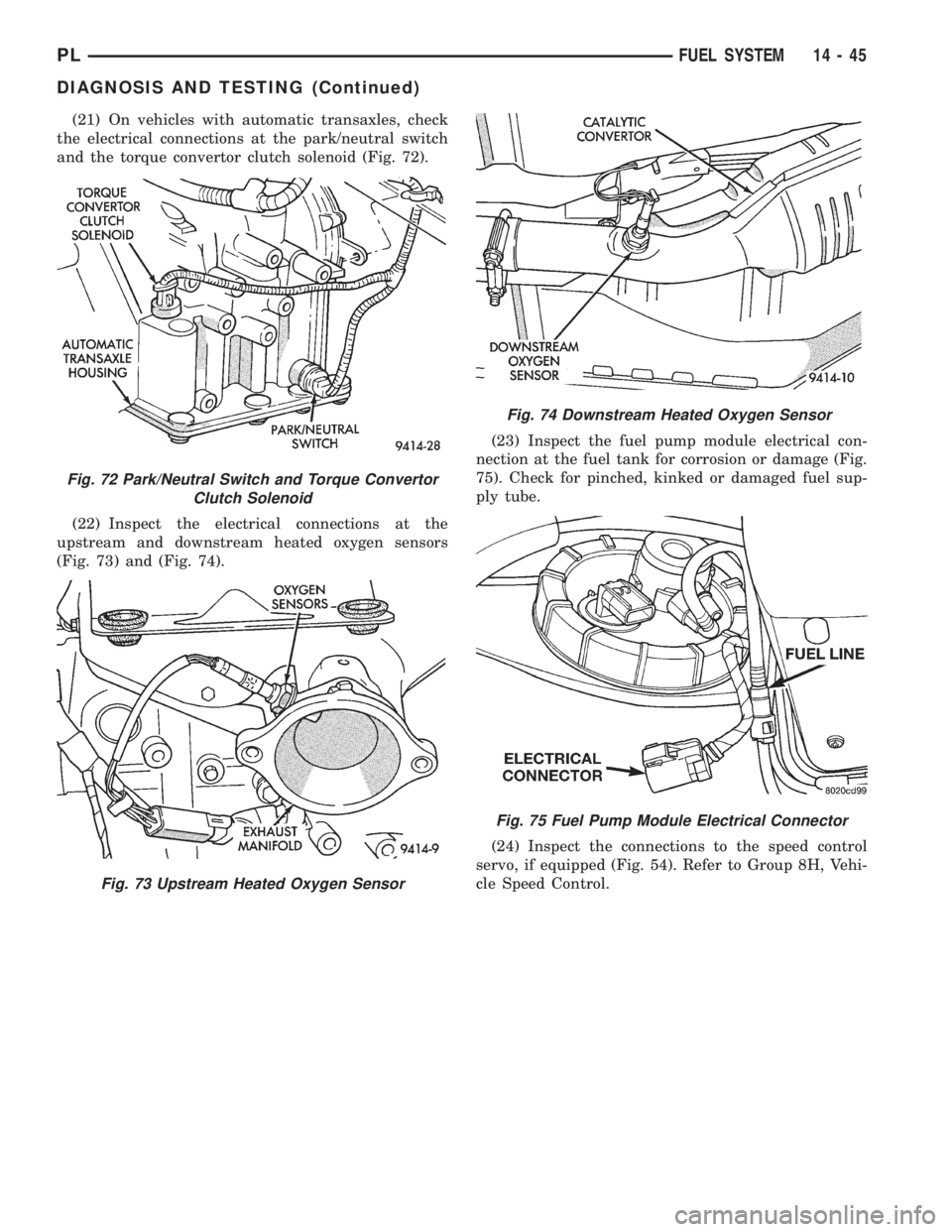
(21) On vehicles with automatic transaxles, check
the electrical connections at the park/neutral switch
and the torque convertor clutch solenoid (Fig. 72).
(22) Inspect the electrical connections at the
upstream and downstream heated oxygen sensors
(Fig. 73) and (Fig. 74).(23) Inspect the fuel pump module electrical con-
nection at the fuel tank for corrosion or damage (Fig.
75). Check for pinched, kinked or damaged fuel sup-
ply tube.
(24) Inspect the connections to the speed control
servo, if equipped (Fig. 54). Refer to Group 8H, Vehi-
cle Speed Control.
Fig. 72 Park/Neutral Switch and Torque Convertor
Clutch Solenoid
Fig. 73 Upstream Heated Oxygen Sensor
Fig. 74 Downstream Heated Oxygen Sensor
Fig. 75 Fuel Pump Module Electrical Connector
PLFUEL SYSTEM 14 - 45
DIAGNOSIS AND TESTING (Continued)
Page 893 of 1200
(9) Rotate throttle lever forward to the wide open
position and slide kickdown cable connector onto nail
head.
(10) Install throttle cable cover. Tighten bolt to 5.6
N´m (50 ins. lbs.).
THROTTLE POSITION SENSOR (TPS)
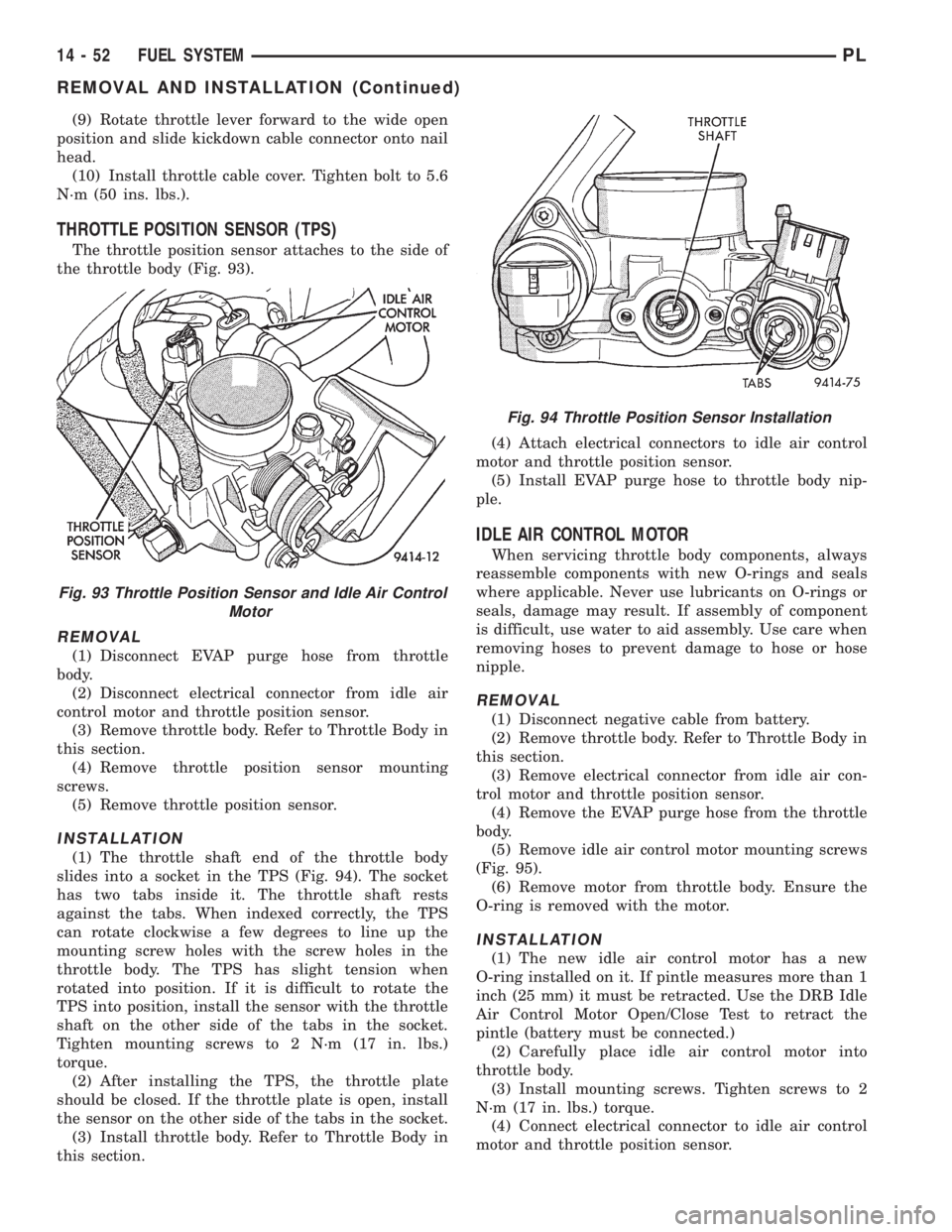
The throttle position sensor attaches to the side of
the throttle body (Fig. 93).
REMOVAL
(1) Disconnect EVAP purge hose from throttle
body.
(2) Disconnect electrical connector from idle air
control motor and throttle position sensor.
(3) Remove throttle body. Refer to Throttle Body in
this section.
(4) Remove throttle position sensor mounting
screws.
(5) Remove throttle position sensor.
INSTALLATION
(1) The throttle shaft end of the throttle body
slides into a socket in the TPS (Fig. 94). The socket
has two tabs inside it. The throttle shaft rests
against the tabs. When indexed correctly, the TPS
can rotate clockwise a few degrees to line up the
mounting screw holes with the screw holes in the
throttle body. The TPS has slight tension when
rotated into position. If it is difficult to rotate the
TPS into position, install the sensor with the throttle
shaft on the other side of the tabs in the socket.
Tighten mounting screws to 2 N´m (17 in. lbs.)
torque.
(2) After installing the TPS, the throttle plate
should be closed. If the throttle plate is open, install
the sensor on the other side of the tabs in the socket.
(3) Install throttle body. Refer to Throttle Body in
this section.(4) Attach electrical connectors to idle air control
motor and throttle position sensor.
(5) Install EVAP purge hose to throttle body nip-
ple.
IDLE AIR CONTROL MOTOR
When servicing throttle body components, always
reassemble components with new O-rings and seals
where applicable. Never use lubricants on O-rings or
seals, damage may result. If assembly of component
is difficult, use water to aid assembly. Use care when
removing hoses to prevent damage to hose or hose
nipple.
REMOVAL
(1) Disconnect negative cable from battery.
(2) Remove throttle body. Refer to Throttle Body in
this section.
(3) Remove electrical connector from idle air con-
trol motor and throttle position sensor.
(4) Remove the EVAP purge hose from the throttle
body.
(5) Remove idle air control motor mounting screws
(Fig. 95).
(6) Remove motor from throttle body. Ensure the
O-ring is removed with the motor.
INSTALLATION
(1) The new idle air control motor has a new
O-ring installed on it. If pintle measures more than 1
inch (25 mm) it must be retracted. Use the DRB Idle
Air Control Motor Open/Close Test to retract the
pintle (battery must be connected.)
(2) Carefully place idle air control motor into
throttle body.
(3) Install mounting screws. Tighten screws to 2
N´m (17 in. lbs.) torque.
(4) Connect electrical connector to idle air control
motor and throttle position sensor.
Fig. 93 Throttle Position Sensor and Idle Air Control
Motor
Fig. 94 Throttle Position Sensor Installation
14 - 52 FUEL SYSTEMPL
REMOVAL AND INSTALLATION (Continued)
Page 894 of 1200
(5) Install throttle body. Refer to Throttle Body in
this section.
(6) Connect the EVAP purge hose to the throttle
body nipple.
(7) Connect negative cable to battery.
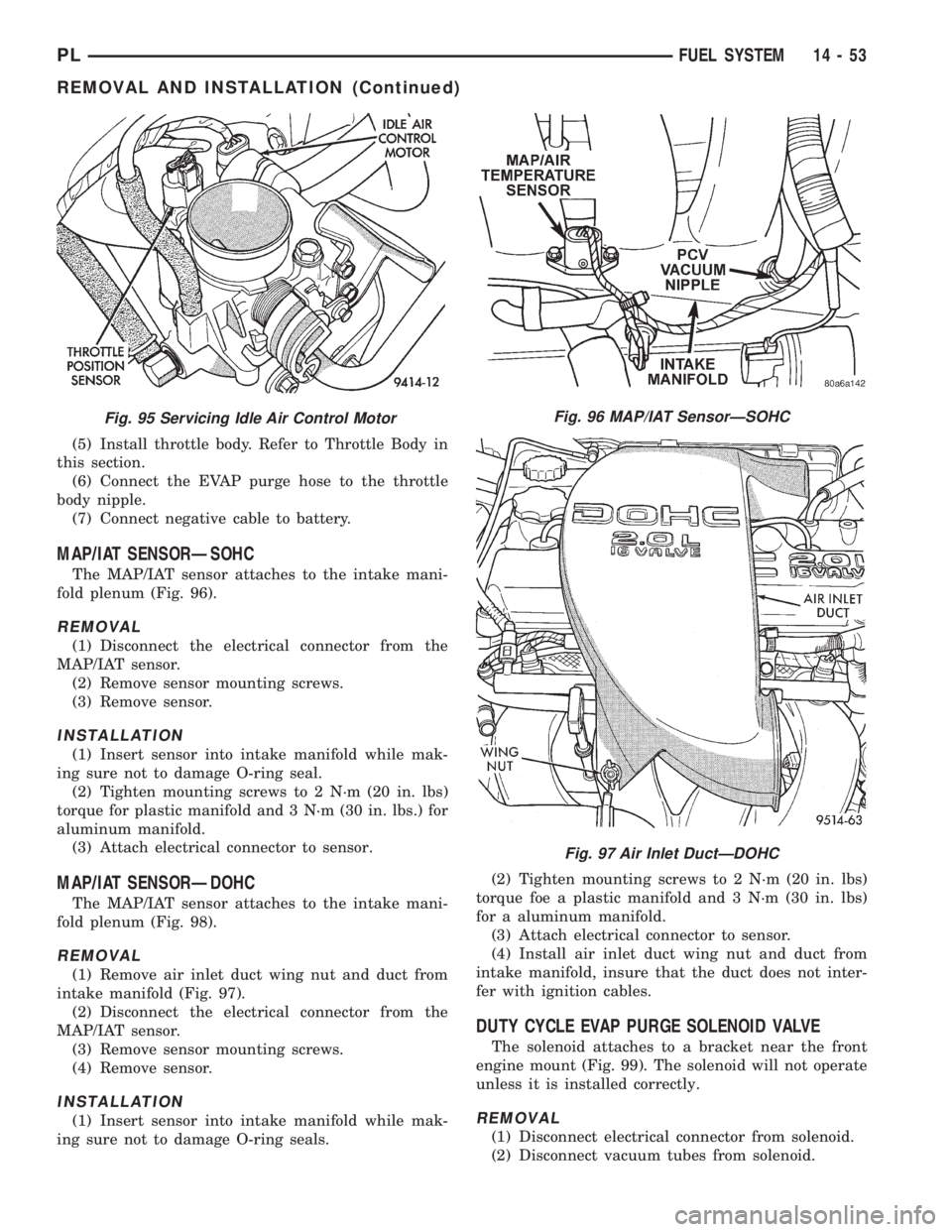
MAP/IAT SENSORÐSOHC
The MAP/IAT sensor attaches to the intake mani-
fold plenum (Fig. 96).
REMOVAL
(1) Disconnect the electrical connector from the
MAP/IAT sensor.
(2) Remove sensor mounting screws.
(3) Remove sensor.
INSTALLATION
(1) Insert sensor into intake manifold while mak-
ing sure not to damage O-ring seal.
(2) Tighten mounting screws to 2 N´m (20 in. lbs)
torque for plastic manifold and 3 N´m (30 in. lbs.) for
aluminum manifold.
(3) Attach electrical connector to sensor.
MAP/IAT SENSORÐDOHC
The MAP/IAT sensor attaches to the intake mani-
fold plenum (Fig. 98).
REMOVAL
(1) Remove air inlet duct wing nut and duct from
intake manifold (Fig. 97).
(2) Disconnect the electrical connector from the
MAP/IAT sensor.
(3) Remove sensor mounting screws.
(4) Remove sensor.
INSTALLATION
(1) Insert sensor into intake manifold while mak-
ing sure not to damage O-ring seals.(2) Tighten mounting screws to 2 N´m (20 in. lbs)
torque foe a plastic manifold and 3 N´m (30 in. lbs)
for a aluminum manifold.
(3) Attach electrical connector to sensor.
(4) Install air inlet duct wing nut and duct from
intake manifold, insure that the duct does not inter-
fer with ignition cables.
DUTY CYCLE EVAP PURGE SOLENOID VALVE
The solenoid attaches to a bracket near the front
engine mount (Fig. 99). The solenoid will not operate
unless it is installed correctly.
REMOVAL
(1) Disconnect electrical connector from solenoid.
(2) Disconnect vacuum tubes from solenoid.
Fig. 95 Servicing Idle Air Control MotorFig. 96 MAP/IAT SensorÐSOHC
Fig. 97 Air Inlet DuctÐDOHC
PLFUEL SYSTEM 14 - 53
REMOVAL AND INSTALLATION (Continued)
Page 895 of 1200
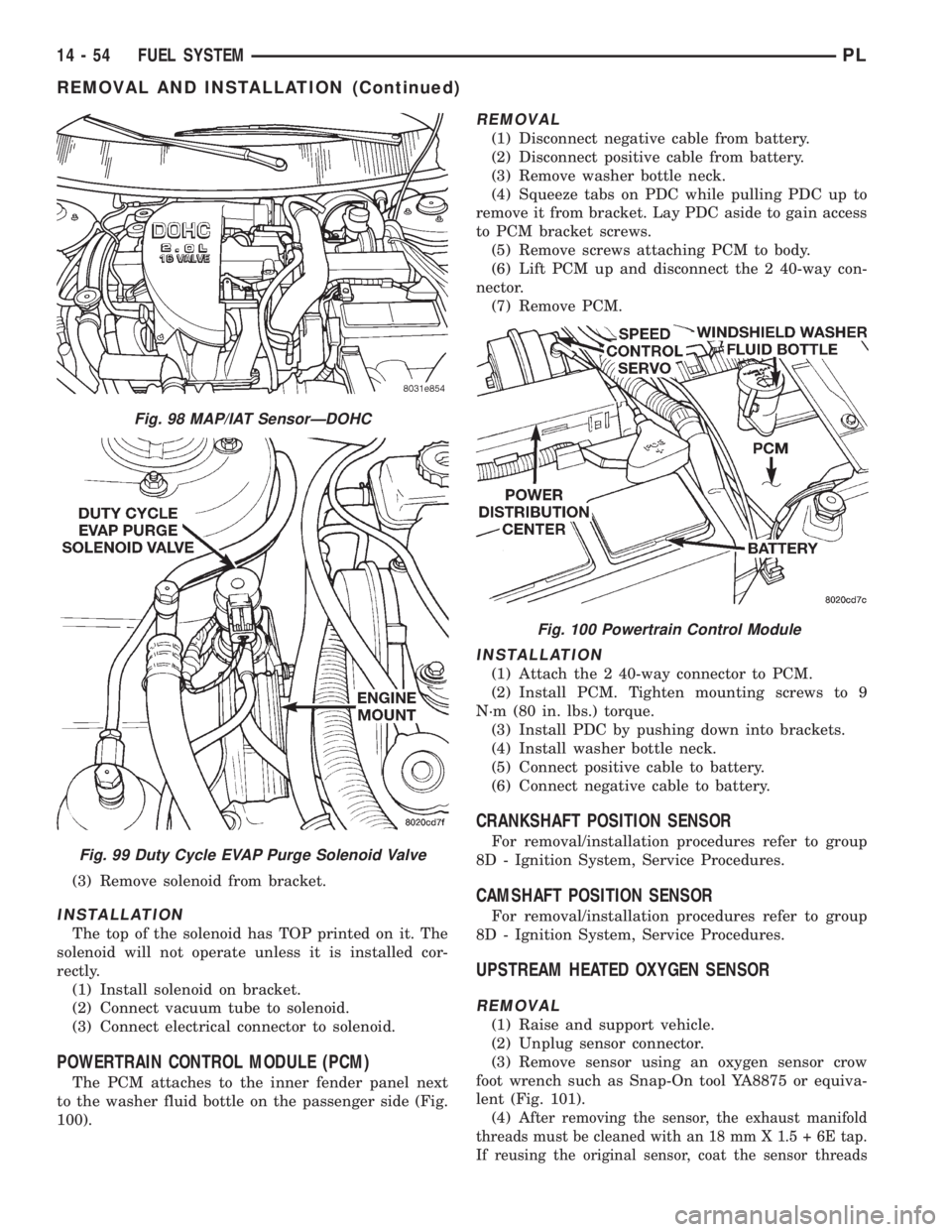
(3) Remove solenoid from bracket.
INSTALLATION
The top of the solenoid has TOP printed on it. The
solenoid will not operate unless it is installed cor-
rectly.
(1) Install solenoid on bracket.
(2) Connect vacuum tube to solenoid.
(3) Connect electrical connector to solenoid.
POWERTRAIN CONTROL MODULE (PCM)
The PCM attaches to the inner fender panel next
to the washer fluid bottle on the passenger side (Fig.
100).
REMOVAL
(1) Disconnect negative cable from battery.
(2) Disconnect positive cable from battery.
(3) Remove washer bottle neck.
(4) Squeeze tabs on PDC while pulling PDC up to
remove it from bracket. Lay PDC aside to gain access
to PCM bracket screws.
(5) Remove screws attaching PCM to body.
(6) Lift PCM up and disconnect the 2 40-way con-
nector.
(7) Remove PCM.
INSTALLATION
(1) Attach the 2 40-way connector to PCM.
(2) Install PCM. Tighten mounting screws to 9
N´m (80 in. lbs.) torque.
(3) Install PDC by pushing down into brackets.
(4) Install washer bottle neck.
(5) Connect positive cable to battery.
(6) Connect negative cable to battery.
CRANKSHAFT POSITION SENSOR
For removal/installation procedures refer to group
8D - Ignition System, Service Procedures.
CAMSHAFT POSITION SENSOR
For removal/installation procedures refer to group
8D - Ignition System, Service Procedures.
UPSTREAM HEATED OXYGEN SENSOR
REMOVAL
(1) Raise and support vehicle.
(2) Unplug sensor connector.
(3) Remove sensor using an oxygen sensor crow
foot wrench such as Snap-On tool YA8875 or equiva-
lent (Fig. 101).
(4) A
fter removing the sensor, the exhaust manifold
threads must be cleaned with an 18 mm X 1.5 + 6E tap.
If reusing the original sensor, coat the sensor threads
Fig. 98 MAP/IAT SensorÐDOHC
Fig. 99 Duty Cycle EVAP Purge Solenoid Valve
Fig. 100 Powertrain Control Module
14 - 54 FUEL SYSTEMPL
REMOVAL AND INSTALLATION (Continued)
Page 896 of 1200
with an anti-seize compound such as Loctitet771-64 or
equivalent.
INSTALLATION
New sensors have compound on the threads and do
not require an additional coating.
(1) Install sensor using an oxygen sensor crow foot
wrench such as Snap-On tool YA8875 or equivalent
(Fig. 101). Tighten the sensor to 28 N´m (20 ft. lbs.)
torque.
(2) Plug sensor connector.
(3) Lower vehicle.
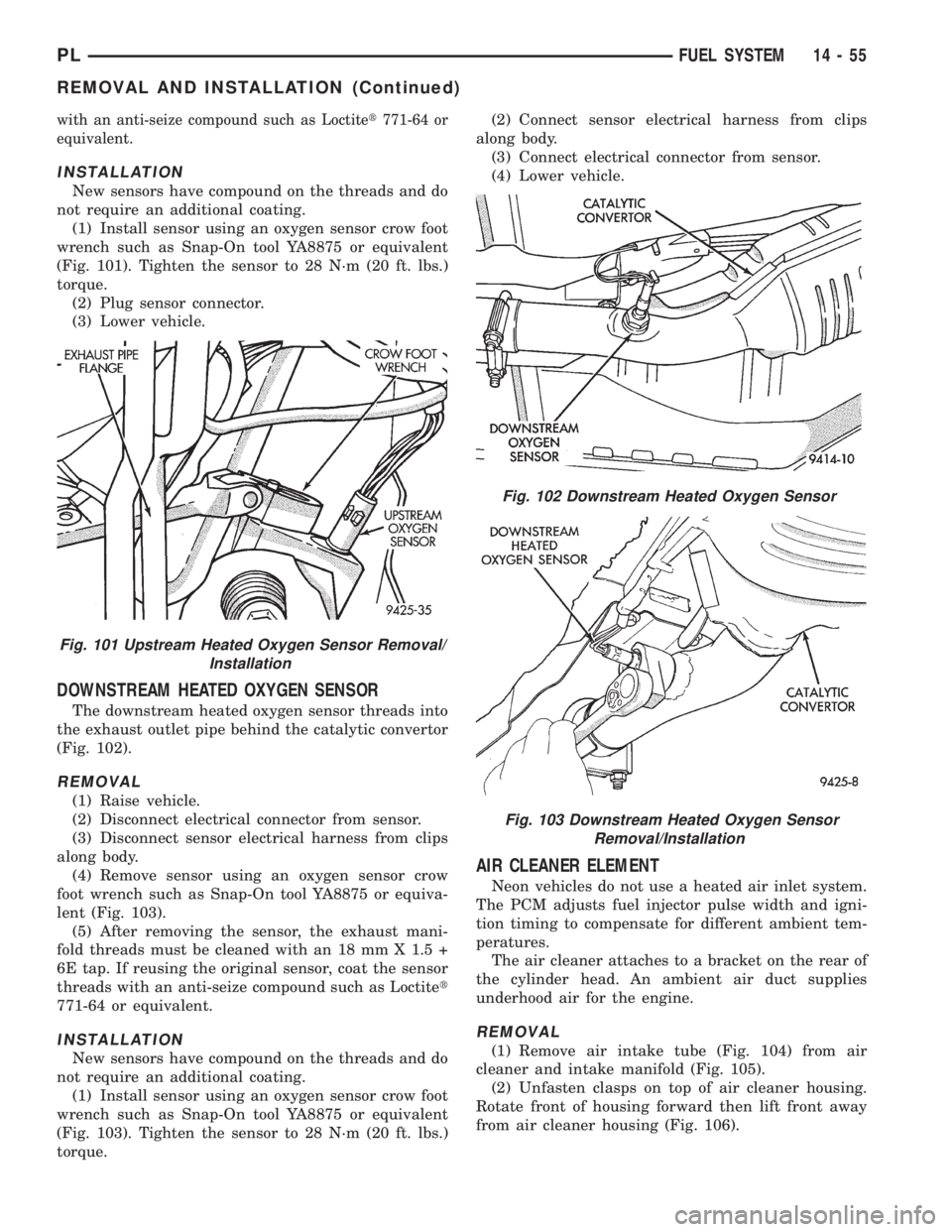
DOWNSTREAM HEATED OXYGEN SENSOR
The downstream heated oxygen sensor threads into
the exhaust outlet pipe behind the catalytic convertor
(Fig. 102).
REMOVAL
(1) Raise vehicle.
(2) Disconnect electrical connector from sensor.
(3) Disconnect sensor electrical harness from clips
along body.
(4) Remove sensor using an oxygen sensor crow
foot wrench such as Snap-On tool YA8875 or equiva-
lent (Fig. 103).
(5) After removing the sensor, the exhaust mani-
fold threads must be cleaned with an 18 mm X 1.5 +
6E tap. If reusing the original sensor, coat the sensor
threads with an anti-seize compound such as Loctitet
771-64 or equivalent.
INSTALLATION
New sensors have compound on the threads and do
not require an additional coating.
(1) Install sensor using an oxygen sensor crow foot
wrench such as Snap-On tool YA8875 or equivalent
(Fig. 103). Tighten the sensor to 28 N´m (20 ft. lbs.)
torque.(2) Connect sensor electrical harness from clips
along body.
(3) Connect electrical connector from sensor.
(4) Lower vehicle.
AIR CLEANER ELEMENT
Neon vehicles do not use a heated air inlet system.
The PCM adjusts fuel injector pulse width and igni-
tion timing to compensate for different ambient tem-
peratures.
The air cleaner attaches to a bracket on the rear of
the cylinder head. An ambient air duct supplies
underhood air for the engine.
REMOVAL
(1) Remove air intake tube (Fig. 104) from air
cleaner and intake manifold (Fig. 105).
(2) Unfasten clasps on top of air cleaner housing.
Rotate front of housing forward then lift front away
from air cleaner housing (Fig. 106).
Fig. 101 Upstream Heated Oxygen Sensor Removal/
Installation
Fig. 102 Downstream Heated Oxygen Sensor
Fig. 103 Downstream Heated Oxygen Sensor
Removal/Installation
PLFUEL SYSTEM 14 - 55
REMOVAL AND INSTALLATION (Continued)