torque DODGE NEON 1999 Service Repair Manual
[x] Cancel search | Manufacturer: DODGE, Model Year: 1999, Model line: NEON, Model: DODGE NEON 1999Pages: 1200, PDF Size: 35.29 MB
Page 897 of 1200
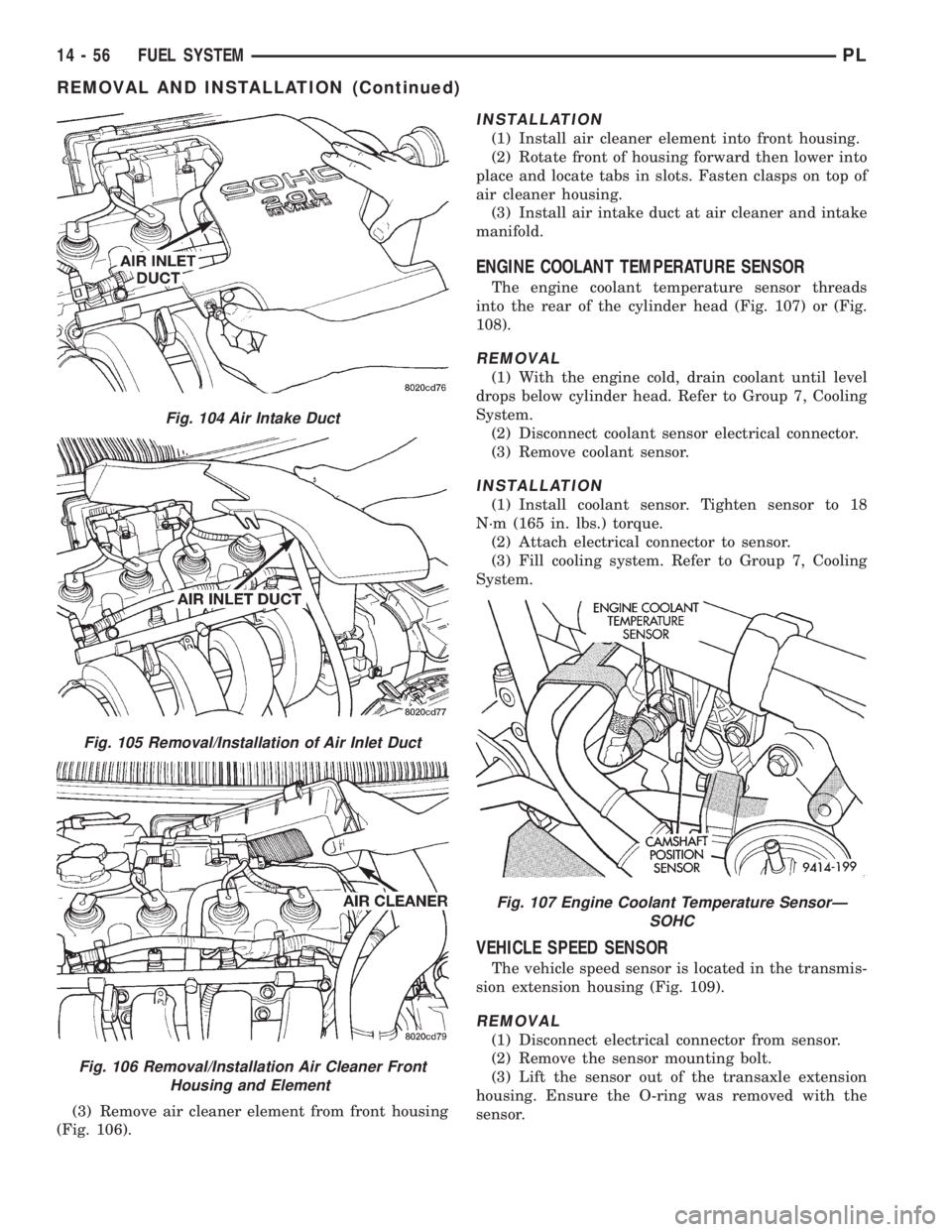
(3) Remove air cleaner element from front housing
(Fig. 106).
INSTALLATION
(1) Install air cleaner element into front housing.
(2) Rotate front of housing forward then lower into
place and locate tabs in slots. Fasten clasps on top of
air cleaner housing.
(3) Install air intake duct at air cleaner and intake
manifold.
ENGINE COOLANT TEMPERATURE SENSOR
The engine coolant temperature sensor threads
into the rear of the cylinder head (Fig. 107) or (Fig.
108).
REMOVAL
(1) With the engine cold, drain coolant until level
drops below cylinder head. Refer to Group 7, Cooling
System.
(2) Disconnect coolant sensor electrical connector.
(3) Remove coolant sensor.
INSTALLATION
(1) Install coolant sensor. Tighten sensor to 18
N´m (165 in. lbs.) torque.
(2) Attach electrical connector to sensor.
(3) Fill cooling system. Refer to Group 7, Cooling
System.
VEHICLE SPEED SENSOR
The vehicle speed sensor is located in the transmis-
sion extension housing (Fig. 109).
REMOVAL
(1) Disconnect electrical connector from sensor.
(2) Remove the sensor mounting bolt.
(3) Lift the sensor out of the transaxle extension
housing. Ensure the O-ring was removed with the
sensor.
Fig. 104 Air Intake Duct
Fig. 105 Removal/Installation of Air Inlet Duct
Fig. 106 Removal/Installation Air Cleaner Front
Housing and Element
Fig. 107 Engine Coolant Temperature SensorÐ
SOHC
14 - 56 FUEL SYSTEMPL
REMOVAL AND INSTALLATION (Continued)
Page 898 of 1200
INSTALLATION
The speed sensor gear meshes with a gear on the
output shaft.
(1) With O-ring in place, install sensor.
(2) Install mounting bolt.
(3) Connect electrical connector to sensor.
KNOCK SENSOR
For removal/installation procedures refer to Group
8D- Ignition System, Service Procedures.
SPECIFICATIONS
VECI LABEL
If anything differs between the specifications found
on the Vehicle Emission Control Information (VECI)
label and the following specifications, use specifica-
tions on VECI label. The VECI label is located in the
engine compartment.
TORQUE
DESCRIPTION TORQUE
Air Cleaner Wingnut..........1.5 N´m (15 in. lbs.)
Air Cleaner Mount. Stud-To-Thrott. Body .10 N´m (90
in. lbs.)
Crankshaft Position Sensor Mounting Bolts.8 N´m (70
in. lbs.)
Engine Coolant Temperature Sensor .18 N´m (165 in.
lbs.)
IAC Motor-To-Throttle Body Bolts .7 N´m (60 in. lbs.)
MAP/IAT Sensor..............2N´m(20in.lbs.)
MAP/IAT Sensor..............3N´m(30in.lbs.)
Oxygen Sensor...............28N´m(20ft.lbs.)
Powertrain Control Module (PCM) Mounting Screws.4
N´m (35 in. lbs.)
Throttle Cable Cover.........4.5 N´m (40 in. lbs.).
Throttle Body Mounting Bolts . .23 N´m (200 in. lbs.)
Throttle Position Sensor Mounting Screws .2 N´m (20
in. lbs.)
Vehicle Speed Sensor Mounting Bolt .2.2 N´m (20 in.
lbs.)
SPECIAL TOOLS
FUEL
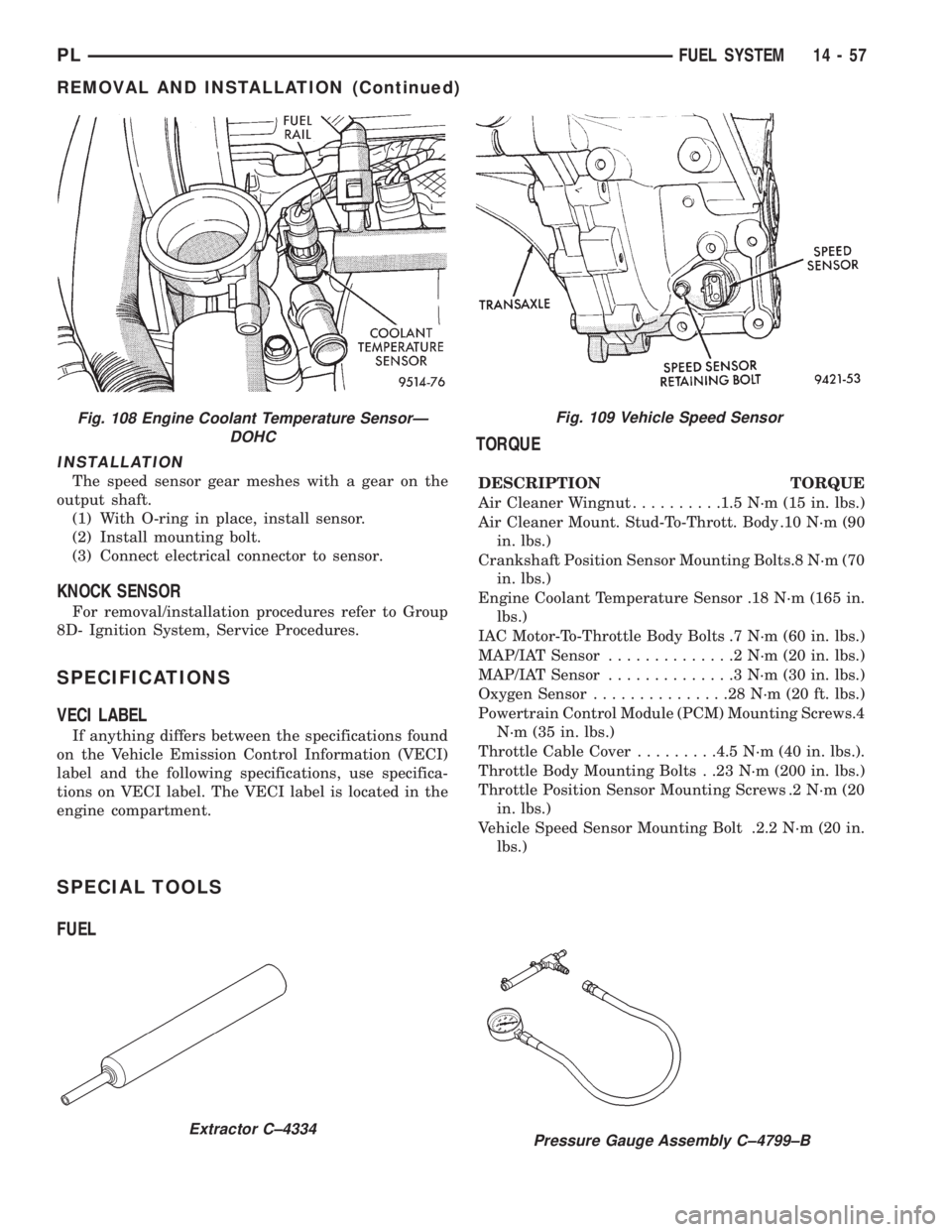
Fig. 108 Engine Coolant Temperature SensorÐ
DOHCFig. 109 Vehicle Speed Sensor
Extractor C±4334Pressure Gauge Assembly C±4799±B
PLFUEL SYSTEM 14 - 57
REMOVAL AND INSTALLATION (Continued)
Page 903 of 1200
DIAGNOSIS AND TESTING
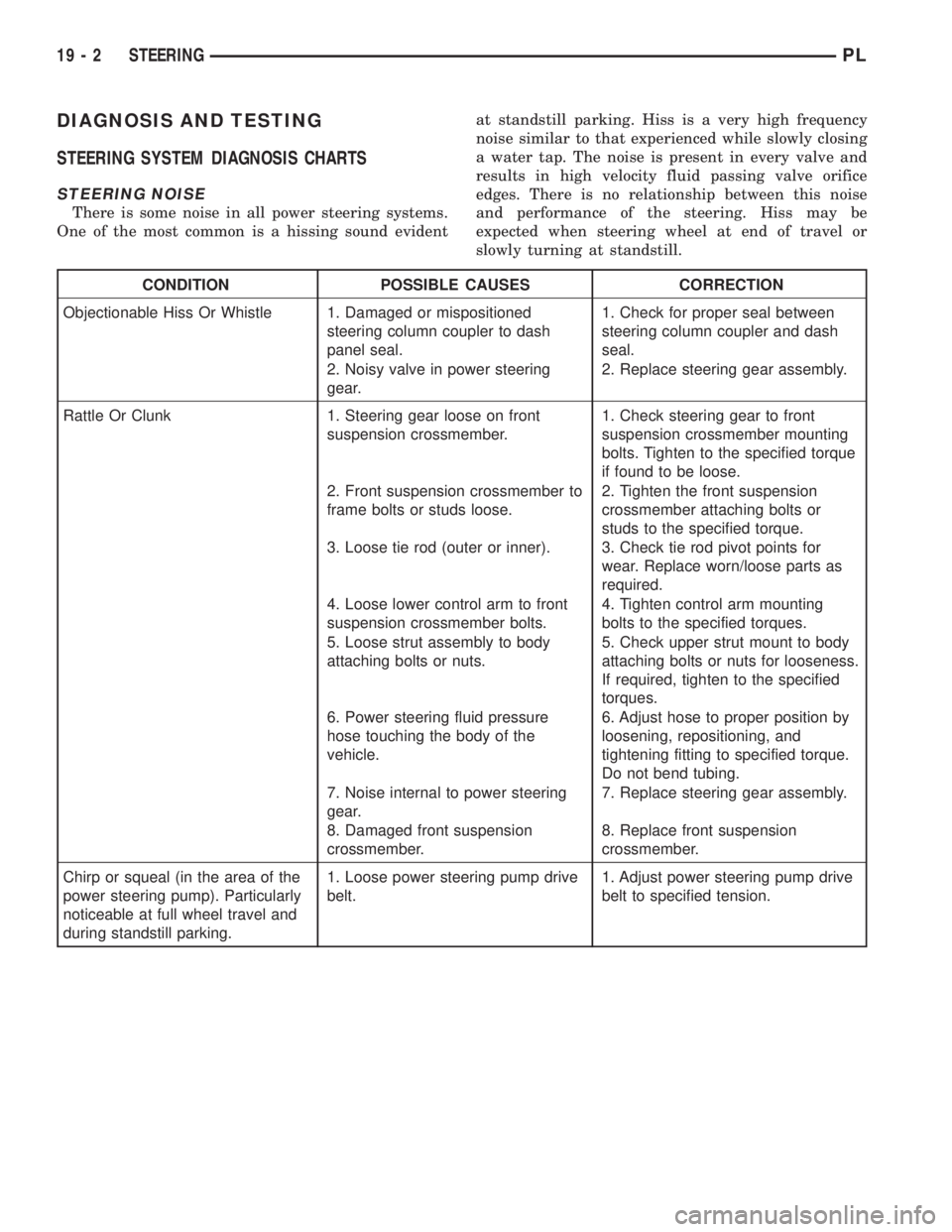
STEERING SYSTEM DIAGNOSIS CHARTS
STEERING NOISE
There is some noise in all power steering systems.
One of the most common is a hissing sound evidentat standstill parking. Hiss is a very high frequency
noise similar to that experienced while slowly closing
a water tap. The noise is present in every valve and
results in high velocity fluid passing valve orifice
edges. There is no relationship between this noise
and performance of the steering. Hiss may be
expected when steering wheel at end of travel or
slowly turning at standstill.
CONDITION POSSIBLE CAUSES CORRECTION
Objectionable Hiss Or Whistle 1. Damaged or mispositioned
steering column coupler to dash
panel seal.1. Check for proper seal between
steering column coupler and dash
seal.
2. Noisy valve in power steering
gear.2. Replace steering gear assembly.
Rattle Or Clunk 1. Steering gear loose on front
suspension crossmember.1. Check steering gear to front
suspension crossmember mounting
bolts. Tighten to the specified torque
if found to be loose.
2. Front suspension crossmember to
frame bolts or studs loose.2. Tighten the front suspension
crossmember attaching bolts or
studs to the specified torque.
3. Loose tie rod (outer or inner). 3. Check tie rod pivot points for
wear. Replace worn/loose parts as
required.
4. Loose lower control arm to front
suspension crossmember bolts.4. Tighten control arm mounting
bolts to the specified torques.
5. Loose strut assembly to body
attaching bolts or nuts.5. Check upper strut mount to body
attaching bolts or nuts for looseness.
If required, tighten to the specified
torques.
6. Power steering fluid pressure
hose touching the body of the
vehicle.6. Adjust hose to proper position by
loosening, repositioning, and
tightening fitting to specified torque.
Do not bend tubing.
7. Noise internal to power steering
gear.7. Replace steering gear assembly.
8. Damaged front suspension
crossmember.8. Replace front suspension
crossmember.
Chirp or squeal (in the area of the
power steering pump). Particularly
noticeable at full wheel travel and
during standstill parking.1. Loose power steering pump drive
belt.1. Adjust power steering pump drive
belt to specified tension.
19 - 2 STEERINGPL
Page 905 of 1200
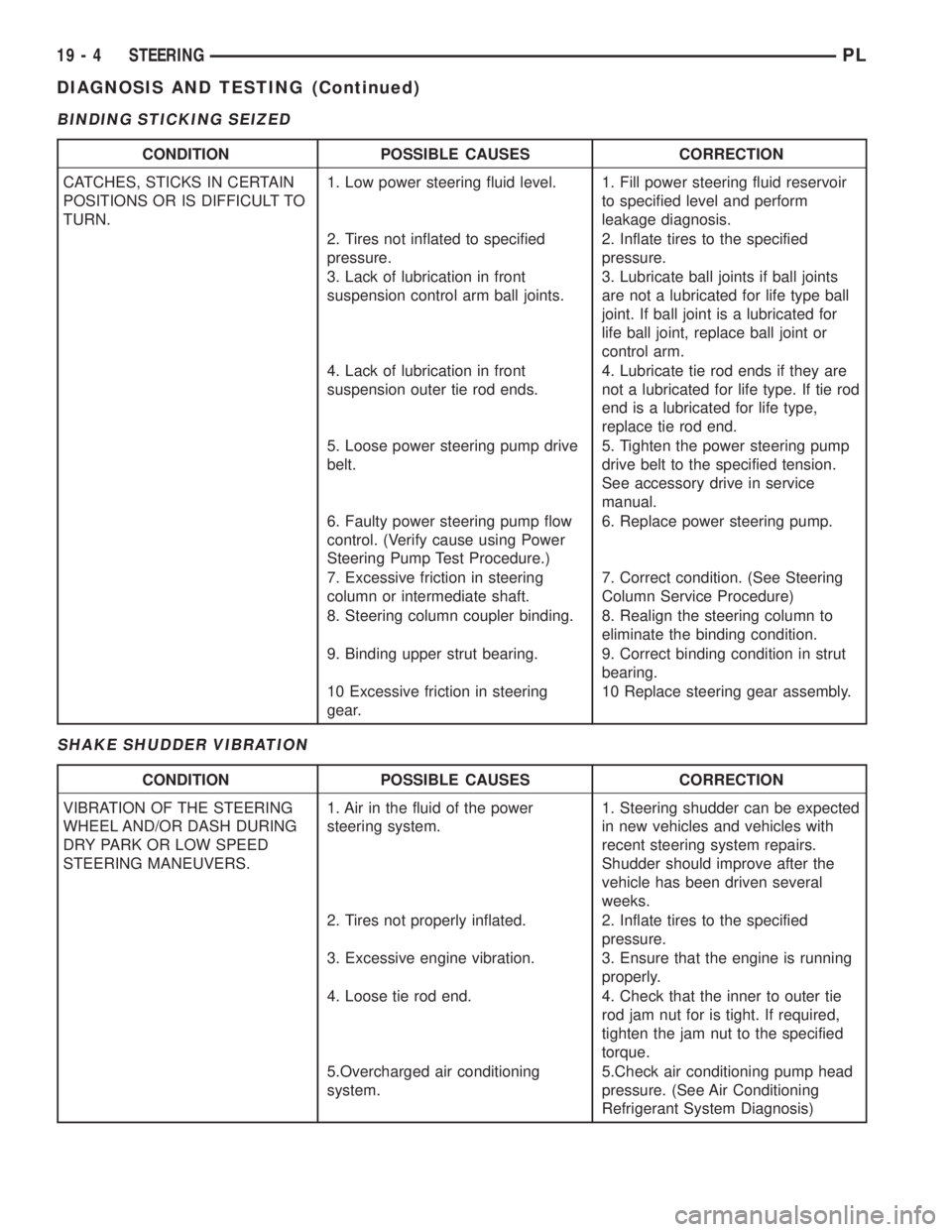
BINDING STICKING SEIZED
SHAKE SHUDDER VIBRATION
CONDITION POSSIBLE CAUSES CORRECTION
CATCHES, STICKS IN CERTAIN
POSITIONS OR IS DIFFICULT TO
TURN.1. Low power steering fluid level. 1. Fill power steering fluid reservoir
to specified level and perform
leakage diagnosis.
2. Tires not inflated to specified
pressure.2. Inflate tires to the specified
pressure.
3. Lack of lubrication in front
suspension control arm ball joints.3. Lubricate ball joints if ball joints
are not a lubricated for life type ball
joint. If ball joint is a lubricated for
life ball joint, replace ball joint or
control arm.
4. Lack of lubrication in front
suspension outer tie rod ends.4. Lubricate tie rod ends if they are
not a lubricated for life type. If tie rod
end is a lubricated for life type,
replace tie rod end.
5. Loose power steering pump drive
belt.5. Tighten the power steering pump
drive belt to the specified tension.
See accessory drive in service
manual.
6. Faulty power steering pump flow
control. (Verify cause using Power
Steering Pump Test Procedure.)6. Replace power steering pump.
7. Excessive friction in steering
column or intermediate shaft.7. Correct condition. (See Steering
Column Service Procedure)
8. Steering column coupler binding. 8. Realign the steering column to
eliminate the binding condition.
9. Binding upper strut bearing. 9. Correct binding condition in strut
bearing.
10 Excessive friction in steering
gear.10 Replace steering gear assembly.
CONDITION POSSIBLE CAUSES CORRECTION
VIBRATION OF THE STEERING
WHEEL AND/OR DASH DURING
DRY PARK OR LOW SPEED
STEERING MANEUVERS.1. Air in the fluid of the power
steering system.1. Steering shudder can be expected
in new vehicles and vehicles with
recent steering system repairs.
Shudder should improve after the
vehicle has been driven several
weeks.
2. Tires not properly inflated. 2. Inflate tires to the specified
pressure.
3. Excessive engine vibration. 3. Ensure that the engine is running
properly.
4. Loose tie rod end. 4. Check that the inner to outer tie
rod jam nut for is tight. If required,
tighten the jam nut to the specified
torque.
5.Overcharged air conditioning
system.5.Check air conditioning pump head
pressure. (See Air Conditioning
Refrigerant System Diagnosis)
19 - 4 STEERINGPL
DIAGNOSIS AND TESTING (Continued)
Page 908 of 1200
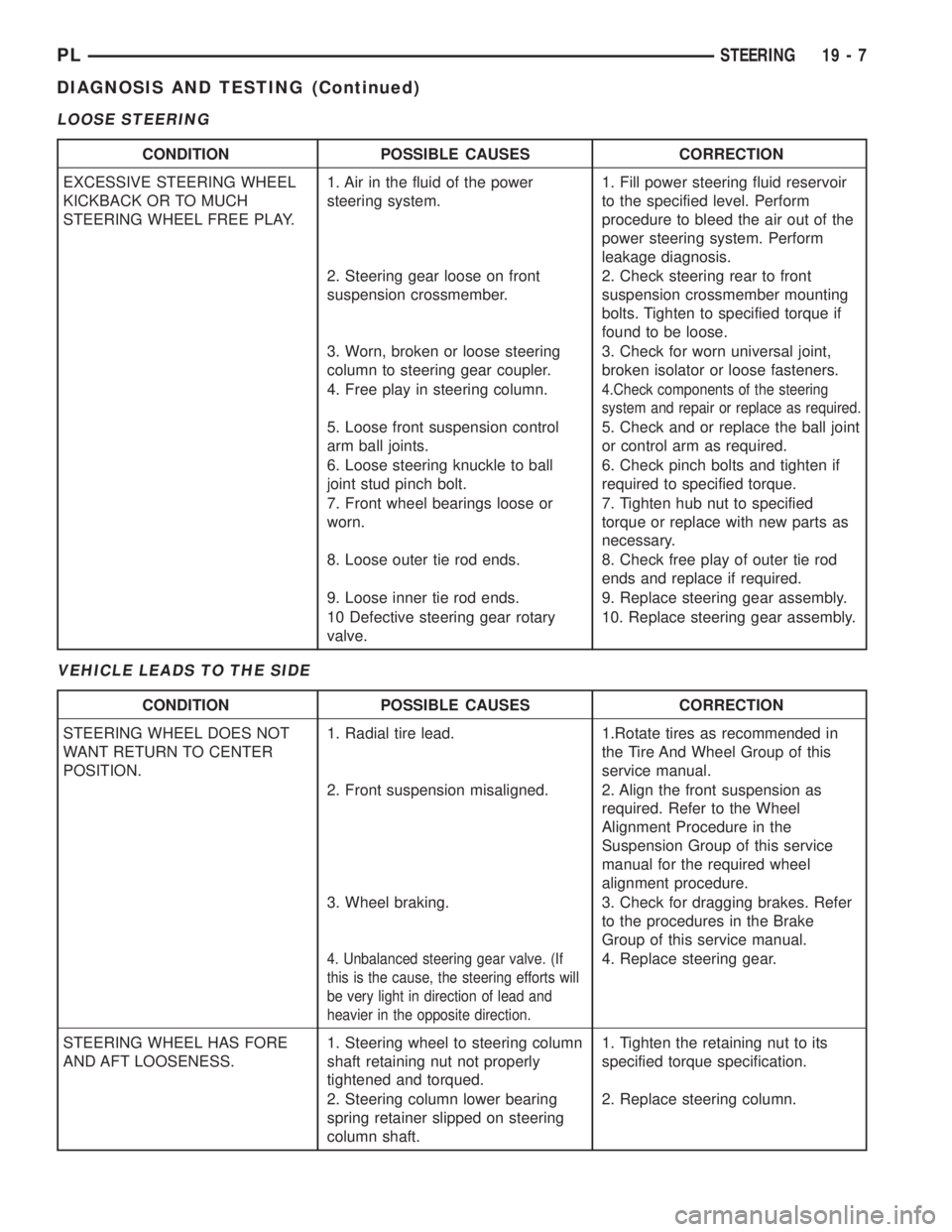
LOOSE STEERING
VEHICLE LEADS TO THE SIDE
CONDITION POSSIBLE CAUSES CORRECTION
EXCESSIVE STEERING WHEEL
KICKBACK OR TO MUCH
STEERING WHEEL FREE PLAY.1. Air in the fluid of the power
steering system.1. Fill power steering fluid reservoir
to the specified level. Perform
procedure to bleed the air out of the
power steering system. Perform
leakage diagnosis.
2. Steering gear loose on front
suspension crossmember.2. Check steering rear to front
suspension crossmember mounting
bolts. Tighten to specified torque if
found to be loose.
3. Worn, broken or loose steering
column to steering gear coupler.3. Check for worn universal joint,
broken isolator or loose fasteners.
4. Free play in steering column.
4.Check components of the steering
system and repair or replace as required.
5. Loose front suspension control
arm ball joints.5. Check and or replace the ball joint
or control arm as required.
6. Loose steering knuckle to ball
joint stud pinch bolt.6. Check pinch bolts and tighten if
required to specified torque.
7. Front wheel bearings loose or
worn.7. Tighten hub nut to specified
torque or replace with new parts as
necessary.
8. Loose outer tie rod ends. 8. Check free play of outer tie rod
ends and replace if required.
9. Loose inner tie rod ends. 9. Replace steering gear assembly.
10 Defective steering gear rotary
valve.10. Replace steering gear assembly.
CONDITION POSSIBLE CAUSES CORRECTION
STEERING WHEEL DOES NOT
WANT RETURN TO CENTER
POSITION.1. Radial tire lead. 1.Rotate tires as recommended in
the Tire And Wheel Group of this
service manual.
2. Front suspension misaligned. 2. Align the front suspension as
required. Refer to the Wheel
Alignment Procedure in the
Suspension Group of this service
manual for the required wheel
alignment procedure.
3. Wheel braking. 3. Check for dragging brakes. Refer
to the procedures in the Brake
Group of this service manual.
4. Unbalanced steering gear valve. (If
this is the cause, the steering efforts will
be very light in direction of lead and
heavier in the opposite direction.4. Replace steering gear.
STEERING WHEEL HAS FORE
AND AFT LOOSENESS.1. Steering wheel to steering column
shaft retaining nut not properly
tightened and torqued.1. Tighten the retaining nut to its
specified torque specification.
2. Steering column lower bearing
spring retainer slipped on steering
column shaft.2. Replace steering column.
PLSTEERING 19 - 7
DIAGNOSIS AND TESTING (Continued)
Page 909 of 1200
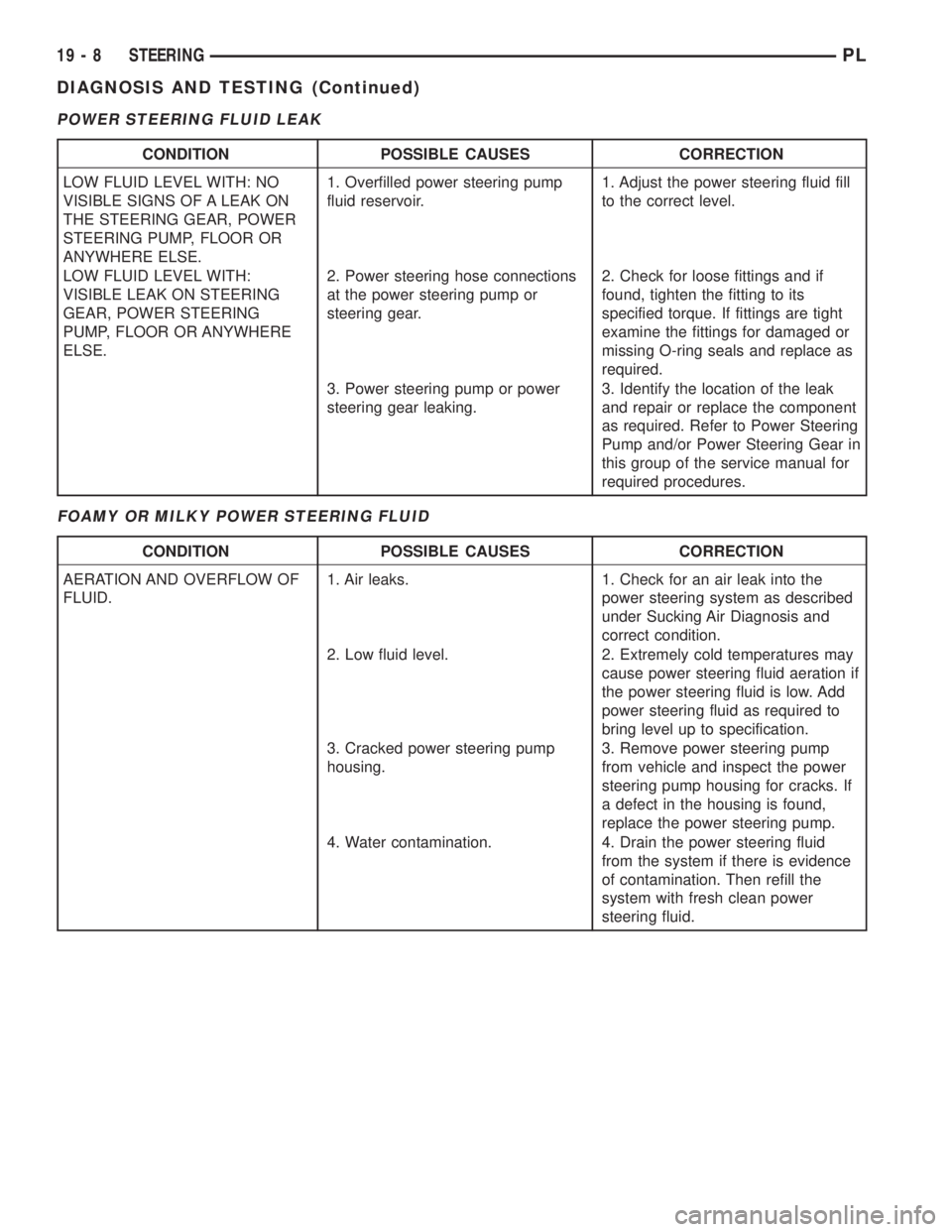
POWER STEERING FLUID LEAK
FOAMY OR MILKY POWER STEERING FLUID
CONDITION POSSIBLE CAUSES CORRECTION
LOW FLUID LEVEL WITH: NO
VISIBLE SIGNS OF A LEAK ON
THE STEERING GEAR, POWER
STEERING PUMP, FLOOR OR
ANYWHERE ELSE.1. Overfilled power steering pump
fluid reservoir.1. Adjust the power steering fluid fill
to the correct level.
LOW FLUID LEVEL WITH:
VISIBLE LEAK ON STEERING
GEAR, POWER STEERING
PUMP, FLOOR OR ANYWHERE
ELSE.2. Power steering hose connections
at the power steering pump or
steering gear.2. Check for loose fittings and if
found, tighten the fitting to its
specified torque. If fittings are tight
examine the fittings for damaged or
missing O-ring seals and replace as
required.
3. Power steering pump or power
steering gear leaking.3. Identify the location of the leak
and repair or replace the component
as required. Refer to Power Steering
Pump and/or Power Steering Gear in
this group of the service manual for
required procedures.
CONDITION POSSIBLE CAUSES CORRECTION
AERATION AND OVERFLOW OF
FLUID.1. Air leaks. 1. Check for an air leak into the
power steering system as described
under Sucking Air Diagnosis and
correct condition.
2. Low fluid level. 2. Extremely cold temperatures may
cause power steering fluid aeration if
the power steering fluid is low. Add
power steering fluid as required to
bring level up to specification.
3. Cracked power steering pump
housing.3. Remove power steering pump
from vehicle and inspect the power
steering pump housing for cracks. If
a defect in the housing is found,
replace the power steering pump.
4. Water contamination. 4. Drain the power steering fluid
from the system if there is evidence
of contamination. Then refill the
system with fresh clean power
steering fluid.
19 - 8 STEERINGPL
DIAGNOSIS AND TESTING (Continued)
Page 910 of 1200
POWER STEERING PUMP
INDEX
page page
DESCRIPTION AND OPERATION
POWER STEERING PUMP................. 9
DIAGNOSIS AND TESTING
POWER STEERING SYSTEM TEST
PROCEDURE......................... 10
SERVICE PROCEDURES
POWER STEERING PUMP
FLOW CONTROL VALVE SEAL............ 11
POWER STEERING PUMP
INITIAL OPERATION.................... 11
POWER STEERING PUMP
SUCTION PORT SEAL.................. 12
POWER STEERING SYSTEM
FLUID LEVEL CHECK................... 11
REMOVAL AND INSTALLATION
POWER STEERING FLUID PRESSURE HOSE . . 13
POWER STEERING FLUID RESERVOIR...... 21POWER STEERING FLUID RETURN HOSE.... 15
POWER STEERING FLUID SUPPLY HOSE
RESERVOIR TO POWER STEERING PUMP . . 17
POWER STEERING PRESSURE SWITCH..... 12
POWER STEERING PUMP (ALL ENGINES).... 18
DISASSEMBLY AND ASSEMBLY
POWER STEERING PUMP DRIVE PULLEY.... 22
POWER STEERING PUMP MOUNTING
BRACKET............................ 23
SPECIFICATIONS
POWER STEERING PUMP FASTENER
TORQUE SPECIFICATIONS.............. 25
POWER STEERING PUMP FLOW
SPECIFICATIONS...................... 25
SPECIAL TOOLS
POWER STEERING PUMP................. 25
DESCRIPTION AND OPERATION
POWER STEERING PUMP
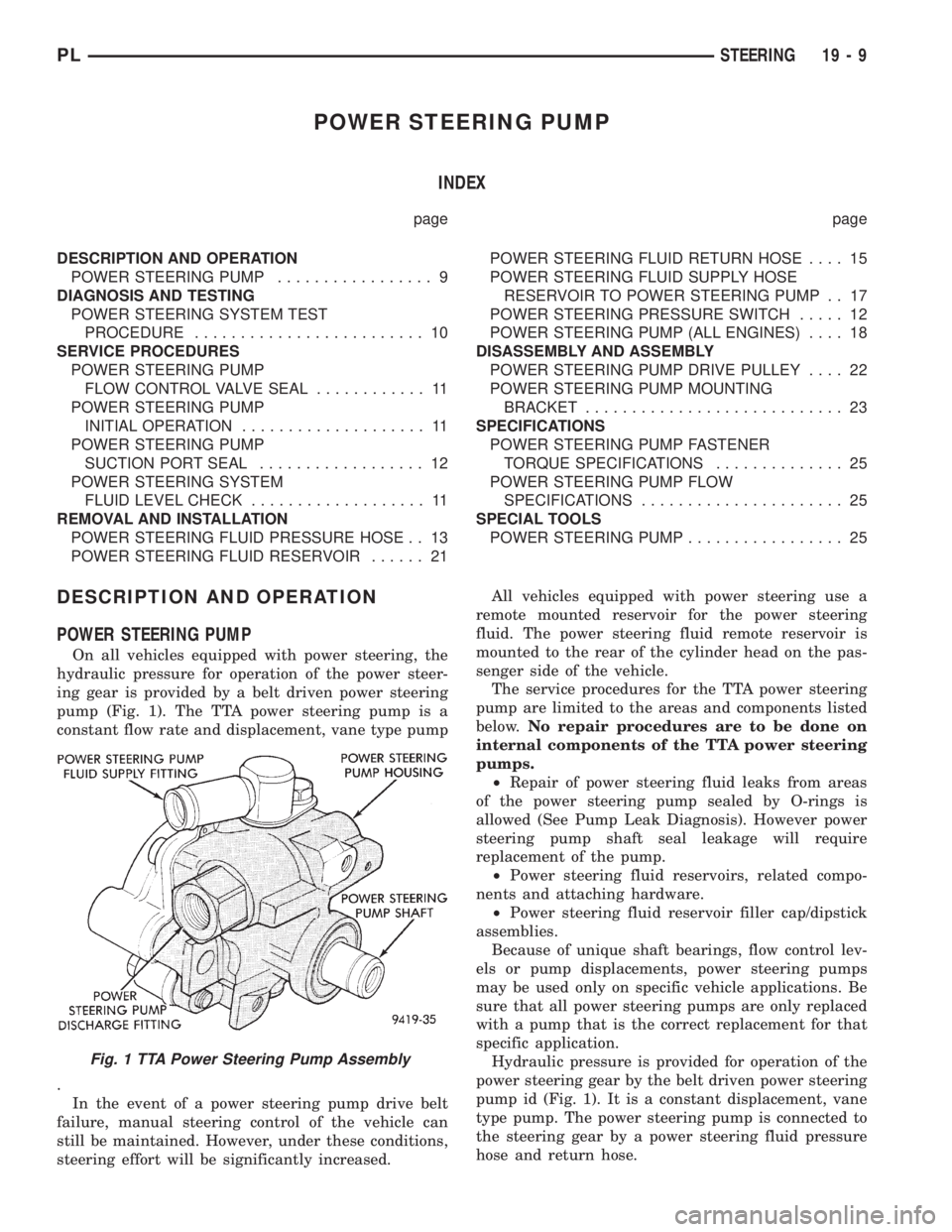
On all vehicles equipped with power steering, the
hydraulic pressure for operation of the power steer-
ing gear is provided by a belt driven power steering
pump (Fig. 1). The TTA power steering pump is a
constant flow rate and displacement, vane type pump
.
In the event of a power steering pump drive belt
failure, manual steering control of the vehicle can
still be maintained. However, under these conditions,
steering effort will be significantly increased.All vehicles equipped with power steering use a
remote mounted reservoir for the power steering
fluid. The power steering fluid remote reservoir is
mounted to the rear of the cylinder head on the pas-
senger side of the vehicle.
The service procedures for the TTA power steering
pump are limited to the areas and components listed
below.No repair procedures are to be done on
internal components of the TTA power steering
pumps.
²Repair of power steering fluid leaks from areas
of the power steering pump sealed by O-rings is
allowed (See Pump Leak Diagnosis). However power
steering pump shaft seal leakage will require
replacement of the pump.
²Power steering fluid reservoirs, related compo-
nents and attaching hardware.
²Power steering fluid reservoir filler cap/dipstick
assemblies.
Because of unique shaft bearings, flow control lev-
els or pump displacements, power steering pumps
may be used only on specific vehicle applications. Be
sure that all power steering pumps are only replaced
with a pump that is the correct replacement for that
specific application.
Hydraulic pressure is provided for operation of the
power steering gear by the belt driven power steering
pump id (Fig. 1). It is a constant displacement, vane
type pump. The power steering pump is connected to
the steering gear by a power steering fluid pressure
hose and return hose.
Fig. 1 TTA Power Steering Pump Assembly
PLSTEERING 19 - 9
Page 913 of 1200
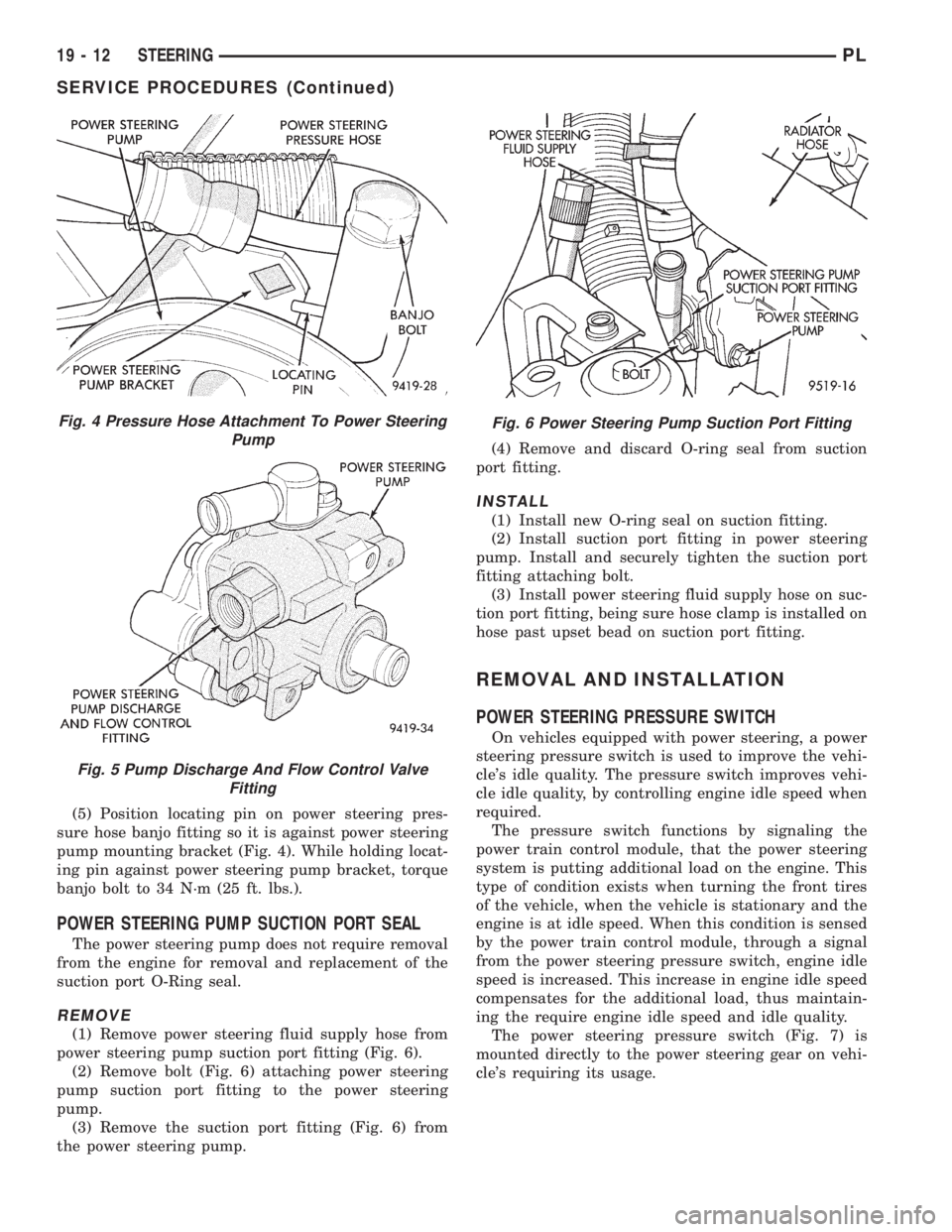
(5) Position locating pin on power steering pres-
sure hose banjo fitting so it is against power steering
pump mounting bracket (Fig. 4). While holding locat-
ing pin against power steering pump bracket, torque
banjo bolt to 34 N´m (25 ft. lbs.).
POWER STEERING PUMP SUCTION PORT SEAL
The power steering pump does not require removal
from the engine for removal and replacement of the
suction port O-Ring seal.
REMOVE
(1) Remove power steering fluid supply hose from
power steering pump suction port fitting (Fig. 6).
(2) Remove bolt (Fig. 6) attaching power steering
pump suction port fitting to the power steering
pump.
(3) Remove the suction port fitting (Fig. 6) from
the power steering pump.(4) Remove and discard O-ring seal from suction
port fitting.
INSTALL
(1) Install new O-ring seal on suction fitting.
(2) Install suction port fitting in power steering
pump. Install and securely tighten the suction port
fitting attaching bolt.
(3) Install power steering fluid supply hose on suc-
tion port fitting, being sure hose clamp is installed on
hose past upset bead on suction port fitting.
REMOVAL AND INSTALLATION
POWER STEERING PRESSURE SWITCH
On vehicles equipped with power steering, a power
steering pressure switch is used to improve the vehi-
cle's idle quality. The pressure switch improves vehi-
cle idle quality, by controlling engine idle speed when
required.
The pressure switch functions by signaling the
power train control module, that the power steering
system is putting additional load on the engine. This
type of condition exists when turning the front tires
of the vehicle, when the vehicle is stationary and the
engine is at idle speed. When this condition is sensed
by the power train control module, through a signal
from the power steering pressure switch, engine idle
speed is increased. This increase in engine idle speed
compensates for the additional load, thus maintain-
ing the require engine idle speed and idle quality.
The power steering pressure switch (Fig. 7) is
mounted directly to the power steering gear on vehi-
cle's requiring its usage.
Fig. 4 Pressure Hose Attachment To Power Steering
Pump
Fig. 5 Pump Discharge And Flow Control Valve
Fitting
Fig. 6 Power Steering Pump Suction Port Fitting
19 - 12 STEERINGPL
SERVICE PROCEDURES (Continued)
Page 914 of 1200
REMOVE
CAUTION: When removing and installing the
power steering pressure switch, the use of a 7/8
inch deep well socket is required. The deep well
socket will prevent damage to the plastic, electrical
connector area, of the power steering pressure
switch.
(1) Disconnect negative battery cable from the neg-
ative post of the battery. Be sure cable is isolated
from negative post on battery.
(2) Raise vehicle.
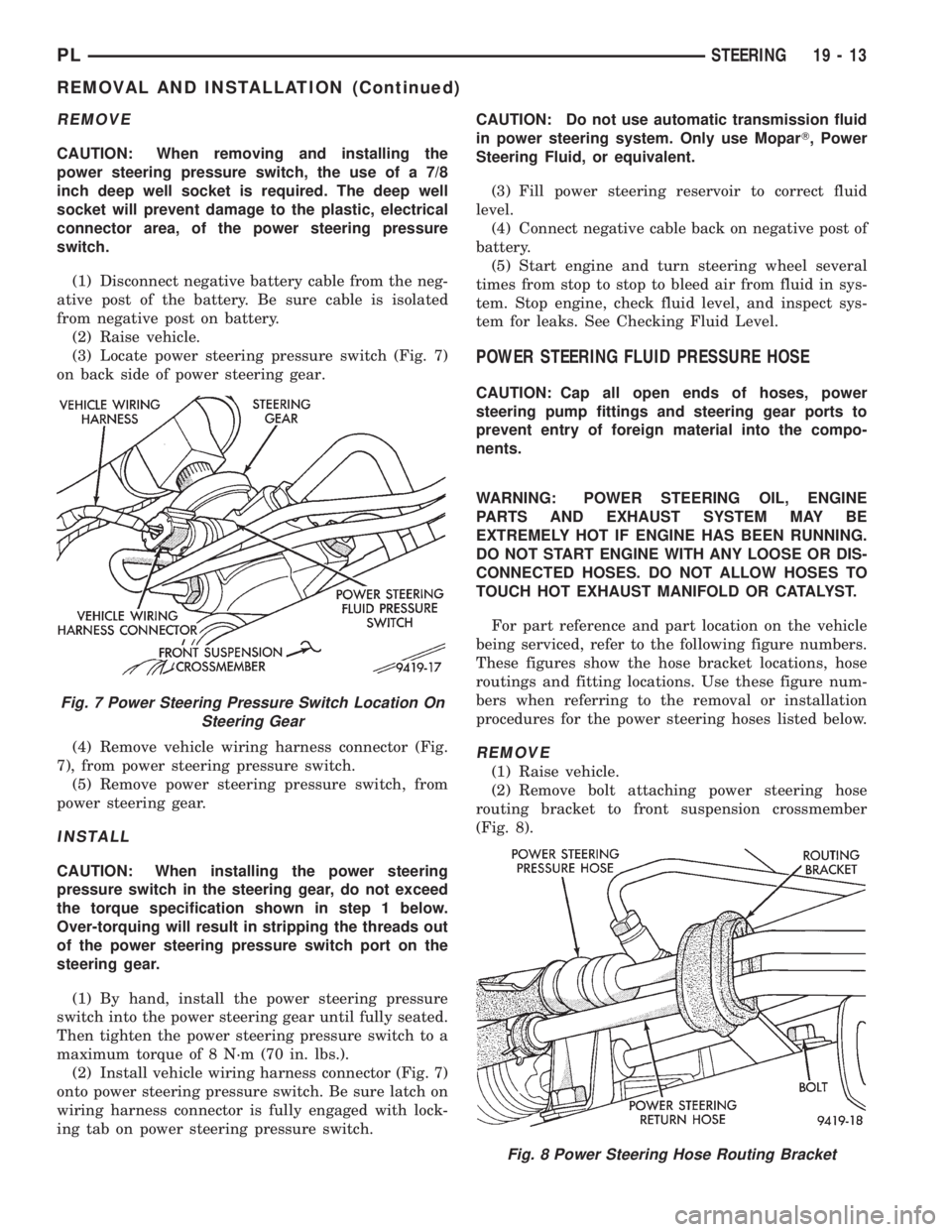
(3) Locate power steering pressure switch (Fig. 7)
on back side of power steering gear.
(4) Remove vehicle wiring harness connector (Fig.
7), from power steering pressure switch.
(5) Remove power steering pressure switch, from
power steering gear.
INSTALL
CAUTION: When installing the power steering
pressure switch in the steering gear, do not exceed
the torque specification shown in step 1 below.
Over-torquing will result in stripping the threads out
of the power steering pressure switch port on the
steering gear.
(1) By hand, install the power steering pressure
switch into the power steering gear until fully seated.
Then tighten the power steering pressure switch to a
maximum torque of 8 N´m (70 in. lbs.).
(2) Install vehicle wiring harness connector (Fig. 7)
onto power steering pressure switch. Be sure latch on
wiring harness connector is fully engaged with lock-
ing tab on power steering pressure switch.CAUTION: Do not use automatic transmission fluid
in power steering system. Only use MoparT, Power
Steering Fluid, or equivalent.
(3) Fill power steering reservoir to correct fluid
level.
(4) Connect negative cable back on negative post of
battery.
(5) Start engine and turn steering wheel several
times from stop to stop to bleed air from fluid in sys-
tem. Stop engine, check fluid level, and inspect sys-
tem for leaks. See Checking Fluid Level.
POWER STEERING FLUID PRESSURE HOSE
CAUTION: Cap all open ends of hoses, power
steering pump fittings and steering gear ports to
prevent entry of foreign material into the compo-
nents.
WARNING: POWER STEERING OIL, ENGINE
PARTS AND EXHAUST SYSTEM MAY BE
EXTREMELY HOT IF ENGINE HAS BEEN RUNNING.
DO NOT START ENGINE WITH ANY LOOSE OR DIS-
CONNECTED HOSES. DO NOT ALLOW HOSES TO
TOUCH HOT EXHAUST MANIFOLD OR CATALYST.
For part reference and part location on the vehicle
being serviced, refer to the following figure numbers.
These figures show the hose bracket locations, hose
routings and fitting locations. Use these figure num-
bers when referring to the removal or installation
procedures for the power steering hoses listed below.
REMOVE
(1) Raise vehicle.
(2) Remove bolt attaching power steering hose
routing bracket to front suspension crossmember
(Fig. 8).
Fig. 7 Power Steering Pressure Switch Location On
Steering Gear
Fig. 8 Power Steering Hose Routing Bracket
PLSTEERING 19 - 13
REMOVAL AND INSTALLATION (Continued)
Page 915 of 1200
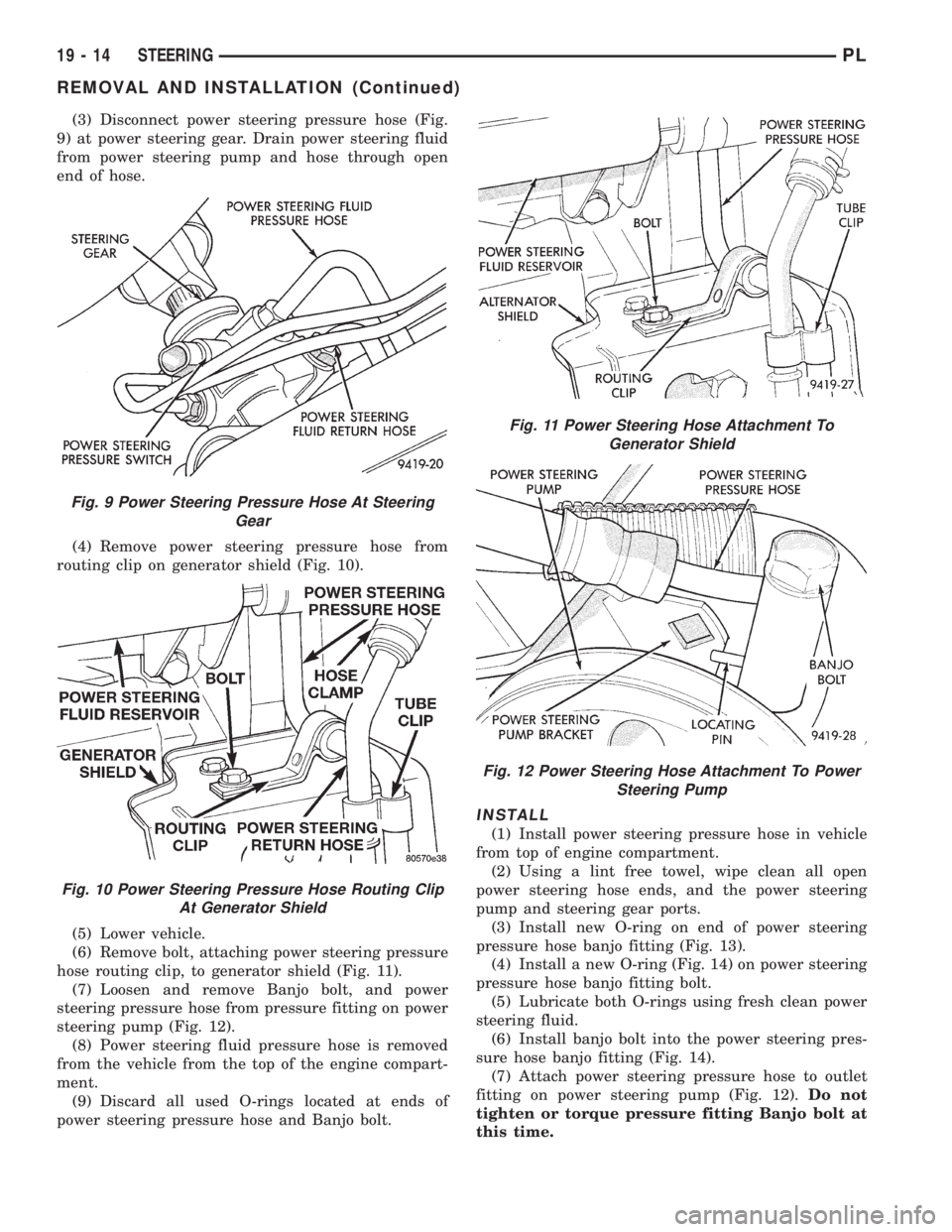
(3) Disconnect power steering pressure hose (Fig.
9) at power steering gear. Drain power steering fluid
from power steering pump and hose through open
end of hose.
(4) Remove power steering pressure hose from
routing clip on generator shield (Fig. 10).
(5) Lower vehicle.
(6) Remove bolt, attaching power steering pressure
hose routing clip, to generator shield (Fig. 11).
(7) Loosen and remove Banjo bolt, and power
steering pressure hose from pressure fitting on power
steering pump (Fig. 12).
(8) Power steering fluid pressure hose is removed
from the vehicle from the top of the engine compart-
ment.
(9) Discard all used O-rings located at ends of
power steering pressure hose and Banjo bolt.
INSTALL
(1) Install power steering pressure hose in vehicle
from top of engine compartment.
(2) Using a lint free towel, wipe clean all open
power steering hose ends, and the power steering
pump and steering gear ports.
(3) Install new O-ring on end of power steering
pressure hose banjo fitting (Fig. 13).
(4) Install a new O-ring (Fig. 14) on power steering
pressure hose banjo fitting bolt.
(5) Lubricate both O-rings using fresh clean power
steering fluid.
(6) Install banjo bolt into the power steering pres-
sure hose banjo fitting (Fig. 14).
(7) Attach power steering pressure hose to outlet
fitting on power steering pump (Fig. 12).Do not
tighten or torque pressure fitting Banjo bolt at
this time.
Fig. 9 Power Steering Pressure Hose At Steering
Gear
Fig. 10 Power Steering Pressure Hose Routing Clip
At Generator Shield
Fig. 11 Power Steering Hose Attachment To
Generator Shield
Fig. 12 Power Steering Hose Attachment To Power
Steering Pump
19 - 14 STEERINGPL
REMOVAL AND INSTALLATION (Continued)