torque DODGE NEON 1999 Service Repair Manual
[x] Cancel search | Manufacturer: DODGE, Model Year: 1999, Model line: NEON, Model: DODGE NEON 1999Pages: 1200, PDF Size: 35.29 MB
Page 916 of 1200
(8) Correctly route power steering pressure hose
avoiding tight bends or kinking of the hose. Install
power steering pressure hose to generator shield
routing clip attaching screw (Fig. 11)but do not
tighten at this time.
(9) Raise vehicle.
CAUTION: Hoses must remain away from exhaust
system, vehicle components and unfriendly sur-
faces causing possible damage to power steering
hoses.
(10) Route power steering pressure hose to pres-
sure port on power steering gear. Install power steer-
ing pressure hose, on steering gear and loosely
install tube nut into steering gear (Fig. 9).Tighten
and torque tube nut after routing bracket is
installed, correctly positioning hoses in vehicle.(11) Install the power steering pressure and return
hose routing clip on hoses (Fig. 8). Install bolt attach-
ing routing clip to front suspension crossmember.
Torque routing clip to front suspension crossmember
attaching bolt to 23 N´m (17 ft. lbs.)
(12) Torque power steering pressure hose to steer-
ing gear tube nut to 34 N´m (25 ft. lbs.).
(13) Install power steering pressure hose in rout-
ing clip on generator shield (Fig. 10).
(14) Lower Vehicle.
(15) Position locating pin on power steering pres-
sure hose banjo fitting so it is against power steering
pump mounting bracket (Fig. 12). While holding
locating pin against power steering pump bracket,
torque pump end Banjo bolt to 34 N´m (25 ft. lbs.).
(16) Securely tighten bolt attaching power steering
pressure hose bracket to generator shield.
(17) Start the engine and let run for a few seconds.
Then turn the engine off.
(18) Add fluid if necessary. Repeat the above pro-
cedure until the fluid level remains constant after
running the engine.
(19) Raise front wheels of vehicle off the ground.
(20) Start the engine. Slowly turn the steering
wheel right and left, lightly contacting the wheel
stops. Then turn the engine off.
(21) Add power steering fluid if necessary.
(22) Lower the vehicle and turn the steering wheel
slowly from lock to lock.
(23) Stop the engine. Check the fluid level and
refill as required.
(24) If the fluid is extremely foamy, allow the vehi-
cle to stand a few minutes and repeat the above pro-
cedure.
(25) After hose is installed, check for leaks at all
hose connections.POWER STEERING FLUID RETURN HOSE
CAUTION: Cap all open ends of hoses, power
steering pump fittings and steering gear ports to
prevent entry of foreign material into the compo-
nents.
WARNING: POWER STEERING OIL, ENGINE
PARTS AND EXHAUST SYSTEM MAY BE
EXTREMELY HOT IF ENGINE HAS BEEN RUNNING.
DO NOT START ENGINE WITH ANY LOOSE OR DIS-
CONNECTED HOSES. DO NOT ALLOW HOSES TO
TOUCH HOT EXHAUST MANIFOLD OR CATALYST.
REMOVE
(1) Raise vehicle.
(2) Remove hose clamp, attaching return hose to
steel tube at power steering gear (Fig. 15). Let power
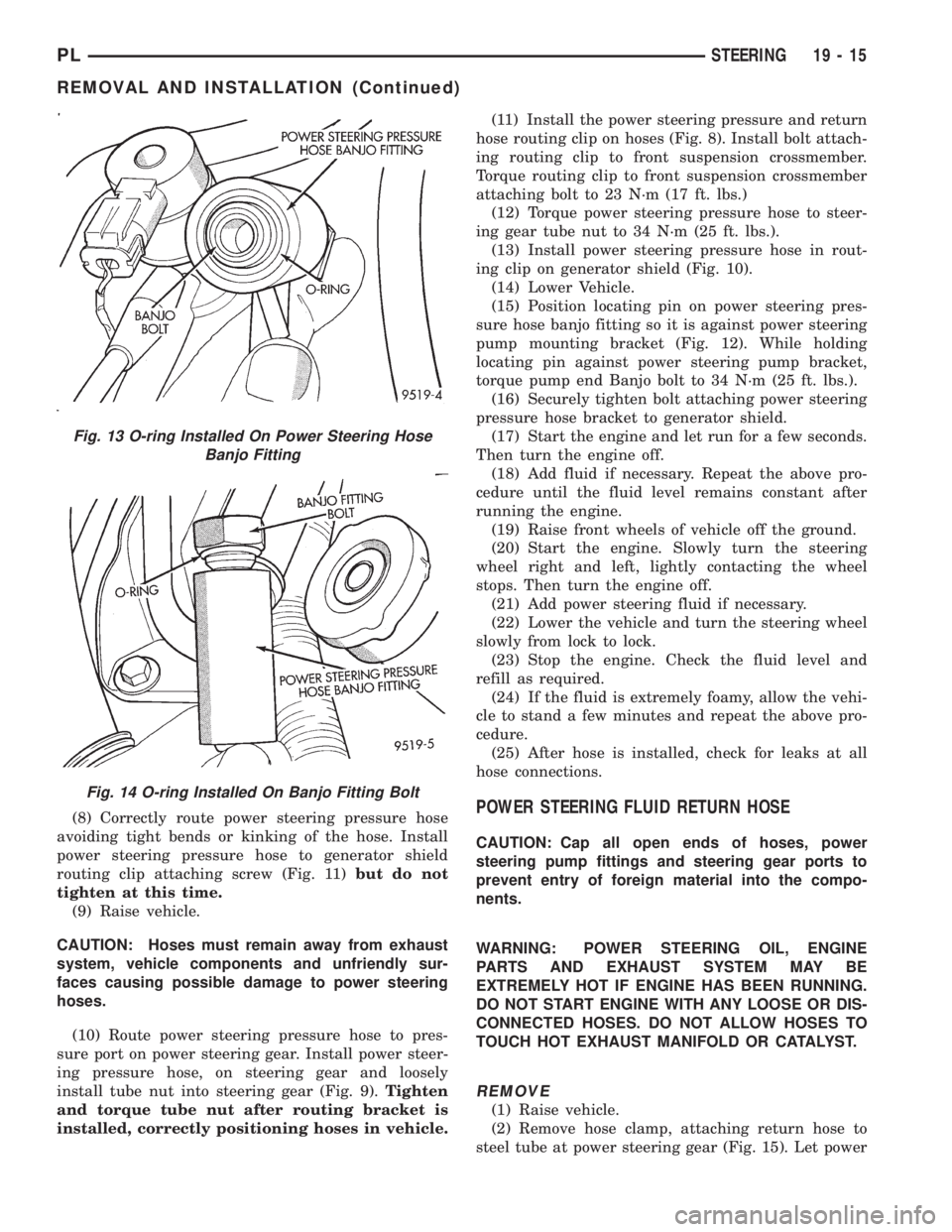
Fig. 13 O-ring Installed On Power Steering Hose
Banjo Fitting
Fig. 14 O-ring Installed On Banjo Fitting Bolt
PLSTEERING 19 - 15
REMOVAL AND INSTALLATION (Continued)
Page 921 of 1200
drive belt tension. See Accessory Drive Belts in
Group 7 Cooling System of this service manual for
the correct drive belt tension specification. When cor-
rect drive belt tension is obtained torque the 2 bolts
at the power steering pump cast mounting bracket
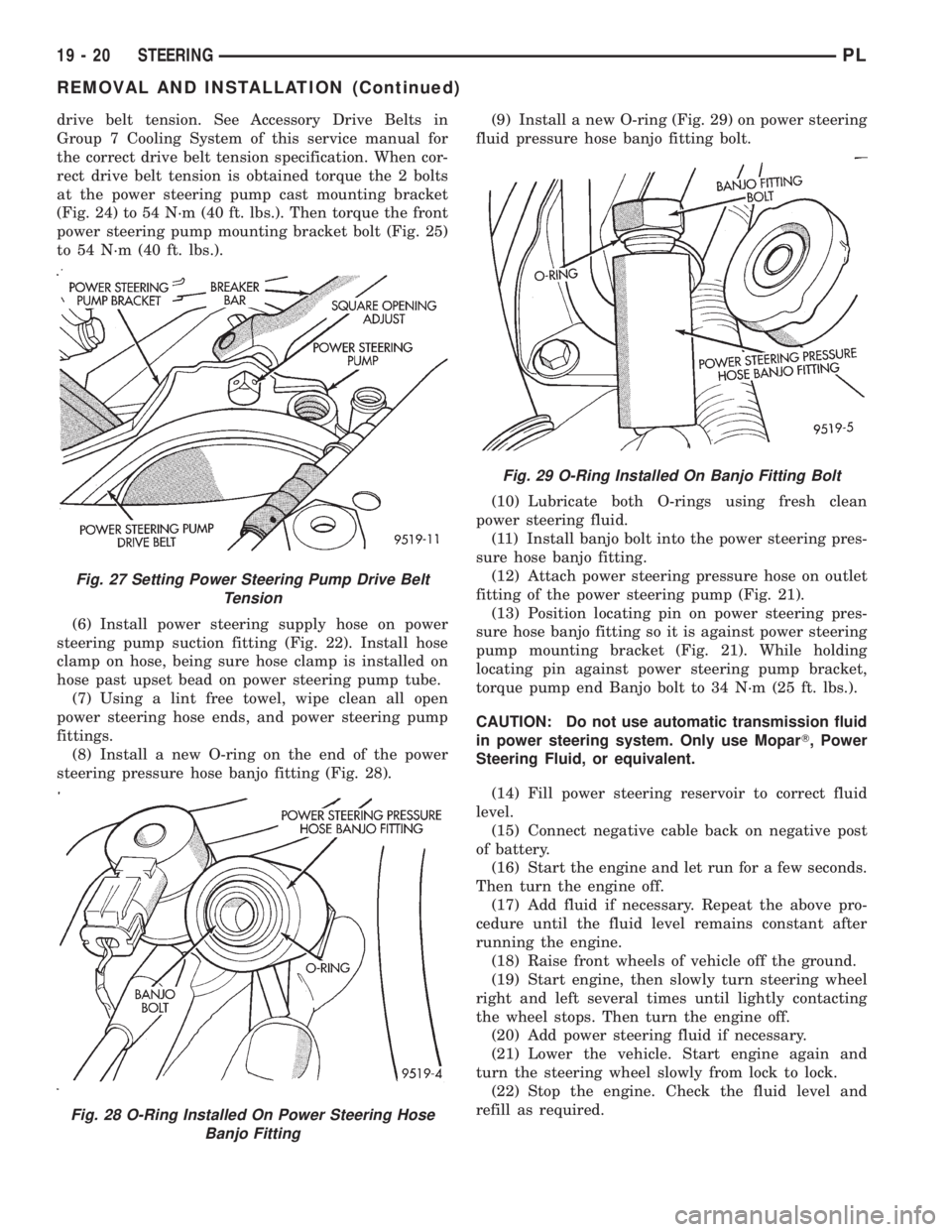
(Fig. 24) to 54 N´m (40 ft. lbs.). Then torque the front
power steering pump mounting bracket bolt (Fig. 25)
to 54 N´m (40 ft. lbs.).
(6) Install power steering supply hose on power
steering pump suction fitting (Fig. 22). Install hose
clamp on hose, being sure hose clamp is installed on
hose past upset bead on power steering pump tube.
(7) Using a lint free towel, wipe clean all open
power steering hose ends, and power steering pump
fittings.
(8) Install a new O-ring on the end of the power
steering pressure hose banjo fitting (Fig. 28).(9) Install a new O-ring (Fig. 29) on power steering
fluid pressure hose banjo fitting bolt.
(10) Lubricate both O-rings using fresh clean
power steering fluid.
(11) Install banjo bolt into the power steering pres-
sure hose banjo fitting.
(12) Attach power steering pressure hose on outlet
fitting of the power steering pump (Fig. 21).
(13) Position locating pin on power steering pres-
sure hose banjo fitting so it is against power steering
pump mounting bracket (Fig. 21). While holding
locating pin against power steering pump bracket,
torque pump end Banjo bolt to 34 N´m (25 ft. lbs.).
CAUTION: Do not use automatic transmission fluid
in power steering system. Only use MoparT, Power
Steering Fluid, or equivalent.
(14) Fill power steering reservoir to correct fluid
level.
(15) Connect negative cable back on negative post
of battery.
(16) Start the engine and let run for a few seconds.
Then turn the engine off.
(17) Add fluid if necessary. Repeat the above pro-
cedure until the fluid level remains constant after
running the engine.
(18) Raise front wheels of vehicle off the ground.
(19) Start engine, then slowly turn steering wheel
right and left several times until lightly contacting
the wheel stops. Then turn the engine off.
(20) Add power steering fluid if necessary.
(21) Lower the vehicle. Start engine again and
turn the steering wheel slowly from lock to lock.
(22) Stop the engine. Check the fluid level and
refill as required.
Fig. 27 Setting Power Steering Pump Drive Belt
Tension
Fig. 28 O-Ring Installed On Power Steering Hose
Banjo Fitting
Fig. 29 O-Ring Installed On Banjo Fitting Bolt
19 - 20 STEERINGPL
REMOVAL AND INSTALLATION (Continued)
Page 924 of 1200
INSTALL
CAUTION: Do not hammer on power steering
pump pulley or shaft to remove power steering
pump pulley. This will damage the pulley and the
power steering pump.
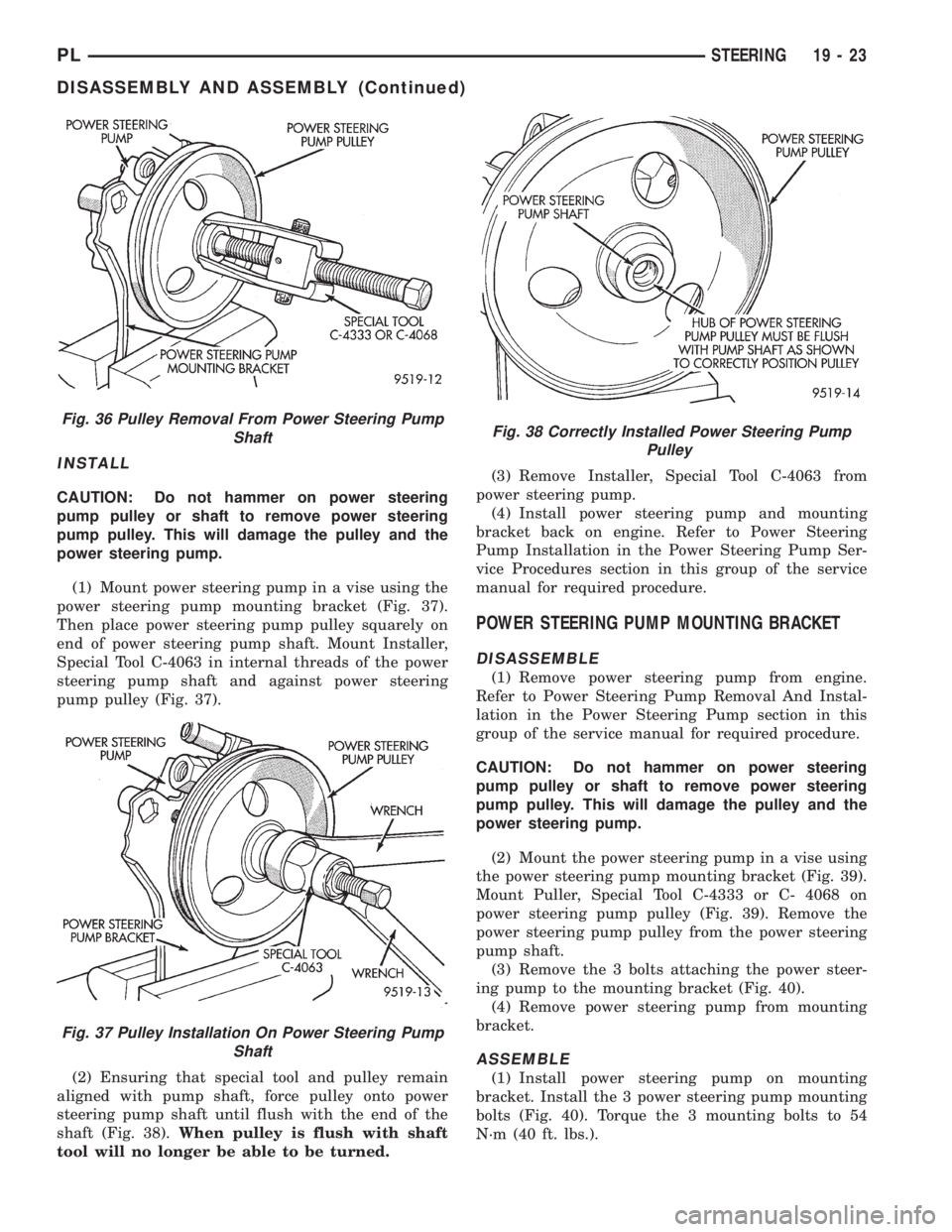
(1) Mount power steering pump in a vise using the
power steering pump mounting bracket (Fig. 37).
Then place power steering pump pulley squarely on
end of power steering pump shaft. Mount Installer,
Special Tool C-4063 in internal threads of the power
steering pump shaft and against power steering
pump pulley (Fig. 37).
(2) Ensuring that special tool and pulley remain
aligned with pump shaft, force pulley onto power
steering pump shaft until flush with the end of the
shaft (Fig. 38).When pulley is flush with shaft
tool will no longer be able to be turned.(3) Remove Installer, Special Tool C-4063 from
power steering pump.
(4) Install power steering pump and mounting
bracket back on engine. Refer to Power Steering
Pump Installation in the Power Steering Pump Ser-
vice Procedures section in this group of the service
manual for required procedure.
POWER STEERING PUMP MOUNTING BRACKET
DISASSEMBLE
(1) Remove power steering pump from engine.
Refer to Power Steering Pump Removal And Instal-
lation in the Power Steering Pump section in this
group of the service manual for required procedure.
CAUTION: Do not hammer on power steering
pump pulley or shaft to remove power steering
pump pulley. This will damage the pulley and the
power steering pump.
(2) Mount the power steering pump in a vise using
the power steering pump mounting bracket (Fig. 39).
Mount Puller, Special Tool C-4333 or C- 4068 on
power steering pump pulley (Fig. 39). Remove the
power steering pump pulley from the power steering
pump shaft.
(3) Remove the 3 bolts attaching the power steer-
ing pump to the mounting bracket (Fig. 40).
(4) Remove power steering pump from mounting
bracket.
ASSEMBLE
(1) Install power steering pump on mounting
bracket. Install the 3 power steering pump mounting
bolts (Fig. 40). Torque the 3 mounting bolts to 54
N´m (40 ft. lbs.).
Fig. 36 Pulley Removal From Power Steering Pump
Shaft
Fig. 37 Pulley Installation On Power Steering Pump
Shaft
Fig. 38 Correctly Installed Power Steering Pump
Pulley
PLSTEERING 19 - 23
DISASSEMBLY AND ASSEMBLY (Continued)
Page 926 of 1200
SPECIFICATIONS
POWER STEERING PUMP FLOW SPECIFICATIONS
Power Steering Pump Flow:
At 1500 RPM And
Minimum Pressure.........4.9 to 5.3 Liters/Min
(1.3 to 1.9 GPM)
Control Valve Pressure Relief....8240 to 8920 kPa
(1195 to 1293 psi)
POWER STEERING PUMP FASTENER TORQUE
SPECIFICATIONS
DESCRIPTION TORQUE
Power Steering Hose:
Tube Nuts Pressure And Return...........31N´m
(275 in. lbs.)
Bracket To Front Crossmember
Attaching Bolt.............23N´m(17ft.lbs.).
Power Steering Pump:
Pressure Hose Banjo Bolt......34N´m(25ft.lbs.).
Discharge Fitting.............75N´m(55ft.lbs.)
To Bracket Mounting Bolts.....54N´m(40. ft. lbs.)
Brackets To Engine Mounting Bolts.......54N´m
(40 ft. lbs.)
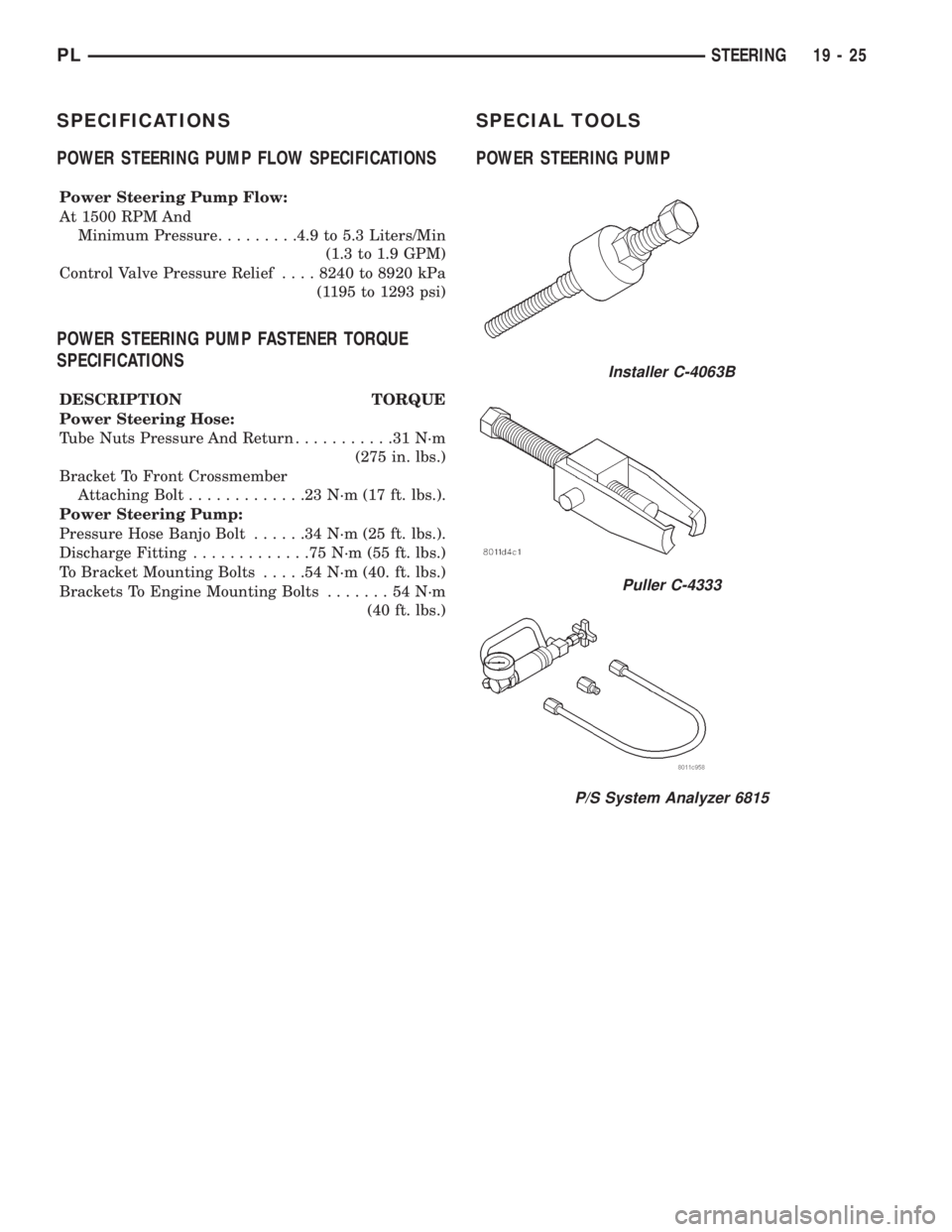
SPECIAL TOOLS
POWER STEERING PUMP
Installer C-4063B
Puller C-4333
P/S System Analyzer 6815
PLSTEERING 19 - 25
Page 927 of 1200
STEERING GEAR
INDEX
page page
DESCRIPTION AND OPERATION
STEERING GEAR........................ 26
DIAGNOSIS AND TESTING
POWER STEERING SYSTEM
TEST PROCEDURE.................... 27
REMOVAL AND INSTALLATION
MANUAL AND POWER STEERING GEAR..... 28DISASSEMBLY AND ASSEMBLY
OUTER TIE ROD........................ 32
SPECIFICATIONS
STEERING GEAR FASTENER
TORQUE SPECIFICATIONS.............. 34
SPECIAL TOOLS
POWER STEERING GEAR................. 34
DESCRIPTION AND OPERATION
STEERING GEAR
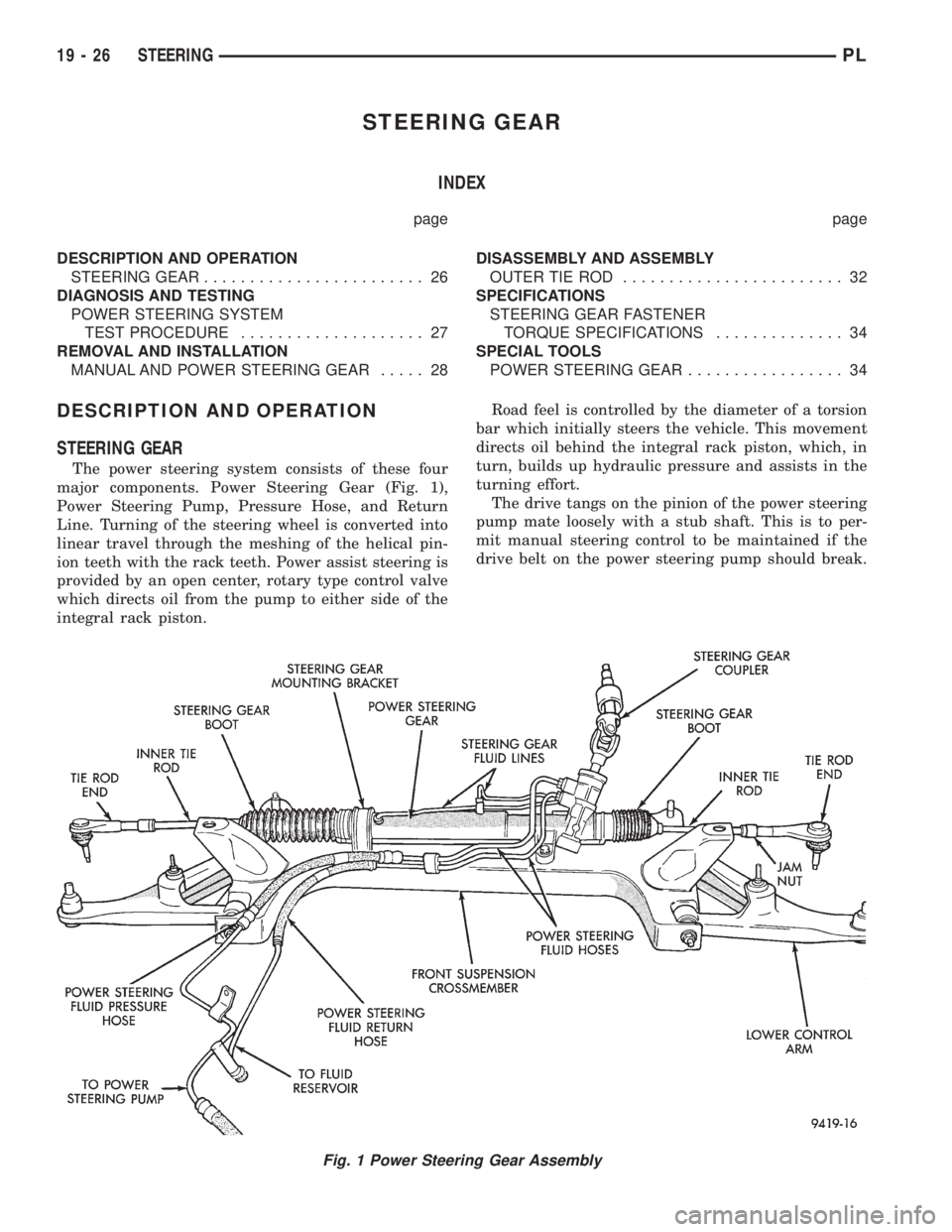
The power steering system consists of these four
major components. Power Steering Gear (Fig. 1),
Power Steering Pump, Pressure Hose, and Return
Line. Turning of the steering wheel is converted into
linear travel through the meshing of the helical pin-
ion teeth with the rack teeth. Power assist steering is
provided by an open center, rotary type control valve
which directs oil from the pump to either side of the
integral rack piston.Road feel is controlled by the diameter of a torsion
bar which initially steers the vehicle. This movement
directs oil behind the integral rack piston, which, in
turn, builds up hydraulic pressure and assists in the
turning effort.
The drive tangs on the pinion of the power steering
pump mate loosely with a stub shaft. This is to per-
mit manual steering control to be maintained if the
drive belt on the power steering pump should break.
Fig. 1 Power Steering Gear Assembly
19 - 26 STEERINGPL
Page 932 of 1200
Torque the 4 steering gear mounting bolts to 68 N´m
(50 ft. lbs.).
(2) Using the transmission jack, raise front sus-
pension crossmember and steering gear against body
and frame rails of vehicle. Start the 2 rear bolts into
tapping plates, attaching front suspension crossmem-
ber to body of vehicle (Fig. 13). Then install the 2
front bolts, attaching front suspension crossmember
to frame rails of vehicle (Fig. 13). Tighten the 4
mounting bolts, until front suspension crossmember
is against body of vehicle at the 4 mounting points.
Then torque the 4 mounting bolts to 2 N´m (20 in.
lbs.) to hold front suspension crossmember in posi-
tion.
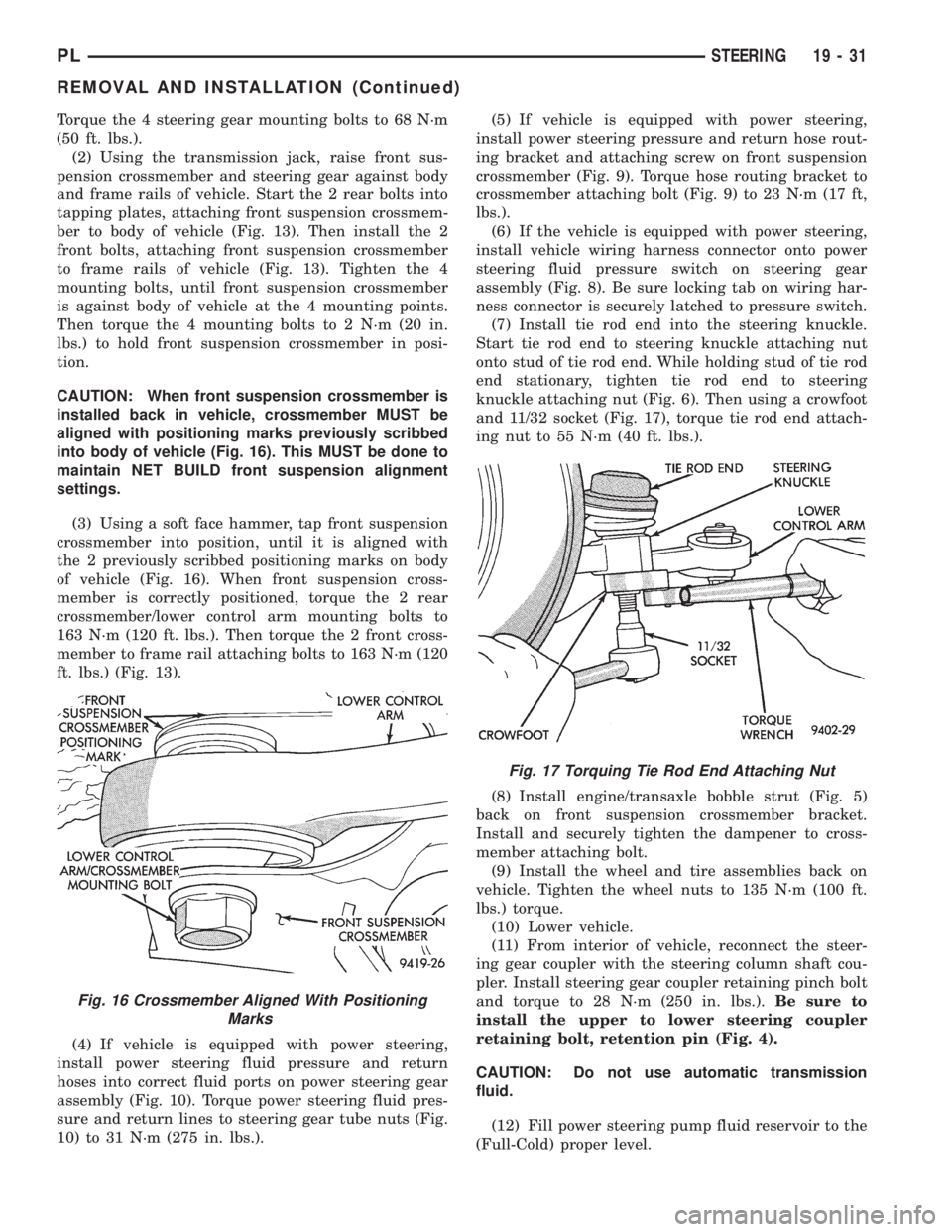
CAUTION: When front suspension crossmember is
installed back in vehicle, crossmember MUST be
aligned with positioning marks previously scribbed
into body of vehicle (Fig. 16). This MUST be done to
maintain NET BUILD front suspension alignment
settings.
(3) Using a soft face hammer, tap front suspension
crossmember into position, until it is aligned with
the 2 previously scribbed positioning marks on body
of vehicle (Fig. 16). When front suspension cross-
member is correctly positioned, torque the 2 rear
crossmember/lower control arm mounting bolts to
163 N´m (120 ft. lbs.). Then torque the 2 front cross-
member to frame rail attaching bolts to 163 N´m (120
ft. lbs.) (Fig. 13).
(4) If vehicle is equipped with power steering,
install power steering fluid pressure and return
hoses into correct fluid ports on power steering gear
assembly (Fig. 10). Torque power steering fluid pres-
sure and return lines to steering gear tube nuts (Fig.
10) to 31 N´m (275 in. lbs.).(5) If vehicle is equipped with power steering,
install power steering pressure and return hose rout-
ing bracket and attaching screw on front suspension
crossmember (Fig. 9). Torque hose routing bracket to
crossmember attaching bolt (Fig. 9) to 23 N´m (17 ft,
lbs.).
(6) If the vehicle is equipped with power steering,
install vehicle wiring harness connector onto power
steering fluid pressure switch on steering gear
assembly (Fig. 8). Be sure locking tab on wiring har-
ness connector is securely latched to pressure switch.
(7) Install tie rod end into the steering knuckle.
Start tie rod end to steering knuckle attaching nut
onto stud of tie rod end. While holding stud of tie rod
end stationary, tighten tie rod end to steering
knuckle attaching nut (Fig. 6). Then using a crowfoot
and 11/32 socket (Fig. 17), torque tie rod end attach-
ing nut to 55 N´m (40 ft. lbs.).
(8) Install engine/transaxle bobble strut (Fig. 5)
back on front suspension crossmember bracket.
Install and securely tighten the dampener to cross-
member attaching bolt.
(9) Install the wheel and tire assemblies back on
vehicle. Tighten the wheel nuts to 135 N´m (100 ft.
lbs.) torque.
(10) Lower vehicle.
(11) From interior of vehicle, reconnect the steer-
ing gear coupler with the steering column shaft cou-
pler. Install steering gear coupler retaining pinch bolt
and torque to 28 N´m (250 in. lbs.).Be sure to
install the upper to lower steering coupler
retaining bolt, retention pin (Fig. 4).
CAUTION: Do not use automatic transmission
fluid.
(12) Fill power steering pump fluid reservoir to the
(Full-Cold) proper level.
Fig. 16 Crossmember Aligned With Positioning
Marks
Fig. 17 Torquing Tie Rod End Attaching Nut
PLSTEERING 19 - 31
REMOVAL AND INSTALLATION (Continued)
Page 933 of 1200
(13) Start the engine and let run for a few seconds.
Then turn the engine off.
(14) Add fluid if necessary.
(15) Raise front wheels of vehicle off the ground.
(16) Start engine and turn steering wheel several
times from stop to stop to bleed air from fluid in sys-
tem. Stop engine, check fluid level, and inspect sys-
tem for leaks.Fill pump reservoir to correct
level with Mopart, Power Steering Fluid, or
equivalent.See Checking Fluid Level.
(17) Lower front wheels of vehicle back on the
ground.
CAUTION: During this procedure do not allow the
steering gear inner tie rod boots to become twisted.
(See Wheel Alignment in the suspension section of
this service manual).
(18) Adjust the front Toe setting on the vehicle.
Refer to the Toe Setting Procedure in Front Suspen-
sion Service Procedures in this group of the service
manual. Refer to the Specifications Section at the
end of this group for the desired front Toe specifica-
tion.
(19) Tighten tie rod jam nut (Fig. 18) to 61 N´m
(45 ft.lbs.) torque.
(20) Adjust steering gear to tie rod boots at tie
rods.
DISASSEMBLY AND ASSEMBLY
OUTER TIE ROD
DISASSEMBLE
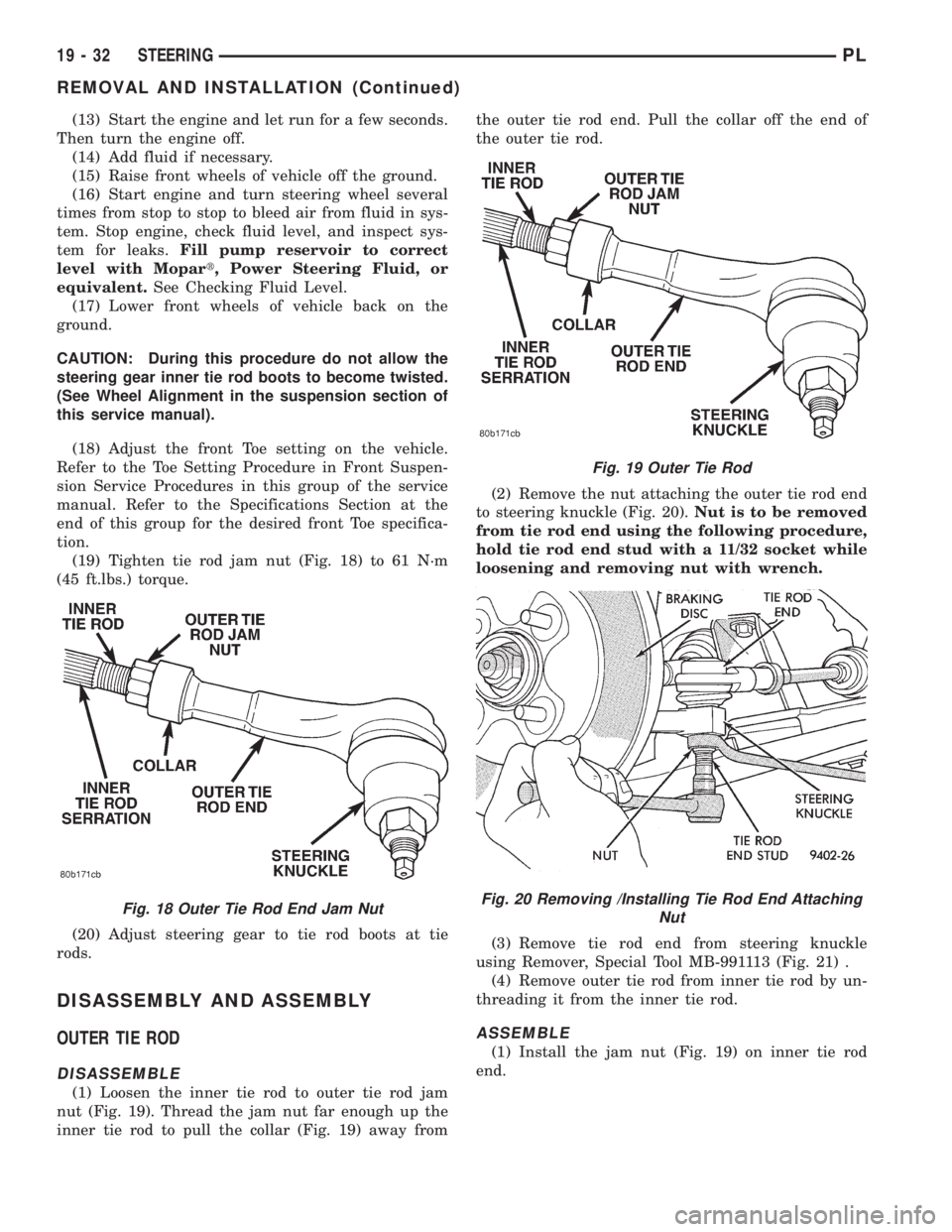
(1) Loosen the inner tie rod to outer tie rod jam
nut (Fig. 19). Thread the jam nut far enough up the
inner tie rod to pull the collar (Fig. 19) away fromthe outer tie rod end. Pull the collar off the end of
the outer tie rod.
(2) Remove the nut attaching the outer tie rod end
to steering knuckle (Fig. 20).Nut is to be removed
from tie rod end using the following procedure,
hold tie rod end stud with a 11/32 socket while
loosening and removing nut with wrench.
(3) Remove tie rod end from steering knuckle
using Remover, Special Tool MB-991113 (Fig. 21) .
(4) Remove outer tie rod from inner tie rod by un-
threading it from the inner tie rod.
ASSEMBLE
(1) Install the jam nut (Fig. 19) on inner tie rod
end.
Fig. 18 Outer Tie Rod End Jam Nut
Fig. 19 Outer Tie Rod
Fig. 20 Removing /Installing Tie Rod End Attaching
Nut
19 - 32 STEERINGPL
REMOVAL AND INSTALLATION (Continued)
Page 934 of 1200
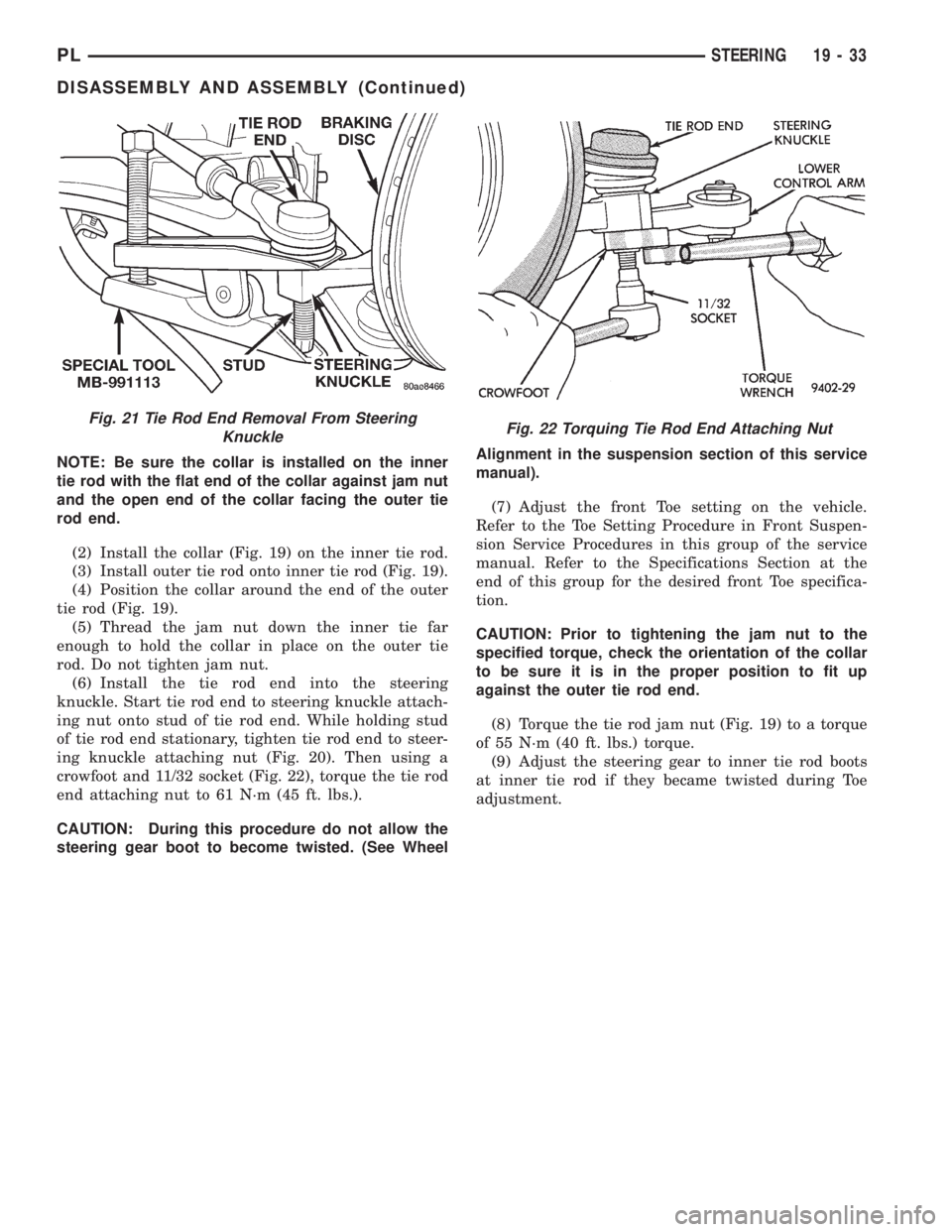
NOTE: Be sure the collar is installed on the inner
tie rod with the flat end of the collar against jam nut
and the open end of the collar facing the outer tie
rod end.
(2) Install the collar (Fig. 19) on the inner tie rod.
(3) Install outer tie rod onto inner tie rod (Fig. 19).
(4) Position the collar around the end of the outer
tie rod (Fig. 19).
(5) Thread the jam nut down the inner tie far
enough to hold the collar in place on the outer tie
rod. Do not tighten jam nut.
(6) Install the tie rod end into the steering
knuckle. Start tie rod end to steering knuckle attach-
ing nut onto stud of tie rod end. While holding stud
of tie rod end stationary, tighten tie rod end to steer-
ing knuckle attaching nut (Fig. 20). Then using a
crowfoot and 11/32 socket (Fig. 22), torque the tie rod
end attaching nut to 61 N´m (45 ft. lbs.).
CAUTION: During this procedure do not allow the
steering gear boot to become twisted. (See WheelAlignment in the suspension section of this service
manual).
(7) Adjust the front Toe setting on the vehicle.
Refer to the Toe Setting Procedure in Front Suspen-
sion Service Procedures in this group of the service
manual. Refer to the Specifications Section at the
end of this group for the desired front Toe specifica-
tion.
CAUTION: Prior to tightening the jam nut to the
specified torque, check the orientation of the collar
to be sure it is in the proper position to fit up
against the outer tie rod end.
(8) Torque the tie rod jam nut (Fig. 19) to a torque
of 55 N´m (40 ft. lbs.) torque.
(9) Adjust the steering gear to inner tie rod boots
at inner tie rod if they became twisted during Toe
adjustment.
Fig. 22 Torquing Tie Rod End Attaching NutFig. 21 Tie Rod End Removal From Steering
Knuckle
PLSTEERING 19 - 33
DISASSEMBLY AND ASSEMBLY (Continued)
Page 935 of 1200
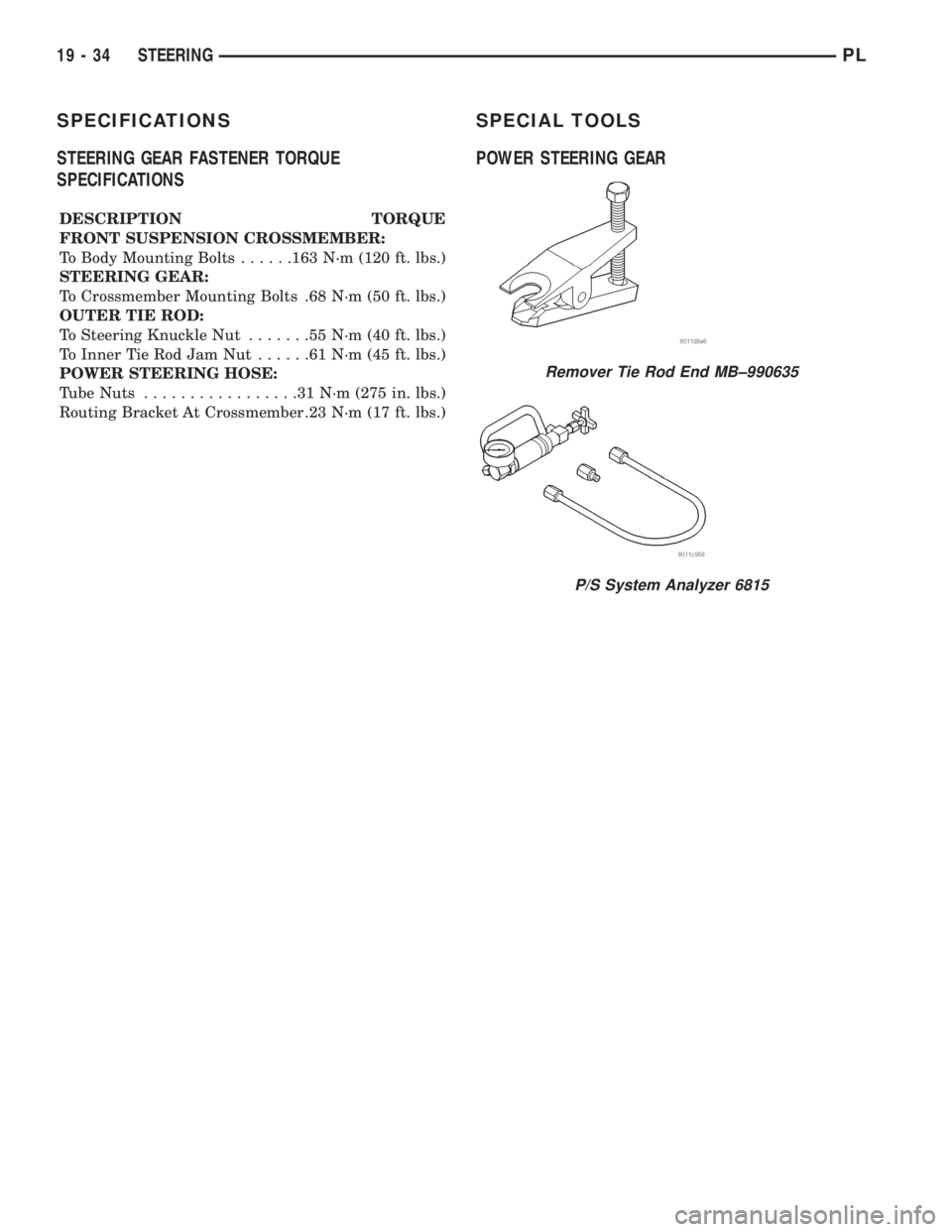
SPECIFICATIONS
STEERING GEAR FASTENER TORQUE
SPECIFICATIONS
DESCRIPTION TORQUE
FRONT SUSPENSION CROSSMEMBER:
To Body Mounting Bolts......163 N´m (120 ft. lbs.)
STEERING GEAR:
To Crossmember Mounting Bolts .68 N´m (50 ft. lbs.)
OUTER TIE ROD:
To Steering Knuckle Nut.......55N´m(40ft.lbs.)
To Inner Tie Rod Jam Nut......61N´m(45ft.lbs.)
POWER STEERING HOSE:
Tube Nuts.................31N´m(275 in. lbs.)
Routing Bracket At Crossmember .23 N´m (17 ft. lbs.)
SPECIAL TOOLS
POWER STEERING GEAR
Remover Tie Rod End MB±990635
P/S System Analyzer 6815
19 - 34 STEERINGPL
Page 936 of 1200
STEERING COLUMN
INDEX
page page
DESCRIPTION AND OPERATION
STEERING COLUMN ASSEMBLY............ 35
STEERING GEAR TO STEERING
COLUMN COUPLING................... 36
DIAGNOSIS AND TESTING
STEERING COLUMN TO STEERING
GEAR COUPLING...................... 36
STEERING COLUMN..................... 36REMOVAL AND INSTALLATION
STEERING COLUMN SERVICE
PROCEDURE WARNINGS............... 37
STEERING COLUMN..................... 38
SPECIFICATIONS
STEERING COLUMN FASTEER
TORQUE SPECIFICATIONS.............. 42
DESCRIPTION AND OPERATION
STEERING COLUMN ASSEMBLY
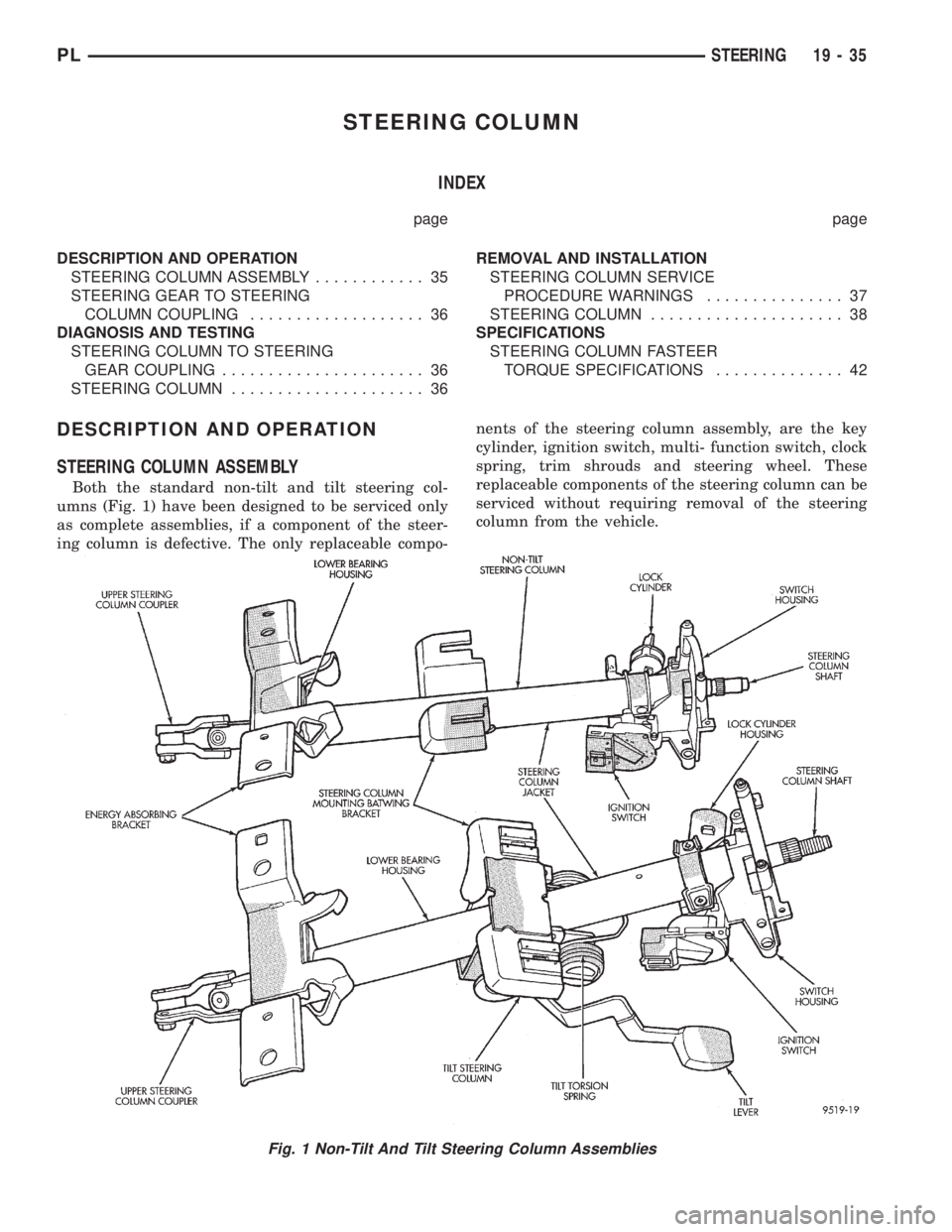
Both the standard non-tilt and tilt steering col-
umns (Fig. 1) have been designed to be serviced only
as complete assemblies, if a component of the steer-
ing column is defective. The only replaceable compo-nents of the steering column assembly, are the key
cylinder, ignition switch, multi- function switch, clock
spring, trim shrouds and steering wheel. These
replaceable components of the steering column can be
serviced without requiring removal of the steering
column from the vehicle.
Fig. 1 Non-Tilt And Tilt Steering Column Assemblies
PLSTEERING 19 - 35