sensor DODGE NEON 1999 Service Repair Manual
[x] Cancel search | Manufacturer: DODGE, Model Year: 1999, Model line: NEON, Model: DODGE NEON 1999Pages: 1200, PDF Size: 35.29 MB
Page 951 of 1200
SELECTOR LEVER
The selector shaft uses a lever with a weight on
the end. The weight is used to improve shift±feel and
reduce noise.
The selector lever is retained by two roll pins (one
inside the other).
REMOVAL
(1) Remove the selector cable. Refer to Gearshift
Cable removal.
(2) Using a pin punch, remove both roll pins from
the lever.
(3) Pull up and remove the selector lever from the
transaxle selector shaft
INSTALLATION
(1) For installation, reverse removal procedure.
Replace the roll pins that were removed with new
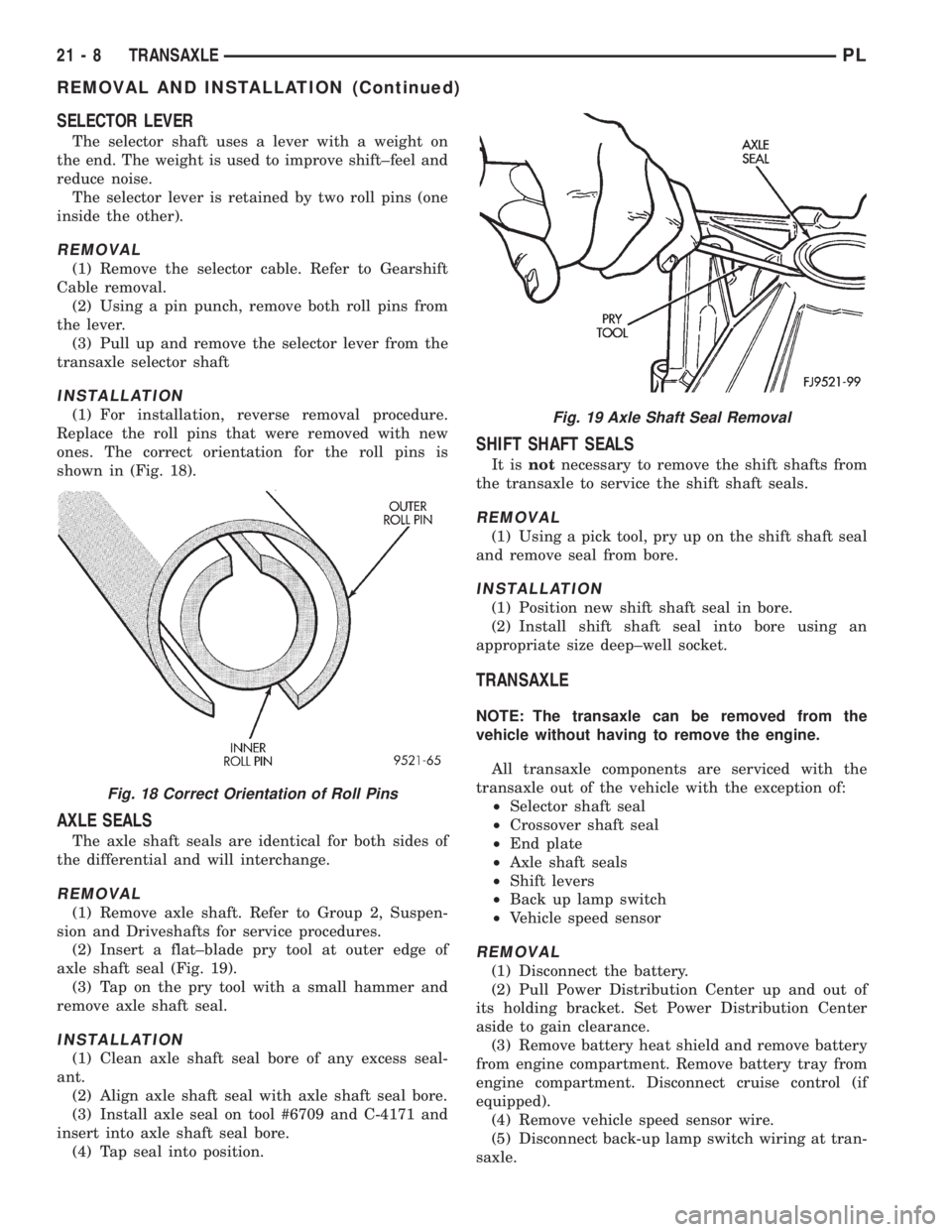
ones. The correct orientation for the roll pins is
shown in (Fig. 18).
AXLE SEALS
The axle shaft seals are identical for both sides of
the differential and will interchange.
REMOVAL
(1) Remove axle shaft. Refer to Group 2, Suspen-
sion and Driveshafts for service procedures.
(2) Insert a flat±blade pry tool at outer edge of
axle shaft seal (Fig. 19).
(3) Tap on the pry tool with a small hammer and
remove axle shaft seal.
INSTALLATION
(1) Clean axle shaft seal bore of any excess seal-
ant.
(2) Align axle shaft seal with axle shaft seal bore.
(3) Install axle seal on tool #6709 and C-4171 and
insert into axle shaft seal bore.
(4) Tap seal into position.
SHIFT SHAFT SEALS
It isnotnecessary to remove the shift shafts from
the transaxle to service the shift shaft seals.
REMOVAL
(1) Using a pick tool, pry up on the shift shaft seal
and remove seal from bore.
INSTALLATION
(1) Position new shift shaft seal in bore.
(2) Install shift shaft seal into bore using an
appropriate size deep±well socket.
TRANSAXLE
NOTE: The transaxle can be removed from the
vehicle without having to remove the engine.
All transaxle components are serviced with the
transaxle out of the vehicle with the exception of:
²Selector shaft seal
²Crossover shaft seal
²End plate
²Axle shaft seals
²Shift levers
²Back up lamp switch
²Vehicle speed sensor
REMOVAL
(1) Disconnect the battery.
(2) Pull Power Distribution Center up and out of
its holding bracket. Set Power Distribution Center
aside to gain clearance.
(3) Remove battery heat shield and remove battery
from engine compartment. Remove battery tray from
engine compartment. Disconnect cruise control (if
equipped).
(4) Remove vehicle speed sensor wire.
(5) Disconnect back-up lamp switch wiring at tran-
saxle.
Fig. 18 Correct Orientation of Roll Pins
Fig. 19 Axle Shaft Seal Removal
21 - 8 TRANSAXLEPL
REMOVAL AND INSTALLATION (Continued)
Page 980 of 1200
SPECIFICATIONS
NV T350 (A-578)
DESCRIPTION TORQUE
Back-up Lamp Switch..........24N´m(18ft.lbs.)
Crossover Cable Adj. Screw......8N´m(70in.lbs.)
Drain Plug.................30N´m(267 in. lbs.)
Differential Ring Gear Bolts.....81N´m(60ft.lbs.)
Dust Shield to Transaxle......12N´m(105 in. lbs.)
End Plate Cover Bolts.........29N´m(21ft.lbs.)
Front Engine Mount to Trans . . .108 N´m (80 ft. lbs.)
Front Mount Through Bolt......61N´m(45ft.lbs.)
Front Mount to Engine Bolt.....54N´m(40ft.lbs.)
Lateral Bending
Strut to Engine.............54N´m(40ft.lbs.)
Lateral Bending Strut to Trans. . .54 N´m (40 ft. lbs.)
Left Mount Through Bolt......108 N´m (80 ft. lbs.)
Left Mount to Transaxle........54N´m(40ft.lbs.)
Output Bearing Race Ret. Strap .11 N´m (96 in. lbs.)
Power Hop Damper Bkt. to
Trans.....................54N´m(40ft.lbs.)
Power Hop Damper to
Frame Bkt.................54N´m(40ft.lbs.)
Power Hop Damper to
Trans. Bkt.................54N´m(40ft.lbs.)
Reverse Fork Bracket..........11N´m(96in.lbs.)
Reverse Idler Shaft Bolt........26N´m(19ft.lbs.)
Shift Cable Bracket to
Transaxle................28N´m(250 in. lbs.)
Transaxle Case Bolts..........29N´m(21ft.lbs.)
Transaxle to Engine Bolt.......95N´m(70ft.lbs.)
Trans. to Eng. Intake Bkt. Bolts . .95 N´m (70 ft. lbs.)
Vehicle Speed Sensor...........7N´m(60in.lbs.)
Vertical Bending Strut to
Engine..................108 N´m (80 ft. lbs.)
Vertical Bending Strut to Trans. .108 N´m (80 ft. lbs.)
NOTE: Bolts that have thread sealer or torque lock
patches should not be reused. Always install new
bolts in these applications.
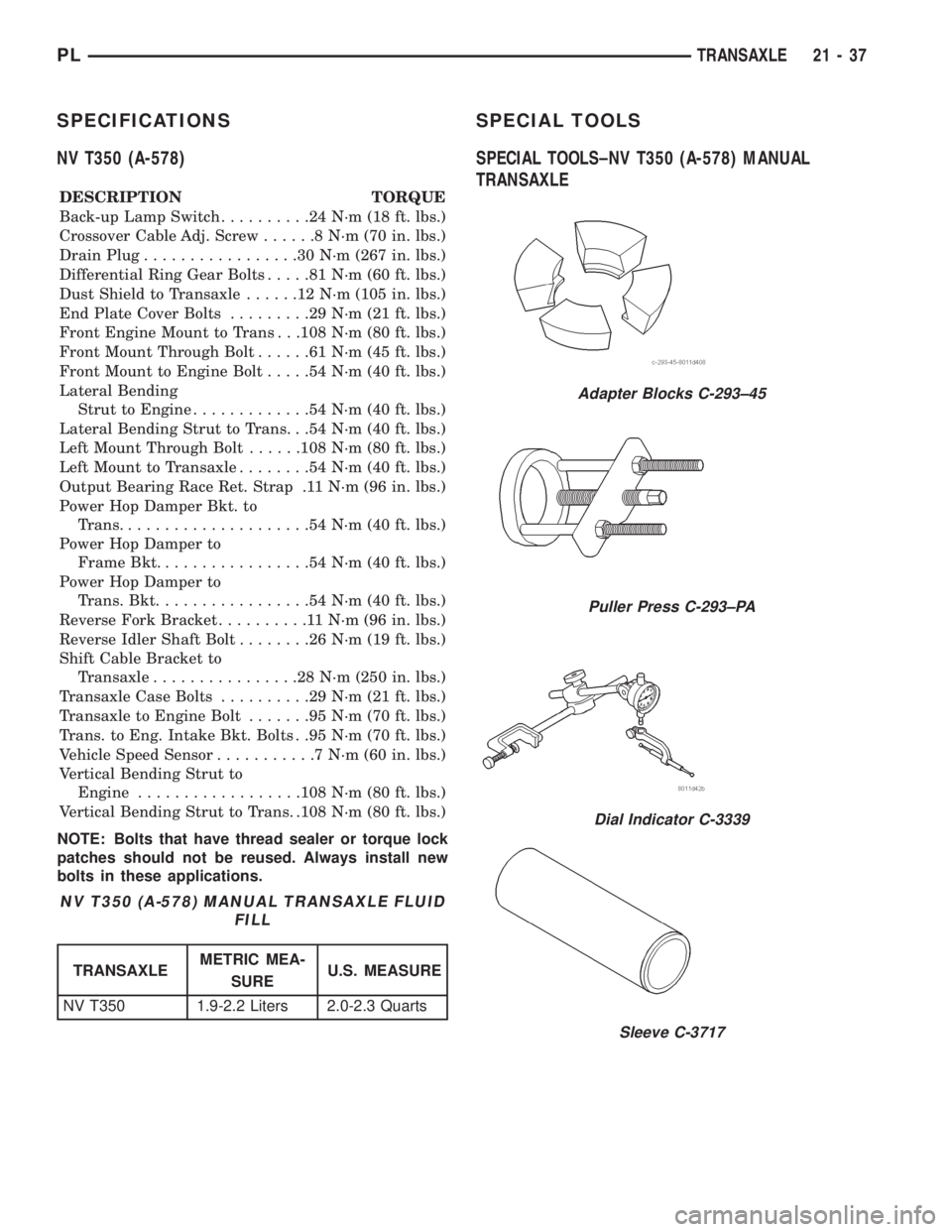
SPECIAL TOOLS
SPECIAL TOOLS±NV T350 (A-578) MANUAL
TRANSAXLE
NV T350 (A-578) MANUAL TRANSAXLE FLUID
FILL
TRANSAXLEMETRIC MEA-
SUREU.S. MEASURE
NV T350 1.9-2.2 Liters 2.0-2.3 Quarts
Adapter Blocks C-293±45
Puller Press C-293±PA
Dial Indicator C-3339
Sleeve C-3717
PLTRANSAXLE 21 - 37
Page 983 of 1200
31TH AUTOMATIC TRANSAXLE
INDEX
page page
GENERAL INFORMATION
FLUID LEVEL AND CONDITION............. 41
GENERAL INFORMATION................. 40
SELECTION OF LUBRICANT............... 41
SPECIAL ADDITIVES..................... 41
DESCRIPTION AND OPERATION
AUTOMATIC TRANSMISSION SHIFTER/
IGNITION INTERLOCK.................. 42
CLUTCHES, BAND SERVOS, AND
ACCUMULATOR....................... 42
FLOW CONTROL VALVES................. 42
GEARSHIFT AND PARKING LOCK CONTROLS . 42
GOVERNOR............................ 43
HYDRAULIC CONTROL SYSTEM............ 42
PRESSURE REGULATING VALVES.......... 42
PRESSURE SUPPLY SYSTEM.............. 42
TORQUE CONVERTER CLUTCH SOLENOID
WIRING CONNECTOR.................. 43
TORQUE CONVERTER CLUTCH............ 42
DIAGNOSIS AND TESTING
CLUTCH AND SERVO AIR PRESSURE TESTS . 54
FLUID LEAKAGE-TRANSAXLE TORQUE
CONVERTER HOUSING AREA............ 55
HYDRAULIC PRESSURE TESTS............ 52
INTERLOCK SYSTEM OPERATION CHECK.... 55
ROAD TEST............................ 52
THREE SPEED TRANSAXLE DIAGNOSIS AND
TESTS.............................. 43
SERVICE PROCEDURES
ALUMINUM THREAD REPAIR.............. 58
FLUID AND FILTER CHANGE............... 56
FLUID DRAIN AND REFILL................. 57
FLUSHING COOLERS AND TUBES.......... 58
OIL PUMP VOLUME CHECK............... 58
REMOVAL AND INSTALLATION
GEARSHIFT CABLE...................... 59
GEARSHIFT MECHANISM................. 60
INTERLOCK MECHANISM................. 63
PARK/NEUTRAL STARTING AND BACK-UP
LAMP SWITCH........................ 64
PUMP OIL SEAL......................... 67
SHIFTER IGNITION INTERLOCK CABLE...... 61THROTTLE PRESSURE CABLE............. 60
TRANSAXLE........................... 64
VEHICLE SPEED SENSOR PINION GEAR..... 64
DISASSEMBLY AND ASSEMBLY
ACCUMULATOR-RECONDITION............ 83
DIFFERENTIAL REPAIR................... 95
FRONT CLUTCH-RECONDITION............ 78
FRONT PLANETARY AND ANNULUS GEAR-
RECONDITION........................ 81
KICKDOWN SERVO (CONTROLLED LOAD)-
RECONDITION........................ 83
LOW/REVERSE (REAR)
SERVO-RECONDITION.................. 82
OIL PUMP-RECONDITION................. 78
OUTPUT SHAFT REPAIR.................. 89
PARKING PAWL......................... 89
REAR CLUTCH-RECONDITION............. 79
TRANSAXLE........................... 67
TRANSFER SHAFT REPAIR................ 83
VALVE BODY RECONDITION............... 74
CLEANING AND INSPECTION
VALVE BODY........................... 99
ADJUSTMENTS
BAND ADJUSTMENT.................... 101
BEARING ADJUSTMENT PROCEDURES..... 101
DIFFERENTIAL BEARING................. 102
GEARSHIFT CABLE...................... 99
HYDRAULIC CONTROL PRESSURE
ADJUSTMENTS....................... 101
OUTPUT SHAFT BEARING................ 102
SHIFTER/IGNITION INTERLOCK SYSTEM.... 100
THROTTLE PRESSURE CABLE ADJUSTMENT
PROCEDURE........................ 100
TRANSFER SHAFT BEARING............. 103
SCHEMATICS AND DIAGRAMS
31TH TRANSAXLE HYDRAULIC SCHEMATIC . 105
SPECIFICATIONS
31TH AUTOMATIC TRANSAXLE............ 113
31TH TRANSAXLE TORQUE
SPECIFICATIONS..................... 113
SPECIAL TOOLS
31TH AUTOMATIC TRANSAXLE............ 114
GENERAL INFORMATION
GENERAL INFORMATION
NOTE: Safety goggles should be worn at all times
when working on these transaxles.This transaxle combines torque converter, three
speed transmission, final drive gearing, and differen-
tial into a front wheel drive system. The identifica-
tion markings and usage of the transaxle are charted
in Diagnosis and Tests.
21 - 40 TRANSAXLEPL
Page 1007 of 1200
VEHICLE SPEED SENSOR PINION GEAR
When the sensor is removed for any reason, a
NEW O-ring must be installed on its outside diame-
ter.
REMOVAL
(1) Remove harness connector from sensor. Be sure
weather seal stays on harness connector.
(2) Remove bolt securing the sensor in the exten-
sion housing.
(3) Carefully pull sensor and pinion gear assembly
out of extension housing.
(4) Remove pinion gear from sensor.
INSTALLATION
(1) To install, reverse the above procedure. Be sure
extension housing and sensor flange are clean prior
to installation. Always use a NEW sensor O-ring.
(2) Tighten bolt to 7 N´m (60 in. lbs.). Tighten
speedometer cable to 4 N´m (35 in. lbs.).
PARK/NEUTRAL STARTING AND BACK-UP LAMP
SWITCH
TEST
The park/neutral starting switch is the center ter-
minal of the three terminal switch. It provides
ground for the starter solenoid circuit through the
selector lever in PARK and NEUTRAL positions only.
(1) To test switch, remove wiring connector from
switch and test for continuity between center pin of
switch and transaxle case. Continuity should exist
only when transaxle is in PARK or NEUTRAL.
(2) Check gearshift cable adjustment before replac-
ing a switch that tests bad.
REMOVAL
(1) Unscrew switch from transaxle case allowing
fluid to drain into a container. Move selector lever to
PARK, then to NEUTRAL position, and inspect to see
the switch operating lever fingers are centered in
switch opening.
INSTALLATION
(1) Screw the switch with a new seal into tran-
saxle case and tighten to 33 N´m (24 ft. lbs.). Retest
switch with the test lamp.
(2) Add fluid to transaxle to bring up to proper
level.
(3) The back-up lamp switch circuit is through the
two outside terminals of the three terminal switch.
(4) To test switch, remove wiring connector from
switch and test for continuity between the two out-
side pins.
(5) Continuity should exist only with transaxle in
REVERSE position.(6) No continuity should exist from either pin to
the case.
TRANSAXLE
REMOVAL
NOTE: The transaxle can be removed from the
vehicle without having to remove the engine.
The transaxle and torque converter must be
removed as an assembly; otherwise, the torque con-
verter drive plate, pump bushing, or oil seal may be
damaged. The drive plate will not support a load;
therefore, none of the weight of the transaxle should
be allowed to rest on the plate during removal.
All transaxle components are serviced with the
transaxle out of the vehicle. The components that are
serviceable in the vehicle are:
²Axle shaft seals
²Back±up lamp switch
²End plate
²Extension housing
²Neutral safety switch
²Shift lever
²Transaxle oil pan
²Valve Body
²Vehicle speed sensor
(1) Disconnect the battery.
(2) Pull Power Distribution Center up and out of
its holding bracket. Set Power Distribution Center
aside to gain clearance.
(3) Remove battery heat shield and remove battery
from engine compartment. Remove battery tray from
engine compartment. Disconnect cruise control (if
equipped).
(4) Remove vehicle speed sensor wiring.
(5) Disconnect neutral safety switch and torque
converter control wiring at transaxle.
CAUTION: Pry up with equal force on both sides of
shifter cable isolator bushing to avoid damaging
cable isolator bushing.
(6) Disconnect gear shift cable end from transaxle
shift lever (Fig. 22). Remove bracket bolt at transaxle
(Fig. 23).
(7) Remove throttle pressure control cable from
lever. Then remove bracket bolts at the transaxle
(Fig. 24).
(8) Remove dipstick tube.
(9) Remove transaxle cooler lines and plug lines
(Fig. 25).
(10) Remove throttle pressure control cable sup-
port bracket bolts. Remove upper bellhousing bolts
and upper starter bolt (Fig. 26).
21 - 64 TRANSAXLEPL
REMOVAL AND INSTALLATION (Continued)
Page 1164 of 1200
EMISSION CONTROL SYSTEMS
CONTENTS
page page
EVAPORATIVE EMISSION CONTROLS........ 11
EXHAUST GAS RECIRCULATION (EGR)
SYSTEM.............................. 18ON-BOARD DIAGNOSTICS.................. 1
ON-BOARD DIAGNOSTICS
INDEX
page page
GENERAL INFORMATION
SYSTEM DESCRIPTION................... 1
DESCRIPTION AND OPERATION
CIRCUIT ACTUATION TEST MODE........... 2
COMPONENT MONITORS.................. 9
DIAGNOSTIC TROUBLE CODES............. 2
HIGH AND LOW LIMITS................... 10LOAD VALUE........................... 10
MALFUNCTION INDICATOR LAMP (MIL)....... 1
MONITORED SYSTEMS.................... 6
NON-MONITORED CIRCUITS............... 9
STATE DISPLAY TEST MODE............... 2
TRIP DEFINITION........................ 9
GENERAL INFORMATION
SYSTEM DESCRIPTION
The Powertrain Control Module (PCM) monitors
many different circuits in the fuel injection, ignition,
emission and engine systems. If the PCM senses a
problem with a monitored circuit often enough to
indicate an actual problem, it stores a Diagnostic
Trouble Code (DTC) in the PCM's memory. If the
code applies to a non-emissions related component or
system, and the problem is repaired or ceases to
exist, the PCM cancels the code after 40 warmup
cycles. Diagnostic trouble codes that affect vehicle
emissions illuminate the Malfunction Indicator Lamp
(MIL). Refer to Malfunction Indicator Lamp in this
section.
Certain criteria must be met before the PCM
stores a DTC in memory. The criteria may be a spe-
cific range of engine RPM, engine temperature,
and/or input voltage to the PCM.
The PCM might not store a DTC for a monitored
circuit even though a malfunction has occurred. This
may happen because one of the DTC criteria for the
circuit has not been met.For example, assume the
diagnostic trouble code criteria requires the PCM to
monitor the circuit only when the engine operates
between 750 and 2000 RPM. Suppose the sensor'soutput circuit shorts to ground when engine operates
above 2400 RPM (resulting in 0 volt input to the
PCM). Because the condition happens at an engine
speed above the maximum threshold (2000 rpm), the
PCM will not store a DTC.
There are several operating conditions for which
the PCM monitors and sets DTC's. Refer to Moni-
tored Systems, Components, and Non-Monitored Cir-
cuits in this section.
NOTE: Various diagnostic procedures may actually
cause a diagnostic monitor to set a DTC. For
instance, pulling a spark plug wire to perform a
spark test may set the misfire code. When a repair
is completed and verified, use the DRB scan tool to
erase all DTC's and extinguish the MIL.
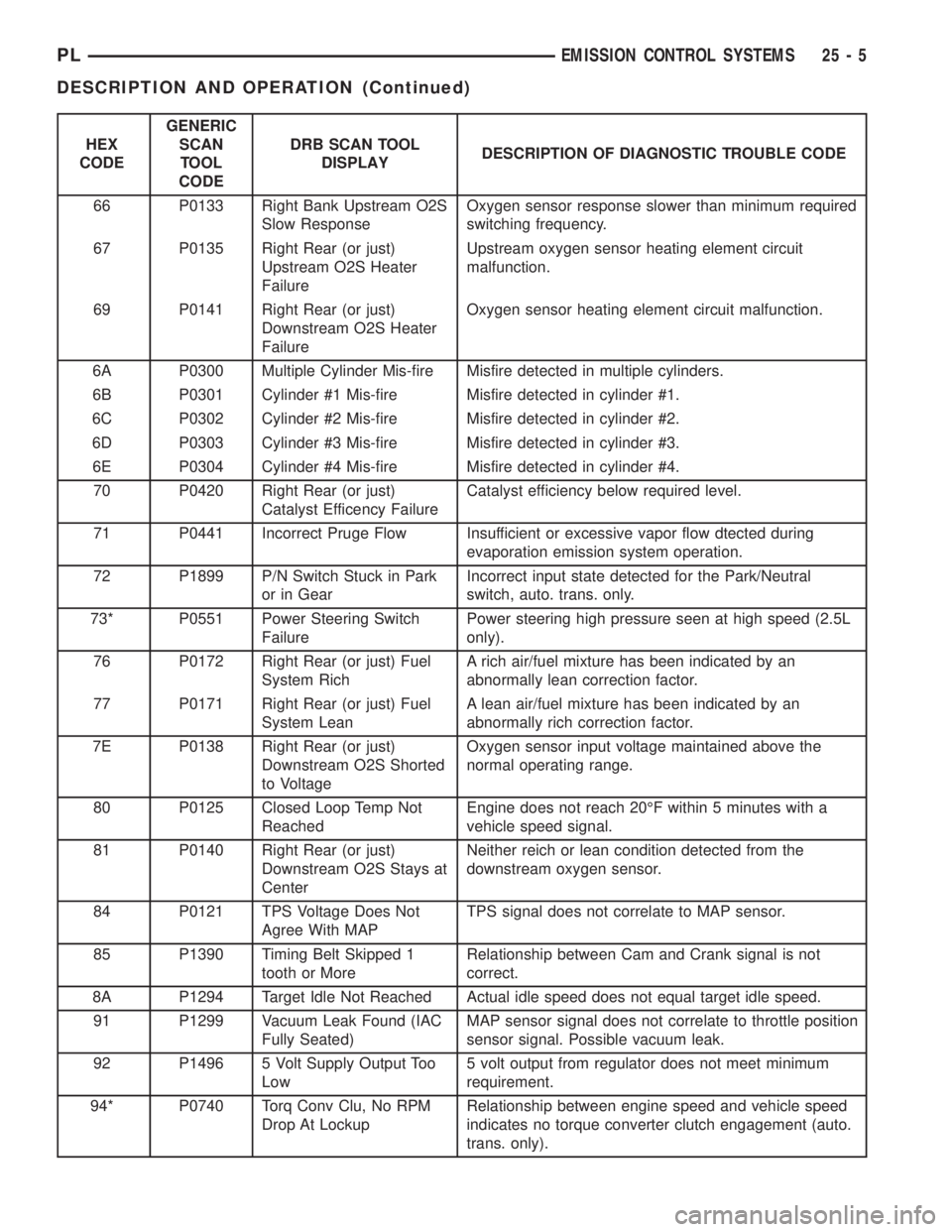
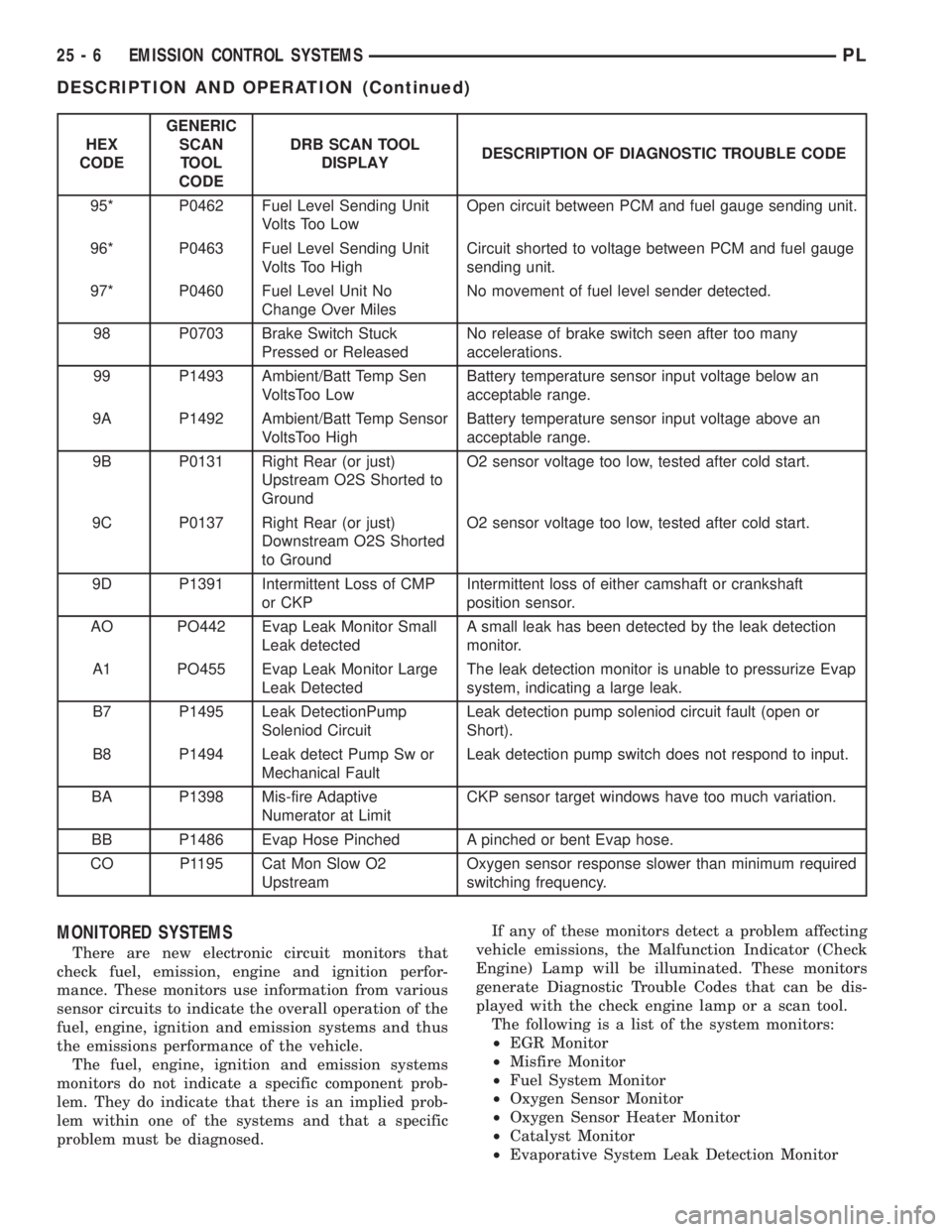
Technicians can display stored DTC's by using the
DRB scan tool. Refer to Diagnostic Trouble Codes in
this section. For DTC information, refer to charts in
this section.
DESCRIPTION AND OPERATION
MALFUNCTION INDICATOR LAMP (MIL)
As a functional test, the Malfunction Indicator
Lamp (MIL) illuminates at key-on before engine
PLEMISSION CONTROL SYSTEMS 25 - 1
Page 1165 of 1200
cranking. Whenever the Powertrain Control Module
(PCM) sets a Diagnostic Trouble Code (DTC) that
affects vehicle emissions, it illuminates the MIL. If a
problem is detected, the PCM sends a message over
the CCD Bus to the instrument cluster to illuminate
the lamp. The PCM illuminates the MIL only for
DTC's that affect vehicle emissions. The MIL stays
on continuously when the PCM has entered a
Limp-In mode or identified a failed emission compo-
nent or system. The MIL remains on until the DTC
is erased. Refer to the Diagnostic Trouble Code
charts in this group for emission related codes.
Also, the MIL either flashes or illuminates contin-
uously when the PCM detects active engine misfire.
Refer to Misfire Monitoring in this section.
Additionally, the PCM may reset (turn off) the MIL
when one of the following occur:
²PCM does not detect the malfunction for 3 con-
secutive trips (except misfire and fuel system moni-
tors).
²PCM does not detect a malfunction while per-
forming three successive engine misfire or fuel sys-
tem tests. The PCM performs these tests while the
engine is operating within6375 RPM of and within
10 % of the load of the operating condition at which
the malfunction was first detected.
STATE DISPLAY TEST MODE
The switch inputs to the Powertrain Control Mod-
ule (PCM) have two recognized states; HIGH and
LOW. For this reason, the PCM cannot recognize the
difference between a selected switch position versus
an open circuit, a short circuit, or a defective switch.
If the State Display screen shows the change from
HIGH to LOW or LOW to HIGH, assume the entire
switch circuit to the PCM functions properly. From
the state display screen, access either State Display
Inputs and Outputs or State Display Sensors.
CIRCUIT ACTUATION TEST MODE
The Circuit Actuation Test Mode checks for proper
operation of output circuits or devices the Powertrain
Control Module (PCM) may not internally recognize.
The PCM attempts to activate these outputs and
allow an observer to verify proper operation. Most of
the tests provide an audible or visual indication of
device operation (click of relay contacts, fuel spray,
etc.). Except for intermittent conditions, if a device
functions properly during testing, assume the device,
its associated wiring, and driver circuit work cor-
rectly.
DIAGNOSTIC TROUBLE CODES
A Diagnostic Trouble Code (DTC) indicates the
PCM has recognized an abnormal condition in the
system.
²The preferred and most accurate method of
retrieving a DTC is by using the DRB scan tool. The
scan tool supplies detailed diagnostic information
which can be used to more accurately diagnose
causes for a DTC.
Remember that DTC's are the results of a sys-
tem or circuit failure, but do not directly iden-
tify the failed component or components.
NOTE: For a list of DTC's, refer to the charts in this
section.
BULB CHECK
Each time the ignition key is turned to the ON
position, the malfunction indicator (check engine)
lamp on the instrument panel should illuminate for
approximately 2 seconds then go out. This is done for
a bulb check.
OBTAINING DTC'S USING DRB SCAN TOOL
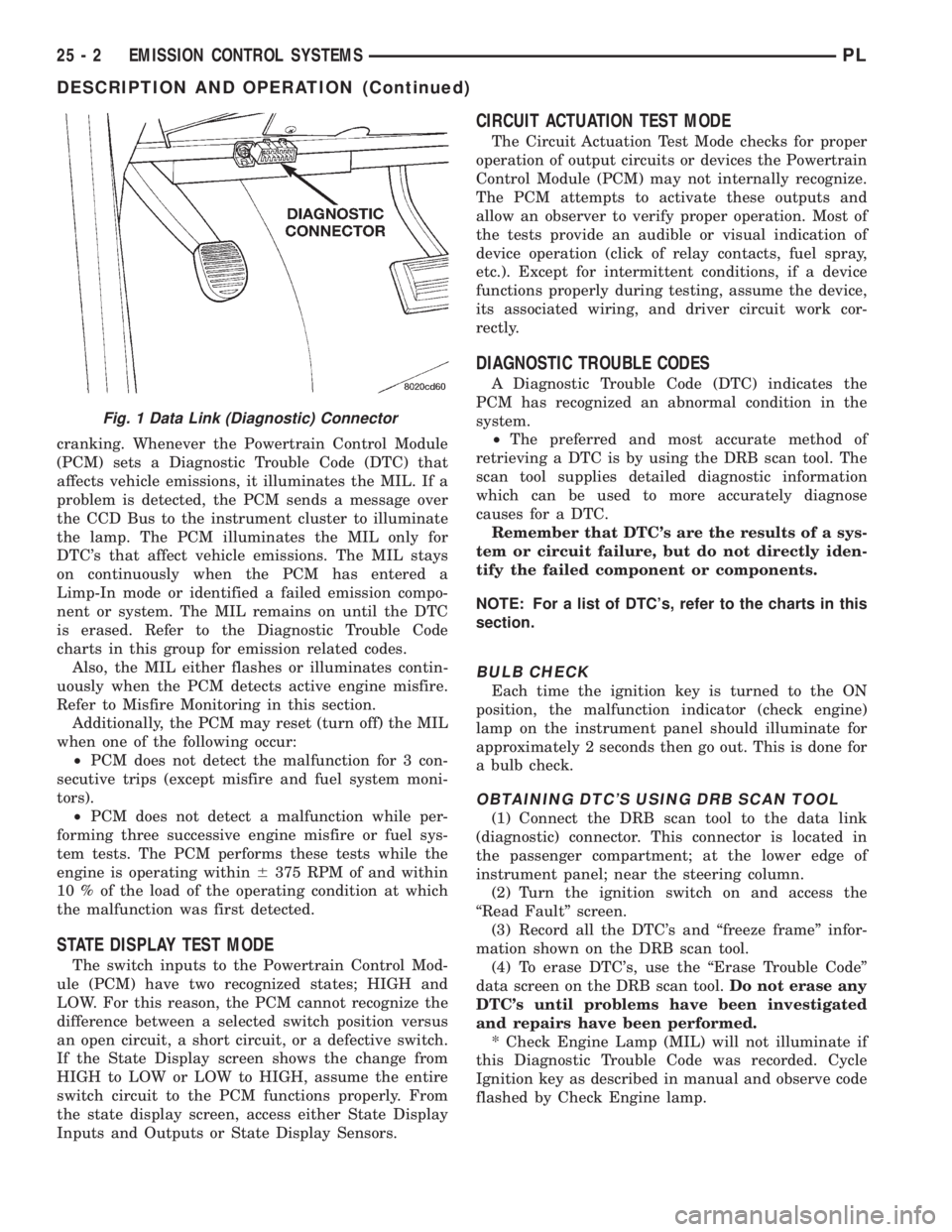
(1) Connect the DRB scan tool to the data link
(diagnostic) connector. This connector is located in
the passenger compartment; at the lower edge of
instrument panel; near the steering column.
(2) Turn the ignition switch on and access the
ªRead Faultº screen.
(3) Record all the DTC's and ªfreeze frameº infor-
mation shown on the DRB scan tool.
(4) To erase DTC's, use the ªErase Trouble Codeº
data screen on the DRB scan tool.Do not erase any
DTC's until problems have been investigated
and repairs have been performed.
* Check Engine Lamp (MIL) will not illuminate if
this Diagnostic Trouble Code was recorded. Cycle
Ignition key as described in manual and observe code
flashed by Check Engine lamp.
Fig. 1 Data Link (Diagnostic) Connector
25 - 2 EMISSION CONTROL SYSTEMSPL
DESCRIPTION AND OPERATION (Continued)
Page 1166 of 1200
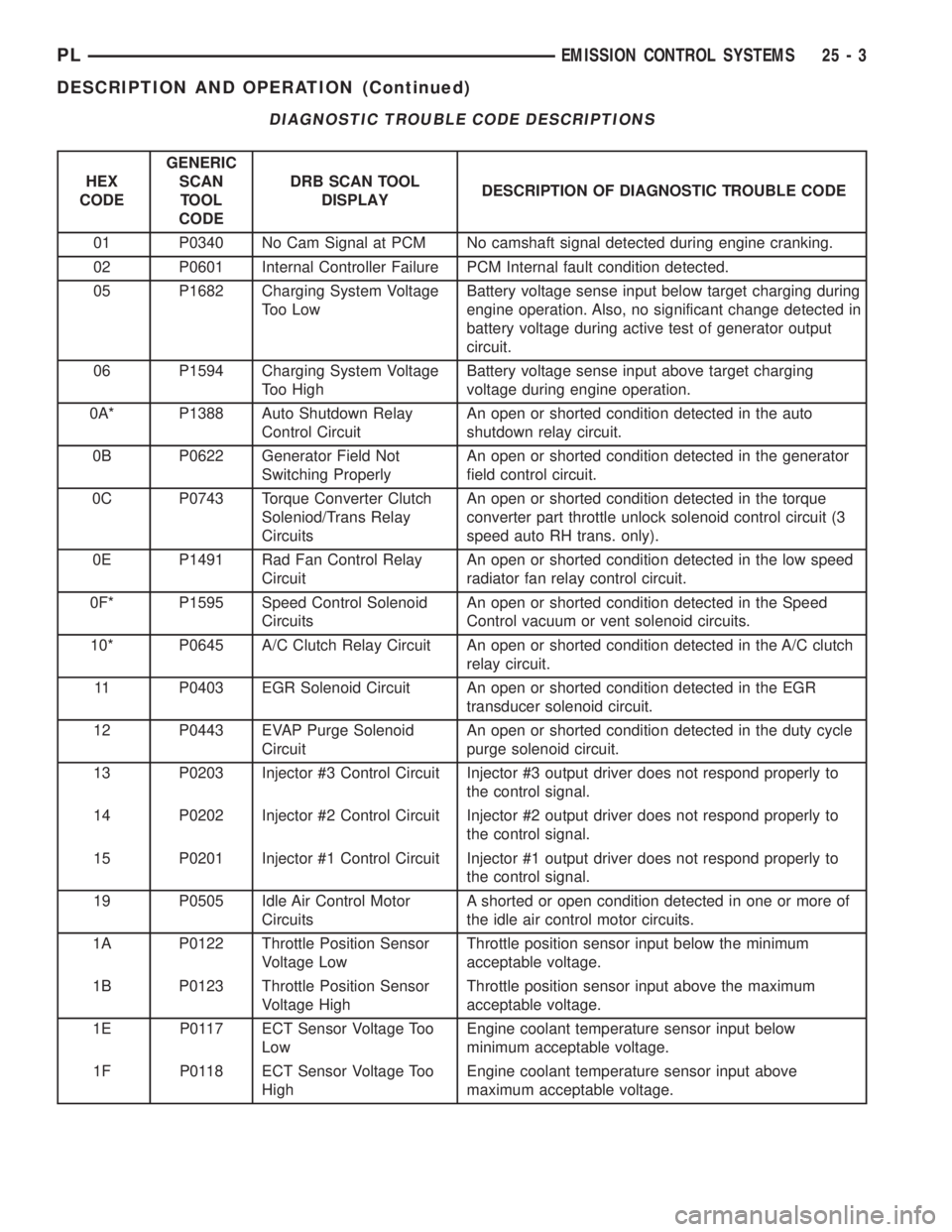
DIAGNOSTIC TROUBLE CODE DESCRIPTIONS
HEX
CODEGENERIC
SCAN
TOOL
CODEDRB SCAN TOOL
DISPLAYDESCRIPTION OF DIAGNOSTIC TROUBLE CODE
01 P0340 No Cam Signal at PCM No camshaft signal detected during engine cranking.
02 P0601 Internal Controller Failure PCM Internal fault condition detected.
05 P1682 Charging System Voltage
Too LowBattery voltage sense input below target charging during
engine operation. Also, no significant change detected in
battery voltage during active test of generator output
circuit.
06 P1594 Charging System Voltage
Too HighBattery voltage sense input above target charging
voltage during engine operation.
0A* P1388 Auto Shutdown Relay
Control CircuitAn open or shorted condition detected in the auto
shutdown relay circuit.
0B P0622 Generator Field Not
Switching ProperlyAn open or shorted condition detected in the generator
field control circuit.
0C P0743 Torque Converter Clutch
Soleniod/Trans Relay
CircuitsAn open or shorted condition detected in the torque
converter part throttle unlock solenoid control circuit (3
speed auto RH trans. only).
0E P1491 Rad Fan Control Relay
CircuitAn open or shorted condition detected in the low speed
radiator fan relay control circuit.
0F* P1595 Speed Control Solenoid
CircuitsAn open or shorted condition detected in the Speed
Control vacuum or vent solenoid circuits.
10* P0645 A/C Clutch Relay Circuit An open or shorted condition detected in the A/C clutch
relay circuit.
11 P0403 EGR Solenoid Circuit An open or shorted condition detected in the EGR
transducer solenoid circuit.
12 P0443 EVAP Purge Solenoid
CircuitAn open or shorted condition detected in the duty cycle
purge solenoid circuit.
13 P0203 Injector #3 Control Circuit Injector #3 output driver does not respond properly to
the control signal.
14 P0202 Injector #2 Control Circuit Injector #2 output driver does not respond properly to
the control signal.
15 P0201 Injector #1 Control Circuit Injector #1 output driver does not respond properly to
the control signal.
19 P0505 Idle Air Control Motor
CircuitsA shorted or open condition detected in one or more of
the idle air control motor circuits.
1A P0122 Throttle Position Sensor
Voltage LowThrottle position sensor input below the minimum
acceptable voltage.
1B P0123 Throttle Position Sensor
Voltage HighThrottle position sensor input above the maximum
acceptable voltage.
1E P0117 ECT Sensor Voltage Too
LowEngine coolant temperature sensor input below
minimum acceptable voltage.
1F P0118 ECT Sensor Voltage Too
HighEngine coolant temperature sensor input above
maximum acceptable voltage.
PLEMISSION CONTROL SYSTEMS 25 - 3
DESCRIPTION AND OPERATION (Continued)
Page 1167 of 1200
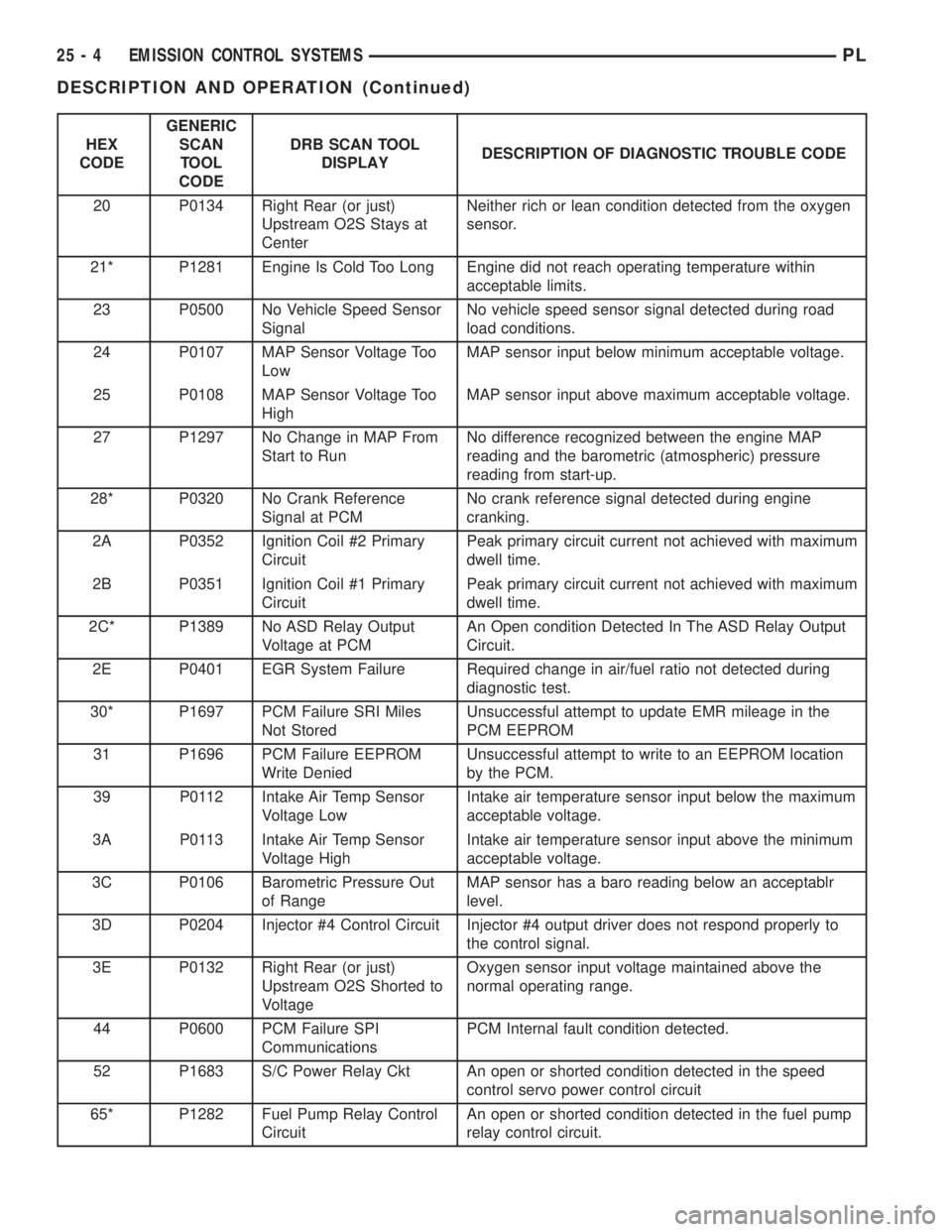
HEX
CODEGENERIC
SCAN
TOOL
CODEDRB SCAN TOOL
DISPLAYDESCRIPTION OF DIAGNOSTIC TROUBLE CODE
20 P0134 Right Rear (or just)
Upstream O2S Stays at
CenterNeither rich or lean condition detected from the oxygen
sensor.
21* P1281 Engine Is Cold Too Long Engine did not reach operating temperature within
acceptable limits.
23 P0500 No Vehicle Speed Sensor
SignalNo vehicle speed sensor signal detected during road
load conditions.
24 P0107 MAP Sensor Voltage Too
LowMAP sensor input below minimum acceptable voltage.
25 P0108 MAP Sensor Voltage Too
HighMAP sensor input above maximum acceptable voltage.
27 P1297 No Change in MAP From
Start to RunNo difference recognized between the engine MAP
reading and the barometric (atmospheric) pressure
reading from start-up.
28* P0320 No Crank Reference
Signal at PCMNo crank reference signal detected during engine
cranking.
2A P0352 Ignition Coil #2 Primary
CircuitPeak primary circuit current not achieved with maximum
dwell time.
2B P0351 Ignition Coil #1 Primary
CircuitPeak primary circuit current not achieved with maximum
dwell time.
2C* P1389 No ASD Relay Output
Voltage at PCMAn Open condition Detected In The ASD Relay Output
Circuit.
2E P0401 EGR System Failure Required change in air/fuel ratio not detected during
diagnostic test.
30* P1697 PCM Failure SRI Miles
Not StoredUnsuccessful attempt to update EMR mileage in the
PCM EEPROM
31 P1696 PCM Failure EEPROM
Write DeniedUnsuccessful attempt to write to an EEPROM location
by the PCM.
39 P0112 Intake Air Temp Sensor
Voltage LowIntake air temperature sensor input below the maximum
acceptable voltage.
3A P0113 Intake Air Temp Sensor
Voltage HighIntake air temperature sensor input above the minimum
acceptable voltage.
3C P0106 Barometric Pressure Out
of RangeMAP sensor has a baro reading below an acceptablr
level.
3D P0204 Injector #4 Control Circuit Injector #4 output driver does not respond properly to
the control signal.
3E P0132 Right Rear (or just)
Upstream O2S Shorted to
VoltageOxygen sensor input voltage maintained above the
normal operating range.
44 P0600 PCM Failure SPI
CommunicationsPCM Internal fault condition detected.
52 P1683 S/C Power Relay Ckt An open or shorted condition detected in the speed
control servo power control circuit
65* P1282 Fuel Pump Relay Control
CircuitAn open or shorted condition detected in the fuel pump
relay control circuit.
25 - 4 EMISSION CONTROL SYSTEMSPL
DESCRIPTION AND OPERATION (Continued)
Page 1168 of 1200
HEX
CODEGENERIC
SCAN
TOOL
CODEDRB SCAN TOOL
DISPLAYDESCRIPTION OF DIAGNOSTIC TROUBLE CODE
66 P0133 Right Bank Upstream O2S
Slow ResponseOxygen sensor response slower than minimum required
switching frequency.
67 P0135 Right Rear (or just)
Upstream O2S Heater
FailureUpstream oxygen sensor heating element circuit
malfunction.
69 P0141 Right Rear (or just)
Downstream O2S Heater
FailureOxygen sensor heating element circuit malfunction.
6A P0300 Multiple Cylinder Mis-fire Misfire detected in multiple cylinders.
6B P0301 Cylinder #1 Mis-fire Misfire detected in cylinder #1.
6C P0302 Cylinder #2 Mis-fire Misfire detected in cylinder #2.
6D P0303 Cylinder #3 Mis-fire Misfire detected in cylinder #3.
6E P0304 Cylinder #4 Mis-fire Misfire detected in cylinder #4.
70 P0420 Right Rear (or just)
Catalyst Efficency FailureCatalyst efficiency below required level.
71 P0441 Incorrect Pruge Flow Insufficient or excessive vapor flow dtected during
evaporation emission system operation.
72 P1899 P/N Switch Stuck in Park
or in GearIncorrect input state detected for the Park/Neutral
switch, auto. trans. only.
73* P0551 Power Steering Switch
FailurePower steering high pressure seen at high speed (2.5L
only).
76 P0172 Right Rear (or just) Fuel
System RichA rich air/fuel mixture has been indicated by an
abnormally lean correction factor.
77 P0171 Right Rear (or just) Fuel
System LeanA lean air/fuel mixture has been indicated by an
abnormally rich correction factor.
7E P0138 Right Rear (or just)
Downstream O2S Shorted
to VoltageOxygen sensor input voltage maintained above the
normal operating range.
80 P0125 Closed Loop Temp Not
ReachedEngine does not reach 20ÉF within 5 minutes with a
vehicle speed signal.
81 P0140 Right Rear (or just)
Downstream O2S Stays at
CenterNeither reich or lean condition detected from the
downstream oxygen sensor.
84 P0121 TPS Voltage Does Not
Agree With MAPTPS signal does not correlate to MAP sensor.
85 P1390 Timing Belt Skipped 1
tooth or MoreRelationship between Cam and Crank signal is not
correct.
8A P1294 Target Idle Not Reached Actual idle speed does not equal target idle speed.
91 P1299 Vacuum Leak Found (IAC
Fully Seated)MAP sensor signal does not correlate to throttle position
sensor signal. Possible vacuum leak.
92 P1496 5 Volt Supply Output Too
Low5 volt output from regulator does not meet minimum
requirement.
94* P0740 Torq Conv Clu, No RPM
Drop At LockupRelationship between engine speed and vehicle speed
indicates no torque converter clutch engagement (auto.
trans. only).
PLEMISSION CONTROL SYSTEMS 25 - 5
DESCRIPTION AND OPERATION (Continued)
Page 1169 of 1200
HEX
CODEGENERIC
SCAN
TOOL
CODEDRB SCAN TOOL
DISPLAYDESCRIPTION OF DIAGNOSTIC TROUBLE CODE
95* P0462 Fuel Level Sending Unit
Volts Too LowOpen circuit between PCM and fuel gauge sending unit.
96* P0463 Fuel Level Sending Unit
Volts Too HighCircuit shorted to voltage between PCM and fuel gauge
sending unit.
97* P0460 Fuel Level Unit No
Change Over MilesNo movement of fuel level sender detected.
98 P0703 Brake Switch Stuck
Pressed or ReleasedNo release of brake switch seen after too many
accelerations.
99 P1493 Ambient/Batt Temp Sen
VoltsToo LowBattery temperature sensor input voltage below an
acceptable range.
9A P1492 Ambient/Batt Temp Sensor
VoltsToo HighBattery temperature sensor input voltage above an
acceptable range.
9B P0131 Right Rear (or just)
Upstream O2S Shorted to
GroundO2 sensor voltage too low, tested after cold start.
9C P0137 Right Rear (or just)
Downstream O2S Shorted
to GroundO2 sensor voltage too low, tested after cold start.
9D P1391 Intermittent Loss of CMP
or CKPIntermittent loss of either camshaft or crankshaft
position sensor.
AO PO442 Evap Leak Monitor Small
Leak detectedA small leak has been detected by the leak detection
monitor.
A1 PO455 Evap Leak Monitor Large
Leak DetectedThe leak detection monitor is unable to pressurize Evap
system, indicating a large leak.
B7 P1495 Leak DetectionPump
Soleniod CircuitLeak detection pump soleniod circuit fault (open or
Short).
B8 P1494 Leak detect Pump Sw or
Mechanical FaultLeak detection pump switch does not respond to input.
BA P1398 Mis-fire Adaptive
Numerator at LimitCKP sensor target windows have too much variation.
BB P1486 Evap Hose Pinched A pinched or bent Evap hose.
CO P1195 Cat Mon Slow O2
UpstreamOxygen sensor response slower than minimum required
switching frequency.
MONITORED SYSTEMS
There are new electronic circuit monitors that
check fuel, emission, engine and ignition perfor-
mance. These monitors use information from various
sensor circuits to indicate the overall operation of the
fuel, engine, ignition and emission systems and thus
the emissions performance of the vehicle.
The fuel, engine, ignition and emission systems
monitors do not indicate a specific component prob-
lem. They do indicate that there is an implied prob-
lem within one of the systems and that a specific
problem must be diagnosed.If any of these monitors detect a problem affecting
vehicle emissions, the Malfunction Indicator (Check
Engine) Lamp will be illuminated. These monitors
generate Diagnostic Trouble Codes that can be dis-
played with the check engine lamp or a scan tool.
The following is a list of the system monitors:
²EGR Monitor
²Misfire Monitor
²Fuel System Monitor
²Oxygen Sensor Monitor
²Oxygen Sensor Heater Monitor
²Catalyst Monitor
²Evaporative System Leak Detection Monitor
25 - 6 EMISSION CONTROL SYSTEMSPL
DESCRIPTION AND OPERATION (Continued)