wheel DODGE NEON 1999 Service User Guide
[x] Cancel search | Manufacturer: DODGE, Model Year: 1999, Model line: NEON, Model: DODGE NEON 1999Pages: 1200, PDF Size: 35.29 MB
Page 20 of 1200
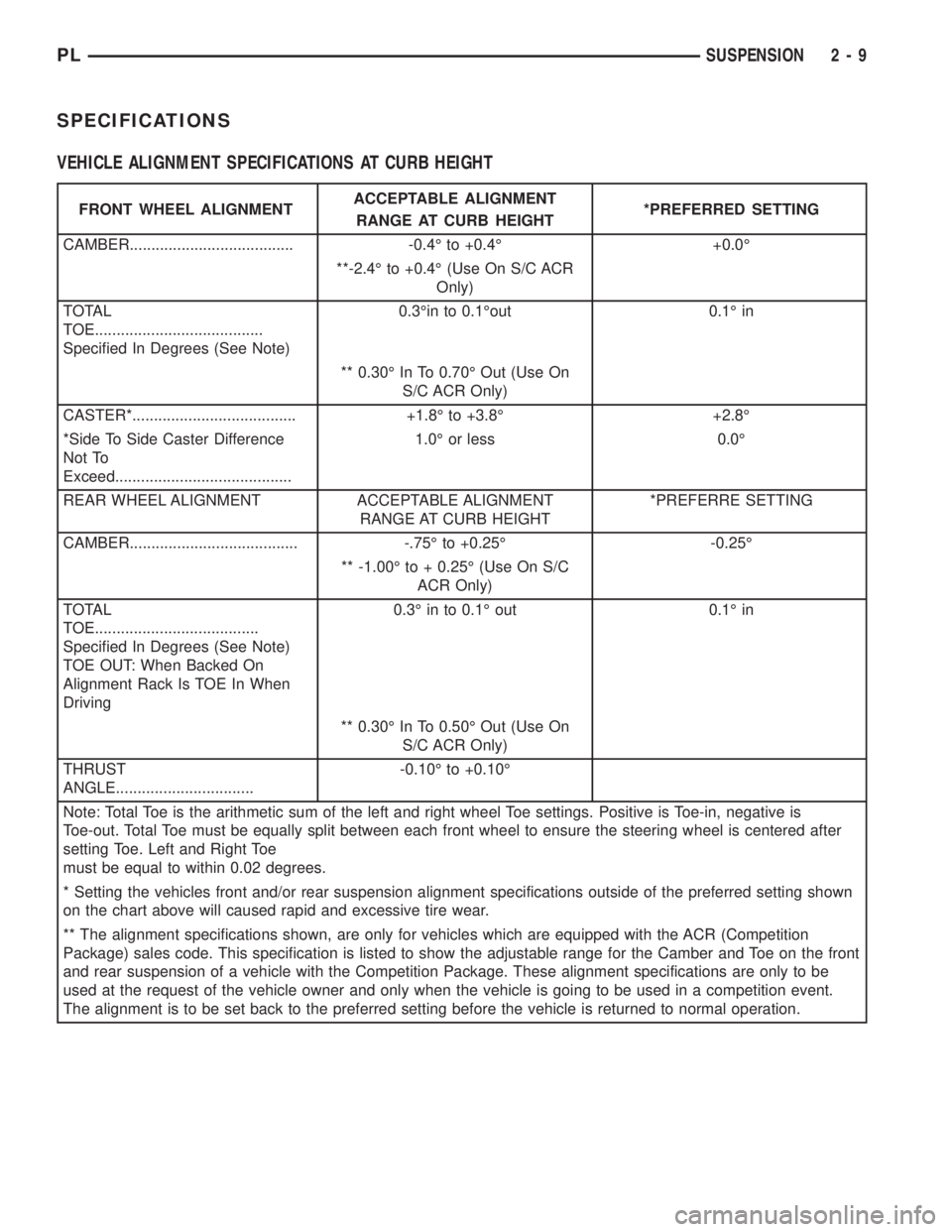
SPECIFICATIONS
VEHICLE ALIGNMENT SPECIFICATIONS AT CURB HEIGHT
FRONT WHEEL ALIGNMENTACCEPTABLE ALIGNMENT
RANGE AT CURB HEIGHT*PREFERRED SETTING
CAMBER...................................... -0.4É to +0.4É +0.0É
**-2.4É to +0.4É (Use On S/C ACR
Only)
TOTAL
TOE.......................................
Specified In Degrees (See Note)0.3Éin to 0.1Éout 0.1É in
** 0.30É In To 0.70É Out (Use On
S/C ACR Only)
CASTER*...................................... +1.8É to +3.8É +2.8É
*Side To Side Caster Difference
Not To
Exceed.........................................1.0É or less 0.0É
REAR WHEEL ALIGNMENT ACCEPTABLE ALIGNMENT
RANGE AT CURB HEIGHT*PREFERRE SETTING
CAMBER....................................... -.75É to +0.25É -0.25É
** -1.00É to + 0.25É (Use On S/C
ACR Only)
TOTAL
TOE......................................
Specified In Degrees (See Note)
TOE OUT: When Backed On
Alignment Rack Is TOE In When
Driving0.3É in to 0.1É out 0.1É in
** 0.30É In To 0.50É Out (Use On
S/C ACR Only)
THRUST
ANGLE................................-0.10É to +0.10É
Note: Total Toe is the arithmetic sum of the left and right wheel Toe settings. Positive is Toe-in, negative is
Toe-out. Total Toe must be equally split between each front wheel to ensure the steering wheel is centered after
setting Toe. Left and Right Toe
must be equal to within 0.02 degrees.
* Setting the vehicles front and/or rear suspension alignment specifications outside of the preferred setting shown
on the chart above will caused rapid and excessive tire wear.
** The alignment specifications shown, are only for vehicles which are equipped with the ACR (Competition
Package) sales code. This specification is listed to show the adjustable range for the Camber and Toe on the front
and rear suspension of a vehicle with the Competition Package. These alignment specifications are only to be
used at the request of the vehicle owner and only when the vehicle is going to be used in a competition event.
The alignment is to be set back to the preferred setting before the vehicle is returned to normal operation.
PLSUSPENSION 2 - 9
Page 21 of 1200
FRONT SUSPENSION
INDEX
page page
GENERAL INFORMATION
GENERAL INFORMATION................. 10
DESCRIPTION AND OPERATION
BALL JOINT............................ 14
COIL SPRING........................... 14
COMPETITION PACKAGE SUSPENSION...... 13
FRONT SUSPENSION.................... 11
FRONT WHEEL HUB BEARING............. 14
LOWER CONTROL ARM.................. 13
McPHERSON STRUT..................... 13
STABILIZER BAR........................ 14
STEERING KNUCKLE.................... 13
WHEEL MOUNTING STUDS................ 14
DIAGNOSIS AND TESTING
BALL JOINT ASSEMBLY................... 16
HUB/BEARING.......................... 16
LOWER CONTROL ARM.................. 15
MCPHERSON STRUT ASSEMBLY........... 15
STABILIZER BAR........................ 16
STEERING KNUCKLE.................... 15
REMOVAL AND INSTALLATION
FRONT WHEEL MOUNTING STUDS......... 28LOWER CONTROL ARM.................. 21
MCPHERSON STRUT.................... 16
STABILIZER BAR........................ 23
STEERING KNUCKLE.................... 17
WHEEL BEARING....................... 25
DISASSEMBLY AND ASSEMBLY
BALL JOINT............................ 32
LOWER CONTROL ARM FRONT
ISOLATOR BUSHING................... 33
LOWER CONTROL ARM REAR ISOLATOR
BUSHING............................ 34
McPHERSON STRUT..................... 30
ADJUSTMENTS
STRUT ADJUSTMENT COMPETITION
PACKAGE SUSPENSION................ 36
SPECIFICATIONS
FRONT SUSPENSION FASTENER
TORQUES............................ 36
SPECIAL TOOLS
FRONT SUSPENSION.................... 37
GENERAL INFORMATION
GENERAL INFORMATION
CAUTION: ONLY FRAME CONTACT HOISTING
EQUIPMENT CAN BE USED ON THIS VEHICLE. All
vehicles have a fully independent rear suspension.
The vehicles can not be hoisted using equipment
designed to lift a vehicle by the rear axle. If this
type of hoisting equipment is used, damage to rear
suspension components will occur.
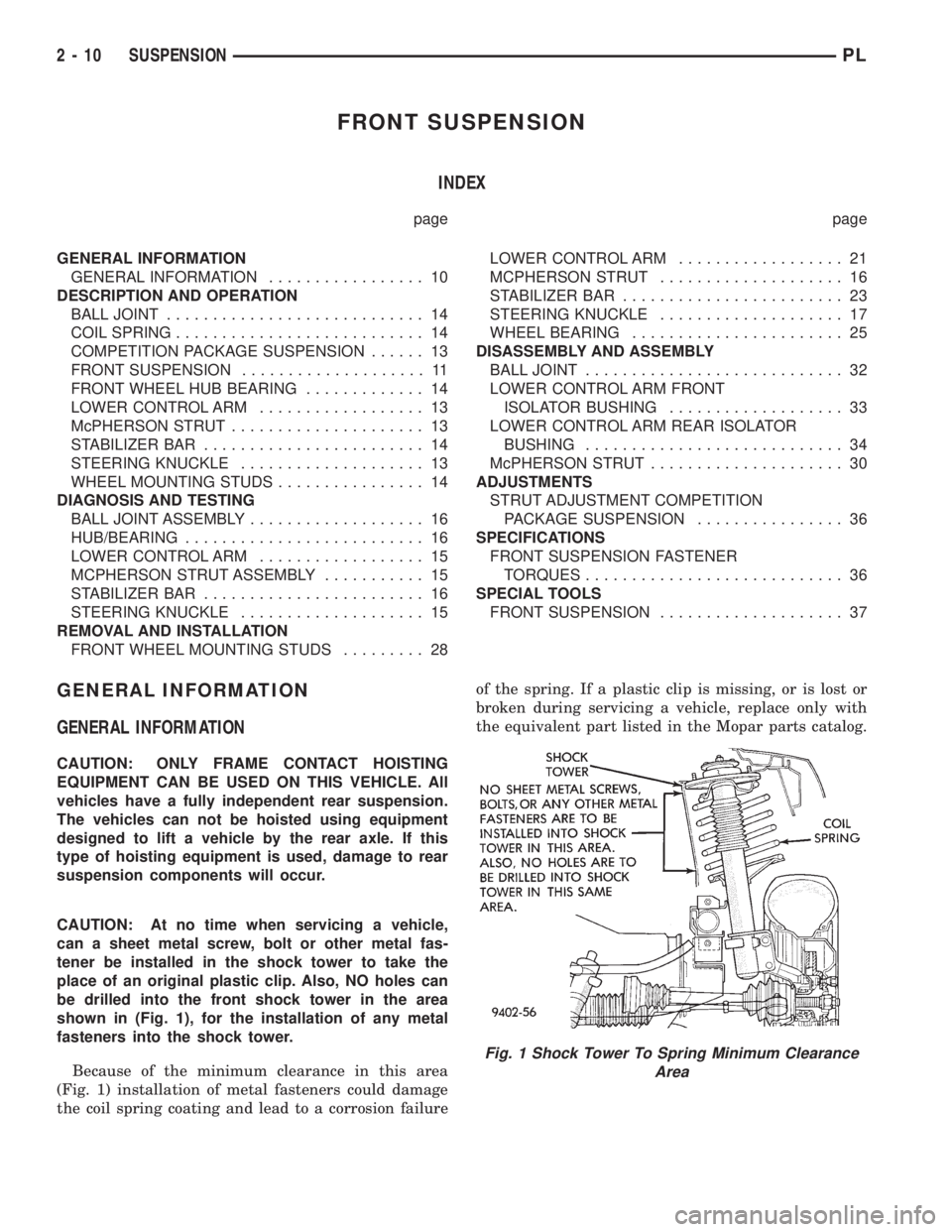
CAUTION: At no time when servicing a vehicle,
can a sheet metal screw, bolt or other metal fas-
tener be installed in the shock tower to take the
place of an original plastic clip. Also, NO holes can
be drilled into the front shock tower in the area
shown in (Fig. 1), for the installation of any metal
fasteners into the shock tower.
Because of the minimum clearance in this area
(Fig. 1) installation of metal fasteners could damage
the coil spring coating and lead to a corrosion failureof the spring. If a plastic clip is missing, or is lost or
broken during servicing a vehicle, replace only with
the equivalent part listed in the Mopar parts catalog.
Fig. 1 Shock Tower To Spring Minimum Clearance
Area
2 - 10 SUSPENSIONPL
Page 25 of 1200
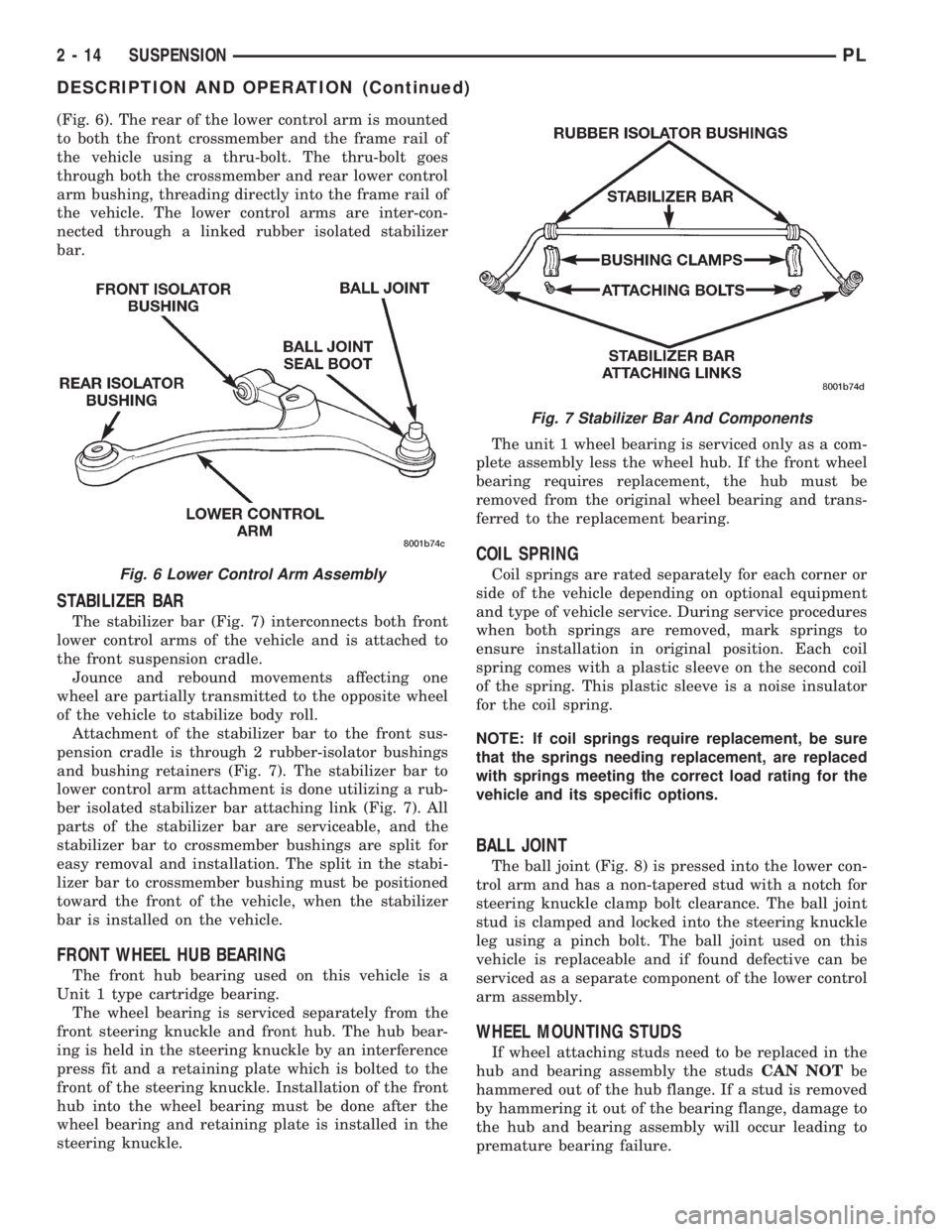
(Fig. 6). The rear of the lower control arm is mounted
to both the front crossmember and the frame rail of
the vehicle using a thru-bolt. The thru-bolt goes
through both the crossmember and rear lower control
arm bushing, threading directly into the frame rail of
the vehicle. The lower control arms are inter-con-
nected through a linked rubber isolated stabilizer
bar.
STABILIZER BAR
The stabilizer bar (Fig. 7) interconnects both front
lower control arms of the vehicle and is attached to
the front suspension cradle.
Jounce and rebound movements affecting one
wheel are partially transmitted to the opposite wheel
of the vehicle to stabilize body roll.
Attachment of the stabilizer bar to the front sus-
pension cradle is through 2 rubber-isolator bushings
and bushing retainers (Fig. 7). The stabilizer bar to
lower control arm attachment is done utilizing a rub-
ber isolated stabilizer bar attaching link (Fig. 7). All
parts of the stabilizer bar are serviceable, and the
stabilizer bar to crossmember bushings are split for
easy removal and installation. The split in the stabi-
lizer bar to crossmember bushing must be positioned
toward the front of the vehicle, when the stabilizer
bar is installed on the vehicle.
FRONT WHEEL HUB BEARING
The front hub bearing used on this vehicle is a
Unit 1 type cartridge bearing.
The wheel bearing is serviced separately from the
front steering knuckle and front hub. The hub bear-
ing is held in the steering knuckle by an interference
press fit and a retaining plate which is bolted to the
front of the steering knuckle. Installation of the front
hub into the wheel bearing must be done after the
wheel bearing and retaining plate is installed in the
steering knuckle.The unit 1 wheel bearing is serviced only as a com-
plete assembly less the wheel hub. If the front wheel
bearing requires replacement, the hub must be
removed from the original wheel bearing and trans-
ferred to the replacement bearing.
COIL SPRING
Coil springs are rated separately for each corner or
side of the vehicle depending on optional equipment
and type of vehicle service. During service procedures
when both springs are removed, mark springs to
ensure installation in original position. Each coil
spring comes with a plastic sleeve on the second coil
of the spring. This plastic sleeve is a noise insulator
for the coil spring.
NOTE: If coil springs require replacement, be sure
that the springs needing replacement, are replaced
with springs meeting the correct load rating for the
vehicle and its specific options.
BALL JOINT
The ball joint (Fig. 8) is pressed into the lower con-
trol arm and has a non-tapered stud with a notch for
steering knuckle clamp bolt clearance. The ball joint
stud is clamped and locked into the steering knuckle
leg using a pinch bolt. The ball joint used on this
vehicle is replaceable and if found defective can be
serviced as a separate component of the lower control
arm assembly.
WHEEL MOUNTING STUDS
If wheel attaching studs need to be replaced in the
hub and bearing assembly the studsCAN NOTbe
hammered out of the hub flange. If a stud is removed
by hammering it out of the bearing flange, damage to
the hub and bearing assembly will occur leading to
premature bearing failure.
Fig. 6 Lower Control Arm Assembly
Fig. 7 Stabilizer Bar And Components
2 - 14 SUSPENSIONPL
DESCRIPTION AND OPERATION (Continued)
Page 26 of 1200
Use the procedure and special tools shown in the
service procedures section for the wheel mounting
studs when replacing the wheel attaching studs.
The hub and bearing assembly does not require
removal from the steering knuckle or the rear
knuckle to replace the wheel attaching studs in the
hub and bearing assembly.
DIAGNOSIS AND TESTING
MCPHERSON STRUT ASSEMBLY
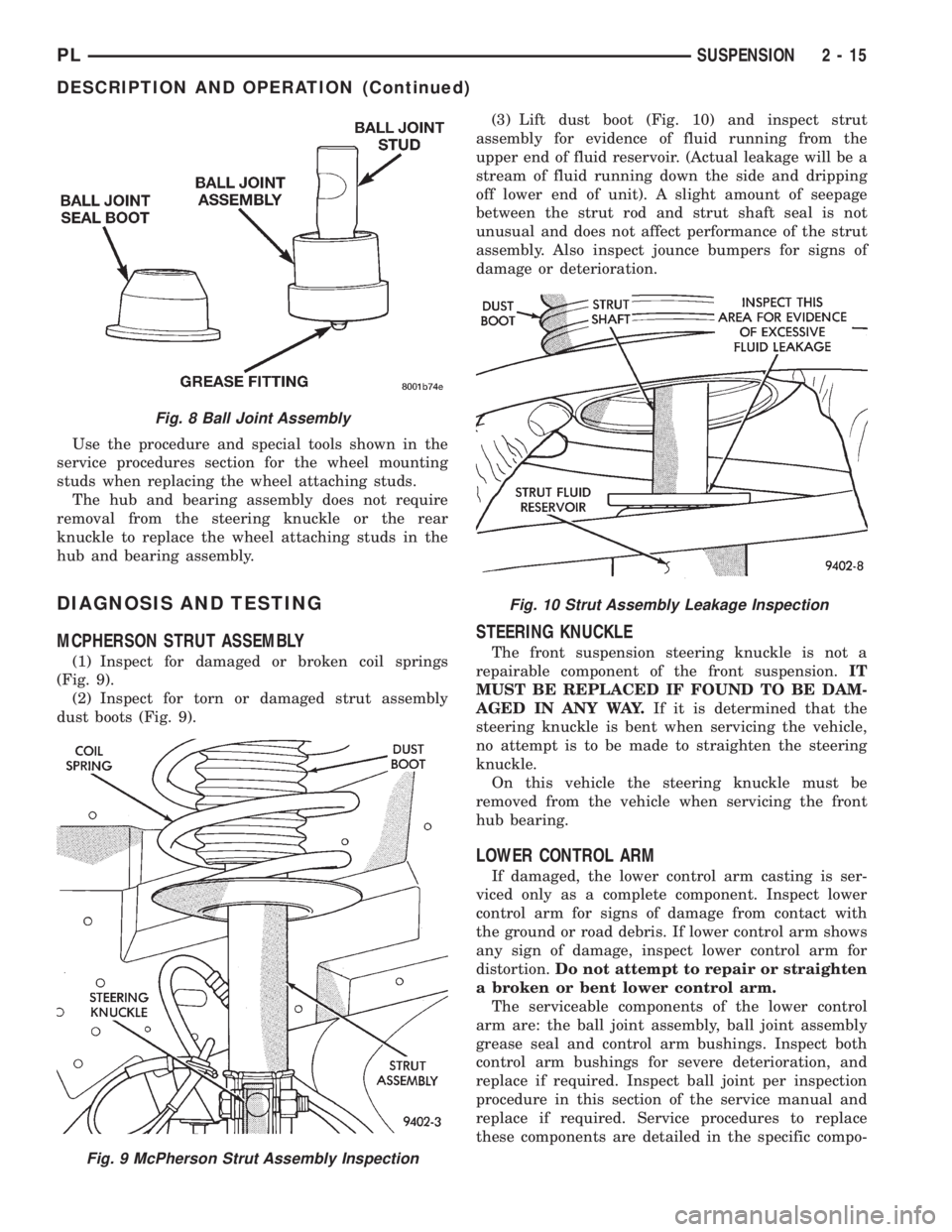
(1) Inspect for damaged or broken coil springs
(Fig. 9).
(2) Inspect for torn or damaged strut assembly
dust boots (Fig. 9).(3) Lift dust boot (Fig. 10) and inspect strut
assembly for evidence of fluid running from the
upper end of fluid reservoir. (Actual leakage will be a
stream of fluid running down the side and dripping
off lower end of unit). A slight amount of seepage
between the strut rod and strut shaft seal is not
unusual and does not affect performance of the strut
assembly. Also inspect jounce bumpers for signs of
damage or deterioration.
STEERING KNUCKLE
The front suspension steering knuckle is not a
repairable component of the front suspension.IT
MUST BE REPLACED IF FOUND TO BE DAM-
AGED IN ANY WAY.If it is determined that the
steering knuckle is bent when servicing the vehicle,
no attempt is to be made to straighten the steering
knuckle.
On this vehicle the steering knuckle must be
removed from the vehicle when servicing the front
hub bearing.
LOWER CONTROL ARM
If damaged, the lower control arm casting is ser-
viced only as a complete component. Inspect lower
control arm for signs of damage from contact with
the ground or road debris. If lower control arm shows
any sign of damage, inspect lower control arm for
distortion.Do not attempt to repair or straighten
a broken or bent lower control arm.
The serviceable components of the lower control
arm are: the ball joint assembly, ball joint assembly
grease seal and control arm bushings. Inspect both
control arm bushings for severe deterioration, and
replace if required. Inspect ball joint per inspection
procedure in this section of the service manual and
replace if required. Service procedures to replace
these components are detailed in the specific compo-
Fig. 8 Ball Joint Assembly
Fig. 9 McPherson Strut Assembly Inspection
Fig. 10 Strut Assembly Leakage Inspection
PLSUSPENSION 2 - 15
DESCRIPTION AND OPERATION (Continued)
Page 27 of 1200
nent removal and installation sections in this group
of the service manual.
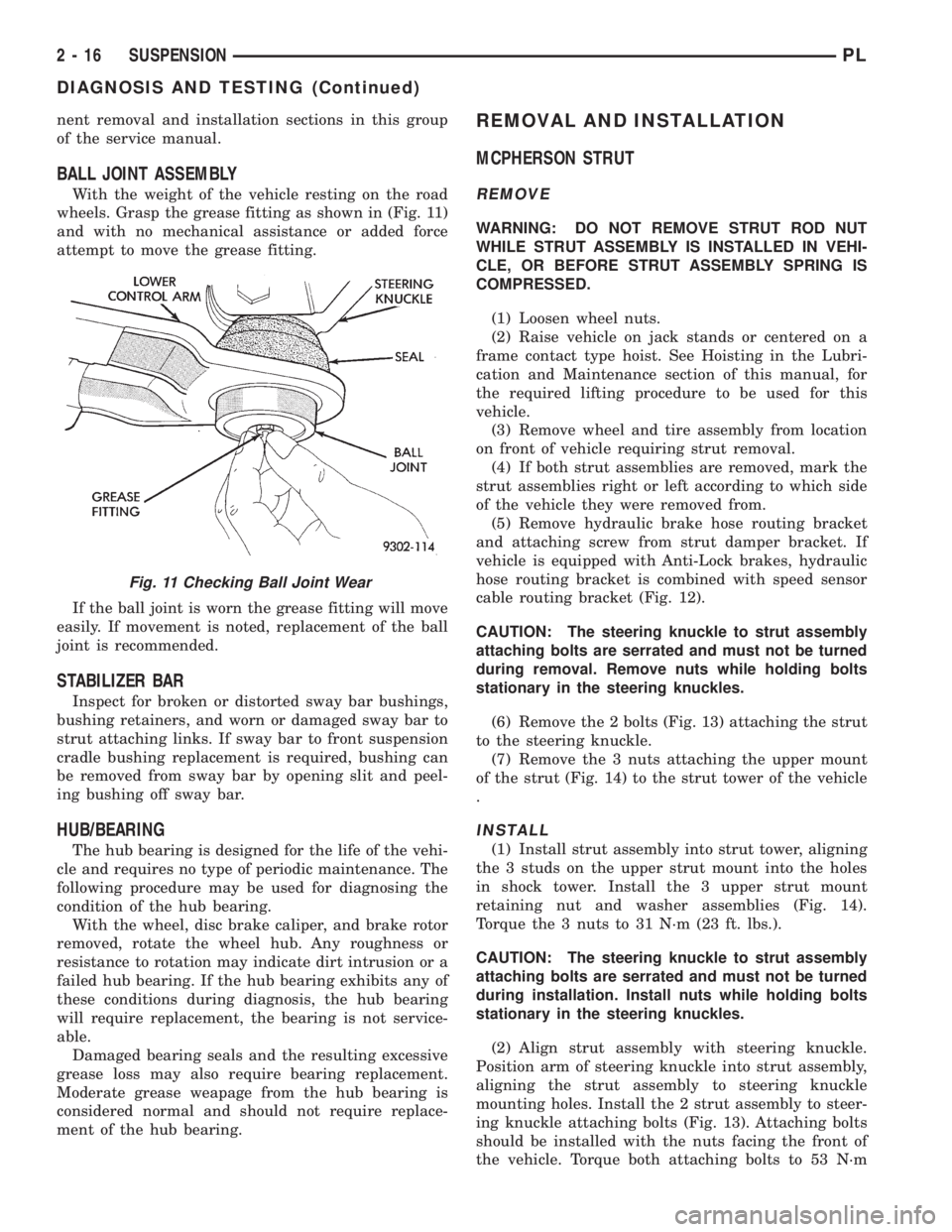
BALL JOINT ASSEMBLY
With the weight of the vehicle resting on the road
wheels. Grasp the grease fitting as shown in (Fig. 11)
and with no mechanical assistance or added force
attempt to move the grease fitting.
If the ball joint is worn the grease fitting will move
easily. If movement is noted, replacement of the ball
joint is recommended.
STABILIZER BAR
Inspect for broken or distorted sway bar bushings,
bushing retainers, and worn or damaged sway bar to
strut attaching links. If sway bar to front suspension
cradle bushing replacement is required, bushing can
be removed from sway bar by opening slit and peel-
ing bushing off sway bar.
HUB/BEARING
The hub bearing is designed for the life of the vehi-
cle and requires no type of periodic maintenance. The
following procedure may be used for diagnosing the
condition of the hub bearing.
With the wheel, disc brake caliper, and brake rotor
removed, rotate the wheel hub. Any roughness or
resistance to rotation may indicate dirt intrusion or a
failed hub bearing. If the hub bearing exhibits any of
these conditions during diagnosis, the hub bearing
will require replacement, the bearing is not service-
able.
Damaged bearing seals and the resulting excessive
grease loss may also require bearing replacement.
Moderate grease weapage from the hub bearing is
considered normal and should not require replace-
ment of the hub bearing.
REMOVAL AND INSTALLATION
MCPHERSON STRUT
REMOVE
WARNING: DO NOT REMOVE STRUT ROD NUT
WHILE STRUT ASSEMBLY IS INSTALLED IN VEHI-
CLE, OR BEFORE STRUT ASSEMBLY SPRING IS
COMPRESSED.
(1) Loosen wheel nuts.
(2) Raise vehicle on jack stands or centered on a
frame contact type hoist. See Hoisting in the Lubri-
cation and Maintenance section of this manual, for
the required lifting procedure to be used for this
vehicle.
(3) Remove wheel and tire assembly from location
on front of vehicle requiring strut removal.
(4) If both strut assemblies are removed, mark the
strut assemblies right or left according to which side
of the vehicle they were removed from.
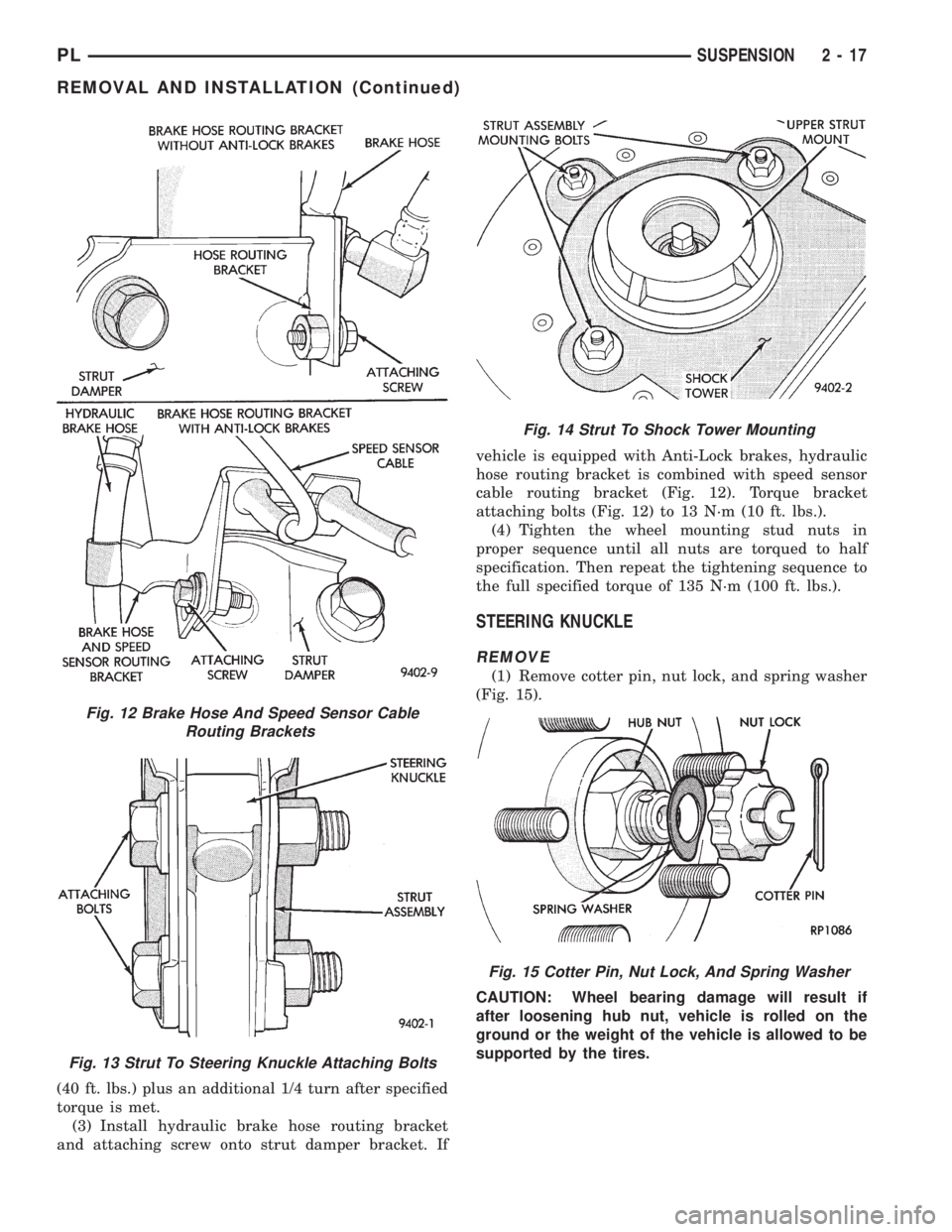
(5) Remove hydraulic brake hose routing bracket
and attaching screw from strut damper bracket. If
vehicle is equipped with Anti-Lock brakes, hydraulic
hose routing bracket is combined with speed sensor
cable routing bracket (Fig. 12).
CAUTION: The steering knuckle to strut assembly
attaching bolts are serrated and must not be turned
during removal. Remove nuts while holding bolts
stationary in the steering knuckles.
(6) Remove the 2 bolts (Fig. 13) attaching the strut
to the steering knuckle.
(7) Remove the 3 nuts attaching the upper mount
of the strut (Fig. 14) to the strut tower of the vehicle
.
INSTALL
(1) Install strut assembly into strut tower, aligning
the 3 studs on the upper strut mount into the holes
in shock tower. Install the 3 upper strut mount
retaining nut and washer assemblies (Fig. 14).
Torque the 3 nuts to 31 N´m (23 ft. lbs.).
CAUTION: The steering knuckle to strut assembly
attaching bolts are serrated and must not be turned
during installation. Install nuts while holding bolts
stationary in the steering knuckles.
(2) Align strut assembly with steering knuckle.
Position arm of steering knuckle into strut assembly,
aligning the strut assembly to steering knuckle
mounting holes. Install the 2 strut assembly to steer-
ing knuckle attaching bolts (Fig. 13). Attaching bolts
should be installed with the nuts facing the front of
the vehicle. Torque both attaching bolts to 53 N´m
Fig. 11 Checking Ball Joint Wear
2 - 16 SUSPENSIONPL
DIAGNOSIS AND TESTING (Continued)
Page 28 of 1200
(40 ft. lbs.) plus an additional 1/4 turn after specified
torque is met.
(3) Install hydraulic brake hose routing bracket
and attaching screw onto strut damper bracket. Ifvehicle is equipped with Anti-Lock brakes, hydraulic
hose routing bracket is combined with speed sensor
cable routing bracket (Fig. 12). Torque bracket
attaching bolts (Fig. 12) to 13 N´m (10 ft. lbs.).
(4) Tighten the wheel mounting stud nuts in
proper sequence until all nuts are torqued to half
specification. Then repeat the tightening sequence to
the full specified torque of 135 N´m (100 ft. lbs.).
STEERING KNUCKLE
REMOVE
(1) Remove cotter pin, nut lock, and spring washer
(Fig. 15).
CAUTION: Wheel bearing damage will result if
after loosening hub nut, vehicle is rolled on the
ground or the weight of the vehicle is allowed to be
supported by the tires.
Fig. 12 Brake Hose And Speed Sensor Cable
Routing Brackets
Fig. 13 Strut To Steering Knuckle Attaching Bolts
Fig. 14 Strut To Shock Tower Mounting
Fig. 15 Cotter Pin, Nut Lock, And Spring Washer
PLSUSPENSION 2 - 17
REMOVAL AND INSTALLATION (Continued)
Page 29 of 1200
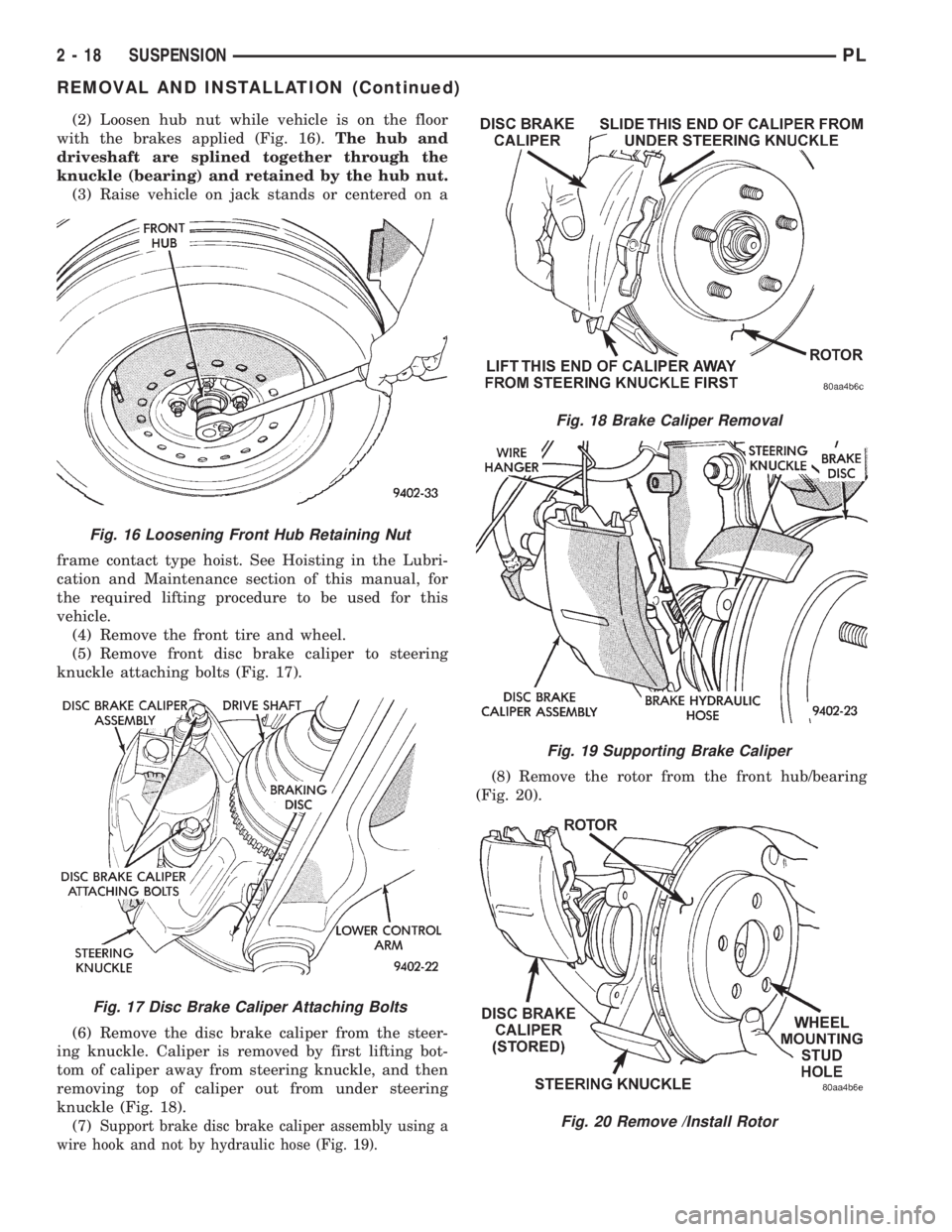
(2) Loosen hub nut while vehicle is on the floor
with the brakes applied (Fig. 16).The hub and
driveshaft are splined together through the
knuckle (bearing) and retained by the hub nut.
(3) Raise vehicle on jack stands or centered on a
frame contact type hoist. See Hoisting in the Lubri-
cation and Maintenance section of this manual, for
the required lifting procedure to be used for this
vehicle.
(4) Remove the front tire and wheel.
(5) Remove front disc brake caliper to steering
knuckle attaching bolts (Fig. 17).
(6) Remove the disc brake caliper from the steer-
ing knuckle. Caliper is removed by first lifting bot-
tom of caliper away from steering knuckle, and then
removing top of caliper out from under steering
knuckle (Fig. 18).
(7)
Support brake disc brake caliper assembly using a
wire hook and not by hydraulic hose (Fig. 19).
(8) Remove the rotor from the front hub/bearing
(Fig. 20).
Fig. 16 Loosening Front Hub Retaining Nut
Fig. 17 Disc Brake Caliper Attaching Bolts
Fig. 18 Brake Caliper Removal
Fig. 19 Supporting Brake Caliper
Fig. 20 Remove /Install Rotor
2 - 18 SUSPENSIONPL
REMOVAL AND INSTALLATION (Continued)
Page 31 of 1200
CAUTION: The steering knuckle to strut assembly
attaching bolts are serrated and must not be turned
during removal. Remove nuts while holding bolts
stationary in the steering knuckles.
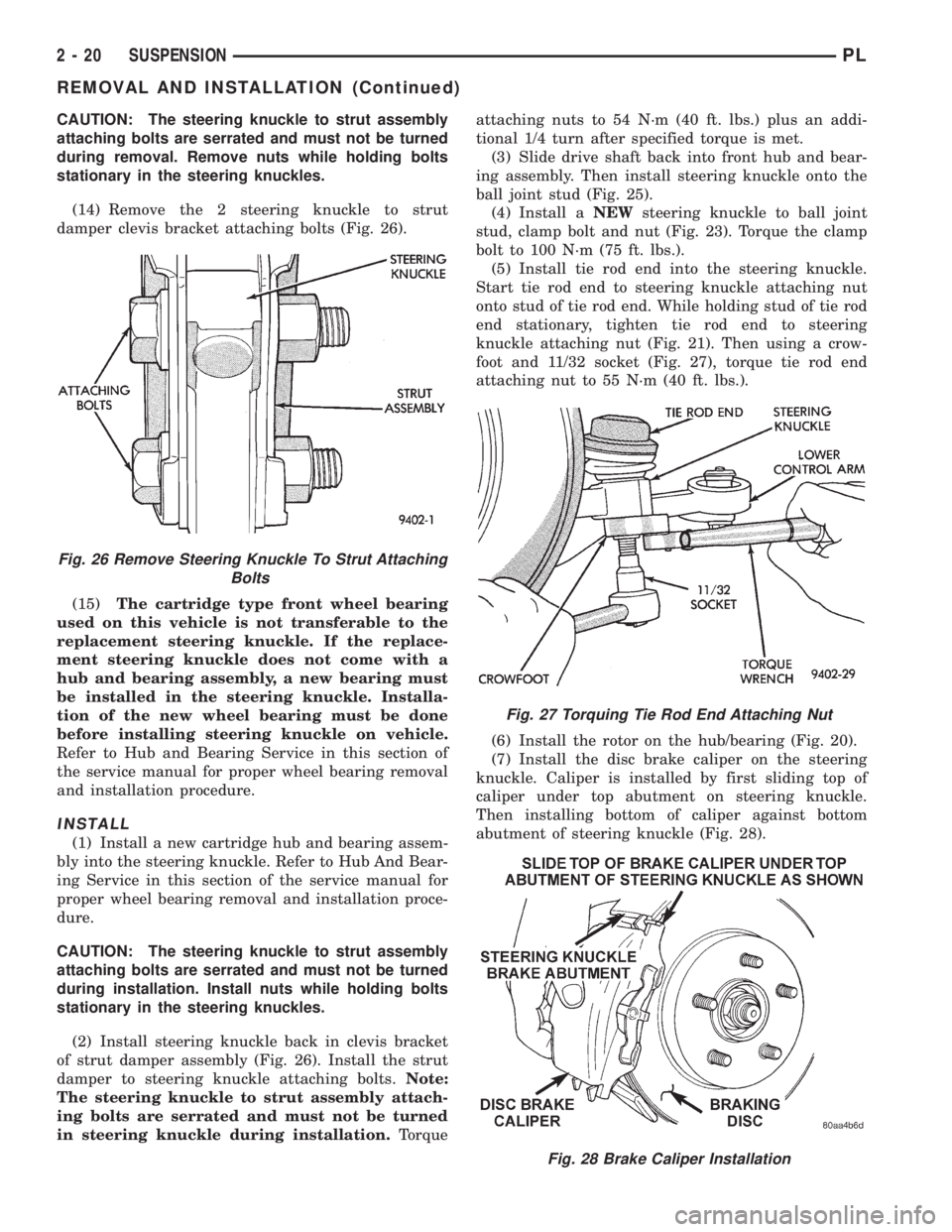
(14) Remove the 2 steering knuckle to strut
damper clevis bracket attaching bolts (Fig. 26).
(15)The cartridge type front wheel bearing
used on this vehicle is not transferable to the
replacement steering knuckle. If the replace-
ment steering knuckle does not come with a
hub and bearing assembly, a new bearing must
be installed in the steering knuckle. Installa-
tion of the new wheel bearing must be done
before installing steering knuckle on vehicle.
Refer to Hub and Bearing Service in this section of
the service manual for proper wheel bearing removal
and installation procedure.
INSTALL
(1) Install a new cartridge hub and bearing assem-
bly into the steering knuckle. Refer to Hub And Bear-
ing Service in this section of the service manual for
proper wheel bearing removal and installation proce-
dure.
CAUTION: The steering knuckle to strut assembly
attaching bolts are serrated and must not be turned
during installation. Install nuts while holding bolts
stationary in the steering knuckles.
(2) Install steering knuckle back in clevis bracket
of strut damper assembly (Fig. 26). Install the strut
damper to steering knuckle attaching bolts.Note:
The steering knuckle to strut assembly attach-
ing bolts are serrated and must not be turned
in steering knuckle during installation.Torqueattaching nuts to 54 N´m (40 ft. lbs.) plus an addi-
tional 1/4 turn after specified torque is met.
(3) Slide drive shaft back into front hub and bear-
ing assembly. Then install steering knuckle onto the
ball joint stud (Fig. 25).
(4) Install aNEWsteering knuckle to ball joint
stud, clamp bolt and nut (Fig. 23). Torque the clamp
bolt to 100 N´m (75 ft. lbs.).
(5) Install tie rod end into the steering knuckle.
Start tie rod end to steering knuckle attaching nut
onto stud of tie rod end. While holding stud of tie rod
end stationary, tighten tie rod end to steering
knuckle attaching nut (Fig. 21). Then using a crow-
foot and 11/32 socket (Fig. 27), torque tie rod end
attaching nut to 55 N´m (40 ft. lbs.).
(6) Install the rotor on the hub/bearing (Fig. 20).
(7) Install the disc brake caliper on the steering
knuckle. Caliper is installed by first sliding top of
caliper under top abutment on steering knuckle.
Then installing bottom of caliper against bottom
abutment of steering knuckle (Fig. 28).
Fig. 28 Brake Caliper Installation
Fig. 26 Remove Steering Knuckle To Strut Attaching
Bolts
Fig. 27 Torquing Tie Rod End Attaching Nut
2 - 20 SUSPENSIONPL
REMOVAL AND INSTALLATION (Continued)
Page 32 of 1200
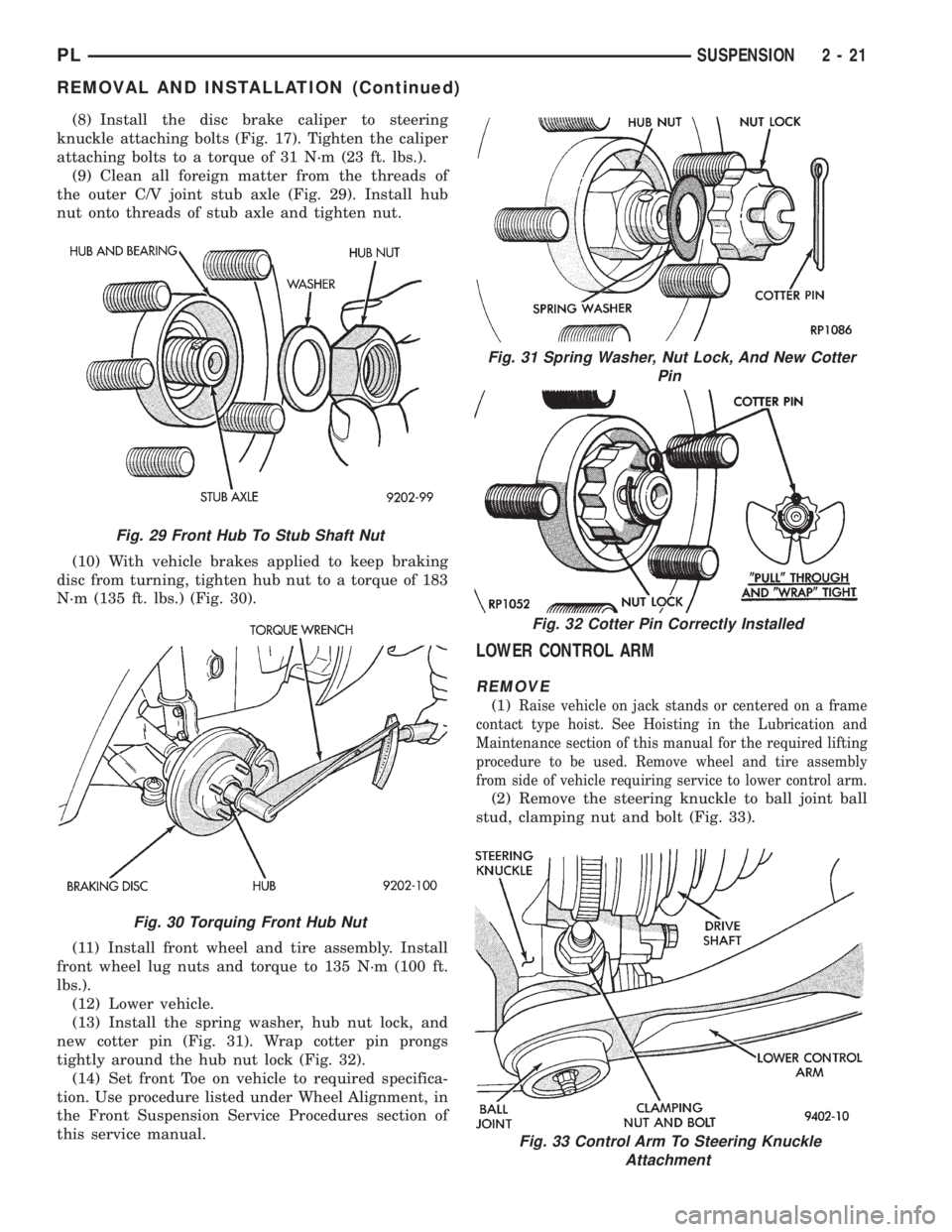
(8) Install the disc brake caliper to steering
knuckle attaching bolts (Fig. 17). Tighten the caliper
attaching bolts to a torque of 31 N´m (23 ft. lbs.).
(9) Clean all foreign matter from the threads of
the outer C/V joint stub axle (Fig. 29). Install hub
nut onto threads of stub axle and tighten nut.
(10) With vehicle brakes applied to keep braking
disc from turning, tighten hub nut to a torque of 183
N´m (135 ft. lbs.) (Fig. 30).
(11) Install front wheel and tire assembly. Install
front wheel lug nuts and torque to 135 N´m (100 ft.
lbs.).
(12) Lower vehicle.
(13) Install the spring washer, hub nut lock, and
new cotter pin (Fig. 31). Wrap cotter pin prongs
tightly around the hub nut lock (Fig. 32).
(14) Set front Toe on vehicle to required specifica-
tion. Use procedure listed under Wheel Alignment, in
the Front Suspension Service Procedures section of
this service manual.
LOWER CONTROL ARM
REMOVE
(1)Raise vehicle on jack stands or centered on a frame
contact type hoist. See Hoisting in the Lubrication and
Maintenance section of this manual for the required lifting
procedure to be used. Remove wheel and tire assembly
from side of vehicle requiring service to lower control arm.
(2) Remove the steering knuckle to ball joint ball
stud, clamping nut and bolt (Fig. 33).
Fig. 29 Front Hub To Stub Shaft Nut
Fig. 30 Torquing Front Hub Nut
Fig. 31 Spring Washer, Nut Lock, And New Cotter
Pin
Fig. 32 Cotter Pin Correctly Installed
Fig. 33 Control Arm To Steering Knuckle
Attachment
PLSUSPENSION 2 - 21
REMOVAL AND INSTALLATION (Continued)
Page 36 of 1200
WHEEL BEARING
REMOVE
(1) Remove steering knuckle, hub and wheel bear-
ing as an assembly from the vehicle. Refer to Steer-
ing Knuckle in the Removal And Installation section
in this group of the service manual for the required
steering knuckle removal procedure.
The removal and installation of the wheel
bearing from the steering knuckle is ONLY to
be done with the steering knuckle removed
from the vehicle. Removal of the wheel bearing
from the steering knuckle MUST be done using
an arbor press and the following procedure.
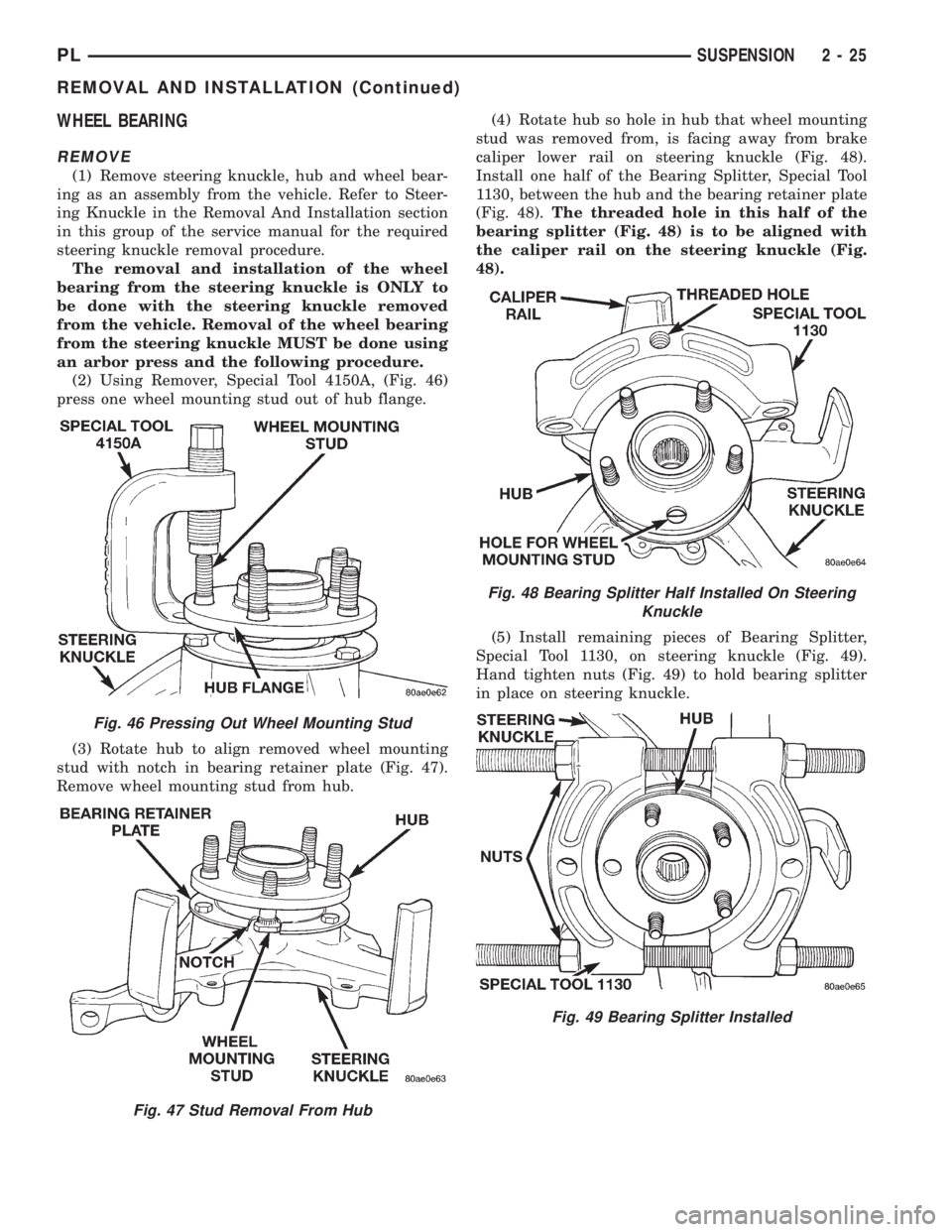
(2) Using Remover, Special Tool 4150A, (Fig. 46)
press one wheel mounting stud out of hub flange.
(3) Rotate hub to align removed wheel mounting
stud with notch in bearing retainer plate (Fig. 47).
Remove wheel mounting stud from hub.(4) Rotate hub so hole in hub that wheel mounting
stud was removed from, is facing away from brake
caliper lower rail on steering knuckle (Fig. 48).
Install one half of the Bearing Splitter, Special Tool
1130, between the hub and the bearing retainer plate
(Fig. 48).The threaded hole in this half of the
bearing splitter (Fig. 48) is to be aligned with
the caliper rail on the steering knuckle (Fig.
48).
(5) Install remaining pieces of Bearing Splitter,
Special Tool 1130, on steering knuckle (Fig. 49).
Hand tighten nuts (Fig. 49) to hold bearing splitter
in place on steering knuckle.
Fig. 46 Pressing Out Wheel Mounting Stud
Fig. 47 Stud Removal From Hub
Fig. 48 Bearing Splitter Half Installed On Steering
Knuckle
Fig. 49 Bearing Splitter Installed
PLSUSPENSION 2 - 25
REMOVAL AND INSTALLATION (Continued)