ignition DODGE NEON 1999 Service Repair Manual
[x] Cancel search | Manufacturer: DODGE, Model Year: 1999, Model line: NEON, Model: DODGE NEON 1999Pages: 1200, PDF Size: 35.29 MB
Page 1003 of 1200
(18) Carefully remove the cable from the under-
body by unfolding the cable retainer clip as you go
along.
INSTALLATION
(1) To install gearshift cable, reverse removal pro-
cedure.
(2) Adjust gearshift cable using the adjustment
procedure in this Group.
GEARSHIFT MECHANISM
REMOVAL
(1) Disconnect battery negative cable and isolate.
(2) Remove console assembly. Refer to Group 23,
Body.
(3) Remove the gearshift knob set screw and knob.
(4) Remove the screws retaining the gearshift indi-
cator bezel and remove bezel and indicator lamp.
(5) Using a flat±blade pry tool, remove the shifter
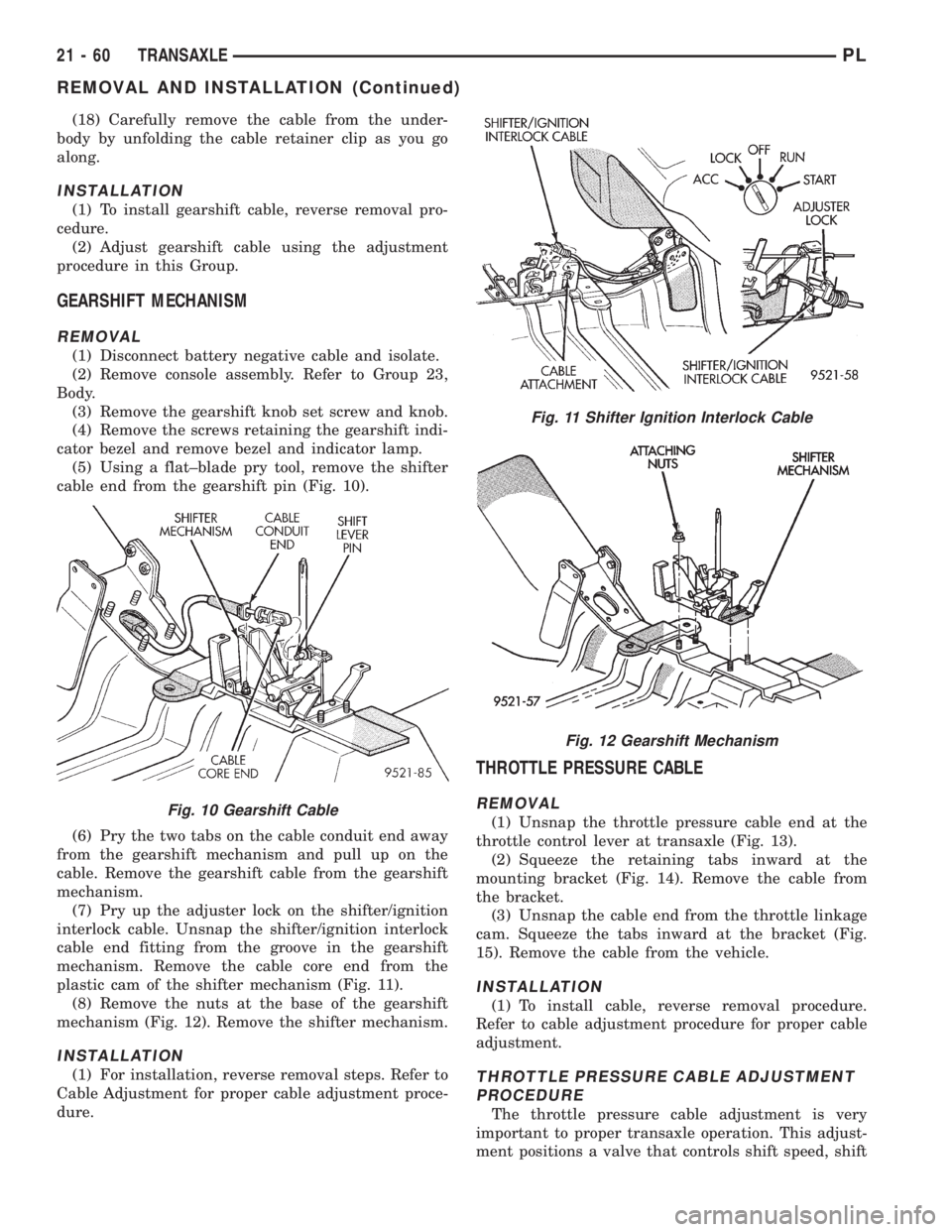
cable end from the gearshift pin (Fig. 10).
(6) Pry the two tabs on the cable conduit end away
from the gearshift mechanism and pull up on the
cable. Remove the gearshift cable from the gearshift
mechanism.
(7) Pry up the adjuster lock on the shifter/ignition
interlock cable. Unsnap the shifter/ignition interlock
cable end fitting from the groove in the gearshift
mechanism. Remove the cable core end from the
plastic cam of the shifter mechanism (Fig. 11).
(8) Remove the nuts at the base of the gearshift
mechanism (Fig. 12). Remove the shifter mechanism.
INSTALLATION
(1) For installation, reverse removal steps. Refer to
Cable Adjustment for proper cable adjustment proce-
dure.
THROTTLE PRESSURE CABLE
REMOVAL
(1) Unsnap the throttle pressure cable end at the
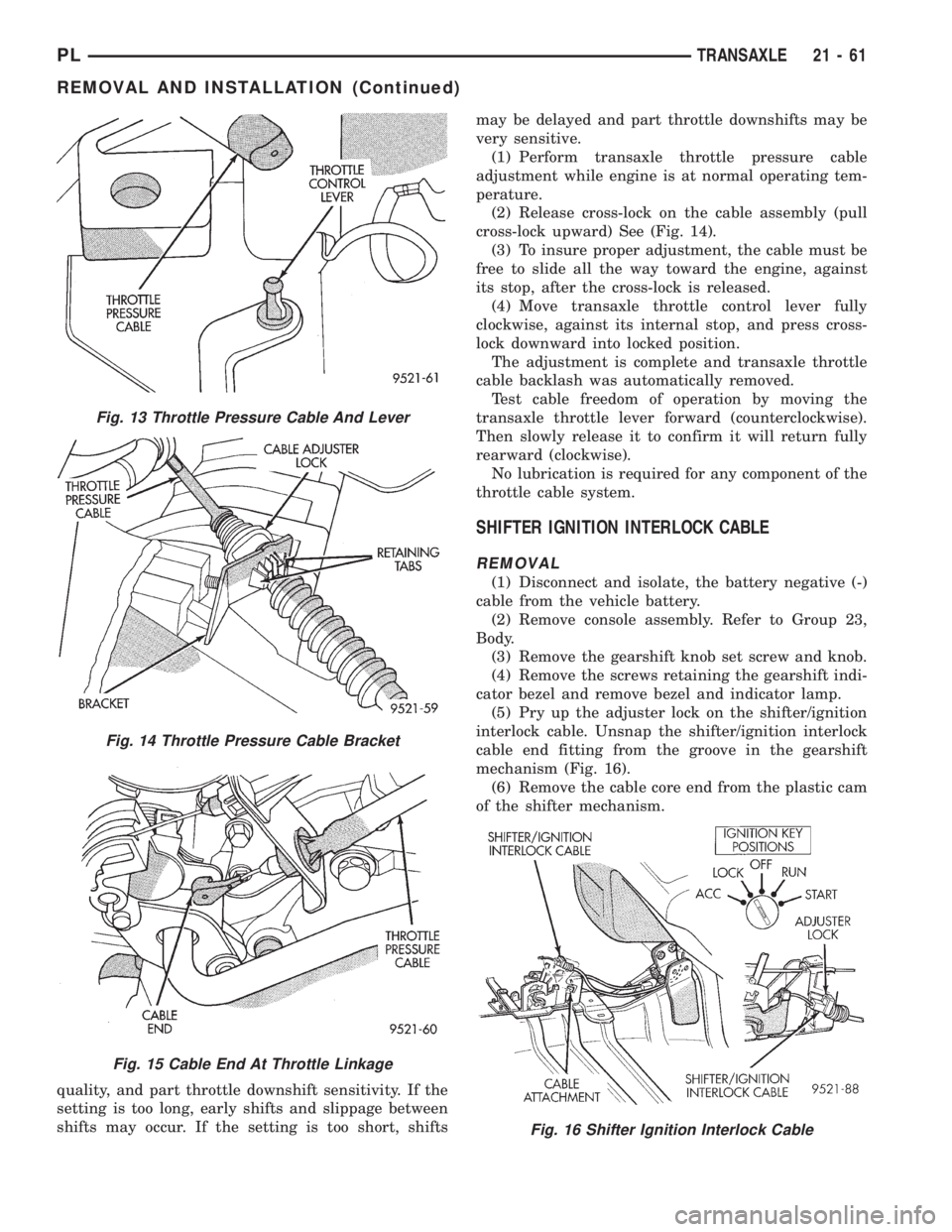
throttle control lever at transaxle (Fig. 13).
(2) Squeeze the retaining tabs inward at the
mounting bracket (Fig. 14). Remove the cable from
the bracket.
(3) Unsnap the cable end from the throttle linkage
cam. Squeeze the tabs inward at the bracket (Fig.
15). Remove the cable from the vehicle.
INSTALLATION
(1) To install cable, reverse removal procedure.
Refer to cable adjustment procedure for proper cable
adjustment.
THROTTLE PRESSURE CABLE ADJUSTMENT
PROCEDURE
The throttle pressure cable adjustment is very
important to proper transaxle operation. This adjust-
ment positions a valve that controls shift speed, shift
Fig. 10 Gearshift Cable
Fig. 11 Shifter Ignition Interlock Cable
Fig. 12 Gearshift Mechanism
21 - 60 TRANSAXLEPL
REMOVAL AND INSTALLATION (Continued)
Page 1004 of 1200
quality, and part throttle downshift sensitivity. If the
setting is too long, early shifts and slippage between
shifts may occur. If the setting is too short, shiftsmay be delayed and part throttle downshifts may be
very sensitive.
(1) Perform transaxle throttle pressure cable
adjustment while engine is at normal operating tem-
perature.
(2) Release cross-lock on the cable assembly (pull
cross-lock upward) See (Fig. 14).
(3) To insure proper adjustment, the cable must be
free to slide all the way toward the engine, against
its stop, after the cross-lock is released.
(4) Move transaxle throttle control lever fully
clockwise, against its internal stop, and press cross-
lock downward into locked position.
The adjustment is complete and transaxle throttle
cable backlash was automatically removed.
Test cable freedom of operation by moving the
transaxle throttle lever forward (counterclockwise).
Then slowly release it to confirm it will return fully
rearward (clockwise).
No lubrication is required for any component of the
throttle cable system.
SHIFTER IGNITION INTERLOCK CABLE
REMOVAL
(1) Disconnect and isolate, the battery negative (-)
cable from the vehicle battery.
(2) Remove console assembly. Refer to Group 23,
Body.
(3) Remove the gearshift knob set screw and knob.
(4) Remove the screws retaining the gearshift indi-
cator bezel and remove bezel and indicator lamp.
(5) Pry up the adjuster lock on the shifter/ignition
interlock cable. Unsnap the shifter/ignition interlock
cable end fitting from the groove in the gearshift
mechanism (Fig. 16).
(6) Remove the cable core end from the plastic cam
of the shifter mechanism.
Fig. 13 Throttle Pressure Cable And Lever
Fig. 14 Throttle Pressure Cable Bracket
Fig. 15 Cable End At Throttle Linkage
Fig. 16 Shifter Ignition Interlock Cable
PLTRANSAXLE 21 - 61
REMOVAL AND INSTALLATION (Continued)
Page 1005 of 1200
(7) Pull cable up and out of the gearshift mecha-
nism.
(8) Remove the three screws along the bottom of
the lower steering column cover and screw on the left
outward face of cover.
(9) Grasp the cover and pull rearward until the
clips disengage.
(10) Remove two screws at the upper area of the
column liner and lower left corner.
(11) Remove steering column cover and steering
column cover liner.
(12) Lift up the top cover and cluster bezel until
the clips disengage and separate to provide clear-
ance.
(13) Insert a screwdriver into access hole in the
lower shroud. Depress the cylinder button while
rotating the cylinder with the key inserted between
the ON and START positions. This will disengage the
cylinder from the column.
(14) Pull out the key cylinder.
(15) Remove the three lower±to±upper shroud
attaching screws through the bottom of the lower
shroud.
(16) Separate the upper and lower shrouds.
(17) Grasp the interlock cable clip and connector.
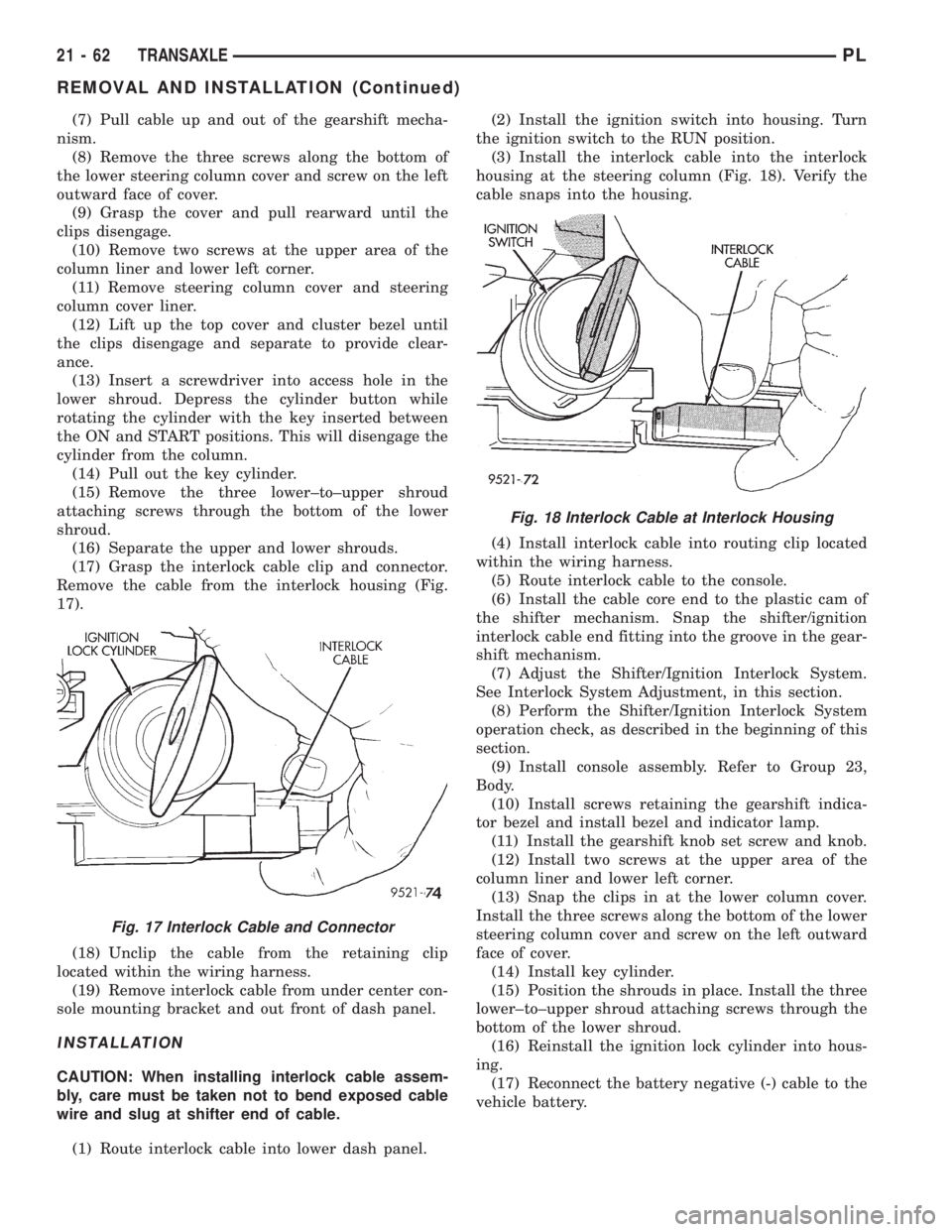
Remove the cable from the interlock housing (Fig.
17).
(18) Unclip the cable from the retaining clip
located within the wiring harness.
(19) Remove interlock cable from under center con-
sole mounting bracket and out front of dash panel.
INSTALLATION
CAUTION: When installing interlock cable assem-
bly, care must be taken not to bend exposed cable
wire and slug at shifter end of cable.
(1) Route interlock cable into lower dash panel.(2) Install the ignition switch into housing. Turn
the ignition switch to the RUN position.
(3) Install the interlock cable into the interlock
housing at the steering column (Fig. 18). Verify the
cable snaps into the housing.
(4) Install interlock cable into routing clip located
within the wiring harness.
(5) Route interlock cable to the console.
(6) Install the cable core end to the plastic cam of
the shifter mechanism. Snap the shifter/ignition
interlock cable end fitting into the groove in the gear-
shift mechanism.
(7) Adjust the Shifter/Ignition Interlock System.
See Interlock System Adjustment, in this section.
(8) Perform the Shifter/Ignition Interlock System
operation check, as described in the beginning of this
section.
(9) Install console assembly. Refer to Group 23,
Body.
(10) Install screws retaining the gearshift indica-
tor bezel and install bezel and indicator lamp.
(11) Install the gearshift knob set screw and knob.
(12) Install two screws at the upper area of the
column liner and lower left corner.
(13) Snap the clips in at the lower column cover.
Install the three screws along the bottom of the lower
steering column cover and screw on the left outward
face of cover.
(14) Install key cylinder.
(15) Position the shrouds in place. Install the three
lower±to±upper shroud attaching screws through the
bottom of the lower shroud.
(16) Reinstall the ignition lock cylinder into hous-
ing.
(17) Reconnect the battery negative (-) cable to the
vehicle battery.
Fig. 17 Interlock Cable and Connector
Fig. 18 Interlock Cable at Interlock Housing
21 - 62 TRANSAXLEPL
REMOVAL AND INSTALLATION (Continued)
Page 1006 of 1200
INTERLOCK SYSTEM ADJUSTMENT
If ignition switch cannot be turned to the LOCK
position, with shifter in PARK, an adjustment of the
Interlock System may be required. To adjust Shifter/
Ignition Interlock System, follow procedure listed
below.
(1) Disconnect and isolate, the battery negative (-)
cable from the vehicle battery.
(2) Remove console assembly. Refer to Group 23,
Body.
(3) Remove the gearshift knob set screw and knob.
(4) Remove the screws retaining the gearshift indi-
cator bezel and remove bezel and indicator lamp.
(5) Reinstall the gearshift knob.
(6) Place shifter in PARK.
(7) Turn ignition switch to the LOCK or ACCES-
SORY position. If cable has lost its adjustment, man-
ually position cable to get key into LOCK or
ACCESSORY position. Grasp slug on interlock cable
with needle nose pliers and pull back on cable. This
will allow the ignition switch to be turned to the
LOCK or ACCESSORY position.
(8) Check that the interlock cable slug is com-
pletely seated into the shifter interlock lever.
(9) Check that the ignition switch is still in the
LOCK or ACCESSORY position.
(10) Pry up the adjuster lock on the shifter/igni-
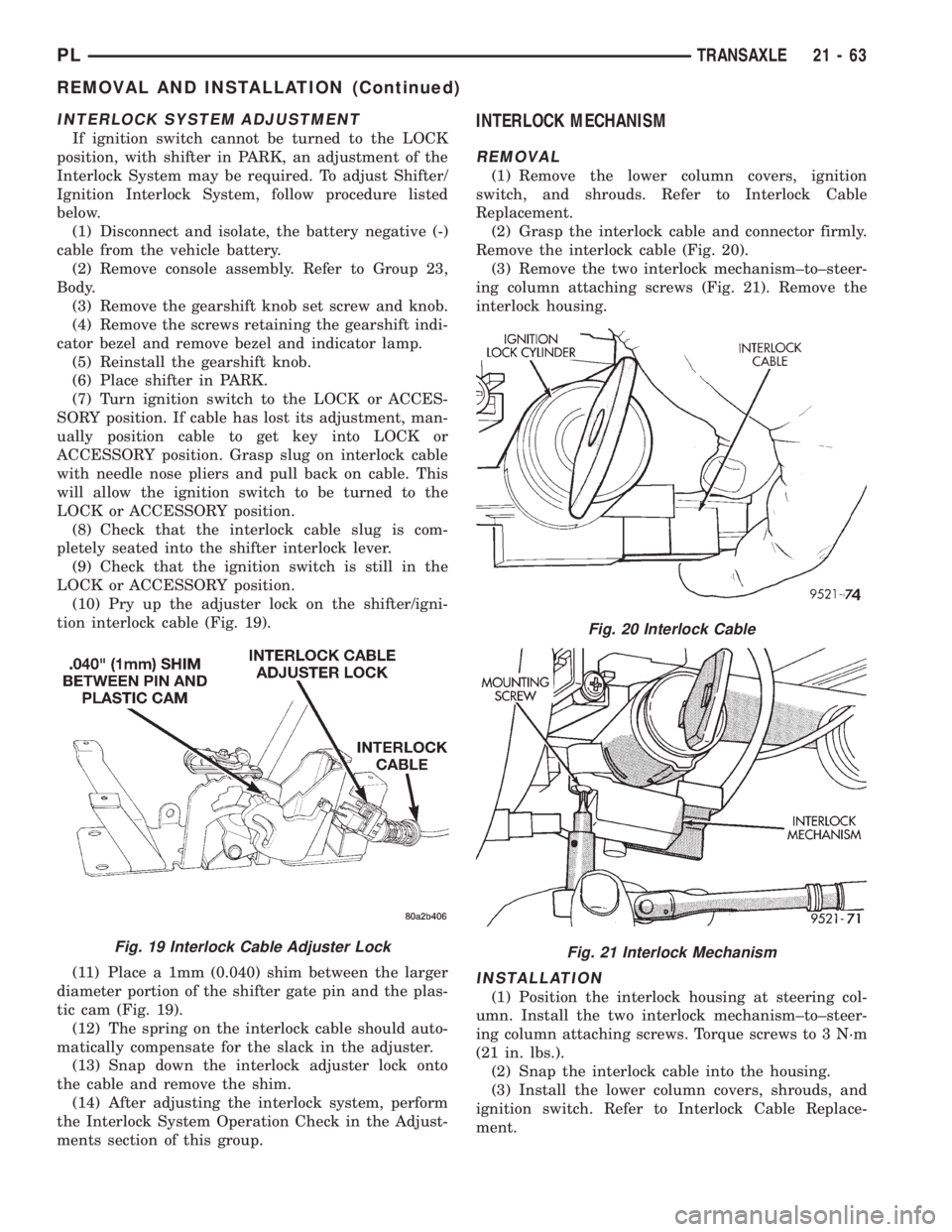
tion interlock cable (Fig. 19).
(11) Place a 1mm (0.040) shim between the larger
diameter portion of the shifter gate pin and the plas-
tic cam (Fig. 19).
(12) The spring on the interlock cable should auto-
matically compensate for the slack in the adjuster.
(13) Snap down the interlock adjuster lock onto
the cable and remove the shim.
(14) After adjusting the interlock system, perform
the Interlock System Operation Check in the Adjust-
ments section of this group.
INTERLOCK MECHANISM
REMOVAL
(1) Remove the lower column covers, ignition
switch, and shrouds. Refer to Interlock Cable
Replacement.
(2) Grasp the interlock cable and connector firmly.
Remove the interlock cable (Fig. 20).
(3) Remove the two interlock mechanism±to±steer-
ing column attaching screws (Fig. 21). Remove the
interlock housing.
INSTALLATION
(1) Position the interlock housing at steering col-
umn. Install the two interlock mechanism±to±steer-
ing column attaching screws. Torque screws to 3 N´m
(21 in. lbs.).
(2) Snap the interlock cable into the housing.
(3) Install the lower column covers, shrouds, and
ignition switch. Refer to Interlock Cable Replace-
ment.
Fig. 19 Interlock Cable Adjuster Lock
Fig. 20 Interlock Cable
Fig. 21 Interlock Mechanism
PLTRANSAXLE 21 - 63
REMOVAL AND INSTALLATION (Continued)
Page 1043 of 1200
ADJUSTMENT
(1) Set parking brake.
(2) Remove floor console. Refer to Group 23, Body.
(3) Place gearshift lever in the (PARK) (P) posi-
tion.
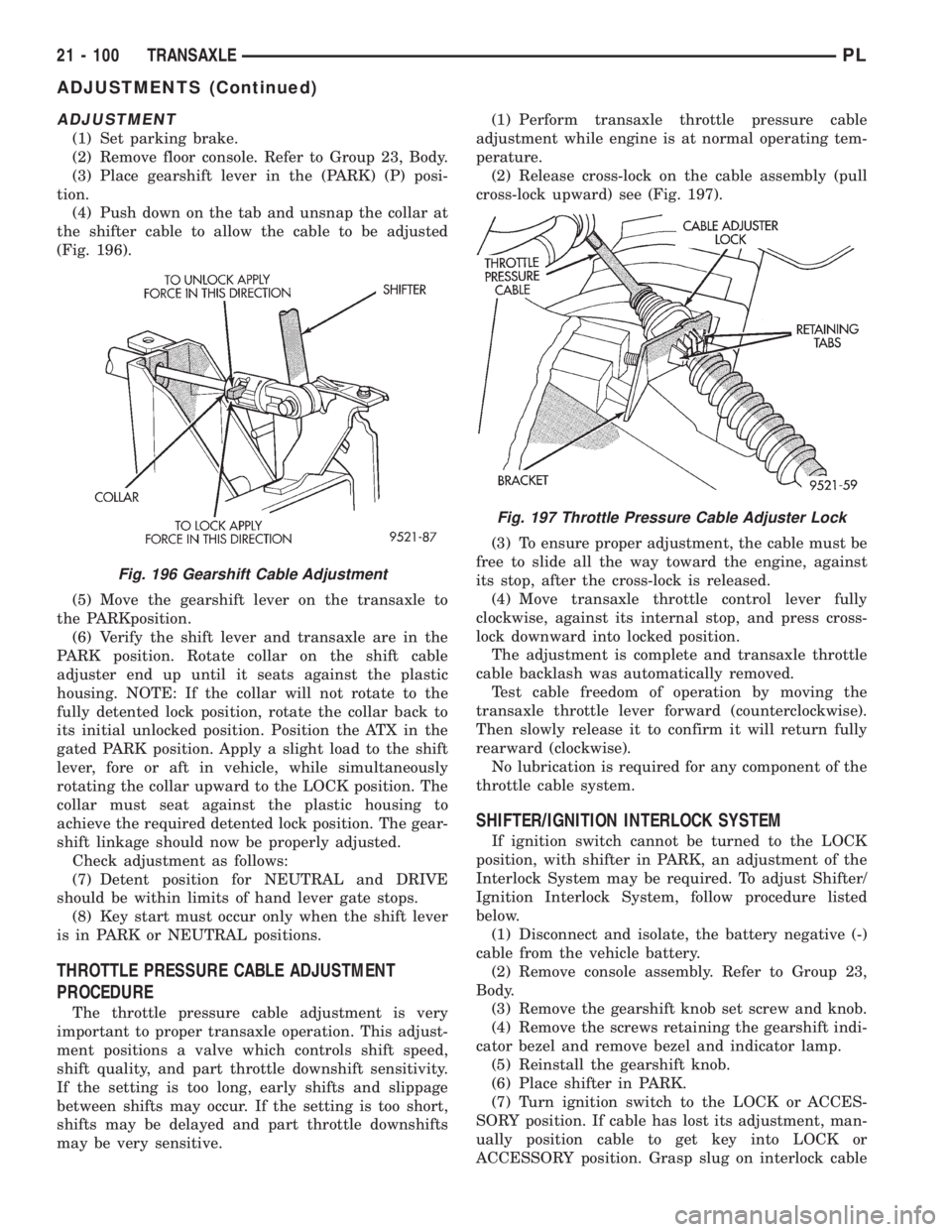
(4) Push down on the tab and unsnap the collar at
the shifter cable to allow the cable to be adjusted
(Fig. 196).
(5) Move the gearshift lever on the transaxle to
the PARKposition.
(6) Verify the shift lever and transaxle are in the
PARK position. Rotate collar on the shift cable
adjuster end up until it seats against the plastic
housing. NOTE: If the collar will not rotate to the
fully detented lock position, rotate the collar back to
its initial unlocked position. Position the ATX in the
gated PARK position. Apply a slight load to the shift
lever, fore or aft in vehicle, while simultaneously
rotating the collar upward to the LOCK position. The
collar must seat against the plastic housing to
achieve the required detented lock position. The gear-
shift linkage should now be properly adjusted.
Check adjustment as follows:
(7) Detent position for NEUTRAL and DRIVE
should be within limits of hand lever gate stops.
(8) Key start must occur only when the shift lever
is in PARK or NEUTRAL positions.
THROTTLE PRESSURE CABLE ADJUSTMENT
PROCEDURE
The throttle pressure cable adjustment is very
important to proper transaxle operation. This adjust-
ment positions a valve which controls shift speed,
shift quality, and part throttle downshift sensitivity.
If the setting is too long, early shifts and slippage
between shifts may occur. If the setting is too short,
shifts may be delayed and part throttle downshifts
may be very sensitive.(1) Perform transaxle throttle pressure cable
adjustment while engine is at normal operating tem-
perature.
(2) Release cross-lock on the cable assembly (pull
cross-lock upward) see (Fig. 197).
(3) To ensure proper adjustment, the cable must be
free to slide all the way toward the engine, against
its stop, after the cross-lock is released.
(4) Move transaxle throttle control lever fully
clockwise, against its internal stop, and press cross-
lock downward into locked position.
The adjustment is complete and transaxle throttle
cable backlash was automatically removed.
Test cable freedom of operation by moving the
transaxle throttle lever forward (counterclockwise).
Then slowly release it to confirm it will return fully
rearward (clockwise).
No lubrication is required for any component of the
throttle cable system.
SHIFTER/IGNITION INTERLOCK SYSTEM
If ignition switch cannot be turned to the LOCK
position, with shifter in PARK, an adjustment of the
Interlock System may be required. To adjust Shifter/
Ignition Interlock System, follow procedure listed
below.
(1) Disconnect and isolate, the battery negative (-)
cable from the vehicle battery.
(2) Remove console assembly. Refer to Group 23,
Body.
(3) Remove the gearshift knob set screw and knob.
(4) Remove the screws retaining the gearshift indi-
cator bezel and remove bezel and indicator lamp.
(5) Reinstall the gearshift knob.
(6) Place shifter in PARK.
(7) Turn ignition switch to the LOCK or ACCES-
SORY position. If cable has lost its adjustment, man-
ually position cable to get key into LOCK or
ACCESSORY position. Grasp slug on interlock cable
Fig. 196 Gearshift Cable Adjustment
Fig. 197 Throttle Pressure Cable Adjuster Lock
21 - 100 TRANSAXLEPL
ADJUSTMENTS (Continued)
Page 1044 of 1200
with needle±nose pliers and pull back on cable. This
will allow the ignition switch to be turned to the
LOCK or ACCESSORY position.
(8) Check that the interlock cable slug is com-
pletely seated into the shifter interlock lever.
(9) Check that the ignition switch is still in the
LOCK or ACCESSORY position.
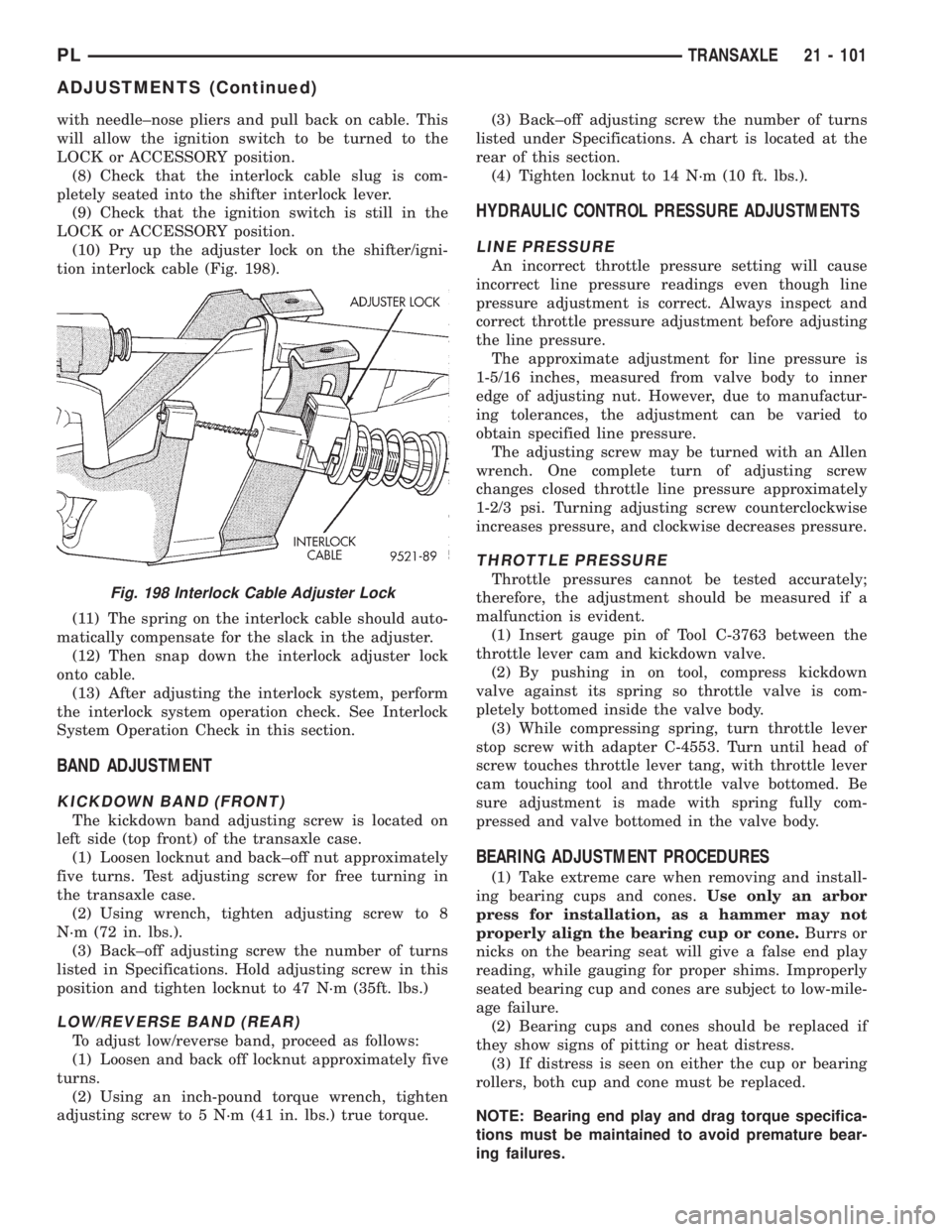
(10) Pry up the adjuster lock on the shifter/igni-
tion interlock cable (Fig. 198).
(11) The spring on the interlock cable should auto-
matically compensate for the slack in the adjuster.
(12) Then snap down the interlock adjuster lock
onto cable.
(13) After adjusting the interlock system, perform
the interlock system operation check. See Interlock
System Operation Check in this section.
BAND ADJUSTMENT
KICKDOWN BAND (FRONT)
The kickdown band adjusting screw is located on
left side (top front) of the transaxle case.
(1) Loosen locknut and back±off nut approximately
five turns. Test adjusting screw for free turning in
the transaxle case.
(2) Using wrench, tighten adjusting screw to 8
N´m (72 in. lbs.).
(3) Back±off adjusting screw the number of turns
listed in Specifications. Hold adjusting screw in this
position and tighten locknut to 47 N´m (35ft. lbs.)
LOW/REVERSE BAND (REAR)
To adjust low/reverse band, proceed as follows:
(1) Loosen and back off locknut approximately five
turns.
(2) Using an inch-pound torque wrench, tighten
adjusting screw to 5 N´m (41 in. lbs.) true torque.(3) Back±off adjusting screw the number of turns
listed under Specifications. A chart is located at the
rear of this section.
(4) Tighten locknut to 14 N´m (10 ft. lbs.).
HYDRAULIC CONTROL PRESSURE ADJUSTMENTS
LINE PRESSURE
An incorrect throttle pressure setting will cause
incorrect line pressure readings even though line
pressure adjustment is correct. Always inspect and
correct throttle pressure adjustment before adjusting
the line pressure.
The approximate adjustment for line pressure is
1-5/16 inches, measured from valve body to inner
edge of adjusting nut. However, due to manufactur-
ing tolerances, the adjustment can be varied to
obtain specified line pressure.
The adjusting screw may be turned with an Allen
wrench. One complete turn of adjusting screw
changes closed throttle line pressure approximately
1-2/3 psi. Turning adjusting screw counterclockwise
increases pressure, and clockwise decreases pressure.
THROTTLE PRESSURE
Throttle pressures cannot be tested accurately;
therefore, the adjustment should be measured if a
malfunction is evident.
(1) Insert gauge pin of Tool C-3763 between the
throttle lever cam and kickdown valve.
(2) By pushing in on tool, compress kickdown
valve against its spring so throttle valve is com-
pletely bottomed inside the valve body.
(3) While compressing spring, turn throttle lever
stop screw with adapter C-4553. Turn until head of
screw touches throttle lever tang, with throttle lever
cam touching tool and throttle valve bottomed. Be
sure adjustment is made with spring fully com-
pressed and valve bottomed in the valve body.
BEARING ADJUSTMENT PROCEDURES
(1) Take extreme care when removing and install-
ing bearing cups and cones.Use only an arbor
press for installation, as a hammer may not
properly align the bearing cup or cone.Burrs or
nicks on the bearing seat will give a false end play
reading, while gauging for proper shims. Improperly
seated bearing cup and cones are subject to low-mile-
age failure.
(2) Bearing cups and cones should be replaced if
they show signs of pitting or heat distress.
(3) If distress is seen on either the cup or bearing
rollers, both cup and cone must be replaced.
NOTE: Bearing end play and drag torque specifica-
tions must be maintained to avoid premature bear-
ing failures.
Fig. 198 Interlock Cable Adjuster Lock
PLTRANSAXLE 21 - 101
ADJUSTMENTS (Continued)
Page 1064 of 1200
TRANSAXLE
CONTENTS
page page
DESCRIPTION AND OPERATION
BRAKE TRANSMISSION SHIFT INTERLOCK
(BTSI) SYSTEM........................ 1
DIAGNOSIS AND TESTING
BRAKE TRANSMISSION SHIFT INTERLOCK
(BTSI) SYSTEM........................ 1REMOVAL AND INSTALLATION
BRAKE TRANSMISSION SHIFT INTERLOCK
(BTSI) CABLE ASSEMBLY................ 2
ADJUSTMENTS
BRAKE TRANSMISSION SHIFT INTERLOCK
(BTSI) SYSTEM ADJUSTMENT............ 4
DESCRIPTION AND OPERATION
BRAKE TRANSMISSION SHIFT INTERLOCK
(BTSI) SYSTEM
The Brake Transmission Shift Interlock (BTSI)
System, is a cable and solenoid operated system. It
interconnects the automatic transmission floor
mounted shifter to the steering column ignition
switch. The BTSI system locks the shifter into the
PARK position. The BTSI system is engaged when-
ever the ignition switch is in the LOCK or ACCES-
SORY position.
An additional electrically activated feature will
prevent shifting out of the PARK position unless the
brake pedal is depressed at least one-half an inch. A
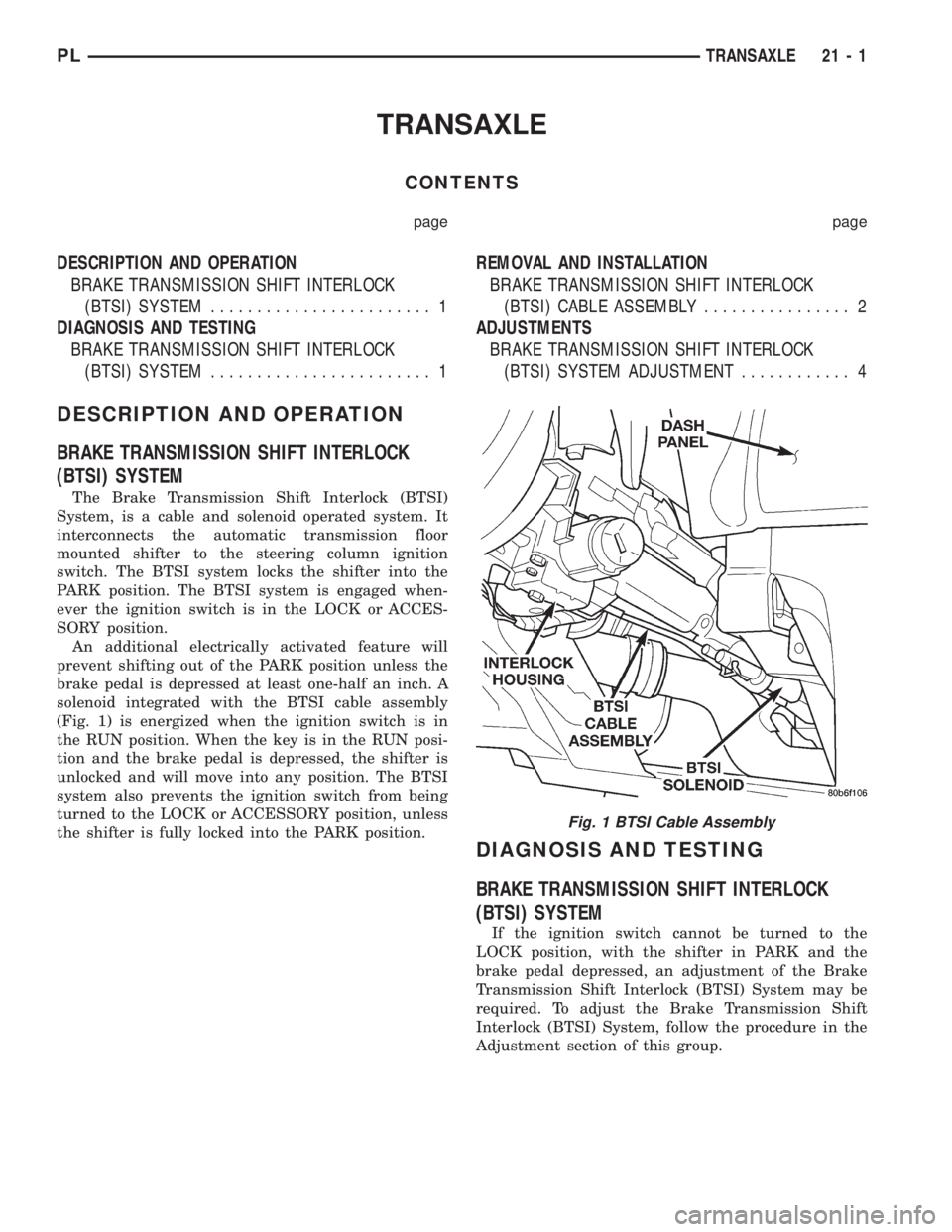
solenoid integrated with the BTSI cable assembly
(Fig. 1) is energized when the ignition switch is in
the RUN position. When the key is in the RUN posi-
tion and the brake pedal is depressed, the shifter is
unlocked and will move into any position. The BTSI
system also prevents the ignition switch from being
turned to the LOCK or ACCESSORY position, unless
the shifter is fully locked into the PARK position.
DIAGNOSIS AND TESTING
BRAKE TRANSMISSION SHIFT INTERLOCK
(BTSI) SYSTEM
If the ignition switch cannot be turned to the
LOCK position, with the shifter in PARK and the
brake pedal depressed, an adjustment of the Brake
Transmission Shift Interlock (BTSI) System may be
required. To adjust the Brake Transmission Shift
Interlock (BTSI) System, follow the procedure in the
Adjustment section of this group.
Fig. 1 BTSI Cable Assembly
PLTRANSAXLE 21 - 1
Page 1065 of 1200
REMOVAL AND INSTALLATION
BRAKE TRANSMISSION SHIFT INTERLOCK
(BTSI) CABLE ASSEMBLY
REMOVAL
(1) Disconnect and isolate, the battery negative (-)
cable from the vehicle battery.
(2) Remove console assembly. Refer to Group 23,
Body.
(3) Remove the gearshift knob set screw and knob.
(4) Remove the screws retaining the gearshift indi-
cator bezel and remove bezel and indicator lamp.
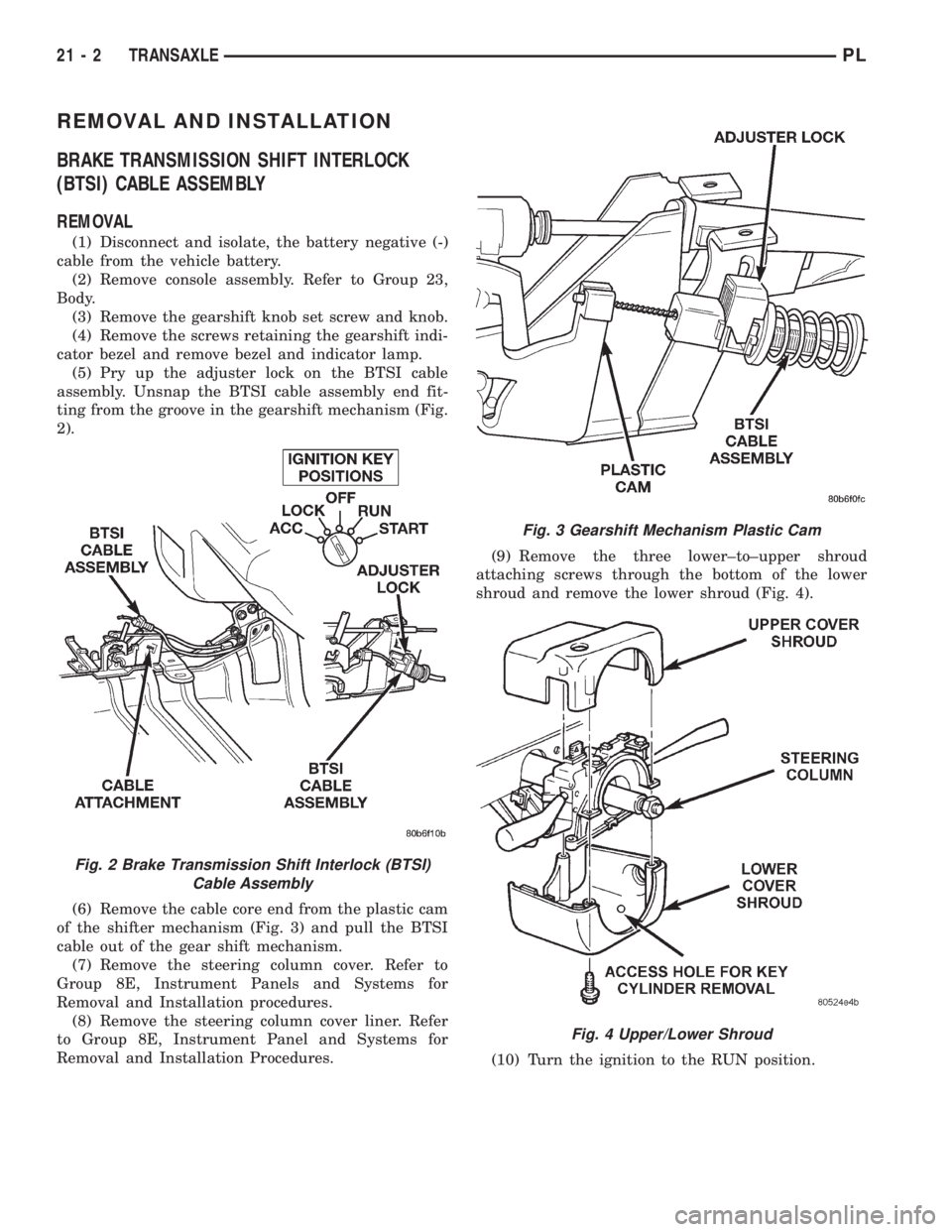
(5) Pry up the adjuster lock on the BTSI cable
assembly. Unsnap the BTSI cable assembly end fit-
ting from the groove in the gearshift mechanism (Fig.
2).
(6) Remove the cable core end from the plastic cam
of the shifter mechanism (Fig. 3) and pull the BTSI
cable out of the gear shift mechanism.
(7) Remove the steering column cover. Refer to
Group 8E, Instrument Panels and Systems for
Removal and Installation procedures.
(8) Remove the steering column cover liner. Refer
to Group 8E, Instrument Panel and Systems for
Removal and Installation Procedures.(9) Remove the three lower±to±upper shroud
attaching screws through the bottom of the lower
shroud and remove the lower shroud (Fig. 4).
(10) Turn the ignition to the RUN position.
Fig. 2 Brake Transmission Shift Interlock (BTSI)
Cable Assembly
Fig. 3 Gearshift Mechanism Plastic Cam
Fig. 4 Upper/Lower Shroud
21 - 2 TRANSAXLEPL
Page 1067 of 1200
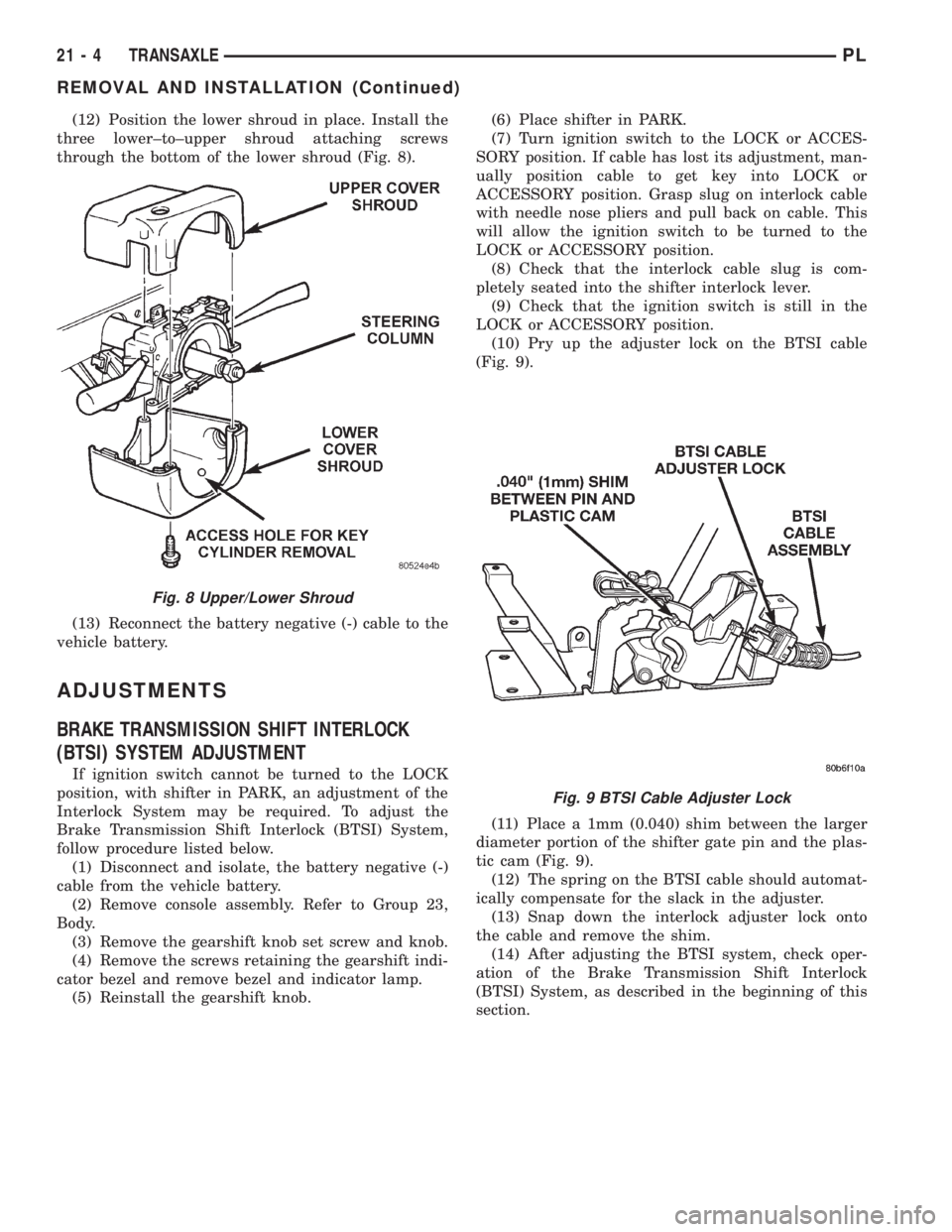
(12) Position the lower shroud in place. Install the
three lower±to±upper shroud attaching screws
through the bottom of the lower shroud (Fig. 8).
(13) Reconnect the battery negative (-) cable to the
vehicle battery.
ADJUSTMENTS
BRAKE TRANSMISSION SHIFT INTERLOCK
(BTSI) SYSTEM ADJUSTMENT
If ignition switch cannot be turned to the LOCK
position, with shifter in PARK, an adjustment of the
Interlock System may be required. To adjust the
Brake Transmission Shift Interlock (BTSI) System,
follow procedure listed below.
(1) Disconnect and isolate, the battery negative (-)
cable from the vehicle battery.
(2) Remove console assembly. Refer to Group 23,
Body.
(3) Remove the gearshift knob set screw and knob.
(4) Remove the screws retaining the gearshift indi-
cator bezel and remove bezel and indicator lamp.
(5) Reinstall the gearshift knob.(6) Place shifter in PARK.
(7) Turn ignition switch to the LOCK or ACCES-
SORY position. If cable has lost its adjustment, man-
ually position cable to get key into LOCK or
ACCESSORY position. Grasp slug on interlock cable
with needle nose pliers and pull back on cable. This
will allow the ignition switch to be turned to the
LOCK or ACCESSORY position.
(8) Check that the interlock cable slug is com-
pletely seated into the shifter interlock lever.
(9) Check that the ignition switch is still in the
LOCK or ACCESSORY position.
(10) Pry up the adjuster lock on the BTSI cable
(Fig. 9).
(11) Place a 1mm (0.040) shim between the larger
diameter portion of the shifter gate pin and the plas-
tic cam (Fig. 9).
(12) The spring on the BTSI cable should automat-
ically compensate for the slack in the adjuster.
(13) Snap down the interlock adjuster lock onto
the cable and remove the shim.
(14) After adjusting the BTSI system, check oper-
ation of the Brake Transmission Shift Interlock
(BTSI) System, as described in the beginning of this
section.
Fig. 8 Upper/Lower Shroud
Fig. 9 BTSI Cable Adjuster Lock
21 - 4 TRANSAXLEPL
REMOVAL AND INSTALLATION (Continued)
Page 1082 of 1200
BODY
CONTENTS
page page
BODY COMPONENTS...................... 2
GENERAL SERVICE INFORMATION........... 1
PAINT................................. 41STATIONARY GLASS...................... 43
SUNROOF.............................. 47
GENERAL SERVICE INFORMATION
INDEX
page
GENERAL INFORMATION
SAFETY PRECAUTIONS AND WARNINGS...... 1
GENERAL INFORMATION
SAFETY PRECAUTIONS AND WARNINGS
WARNING: EYE PROTECTION SHOULD BE USED
WHEN SERVICING GLASS COMPONENTS. PER-
SONAL INJURY CAN RESULT.
USE A OSHA APPROVED BREATHING FILTER
WHEN SPRAYING PAINT OR SOLVENTS IN A CON-
FINED AREA. PERSONAL INJURY CAN RESULT.
AVOID PROLONGED SKIN CONTACT WITH
PETROLEUM OR ALCOHOL± BASED CLEANING
SOLVENTS. PERSONAL INJURY CAN RESULT.
DO NOT STAND UNDER A HOISTED VEHICLE
THAT IS NOT PROPERLY SUPPORTED ON SAFETY
STANDS. PERSONAL INJURY CAN RESULT.
CAUTION: When holes must be drilled or punched
in an inner body panel, verify depth of space to the
outer body panel, electrical wiring, or other compo-
nents. Damage to vehicle can result.
Do not weld exterior panels unless combustible
material on the interior of vehicle is removed from
the repair area. Fire or hazardous conditions, can
result.
Always have a fire extinguisher ready for use
when welding.
Disconnect the negative (-) cable clamp from the
battery when servicing electrical components that
are live when the ignition is OFF. Damage to electri-
cal system can result.Do not use abrasive chemicals or compounds on
painted surfaces. Damage to finish can result.
Do not use harsh alkaline based cleaning sol-
vents on painted or upholstered surfaces. Damage
to finish or color can result.
Do not hammer or pound on plastic trim panel
when servicing interior trim. Plastic panels can
break.
Chrysler Corporation uses many different types of
push-in fasteners to secure the interior and exterior
trim to the body. Most of these fasteners can be
reused to assemble the trim during various repair
procedures. At times, a push-in fastener cannot be
removed without damaging the fastener or the com-
ponent it is holding. If it is not possible to remove a
fastener without damaging a component or body, cut
or break the fastener and use a new one when
installing the component. Never pry or pound on a
plastic or pressed-board trim component. Using a
suitable fork-type prying device, pry the fastener
from the retaining hole behind the component being
removed. When installing, verify fastener alignment
with the retaining hole by hand. Push directly on or
over the fastener until it seats. Apply a low-force pull
to the panel to verify that it is secure.
When it is necessary to remove components to ser-
vice another, it should not be necessary to apply
excessive force or bend a component to remove it.
Before damaging a trim component, verify hidden
fasteners or captured edges holding the component in
place.
PLBODY 23 - 1