engine DODGE NEON 1999 Service Repair Manual
[x] Cancel search | Manufacturer: DODGE, Model Year: 1999, Model line: NEON, Model: DODGE NEON 1999Pages: 1200, PDF Size: 35.29 MB
Page 924 of 1200
INSTALL
CAUTION: Do not hammer on power steering
pump pulley or shaft to remove power steering
pump pulley. This will damage the pulley and the
power steering pump.
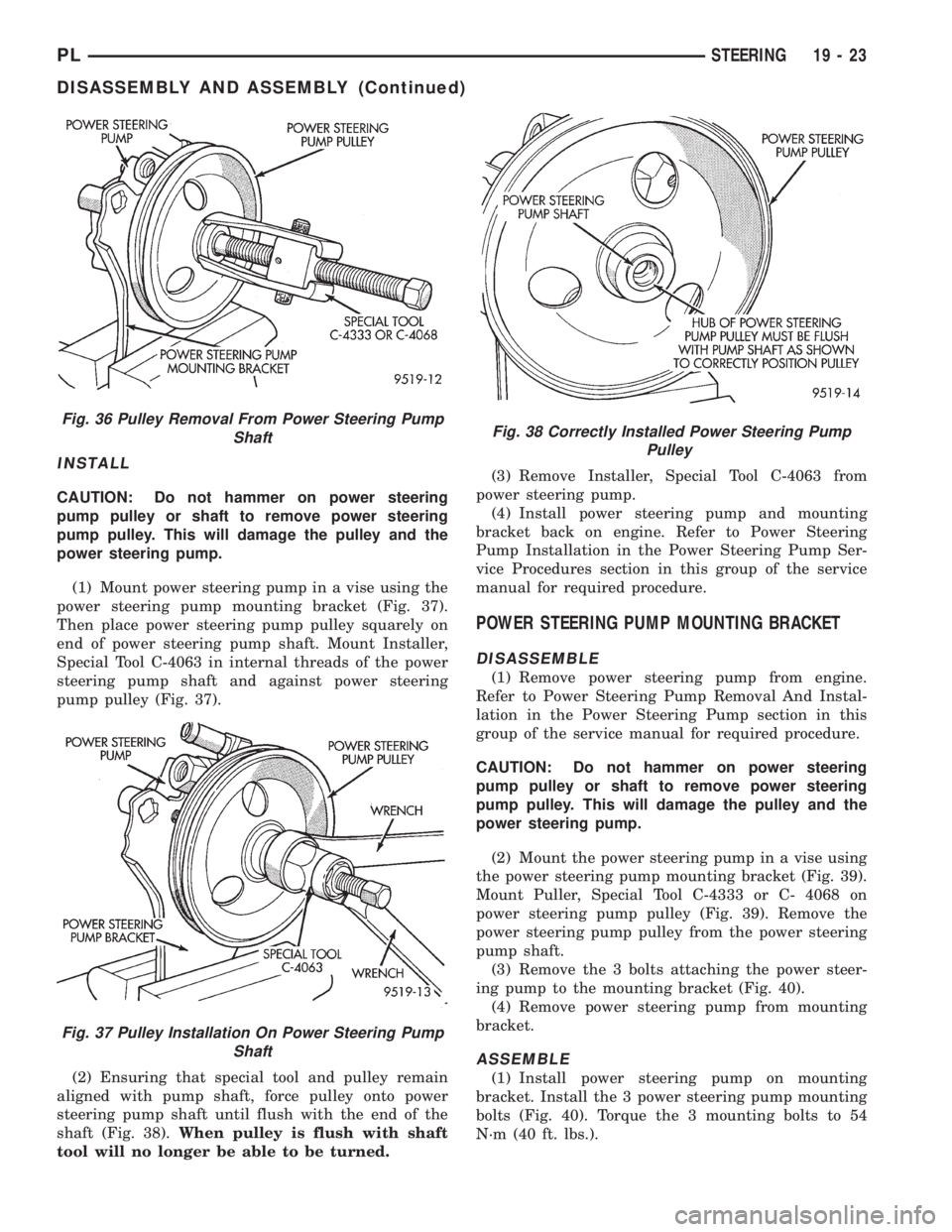
(1) Mount power steering pump in a vise using the
power steering pump mounting bracket (Fig. 37).
Then place power steering pump pulley squarely on
end of power steering pump shaft. Mount Installer,
Special Tool C-4063 in internal threads of the power
steering pump shaft and against power steering
pump pulley (Fig. 37).
(2) Ensuring that special tool and pulley remain
aligned with pump shaft, force pulley onto power
steering pump shaft until flush with the end of the
shaft (Fig. 38).When pulley is flush with shaft
tool will no longer be able to be turned.(3) Remove Installer, Special Tool C-4063 from
power steering pump.
(4) Install power steering pump and mounting
bracket back on engine. Refer to Power Steering
Pump Installation in the Power Steering Pump Ser-
vice Procedures section in this group of the service
manual for required procedure.
POWER STEERING PUMP MOUNTING BRACKET
DISASSEMBLE
(1) Remove power steering pump from engine.
Refer to Power Steering Pump Removal And Instal-
lation in the Power Steering Pump section in this
group of the service manual for required procedure.
CAUTION: Do not hammer on power steering
pump pulley or shaft to remove power steering
pump pulley. This will damage the pulley and the
power steering pump.
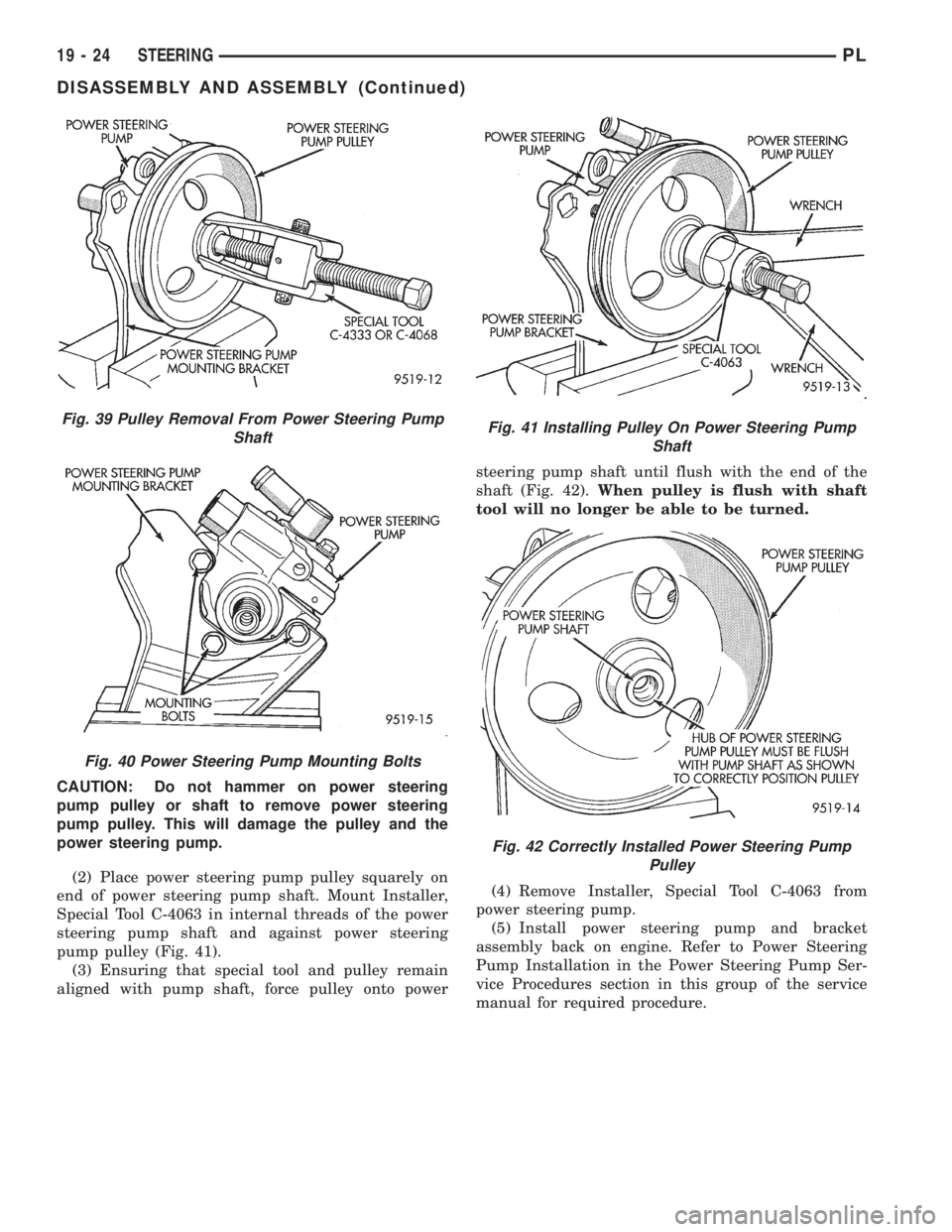
(2) Mount the power steering pump in a vise using
the power steering pump mounting bracket (Fig. 39).
Mount Puller, Special Tool C-4333 or C- 4068 on
power steering pump pulley (Fig. 39). Remove the
power steering pump pulley from the power steering
pump shaft.
(3) Remove the 3 bolts attaching the power steer-
ing pump to the mounting bracket (Fig. 40).
(4) Remove power steering pump from mounting
bracket.
ASSEMBLE
(1) Install power steering pump on mounting
bracket. Install the 3 power steering pump mounting
bolts (Fig. 40). Torque the 3 mounting bolts to 54
N´m (40 ft. lbs.).
Fig. 36 Pulley Removal From Power Steering Pump
Shaft
Fig. 37 Pulley Installation On Power Steering Pump
Shaft
Fig. 38 Correctly Installed Power Steering Pump
Pulley
PLSTEERING 19 - 23
DISASSEMBLY AND ASSEMBLY (Continued)
Page 925 of 1200
CAUTION: Do not hammer on power steering
pump pulley or shaft to remove power steering
pump pulley. This will damage the pulley and the
power steering pump.
(2) Place power steering pump pulley squarely on
end of power steering pump shaft. Mount Installer,
Special Tool C-4063 in internal threads of the power
steering pump shaft and against power steering
pump pulley (Fig. 41).
(3) Ensuring that special tool and pulley remain
aligned with pump shaft, force pulley onto powersteering pump shaft until flush with the end of the
shaft (Fig. 42).When pulley is flush with shaft
tool will no longer be able to be turned.
(4) Remove Installer, Special Tool C-4063 from
power steering pump.
(5) Install power steering pump and bracket
assembly back on engine. Refer to Power Steering
Pump Installation in the Power Steering Pump Ser-
vice Procedures section in this group of the service
manual for required procedure.
Fig. 41 Installing Pulley On Power Steering Pump
Shaft
Fig. 42 Correctly Installed Power Steering Pump
Pulley
Fig. 39 Pulley Removal From Power Steering Pump
Shaft
Fig. 40 Power Steering Pump Mounting Bolts
19 - 24 STEERINGPL
DISASSEMBLY AND ASSEMBLY (Continued)
Page 926 of 1200
SPECIFICATIONS
POWER STEERING PUMP FLOW SPECIFICATIONS
Power Steering Pump Flow:
At 1500 RPM And
Minimum Pressure.........4.9 to 5.3 Liters/Min
(1.3 to 1.9 GPM)
Control Valve Pressure Relief....8240 to 8920 kPa
(1195 to 1293 psi)
POWER STEERING PUMP FASTENER TORQUE
SPECIFICATIONS
DESCRIPTION TORQUE
Power Steering Hose:
Tube Nuts Pressure And Return...........31N´m
(275 in. lbs.)
Bracket To Front Crossmember
Attaching Bolt.............23N´m(17ft.lbs.).
Power Steering Pump:
Pressure Hose Banjo Bolt......34N´m(25ft.lbs.).
Discharge Fitting.............75N´m(55ft.lbs.)
To Bracket Mounting Bolts.....54N´m(40. ft. lbs.)
Brackets To Engine Mounting Bolts.......54N´m
(40 ft. lbs.)
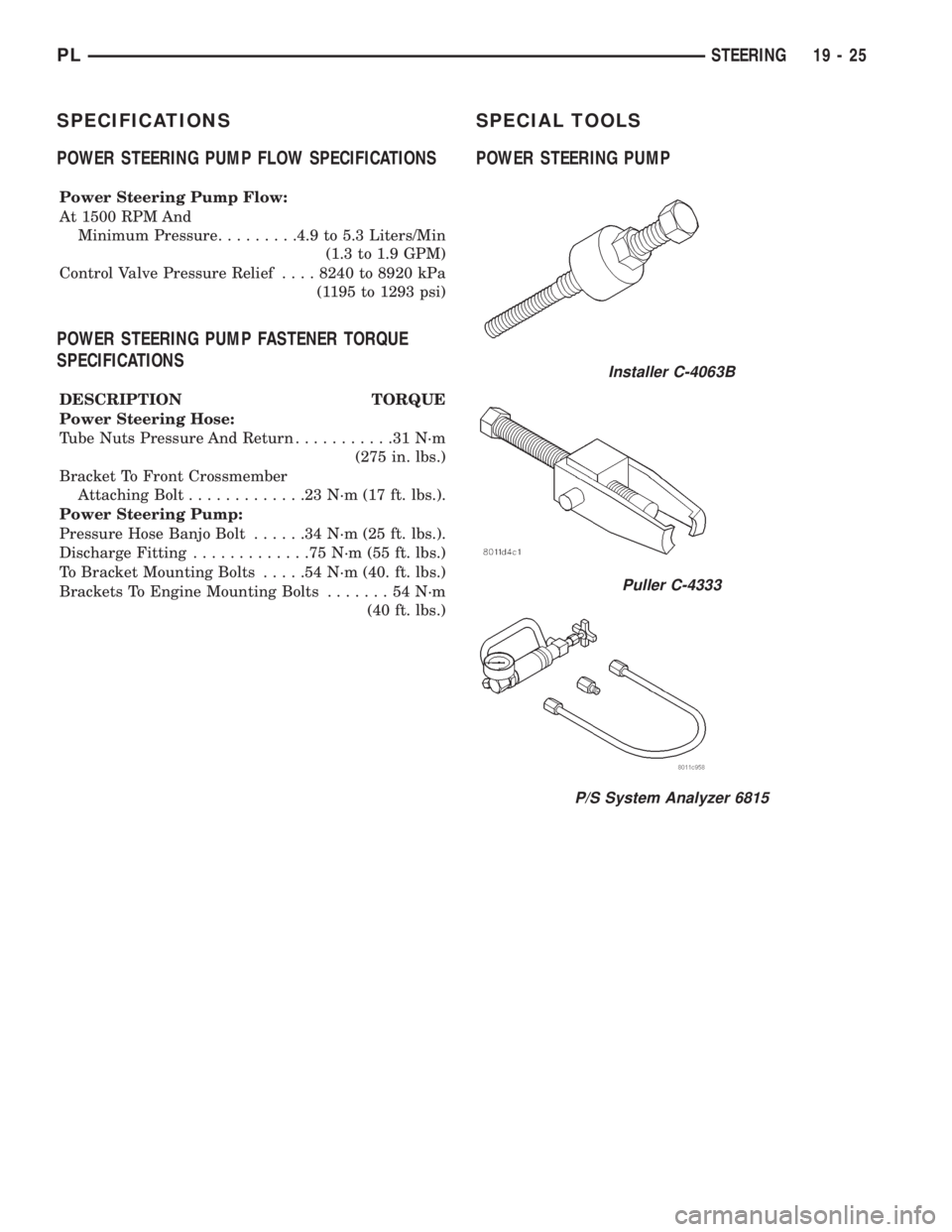
SPECIAL TOOLS
POWER STEERING PUMP
Installer C-4063B
Puller C-4333
P/S System Analyzer 6815
PLSTEERING 19 - 25
Page 928 of 1200
However, under these conditions, steering effort will
be increased.
NOTE: The power steering gear (Fig. 1) should NOT
be serviced or adjusted. If a malfunction or oil leak
occurs with the steering gear, the complete steering
gear needs to be replaced.
DIAGNOSIS AND TESTING
POWER STEERING SYSTEM TEST PROCEDURE
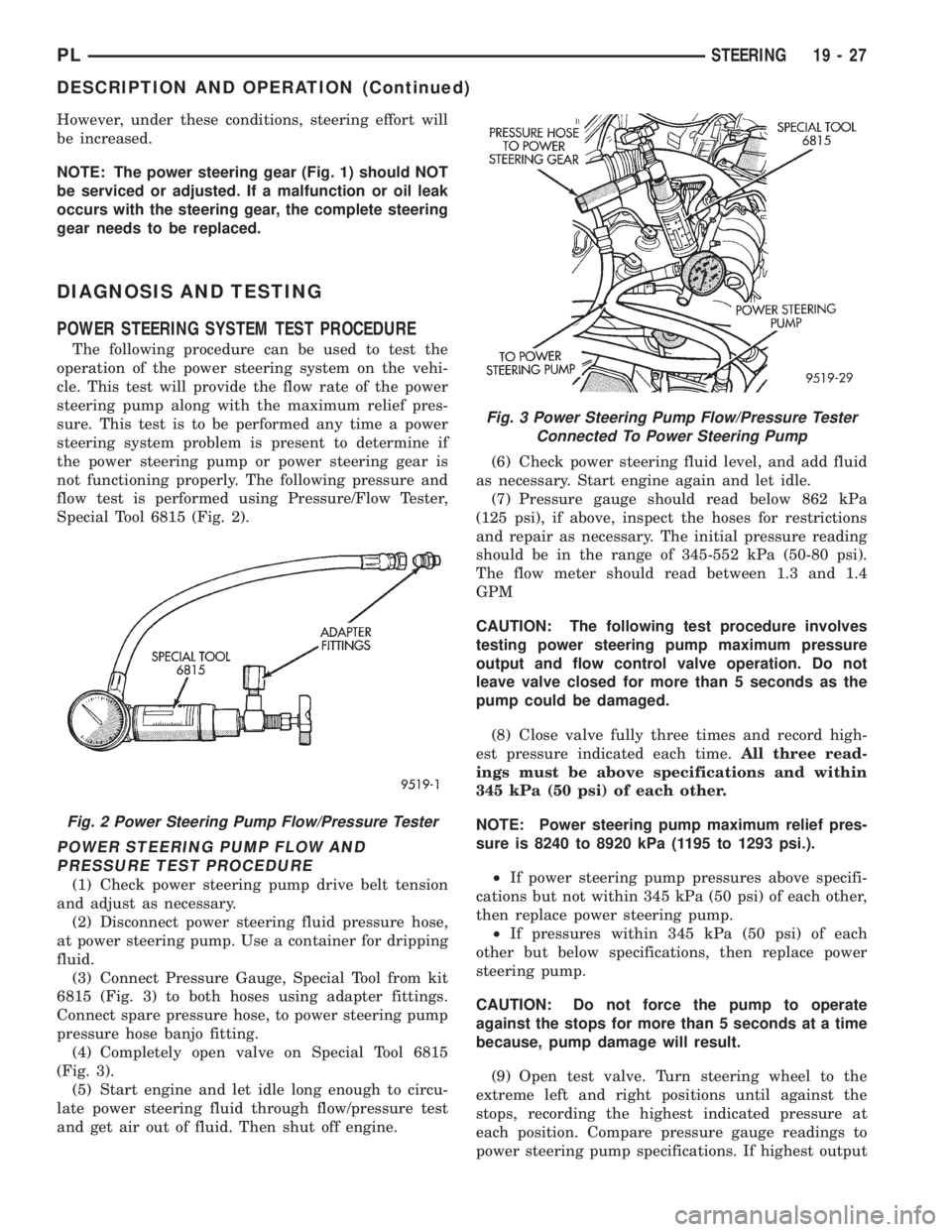
The following procedure can be used to test the
operation of the power steering system on the vehi-
cle. This test will provide the flow rate of the power
steering pump along with the maximum relief pres-
sure. This test is to be performed any time a power
steering system problem is present to determine if
the power steering pump or power steering gear is
not functioning properly. The following pressure and
flow test is performed using Pressure/Flow Tester,
Special Tool 6815 (Fig. 2).
POWER STEERING PUMP FLOW AND
PRESSURE TEST PROCEDURE
(1) Check power steering pump drive belt tension
and adjust as necessary.
(2) Disconnect power steering fluid pressure hose,
at power steering pump. Use a container for dripping
fluid.
(3) Connect Pressure Gauge, Special Tool from kit
6815 (Fig. 3) to both hoses using adapter fittings.
Connect spare pressure hose, to power steering pump
pressure hose banjo fitting.
(4) Completely open valve on Special Tool 6815
(Fig. 3).
(5) Start engine and let idle long enough to circu-
late power steering fluid through flow/pressure test
and get air out of fluid. Then shut off engine.(6) Check power steering fluid level, and add fluid
as necessary. Start engine again and let idle.
(7) Pressure gauge should read below 862 kPa
(125 psi), if above, inspect the hoses for restrictions
and repair as necessary. The initial pressure reading
should be in the range of 345-552 kPa (50-80 psi).
The flow meter should read between 1.3 and 1.4
GPM
CAUTION: The following test procedure involves
testing power steering pump maximum pressure
output and flow control valve operation. Do not
leave valve closed for more than 5 seconds as the
pump could be damaged.
(8) Close valve fully three times and record high-
est pressure indicated each time.All three read-
ings must be above specifications and within
345 kPa (50 psi) of each other.
NOTE: Power steering pump maximum relief pres-
sure is 8240 to 8920 kPa (1195 to 1293 psi.).
²If power steering pump pressures above specifi-
cations but not within 345 kPa (50 psi) of each other,
then replace power steering pump.
²If pressures within 345 kPa (50 psi) of each
other but below specifications, then replace power
steering pump.
CAUTION: Do not force the pump to operate
against the stops for more than 5 seconds at a time
because, pump damage will result.
(9) Open test valve. Turn steering wheel to the
extreme left and right positions until against the
stops, recording the highest indicated pressure at
each position. Compare pressure gauge readings to
power steering pump specifications. If highest output
Fig. 3 Power Steering Pump Flow/Pressure Tester
Connected To Power Steering Pump
Fig. 2 Power Steering Pump Flow/Pressure Tester
PLSTEERING 19 - 27
DESCRIPTION AND OPERATION (Continued)
Page 929 of 1200
pressures are not the same against either stop, the
steering gear is leaking internally and must be
replaced.
REMOVAL AND INSTALLATION
MANUAL AND POWER STEERING GEAR
The removal and replacement procedure for both
the manual and power steering gears is the same.
The only additional steps of the procedure for the
power steering gear, is the removal and replacement
of the power steering fluid lines at the steering gear.
REMOVE
(1) From interior of vehicle, disconnect the steer-
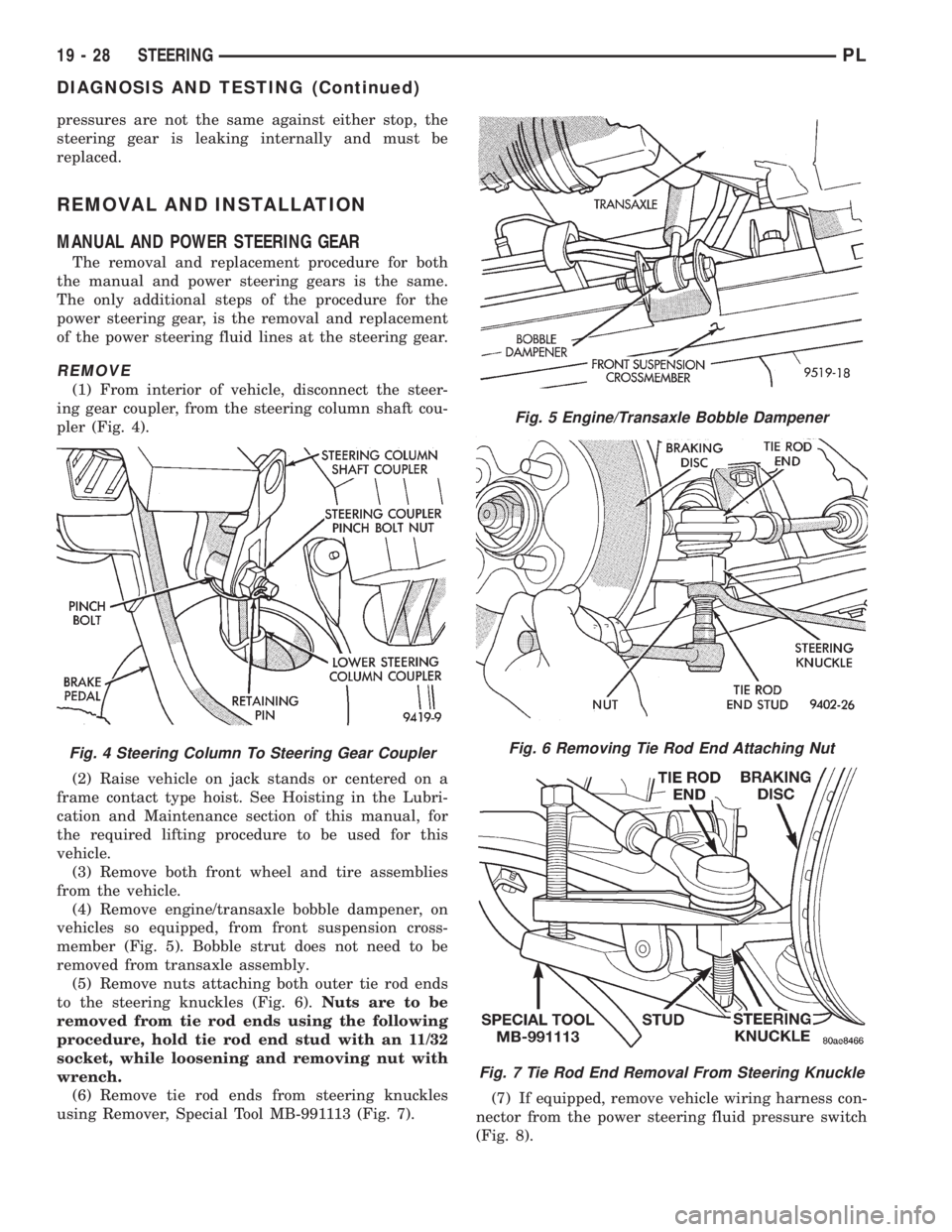
ing gear coupler, from the steering column shaft cou-
pler (Fig. 4).
(2) Raise vehicle on jack stands or centered on a
frame contact type hoist. See Hoisting in the Lubri-
cation and Maintenance section of this manual, for
the required lifting procedure to be used for this
vehicle.
(3) Remove both front wheel and tire assemblies
from the vehicle.
(4) Remove engine/transaxle bobble dampener, on
vehicles so equipped, from front suspension cross-
member (Fig. 5). Bobble strut does not need to be
removed from transaxle assembly.
(5) Remove nuts attaching both outer tie rod ends
to the steering knuckles (Fig. 6).Nuts are to be
removed from tie rod ends using the following
procedure, hold tie rod end stud with an 11/32
socket, while loosening and removing nut with
wrench.
(6) Remove tie rod ends from steering knuckles
using Remover, Special Tool MB-991113 (Fig. 7).(7) If equipped, remove vehicle wiring harness con-
nector from the power steering fluid pressure switch
(Fig. 8).
Fig. 4 Steering Column To Steering Gear Coupler
Fig. 5 Engine/Transaxle Bobble Dampener
Fig. 6 Removing Tie Rod End Attaching Nut
Fig. 7 Tie Rod End Removal From Steering Knuckle
19 - 28 STEERINGPL
DIAGNOSIS AND TESTING (Continued)
Page 932 of 1200
Torque the 4 steering gear mounting bolts to 68 N´m
(50 ft. lbs.).
(2) Using the transmission jack, raise front sus-
pension crossmember and steering gear against body
and frame rails of vehicle. Start the 2 rear bolts into
tapping plates, attaching front suspension crossmem-
ber to body of vehicle (Fig. 13). Then install the 2
front bolts, attaching front suspension crossmember
to frame rails of vehicle (Fig. 13). Tighten the 4
mounting bolts, until front suspension crossmember
is against body of vehicle at the 4 mounting points.
Then torque the 4 mounting bolts to 2 N´m (20 in.
lbs.) to hold front suspension crossmember in posi-
tion.
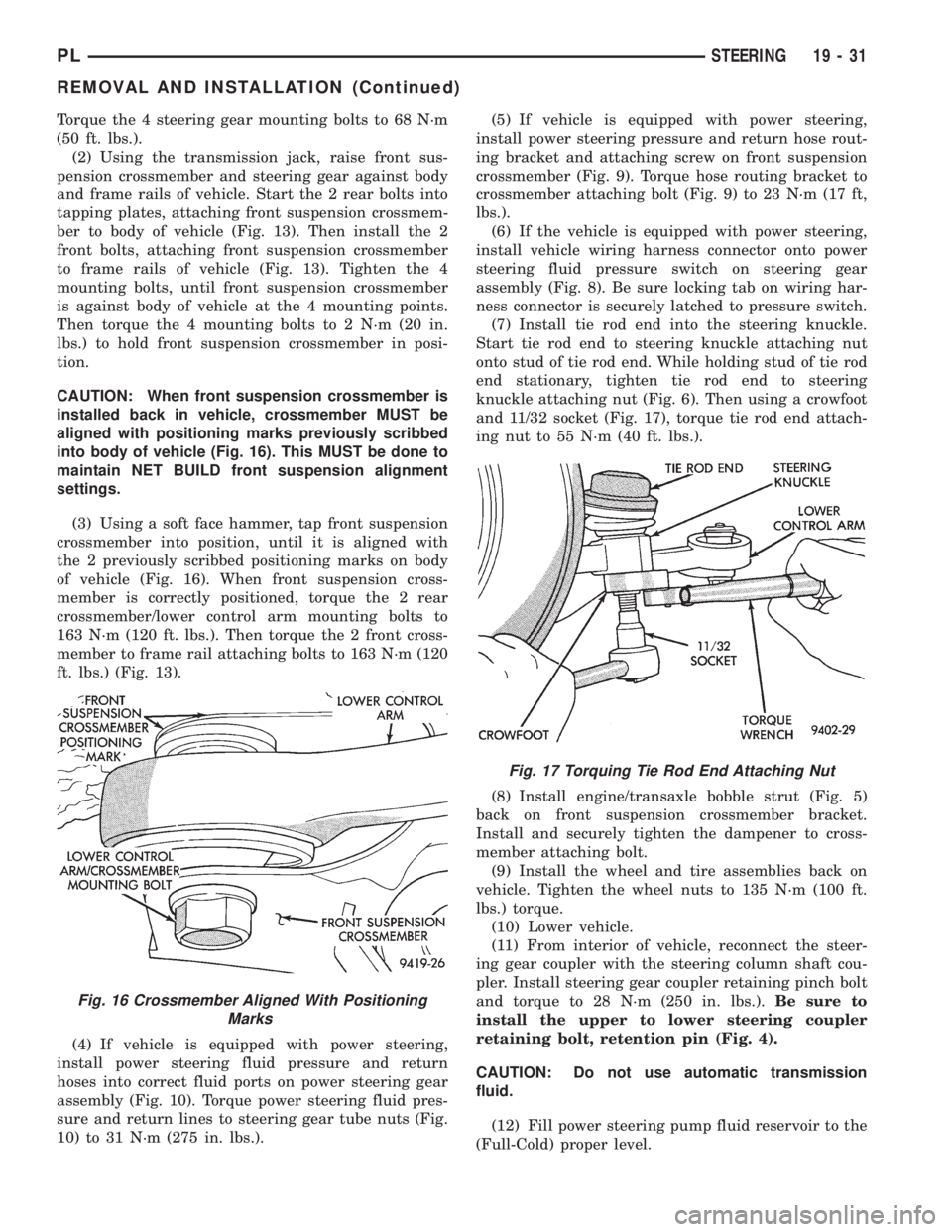
CAUTION: When front suspension crossmember is
installed back in vehicle, crossmember MUST be
aligned with positioning marks previously scribbed
into body of vehicle (Fig. 16). This MUST be done to
maintain NET BUILD front suspension alignment
settings.
(3) Using a soft face hammer, tap front suspension
crossmember into position, until it is aligned with
the 2 previously scribbed positioning marks on body
of vehicle (Fig. 16). When front suspension cross-
member is correctly positioned, torque the 2 rear
crossmember/lower control arm mounting bolts to
163 N´m (120 ft. lbs.). Then torque the 2 front cross-
member to frame rail attaching bolts to 163 N´m (120
ft. lbs.) (Fig. 13).
(4) If vehicle is equipped with power steering,
install power steering fluid pressure and return
hoses into correct fluid ports on power steering gear
assembly (Fig. 10). Torque power steering fluid pres-
sure and return lines to steering gear tube nuts (Fig.
10) to 31 N´m (275 in. lbs.).(5) If vehicle is equipped with power steering,
install power steering pressure and return hose rout-
ing bracket and attaching screw on front suspension
crossmember (Fig. 9). Torque hose routing bracket to
crossmember attaching bolt (Fig. 9) to 23 N´m (17 ft,
lbs.).
(6) If the vehicle is equipped with power steering,
install vehicle wiring harness connector onto power
steering fluid pressure switch on steering gear
assembly (Fig. 8). Be sure locking tab on wiring har-
ness connector is securely latched to pressure switch.
(7) Install tie rod end into the steering knuckle.
Start tie rod end to steering knuckle attaching nut
onto stud of tie rod end. While holding stud of tie rod
end stationary, tighten tie rod end to steering
knuckle attaching nut (Fig. 6). Then using a crowfoot
and 11/32 socket (Fig. 17), torque tie rod end attach-
ing nut to 55 N´m (40 ft. lbs.).
(8) Install engine/transaxle bobble strut (Fig. 5)
back on front suspension crossmember bracket.
Install and securely tighten the dampener to cross-
member attaching bolt.
(9) Install the wheel and tire assemblies back on
vehicle. Tighten the wheel nuts to 135 N´m (100 ft.
lbs.) torque.
(10) Lower vehicle.
(11) From interior of vehicle, reconnect the steer-
ing gear coupler with the steering column shaft cou-
pler. Install steering gear coupler retaining pinch bolt
and torque to 28 N´m (250 in. lbs.).Be sure to
install the upper to lower steering coupler
retaining bolt, retention pin (Fig. 4).
CAUTION: Do not use automatic transmission
fluid.
(12) Fill power steering pump fluid reservoir to the
(Full-Cold) proper level.
Fig. 16 Crossmember Aligned With Positioning
Marks
Fig. 17 Torquing Tie Rod End Attaching Nut
PLSTEERING 19 - 31
REMOVAL AND INSTALLATION (Continued)
Page 933 of 1200
(13) Start the engine and let run for a few seconds.
Then turn the engine off.
(14) Add fluid if necessary.
(15) Raise front wheels of vehicle off the ground.
(16) Start engine and turn steering wheel several
times from stop to stop to bleed air from fluid in sys-
tem. Stop engine, check fluid level, and inspect sys-
tem for leaks.Fill pump reservoir to correct
level with Mopart, Power Steering Fluid, or
equivalent.See Checking Fluid Level.
(17) Lower front wheels of vehicle back on the
ground.
CAUTION: During this procedure do not allow the
steering gear inner tie rod boots to become twisted.
(See Wheel Alignment in the suspension section of
this service manual).
(18) Adjust the front Toe setting on the vehicle.
Refer to the Toe Setting Procedure in Front Suspen-
sion Service Procedures in this group of the service
manual. Refer to the Specifications Section at the
end of this group for the desired front Toe specifica-
tion.
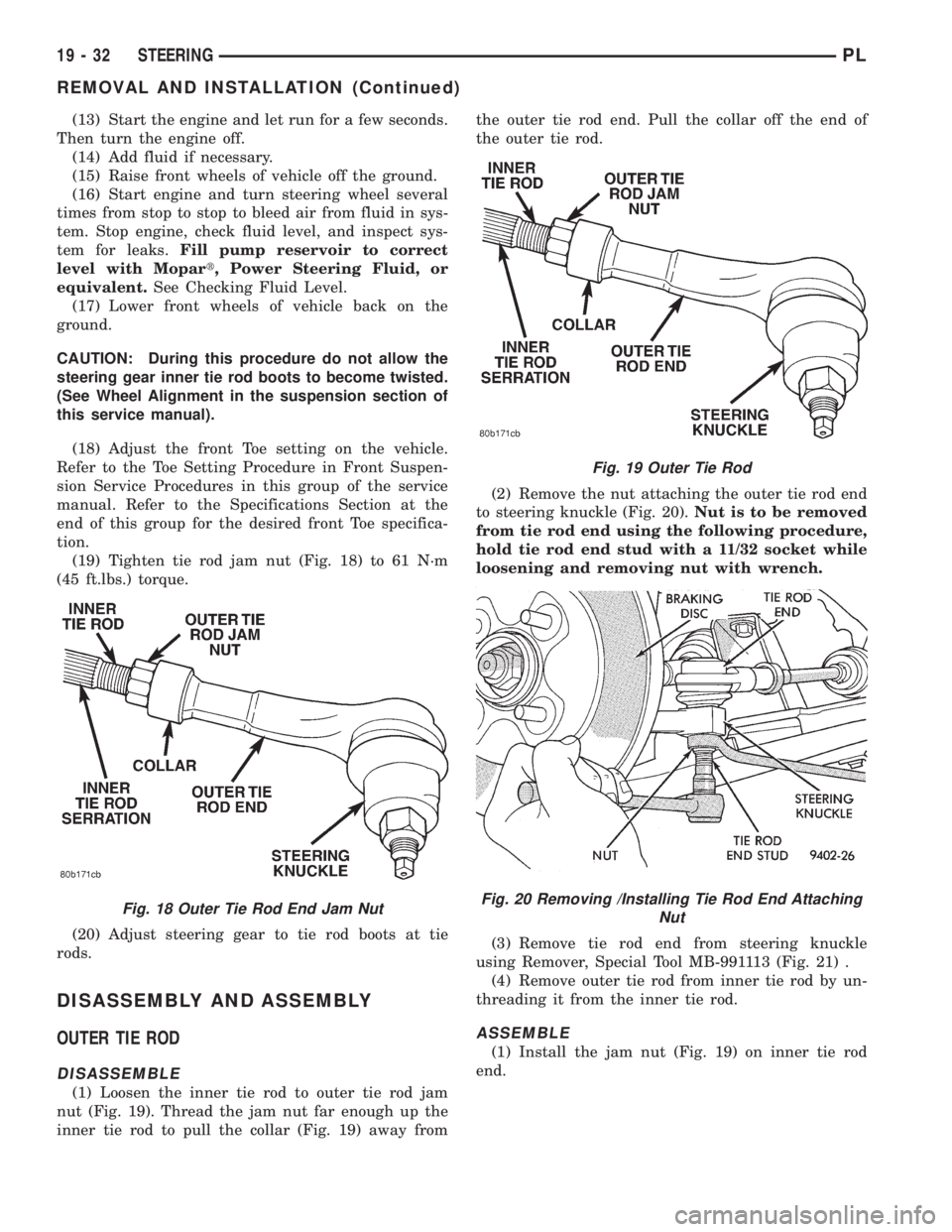
(19) Tighten tie rod jam nut (Fig. 18) to 61 N´m
(45 ft.lbs.) torque.
(20) Adjust steering gear to tie rod boots at tie
rods.
DISASSEMBLY AND ASSEMBLY
OUTER TIE ROD
DISASSEMBLE
(1) Loosen the inner tie rod to outer tie rod jam
nut (Fig. 19). Thread the jam nut far enough up the
inner tie rod to pull the collar (Fig. 19) away fromthe outer tie rod end. Pull the collar off the end of
the outer tie rod.
(2) Remove the nut attaching the outer tie rod end
to steering knuckle (Fig. 20).Nut is to be removed
from tie rod end using the following procedure,
hold tie rod end stud with a 11/32 socket while
loosening and removing nut with wrench.
(3) Remove tie rod end from steering knuckle
using Remover, Special Tool MB-991113 (Fig. 21) .
(4) Remove outer tie rod from inner tie rod by un-
threading it from the inner tie rod.
ASSEMBLE
(1) Install the jam nut (Fig. 19) on inner tie rod
end.
Fig. 18 Outer Tie Rod End Jam Nut
Fig. 19 Outer Tie Rod
Fig. 20 Removing /Installing Tie Rod End Attaching
Nut
19 - 32 STEERINGPL
REMOVAL AND INSTALLATION (Continued)
Page 945 of 1200
CAUTION: The transaxle output shaft is serviced as
a unit. No disassembly and reassembly is possible.
Damage to the transaxle may result.
TRANSAXLE IDENTIFICATION INFORMATION
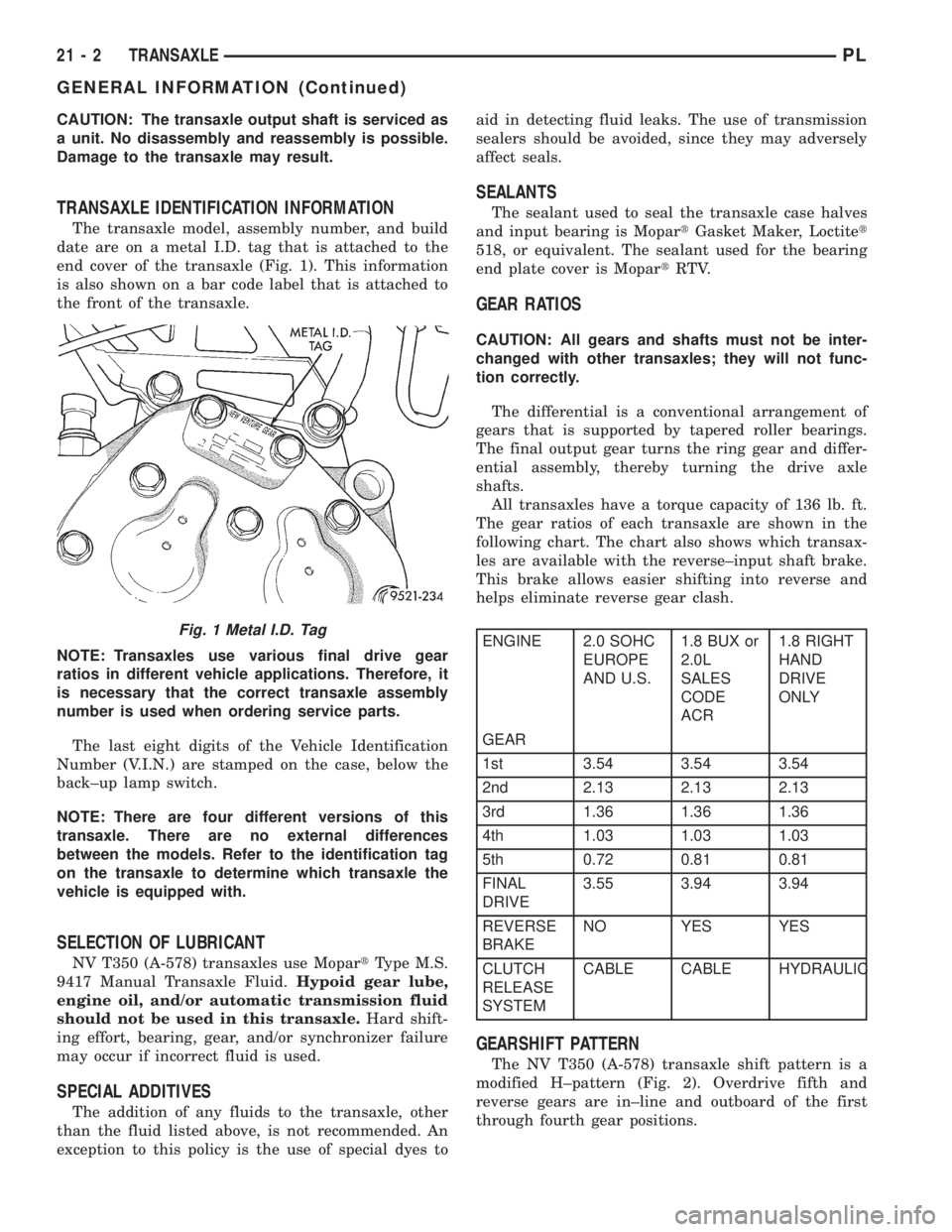
The transaxle model, assembly number, and build
date are on a metal I.D. tag that is attached to the
end cover of the transaxle (Fig. 1). This information
is also shown on a bar code label that is attached to
the front of the transaxle.
NOTE: Transaxles use various final drive gear
ratios in different vehicle applications. Therefore, it
is necessary that the correct transaxle assembly
number is used when ordering service parts.
The last eight digits of the Vehicle Identification
Number (V.I.N.) are stamped on the case, below the
back±up lamp switch.
NOTE: There are four different versions of this
transaxle. There are no external differences
between the models. Refer to the identification tag
on the transaxle to determine which transaxle the
vehicle is equipped with.
SELECTION OF LUBRICANT
NV T350 (A-578) transaxles use MopartType M.S.
9417 Manual Transaxle Fluid.Hypoid gear lube,
engine oil, and/or automatic transmission fluid
should not be used in this transaxle.Hard shift-
ing effort, bearing, gear, and/or synchronizer failure
may occur if incorrect fluid is used.
SPECIAL ADDITIVES
The addition of any fluids to the transaxle, other
than the fluid listed above, is not recommended. An
exception to this policy is the use of special dyes toaid in detecting fluid leaks. The use of transmission
sealers should be avoided, since they may adversely
affect seals.
SEALANTS
The sealant used to seal the transaxle case halves
and input bearing is MopartGasket Maker, Loctitet
518, or equivalent. The sealant used for the bearing
end plate cover is MopartRTV.
GEAR RATIOS
CAUTION: All gears and shafts must not be inter-
changed with other transaxles; they will not func-
tion correctly.
The differential is a conventional arrangement of
gears that is supported by tapered roller bearings.
The final output gear turns the ring gear and differ-
ential assembly, thereby turning the drive axle
shafts.
All transaxles have a torque capacity of 136 lb. ft.
The gear ratios of each transaxle are shown in the
following chart. The chart also shows which transax-
les are available with the reverse±input shaft brake.
This brake allows easier shifting into reverse and
helps eliminate reverse gear clash.
ENGINE 2.0 SOHC
EUROPE
AND U.S.1.8 BUX or
2.0L
SALES
CODE
ACR1.8 RIGHT
HAND
DRIVE
ONLY
GEAR
1st 3.54 3.54 3.54
2nd 2.13 2.13 2.13
3rd 1.36 1.36 1.36
4th 1.03 1.03 1.03
5th 0.72 0.81 0.81
FINAL
DRIVE3.55 3.94 3.94
REVERSE
BRAKENO YES YES
CLUTCH
RELEASE
SYSTEMCABLE CABLE HYDRAULIC
GEARSHIFT PATTERN
The NV T350 (A-578) transaxle shift pattern is a
modified H±pattern (Fig. 2). Overdrive fifth and
reverse gears are in±line and outboard of the first
through fourth gear positions.
Fig. 1 Metal I.D. Tag
21 - 2 TRANSAXLEPL
GENERAL INFORMATION (Continued)
Page 951 of 1200
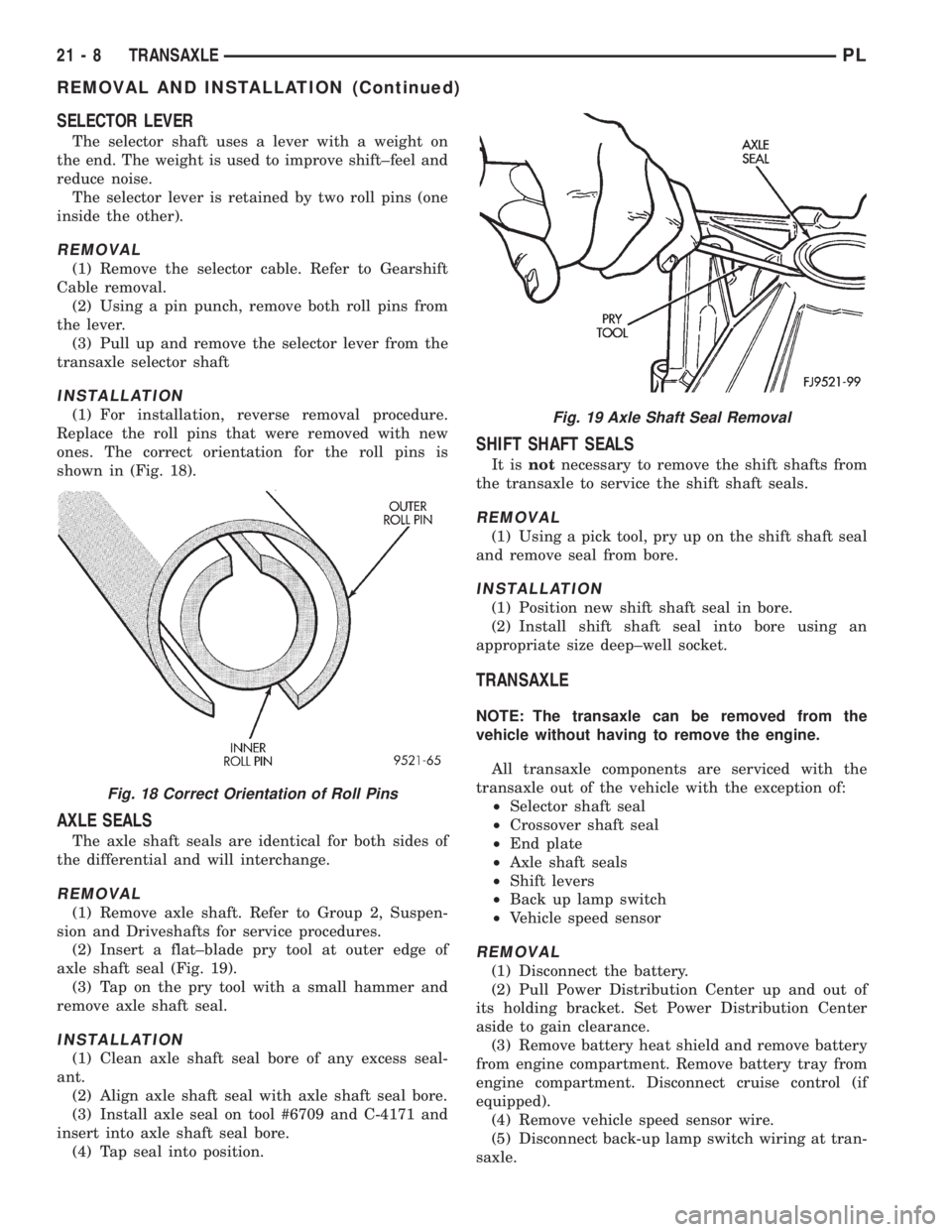
SELECTOR LEVER
The selector shaft uses a lever with a weight on
the end. The weight is used to improve shift±feel and
reduce noise.
The selector lever is retained by two roll pins (one
inside the other).
REMOVAL
(1) Remove the selector cable. Refer to Gearshift
Cable removal.
(2) Using a pin punch, remove both roll pins from
the lever.
(3) Pull up and remove the selector lever from the
transaxle selector shaft
INSTALLATION
(1) For installation, reverse removal procedure.
Replace the roll pins that were removed with new
ones. The correct orientation for the roll pins is
shown in (Fig. 18).
AXLE SEALS
The axle shaft seals are identical for both sides of
the differential and will interchange.
REMOVAL
(1) Remove axle shaft. Refer to Group 2, Suspen-
sion and Driveshafts for service procedures.
(2) Insert a flat±blade pry tool at outer edge of
axle shaft seal (Fig. 19).
(3) Tap on the pry tool with a small hammer and
remove axle shaft seal.
INSTALLATION
(1) Clean axle shaft seal bore of any excess seal-
ant.
(2) Align axle shaft seal with axle shaft seal bore.
(3) Install axle seal on tool #6709 and C-4171 and
insert into axle shaft seal bore.
(4) Tap seal into position.
SHIFT SHAFT SEALS
It isnotnecessary to remove the shift shafts from
the transaxle to service the shift shaft seals.
REMOVAL
(1) Using a pick tool, pry up on the shift shaft seal
and remove seal from bore.
INSTALLATION
(1) Position new shift shaft seal in bore.
(2) Install shift shaft seal into bore using an
appropriate size deep±well socket.
TRANSAXLE
NOTE: The transaxle can be removed from the
vehicle without having to remove the engine.
All transaxle components are serviced with the
transaxle out of the vehicle with the exception of:
²Selector shaft seal
²Crossover shaft seal
²End plate
²Axle shaft seals
²Shift levers
²Back up lamp switch
²Vehicle speed sensor
REMOVAL
(1) Disconnect the battery.
(2) Pull Power Distribution Center up and out of
its holding bracket. Set Power Distribution Center
aside to gain clearance.
(3) Remove battery heat shield and remove battery
from engine compartment. Remove battery tray from
engine compartment. Disconnect cruise control (if
equipped).
(4) Remove vehicle speed sensor wire.
(5) Disconnect back-up lamp switch wiring at tran-
saxle.
Fig. 18 Correct Orientation of Roll Pins
Fig. 19 Axle Shaft Seal Removal
21 - 8 TRANSAXLEPL
REMOVAL AND INSTALLATION (Continued)
Page 952 of 1200
CAUTION: Pry up with equal force on both sides of
shifter cable isolator bushing to avoid damaging
cable isolator bushing.
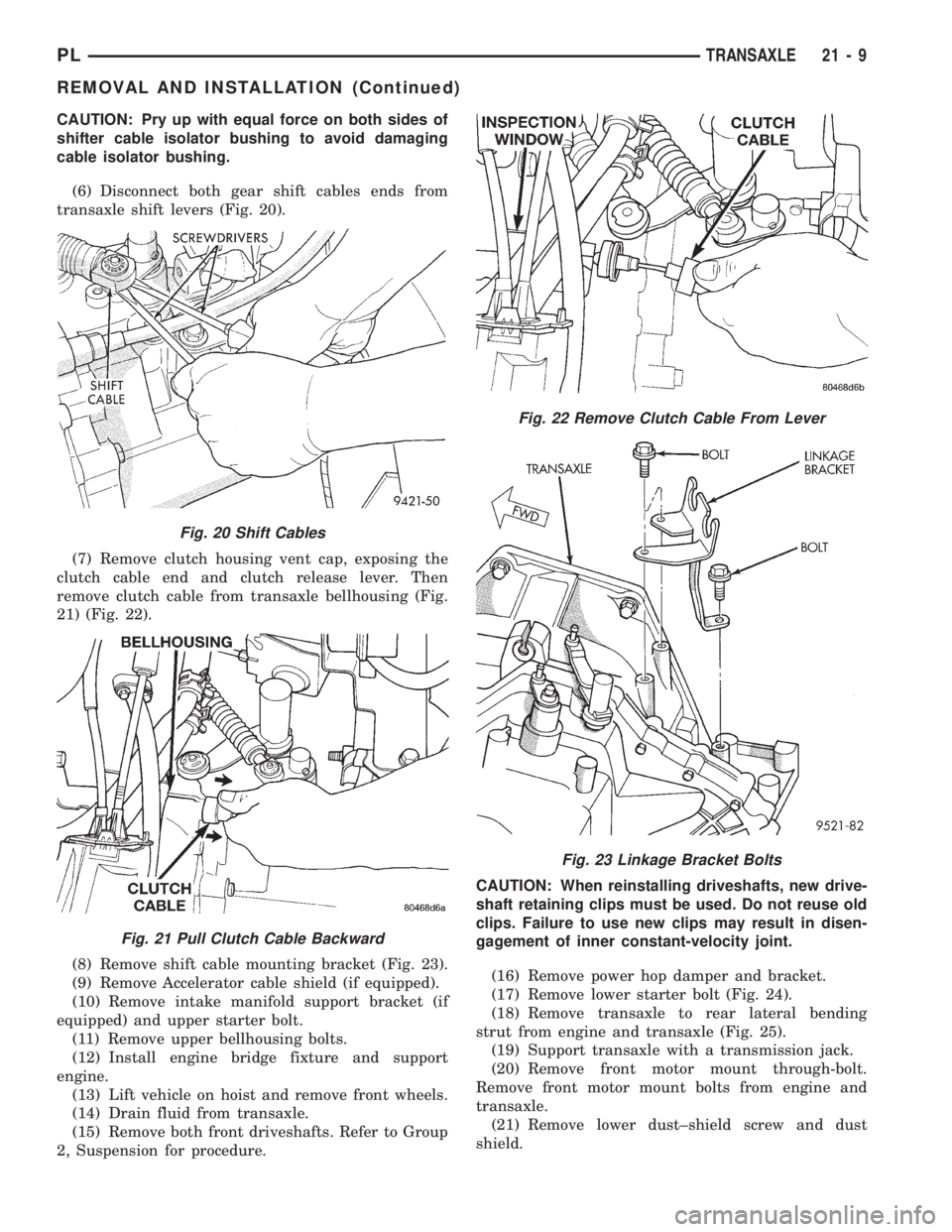
(6) Disconnect both gear shift cables ends from
transaxle shift levers (Fig. 20).
(7) Remove clutch housing vent cap, exposing the
clutch cable end and clutch release lever. Then
remove clutch cable from transaxle bellhousing (Fig.
21) (Fig. 22).
(8) Remove shift cable mounting bracket (Fig. 23).
(9) Remove Accelerator cable shield (if equipped).
(10) Remove intake manifold support bracket (if
equipped) and upper starter bolt.
(11) Remove upper bellhousing bolts.
(12) Install engine bridge fixture and support
engine.
(13) Lift vehicle on hoist and remove front wheels.
(14) Drain fluid from transaxle.
(15) Remove both front driveshafts. Refer to Group
2, Suspension for procedure.CAUTION: When reinstalling driveshafts, new drive-
shaft retaining clips must be used. Do not reuse old
clips. Failure to use new clips may result in disen-
gagement of inner constant-velocity joint.
(16) Remove power hop damper and bracket.
(17) Remove lower starter bolt (Fig. 24).
(18) Remove transaxle to rear lateral bending
strut from engine and transaxle (Fig. 25).
(19) Support transaxle with a transmission jack.
(20) Remove front motor mount through-bolt.
Remove front motor mount bolts from engine and
transaxle.
(21) Remove lower dust±shield screw and dust
shield.
Fig. 20 Shift Cables
Fig. 21 Pull Clutch Cable Backward
Fig. 22 Remove Clutch Cable From Lever
Fig. 23 Linkage Bracket Bolts
PLTRANSAXLE 21 - 9
REMOVAL AND INSTALLATION (Continued)