torque DODGE NEON 1999 Service Owner's Guide
[x] Cancel search | Manufacturer: DODGE, Model Year: 1999, Model line: NEON, Model: DODGE NEON 1999Pages: 1200, PDF Size: 35.29 MB
Page 66 of 1200
DIFFERENTIAL AND DRIVELINE
CONTENTS
page page
GENERAL INFORMATION
FRONT DRIVESHAFTS.................... 1
DIAGNOSIS AND TESTING
DRIVESHAFT DIAGNOSIS.................. 2
REMOVAL AND INSTALLATION
FRONT DRIVESHAFTS.................... 2
DISASSEMBLY AND ASSEMBLY
DRIVESHAFT RECONDITION............... 7INNER TRIPOD JOINT SEAL BOOT.......... 9
OUTER C/V JOINT SEAL BOOT............ 13
SPECIFICATIONS
TORQUE.............................. 16
SPECIAL TOOLS
DRIVESHAFT........................... 16
GENERAL INFORMATION
FRONT DRIVESHAFTS
Vehicles equipped with either an automatic or
manual transmission use the unequal±length drive-
shaft system.
Vehicles equipped with automatic transaxles use a
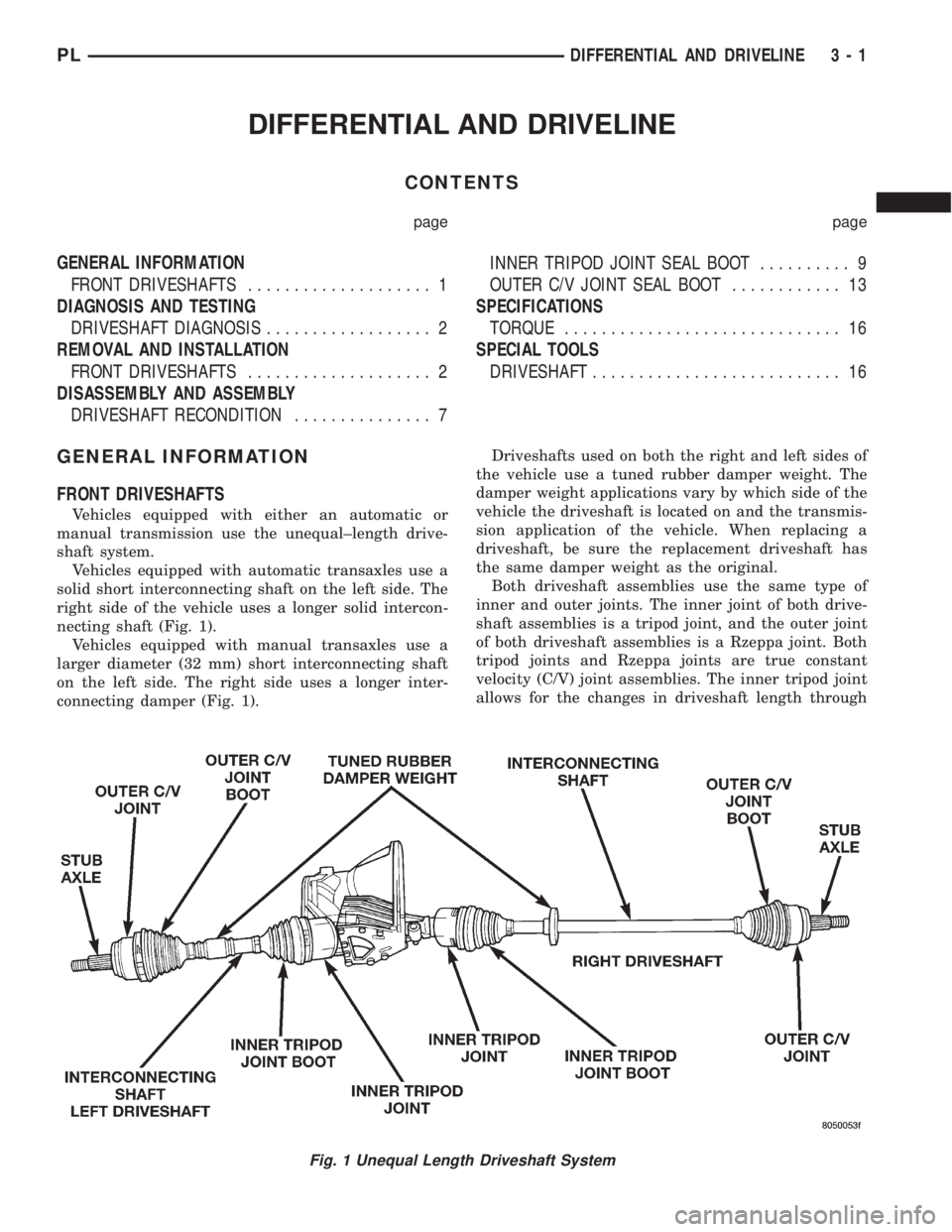
solid short interconnecting shaft on the left side. The
right side of the vehicle uses a longer solid intercon-
necting shaft (Fig. 1).
Vehicles equipped with manual transaxles use a
larger diameter (32 mm) short interconnecting shaft
on the left side. The right side uses a longer inter-
connecting damper (Fig. 1).Driveshafts used on both the right and left sides of
the vehicle use a tuned rubber damper weight. The
damper weight applications vary by which side of the
vehicle the driveshaft is located on and the transmis-
sion application of the vehicle. When replacing a
driveshaft, be sure the replacement driveshaft has
the same damper weight as the original.
Both driveshaft assemblies use the same type of
inner and outer joints. The inner joint of both drive-
shaft assemblies is a tripod joint, and the outer joint
of both driveshaft assemblies is a Rzeppa joint. Both
tripod joints and Rzeppa joints are true constant
velocity (C/V) joint assemblies. The inner tripod joint
allows for the changes in driveshaft length through
Fig. 1 Unequal Length Driveshaft System
PLDIFFERENTIAL AND DRIVELINE 3 - 1
Page 81 of 1200
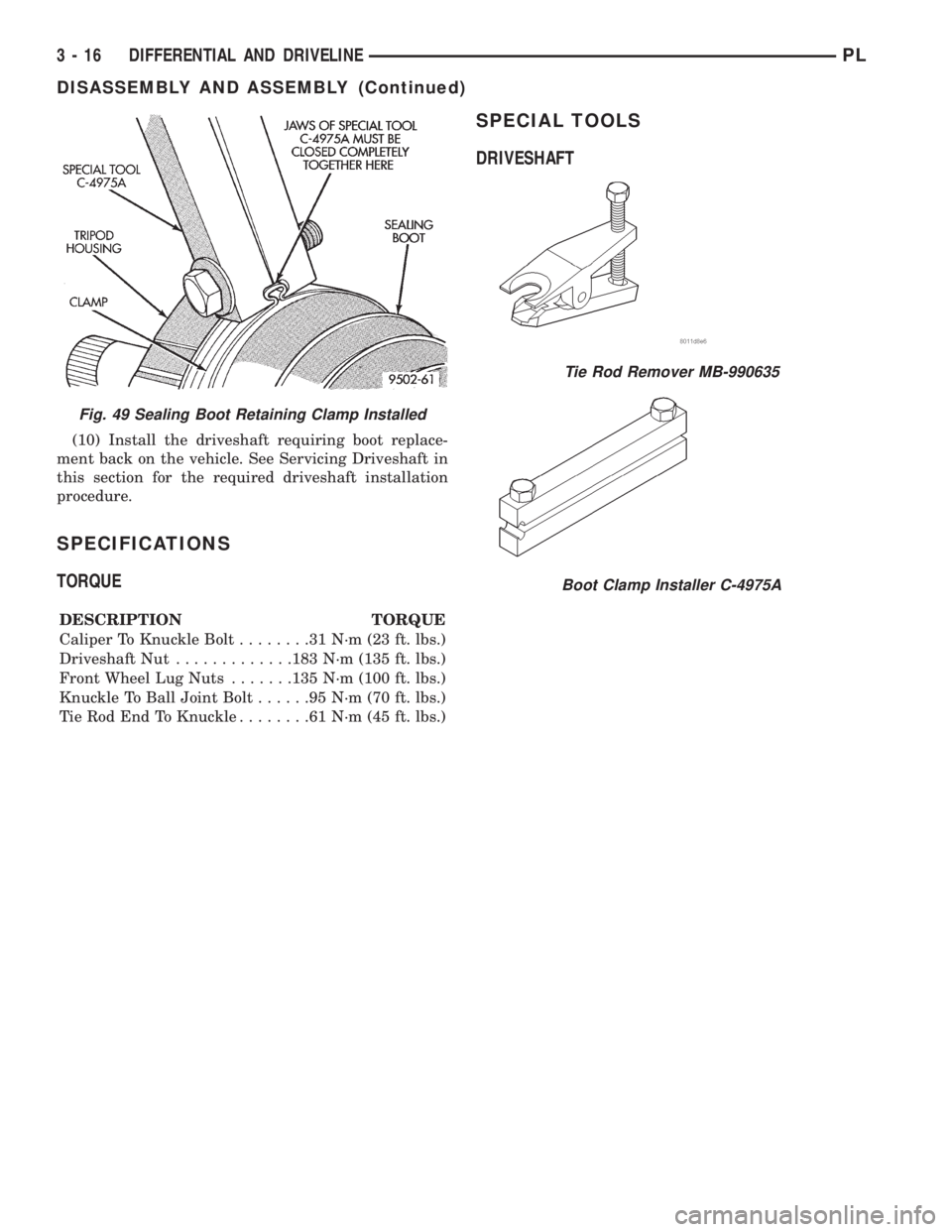
(10) Install the driveshaft requiring boot replace-
ment back on the vehicle. See Servicing Driveshaft in
this section for the required driveshaft installation
procedure.
SPECIFICATIONS
TORQUE
DESCRIPTION TORQUE
Caliper To Knuckle Bolt........31N´m(23ft.lbs.)
Driveshaft Nut.............183 N´m (135 ft. lbs.)
Front Wheel Lug Nuts.......135 N´m (100 ft. lbs.)
Knuckle To Ball Joint Bolt......95N´m(70ft.lbs.)
Tie Rod End To Knuckle........61N´m(45ft.lbs.)
SPECIAL TOOLS
DRIVESHAFT
Fig. 49 Sealing Boot Retaining Clamp Installed
Tie Rod Remover MB-990635
Boot Clamp Installer C-4975A
3 - 16 DIFFERENTIAL AND DRIVELINEPL
DISASSEMBLY AND ASSEMBLY (Continued)
Page 83 of 1200
BASE BRAKE SYSTEM
INDEX
page page
DESCRIPTION AND OPERATION
CHASSIS TUBES AND HOSES.............. 6
FRONT DISC BRAKES..................... 2
MASTER CYLINDER...................... 6
PARKING BRAKES........................ 4
PROPORTIONING VALVES................. 5
REAR DISC BRAKES...................... 4
REAR DRUM BRAKES..................... 4
REAR WHEEL HUB/BEARING............... 8
RED BRAKE WARNING LAMP............... 7
STOP LAMP SWITCH...................... 8
VACUUM BOOSTER...................... 6
DIAGNOSIS AND TESTING
BRAKE FLUID CONTAMINATION............ 19
BRAKE SYSTEM BASIC DIAGNOSIS GUIDE.... 9
BRAKE SYSTEM DIAGNOSIS CHARTS....... 10
DRUM BRAKE AUTOMATIC ADJUSTER....... 14
PROPORTIONING VALVES................ 16
RED BRAKE WARNING LAMP TEST......... 19
ROTOR THICKNESS AND RUNOUT.......... 14
STOP LAMP SWITCH TEST PROCEDURE..... 19
SERVICE PROCEDURES
BRAKE BLEEDING....................... 20
BRAKE DRUM MACHINING................ 23
BRAKE FLUID LEVEL CHECK.............. 19
BRAKE ROTOR MACHINING............... 22
BRAKE TUBE REPAIR.................... 25
MASTER CYLINDER BLEEDING............ 21
PARK BRAKE LEVER AUTO ADJUSTER
MECHANISM.......................... 23
REMOVAL AND INSTALLATION
CHASSIS TUBES AND HOSES.............. 47
FRONT DISC BRAKE CALIPER............. 26
FRONT DISC BRAKE SHOES.............. 28
MASTER CYLINDER..................... 41
PARK BRAKE CABLES.................... 50
PARK BRAKE LEVER ASSEMBLY........... 48PARK BRAKE LEVER OUTPUT CABLE....... 49
PARK BRAKE SHOES WITH REAR DISC
BRAKES............................. 55
PROPORTIONING VALVE (BASE BRAKES).... 47
REAR BRAKE DRUM..................... 34
REAR BRAKE SHOE SUPPORT PLATE....... 37
REAR BRAKE SHOES.................... 35
REAR BRAKE WHEEL CYLINDER........... 38
REAR DISC BRAKE CALIPER.............. 30
REAR DISC BRAKE SHOES................ 32
REAR HUB/BEARING..................... 39
STOP LAMP SWITCH..................... 57
VACUUM BOOSTER..................... 44
WHEEL AND TIRE ASSEMBLY.............. 26
DISASSEMBLY AND ASSEMBLY
BRAKE FLUID LEVEL SWITCH............. 58
BRAKE FLUID RESERVOIR................ 57
FRONT AND REAR DISC BRAKE CALIPER.... 58
WHEEL CYLINDER (REAR DRUM BRAKE).... 63
CLEANING AND INSPECTION
CHASSIS TUBES AND HOSES.............. 65
FRONT DISC BRAKES.................... 63
REAR DISC BRAKES..................... 64
REAR DRUM BRAKE WHEEL CYLINDER...... 65
REAR DRUM BRAKES.................... 64
REAR WHEEL HUB AND BEARING ASSEMBLY . 65
ADJUSTMENTS
PARK BRAKE ADJUSTMENT............... 66
REAR DRUM BRAKE SHOE ADJUSTMENT.... 65
STOP LAMP SWITCH..................... 65
SPECIFICATIONS
BRAKE ACTUATION SYSTEM.............. 67
BRAKE FASTENER TORQUE SPECIFICATIONS . 67
BRAKE FLUID.......................... 67
SPECIAL TOOLS
BASE BRAKE SYSTEM................... 68
DESCRIPTION AND OPERATION
FRONT DISC BRAKES
The front disc brakes (Fig. 1) and (Fig. 2) consists
of the following components:
²The driving hub
²Braking disc (rotor)
²Caliper assembly - single piston, floating type
²Brake shoes and linings
The double pin calipers are mounted directly to the
steering knuckles and use no adapter. The caliper ismounted to the steering knuckle using bushings,
sleeves and 2 guide pin bolts which thread directly
into bosses on the steering knuckle (Fig. 2) and (Fig.
3).
Two machined abutments on the steering knuckle
position the caliper. The guide pin bolts, sleeves and
bushings control the side to side movement of the
caliper. The piston seal is designed to pull the piston
back into the bore of the caliper when the brake
pedal is released. This maintains the proper brake
shoe to rotor clearance (Fig. 4).
5 - 2 BRAKESPL
Page 96 of 1200
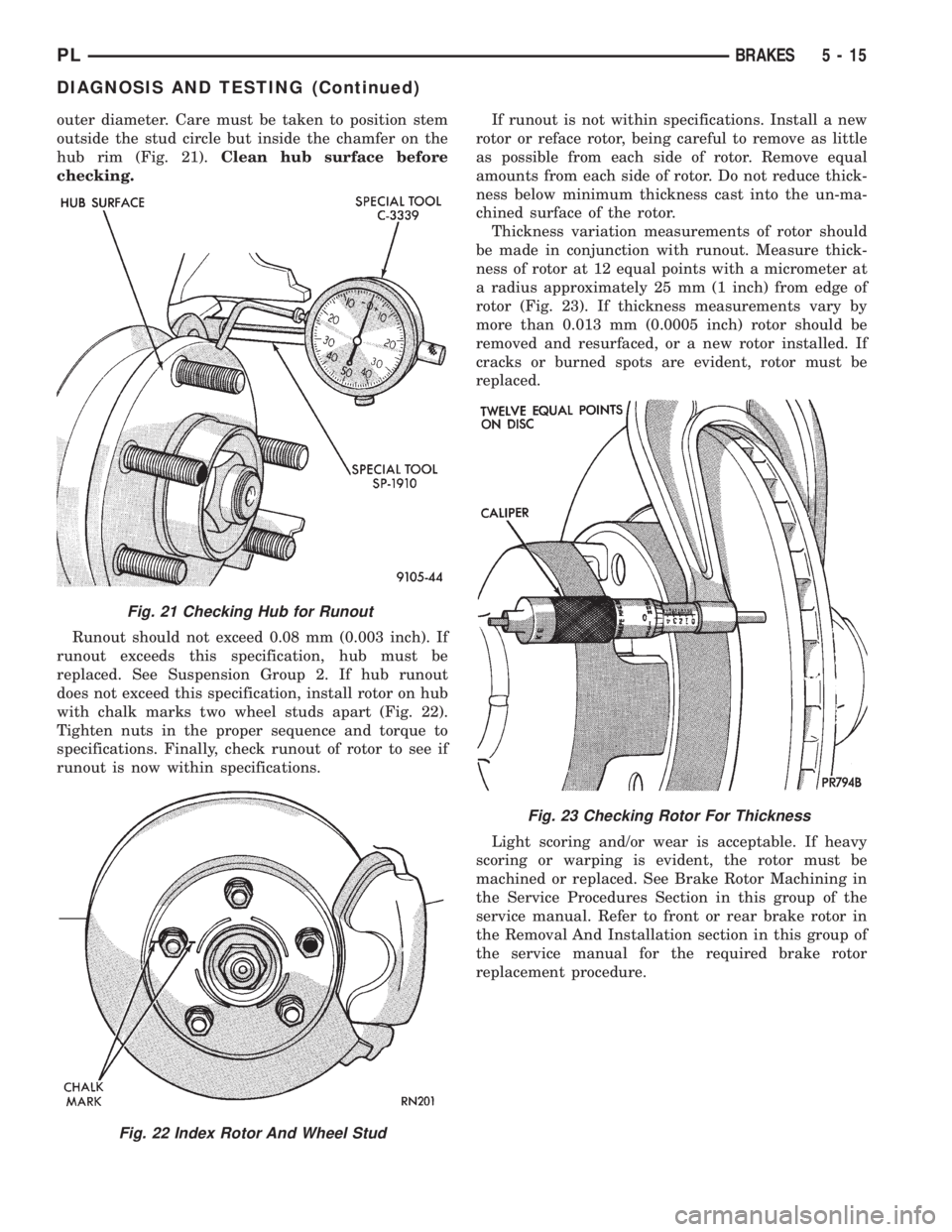
outer diameter. Care must be taken to position stem
outside the stud circle but inside the chamfer on the
hub rim (Fig. 21).Clean hub surface before
checking.
Runout should not exceed 0.08 mm (0.003 inch). If
runout exceeds this specification, hub must be
replaced. See Suspension Group 2. If hub runout
does not exceed this specification, install rotor on hub
with chalk marks two wheel studs apart (Fig. 22).
Tighten nuts in the proper sequence and torque to
specifications. Finally, check runout of rotor to see if
runout is now within specifications.If runout is not within specifications. Install a new
rotor or reface rotor, being careful to remove as little
as possible from each side of rotor. Remove equal
amounts from each side of rotor. Do not reduce thick-
ness below minimum thickness cast into the un-ma-
chined surface of the rotor.
Thickness variation measurements of rotor should
be made in conjunction with runout. Measure thick-
ness of rotor at 12 equal points with a micrometer at
a radius approximately 25 mm (1 inch) from edge of
rotor (Fig. 23). If thickness measurements vary by
more than 0.013 mm (0.0005 inch) rotor should be
removed and resurfaced, or a new rotor installed. If
cracks or burned spots are evident, rotor must be
replaced.
Light scoring and/or wear is acceptable. If heavy
scoring or warping is evident, the rotor must be
machined or replaced. See Brake Rotor Machining in
the Service Procedures Section in this group of the
service manual. Refer to front or rear brake rotor in
the Removal And Installation section in this group of
the service manual for the required brake rotor
replacement procedure.
Fig. 21 Checking Hub for Runout
Fig. 22 Index Rotor And Wheel Stud
Fig. 23 Checking Rotor For Thickness
PLBRAKES 5 - 15
DIAGNOSIS AND TESTING (Continued)
Page 98 of 1200
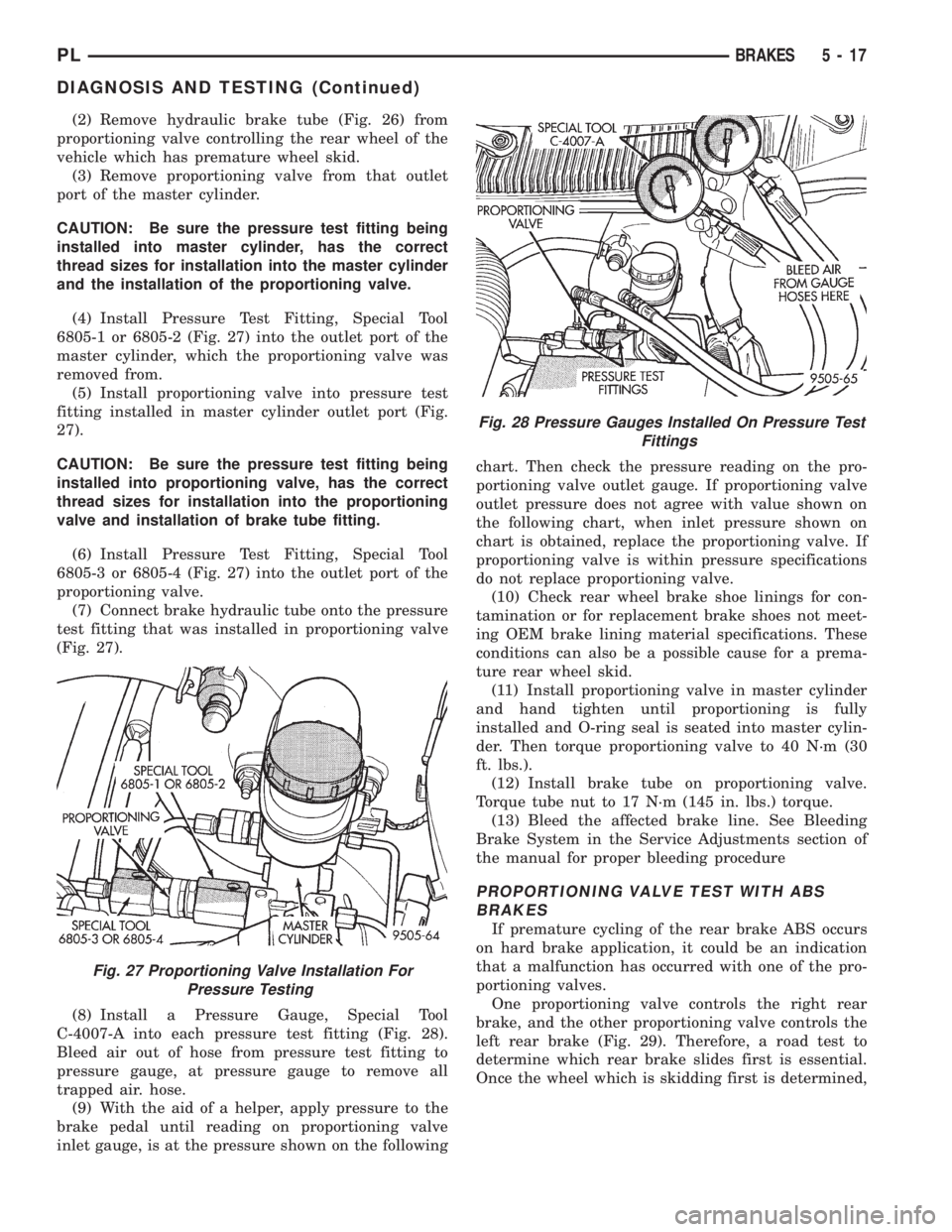
(2) Remove hydraulic brake tube (Fig. 26) from
proportioning valve controlling the rear wheel of the
vehicle which has premature wheel skid.
(3) Remove proportioning valve from that outlet
port of the master cylinder.
CAUTION: Be sure the pressure test fitting being
installed into master cylinder, has the correct
thread sizes for installation into the master cylinder
and the installation of the proportioning valve.
(4) Install Pressure Test Fitting, Special Tool
6805-1 or 6805-2 (Fig. 27) into the outlet port of the
master cylinder, which the proportioning valve was
removed from.
(5) Install proportioning valve into pressure test
fitting installed in master cylinder outlet port (Fig.
27).
CAUTION: Be sure the pressure test fitting being
installed into proportioning valve, has the correct
thread sizes for installation into the proportioning
valve and installation of brake tube fitting.
(6) Install Pressure Test Fitting, Special Tool
6805-3 or 6805-4 (Fig. 27) into the outlet port of the
proportioning valve.
(7) Connect brake hydraulic tube onto the pressure
test fitting that was installed in proportioning valve
(Fig. 27).
(8) Install a Pressure Gauge, Special Tool
C-4007-A into each pressure test fitting (Fig. 28).
Bleed air out of hose from pressure test fitting to
pressure gauge, at pressure gauge to remove all
trapped air. hose.
(9) With the aid of a helper, apply pressure to the
brake pedal until reading on proportioning valve
inlet gauge, is at the pressure shown on the followingchart. Then check the pressure reading on the pro-
portioning valve outlet gauge. If proportioning valve
outlet pressure does not agree with value shown on
the following chart, when inlet pressure shown on
chart is obtained, replace the proportioning valve. If
proportioning valve is within pressure specifications
do not replace proportioning valve.
(10) Check rear wheel brake shoe linings for con-
tamination or for replacement brake shoes not meet-
ing OEM brake lining material specifications. These
conditions can also be a possible cause for a prema-
ture rear wheel skid.
(11) Install proportioning valve in master cylinder
and hand tighten until proportioning is fully
installed and O-ring seal is seated into master cylin-
der. Then torque proportioning valve to 40 N´m (30
ft. lbs.).
(12) Install brake tube on proportioning valve.
Torque tube nut to 17 N´m (145 in. lbs.) torque.
(13) Bleed the affected brake line. See Bleeding
Brake System in the Service Adjustments section of
the manual for proper bleeding procedure
PROPORTIONING VALVE TEST WITH ABS
BRAKES
If premature cycling of the rear brake ABS occurs
on hard brake application, it could be an indication
that a malfunction has occurred with one of the pro-
portioning valves.
One proportioning valve controls the right rear
brake, and the other proportioning valve controls the
left rear brake (Fig. 29). Therefore, a road test to
determine which rear brake slides first is essential.
Once the wheel which is skidding first is determined,
Fig. 27 Proportioning Valve Installation For
Pressure Testing
Fig. 28 Pressure Gauges Installed On Pressure Test
Fittings
PLBRAKES 5 - 17
DIAGNOSIS AND TESTING (Continued)
Page 99 of 1200
use the following procedure to diagnose the propor-
tioning valve.
The test procedure is the same for both rear pro-
portioning valves. After road testing the vehicle to
determine which wheel skids first, follow the proce-
dure below for testing the required proportioning
valve.
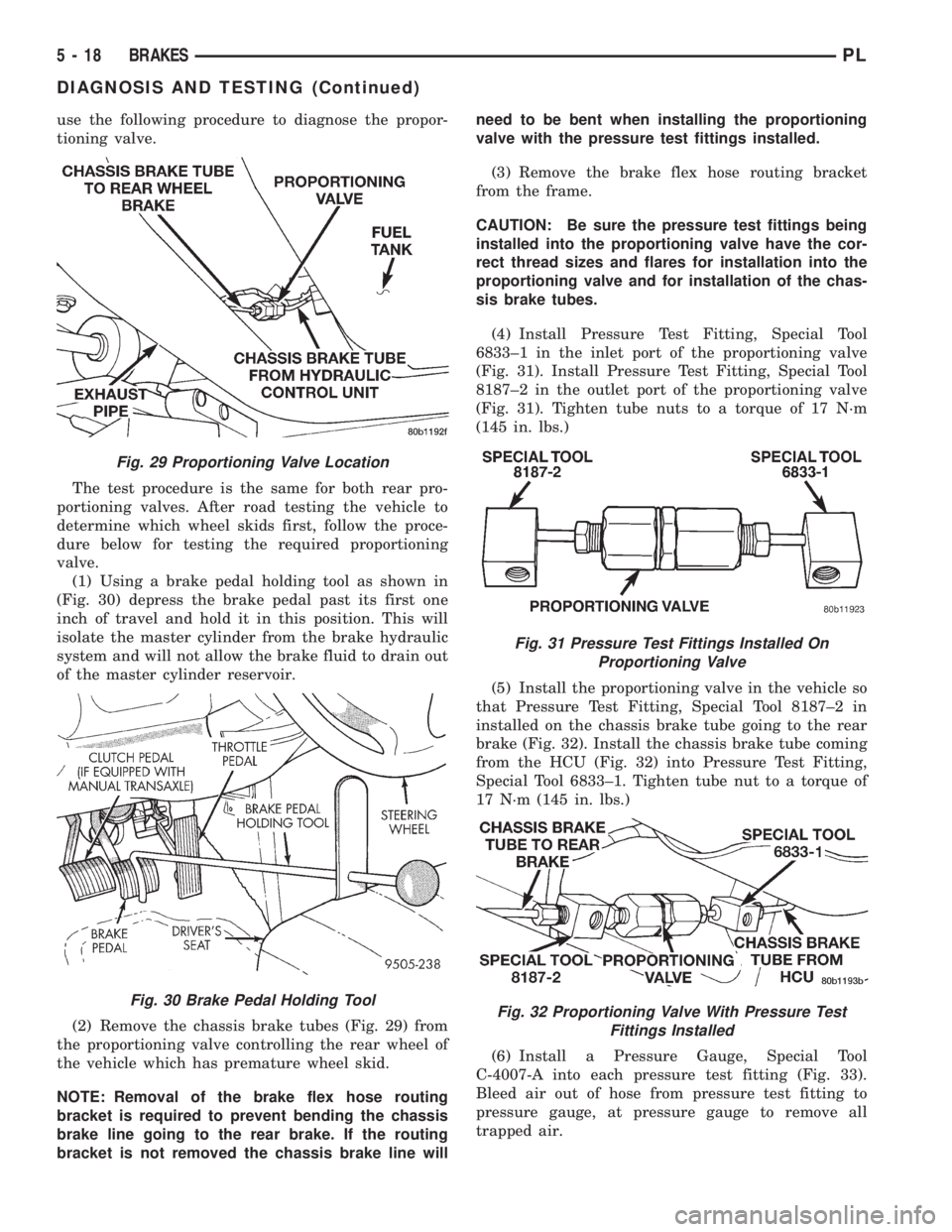
(1) Using a brake pedal holding tool as shown in
(Fig. 30) depress the brake pedal past its first one
inch of travel and hold it in this position. This will
isolate the master cylinder from the brake hydraulic
system and will not allow the brake fluid to drain out
of the master cylinder reservoir.
(2) Remove the chassis brake tubes (Fig. 29) from
the proportioning valve controlling the rear wheel of
the vehicle which has premature wheel skid.
NOTE: Removal of the brake flex hose routing
bracket is required to prevent bending the chassis
brake line going to the rear brake. If the routing
bracket is not removed the chassis brake line willneed to be bent when installing the proportioning
valve with the pressure test fittings installed.
(3) Remove the brake flex hose routing bracket
from the frame.
CAUTION: Be sure the pressure test fittings being
installed into the proportioning valve have the cor-
rect thread sizes and flares for installation into the
proportioning valve and for installation of the chas-
sis brake tubes.
(4) Install Pressure Test Fitting, Special Tool
6833±1 in the inlet port of the proportioning valve
(Fig. 31). Install Pressure Test Fitting, Special Tool
8187±2 in the outlet port of the proportioning valve
(Fig. 31). Tighten tube nuts to a torque of 17 N´m
(145 in. lbs.)
(5) Install the proportioning valve in the vehicle so
that Pressure Test Fitting, Special Tool 8187±2 in
installed on the chassis brake tube going to the rear
brake (Fig. 32). Install the chassis brake tube coming
from the HCU (Fig. 32) into Pressure Test Fitting,
Special Tool 6833±1. Tighten tube nut to a torque of
17 N´m (145 in. lbs.)
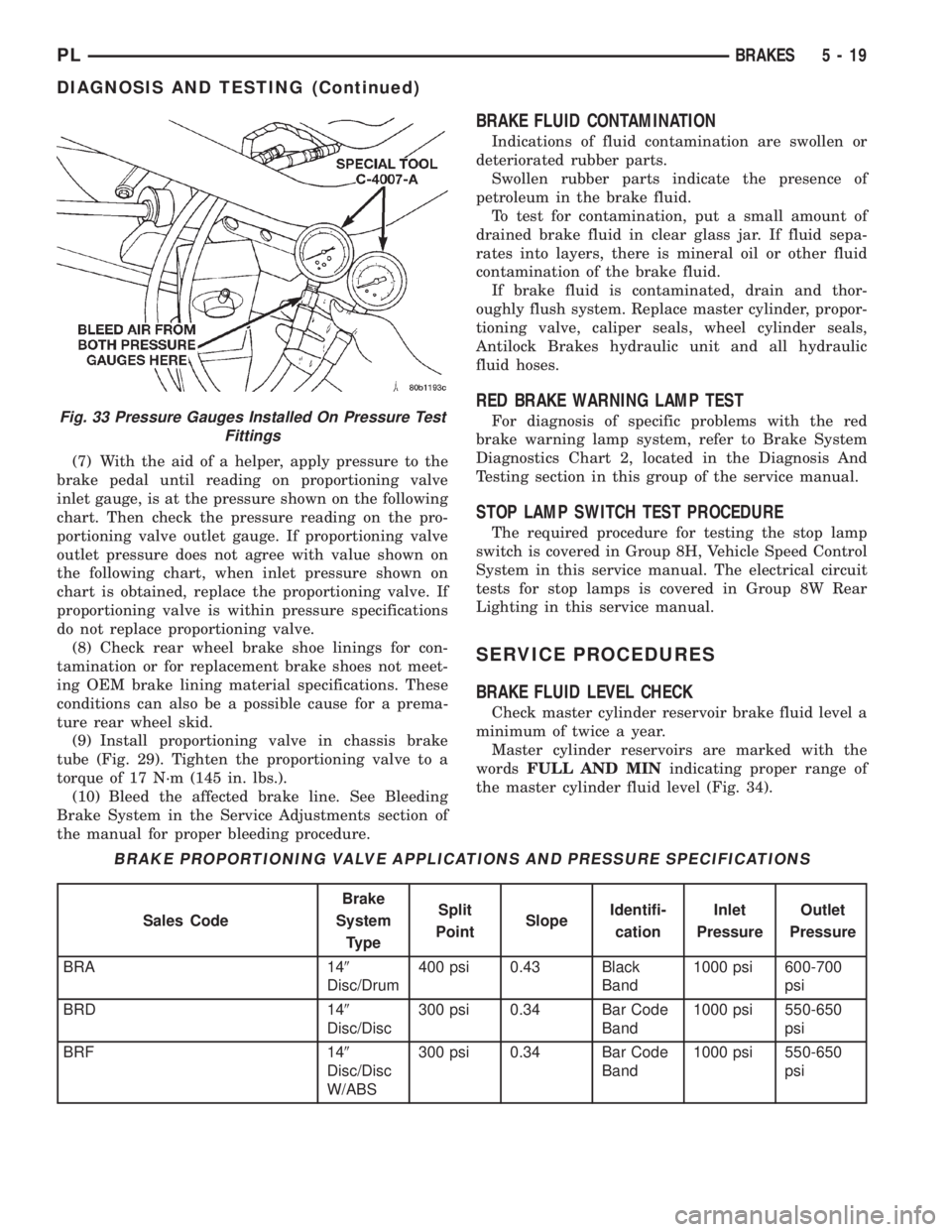
(6) Install a Pressure Gauge, Special Tool
C-4007-A into each pressure test fitting (Fig. 33).
Bleed air out of hose from pressure test fitting to
pressure gauge, at pressure gauge to remove all
trapped air.
Fig. 29 Proportioning Valve Location
Fig. 30 Brake Pedal Holding Tool
Fig. 31 Pressure Test Fittings Installed On
Proportioning Valve
Fig. 32 Proportioning Valve With Pressure Test
Fittings Installed
5 - 18 BRAKESPL
DIAGNOSIS AND TESTING (Continued)
Page 100 of 1200
(7) With the aid of a helper, apply pressure to the
brake pedal until reading on proportioning valve
inlet gauge, is at the pressure shown on the following
chart. Then check the pressure reading on the pro-
portioning valve outlet gauge. If proportioning valve
outlet pressure does not agree with value shown on
the following chart, when inlet pressure shown on
chart is obtained, replace the proportioning valve. If
proportioning valve is within pressure specifications
do not replace proportioning valve.
(8) Check rear wheel brake shoe linings for con-
tamination or for replacement brake shoes not meet-
ing OEM brake lining material specifications. These
conditions can also be a possible cause for a prema-
ture rear wheel skid.
(9) Install proportioning valve in chassis brake
tube (Fig. 29). Tighten the proportioning valve to a
torque of 17 N´m (145 in. lbs.).
(10) Bleed the affected brake line. See Bleeding
Brake System in the Service Adjustments section of
the manual for proper bleeding procedure.
BRAKE FLUID CONTAMINATION
Indications of fluid contamination are swollen or
deteriorated rubber parts.
Swollen rubber parts indicate the presence of
petroleum in the brake fluid.
To test for contamination, put a small amount of
drained brake fluid in clear glass jar. If fluid sepa-
rates into layers, there is mineral oil or other fluid
contamination of the brake fluid.
If brake fluid is contaminated, drain and thor-
oughly flush system. Replace master cylinder, propor-
tioning valve, caliper seals, wheel cylinder seals,
Antilock Brakes hydraulic unit and all hydraulic
fluid hoses.
RED BRAKE WARNING LAMP TEST
For diagnosis of specific problems with the red
brake warning lamp system, refer to Brake System
Diagnostics Chart 2, located in the Diagnosis And
Testing section in this group of the service manual.
STOP LAMP SWITCH TEST PROCEDURE
The required procedure for testing the stop lamp
switch is covered in Group 8H, Vehicle Speed Control
System in this service manual. The electrical circuit
tests for stop lamps is covered in Group 8W Rear
Lighting in this service manual.
SERVICE PROCEDURES
BRAKE FLUID LEVEL CHECK
Check master cylinder reservoir brake fluid level a
minimum of twice a year.
Master cylinder reservoirs are marked with the
wordsFULL AND MINindicating proper range of
the master cylinder fluid level (Fig. 34).
Fig. 33 Pressure Gauges Installed On Pressure Test
Fittings
BRAKE PROPORTIONING VALVE APPLICATIONS AND PRESSURE SPECIFICATIONS
Sales CodeBrake
System
TypeSplit
PointSlopeIdentifi-
cationInlet
PressureOutlet
Pressure
BRA 149
Disc/Drum400 psi 0.43 Black
Band1000 psi 600-700
psi
BRD 149
Disc/Disc300 psi 0.34 Bar Code
Band1000 psi 550-650
psi
BRF 149
Disc/Disc
W/ABS300 psi 0.34 Bar Code
Band1000 psi 550-650
psi
PLBRAKES 5 - 19
DIAGNOSIS AND TESTING (Continued)
Page 107 of 1200
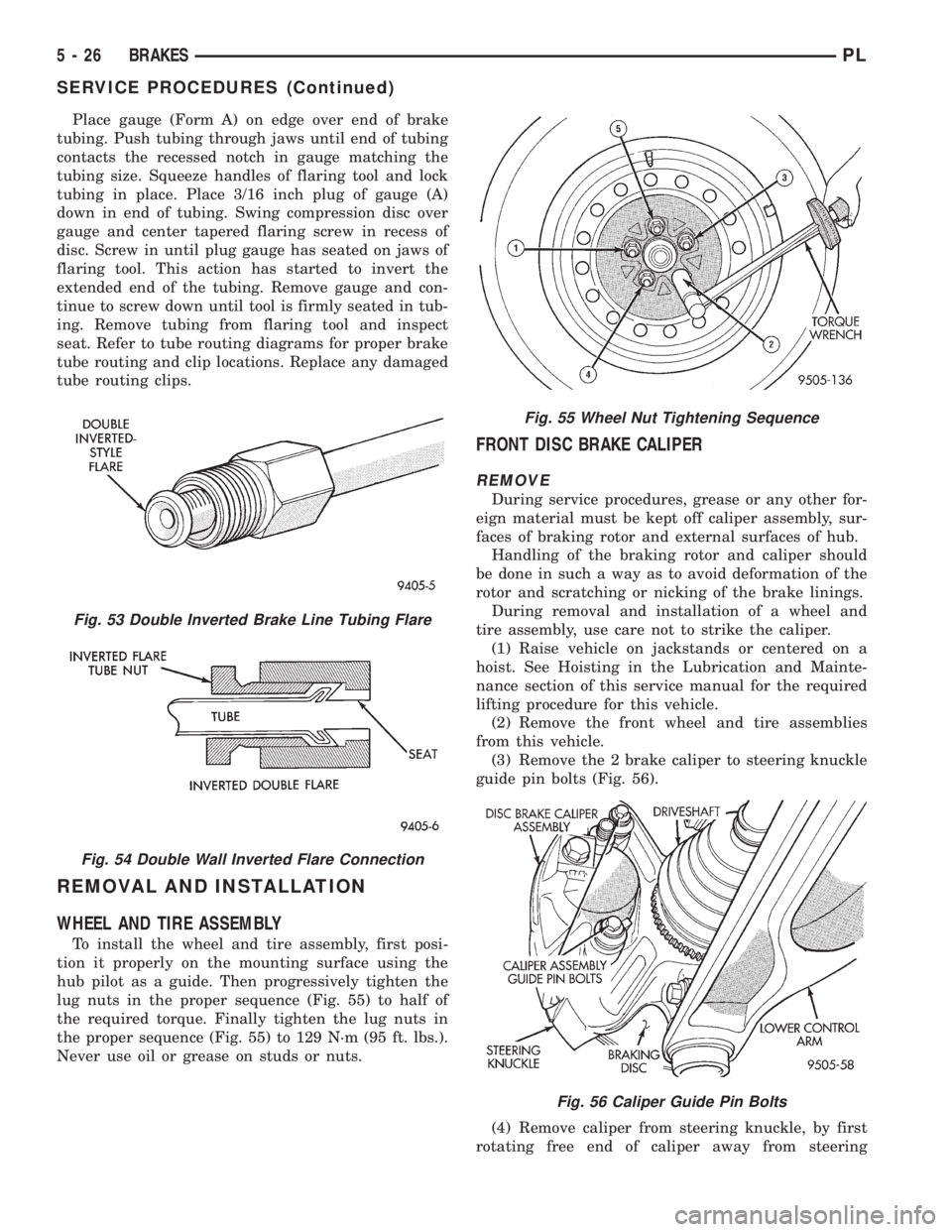
Place gauge (Form A) on edge over end of brake
tubing. Push tubing through jaws until end of tubing
contacts the recessed notch in gauge matching the
tubing size. Squeeze handles of flaring tool and lock
tubing in place. Place 3/16 inch plug of gauge (A)
down in end of tubing. Swing compression disc over
gauge and center tapered flaring screw in recess of
disc. Screw in until plug gauge has seated on jaws of
flaring tool. This action has started to invert the
extended end of the tubing. Remove gauge and con-
tinue to screw down until tool is firmly seated in tub-
ing. Remove tubing from flaring tool and inspect
seat. Refer to tube routing diagrams for proper brake
tube routing and clip locations. Replace any damaged
tube routing clips.
REMOVAL AND INSTALLATION
WHEEL AND TIRE ASSEMBLY
To install the wheel and tire assembly, first posi-
tion it properly on the mounting surface using the
hub pilot as a guide. Then progressively tighten the
lug nuts in the proper sequence (Fig. 55) to half of
the required torque. Finally tighten the lug nuts in
the proper sequence (Fig. 55) to 129 N´m (95 ft. lbs.).
Never use oil or grease on studs or nuts.
FRONT DISC BRAKE CALIPER
REMOVE
During service procedures, grease or any other for-
eign material must be kept off caliper assembly, sur-
faces of braking rotor and external surfaces of hub.
Handling of the braking rotor and caliper should
be done in such a way as to avoid deformation of the
rotor and scratching or nicking of the brake linings.
During removal and installation of a wheel and
tire assembly, use care not to strike the caliper.
(1) Raise vehicle on jackstands or centered on a
hoist. See Hoisting in the Lubrication and Mainte-
nance section of this service manual for the required
lifting procedure for this vehicle.
(2) Remove the front wheel and tire assemblies
from this vehicle.
(3) Remove the 2 brake caliper to steering knuckle
guide pin bolts (Fig. 56).
(4) Remove caliper from steering knuckle, by first
rotating free end of caliper away from steering
Fig. 53 Double Inverted Brake Line Tubing Flare
Fig. 54 Double Wall Inverted Flare Connection
Fig. 55 Wheel Nut Tightening Sequence
Fig. 56 Caliper Guide Pin Bolts
5 - 26 BRAKESPL
SERVICE PROCEDURES (Continued)
Page 108 of 1200
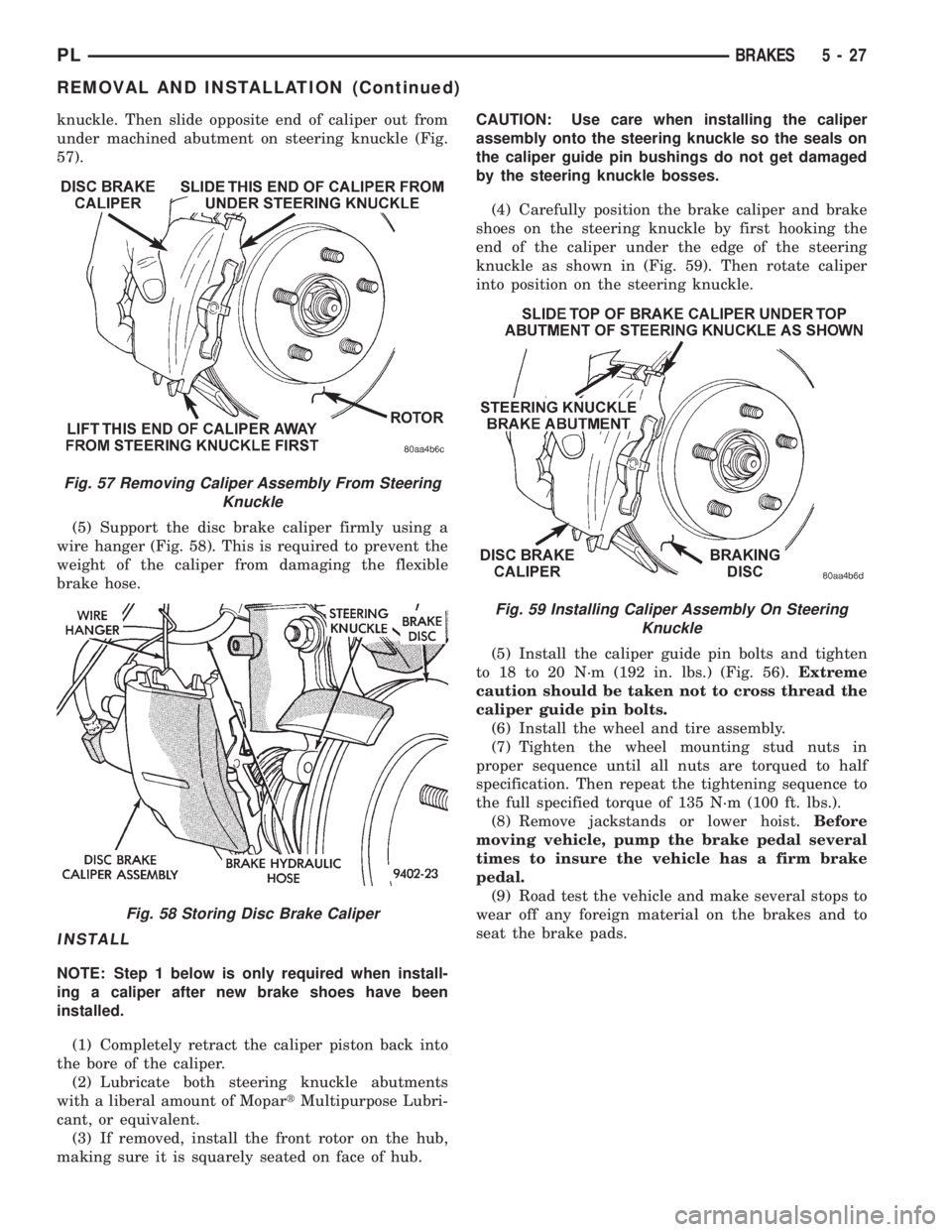
knuckle. Then slide opposite end of caliper out from
under machined abutment on steering knuckle (Fig.
57).
(5) Support the disc brake caliper firmly using a
wire hanger (Fig. 58). This is required to prevent the
weight of the caliper from damaging the flexible
brake hose.
INSTALL
NOTE: Step 1 below is only required when install-
ing a caliper after new brake shoes have been
installed.
(1) Completely retract the caliper piston back into
the bore of the caliper.
(2) Lubricate both steering knuckle abutments
with a liberal amount of MopartMultipurpose Lubri-
cant, or equivalent.
(3) If removed, install the front rotor on the hub,
making sure it is squarely seated on face of hub.CAUTION: Use care when installing the caliper
assembly onto the steering knuckle so the seals on
the caliper guide pin bushings do not get damaged
by the steering knuckle bosses.
(4) Carefully position the brake caliper and brake
shoes on the steering knuckle by first hooking the
end of the caliper under the edge of the steering
knuckle as shown in (Fig. 59). Then rotate caliper
into position on the steering knuckle.
(5) Install the caliper guide pin bolts and tighten
to 18 to 20 N´m (192 in. lbs.) (Fig. 56).Extreme
caution should be taken not to cross thread the
caliper guide pin bolts.
(6) Install the wheel and tire assembly.
(7) Tighten the wheel mounting stud nuts in
proper sequence until all nuts are torqued to half
specification. Then repeat the tightening sequence to
the full specified torque of 135 N´m (100 ft. lbs.).
(8) Remove jackstands or lower hoist.Before
moving vehicle, pump the brake pedal several
times to insure the vehicle has a firm brake
pedal.
(9) Road test the vehicle and make several stops to
wear off any foreign material on the brakes and to
seat the brake pads.
Fig. 57 Removing Caliper Assembly From Steering
Knuckle
Fig. 58 Storing Disc Brake Caliper
Fig. 59 Installing Caliper Assembly On Steering
Knuckle
PLBRAKES 5 - 27
REMOVAL AND INSTALLATION (Continued)
Page 111 of 1200
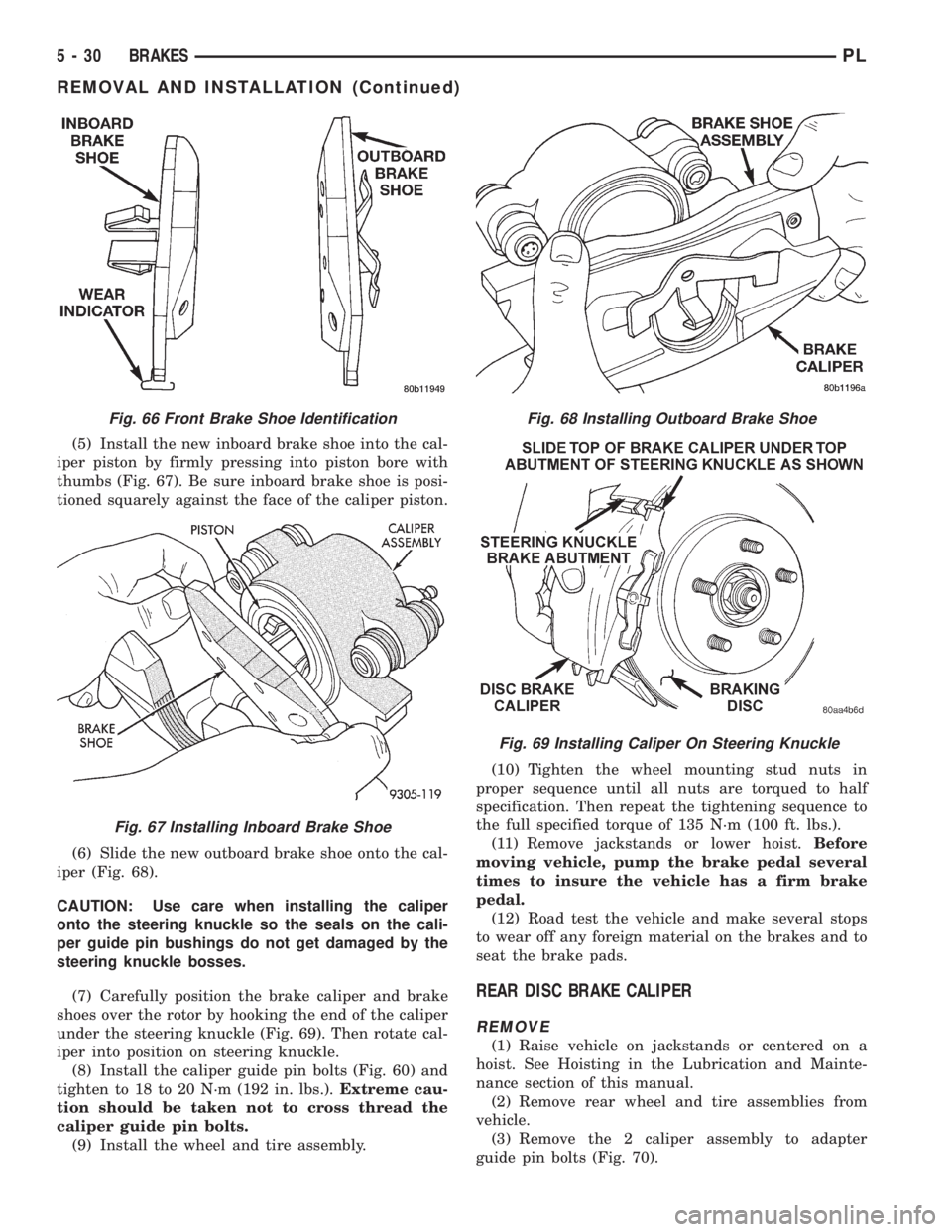
(5) Install the new inboard brake shoe into the cal-
iper piston by firmly pressing into piston bore with
thumbs (Fig. 67). Be sure inboard brake shoe is posi-
tioned squarely against the face of the caliper piston.
(6) Slide the new outboard brake shoe onto the cal-
iper (Fig. 68).
CAUTION: Use care when installing the caliper
onto the steering knuckle so the seals on the cali-
per guide pin bushings do not get damaged by the
steering knuckle bosses.
(7) Carefully position the brake caliper and brake
shoes over the rotor by hooking the end of the caliper
under the steering knuckle (Fig. 69). Then rotate cal-
iper into position on steering knuckle.
(8) Install the caliper guide pin bolts (Fig. 60) and
tighten to 18 to 20 N´m (192 in. lbs.).Extreme cau-
tion should be taken not to cross thread the
caliper guide pin bolts.
(9) Install the wheel and tire assembly.(10) Tighten the wheel mounting stud nuts in
proper sequence until all nuts are torqued to half
specification. Then repeat the tightening sequence to
the full specified torque of 135 N´m (100 ft. lbs.).
(11) Remove jackstands or lower hoist.Before
moving vehicle, pump the brake pedal several
times to insure the vehicle has a firm brake
pedal.
(12) Road test the vehicle and make several stops
to wear off any foreign material on the brakes and to
seat the brake pads.
REAR DISC BRAKE CALIPER
REMOVE
(1) Raise vehicle on jackstands or centered on a
hoist. See Hoisting in the Lubrication and Mainte-
nance section of this manual.
(2) Remove rear wheel and tire assemblies from
vehicle.
(3) Remove the 2 caliper assembly to adapter
guide pin bolts (Fig. 70).
Fig. 66 Front Brake Shoe Identification
Fig. 67 Installing Inboard Brake Shoe
Fig. 68 Installing Outboard Brake Shoe
Fig. 69 Installing Caliper On Steering Knuckle
5 - 30 BRAKESPL
REMOVAL AND INSTALLATION (Continued)