torque DODGE NEON 1999 Service Owner's Manual
[x] Cancel search | Manufacturer: DODGE, Model Year: 1999, Model line: NEON, Model: DODGE NEON 1999Pages: 1200, PDF Size: 35.29 MB
Page 47 of 1200
ADJUSTMENTS
STRUT ADJUSTMENT COMPETITION PACKAGE
SUSPENSION
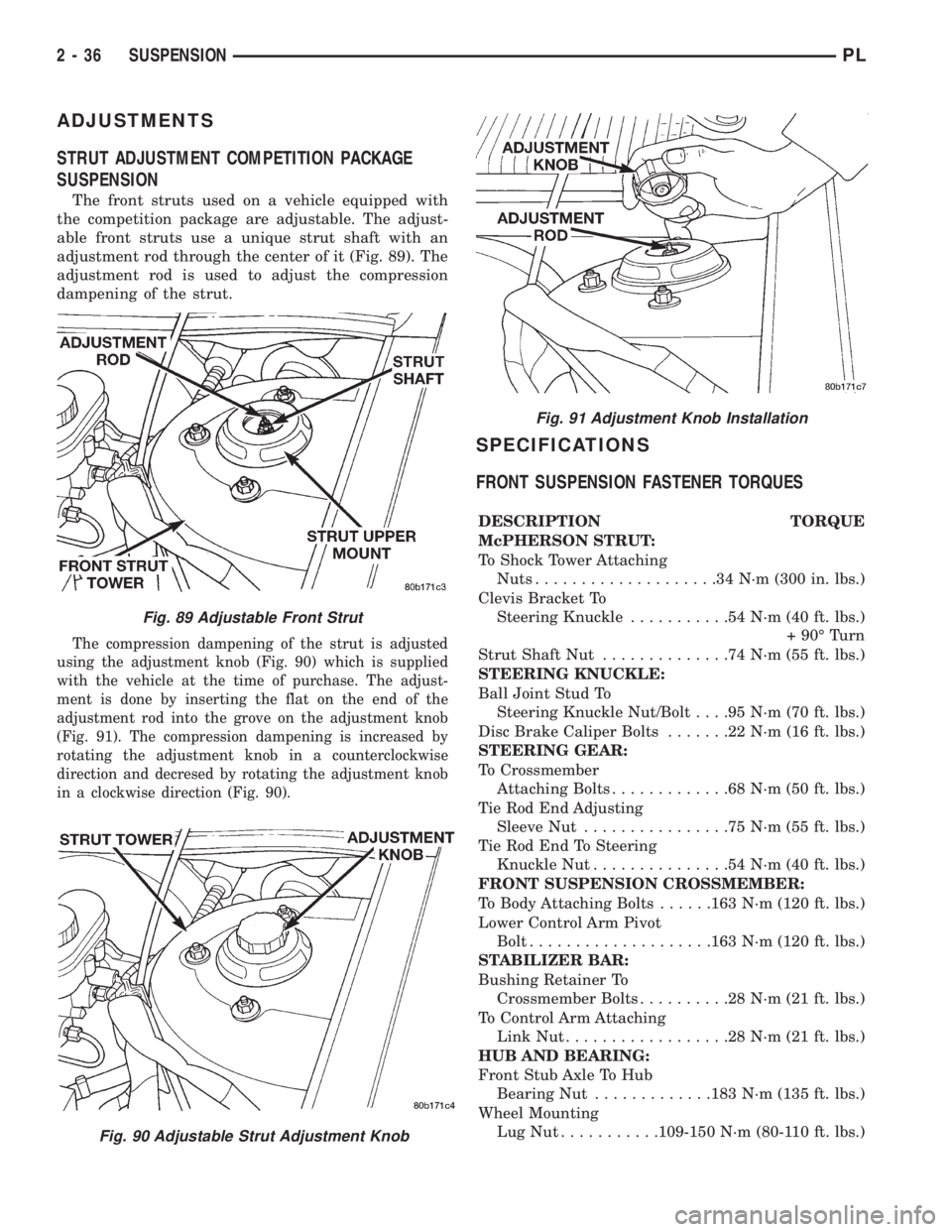
The front struts used on a vehicle equipped with
the competition package are adjustable. The adjust-
able front struts use a unique strut shaft with an
adjustment rod through the center of it (Fig. 89). The
adjustment rod is used to adjust the compression
dampening of the strut.
The compression dampening of the strut is adjusted
using the adjustment knob (Fig. 90) which is supplied
with the vehicle at the time of purchase. The adjust-
ment is done by inserting the flat on the end of the
adjustment rod into the grove on the adjustment knob
(Fig. 91). The compression dampening is increased by
rotating the adjustment knob in a counterclockwise
direction and decresed by rotating the adjustment knob
in a clockwise direction (Fig. 90).
SPECIFICATIONS
FRONT SUSPENSION FASTENER TORQUES
DESCRIPTION TORQUE
McPHERSON STRUT:
To Shock Tower Attaching
Nuts....................34N´m(300 in. lbs.)
Clevis Bracket To
Steering Knuckle...........54N´m(40ft.lbs.)
+ 90É Turn
Strut Shaft Nut..............74N´m(55ft.lbs.)
STEERING KNUCKLE:
Ball Joint Stud To
Steering Knuckle Nut/Bolt. . . .95 N´m (70 ft. lbs.)
Disc Brake Caliper Bolts.......22N´m(16ft.lbs.)
STEERING GEAR:
To Crossmember
Attaching Bolts.............68N´m(50ft.lbs.)
Tie Rod End Adjusting
Sleeve Nut................75N´m(55ft.lbs.)
Tie Rod End To Steering
Knuckle Nut...............54N´m(40ft.lbs.)
FRONT SUSPENSION CROSSMEMBER:
To Body Attaching Bolts......163 N´m (120 ft. lbs.)
Lower Control Arm Pivot
Bolt....................163 N´m (120 ft. lbs.)
STABILIZER BAR:
Bushing Retainer To
Crossmember Bolts..........28N´m(21ft.lbs.)
To Control Arm Attaching
Link Nut..................28N´m(21ft.lbs.)
HUB AND BEARING:
Front Stub Axle To Hub
Bearing Nut.............183 N´m (135 ft. lbs.)
Wheel Mounting
LugNut...........109-150 N´m (80-110 ft. lbs.)
Fig. 89 Adjustable Front Strut
Fig. 90 Adjustable Strut Adjustment Knob
Fig. 91 Adjustment Knob Installation
2 - 36 SUSPENSIONPL
Page 50 of 1200
REAR SUSPENSION
INDEX
page page
GENERAL INFORMATION
GENERAL INFORMATION................. 39
DESCRIPTION AND OPERATION
COIL SPRING........................... 41
COMPETITION PACKAGE SUSPENSION...... 41
KNUCKLE............................. 41
LATERAL LINKS AND TENSION STRUTS...... 41
REAR SUSPENSION..................... 39
STABILIZER BAR........................ 41
STRUT................................ 41
DIAGNOSIS AND TESTING
KNUCKLE............................. 42
LATERAL LINKS......................... 42
STABILIZER BAR AND BUSHINGS........... 43
STABILIZER BAR ATTACHING LINKS......... 43
STRUT INSPECTION (ON VEHICLE)......... 42
TENSION STRUT........................ 42
SERVICE PROCEDURES
REAR WHEEL ALIGNMENT................ 43REMOVAL AND INSTALLATION
COIL SPRING........................... 44
KNUCKLE............................. 46
LATERAL LINKS......................... 48
STABILIZER BAR........................ 45
STRUT ASSEMBLY...................... 43
DISASSEMBLY AND ASSEMBLY
STABILIZER BAR BUSHINGS............... 53
STRUT ASSEMBLY...................... 50
ADJUSTMENTS
STRUT ADJUSTMENT COMPETITION
PACKAGE SUSPENSION................ 53
SPECIFICATIONS
REAR SUSPENSION FASTENER TORQUE
SPECIFICATIONS...................... 54
SPECIAL TOOLS
REAR SUSPENSION..................... 54
GENERAL INFORMATION
GENERAL INFORMATION
CAUTION: Only frame contact or wheel lift hoisting
equipment can be used on vehicles having a fully
independent rear suspension. Vehicles with inde-
pendent rear suspension can not be hoisted using
equipment designed to lift a vehicle by the rear
axle. If this type of hoisting equipment is used dam-
age to rear suspension components will occur.
NOTE: If a rear suspension component becomes
bent, damaged or fails, no attempt should be made
to straighten or repair it. Always replace with a new
component.
DESCRIPTION AND OPERATION
REAR SUSPENSION
The rear suspension system used on this vehicle is
a fully independent type rear suspension system (Fig.
1).A forged rear knuckle is bolted to each rear strut.
The movement of the rear knuckle is controlled lat-
erally using lateral links going from the front and
rear of the knuckle to the rear crossmember. Fore
and aft movement of the knuckle is controlled by a
tension strut.
The lateral links and tension strut have rubber iso-
lator bushings at each end. The lateral links are
attached to the rear crossmember and knuckle, using
a common bolt and nut assembly at each end. The
tension strut bolts to the bottom of the knuckle and
to a bracket attached to the floor pan of the vehicle.
The lateral links, tension strut and spindle are
normally replaced only when the part has been dam-
aged or when the vehicle has been involved in an
accident. If a suspension part has been damaged, be
sure to check the underbody dimensions of the car. If
the underbody dimensions are not correct, the frame
of the vehicle must be straightened, before replace-
ment suspension components are installed.
PLSUSPENSION 2 - 39
Page 52 of 1200
COMPETITION PACKAGE SUSPENSION
On vehicles that are equipped with the optional
competition package, special rear struts are used.
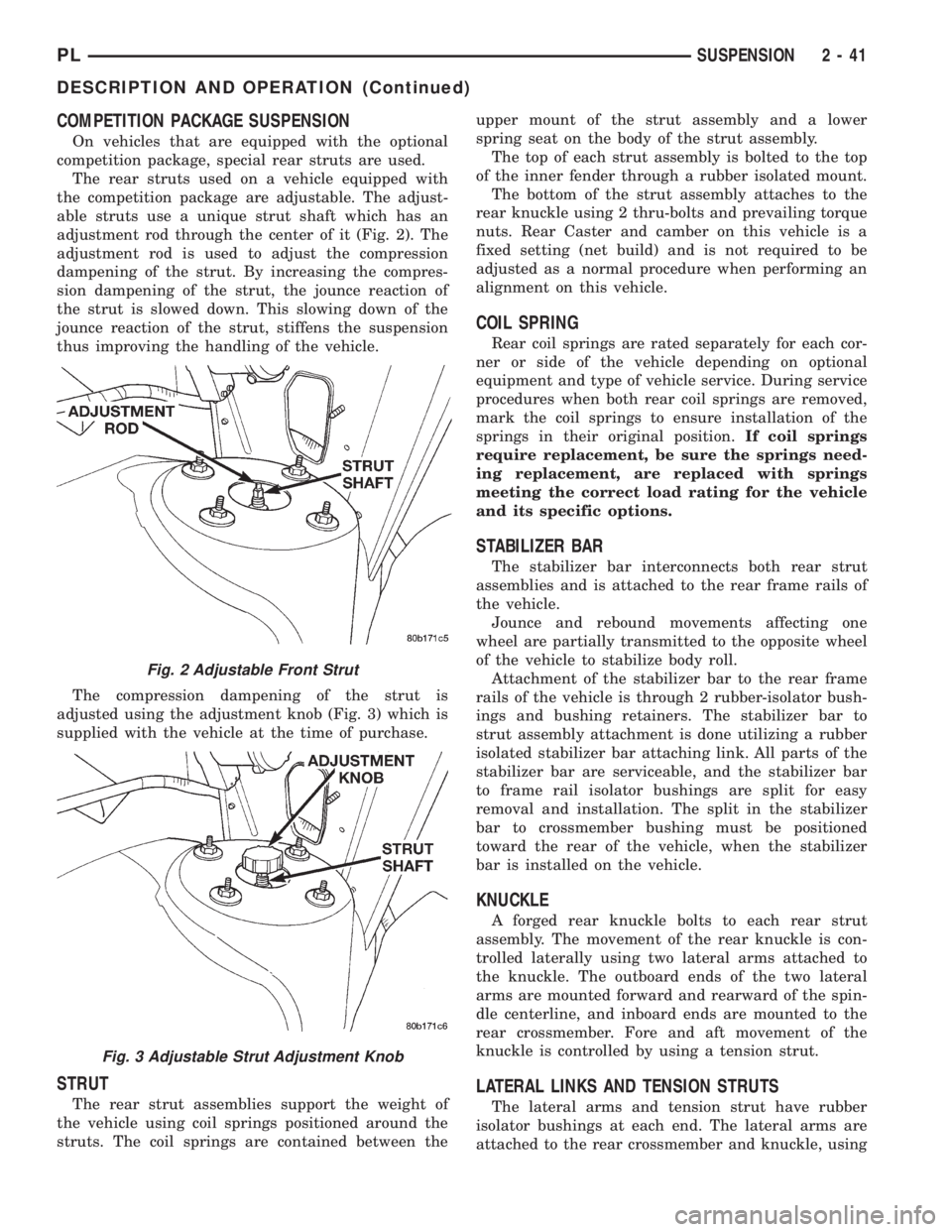
The rear struts used on a vehicle equipped with
the competition package are adjustable. The adjust-
able struts use a unique strut shaft which has an
adjustment rod through the center of it (Fig. 2). The
adjustment rod is used to adjust the compression
dampening of the strut. By increasing the compres-
sion dampening of the strut, the jounce reaction of
the strut is slowed down. This slowing down of the
jounce reaction of the strut, stiffens the suspension
thus improving the handling of the vehicle.
The compression dampening of the strut is
adjusted using the adjustment knob (Fig. 3) which is
supplied with the vehicle at the time of purchase.
STRUT
The rear strut assemblies support the weight of
the vehicle using coil springs positioned around the
struts. The coil springs are contained between theupper mount of the strut assembly and a lower
spring seat on the body of the strut assembly.
The top of each strut assembly is bolted to the top
of the inner fender through a rubber isolated mount.
The bottom of the strut assembly attaches to the
rear knuckle using 2 thru-bolts and prevailing torque
nuts. Rear Caster and camber on this vehicle is a
fixed setting (net build) and is not required to be
adjusted as a normal procedure when performing an
alignment on this vehicle.
COIL SPRING
Rear coil springs are rated separately for each cor-
ner or side of the vehicle depending on optional
equipment and type of vehicle service. During service
procedures when both rear coil springs are removed,
mark the coil springs to ensure installation of the
springs in their original position.If coil springs
require replacement, be sure the springs need-
ing replacement, are replaced with springs
meeting the correct load rating for the vehicle
and its specific options.
STABILIZER BAR
The stabilizer bar interconnects both rear strut
assemblies and is attached to the rear frame rails of
the vehicle.
Jounce and rebound movements affecting one
wheel are partially transmitted to the opposite wheel
of the vehicle to stabilize body roll.
Attachment of the stabilizer bar to the rear frame
rails of the vehicle is through 2 rubber-isolator bush-
ings and bushing retainers. The stabilizer bar to
strut assembly attachment is done utilizing a rubber
isolated stabilizer bar attaching link. All parts of the
stabilizer bar are serviceable, and the stabilizer bar
to frame rail isolator bushings are split for easy
removal and installation. The split in the stabilizer
bar to crossmember bushing must be positioned
toward the rear of the vehicle, when the stabilizer
bar is installed on the vehicle.
KNUCKLE
A forged rear knuckle bolts to each rear strut
assembly. The movement of the rear knuckle is con-
trolled laterally using two lateral arms attached to
the knuckle. The outboard ends of the two lateral
arms are mounted forward and rearward of the spin-
dle centerline, and inboard ends are mounted to the
rear crossmember. Fore and aft movement of the
knuckle is controlled by using a tension strut.
LATERAL LINKS AND TENSION STRUTS
The lateral arms and tension strut have rubber
isolator bushings at each end. The lateral arms are
attached to the rear crossmember and knuckle, using
Fig. 2 Adjustable Front Strut
Fig. 3 Adjustable Strut Adjustment Knob
PLSUSPENSION 2 - 41
DESCRIPTION AND OPERATION (Continued)
Page 55 of 1200
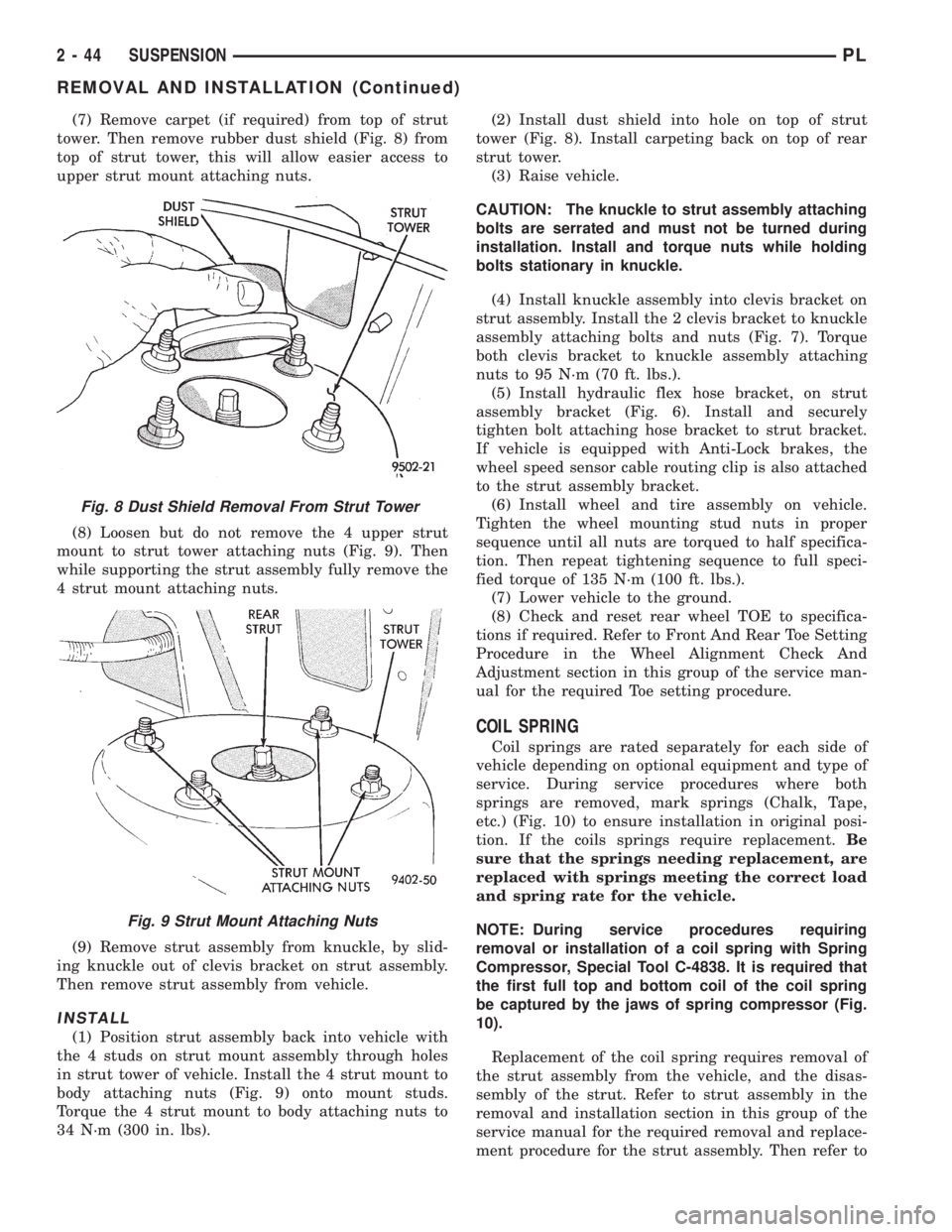
(7) Remove carpet (if required) from top of strut
tower. Then remove rubber dust shield (Fig. 8) from
top of strut tower, this will allow easier access to
upper strut mount attaching nuts.
(8) Loosen but do not remove the 4 upper strut
mount to strut tower attaching nuts (Fig. 9). Then
while supporting the strut assembly fully remove the
4 strut mount attaching nuts.
(9) Remove strut assembly from knuckle, by slid-
ing knuckle out of clevis bracket on strut assembly.
Then remove strut assembly from vehicle.
INSTALL
(1) Position strut assembly back into vehicle with
the 4 studs on strut mount assembly through holes
in strut tower of vehicle. Install the 4 strut mount to
body attaching nuts (Fig. 9) onto mount studs.
Torque the 4 strut mount to body attaching nuts to
34 N´m (300 in. lbs).(2) Install dust shield into hole on top of strut
tower (Fig. 8). Install carpeting back on top of rear
strut tower.
(3) Raise vehicle.
CAUTION: The knuckle to strut assembly attaching
bolts are serrated and must not be turned during
installation. Install and torque nuts while holding
bolts stationary in knuckle.
(4) Install knuckle assembly into clevis bracket on
strut assembly. Install the 2 clevis bracket to knuckle
assembly attaching bolts and nuts (Fig. 7). Torque
both clevis bracket to knuckle assembly attaching
nuts to 95 N´m (70 ft. lbs.).
(5) Install hydraulic flex hose bracket, on strut
assembly bracket (Fig. 6). Install and securely
tighten bolt attaching hose bracket to strut bracket.
If vehicle is equipped with Anti-Lock brakes, the
wheel speed sensor cable routing clip is also attached
to the strut assembly bracket.
(6) Install wheel and tire assembly on vehicle.
Tighten the wheel mounting stud nuts in proper
sequence until all nuts are torqued to half specifica-
tion. Then repeat tightening sequence to full speci-
fied torque of 135 N´m (100 ft. lbs.).
(7) Lower vehicle to the ground.
(8) Check and reset rear wheel TOE to specifica-
tions if required. Refer to Front And Rear Toe Setting
Procedure in the Wheel Alignment Check And
Adjustment section in this group of the service man-
ual for the required Toe setting procedure.
COIL SPRING
Coil springs are rated separately for each side of
vehicle depending on optional equipment and type of
service. During service procedures where both
springs are removed, mark springs (Chalk, Tape,
etc.) (Fig. 10) to ensure installation in original posi-
tion. If the coils springs require replacement.Be
sure that the springs needing replacement, are
replaced with springs meeting the correct load
and spring rate for the vehicle.
NOTE: During service procedures requiring
removal or installation of a coil spring with Spring
Compressor, Special Tool C-4838. It is required that
the first full top and bottom coil of the coil spring
be captured by the jaws of spring compressor (Fig.
10).
Replacement of the coil spring requires removal of
the strut assembly from the vehicle, and the disas-
sembly of the strut. Refer to strut assembly in the
removal and installation section in this group of the
service manual for the required removal and replace-
ment procedure for the strut assembly. Then refer to
Fig. 8 Dust Shield Removal From Strut Tower
Fig. 9 Strut Mount Attaching Nuts
2 - 44 SUSPENSIONPL
REMOVAL AND INSTALLATION (Continued)
Page 57 of 1200
sequence until all nuts are torqued to half specifica-
tion. Then repeat the tightening sequence to the full
specified torque of 129 N´m (95 ft. lbs.).
(5) Lower the vehicle to the ground.
(6) With suspension supporting the full weight of
the vehicle, securely tighten the stabilizer bar
retainer to frame rail attaching bolts (Fig. 11).
KNUCKLE
REMOVE
(1) Raise vehicle on jackstands or centered on a
frame contact type hoist. See Hoisting in the Lubri-
cation and Maintenance section of this manual, for
the required lifting procedure to be used for this
vehicle.
(2) Remove the rear wheel and tire.
(3) If vehicle is equipped with rear disc brakes,
remove the rear caliper from the adapter. Refer to
Rear Disk Brakes in Group 5 Brakes of this Service
manual for required caliper removal procedure. After
removing the caliper, store the caliper by hanging it
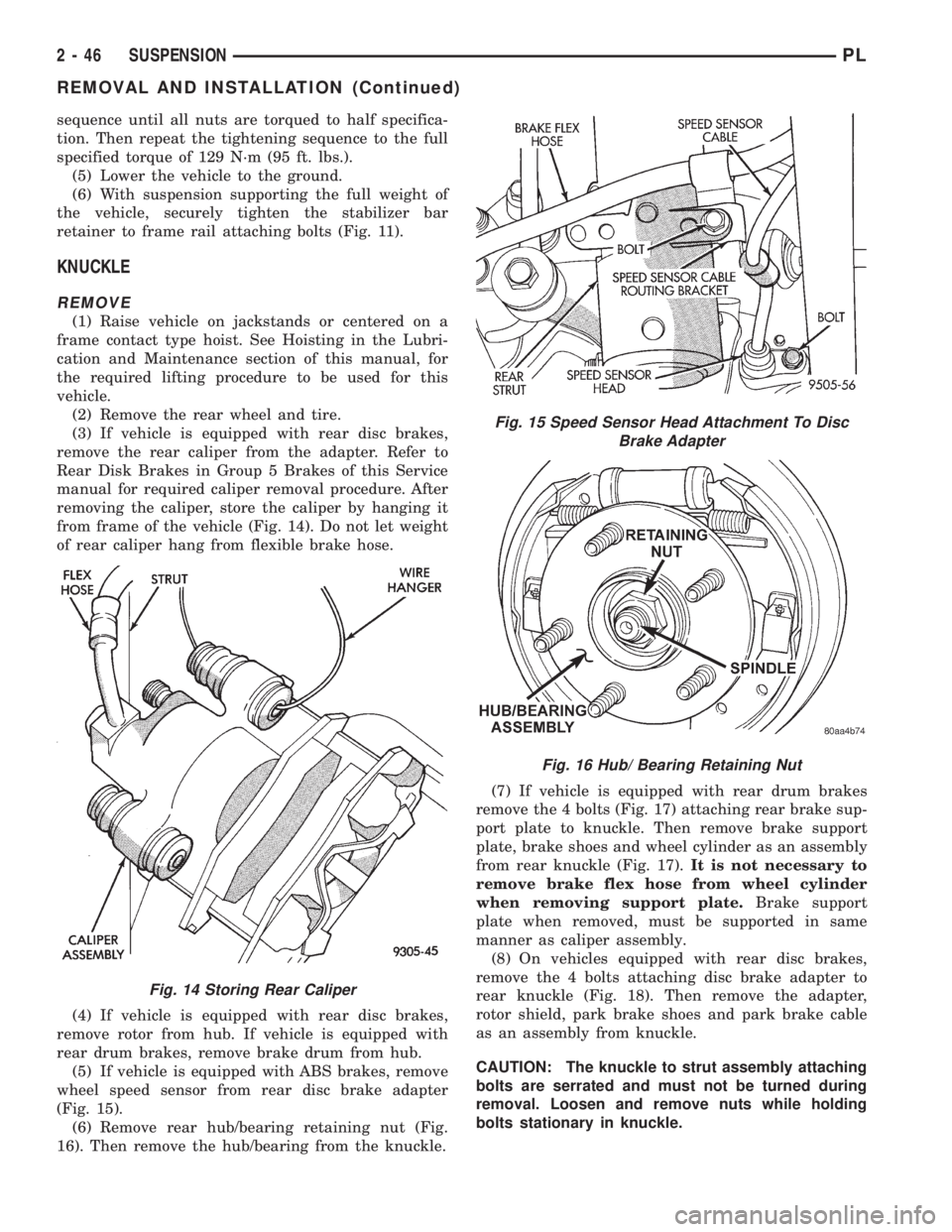
from frame of the vehicle (Fig. 14). Do not let weight
of rear caliper hang from flexible brake hose.
(4) If vehicle is equipped with rear disc brakes,
remove rotor from hub. If vehicle is equipped with
rear drum brakes, remove brake drum from hub.
(5) If vehicle is equipped with ABS brakes, remove
wheel speed sensor from rear disc brake adapter
(Fig. 15).
(6) Remove rear hub/bearing retaining nut (Fig.
16). Then remove the hub/bearing from the knuckle.(7) If vehicle is equipped with rear drum brakes
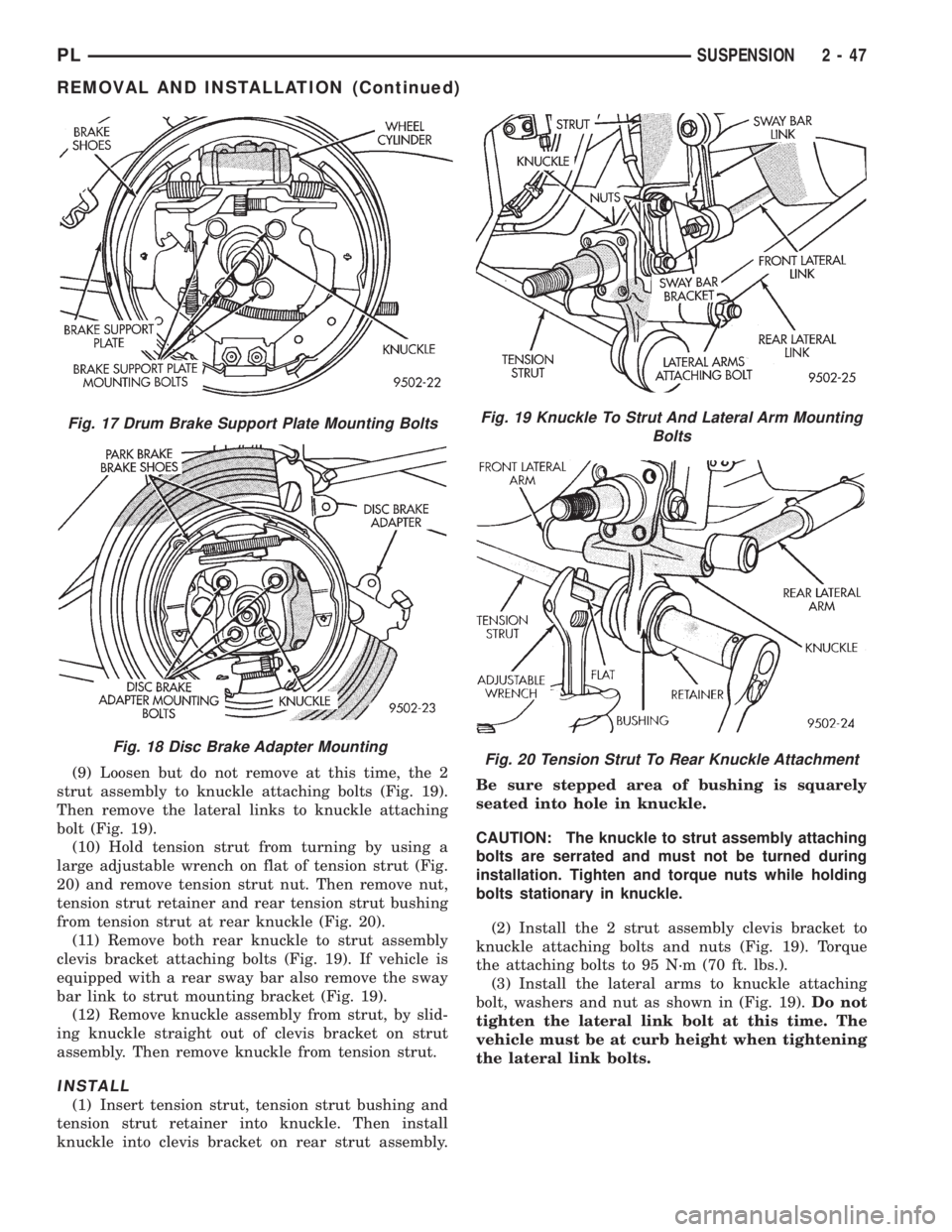
remove the 4 bolts (Fig. 17) attaching rear brake sup-
port plate to knuckle. Then remove brake support
plate, brake shoes and wheel cylinder as an assembly
from rear knuckle (Fig. 17).It is not necessary to
remove brake flex hose from wheel cylinder
when removing support plate.Brake support
plate when removed, must be supported in same
manner as caliper assembly.
(8) On vehicles equipped with rear disc brakes,
remove the 4 bolts attaching disc brake adapter to
rear knuckle (Fig. 18). Then remove the adapter,
rotor shield, park brake shoes and park brake cable
as an assembly from knuckle.
CAUTION: The knuckle to strut assembly attaching
bolts are serrated and must not be turned during
removal. Loosen and remove nuts while holding
bolts stationary in knuckle.
Fig. 14 Storing Rear Caliper
Fig. 15 Speed Sensor Head Attachment To Disc
Brake Adapter
Fig. 16 Hub/ Bearing Retaining Nut
2 - 46 SUSPENSIONPL
REMOVAL AND INSTALLATION (Continued)
Page 58 of 1200
(9) Loosen but do not remove at this time, the 2
strut assembly to knuckle attaching bolts (Fig. 19).
Then remove the lateral links to knuckle attaching
bolt (Fig. 19).
(10) Hold tension strut from turning by using a
large adjustable wrench on flat of tension strut (Fig.
20) and remove tension strut nut. Then remove nut,
tension strut retainer and rear tension strut bushing
from tension strut at rear knuckle (Fig. 20).
(11) Remove both rear knuckle to strut assembly
clevis bracket attaching bolts (Fig. 19). If vehicle is
equipped with a rear sway bar also remove the sway
bar link to strut mounting bracket (Fig. 19).
(12) Remove knuckle assembly from strut, by slid-
ing knuckle straight out of clevis bracket on strut
assembly. Then remove knuckle from tension strut.
INSTALL
(1) Insert tension strut, tension strut bushing and
tension strut retainer into knuckle. Then install
knuckle into clevis bracket on rear strut assembly.Be sure stepped area of bushing is squarely
seated into hole in knuckle.
CAUTION: The knuckle to strut assembly attaching
bolts are serrated and must not be turned during
installation. Tighten and torque nuts while holding
bolts stationary in knuckle.
(2) Install the 2 strut assembly clevis bracket to
knuckle attaching bolts and nuts (Fig. 19). Torque
the attaching bolts to 95 N´m (70 ft. lbs.).
(3) Install the lateral arms to knuckle attaching
bolt, washers and nut as shown in (Fig. 19).Do not
tighten the lateral link bolt at this time. The
vehicle must be at curb height when tightening
the lateral link bolts.
Fig. 17 Drum Brake Support Plate Mounting Bolts
Fig. 18 Disc Brake Adapter Mounting
Fig. 19 Knuckle To Strut And Lateral Arm Mounting
Bolts
Fig. 20 Tension Strut To Rear Knuckle Attachment
PLSUSPENSION 2 - 47
REMOVAL AND INSTALLATION (Continued)
Page 59 of 1200
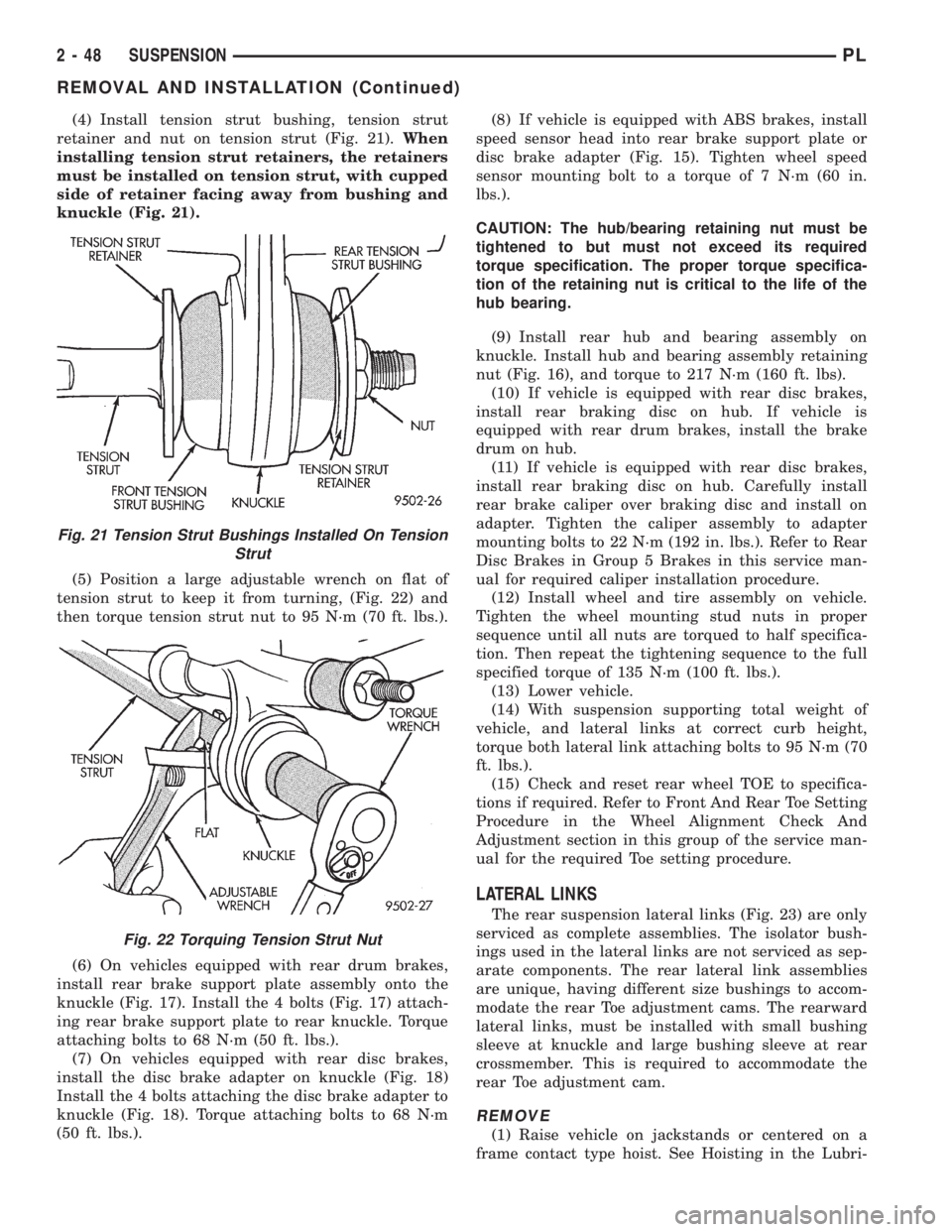
(4) Install tension strut bushing, tension strut
retainer and nut on tension strut (Fig. 21).When
installing tension strut retainers, the retainers
must be installed on tension strut, with cupped
side of retainer facing away from bushing and
knuckle (Fig. 21).
(5) Position a large adjustable wrench on flat of
tension strut to keep it from turning, (Fig. 22) and
then torque tension strut nut to 95 N´m (70 ft. lbs.).
(6) On vehicles equipped with rear drum brakes,
install rear brake support plate assembly onto the
knuckle (Fig. 17). Install the 4 bolts (Fig. 17) attach-
ing rear brake support plate to rear knuckle. Torque
attaching bolts to 68 N´m (50 ft. lbs.).
(7) On vehicles equipped with rear disc brakes,
install the disc brake adapter on knuckle (Fig. 18)
Install the 4 bolts attaching the disc brake adapter to
knuckle (Fig. 18). Torque attaching bolts to 68 N´m
(50 ft. lbs.).(8) If vehicle is equipped with ABS brakes, install
speed sensor head into rear brake support plate or
disc brake adapter (Fig. 15). Tighten wheel speed
sensor mounting bolt to a torque of 7 N´m (60 in.
lbs.).
CAUTION: The hub/bearing retaining nut must be
tightened to but must not exceed its required
torque specification. The proper torque specifica-
tion of the retaining nut is critical to the life of the
hub bearing.
(9) Install rear hub and bearing assembly on
knuckle. Install hub and bearing assembly retaining
nut (Fig. 16), and torque to 217 N´m (160 ft. lbs).
(10) If vehicle is equipped with rear disc brakes,
install rear braking disc on hub. If vehicle is
equipped with rear drum brakes, install the brake
drum on hub.
(11) If vehicle is equipped with rear disc brakes,
install rear braking disc on hub. Carefully install
rear brake caliper over braking disc and install on
adapter. Tighten the caliper assembly to adapter
mounting bolts to 22 N´m (192 in. lbs.). Refer to Rear
Disc Brakes in Group 5 Brakes in this service man-
ual for required caliper installation procedure.
(12) Install wheel and tire assembly on vehicle.
Tighten the wheel mounting stud nuts in proper
sequence until all nuts are torqued to half specifica-
tion. Then repeat the tightening sequence to the full
specified torque of 135 N´m (100 ft. lbs.).
(13) Lower vehicle.
(14) With suspension supporting total weight of
vehicle, and lateral links at correct curb height,
torque both lateral link attaching bolts to 95 N´m (70
ft. lbs.).
(15) Check and reset rear wheel TOE to specifica-
tions if required. Refer to Front And Rear Toe Setting
Procedure in the Wheel Alignment Check And
Adjustment section in this group of the service man-
ual for the required Toe setting procedure.
LATERAL LINKS
The rear suspension lateral links (Fig. 23) are only
serviced as complete assemblies. The isolator bush-
ings used in the lateral links are not serviced as sep-
arate components. The rear lateral link assemblies
are unique, having different size bushings to accom-
modate the rear Toe adjustment cams. The rearward
lateral links, must be installed with small bushing
sleeve at knuckle and large bushing sleeve at rear
crossmember. This is required to accommodate the
rear Toe adjustment cam.
REMOVE
(1) Raise vehicle on jackstands or centered on a
frame contact type hoist. See Hoisting in the Lubri-
Fig. 21 Tension Strut Bushings Installed On Tension
Strut
Fig. 22 Torquing Tension Strut Nut
2 - 48 SUSPENSIONPL
REMOVAL AND INSTALLATION (Continued)
Page 61 of 1200
link mounting bolt at crossmember MUST be
installed, with head of bolt facing rear of vehi-
cle. The long attaching bolt must be used at
rear crossmember and short bolt used at
knuckle.
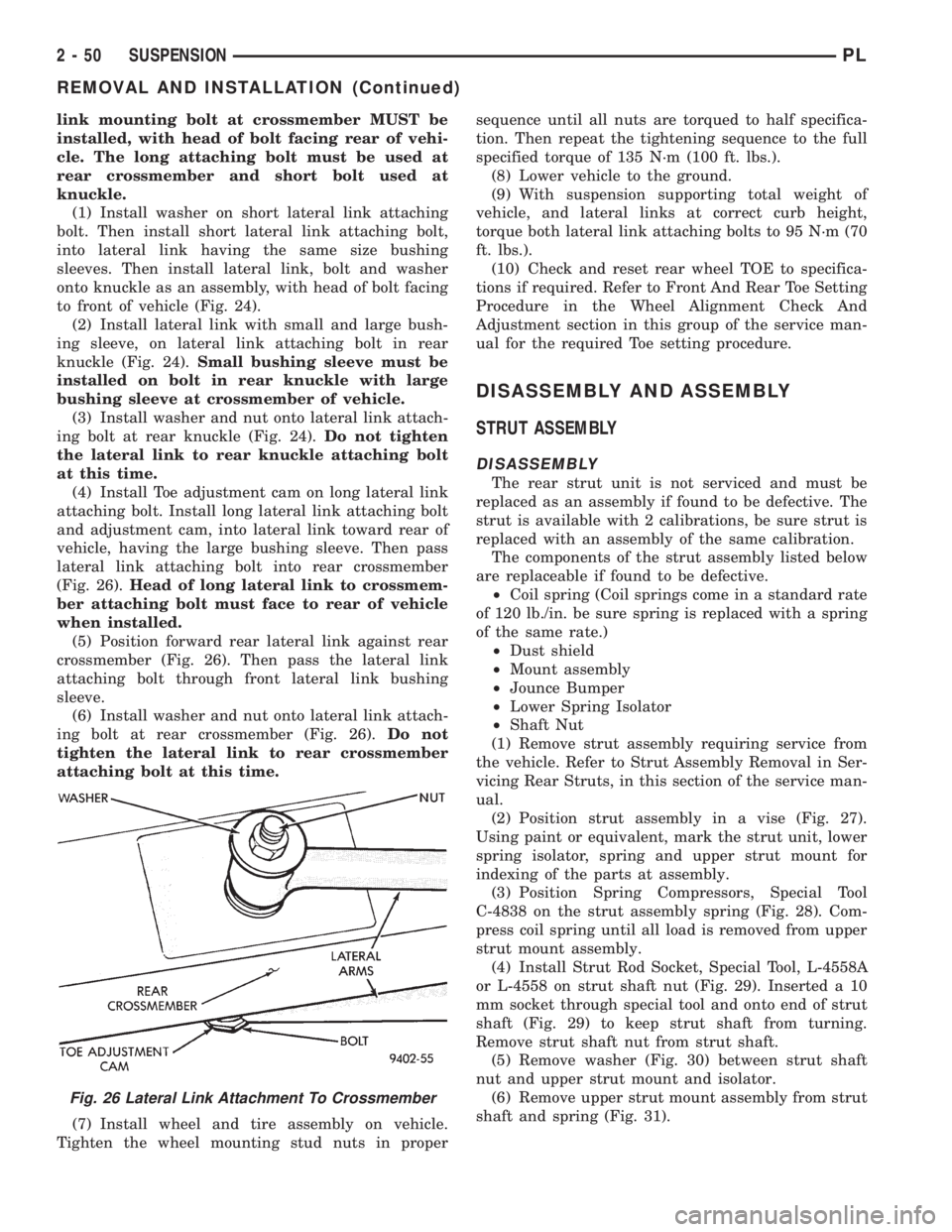
(1) Install washer on short lateral link attaching
bolt. Then install short lateral link attaching bolt,
into lateral link having the same size bushing
sleeves. Then install lateral link, bolt and washer
onto knuckle as an assembly, with head of bolt facing
to front of vehicle (Fig. 24).
(2) Install lateral link with small and large bush-
ing sleeve, on lateral link attaching bolt in rear
knuckle (Fig. 24).Small bushing sleeve must be
installed on bolt in rear knuckle with large
bushing sleeve at crossmember of vehicle.
(3) Install washer and nut onto lateral link attach-
ing bolt at rear knuckle (Fig. 24).Do not tighten
the lateral link to rear knuckle attaching bolt
at this time.
(4) Install Toe adjustment cam on long lateral link
attaching bolt. Install long lateral link attaching bolt
and adjustment cam, into lateral link toward rear of
vehicle, having the large bushing sleeve. Then pass
lateral link attaching bolt into rear crossmember
(Fig. 26).Head of long lateral link to crossmem-
ber attaching bolt must face to rear of vehicle
when installed.
(5) Position forward rear lateral link against rear
crossmember (Fig. 26). Then pass the lateral link
attaching bolt through front lateral link bushing
sleeve.
(6) Install washer and nut onto lateral link attach-
ing bolt at rear crossmember (Fig. 26).Do not
tighten the lateral link to rear crossmember
attaching bolt at this time.
(7) Install wheel and tire assembly on vehicle.
Tighten the wheel mounting stud nuts in propersequence until all nuts are torqued to half specifica-
tion. Then repeat the tightening sequence to the full
specified torque of 135 N´m (100 ft. lbs.).
(8) Lower vehicle to the ground.
(9) With suspension supporting total weight of
vehicle, and lateral links at correct curb height,
torque both lateral link attaching bolts to 95 N´m (70
ft. lbs.).
(10) Check and reset rear wheel TOE to specifica-
tions if required. Refer to Front And Rear Toe Setting
Procedure in the Wheel Alignment Check And
Adjustment section in this group of the service man-
ual for the required Toe setting procedure.
DISASSEMBLY AND ASSEMBLY
STRUT ASSEMBLY
DISASSEMBLY
The rear strut unit is not serviced and must be
replaced as an assembly if found to be defective. The
strut is available with 2 calibrations, be sure strut is
replaced with an assembly of the same calibration.
The components of the strut assembly listed below
are replaceable if found to be defective.
²Coil spring (Coil springs come in a standard rate
of 120 lb./in. be sure spring is replaced with a spring
of the same rate.)
²Dust shield
²Mount assembly
²Jounce Bumper
²Lower Spring Isolator
²Shaft Nut
(1) Remove strut assembly requiring service from
the vehicle. Refer to Strut Assembly Removal in Ser-
vicing Rear Struts, in this section of the service man-
ual.
(2) Position strut assembly in a vise (Fig. 27).
Using paint or equivalent, mark the strut unit, lower
spring isolator, spring and upper strut mount for
indexing of the parts at assembly.
(3) Position Spring Compressors, Special Tool
C-4838 on the strut assembly spring (Fig. 28). Com-
press coil spring until all load is removed from upper
strut mount assembly.
(4) Install Strut Rod Socket, Special Tool, L-4558A
or L-4558 on strut shaft nut (Fig. 29). Inserted a 10
mm socket through special tool and onto end of strut
shaft (Fig. 29) to keep strut shaft from turning.
Remove strut shaft nut from strut shaft.
(5) Remove washer (Fig. 30) between strut shaft
nut and upper strut mount and isolator.
(6) Remove upper strut mount assembly from strut
shaft and spring (Fig. 31).
Fig. 26 Lateral Link Attachment To Crossmember
2 - 50 SUSPENSIONPL
REMOVAL AND INSTALLATION (Continued)
Page 63 of 1200
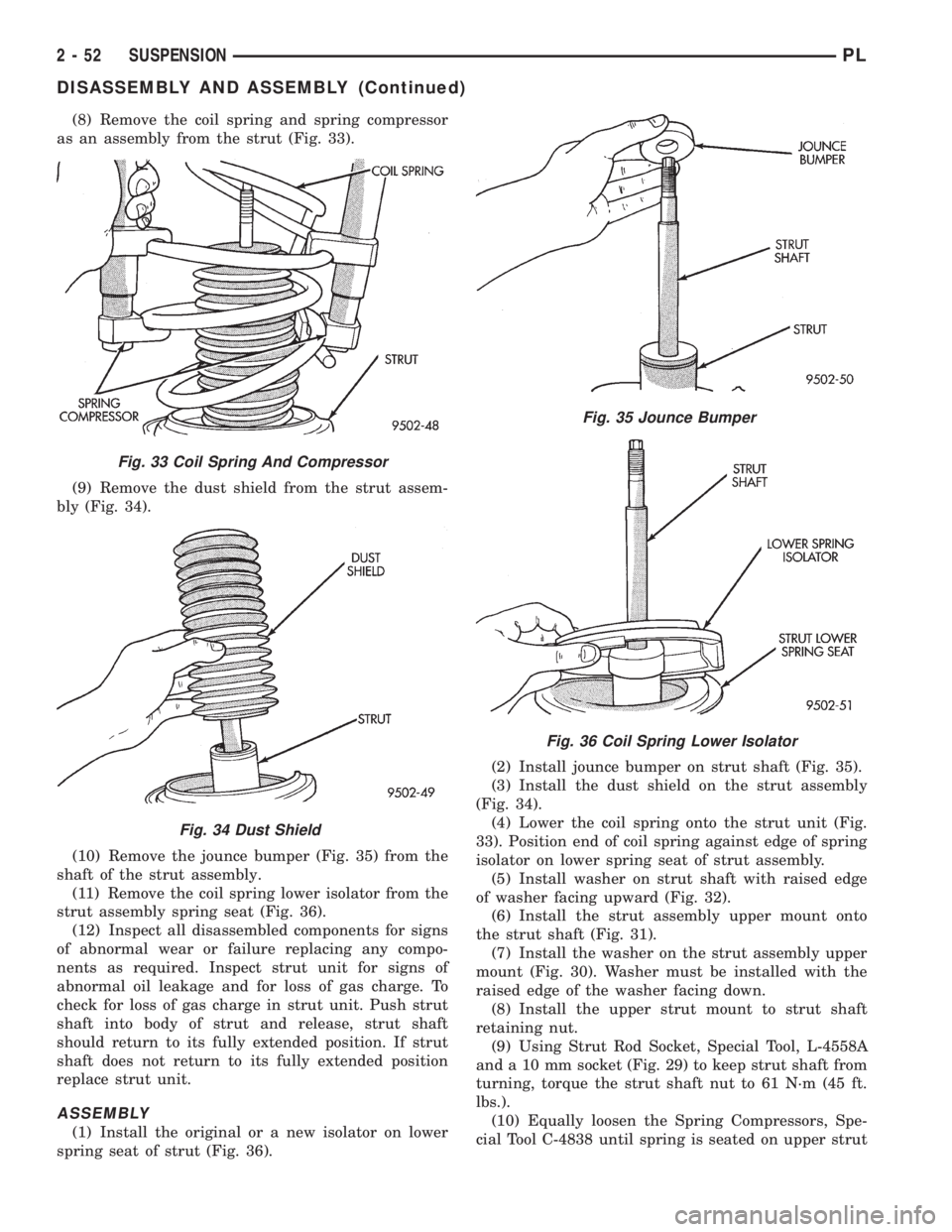
(8) Remove the coil spring and spring compressor
as an assembly from the strut (Fig. 33).
(9) Remove the dust shield from the strut assem-
bly (Fig. 34).
(10) Remove the jounce bumper (Fig. 35) from the
shaft of the strut assembly.
(11) Remove the coil spring lower isolator from the
strut assembly spring seat (Fig. 36).
(12) Inspect all disassembled components for signs
of abnormal wear or failure replacing any compo-
nents as required. Inspect strut unit for signs of
abnormal oil leakage and for loss of gas charge. To
check for loss of gas charge in strut unit. Push strut
shaft into body of strut and release, strut shaft
should return to its fully extended position. If strut
shaft does not return to its fully extended position
replace strut unit.
ASSEMBLY
(1) Install the original or a new isolator on lower
spring seat of strut (Fig. 36).(2) Install jounce bumper on strut shaft (Fig. 35).
(3) Install the dust shield on the strut assembly
(Fig. 34).
(4) Lower the coil spring onto the strut unit (Fig.
33). Position end of coil spring against edge of spring
isolator on lower spring seat of strut assembly.
(5) Install washer on strut shaft with raised edge
of washer facing upward (Fig. 32).
(6) Install the strut assembly upper mount onto
the strut shaft (Fig. 31).
(7) Install the washer on the strut assembly upper
mount (Fig. 30). Washer must be installed with the
raised edge of the washer facing down.
(8) Install the upper strut mount to strut shaft
retaining nut.
(9) Using Strut Rod Socket, Special Tool, L-4558A
and a 10 mm socket (Fig. 29) to keep strut shaft from
turning, torque the strut shaft nut to 61 N´m (45 ft.
lbs.).
(10) Equally loosen the Spring Compressors, Spe-
cial Tool C-4838 until spring is seated on upper strut
Fig. 33 Coil Spring And Compressor
Fig. 34 Dust Shield
Fig. 35 Jounce Bumper
Fig. 36 Coil Spring Lower Isolator
2 - 52 SUSPENSIONPL
DISASSEMBLY AND ASSEMBLY (Continued)
Page 65 of 1200
SPECIFICATIONS
REAR SUSPENSION FASTENER TORQUE
SPECIFICATIONS
DESCRIPTION TORQUE
STRUT ASSEMBLY:
To Body Attaching Nuts.......34N´m(300 in. lbs.)
Clevis Bracket To Knuckle
Nut/Bolt..................95N´m(70ft.lbs.)
Strut Assembly Shaft Nut.......75N´m(55ft.lbs.)
BRAKE SUPPORT PLATE:
To Knuckle Bolts..............68N´m(50ft.lbs.)
STABILIZER BAR:
Bushing Retainer To
Frame Bolt...............34N´m(300 in. lbs.)
To Strut Attaching Link Nut . . .34 N´m (300 in. lbs.)
TENSION STRUT:
Shaft Nut...................95N´m(70ft.lbs.)
Bracket To Body Attaching
Bolts.....................95N´m(70ft.lbs.)
LATERAL LINK:
Attaching Nut................95N´m(70ft.lbs.)
DISC BRAKE CALIPER:
To Adapter Mounting Bolt......22N´m(16ft.lbs.)
Brake Hose To Caliper
Mounting Bolt..............45N´m(35ft.lbs.)
Adapter To Knuckle
Mounting Bolt..............68N´m(50ft.lbs.)
BRAKE HOSE:
Bracket Mounting Bolt........23N´m(17ft.lbs.)
HUB AND BEARING:
To Knuckle Retaining Nut.....216 N´m (160 ft. lbs.)
Wheel Stud Lug Nuts
(All Wheel Types). . . .109-150 N´m (80-110 ft. lbs.)
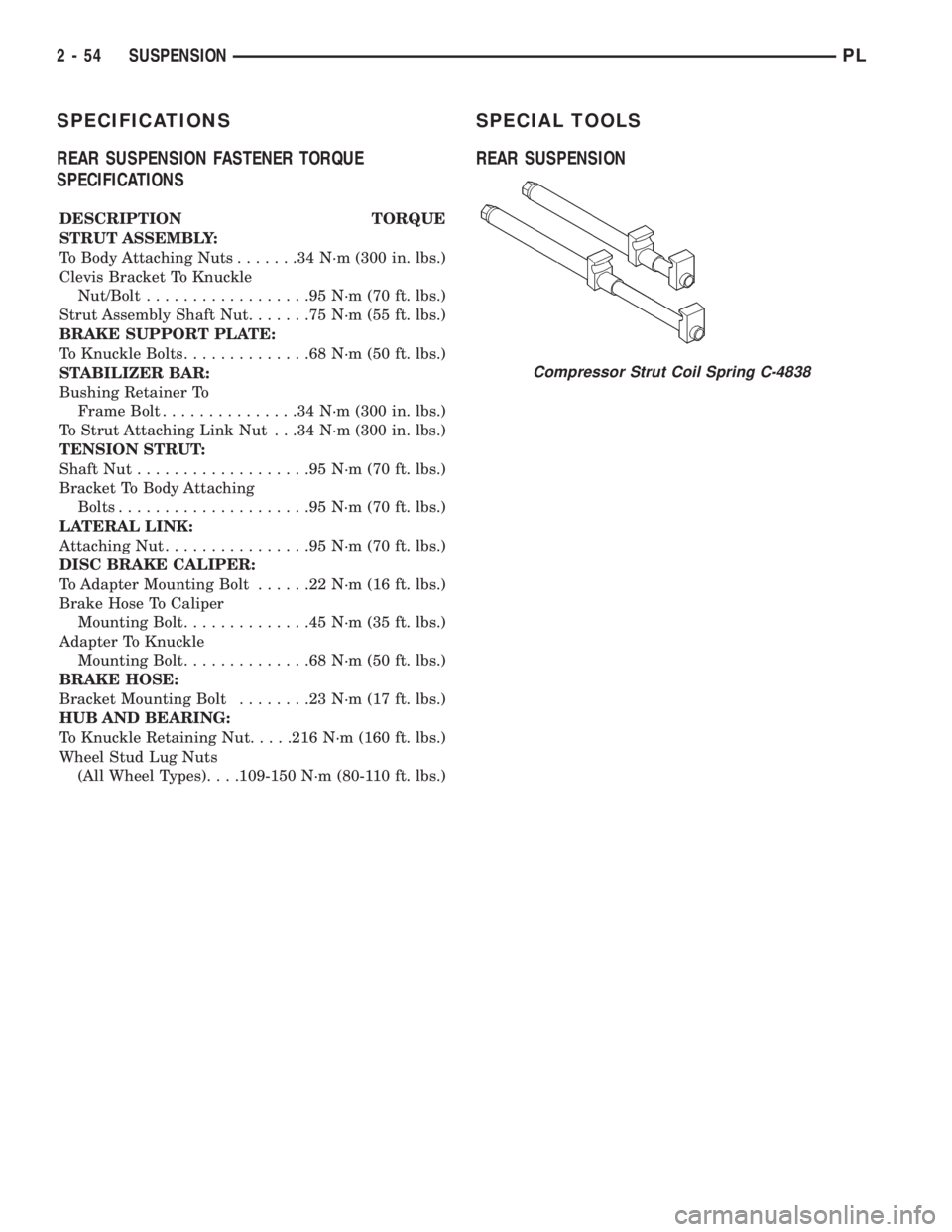
SPECIAL TOOLS
REAR SUSPENSION
Compressor Strut Coil Spring C-4838
2 - 54 SUSPENSIONPL