wheel bolts DODGE NEON 2000 Service User Guide
[x] Cancel search | Manufacturer: DODGE, Model Year: 2000, Model line: NEON, Model: DODGE NEON 2000Pages: 1285, PDF Size: 29.42 MB
Page 32 of 1285
(4) Lower the vehicle.
NOTE: It may be necessary to put the vehicle on a
platform hoist or alignment rack to gain access to
the stabilizer bar mounting bolts with the vehicle at
curb height.
(5) Tighten each stabilizer bar link by holding the
upper retainer/nut with a wrench and turning the
link bolt. Tighten each link bolt to a torque of 23
N´m (200 in. lbs.).
(6) Tighten the stabilizer bar cushion retainer
bolts to a torque of 28 N´m (250 in. lbs.).
WHEEL MOUNTING STUD (FRONT)
NOTE: Before proceeding with this procedure,
review SERVICE WARNINGS AND CAUTIONS at the
beginning of REMOVAL AND INSTALLATION in this
section.
Use the following procedure to remove and install
one of five studs on one wheel hub.
REMOVAL
(1) Raise the vehicle. Refer to HOISTING in the
LUBRICATION AND MAINTENANCE group for the
proper lifting procedure.
(2) Remove the front tire and wheel assembly.
(3) Remove the two guide pin bolts securing the
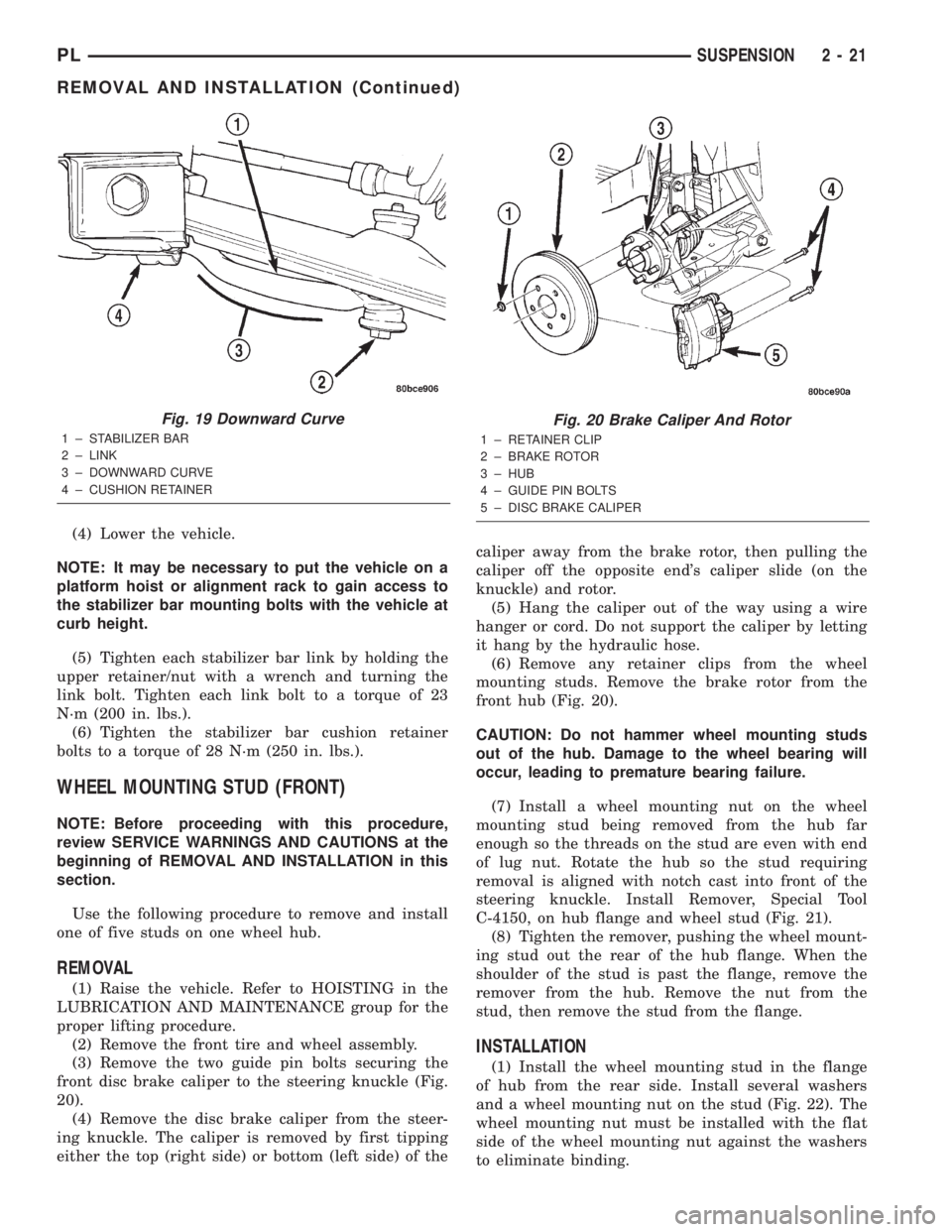
front disc brake caliper to the steering knuckle (Fig.
20).
(4) Remove the disc brake caliper from the steer-
ing knuckle. The caliper is removed by first tipping
either the top (right side) or bottom (left side) of thecaliper away from the brake rotor, then pulling the
caliper off the opposite end's caliper slide (on the
knuckle) and rotor.
(5) Hang the caliper out of the way using a wire
hanger or cord. Do not support the caliper by letting
it hang by the hydraulic hose.
(6) Remove any retainer clips from the wheel
mounting studs. Remove the brake rotor from the
front hub (Fig. 20).
CAUTION: Do not hammer wheel mounting studs
out of the hub. Damage to the wheel bearing will
occur, leading to premature bearing failure.
(7) Install a wheel mounting nut on the wheel
mounting stud being removed from the hub far
enough so the threads on the stud are even with end
of lug nut. Rotate the hub so the stud requiring
removal is aligned with notch cast into front of the
steering knuckle. Install Remover, Special Tool
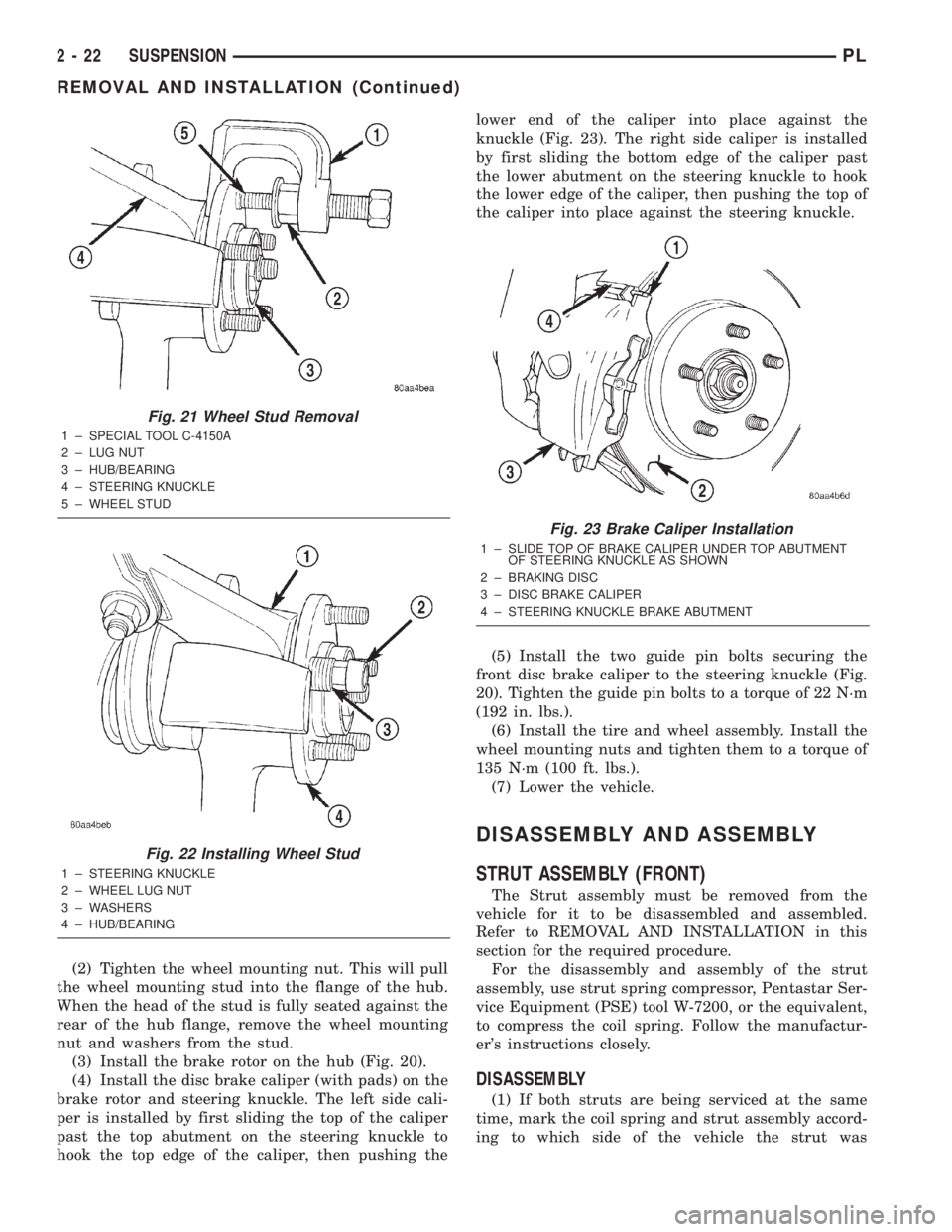
C-4150, on hub flange and wheel stud (Fig. 21).
(8) Tighten the remover, pushing the wheel mount-
ing stud out the rear of the hub flange. When the
shoulder of the stud is past the flange, remove the
remover from the hub. Remove the nut from the
stud, then remove the stud from the flange.
INSTALLATION
(1) Install the wheel mounting stud in the flange
of hub from the rear side. Install several washers
and a wheel mounting nut on the stud (Fig. 22). The
wheel mounting nut must be installed with the flat
side of the wheel mounting nut against the washers
to eliminate binding.
Fig. 19 Downward Curve
1 ± STABILIZER BAR
2 ± LINK
3 ± DOWNWARD CURVE
4 ± CUSHION RETAINER
Fig. 20 Brake Caliper And Rotor
1 ± RETAINER CLIP
2 ± BRAKE ROTOR
3 ± HUB
4 ± GUIDE PIN BOLTS
5 ± DISC BRAKE CALIPER
PLSUSPENSION 2 - 21
REMOVAL AND INSTALLATION (Continued)
Page 33 of 1285
(2) Tighten the wheel mounting nut. This will pull
the wheel mounting stud into the flange of the hub.
When the head of the stud is fully seated against the
rear of the hub flange, remove the wheel mounting
nut and washers from the stud.
(3) Install the brake rotor on the hub (Fig. 20).
(4) Install the disc brake caliper (with pads) on the
brake rotor and steering knuckle. The left side cali-
per is installed by first sliding the top of the caliper
past the top abutment on the steering knuckle to
hook the top edge of the caliper, then pushing thelower end of the caliper into place against the
knuckle (Fig. 23). The right side caliper is installed
by first sliding the bottom edge of the caliper past
the lower abutment on the steering knuckle to hook
the lower edge of the caliper, then pushing the top of
the caliper into place against the steering knuckle.
(5) Install the two guide pin bolts securing the
front disc brake caliper to the steering knuckle (Fig.
20). Tighten the guide pin bolts to a torque of 22 N´m
(192 in. lbs.).
(6) Install the tire and wheel assembly. Install the
wheel mounting nuts and tighten them to a torque of
135 N´m (100 ft. lbs.).
(7) Lower the vehicle.
DISASSEMBLY AND ASSEMBLY
STRUT ASSEMBLY (FRONT)
The Strut assembly must be removed from the
vehicle for it to be disassembled and assembled.
Refer to REMOVAL AND INSTALLATION in this
section for the required procedure.
For the disassembly and assembly of the strut
assembly, use strut spring compressor, Pentastar Ser-
vice Equipment (PSE) tool W-7200, or the equivalent,
to compress the coil spring. Follow the manufactur-
er's instructions closely.
DISASSEMBLY
(1) If both struts are being serviced at the same
time, mark the coil spring and strut assembly accord-
ing to which side of the vehicle the strut was
Fig. 21 Wheel Stud Removal
1 ± SPECIAL TOOL C-4150A
2 ± LUG NUT
3 ± HUB/BEARING
4 ± STEERING KNUCKLE
5 ± WHEEL STUD
Fig. 22 Installing Wheel Stud
1 ± STEERING KNUCKLE
2 ± WHEEL LUG NUT
3 ± WASHERS
4 ± HUB/BEARING
Fig. 23 Brake Caliper Installation
1 ± SLIDE TOP OF BRAKE CALIPER UNDER TOP ABUTMENT
OF STEERING KNUCKLE AS SHOWN
2 ± BRAKING DISC
3 ± DISC BRAKE CALIPER
4 ± STEERING KNUCKLE BRAKE ABUTMENT
2 - 22 SUSPENSIONPL
REMOVAL AND INSTALLATION (Continued)
Page 37 of 1285
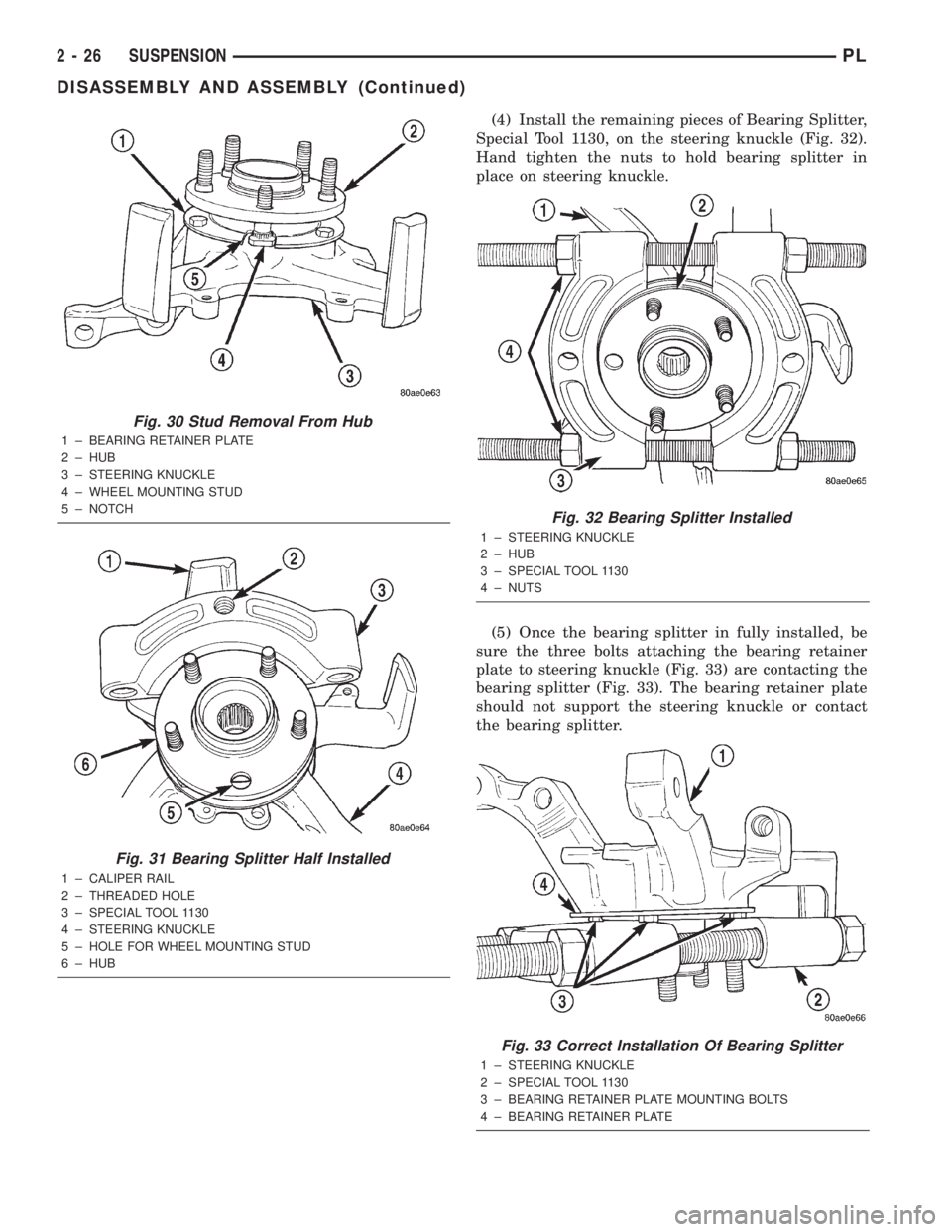
(4) Install the remaining pieces of Bearing Splitter,
Special Tool 1130, on the steering knuckle (Fig. 32).
Hand tighten the nuts to hold bearing splitter in
place on steering knuckle.
(5) Once the bearing splitter in fully installed, be
sure the three bolts attaching the bearing retainer
plate to steering knuckle (Fig. 33) are contacting the
bearing splitter (Fig. 33). The bearing retainer plate
should not support the steering knuckle or contact
the bearing splitter.
Fig. 30 Stud Removal From Hub
1 ± BEARING RETAINER PLATE
2 ± HUB
3 ± STEERING KNUCKLE
4 ± WHEEL MOUNTING STUD
5 ± NOTCH
Fig. 31 Bearing Splitter Half Installed
1 ± CALIPER RAIL
2 ± THREADED HOLE
3 ± SPECIAL TOOL 1130
4 ± STEERING KNUCKLE
5 ± HOLE FOR WHEEL MOUNTING STUD
6 ± HUB
Fig. 32 Bearing Splitter Installed
1 ± STEERING KNUCKLE
2 ± HUB
3 ± SPECIAL TOOL 1130
4 ± NUTS
Fig. 33 Correct Installation Of Bearing Splitter
1 ± STEERING KNUCKLE
2 ± SPECIAL TOOL 1130
3 ± BEARING RETAINER PLATE MOUNTING BOLTS
4 ± BEARING RETAINER PLATE
2 - 26 SUSPENSIONPL
DISASSEMBLY AND ASSEMBLY (Continued)
Page 38 of 1285
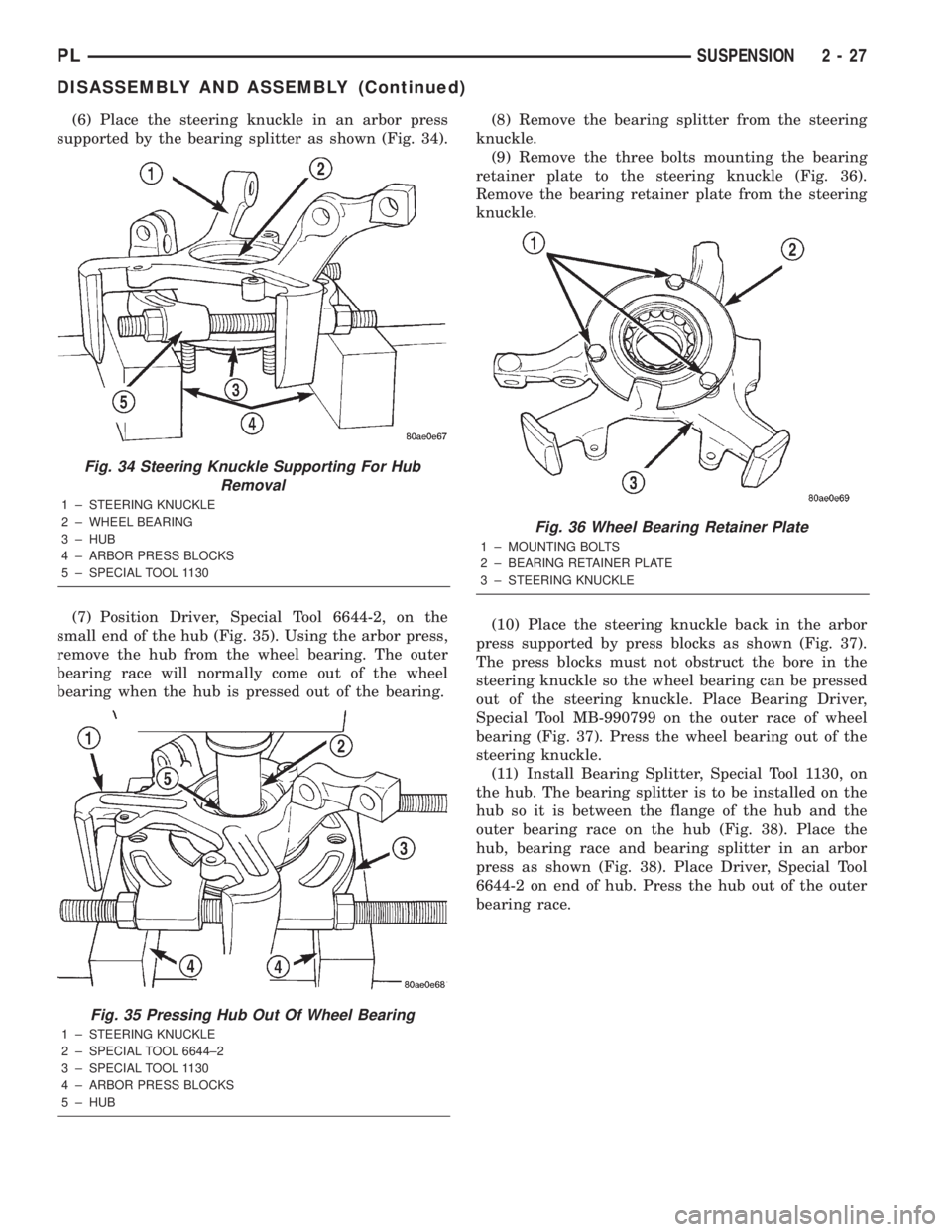
(6) Place the steering knuckle in an arbor press
supported by the bearing splitter as shown (Fig. 34).
(7) Position Driver, Special Tool 6644-2, on the
small end of the hub (Fig. 35). Using the arbor press,
remove the hub from the wheel bearing. The outer
bearing race will normally come out of the wheel
bearing when the hub is pressed out of the bearing.(8) Remove the bearing splitter from the steering
knuckle.
(9) Remove the three bolts mounting the bearing
retainer plate to the steering knuckle (Fig. 36).
Remove the bearing retainer plate from the steering
knuckle.
(10) Place the steering knuckle back in the arbor
press supported by press blocks as shown (Fig. 37).
The press blocks must not obstruct the bore in the
steering knuckle so the wheel bearing can be pressed
out of the steering knuckle. Place Bearing Driver,
Special Tool MB-990799 on the outer race of wheel
bearing (Fig. 37). Press the wheel bearing out of the
steering knuckle.
(11) Install Bearing Splitter, Special Tool 1130, on
the hub. The bearing splitter is to be installed on the
hub so it is between the flange of the hub and the
outer bearing race on the hub (Fig. 38). Place the
hub, bearing race and bearing splitter in an arbor
press as shown (Fig. 38). Place Driver, Special Tool
6644-2 on end of hub. Press the hub out of the outer
bearing race.
Fig. 34 Steering Knuckle Supporting For Hub
Removal
1 ± STEERING KNUCKLE
2 ± WHEEL BEARING
3 ± HUB
4 ± ARBOR PRESS BLOCKS
5 ± SPECIAL TOOL 1130
Fig. 35 Pressing Hub Out Of Wheel Bearing
1 ± STEERING KNUCKLE
2 ± SPECIAL TOOL 6644±2
3 ± SPECIAL TOOL 1130
4 ± ARBOR PRESS BLOCKS
5 ± HUB
Fig. 36 Wheel Bearing Retainer Plate
1 ± MOUNTING BOLTS
2 ± BEARING RETAINER PLATE
3 ± STEERING KNUCKLE
PLSUSPENSION 2 - 27
DISASSEMBLY AND ASSEMBLY (Continued)
Page 39 of 1285
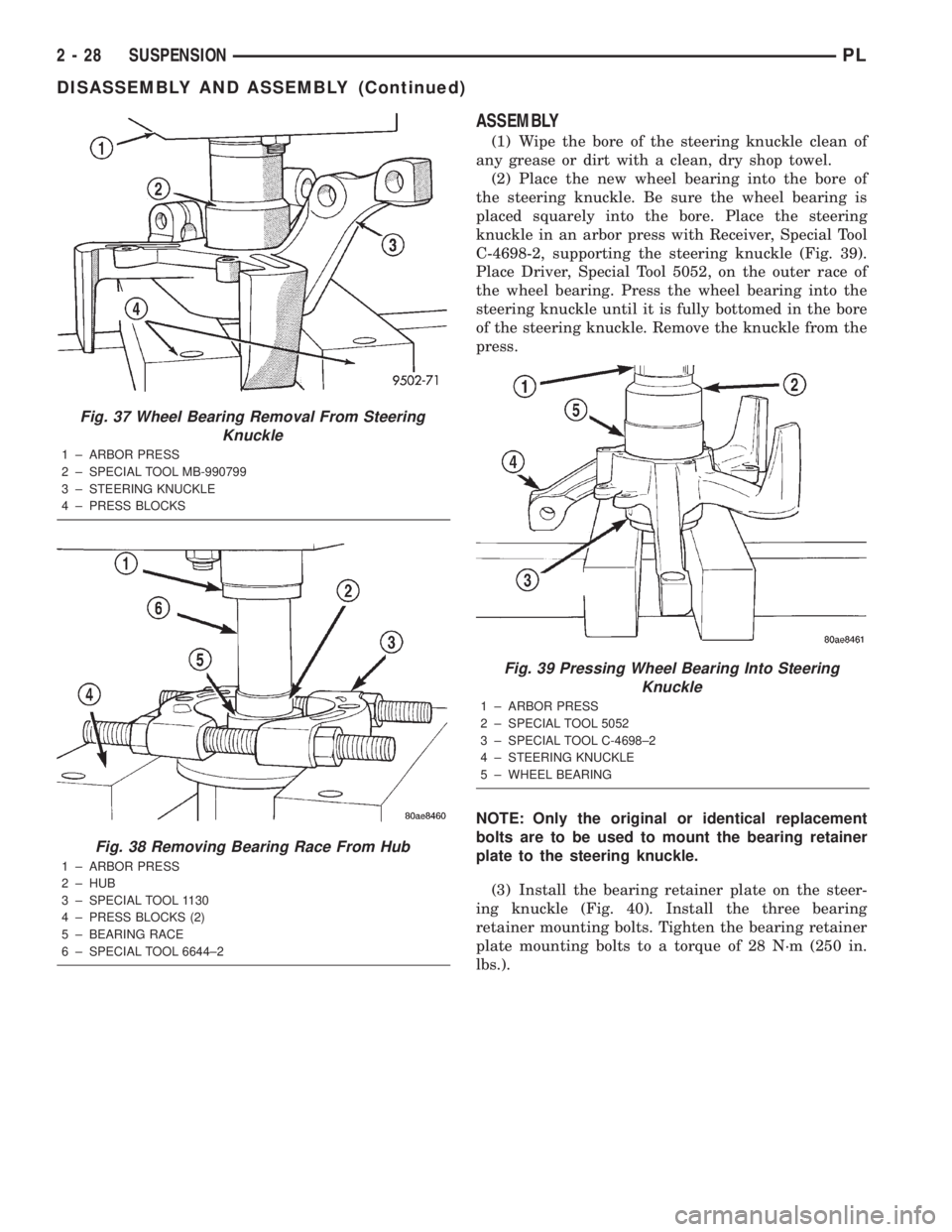
ASSEMBLY
(1) Wipe the bore of the steering knuckle clean of
any grease or dirt with a clean, dry shop towel.
(2) Place the new wheel bearing into the bore of
the steering knuckle. Be sure the wheel bearing is
placed squarely into the bore. Place the steering
knuckle in an arbor press with Receiver, Special Tool
C-4698-2, supporting the steering knuckle (Fig. 39).
Place Driver, Special Tool 5052, on the outer race of
the wheel bearing. Press the wheel bearing into the
steering knuckle until it is fully bottomed in the bore
of the steering knuckle. Remove the knuckle from the
press.
NOTE: Only the original or identical replacement
bolts are to be used to mount the bearing retainer
plate to the steering knuckle.
(3) Install the bearing retainer plate on the steer-
ing knuckle (Fig. 40). Install the three bearing
retainer mounting bolts. Tighten the bearing retainer
plate mounting bolts to a torque of 28 N´m (250 in.
lbs.).
Fig. 37 Wheel Bearing Removal From Steering
Knuckle
1 ± ARBOR PRESS
2 ± SPECIAL TOOL MB-990799
3 ± STEERING KNUCKLE
4 ± PRESS BLOCKS
Fig. 38 Removing Bearing Race From Hub
1 ± ARBOR PRESS
2 ± HUB
3 ± SPECIAL TOOL 1130
4 ± PRESS BLOCKS (2)
5 ± BEARING RACE
6 ± SPECIAL TOOL 6644±2
Fig. 39 Pressing Wheel Bearing Into Steering
Knuckle
1 ± ARBOR PRESS
2 ± SPECIAL TOOL 5052
3 ± SPECIAL TOOL C-4698±2
4 ± STEERING KNUCKLE
5 ± WHEEL BEARING
2 - 28 SUSPENSIONPL
DISASSEMBLY AND ASSEMBLY (Continued)
Page 40 of 1285
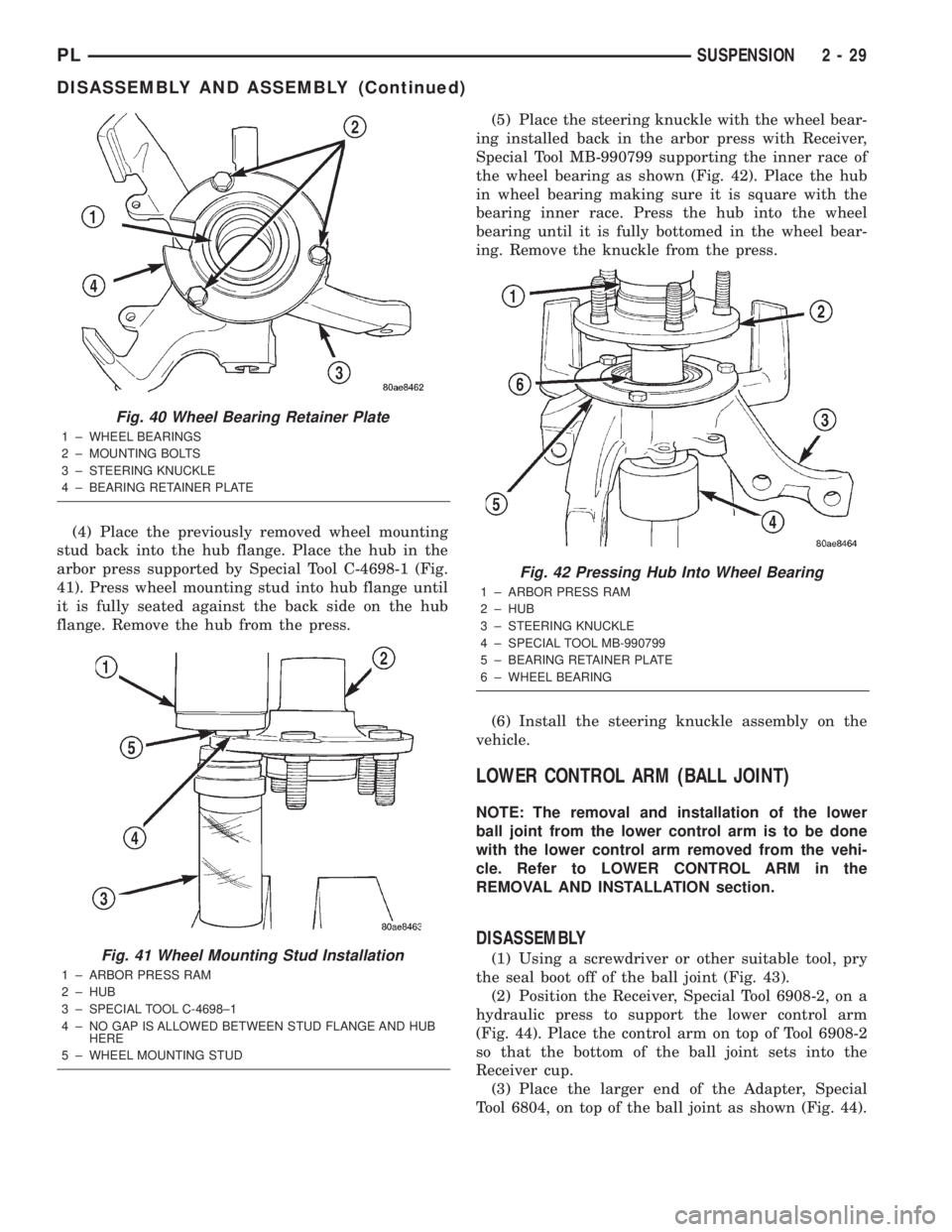
(4) Place the previously removed wheel mounting
stud back into the hub flange. Place the hub in the
arbor press supported by Special Tool C-4698-1 (Fig.
41). Press wheel mounting stud into hub flange until
it is fully seated against the back side on the hub
flange. Remove the hub from the press.(5) Place the steering knuckle with the wheel bear-
ing installed back in the arbor press with Receiver,
Special Tool MB-990799 supporting the inner race of
the wheel bearing as shown (Fig. 42). Place the hub
in wheel bearing making sure it is square with the
bearing inner race. Press the hub into the wheel
bearing until it is fully bottomed in the wheel bear-
ing. Remove the knuckle from the press.
(6) Install the steering knuckle assembly on the
vehicle.
LOWER CONTROL ARM (BALL JOINT)
NOTE: The removal and installation of the lower
ball joint from the lower control arm is to be done
with the lower control arm removed from the vehi-
cle. Refer to LOWER CONTROL ARM in the
REMOVAL AND INSTALLATION section.
DISASSEMBLY
(1) Using a screwdriver or other suitable tool, pry
the seal boot off of the ball joint (Fig. 43).
(2) Position the Receiver, Special Tool 6908-2, on a
hydraulic press to support the lower control arm
(Fig. 44). Place the control arm on top of Tool 6908-2
so that the bottom of the ball joint sets into the
Receiver cup.
(3) Place the larger end of the Adapter, Special
Tool 6804, on top of the ball joint as shown (Fig. 44).
Fig. 40 Wheel Bearing Retainer Plate
1 ± WHEEL BEARINGS
2 ± MOUNTING BOLTS
3 ± STEERING KNUCKLE
4 ± BEARING RETAINER PLATE
Fig. 41 Wheel Mounting Stud Installation
1 ± ARBOR PRESS RAM
2 ± HUB
3 ± SPECIAL TOOL C-4698±1
4 ± NO GAP IS ALLOWED BETWEEN STUD FLANGE AND HUB
HERE
5 ± WHEEL MOUNTING STUD
Fig. 42 Pressing Hub Into Wheel Bearing
1 ± ARBOR PRESS RAM
2 ± HUB
3 ± STEERING KNUCKLE
4 ± SPECIAL TOOL MB-990799
5 ± BEARING RETAINER PLATE
6 ± WHEEL BEARING
PLSUSPENSION 2 - 29
DISASSEMBLY AND ASSEMBLY (Continued)
Page 44 of 1285
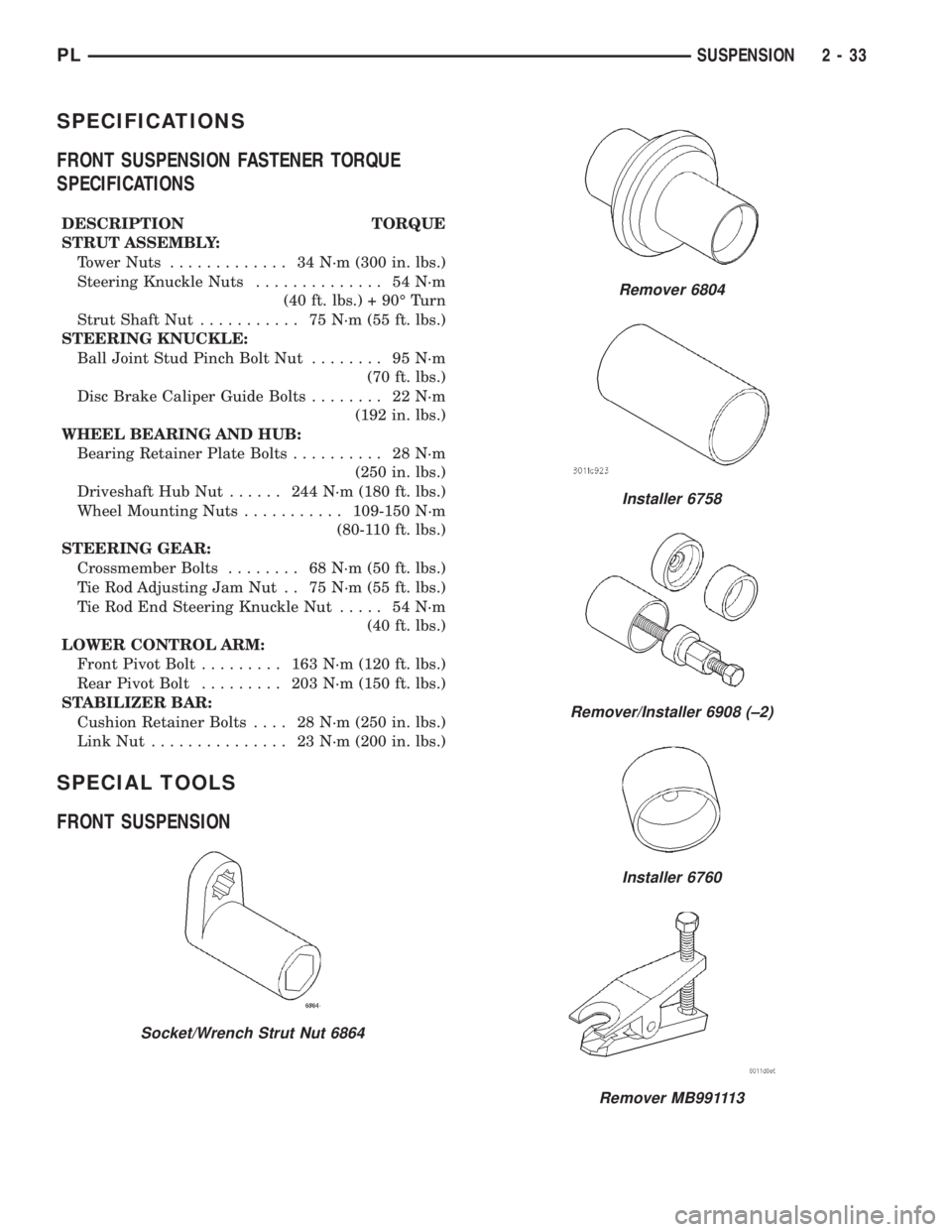
SPECIFICATIONS
FRONT SUSPENSION FASTENER TORQUE
SPECIFICATIONS
DESCRIPTION TORQUE
STRUT ASSEMBLY:
Tower Nuts............. 34N´m(300 in. lbs.)
Steering Knuckle Nuts.............. 54N´m
(40 ft. lbs.) + 90É Turn
Strut Shaft Nut........... 75N´m(55ft.lbs.)
STEERING KNUCKLE:
Ball Joint Stud Pinch Bolt Nut........ 95N´m
(70 ft. lbs.)
Disc Brake Caliper Guide Bolts........ 22N´m
(192 in. lbs.)
WHEEL BEARING AND HUB:
Bearing Retainer Plate Bolts.......... 28N´m
(250 in. lbs.)
Driveshaft Hub Nut...... 244N´m(180 ft. lbs.)
Wheel Mounting Nuts...........109-150 N´m
(80-110 ft. lbs.)
STEERING GEAR:
Crossmember Bolts........ 68N´m(50ft.lbs.)
Tie Rod Adjusting Jam Nut . . 75 N´m (55 ft. lbs.)
Tie Rod End Steering Knuckle Nut..... 54N´m
(40 ft. lbs.)
LOWER CONTROL ARM:
Front Pivot Bolt......... 163N´m(120 ft. lbs.)
Rear Pivot Bolt......... 203N´m(150 ft. lbs.)
STABILIZER BAR:
Cushion Retainer Bolts.... 28N´m(250 in. lbs.)
Link Nut............... 23N´m(200 in. lbs.)
SPECIAL TOOLS
FRONT SUSPENSION
Socket/Wrench Strut Nut 6864
Remover 6804
Installer 6758
Remover/Installer 6908 (±2)
Installer 6760
Remover MB991113
PLSUSPENSION 2 - 33
Page 48 of 1285
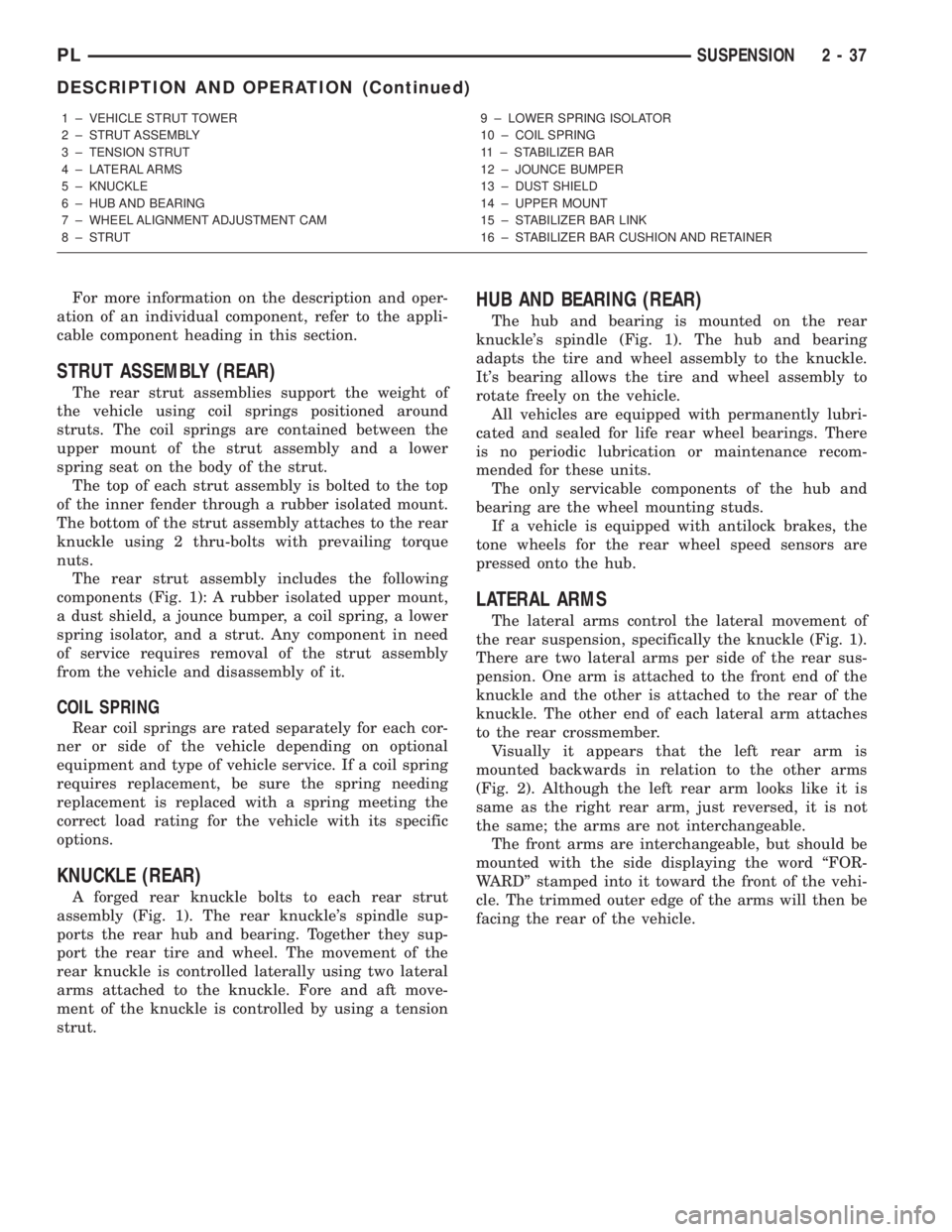
For more information on the description and oper-
ation of an individual component, refer to the appli-
cable component heading in this section.
STRUT ASSEMBLY (REAR)
The rear strut assemblies support the weight of
the vehicle using coil springs positioned around
struts. The coil springs are contained between the
upper mount of the strut assembly and a lower
spring seat on the body of the strut.
The top of each strut assembly is bolted to the top
of the inner fender through a rubber isolated mount.
The bottom of the strut assembly attaches to the rear
knuckle using 2 thru-bolts with prevailing torque
nuts.
The rear strut assembly includes the following
components (Fig. 1): A rubber isolated upper mount,
a dust shield, a jounce bumper, a coil spring, a lower
spring isolator, and a strut. Any component in need
of service requires removal of the strut assembly
from the vehicle and disassembly of it.
COIL SPRING
Rear coil springs are rated separately for each cor-
ner or side of the vehicle depending on optional
equipment and type of vehicle service. If a coil spring
requires replacement, be sure the spring needing
replacement is replaced with a spring meeting the
correct load rating for the vehicle with its specific
options.
KNUCKLE (REAR)
A forged rear knuckle bolts to each rear strut
assembly (Fig. 1). The rear knuckle's spindle sup-
ports the rear hub and bearing. Together they sup-
port the rear tire and wheel. The movement of the
rear knuckle is controlled laterally using two lateral
arms attached to the knuckle. Fore and aft move-
ment of the knuckle is controlled by using a tension
strut.
HUB AND BEARING (REAR)
The hub and bearing is mounted on the rear
knuckle's spindle (Fig. 1). The hub and bearing
adapts the tire and wheel assembly to the knuckle.
It's bearing allows the tire and wheel assembly to
rotate freely on the vehicle.
All vehicles are equipped with permanently lubri-
cated and sealed for life rear wheel bearings. There
is no periodic lubrication or maintenance recom-
mended for these units.
The only servicable components of the hub and
bearing are the wheel mounting studs.
If a vehicle is equipped with antilock brakes, the
tone wheels for the rear wheel speed sensors are
pressed onto the hub.
LATERAL ARMS
The lateral arms control the lateral movement of
the rear suspension, specifically the knuckle (Fig. 1).
There are two lateral arms per side of the rear sus-
pension. One arm is attached to the front end of the
knuckle and the other is attached to the rear of the
knuckle. The other end of each lateral arm attaches
to the rear crossmember.
Visually it appears that the left rear arm is
mounted backwards in relation to the other arms
(Fig. 2). Although the left rear arm looks like it is
same as the right rear arm, just reversed, it is not
the same; the arms are not interchangeable.
The front arms are interchangeable, but should be
mounted with the side displaying the word ªFOR-
WARDº stamped into it toward the front of the vehi-
cle. The trimmed outer edge of the arms will then be
facing the rear of the vehicle.
1 ± VEHICLE STRUT TOWER
2 ± STRUT ASSEMBLY
3 ± TENSION STRUT
4 ± LATERAL ARMS
5 ± KNUCKLE
6 ± HUB AND BEARING
7 ± WHEEL ALIGNMENT ADJUSTMENT CAM
8 ± STRUT9 ± LOWER SPRING ISOLATOR
10 ± COIL SPRING
11 ± STABILIZER BAR
12 ± JOUNCE BUMPER
13 ± DUST SHIELD
14 ± UPPER MOUNT
15 ± STABILIZER BAR LINK
16 ± STABILIZER BAR CUSHION AND RETAINER
PLSUSPENSION 2 - 37
DESCRIPTION AND OPERATION (Continued)
Page 49 of 1285
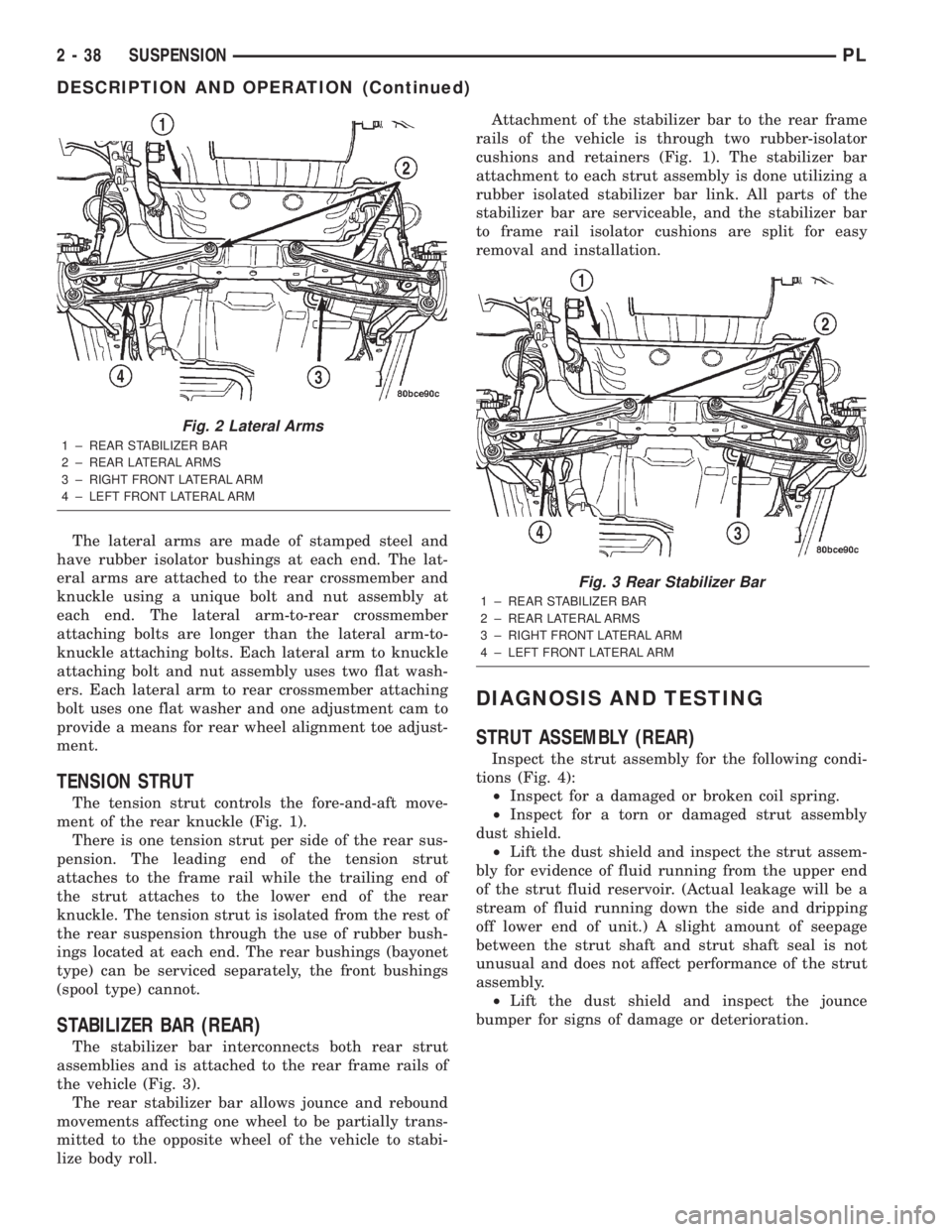
The lateral arms are made of stamped steel and
have rubber isolator bushings at each end. The lat-
eral arms are attached to the rear crossmember and
knuckle using a unique bolt and nut assembly at
each end. The lateral arm-to-rear crossmember
attaching bolts are longer than the lateral arm-to-
knuckle attaching bolts. Each lateral arm to knuckle
attaching bolt and nut assembly uses two flat wash-
ers. Each lateral arm to rear crossmember attaching
bolt uses one flat washer and one adjustment cam to
provide a means for rear wheel alignment toe adjust-
ment.
TENSION STRUT
The tension strut controls the fore-and-aft move-
ment of the rear knuckle (Fig. 1).
There is one tension strut per side of the rear sus-
pension. The leading end of the tension strut
attaches to the frame rail while the trailing end of
the strut attaches to the lower end of the rear
knuckle. The tension strut is isolated from the rest of
the rear suspension through the use of rubber bush-
ings located at each end. The rear bushings (bayonet
type) can be serviced separately, the front bushings
(spool type) cannot.
STABILIZER BAR (REAR)
The stabilizer bar interconnects both rear strut
assemblies and is attached to the rear frame rails of
the vehicle (Fig. 3).
The rear stabilizer bar allows jounce and rebound
movements affecting one wheel to be partially trans-
mitted to the opposite wheel of the vehicle to stabi-
lize body roll.Attachment of the stabilizer bar to the rear frame
rails of the vehicle is through two rubber-isolator
cushions and retainers (Fig. 1). The stabilizer bar
attachment to each strut assembly is done utilizing a
rubber isolated stabilizer bar link. All parts of the
stabilizer bar are serviceable, and the stabilizer bar
to frame rail isolator cushions are split for easy
removal and installation.
DIAGNOSIS AND TESTING
STRUT ASSEMBLY (REAR)
Inspect the strut assembly for the following condi-
tions (Fig. 4):
²Inspect for a damaged or broken coil spring.
²Inspect for a torn or damaged strut assembly
dust shield.
²Lift the dust shield and inspect the strut assem-
bly for evidence of fluid running from the upper end
of the strut fluid reservoir. (Actual leakage will be a
stream of fluid running down the side and dripping
off lower end of unit.) A slight amount of seepage
between the strut shaft and strut shaft seal is not
unusual and does not affect performance of the strut
assembly.
²Lift the dust shield and inspect the jounce
bumper for signs of damage or deterioration.
Fig. 2 Lateral Arms
1 ± REAR STABILIZER BAR
2 ± REAR LATERAL ARMS
3 ± RIGHT FRONT LATERAL ARM
4 ± LEFT FRONT LATERAL ARM
Fig. 3 Rear Stabilizer Bar
1 ± REAR STABILIZER BAR
2 ± REAR LATERAL ARMS
3 ± RIGHT FRONT LATERAL ARM
4 ± LEFT FRONT LATERAL ARM
2 - 38 SUSPENSIONPL
DESCRIPTION AND OPERATION (Continued)
Page 51 of 1285
REMOVAL AND INSTALLATION
SERVICE WARNINGS AND CAUTIONS
WARNING: DO NOT REMOVE THE STRUT SHAFT
NUT WHILE STRUT ASSEMBLY IS INSTALLED IN
VEHICLE, OR BEFORE THE COIL SPRING IS COM-
PRESSED WITH A COMPRESSION TOOL. THE
SPRING IS HELD UNDER HIGH PRESSURE.
CAUTION: Only frame contact or wheel lift hoisting
equipment can be used on vehicles having a fully
independent rear suspension. Vehicles with inde-
pendent rear suspension can not be hoisted using
equipment designed to lift a vehicle by the rear
axle. If this type of hoisting equipment is used dam-
age to rear suspension components will occur.
NOTE: If a rear suspension component becomes
bent, damaged or fails, no attempt should be made
to straighten or repair it. Always replace it with a
new component.
STRUT ASSEMBLY (REAR)
NOTE: Before proceeding with this procedure,
review SERVICE WARNINGS AND CAUTIONS at the
beginning of REMOVAL AND INSTALLATION in this
section.
REMOVAL
(1) Raise the vehicle. Refer to HOISTING in the
LUBRICATION AND MAINTENANCE group for the
proper lifting procedure.
(2) Remove the rear wheel and tire assembly from
the vehicle.
(3) If the vehicle is equipped with rear drum
brakes, remove the screw securing the brake hose
bracket to the rear of the strut assembly (Fig. 5).
(4) If the vehicle is equipped with the antilock
brake system (ABS), remove the screw securing the
ABS wheel speed sensor bracket to the rear of the
strut assembly (Fig. 6).
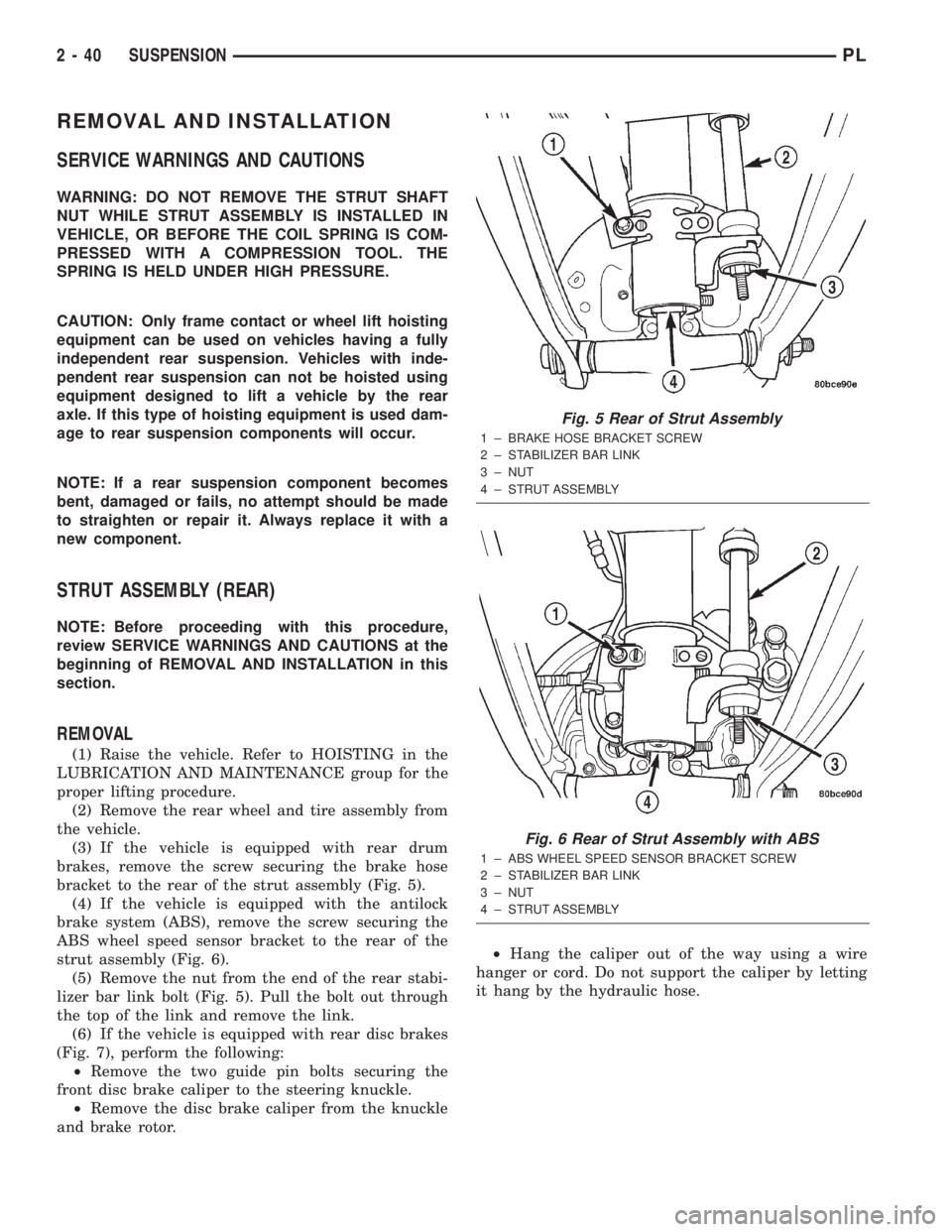
(5) Remove the nut from the end of the rear stabi-
lizer bar link bolt (Fig. 5). Pull the bolt out through
the top of the link and remove the link.
(6) If the vehicle is equipped with rear disc brakes
(Fig. 7), perform the following:
²Remove the two guide pin bolts securing the
front disc brake caliper to the steering knuckle.
²Remove the disc brake caliper from the knuckle
and brake rotor.²Hang the caliper out of the way using a wire
hanger or cord. Do not support the caliper by letting
it hang by the hydraulic hose.
Fig. 5 Rear of Strut Assembly
1 ± BRAKE HOSE BRACKET SCREW
2 ± STABILIZER BAR LINK
3 ± NUT
4 ± STRUT ASSEMBLY
Fig. 6 Rear of Strut Assembly with ABS
1 ± ABS WHEEL SPEED SENSOR BRACKET SCREW
2 ± STABILIZER BAR LINK
3 ± NUT
4 ± STRUT ASSEMBLY
2 - 40 SUSPENSIONPL