hose DODGE NEON 2000 Service Owner's Manual
[x] Cancel search | Manufacturer: DODGE, Model Year: 2000, Model line: NEON, Model: DODGE NEON 2000Pages: 1285, PDF Size: 29.42 MB
Page 112 of 1285
INSTALLATION
(1) Lubricate the O-ring on the proportioning
valve. Make sure the O-ring on the proportioning
valve is new.
(2) Install the proportioning valve in its master
cylinder port. Tighten the proportioning valve to a
torque of 40 N´m (30 ft. lbs.).
(3) Connect the brake tube to the proportioning
valve (Fig. 54). Tighten the tube nut to a torque of 17
N´m (145 in. lbs.).
(4) Remove the brake pedal holder (Fig. 53).
(5) Bleed the affected brake line. See BASE
BRAKE BLEEDING in the SERVICE PROCE-
DURES section in this service manual group.
(6) Road test the vehicle to ensure proper opera-
tion of the brakes.
BRAKES TUBES AND HOSES
NOTE: Brake hoses for each brake are unique and
are not interchangeable.
Always use Mopartreplacement brake hoses to
ensure quality, correct length and superior fatigue
life. Care should be taken to make sure that the tube
and hose mating surfaces are clean and free from
nicks and burrs.
Use new copper seal washers on all connections
using banjo bolts and tighten all the fittings to their
specified torques.
Follow the procedures in the next three paragraphs
to reduce the potential for twisting the brake hose
during installation.
The flexible front hydraulic brake hose should
always be installed on the vehicle by first attaching
the banjo fitting to the disc brake caliper. Attach the
hose to the brake tubing before attaching it to the
front frame rail. Tighten all brake line fittings to the
specified torque.
On vehicles equipped with rear drum brakes,
loosely install the rear brake hose to the wheel cylin-
der first, then bolt the intermediate routing bracket
to the strut. Next, loosely install the hose to the steel
tube coming from the master cylinder. Attach the
hose bracket to the body. Finally, tighten the tube
nuts at each end of the brake hose.
On vehicles equipped with rear disc brakes, attach
the brake hose banjo fitting to the caliper first, then
loosely install the hose to the steel tube coming from
the master cylinder. Next, attach the brake hose
bracket to the body. Finally, tighten the tube nut at
the each of the end of the brake hose connecting to
the steel tube coming from the master cylinder.Only double wall 4.75 mm (3/16 in.) steel brake
line tubing with Nygal coating should be used for
replacement along with its special tube nuts. Care
must be taken when replacing brake tubing; to be
sure, use the proper bending and flaring tools, and
procedures to avoid kinking. Do not route the tubes
against sharp edges, moving components, or into hot
areas. All tubes should be properly attached with the
recommended retaining clips.
DISC BRAKE CALIPER (FRONT)
NOTE: Before proceeding with this procedure,
review SERVICE WARNINGS AND CAUTIONS at the
beginning of REMOVAL AND INSTALLATION in this
section.
REMOVAL
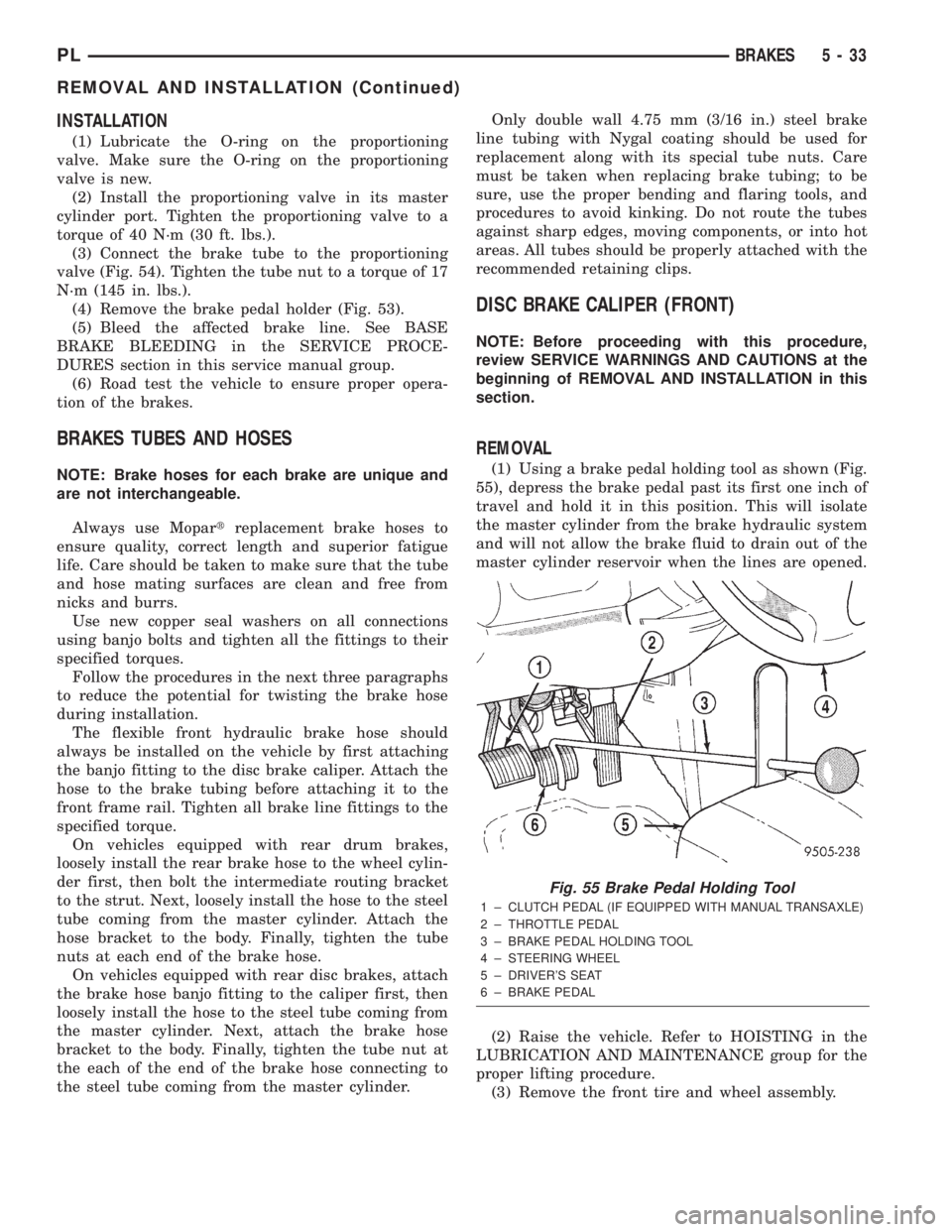
(1) Using a brake pedal holding tool as shown (Fig.
55), depress the brake pedal past its first one inch of
travel and hold it in this position. This will isolate
the master cylinder from the brake hydraulic system
and will not allow the brake fluid to drain out of the
master cylinder reservoir when the lines are opened.
(2) Raise the vehicle. Refer to HOISTING in the
LUBRICATION AND MAINTENANCE group for the
proper lifting procedure.
(3) Remove the front tire and wheel assembly.
Fig. 55 Brake Pedal Holding Tool
1 ± CLUTCH PEDAL (IF EQUIPPED WITH MANUAL TRANSAXLE)
2 ± THROTTLE PEDAL
3 ± BRAKE PEDAL HOLDING TOOL
4 ± STEERING WHEEL
5 ± DRIVER'S SEAT
6 ± BRAKE PEDAL
PLBRAKES 5 - 33
REMOVAL AND INSTALLATION (Continued)
Page 113 of 1285
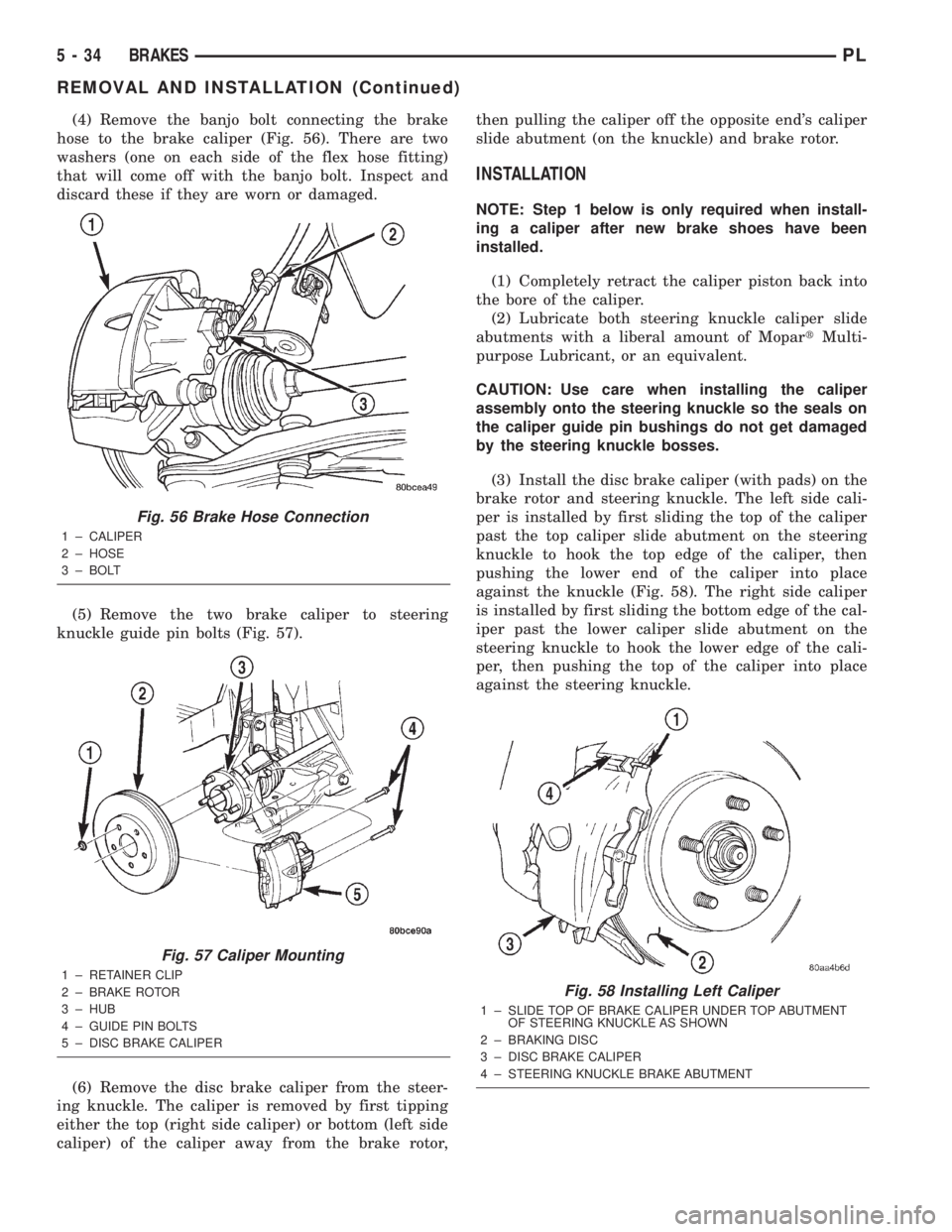
(4) Remove the banjo bolt connecting the brake
hose to the brake caliper (Fig. 56). There are two
washers (one on each side of the flex hose fitting)
that will come off with the banjo bolt. Inspect and
discard these if they are worn or damaged.
(5) Remove the two brake caliper to steering
knuckle guide pin bolts (Fig. 57).
(6) Remove the disc brake caliper from the steer-
ing knuckle. The caliper is removed by first tipping
either the top (right side caliper) or bottom (left side
caliper) of the caliper away from the brake rotor,then pulling the caliper off the opposite end's caliper
slide abutment (on the knuckle) and brake rotor.
INSTALLATION
NOTE: Step 1 below is only required when install-
ing a caliper after new brake shoes have been
installed.
(1) Completely retract the caliper piston back into
the bore of the caliper.
(2) Lubricate both steering knuckle caliper slide
abutments with a liberal amount of MopartMulti-
purpose Lubricant, or an equivalent.
CAUTION: Use care when installing the caliper
assembly onto the steering knuckle so the seals on
the caliper guide pin bushings do not get damaged
by the steering knuckle bosses.
(3) Install the disc brake caliper (with pads) on the
brake rotor and steering knuckle. The left side cali-
per is installed by first sliding the top of the caliper
past the top caliper slide abutment on the steering
knuckle to hook the top edge of the caliper, then
pushing the lower end of the caliper into place
against the knuckle (Fig. 58). The right side caliper
is installed by first sliding the bottom edge of the cal-
iper past the lower caliper slide abutment on the
steering knuckle to hook the lower edge of the cali-
per, then pushing the top of the caliper into place
against the steering knuckle.
Fig. 56 Brake Hose Connection
1 ± CALIPER
2 ± HOSE
3 ± BOLT
Fig. 57 Caliper Mounting
1 ± RETAINER CLIP
2 ± BRAKE ROTOR
3 ± HUB
4 ± GUIDE PIN BOLTS
5 ± DISC BRAKE CALIPER
Fig. 58 Installing Left Caliper
1 ± SLIDE TOP OF BRAKE CALIPER UNDER TOP ABUTMENT
OF STEERING KNUCKLE AS SHOWN
2 ± BRAKING DISC
3 ± DISC BRAKE CALIPER
4 ± STEERING KNUCKLE BRAKE ABUTMENT
5 - 34 BRAKESPL
REMOVAL AND INSTALLATION (Continued)
Page 114 of 1285
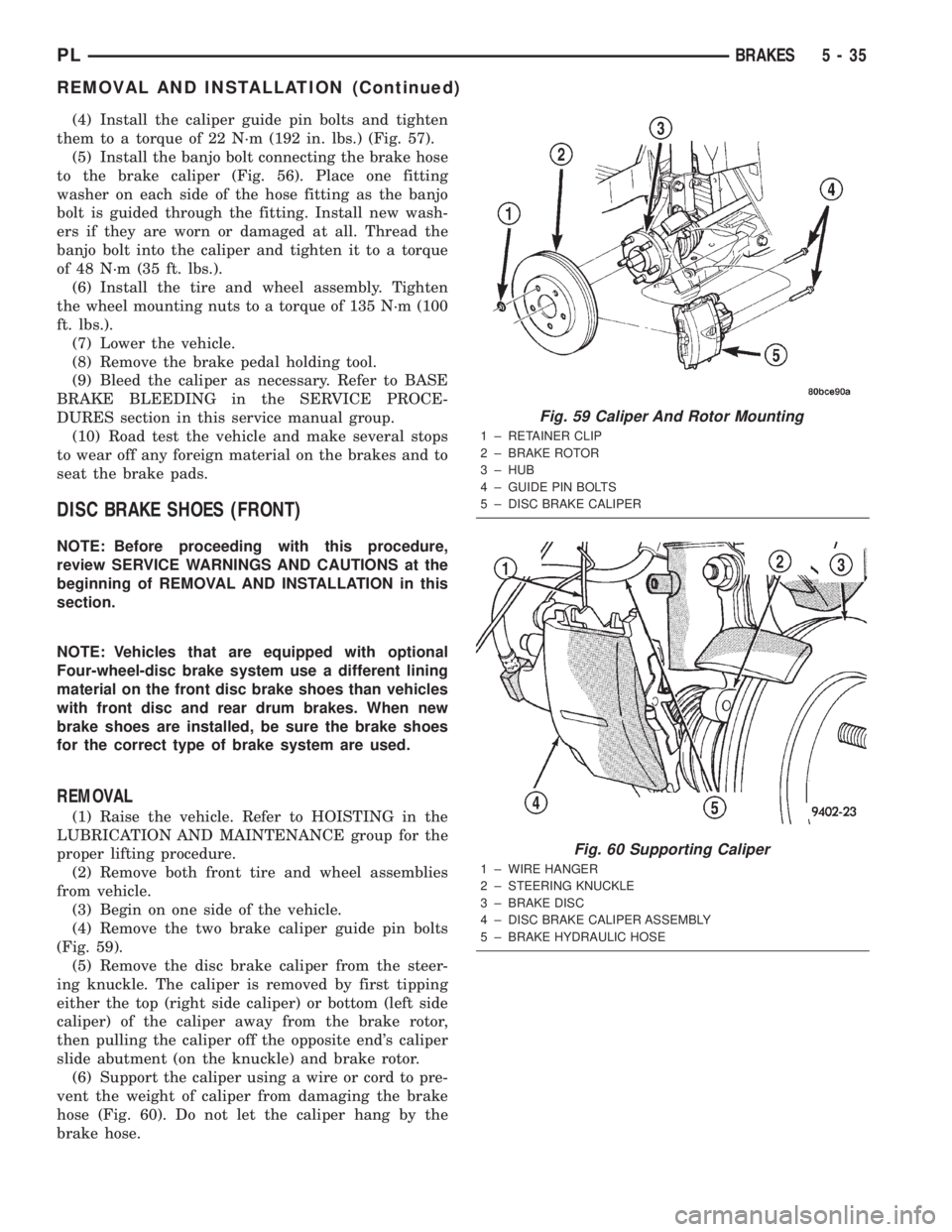
(4) Install the caliper guide pin bolts and tighten
them to a torque of 22 N´m (192 in. lbs.) (Fig. 57).
(5) Install the banjo bolt connecting the brake hose
to the brake caliper (Fig. 56). Place one fitting
washer on each side of the hose fitting as the banjo
bolt is guided through the fitting. Install new wash-
ers if they are worn or damaged at all. Thread the
banjo bolt into the caliper and tighten it to a torque
of 48 N´m (35 ft. lbs.).
(6) Install the tire and wheel assembly. Tighten
the wheel mounting nuts to a torque of 135 N´m (100
ft. lbs.).
(7) Lower the vehicle.
(8) Remove the brake pedal holding tool.
(9) Bleed the caliper as necessary. Refer to BASE
BRAKE BLEEDING in the SERVICE PROCE-
DURES section in this service manual group.
(10) Road test the vehicle and make several stops
to wear off any foreign material on the brakes and to
seat the brake pads.
DISC BRAKE SHOES (FRONT)
NOTE: Before proceeding with this procedure,
review SERVICE WARNINGS AND CAUTIONS at the
beginning of REMOVAL AND INSTALLATION in this
section.
NOTE: Vehicles that are equipped with optional
Four-wheel-disc brake system use a different lining
material on the front disc brake shoes than vehicles
with front disc and rear drum brakes. When new
brake shoes are installed, be sure the brake shoes
for the correct type of brake system are used.
REMOVAL
(1) Raise the vehicle. Refer to HOISTING in the
LUBRICATION AND MAINTENANCE group for the
proper lifting procedure.
(2) Remove both front tire and wheel assemblies
from vehicle.
(3) Begin on one side of the vehicle.
(4) Remove the two brake caliper guide pin bolts
(Fig. 59).
(5) Remove the disc brake caliper from the steer-
ing knuckle. The caliper is removed by first tipping
either the top (right side caliper) or bottom (left side
caliper) of the caliper away from the brake rotor,
then pulling the caliper off the opposite end's caliper
slide abutment (on the knuckle) and brake rotor.
(6) Support the caliper using a wire or cord to pre-
vent the weight of caliper from damaging the brake
hose (Fig. 60). Do not let the caliper hang by the
brake hose.
Fig. 59 Caliper And Rotor Mounting
1 ± RETAINER CLIP
2 ± BRAKE ROTOR
3 ± HUB
4 ± GUIDE PIN BOLTS
5 ± DISC BRAKE CALIPER
Fig. 60 Supporting Caliper
1 ± WIRE HANGER
2 ± STEERING KNUCKLE
3 ± BRAKE DISC
4 ± DISC BRAKE CALIPER ASSEMBLY
5 ± BRAKE HYDRAULIC HOSE
PLBRAKES 5 - 35
REMOVAL AND INSTALLATION (Continued)
Page 115 of 1285
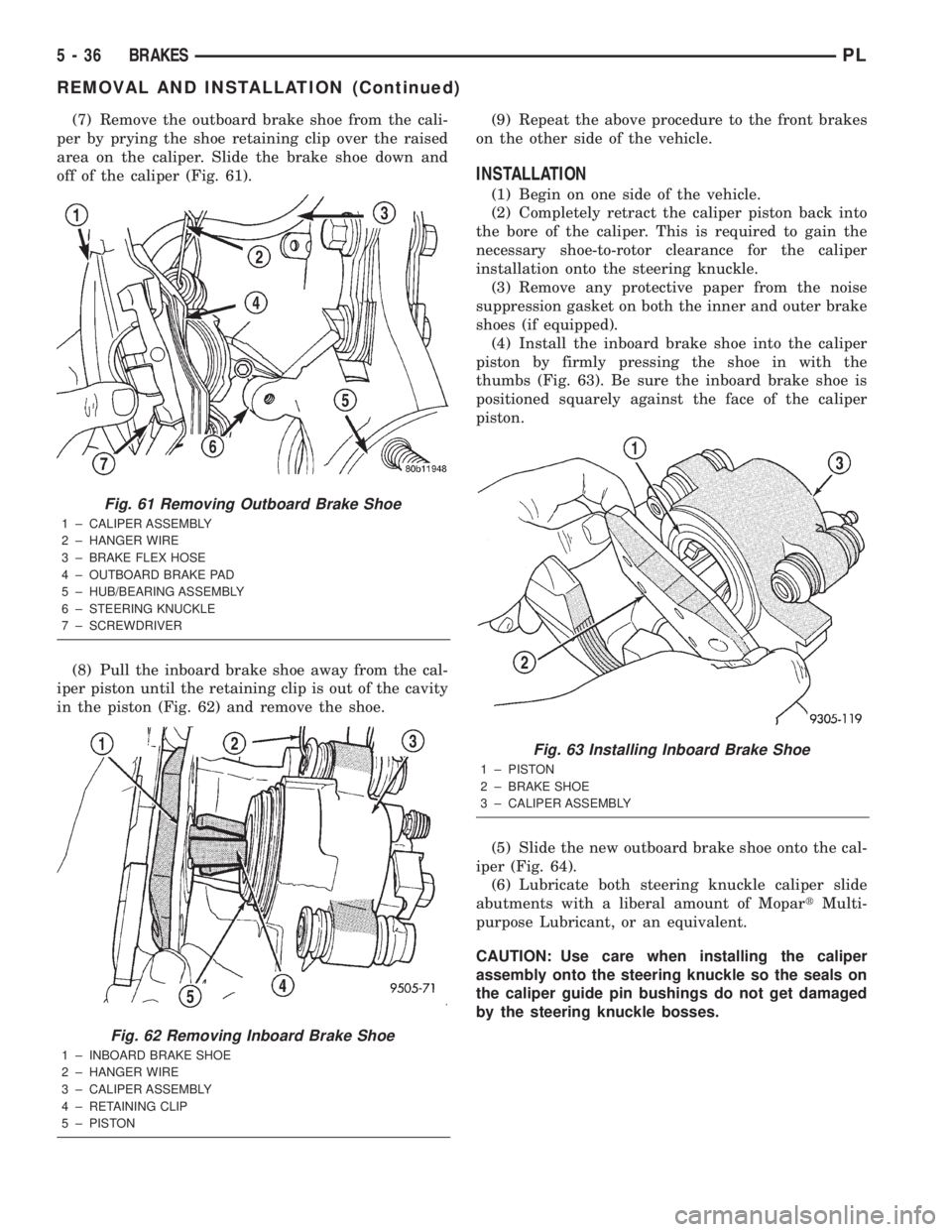
(7) Remove the outboard brake shoe from the cali-
per by prying the shoe retaining clip over the raised
area on the caliper. Slide the brake shoe down and
off of the caliper (Fig. 61).
(8) Pull the inboard brake shoe away from the cal-
iper piston until the retaining clip is out of the cavity
in the piston (Fig. 62) and remove the shoe.(9) Repeat the above procedure to the front brakes
on the other side of the vehicle.
INSTALLATION
(1) Begin on one side of the vehicle.
(2) Completely retract the caliper piston back into
the bore of the caliper. This is required to gain the
necessary shoe-to-rotor clearance for the caliper
installation onto the steering knuckle.
(3) Remove any protective paper from the noise
suppression gasket on both the inner and outer brake
shoes (if equipped).
(4) Install the inboard brake shoe into the caliper
piston by firmly pressing the shoe in with the
thumbs (Fig. 63). Be sure the inboard brake shoe is
positioned squarely against the face of the caliper
piston.
(5) Slide the new outboard brake shoe onto the cal-
iper (Fig. 64).
(6) Lubricate both steering knuckle caliper slide
abutments with a liberal amount of MopartMulti-
purpose Lubricant, or an equivalent.
CAUTION: Use care when installing the caliper
assembly onto the steering knuckle so the seals on
the caliper guide pin bushings do not get damaged
by the steering knuckle bosses.
Fig. 61 Removing Outboard Brake Shoe
1 ± CALIPER ASSEMBLY
2 ± HANGER WIRE
3 ± BRAKE FLEX HOSE
4 ± OUTBOARD BRAKE PAD
5 ± HUB/BEARING ASSEMBLY
6 ± STEERING KNUCKLE
7 ± SCREWDRIVER
Fig. 62 Removing Inboard Brake Shoe
1 ± INBOARD BRAKE SHOE
2 ± HANGER WIRE
3 ± CALIPER ASSEMBLY
4 ± RETAINING CLIP
5 ± PISTON
Fig. 63 Installing Inboard Brake Shoe
1 ± PISTON
2 ± BRAKE SHOE
3 ± CALIPER ASSEMBLY
5 - 36 BRAKESPL
REMOVAL AND INSTALLATION (Continued)
Page 117 of 1285
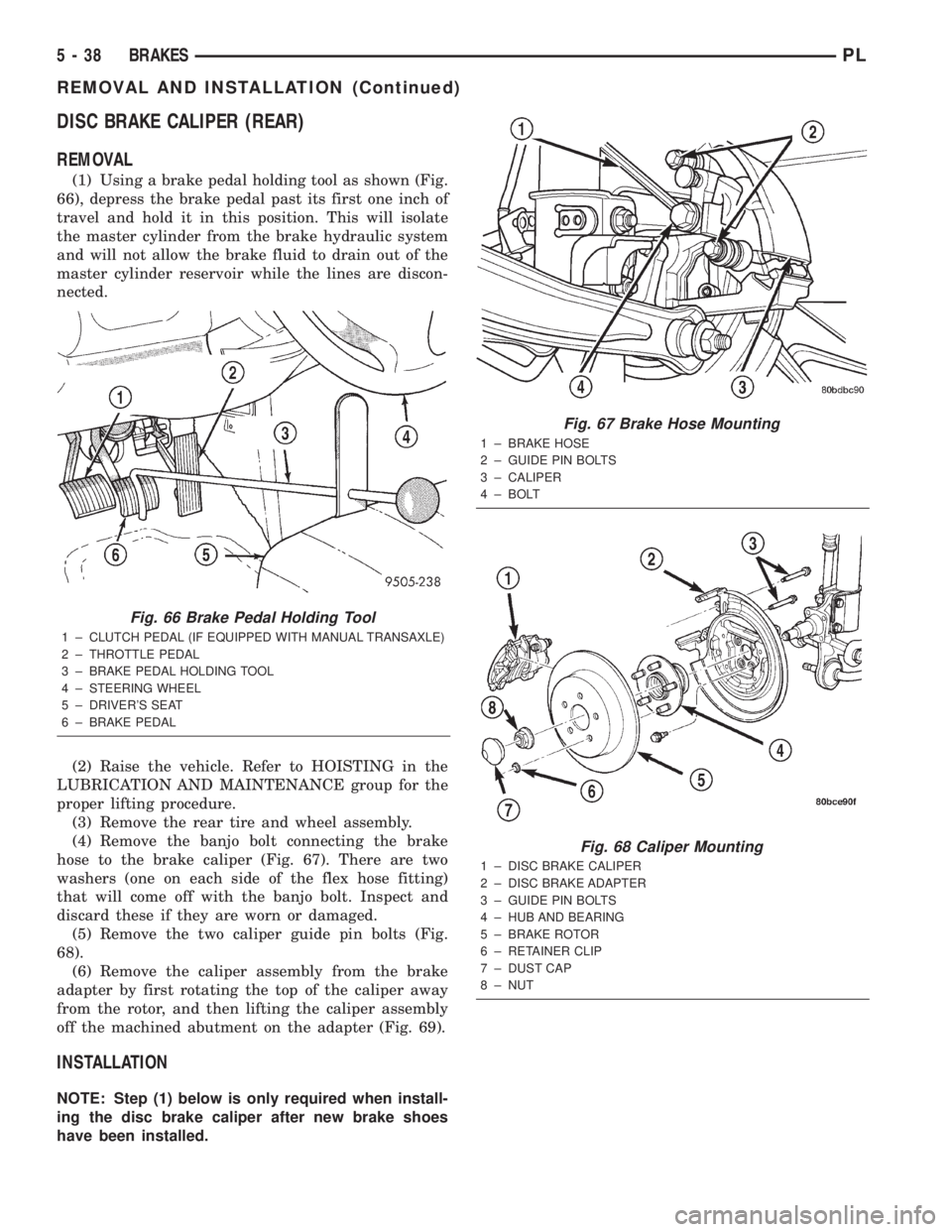
DISC BRAKE CALIPER (REAR)
REMOVAL
(1) Using a brake pedal holding tool as shown (Fig.
66), depress the brake pedal past its first one inch of
travel and hold it in this position. This will isolate
the master cylinder from the brake hydraulic system
and will not allow the brake fluid to drain out of the
master cylinder reservoir while the lines are discon-
nected.
(2) Raise the vehicle. Refer to HOISTING in the
LUBRICATION AND MAINTENANCE group for the
proper lifting procedure.
(3) Remove the rear tire and wheel assembly.
(4) Remove the banjo bolt connecting the brake
hose to the brake caliper (Fig. 67). There are two
washers (one on each side of the flex hose fitting)
that will come off with the banjo bolt. Inspect and
discard these if they are worn or damaged.
(5) Remove the two caliper guide pin bolts (Fig.
68).
(6) Remove the caliper assembly from the brake
adapter by first rotating the top of the caliper away
from the rotor, and then lifting the caliper assembly
off the machined abutment on the adapter (Fig. 69).
INSTALLATION
NOTE: Step (1) below is only required when install-
ing the disc brake caliper after new brake shoes
have been installed.
Fig. 66 Brake Pedal Holding Tool
1 ± CLUTCH PEDAL (IF EQUIPPED WITH MANUAL TRANSAXLE)
2 ± THROTTLE PEDAL
3 ± BRAKE PEDAL HOLDING TOOL
4 ± STEERING WHEEL
5 ± DRIVER'S SEAT
6 ± BRAKE PEDAL
Fig. 67 Brake Hose Mounting
1 ± BRAKE HOSE
2 ± GUIDE PIN BOLTS
3 ± CALIPER
4 ± BOLT
Fig. 68 Caliper Mounting
1 ± DISC BRAKE CALIPER
2 ± DISC BRAKE ADAPTER
3 ± GUIDE PIN BOLTS
4 ± HUB AND BEARING
5 ± BRAKE ROTOR
6 ± RETAINER CLIP
7 ± DUST CAP
8 ± NUT
5 - 38 BRAKESPL
REMOVAL AND INSTALLATION (Continued)
Page 118 of 1285
(1) Completely retract the caliper piston back into
piston bore of the caliper.
(2) Lubricate both adapter caliper slide abutments
with a liberal amount of MopartMultipurpose Lubri-
cant, or an equivalent.
CAUTION: Use care when installing the caliper
assembly onto adapter so the guide pin bushings
and sleeves do not get damaged by the mounting
bosses on adapter.
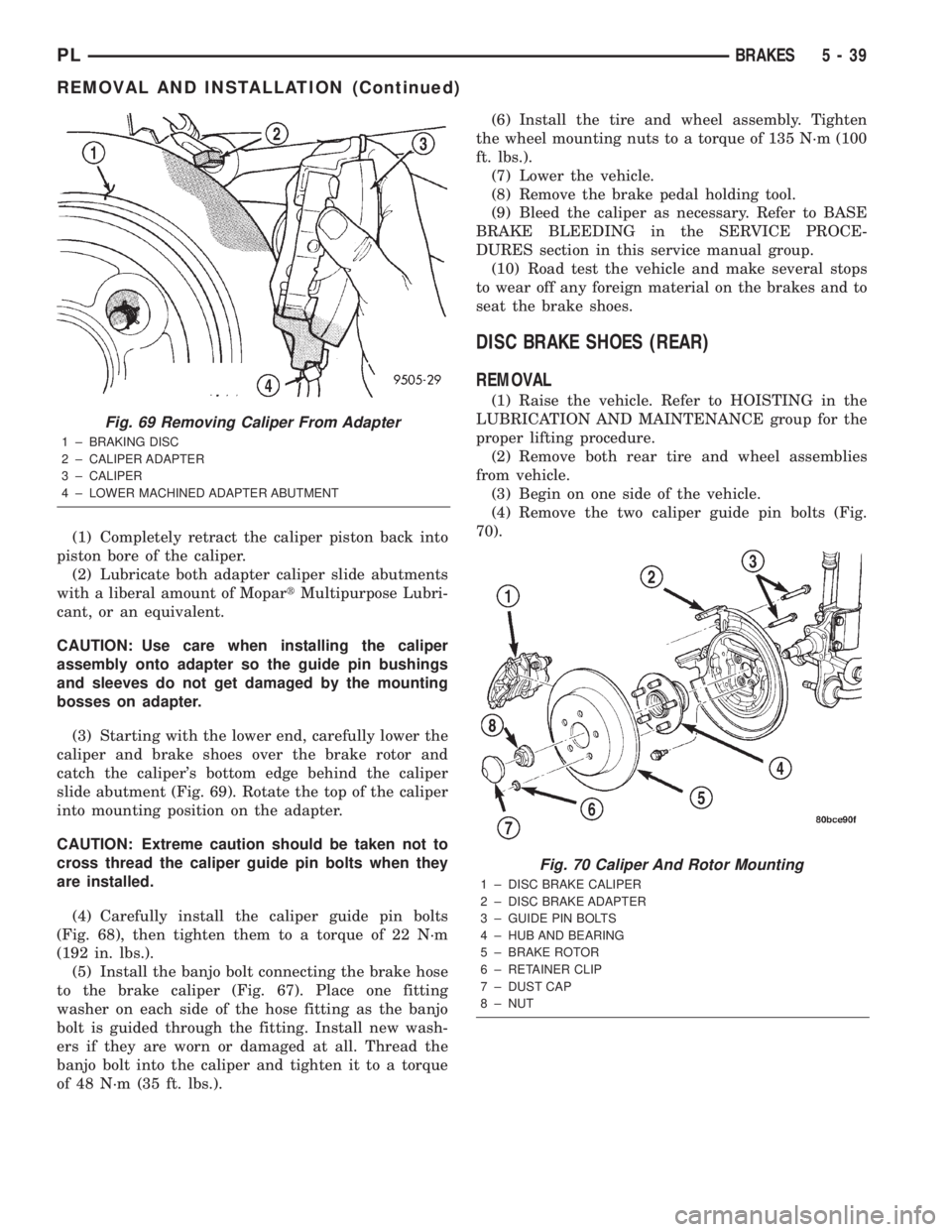
(3) Starting with the lower end, carefully lower the
caliper and brake shoes over the brake rotor and
catch the caliper's bottom edge behind the caliper
slide abutment (Fig. 69). Rotate the top of the caliper
into mounting position on the adapter.
CAUTION: Extreme caution should be taken not to
cross thread the caliper guide pin bolts when they
are installed.
(4) Carefully install the caliper guide pin bolts
(Fig. 68), then tighten them to a torque of 22 N´m
(192 in. lbs.).
(5) Install the banjo bolt connecting the brake hose
to the brake caliper (Fig. 67). Place one fitting
washer on each side of the hose fitting as the banjo
bolt is guided through the fitting. Install new wash-
ers if they are worn or damaged at all. Thread the
banjo bolt into the caliper and tighten it to a torque
of 48 N´m (35 ft. lbs.).(6) Install the tire and wheel assembly. Tighten
the wheel mounting nuts to a torque of 135 N´m (100
ft. lbs.).
(7) Lower the vehicle.
(8) Remove the brake pedal holding tool.
(9) Bleed the caliper as necessary. Refer to BASE
BRAKE BLEEDING in the SERVICE PROCE-
DURES section in this service manual group.
(10) Road test the vehicle and make several stops
to wear off any foreign material on the brakes and to
seat the brake shoes.
DISC BRAKE SHOES (REAR)
REMOVAL
(1) Raise the vehicle. Refer to HOISTING in the
LUBRICATION AND MAINTENANCE group for the
proper lifting procedure.
(2) Remove both rear tire and wheel assemblies
from vehicle.
(3) Begin on one side of the vehicle.
(4) Remove the two caliper guide pin bolts (Fig.
70).
Fig. 69 Removing Caliper From Adapter
1 ± BRAKING DISC
2 ± CALIPER ADAPTER
3 ± CALIPER
4 ± LOWER MACHINED ADAPTER ABUTMENT
Fig. 70 Caliper And Rotor Mounting
1 ± DISC BRAKE CALIPER
2 ± DISC BRAKE ADAPTER
3 ± GUIDE PIN BOLTS
4 ± HUB AND BEARING
5 ± BRAKE ROTOR
6 ± RETAINER CLIP
7 ± DUST CAP
8 ± NUT
PLBRAKES 5 - 39
REMOVAL AND INSTALLATION (Continued)
Page 119 of 1285
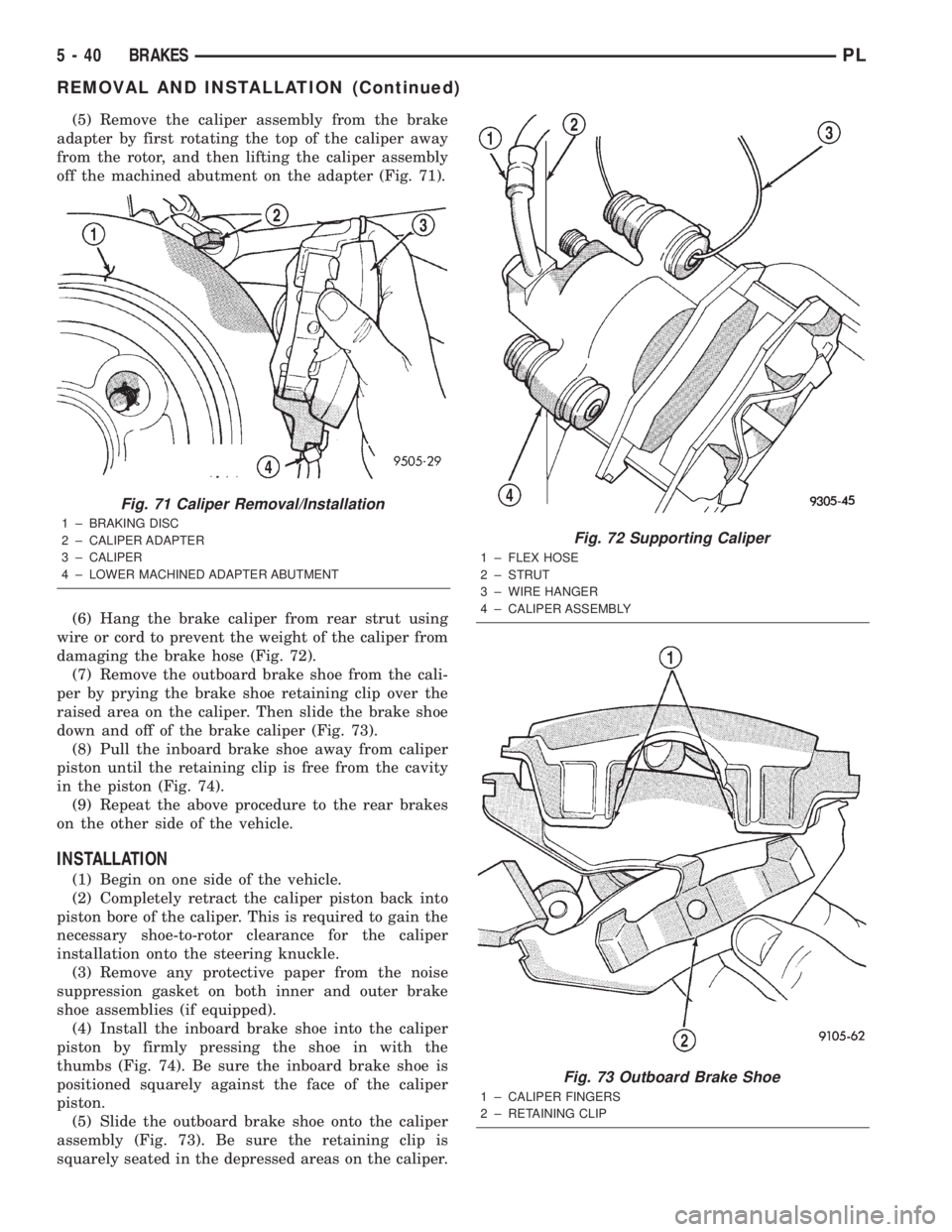
(5) Remove the caliper assembly from the brake
adapter by first rotating the top of the caliper away
from the rotor, and then lifting the caliper assembly
off the machined abutment on the adapter (Fig. 71).
(6) Hang the brake caliper from rear strut using
wire or cord to prevent the weight of the caliper from
damaging the brake hose (Fig. 72).
(7) Remove the outboard brake shoe from the cali-
per by prying the brake shoe retaining clip over the
raised area on the caliper. Then slide the brake shoe
down and off of the brake caliper (Fig. 73).
(8) Pull the inboard brake shoe away from caliper
piston until the retaining clip is free from the cavity
in the piston (Fig. 74).
(9) Repeat the above procedure to the rear brakes
on the other side of the vehicle.
INSTALLATION
(1) Begin on one side of the vehicle.
(2) Completely retract the caliper piston back into
piston bore of the caliper. This is required to gain the
necessary shoe-to-rotor clearance for the caliper
installation onto the steering knuckle.
(3) Remove any protective paper from the noise
suppression gasket on both inner and outer brake
shoe assemblies (if equipped).
(4) Install the inboard brake shoe into the caliper
piston by firmly pressing the shoe in with the
thumbs (Fig. 74). Be sure the inboard brake shoe is
positioned squarely against the face of the caliper
piston.
(5) Slide the outboard brake shoe onto the caliper
assembly (Fig. 73). Be sure the retaining clip is
squarely seated in the depressed areas on the caliper.
Fig. 71 Caliper Removal/Installation
1 ± BRAKING DISC
2 ± CALIPER ADAPTER
3 ± CALIPER
4 ± LOWER MACHINED ADAPTER ABUTMENT
Fig. 72 Supporting Caliper
1 ± FLEX HOSE
2 ± STRUT
3 ± WIRE HANGER
4 ± CALIPER ASSEMBLY
Fig. 73 Outboard Brake Shoe
1 ± CALIPER FINGERS
2 ± RETAINING CLIP
5 - 40 BRAKESPL
REMOVAL AND INSTALLATION (Continued)
Page 121 of 1285
REMOVAL
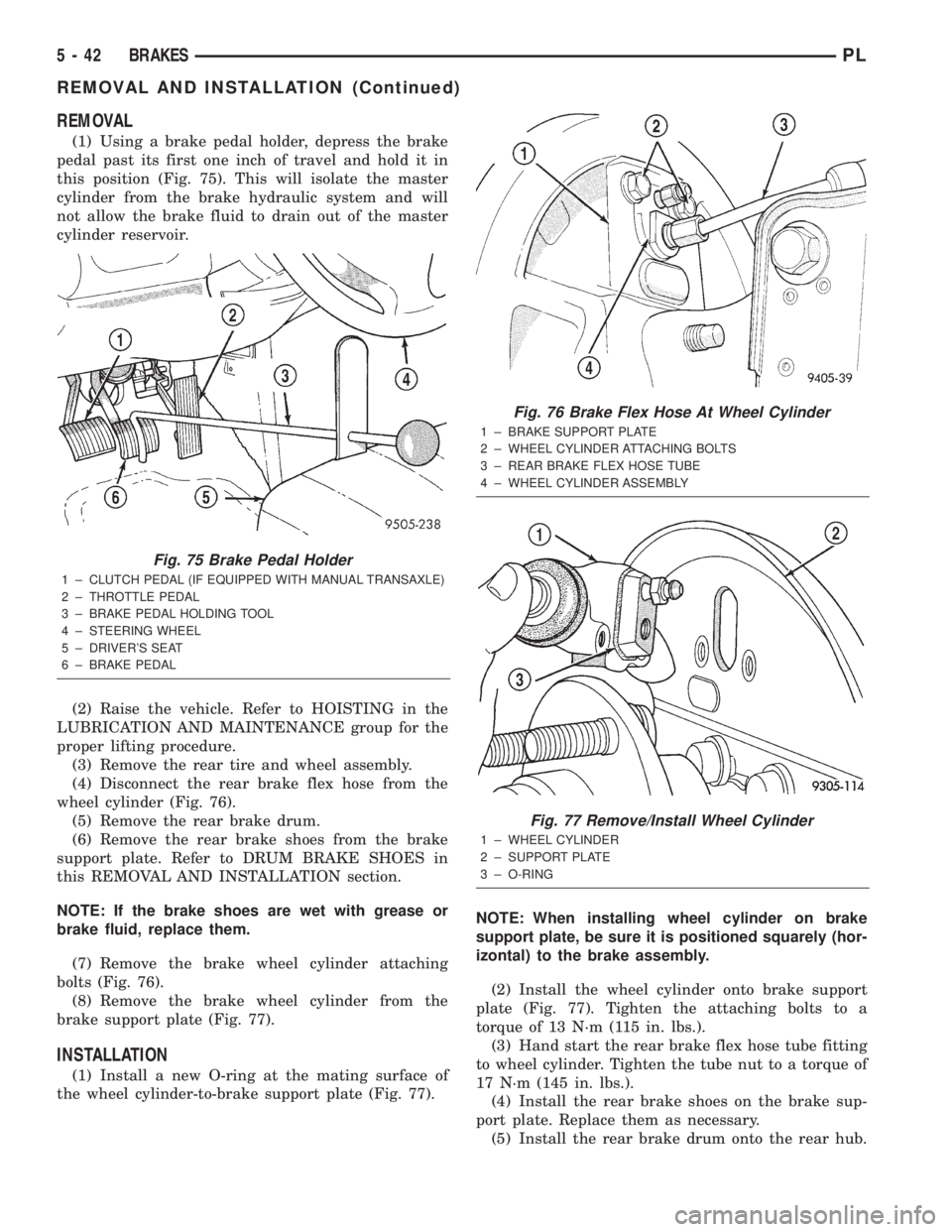
(1) Using a brake pedal holder, depress the brake
pedal past its first one inch of travel and hold it in
this position (Fig. 75). This will isolate the master
cylinder from the brake hydraulic system and will
not allow the brake fluid to drain out of the master
cylinder reservoir.
(2) Raise the vehicle. Refer to HOISTING in the
LUBRICATION AND MAINTENANCE group for the
proper lifting procedure.
(3) Remove the rear tire and wheel assembly.
(4) Disconnect the rear brake flex hose from the
wheel cylinder (Fig. 76).
(5) Remove the rear brake drum.
(6) Remove the rear brake shoes from the brake
support plate. Refer to DRUM BRAKE SHOES in
this REMOVAL AND INSTALLATION section.
NOTE: If the brake shoes are wet with grease or
brake fluid, replace them.
(7) Remove the brake wheel cylinder attaching
bolts (Fig. 76).
(8) Remove the brake wheel cylinder from the
brake support plate (Fig. 77).
INSTALLATION
(1) Install a new O-ring at the mating surface of
the wheel cylinder-to-brake support plate (Fig. 77).NOTE: When installing wheel cylinder on brake
support plate, be sure it is positioned squarely (hor-
izontal) to the brake assembly.
(2) Install the wheel cylinder onto brake support
plate (Fig. 77). Tighten the attaching bolts to a
torque of 13 N´m (115 in. lbs.).
(3) Hand start the rear brake flex hose tube fitting
to wheel cylinder. Tighten the tube nut to a torque of
17 N´m (145 in. lbs.).
(4) Install the rear brake shoes on the brake sup-
port plate. Replace them as necessary.
(5) Install the rear brake drum onto the rear hub.
Fig. 75 Brake Pedal Holder
1 ± CLUTCH PEDAL (IF EQUIPPED WITH MANUAL TRANSAXLE)
2 ± THROTTLE PEDAL
3 ± BRAKE PEDAL HOLDING TOOL
4 ± STEERING WHEEL
5 ± DRIVER'S SEAT
6 ± BRAKE PEDAL
Fig. 76 Brake Flex Hose At Wheel Cylinder
1 ± BRAKE SUPPORT PLATE
2 ± WHEEL CYLINDER ATTACHING BOLTS
3 ± REAR BRAKE FLEX HOSE TUBE
4 ± WHEEL CYLINDER ASSEMBLY
Fig. 77 Remove/Install Wheel Cylinder
1 ± WHEEL CYLINDER
2 ± SUPPORT PLATE
3 ± O-RING
5 - 42 BRAKESPL
REMOVAL AND INSTALLATION (Continued)
Page 125 of 1285
(4) Remove the brake drum (Fig. 87).
NOTE: If the drum does not come off, further brake
clearance can be obtained by backing off the brake
automatic adjuster screw. Remove the rubber plug
from the top of brake support plate. Rotate the
automatic adjuster screw in an upward motion,
using a screwdriver.
INSTALLATION
NOTE: Before installing the drum, inspect the brake
shoe linings for wear, shoe alignment, and contam-
ination.
(1) Install the rear brake drum on rear hub and
bearing (Fig. 87).
(2) Install the tire and wheel assembly. Tighten
the wheel mounting nuts to a torque of 135 N´m (100
ft. lbs.).
(3) Adjust the rear brake shoes as necessary. Refer
to ADJUSTMENTS in this section of this service
manual group.
(4) Lower the vehicle.
DRUM BRAKE SHOE SUPPORT PLATE (REAR)
NOTE: Before proceeding with this procedure,
review SERVICE WARNINGS AND CAUTIONS at the
beginning of REMOVAL AND INSTALLATION in this
section.
REMOVAL
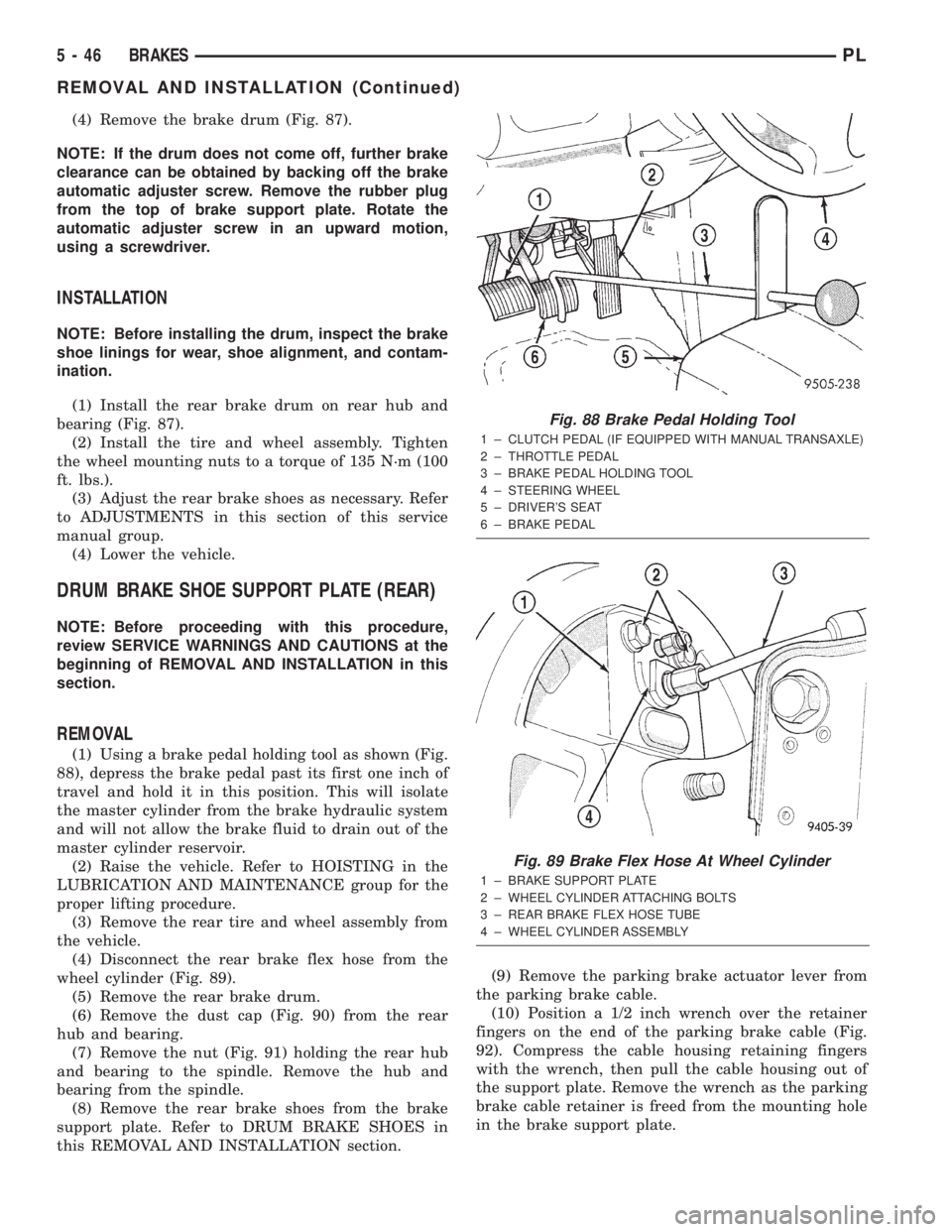
(1) Using a brake pedal holding tool as shown (Fig.
88), depress the brake pedal past its first one inch of
travel and hold it in this position. This will isolate
the master cylinder from the brake hydraulic system
and will not allow the brake fluid to drain out of the
master cylinder reservoir.
(2) Raise the vehicle. Refer to HOISTING in the
LUBRICATION AND MAINTENANCE group for the
proper lifting procedure.
(3) Remove the rear tire and wheel assembly from
the vehicle.
(4) Disconnect the rear brake flex hose from the
wheel cylinder (Fig. 89).
(5) Remove the rear brake drum.
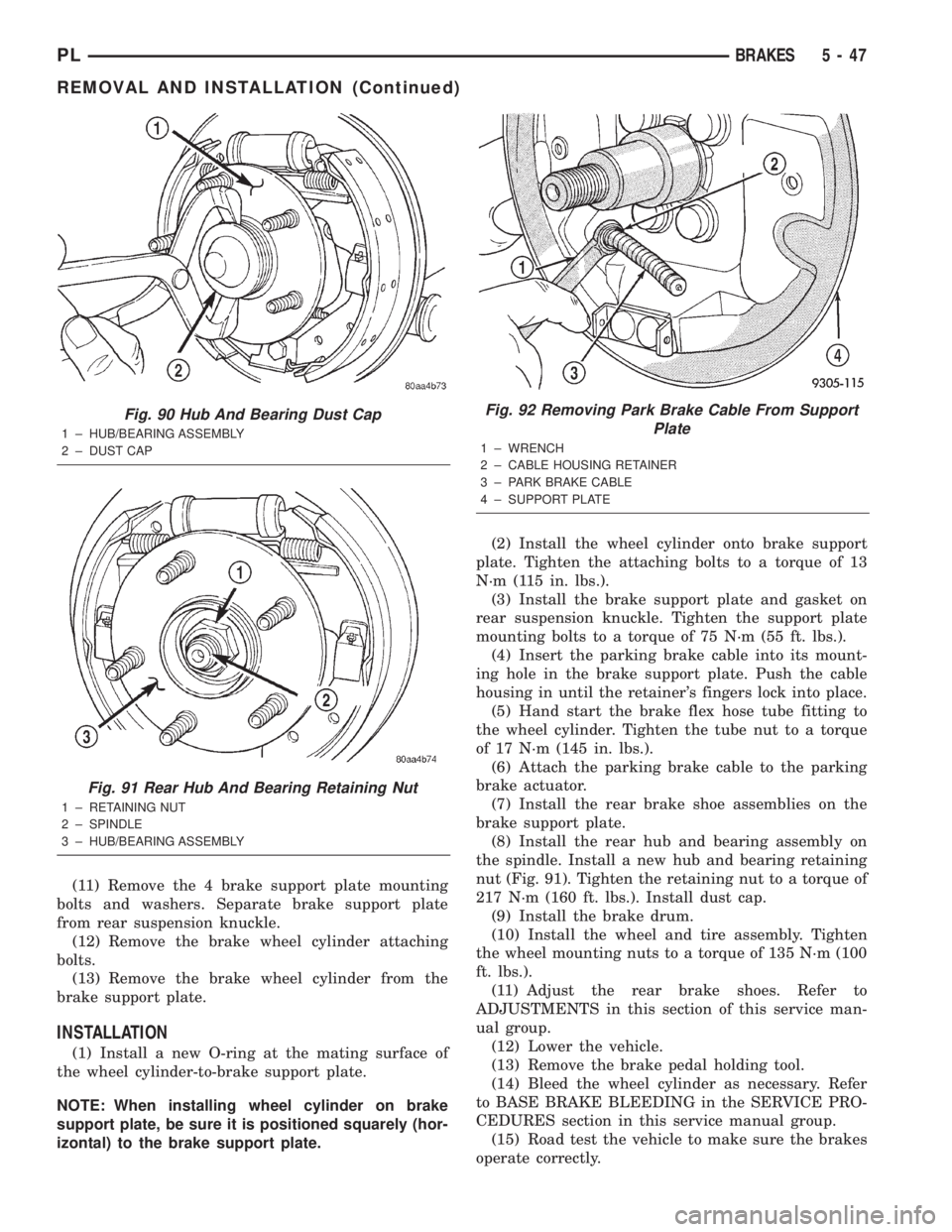
(6) Remove the dust cap (Fig. 90) from the rear
hub and bearing.
(7) Remove the nut (Fig. 91) holding the rear hub
and bearing to the spindle. Remove the hub and
bearing from the spindle.
(8) Remove the rear brake shoes from the brake
support plate. Refer to DRUM BRAKE SHOES in
this REMOVAL AND INSTALLATION section.(9) Remove the parking brake actuator lever from
the parking brake cable.
(10) Position a 1/2 inch wrench over the retainer
fingers on the end of the parking brake cable (Fig.
92). Compress the cable housing retaining fingers
with the wrench, then pull the cable housing out of
the support plate. Remove the wrench as the parking
brake cable retainer is freed from the mounting hole
in the brake support plate.
Fig. 88 Brake Pedal Holding Tool
1 ± CLUTCH PEDAL (IF EQUIPPED WITH MANUAL TRANSAXLE)
2 ± THROTTLE PEDAL
3 ± BRAKE PEDAL HOLDING TOOL
4 ± STEERING WHEEL
5 ± DRIVER'S SEAT
6 ± BRAKE PEDAL
Fig. 89 Brake Flex Hose At Wheel Cylinder
1 ± BRAKE SUPPORT PLATE
2 ± WHEEL CYLINDER ATTACHING BOLTS
3 ± REAR BRAKE FLEX HOSE TUBE
4 ± WHEEL CYLINDER ASSEMBLY
5 - 46 BRAKESPL
REMOVAL AND INSTALLATION (Continued)
Page 126 of 1285
(11) Remove the 4 brake support plate mounting
bolts and washers. Separate brake support plate
from rear suspension knuckle.
(12) Remove the brake wheel cylinder attaching
bolts.
(13) Remove the brake wheel cylinder from the
brake support plate.
INSTALLATION
(1) Install a new O-ring at the mating surface of
the wheel cylinder-to-brake support plate.
NOTE: When installing wheel cylinder on brake
support plate, be sure it is positioned squarely (hor-
izontal) to the brake support plate.(2) Install the wheel cylinder onto brake support
plate. Tighten the attaching bolts to a torque of 13
N´m (115 in. lbs.).
(3) Install the brake support plate and gasket on
rear suspension knuckle. Tighten the support plate
mounting bolts to a torque of 75 N´m (55 ft. lbs.).
(4) Insert the parking brake cable into its mount-
ing hole in the brake support plate. Push the cable
housing in until the retainer's fingers lock into place.
(5) Hand start the brake flex hose tube fitting to
the wheel cylinder. Tighten the tube nut to a torque
of 17 N´m (145 in. lbs.).
(6) Attach the parking brake cable to the parking
brake actuator.
(7) Install the rear brake shoe assemblies on the
brake support plate.
(8) Install the rear hub and bearing assembly on
the spindle. Install a new hub and bearing retaining
nut (Fig. 91). Tighten the retaining nut to a torque of
217 N´m (160 ft. lbs.). Install dust cap.
(9) Install the brake drum.
(10) Install the wheel and tire assembly. Tighten
the wheel mounting nuts to a torque of 135 N´m (100
ft. lbs.).
(11) Adjust the rear brake shoes. Refer to
ADJUSTMENTS in this section of this service man-
ual group.
(12) Lower the vehicle.
(13) Remove the brake pedal holding tool.
(14) Bleed the wheel cylinder as necessary. Refer
to BASE BRAKE BLEEDING in the SERVICE PRO-
CEDURES section in this service manual group.
(15) Road test the vehicle to make sure the brakes
operate correctly.
Fig. 90 Hub And Bearing Dust Cap
1 ± HUB/BEARING ASSEMBLY
2 ± DUST CAP
Fig. 91 Rear Hub And Bearing Retaining Nut
1 ± RETAINING NUT
2 ± SPINDLE
3 ± HUB/BEARING ASSEMBLY
Fig. 92 Removing Park Brake Cable From Support
Plate
1 ± WRENCH
2 ± CABLE HOUSING RETAINER
3 ± PARK BRAKE CABLE
4 ± SUPPORT PLATE
PLBRAKES 5 - 47
REMOVAL AND INSTALLATION (Continued)