belt DODGE NEON 2000 Service Manual PDF
[x] Cancel search | Manufacturer: DODGE, Model Year: 2000, Model line: NEON, Model: DODGE NEON 2000Pages: 1285, PDF Size: 29.42 MB
Page 772 of 1285
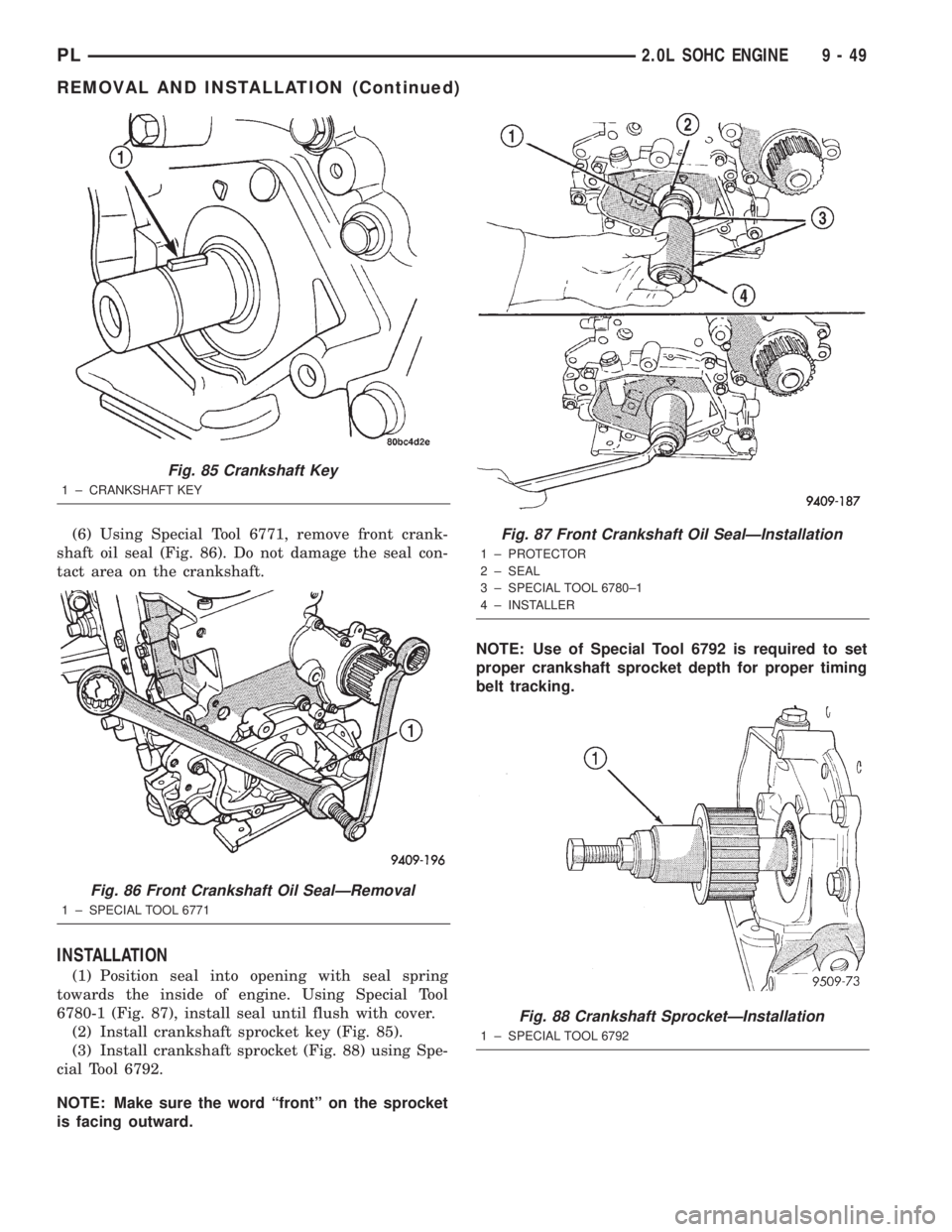
(6) Using Special Tool 6771, remove front crank-
shaft oil seal (Fig. 86). Do not damage the seal con-
tact area on the crankshaft.
INSTALLATION
(1) Position seal into opening with seal spring
towards the inside of engine. Using Special Tool
6780-1 (Fig. 87), install seal until flush with cover.
(2) Install crankshaft sprocket key (Fig. 85).
(3) Install crankshaft sprocket (Fig. 88) using Spe-
cial Tool 6792.
NOTE: Make sure the word ªfrontº on the sprocket
is facing outward.NOTE: Use of Special Tool 6792 is required to set
proper crankshaft sprocket depth for proper timing
belt tracking.
Fig. 85 Crankshaft Key
1 ± CRANKSHAFT KEY
Fig. 86 Front Crankshaft Oil SealÐRemoval
1 ± SPECIAL TOOL 6771
Fig. 87 Front Crankshaft Oil SealÐInstallation
1 ± PROTECTOR
2 ± SEAL
3 ± SPECIAL TOOL 6780±1
4 ± INSTALLER
Fig. 88 Crankshaft SprocketÐInstallation
1 ± SPECIAL TOOL 6792
PL2.0L SOHC ENGINE 9 - 49
REMOVAL AND INSTALLATION (Continued)
Page 773 of 1285
(4) Install timing belt and cover. Refer to proce-
dures in this section.
(5) Install crankshaft damper. Refer to procedure
in this section.
(6) Install accessory drive belts. Refer to Group 7,
Cooling System for procedure.
CRANKSHAFT OIL SEALÐREAR
REMOVAL
(1) Remove transaxle. Refer to Group 21, Tran-
saxle for procedure.
(2) Remove drive plate. Refer to procedure in this
section.
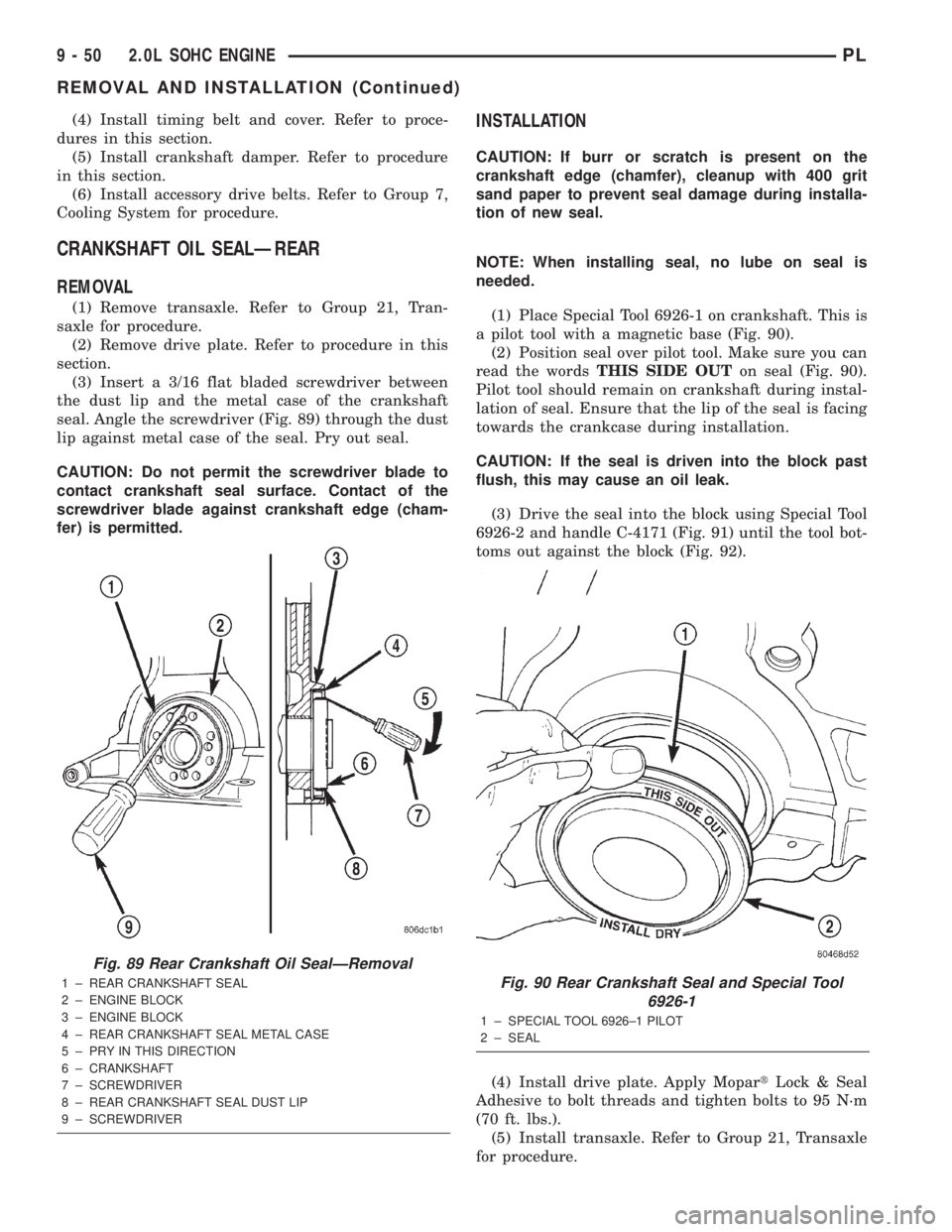
(3) Insert a 3/16 flat bladed screwdriver between
the dust lip and the metal case of the crankshaft
seal. Angle the screwdriver (Fig. 89) through the dust
lip against metal case of the seal. Pry out seal.
CAUTION: Do not permit the screwdriver blade to
contact crankshaft seal surface. Contact of the
screwdriver blade against crankshaft edge (cham-
fer) is permitted.
INSTALLATION
CAUTION: If burr or scratch is present on the
crankshaft edge (chamfer), cleanup with 400 grit
sand paper to prevent seal damage during installa-
tion of new seal.
NOTE: When installing seal, no lube on seal is
needed.
(1) Place Special Tool 6926-1 on crankshaft. This is
a pilot tool with a magnetic base (Fig. 90).
(2) Position seal over pilot tool. Make sure you can
read the wordsTHIS SIDE OUTon seal (Fig. 90).
Pilot tool should remain on crankshaft during instal-
lation of seal. Ensure that the lip of the seal is facing
towards the crankcase during installation.
CAUTION: If the seal is driven into the block past
flush, this may cause an oil leak.
(3) Drive the seal into the block using Special Tool
6926-2 and handle C-4171 (Fig. 91) until the tool bot-
toms out against the block (Fig. 92).
(4) Install drive plate. Apply MopartLock & Seal
Adhesive to bolt threads and tighten bolts to 95 N´m
(70 ft. lbs.).
(5) Install transaxle. Refer to Group 21, Transaxle
for procedure.
Fig. 89 Rear Crankshaft Oil SealÐRemoval
1 ± REAR CRANKSHAFT SEAL
2 ± ENGINE BLOCK
3 ± ENGINE BLOCK
4 ± REAR CRANKSHAFT SEAL METAL CASE
5 ± PRY IN THIS DIRECTION
6 ± CRANKSHAFT
7 ± SCREWDRIVER
8 ± REAR CRANKSHAFT SEAL DUST LIP
9 ± SCREWDRIVERFig. 90 Rear Crankshaft Seal and Special Tool
6926-1
1 ± SPECIAL TOOL 6926±1 PILOT
2 ± SEAL
9 - 50 2.0L SOHC ENGINEPL
REMOVAL AND INSTALLATION (Continued)
Page 775 of 1285
CRANKSHAFT
REMOVAL
(1) Remove engine assembly. Refer to procedure in
this section.
(2) Remove structural collar from oil pan to tran-
saxle housing.
(3) Separate transaxle from engine.
(4) Remove drive plate/flywheel.
(5) Remove crankshaft rear oil seal. Refer to pro-
cedure in this section.
(6) Mount engine on a suitable repair stand.
(7) Remove crankshaft damper, timing belt, and
tensioner. Refer to procedures in this section.
(8) Remove camshaft sprocket and rear timing belt
cover. Refer to procedures in this section.
(9) Remove crankshaft sprocket. Refer to proce-
dure in this section.(10) Remove lower torque strut/air conditioning
compressor mounting bracket from engine (Fig. 95).
(11) Remove oil filter and adapter.
(12) Remove oil pan.
(13) Remove oil pump pick-up tube.
(14) Remove oil pump.
(15) Remove crankshaft position sensor.
(16) Using a permanent ink or paint marker, iden-
tify cylinder number on each connecting rod cap.
CAUTION: DO NOT use a number stamp or a punch
to mark connecting rods. Damage to connecting
rod could occur.
(17) Remove all connecting rod bolts and caps.
Care should be taken not to damage the fracture rod
and cap surfaces.
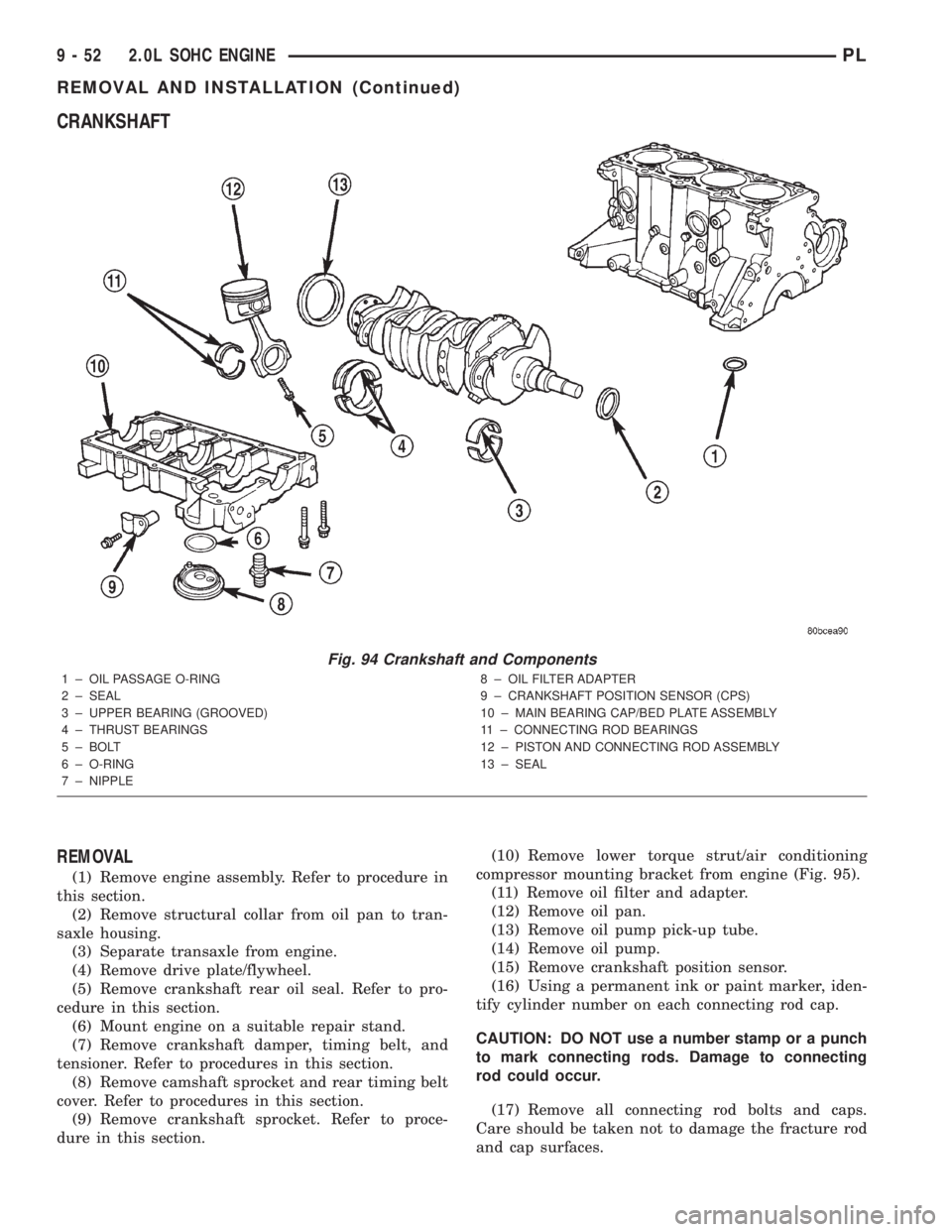
Fig. 94 Crankshaft and Components
1 ± OIL PASSAGE O-RING
2 ± SEAL
3 ± UPPER BEARING (GROOVED)
4 ± THRUST BEARINGS
5 ± BOLT
6 ± O-RING
7 ± NIPPLE8 ± OIL FILTER ADAPTER
9 ± CRANKSHAFT POSITION SENSOR (CPS)
10 ± MAIN BEARING CAP/BED PLATE ASSEMBLY
11 ± CONNECTING ROD BEARINGS
12 ± PISTON AND CONNECTING ROD ASSEMBLY
13 ± SEAL
9 - 52 2.0L SOHC ENGINEPL
REMOVAL AND INSTALLATION (Continued)
Page 778 of 1285
(17) Install rear timing belt cover and camshaft
sprocket.
(18) Install crankshaft sprocket, timing belt ten-
sioner, timing belt, and cover.
(19) Install front engine mount bracket.
(20) Remove engine from repair stand and position
on Special Tools 6135 and 6710 Engine Dolly and
Cradle. Install safety straps around the engine to
cradle and tighten and lock them into position.
(21) Install crankshaft rear oil seal. Refer to proce-
dure in this section.
(22) Install drive plate/flywheel. Apply Mopart
Lock & Seal Adhesive to bolt threads and tighten to
95 N´m (70 ft. lbs.).
(23) Install transaxle to engine.
(24) Install structural collar. Refer to procedure in
this section.
(25) Install engine assembly. Refer to procedure in
this section.
(26) Perform camshaft and crankshaft timing
relearn procedure as follows:
²Connect the DRB scan tool to the data link
(diagnostic) connector. This connector is located in
the passenger compartment; at the lower edge of
instrument panel; near the steering column.
²Turn the ignition switch on and access the ªmis-
cellaneousº screen.
²Select ªre-learn cam/crankº option and follow
directions on DRB screen.
OIL FILTER ADAPTER
REMOVE AND INSTALL
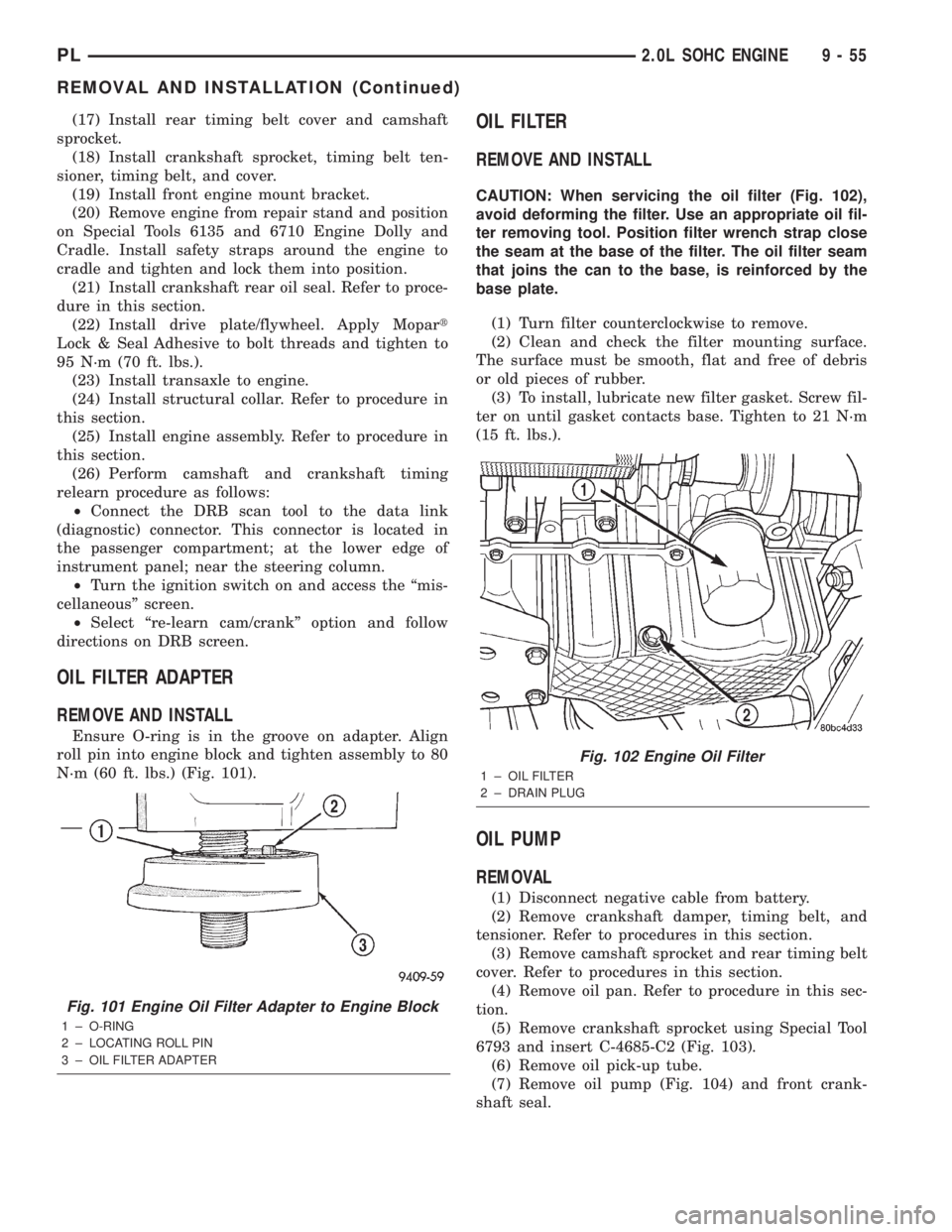
Ensure O-ring is in the groove on adapter. Align
roll pin into engine block and tighten assembly to 80
N´m (60 ft. lbs.) (Fig. 101).
OIL FILTER
REMOVE AND INSTALL
CAUTION: When servicing the oil filter (Fig. 102),
avoid deforming the filter. Use an appropriate oil fil-
ter removing tool. Position filter wrench strap close
the seam at the base of the filter. The oil filter seam
that joins the can to the base, is reinforced by the
base plate.
(1) Turn filter counterclockwise to remove.
(2) Clean and check the filter mounting surface.
The surface must be smooth, flat and free of debris
or old pieces of rubber.
(3) To install, lubricate new filter gasket. Screw fil-
ter on until gasket contacts base. Tighten to 21 N´m
(15 ft. lbs.).
OIL PUMP
REMOVAL
(1) Disconnect negative cable from battery.
(2) Remove crankshaft damper, timing belt, and
tensioner. Refer to procedures in this section.
(3) Remove camshaft sprocket and rear timing belt
cover. Refer to procedures in this section.
(4) Remove oil pan. Refer to procedure in this sec-
tion.
(5) Remove crankshaft sprocket using Special Tool
6793 and insert C-4685-C2 (Fig. 103).
(6) Remove oil pick-up tube.
(7) Remove oil pump (Fig. 104) and front crank-
shaft seal.
Fig. 101 Engine Oil Filter Adapter to Engine Block
1 ± O-RING
2 ± LOCATING ROLL PIN
3 ± OIL FILTER ADAPTER
Fig. 102 Engine Oil Filter
1 ± OIL FILTER
2 ± DRAIN PLUG
PL2.0L SOHC ENGINE 9 - 55
REMOVAL AND INSTALLATION (Continued)
Page 780 of 1285
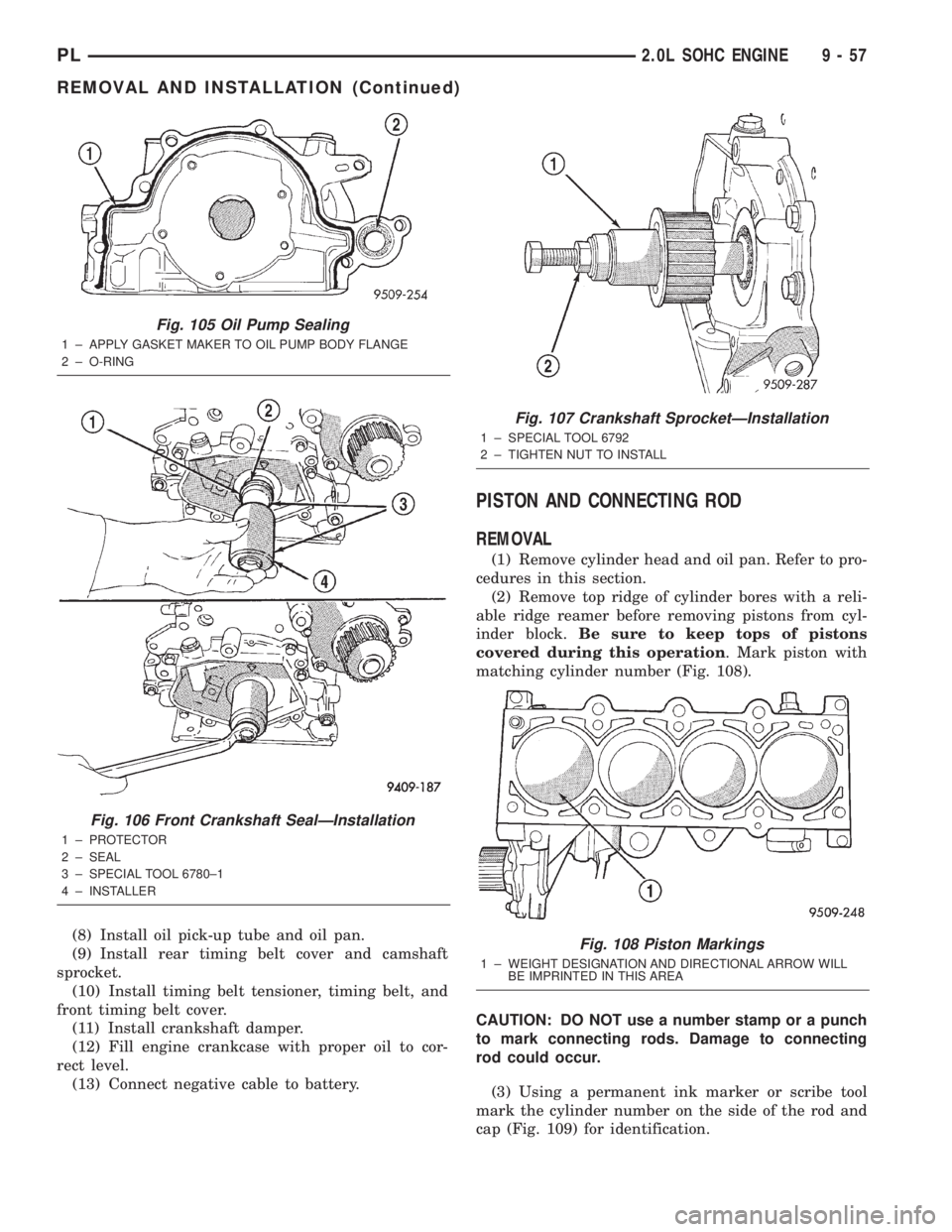
(8) Install oil pick-up tube and oil pan.
(9) Install rear timing belt cover and camshaft
sprocket.
(10) Install timing belt tensioner, timing belt, and
front timing belt cover.
(11) Install crankshaft damper.
(12) Fill engine crankcase with proper oil to cor-
rect level.
(13) Connect negative cable to battery.
PISTON AND CONNECTING ROD
REMOVAL
(1) Remove cylinder head and oil pan. Refer to pro-
cedures in this section.
(2) Remove top ridge of cylinder bores with a reli-
able ridge reamer before removing pistons from cyl-
inder block.Be sure to keep tops of pistons
covered during this operation. Mark piston with
matching cylinder number (Fig. 108).
CAUTION: DO NOT use a number stamp or a punch
to mark connecting rods. Damage to connecting
rod could occur.
(3) Using a permanent ink marker or scribe tool
mark the cylinder number on the side of the rod and
cap (Fig. 109) for identification.
Fig. 105 Oil Pump Sealing
1 ± APPLY GASKET MAKER TO OIL PUMP BODY FLANGE
2 ± O-RING
Fig. 106 Front Crankshaft SealÐInstallation
1 ± PROTECTOR
2 ± SEAL
3 ± SPECIAL TOOL 6780±1
4 ± INSTALLER
Fig. 107 Crankshaft SprocketÐInstallation
1 ± SPECIAL TOOL 6792
2 ± TIGHTEN NUT TO INSTALL
Fig. 108 Piston Markings
1 ± WEIGHT DESIGNATION AND DIRECTIONAL ARROW WILL
BE IMPRINTED IN THIS AREA
PL2.0L SOHC ENGINE 9 - 57
REMOVAL AND INSTALLATION (Continued)
Page 781 of 1285
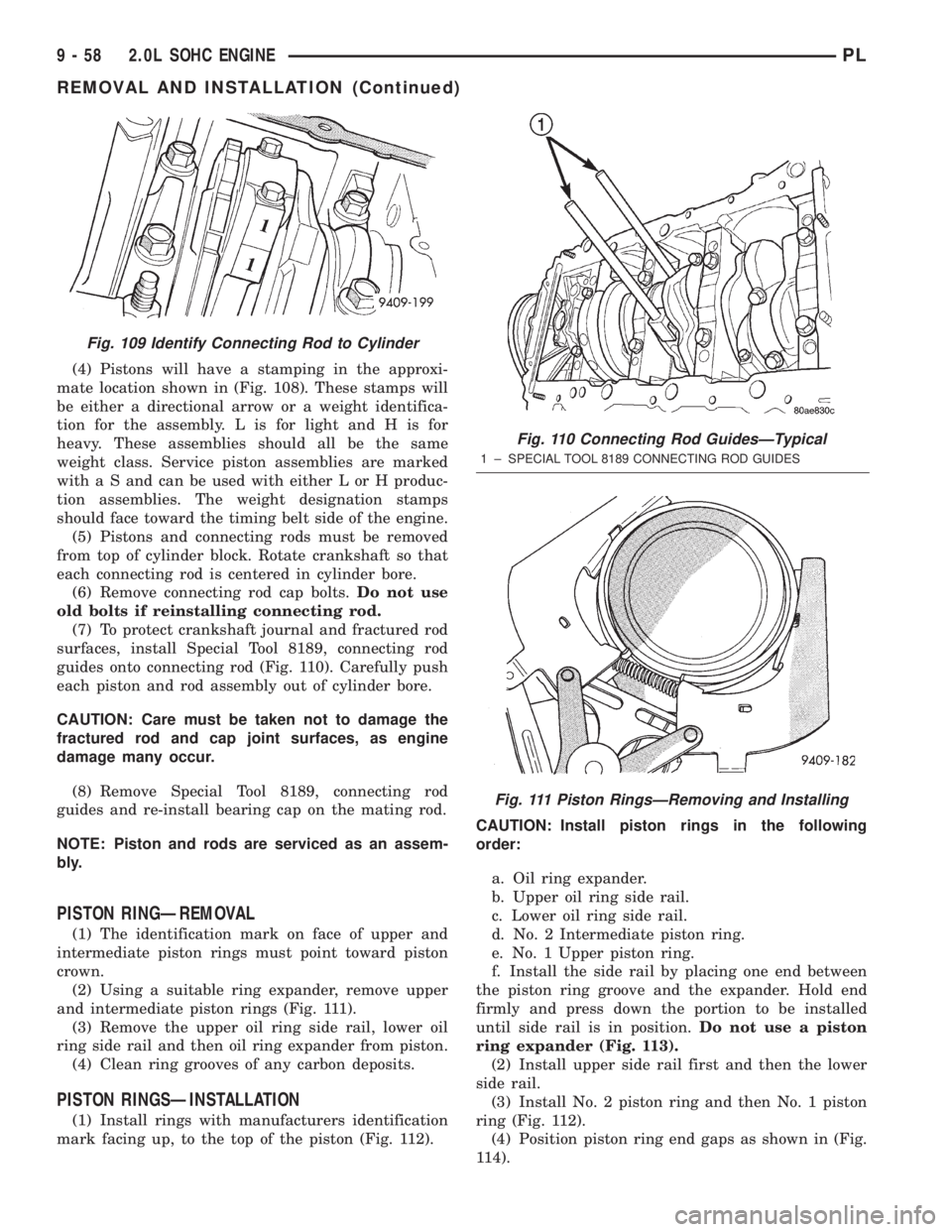
(4) Pistons will have a stamping in the approxi-
mate location shown in (Fig. 108). These stamps will
be either a directional arrow or a weight identifica-
tion for the assembly. L is for light and H is for
heavy. These assemblies should all be the same
weight class. Service piston assemblies are marked
with a S and can be used with either L or H produc-
tion assemblies. The weight designation stamps
should face toward the timing belt side of the engine.
(5) Pistons and connecting rods must be removed
from top of cylinder block. Rotate crankshaft so that
each connecting rod is centered in cylinder bore.
(6) Remove connecting rod cap bolts.Do not use
old bolts if reinstalling connecting rod.
(7) To protect crankshaft journal and fractured rod
surfaces, install Special Tool 8189, connecting rod
guides onto connecting rod (Fig. 110). Carefully push
each piston and rod assembly out of cylinder bore.
CAUTION: Care must be taken not to damage the
fractured rod and cap joint surfaces, as engine
damage many occur.
(8) Remove Special Tool 8189, connecting rod
guides and re-install bearing cap on the mating rod.
NOTE: Piston and rods are serviced as an assem-
bly.
PISTON RINGÐREMOVAL
(1) The identification mark on face of upper and
intermediate piston rings must point toward piston
crown.
(2) Using a suitable ring expander, remove upper
and intermediate piston rings (Fig. 111).
(3) Remove the upper oil ring side rail, lower oil
ring side rail and then oil ring expander from piston.
(4) Clean ring grooves of any carbon deposits.
PISTON RINGSÐINSTALLATION
(1) Install rings with manufacturers identification
mark facing up, to the top of the piston (Fig. 112).CAUTION: Install piston rings in the following
order:
a. Oil ring expander.
b. Upper oil ring side rail.
c. Lower oil ring side rail.
d. No. 2 Intermediate piston ring.
e. No. 1 Upper piston ring.
f. Install the side rail by placing one end between
the piston ring groove and the expander. Hold end
firmly and press down the portion to be installed
until side rail is in position.Do not use a piston
ring expander (Fig. 113).
(2) Install upper side rail first and then the lower
side rail.
(3) Install No. 2 piston ring and then No. 1 piston
ring (Fig. 112).
(4) Position piston ring end gaps as shown in (Fig.
114).
Fig. 109 Identify Connecting Rod to Cylinder
Fig. 110 Connecting Rod GuidesÐTypical
1 ± SPECIAL TOOL 8189 CONNECTING ROD GUIDES
Fig. 111 Piston RingsÐRemoving and Installing
9 - 58 2.0L SOHC ENGINEPL
REMOVAL AND INSTALLATION (Continued)
Page 794 of 1285
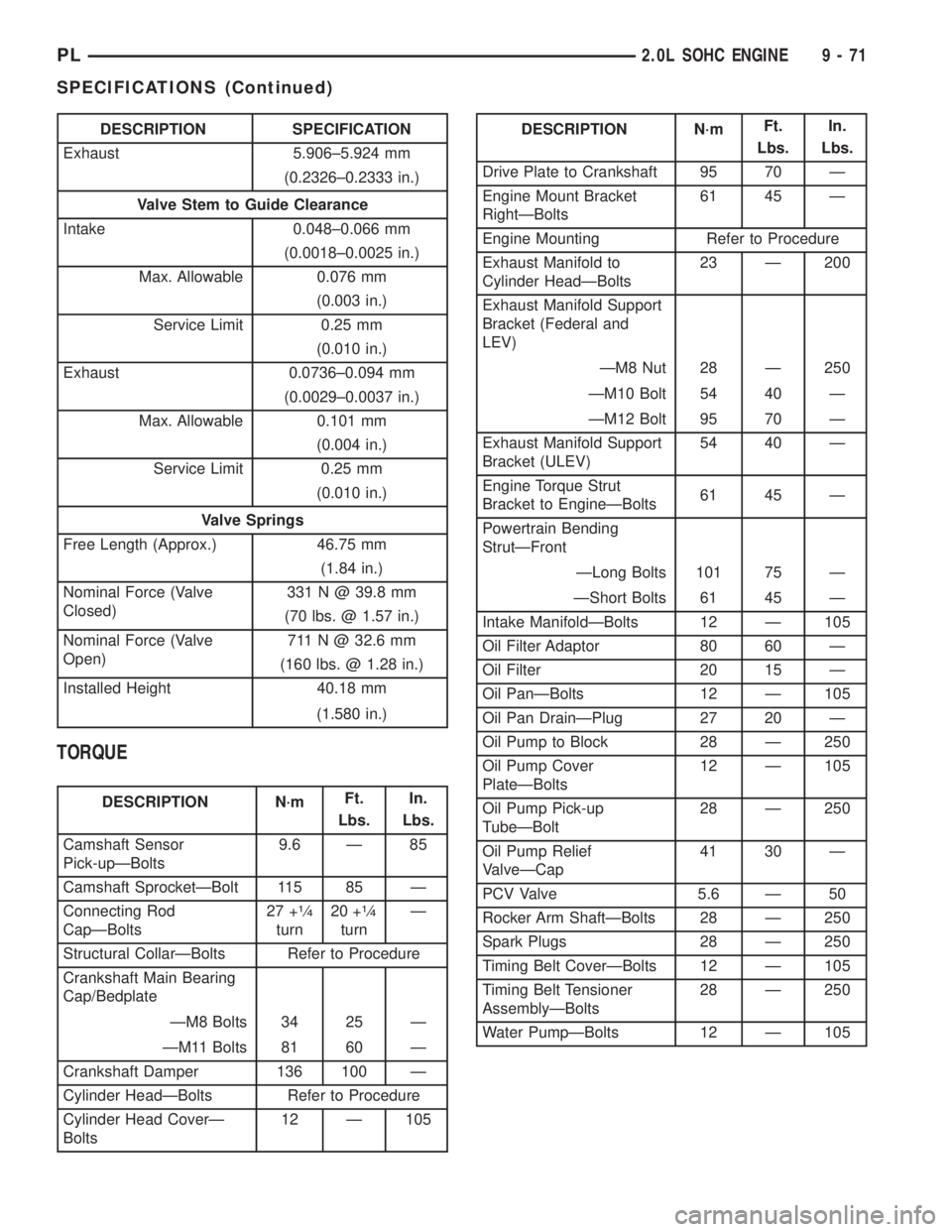
DESCRIPTION SPECIFICATION
Exhaust 5.906±5.924 mm
(0.2326±0.2333 in.)
Valve Stem to Guide Clearance
Intake 0.048±0.066 mm
(0.0018±0.0025 in.)
Max. Allowable 0.076 mm
(0.003 in.)
Service Limit 0.25 mm
(0.010 in.)
Exhaust 0.0736±0.094 mm
(0.0029±0.0037 in.)
Max. Allowable 0.101 mm
(0.004 in.)
Service Limit 0.25 mm
(0.010 in.)
Valve Springs
Free Length (Approx.) 46.75 mm
(1.84 in.)
Nominal Force (Valve
Closed)331 N @ 39.8 mm
(70 lbs. @ 1.57 in.)
Nominal Force (Valve
Open)711 N @ 32.6 mm
(160 lbs. @ 1.28 in.)
Installed Height 40.18 mm
(1.580 in.)
TORQUE
DESCRIPTION N´mFt.
Lbs.In.
Lbs.
Camshaft Sensor
Pick-upÐBolts9.6 Ð 85
Camshaft SprocketÐBolt 115 85 Ð
Connecting Rod
CapÐBolts27 +
1¤4
turn20 +
1¤4
turnÐ
Structural CollarÐBolts Refer to Procedure
Crankshaft Main Bearing
Cap/Bedplate
ÐM8 Bolts 34 25 Ð
ÐM11 Bolts 81 60 Ð
Crankshaft Damper 136 100 Ð
Cylinder HeadÐBolts Refer to Procedure
Cylinder Head CoverÐ
Bolts12 Ð 105
DESCRIPTION N´mFt.
Lbs.In.
Lbs.
Drive Plate to Crankshaft 95 70 Ð
Engine Mount Bracket
RightÐBolts61 45 Ð
Engine Mounting Refer to Procedure
Exhaust Manifold to
Cylinder HeadÐBolts23 Ð 200
Exhaust Manifold Support
Bracket (Federal and
LEV)
ÐM8 Nut 28 Ð 250
ÐM10 Bolt 54 40 Ð
ÐM12 Bolt 95 70 Ð
Exhaust Manifold Support
Bracket (ULEV)54 40 Ð
Engine Torque Strut
Bracket to EngineÐBolts61 45 Ð
Powertrain Bending
StrutÐFront
ÐLong Bolts 101 75 Ð
ÐShort Bolts 61 45 Ð
Intake ManifoldÐBolts 12 Ð 105
Oil Filter Adaptor 80 60 Ð
Oil Filter 20 15 Ð
Oil PanÐBolts 12 Ð 105
Oil Pan DrainÐPlug 27 20 Ð
Oil Pump to Block 28 Ð 250
Oil Pump Cover
PlateÐBolts12 Ð 105
Oil Pump Pick-up
TubeÐBolt28 Ð 250
Oil Pump Relief
ValveÐCap41 30 Ð
PCV Valve 5.6 Ð 50
Rocker Arm ShaftÐBolts 28 Ð 250
Spark Plugs 28 Ð 250
Timing Belt CoverÐBolts 12 Ð 105
Timing Belt Tensioner
AssemblyÐBolts28 Ð 250
Water PumpÐBolts 12 Ð 105
PL2.0L SOHC ENGINE 9 - 71
SPECIFICATIONS (Continued)
Page 851 of 1285
signal to the PCM, allowing engine starter operation.
The interlock switch is not adjustable.
Clutch Pedal Upstop Switch
With the clutch pedal at rest, the clutch pedal
upstop switch is closed, allowing speed control oper-
ation. When the clutch pedal is depressed, the upstop
switch opens and signals the PCM to cancel speed
control operation, and enter a modified engine cali-
bration schedule to improve driveability during gear-
to-gear shifts. The upstop switch is not adjustable.
CRANKSHAFT POSITION SENSORÐPCM
INPUT
DESCRIPTION
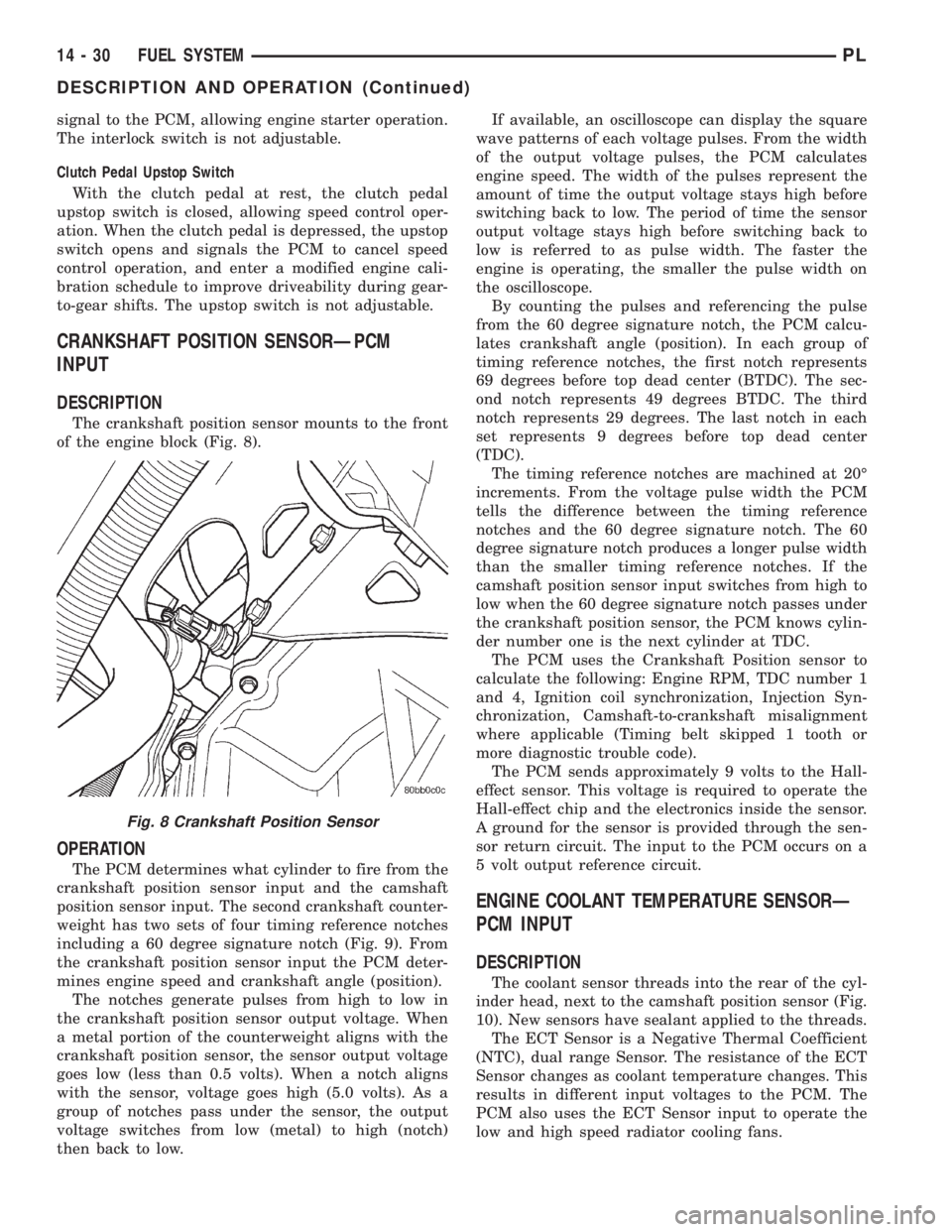
The crankshaft position sensor mounts to the front
of the engine block (Fig. 8).
OPERATION
The PCM determines what cylinder to fire from the
crankshaft position sensor input and the camshaft
position sensor input. The second crankshaft counter-
weight has two sets of four timing reference notches
including a 60 degree signature notch (Fig. 9). From
the crankshaft position sensor input the PCM deter-
mines engine speed and crankshaft angle (position).
The notches generate pulses from high to low in
the crankshaft position sensor output voltage. When
a metal portion of the counterweight aligns with the
crankshaft position sensor, the sensor output voltage
goes low (less than 0.5 volts). When a notch aligns
with the sensor, voltage goes high (5.0 volts). As a
group of notches pass under the sensor, the output
voltage switches from low (metal) to high (notch)
then back to low.If available, an oscilloscope can display the square
wave patterns of each voltage pulses. From the width
of the output voltage pulses, the PCM calculates
engine speed. The width of the pulses represent the
amount of time the output voltage stays high before
switching back to low. The period of time the sensor
output voltage stays high before switching back to
low is referred to as pulse width. The faster the
engine is operating, the smaller the pulse width on
the oscilloscope.
By counting the pulses and referencing the pulse
from the 60 degree signature notch, the PCM calcu-
lates crankshaft angle (position). In each group of
timing reference notches, the first notch represents
69 degrees before top dead center (BTDC). The sec-
ond notch represents 49 degrees BTDC. The third
notch represents 29 degrees. The last notch in each
set represents 9 degrees before top dead center
(TDC).
The timing reference notches are machined at 20É
increments. From the voltage pulse width the PCM
tells the difference between the timing reference
notches and the 60 degree signature notch. The 60
degree signature notch produces a longer pulse width
than the smaller timing reference notches. If the
camshaft position sensor input switches from high to
low when the 60 degree signature notch passes under
the crankshaft position sensor, the PCM knows cylin-
der number one is the next cylinder at TDC.
The PCM uses the Crankshaft Position sensor to
calculate the following: Engine RPM, TDC number 1
and 4, Ignition coil synchronization, Injection Syn-
chronization, Camshaft-to-crankshaft misalignment
where applicable (Timing belt skipped 1 tooth or
more diagnostic trouble code).
The PCM sends approximately 9 volts to the Hall-
effect sensor. This voltage is required to operate the
Hall-effect chip and the electronics inside the sensor.
A ground for the sensor is provided through the sen-
sor return circuit. The input to the PCM occurs on a
5 volt output reference circuit.
ENGINE COOLANT TEMPERATURE SENSORÐ
PCM INPUT
DESCRIPTION
The coolant sensor threads into the rear of the cyl-
inder head, next to the camshaft position sensor (Fig.
10). New sensors have sealant applied to the threads.
The ECT Sensor is a Negative Thermal Coefficient
(NTC), dual range Sensor. The resistance of the ECT
Sensor changes as coolant temperature changes. This
results in different input voltages to the PCM. The
PCM also uses the ECT Sensor input to operate the
low and high speed radiator cooling fans.
Fig. 8 Crankshaft Position Sensor
14 - 30 FUEL SYSTEMPL
DESCRIPTION AND OPERATION (Continued)
Page 875 of 1285
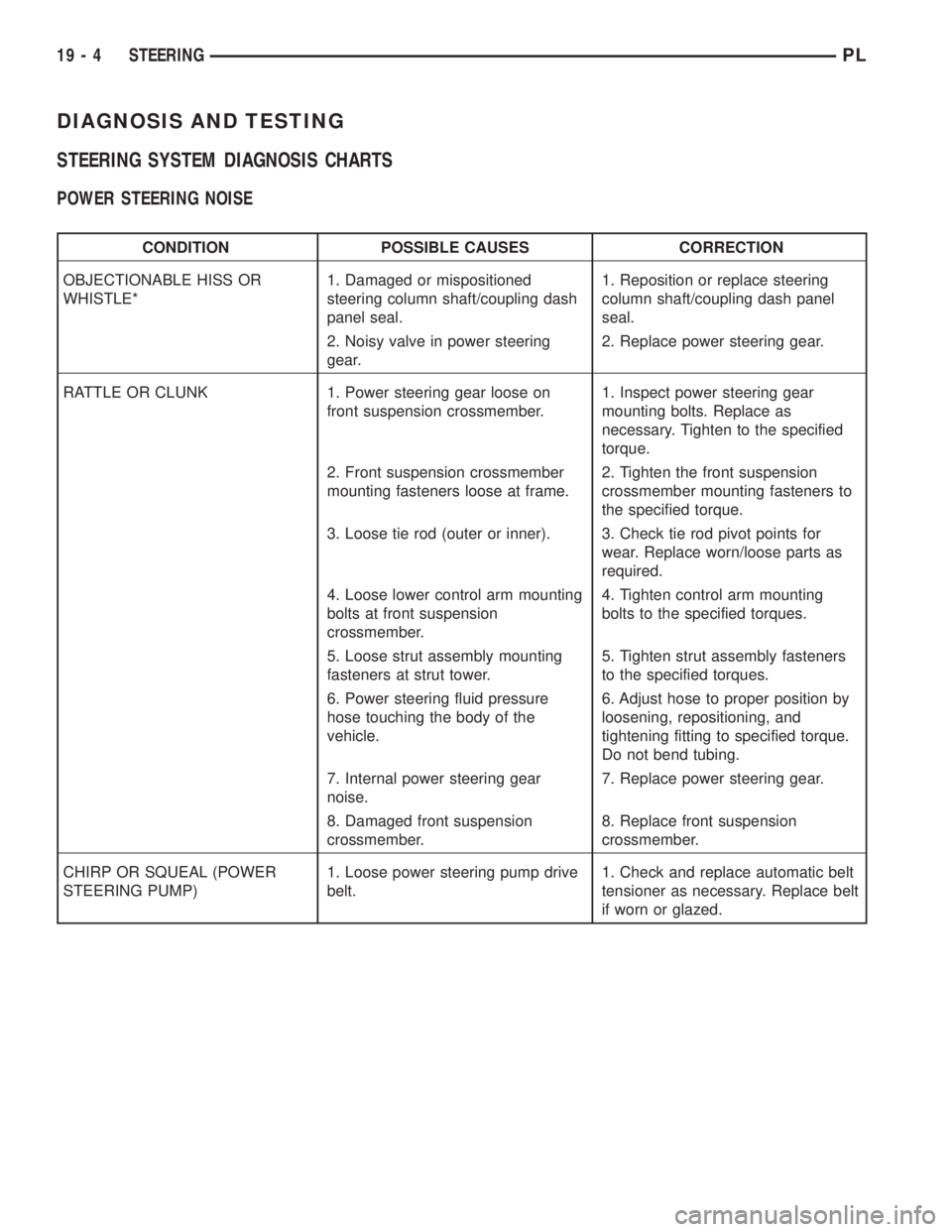
DIAGNOSIS AND TESTING
STEERING SYSTEM DIAGNOSIS CHARTS
POWER STEERING NOISE
CONDITION POSSIBLE CAUSES CORRECTION
OBJECTIONABLE HISS OR
WHISTLE*1. Damaged or mispositioned
steering column shaft/coupling dash
panel seal.1. Reposition or replace steering
column shaft/coupling dash panel
seal.
2. Noisy valve in power steering
gear.2. Replace power steering gear.
RATTLE OR CLUNK 1. Power steering gear loose on
front suspension crossmember.1. Inspect power steering gear
mounting bolts. Replace as
necessary. Tighten to the specified
torque.
2. Front suspension crossmember
mounting fasteners loose at frame.2. Tighten the front suspension
crossmember mounting fasteners to
the specified torque.
3. Loose tie rod (outer or inner). 3. Check tie rod pivot points for
wear. Replace worn/loose parts as
required.
4. Loose lower control arm mounting
bolts at front suspension
crossmember.4. Tighten control arm mounting
bolts to the specified torques.
5. Loose strut assembly mounting
fasteners at strut tower.5. Tighten strut assembly fasteners
to the specified torques.
6. Power steering fluid pressure
hose touching the body of the
vehicle.6. Adjust hose to proper position by
loosening, repositioning, and
tightening fitting to specified torque.
Do not bend tubing.
7. Internal power steering gear
noise.7. Replace power steering gear.
8. Damaged front suspension
crossmember.8. Replace front suspension
crossmember.
CHIRP OR SQUEAL (POWER
STEERING PUMP)1. Loose power steering pump drive
belt.1. Check and replace automatic belt
tensioner as necessary. Replace belt
if worn or glazed.
19 - 4 STEERINGPL
Page 877 of 1285
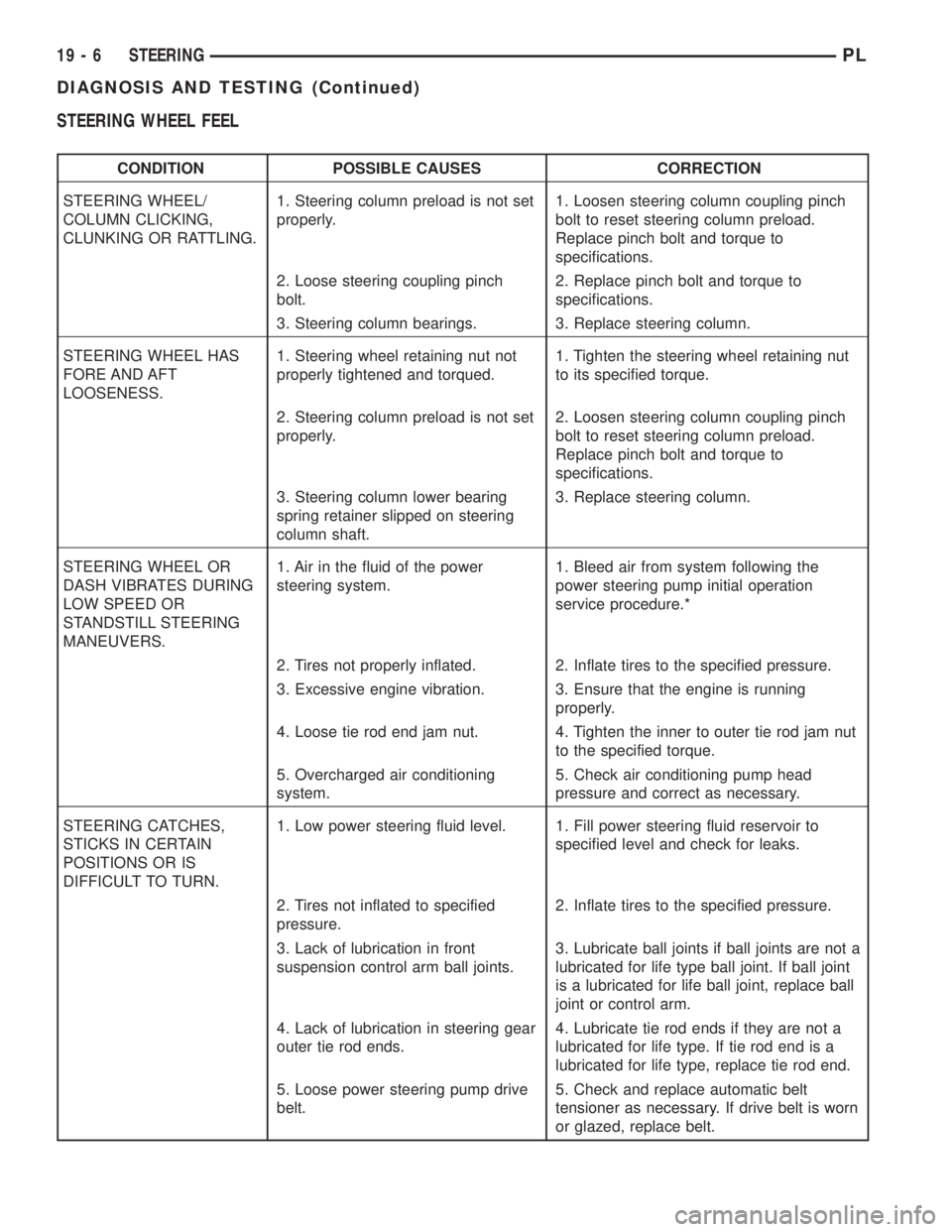
STEERING WHEEL FEEL
CONDITION POSSIBLE CAUSES CORRECTION
STEERING WHEEL/
COLUMN CLICKING,
CLUNKING OR RATTLING.1. Steering column preload is not set
properly.1. Loosen steering column coupling pinch
bolt to reset steering column preload.
Replace pinch bolt and torque to
specifications.
2. Loose steering coupling pinch
bolt.2. Replace pinch bolt and torque to
specifications.
3. Steering column bearings. 3. Replace steering column.
STEERING WHEEL HAS
FORE AND AFT
LOOSENESS.1. Steering wheel retaining nut not
properly tightened and torqued.1. Tighten the steering wheel retaining nut
to its specified torque.
2. Steering column preload is not set
properly.2. Loosen steering column coupling pinch
bolt to reset steering column preload.
Replace pinch bolt and torque to
specifications.
3. Steering column lower bearing
spring retainer slipped on steering
column shaft.3. Replace steering column.
STEERING WHEEL OR
DASH VIBRATES DURING
LOW SPEED OR
STANDSTILL STEERING
MANEUVERS.1. Air in the fluid of the power
steering system.1. Bleed air from system following the
power steering pump initial operation
service procedure.*
2. Tires not properly inflated. 2. Inflate tires to the specified pressure.
3. Excessive engine vibration. 3. Ensure that the engine is running
properly.
4. Loose tie rod end jam nut. 4. Tighten the inner to outer tie rod jam nut
to the specified torque.
5. Overcharged air conditioning
system.5. Check air conditioning pump head
pressure and correct as necessary.
STEERING CATCHES,
STICKS IN CERTAIN
POSITIONS OR IS
DIFFICULT TO TURN.1. Low power steering fluid level. 1. Fill power steering fluid reservoir to
specified level and check for leaks.
2. Tires not inflated to specified
pressure.2. Inflate tires to the specified pressure.
3. Lack of lubrication in front
suspension control arm ball joints.3. Lubricate ball joints if ball joints are not a
lubricated for life type ball joint. If ball joint
is a lubricated for life ball joint, replace ball
joint or control arm.
4. Lack of lubrication in steering gear
outer tie rod ends.4. Lubricate tie rod ends if they are not a
lubricated for life type. If tie rod end is a
lubricated for life type, replace tie rod end.
5. Loose power steering pump drive
belt.5. Check and replace automatic belt
tensioner as necessary. If drive belt is worn
or glazed, replace belt.
19 - 6 STEERINGPL
DIAGNOSIS AND TESTING (Continued)