belt DODGE NEON 2000 Service Manual Online
[x] Cancel search | Manufacturer: DODGE, Model Year: 2000, Model line: NEON, Model: DODGE NEON 2000Pages: 1285, PDF Size: 29.42 MB
Page 878 of 1285
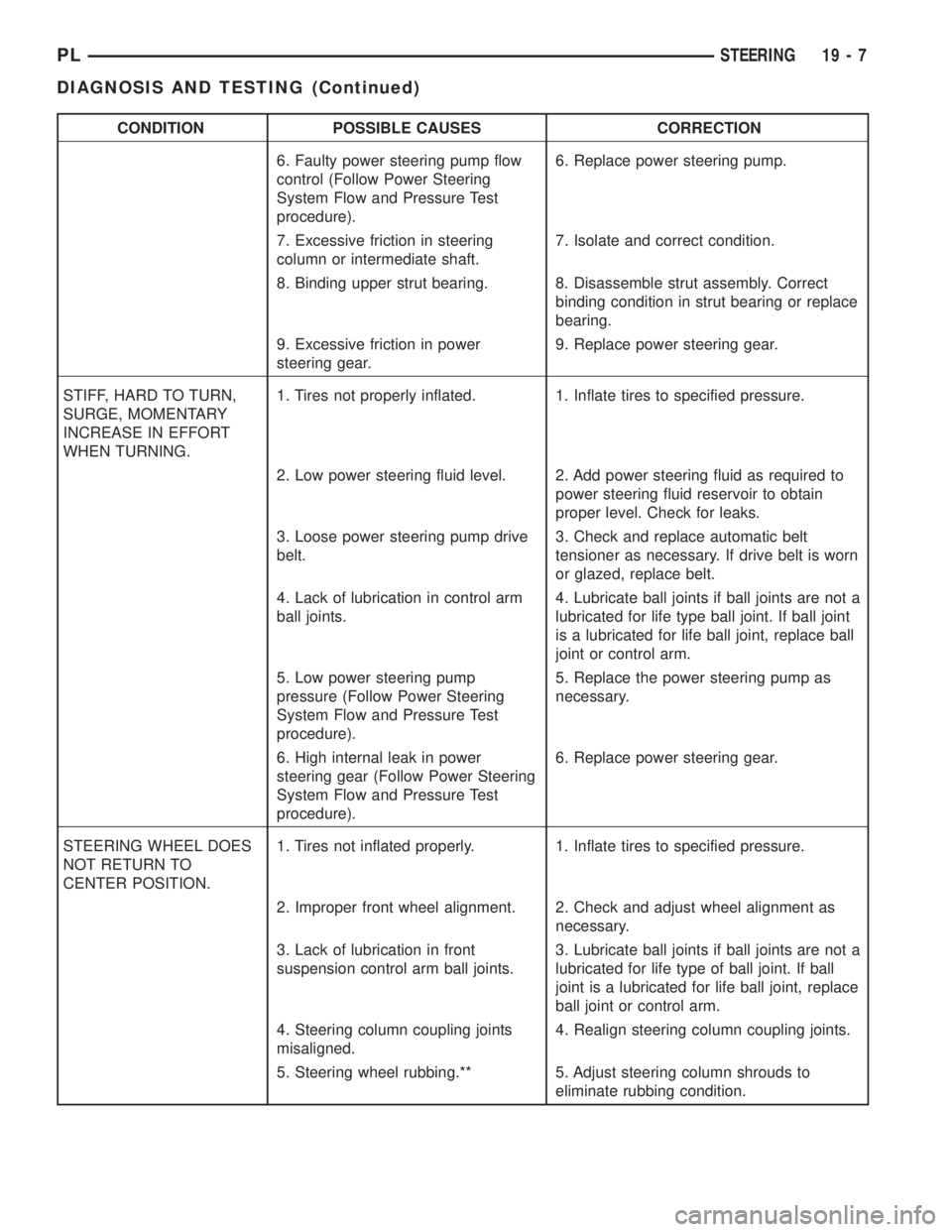
CONDITION POSSIBLE CAUSES CORRECTION
6. Faulty power steering pump flow
control (Follow Power Steering
System Flow and Pressure Test
procedure).6. Replace power steering pump.
7. Excessive friction in steering
column or intermediate shaft.7. Isolate and correct condition.
8. Binding upper strut bearing. 8. Disassemble strut assembly. Correct
binding condition in strut bearing or replace
bearing.
9. Excessive friction in power
steering gear.9. Replace power steering gear.
STIFF, HARD TO TURN,
SURGE, MOMENTARY
INCREASE IN EFFORT
WHEN TURNING.1. Tires not properly inflated. 1. Inflate tires to specified pressure.
2. Low power steering fluid level. 2. Add power steering fluid as required to
power steering fluid reservoir to obtain
proper level. Check for leaks.
3. Loose power steering pump drive
belt.3. Check and replace automatic belt
tensioner as necessary. If drive belt is worn
or glazed, replace belt.
4. Lack of lubrication in control arm
ball joints.4. Lubricate ball joints if ball joints are not a
lubricated for life type ball joint. If ball joint
is a lubricated for life ball joint, replace ball
joint or control arm.
5. Low power steering pump
pressure (Follow Power Steering
System Flow and Pressure Test
procedure).5. Replace the power steering pump as
necessary.
6. High internal leak in power
steering gear (Follow Power Steering
System Flow and Pressure Test
procedure).6. Replace power steering gear.
STEERING WHEEL DOES
NOT RETURN TO
CENTER POSITION.1. Tires not inflated properly. 1. Inflate tires to specified pressure.
2. Improper front wheel alignment. 2. Check and adjust wheel alignment as
necessary.
3. Lack of lubrication in front
suspension control arm ball joints.3. Lubricate ball joints if ball joints are not a
lubricated for life type of ball joint. If ball
joint is a lubricated for life ball joint, replace
ball joint or control arm.
4. Steering column coupling joints
misaligned.4. Realign steering column coupling joints.
5. Steering wheel rubbing.** 5. Adjust steering column shrouds to
eliminate rubbing condition.
PLSTEERING 19 - 7
DIAGNOSIS AND TESTING (Continued)
Page 887 of 1285
POWER STEERING PUMP
TABLE OF CONTENTS
page page
DESCRIPTION AND OPERATION
POWER STEERING PUMP.................16
POWER STEERING FLUID RESERVOIR.......17
SERVICE PROCEDURES
POWER STEERING PUMP INITIAL
OPERATION...........................17
REMOVAL AND INSTALLATION
SERVICE WARNINGS AND CAUTIONS........17
POWER STEERING PUMP.................17DISASSEMBLY AND ASSEMBLY
POWER STEERING PUMP (PULLEY).........19
SPECIFICATIONS
POWER STEERING PUMP FLOW
SPECIFICATIONS.......................20
POWER STEERING FASTENER TORQUE
SPECIFICATIONS.......................20
SPECIAL TOOLS
POWER STEERING PUMP.................20
DESCRIPTION AND OPERATION
POWER STEERING PUMP
The hydraulic pressure for operation of the power
steering gear is provided by a belt driven power
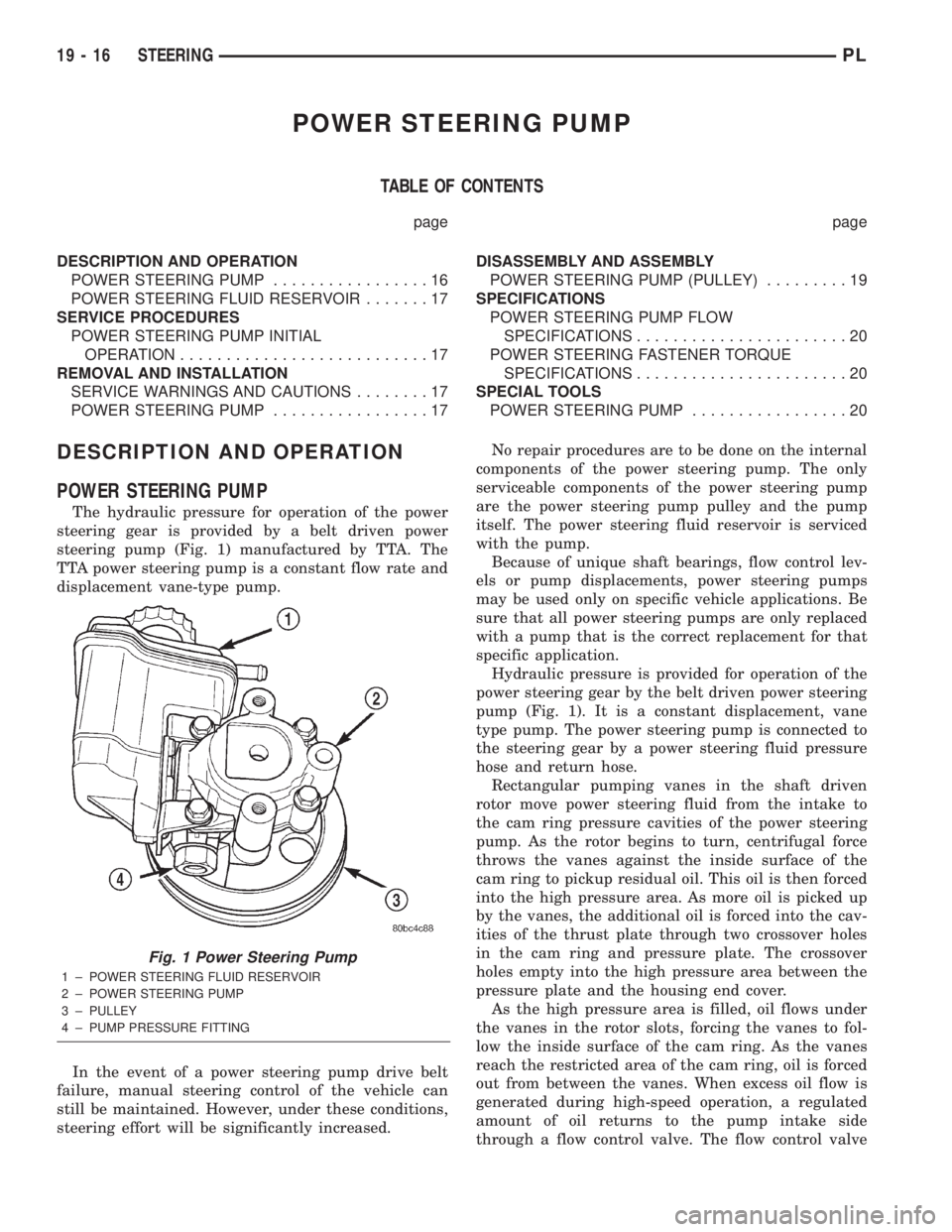
steering pump (Fig. 1) manufactured by TTA. The
TTA power steering pump is a constant flow rate and
displacement vane-type pump.
In the event of a power steering pump drive belt
failure, manual steering control of the vehicle can
still be maintained. However, under these conditions,
steering effort will be significantly increased.No repair procedures are to be done on the internal
components of the power steering pump. The only
serviceable components of the power steering pump
are the power steering pump pulley and the pump
itself. The power steering fluid reservoir is serviced
with the pump.
Because of unique shaft bearings, flow control lev-
els or pump displacements, power steering pumps
may be used only on specific vehicle applications. Be
sure that all power steering pumps are only replaced
with a pump that is the correct replacement for that
specific application.
Hydraulic pressure is provided for operation of the
power steering gear by the belt driven power steering
pump (Fig. 1). It is a constant displacement, vane
type pump. The power steering pump is connected to
the steering gear by a power steering fluid pressure
hose and return hose.
Rectangular pumping vanes in the shaft driven
rotor move power steering fluid from the intake to
the cam ring pressure cavities of the power steering
pump. As the rotor begins to turn, centrifugal force
throws the vanes against the inside surface of the
cam ring to pickup residual oil. This oil is then forced
into the high pressure area. As more oil is picked up
by the vanes, the additional oil is forced into the cav-
ities of the thrust plate through two crossover holes
in the cam ring and pressure plate. The crossover
holes empty into the high pressure area between the
pressure plate and the housing end cover.
As the high pressure area is filled, oil flows under
the vanes in the rotor slots, forcing the vanes to fol-
low the inside surface of the cam ring. As the vanes
reach the restricted area of the cam ring, oil is forced
out from between the vanes. When excess oil flow is
generated during high-speed operation, a regulated
amount of oil returns to the pump intake side
through a flow control valve. The flow control valve
Fig. 1 Power Steering Pump
1 ± POWER STEERING FLUID RESERVOIR
2 ± POWER STEERING PUMP
3 ± PULLEY
4 ± PUMP PRESSURE FITTING
19 - 16 STEERINGPL
Page 888 of 1285
reduces the power required to drive the pump and
holds down temperature build-up.
When steering conditions exceed maximum pres-
sure requirements, such as when the wheels are
turned against the stops, the pressure built up in the
steering gear exerts pressure on the spring end of the
flow control valve. The high pressure lifts the relief
valve ball from its seat and allows oil to flow through
a trigger orifice located in the outlet fitting. This
reduces pressure on the spring end of the flow con-
trol valve which then opens and allows the oil to
return to the intake side of the pump. This action
limits maximum pressure output of the pump to a
safe level.
Under normal power steering pump operating con-
ditions, pressure requirements of the pump are below
maximum, causing the pressure relief valve to
remain closed.
POWER STEERING FLUID RESERVOIR
The power steering fluid reservoir is mounted on
the power steering pump using 3 bolts (Fig. 1). It
stores fluid for the power steering system.
The power steering fluid reservoir is considered an
integral part of the power steering pump and is not
serviced separately.
SERVICE PROCEDURES
POWER STEERING PUMP INITIAL OPERATION
CAUTION: The fluid level should be checked with
engine off to prevent injury from moving compo-
nents. Use only MoparTPower Steering Fluid. Do
not use automatic transmission fluid. Do not over-
fill.
Wipe the filler cap clean, then check the fluid level.
The dipstick should indicateCOLDwhen the fluid is
at normal temperature, approximately 21ÉC to 27ÉC
(70ÉF to 80ÉF).
(1) Fill the power steering fluid reservoir to the
proper level and let the fluid settle for at least two
minutes.
(2) Start the engine and let run for a few seconds,
then turn the engine off.
(3) Add fluid if necessary. Repeat the above proce-
dure until the fluid level remains constant after run-
ning the engine.
(4) Raise the front wheels off the ground.
(5) Start the engine. Slowly turn the steering
wheel right and left, lightly contacting the wheel
stops.
(6) Add power steering fluid if necessary.
(7) Lower the vehicle and turn the steering wheel
slowly from lock to lock.(8) Stop the engine. Check the fluid level and refill
as required.
(9) If the fluid is extremely foamy, allow the vehi-
cle to stand a few minutes and repeat the above pro-
cedure.
REMOVAL AND INSTALLATION
SERVICE WARNINGS AND CAUTIONS
WARNING: POWER STEERING FLUID, ENGINE
PARTS AND EXHAUST SYSTEM MAY BE
EXTREMELY HOT IF ENGINE HAS BEEN RUNNING.
DO NOT START ENGINE WITH ANY LOOSE OR DIS-
CONNECTED HOSES. DO NOT ALLOW HOSES TO
TOUCH HOT EXHAUST MANIFOLD OR CATALYST.
WARNING: FLUID LEVEL SHOULD BE CHECKED
WITH THE ENGINE OFF TO PREVENT PERSONAL
INJURY FROM MOVING PARTS.
CAUTION: When the system is open, cap all open
ends of the hoses, power steering pump fittings or
power steering gear ports to prevent entry of for-
eign material into the components.
NOTE: Do not use any type of automatic transmis-
sion fluid in the power steering system.
POWER STEERING PUMP
NOTE: Before proceeding with this removal and
installation procedure, review SERVICE WARNINGS
AND CAUTIONS at the beginning of REMOVAL AND
INSTALLATION in this section.
REMOVAL
(1) Remove battery cable from the negative post on
the battery.
(2) Siphon as much fluid as possible from the
power steering fluid reservoir.
(3) Remove the power steering pump drive belt
from the power steering pump pulley. Refer to
ACCESSORY DRIVE BELTS in the COOLING SYS-
TEM service manual group for the required removal
and installation procedure.
(4) Remove the hose clamp securing the return
hose to the power steering fluid reservoir. Slide the
hose off the end of the reservoir fitting. (Fig. 2).
(5) Back out the tube nut securing the power
steering fluid pressure hose to the power steering
pump and remove the hose from the pump (Fig. 2).
PLSTEERING 19 - 17
DESCRIPTION AND OPERATION (Continued)
Page 889 of 1285
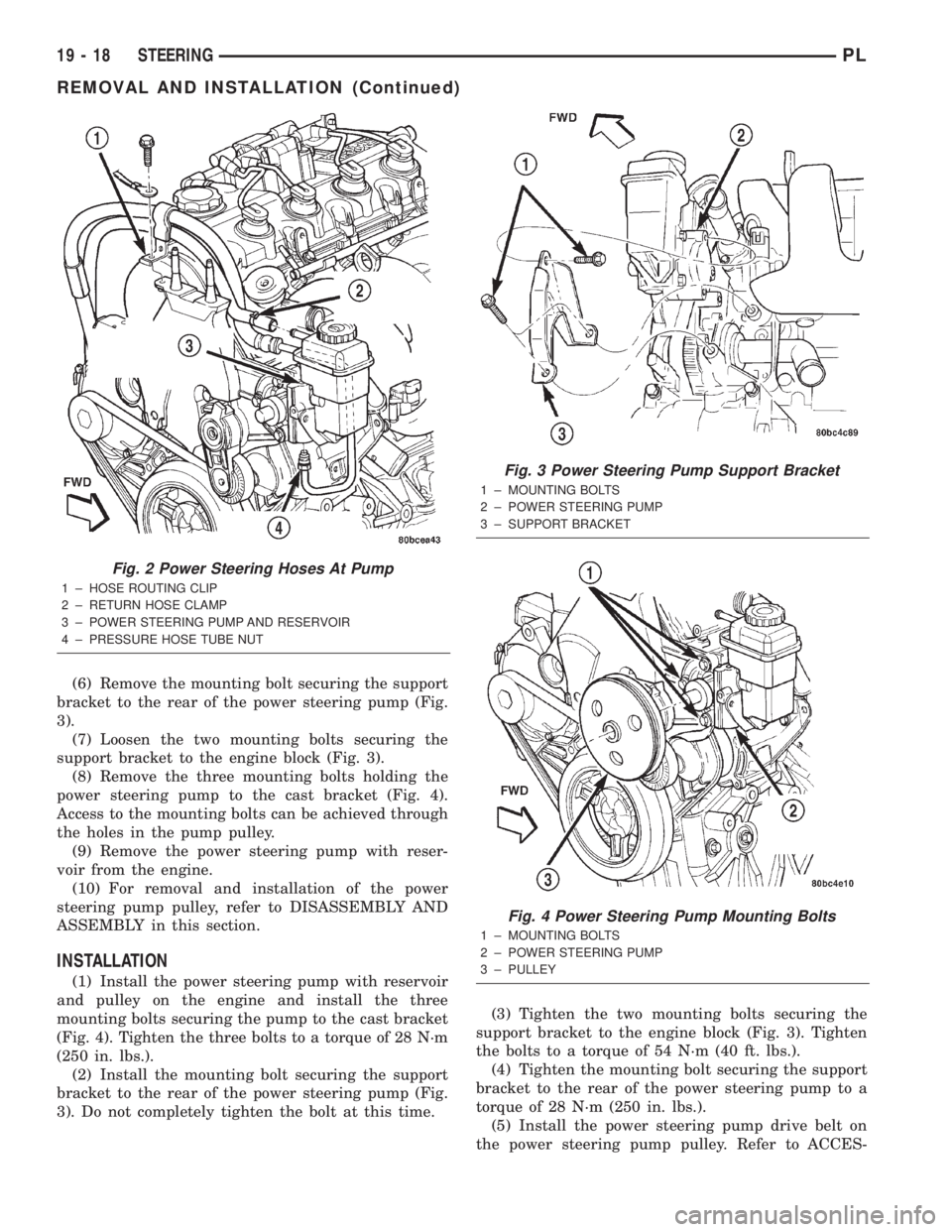
(6) Remove the mounting bolt securing the support
bracket to the rear of the power steering pump (Fig.
3).
(7) Loosen the two mounting bolts securing the
support bracket to the engine block (Fig. 3).
(8) Remove the three mounting bolts holding the
power steering pump to the cast bracket (Fig. 4).
Access to the mounting bolts can be achieved through
the holes in the pump pulley.
(9) Remove the power steering pump with reser-
voir from the engine.
(10) For removal and installation of the power
steering pump pulley, refer to DISASSEMBLY AND
ASSEMBLY in this section.
INSTALLATION
(1) Install the power steering pump with reservoir
and pulley on the engine and install the three
mounting bolts securing the pump to the cast bracket
(Fig. 4). Tighten the three bolts to a torque of 28 N´m
(250 in. lbs.).
(2) Install the mounting bolt securing the support
bracket to the rear of the power steering pump (Fig.
3). Do not completely tighten the bolt at this time.(3) Tighten the two mounting bolts securing the
support bracket to the engine block (Fig. 3). Tighten
the bolts to a torque of 54 N´m (40 ft. lbs.).
(4) Tighten the mounting bolt securing the support
bracket to the rear of the power steering pump to a
torque of 28 N´m (250 in. lbs.).
(5) Install the power steering pump drive belt on
the power steering pump pulley. Refer to ACCES-
Fig. 2 Power Steering Hoses At Pump
1 ± HOSE ROUTING CLIP
2 ± RETURN HOSE CLAMP
3 ± POWER STEERING PUMP AND RESERVOIR
4 ± PRESSURE HOSE TUBE NUT
Fig. 3 Power Steering Pump Support Bracket
1 ± MOUNTING BOLTS
2 ± POWER STEERING PUMP
3 ± SUPPORT BRACKET
Fig. 4 Power Steering Pump Mounting Bolts
1 ± MOUNTING BOLTS
2 ± POWER STEERING PUMP
3 ± PULLEY
19 - 18 STEERINGPL
REMOVAL AND INSTALLATION (Continued)
Page 890 of 1285
SORY DRIVE BELTS in the COOLING SYSTEM
service manual group for the required removal and
installation procedure.
(6) Using a lint free towel, wipe clean all open
power steering hose ends and power steering pump
fittings.
(7) Install a new O-ring on the end of the power
steering pressure hose. Lubricate the O-ring using
clean power steering fluid.
(8) Attach the power steering fluid pressure hose
to the pressure fitting on the lower end of the power
steering pump (Fig. 2). Thread the tube nut securing
the power steering fluid pressure hose into the power
steering pump pressure fitting. Tighten the tube nut
to at torque of 34 N´m (25 ft. lbs.).
(9) Slide the power steering fluid return hose onto
the fluid reservoir fitting (Fig. 2). Position the hose
clamp so it is installed on the hose past the bead
formed into the fluid reservoir fitting.
(10) Perform the POWER STEERING PUMP INI-
TIAL OPERATION service procedure found in this
section of this group to properly fill and bleed the
power steering system.
(11) Check for leaks.
DISASSEMBLY AND ASSEMBLY
POWER STEERING PUMP (PULLEY)
The only serviceable part of the power steering
pump is the pulley. The following procedure is for the
removal and installation of the pulley from the
pump.
The power steering pump must be removed from
the vehicle for power steering pump pulley service.
Refer to POWER STEERING PUMP in REMOVAL
AND INSTALLATION for the required procedure.
CAUTION: Use care when removing and installing
the power steering pump pulley. It is made of plas-
tic composite, except for the center shank. The spe-
cial tools are to be used in the shank area only as
described in the following procedure.
DISASSEMBLY
CAUTION: Do not hammer on the power steering
pump pulley or shaft to remove the power steering
pump pulley. This will damage the pulley and the
power steering pump.
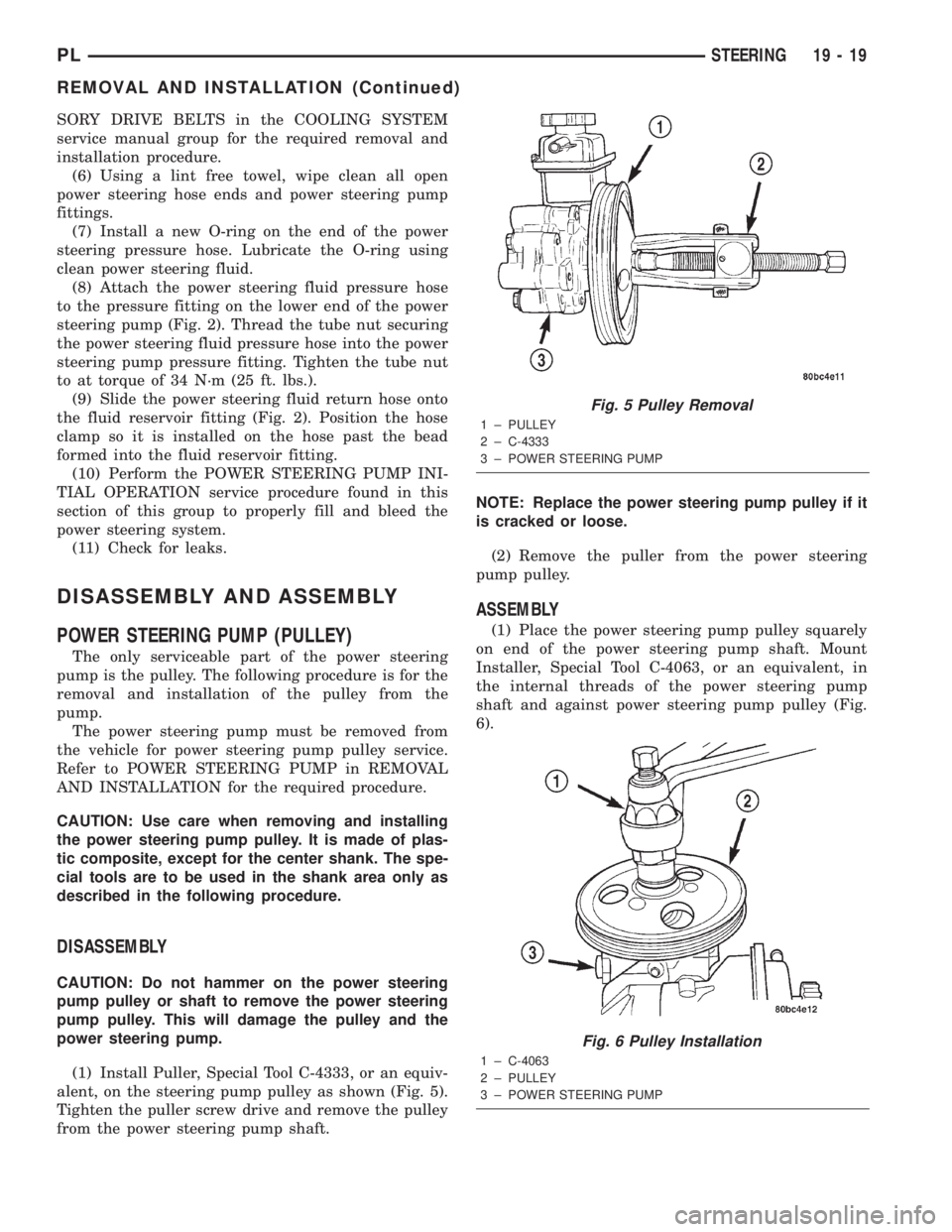
(1) Install Puller, Special Tool C-4333, or an equiv-
alent, on the steering pump pulley as shown (Fig. 5).
Tighten the puller screw drive and remove the pulley
from the power steering pump shaft.NOTE: Replace the power steering pump pulley if it
is cracked or loose.
(2) Remove the puller from the power steering
pump pulley.
ASSEMBLY
(1) Place the power steering pump pulley squarely
on end of the power steering pump shaft. Mount
Installer, Special Tool C-4063, or an equivalent, in
the internal threads of the power steering pump
shaft and against power steering pump pulley (Fig.
6).
Fig. 5 Pulley Removal
1 ± PULLEY
2 ± C-4333
3 ± POWER STEERING PUMP
Fig. 6 Pulley Installation
1 ± C-4063
2 ± PULLEY
3 ± POWER STEERING PUMP
PLSTEERING 19 - 19
REMOVAL AND INSTALLATION (Continued)
Page 892 of 1285
STEERING GEAR
TABLE OF CONTENTS
page page
DESCRIPTION AND OPERATION
POWER STEERING GEAR..................21
REMOVAL AND INSTALLATION
SERVICE WARNINGS AND CAUTIONS........22
POWER STEERING GEAR..................22
OUTER TIE ROD.........................26SPECIFICATIONS
POWER STEERING GEAR FASTENER
TORQUE SPECIFICATIONS...............28
SPECIAL TOOLS
POWER STEERING GEAR..................28
DESCRIPTION AND OPERATION
POWER STEERING GEAR
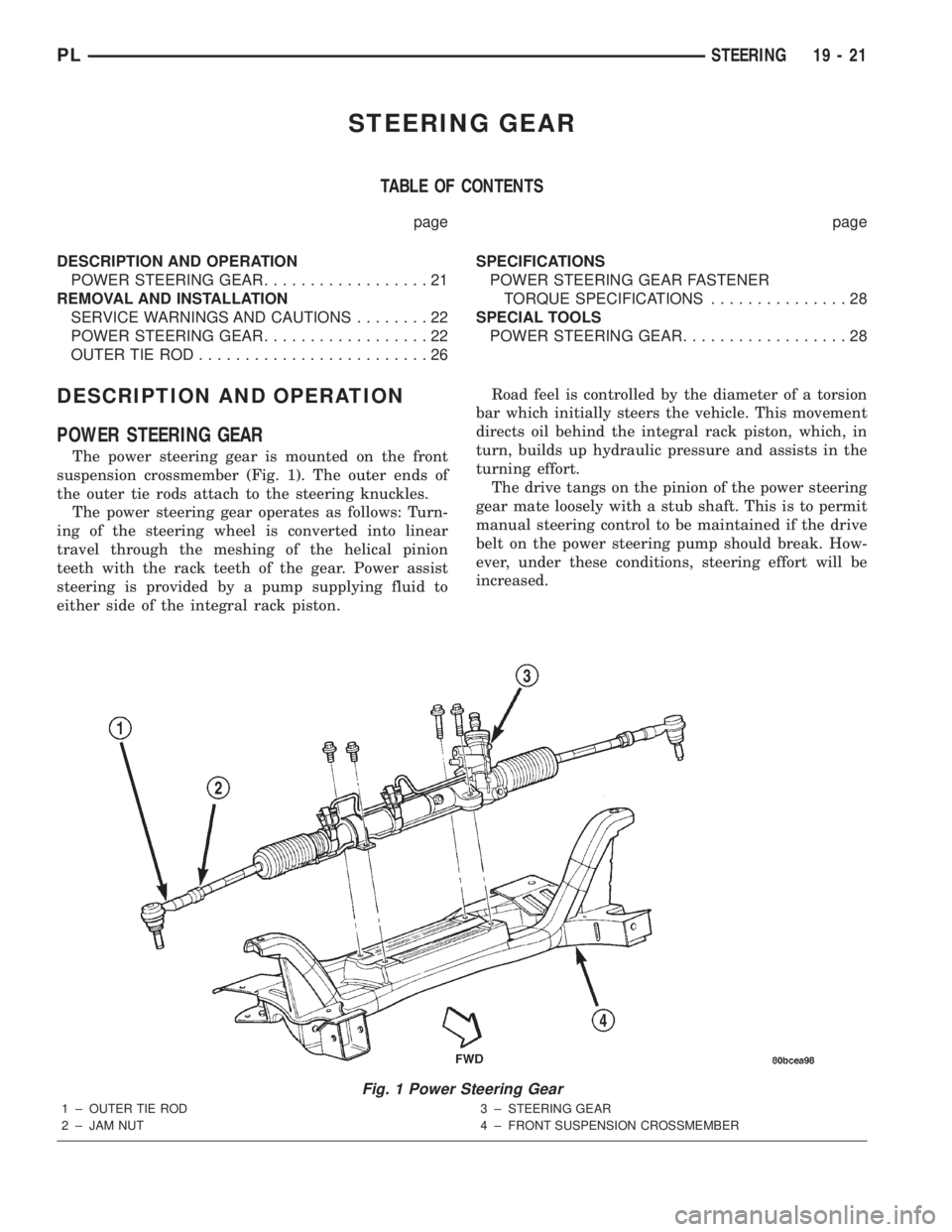
The power steering gear is mounted on the front
suspension crossmember (Fig. 1). The outer ends of
the outer tie rods attach to the steering knuckles.
The power steering gear operates as follows: Turn-
ing of the steering wheel is converted into linear
travel through the meshing of the helical pinion
teeth with the rack teeth of the gear. Power assist
steering is provided by a pump supplying fluid to
either side of the integral rack piston.Road feel is controlled by the diameter of a torsion
bar which initially steers the vehicle. This movement
directs oil behind the integral rack piston, which, in
turn, builds up hydraulic pressure and assists in the
turning effort.
The drive tangs on the pinion of the power steering
gear mate loosely with a stub shaft. This is to permit
manual steering control to be maintained if the drive
belt on the power steering pump should break. How-
ever, under these conditions, steering effort will be
increased.
Fig. 1 Power Steering Gear
1 ± OUTER TIE ROD
2 ± JAM NUT3 ± STEERING GEAR
4 ± FRONT SUSPENSION CROSSMEMBER
PLSTEERING 19 - 21
Page 1099 of 1285
(M) Check Engine Lamp (MIL) will illuminate during engine operation if this Diagnostic Trouble Code was recorded.
P1292 CNG Pressure Sensor Voltage Too
HighCompressed natural gas pressure sensor reading above
acceptable voltage.
P1293 CNG Pressure Sensor Voltage Too
LowCompressed natural gas pressure sensor reading below
acceptable voltage.
P1294 (M) Target Idle Not Reached Target RPM not achieved during drive idle condition.
Possible vacuum leak or IAC (AIS) lost steps.
P1295 No 5 Volts to TP Sensor Loss of a 5 volt feed to the Throttle Position Sensor has
been detected.
P1296 No 5 Volts to MAP Sensor Loss of a 5 volt feed to the MAP Sensor has been
detected.
P1297 (M) No Change in MAP From Start To
RunNo difference is recognized between the MAP reading
at engine idle and the stored barometric pressure
reading.
P1298 Lean Operation at Wide Open
ThrottleA prolonged lean condition is detected during Wide
Open Throttle.
P1299 (M) Vacuum Leak Found (IAC Fully
Seated)MAP Sensor signal does not correlate to Throttle
Position Sensor signal. Possible vacuum leak.
P1388 Auto Shutdown Relay Control
CircuitAn open or shorted condition detected in the ASD or
CNG shutoff relay control ckt.
P1389 No ASD Relay Output Voltage At
PCMNo Z1 or Z2 voltage sensed when the auto shutdown
relay is energized.
P1390 (M) Timing Belt Skipped 1 Tooth or
MoreRelationship between Cam and Crank signals not
correct.
P1391 (M) Intermittent Loss of CMP or CKP Loss of the Cam Position Sensor or Crank Position
sensor has occurred. For PL 2.0L
P1398 (M) Mis-Fire Adaptive Numerator at
LimitPCM is unable to learn the Crank Sensor's signal in
preparation for Misfire Diagnostics. Probable defective
Crank Sensor.
P1399 Wait To Start Lamp Cicuit An open or shorted condition detected in the Wait to
Start Lamp circuit.
P1403 No 5 Volts to EGR Sensor Loss of 5v feed to the EGR position sensor.
P1476 Too Little Secondary Air Insufficient flow of secondary air injection detected
during aspirator test.(was P0411)
P1477 Too Much Secondary Air Excessive flow of secondary air injection detected
during aspirator test (was P0411).
P1478 (M) Battery Temp Sensor Volts Out of
LimitInternal temperature sensor input voltage out of an
acceptable range.
P1479 Transmission Fan Relay Circuit An open or shorted condition detected in the
transmission fan relay circuit.
P1480 PCV Solenoid Circuit An open or shorted condition detected in the PCV
solenoid circuit.
P1482 Catalyst Temperature Sensor Circuit
Shorted LowCatalyst temperature sensor circuit shorted low.
P1483 Catalyst Temperature Sensor Circuit
Shorted High.Catalyst temperature sensor circuit shorted high.
P1484 Catalytic Converter Overheat
DetectedA catalyst overheat condition has been detected by the
catalyst temperature sensor.
25 - 12 EMISSION CONTROL SYSTEMSPL
DESCRIPTION AND OPERATION (Continued)
Page 1125 of 1285
SEATS
TABLE OF CONTENTS
page page
REMOVAL AND INSTALLATION
FRONT SEAT.............................8
FRONT SEAT BACK........................8
FRONT SEAT BACK COVER.................9FRONT SEAT CUSHION COVER..............9
FRONT SEAT CUSHION....................9
REAR SEAT BACK........................10
REAR SEAT CUSHION.....................11
REMOVAL AND INSTALLATION
FRONT SEAT
REMOVAL
(1) Move seat to forward position.
(2) Remove bolts attaching rear of seat track to
floor.
(3) Move seat to rearward position.
(4) Remove bolts attaching front of seat track to
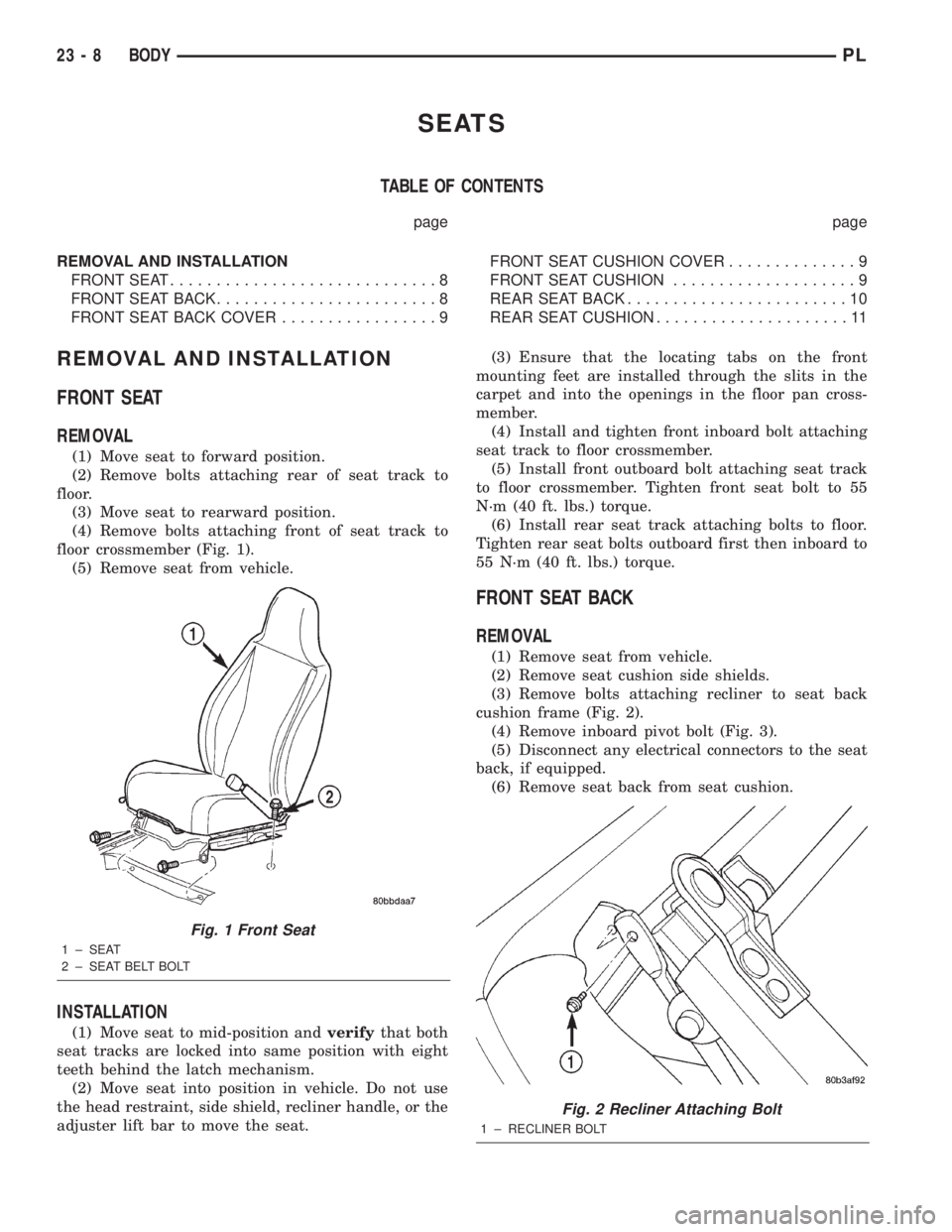
floor crossmember (Fig. 1).
(5) Remove seat from vehicle.
INSTALLATION
(1) Move seat to mid-position andverifythat both
seat tracks are locked into same position with eight
teeth behind the latch mechanism.
(2) Move seat into position in vehicle. Do not use
the head restraint, side shield, recliner handle, or the
adjuster lift bar to move the seat.(3) Ensure that the locating tabs on the front
mounting feet are installed through the slits in the
carpet and into the openings in the floor pan cross-
member.
(4) Install and tighten front inboard bolt attaching
seat track to floor crossmember.
(5) Install front outboard bolt attaching seat track
to floor crossmember. Tighten front seat bolt to 55
N´m (40 ft. lbs.) torque.
(6) Install rear seat track attaching bolts to floor.
Tighten rear seat bolts outboard first then inboard to
55 N´m (40 ft. lbs.) torque.
FRONT SEAT BACK
REMOVAL
(1) Remove seat from vehicle.
(2) Remove seat cushion side shields.
(3) Remove bolts attaching recliner to seat back
cushion frame (Fig. 2).
(4) Remove inboard pivot bolt (Fig. 3).
(5) Disconnect any electrical connectors to the seat
back, if equipped.
(6) Remove seat back from seat cushion.
Fig. 1 Front Seat
1 ± SEAT
2 ± SEAT BELT BOLT
Fig. 2 Recliner Attaching Bolt
1 ± RECLINER BOLT
23 - 8 BODYPL
Page 1127 of 1285
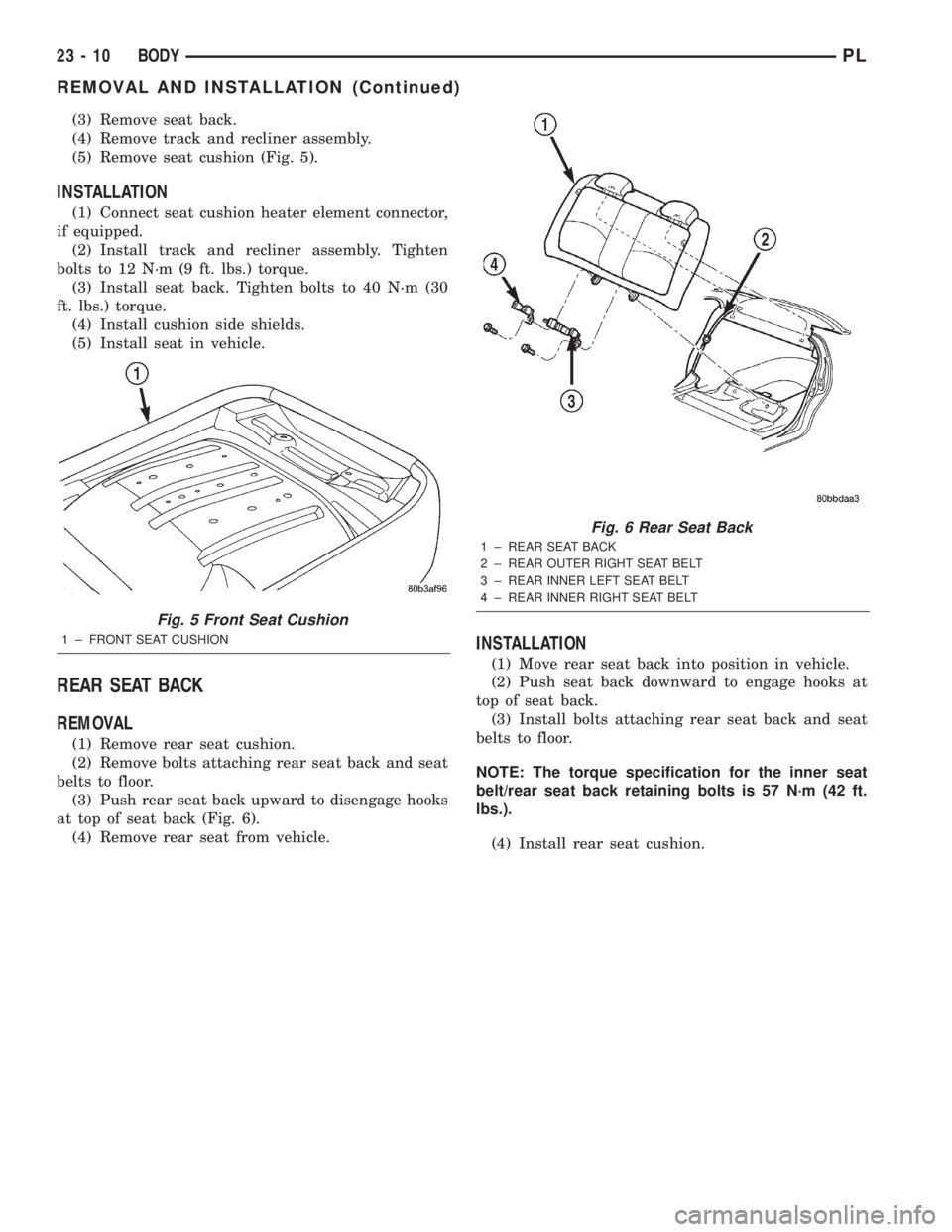
(3) Remove seat back.
(4) Remove track and recliner assembly.
(5) Remove seat cushion (Fig. 5).
INSTALLATION
(1) Connect seat cushion heater element connector,
if equipped.
(2) Install track and recliner assembly. Tighten
bolts to 12 N´m (9 ft. lbs.) torque.
(3) Install seat back. Tighten bolts to 40 N´m (30
ft. lbs.) torque.
(4) Install cushion side shields.
(5) Install seat in vehicle.
REAR SEAT BACK
REMOVAL
(1) Remove rear seat cushion.
(2) Remove bolts attaching rear seat back and seat
belts to floor.
(3) Push rear seat back upward to disengage hooks
at top of seat back (Fig. 6).
(4) Remove rear seat from vehicle.
INSTALLATION
(1) Move rear seat back into position in vehicle.
(2) Push seat back downward to engage hooks at
top of seat back.
(3) Install bolts attaching rear seat back and seat
belts to floor.
NOTE: The torque specification for the inner seat
belt/rear seat back retaining bolts is 57 N´m (42 ft.
lbs.).
(4) Install rear seat cushion.
Fig. 5 Front Seat Cushion
1 ± FRONT SEAT CUSHION
Fig. 6 Rear Seat Back
1 ± REAR SEAT BACK
2 ± REAR OUTER RIGHT SEAT BELT
3 ± REAR INNER LEFT SEAT BELT
4 ± REAR INNER RIGHT SEAT BELT
23 - 10 BODYPL
REMOVAL AND INSTALLATION (Continued)
Page 1128 of 1285
REAR SEAT CUSHION
REMOVAL
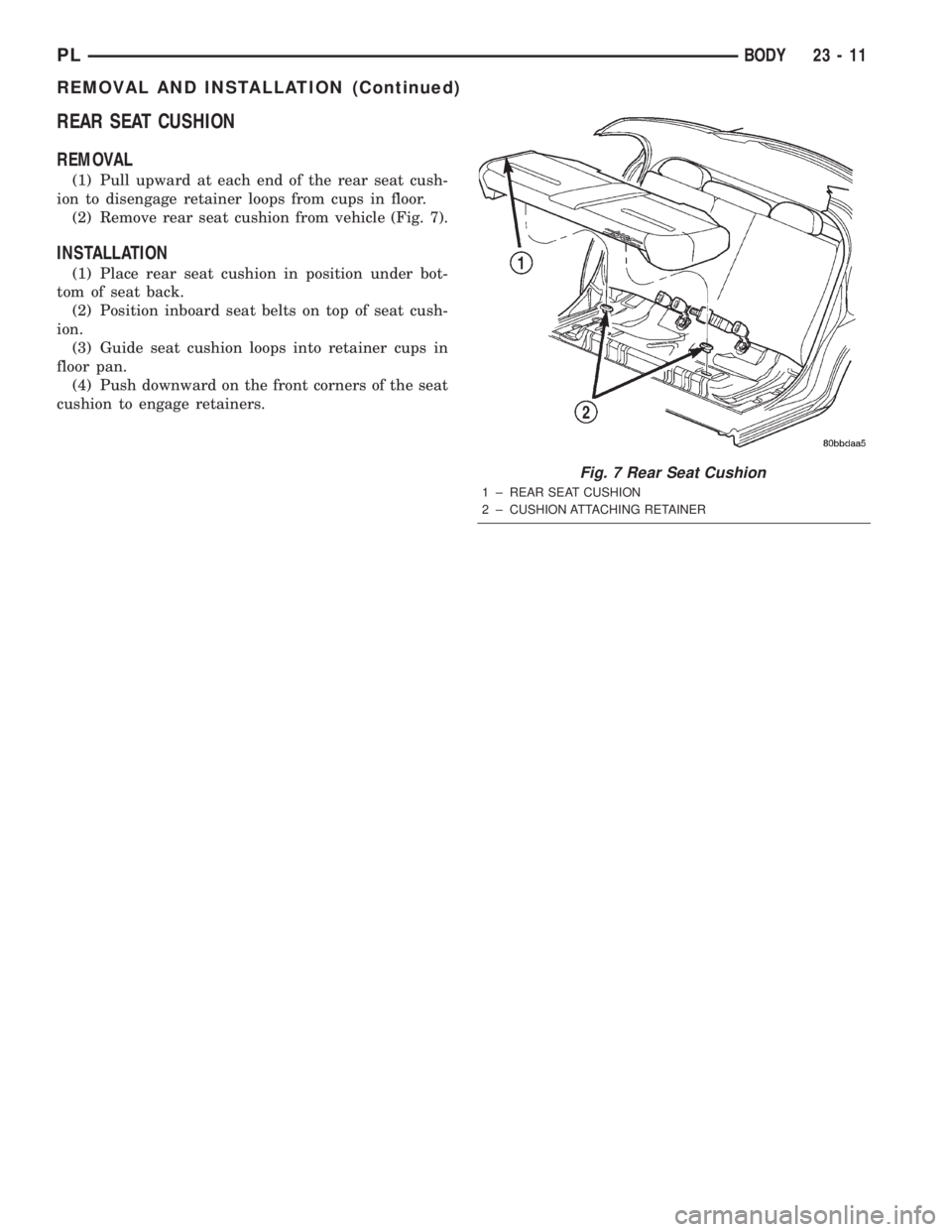
(1) Pull upward at each end of the rear seat cush-
ion to disengage retainer loops from cups in floor.
(2) Remove rear seat cushion from vehicle (Fig. 7).
INSTALLATION
(1) Place rear seat cushion in position under bot-
tom of seat back.
(2) Position inboard seat belts on top of seat cush-
ion.
(3) Guide seat cushion loops into retainer cups in
floor pan.
(4) Push downward on the front corners of the seat
cushion to engage retainers.
Fig. 7 Rear Seat Cushion
1 ± REAR SEAT CUSHION
2 ± CUSHION ATTACHING RETAINER
PLBODY 23 - 11
REMOVAL AND INSTALLATION (Continued)