belt DODGE NEON 2000 Service Repair Manual
[x] Cancel search | Manufacturer: DODGE, Model Year: 2000, Model line: NEON, Model: DODGE NEON 2000Pages: 1285, PDF Size: 29.42 MB
Page 1172 of 1285
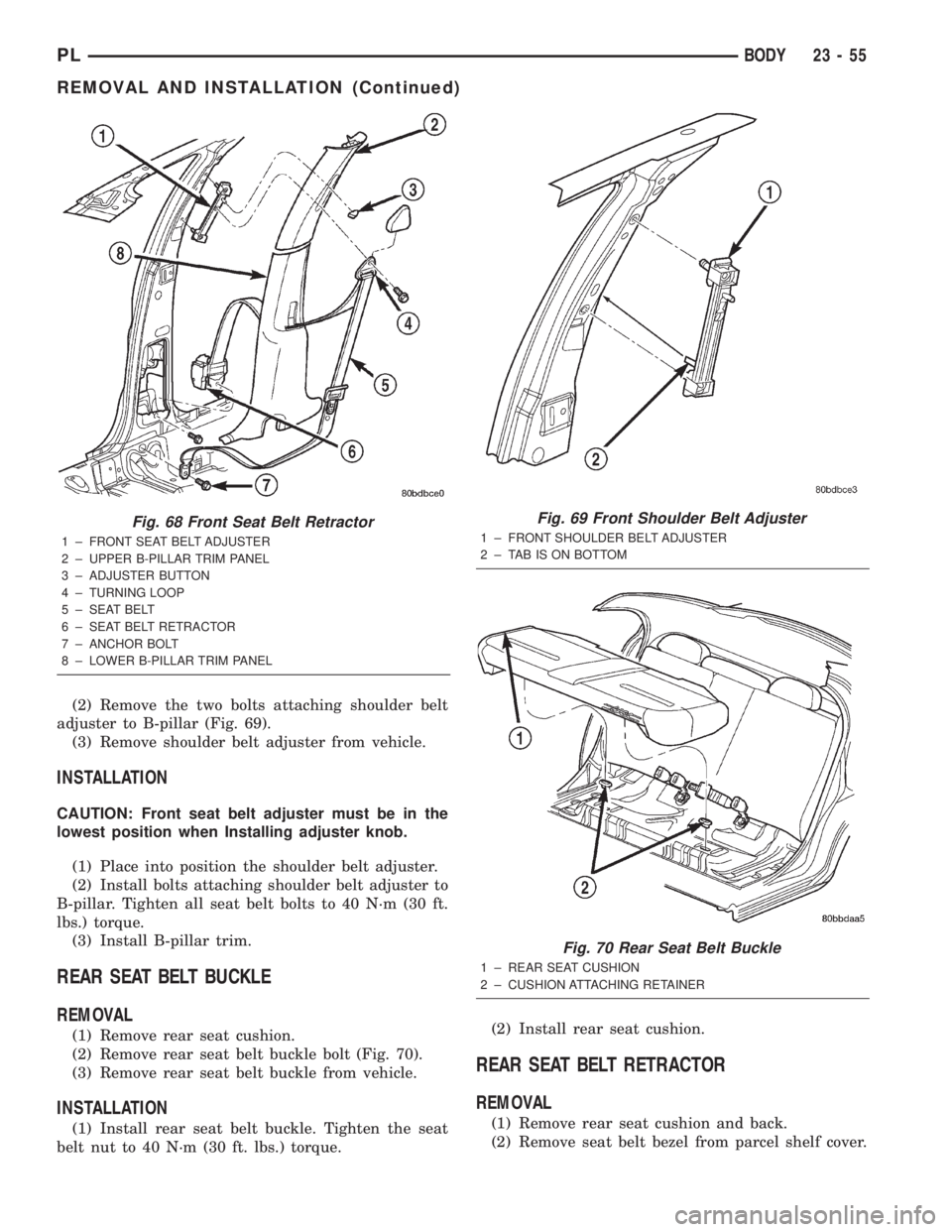
(2) Remove the two bolts attaching shoulder belt
adjuster to B-pillar (Fig. 69).
(3) Remove shoulder belt adjuster from vehicle.
INSTALLATION
CAUTION: Front seat belt adjuster must be in the
lowest position when Installing adjuster knob.
(1) Place into position the shoulder belt adjuster.
(2) Install bolts attaching shoulder belt adjuster to
B-pillar. Tighten all seat belt bolts to 40 N´m (30 ft.
lbs.) torque.
(3) Install B-pillar trim.
REAR SEAT BELT BUCKLE
REMOVAL
(1) Remove rear seat cushion.
(2) Remove rear seat belt buckle bolt (Fig. 70).
(3) Remove rear seat belt buckle from vehicle.
INSTALLATION
(1) Install rear seat belt buckle. Tighten the seat
belt nut to 40 N´m (30 ft. lbs.) torque.(2) Install rear seat cushion.
REAR SEAT BELT RETRACTOR
REMOVAL
(1) Remove rear seat cushion and back.
(2) Remove seat belt bezel from parcel shelf cover.
Fig. 68 Front Seat Belt Retractor
1 ± FRONT SEAT BELT ADJUSTER
2 ± UPPER B-PILLAR TRIM PANEL
3 ± ADJUSTER BUTTON
4 ± TURNING LOOP
5 ± SEAT BELT
6 ± SEAT BELT RETRACTOR
7 ± ANCHOR BOLT
8 ± LOWER B-PILLAR TRIM PANEL
Fig. 69 Front Shoulder Belt Adjuster
1 ± FRONT SHOULDER BELT ADJUSTER
2 ± TAB IS ON BOTTOM
Fig. 70 Rear Seat Belt Buckle
1 ± REAR SEAT CUSHION
2 ± CUSHION ATTACHING RETAINER
PLBODY 23 - 55
REMOVAL AND INSTALLATION (Continued)
Page 1173 of 1285
(3) Remove rear seat closure panel silencer pad as
necessary to gain access to retractor.
(4) Remove bolt attaching seat belt lower anchor to
floor.
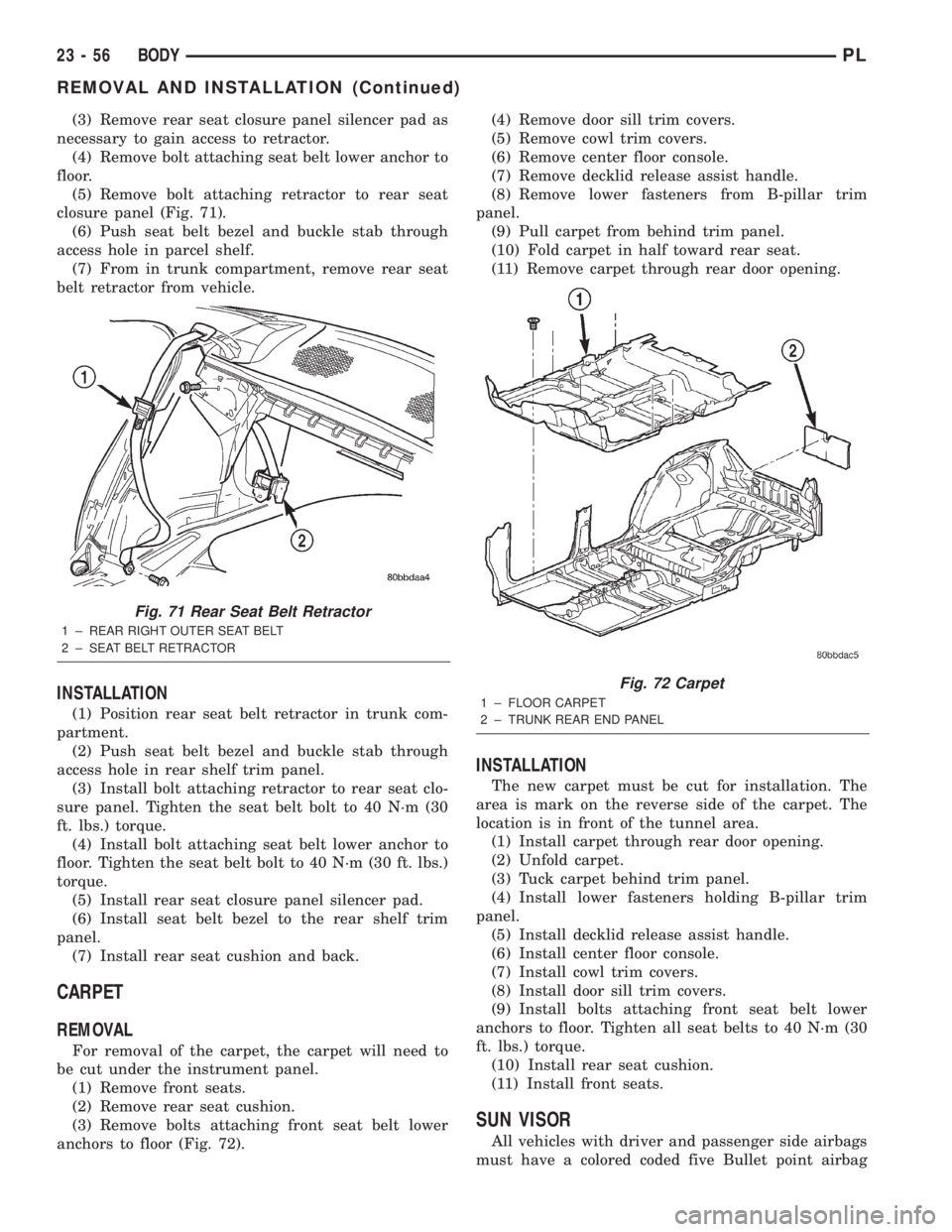
(5) Remove bolt attaching retractor to rear seat
closure panel (Fig. 71).
(6) Push seat belt bezel and buckle stab through
access hole in parcel shelf.
(7) From in trunk compartment, remove rear seat
belt retractor from vehicle.
INSTALLATION
(1) Position rear seat belt retractor in trunk com-
partment.
(2) Push seat belt bezel and buckle stab through
access hole in rear shelf trim panel.
(3) Install bolt attaching retractor to rear seat clo-
sure panel. Tighten the seat belt bolt to 40 N´m (30
ft. lbs.) torque.
(4) Install bolt attaching seat belt lower anchor to
floor. Tighten the seat belt bolt to 40 N´m (30 ft. lbs.)
torque.
(5) Install rear seat closure panel silencer pad.
(6) Install seat belt bezel to the rear shelf trim
panel.
(7) Install rear seat cushion and back.
CARPET
REMOVAL
For removal of the carpet, the carpet will need to
be cut under the instrument panel.
(1) Remove front seats.
(2) Remove rear seat cushion.
(3) Remove bolts attaching front seat belt lower
anchors to floor (Fig. 72).(4) Remove door sill trim covers.
(5) Remove cowl trim covers.
(6) Remove center floor console.
(7) Remove decklid release assist handle.
(8) Remove lower fasteners from B-pillar trim
panel.
(9) Pull carpet from behind trim panel.
(10) Fold carpet in half toward rear seat.
(11) Remove carpet through rear door opening.
INSTALLATION
The new carpet must be cut for installation. The
area is mark on the reverse side of the carpet. The
location is in front of the tunnel area.
(1) Install carpet through rear door opening.
(2) Unfold carpet.
(3) Tuck carpet behind trim panel.
(4) Install lower fasteners holding B-pillar trim
panel.
(5) Install decklid release assist handle.
(6) Install center floor console.
(7) Install cowl trim covers.
(8) Install door sill trim covers.
(9) Install bolts attaching front seat belt lower
anchors to floor. Tighten all seat belts to 40 N´m (30
ft. lbs.) torque.
(10) Install rear seat cushion.
(11) Install front seats.
SUN VISOR
All vehicles with driver and passenger side airbags
must have a colored coded five Bullet point airbag
Fig. 71 Rear Seat Belt Retractor
1 ± REAR RIGHT OUTER SEAT BELT
2 ± SEAT BELT RETRACTOR
Fig. 72 Carpet
1 ± FLOOR CARPET
2 ± TRUNK REAR END PANEL
23 - 56 BODYPL
REMOVAL AND INSTALLATION (Continued)
Page 1174 of 1285
warning label applied to the sun visor, verify label
availability and ensure the label is installed.
REMOVAL
(1) Remove sun visor from center support.
(2) Remove screws attaching sun visor to roof
header.
(3) Remove sun visor from header.
(4) If equipped, disconnect wire connector from
body harness.
(5) Remove sun visor from vehicle.
INSTALLATION
(1) Place sun visor in position.
(2) If equipped, connect wire connector from body
harness.
(3) Install screws attaching sun visor to header.
(4) Install sun visor into center support.
HEADLINER
REMOVAL
(1) Remove screws attaching sun visors to roof
header panel.
(2) Disconnect wire connector from lighted vanity
mirror, if so equipped.
(3) Remove sun visors from vehicle.
(4) Remove A-pillar trim covers.
(5) Remove B-pillar trim panels.
(6) Remove (upper) quarter panel trim panels.
(7) Remove assist handle, if so equipped.
(8) Remove sun visor hooks.
(9) Remove coat hooks, if so equipped.
(10) Remove three push in fasteners at rear of
headliner.
(11) Disengage dome lamp wire connector, at rear
of headliner.
(12) Remove push in fastener attaching wiring to
C-pillar.
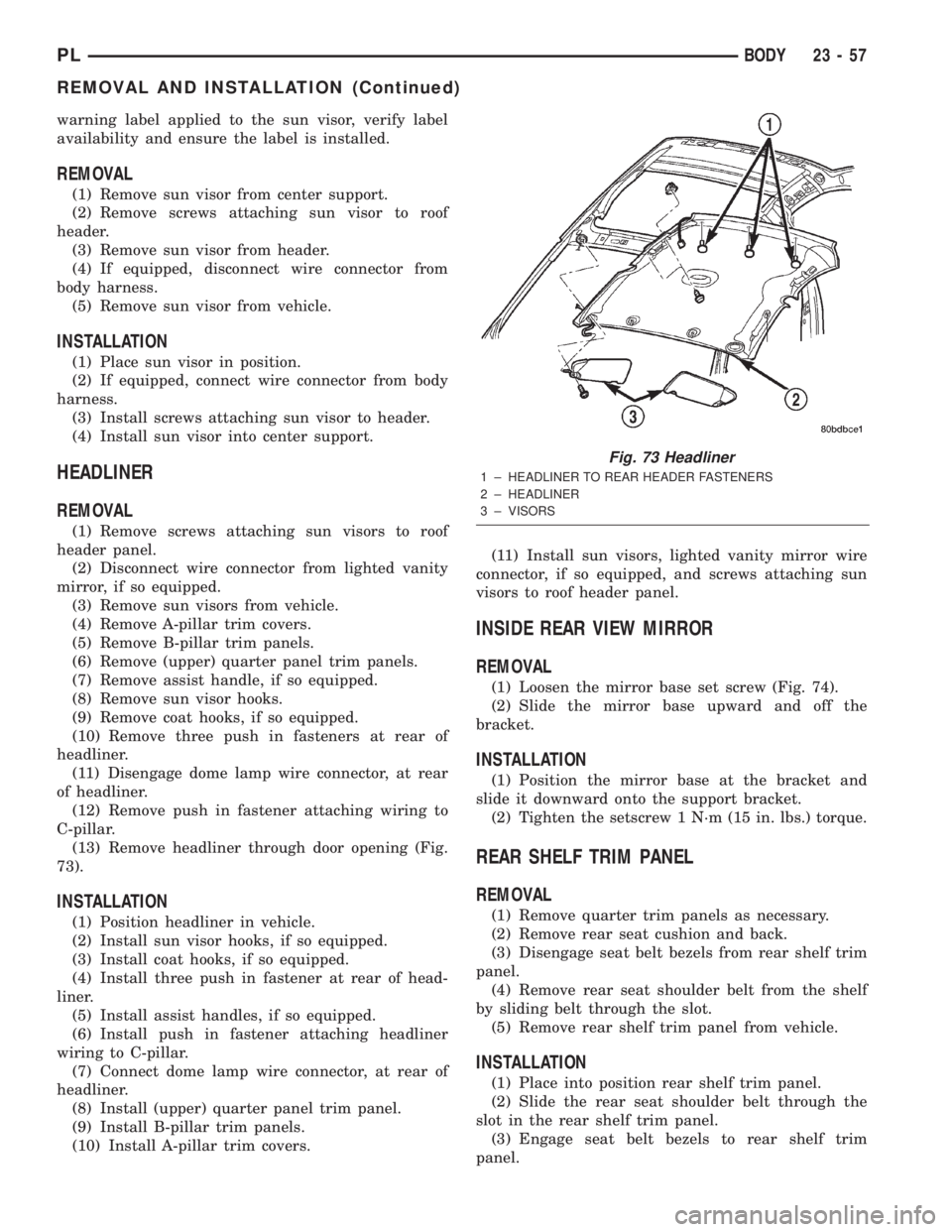
(13) Remove headliner through door opening (Fig.
73).
INSTALLATION
(1) Position headliner in vehicle.
(2) Install sun visor hooks, if so equipped.
(3) Install coat hooks, if so equipped.
(4) Install three push in fastener at rear of head-
liner.
(5) Install assist handles, if so equipped.
(6) Install push in fastener attaching headliner
wiring to C-pillar.
(7) Connect dome lamp wire connector, at rear of
headliner.
(8) Install (upper) quarter panel trim panel.
(9) Install B-pillar trim panels.
(10) Install A-pillar trim covers.(11) Install sun visors, lighted vanity mirror wire
connector, if so equipped, and screws attaching sun
visors to roof header panel.
INSIDE REAR VIEW MIRROR
REMOVAL
(1) Loosen the mirror base set screw (Fig. 74).
(2) Slide the mirror base upward and off the
bracket.
INSTALLATION
(1) Position the mirror base at the bracket and
slide it downward onto the support bracket.
(2) Tighten the setscrew 1 N´m (15 in. lbs.) torque.
REAR SHELF TRIM PANEL
REMOVAL
(1) Remove quarter trim panels as necessary.
(2) Remove rear seat cushion and back.
(3) Disengage seat belt bezels from rear shelf trim
panel.
(4) Remove rear seat shoulder belt from the shelf
by sliding belt through the slot.
(5) Remove rear shelf trim panel from vehicle.
INSTALLATION
(1) Place into position rear shelf trim panel.
(2) Slide the rear seat shoulder belt through the
slot in the rear shelf trim panel.
(3) Engage seat belt bezels to rear shelf trim
panel.
Fig. 73 Headliner
1 ± HEADLINER TO REAR HEADER FASTENERS
2 ± HEADLINER
3 ± VISORS
PLBODY 23 - 57
REMOVAL AND INSTALLATION (Continued)
Page 1193 of 1285
TORQUE SPECIFICATIONS
BODY COMPONENTS
DESCRIPTION TORQUE
All seat belt anchor bolts..... 40N´m(30ft.lbs.)
All seat belt anchor nuts...... 40N´m(30ft.lbs.)
All seat belt retractor bolts.... 40N´m(30ft.lbs.)
Decklid latch striker......... 22N´m(16ft.lbs.)
Front seat track to floor pan bolts . . 55 N´m (40 ft.
lbs.)
Front seat inboard pivot bolt . . . 40 N´m (30 ft. lbs.)
Front seat recliner to seat cushion frame . . 12 N´m
(9 ft. lbs.)
Front seat track to cushion frame bolt . . 12 N´m (9
ft. lbs.)
Front seat back............. 40N´m(30ft.lbs.)DESCRIPTION TORQUE
Front seat back recliner to seat back . 12 N´m (9 ft.
lbs.)
Front door hinge to hinge pillar bolt . 28 N´m (21 ft.
lbs.)
Front door hinge to door nuts and bolt . 28 N´m (21
ft. lbs.)
Front door latch striker....... 28N´m(20ft.lbs.)
Hood latch striker.........13.5 N´m (10 ft. lbs.)
Rear door glass to regulator bolt . . 11 N´m (105 in.
lbs.)
Rear door hinge to B-pillar bolt . 28 N´m (20 ft. lbs.)
Rear door hinge to door bolt . . . 28 N´m (20 ft. lbs.)
Rear door latch striker....... 28N´m(20ft.lbs.)
Rear seat back and seat belt buckle anchor nut . 57
N´m (42 ft. lbs.)
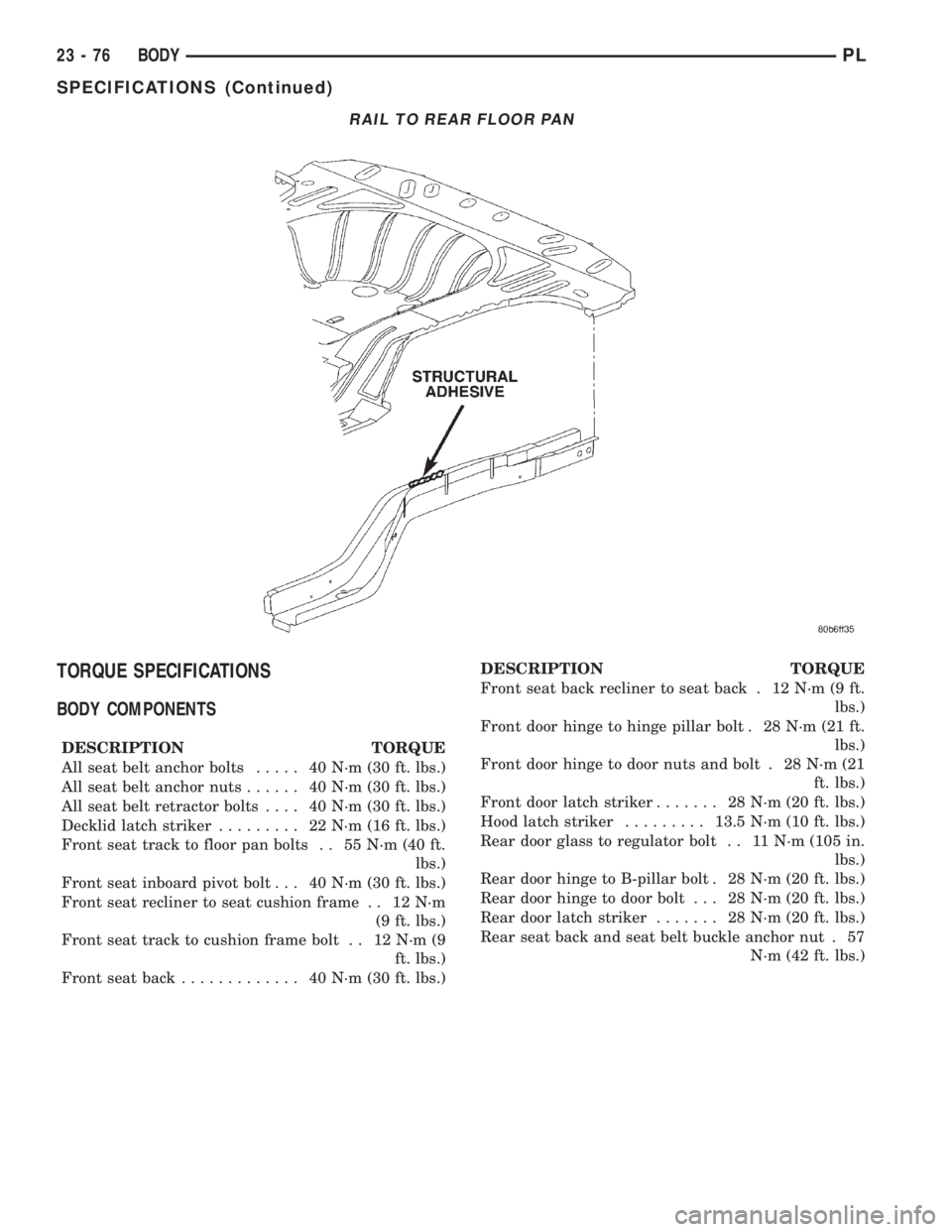
RAIL TO REAR FLOOR PAN
23 - 76 BODYPL
SPECIFICATIONS (Continued)
Page 1236 of 1285
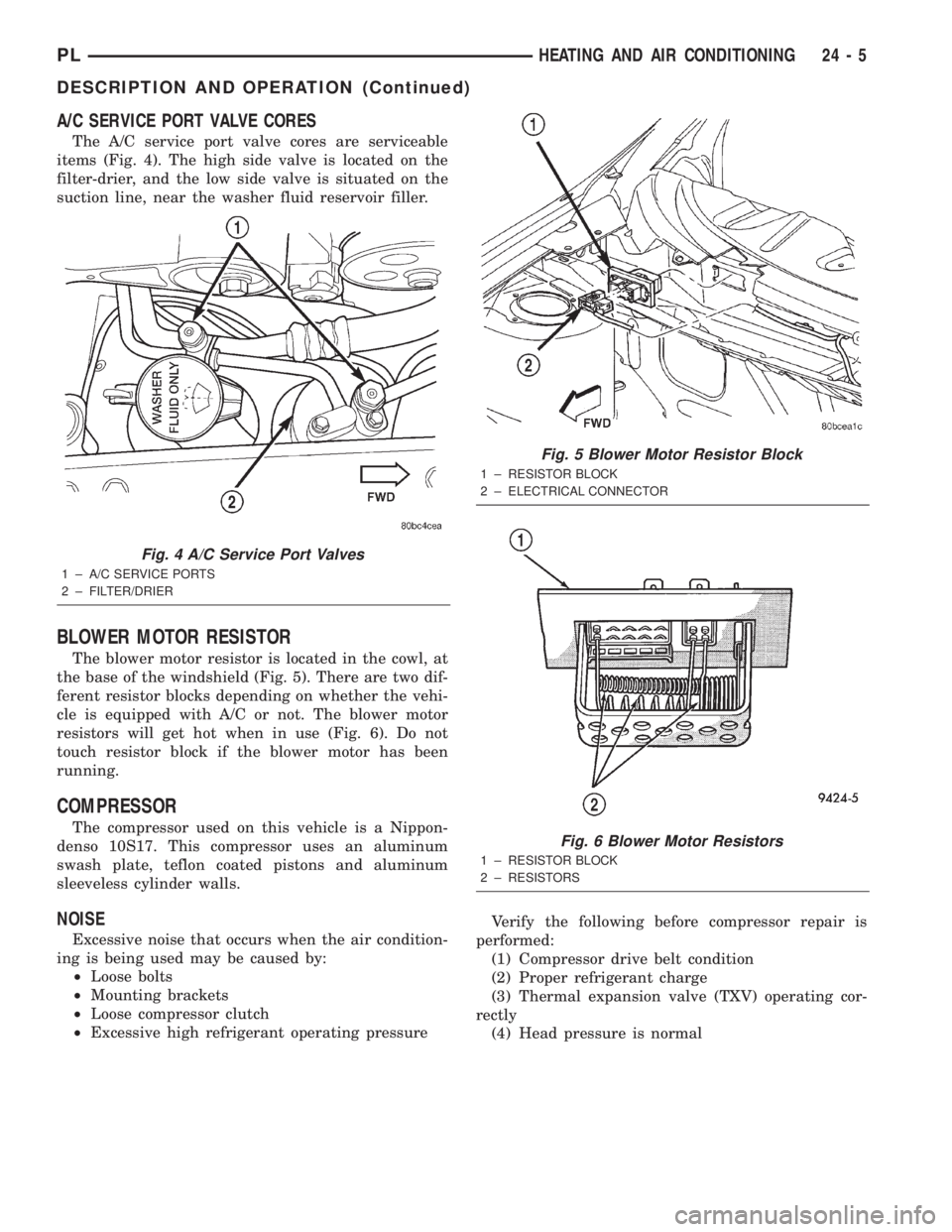
A/C SERVICE PORT VALVE CORES
The A/C service port valve cores are serviceable
items (Fig. 4). The high side valve is located on the
filter-drier, and the low side valve is situated on the
suction line, near the washer fluid reservoir filler.
BLOWER MOTOR RESISTOR
The blower motor resistor is located in the cowl, at
the base of the windshield (Fig. 5). There are two dif-
ferent resistor blocks depending on whether the vehi-
cle is equipped with A/C or not. The blower motor
resistors will get hot when in use (Fig. 6). Do not
touch resistor block if the blower motor has been
running.
COMPRESSOR
The compressor used on this vehicle is a Nippon-
denso 10S17. This compressor uses an aluminum
swash plate, teflon coated pistons and aluminum
sleeveless cylinder walls.
NOISE
Excessive noise that occurs when the air condition-
ing is being used may be caused by:
²Loose bolts
²Mounting brackets
²Loose compressor clutch
²Excessive high refrigerant operating pressureVerify the following before compressor repair is
performed:
(1) Compressor drive belt condition
(2) Proper refrigerant charge
(3) Thermal expansion valve (TXV) operating cor-
rectly
(4) Head pressure is normal
Fig. 4 A/C Service Port Valves
1 ± A/C SERVICE PORTS
2 ± FILTER/DRIER
Fig. 5 Blower Motor Resistor Block
1 ± RESISTOR BLOCK
2 ± ELECTRICAL CONNECTOR
Fig. 6 Blower Motor Resistors
1 ± RESISTOR BLOCK
2 ± RESISTORS
PLHEATING AND AIR CONDITIONING 24 - 5
DESCRIPTION AND OPERATION (Continued)
Page 1242 of 1285
BLOWER MOTOR VIBRATION AND/OR NOISE
DIAGNOSIS
The resistor block supplies the blower motor with
varied voltage (low and middle speeds) or battery
voltage (high speed).
CAUTION: Stay clear of the blower motor and resis-
tor block (Hot). Do not operate the blower motor
with the resistor block removed from the heater-A/C
housing.
Refer to the Blower Motor Vibration/Noise chart
for diagnosis.
COMPRESSOR NOISE DIAGNOSIS
Excessive noise while the A/C is being used, can be
caused by loose mounts, loose clutch, or high operat-
ing pressure. Verify compressor drive belt condition,
proper refrigerant charge and head pressure before
compressor repair is performed.
If the A/C drive belt slips at initial start-up, it does
not necessarily mean the compressor has failed.
With the close tolerances of a compressor it is pos-
sible to experience a temporary lockup. The longer
the A/C system is inactive, the more likely the condi-
tion to occur.
This condition is the result of normal refrigerant
movement within the A/C system caused by temper-
ature changes. The refrigerant movement may wash
the oil out of the compressor.
EVAPORATOR PROBE TEST
The work area and vehicle must be between 16É C
(60É F) and 32É C (90É F) when testing the switch.
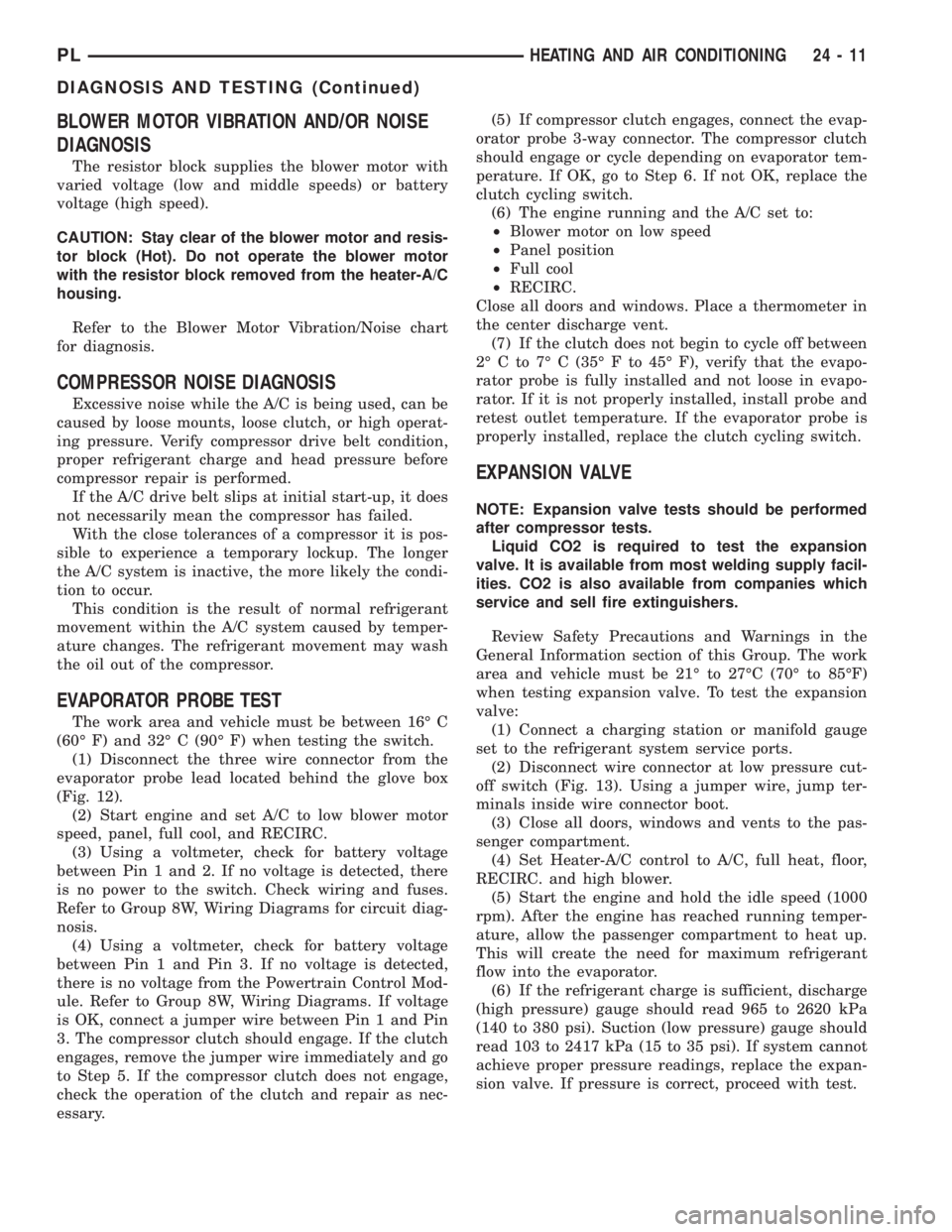
(1) Disconnect the three wire connector from the
evaporator probe lead located behind the glove box
(Fig. 12).
(2) Start engine and set A/C to low blower motor
speed, panel, full cool, and RECIRC.
(3) Using a voltmeter, check for battery voltage
between Pin 1 and 2. If no voltage is detected, there
is no power to the switch. Check wiring and fuses.
Refer to Group 8W, Wiring Diagrams for circuit diag-
nosis.
(4) Using a voltmeter, check for battery voltage
between Pin 1 and Pin 3. If no voltage is detected,
there is no voltage from the Powertrain Control Mod-
ule. Refer to Group 8W, Wiring Diagrams. If voltage
is OK, connect a jumper wire between Pin 1 and Pin
3. The compressor clutch should engage. If the clutch
engages, remove the jumper wire immediately and go
to Step 5. If the compressor clutch does not engage,
check the operation of the clutch and repair as nec-
essary.(5) If compressor clutch engages, connect the evap-
orator probe 3-way connector. The compressor clutch
should engage or cycle depending on evaporator tem-
perature. If OK, go to Step 6. If not OK, replace the
clutch cycling switch.
(6) The engine running and the A/C set to:
²Blower motor on low speed
²Panel position
²Full cool
²RECIRC.
Close all doors and windows. Place a thermometer in
the center discharge vent.
(7) If the clutch does not begin to cycle off between
2É C to 7É C (35É F to 45É F), verify that the evapo-
rator probe is fully installed and not loose in evapo-
rator. If it is not properly installed, install probe and
retest outlet temperature. If the evaporator probe is
properly installed, replace the clutch cycling switch.
EXPANSION VALVE
NOTE: Expansion valve tests should be performed
after compressor tests.
Liquid CO2 is required to test the expansion
valve. It is available from most welding supply facil-
ities. CO2 is also available from companies which
service and sell fire extinguishers.
Review Safety Precautions and Warnings in the
General Information section of this Group. The work
area and vehicle must be 21É to 27ÉC (70É to 85ÉF)
when testing expansion valve. To test the expansion
valve:
(1) Connect a charging station or manifold gauge
set to the refrigerant system service ports.
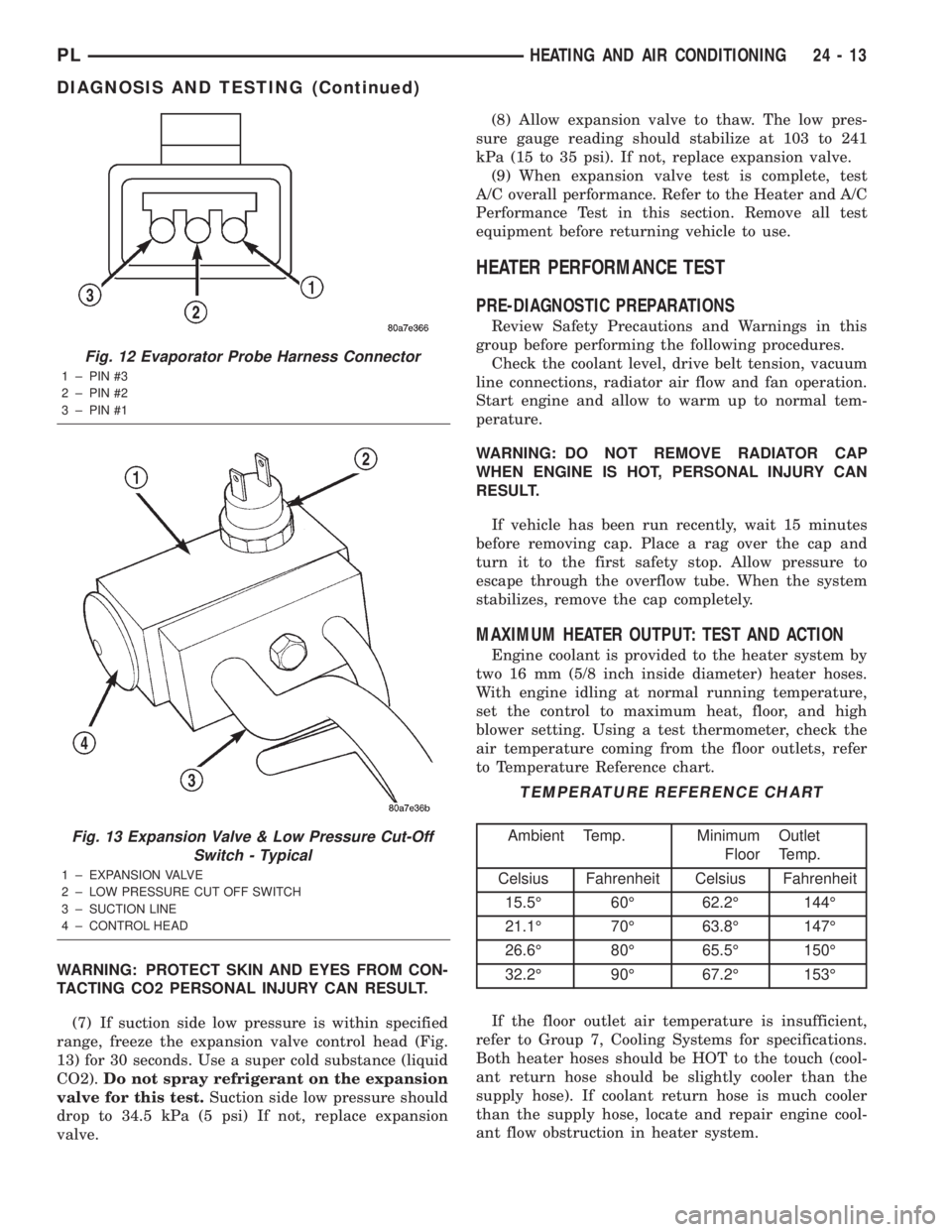
(2) Disconnect wire connector at low pressure cut-
off switch (Fig. 13). Using a jumper wire, jump ter-
minals inside wire connector boot.
(3) Close all doors, windows and vents to the pas-
senger compartment.
(4) Set Heater-A/C control to A/C, full heat, floor,
RECIRC. and high blower.
(5) Start the engine and hold the idle speed (1000
rpm). After the engine has reached running temper-
ature, allow the passenger compartment to heat up.
This will create the need for maximum refrigerant
flow into the evaporator.
(6) If the refrigerant charge is sufficient, discharge
(high pressure) gauge should read 965 to 2620 kPa
(140 to 380 psi). Suction (low pressure) gauge should
read 103 to 2417 kPa (15 to 35 psi). If system cannot
achieve proper pressure readings, replace the expan-
sion valve. If pressure is correct, proceed with test.
PLHEATING AND AIR CONDITIONING 24 - 11
DIAGNOSIS AND TESTING (Continued)
Page 1244 of 1285
WARNING: PROTECT SKIN AND EYES FROM CON-
TACTING CO2 PERSONAL INJURY CAN RESULT.
(7) If suction side low pressure is within specified
range, freeze the expansion valve control head (Fig.
13) for 30 seconds. Use a super cold substance (liquid
CO2).Do not spray refrigerant on the expansion
valve for this test.Suction side low pressure should
drop to 34.5 kPa (5 psi) If not, replace expansion
valve.(8) Allow expansion valve to thaw. The low pres-
sure gauge reading should stabilize at 103 to 241
kPa (15 to 35 psi). If not, replace expansion valve.
(9) When expansion valve test is complete, test
A/C overall performance. Refer to the Heater and A/C
Performance Test in this section. Remove all test
equipment before returning vehicle to use.
HEATER PERFORMANCE TEST
PRE-DIAGNOSTIC PREPARATIONS
Review Safety Precautions and Warnings in this
group before performing the following procedures.
Check the coolant level, drive belt tension, vacuum
line connections, radiator air flow and fan operation.
Start engine and allow to warm up to normal tem-
perature.
WARNING: DO NOT REMOVE RADIATOR CAP
WHEN ENGINE IS HOT, PERSONAL INJURY CAN
RESULT.
If vehicle has been run recently, wait 15 minutes
before removing cap. Place a rag over the cap and
turn it to the first safety stop. Allow pressure to
escape through the overflow tube. When the system
stabilizes, remove the cap completely.
MAXIMUM HEATER OUTPUT: TEST AND ACTION
Engine coolant is provided to the heater system by
two 16 mm (5/8 inch inside diameter) heater hoses.
With engine idling at normal running temperature,
set the control to maximum heat, floor, and high
blower setting. Using a test thermometer, check the
air temperature coming from the floor outlets, refer
to Temperature Reference chart.
If the floor outlet air temperature is insufficient,
refer to Group 7, Cooling Systems for specifications.
Both heater hoses should be HOT to the touch (cool-
ant return hose should be slightly cooler than the
supply hose). If coolant return hose is much cooler
than the supply hose, locate and repair engine cool-
ant flow obstruction in heater system.
Fig. 12 Evaporator Probe Harness Connector
1 ± PIN #3
2 ± PIN #2
3 ± PIN #1
Fig. 13 Expansion Valve & Low Pressure Cut-Off
Switch - Typical
1 ± EXPANSION VALVE
2 ± LOW PRESSURE CUT OFF SWITCH
3 ± SUCTION LINE
4 ± CONTROL HEAD
TEMPERATURE REFERENCE CHART
Ambient Temp. Minimum
FloorOutlet
Temp.
Celsius Fahrenheit Celsius Fahrenheit
15.5É 60É 62.2É 144É
21.1É 70É 63.8É 147É
26.6É 80É 65.5É 150É
32.2É 90É 67.2É 153É
PLHEATING AND AIR CONDITIONING 24 - 13
DIAGNOSIS AND TESTING (Continued)
Page 1253 of 1285
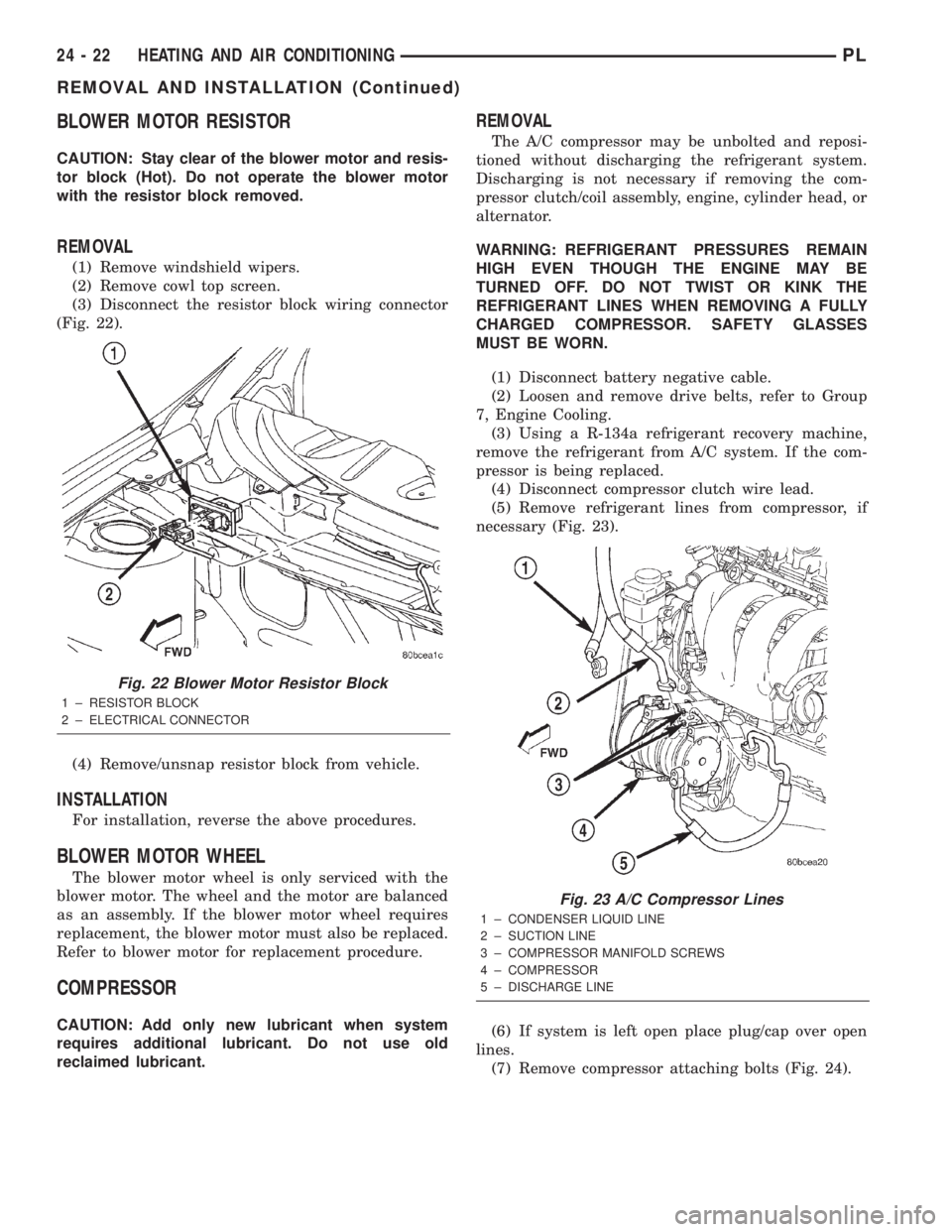
BLOWER MOTOR RESISTOR
CAUTION: Stay clear of the blower motor and resis-
tor block (Hot). Do not operate the blower motor
with the resistor block removed.
REMOVAL
(1) Remove windshield wipers.
(2) Remove cowl top screen.
(3) Disconnect the resistor block wiring connector
(Fig. 22).
(4) Remove/unsnap resistor block from vehicle.
INSTALLATION
For installation, reverse the above procedures.
BLOWER MOTOR WHEEL
The blower motor wheel is only serviced with the
blower motor. The wheel and the motor are balanced
as an assembly. If the blower motor wheel requires
replacement, the blower motor must also be replaced.
Refer to blower motor for replacement procedure.
COMPRESSOR
CAUTION: Add only new lubricant when system
requires additional lubricant. Do not use old
reclaimed lubricant.
REMOVAL
The A/C compressor may be unbolted and reposi-
tioned without discharging the refrigerant system.
Discharging is not necessary if removing the com-
pressor clutch/coil assembly, engine, cylinder head, or
alternator.
WARNING: REFRIGERANT PRESSURES REMAIN
HIGH EVEN THOUGH THE ENGINE MAY BE
TURNED OFF. DO NOT TWIST OR KINK THE
REFRIGERANT LINES WHEN REMOVING A FULLY
CHARGED COMPRESSOR. SAFETY GLASSES
MUST BE WORN.
(1) Disconnect battery negative cable.
(2) Loosen and remove drive belts, refer to Group
7, Engine Cooling.
(3) Using a R-134a refrigerant recovery machine,
remove the refrigerant from A/C system. If the com-
pressor is being replaced.
(4) Disconnect compressor clutch wire lead.
(5) Remove refrigerant lines from compressor, if
necessary (Fig. 23).
(6) If system is left open place plug/cap over open
lines.
(7) Remove compressor attaching bolts (Fig. 24).
Fig. 22 Blower Motor Resistor Block
1 ± RESISTOR BLOCK
2 ± ELECTRICAL CONNECTOR
Fig. 23 A/C Compressor Lines
1 ± CONDENSER LIQUID LINE
2 ± SUCTION LINE
3 ± COMPRESSOR MANIFOLD SCREWS
4 ± COMPRESSOR
5 ± DISCHARGE LINE
24 - 22 HEATING AND AIR CONDITIONINGPL
REMOVAL AND INSTALLATION (Continued)