intake DODGE RAM 2001 Service Repair Manual
[x] Cancel search | Manufacturer: DODGE, Model Year: 2001, Model line: RAM, Model: DODGE RAM 2001Pages: 2889, PDF Size: 68.07 MB
Page 1536 of 2889
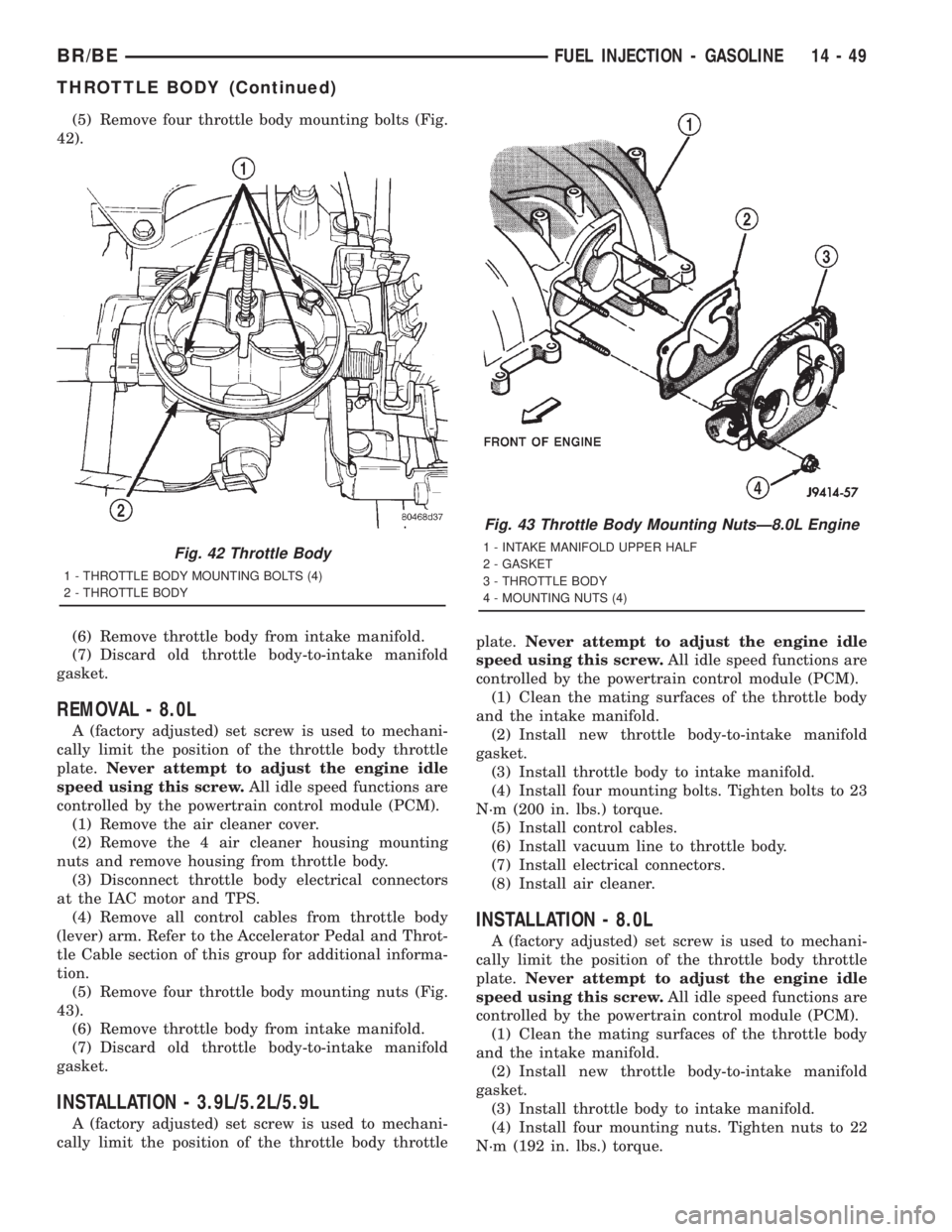
(5) Remove four throttle body mounting bolts (Fig.
42).
(6) Remove throttle body from intake manifold.
(7) Discard old throttle body-to-intake manifold
gasket.
REMOVAL - 8.0L
A (factory adjusted) set screw is used to mechani-
cally limit the position of the throttle body throttle
plate.Never attempt to adjust the engine idle
speed using this screw.All idle speed functions are
controlled by the powertrain control module (PCM).
(1) Remove the air cleaner cover.
(2) Remove the 4 air cleaner housing mounting
nuts and remove housing from throttle body.
(3) Disconnect throttle body electrical connectors
at the IAC motor and TPS.
(4) Remove all control cables from throttle body
(lever) arm. Refer to the Accelerator Pedal and Throt-
tle Cable section of this group for additional informa-
tion.
(5) Remove four throttle body mounting nuts (Fig.
43).
(6) Remove throttle body from intake manifold.
(7) Discard old throttle body-to-intake manifold
gasket.
INSTALLATION - 3.9L/5.2L/5.9L
A (factory adjusted) set screw is used to mechani-
cally limit the position of the throttle body throttleplate.Never attempt to adjust the engine idle
speed using this screw.All idle speed functions are
controlled by the powertrain control module (PCM).
(1) Clean the mating surfaces of the throttle body
and the intake manifold.
(2) Install new throttle body-to-intake manifold
gasket.
(3) Install throttle body to intake manifold.
(4) Install four mounting bolts. Tighten bolts to 23
N´m (200 in. lbs.) torque.
(5) Install control cables.
(6) Install vacuum line to throttle body.
(7) Install electrical connectors.
(8) Install air cleaner.
INSTALLATION - 8.0L
A (factory adjusted) set screw is used to mechani-
cally limit the position of the throttle body throttle
plate.Never attempt to adjust the engine idle
speed using this screw.All idle speed functions are
controlled by the powertrain control module (PCM).
(1) Clean the mating surfaces of the throttle body
and the intake manifold.
(2) Install new throttle body-to-intake manifold
gasket.
(3) Install throttle body to intake manifold.
(4) Install four mounting nuts. Tighten nuts to 22
N´m (192 in. lbs.) torque.
Fig. 42 Throttle Body
1 - THROTTLE BODY MOUNTING BOLTS (4)
2 - THROTTLE BODY
Fig. 43 Throttle Body Mounting NutsÐ8.0L Engine
1 - INTAKE MANIFOLD UPPER HALF
2 - GASKET
3 - THROTTLE BODY
4 - MOUNTING NUTS (4)
BR/BEFUEL INJECTION - GASOLINE 14 - 49
THROTTLE BODY (Continued)
Page 1538 of 2889
(3) Install the remaining cable housing end into
and through the dash panel opening (snaps into posi-
tion). The two plastic pinch tabs (Fig. 21) should lock
the cable to dash panel.
(4) From inside the vehicle, hold up the accelera-
tor pedal. Install the throttle cable core wire and
plastic cable retainer into and through the upper end
of the pedal arm (the plastic retainer is snapped into
the pedal arm). When installing the plastic retainer
to the accelerator pedal arm, note the index tab on
the pedal arm (Fig. 21). Align the index slot on the
plastic cable retainer to this index tab.
THROTTLE POSITION SENSOR
DESCRIPTION
The 3±wire Throttle Position Sensor (TPS) is
mounted on the throttle body and is connected to the
throttle blade.
OPERATION
The TPS is a 3±wire variable resistor that provides
the Powertrain Control Module (PCM) with an input
signal (voltage) that represents the throttle blade
position of the throttle body. The sensor is connected
to the throttle blade shaft. As the position of the
throttle blade changes, the resistance (output volt-
age) of the TPS changes.The PCM supplies approximately 5 volts to the
TPS. The TPS output voltage (input signal to the
PCM) represents the throttle blade position. The
PCM receives an input signal voltage from the TPS.
This will vary in an approximate range of from .26
volts at minimum throttle opening (idle), to 4.49 volts
at wide open throttle. Along with inputs from other
sensors, the PCM uses the TPS input to determine
current engine operating conditions. In response to
engine operating conditions, the PCM will adjust fuel
injector pulse width and ignition timing.
The PCM needs to identify the actions and position
of the throttle blade at all times. This information is
needed to assist in performing the following calcula-
tions:
²Ignition timing advance
²Fuel injection pulse-width
²Idle (learned value or minimum TPS)
²Off-idle (0.06 volt)
²Wide Open Throttle (WOT) open loop (2.608
volts above learned idle voltage)
²Deceleration fuel lean out
²Fuel cutoff during cranking at WOT (2.608 volts
above learned idle voltage)
²A/C WOT cutoff (certain automatic transmis-
sions only)
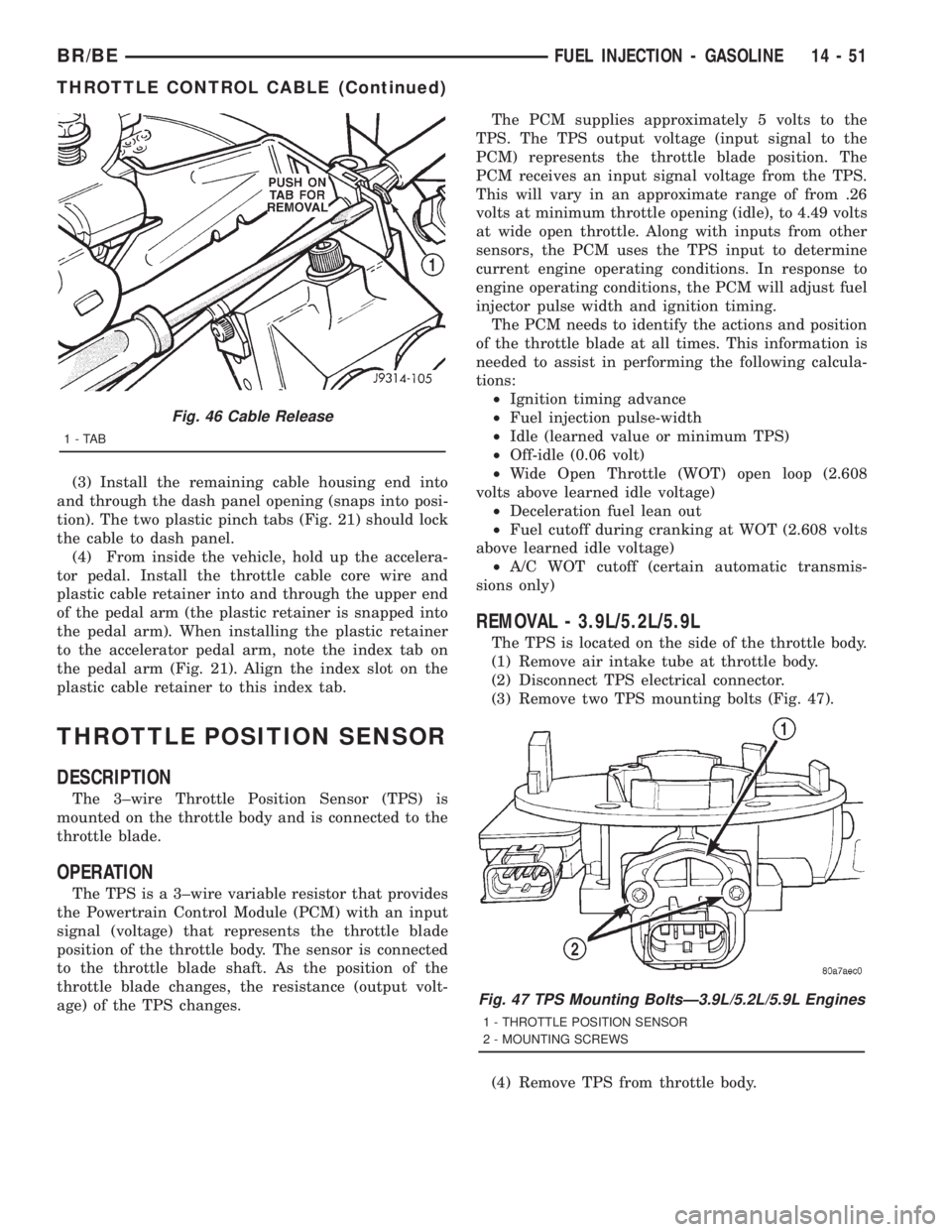
REMOVAL - 3.9L/5.2L/5.9L
The TPS is located on the side of the throttle body.
(1) Remove air intake tube at throttle body.
(2) Disconnect TPS electrical connector.
(3) Remove two TPS mounting bolts (Fig. 47).
(4) Remove TPS from throttle body.
Fig. 46 Cable Release
1-TAB
Fig. 47 TPS Mounting BoltsÐ3.9L/5.2L/5.9L Engines
1 - THROTTLE POSITION SENSOR
2 - MOUNTING SCREWS
BR/BEFUEL INJECTION - GASOLINE 14 - 51
THROTTLE CONTROL CABLE (Continued)
Page 1539 of 2889
REMOVAL - 8.0L
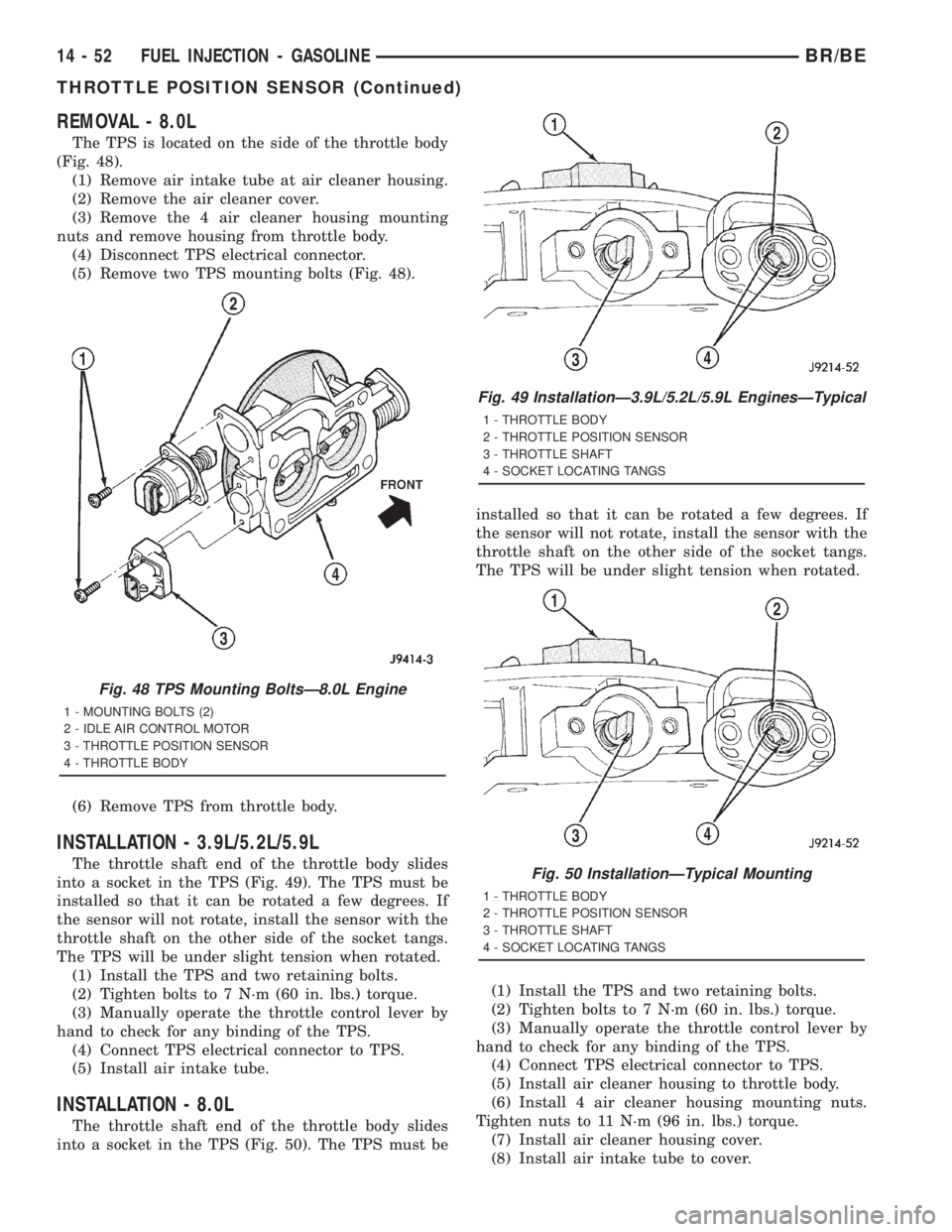
The TPS is located on the side of the throttle body
(Fig. 48).
(1) Remove air intake tube at air cleaner housing.
(2) Remove the air cleaner cover.
(3) Remove the 4 air cleaner housing mounting
nuts and remove housing from throttle body.
(4) Disconnect TPS electrical connector.
(5) Remove two TPS mounting bolts (Fig. 48).
(6) Remove TPS from throttle body.
INSTALLATION - 3.9L/5.2L/5.9L
The throttle shaft end of the throttle body slides
into a socket in the TPS (Fig. 49). The TPS must be
installed so that it can be rotated a few degrees. If
the sensor will not rotate, install the sensor with the
throttle shaft on the other side of the socket tangs.
The TPS will be under slight tension when rotated.
(1) Install the TPS and two retaining bolts.
(2) Tighten bolts to 7 N´m (60 in. lbs.) torque.
(3) Manually operate the throttle control lever by
hand to check for any binding of the TPS.
(4) Connect TPS electrical connector to TPS.
(5) Install air intake tube.
INSTALLATION - 8.0L
The throttle shaft end of the throttle body slides
into a socket in the TPS (Fig. 50). The TPS must beinstalled so that it can be rotated a few degrees. If
the sensor will not rotate, install the sensor with the
throttle shaft on the other side of the socket tangs.
The TPS will be under slight tension when rotated.
(1) Install the TPS and two retaining bolts.
(2) Tighten bolts to 7 N´m (60 in. lbs.) torque.
(3) Manually operate the throttle control lever by
hand to check for any binding of the TPS.
(4) Connect TPS electrical connector to TPS.
(5) Install air cleaner housing to throttle body.
(6) Install 4 air cleaner housing mounting nuts.
Tighten nuts to 11 N´m (96 in. lbs.) torque.
(7) Install air cleaner housing cover.
(8) Install air intake tube to cover.
Fig. 48 TPS Mounting BoltsÐ8.0L Engine
1 - MOUNTING BOLTS (2)
2 - IDLE AIR CONTROL MOTOR
3 - THROTTLE POSITION SENSOR
4 - THROTTLE BODY
Fig. 49 InstallationÐ3.9L/5.2L/5.9L EnginesÐTypical
1 - THROTTLE BODY
2 - THROTTLE POSITION SENSOR
3 - THROTTLE SHAFT
4 - SOCKET LOCATING TANGS
Fig. 50 InstallationÐTypical Mounting
1 - THROTTLE BODY
2 - THROTTLE POSITION SENSOR
3 - THROTTLE SHAFT
4 - SOCKET LOCATING TANGS
14 - 52 FUEL INJECTION - GASOLINEBR/BE
THROTTLE POSITION SENSOR (Continued)
Page 1540 of 2889
FUEL INJECTOR
DESCRIPTION
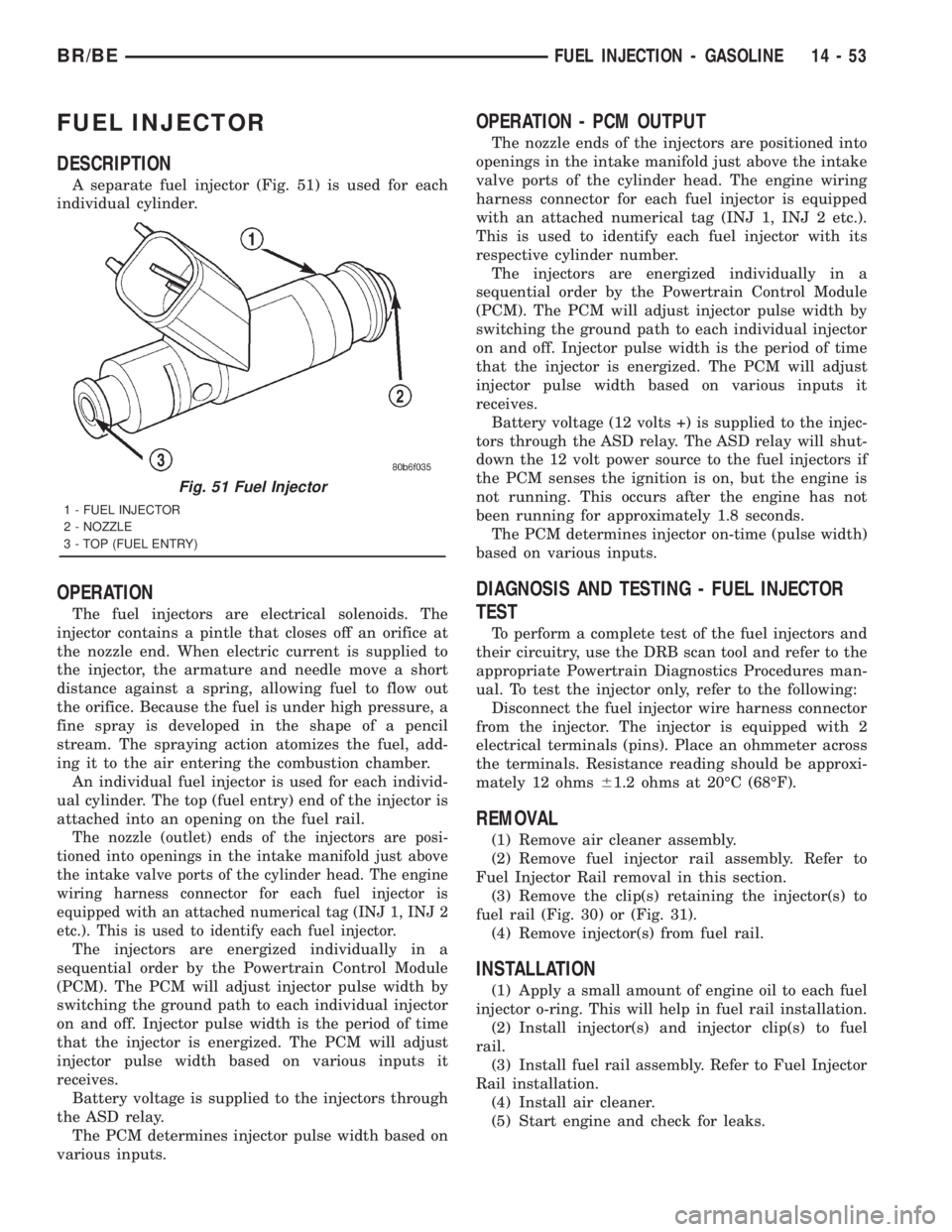
A separate fuel injector (Fig. 51) is used for each
individual cylinder.
OPERATION
The fuel injectors are electrical solenoids. The
injector contains a pintle that closes off an orifice at
the nozzle end. When electric current is supplied to
the injector, the armature and needle move a short
distance against a spring, allowing fuel to flow out
the orifice. Because the fuel is under high pressure, a
fine spray is developed in the shape of a pencil
stream. The spraying action atomizes the fuel, add-
ing it to the air entering the combustion chamber.
An individual fuel injector is used for each individ-
ual cylinder. The top (fuel entry) end of the injector is
attached into an opening on the fuel rail.
The nozzle (outlet) ends of the injectors are posi-
tioned into openings in the intake manifold just above
the intake valve ports of the cylinder head. The engine
wiring harness connector for each fuel injector is
equipped with an attached numerical tag (INJ 1, INJ 2
etc.). This is used to identify each fuel injector.
The injectors are energized individually in a
sequential order by the Powertrain Control Module
(PCM). The PCM will adjust injector pulse width by
switching the ground path to each individual injector
on and off. Injector pulse width is the period of time
that the injector is energized. The PCM will adjust
injector pulse width based on various inputs it
receives.
Battery voltage is supplied to the injectors through
the ASD relay.
The PCM determines injector pulse width based on
various inputs.
OPERATION - PCM OUTPUT
The nozzle ends of the injectors are positioned into
openings in the intake manifold just above the intake
valve ports of the cylinder head. The engine wiring
harness connector for each fuel injector is equipped
with an attached numerical tag (INJ 1, INJ 2 etc.).
This is used to identify each fuel injector with its
respective cylinder number.
The injectors are energized individually in a
sequential order by the Powertrain Control Module
(PCM). The PCM will adjust injector pulse width by
switching the ground path to each individual injector
on and off. Injector pulse width is the period of time
that the injector is energized. The PCM will adjust
injector pulse width based on various inputs it
receives.
Battery voltage (12 volts +) is supplied to the injec-
tors through the ASD relay. The ASD relay will shut-
down the 12 volt power source to the fuel injectors if
the PCM senses the ignition is on, but the engine is
not running. This occurs after the engine has not
been running for approximately 1.8 seconds.
The PCM determines injector on-time (pulse width)
based on various inputs.
DIAGNOSIS AND TESTING - FUEL INJECTOR
TEST
To perform a complete test of the fuel injectors and
their circuitry, use the DRB scan tool and refer to the
appropriate Powertrain Diagnostics Procedures man-
ual. To test the injector only, refer to the following:
Disconnect the fuel injector wire harness connector
from the injector. The injector is equipped with 2
electrical terminals (pins). Place an ohmmeter across
the terminals. Resistance reading should be approxi-
mately 12 ohms61.2 ohms at 20ÉC (68ÉF).
REMOVAL
(1) Remove air cleaner assembly.
(2) Remove fuel injector rail assembly. Refer to
Fuel Injector Rail removal in this section.
(3) Remove the clip(s) retaining the injector(s) to
fuel rail (Fig. 30) or (Fig. 31).
(4) Remove injector(s) from fuel rail.
INSTALLATION
(1) Apply a small amount of engine oil to each fuel
injector o-ring. This will help in fuel rail installation.
(2) Install injector(s) and injector clip(s) to fuel
rail.
(3) Install fuel rail assembly. Refer to Fuel Injector
Rail installation.
(4) Install air cleaner.
(5) Start engine and check for leaks.
Fig. 51 Fuel Injector
1 - FUEL INJECTOR
2 - NOZZLE
3 - TOP (FUEL ENTRY)
BR/BEFUEL INJECTION - GASOLINE 14 - 53
Page 1542 of 2889
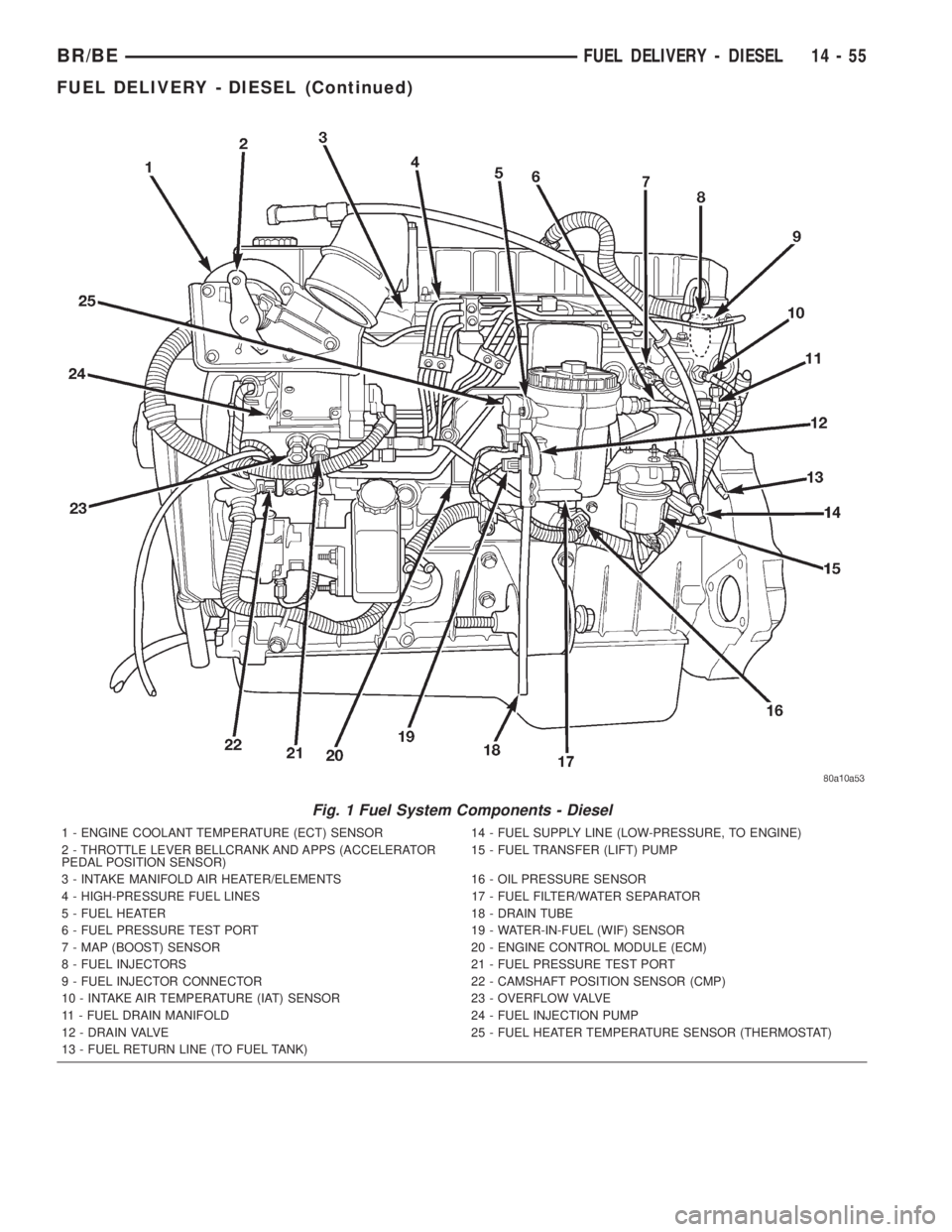
Fig. 1 Fuel System Components - Diesel
1 - ENGINE COOLANT TEMPERATURE (ECT) SENSOR 14 - FUEL SUPPLY LINE (LOW-PRESSURE, TO ENGINE)
2 - THROTTLE LEVER BELLCRANK AND APPS (ACCELERATOR
PEDAL POSITION SENSOR)15 - FUEL TRANSFER (LIFT) PUMP
3 - INTAKE MANIFOLD AIR HEATER/ELEMENTS 16 - OIL PRESSURE SENSOR
4 - HIGH-PRESSURE FUEL LINES 17 - FUEL FILTER/WATER SEPARATOR
5 - FUEL HEATER 18 - DRAIN TUBE
6 - FUEL PRESSURE TEST PORT 19 - WATER-IN-FUEL (WIF) SENSOR
7 - MAP (BOOST) SENSOR 20 - ENGINE CONTROL MODULE (ECM)
8 - FUEL INJECTORS 21 - FUEL PRESSURE TEST PORT
9 - FUEL INJECTOR CONNECTOR 22 - CAMSHAFT POSITION SENSOR (CMP)
10 - INTAKE AIR TEMPERATURE (IAT) SENSOR 23 - OVERFLOW VALVE
11 - FUEL DRAIN MANIFOLD 24 - FUEL INJECTION PUMP
12 - DRAIN VALVE 25 - FUEL HEATER TEMPERATURE SENSOR (THERMOSTAT)
13 - FUEL RETURN LINE (TO FUEL TANK)
BR/BEFUEL DELIVERY - DIESEL 14 - 55
FUEL DELIVERY - DIESEL (Continued)
Page 1555 of 2889
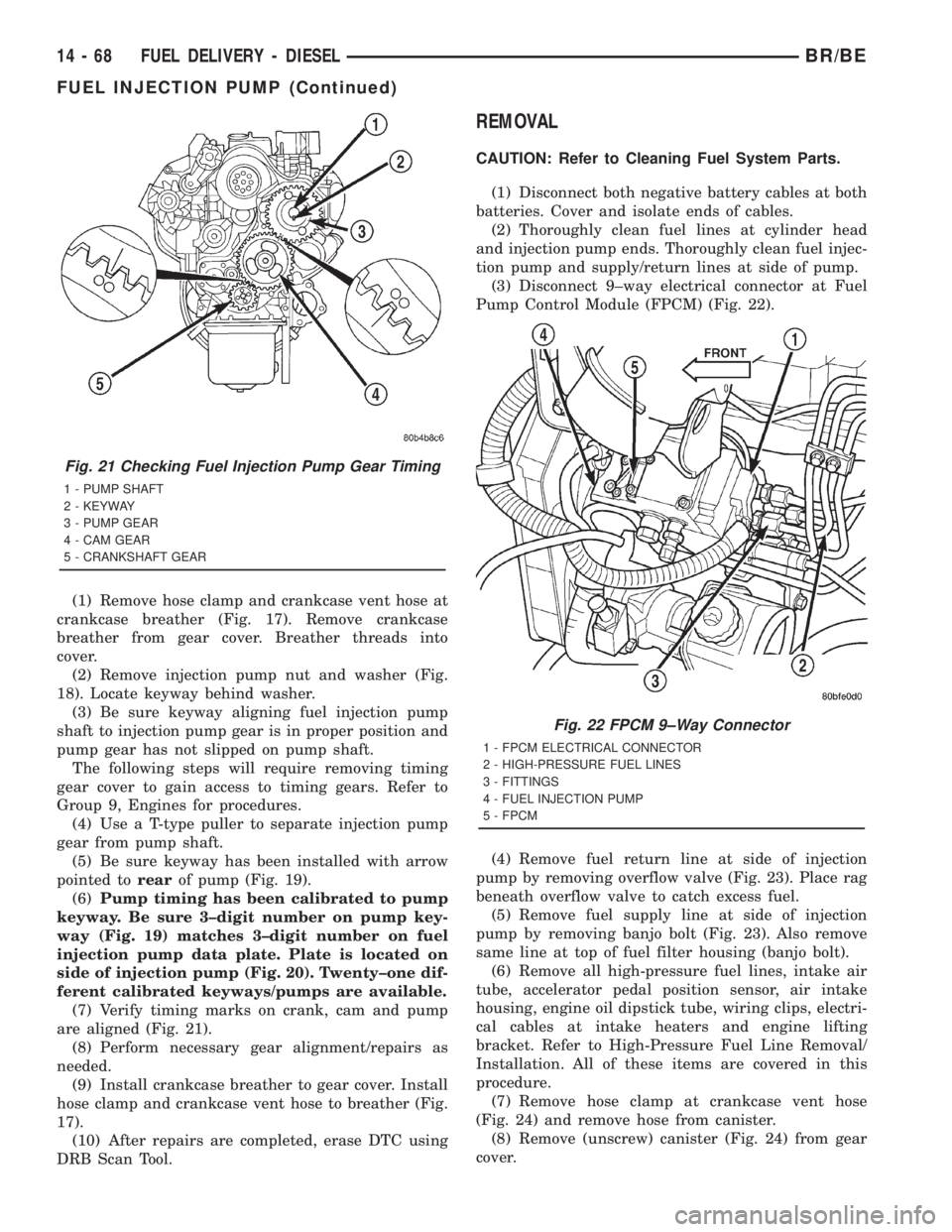
(1) Remove hose clamp and crankcase vent hose at
crankcase breather (Fig. 17). Remove crankcase
breather from gear cover. Breather threads into
cover.
(2) Remove injection pump nut and washer (Fig.
18). Locate keyway behind washer.
(3) Be sure keyway aligning fuel injection pump
shaft to injection pump gear is in proper position and
pump gear has not slipped on pump shaft.
The following steps will require removing timing
gear cover to gain access to timing gears. Refer to
Group 9, Engines for procedures.
(4) Use a T-type puller to separate injection pump
gear from pump shaft.
(5) Be sure keyway has been installed with arrow
pointed torearof pump (Fig. 19).
(6)Pump timing has been calibrated to pump
keyway. Be sure 3±digit number on pump key-
way (Fig. 19) matches 3±digit number on fuel
injection pump data plate. Plate is located on
side of injection pump (Fig. 20). Twenty±one dif-
ferent calibrated keyways/pumps are available.
(7) Verify timing marks on crank, cam and pump
are aligned (Fig. 21).
(8) Perform necessary gear alignment/repairs as
needed.
(9) Install crankcase breather to gear cover. Install
hose clamp and crankcase vent hose to breather (Fig.
17).
(10) After repairs are completed, erase DTC using
DRB Scan Tool.
REMOVAL
CAUTION: Refer to Cleaning Fuel System Parts.
(1) Disconnect both negative battery cables at both
batteries. Cover and isolate ends of cables.
(2) Thoroughly clean fuel lines at cylinder head
and injection pump ends. Thoroughly clean fuel injec-
tion pump and supply/return lines at side of pump.
(3) Disconnect 9±way electrical connector at Fuel
Pump Control Module (FPCM) (Fig. 22).
(4) Remove fuel return line at side of injection
pump by removing overflow valve (Fig. 23). Place rag
beneath overflow valve to catch excess fuel.
(5) Remove fuel supply line at side of injection
pump by removing banjo bolt (Fig. 23). Also remove
same line at top of fuel filter housing (banjo bolt).
(6) Remove all high-pressure fuel lines, intake air
tube, accelerator pedal position sensor, air intake
housing, engine oil dipstick tube, wiring clips, electri-
cal cables at intake heaters and engine lifting
bracket. Refer to High-Pressure Fuel Line Removal/
Installation. All of these items are covered in this
procedure.
(7) Remove hose clamp at crankcase vent hose
(Fig. 24) and remove hose from canister.
(8) Remove (unscrew) canister (Fig. 24) from gear
cover.
Fig. 21 Checking Fuel Injection Pump Gear Timing
1 - PUMP SHAFT
2 - KEYWAY
3 - PUMP GEAR
4 - CAM GEAR
5 - CRANKSHAFT GEAR
Fig. 22 FPCM 9±Way Connector
1 - FPCM ELECTRICAL CONNECTOR
2 - HIGH-PRESSURE FUEL LINES
3 - FITTINGS
4 - FUEL INJECTION PUMP
5 - FPCM
14 - 68 FUEL DELIVERY - DIESELBR/BE
FUEL INJECTION PUMP (Continued)
Page 1559 of 2889
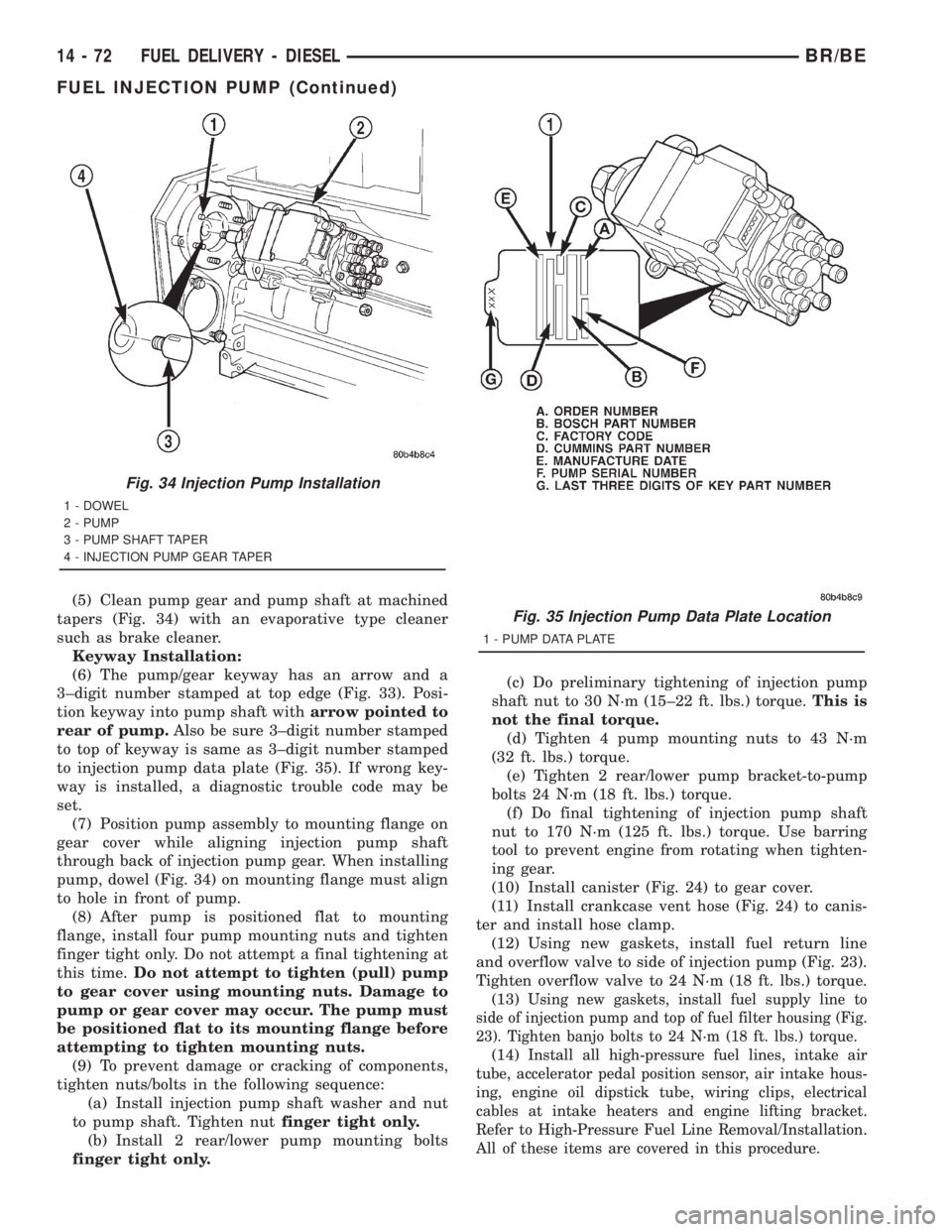
(5) Clean pump gear and pump shaft at machined
tapers (Fig. 34) with an evaporative type cleaner
such as brake cleaner.
Keyway Installation:
(6) The pump/gear keyway has an arrow and a
3±digit number stamped at top edge (Fig. 33). Posi-
tion keyway into pump shaft witharrow pointed to
rear of pump.Also be sure 3±digit number stamped
to top of keyway is same as 3±digit number stamped
to injection pump data plate (Fig. 35). If wrong key-
way is installed, a diagnostic trouble code may be
set.
(7) Position pump assembly to mounting flange on
gear cover while aligning injection pump shaft
through back of injection pump gear. When installing
pump, dowel (Fig. 34) on mounting flange must align
to hole in front of pump.
(8) After pump is positioned flat to mounting
flange, install four pump mounting nuts and tighten
finger tight only. Do not attempt a final tightening at
this time.Do not attempt to tighten (pull) pump
to gear cover using mounting nuts. Damage to
pump or gear cover may occur. The pump must
be positioned flat to its mounting flange before
attempting to tighten mounting nuts.
(9) To prevent damage or cracking of components,
tighten nuts/bolts in the following sequence:
(a) Install injection pump shaft washer and nut
to pump shaft. Tighten nutfinger tight only.
(b) Install 2 rear/lower pump mounting bolts
finger tight only.(c) Do preliminary tightening of injection pump
shaft nut to 30 N´m (15±22 ft. lbs.) torque.This is
not the final torque.
(d) Tighten 4 pump mounting nuts to 43 N´m
(32 ft. lbs.) torque.
(e) Tighten 2 rear/lower pump bracket-to-pump
bolts 24 N´m (18 ft. lbs.) torque.
(f) Do final tightening of injection pump shaft
nut to 170 N´m (125 ft. lbs.) torque. Use barring
tool to prevent engine from rotating when tighten-
ing gear.
(10) Install canister (Fig. 24) to gear cover.
(11) Install crankcase vent hose (Fig. 24) to canis-
ter and install hose clamp.
(12) Using new gaskets, install fuel return line
and overflow valve to side of injection pump (Fig. 23).
Tighten overflow valve to 24 N´m (18 ft. lbs.) torque.
(13)
Using new gaskets, install fuel supply line to
side of injection pump and top of fuel filter housing (Fig.
23). Tighten banjo bolts to 24 N´m (18 ft. lbs.) torque.
(14)Install all high-pressure fuel lines, intake air
tube, accelerator pedal position sensor, air intake hous-
ing, engine oil dipstick tube, wiring clips, electrical
cables at intake heaters and engine lifting bracket.
Refer to High-Pressure Fuel Line Removal/Installation.
All of these items are covered in this procedure.
Fig. 34 Injection Pump Installation
1 - DOWEL
2 - PUMP
3 - PUMP SHAFT TAPER
4 - INJECTION PUMP GEAR TAPER
Fig. 35 Injection Pump Data Plate Location
1 - PUMP DATA PLATE
14 - 72 FUEL DELIVERY - DIESELBR/BE
FUEL INJECTION PUMP (Continued)
Page 1562 of 2889
CAUTION: The high-pressure fuel lines must be
clamped securely in place in the holders. The lines
cannot contact each other or other components. Do
not attempt to weld high-pressure fuel lines or to
repair lines that are damaged. Only use the recom-
mended lines when replacement of high-pressure
fuel line is necessary.
REMOVAL
High-pressure lines are used between the fuel
injection pump and the fuel injectors only. All high-
pressure fuel lines are of the same length and inside
diameter. Correct high-pressure fuel line usage and
installation is critical to smooth engine operation.
CAUTION: Refer to Cleaning Fuel System Parts.
(1) Disconnect both negative battery cables from
both batteries. Cover and isolate ends of cables.
(2) Thoroughly clean fuel lines at cylinder head
and injection pump ends.
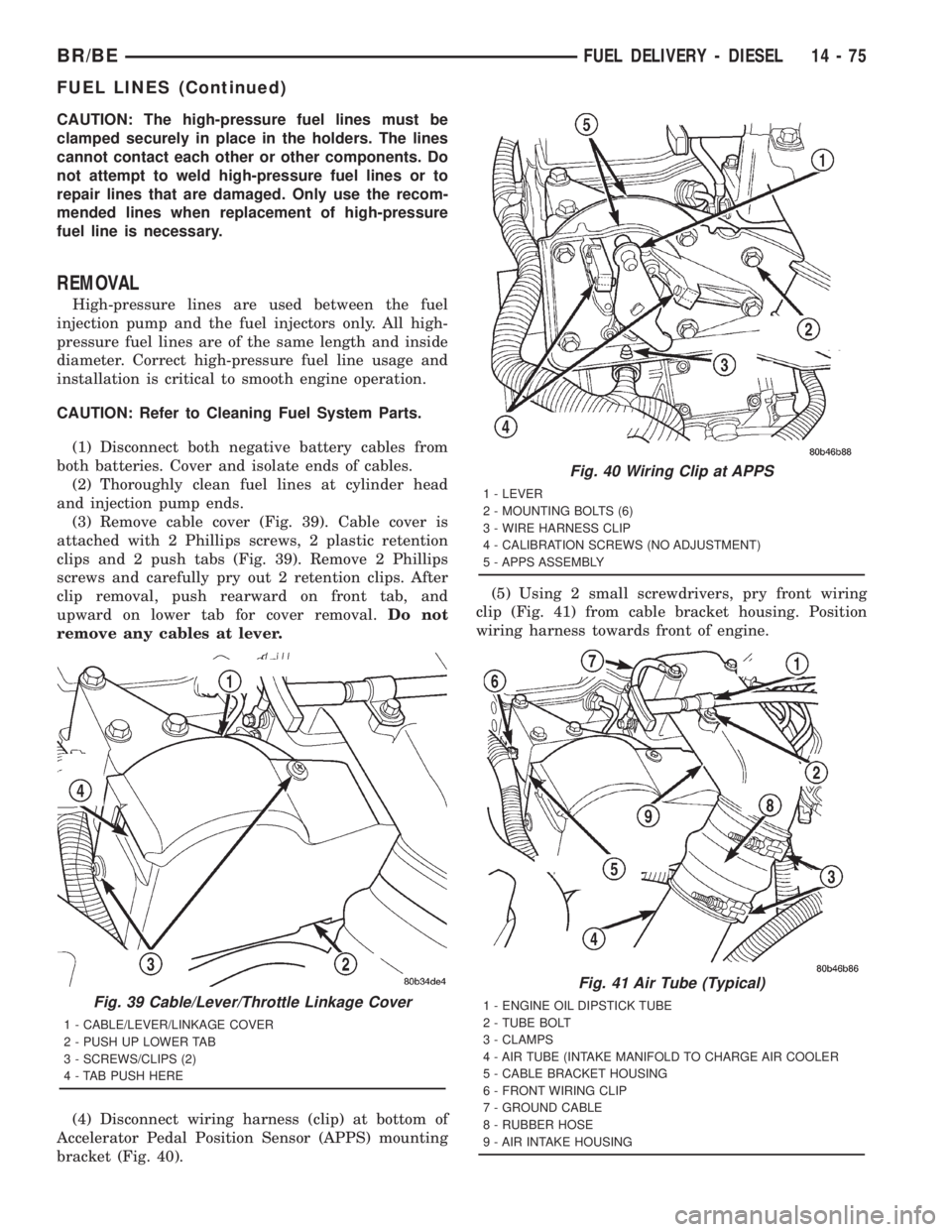
(3) Remove cable cover (Fig. 39). Cable cover is
attached with 2 Phillips screws, 2 plastic retention
clips and 2 push tabs (Fig. 39). Remove 2 Phillips
screws and carefully pry out 2 retention clips. After
clip removal, push rearward on front tab, and
upward on lower tab for cover removal.Do not
remove any cables at lever.
(4) Disconnect wiring harness (clip) at bottom of
Accelerator Pedal Position Sensor (APPS) mounting
bracket (Fig. 40).(5) Using 2 small screwdrivers, pry front wiring
clip (Fig. 41) from cable bracket housing. Position
wiring harness towards front of engine.
Fig. 39 Cable/Lever/Throttle Linkage Cover
1 - CABLE/LEVER/LINKAGE COVER
2 - PUSH UP LOWER TAB
3 - SCREWS/CLIPS (2)
4 - TAB PUSH HERE
Fig. 40 Wiring Clip at APPS
1 - LEVER
2 - MOUNTING BOLTS (6)
3 - WIRE HARNESS CLIP
4 - CALIBRATION SCREWS (NO ADJUSTMENT)
5 - APPS ASSEMBLY
Fig. 41 Air Tube (Typical)
1 - ENGINE OIL DIPSTICK TUBE
2 - TUBE BOLT
3 - CLAMPS
4 - AIR TUBE (INTAKE MANIFOLD TO CHARGE AIR COOLER
5 - CABLE BRACKET HOUSING
6 - FRONT WIRING CLIP
7 - GROUND CABLE
8 - RUBBER HOSE
9 - AIR INTAKE HOUSING
BR/BEFUEL DELIVERY - DIESEL 14 - 75
FUEL LINES (Continued)
Page 1563 of 2889
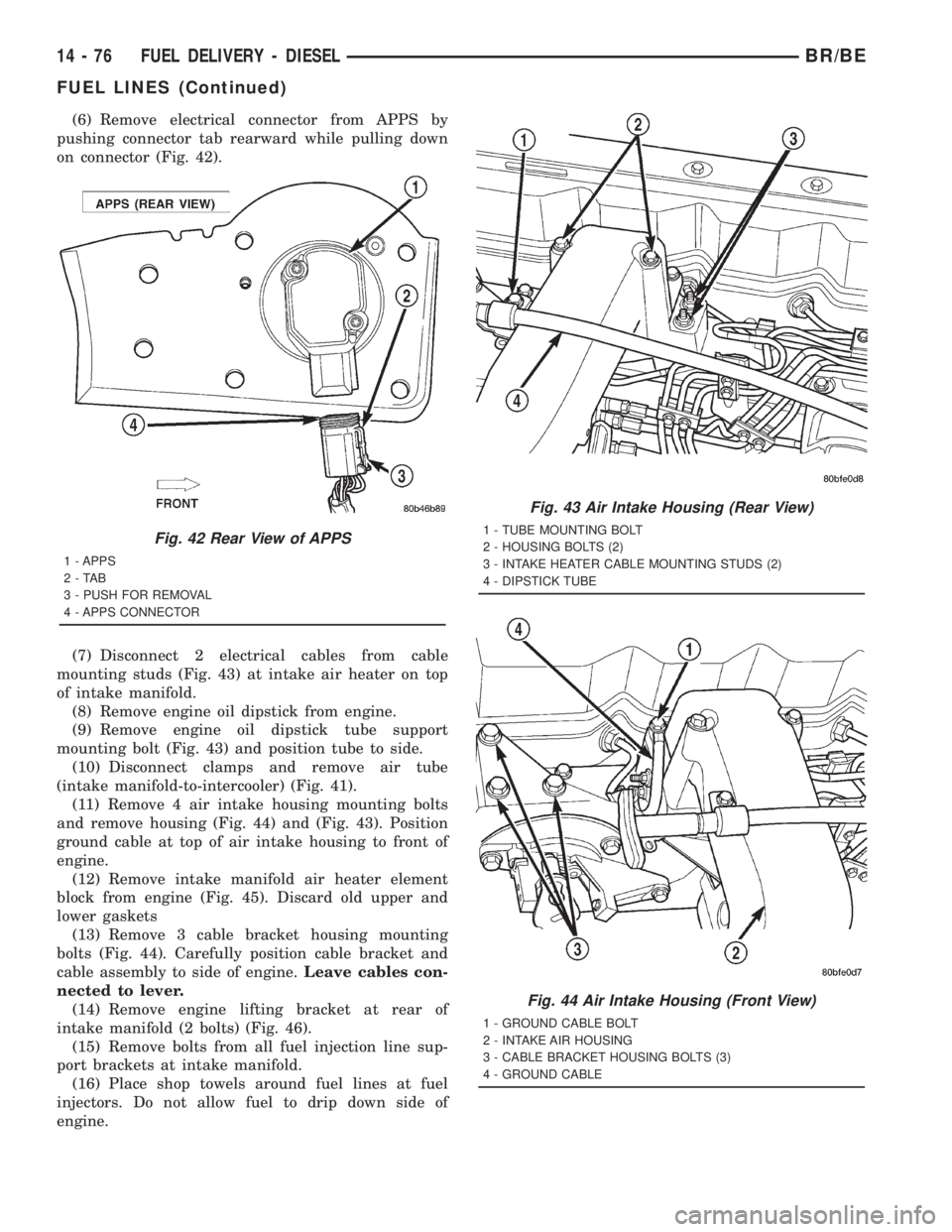
(6) Remove electrical connector from APPS by
pushing connector tab rearward while pulling down
on connector (Fig. 42).
(7) Disconnect 2 electrical cables from cable
mounting studs (Fig. 43) at intake air heater on top
of intake manifold.
(8) Remove engine oil dipstick from engine.
(9) Remove engine oil dipstick tube support
mounting bolt (Fig. 43) and position tube to side.
(10) Disconnect clamps and remove air tube
(intake manifold-to-intercooler) (Fig. 41).
(11) Remove 4 air intake housing mounting bolts
and remove housing (Fig. 44) and (Fig. 43). Position
ground cable at top of air intake housing to front of
engine.
(12) Remove intake manifold air heater element
block from engine (Fig. 45). Discard old upper and
lower gaskets
(13) Remove 3 cable bracket housing mounting
bolts (Fig. 44). Carefully position cable bracket and
cable assembly to side of engine.Leave cables con-
nected to lever.
(14) Remove engine lifting bracket at rear of
intake manifold (2 bolts) (Fig. 46).
(15) Remove bolts from all fuel injection line sup-
port brackets at intake manifold.
(16) Place shop towels around fuel lines at fuel
injectors. Do not allow fuel to drip down side of
engine.
Fig. 42 Rear View of APPS
1 - APPS
2-TAB
3 - PUSH FOR REMOVAL
4 - APPS CONNECTOR
Fig. 43 Air Intake Housing (Rear View)
1 - TUBE MOUNTING BOLT
2 - HOUSING BOLTS (2)
3 - INTAKE HEATER CABLE MOUNTING STUDS (2)
4 - DIPSTICK TUBE
Fig. 44 Air Intake Housing (Front View)
1 - GROUND CABLE BOLT
2 - INTAKE AIR HOUSING
3 - CABLE BRACKET HOUSING BOLTS (3)
4 - GROUND CABLE
14 - 76 FUEL DELIVERY - DIESELBR/BE
FUEL LINES (Continued)
Page 1564 of 2889
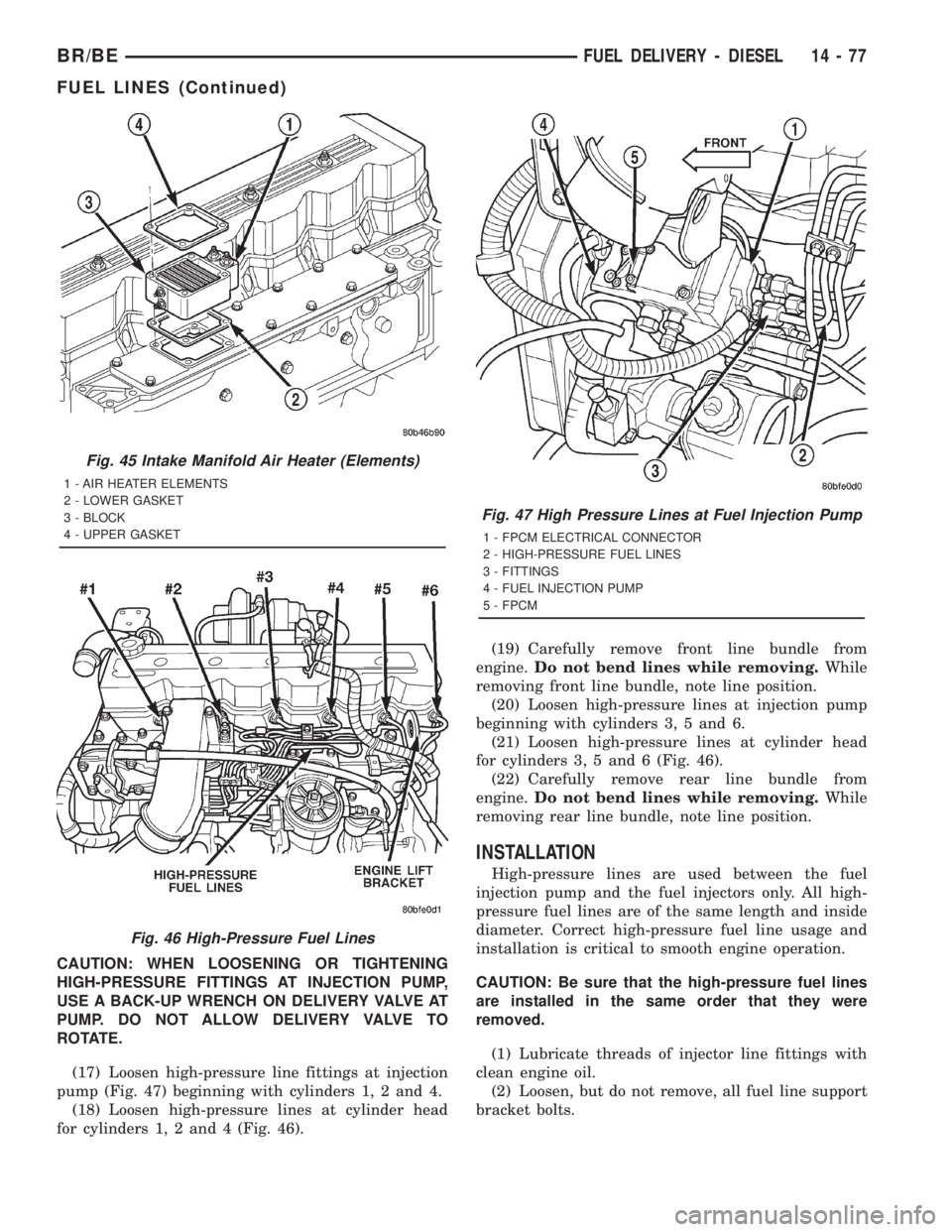
CAUTION: WHEN LOOSENING OR TIGHTENING
HIGH-PRESSURE FITTINGS AT INJECTION PUMP,
USE A BACK-UP WRENCH ON DELIVERY VALVE AT
PUMP. DO NOT ALLOW DELIVERY VALVE TO
ROTATE.
(17) Loosen high-pressure line fittings at injection
pump (Fig. 47) beginning with cylinders 1, 2 and 4.
(18) Loosen high-pressure lines at cylinder head
for cylinders 1, 2 and 4 (Fig. 46).(19) Carefully remove front line bundle from
engine.Do not bend lines while removing.While
removing front line bundle, note line position.
(20) Loosen high-pressure lines at injection pump
beginning with cylinders 3, 5 and 6.
(21) Loosen high-pressure lines at cylinder head
for cylinders 3, 5 and 6 (Fig. 46).
(22) Carefully remove rear line bundle from
engine.Do not bend lines while removing.While
removing rear line bundle, note line position.
INSTALLATION
High-pressure lines are used between the fuel
injection pump and the fuel injectors only. All high-
pressure fuel lines are of the same length and inside
diameter. Correct high-pressure fuel line usage and
installation is critical to smooth engine operation.
CAUTION: Be sure that the high-pressure fuel lines
are installed in the same order that they were
removed.
(1) Lubricate threads of injector line fittings with
clean engine oil.
(2) Loosen, but do not remove, all fuel line support
bracket bolts.
Fig. 45 Intake Manifold Air Heater (Elements)
1 - AIR HEATER ELEMENTS
2 - LOWER GASKET
3 - BLOCK
4 - UPPER GASKET
Fig. 46 High-Pressure Fuel Lines
Fig. 47 High Pressure Lines at Fuel Injection Pump
1 - FPCM ELECTRICAL CONNECTOR
2 - HIGH-PRESSURE FUEL LINES
3 - FITTINGS
4 - FUEL INJECTION PUMP
5 - FPCM
BR/BEFUEL DELIVERY - DIESEL 14 - 77
FUEL LINES (Continued)