harness DODGE RAM 2001 Service Repair Manual
[x] Cancel search | Manufacturer: DODGE, Model Year: 2001, Model line: RAM, Model: DODGE RAM 2001Pages: 2889, PDF Size: 68.07 MB
Page 2692 of 2889
A-PILLAR GRAB HANDLE
REMOVAL
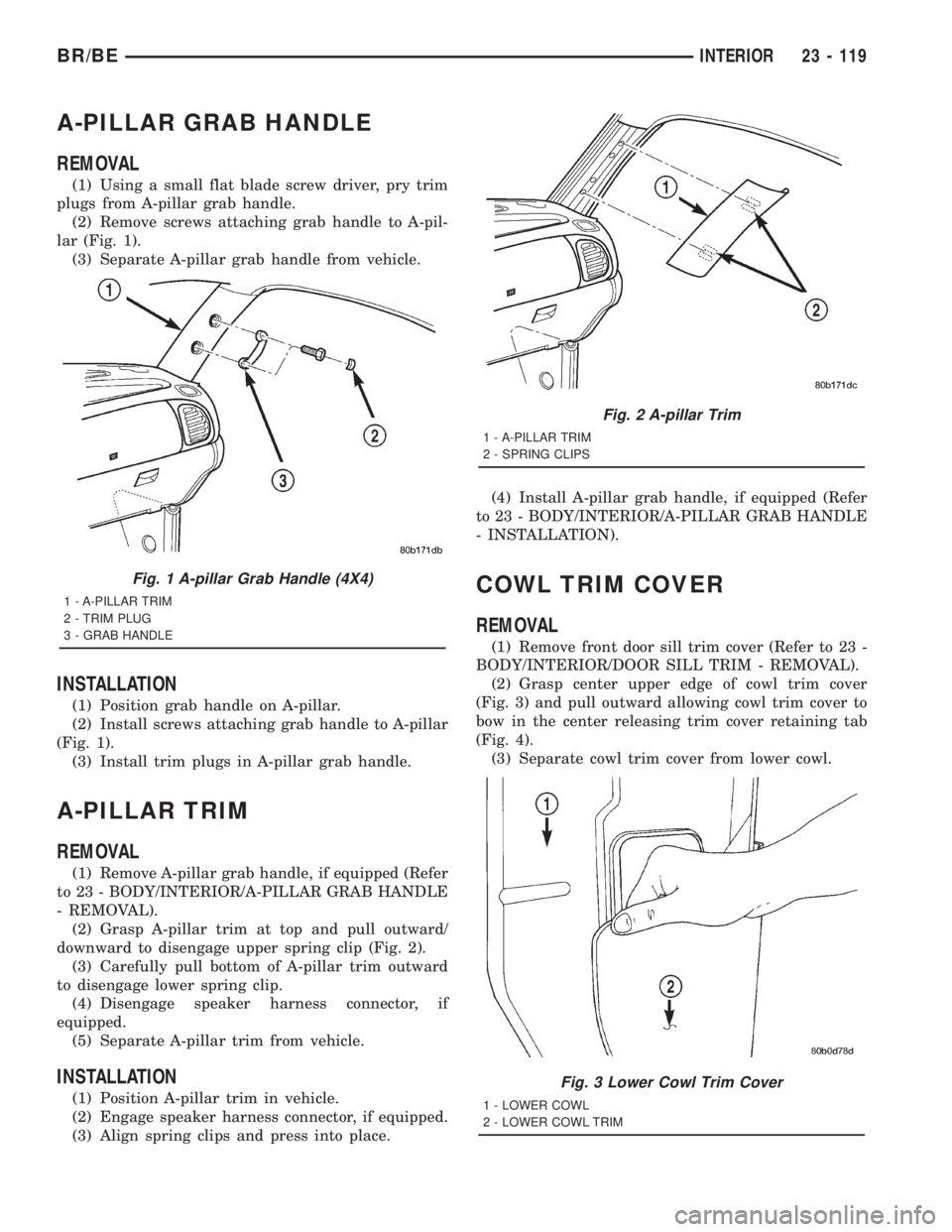
(1) Using a small flat blade screw driver, pry trim
plugs from A-pillar grab handle.
(2) Remove screws attaching grab handle to A-pil-
lar (Fig. 1).
(3) Separate A-pillar grab handle from vehicle.
INSTALLATION
(1) Position grab handle on A-pillar.
(2) Install screws attaching grab handle to A-pillar
(Fig. 1).
(3) Install trim plugs in A-pillar grab handle.
A-PILLAR TRIM
REMOVAL
(1) Remove A-pillar grab handle, if equipped (Refer
to 23 - BODY/INTERIOR/A-PILLAR GRAB HANDLE
- REMOVAL).
(2) Grasp A-pillar trim at top and pull outward/
downward to disengage upper spring clip (Fig. 2).
(3) Carefully pull bottom of A-pillar trim outward
to disengage lower spring clip.
(4) Disengage speaker harness connector, if
equipped.
(5) Separate A-pillar trim from vehicle.
INSTALLATION
(1) Position A-pillar trim in vehicle.
(2) Engage speaker harness connector, if equipped.
(3) Align spring clips and press into place.(4) Install A-pillar grab handle, if equipped (Refer
to 23 - BODY/INTERIOR/A-PILLAR GRAB HANDLE
- INSTALLATION).
COWL TRIM COVER
REMOVAL
(1) Remove front door sill trim cover (Refer to 23 -
BODY/INTERIOR/DOOR SILL TRIM - REMOVAL).
(2) Grasp center upper edge of cowl trim cover
(Fig. 3) and pull outward allowing cowl trim cover to
bow in the center releasing trim cover retaining tab
(Fig. 4).
(3) Separate cowl trim cover from lower cowl.
Fig. 1 A-pillar Grab Handle (4X4)
1 - A-PILLAR TRIM
2 - TRIM PLUG
3 - GRAB HANDLE
Fig. 2 A-pillar Trim
1 - A-PILLAR TRIM
2 - SPRING CLIPS
Fig. 3 Lower Cowl Trim Cover
1 - LOWER COWL
2 - LOWER COWL TRIM
BR/BEINTERIOR 23 - 119
Page 2695 of 2889
SHIFT BOOT - MANUAL
TRANSMISSION
REMOVAL
(1) Using a trim stick, pry the corner of the shift
boot up expose the fasteners.
(2) Remove the screws attaching the shift boot to
the console.
(3) Remove the insert from the shift knob, remove
nut attaching knob to the lever, and remove the shift
knob.
(4) Lift floor shift boot off shifter.
INSTALLATION
(1) Install shift boot over the shift lever, position
boot on console and install the fasteners attaching
boot to concole.
(2) Install the shift knob, shift knob nut, and
tighten to 27.1 N´m (20 ft.lbs) torque.
(3) Install the shift knob insert.
4WD FLOOR SHIFT BOOT
REMOVAL
(1) Remove insert from shift knob.
(2) Remove nut attaching shift knob to shift lever.
(3) Remove shift knob.
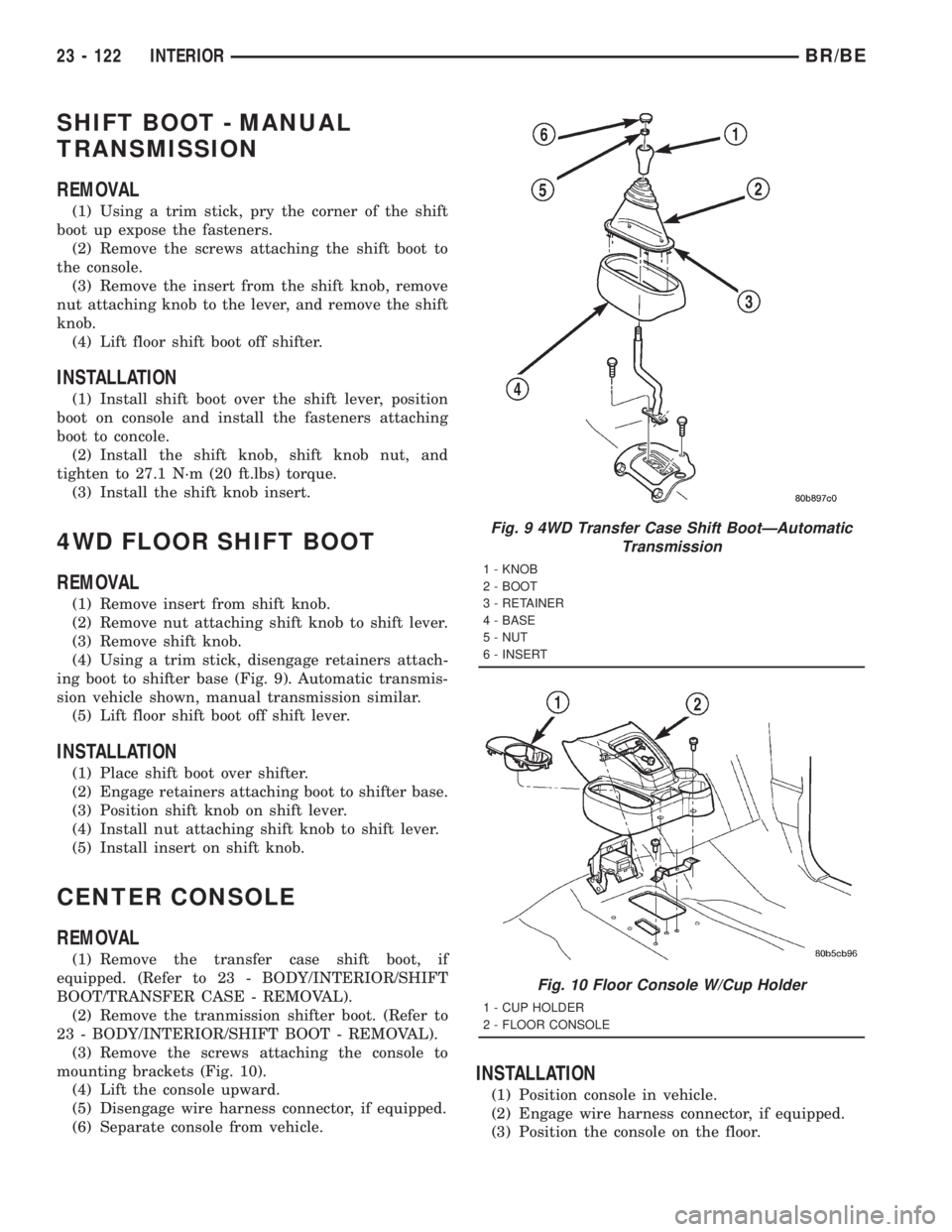
(4) Using a trim stick, disengage retainers attach-
ing boot to shifter base (Fig. 9). Automatic transmis-
sion vehicle shown, manual transmission similar.
(5) Lift floor shift boot off shift lever.
INSTALLATION
(1) Place shift boot over shifter.
(2) Engage retainers attaching boot to shifter base.
(3) Position shift knob on shift lever.
(4) Install nut attaching shift knob to shift lever.
(5) Install insert on shift knob.
CENTER CONSOLE
REMOVAL
(1) Remove the transfer case shift boot, if
equipped. (Refer to 23 - BODY/INTERIOR/SHIFT
BOOT/TRANSFER CASE - REMOVAL).
(2) Remove the tranmission shifter boot. (Refer to
23 - BODY/INTERIOR/SHIFT BOOT - REMOVAL).
(3) Remove the screws attaching the console to
mounting brackets (Fig. 10).
(4) Lift the console upward.
(5) Disengage wire harness connector, if equipped.
(6) Separate console from vehicle.
INSTALLATION
(1) Position console in vehicle.
(2) Engage wire harness connector, if equipped.
(3) Position the console on the floor.
Fig. 9 4WD Transfer Case Shift BootÐAutomatic
Transmission
1 - KNOB
2 - BOOT
3 - RETAINER
4 - BASE
5 - NUT
6 - INSERT
Fig. 10 Floor Console W/Cup Holder
1 - CUP HOLDER
2 - FLOOR CONSOLE
23 - 122 INTERIORBR/BE
Page 2696 of 2889
(4) Install the screws attaching the console to
mounting brackets.
(5) Install the transmission shifter boot, (Refer to
23 - BODY/INTERIOR/SHIFT BOOT - INSTALLA-
TION).
(6) Install the transfer case shifter boot, if
equipped. (Refer to 23 - BODY/INTERIOR/SHIFT
BOOT - INSTALLATION).
(7) Install cup holder in console, if equipped.
CARPETS AND FLOOR MATS
REMOVAL
STANDARD CAB
(1) Remove seat (Refer to 23 - BODY/SEATS/SEAT
- BENCH SEAT - REMOVAL) or(Refer to 23 - BODY/
SEATS/SEAT - SPLIT BENCH - REMOVAL).
(2) Remove door sill covers (Refer to 23 - BODY/
INTERIOR/DOOR SILL TRIM - REMOVAL).
(3) Remove cowl trim covers (Refer to 23 - BODY/
INTERIOR/COWL TRIM COVER - REMOVAL).
(4) Remove center console, if equipped.(Refer to 23
- BODY/INTERIOR/CENTER CONSOLE -
REMOVAL)
(5) If not equipped with a center console remove
the transfer case shifter boot (Refer to 23 - BODY/IN-
TERIOR/SHIFT BOOT/TRANSFER CASE - REMOV-
AL).
(6) Remove rear stowage tray (Refer to 23 - BODY/
INTERIOR/REAR FLOOR STOWAGE TRAY -
REMOVAL).
(7) Remove rear closure panel trim (Refer to 23 -
BODY/INTERIOR/REAR CLOSURE PANEL TRIM -
REMOVAL).
(8) Fold carpet or mat toward center of cab.
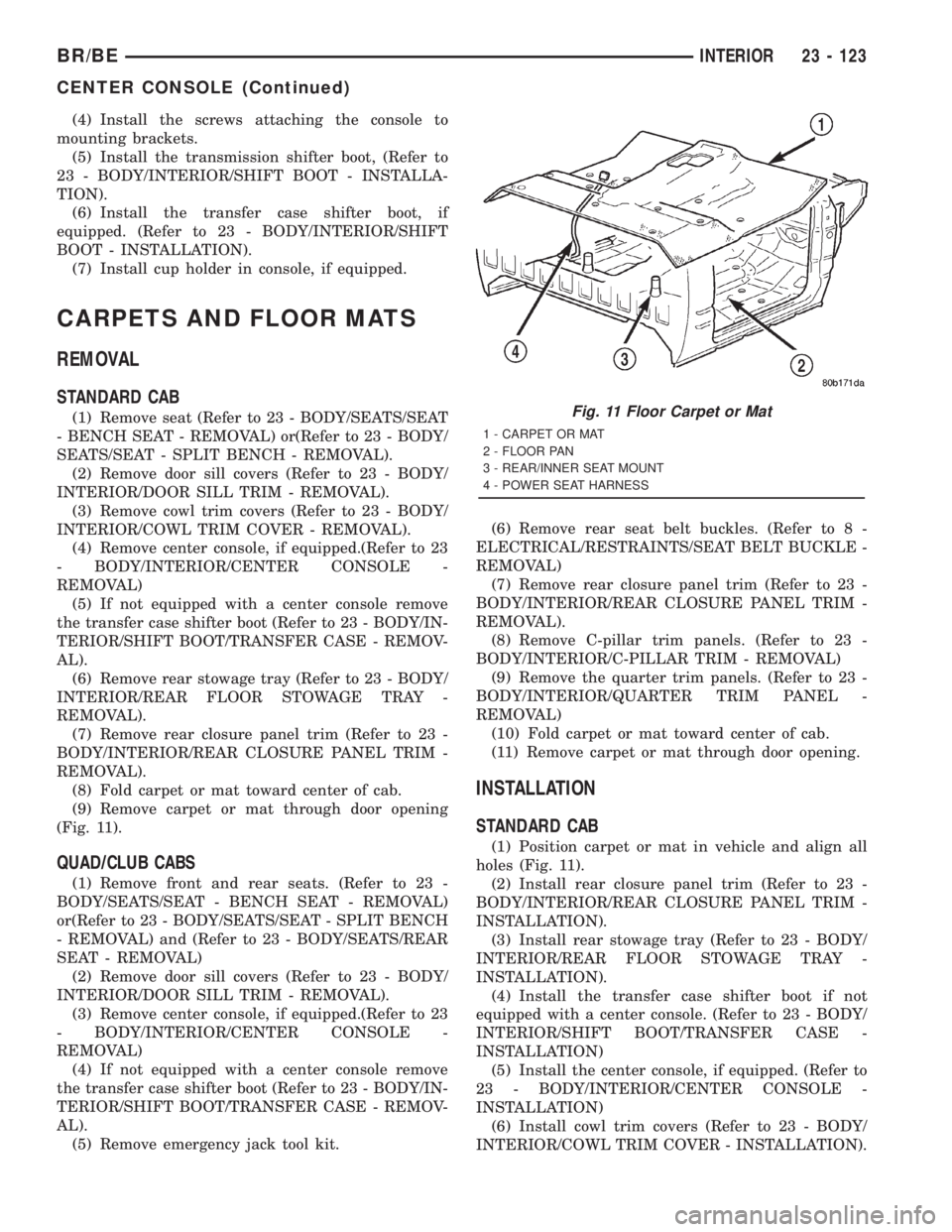
(9) Remove carpet or mat through door opening
(Fig. 11).
QUAD/CLUB CABS
(1) Remove front and rear seats. (Refer to 23 -
BODY/SEATS/SEAT - BENCH SEAT - REMOVAL)
or(Refer to 23 - BODY/SEATS/SEAT - SPLIT BENCH
- REMOVAL) and (Refer to 23 - BODY/SEATS/REAR
SEAT - REMOVAL)
(2) Remove door sill covers (Refer to 23 - BODY/
INTERIOR/DOOR SILL TRIM - REMOVAL).
(3) Remove center console, if equipped.(Refer to 23
- BODY/INTERIOR/CENTER CONSOLE -
REMOVAL)
(4) If not equipped with a center console remove
the transfer case shifter boot (Refer to 23 - BODY/IN-
TERIOR/SHIFT BOOT/TRANSFER CASE - REMOV-
AL).
(5) Remove emergency jack tool kit.(6) Remove rear seat belt buckles. (Refer to 8 -
ELECTRICAL/RESTRAINTS/SEAT BELT BUCKLE -
REMOVAL)
(7) Remove rear closure panel trim (Refer to 23 -
BODY/INTERIOR/REAR CLOSURE PANEL TRIM -
REMOVAL).
(8) Remove C-pillar trim panels. (Refer to 23 -
BODY/INTERIOR/C-PILLAR TRIM - REMOVAL)
(9) Remove the quarter trim panels. (Refer to 23 -
BODY/INTERIOR/QUARTER TRIM PANEL -
REMOVAL)
(10) Fold carpet or mat toward center of cab.
(11) Remove carpet or mat through door opening.
INSTALLATION
STANDARD CAB
(1) Position carpet or mat in vehicle and align all
holes (Fig. 11).
(2) Install rear closure panel trim (Refer to 23 -
BODY/INTERIOR/REAR CLOSURE PANEL TRIM -
INSTALLATION).
(3) Install rear stowage tray (Refer to 23 - BODY/
INTERIOR/REAR FLOOR STOWAGE TRAY -
INSTALLATION).
(4) Install the transfer case shifter boot if not
equipped with a center console. (Refer to 23 - BODY/
INTERIOR/SHIFT BOOT/TRANSFER CASE -
INSTALLATION)
(5) Install the center console, if equipped. (Refer to
23 - BODY/INTERIOR/CENTER CONSOLE -
INSTALLATION)
(6) Install cowl trim covers (Refer to 23 - BODY/
INTERIOR/COWL TRIM COVER - INSTALLATION).
Fig. 11 Floor Carpet or Mat
1 - CARPET OR MAT
2 - FLOOR PAN
3 - REAR/INNER SEAT MOUNT
4 - POWER SEAT HARNESS
BR/BEINTERIOR 23 - 123
CENTER CONSOLE (Continued)
Page 2699 of 2889
BODY VENT
REMOVAL
(1) Open door.
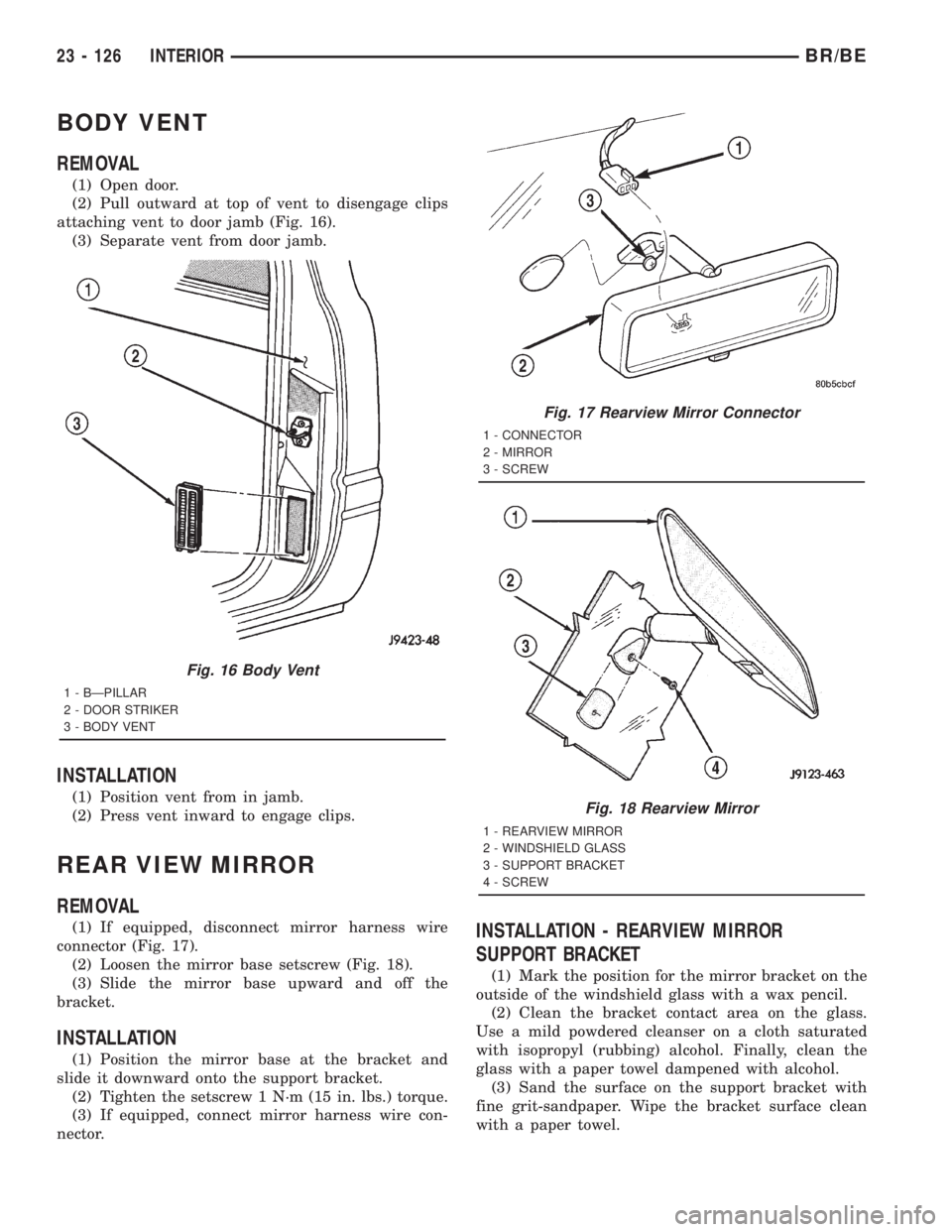
(2) Pull outward at top of vent to disengage clips
attaching vent to door jamb (Fig. 16).
(3) Separate vent from door jamb.
INSTALLATION
(1) Position vent from in jamb.
(2) Press vent inward to engage clips.
REAR VIEW MIRROR
REMOVAL
(1) If equipped, disconnect mirror harness wire
connector (Fig. 17).
(2) Loosen the mirror base setscrew (Fig. 18).
(3) Slide the mirror base upward and off the
bracket.
INSTALLATION
(1) Position the mirror base at the bracket and
slide it downward onto the support bracket.
(2) Tighten the setscrew 1 N´m (15 in. lbs.) torque.
(3) If equipped, connect mirror harness wire con-
nector.
INSTALLATION - REARVIEW MIRROR
SUPPORT BRACKET
(1) Mark the position for the mirror bracket on the
outside of the windshield glass with a wax pencil.
(2) Clean the bracket contact area on the glass.
Use a mild powdered cleanser on a cloth saturated
with isopropyl (rubbing) alcohol. Finally, clean the
glass with a paper towel dampened with alcohol.
(3) Sand the surface on the support bracket with
fine grit-sandpaper. Wipe the bracket surface clean
with a paper towel.
Fig. 16 Body Vent
1 - BÐPILLAR
2 - DOOR STRIKER
3 - BODY VENT
Fig. 17 Rearview Mirror Connector
1 - CONNECTOR
2 - MIRROR
3 - SCREW
Fig. 18 Rearview Mirror
1 - REARVIEW MIRROR
2 - WINDSHIELD GLASS
3 - SUPPORT BRACKET
4 - SCREW
23 - 126 INTERIORBR/BE
Page 2706 of 2889
LUMBAR SUPPORT
REMOVAL
(1) Remove the seat back cover. (Refer to 23 -
BODY/SEATS/SEAT BACK COVER - REMOVAL).
(2) Disengage the heated seat connectors.
(3) Partially separate the seat back foam to access
the lumbar frame clips.
(4) Separate the lumbar assembly from the seat
frame.
INSTALLATION
(1) Position the lumbar assembly on the seat back
frame.
(2) Engage the retaining clips on the seat frame.
(3) Route the lumbar wire harness through seat
assembly.
(4) Engage the heated seat wire connectors.
(5) Install the seat back cover. (Refer to 23 -
BODY/SEATS/SEAT BACK COVER - INSTALLA-
TION).
(6) Perform a function check on the seat opera-
tions.
SEAT - BENCH SEAT
REMOVAL
(1) Move seat track to forward position.
(2) Hinge seat backs forward.
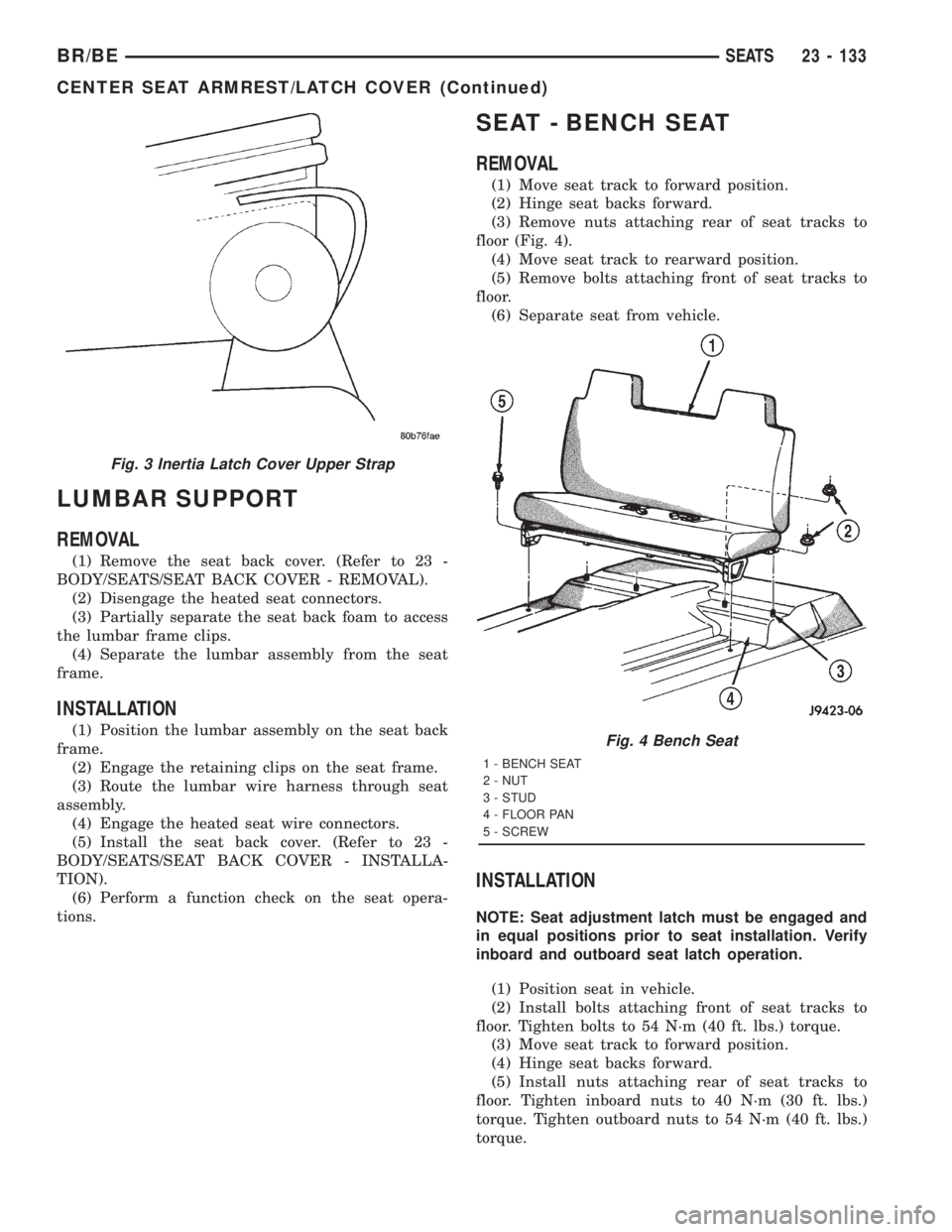
(3) Remove nuts attaching rear of seat tracks to
floor (Fig. 4).
(4) Move seat track to rearward position.
(5) Remove bolts attaching front of seat tracks to
floor.
(6) Separate seat from vehicle.
INSTALLATION
NOTE: Seat adjustment latch must be engaged and
in equal positions prior to seat installation. Verify
inboard and outboard seat latch operation.
(1) Position seat in vehicle.
(2) Install bolts attaching front of seat tracks to
floor. Tighten bolts to 54 N´m (40 ft. lbs.) torque.
(3) Move seat track to forward position.
(4) Hinge seat backs forward.
(5) Install nuts attaching rear of seat tracks to
floor. Tighten inboard nuts to 40 N´m (30 ft. lbs.)
torque. Tighten outboard nuts to 54 N´m (40 ft. lbs.)
torque.
Fig. 3 Inertia Latch Cover Upper Strap
Fig. 4 Bench Seat
1 - BENCH SEAT
2 - NUT
3 - STUD
4 - FLOOR PAN
5 - SCREW
BR/BESEATS 23 - 133
CENTER SEAT ARMREST/LATCH COVER (Continued)
Page 2707 of 2889
SEAT - SPLIT BENCH
REMOVAL
STANDARD CAB
(1) Move seat track to forward position.
(2) Hinge seat back forward.
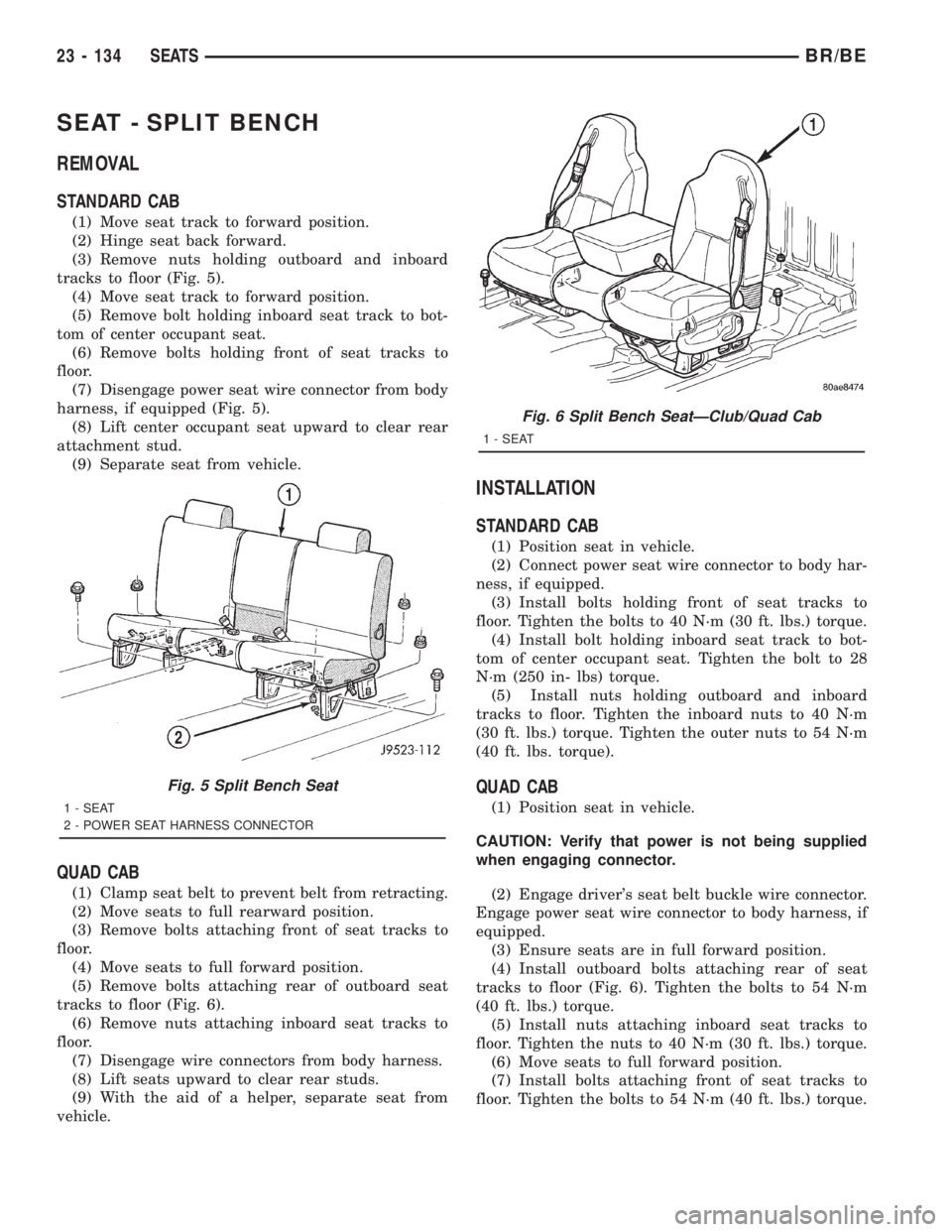
(3) Remove nuts holding outboard and inboard
tracks to floor (Fig. 5).
(4) Move seat track to forward position.
(5) Remove bolt holding inboard seat track to bot-
tom of center occupant seat.
(6) Remove bolts holding front of seat tracks to
floor.
(7) Disengage power seat wire connector from body
harness, if equipped (Fig. 5).
(8) Lift center occupant seat upward to clear rear
attachment stud.
(9) Separate seat from vehicle.
QUAD CAB
(1) Clamp seat belt to prevent belt from retracting.
(2) Move seats to full rearward position.
(3) Remove bolts attaching front of seat tracks to
floor.
(4) Move seats to full forward position.
(5) Remove bolts attaching rear of outboard seat
tracks to floor (Fig. 6).
(6) Remove nuts attaching inboard seat tracks to
floor.
(7) Disengage wire connectors from body harness.
(8) Lift seats upward to clear rear studs.
(9) With the aid of a helper, separate seat from
vehicle.
INSTALLATION
STANDARD CAB
(1) Position seat in vehicle.
(2) Connect power seat wire connector to body har-
ness, if equipped.
(3) Install bolts holding front of seat tracks to
floor. Tighten the bolts to 40 N´m (30 ft. lbs.) torque.
(4) Install bolt holding inboard seat track to bot-
tom of center occupant seat. Tighten the bolt to 28
N´m (250 in- lbs) torque.
(5) Install nuts holding outboard and inboard
tracks to floor. Tighten the inboard nuts to 40 N´m
(30 ft. lbs.) torque. Tighten the outer nuts to 54 N´m
(40 ft. lbs. torque).
QUAD CAB
(1) Position seat in vehicle.
CAUTION: Verify that power is not being supplied
when engaging connector.
(2) Engage driver's seat belt buckle wire connector.
Engage power seat wire connector to body harness, if
equipped.
(3) Ensure seats are in full forward position.
(4) Install outboard bolts attaching rear of seat
tracks to floor (Fig. 6). Tighten the bolts to 54 N´m
(40 ft. lbs.) torque.
(5) Install nuts attaching inboard seat tracks to
floor. Tighten the nuts to 40 N´m (30 ft. lbs.) torque.
(6) Move seats to full forward position.
(7) Install bolts attaching front of seat tracks to
floor. Tighten the bolts to 54 N´m (40 ft. lbs.) torque.
Fig. 5 Split Bench Seat
1 - SEAT
2 - POWER SEAT HARNESS CONNECTOR
Fig. 6 Split Bench SeatÐClub/Quad Cab
1 - SEAT
23 - 134 SEATSBR/BE
Page 2711 of 2889
(7) With seat back in a normal vertical position,
roll cover upwards and remove.
INSTALLATION
(1) With seat back in a normal vertical position,
roll cover downwards over seat back.
(2) Install hog rings, if equipped.
(3) Engage J-Straps at base of seat back.
(4) Align lumbar handle with lumbar cam and tap
on with rubber mallet until seated.
(5) Install latch release bezel.
(6) Install latch release knob.
(7) Install seat back. (Refer to 23 - BODY/SEATS/
SEAT BACK - SPLIT BENCH - INSTALLATION)
SEAT BACK RECLINER
REMOVAL
(1) Remove seat back. (Refer to 23 - BODY/SEATS/
SEAT BACK - SPLIT BENCH - REMOVAL)
(2) Disengage J-straps at base of seat back and
roll seat back cover upward to access rubber bellows
push-in fasteners.
NOTE: Notice the routing of the recliner cable for
installation.
(3) Remove the push-in fasteners attaching upper
rubber bellows to the seat back frame.
(4) Remove rubber bellows.
(5) Remove seat dump handle, 2±door ªBEº vehi-
cles only.
WARNING: Do not pull on upper recliner handle or
recliner cable end. The recliner lead screw is spring
loaded and will eject if either the handle or cable is
pulled before the lead screw is removed.
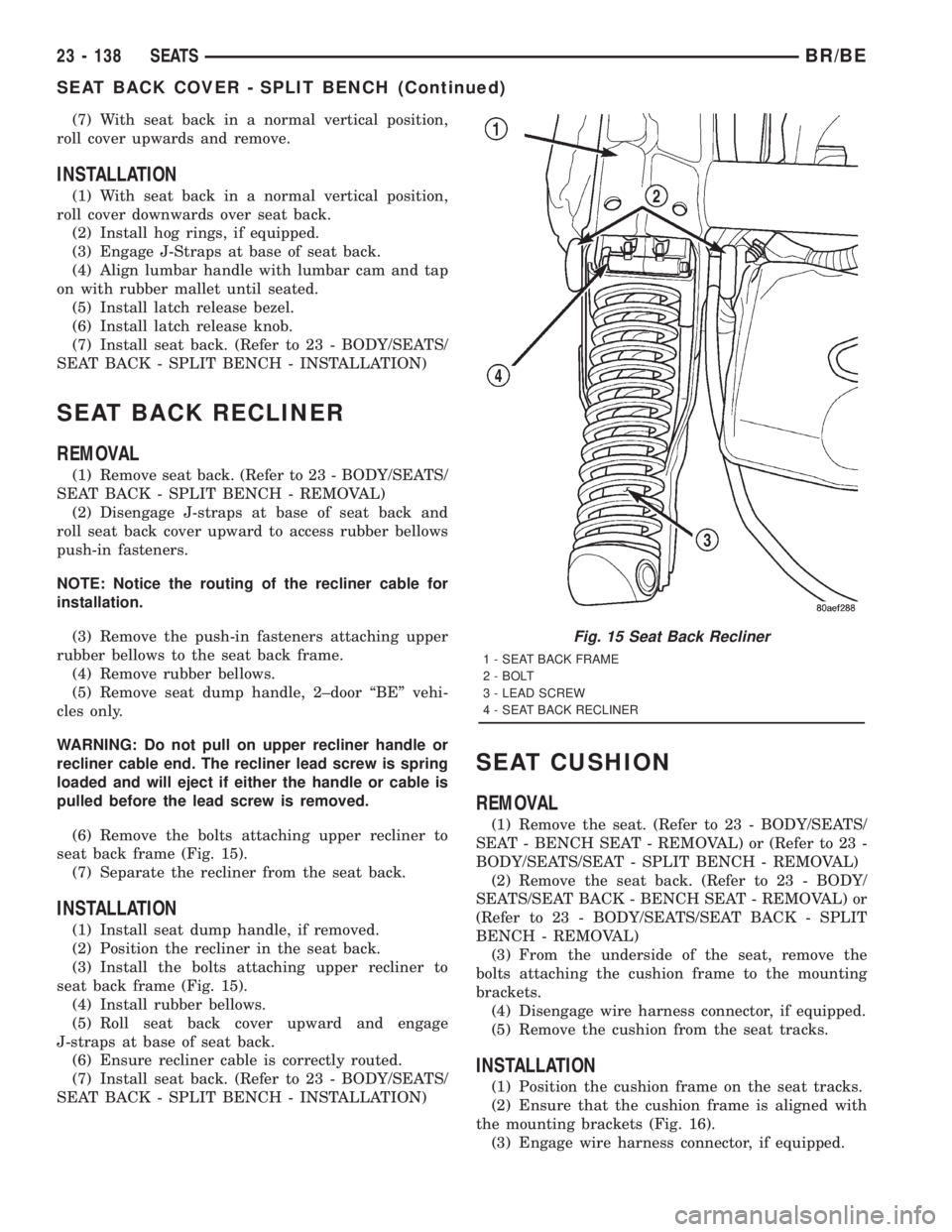
(6) Remove the bolts attaching upper recliner to
seat back frame (Fig. 15).
(7) Separate the recliner from the seat back.
INSTALLATION
(1) Install seat dump handle, if removed.
(2) Position the recliner in the seat back.
(3) Install the bolts attaching upper recliner to
seat back frame (Fig. 15).
(4) Install rubber bellows.
(5) Roll seat back cover upward and engage
J-straps at base of seat back.
(6) Ensure recliner cable is correctly routed.
(7) Install seat back. (Refer to 23 - BODY/SEATS/
SEAT BACK - SPLIT BENCH - INSTALLATION)
SEAT CUSHION
REMOVAL
(1) Remove the seat. (Refer to 23 - BODY/SEATS/
SEAT - BENCH SEAT - REMOVAL) or (Refer to 23 -
BODY/SEATS/SEAT - SPLIT BENCH - REMOVAL)
(2) Remove the seat back. (Refer to 23 - BODY/
SEATS/SEAT BACK - BENCH SEAT - REMOVAL) or
(Refer to 23 - BODY/SEATS/SEAT BACK - SPLIT
BENCH - REMOVAL)
(3) From the underside of the seat, remove the
bolts attaching the cushion frame to the mounting
brackets.
(4) Disengage wire harness connector, if equipped.
(5) Remove the cushion from the seat tracks.
INSTALLATION
(1) Position the cushion frame on the seat tracks.
(2) Ensure that the cushion frame is aligned with
the mounting brackets (Fig. 16).
(3) Engage wire harness connector, if equipped.
Fig. 15 Seat Back Recliner
1 - SEAT BACK FRAME
2 - BOLT
3 - LEAD SCREW
4 - SEAT BACK RECLINER
23 - 138 SEATSBR/BE
SEAT BACK COVER - SPLIT BENCH (Continued)
Page 2714 of 2889
(6) Install seat tracks. (Refer to 23 - BODY/
SEATS/SEAT TRACK - SPLIT BENCH - INSTALLA-
TION)
QUAD CAB
(1) Position the cover on the cushion.
(2) Engage the hog rings attaching the cushion
cover to the cushion frame.
(3) Engage the hook and loop fasteners.
(4) Engage the electrical connectors for the heated
seat grid, if equipped.
(5) Engage the J-straps attaching the cushion
cover to the cushion frame.
(6) Install seat cushion. (Refer to 23 - BODY/
SEATS/SEAT CUSHION - INSTALLATION)
SEAT RISER
REMOVAL
(1) Disconnect seat harness connector.
(2) Remove the seat from the vehicle. (Refer to 23 -
BODY/SEATS/SEAT - BENCH SEAT - REMOVAL) or
(Refer to 23 - BODY/SEATS/SEAT - SPLIT BENCH -
REMOVAL)
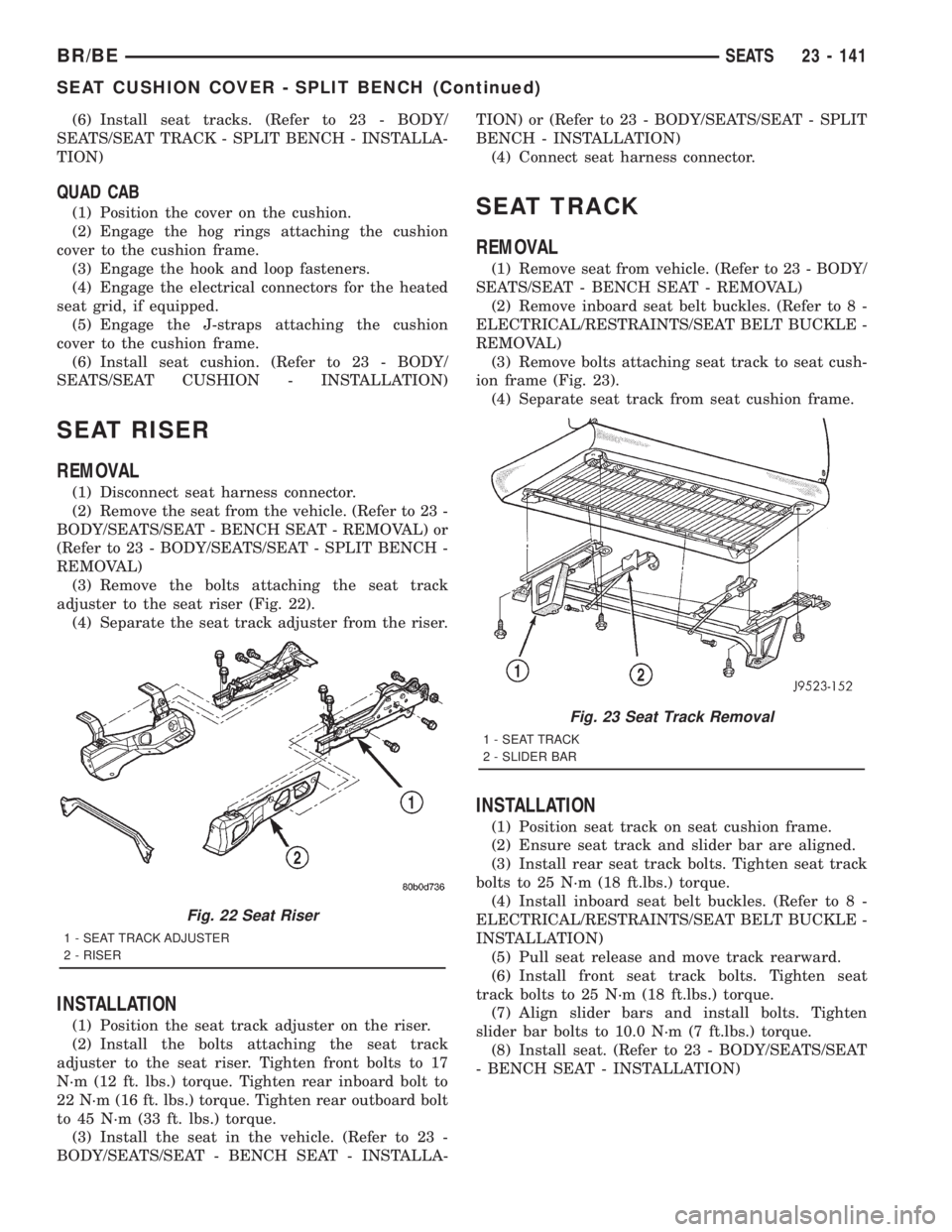
(3) Remove the bolts attaching the seat track
adjuster to the seat riser (Fig. 22).
(4) Separate the seat track adjuster from the riser.
INSTALLATION
(1) Position the seat track adjuster on the riser.
(2) Install the bolts attaching the seat track
adjuster to the seat riser. Tighten front bolts to 17
N´m (12 ft. lbs.) torque. Tighten rear inboard bolt to
22 N´m (16 ft. lbs.) torque. Tighten rear outboard bolt
to 45 N´m (33 ft. lbs.) torque.
(3) Install the seat in the vehicle. (Refer to 23 -
BODY/SEATS/SEAT - BENCH SEAT - INSTALLA-TION) or (Refer to 23 - BODY/SEATS/SEAT - SPLIT
BENCH - INSTALLATION)
(4) Connect seat harness connector.
SEAT TRACK
REMOVAL
(1) Remove seat from vehicle. (Refer to 23 - BODY/
SEATS/SEAT - BENCH SEAT - REMOVAL)
(2) Remove inboard seat belt buckles. (Refer to 8 -
ELECTRICAL/RESTRAINTS/SEAT BELT BUCKLE -
REMOVAL)
(3) Remove bolts attaching seat track to seat cush-
ion frame (Fig. 23).
(4) Separate seat track from seat cushion frame.
INSTALLATION
(1) Position seat track on seat cushion frame.
(2) Ensure seat track and slider bar are aligned.
(3) Install rear seat track bolts. Tighten seat track
bolts to 25 N´m (18 ft.lbs.) torque.
(4) Install inboard seat belt buckles. (Refer to 8 -
ELECTRICAL/RESTRAINTS/SEAT BELT BUCKLE -
INSTALLATION)
(5) Pull seat release and move track rearward.
(6) Install front seat track bolts. Tighten seat
track bolts to 25 N´m (18 ft.lbs.) torque.
(7) Align slider bars and install bolts. Tighten
slider bar bolts to 10.0 N´m (7 ft.lbs.) torque.
(8) Install seat. (Refer to 23 - BODY/SEATS/SEAT
- BENCH SEAT - INSTALLATION)
Fig. 22 Seat Riser
1 - SEAT TRACK ADJUSTER
2 - RISER
Fig. 23 Seat Track Removal
1 - SEAT TRACK
2 - SLIDER BAR
BR/BESEATS 23 - 141
SEAT CUSHION COVER - SPLIT BENCH (Continued)
Page 2731 of 2889
heated air. This air conditioning system uses a fixed ori-
fice tube in the middle of the liquid line to meter refrig-
erant flow to the evaporator coil. To maintain minimum
evaporator temperature and prevent evaporator freez-
ing, the a/c low pressure switch on the accumulator
cycles the compressor clutch.
OPERATION - REFRIGERANT SYSTEM SERVICE
PORT
The high pressure service port is located on the liq-
uid line between the condenser and the evaporator,
near the front of the engine compartment. The low
pressure service port is located on the suction line,
near the accumulator outlet.
Each of the service ports has a threaded plastic
protective cap installed over it from the factory. After
servicing the refrigerant system, always reinstall
both of the service port caps.
DIAGNOSIS AND TESTING - A/C
PERFORMANCE
The air conditioning system is designed to provide
the passenger compartment with low temperature
and low humidity air. The evaporator, located in the
HVAC housing on the dash panel below the instru-
ment panel, is cooled to temperatures near the freez-
ing point. As warm damp air passes through the
cooled evaporator, the air transfers its heat to the
refrigerant in the evaporator tubes and the moisture
in the air condenses on the evaporator fins. During
periods of high heat and humidity, an air condition-
ing system will be more effective in the recirculation
mode (Max-A/C). With the system in the recirculation
mode, only air from the passenger compartment
passes through the evaporator. As the passenger com-
partment air dehumidifies, the air conditioning sys-
tem performance levels improve.
Humidity has an important bearing on the temper-
ature of the air delivered to the interior of the vehi-
cle. It is important to understand the effect that
humidity has on the performance of the air condition-
ing system. When humidity is high, the evaporator
has to perform a double duty. It must lower the air
temperature, and it must lower the temperature of
the moisture in the air that condenses on the evapo-
rator fins. Condensing the moisture in the air trans-
fers heat energy into the evaporator fins and tubing.
This reduces the amount of heat the evaporator can
absorb from the air. High humidity greatly reduces
the ability of the evaporator to lower the temperature
of the air.
However, evaporator capacity used to reduce the
amount of moisture in the air is not wasted. Wring-
ing some of the moisture out of the air entering the
vehicle adds to the comfort of the passengers.
Although, an owner may expect too much from theirair conditioning system on humid days. A perfor-
mance test is the best way to determine whether the
system is performing up to standard. This test also
provides valuable clues as to the possible cause of
trouble with the air conditioning system.
Before proceeding, (Refer to 24 - HEATING & AIR
CONDITIONING/PLUMBING - WARNING) and
(Refer to 24 - HEATING & AIR CONDITIONING/
PLUMBING - CAUTION). The air temperature in
the test room and in the vehicle must be a minimum
of 21É C (70É F) for this test.
(1)
Connect a tachometer and a manifold gauge set.
(2) Set the a/c heater mode control switch knob to
the recirculation mode (Max-A/C) position, the tem-
perature control knob to the full cool position, and
the blower motor switch to the highest speed posi-
tion.
(3) Start the engine and hold the idle speed at
1,000 rpm with the compressor clutch engaged. If the
compressor clutch does not engage, (Refer to 24 -
HEATING & AIR CONDITIONING/CONTROLS/A/C
COMPRESSOR CLUTCH COIL - DIAGNOSIS AND
TESTING).
(4) The engine should be at operating temperature.
The doors and windows must be closed and the hood
must be mostly closed.
(5)
Insert a thermometer in the driver side center
A/C (panel) outlet. Operate the engine for five minutes.
(6) The compressor clutch may cycle, depending
upon the ambient temperature and humidity. If the
clutch cycles, unplug the a/c low pressure switch wire
harness connector from the switch located on the
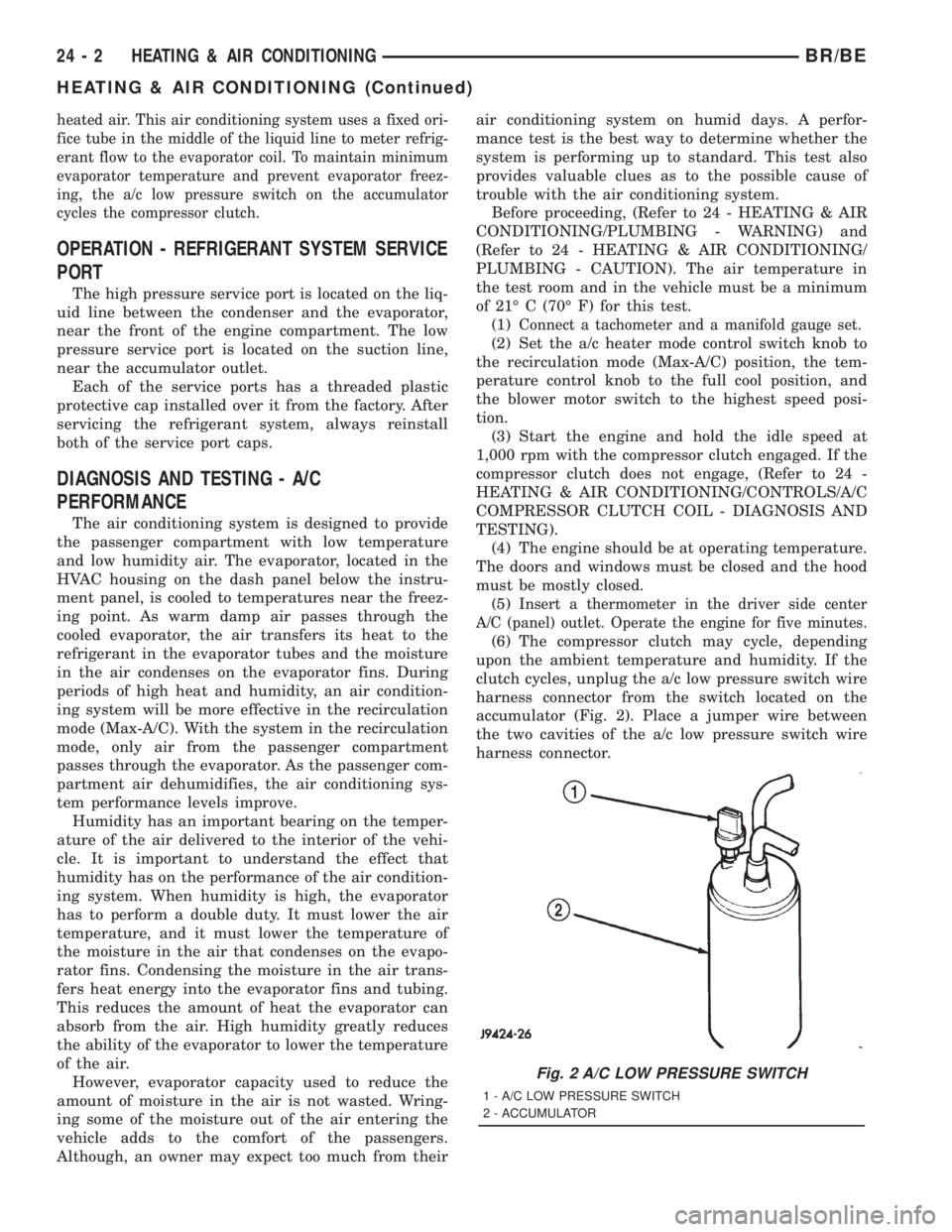
accumulator (Fig. 2). Place a jumper wire between
the two cavities of the a/c low pressure switch wire
harness connector.
Fig. 2 A/C LOW PRESSURE SWITCH
1 - A/C LOW PRESSURE SWITCH
2 - ACCUMULATOR
24 - 2 HEATING & AIR CONDITIONINGBR/BE
HEATING & AIR CONDITIONING (Continued)
Page 2736 of 2889
Heater Diagnosis
CONDITION POSSIBLE CAUSE CORRECTION
INSUFFICIENT HEATER
OUTPUT.1. Incorrect engine
coolant level.1. Check the engine coolant level. Refer to Cooling for
the procedures.
2. Air trapped in engine
cooling system.2. Check the operation of the coolant reserve/recovery
system. Refer to Cooling for the procedures.
3. Incorrect engine
coolant temperature.3. Check the performance and operation of the engine
cooling system including: thermostat, water pump, fan
drive, accessory drive belt, coolant flow (plugged radiator
or heater core, plugged or kinked coolant hoses), air flow
(missing or improperly installed radiator air seals or fan
shroud). Refer to Cooling for the procedures.
4. Blend door actuator
inoperative or defective.4. (Refer to Controls/Blend Door Actuator) in this group.
5. Blend door not
operating properly.5. Check for a damaged, obstructed or improperly
installed blend door or seals. (Refer to Controls/Blend
Door Actuator) in this group.
6. Insufficient air flow
through heater housing.6. Remove foreign material or obstructions from cowl air
intake.
7. Improper blower motor
operation.7. (Refer to Distribution/Blower Motor/ Diagnosis and
Testing) in this group.
STANDARD PROCEDURE - DIODE
REPLACEMENT
(1) Disconnect the battery.
(2) Locate the diode in the harness, and remove
the protective covering.
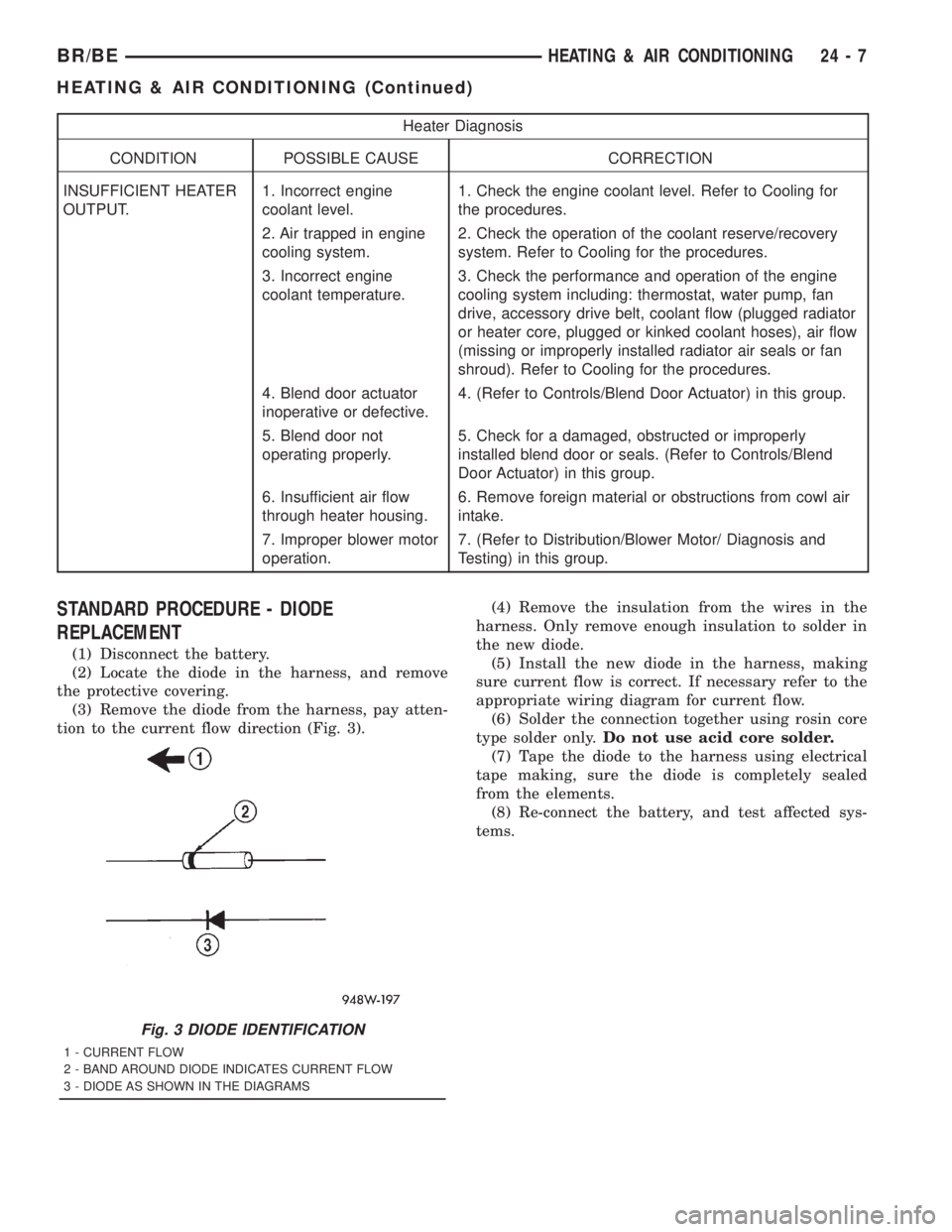
(3) Remove the diode from the harness, pay atten-
tion to the current flow direction (Fig. 3).(4) Remove the insulation from the wires in the
harness. Only remove enough insulation to solder in
the new diode.
(5) Install the new diode in the harness, making
sure current flow is correct. If necessary refer to the
appropriate wiring diagram for current flow.
(6) Solder the connection together using rosin core
type solder only.Do not use acid core solder.
(7) Tape the diode to the harness using electrical
tape making, sure the diode is completely sealed
from the elements.
(8) Re-connect the battery, and test affected sys-
tems.
Fig. 3 DIODE IDENTIFICATION
1 - CURRENT FLOW
2 - BAND AROUND DIODE INDICATES CURRENT FLOW
3 - DIODE AS SHOWN IN THE DIAGRAMS
BR/BEHEATING & AIR CONDITIONING 24 - 7
HEATING & AIR CONDITIONING (Continued)