ECU DODGE RAM 2001 Service Repair Manual
[x] Cancel search | Manufacturer: DODGE, Model Year: 2001, Model line: RAM, Model: DODGE RAM 2001Pages: 2889, PDF Size: 68.07 MB
Page 2535 of 2889
INPUT AND PLANETARY GEAR
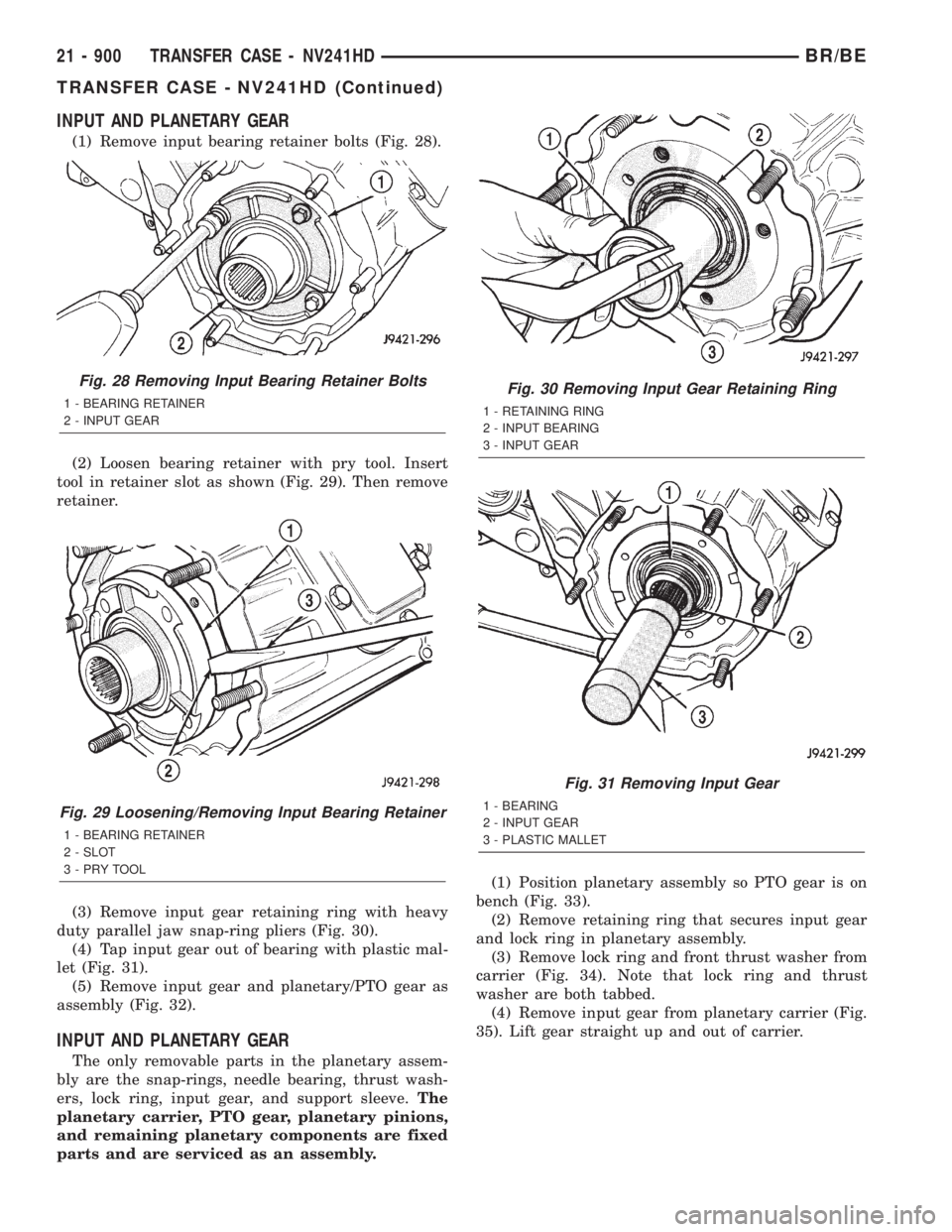
(1) Remove input bearing retainer bolts (Fig. 28).
(2) Loosen bearing retainer with pry tool. Insert
tool in retainer slot as shown (Fig. 29). Then remove
retainer.
(3) Remove input gear retaining ring with heavy
duty parallel jaw snap-ring pliers (Fig. 30).
(4) Tap input gear out of bearing with plastic mal-
let (Fig. 31).
(5) Remove input gear and planetary/PTO gear as
assembly (Fig. 32).
INPUT AND PLANETARY GEAR
The only removable parts in the planetary assem-
bly are the snap-rings, needle bearing, thrust wash-
ers, lock ring, input gear, and support sleeve.The
planetary carrier, PTO gear, planetary pinions,
and remaining planetary components are fixed
parts and are serviced as an assembly.(1) Position planetary assembly so PTO gear is on
bench (Fig. 33).
(2) Remove retaining ring that secures input gear
and lock ring in planetary assembly.
(3) Remove lock ring and front thrust washer from
carrier (Fig. 34). Note that lock ring and thrust
washer are both tabbed.
(4) Remove input gear from planetary carrier (Fig.
35). Lift gear straight up and out of carrier.
Fig. 28 Removing Input Bearing Retainer Bolts
1 - BEARING RETAINER
2 - INPUT GEAR
Fig. 29 Loosening/Removing Input Bearing Retainer
1 - BEARING RETAINER
2 - SLOT
3-PRYTOOL
Fig. 30 Removing Input Gear Retaining Ring
1 - RETAINING RING
2 - INPUT BEARING
3 - INPUT GEAR
Fig. 31 Removing Input Gear
1 - BEARING
2 - INPUT GEAR
3 - PLASTIC MALLET
21 - 900 TRANSFER CASE - NV241HDBR/BE
TRANSFER CASE - NV241HD (Continued)
Page 2538 of 2889
Check a replacement synchronizer ring for proper fit
on the cone with a minimum of wobble. Also check
the synchronizer struts for wear or damage.
Inspect all gear teeth and splines for wear or dam-
age. Also check splines for burrs, or nicks. Remove
minor nicks and scratches with an oil stone. Replace
any part with damaged splines.
It is recommended that all retaining rings be replaced
during overhaul. Most of the retaining rings can be dis-
torted during removal and should not be reused.
Inspect the two case halves, for cracks, porosity,
damaged mating surfaces, stripped bolt threads, or
distortion. Replace either case half if necessary. How-
ever, stripped threads can be repaired with Heli-
CoilŸ stainless steel thread inserts. The case vent
tube can be resecured with LoctiteŸ 680 if necessary.
Inspect the annulus gear. Be sure the gear teeth
are in good condition. Replace the front case and
annulus as an assembly if the gear is damaged.
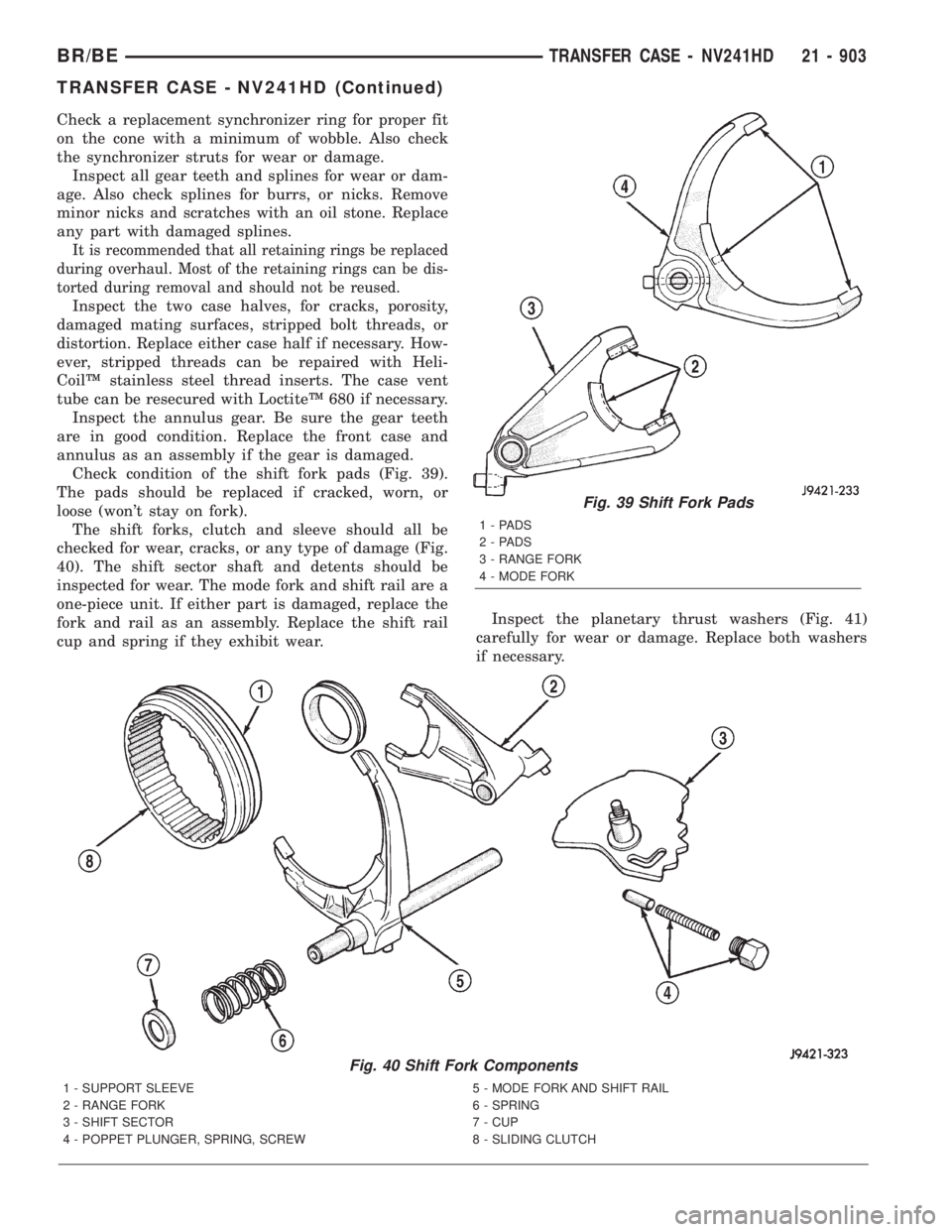
Check condition of the shift fork pads (Fig. 39).
The pads should be replaced if cracked, worn, or
loose (won't stay on fork).
The shift forks, clutch and sleeve should all be
checked for wear, cracks, or any type of damage (Fig.
40). The shift sector shaft and detents should be
inspected for wear. The mode fork and shift rail are a
one-piece unit. If either part is damaged, replace the
fork and rail as an assembly. Replace the shift rail
cup and spring if they exhibit wear.Inspect the planetary thrust washers (Fig. 41)
carefully for wear or damage. Replace both washers
if necessary.
Fig. 39 Shift Fork Pads
1-PADS
2-PADS
3 - RANGE FORK
4 - MODE FORK
Fig. 40 Shift Fork Components
1 - SUPPORT SLEEVE 5 - MODE FORK AND SHIFT RAIL
2 - RANGE FORK 6 - SPRING
3 - SHIFT SECTOR 7 - CUP
4 - POPPET PLUNGER, SPRING, SCREW 8 - SLIDING CLUTCH
BR/BETRANSFER CASE - NV241HD 21 - 903
TRANSFER CASE - NV241HD (Continued)
Page 2546 of 2889
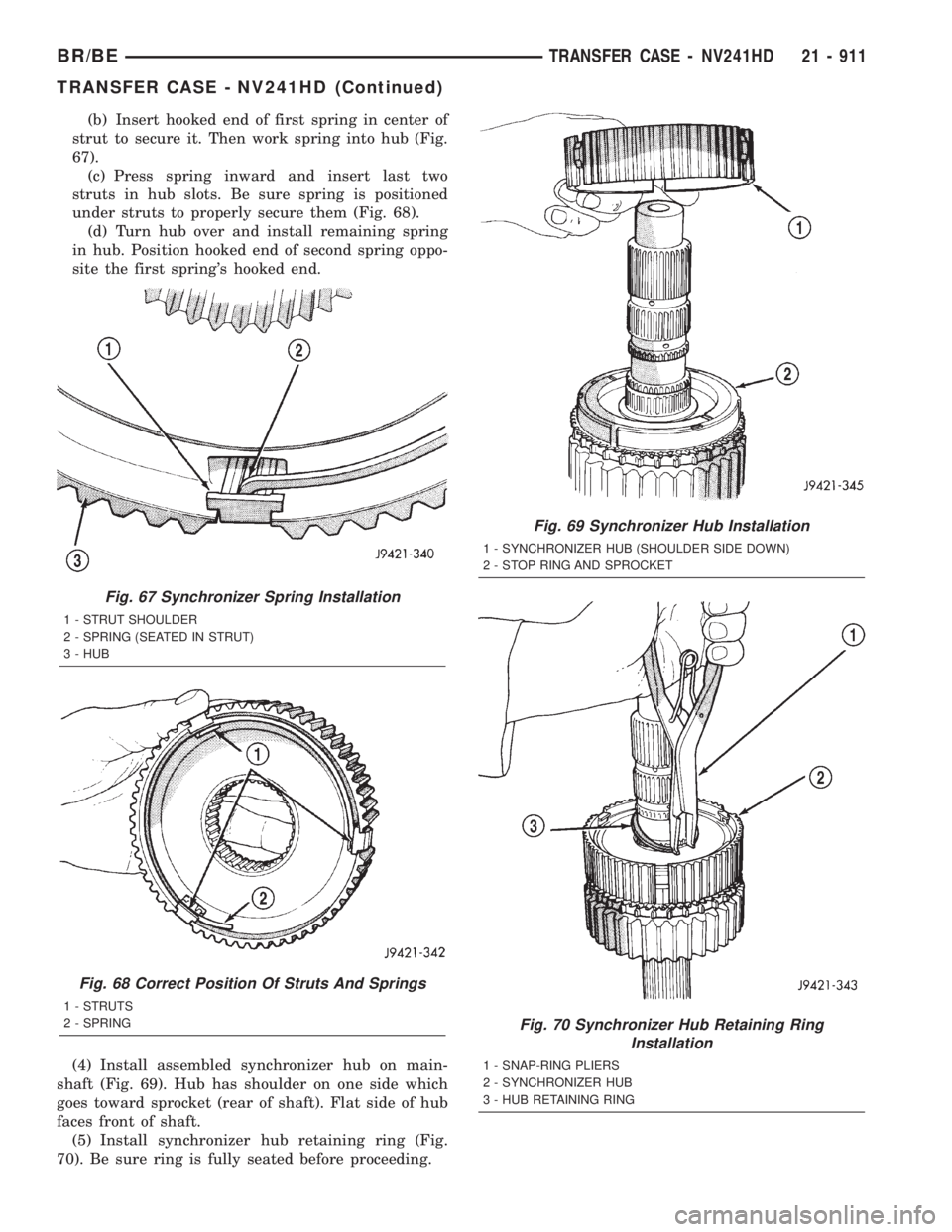
(b) Insert hooked end of first spring in center of
strut to secure it. Then work spring into hub (Fig.
67).
(c) Press spring inward and insert last two
struts in hub slots. Be sure spring is positioned
under struts to properly secure them (Fig. 68).
(d) Turn hub over and install remaining spring
in hub. Position hooked end of second spring oppo-
site the first spring's hooked end.
(4) Install assembled synchronizer hub on main-
shaft (Fig. 69). Hub has shoulder on one side which
goes toward sprocket (rear of shaft). Flat side of hub
faces front of shaft.
(5) Install synchronizer hub retaining ring (Fig.
70). Be sure ring is fully seated before proceeding.
Fig. 67 Synchronizer Spring Installation
1 - STRUT SHOULDER
2 - SPRING (SEATED IN STRUT)
3 - HUB
Fig. 68 Correct Position Of Struts And Springs
1 - STRUTS
2 - SPRING
Fig. 69 Synchronizer Hub Installation
1 - SYNCHRONIZER HUB (SHOULDER SIDE DOWN)
2 - STOP RING AND SPROCKET
Fig. 70 Synchronizer Hub Retaining Ring
Installation
1 - SNAP-RING PLIERS
2 - SYNCHRONIZER HUB
3 - HUB RETAINING RING
BR/BETRANSFER CASE - NV241HD 21 - 911
TRANSFER CASE - NV241HD (Continued)
Page 2549 of 2889
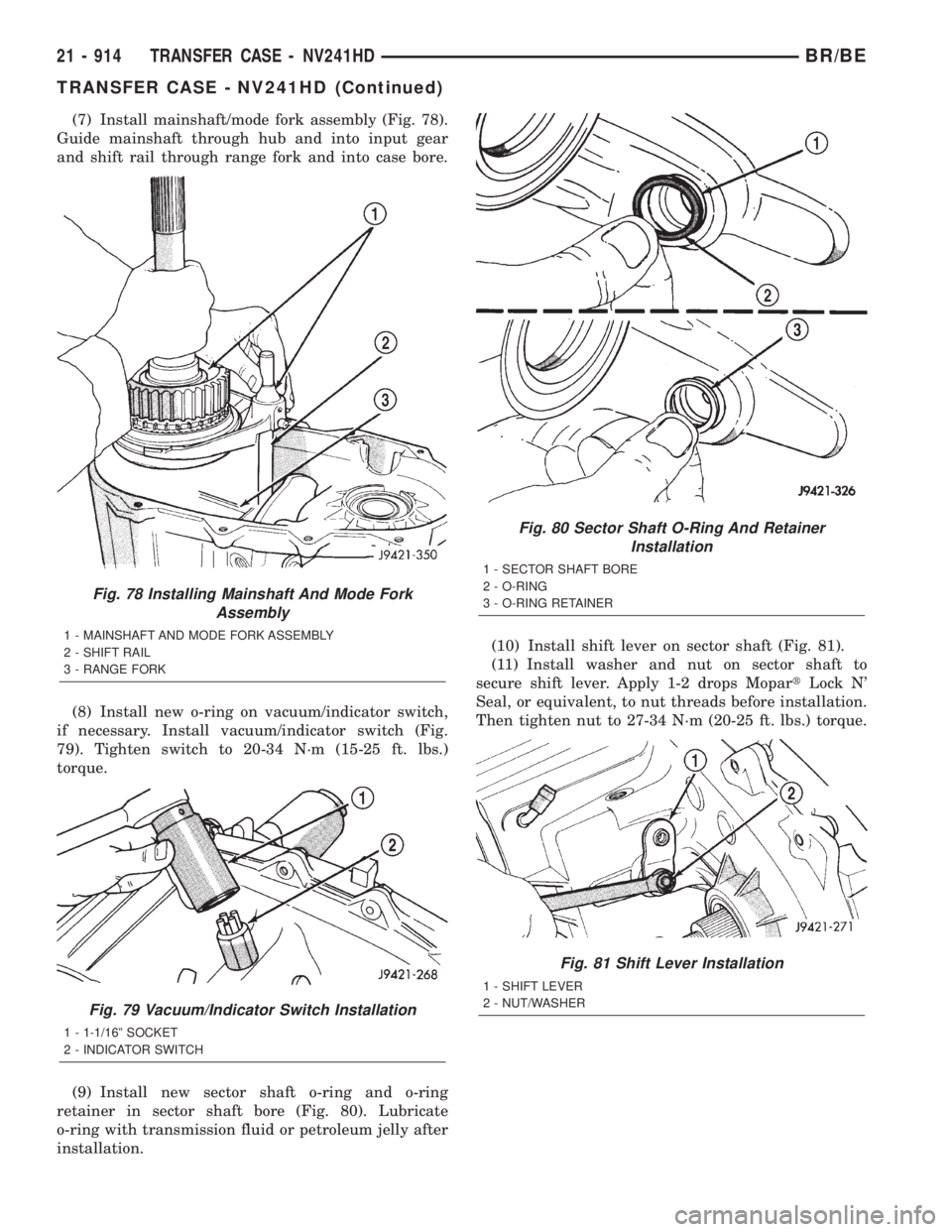
(7) Install mainshaft/mode fork assembly (Fig. 78).
Guide mainshaft through hub and into input gear
and shift rail through range fork and into case bore.
(8) Install new o-ring on vacuum/indicator switch,
if necessary. Install vacuum/indicator switch (Fig.
79). Tighten switch to 20-34 N´m (15-25 ft. lbs.)
torque.
(9) Install new sector shaft o-ring and o-ring
retainer in sector shaft bore (Fig. 80). Lubricate
o-ring with transmission fluid or petroleum jelly after
installation.(10) Install shift lever on sector shaft (Fig. 81).
(11) Install washer and nut on sector shaft to
secure shift lever. Apply 1-2 drops MopartLock N'
Seal, or equivalent, to nut threads before installation.
Then tighten nut to 27-34 N´m (20-25 ft. lbs.) torque.
Fig. 78 Installing Mainshaft And Mode Fork
Assembly
1 - MAINSHAFT AND MODE FORK ASSEMBLY
2 - SHIFT RAIL
3 - RANGE FORK
Fig. 79 Vacuum/Indicator Switch Installation
1 - 1-1/16º SOCKET
2 - INDICATOR SWITCH
Fig. 80 Sector Shaft O-Ring And Retainer
Installation
1 - SECTOR SHAFT BORE
2 - O-RING
3 - O-RING RETAINER
Fig. 81 Shift Lever Installation
1 - SHIFT LEVER
2 - NUT/WASHER
21 - 914 TRANSFER CASE - NV241HDBR/BE
TRANSFER CASE - NV241HD (Continued)
Page 2551 of 2889
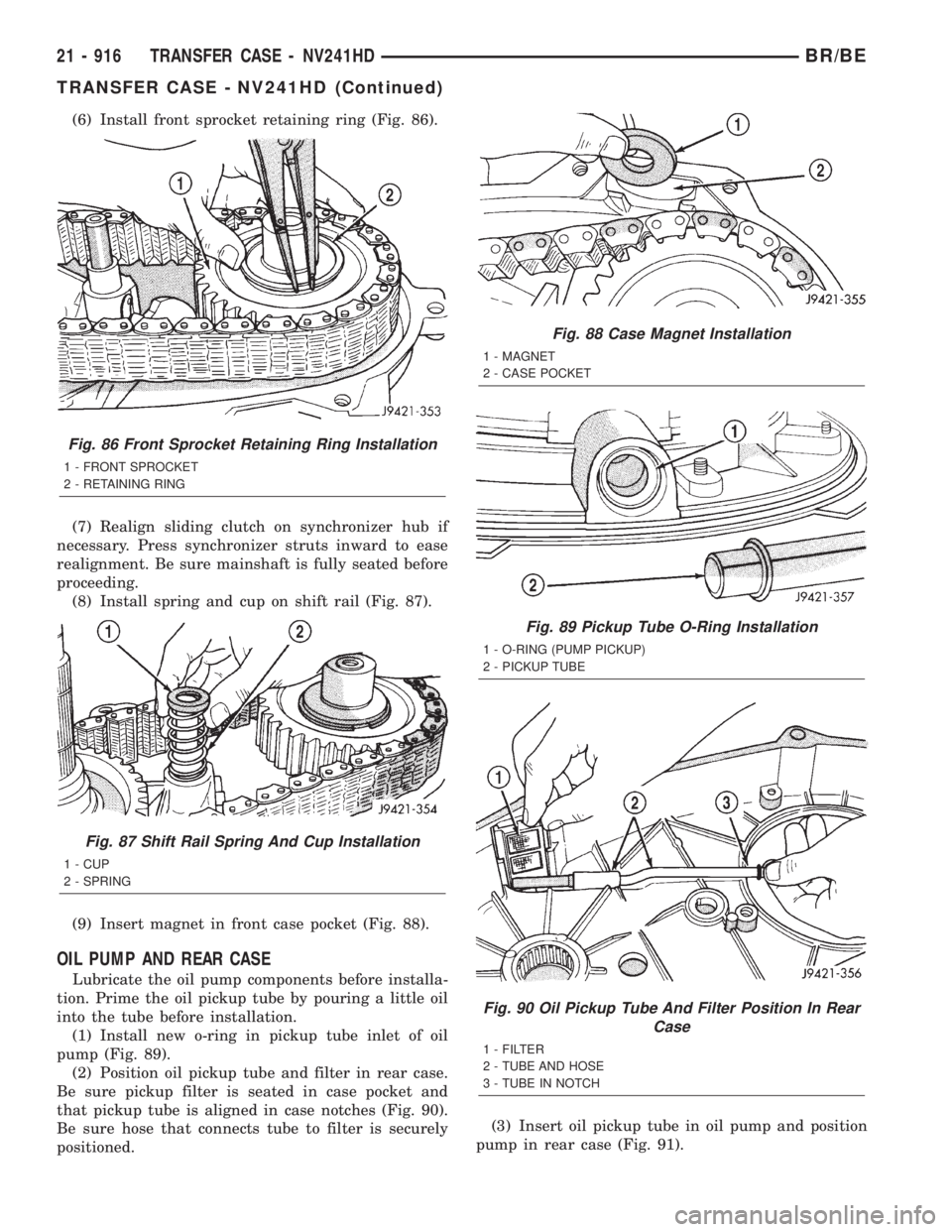
(6) Install front sprocket retaining ring (Fig. 86).
(7) Realign sliding clutch on synchronizer hub if
necessary. Press synchronizer struts inward to ease
realignment. Be sure mainshaft is fully seated before
proceeding.
(8) Install spring and cup on shift rail (Fig. 87).
(9) Insert magnet in front case pocket (Fig. 88).
OIL PUMP AND REAR CASE
Lubricate the oil pump components before installa-
tion. Prime the oil pickup tube by pouring a little oil
into the tube before installation.
(1) Install new o-ring in pickup tube inlet of oil
pump (Fig. 89).
(2) Position oil pickup tube and filter in rear case.
Be sure pickup filter is seated in case pocket and
that pickup tube is aligned in case notches (Fig. 90).
Be sure hose that connects tube to filter is securely
positioned.(3) Insert oil pickup tube in oil pump and position
pump in rear case (Fig. 91).
Fig. 86 Front Sprocket Retaining Ring Installation
1 - FRONT SPROCKET
2 - RETAINING RING
Fig. 87 Shift Rail Spring And Cup Installation
1 - CUP
2 - SPRING
Fig. 88 Case Magnet Installation
1 - MAGNET
2 - CASE POCKET
Fig. 89 Pickup Tube O-Ring Installation
1 - O-RING (PUMP PICKUP)
2 - PICKUP TUBE
Fig. 90 Oil Pickup Tube And Filter Position In Rear
Case
1 - FILTER
2 - TUBE AND HOSE
3 - TUBE IN NOTCH
21 - 916 TRANSFER CASE - NV241HDBR/BE
TRANSFER CASE - NV241HD (Continued)
Page 2559 of 2889
SHIFT LEVER
REMOVAL
(1) Shift transfer case into 2H.
(2) Remove transfer case shifter knob cap.
(3) Remove nut holding shifter knob to shift lever.
(4) Remove shifter knob.
(5) Remove the shift boot from the shifter bezel.
(6) Remove the bolts securing the shifter mecha-
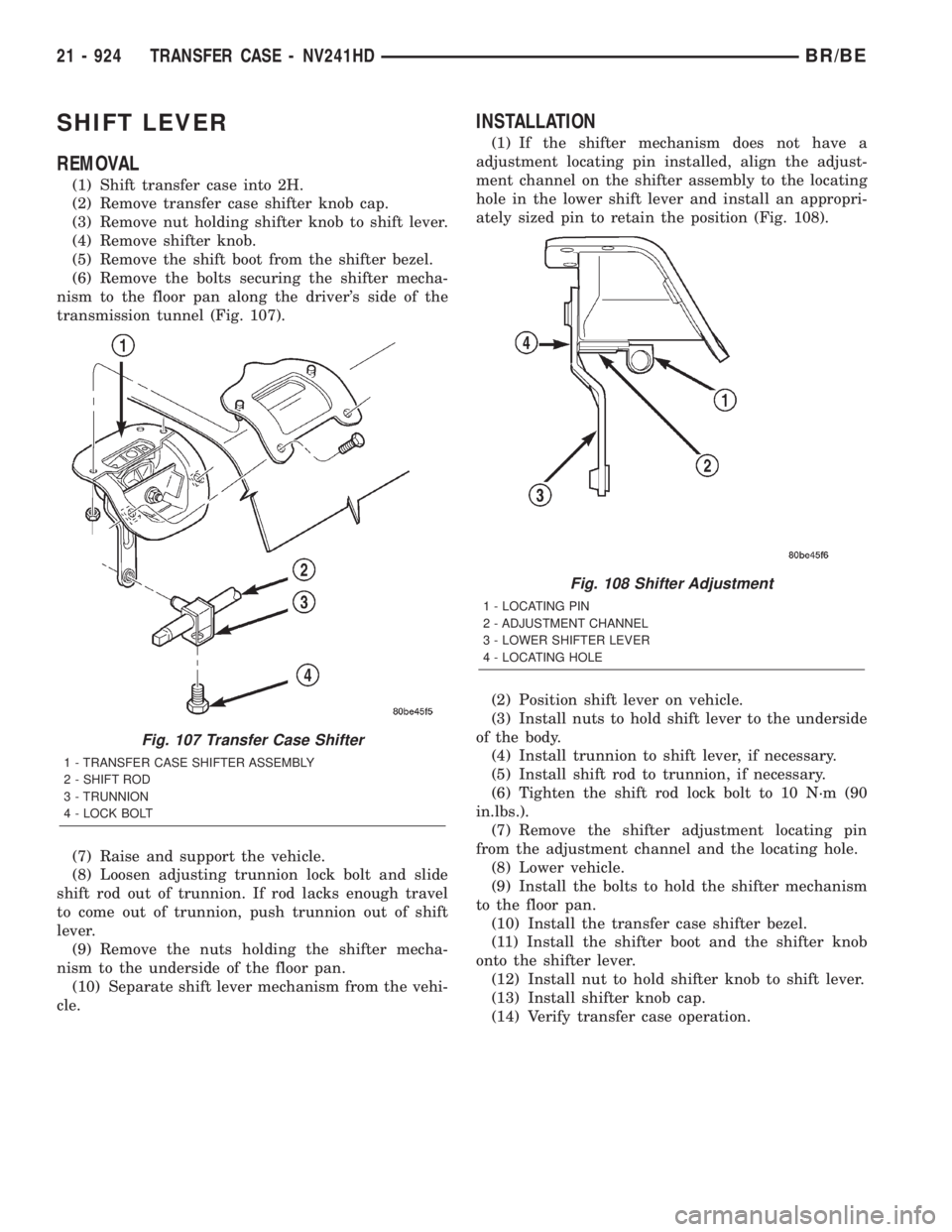
nism to the floor pan along the driver's side of the
transmission tunnel (Fig. 107).
(7) Raise and support the vehicle.
(8) Loosen adjusting trunnion lock bolt and slide
shift rod out of trunnion. If rod lacks enough travel
to come out of trunnion, push trunnion out of shift
lever.
(9) Remove the nuts holding the shifter mecha-
nism to the underside of the floor pan.
(10) Separate shift lever mechanism from the vehi-
cle.
INSTALLATION
(1) If the shifter mechanism does not have a
adjustment locating pin installed, align the adjust-
ment channel on the shifter assembly to the locating
hole in the lower shift lever and install an appropri-
ately sized pin to retain the position (Fig. 108).
(2) Position shift lever on vehicle.
(3) Install nuts to hold shift lever to the underside
of the body.
(4) Install trunnion to shift lever, if necessary.
(5) Install shift rod to trunnion, if necessary.
(6) Tighten the shift rod lock bolt to 10 N´m (90
in.lbs.).
(7) Remove the shifter adjustment locating pin
from the adjustment channel and the locating hole.
(8) Lower vehicle.
(9) Install the bolts to hold the shifter mechanism
to the floor pan.
(10) Install the transfer case shifter bezel.
(11) Install the shifter boot and the shifter knob
onto the shifter lever.
(12) Install nut to hold shifter knob to shift lever.
(13) Install shifter knob cap.
(14) Verify transfer case operation.
Fig. 107 Transfer Case Shifter
1 - TRANSFER CASE SHIFTER ASSEMBLY
2 - SHIFT ROD
3 - TRUNNION
4 - LOCK BOLT
Fig. 108 Shifter Adjustment
1 - LOCATING PIN
2 - ADJUSTMENT CHANNEL
3 - LOWER SHIFTER LEVER
4 - LOCATING HOLE
21 - 924 TRANSFER CASE - NV241HDBR/BE
Page 2574 of 2889
BODY
TABLE OF CONTENTS
page page
BODY
DESCRIPTION............................1
WARNING...............................1
DIAGNOSIS AND TESTING..................2
WATER LEAKS..........................2
WIND NOISE...........................3
SPECIFICATIONS.........................4
DECKLID/HATCH/LIFTGATE/TAILGATE........62
DOOR - FRONT..........................67DOOR - CARGO.........................77
EXTERIOR..............................86
HOOD.................................99
INSTRUMENT PANEL SYSTEM.............104
INTERIOR.............................118
PAINT................................129
SEATS................................131
STATIONARY GLASS.....................145
WEATHERSTRIP/SEALS..................152
BODY
DESCRIPTION ± PUSH-IN FASTENERS
DaimlerChrysler Corporation uses many different
types of push-in fasteners to secure the interior and
exterior trim to the body. Most of these fasteners can
be reused to assemble the trim during various repair
procedures. At times, a push-in fastener cannot be
removed without damaging the fastener or the com-
ponent it is holding. If it is not possible to remove a
fastener without damaging a component or body, cut
or break the fastener and use a new one when
installing the component. Never pry or pound on a
plastic or pressed-board trim component. Using a
suitable fork-type prying device, pry the fastener
from the retaining hole behind the component being
removed. When installing, verify fastener alignment
with the retaining hole by hand. Push directly on or
over the fastener until it seats. Apply a low-force pull
to the panel to verify that it is secure.
When it is necessary to remove components to ser-
vice another, it should not be necessary to apply
excessive force or bend a component to remove it.
Before damaging a trim component, verify hidden
fasteners or captured edges holding the component in
place.
DESCRIPTION ± LOCK CYLINDERS
Ignition, door, deck lid, and rear hatch lock cylin-
ders are all codable to the key. Lock barrels, tum-
blers, and tumbler springs are available to allow the
technician to change replacement locks cylinders to
match the customer's original key set. See the appro-
priate section in this manual for lock cylinder
removal. See the Moparž catalogue for part numbers
and lock coding procedures.
SAFETY PRECAUTIONS AND WARNINGS
WARNING: USE A OSHA APPROVED BREATHING
FILTER WHEN SPRAYING PAINT OR SOLVENTS IN
A CONFINED AREA. PERSONAL INJURY CAN
RESULT.
AVOID PROLONGED SKIN CONTACT WITH PETRO-
LEUM OR ALCOHOL ± BASED CLEANING SOL-
VENTS. PERSONAL INJURY CAN RESULT.
DO NOT STAND UNDER A HOISTED VEHICLE THAT
IS NOT PROPERLY SUPPORTED ON SAFETY
STANDS. PERSONAL INJURY CAN RESULT.
CAUTION: When holes must be drilled or punched
in an inner body panel, verify depth of space to the
outer body panel, electrical wiring, or other compo-
nents. Damage to vehicle can result.
Do not weld exterior panels unless combustible
material on the interior of vehicle is removed from
the repair area. Fire or hazardous conditions, can
result.
Always have a fire extinguisher ready for use when
welding.
Disconnect the negative (-) cable clamp from the
battery when servicing electrical components that
are live when the ignition is OFF. Damage to electri-
cal system can result.
Do not use abrasive chemicals or compounds on
painted surfaces. Damage to finish can result.
Do not use harsh alkaline based cleaning solvents
on painted or upholstered surfaces. Damage to fin-
ish or color can result.
Do not hammer or pound on plastic trim panel
when servicing interior trim. Plastic panels can
break.
BR/BEBODY 23 - 1
Page 2636 of 2889
INSTALLATION
(1) Position check cable on tailgate.
(2) Install screw attaching small end of cable to
tailgate.
(3) Position large end of cable onto stud head and
slide downward to secure lock tab.
DECALS
REMOVAL
(1) Warm the panel to approximately 38ÉC (100ÉF)
using a suitable heat lamp or heat gun.
(2) Peel tape stripe from body panel using an even
pressure pull.
(3) Remove adhesive residue from body panel
using a suitable adhesive removing solvent.
INSTALLATION
(1) Clean painted body surface with Moparž Super
Clean solvent or equivalent and a lint free cloth.
(2) Remove protective cover from back side of
decal.
(3) Position decal properly on body.
(4) Press decal firmly to body with palm of hand.
(5) If temperature is below 21ÉC (70ÉF) warm decal
with a heat lamp or gun to assure adhesion. Do not
exceed 65ÉC (150ÉF) when heating emblem.
HANDLE ESCUTCHEON
REMOVAL
(1) Lift and hold tailgate latch release handle.
(2) Using a trim stick (C±4755), pry bottom of
escutcheon outward to disengage clips.
(3) Rotate escutcheon upward to disengage clip
above release handle.
(4) Push escutcheon downward from behind to
clear handle.
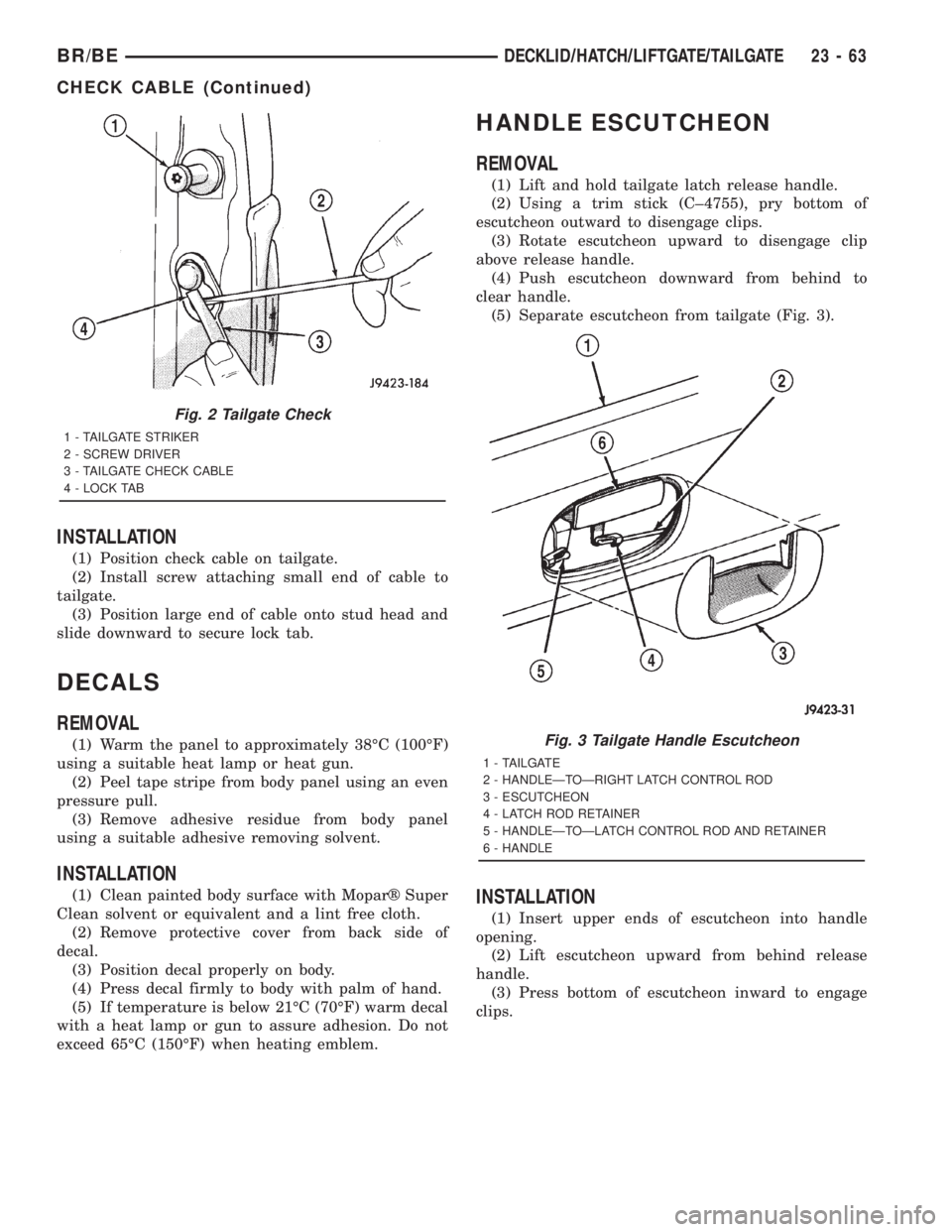
(5) Separate escutcheon from tailgate (Fig. 3).
INSTALLATION
(1) Insert upper ends of escutcheon into handle
opening.
(2) Lift escutcheon upward from behind release
handle.
(3) Press bottom of escutcheon inward to engage
clips.
Fig. 2 Tailgate Check
1 - TAILGATE STRIKER
2 - SCREW DRIVER
3 - TAILGATE CHECK CABLE
4 - LOCK TAB
Fig. 3 Tailgate Handle Escutcheon
1 - TAILGATE
2 - HANDLEÐTOÐRIGHT LATCH CONTROL ROD
3 - ESCUTCHEON
4 - LATCH ROD RETAINER
5 - HANDLEÐTOÐLATCH CONTROL ROD AND RETAINER
6 - HANDLE
BR/BEDECKLID/HATCH/LIFTGATE/TAILGATE 23 - 63
CHECK CABLE (Continued)
Page 2640 of 2889
DOOR - FRONT
TABLE OF CONTENTS
page page
APPLIQUE
REMOVAL..............................67
INSTALLATION...........................67
DOOR
REMOVAL..............................68
INSTALLATION...........................68
ADJUSTMENTS..........................68
DOOR GLASS
REMOVAL..............................69
INSTALLATION...........................69
EXTERIOR HANDLE
REMOVAL..............................70
INSTALLATION...........................70
GLASS RUN CHANNEL
REMOVAL..............................70
INSTALLATION...........................70
HINGE
REMOVAL..............................70
INSTALLATION...........................71
INSIDE HANDLE ACTUATOR
REMOVAL..............................71
INSTALLATION...........................71LATCH
REMOVAL..............................72
INSTALLATION...........................72
ADJUSTMENTS..........................72
LATCH STRIKER
REMOVAL..............................73
INSTALLATION...........................73
LOCK CYLINDER
REMOVAL..............................73
INSTALLATION...........................73
SIDE VIEW MIRROR FLAG
REMOVAL..............................74
INSTALLATION...........................74
TRIM PANEL
REMOVAL..............................74
INSTALLATION...........................74
WATERDAM
REMOVAL..............................75
INSTALLATION...........................75
WINDOW REGULATOR
REMOVAL..............................75
INSTALLATION...........................76
APPLIQUE
REMOVAL
(1) Using a heat lamp, warm B-pillar to 38É C
(100É F).
(2) Remove glass run weatherstrip (Refer to 23 -
BODY/WEATHERSTRIP/SEALS/FDR GLASS RUN
WEATHERSTRIP - REMOVAL).
(3) Remove outer belt weatherstrip (Refer to 23 -
BODY/WEATHERSTRIP/SEALS/FDR OUTER BELT
WEATHERSTRIP - REMOVAL).
(4) Using an even pressure pull, peel B-pillar
applique away from the B-pillar.
INSTALLATION
Installation equipment needed:
²Lint free applicator cloth
²six inch applicator squeegee
²Piercing pin
(1) Clean B-pillar using Mopar Super Kleen or
equivalent.
(2) Wipe surface with a lint free cloth.
(3) Using a heat gun, warm surface to 22É C (70É
F).(4) Fold down, up/down locator tab (1a or 1b) (Fig.
1)along crease.
(5) Remove carrier from adhesion strip (2).
(6) Using up/down locator tab (1a or 1b) and fore/
aft locator tab (3a or 3b), position the applique on the
upper portion of the B-pillar.
(7) Using the lower edge locator (4), position the
applique on the lower portion of the B-pillar.
(8) Verify the applique is positioned correctly and
press the adhesion strip (2) to the door to tempo-
rarily secure it in place.
(9) Remove the carrier for the applique.
(10) Holding the applique from the surface, apply
firm downward pressure with a six inch applicator
squeegee. Ensure the lower rear edge (4) is aligned
correctly.
(11) Wrap edges around door to at least a 90É
angle.
(12) Remove premask by pulling in a firm contin-
uous manner from top down at 180É.
(13) Complete wrapping applique around the door
edges.
(14) Inspect for air bubbles. Small bubbles can be
pierced with a sharp pin and smoothed out.
BR/BEDOOR - FRONT 23 - 67
Page 2646 of 2889
LATCH STRIKER
REMOVAL
(1) Mark outline of striker base on B-pillar with a
grease pencil or equivalent to aid installation.
(2) Remove screws attaching striker to B-pillar
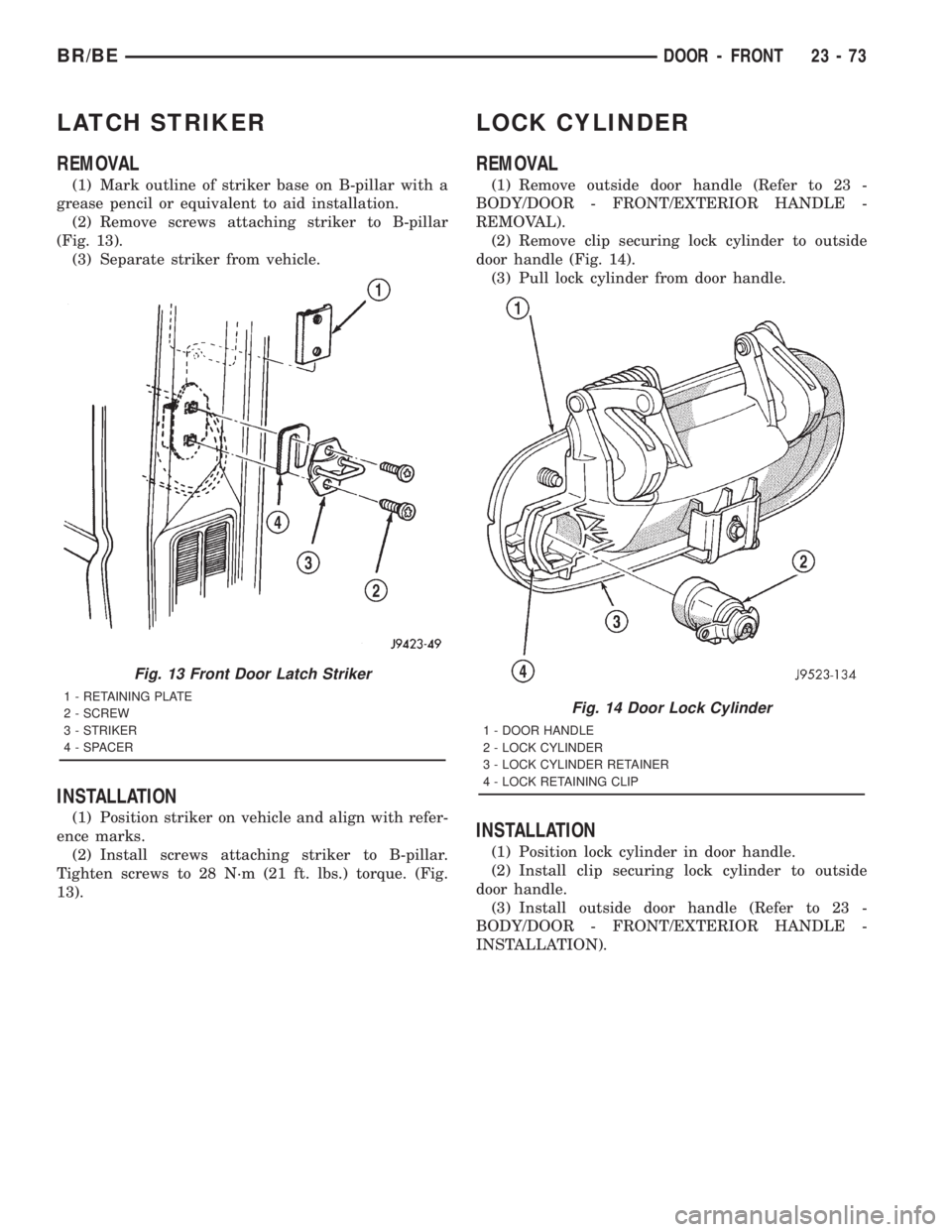
(Fig. 13).
(3) Separate striker from vehicle.
INSTALLATION
(1) Position striker on vehicle and align with refer-
ence marks.
(2) Install screws attaching striker to B-pillar.
Tighten screws to 28 N´m (21 ft. lbs.) torque. (Fig.
13).
LOCK CYLINDER
REMOVAL
(1) Remove outside door handle (Refer to 23 -
BODY/DOOR - FRONT/EXTERIOR HANDLE -
REMOVAL).
(2) Remove clip securing lock cylinder to outside
door handle (Fig. 14).
(3) Pull lock cylinder from door handle.
INSTALLATION
(1) Position lock cylinder in door handle.
(2) Install clip securing lock cylinder to outside
door handle.
(3) Install outside door handle (Refer to 23 -
BODY/DOOR - FRONT/EXTERIOR HANDLE -
INSTALLATION).
Fig. 13 Front Door Latch Striker
1 - RETAINING PLATE
2 - SCREW
3 - STRIKER
4 - SPACERFig. 14 Door Lock Cylinder
1 - DOOR HANDLE
2 - LOCK CYLINDER
3 - LOCK CYLINDER RETAINER
4 - LOCK RETAINING CLIP
BR/BEDOOR - FRONT 23 - 73