ECU DODGE RAM 2001 Service Repair Manual
[x] Cancel search | Manufacturer: DODGE, Model Year: 2001, Model line: RAM, Model: DODGE RAM 2001Pages: 2889, PDF Size: 68.07 MB
Page 2705 of 2889
INSTALLATION
(1) Align console lid with console. Verify lid tension
spring is in position.
(2) Install hinge pin.
(3) Position trim bezel on lid and snap into place.
CENTER SEAT ARMREST/
CONSOLE
REMOVAL
(1) Remove bolts on driver and passenger seat
inboard seat tracks.
(2) Separate center section.
INSTALLATION
(1) Position and align center section on driver and
passenger seat inboard seat tracks.
(2) Install bolts. Tighten to 19.5 N´m (14 ft. lbs.)
torque.
CENTER SEAT ARMREST/
LATCH COVER
REMOVAL
(1) With the seat back fully forward, move the
driver's seat to a full forward position.
(2) Place the center arm rest in a full up position.
(3) Remove the fastener securing the cover to the
inertia latch.
(4) Disengage the front edge of the cover, then
lower the arm rest.
(5) Remove the inertia latch cover by pulling the
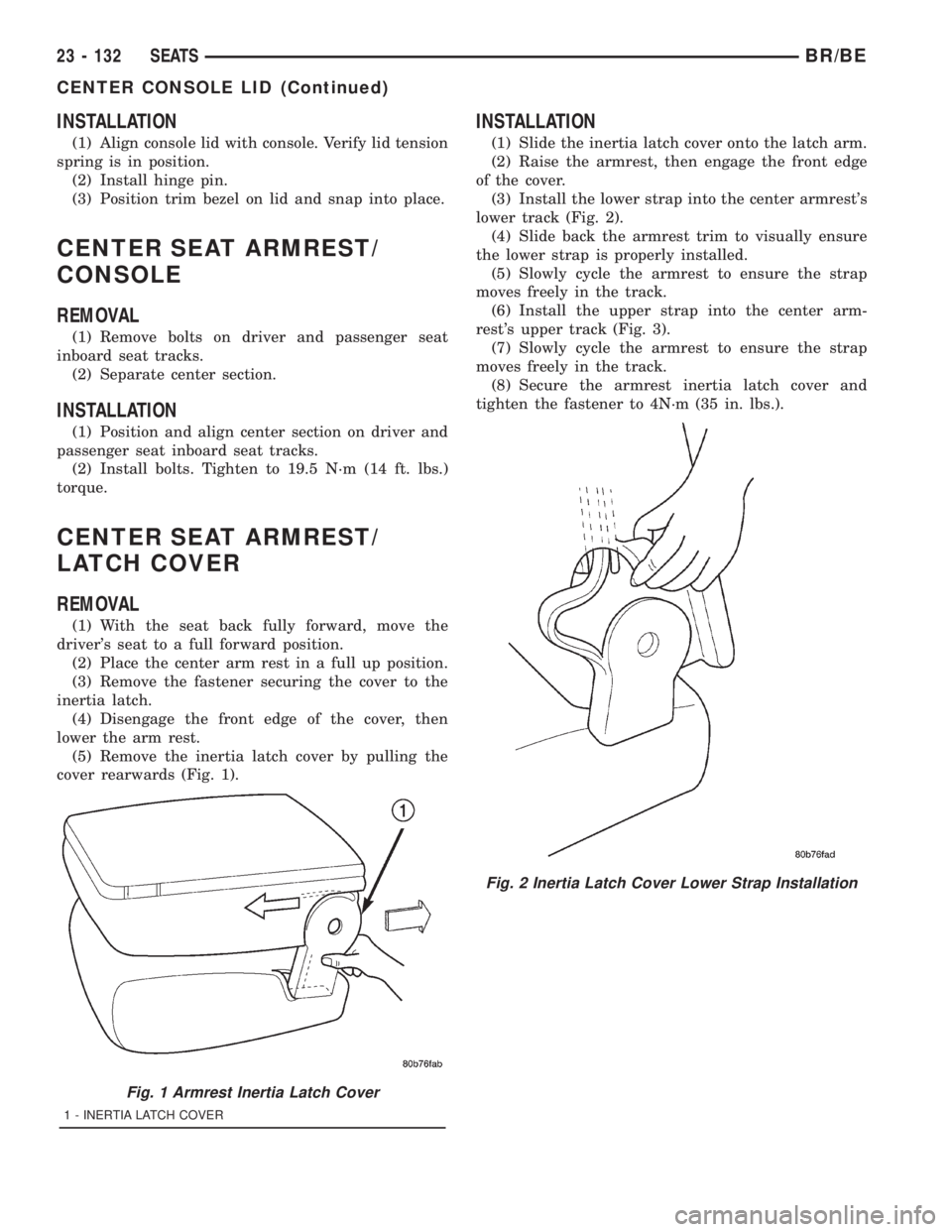
cover rearwards (Fig. 1).
INSTALLATION
(1) Slide the inertia latch cover onto the latch arm.
(2) Raise the armrest, then engage the front edge
of the cover.
(3) Install the lower strap into the center armrest's
lower track (Fig. 2).
(4) Slide back the armrest trim to visually ensure
the lower strap is properly installed.
(5) Slowly cycle the armrest to ensure the strap
moves freely in the track.
(6) Install the upper strap into the center arm-
rest's upper track (Fig. 3).
(7) Slowly cycle the armrest to ensure the strap
moves freely in the track.
(8) Secure the armrest inertia latch cover and
tighten the fastener to 4N´m (35 in. lbs.).
Fig. 1 Armrest Inertia Latch Cover
1 - INERTIA LATCH COVER
Fig. 2 Inertia Latch Cover Lower Strap Installation
23 - 132 SEATSBR/BE
CENTER CONSOLE LID (Continued)
Page 2708 of 2889
SEAT BACK - BENCH SEAT
REMOVAL
(1) Move seat to the full forward position.
(2) Release J-Strap and peel back side of cover
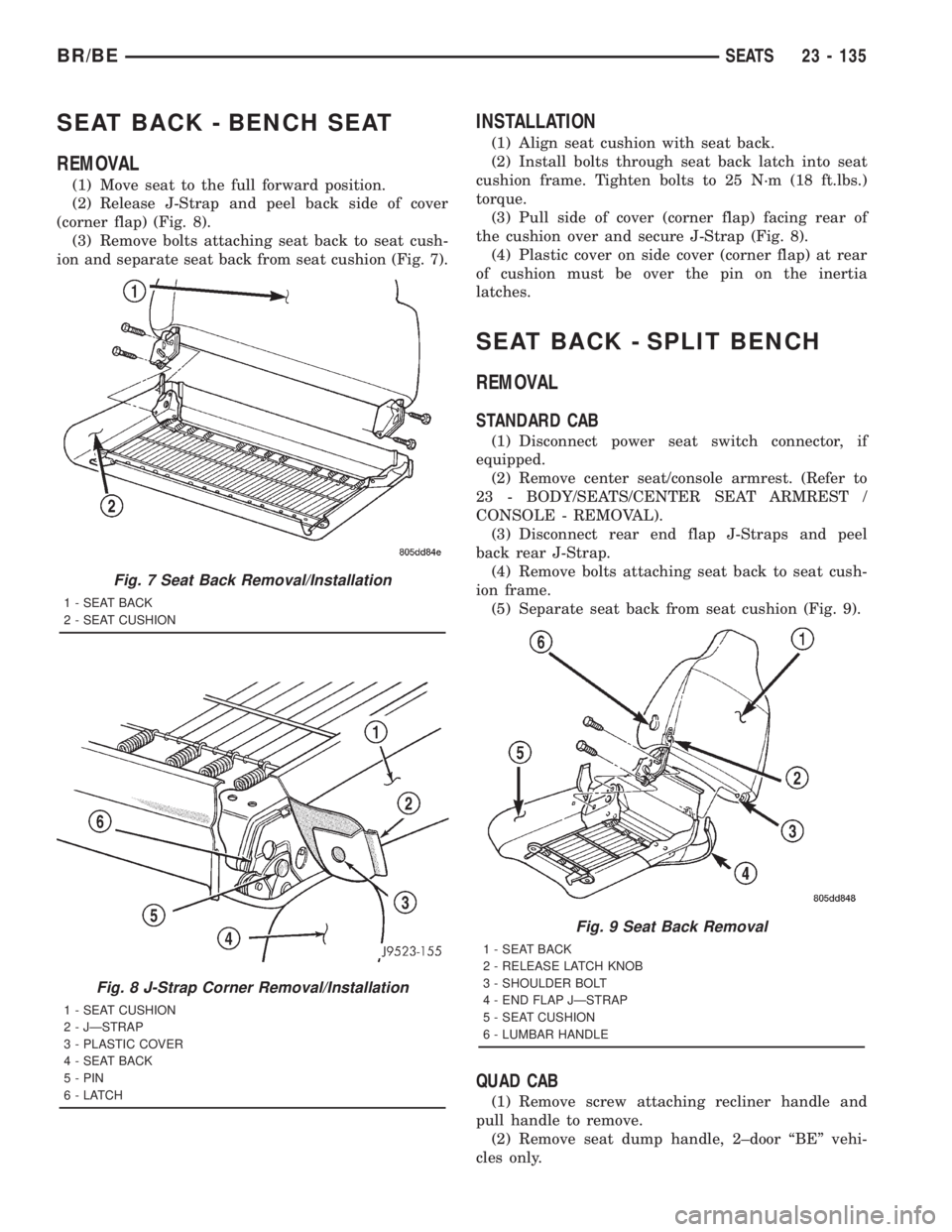
(corner flap) (Fig. 8).
(3) Remove bolts attaching seat back to seat cush-
ion and separate seat back from seat cushion (Fig. 7).
INSTALLATION
(1) Align seat cushion with seat back.
(2) Install bolts through seat back latch into seat
cushion frame. Tighten bolts to 25 N´m (18 ft.lbs.)
torque.
(3) Pull side of cover (corner flap) facing rear of
the cushion over and secure J-Strap (Fig. 8).
(4) Plastic cover on side cover (corner flap) at rear
of cushion must be over the pin on the inertia
latches.
SEAT BACK - SPLIT BENCH
REMOVAL
STANDARD CAB
(1) Disconnect power seat switch connector, if
equipped.
(2) Remove center seat/console armrest. (Refer to
23 - BODY/SEATS/CENTER SEAT ARMREST /
CONSOLE - REMOVAL).
(3) Disconnect rear end flap J-Straps and peel
back rear J-Strap.
(4) Remove bolts attaching seat back to seat cush-
ion frame.
(5) Separate seat back from seat cushion (Fig. 9).
QUAD CAB
(1) Remove screw attaching recliner handle and
pull handle to remove.
(2) Remove seat dump handle, 2±door ªBEº vehi-
cles only.
Fig. 7 Seat Back Removal/Installation
1 - SEAT BACK
2 - SEAT CUSHION
Fig. 8 J-Strap Corner Removal/Installation
1 - SEAT CUSHION
2 - JÐSTRAP
3 - PLASTIC COVER
4 - SEAT BACK
5 - PIN
6-LATCH
Fig. 9 Seat Back Removal
1 - SEAT BACK
2 - RELEASE LATCH KNOB
3 - SHOULDER BOLT
4 - END FLAP JÐSTRAP
5 - SEAT CUSHION
6 - LUMBAR HANDLE
BR/BESEATS 23 - 135
Page 2709 of 2889
(3) Remove screws attaching side shield to seat
track adjuster.
(4) Remove seat dump handle.
(5) Pull shoulder belt out completely and clamp
shoulder belt to prevent shoulder belt from retracting
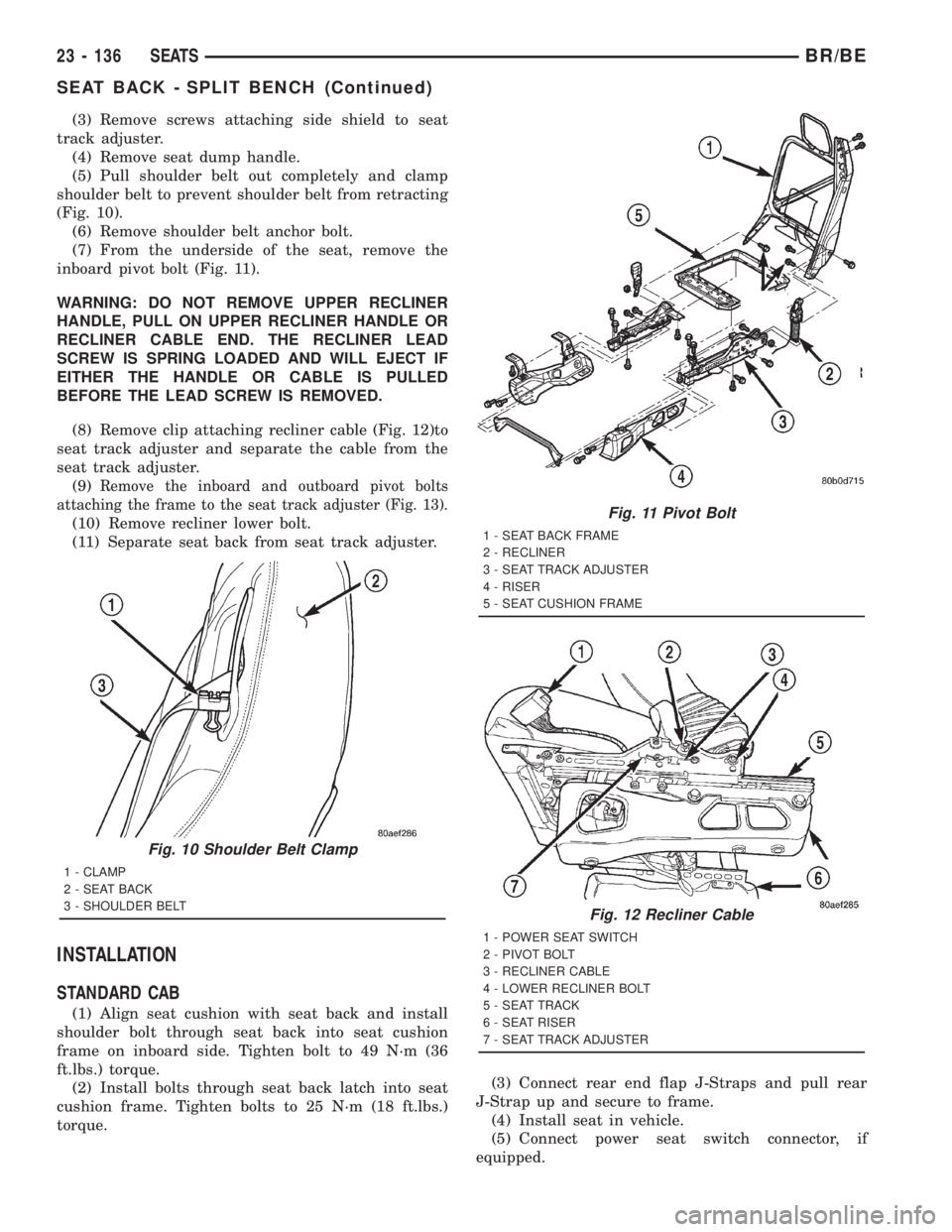
(Fig. 10).
(6) Remove shoulder belt anchor bolt.
(7) From the underside of the seat, remove the
inboard pivot bolt (Fig. 11).
WARNING: DO NOT REMOVE UPPER RECLINER
HANDLE, PULL ON UPPER RECLINER HANDLE OR
RECLINER CABLE END. THE RECLINER LEAD
SCREW IS SPRING LOADED AND WILL EJECT IF
EITHER THE HANDLE OR CABLE IS PULLED
BEFORE THE LEAD SCREW IS REMOVED.
(8) Remove clip attaching recliner cable (Fig. 12)to
seat track adjuster and separate the cable from the
seat track adjuster.
(9)
Remove the inboard and outboard pivot bolts
attaching the frame to the seat track adjuster (Fig. 13).
(10) Remove recliner lower bolt.
(11) Separate seat back from seat track adjuster.
INSTALLATION
STANDARD CAB
(1) Align seat cushion with seat back and install
shoulder bolt through seat back into seat cushion
frame on inboard side. Tighten bolt to 49 N´m (36
ft.lbs.) torque.
(2) Install bolts through seat back latch into seat
cushion frame. Tighten bolts to 25 N´m (18 ft.lbs.)
torque.(3) Connect rear end flap J-Straps and pull rear
J-Strap up and secure to frame.
(4) Install seat in vehicle.
(5) Connect power seat switch connector, if
equipped.
Fig. 10 Shoulder Belt Clamp
1 - CLAMP
2 - SEAT BACK
3 - SHOULDER BELT
Fig. 11 Pivot Bolt
1 - SEAT BACK FRAME
2 - RECLINER
3 - SEAT TRACK ADJUSTER
4 - RISER
5 - SEAT CUSHION FRAME
Fig. 12 Recliner Cable
1 - POWER SEAT SWITCH
2 - PIVOT BOLT
3 - RECLINER CABLE
4 - LOWER RECLINER BOLT
5 - SEAT TRACK
6 - SEAT RISER
7 - SEAT TRACK ADJUSTER
23 - 136 SEATSBR/BE
SEAT BACK - SPLIT BENCH (Continued)
Page 2710 of 2889
QUAD CAB
(1) Position seat back on seat track adjuster.
(2)
Install the inboard and outboard pivot bolts
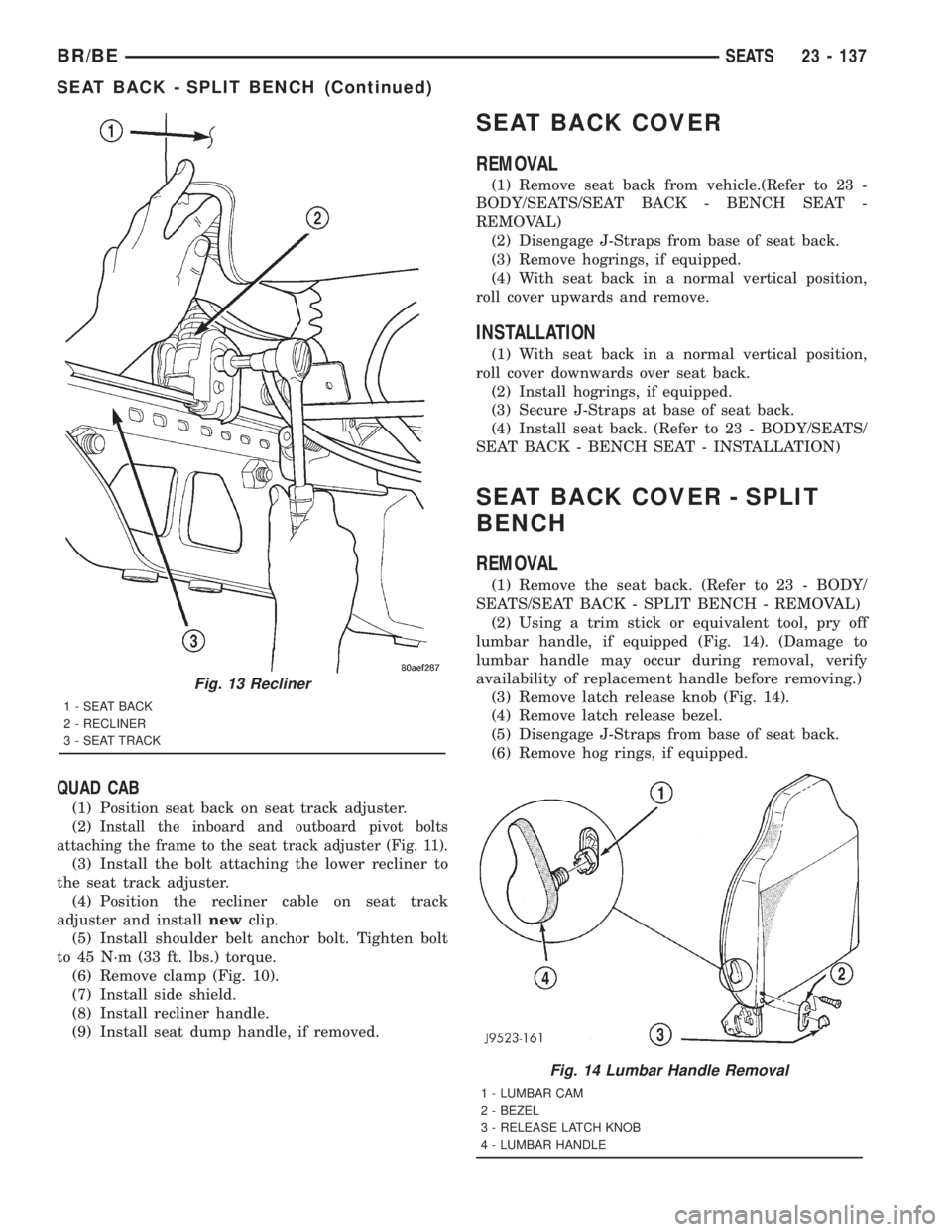
attaching the frame to the seat track adjuster (Fig. 11).
(3) Install the bolt attaching the lower recliner to
the seat track adjuster.
(4) Position the recliner cable on seat track
adjuster and installnewclip.
(5) Install shoulder belt anchor bolt. Tighten bolt
to 45 N´m (33 ft. lbs.) torque.
(6) Remove clamp (Fig. 10).
(7) Install side shield.
(8) Install recliner handle.
(9) Install seat dump handle, if removed.
SEAT BACK COVER
REMOVAL
(1) Remove seat back from vehicle.(Refer to 23 -
BODY/SEATS/SEAT BACK - BENCH SEAT -
REMOVAL)
(2) Disengage J-Straps from base of seat back.
(3) Remove hogrings, if equipped.
(4) With seat back in a normal vertical position,
roll cover upwards and remove.
INSTALLATION
(1) With seat back in a normal vertical position,
roll cover downwards over seat back.
(2) Install hogrings, if equipped.
(3) Secure J-Straps at base of seat back.
(4) Install seat back. (Refer to 23 - BODY/SEATS/
SEAT BACK - BENCH SEAT - INSTALLATION)
SEAT BACK COVER - SPLIT
BENCH
REMOVAL
(1) Remove the seat back. (Refer to 23 - BODY/
SEATS/SEAT BACK - SPLIT BENCH - REMOVAL)
(2) Using a trim stick or equivalent tool, pry off
lumbar handle, if equipped (Fig. 14). (Damage to
lumbar handle may occur during removal, verify
availability of replacement handle before removing.)
(3) Remove latch release knob (Fig. 14).
(4) Remove latch release bezel.
(5) Disengage J-Straps from base of seat back.
(6) Remove hog rings, if equipped.
Fig. 14 Lumbar Handle Removal
1 - LUMBAR CAM
2 - BEZEL
3 - RELEASE LATCH KNOB
4 - LUMBAR HANDLE
Fig. 13 Recliner
1 - SEAT BACK
2 - RECLINER
3 - SEAT TRACK
BR/BESEATS 23 - 137
SEAT BACK - SPLIT BENCH (Continued)
Page 2712 of 2889
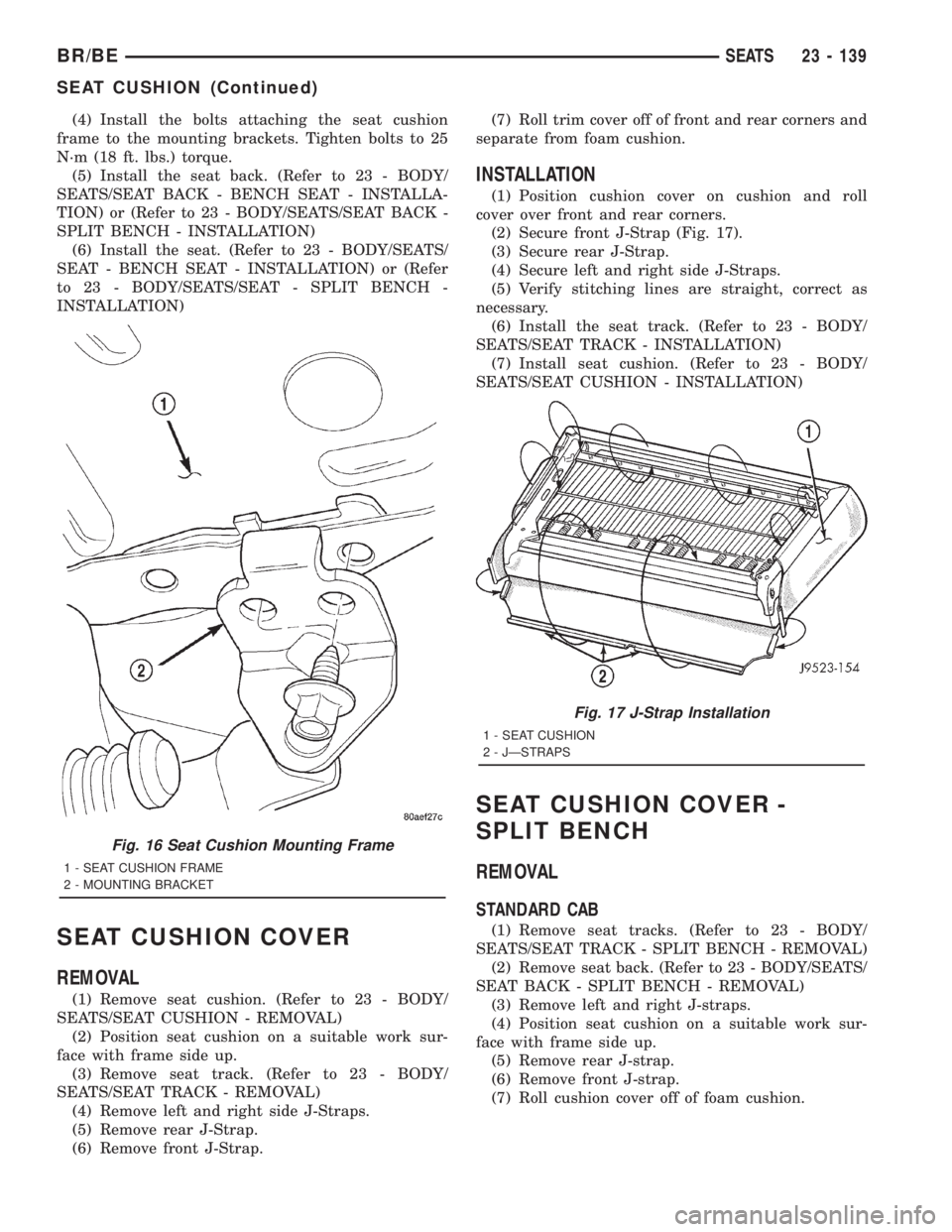
(4) Install the bolts attaching the seat cushion
frame to the mounting brackets. Tighten bolts to 25
N´m (18 ft. lbs.) torque.
(5) Install the seat back. (Refer to 23 - BODY/
SEATS/SEAT BACK - BENCH SEAT - INSTALLA-
TION) or (Refer to 23 - BODY/SEATS/SEAT BACK -
SPLIT BENCH - INSTALLATION)
(6) Install the seat. (Refer to 23 - BODY/SEATS/
SEAT - BENCH SEAT - INSTALLATION) or (Refer
to 23 - BODY/SEATS/SEAT - SPLIT BENCH -
INSTALLATION)
SEAT CUSHION COVER
REMOVAL
(1) Remove seat cushion. (Refer to 23 - BODY/
SEATS/SEAT CUSHION - REMOVAL)
(2) Position seat cushion on a suitable work sur-
face with frame side up.
(3) Remove seat track. (Refer to 23 - BODY/
SEATS/SEAT TRACK - REMOVAL)
(4) Remove left and right side J-Straps.
(5) Remove rear J-Strap.
(6) Remove front J-Strap.(7) Roll trim cover off of front and rear corners and
separate from foam cushion.
INSTALLATION
(1) Position cushion cover on cushion and roll
cover over front and rear corners.
(2) Secure front J-Strap (Fig. 17).
(3) Secure rear J-Strap.
(4) Secure left and right side J-Straps.
(5) Verify stitching lines are straight, correct as
necessary.
(6) Install the seat track. (Refer to 23 - BODY/
SEATS/SEAT TRACK - INSTALLATION)
(7) Install seat cushion. (Refer to 23 - BODY/
SEATS/SEAT CUSHION - INSTALLATION)
SEAT CUSHION COVER -
SPLIT BENCH
REMOVAL
STANDARD CAB
(1) Remove seat tracks. (Refer to 23 - BODY/
SEATS/SEAT TRACK - SPLIT BENCH - REMOVAL)
(2) Remove seat back. (Refer to 23 - BODY/SEATS/
SEAT BACK - SPLIT BENCH - REMOVAL)
(3) Remove left and right J-straps.
(4) Position seat cushion on a suitable work sur-
face with frame side up.
(5) Remove rear J-strap.
(6) Remove front J-strap.
(7) Roll cushion cover off of foam cushion.
Fig. 16 Seat Cushion Mounting Frame
1 - SEAT CUSHION FRAME
2 - MOUNTING BRACKET
Fig. 17 J-Strap Installation
1 - SEAT CUSHION
2 - JÐSTRAPS
BR/BESEATS 23 - 139
SEAT CUSHION (Continued)
Page 2713 of 2889
QUAD CAB
(1) Remove seat cushion. (Refer to 23 - BODY/
SEATS/SEAT CUSHION - REMOVAL)
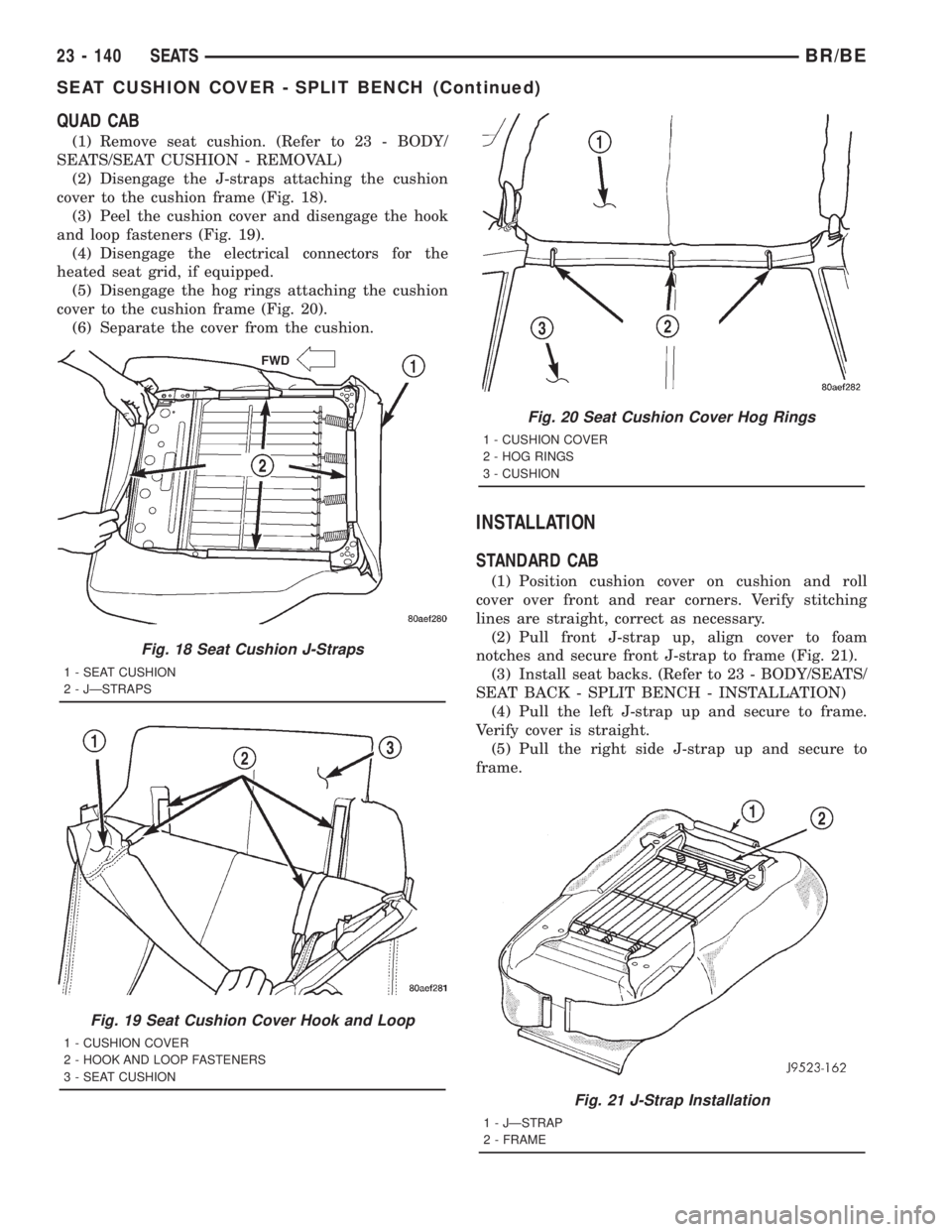
(2) Disengage the J-straps attaching the cushion
cover to the cushion frame (Fig. 18).
(3) Peel the cushion cover and disengage the hook
and loop fasteners (Fig. 19).
(4) Disengage the electrical connectors for the
heated seat grid, if equipped.
(5) Disengage the hog rings attaching the cushion
cover to the cushion frame (Fig. 20).
(6) Separate the cover from the cushion.
INSTALLATION
STANDARD CAB
(1) Position cushion cover on cushion and roll
cover over front and rear corners. Verify stitching
lines are straight, correct as necessary.
(2) Pull front J-strap up, align cover to foam
notches and secure front J-strap to frame (Fig. 21).
(3) Install seat backs. (Refer to 23 - BODY/SEATS/
SEAT BACK - SPLIT BENCH - INSTALLATION)
(4) Pull the left J-strap up and secure to frame.
Verify cover is straight.
(5) Pull the right side J-strap up and secure to
frame.
Fig. 21 J-Strap Installation
1 - JÐSTRAP
2 - FRAME
Fig. 18 Seat Cushion J-Straps
1 - SEAT CUSHION
2 - JÐSTRAPS
Fig. 19 Seat Cushion Cover Hook and Loop
1 - CUSHION COVER
2 - HOOK AND LOOP FASTENERS
3 - SEAT CUSHION
Fig. 20 Seat Cushion Cover Hog Rings
1 - CUSHION COVER
2 - HOG RINGS
3 - CUSHION
23 - 140 SEATSBR/BE
SEAT CUSHION COVER - SPLIT BENCH (Continued)
Page 2718 of 2889
STATIONARY GLASS
TABLE OF CONTENTS
page page
STATIONARY GLASS
DESCRIPTION..........................145
OPERATION............................145
BACKLITE
REMOVAL.............................145
INSTALLATION..........................145
BACKLITE LATCH AND KEEPER
REMOVAL.............................146
INSTALLATION..........................146
BACKLITE VENT GLASS
REMOVAL.............................147INSTALLATION..........................147
WINDSHIELD
DESCRIPTION..........................148
REMOVAL.............................148
INSTALLATION..........................148
QUARTER WINDOW
REMOVAL.............................151
INSTALLATION..........................151
STATIONARY GLASS
DESCRIPTION
Windshields are made of two pieces of glass with a
plastic inner layer. Windshields and selected station-
ary glass are structural members of the vehicle. The
windshield glass is bonded to the windshield frame
with urethane adhesive.
OPERATION
Windshields and other stationary glass protect the
occupants from the effects of the elements. Wind-
shields are also used to retain some airbags in posi-
tion during deployment. Urethane bonded glass is
difficult to salvage during removal. The urethane
bonding is difficult to cut or clean from any surface.
Before removing the glass, check the availability of
replacement components.
BACKLITE
REMOVAL
It is difficult to salvage the backlite during the
removal operation. The backlite is part of the struc-
tural support for the roof. The urethane bonding
used to secure the glass to the fence is difficult to cut
or clean from any surface. Since the molding is set in
urethane, it is unlikely it would be salvaged. Before
removing the backlite, check the availability from the
parts supplier.
The backlite is attached to the window frame with
urethane adhesive. The urethane adhesive is applied
cold and seals the surface area between the window
opening and the glass. The primer adheres the ure-
thane adhesive to the backlite.(1) Roll down door glass.
(2) Remove headliner. (Refer to 23 - BODY/INTE-
RIOR/HEADLINER - REMOVAL).
(3) Remove rear closer panel trim. (Refer to 23 -
BODY/INTERIOR/REAR CLOSURE PANEL TRIM -
REMOVAL).
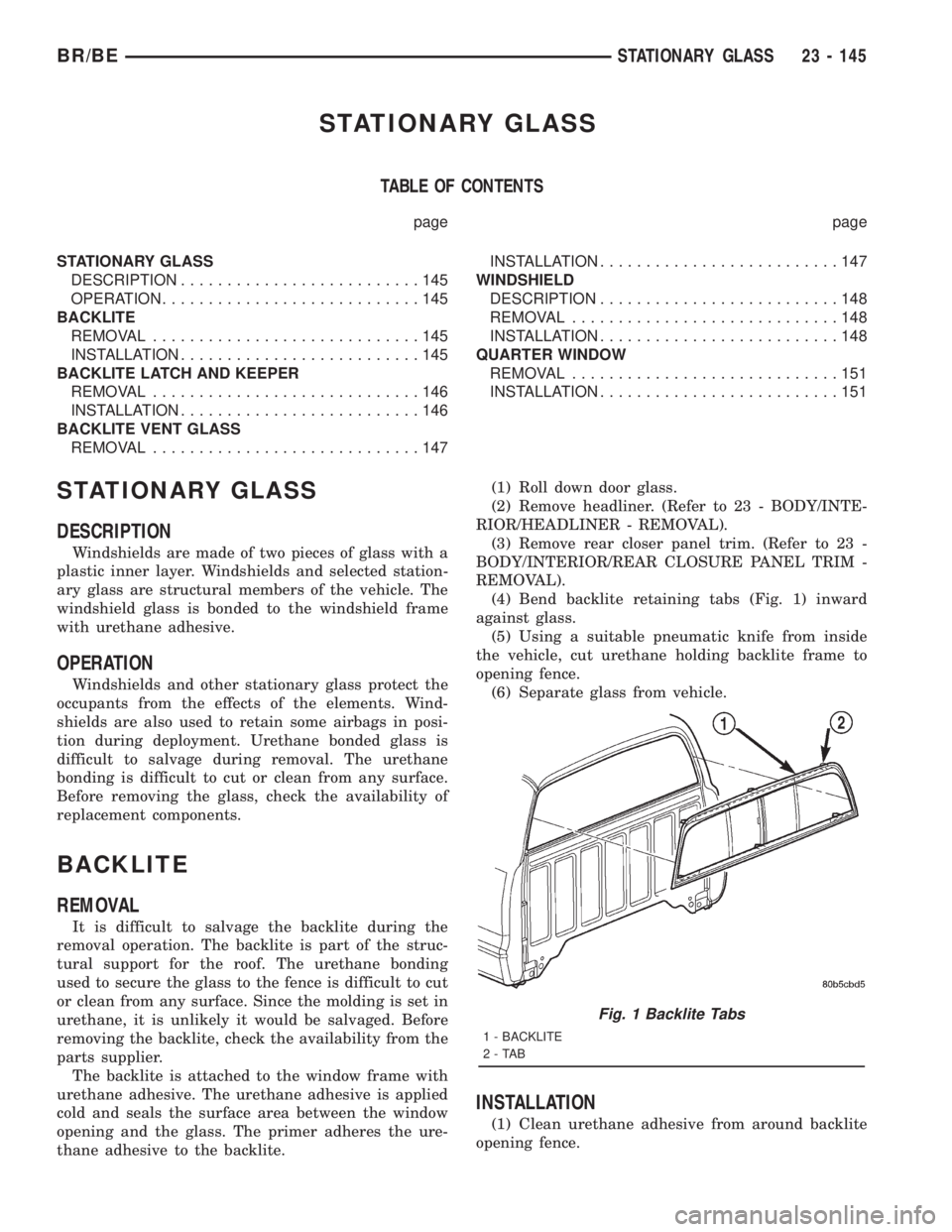
(4) Bend backlite retaining tabs (Fig. 1) inward
against glass.
(5) Using a suitable pneumatic knife from inside
the vehicle, cut urethane holding backlite frame to
opening fence.
(6) Separate glass from vehicle.
INSTALLATION
(1) Clean urethane adhesive from around backlite
opening fence.
Fig. 1 Backlite Tabs
1 - BACKLITE
2-TAB
BR/BESTATIONARY GLASS 23 - 145
Page 2721 of 2889
WINDSHIELD
DESCRIPTION
WARNING: DO NOT OPERATE THE VEHICLE
WITHIN 24 HOURS OF WINDSHIELD INSTALLATION.
IT TAKES AT LEAST 24 HOURS FOR URETHANE
ADHESIVE TO CURE. IF IT IS NOT CURED, THE
WINDSHIELD MAY NOT PERFORM PROPERLY IN
AN ACCIDENT.
URETHANE ADHESIVES ARE APPLIED AS A SYS-
TEM. USE GLASS CLEANER, GLASS PREP SOL-
VENT, GLASS PRIMER, PVC (VINYL) PRIMER AND
PINCH WELD (FENCE) PRIMER PROVIDED BY THE
ADHESIVE MANUFACTURER. IF NOT, STRUCTURAL
INTEGRITY COULD BE COMPROMISED.
DAIMLERCHRYSLER DOES NOT RECOMMEND
GLASS ADHESIVE BY BRAND. TECHNICIANS
SHOULD REVIEW PRODUCT LABELS AND TECHNI-
CAL DATA SHEETS, AND USE ONLY ADHESIVES
THAT THEIR MANUFACTURES WARRANT WILL
RESTORE A VEHICLE TO THE REQUIREMENTS OF
FMVSS 212. TECHNICIANS SHOULD ALSO INSURE
THAT PRIMERS AND CLEANERS ARE COMPATIBLE
WITH THE PARTICULAR ADHESIVE USED.
BE SURE TO REFER TO THE URETHANE MANU-
FACTURER'S DIRECTIONS FOR CURING TIME
SPECIFICATIONS, AND DO NOT USE ADHESIVE
AFTER ITS EXPIRATION DATE.
VAPORS THAT ARE EMITTED FROM THE URE-
THANE ADHESIVE OR PRIMER COULD CAUSE
PERSONAL INJURY. USE THEM IN A WELL-VENTI-
LATED AREA.
SKIN CONTACT WITH URETHANE ADHESIVE
SHOULD BE AVOIDED. PERSONAL INJURY MAY
RESULT.
ALWAYS WEAR EYE AND HAND PROTECTION
WHEN WORKING WITH GLASS.
CAUTION: Protect all painted and trimmed surfaces
from coming in contact with urethane or primers.
Be careful not to damage painted surfaces when
removing moldings or cutting urethane around
windshield.
OPERATION
The windshield is attached to the window frame
with urethane adhesive. The urethane adhesive is
applied cold and seals the surface area between the
window opening and the glass. The primer adheres
the urethane adhesive to the windshield.
It is difficult to salvage a windshield during the
removal operation. The windshield is part of the
structural support for the roof. The urethane bonding
used to secure the windshield to the fence is difficultto cut or clean from any surface. If the moldings are
set in urethane, it would also be unlikely they could
be salvaged. Before removing the windshield, check
the availability of the windshield and moldings from
the parts supplier.
REMOVAL
(1) Remove inside rear view mirror. (Refer to 23 -
BODY/INTERIOR/REAR VIEW MIRROR - REMOV-
AL).
(2) Remove cowl grill. (Refer to 23 - BODY/EXTE-
RIOR/COWL GRILLE - REMOVAL).
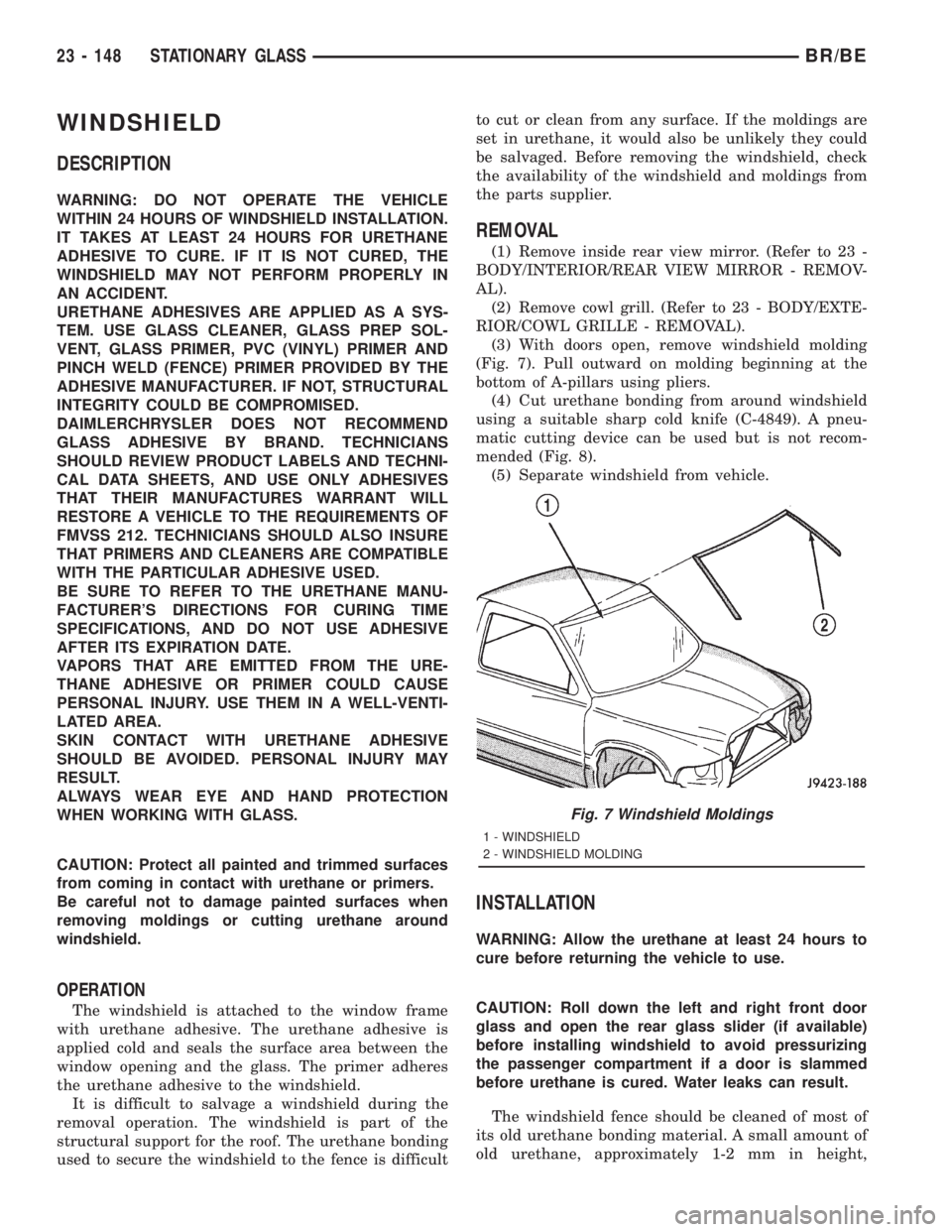
(3) With doors open, remove windshield molding
(Fig. 7). Pull outward on molding beginning at the
bottom of A-pillars using pliers.
(4) Cut urethane bonding from around windshield
using a suitable sharp cold knife (C-4849). A pneu-
matic cutting device can be used but is not recom-
mended (Fig. 8).
(5) Separate windshield from vehicle.
INSTALLATION
WARNING: Allow the urethane at least 24 hours to
cure before returning the vehicle to use.
CAUTION: Roll down the left and right front door
glass and open the rear glass slider (if available)
before installing windshield to avoid pressurizing
the passenger compartment if a door is slammed
before urethane is cured. Water leaks can result.
The windshield fence should be cleaned of most of
its old urethane bonding material. A small amount of
old urethane, approximately 1-2 mm in height,
Fig. 7 Windshield Moldings
1 - WINDSHIELD
2 - WINDSHIELD MOLDING
23 - 148 STATIONARY GLASSBR/BE
Page 2742 of 2889
A/C COMPRESSOR CLUTCH
DESCRIPTION
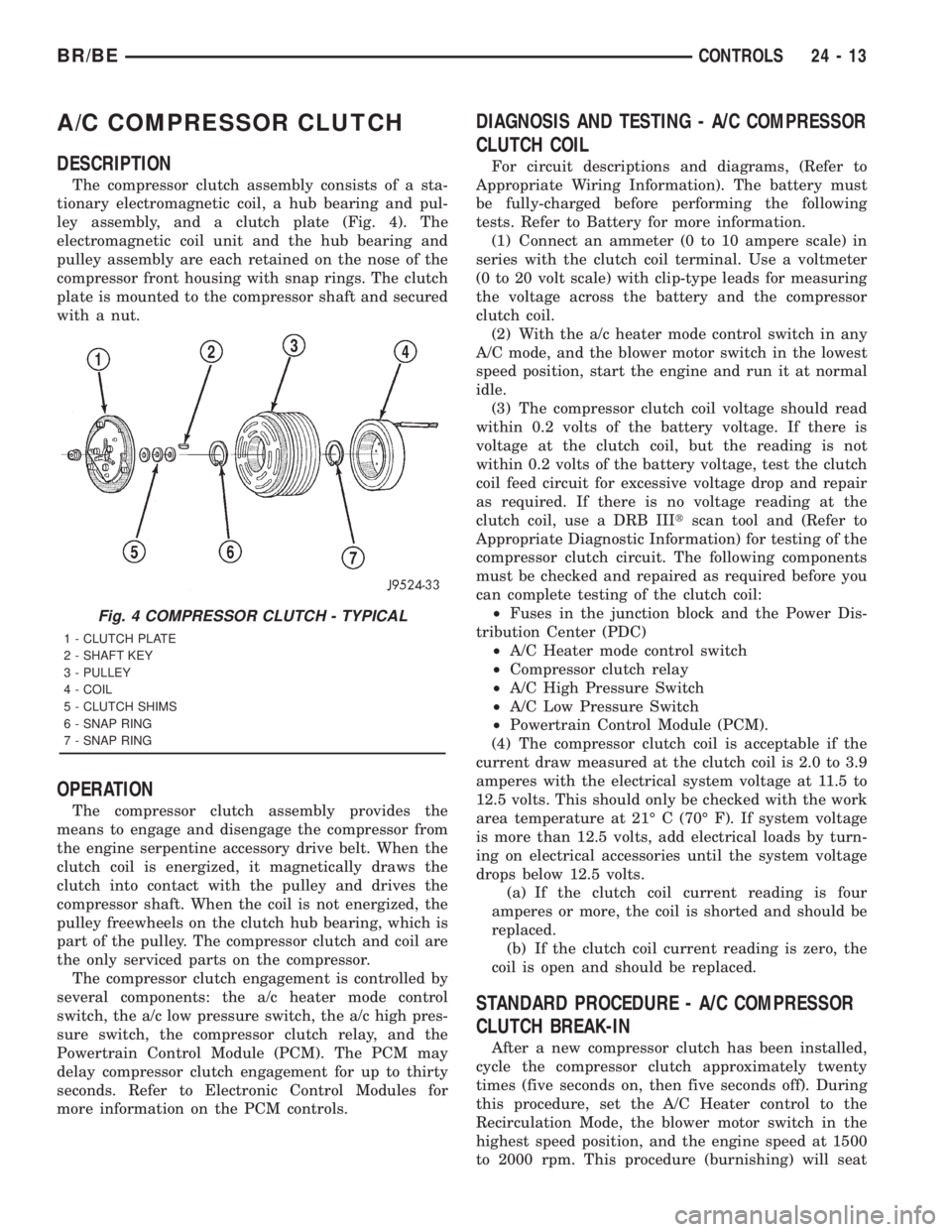
The compressor clutch assembly consists of a sta-
tionary electromagnetic coil, a hub bearing and pul-
ley assembly, and a clutch plate (Fig. 4). The
electromagnetic coil unit and the hub bearing and
pulley assembly are each retained on the nose of the
compressor front housing with snap rings. The clutch
plate is mounted to the compressor shaft and secured
with a nut.
OPERATION
The compressor clutch assembly provides the
means to engage and disengage the compressor from
the engine serpentine accessory drive belt. When the
clutch coil is energized, it magnetically draws the
clutch into contact with the pulley and drives the
compressor shaft. When the coil is not energized, the
pulley freewheels on the clutch hub bearing, which is
part of the pulley. The compressor clutch and coil are
the only serviced parts on the compressor.
The compressor clutch engagement is controlled by
several components: the a/c heater mode control
switch, the a/c low pressure switch, the a/c high pres-
sure switch, the compressor clutch relay, and the
Powertrain Control Module (PCM). The PCM may
delay compressor clutch engagement for up to thirty
seconds. Refer to Electronic Control Modules for
more information on the PCM controls.
DIAGNOSIS AND TESTING - A/C COMPRESSOR
CLUTCH COIL
For circuit descriptions and diagrams, (Refer to
Appropriate Wiring Information). The battery must
be fully-charged before performing the following
tests. Refer to Battery for more information.
(1) Connect an ammeter (0 to 10 ampere scale) in
series with the clutch coil terminal. Use a voltmeter
(0 to 20 volt scale) with clip-type leads for measuring
the voltage across the battery and the compressor
clutch coil.
(2) With the a/c heater mode control switch in any
A/C mode, and the blower motor switch in the lowest
speed position, start the engine and run it at normal
idle.
(3) The compressor clutch coil voltage should read
within 0.2 volts of the battery voltage. If there is
voltage at the clutch coil, but the reading is not
within 0.2 volts of the battery voltage, test the clutch
coil feed circuit for excessive voltage drop and repair
as required. If there is no voltage reading at the
clutch coil, use a DRB IIItscan tool and (Refer to
Appropriate Diagnostic Information) for testing of the
compressor clutch circuit. The following components
must be checked and repaired as required before you
can complete testing of the clutch coil:
²Fuses in the junction block and the Power Dis-
tribution Center (PDC)
²A/C Heater mode control switch
²Compressor clutch relay
²A/C High Pressure Switch
²A/C Low Pressure Switch
²Powertrain Control Module (PCM).
(4) The compressor clutch coil is acceptable if the
current draw measured at the clutch coil is 2.0 to 3.9
amperes with the electrical system voltage at 11.5 to
12.5 volts. This should only be checked with the work
area temperature at 21É C (70É F). If system voltage
is more than 12.5 volts, add electrical loads by turn-
ing on electrical accessories until the system voltage
drops below 12.5 volts.
(a) If the clutch coil current reading is four
amperes or more, the coil is shorted and should be
replaced.
(b) If the clutch coil current reading is zero, the
coil is open and should be replaced.
STANDARD PROCEDURE - A/C COMPRESSOR
CLUTCH BREAK-IN
After a new compressor clutch has been installed,
cycle the compressor clutch approximately twenty
times (five seconds on, then five seconds off). During
this procedure, set the A/C Heater control to the
Recirculation Mode, the blower motor switch in the
highest speed position, and the engine speed at 1500
to 2000 rpm. This procedure (burnishing) will seat
Fig. 4 COMPRESSOR CLUTCH - TYPICAL
1 - CLUTCH PLATE
2 - SHAFT KEY
3 - PULLEY
4 - COIL
5 - CLUTCH SHIMS
6 - SNAP RING
7 - SNAP RING
BR/BECONTROLS 24 - 13
Page 2749 of 2889
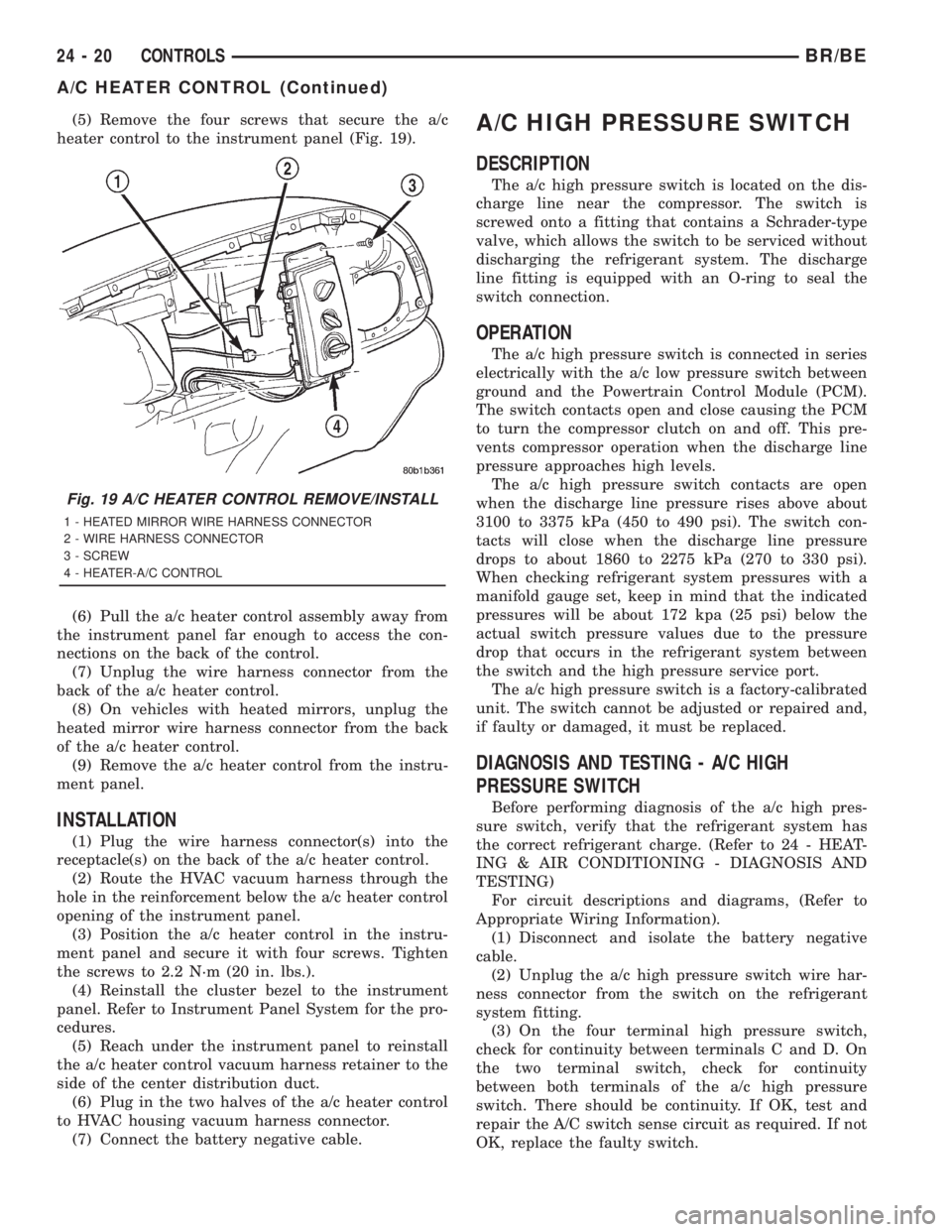
(5) Remove the four screws that secure the a/c
heater control to the instrument panel (Fig. 19).
(6) Pull the a/c heater control assembly away from
the instrument panel far enough to access the con-
nections on the back of the control.
(7) Unplug the wire harness connector from the
back of the a/c heater control.
(8) On vehicles with heated mirrors, unplug the
heated mirror wire harness connector from the back
of the a/c heater control.
(9) Remove the a/c heater control from the instru-
ment panel.
INSTALLATION
(1) Plug the wire harness connector(s) into the
receptacle(s) on the back of the a/c heater control.
(2) Route the HVAC vacuum harness through the
hole in the reinforcement below the a/c heater control
opening of the instrument panel.
(3) Position the a/c heater control in the instru-
ment panel and secure it with four screws. Tighten
the screws to 2.2 N´m (20 in. lbs.).
(4) Reinstall the cluster bezel to the instrument
panel. Refer to Instrument Panel System for the pro-
cedures.
(5) Reach under the instrument panel to reinstall
the a/c heater control vacuum harness retainer to the
side of the center distribution duct.
(6) Plug in the two halves of the a/c heater control
to HVAC housing vacuum harness connector.
(7) Connect the battery negative cable.
A/C HIGH PRESSURE SWITCH
DESCRIPTION
The a/c high pressure switch is located on the dis-
charge line near the compressor. The switch is
screwed onto a fitting that contains a Schrader-type
valve, which allows the switch to be serviced without
discharging the refrigerant system. The discharge
line fitting is equipped with an O-ring to seal the
switch connection.
OPERATION
The a/c high pressure switch is connected in series
electrically with the a/c low pressure switch between
ground and the Powertrain Control Module (PCM).
The switch contacts open and close causing the PCM
to turn the compressor clutch on and off. This pre-
vents compressor operation when the discharge line
pressure approaches high levels.
The a/c high pressure switch contacts are open
when the discharge line pressure rises above about
3100 to 3375 kPa (450 to 490 psi). The switch con-
tacts will close when the discharge line pressure
drops to about 1860 to 2275 kPa (270 to 330 psi).
When checking refrigerant system pressures with a
manifold gauge set, keep in mind that the indicated
pressures will be about 172 kpa (25 psi) below the
actual switch pressure values due to the pressure
drop that occurs in the refrigerant system between
the switch and the high pressure service port.
The a/c high pressure switch is a factory-calibrated
unit. The switch cannot be adjusted or repaired and,
if faulty or damaged, it must be replaced.
DIAGNOSIS AND TESTING - A/C HIGH
PRESSURE SWITCH
Before performing diagnosis of the a/c high pres-
sure switch, verify that the refrigerant system has
the correct refrigerant charge. (Refer to 24 - HEAT-
ING & AIR CONDITIONING - DIAGNOSIS AND
TESTING)
For circuit descriptions and diagrams, (Refer to
Appropriate Wiring Information).
(1) Disconnect and isolate the battery negative
cable.
(2) Unplug the a/c high pressure switch wire har-
ness connector from the switch on the refrigerant
system fitting.
(3) On the four terminal high pressure switch,
check for continuity between terminals C and D. On
the two terminal switch, check for continuity
between both terminals of the a/c high pressure
switch. There should be continuity. If OK, test and
repair the A/C switch sense circuit as required. If not
OK, replace the faulty switch.
Fig. 19 A/C HEATER CONTROL REMOVE/INSTALL
1 - HEATED MIRROR WIRE HARNESS CONNECTOR
2 - WIRE HARNESS CONNECTOR
3 - SCREW
4 - HEATER-A/C CONTROL
24 - 20 CONTROLSBR/BE
A/C HEATER CONTROL (Continued)