clock DODGE RAM 2002 Service Owners Manual
[x] Cancel search | Manufacturer: DODGE, Model Year: 2002, Model line: RAM, Model: DODGE RAM 2002Pages: 2255, PDF Size: 62.07 MB
Page 1428 of 2255
WORM THRUST BEARING PRELOAD
(1) Mount the gear carefully into a vise.
CAUTION: Do not overtighten the vise on the gear
case. This may affect the adjustment
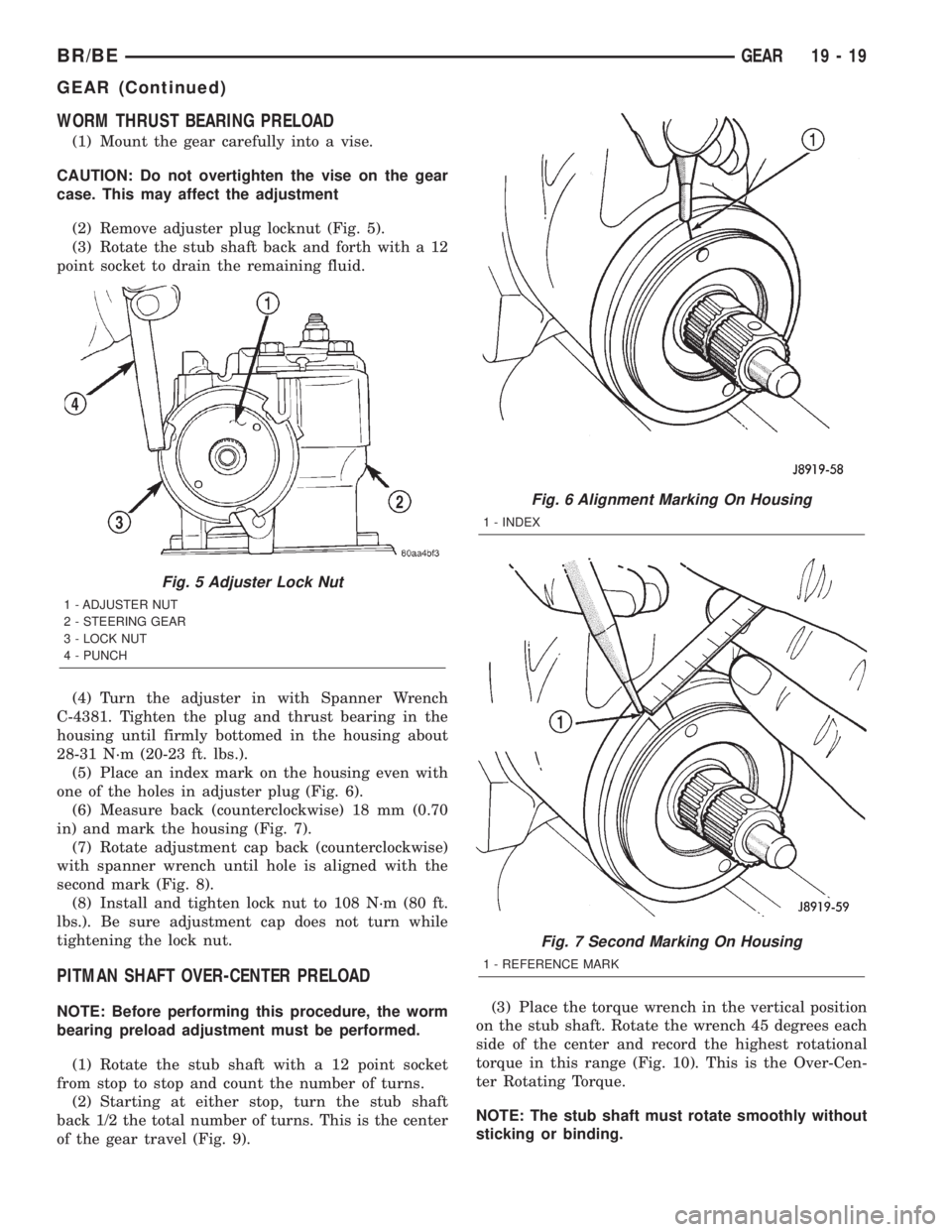
(2) Remove adjuster plug locknut (Fig. 5).
(3) Rotate the stub shaft back and forth with a 12
point socket to drain the remaining fluid.
(4) Turn the adjuster in with Spanner Wrench
C-4381. Tighten the plug and thrust bearing in the
housing until firmly bottomed in the housing about
28-31 N´m (20-23 ft. lbs.).
(5) Place an index mark on the housing even with
one of the holes in adjuster plug (Fig. 6).
(6) Measure back (counterclockwise) 18 mm (0.70
in) and mark the housing (Fig. 7).
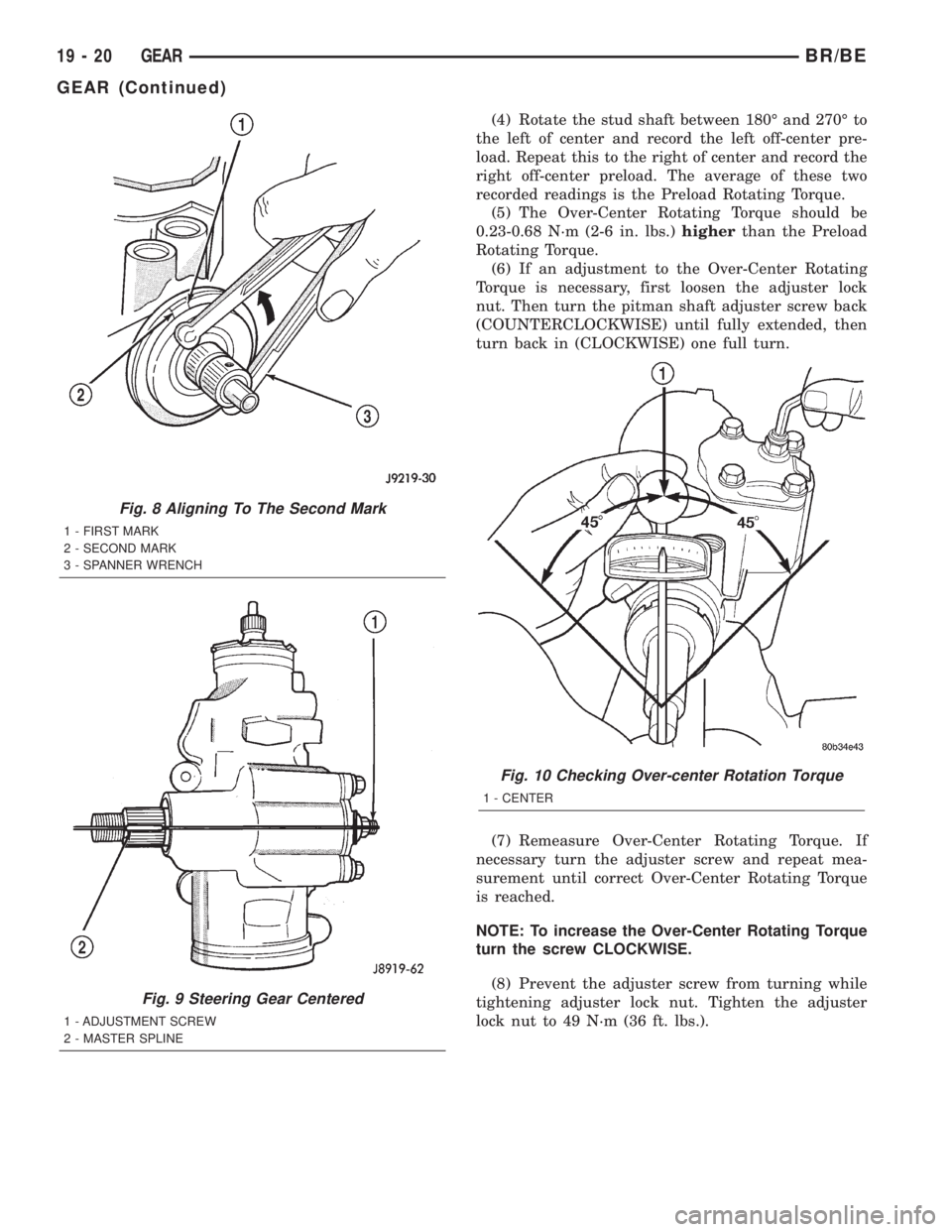
(7) Rotate adjustment cap back (counterclockwise)
with spanner wrench until hole is aligned with the
second mark (Fig. 8).
(8) Install and tighten lock nut to 108 N´m (80 ft.
lbs.). Be sure adjustment cap does not turn while
tightening the lock nut.
PITMAN SHAFT OVER-CENTER PRELOAD
NOTE: Before performing this procedure, the worm
bearing preload adjustment must be performed.
(1) Rotate the stub shaft with a 12 point socket
from stop to stop and count the number of turns.
(2) Starting at either stop, turn the stub shaft
back 1/2 the total number of turns. This is the center
of the gear travel (Fig. 9).(3) Place the torque wrench in the vertical position
on the stub shaft. Rotate the wrench 45 degrees each
side of the center and record the highest rotational
torque in this range (Fig. 10). This is the Over-Cen-
ter Rotating Torque.
NOTE: The stub shaft must rotate smoothly without
sticking or binding.
Fig. 5 Adjuster Lock Nut
1 - ADJUSTER NUT
2 - STEERING GEAR
3 - LOCK NUT
4 - PUNCH
Fig. 6 Alignment Marking On Housing
1 - INDEX
Fig. 7 Second Marking On Housing
1 - REFERENCE MARK
BR/BEGEAR 19 - 19
GEAR (Continued)
Page 1429 of 2255
(4) Rotate the stud shaft between 180É and 270É to
the left of center and record the left off-center pre-
load. Repeat this to the right of center and record the
right off-center preload. The average of these two
recorded readings is the Preload Rotating Torque.
(5) The Over-Center Rotating Torque should be
0.23-0.68 N´m (2-6 in. lbs.)higherthan the Preload
Rotating Torque.
(6) If an adjustment to the Over-Center Rotating
Torque is necessary, first loosen the adjuster lock
nut. Then turn the pitman shaft adjuster screw back
(COUNTERCLOCKWISE) until fully extended, then
turn back in (CLOCKWISE) one full turn.
(7) Remeasure Over-Center Rotating Torque. If
necessary turn the adjuster screw and repeat mea-
surement until correct Over-Center Rotating Torque
is reached.
NOTE: To increase the Over-Center Rotating Torque
turn the screw CLOCKWISE.
(8) Prevent the adjuster screw from turning while
tightening adjuster lock nut. Tighten the adjuster
lock nut to 49 N´m (36 ft. lbs.).
Fig. 8 Aligning To The Second Mark
1 - FIRST MARK
2 - SECOND MARK
3 - SPANNER WRENCH
Fig. 9 Steering Gear Centered
1 - ADJUSTMENT SCREW
2 - MASTER SPLINE
Fig. 10 Checking Over-center Rotation Torque
1 - CENTER
19 - 20 GEARBR/BE
GEAR (Continued)
Page 1438 of 2255
(8) Install adjuster nut and lock nut.
(9) Adjust Thrust Bearing Preload and Over-Cen-
ter Rotating Torque, (Refer to 19 - STEERING/GEAR
- ADJUSTMENTS).
STEERING GEAR HOUSING
PLUG
REMOVAL
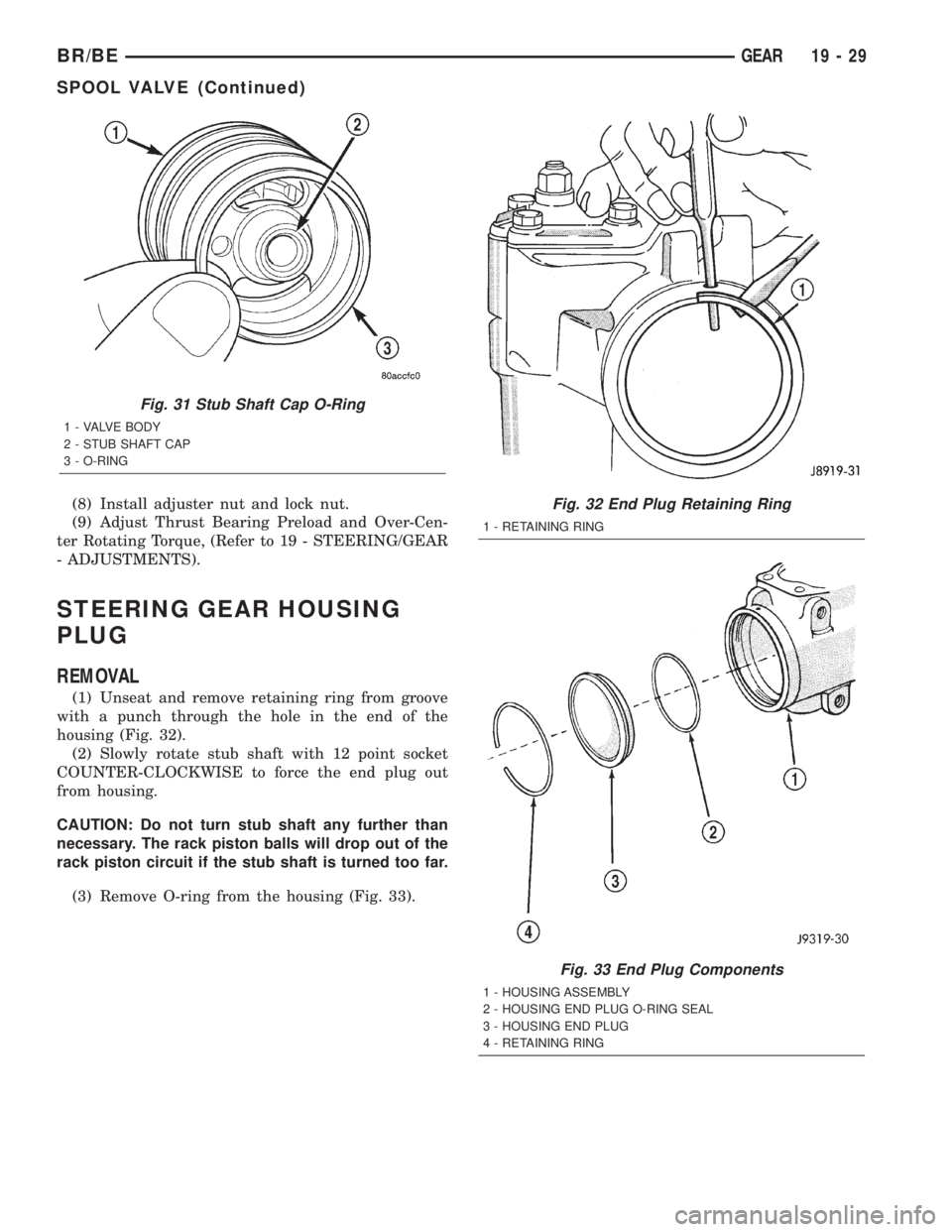
(1) Unseat and remove retaining ring from groove
with a punch through the hole in the end of the
housing (Fig. 32).
(2) Slowly rotate stub shaft with 12 point socket
COUNTER-CLOCKWISE to force the end plug out
from housing.
CAUTION: Do not turn stub shaft any further than
necessary. The rack piston balls will drop out of the
rack piston circuit if the stub shaft is turned too far.
(3) Remove O-ring from the housing (Fig. 33).
Fig. 31 Stub Shaft Cap O-Ring
1 - VALVE BODY
2 - STUB SHAFT CAP
3 - O-RING
Fig. 32 End Plug Retaining Ring
1 - RETAINING RING
Fig. 33 End Plug Components
1 - HOUSING ASSEMBLY
2 - HOUSING END PLUG O-RING SEAL
3 - HOUSING END PLUG
4 - RETAINING RING
BR/BEGEAR 19 - 29
SPOOL VALVE (Continued)
Page 1439 of 2255
INSTALLATION
(1) Lubricate O-ring with power steering fluid and
install into the housing.
(2) Install end plug by tapping the plug lightly
with a plastic mallet into the housing.
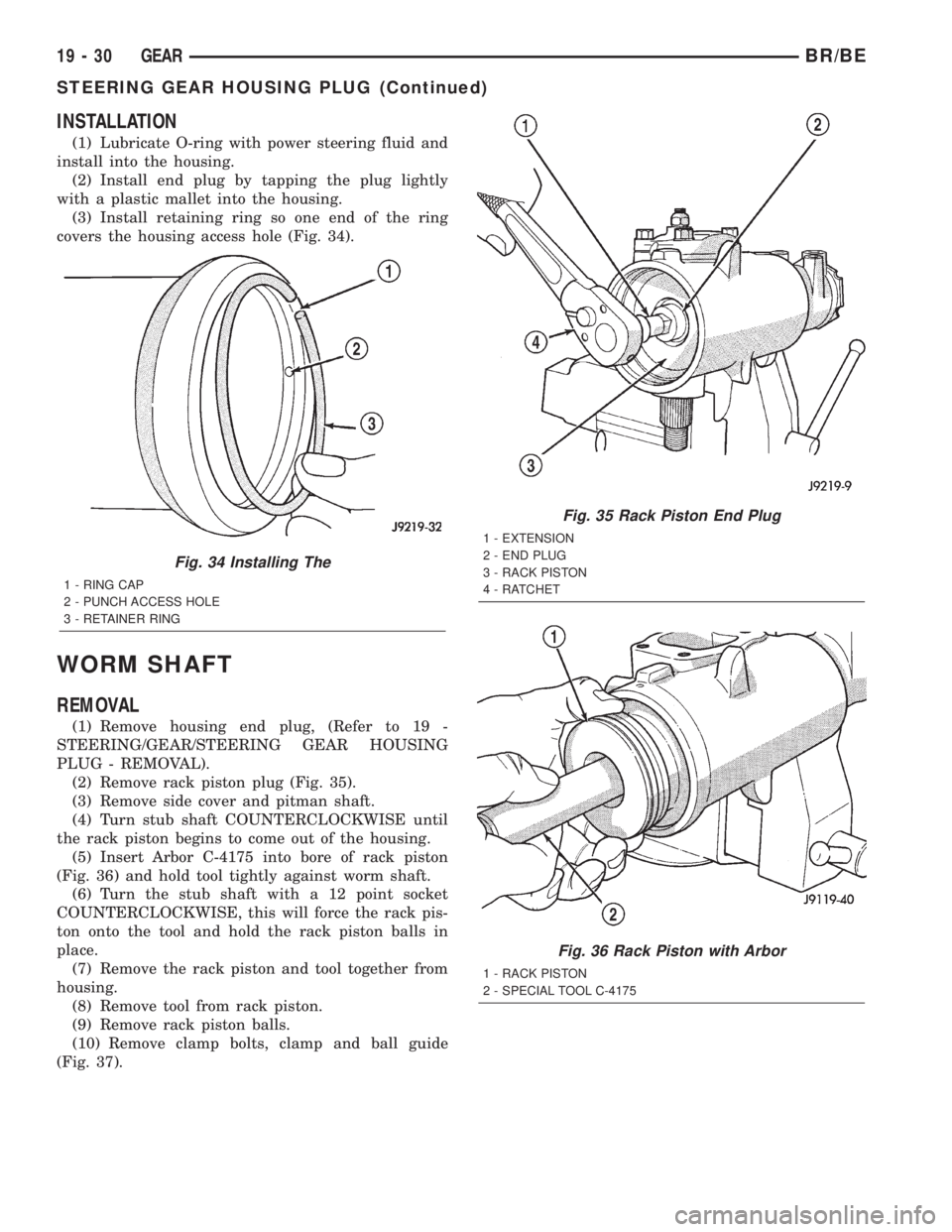
(3) Install retaining ring so one end of the ring
covers the housing access hole (Fig. 34).
WORM SHAFT
REMOVAL
(1) Remove housing end plug, (Refer to 19 -
STEERING/GEAR/STEERING GEAR HOUSING
PLUG - REMOVAL).
(2) Remove rack piston plug (Fig. 35).
(3) Remove side cover and pitman shaft.
(4) Turn stub shaft COUNTERCLOCKWISE until
the rack piston begins to come out of the housing.
(5) Insert Arbor C-4175 into bore of rack piston
(Fig. 36) and hold tool tightly against worm shaft.
(6) Turn the stub shaft with a 12 point socket
COUNTERCLOCKWISE, this will force the rack pis-
ton onto the tool and hold the rack piston balls in
place.
(7) Remove the rack piston and tool together from
housing.
(8) Remove tool from rack piston.
(9) Remove rack piston balls.
(10) Remove clamp bolts, clamp and ball guide
(Fig. 37).
Fig. 34 Installing The
1 - RING CAP
2 - PUNCH ACCESS HOLE
3 - RETAINER RING
Fig. 35 Rack Piston End Plug
1 - EXTENSION
2 - END PLUG
3 - RACK PISTON
4 - RATCHET
Fig. 36 Rack Piston with Arbor
1 - RACK PISTON
2 - SPECIAL TOOL C-4175
19 - 30 GEARBR/BE
STEERING GEAR HOUSING PLUG (Continued)
Page 1440 of 2255
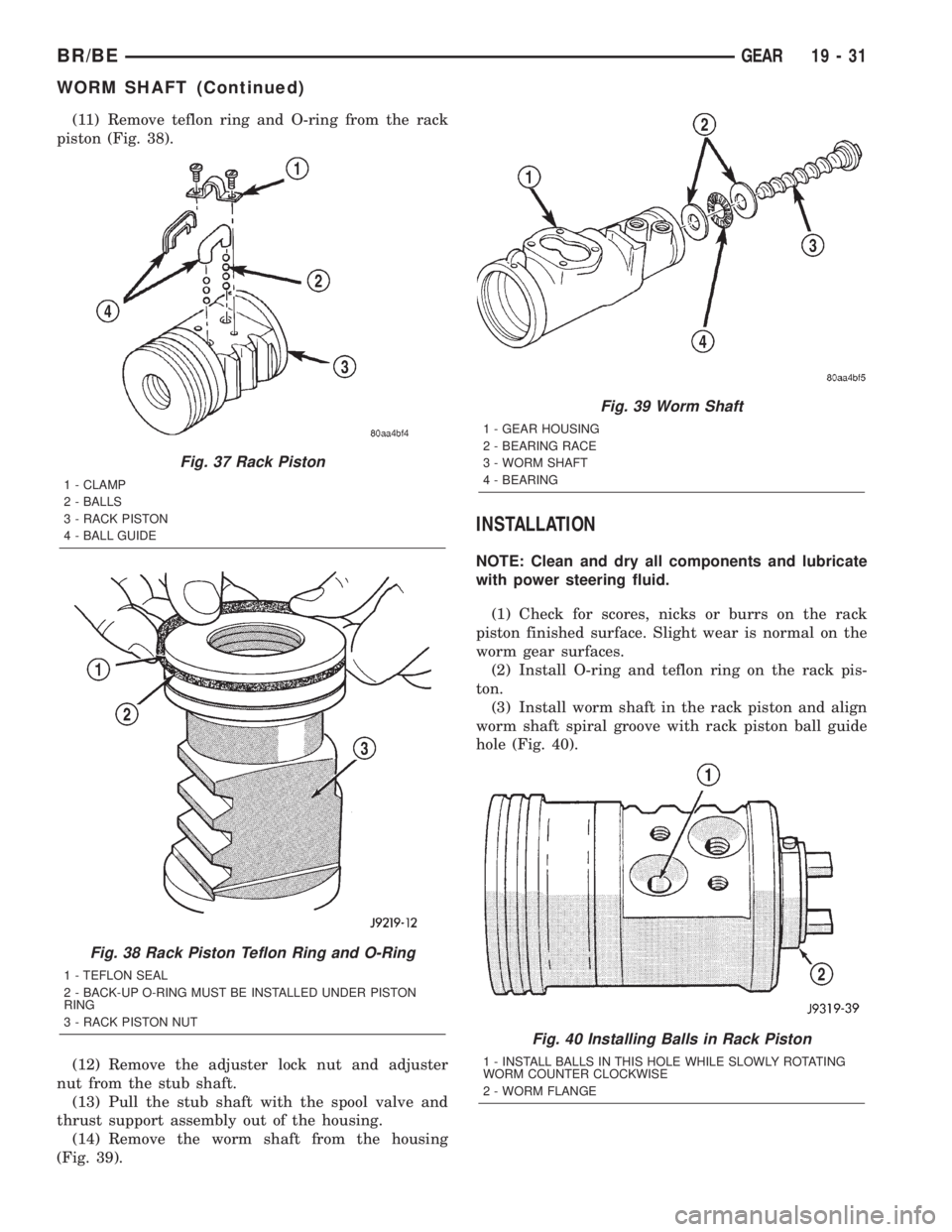
(11) Remove teflon ring and O-ring from the rack
piston (Fig. 38).
(12) Remove the adjuster lock nut and adjuster
nut from the stub shaft.
(13) Pull the stub shaft with the spool valve and
thrust support assembly out of the housing.
(14) Remove the worm shaft from the housing
(Fig. 39).
INSTALLATION
NOTE: Clean and dry all components and lubricate
with power steering fluid.
(1) Check for scores, nicks or burrs on the rack
piston finished surface. Slight wear is normal on the
worm gear surfaces.
(2) Install O-ring and teflon ring on the rack pis-
ton.
(3) Install worm shaft in the rack piston and align
worm shaft spiral groove with rack piston ball guide
hole (Fig. 40).
Fig. 37 Rack Piston
1 - CLAMP
2 - BALLS
3 - RACK PISTON
4 - BALL GUIDE
Fig. 38 Rack Piston Teflon Ring and O-Ring
1 - TEFLON SEAL
2 - BACK-UP O-RING MUST BE INSTALLED UNDER PISTON
RING
3 - RACK PISTON NUT
Fig. 39 Worm Shaft
1 - GEAR HOUSING
2 - BEARING RACE
3 - WORM SHAFT
4 - BEARING
Fig. 40 Installing Balls in Rack Piston
1 - INSTALL BALLS IN THIS HOLE WHILE SLOWLY ROTATING
WORM COUNTER CLOCKWISE
2 - WORM FLANGE
BR/BEGEAR 19 - 31
WORM SHAFT (Continued)
Page 1441 of 2255
CAUTION: The rack piston balls must be installed
alternately into the rack piston and ball guide. This
maintains worm shaft preload. There are 12 black
balls and 12 silver (Chrome) balls. The black balls
are smaller than the silver balls.
(4) Lubricate and install rack piston balls through
return guide hole while turning worm shaft COUN-
TERCLOCKWISE (Fig. 40).
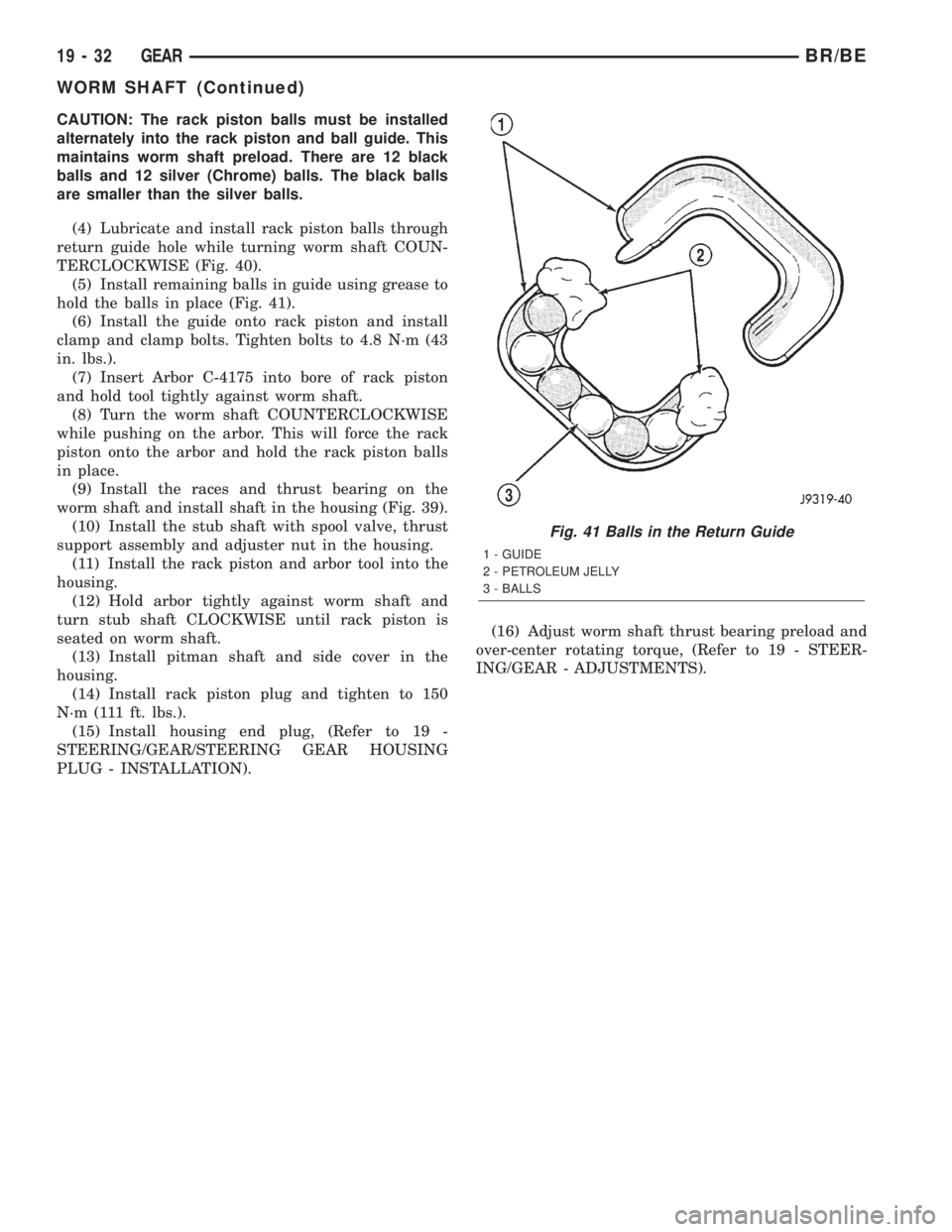
(5) Install remaining balls in guide using grease to
hold the balls in place (Fig. 41).
(6) Install the guide onto rack piston and install
clamp and clamp bolts. Tighten bolts to 4.8 N´m (43
in. lbs.).
(7) Insert Arbor C-4175 into bore of rack piston
and hold tool tightly against worm shaft.
(8) Turn the worm shaft COUNTERCLOCKWISE
while pushing on the arbor. This will force the rack
piston onto the arbor and hold the rack piston balls
in place.
(9) Install the races and thrust bearing on the
worm shaft and install shaft in the housing (Fig. 39).
(10) Install the stub shaft with spool valve, thrust
support assembly and adjuster nut in the housing.
(11) Install the rack piston and arbor tool into the
housing.
(12) Hold arbor tightly against worm shaft and
turn stub shaft CLOCKWISE until rack piston is
seated on worm shaft.
(13) Install pitman shaft and side cover in the
housing.
(14) Install rack piston plug and tighten to 150
N´m (111 ft. lbs.).
(15) Install housing end plug, (Refer to 19 -
STEERING/GEAR/STEERING GEAR HOUSING
PLUG - INSTALLATION).(16) Adjust worm shaft thrust bearing preload and
over-center rotating torque, (Refer to 19 - STEER-
ING/GEAR - ADJUSTMENTS).
Fig. 41 Balls in the Return Guide
1 - GUIDE
2 - PETROLEUM JELLY
3 - BALLS
19 - 32 GEARBR/BE
WORM SHAFT (Continued)
Page 1464 of 2255
MAINSHAFT AND GEARTRAIN
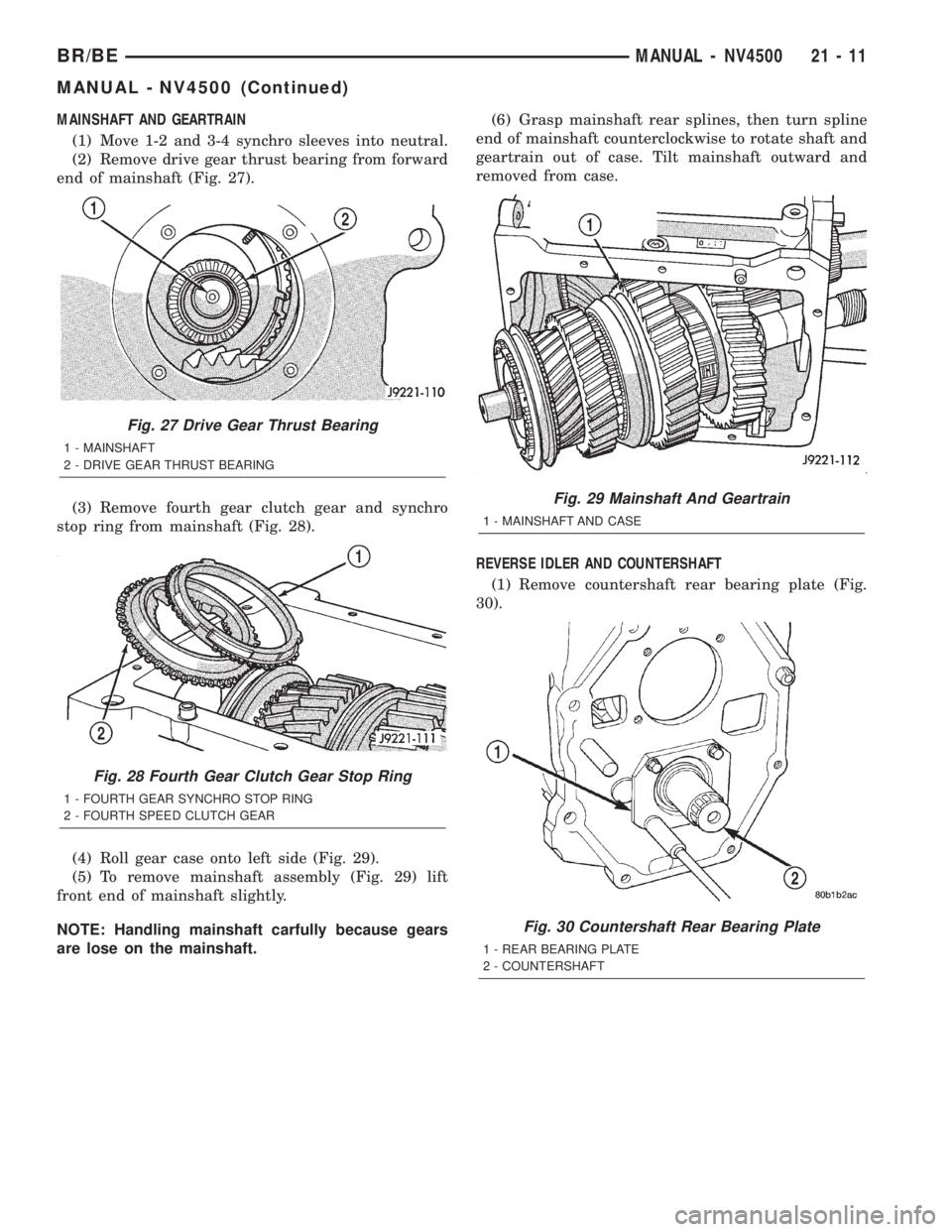
(1) Move 1-2 and 3-4 synchro sleeves into neutral.
(2) Remove drive gear thrust bearing from forward
end of mainshaft (Fig. 27).
(3) Remove fourth gear clutch gear and synchro
stop ring from mainshaft (Fig. 28).
(4) Roll gear case onto left side (Fig. 29).
(5) To remove mainshaft assembly (Fig. 29) lift
front end of mainshaft slightly.
NOTE: Handling mainshaft carfully because gears
are lose on the mainshaft.(6) Grasp mainshaft rear splines, then turn spline
end of mainshaft counterclockwise to rotate shaft and
geartrain out of case. Tilt mainshaft outward and
removed from case.
REVERSE IDLER AND COUNTERSHAFT
(1) Remove countershaft rear bearing plate (Fig.
30).
Fig. 27 Drive Gear Thrust Bearing
1 - MAINSHAFT
2 - DRIVE GEAR THRUST BEARING
Fig. 28 Fourth Gear Clutch Gear Stop Ring
1 - FOURTH GEAR SYNCHRO STOP RING
2 - FOURTH SPEED CLUTCH GEAR
Fig. 29 Mainshaft And Geartrain
1 - MAINSHAFT AND CASE
Fig. 30 Countershaft Rear Bearing Plate
1 - REAR BEARING PLATE
2 - COUNTERSHAFT
BR/BEMANUAL - NV4500 21 - 11
MANUAL - NV4500 (Continued)
Page 1485 of 2255
DRIVE GEAR AND RETAINER
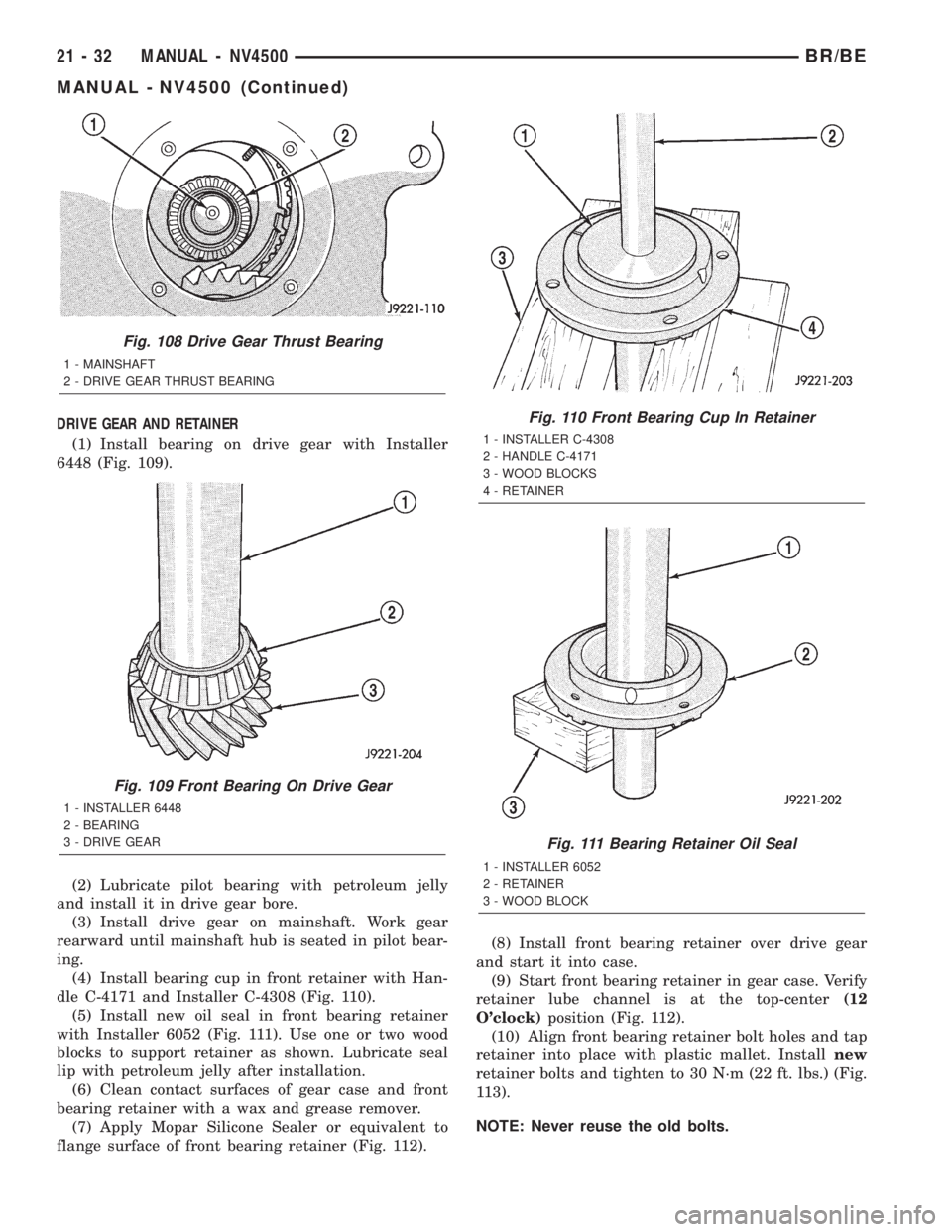
(1) Install bearing on drive gear with Installer
6448 (Fig. 109).
(2) Lubricate pilot bearing with petroleum jelly
and install it in drive gear bore.
(3) Install drive gear on mainshaft. Work gear
rearward until mainshaft hub is seated in pilot bear-
ing.
(4) Install bearing cup in front retainer with Han-
dle C-4171 and Installer C-4308 (Fig. 110).
(5) Install new oil seal in front bearing retainer
with Installer 6052 (Fig. 111). Use one or two wood
blocks to support retainer as shown. Lubricate seal
lip with petroleum jelly after installation.
(6) Clean contact surfaces of gear case and front
bearing retainer with a wax and grease remover.
(7) Apply Mopar Silicone Sealer or equivalent to
flange surface of front bearing retainer (Fig. 112).(8) Install front bearing retainer over drive gear
and start it into case.
(9) Start front bearing retainer in gear case. Verify
retainer lube channel is at the top-center(12
O'clock)position (Fig. 112).
(10) Align front bearing retainer bolt holes and tap
retainer into place with plastic mallet. Installnew
retainer bolts and tighten to 30 N´m (22 ft. lbs.) (Fig.
113).
NOTE: Never reuse the old bolts.
Fig. 108 Drive Gear Thrust Bearing
1 - MAINSHAFT
2 - DRIVE GEAR THRUST BEARING
Fig. 109 Front Bearing On Drive Gear
1 - INSTALLER 6448
2 - BEARING
3 - DRIVE GEAR
Fig. 110 Front Bearing Cup In Retainer
1 - INSTALLER C-4308
2 - HANDLE C-4171
3 - WOOD BLOCKS
4 - RETAINER
Fig. 111 Bearing Retainer Oil Seal
1 - INSTALLER 6052
2 - RETAINER
3 - WOOD BLOCK
21 - 32 MANUAL - NV4500BR/BE
MANUAL - NV4500 (Continued)
Page 1528 of 2255
(7) Install input shaft oil guide with C-3972-A and
Handle C-4171.
(8) Apply sealer to the input shaft retainer and
install retainer onto the clutch housing. Install bolts
and tighten to 28 N´m (20 ft.lbs.).
REVERSE GEAR
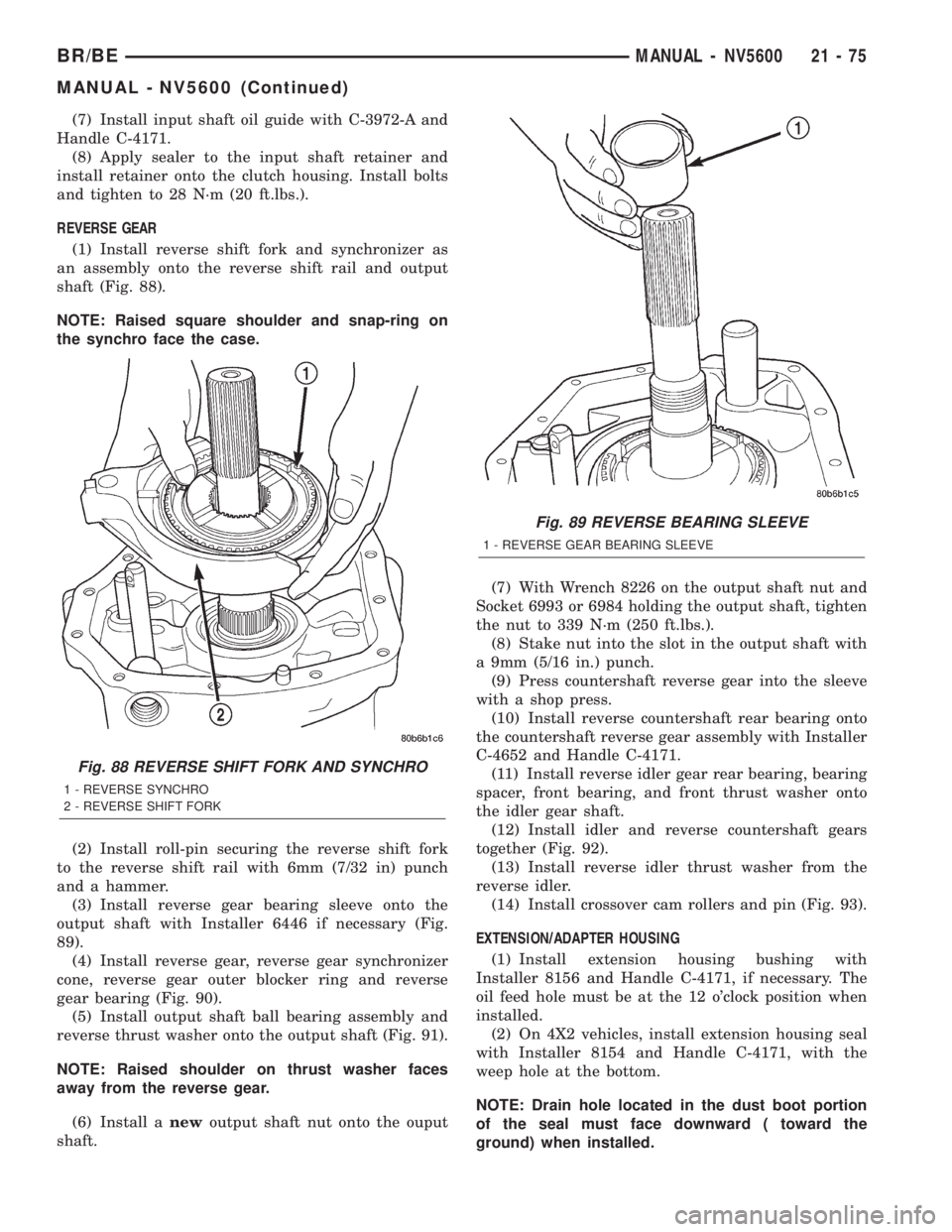
(1) Install reverse shift fork and synchronizer as
an assembly onto the reverse shift rail and output
shaft (Fig. 88).
NOTE: Raised square shoulder and snap-ring on
the synchro face the case.
(2) Install roll-pin securing the reverse shift fork
to the reverse shift rail with 6mm (7/32 in) punch
and a hammer.
(3) Install reverse gear bearing sleeve onto the
output shaft with Installer 6446 if necessary (Fig.
89).
(4) Install reverse gear, reverse gear synchronizer
cone, reverse gear outer blocker ring and reverse
gear bearing (Fig. 90).
(5) Install output shaft ball bearing assembly and
reverse thrust washer onto the output shaft (Fig. 91).
NOTE: Raised shoulder on thrust washer faces
away from the reverse gear.
(6) Install anewoutput shaft nut onto the ouput
shaft.(7) With Wrench 8226 on the output shaft nut and
Socket 6993 or 6984 holding the output shaft, tighten
the nut to 339 N´m (250 ft.lbs.).
(8) Stake nut into the slot in the output shaft with
a 9mm (5/16 in.) punch.
(9) Press countershaft reverse gear into the sleeve
with a shop press.
(10) Install reverse countershaft rear bearing onto
the countershaft reverse gear assembly with Installer
C-4652 and Handle C-4171.
(11) Install reverse idler gear rear bearing, bearing
spacer, front bearing, and front thrust washer onto
the idler gear shaft.
(12) Install idler and reverse countershaft gears
together (Fig. 92).
(13) Install reverse idler thrust washer from the
reverse idler.
(14) Install crossover cam rollers and pin (Fig. 93).
EXTENSION/ADAPTER HOUSING
(1) Install extension housing bushing with
Installer 8156 and Handle C-4171, if necessary. The
oil feed hole must be at the 12 o'clock position when
installed.
(2) On 4X2 vehicles, install extension housing seal
with Installer 8154 and Handle C-4171, with the
weep hole at the bottom.
NOTE: Drain hole located in the dust boot portion
of the seal must face downward ( toward the
ground) when installed.
Fig. 88 REVERSE SHIFT FORK AND SYNCHRO
1 - REVERSE SYNCHRO
2 - REVERSE SHIFT FORK
Fig. 89 REVERSE BEARING SLEEVE
1 - REVERSE GEAR BEARING SLEEVE
BR/BEMANUAL - NV5600 21 - 75
MANUAL - NV5600 (Continued)
Page 1545 of 2255
PARK POWERFLOW
As the engine is running and the crankshaft is
rotating, the flexplate and torque converter, which
are also bolted to it, are all rotating in a clockwise
direction as viewed from the front of the engine. The
notched hub of the torque converter is connected to
the oil pump's internal gear, supplying the transmis-
sion with oil pressure. As the converter turns, it
turns the input shaft in a clockwise direction. As the
input shaft is rotating, the front clutch hub-rear
clutch retainer and all their associated parts are also
rotating, all being directly connected to the input
shaft. The power flow from the engine through the
front clutch hub and rear clutch retainer stops at the
rear clutch retainer. Therefore, no power flow to the
output shaft occurs because no clutches are applied.
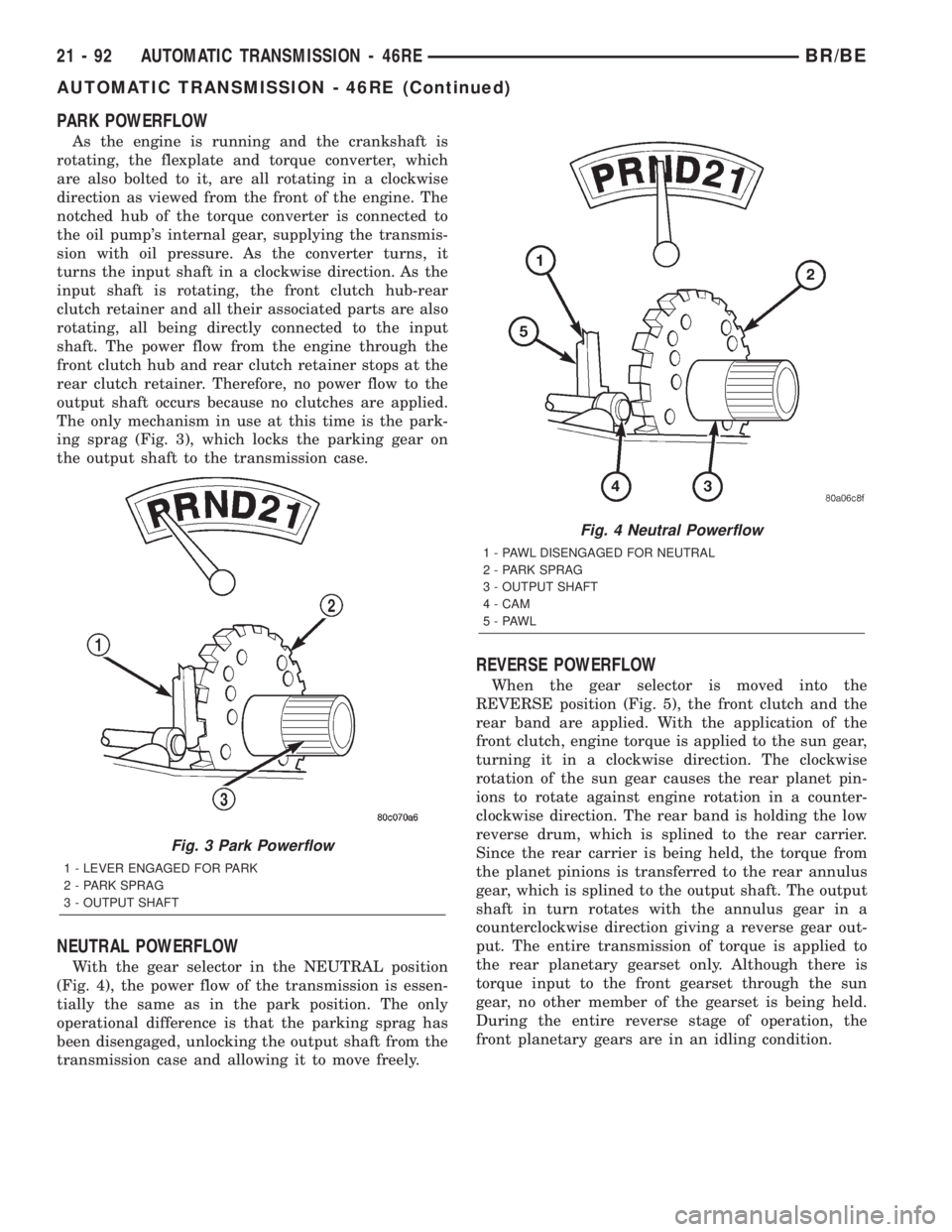
The only mechanism in use at this time is the park-
ing sprag (Fig. 3), which locks the parking gear on
the output shaft to the transmission case.
NEUTRAL POWERFLOW
With the gear selector in the NEUTRAL position
(Fig. 4), the power flow of the transmission is essen-
tially the same as in the park position. The only
operational difference is that the parking sprag has
been disengaged, unlocking the output shaft from the
transmission case and allowing it to move freely.
REVERSE POWERFLOW
When the gear selector is moved into the
REVERSE position (Fig. 5), the front clutch and the
rear band are applied. With the application of the
front clutch, engine torque is applied to the sun gear,
turning it in a clockwise direction. The clockwise
rotation of the sun gear causes the rear planet pin-
ions to rotate against engine rotation in a counter-
clockwise direction. The rear band is holding the low
reverse drum, which is splined to the rear carrier.
Since the rear carrier is being held, the torque from
the planet pinions is transferred to the rear annulus
gear, which is splined to the output shaft. The output
shaft in turn rotates with the annulus gear in a
counterclockwise direction giving a reverse gear out-
put. The entire transmission of torque is applied to
the rear planetary gearset only. Although there is
torque input to the front gearset through the sun
gear, no other member of the gearset is being held.
During the entire reverse stage of operation, the
front planetary gears are in an idling condition.
Fig. 3 Park Powerflow
1 - LEVER ENGAGED FOR PARK
2 - PARK SPRAG
3 - OUTPUT SHAFT
Fig. 4 Neutral Powerflow
1 - PAWL DISENGAGED FOR NEUTRAL
2 - PARK SPRAG
3 - OUTPUT SHAFT
4 - CAM
5-PAWL
21 - 92 AUTOMATIC TRANSMISSION - 46REBR/BE
AUTOMATIC TRANSMISSION - 46RE (Continued)