ad blue DODGE RAM 2002 Service User Guide
[x] Cancel search | Manufacturer: DODGE, Model Year: 2002, Model line: RAM, Model: DODGE RAM 2002Pages: 2255, PDF Size: 62.07 MB
Page 504 of 2255
played when the ignition switch was turned to the
Off position.
²Trip Odometer Reset- When the trip odome-
ter reset switch is pressed and held for longer than
about two seconds, the trip odometer will be reset to
000.0 kilometers (miles). The VFD must be display-
ing the trip odometer information in order for the
trip odometer information to be reset.
²Message Failure- If the cluster fails to receive
a distance message during normal operation, it will
flash the odometer/trip odometer distance informa-
tion on and off repeatedly until a distance message is
received, or until the ignition switch is turned to the
Off position, whichever occurs first. If the cluster
does not receive a distance message within one sec-
ond after the ignition switch is turned to the On posi-
tion, it will display the last distance message stored
in the cluster memory. If the cluster is unable to dis-
play distance information due to an error internal to
the cluster, the VFD display will be blank.
²Actuator Test- Each time the cluster is put
through the actuator test, the VFD will display all of
its characters at once, then step through each char-
acter segment individually during the VFD portion of
the test to confirm the functionality of the VFD and
the cluster control circuitry.
The PCM continually monitors the vehicle speed
sensor, then sends the proper distance messages to
the instrument cluster. For further diagnosis of the
odometer/trip odometer or the instrument cluster cir-
cuitry that controls these functions, (Refer to 8 -
ELECTRICAL/INSTRUMENT CLUSTER - DIAGNO-
SIS AND TESTING). For proper diagnosis of the
vehicle speed sensor, the PCM, the CCD data bus, or
the message inputs to the instrument cluster that
control the odometer/trip odometer, a DRBIIItscan
tool is required. Refer to the appropriate diagnostic
information.
OIL PRESSURE GAUGE
DESCRIPTION
An oil pressure gauge is standard equipment on all
instrument clusters. The oil pressure gauge is located
in the upper right quadrant of the instrument clus-
ter, above the fuel gauge. The oil pressure gauge con-
sists of a movable gauge needle or pointer controlled
by the instrument cluster circuitry and a fixed 90
degree scale on the cluster overlay that reads left-to-
right either from 0 kPa (0 psi) to 758 kPa (110 psi).
An International Control and Display Symbol icon for
ªEngine Oilº is located on the cluster overlay, directly
below the highest graduation of the gauge scale. The
oil pressure gauge graphics are white against a black
field except for a single red graduation at the lowend of the gauge scale, making them clearly visible
within the instrument cluster in daylight. When illu-
minated from behind by the panel lamps dimmer
controlled cluster illumination lighting with the exte-
rior lamps turned On, the white graphics appear
blue-green and the red graphics appear red. The
orange gauge needle is internally illuminated. Gauge
illumination is provided by replaceable incandescent
bulb and bulb holder units located on the instrument
cluster electronic circuit board. The oil pressure
gauge is serviced as a unit with the instrument clus-
ter.
OPERATION
The oil pressure gauge gives an indication to the
vehicle operator of the engine oil pressure. This
gauge is controlled by the instrument cluster circuit
board based upon the cluster programming and elec-
tronic messages received by the cluster from the
Powertrain Control Module (PCM) over the Chrysler
Collision Detection (CCD) data bus. The oil pressure
gauge is an air core magnetic unit that receives bat-
tery current on the instrument cluster electronic cir-
cuit board through the fused ignition switch output
(st-run) circuit whenever the ignition switch is in the
On or Start positions. The cluster is programmed to
move the gauge needle back to the low end of the
scale after the ignition switch is turned to the Off
position. The instrument cluster circuitry controls
the gauge needle position and provides the following
features:
²Engine Oil Pressure Message- The instru-
ment cluster circuitry restricts the oil pressure gauge
needle operation in order to provide readings that
are consistent with customer expectations. Each time
the cluster receives a message from the PCM indicat-
ing the engine oil pressure is between about 6.9 kPa
(1 psi) and 137.9 kPa (20 psi) for gasoline engines, or
55 kPa (8 psi) and 58.6 kPa (8.5 psi) for diesel
engines, the cluster holds the gauge needle at a point
about 11 degrees above the low end of normal incre-
ment on the gauge scale. Each time the cluster
receives a message from the PCM indicating the
engine oil pressure is between about 517.1 kPa (75
psi) and 755 kPa (109.5 psi) for gasoline engines, or
551.6 kPa (80 psi) and 755 kPa (109.5 psi) for diesel
engines, the cluster holds the gauge needle at a point
about 7.4 degrees below the high end of normal
increment on the gauge scale. When the cluster
receives messages from the PCM indicating the
engine oil pressure is between about 137.9 kPa (20
psi) and 517.1 kPa (75 psi) for gasoline engines, or
58.6 kPa (8.5 psi) and 551.6 kPa (80 psi) for diesel
engines], the gauge needle is moved to the actual
pressure position on the gauge scale.
BR/BEINSTRUMENT CLUSTER 8J - 25
ODOMETER (Continued)
Page 509 of 2255
illumination lighting with the exterior lamps turned
On, the white graphics appear blue-green, while the
red graphics still appear red. The orange gauge nee-
dle is internally illuminated. Gauge illumination is
provided by replaceable incandescent bulb and bulb
holder units located on the instrument cluster elec-
tronic circuit board. The speedometer is serviced as a
unit with the instrument cluster.
OPERATION
The speedometer gives an indication to the vehicle
operator of the vehicle road speed. This gauge is con-
trolled by the instrument cluster circuit board based
upon the cluster programming and electronic mes-
sages received by the cluster from the Powertrain
Control Module (PCM) over the Chrysler Collision
Detection (CCD) data bus. The speedometer is an air
core magnetic unit that receives battery current on
the instrument cluster electronic circuit board
through the fused ignition switch output (st-run) cir-
cuit whenever the ignition switch is in the On or
Start positions. The cluster is programmed to move
the gauge needle back to the low end of the scale
after the ignition switch is turned to the Off position.
The instrument cluster circuitry controls the gauge
needle position and provides the following features:
²Message Failure- If the cluster fails to receive
a speedometer message, it will hold the gauge needle
at the last indication for about four seconds, or until
the ignition switch is turned to the Off position,
whichever occurs first. If a new speedometer message
is not received after about four seconds, the gauge
needle will return to the far left (low) end of the
scale.
²Actuator Test- Each time the cluster is put
through the actuator test, the gauge needle will be
swept to several calibration points on the gauge scale
in a prescribed sequence in order to confirm the func-
tionality of the gauge and the cluster control cir-
cuitry.
The PCM continually monitors the vehicle speed
sensor to determine the vehicle road speed, then
sends the proper vehicle speed messages to the
instrument cluster. For further diagnosis of the
speedometer or the instrument cluster circuitry that
controls the gauge, (Refer to 8 - ELECTRICAL/IN-
STRUMENT CLUSTER - DIAGNOSIS AND TEST-
ING). For proper diagnosis of the vehicle speed
sensor, the PCM, the CCD data bus, or the message
inputs to the instrument cluster that control the
speedometer, a DRBIIItscan tool is required. Refer
to the appropriate diagnostic information.
TACHOMETER
DESCRIPTION
A tachometer is standard equipment on all instru-
ment clusters. The tachometer is located just to the
left of the speedometer near the center of the instru-
ment cluster. The tachometer consists of a movable
gauge needle or pointer controlled by the instrument
cluster circuitry and a fixed 210 degree scale on the
gauge dial face that reads left-to-right either from 0
to 6 for gasoline engines, or from 0 to 4 for diesel
engines. The text ªRPM X 1000º imprinted on the
cluster overlay directly below the hub of the tachom-
eter needle identifies that each number on the
tachometer scale is to be multiplied times 1000 rpm.
The gauge scale of the gasoline engine tachometer is
red lined at 5000 rpm, while the diesel engine
tachometer is red lined at 3375 rpm. The diesel
engine tachometer also includes text that specifies
ªDIESEL FUEL ONLYº located just above the hub of
the tachometer needle. The tachometer graphics are
white and red against a black field, making them
clearly visible within the instrument cluster in day-
light. When illuminated from behind by the panel
lamps dimmer controlled cluster illumination lighting
with the exterior lamps turned On, the white graph-
ics appear blue-green, while the red graphics still
appear red. The orange gauge needle is internally
illuminated. Gauge illumination is provided by
replaceable incandescent bulb and bulb holder units
located on the instrument cluster electronic circuit
board. The tachometer is serviced as a unit with the
instrument cluster.
OPERATION
The tachometer gives an indication to the vehicle
operator of the engine speed. This gauge is controlled
by the instrument cluster circuit board based upon
the cluster programming and electronic messages
received by the cluster from the Powertrain Control
Module (PCM) over the Chrysler Collision Detection
(CCD) data bus. The tachometer is an air core mag-
netic unit that receives battery current on the instru-
ment cluster electronic circuit board through the
fused ignition switch output (st-run) circuit whenever
the ignition switch is in the On or Start positions.
The cluster is programmed to move the gauge needle
back to the low end of the scale after the ignition
switch is turned to the Off position. The instrument
cluster circuitry controls the gauge needle position
and provides the following features:
²Message Failure- If the cluster fails to receive
an engine speed message, it will hold the gauge nee-
dle at the last indication for about four seconds, or
until the ignition switch is turned to the Off position,
whichever occurs first. If a new engine speed mes-
8J - 30 INSTRUMENT CLUSTERBR/BE
SPEEDOMETER (Continued)
Page 512 of 2255
OPERATION
The upshift indicator gives an indication to the
vehicle operator when the transmission should be
shifted to the next highest gear in order to achieve
the best fuel economy. This indicator is controlled by
a transistor on the instrument cluster circuit board
based upon the cluster programming and electronic
messages received by the cluster from the Powertrain
Control Module (PCM) over the Chrysler Collision
Detection (CCD) data bus. The upshift indicator bulb
receives battery current on the instrument cluster
electronic circuit board through the fused ignition
switch output (st-run) circuit whenever the ignition
switch is in the On or Start positions; therefore, the
lamp will always be off when the ignition switch is in
any position except On or Start. The bulb only illu-
minates when it is provided a path to ground by the
instrument cluster transistor. On models not
equipped with a manual transmission, the incandes-
cent bulb and bulb holder unit are not installed at
the factory when the vehicle is built. The instrument
cluster will turn on the upshift indicator for the fol-
lowing reasons:
²Upshift Lamp-On Message- Each time the
cluster receives an upshift lamp-on message from the
PCM indicating the engine speed and load conditions
are right for a transmission upshift to occur, the
upshift indicator is illuminated. The indicator
remains illuminated until the cluster receives an
upshift lamp-off message from the PCM or until the
ignition switch is turned to the Off position, which-
ever occurs first. The PCM will normally send an
upshift lamp-off message three to five seconds after a
lamp-on message, if an upshift is not performed. The
indicator will then remain off until the vehicle stops
accelerating and is brought back into the range of
indicator operation, or until the transmission is
shifted into another gear.
²Actuator Test- Each time the cluster is put
through the actuator test, the indicator will be
turned on during the bulb check portion of the test to
confirm the functionality of the indicator and the
cluster control circuitry.
The PCM continually monitors the engine speed
and load conditions to determine the proper fuel and
ignition requirements. The PCM then sends the
proper messages to the instrument cluster. If the
upshift indicator fails to light during normal vehicle
operation, replace the bulb with a known good unit.
For further diagnosis of the upshift indicator or the
instrument cluster circuitry that controls the indica-
tor, (Refer to 8 - ELECTRICAL/INSTRUMENT
CLUSTER - DIAGNOSIS AND TESTING). For
proper diagnosis of the PCM, the CCD data bus, or
the message inputs to the instrument cluster that
control the upshift indicator, a DRBIIItscan tool isrequired. Refer to the appropriate diagnostic infor-
mation.
VOLTAGE GAUGE
DESCRIPTION
A voltage gauge is standard equipment on all
instrument clusters. The voltage gauge is located in
the upper left quadrant of the instrument cluster,
above the temperature gauge. The voltage gauge con-
sists of a movable gauge needle or pointer controlled
by the instrument cluster circuitry and a fixed 90
degree scale on the cluster overlay that reads left-to-
right from 8 volts to 18 volts. An International Con-
trol and Display Symbol icon for ªBattery Charging
Conditionº is located directly below the lowest grad-
uation of the gauge scale. The voltage gauge graphics
are white against a black field except for a single red
graduation at each end of the gauge scale, making
them clearly visible within the instrument cluster in
daylight. When illuminated from behind by the panel
lamps dimmer controlled cluster illumination lighting
with the exterior lamps turned On, the white graph-
ics appear blue-green and the red graphics appear
red. The orange gauge needle is internally illumi-
nated. Gauge illumination is provided by replaceable
incandescent bulb and bulb holder units located on
the instrument cluster electronic circuit board. The
voltage gauge is serviced as a unit with the instru-
ment cluster.
OPERATION
The voltage gauge gives an indication to the vehi-
cle operator of the electrical system voltage. This
gauge is controlled by the instrument cluster circuit
board based upon the cluster programming and elec-
tronic messages received by the cluster from the
Powertrain Control Module (PCM) over the Chrysler
Collision Detection (CCD) data bus. The voltage
gauge is an air core magnetic unit that receives bat-
tery current on the instrument cluster electronic cir-
cuit board through the fused ignition switch output
(st-run) circuit whenever the ignition switch is in the
On or Start positions. The cluster is programmed to
move the gauge needle back to the low end of the
scale after the ignition switch is turned to the Off
position. The instrument cluster circuitry controls
the gauge needle position and provides the following
features:
²Charge Fail Message- Each time the cluster
receives a message from the PCM indicating a charge
fail condition (system voltage is 10.8 volts or lower),
the gauge needle is moved to the 8 volt graduation
on the gauge scale and the check gauges indicator is
illuminated. The gauge needle remains on the 8 volt
BR/BEINSTRUMENT CLUSTER 8J - 33
UPSHIFT INDICATOR (Continued)
Page 667 of 2255
SYMBOLS
International symbols are used throughout the wir-
ing diagrams. These symbols are consistent with
those being used around the world (Fig. 3).
TERMINOLOGY
This is a list of terms and definitions used in the
wiring diagrams.
LHD .................Left Hand Drive Vehicles
RHD................Right Hand Drive Vehicles
ATX . . Automatic Transmissions-Front Wheel Drive
MTX....Manual Transmissions-Front Wheel Drive
AT ....Automatic Transmissions-Rear Wheel Drive
MT .....Manual Transmissions-Rear Wheel Drive
SOHC...........Single Over Head Cam Engine
DOHC..........Double Over Head Cam Engine
Built-Up-Export........ Vehicles Built For Sale In
Markets Other Than North America
Except-Built-Up-Export . . Vehicles Built For Sale In
North America
DESCRIPTION - CIRCUIT INFORMATION
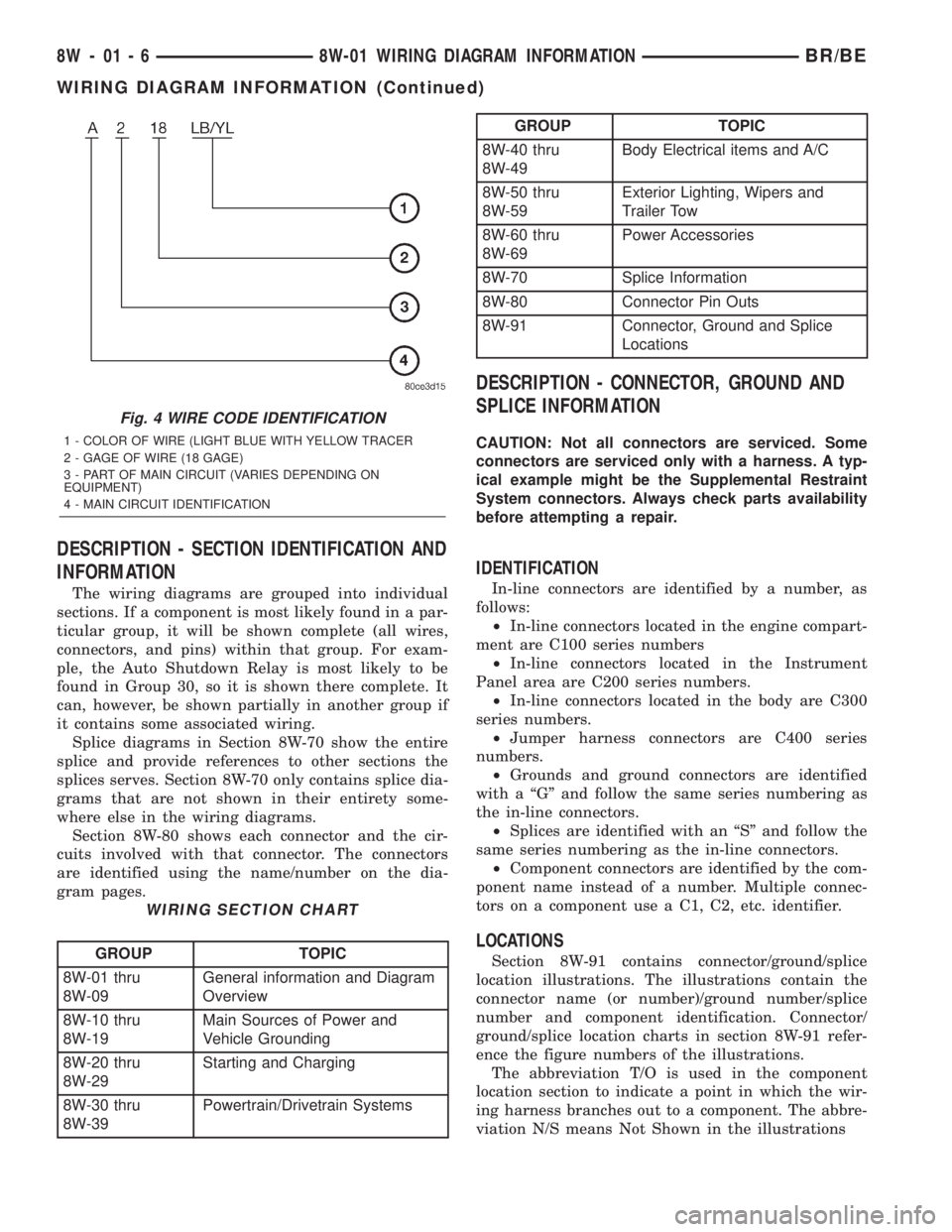
Each wire shown in the diagrams contains a code
which identifies the main circuit, part of the main
circuit, gage of wire, and color (Fig. 4).
WIRE COLOR CODE CHART
COLOR CODE COLOR
BL BLUE
BK BLACK
BR BROWN
DB DARK BLUE
DG DARK GREEN
GY GRAY
LB LIGHT BLUE
LG LIGHT GREEN
OR ORANGE
PK PINK
RD RED
TN TAN
VT VIOLET
WT WHITE
YL YELLOW
* WITH TRACER
DESCRIPTION - CIRCUIT FUNCTIONS
All circuits in the diagrams use an alpha/numeric
code to identify the wire and it's function. To identify
which circuit code applies to a system, refer to the
Circuit Identification Code Chart. This chart shows
the main circuits only and does not show the second-
ary codes that may apply to some models.
CIRCUIT IDENTIFICATION CODE CHART
CIRCUIT FUNCTION
A BATTERY FEED
B BRAKE CONTROLS
C CLIMATE CONTROLS
D DIAGNOSTIC CIRCUITS
E DIMMING ILLUMINATION
CIRCUITS
F FUSED CIRCUITS
G MONITORING CIRCUITS
(GAUGES)
H OPEN
I NOT USED
J OPEN
K POWERTRAIN CONTROL
MODULE
L EXTERIOR LIGHTING
M INTERIOR LIGHTING
N NOT USED
O NOT USED
P POWER OPTION (BATTERY
FEED)
Q POWER OPTIONS (IGNITION
FEED)
R PASSIVE RESTRAINT
S SUSPENSION/STEERING
T TRANSMISSION/TRANSAXLE/
TRANSFER CASE
U OPEN
V SPEED CONTROL, WIPER/
WASHER
W OPEN
X AUDIO SYSTEMS
Y OPEN
Z GROUNDS
8W - 01 - 4 8W-01 WIRING DIAGRAM INFORMATIONBR/BE
WIRING DIAGRAM INFORMATION (Continued)
Page 669 of 2255
DESCRIPTION - SECTION IDENTIFICATION AND
INFORMATION
The wiring diagrams are grouped into individual
sections. If a component is most likely found in a par-
ticular group, it will be shown complete (all wires,
connectors, and pins) within that group. For exam-
ple, the Auto Shutdown Relay is most likely to be
found in Group 30, so it is shown there complete. It
can, however, be shown partially in another group if
it contains some associated wiring.
Splice diagrams in Section 8W-70 show the entire
splice and provide references to other sections the
splices serves. Section 8W-70 only contains splice dia-
grams that are not shown in their entirety some-
where else in the wiring diagrams.
Section 8W-80 shows each connector and the cir-
cuits involved with that connector. The connectors
are identified using the name/number on the dia-
gram pages.
WIRING SECTION CHART
GROUP TOPIC
8W-01 thru
8W-09General information and Diagram
Overview
8W-10 thru
8W-19Main Sources of Power and
Vehicle Grounding
8W-20 thru
8W-29Starting and Charging
8W-30 thru
8W-39Powertrain/Drivetrain Systems
GROUP TOPIC
8W-40 thru
8W-49Body Electrical items and A/C
8W-50 thru
8W-59Exterior Lighting, Wipers and
Trailer Tow
8W-60 thru
8W-69Power Accessories
8W-70 Splice Information
8W-80 Connector Pin Outs
8W-91 Connector, Ground and Splice
Locations
DESCRIPTION - CONNECTOR, GROUND AND
SPLICE INFORMATION
CAUTION: Not all connectors are serviced. Some
connectors are serviced only with a harness. A typ-
ical example might be the Supplemental Restraint
System connectors. Always check parts availability
before attempting a repair.
IDENTIFICATION
In-line connectors are identified by a number, as
follows:
²In-line connectors located in the engine compart-
ment are C100 series numbers
²In-line connectors located in the Instrument
Panel area are C200 series numbers.
²In-line connectors located in the body are C300
series numbers.
²Jumper harness connectors are C400 series
numbers.
²Grounds and ground connectors are identified
with a ªGº and follow the same series numbering as
the in-line connectors.
²Splices are identified with an ªSº and follow the
same series numbering as the in-line connectors.
²Component connectors are identified by the com-
ponent name instead of a number. Multiple connec-
tors on a component use a C1, C2, etc. identifier.
LOCATIONS
Section 8W-91 contains connector/ground/splice
location illustrations. The illustrations contain the
connector name (or number)/ground number/splice
number and component identification. Connector/
ground/splice location charts in section 8W-91 refer-
ence the figure numbers of the illustrations.
The abbreviation T/O is used in the component
location section to indicate a point in which the wir-
ing harness branches out to a component. The abbre-
viation N/S means Not Shown in the illustrations
Fig. 4 WIRE CODE IDENTIFICATION
1 - COLOR OF WIRE (LIGHT BLUE WITH YELLOW TRACER
2 - GAGE OF WIRE (18 GAGE)
3 - PART OF MAIN CIRCUIT (VARIES DEPENDING ON
EQUIPMENT)
4 - MAIN CIRCUIT IDENTIFICATION
8W - 01 - 6 8W-01 WIRING DIAGRAM INFORMATIONBR/BE
WIRING DIAGRAM INFORMATION (Continued)
Page 973 of 2255
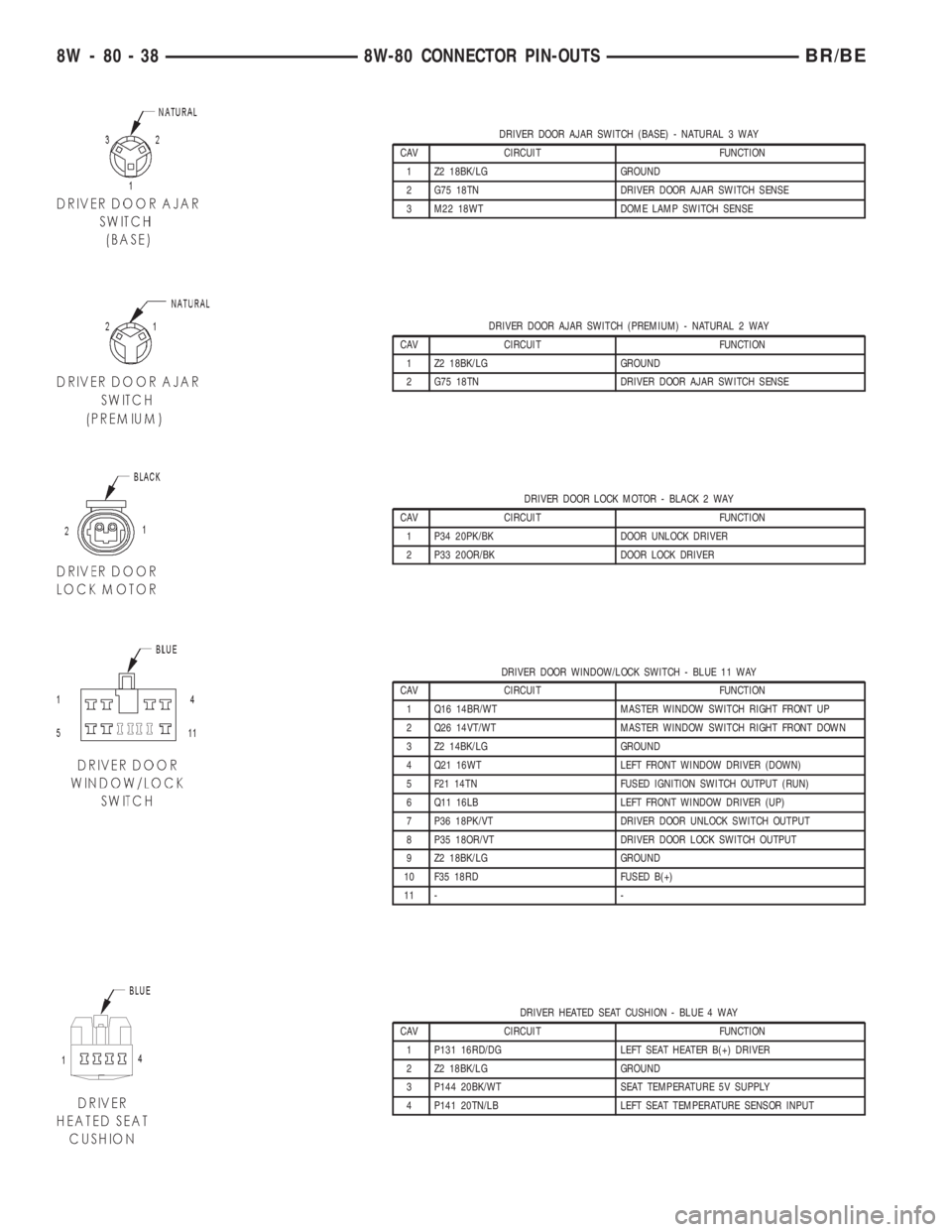
DRIVER DOOR AJAR SWITCH (BASE) - NATURAL 3 WAY
CAV CIRCUIT FUNCTION
1 Z2 18BK/LG GROUND
2 G75 18TN DRIVER DOOR AJAR SWITCH SENSE
3 M22 18WT DOME LAMP SWITCH SENSE
DRIVER DOOR AJAR SWITCH (PREMIUM) - NATURAL 2 WAY
CAV CIRCUIT FUNCTION
1 Z2 18BK/LG GROUND
2 G75 18TN DRIVER DOOR AJAR SWITCH SENSE
DRIVER DOOR LOCK MOTOR - BLACK 2 WAY
CAV CIRCUIT FUNCTION
1 P34 20PK/BK DOOR UNLOCK DRIVER
2 P33 20OR/BK DOOR LOCK DRIVER
DRIVER DOOR WINDOW/LOCK SWITCH - BLUE 11 WAY
CAV CIRCUIT FUNCTION
1 Q16 14BR/WT MASTER WINDOW SWITCH RIGHT FRONT UP
2 Q26 14VT/WT MASTER WINDOW SWITCH RIGHT FRONT DOWN
3 Z2 14BK/LG GROUND
4 Q21 16WT LEFT FRONT WINDOW DRIVER (DOWN)
5 F21 14TN FUSED IGNITION SWITCH OUTPUT (RUN)
6 Q11 16LB LEFT FRONT WINDOW DRIVER (UP)
7 P36 18PK/VT DRIVER DOOR UNLOCK SWITCH OUTPUT
8 P35 18OR/VT DRIVER DOOR LOCK SWITCH OUTPUT
9 Z2 18BK/LG GROUND
10 F35 18RD FUSED B(+)
11 - -
DRIVER HEATED SEAT CUSHION - BLUE 4 WAY
CAV CIRCUIT FUNCTION
1 P131 16RD/DG LEFT SEAT HEATER B(+) DRIVER
2 Z2 18BK/LG GROUND
3 P144 20BK/WT SEAT TEMPERATURE 5V SUPPLY
4 P141 20TN/LB LEFT SEAT TEMPERATURE SENSOR INPUT
8W - 80 - 38 8W-80 CONNECTOR PIN-OUTSBR/BE
Page 989 of 2255
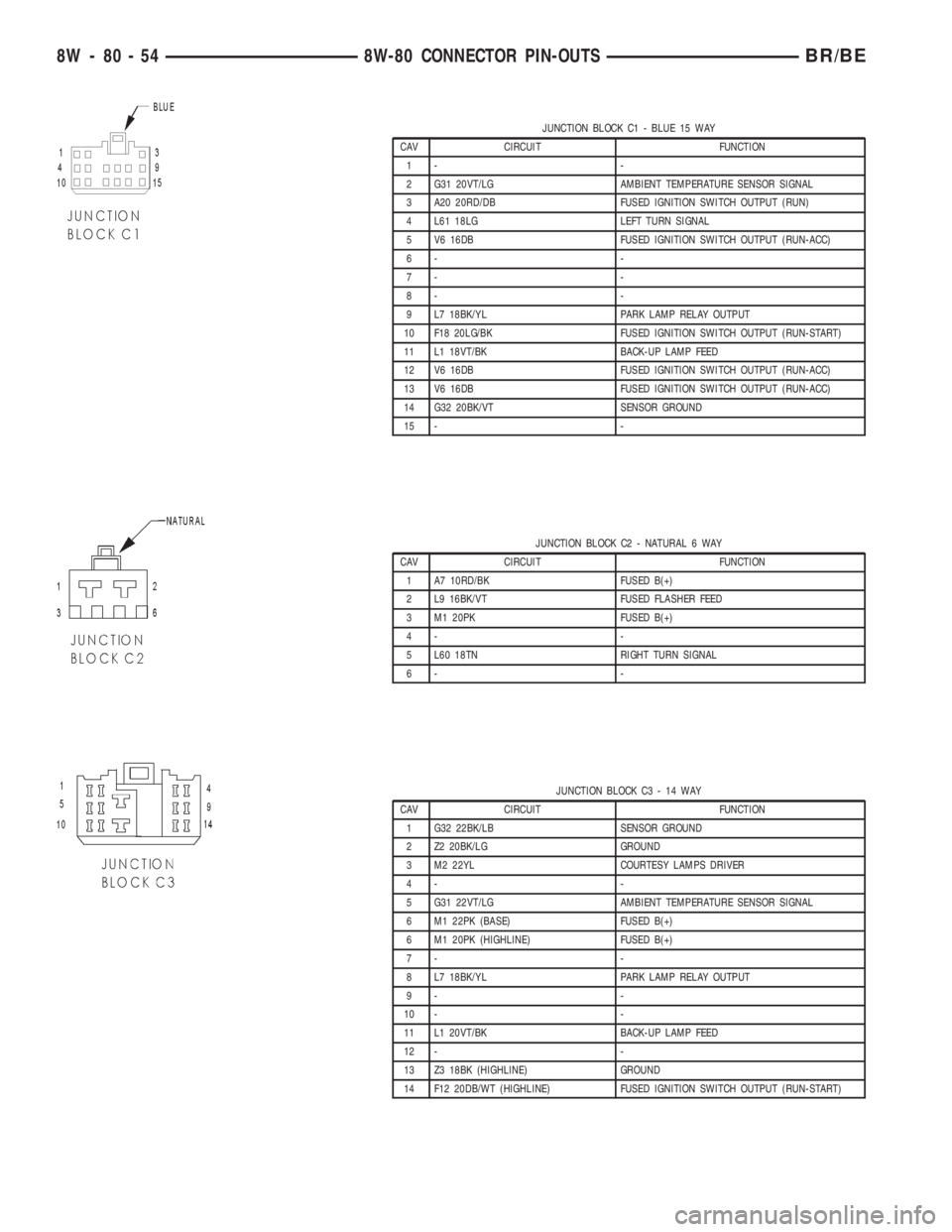
JUNCTION BLOCK C1 - BLUE 15 WAY
CAV CIRCUIT FUNCTION
1- -
2 G31 20VT/LG AMBIENT TEMPERATURE SENSOR SIGNAL
3 A20 20RD/DB FUSED IGNITION SWITCH OUTPUT (RUN)
4 L61 18LG LEFT TURN SIGNAL
5 V6 16DB FUSED IGNITION SWITCH OUTPUT (RUN-ACC)
6- -
7- -
8- -
9 L7 18BK/YL PARK LAMP RELAY OUTPUT
10 F18 20LG/BK FUSED IGNITION SWITCH OUTPUT (RUN-START)
11 L1 18VT/BK BACK-UP LAMP FEED
12 V6 16DB FUSED IGNITION SWITCH OUTPUT (RUN-ACC)
13 V6 16DB FUSED IGNITION SWITCH OUTPUT (RUN-ACC)
14 G32 20BK/VT SENSOR GROUND
15 - -
JUNCTION BLOCK C2 - NATURAL 6 WAY
CAV CIRCUIT FUNCTION
1 A7 10RD/BK FUSED B(+)
2 L9 16BK/VT FUSED FLASHER FEED
3 M1 20PK FUSED B(+)
4- -
5 L60 18TN RIGHT TURN SIGNAL
6- -
JUNCTION BLOCK C3 - 14 WAY
CAV CIRCUIT FUNCTION
1 G32 22BK/LB SENSOR GROUND
2 Z2 20BK/LG GROUND
3 M2 22YL COURTESY LAMPS DRIVER
4- -
5 G31 22VT/LG AMBIENT TEMPERATURE SENSOR SIGNAL
6 M1 22PK (BASE) FUSED B(+)
6 M1 20PK (HIGHLINE) FUSED B(+)
7- -
8 L7 18BK/YL PARK LAMP RELAY OUTPUT
9- -
10 - -
11 L1 20VT/BK BACK-UP LAMP FEED
12 - -
13 Z3 18BK (HIGHLINE) GROUND
14 F12 20DB/WT (HIGHLINE) FUSED IGNITION SWITCH OUTPUT (RUN-START)
8W - 80 - 54 8W-80 CONNECTOR PIN-OUTSBR/BE
Page 993 of 2255
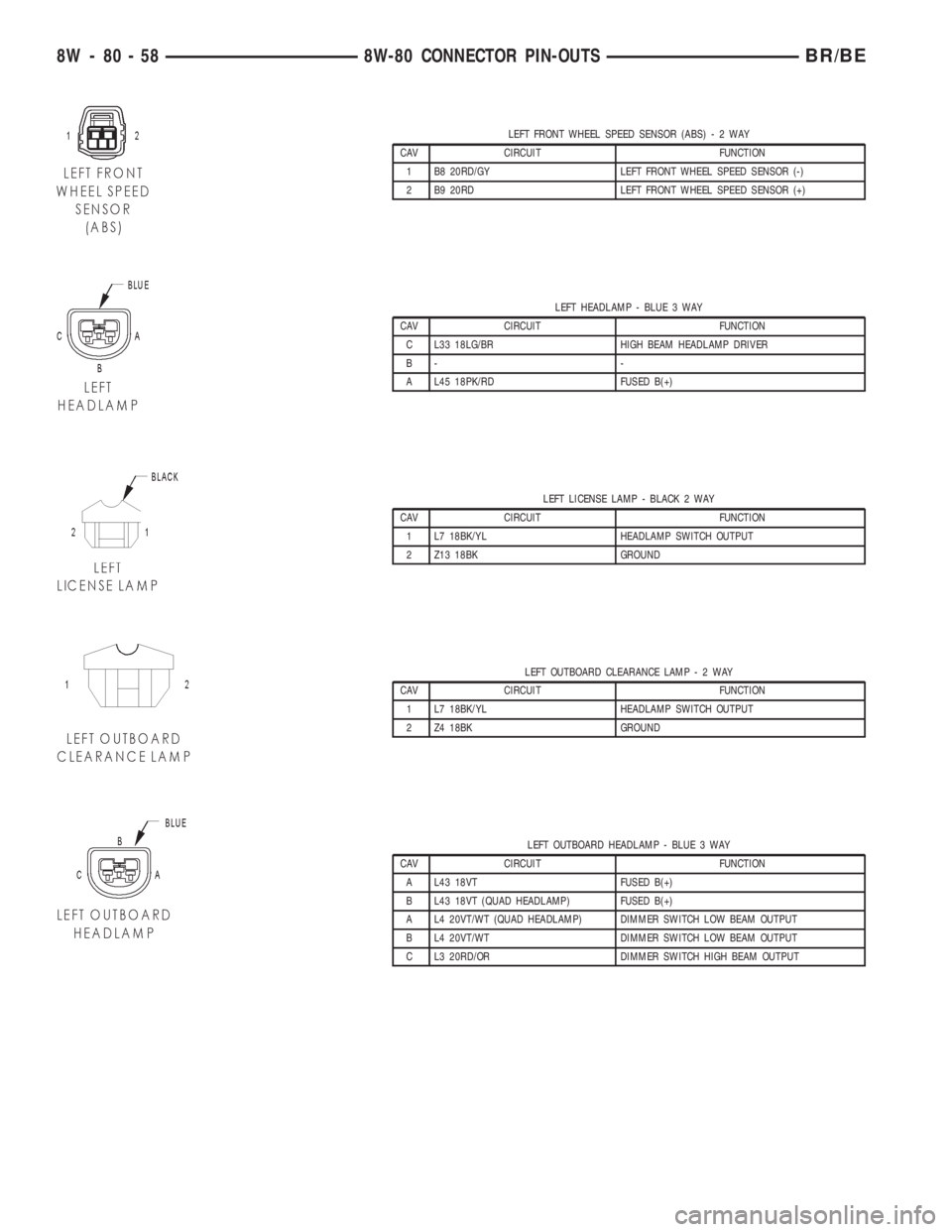
LEFT FRONT WHEEL SPEED SENSOR (ABS)-2WAY
CAV CIRCUIT FUNCTION
1 B8 20RD/GY LEFT FRONT WHEEL SPEED SENSOR (-)
2 B9 20RD LEFT FRONT WHEEL SPEED SENSOR (+)
LEFT HEADLAMP - BLUE 3 WAY
CAV CIRCUIT FUNCTION
C L33 18LG/BR HIGH BEAM HEADLAMP DRIVER
B- -
A L45 18PK/RD FUSED B(+)
LEFT LICENSE LAMP - BLACK 2 WAY
CAV CIRCUIT FUNCTION
1 L7 18BK/YL HEADLAMP SWITCH OUTPUT
2 Z13 18BK GROUND
LEFT OUTBOARD CLEARANCE LAMP-2WAY
CAV CIRCUIT FUNCTION
1 L7 18BK/YL HEADLAMP SWITCH OUTPUT
2 Z4 18BK GROUND
LEFT OUTBOARD HEADLAMP - BLUE 3 WAY
CAV CIRCUIT FUNCTION
A L43 18VT FUSED B(+)
B L43 18VT (QUAD HEADLAMP) FUSED B(+)
A L4 20VT/WT (QUAD HEADLAMP) DIMMER SWITCH LOW BEAM OUTPUT
B L4 20VT/WT DIMMER SWITCH LOW BEAM OUTPUT
C L3 20RD/OR DIMMER SWITCH HIGH BEAM OUTPUT
8W - 80 - 58 8W-80 CONNECTOR PIN-OUTSBR/BE
Page 998 of 2255
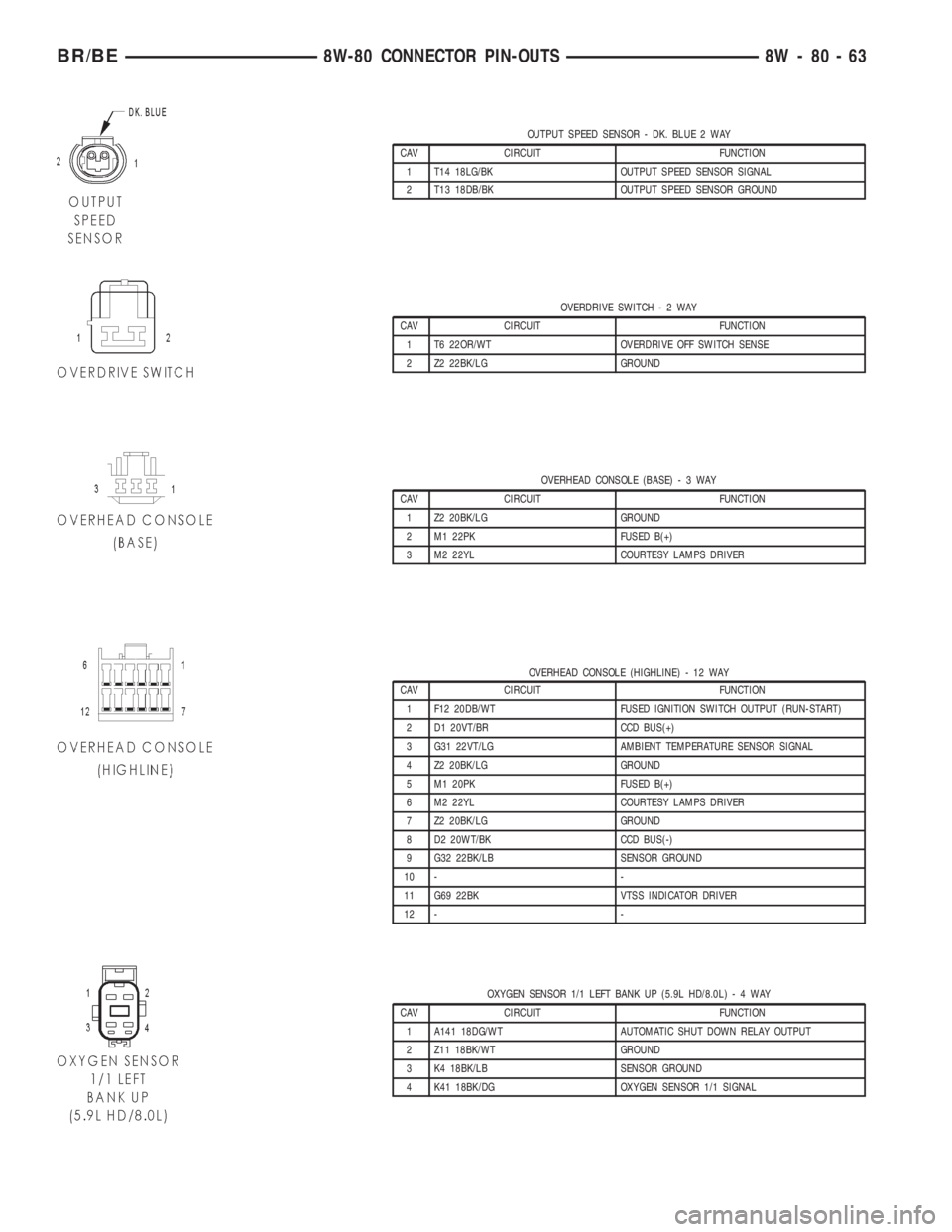
OUTPUT SPEED SENSOR - DK. BLUE 2 WAY
CAV CIRCUIT FUNCTION
1 T14 18LG/BK OUTPUT SPEED SENSOR SIGNAL
2 T13 18DB/BK OUTPUT SPEED SENSOR GROUND
OVERDRIVE SWITCH-2WAY
CAV CIRCUIT FUNCTION
1 T6 22OR/WT OVERDRIVE OFF SWITCH SENSE
2 Z2 22BK/LG GROUND
OVERHEAD CONSOLE (BASE)-3WAY
CAV CIRCUIT FUNCTION
1 Z2 20BK/LG GROUND
2 M1 22PK FUSED B(+)
3 M2 22YL COURTESY LAMPS DRIVER
OVERHEAD CONSOLE (HIGHLINE) - 12 WAY
CAV CIRCUIT FUNCTION
1 F12 20DB/WT FUSED IGNITION SWITCH OUTPUT (RUN-START)
2 D1 20VT/BR CCD BUS(+)
3 G31 22VT/LG AMBIENT TEMPERATURE SENSOR SIGNAL
4 Z2 20BK/LG GROUND
5 M1 20PK FUSED B(+)
6 M2 22YL COURTESY LAMPS DRIVER
7 Z2 20BK/LG GROUND
8 D2 20WT/BK CCD BUS(-)
9 G32 22BK/LB SENSOR GROUND
10 - -
11 G69 22BK VTSS INDICATOR DRIVER
12 - -
OXYGEN SENSOR 1/1 LEFT BANK UP (5.9L HD/8.0L)-4WAY
CAV CIRCUIT FUNCTION
1 A141 18DG/WT AUTOMATIC SHUT DOWN RELAY OUTPUT
2 Z11 18BK/WT GROUND
3 K4 18BK/LB SENSOR GROUND
4 K41 18BK/DG OXYGEN SENSOR 1/1 SIGNAL
BR/BE8W-80 CONNECTOR PIN-OUTS 8W - 80 - 63
Page 1002 of 2255
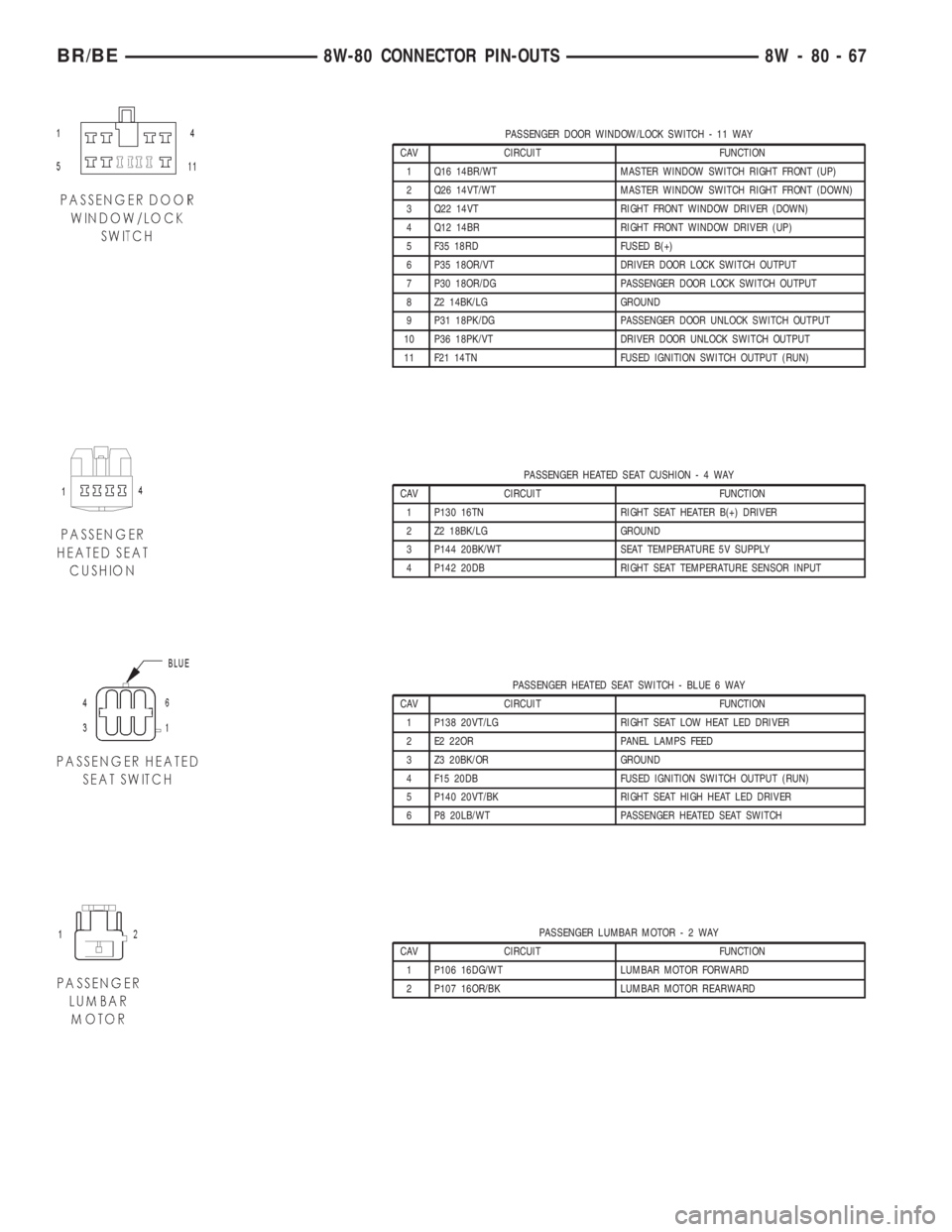
PASSENGER DOOR WINDOW/LOCK SWITCH - 11 WAY
CAV CIRCUIT FUNCTION
1 Q16 14BR/WT MASTER WINDOW SWITCH RIGHT FRONT (UP)
2 Q26 14VT/WT MASTER WINDOW SWITCH RIGHT FRONT (DOWN)
3 Q22 14VT RIGHT FRONT WINDOW DRIVER (DOWN)
4 Q12 14BR RIGHT FRONT WINDOW DRIVER (UP)
5 F35 18RD FUSED B(+)
6 P35 18OR/VT DRIVER DOOR LOCK SWITCH OUTPUT
7 P30 18OR/DG PASSENGER DOOR LOCK SWITCH OUTPUT
8 Z2 14BK/LG GROUND
9 P31 18PK/DG PASSENGER DOOR UNLOCK SWITCH OUTPUT
10 P36 18PK/VT DRIVER DOOR UNLOCK SWITCH OUTPUT
11 F21 14TN FUSED IGNITION SWITCH OUTPUT (RUN)
PASSENGER HEATED SEAT CUSHION-4WAY
CAV CIRCUIT FUNCTION
1 P130 16TN RIGHT SEAT HEATER B(+) DRIVER
2 Z2 18BK/LG GROUND
3 P144 20BK/WT SEAT TEMPERATURE 5V SUPPLY
4 P142 20DB RIGHT SEAT TEMPERATURE SENSOR INPUT
PASSENGER HEATED SEAT SWITCH - BLUE 6 WAY
CAV CIRCUIT FUNCTION
1 P138 20VT/LG RIGHT SEAT LOW HEAT LED DRIVER
2 E2 22OR PANEL LAMPS FEED
3 Z3 20BK/OR GROUND
4 F15 20DB FUSED IGNITION SWITCH OUTPUT (RUN)
5 P140 20VT/BK RIGHT SEAT HIGH HEAT LED DRIVER
6 P8 20LB/WT PASSENGER HEATED SEAT SWITCH
PASSENGER LUMBAR MOTOR-2WAY
CAV CIRCUIT FUNCTION
1 P106 16DG/WT LUMBAR MOTOR FORWARD
2 P107 16OR/BK LUMBAR MOTOR REARWARD
BR/BE8W-80 CONNECTOR PIN-OUTS 8W - 80 - 67