engine DODGE RAM SRT-10 2006 Service Repair Manual
[x] Cancel search | Manufacturer: DODGE, Model Year: 2006, Model line: RAM SRT-10, Model: DODGE RAM SRT-10 2006Pages: 5267, PDF Size: 68.7 MB
Page 4071 of 5267
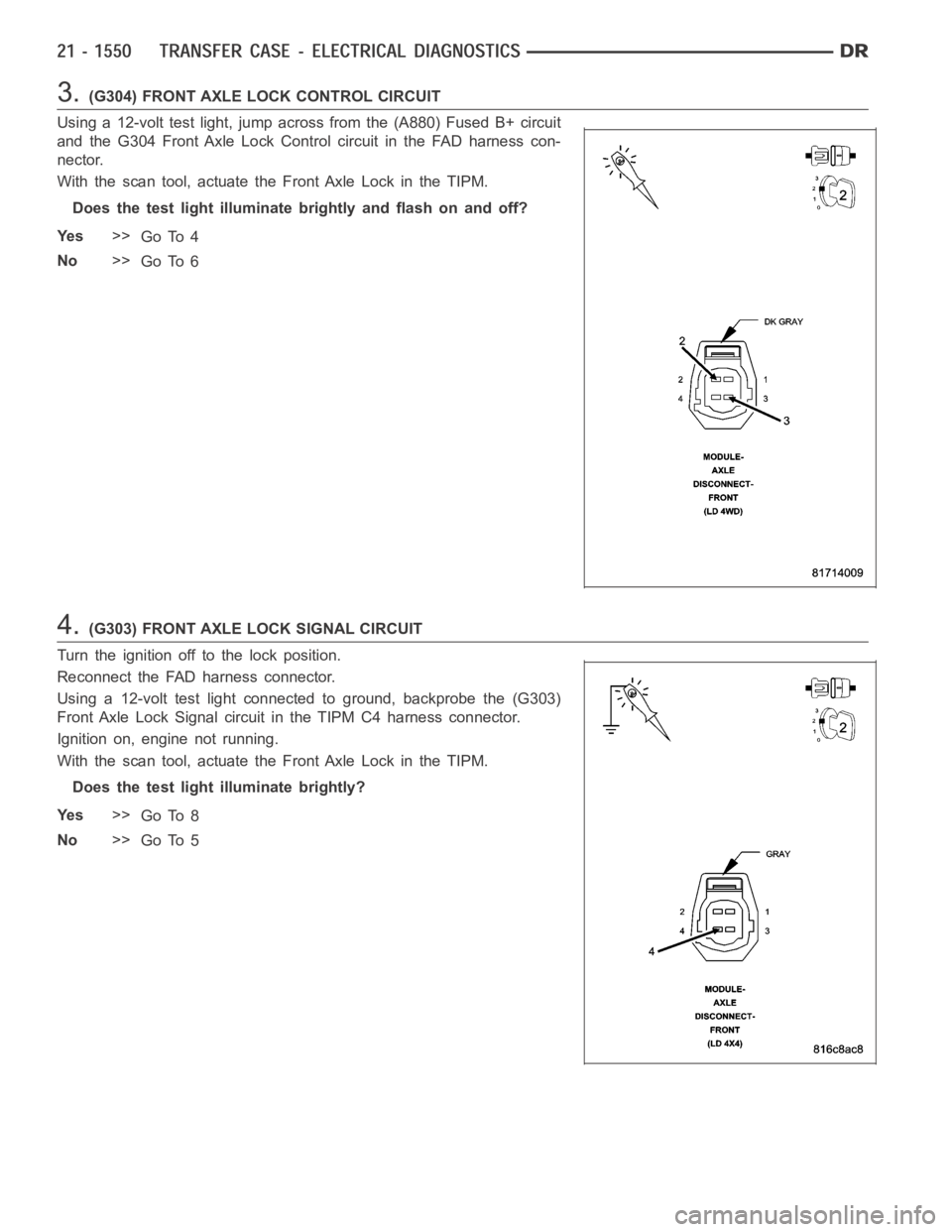
3.(G304) FRONT AXLE LOCK CONTROL CIRCUIT
Using a 12-volt test light, jump across from the (A880) Fused B+ circuit
and the G304 Front Axle Lock Control circuit in the FAD harness con-
nector.
With the scan tool, actuate the Front Axle Lock in the TIPM.
Does the test light illuminate brightly and flash on and off?
Ye s>>
Go To 4
No>>
Go To 6
4.(G303) FRONT AXLE LOCK SIGNAL CIRCUIT
Turn the ignition off to the lock position.
Reconnect the FAD harness connector.
Using a 12-volt test light connected to ground, backprobe the (G303)
Front Axle Lock Signal circuit in the TIPM C4 harness connector.
Ignition on, engine not running.
With the scan tool, actuate the Front Axle Lock in the TIPM.
Does the test light illuminate brightly?
Ye s>>
Go To 8
No>>
Go To 5
Page 4075 of 5267
When Monitored:
The ignition on, T-Case Switch in 4W/LO position.
Set Condition:
The TIPM detects the Front Axle Lock Signal circuit is shorted low.
Possible Causes
(G303) FRONT AXLE LOCK CONTROL CIRCUIT SHORTED TO VOLTAGE
(G304) FRONT AXLE LOCK CONTROL CIRCUIT SHORTED TO GROUND
FRONT AXLE DISCONNECT (FAD) MODULE
TOTALLY INTEGRATED POWER MODULE (TIPM)
Diagnostic Test
1.ACTIVE DTC
CAUTION: Before removing the TIPM harness connectors, clean the connector and locking cam area of dirt
and debris. Failure to do so can result in the connector being jammed or damage to the locking cams on
the harness connector or module. Do not force the assist arm when releasingor installing the harness con-
nector.
Ignition on, engine not running.
With the scan tool, select View DTCs.
Is the status Active for this DTC?
Ye s>>
Go To 2
No>>
Go To 6
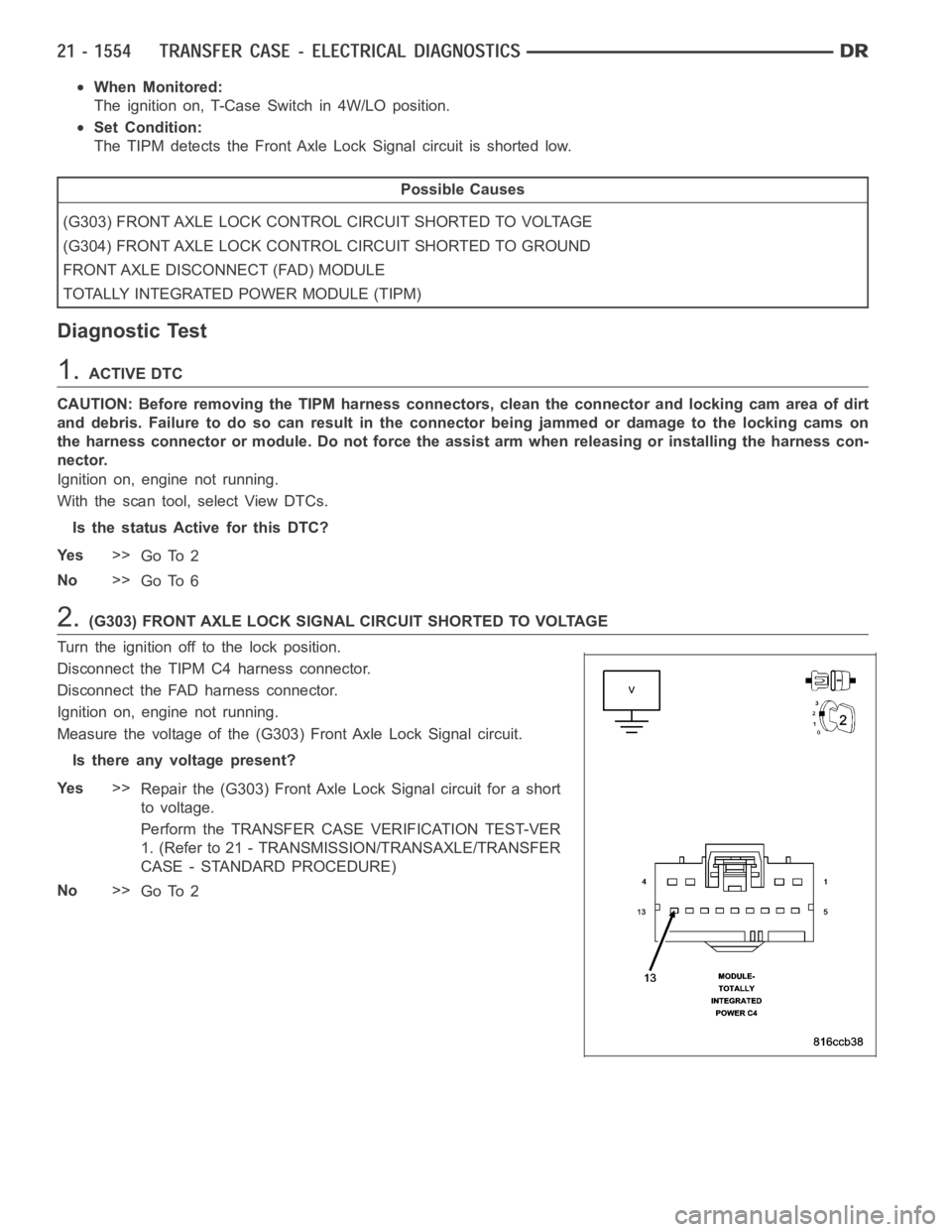
2.(G303) FRONT AXLE LOCK SIGNAL CIRCUIT SHORTED TO VOLTAGE
Turn the ignition off to the lock position.
Disconnect the TIPM C4 harness connector.
Disconnect the FAD harness connector.
Ignition on, engine not running.
Measure the voltage of the (G303) Front Axle Lock Signal circuit.
Is there any voltage present?
Ye s>>
Repair the (G303) Front Axle Lock Signal circuit for a short
to voltage.
Perform the TRANSFER CASE VERIFICATION TEST-VER
1. (Refer to 21 - TRANSMISSION/TRANSAXLE/TRANSFER
CASE - STANDARD PROCEDURE)
No>>
Go To 2
Page 4076 of 5267
3.(G304) FRONT AXLE LOCK CONTROL CIRCUIT
Turn the ignition off to the lock position.
Disconnect the TIPM C2 harness connector.
Ignition on, engine not running.
With the scan tool, actuate the TIPM.
Using a 12-volt test light connected to 12-volts, check the (G304) Front Axle Lock Control circuit in the FAD harness
connector.
Does the test light turn on and off?
Ye s>>
Go To 5
No>>
Go To 4
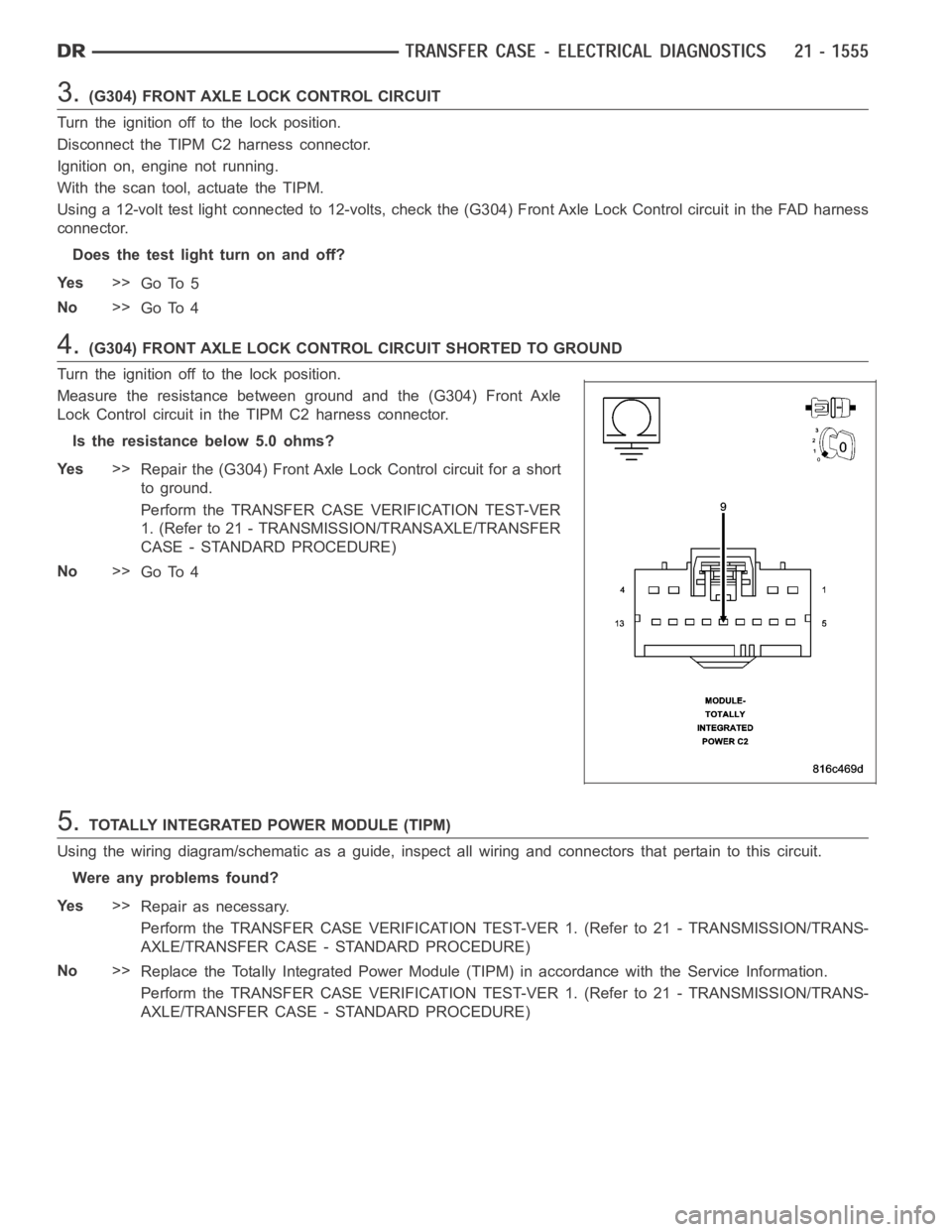
4.(G304) FRONT AXLE LOCK CONTROL CIRCUIT SHORTED TO GROUND
Turn the ignition off to the lock position.
Measure the resistance between ground and the (G304) Front Axle
Lock Control circuit in the TIPM C2 harness connector.
Is the resistance below 5.0 ohms?
Ye s>>
Repair the (G304) Front Axle Lock Control circuit for a short
to ground.
Perform the TRANSFER CASE VERIFICATION TEST-VER
1. (Refer to 21 - TRANSMISSION/TRANSAXLE/TRANSFER
CASE - STANDARD PROCEDURE)
No>>
Go To 4
5.TOTALLY INTEGRATED POWER MODULE (TIPM)
Using the wiring diagram/schematic as a guide, inspect all wiring and connectors that pertain to this circuit.
Were any problems found?
Ye s>>
Repair as necessary.
Perform the TRANSFER CASE VERIFICATION TEST-VER 1. (Refer to 21 - TRANSMISSION/TRANS-
AXLE/TRANSFER CASE - STANDARD PROCEDURE)
No>>
Replace the Totally Integrated Power Module (TIPM) in accordance with theService Information.
Perform the TRANSFER CASE VERIFICATION TEST-VER 1. (Refer to 21 - TRANSMISSION/TRANS-
AXLE/TRANSFER CASE - STANDARD PROCEDURE)
Page 4079 of 5267
When Monitored:
The ignition on. T-Case Switch in 4W/LO position.
Set Condition:
The TIPM detects that the Front Axle Lock Signal circuit is shorted low.
Possible Causes
(A880) FUSED B+ CIRCUIT OPEN
(G303) FRONT AXLE LOCK SIGNAL CIRCUIT OPEN
(G304) FRONT AXLE LOCK CONTROL CIRCUIT OPEN
FRONT AXLE DISCONNECT (FAD) MODULE
TOTALLY INTEGRATED POWER MODULE (TIPM)
Diagnostic Test
1.ACTIVE DTC
CAUTION: Before removing the TIPM harness connectors, clean the connector and locking cam area of dirt
and debris. Failure to do so can result in the connector being jammed or damage to the locking cams on
the harness connector or module. Do not force the assist arm when releasingor installing the harness con-
nector.
Ignition on, engine not running.
With the scan tool, read the TIPM DTCs.
Is the status Active for this DTC?
Ye s>>
Go To 2
No>>
Go To 6
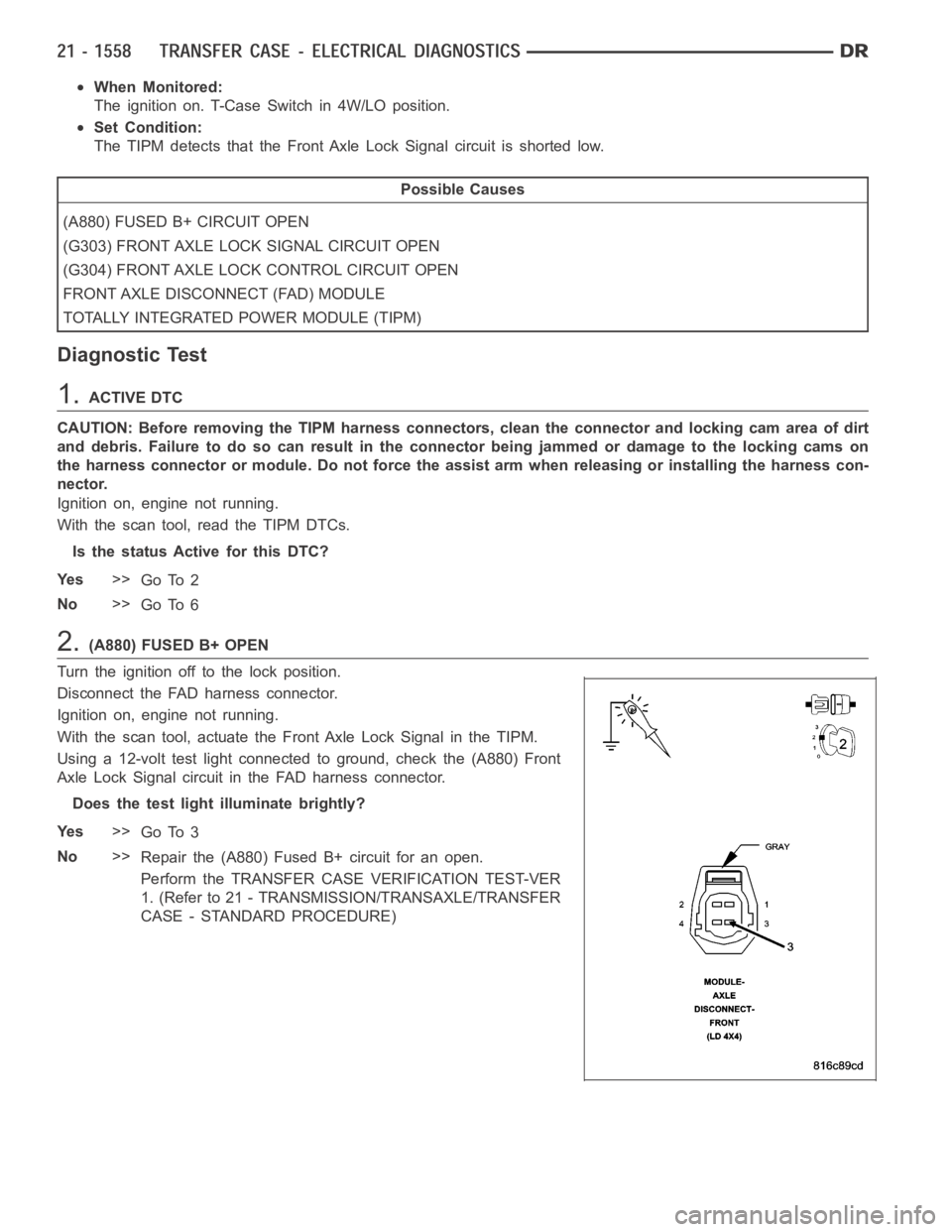
2.(A880) FUSED B+ OPEN
Turn the ignition off to the lock position.
Disconnect the FAD harness connector.
Ignition on, engine not running.
With the scan tool, actuate the Front Axle Lock Signal in the TIPM.
Using a 12-volt test light connected to ground, check the (A880) Front
Axle Lock Signal circuit in the FAD harness connector.
Does the test light illuminate brightly?
Ye s>>
Go To 3
No>>
Repair the (A880) Fused B+ circuit for an open.
Perform the TRANSFER CASE VERIFICATION TEST-VER
1. (Refer to 21 - TRANSMISSION/TRANSAXLE/TRANSFER
CASE - STANDARD PROCEDURE)
Page 4080 of 5267
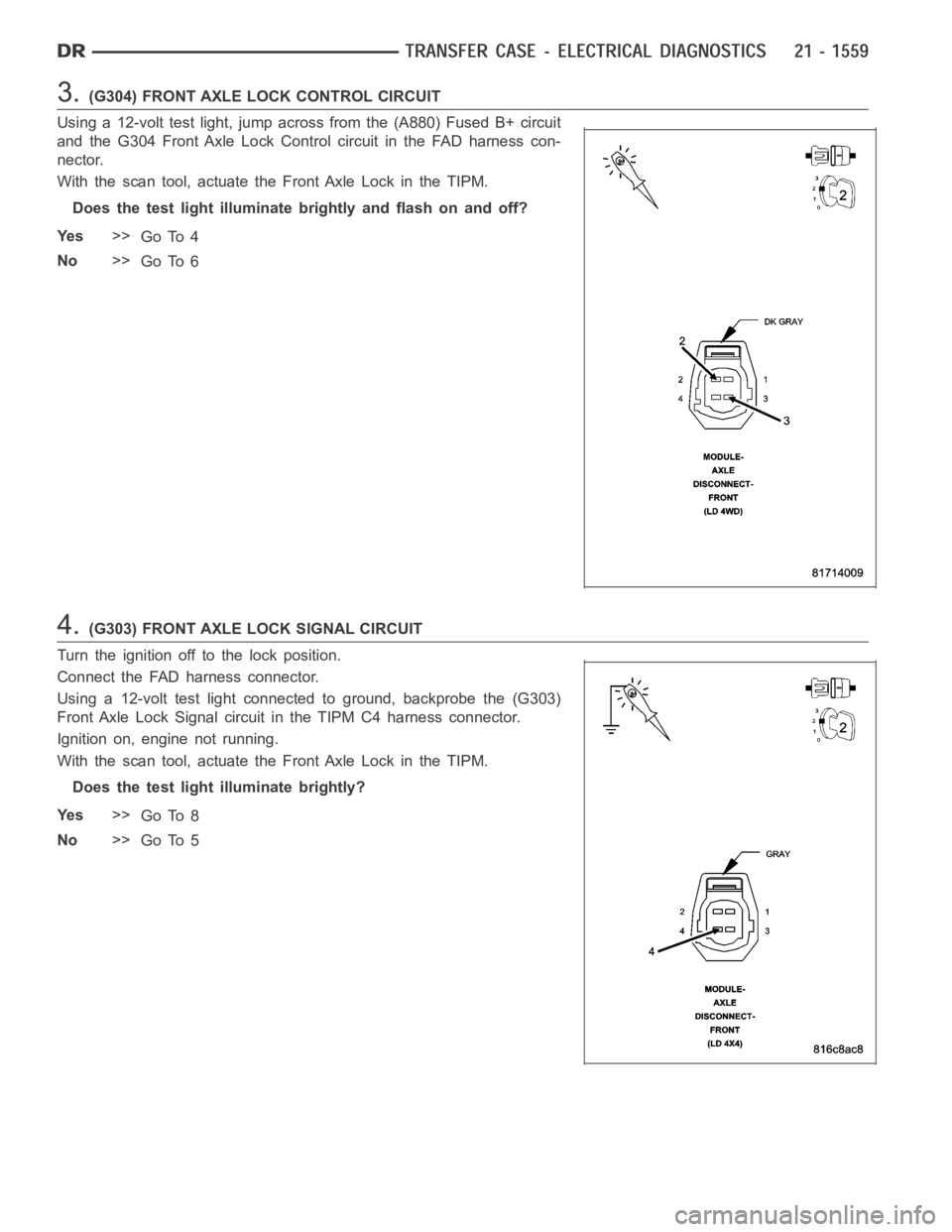
3.(G304) FRONT AXLE LOCK CONTROL CIRCUIT
Using a 12-volt test light, jump across from the (A880) Fused B+ circuit
and the G304 Front Axle Lock Control circuit in the FAD harness con-
nector.
With the scan tool, actuate the Front Axle Lock in the TIPM.
Does the test light illuminate brightly and flash on and off?
Ye s>>
Go To 4
No>>
Go To 6
4.(G303) FRONT AXLE LOCK SIGNAL CIRCUIT
Turn the ignition off to the lock position.
Connect the FAD harness connector.
Using a 12-volt test light connected to ground, backprobe the (G303)
Front Axle Lock Signal circuit in the TIPM C4 harness connector.
Ignition on, engine not running.
With the scan tool, actuate the Front Axle Lock in the TIPM.
Does the test light illuminate brightly?
Ye s>>
Go To 8
No>>
Go To 5
Page 4083 of 5267
TRANSFER CASE VERIFICATION TEST
1.
Disconnect all jumper wires and reconnect all previously disconnected components and connectors.
With the scan tool, select clear Stored DTCs.
Make sure that all accessories are turned off and that the battery is fully charged.
Test drive the vehicle in each Transfer Case range and verify proper operation in each range.
To select or deselect 2WD, AWD or 4HI mode, vehicle speed must be below 88 Kmh(55 mph) with all wheels
at vehicle speed.
Shifts will not take place with a wheel speed difference of greater than 21 Kmh (13 mph) between the front
and rear wheels.
To select or deselect 4LO (if equipped), vehicle speed must be below 5 Kmh (3mph) with the ignition ON and
the transmission in neutral (auto trans) or the clutch pedal pressed (man trans).
To select or deselect Transfer Case Neutral, vehicle speed must be 0 Kmh (0 mph) with the ignition ON,
engine OFF, the brake pedal applied, and the transmission in neutral (autotrans) or the clutch pedal pressed
(man trans). Press the Neutral button (if equipped) on the Transfer Case Selector Switch until the Neutral Indi-
cator is illuminated.
WARNING: Apply the parking brake. The vehicle may roll with the Transfer Case in neutral.
To verify that the Transfer Case is in Neutral, shift the automatic transmission into reverse and release the
brake pedal for three seconds or shift the manual transmission into gear andslowlyreleasetheclutchpedal.
There should be no vehicle movement if the Transfer Case is in Neutral.
With the scan tool, select View DTCs in the Totally Integrated Power Module(TIPM) and in the Instrument Cluster.
Are there any DTCs present in the Totally Integrated Power Module (TIPM) orin the Instrument Cluster?
Ye s>>
Return to the symptom list and perform the appropriate diagnostic test.
No>>
Repair is complete.
Page 4085 of 5267
TRANSFER CASE - NV241 GENII - SERVICE INFORMATION
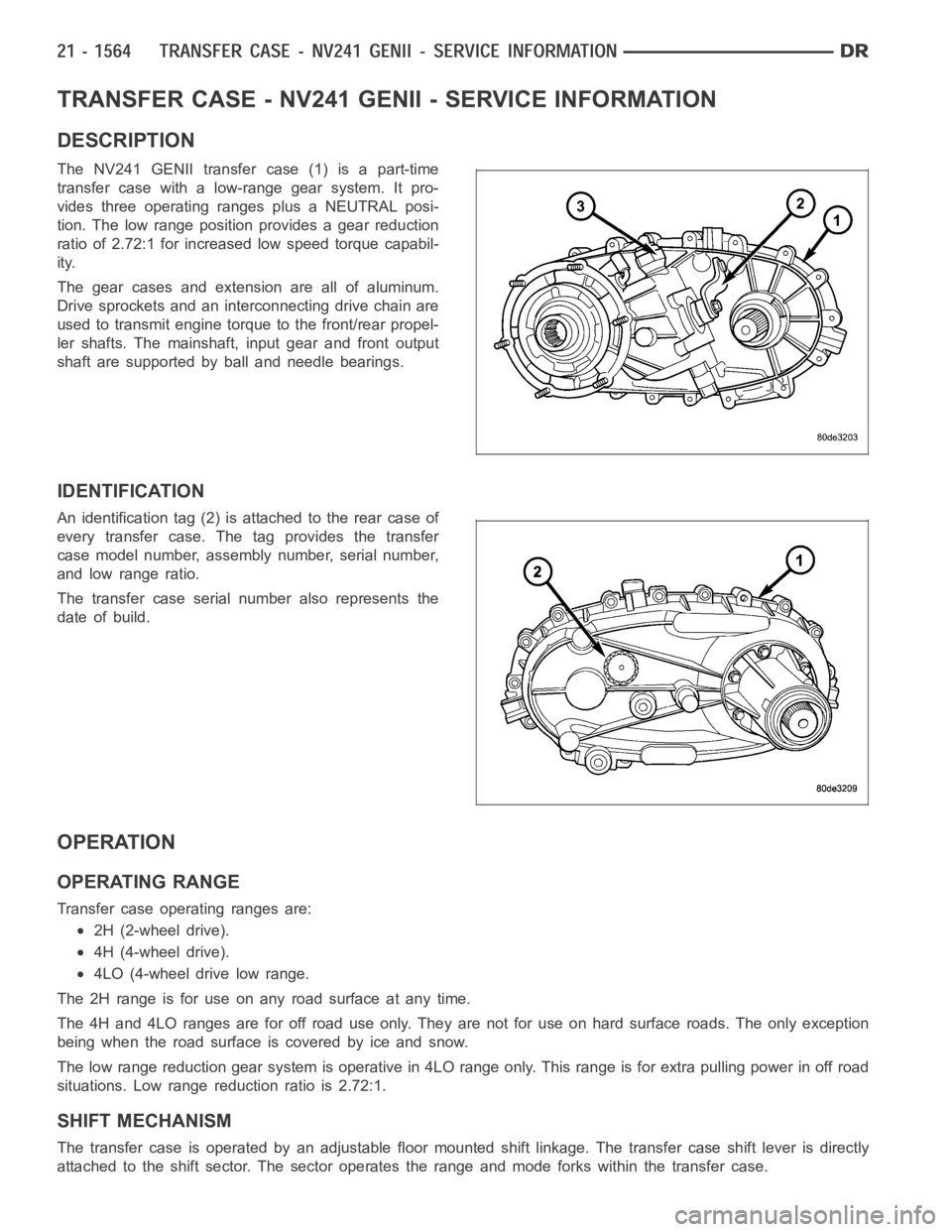
DESCRIPTION
The NV241 GENII transfer case (1) is a part-time
transfer case with a low-range gear system. It pro-
vides three operating ranges plus a NEUTRAL posi-
tion. The low range position provides a gear reduction
ratio of 2.72:1 for increased low speed torque capabil-
ity.
The gear cases and extension are all of aluminum.
Drive sprockets and an interconnecting drive chain are
used to transmit engine torque to the front/rear propel-
ler shafts. The mainshaft, input gear and front output
shaft are supported by ball and needle bearings.
IDENTIFICATION
An identification tag (2) is attached to the rear case of
every transfer case. The tag provides the transfer
case model number, assembly number, serial number,
and low range ratio.
The transfer case serial number also represents the
date of build.
OPERATION
OPERATING RANGE
Transfer case operating ranges are:
2H (2-wheel drive).
4H (4-wheel drive).
4LO (4-wheel drive low range.
The 2H range is for use on any road surface at any time.
The 4H and 4LO ranges are for off road use only. They are not for use on hard surface roads. The only exception
being when the road surface is covered by ice and snow.
The low range reduction gear system is operative in 4LO range only. This range is for extra pulling power in off road
situations. Low range reduction ratio is 2.72:1.
SHIFT MECHANISM
The transfer case is operated by an adjustable floor mounted shift linkage. The transfer case shift lever is directly
attached to the shift sector. The sector operates the range and mode forks within the transfer case.
Page 4127 of 5267
TRANSFER CASE - NV271 - SERVICE INFORMATION
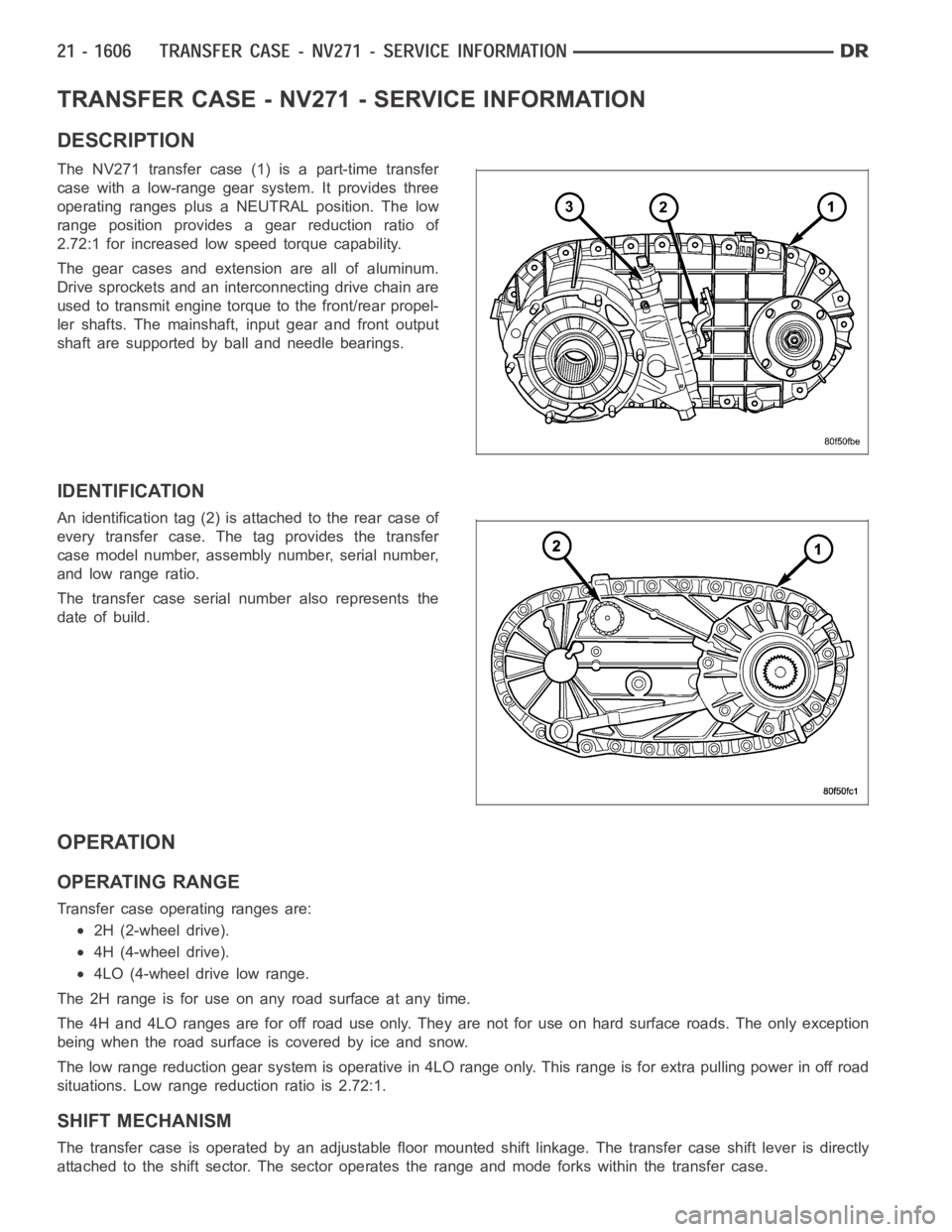
DESCRIPTION
The NV271 transfer case (1) is a part-time transfer
case with a low-range gear system. It provides three
operating ranges plus a NEUTRAL position. The low
range position provides a gear reduction ratio of
2.72:1 for increased low speed torque capability.
The gear cases and extension are all of aluminum.
Drive sprockets and an interconnecting drive chain are
used to transmit engine torque to the front/rear propel-
ler shafts. The mainshaft, input gear and front output
shaft are supported by ball and needle bearings.
IDENTIFICATION
An identification tag (2) is attached to the rear case of
every transfer case. The tag provides the transfer
case model number, assembly number, serial number,
and low range ratio.
The transfer case serial number also represents the
date of build.
OPERATION
OPERATING RANGE
Transfer case operating ranges are:
2H (2-wheel drive).
4H (4-wheel drive).
4LO (4-wheel drive low range.
The 2H range is for use on any road surface at any time.
The 4H and 4LO ranges are for off road use only. They are not for use on hard surface roads. The only exception
being when the road surface is covered by ice and snow.
The low range reduction gear system is operative in 4LO range only. This range is for extra pulling power in off road
situations. Low range reduction ratio is 2.72:1.
SHIFT MECHANISM
The transfer case is operated by an adjustable floor mounted shift linkage. The transfer case shift lever is directly
attached to the shift sector. The sector operates the range and mode forks within the transfer case.
Page 4321 of 5267
TIRES
DESCRIPTION
TIRES
Tires are designed and engineered for each specific vehicle. They providethe best overall performance for normal
operation. The ride and handling characteristics match the vehicle’s requirements. With proper care they will give
excellent reliability, traction,skid resistance, and tread life.
Driving habits have more effect on tire life than any other factor. Carefuldrivers will obtain in most cases, much
greater mileage than severe use or careless drivers. A few of the driving habits which will shorten the life of any tire
are:
Rapid acceleration
Severe brake applications
High speed driving
Excessive speeds on turns
Striking curbs and other obstacles
Radial-ply tires are more prone to irregular tread wear. It is important tofollow the tire rotation interval (Refer to 22
- TIRES/WHEELS - STANDARD PROCEDURE). This will help to achieve a greater tread life.
TIRE IDENTIFICATION
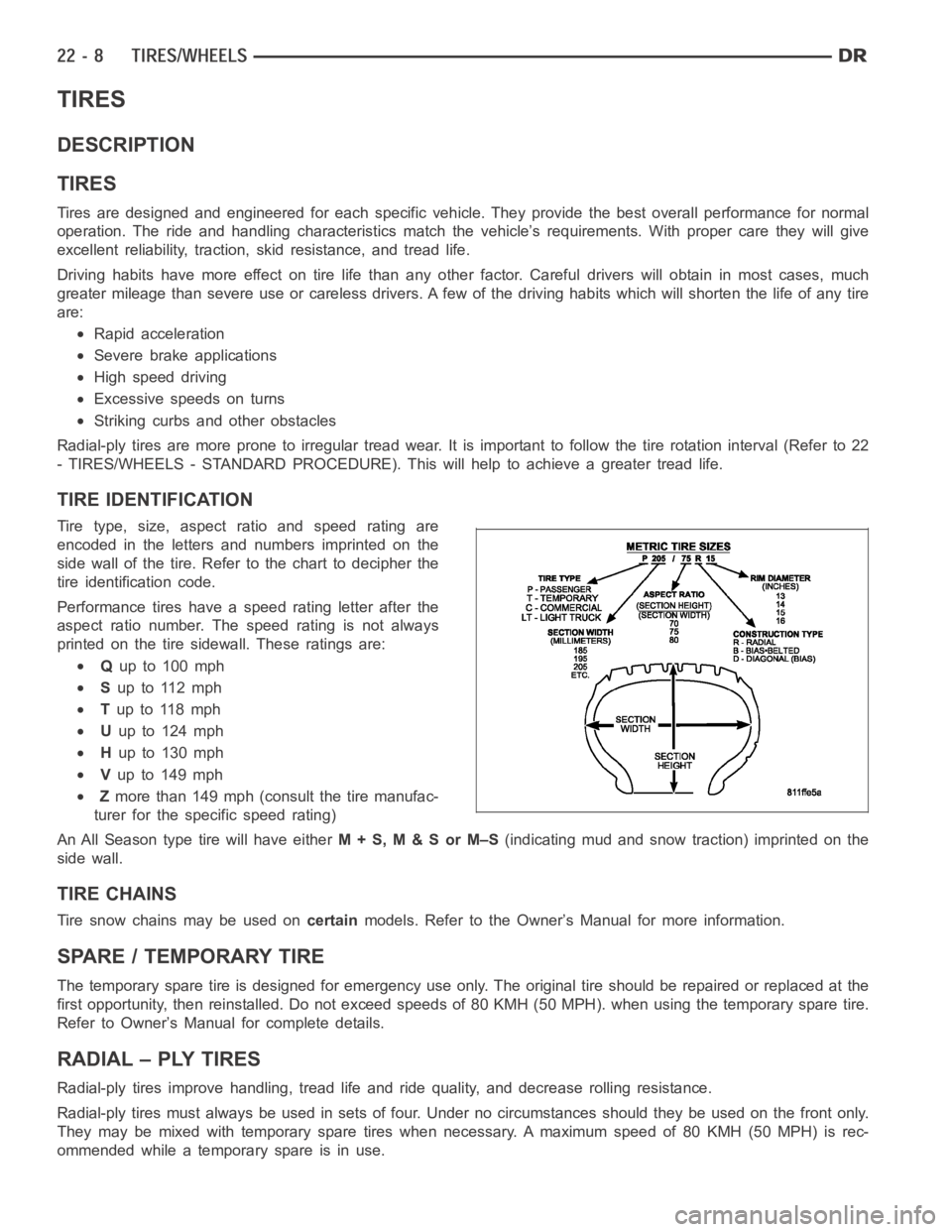
Tire type, size, aspect ratio and speed rating are
encoded in the letters and numbers imprinted on the
side wall of the tire. Refer to the chart to decipher the
tire identification code.
Performance tires have a speed rating letter after the
aspect ratio number. The speed rating is not always
printed on the tire sidewall. These ratings are:
Qup to 100 mph
Sup to 112 mph
Tup to 118 mph
Uup to 124 mph
Hup to 130 mph
Vup to 149 mph
Zmore than 149 mph (consult the tire manufac-
turer for the specific speed rating)
An All Season type tire will have eitherM+S,M&SorM–S(indicating mud and snow traction) imprinted on the
side wall.
TIRE CHAINS
Tire snow chains may be used oncertainmodels. Refer to the Owner’s Manual for more information.
SPARE / TEMPORARY TIRE
The temporary spare tire is designed for emergency use only. The original tire should be repaired or replaced at the
first opportunity, then reinstalled. Do not exceed speeds of 80 KMH (50 MPH). when using the temporary spare tire.
Refer to Owner’s Manual for complete details.
RADIAL – PLY TIRES
Radial-ply tires improve handling, tread life and ride quality, and decrease rolling resistance.
Radial-ply tires must always be used in sets of four. Under no circumstances should they be used on the front only.
They may be mixed with temporary spare tires when necessary. A maximum speedof80KMH(50MPH)isrec-
ommended while a temporary spare is in use.
Page 4323 of 5267
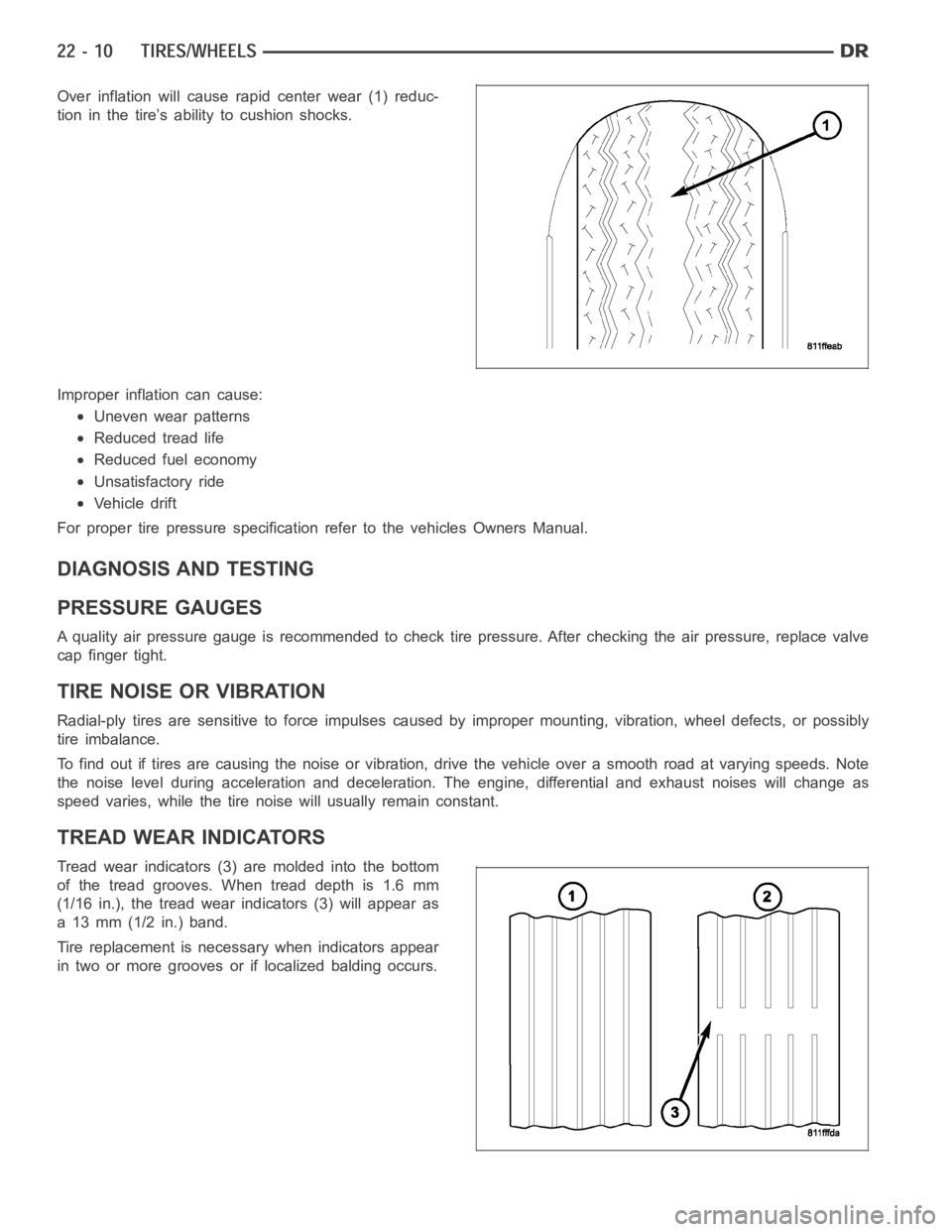
Over inflation will cause rapid center wear (1) reduc-
tion in the tire’s ability to cushion shocks.
Improper inflation can cause:
Uneven wear patterns
Reduced tread life
Reduced fuel economy
Unsatisfactory ride
Vehicle drift
For proper tire pressure specification refer to the vehicles Owners Manual.
DIAGNOSIS AND TESTING
PRESSURE GAUGES
A quality air pressure gauge is recommended to check tire pressure. After checking the air pressure, replace valve
cap finger tight.
TIRE NOISE OR VIBRATION
Radial-ply tires are sensitive to force impulses caused by improper mounting, vibration, wheel defects, or possibly
tire imbalance.
To find out if tires are causing the noise or vibration, drive the vehicle over a smooth road at varying speeds. Note
the noise level during acceleration and deceleration. The engine, differential and exhaust noises will change as
speed varies, while the tire noise will usually remain constant.
TREAD WEAR INDICATORS
Tread wear indicators (3) are molded into the bottom
of the tread grooves. When tread depth is 1.6 mm
(1/16 in.), the tread wear indicators (3) will appear as
a 13 mm (1/2 in.) band.
Tire replacement is necessary when indicators appear
in two or more grooves or if localized balding occurs.