warning DODGE RAM SRT-10 2006 Service Repair Manual
[x] Cancel search | Manufacturer: DODGE, Model Year: 2006, Model line: RAM SRT-10, Model: DODGE RAM SRT-10 2006Pages: 5267, PDF Size: 68.7 MB
Page 5151 of 5267
CORE-HEATER
DESCRIPTION
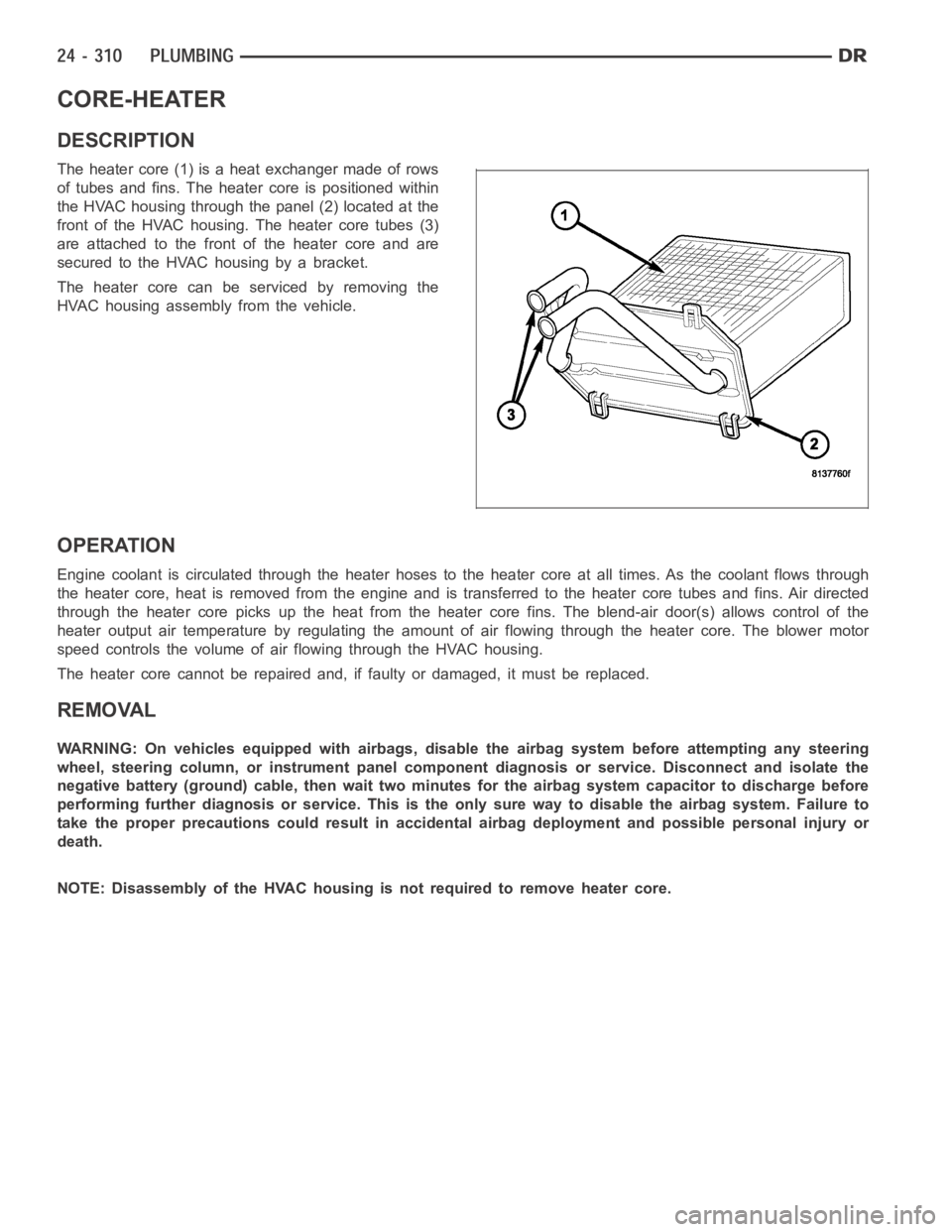
The heater core (1) is a heat exchanger made of rows
of tubes and fins. The heater core is positioned within
the HVAC housing through the panel (2) located at the
front of the HVAC housing. The heater core tubes (3)
are attached to the front of the heater core and are
secured to the HVAC housing by a bracket.
The heater core can be serviced by removing the
HVAC housing assembly from the vehicle.
OPERATION
Engine coolant is circulated through the heater hoses to the heater core atall times. As the coolant flows through
the heater core, heat is removed from the engine and is transferred to the heater core tubes and fins. Air directed
through the heater core picks up the heat from the heater core fins. The blend-air door(s) allows control of the
heater output air temperature by regulating the amount of air flowing through the heater core. The blower motor
speed controls the volume of air flowing through the HVAC housing.
The heater core cannot be repaired and, if faulty or damaged, it must be replaced.
REMOVAL
WARNING: On vehicles equipped with airbags, disable the airbag system before attempting any steering
wheel, steering column, or instrument panel component diagnosis or service. Disconnect and isolate the
negative battery (ground) cable, then wait two minutes for the airbag system capacitor to discharge before
performing further diagnosis or service. This is the only sure way to disable the airbag system. Failure to
take the proper precautions could result in accidental airbag deploymentand possible personal injury or
death.
NOTE: Disassembly of the HVAC housing is not required to remove heater core.
Page 5153 of 5267
CORE-VALVE-SERVICE PORT
DESCRIPTION
Two refrigerant system service ports are used to recover/recycle/evacuate/charge and test the A/C refrigerant sys-
tem. Unique sizes are used on the service ports for the R-134a refrigerant system to ensure the system is not
accidentally contaminated with R-12 refrigerant or service equipment used for R-12 refrigerant.
The high side service port is located on the A/C discharge line. The A/C pressure transducer is mounted on the high
side service port (Refer to 24 - HEATING & AIR CONDITIONING/CONTROLS/TRANSDUCER-A/C PRESSURE -
DESCRIPTION). The low side service port is located either on the top of the A/C accumulator or on the A/C suction
line near the accumulator, depending on engine application. Both the highside and low side A/C service port valve
cores are serviceable.
Each of the service ports has a threaded plastic protective cap installed over it from the factory. After servicing the
refrigerant system, always reinstall both of the service port caps.
REMOVAL
WARNING: Refer to the applicable warnings and cautions for this system before performing the following
operation (Refer to 24 - HEATING & AIR CONDITIONING/PLUMBING - WARNINGS) and (Refer to 24 - HEAT-
ING & AIR CONDITIONING/PLUMBING - CAUTIONS). Failure to follow the warnings and cautions could result
in possible personal injury or death.
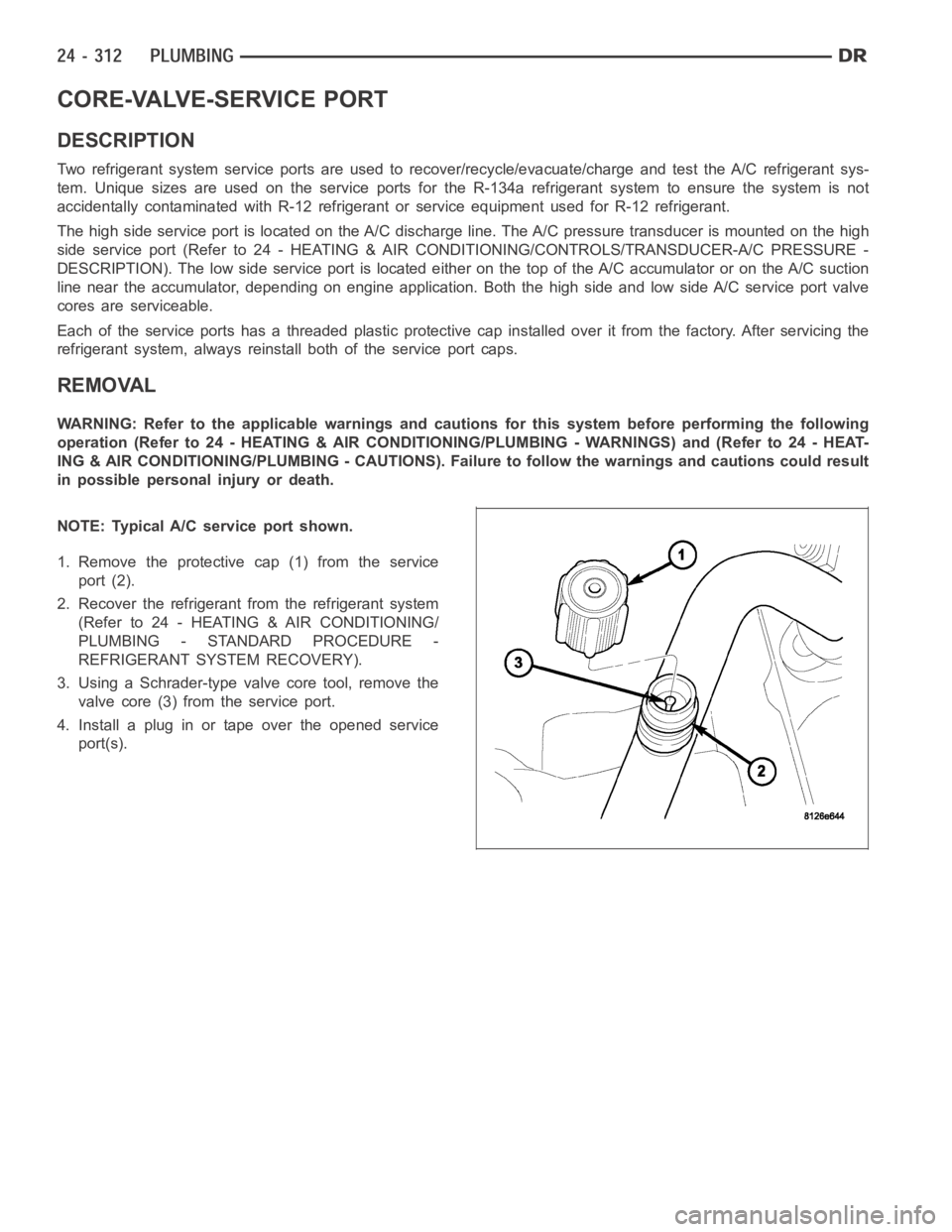
NOTE: Typical A/C service port shown.
1. Remove the protective cap (1) from the service
port (2).
2. Recover the refrigerant from the refrigerant system
(Refer to 24 - HEATING & AIR CONDITIONING/
PLUMBING - STANDARD PROCEDURE -
REFRIGERANT SYSTEM RECOVERY).
3. Using a Schrader-type valve core tool, remove the
valve core (3) from the service port.
4. Install a plug in or tape over the opened service
port(s).
Page 5155 of 5267
COUPLER-REFRIGERANT LINE
DESCRIPTION
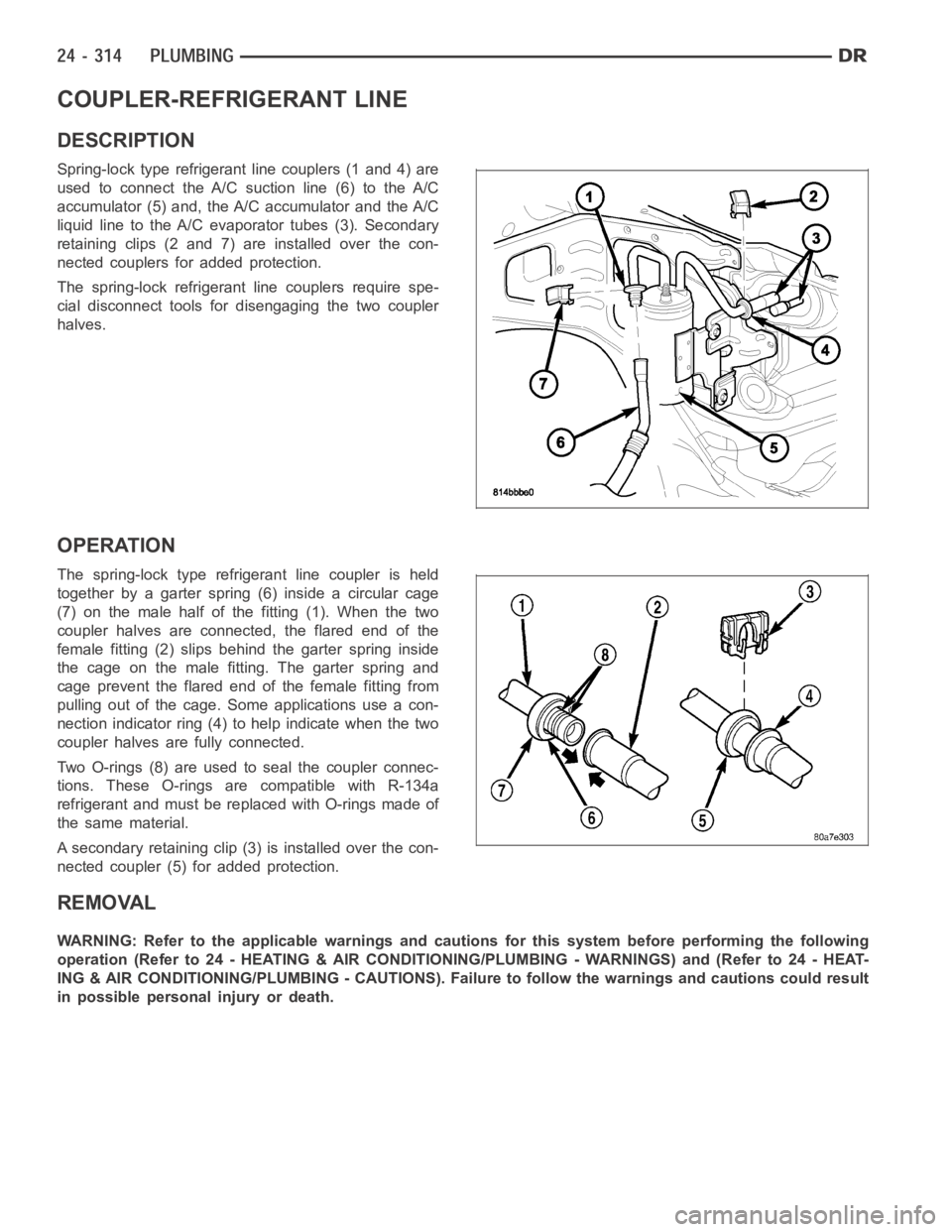
Spring-lock type refrigerant line couplers (1 and 4) are
used to connect the A/C suction line (6) to the A/C
accumulator (5) and, the A/C accumulator and the A/C
liquid line to the A/C evaporator tubes (3). Secondary
retaining clips (2 and 7) are installed over the con-
nected couplers for added protection.
The spring-lock refrigerant line couplers require spe-
cial disconnect tools for disengaging the two coupler
halves.
OPERATION
The spring-lock type refrigerant line coupler is held
together by a garter spring (6) inside a circular cage
(7) on the male half of the fitting (1). When the two
coupler halves are connected, the flared end of the
female fitting (2) slips behind the garter spring inside
the cage on the male fitting. The garter spring and
cage prevent the flared end of the female fitting from
pulling out of the cage. Some applications use a con-
nection indicator ring (4) to help indicate when the two
coupler halves are fully connected.
Two O-rings (8) are used to seal the coupler connec-
tions. These O-rings are compatible with R-134a
refrigerant and must be replaced with O-rings made of
the same material.
A secondary retaining clip (3) is installed over the con-
nected coupler (5) for added protection.
REMOVAL
WARNING: Refer to the applicable warnings and cautions for this system before performing the following
operation (Refer to 24 - HEATING & AIR CONDITIONING/PLUMBING - WARNINGS) and (Refer to 24 - HEAT-
ING & AIR CONDITIONING/PLUMBING - CAUTIONS). Failure to follow the warnings and cautions could result
in possible personal injury or death.
Page 5160 of 5267
FAN-A/C CONDENSER
DESCRIPTION
All models equipped with gasoline engines, except
SRT 8, use an electric cooling fan to help pull heat out
of the A/C system, especially during idle conditions.
Without a cooling fan, A/C high side pressures would
increase and A/C system performance would eventu-
ally deteriorate.
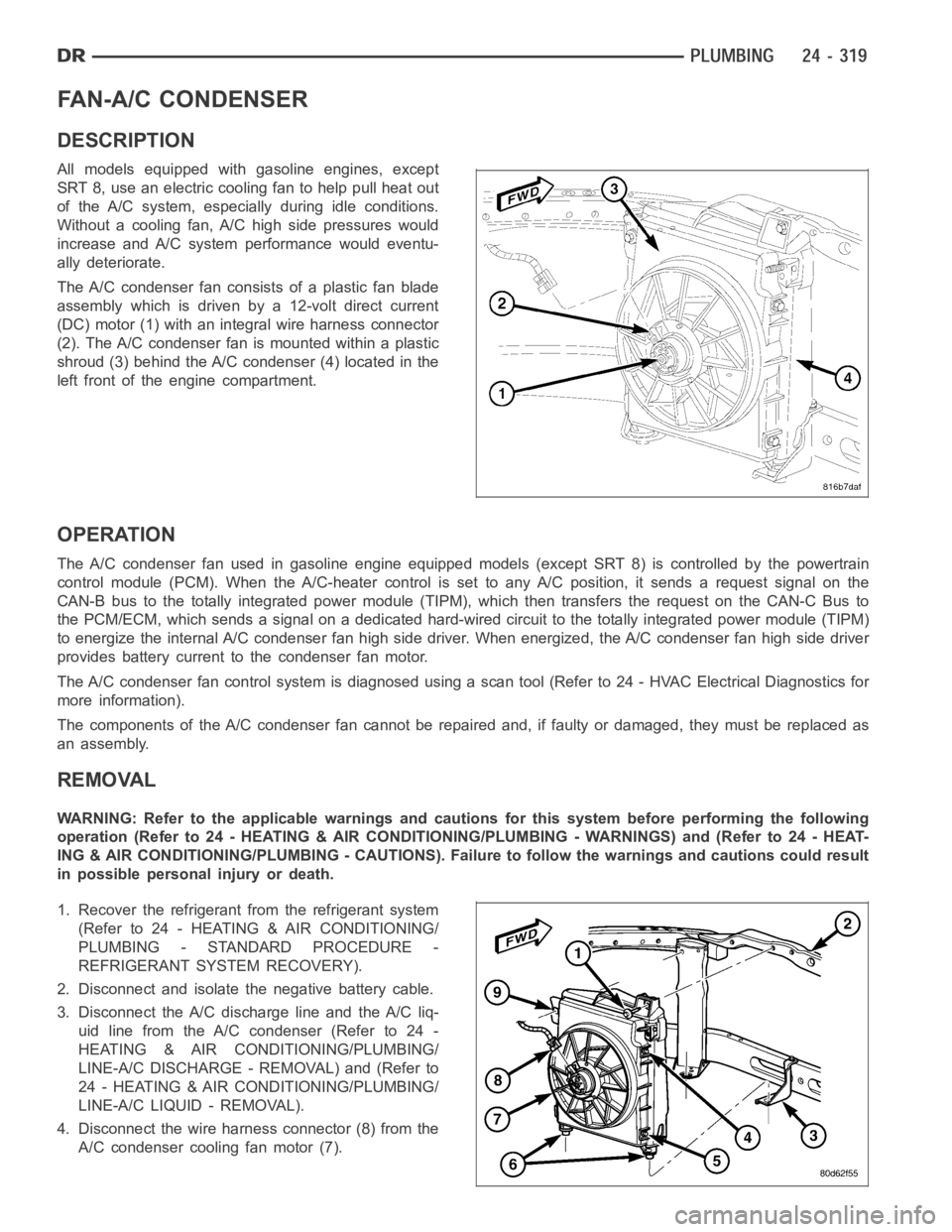
The A/C condenser fan consists of a plastic fan blade
assembly which is driven by a 12-volt direct current
(DC) motor (1) with an integral wire harness connector
(2). The A/C condenser fan is mounted within a plastic
shroud (3) behind the A/C condenser (4) located in the
left front of the engine compartment.
OPERATION
The A/C condenser fan used in gasoline engine equipped models (except SRT 8) is controlled by the powertrain
control module (PCM). When the A/C-heater control is set to any A/C position, it sends a request signal on the
CAN-B bus to the totally integrated power module (TIPM), which then transfers the request on the CAN-C Bus to
the PCM/ECM, which sends a signal on a dedicated hard-wired circuit to the totally integrated power module (TIPM)
to energize the internal A/C condenser fan high side driver. When energized, the A/C condenser fan high side driver
provides battery current to the condenser fan motor.
The A/C condenser fan control system isdiagnosed using a scan tool (Refer to 24 - HVAC Electrical Diagnostics for
more information).
The components of the A/C condenser fan cannot be repaired and, if faulty ordamaged, they must be replaced as
an assembly.
REMOVAL
WARNING: Refer to the applicable warnings and cautions for this system before performing the following
operation (Refer to 24 - HEATING & AIR CONDITIONING/PLUMBING - WARNINGS) and (Refer to 24 - HEAT-
ING & AIR CONDITIONING/PLUMBING - CAUTIONS). Failure to follow the warnings and cautions could result
in possible personal injury or death.
1. Recover the refrigerant from the refrigerant system
(Refer to 24 - HEATING & AIR CONDITIONING/
PLUMBING - STANDARD PROCEDURE -
REFRIGERANT SYSTEM RECOVERY).
2. Disconnect and isolate the negative battery cable.
3. Disconnect the A/C discharge line and the A/C liq-
uidlinefromtheA/Ccondenser(Referto24-
HEATING & AIR CONDITIONING/PLUMBING/
LINE-A/C DISCHARGE - REMOVAL) and (Refer to
24 - HEATING & AIR CONDITIONING/PLUMBING/
LINE-A/C LIQUID - REMOVAL).
4. Disconnect the wire harness connector (8) from the
A/C condenser cooling fan motor (7).
Page 5162 of 5267
LINE-A/C DISCHARGE
DESCRIPTION
The A/C discharge line is the refrigerant line that goes from the A/C compressor to the A/C condenser and has an
integral fitting for the A/C pressure transducer (Refer to 24 - HEATING & AIR CONDITIONING/CONTROLS/TRANS-
DUCER-A/C PRESSURE - DESCRIPTION).
The A/C discharge line for the 5.9L Diesel engine is serviced as an assemblywith the suction line.
The A/C discharge line for the 8.3L engine is secured to the top of fan shroudby two retainers.
CAUTION: Use only O-ring seals specified for the vehicle. Failure to use correct O-ring seal will cause the
refrigerant system connection to leak.
The A/C discharge line has no serviceable parts except the rubber O-ring seals. The O-ring seals used on the
connections are made from a special type of rubber not affected by R-134a refrigerant. The O-ring seals must be
replaced whenever the A/C discharge line is removed and installed.
If the A/C discharge line is found to be leaking or is damaged, it must be replaced.
REMOVAL
3.7L/4.7L ENGINES
WARNING: Refer to the applicable warnings and cautions for this system before performing the following
operation (Refer to 24 - HEATING & AIR CONDITIONING/PLUMBING - WARNINGS) and (Refer to 24 - HEAT-
ING & AIR CONDITIONING/PLUMBING - CAUTIONS). Failure to follow the warnings and cautions could result
in possible personal injury or death.
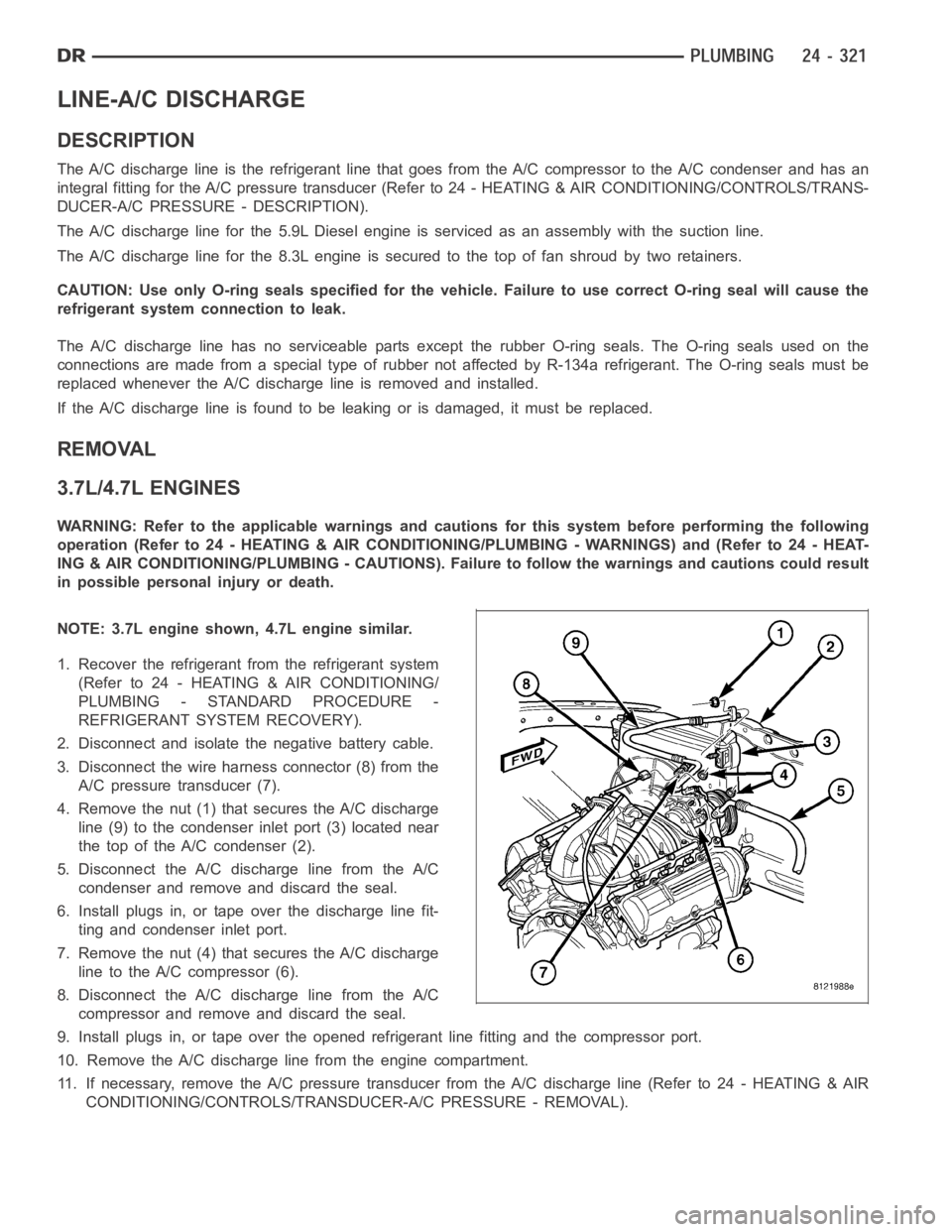
NOTE: 3.7L engine shown, 4.7L engine similar.
1. Recover the refrigerant from the refrigerant system
(Refer to 24 - HEATING & AIR CONDITIONING/
PLUMBING - STANDARD PROCEDURE -
REFRIGERANT SYSTEM RECOVERY).
2. Disconnect and isolate the negative battery cable.
3. Disconnect the wire harness connector (8) from the
A/C pressure transducer (7).
4. Remove the nut (1) that secures the A/C discharge
line (9) to the condenser inlet port (3) located near
the top of the A/C condenser (2).
5. Disconnect the A/C discharge line from the A/C
condenser and remove and discard the seal.
6. Install plugs in, or tape over the discharge line fit-
ting and condenser inlet port.
7. Remove the nut (4) that secures the A/C discharge
line to the A/C compressor (6).
8. Disconnect the A/C discharge line from the A/C
compressor and remove and discard the seal.
9. Install plugs in, or tape over the opened refrigerant line fitting and the compressor port.
10. Remove the A/C discharge line from the engine compartment.
11. If necessary, remove the A/C pressure transducer from the A/C dischargeline(Referto24-HEATING&AIR
CONDITIONING/CONTROLS/TRANSDUCER-A/C PRESSURE - REMOVAL).
Page 5163 of 5267
5.7L ENGINE
WARNING: Refer to the applicable warnings and cautions for this system before performing the following
operation (Refer to 24 - HEATING & AIR CONDITIONING/PLUMBING - WARNINGS) and (Refer to 24 - HEAT-
ING & AIR CONDITIONING/PLUMBING - CAUTIONS). Failure to follow the warnings and cautions could result
in possible personal injury or death.
1. Recover the refrigerant from the refrigerant system
(Refer to 24 - HEATING & AIR CONDITIONING/
PLUMBING - STANDARD PROCEDURE -
REFRIGERANT SYSTEM RECOVERY).
2. Disconnect and isolate the negative battery cable.
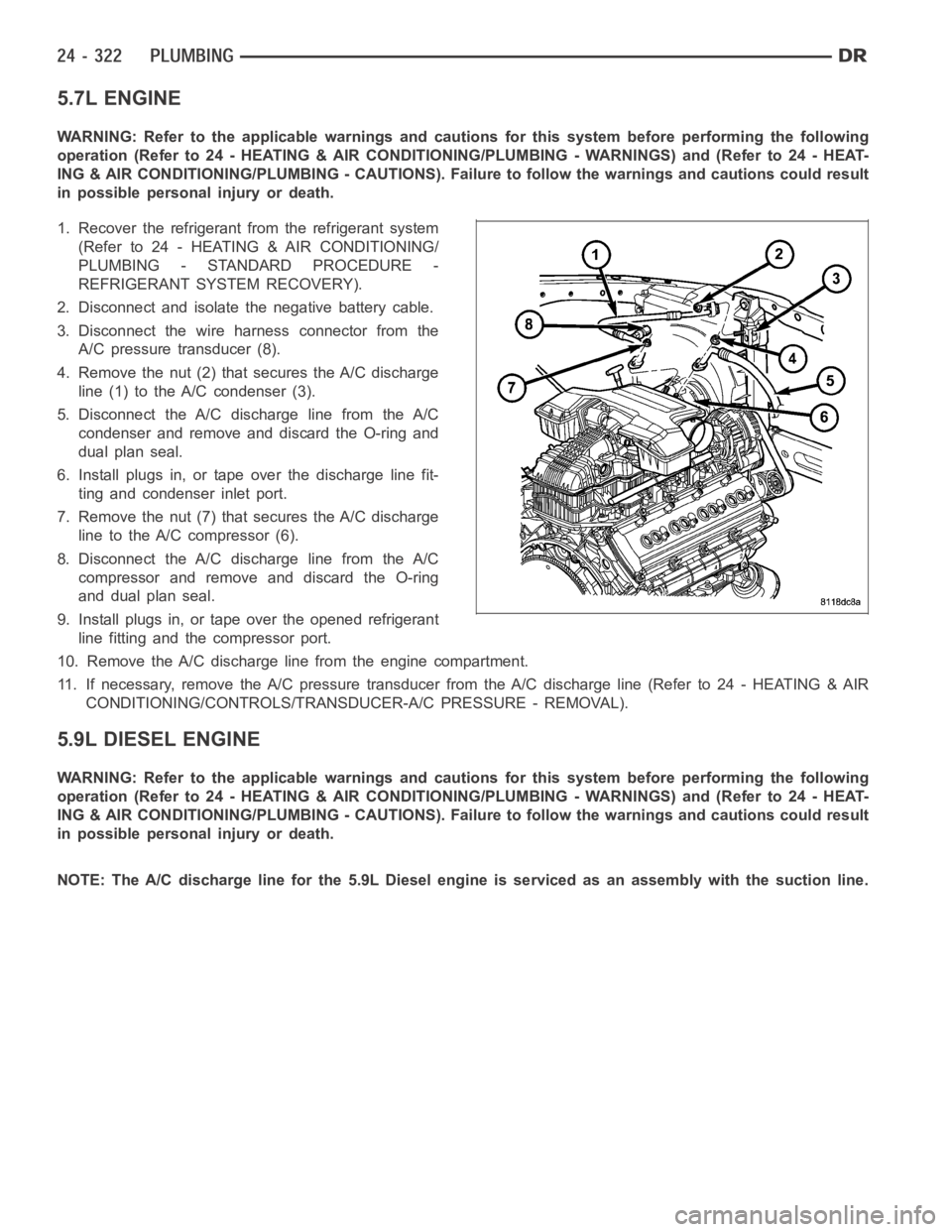
3. Disconnect the wire harness connector from the
A/C pressure transducer (8).
4. Remove the nut (2) that secures the A/C discharge
line (1) to the A/C condenser (3).
5. Disconnect the A/C discharge line from the A/C
condenser and remove and discard the O-ring and
dual plan seal.
6. Install plugs in, or tape over the discharge line fit-
ting and condenser inlet port.
7. Remove the nut (7) that secures the A/C discharge
line to the A/C compressor (6).
8. Disconnect the A/C discharge line from the A/C
compressor and remove and discard the O-ring
and dual plan seal.
9. Install plugs in, or tape over the opened refrigerant
line fitting and the compressor port.
10. Remove the A/C discharge line from the engine compartment.
11. If necessary, remove the A/C pressure transducer from the A/C dischargeline(Referto24-HEATING&AIR
CONDITIONING/CONTROLS/TRANSDUCER-A/C PRESSURE - REMOVAL).
5.9L DIESEL ENGINE
WARNING: Refer to the applicable warnings and cautions for this system before performing the following
operation (Refer to 24 - HEATING & AIR CONDITIONING/PLUMBING - WARNINGS) and (Refer to 24 - HEAT-
ING & AIR CONDITIONING/PLUMBING - CAUTIONS). Failure to follow the warnings and cautions could result
in possible personal injury or death.
NOTE: The A/C discharge line for the 5.9L Diesel engine is serviced as an assembly with the suction line.
Page 5164 of 5267
1. Recover the refrigerant from the refrigerant system
(Refer to 24 - HEATING & AIR CONDITIONING/
PLUMBING - STANDARD PROCEDURE -
REFRIGERANT SYSTEM RECOVERY).
2. Disconnect and isolate the negative battery cable.
3. Remove the air filter housing cover (Refer to 9 -
ENGINE/AIR INTAKE SYSTEM).
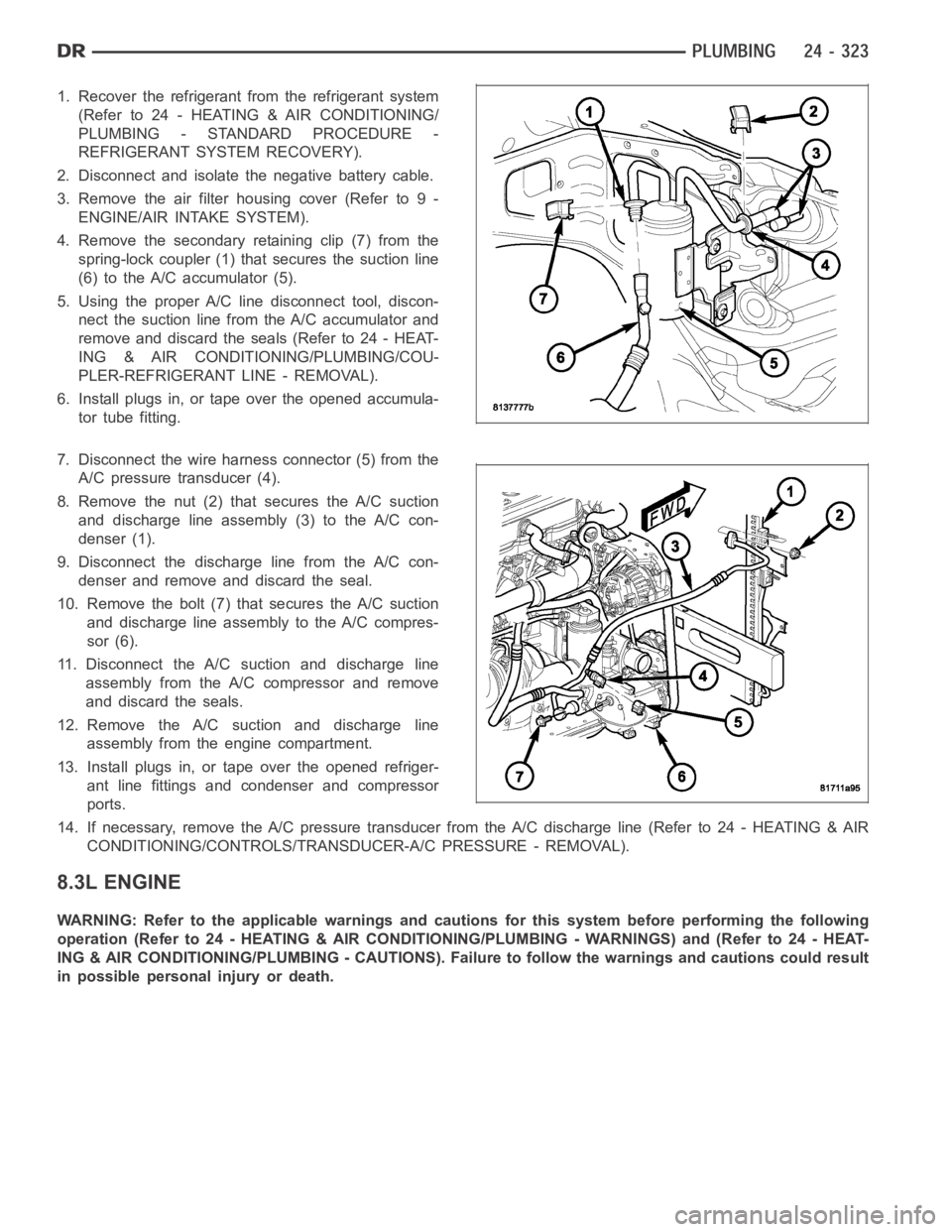
4. Remove the secondary retaining clip (7) from the
spring-lock coupler (1) thatsecures the suction line
(6) to the A/C accumulator (5).
5. Using the proper A/C line disconnect tool, discon-
nect the suction line from the A/C accumulator and
remove and discard the seals (Refer to 24 - HEAT-
ING & AIR CONDITIONING/PLUMBING/COU-
PLER-REFRIGERANT LINE - REMOVAL).
6. Install plugs in, or tape over the opened accumula-
tor tube fitting.
7. Disconnect the wire harness connector (5) from the
A/C pressure transducer (4).
8. Remove the nut (2) that secures the A/C suction
and discharge line assembly (3) to the A/C con-
denser (1).
9. Disconnect the discharge line from the A/C con-
denser and remove and discard the seal.
10. Remove the bolt (7) that secures the A/C suction
and discharge line assembly to the A/C compres-
sor (6).
11. Disconnect the A/C suction and discharge line
assembly from the A/C compressor and remove
and discard the seals.
12. Remove the A/C suction and discharge line
assembly from the engine compartment.
13. Install plugs in, or tape over the opened refriger-
ant line fittings and condenser and compressor
ports.
14. If necessary, remove the A/C pressure transducer from the A/C dischargeline(Referto24-HEATING&AIR
CONDITIONING/CONTROLS/TRANSDUCER-A/C PRESSURE - REMOVAL).
8.3L ENGINE
WARNING: Refer to the applicable warnings and cautions for this system before performing the following
operation (Refer to 24 - HEATING & AIR CONDITIONING/PLUMBING - WARNINGS) and (Refer to 24 - HEAT-
ING & AIR CONDITIONING/PLUMBING - CAUTIONS). Failure to follow the warnings and cautions could result
in possible personal injury or death.
Page 5171 of 5267
LINE-A/C LIQUID
DESCRIPTION
The liquid line is the refrigerant line that carries refrigerant from the A/C condenser to the A/C evaporator. The liquid
line for this model consist of two separate lines that connect to each otherusing a spring-lock type refrigerant line
coupler (Refer to 24 - HEATING & AIR CONDITIONING/PLUMBING/REFRIGERANT LINE COUPLER - DESCRIP-
TION). The liquid lines are made from light-weight aluminum, and use braze-less fittings.
The front half of the liquid line includes the high-side service port and the rear half of the liquid line contains the
fixed orifice tube.
CAUTION: Use only O-ring seals specified for the vehicle. Failure to use the correct O-ring seal will cause
the refrigerant system connections to leak.
The liquid line has no serviceable parts except for the rubber O-ring seals, high-side service port valve, cap and
secondary retaining clip. The O-ring seals used on the connections are made from a special type of rubber not
affected by R-134a refrigerant. The O-ring seals must be replaced whenever the liquid line is removed and installed.
If the liquid line is found to be leaking or is damaged, it must be replaced.
REMOVAL
3.7L/4.7L/5.7L/5.9L ENGINES
WARNING: Refer to the applicable warnings and cautions for this system before performing the following
operation (Refer to 24 - HEATING & AIR CONDITIONING/PLUMBING - WARNINGS) and (Refer to 24 - HEAT-
ING & AIR CONDITIONING/PLUMBING - CAUTIONS). Failure to follow the warnings and cautions could result
in possible personal injury or death.
NOTE:TheA/Cliquidlineisservicedintwosections.
FRONT SECTION
1. Recover the refrigerant from the refrigerant system
(Refer to 24 - HEATING & AIR CONDITIONING/
PLUMBING - STANDARD PROCEDURE -
REFRIGERANT SYSTEM RECOVERY).
2. Disconnect and isolate the negative battery cable.
3. If equipped with the diesel engine, remove the pas-
senger side battery (Refer to 8 - ELECTRICAL/
BATTERY SYSTEM/BATTERY - REMOVAL).
4. If equipped with a gasoline engine, remove the air
filter housing and mounting bracket (Refer to 9 -
ENGINE/AIR INTAKE SYSTEM/AIR FILTER
HOUSING - REMOVAL).
5. Remove the plastic cover from the condenser out-
let stud.
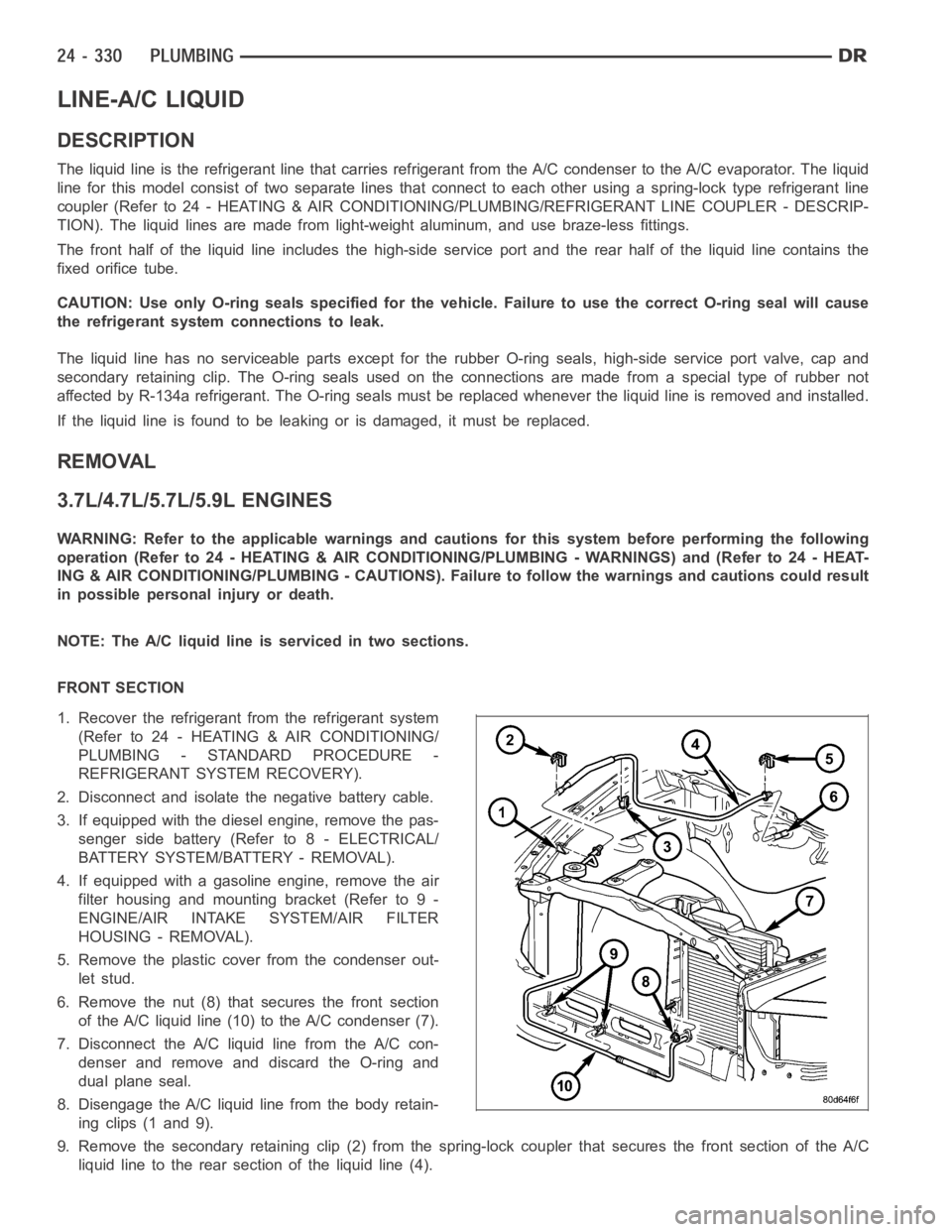
6. Remove the nut (8) that secures the front section
of the A/C liquid line (10) to the A/C condenser (7).
7. Disconnect the A/C liquid line from the A/C con-
denser and remove and discard the O-ring and
dual plane seal.
8. Disengage the A/C liquid line from the body retain-
ing clips (1 and 9).
9. Remove the secondary retaining clip (2) from the spring-lock coupler that secures the front section of the A/C
liquid line to the rear section of the liquid line (4).
Page 5172 of 5267
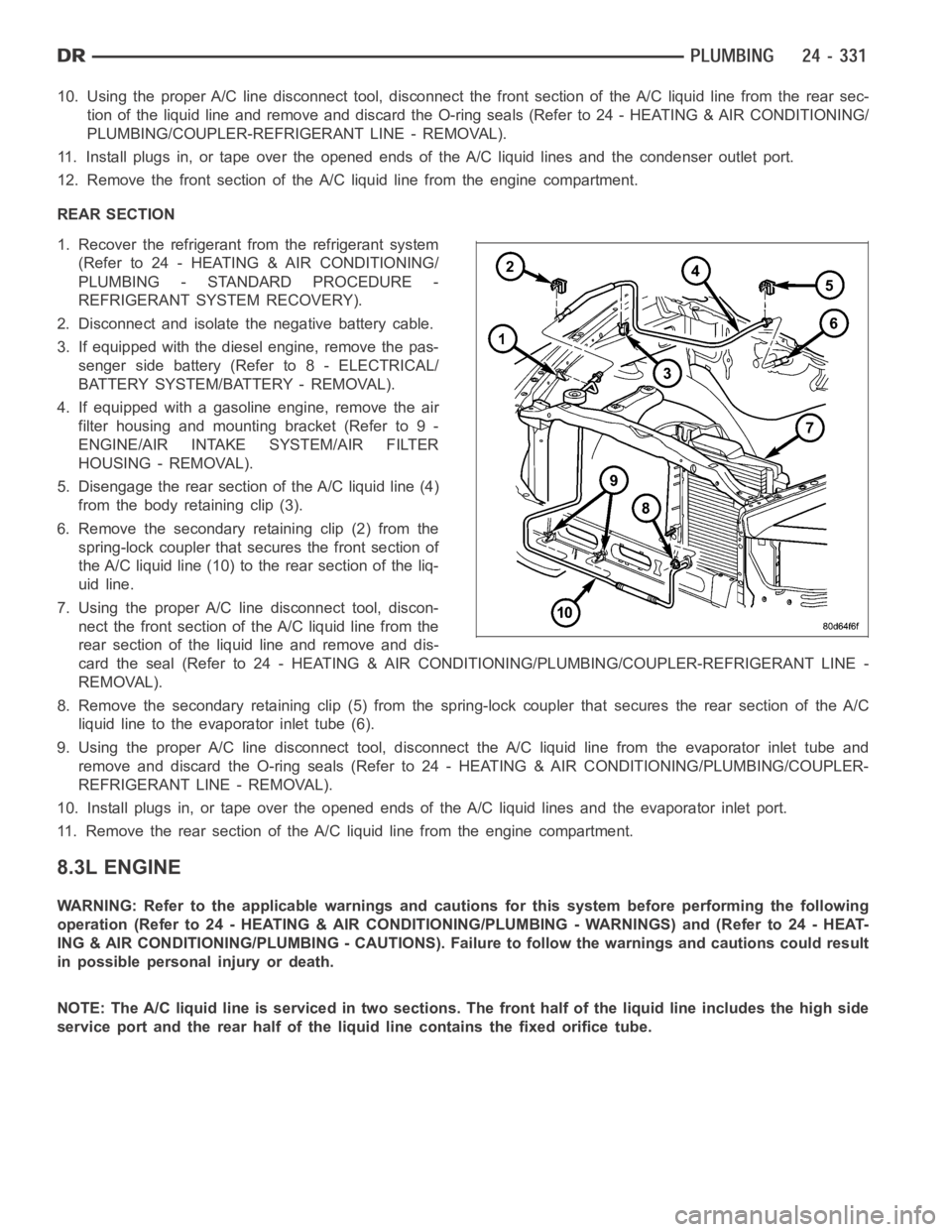
10. Using the proper A/C line disconnect tool, disconnect the front section of the A/C liquid line from the rear sec-
tion of the liquid line and remove and discard the O-ring seals (Refer to 24 -HEATING & AIR CONDITIONING/
PLUMBING/COUPLER-REFRIGERANT LINE - REMOVAL).
11. Install plugs in, or tape over the opened ends of the A/C liquid lines andthe condenser outlet port.
12. Remove the front section of the A/C liquid line from the engine compartment.
REAR SECTION
1. Recover the refrigerant from the refrigerant system
(Refer to 24 - HEATING & AIR CONDITIONING/
PLUMBING - STANDARD PROCEDURE -
REFRIGERANT SYSTEM RECOVERY).
2. Disconnect and isolate the negative battery cable.
3. If equipped with the diesel engine, remove the pas-
senger side battery (Refer to 8 - ELECTRICAL/
BATTERY SYSTEM/BATTERY - REMOVAL).
4. If equipped with a gasoline engine, remove the air
filter housing and mounting bracket (Refer to 9 -
ENGINE/AIR INTAKE SYSTEM/AIR FILTER
HOUSING - REMOVAL).
5. Disengage the rear section of the A/C liquid line (4)
from the body retaining clip (3).
6. Remove the secondary retaining clip (2) from the
spring-lock coupler that secures the front section of
the A/C liquid line (10) to the rear section of the liq-
uid line.
7. Using the proper A/C line disconnect tool, discon-
nect the front section of the A/C liquid line from the
rear section of the liquid line and remove and dis-
card the seal (Refer to 24 - HEATING & AIR CONDITIONING/PLUMBING/COUPLER-REFRIGERANT LINE -
REMOVAL).
8. Remove the secondary retaining clip (5) from the spring-lock coupler that secures the rear section of the A/C
liquid line to the evaporator inlet tube (6).
9. Using the proper A/C line disconnect tool, disconnect the A/C liquid line from the evaporator inlet tube and
removeanddiscardtheO-ringseals(Referto24-HEATING&AIRCONDITIONING/PLUMBING/COUPLER-
REFRIGERANT LINE - REMOVAL).
10. Install plugs in, or tape over the opened ends of the A/C liquid lines andthe evaporator inlet port.
11. Remove the rear section of the A/C liquid line from the engine compartment.
8.3L ENGINE
WARNING: Refer to the applicable warnings and cautions for this system before performing the following
operation (Refer to 24 - HEATING & AIR CONDITIONING/PLUMBING - WARNINGS) and (Refer to 24 - HEAT-
ING & AIR CONDITIONING/PLUMBING - CAUTIONS). Failure to follow the warnings and cautions could result
in possible personal injury or death.
NOTE: The A/C liquid line is serviced in two sections. The front half of the liquid line includes the high side
service port and the rear half of the liquid line contains the fixed orificetube.
Page 5178 of 5267
LINE-A/C SUCTION
DESCRIPTION
The A/C suction line is the refrigerant line that goes from the A/C evaporator to the A/C compressor.
TheA/Csuctionlineforthe5.9LDieselengineisservicedasanassemblywith the discharge line.
The A/C discharge line for the 8.3L engine is secured to the top of fan shroudby two retainers.
CAUTION: Use only O-ring seals specified for the vehicle. Failure to use the correct O-ring seal will cause
the refrigerant system connections to leak.
The A/C suction line has no serviceable parts except for the rubber O-ring seals and the secondary retaining clip.
The O-ring seals used on the connections are made from a special type of rubber not affected by R-134a refriger-
ant. The O-ring seals must be replaced whenever the A/C suction line is removed and installed.
If the A/C suction line is found to be leaking or is damaged, it must be replaced.
REMOVAL
3.7L/4.7L ENGINES
WARNING: Refer to the applicable warnings and cautions for this system before performing the following
operation (Refer to 24 - HEATING & AIR CONDITIONING/PLUMBING - WARNINGS) and (Refer to 24 - HEAT-
ING & AIR CONDITIONING/PLUMBING - CAUTIONS). Failure to follow the warnings and cautions could result
in possible personal injury or death.
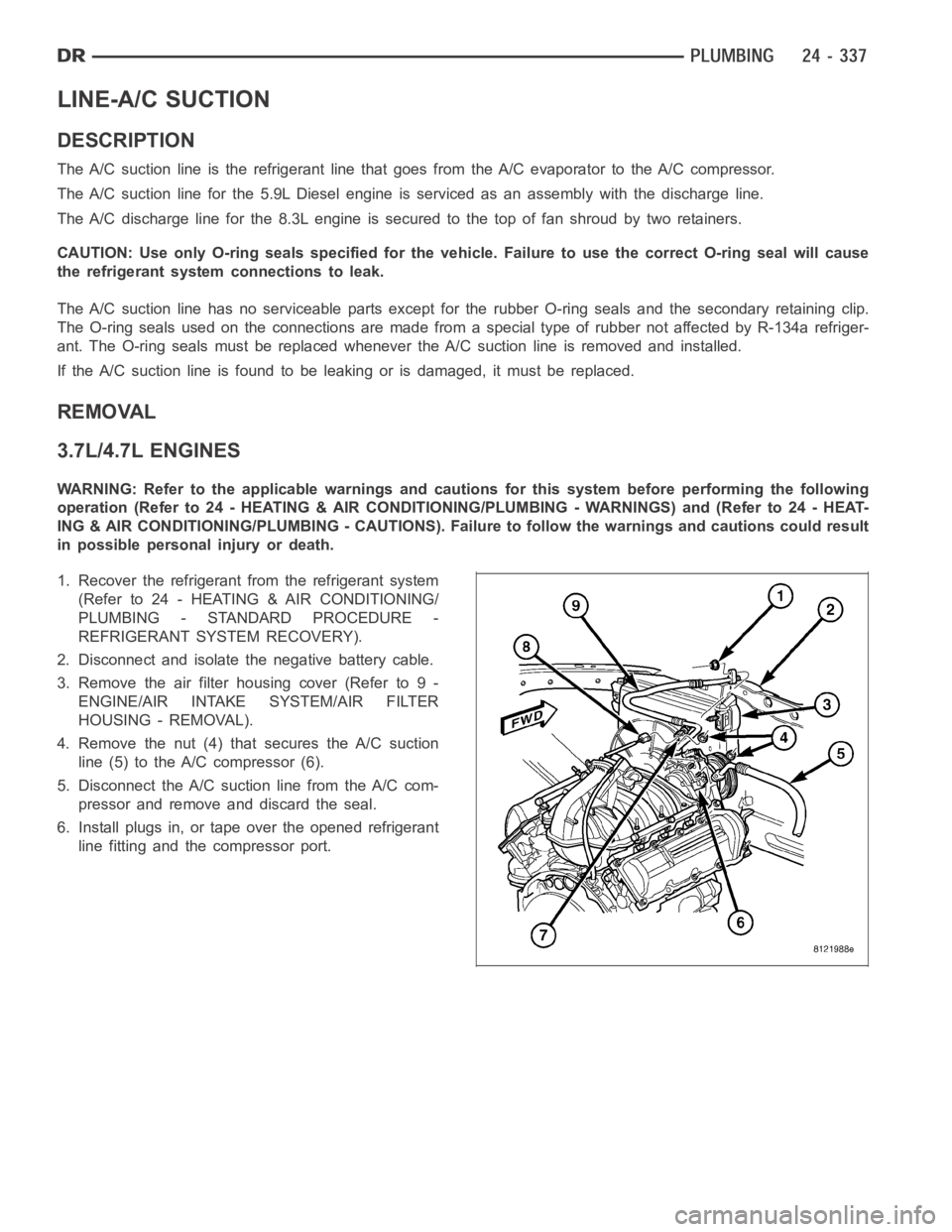
1. Recover the refrigerant from the refrigerant system
(Refer to 24 - HEATING & AIR CONDITIONING/
PLUMBING - STANDARD PROCEDURE -
REFRIGERANT SYSTEM RECOVERY).
2. Disconnect and isolate the negative battery cable.
3. Remove the air filter housing cover (Refer to 9 -
ENGINE/AIR INTAKE SYSTEM/AIR FILTER
HOUSING - REMOVAL).
4. Remove the nut (4) that secures the A/C suction
line (5) to the A/C compressor (6).
5. Disconnect the A/C suction line from the A/C com-
pressor and remove and discard the seal.
6. Install plugs in, or tape over the opened refrigerant
line fitting and the compressor port.