warning DODGE RAM SRT-10 2006 Service Repair Manual
[x] Cancel search | Manufacturer: DODGE, Model Year: 2006, Model line: RAM SRT-10, Model: DODGE RAM SRT-10 2006Pages: 5267, PDF Size: 68.7 MB
Page 4562 of 5267
CENTER ARMREST / SEAT BACK
REMOVAL
1. Before proceeding with the following repair proce-
dure, review all warnings and cautions. (Refer to
23 - BODY/SEATS - WARNING)
NOTE: Do not reuse the seat fasteners, always
replace with new ones.
2.Removethecenterseat(Referto23-BODY/
SEATS/SEAT - CENTER - REMOVAL).
3. Disconnect the storage bin/cushion cover j-straps
and position aside.
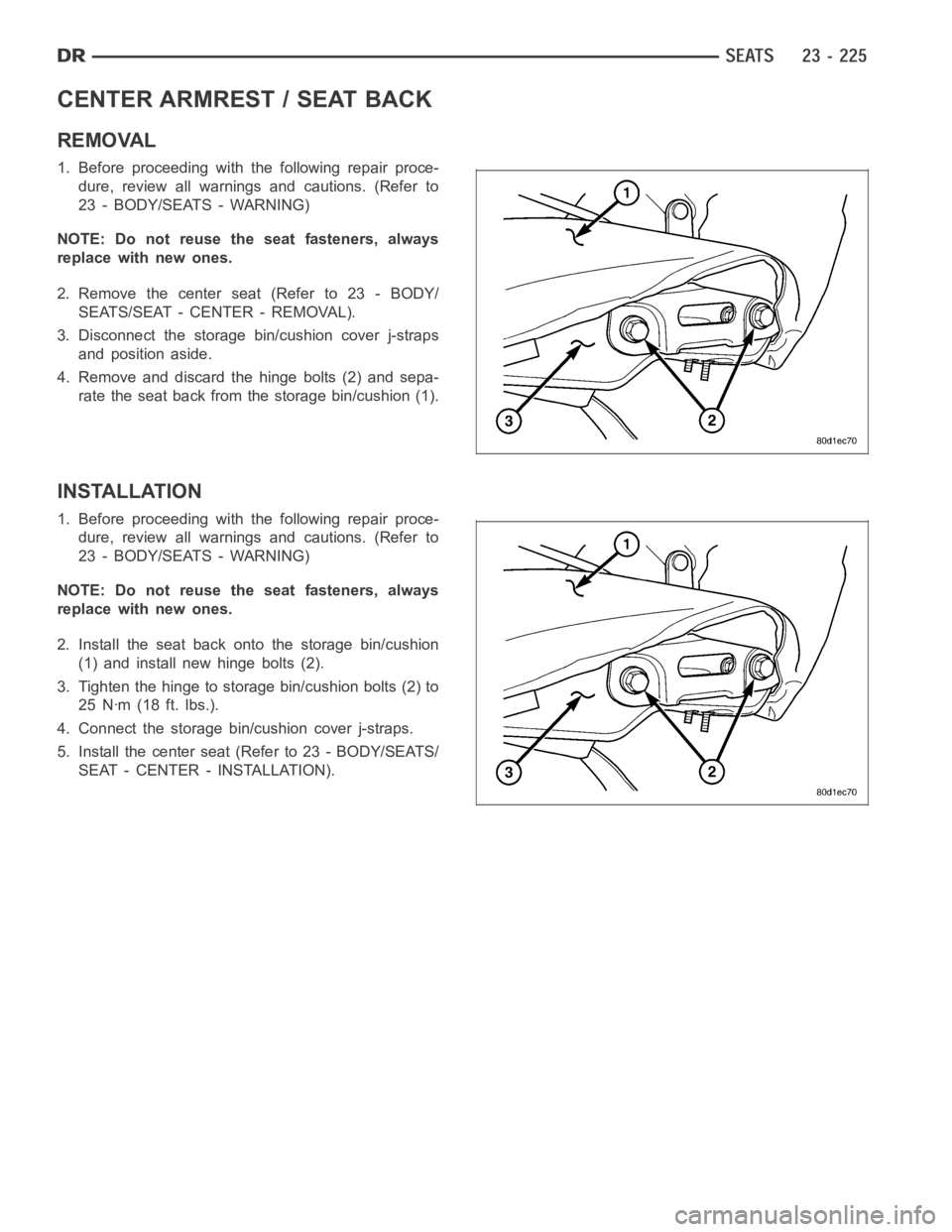
4. Remove and discard the hinge bolts (2) and sepa-
rate the seat back from the storage bin/cushion (1).
INSTALLATION
1. Before proceeding with the following repair proce-
dure, review all warnings and cautions. (Refer to
23 - BODY/SEATS - WARNING)
NOTE: Do not reuse the seat fasteners, always
replace with new ones.
2. Install the seat back onto the storage bin/cushion
(1) and install new hinge bolts (2).
3. Tighten the hinge to storage bin/cushion bolts (2) to
25 Nꞏm (18 ft. lbs.).
4. Connect the storage bin/cushion cover j-straps.
5. Install the center seat (Refer to 23 - BODY/SEATS/
SEAT - CENTER - INSTALLATION).
Page 4574 of 5267
SEAT - FRONT
REMOVAL
1. Before proceeding with the following repair proce-
dure, review all warnings and cautions. (Refer to
23 - BODY/SEATS - WARNING)
NOTE: Do not reuse the seat fasteners, always
replace with new ones.
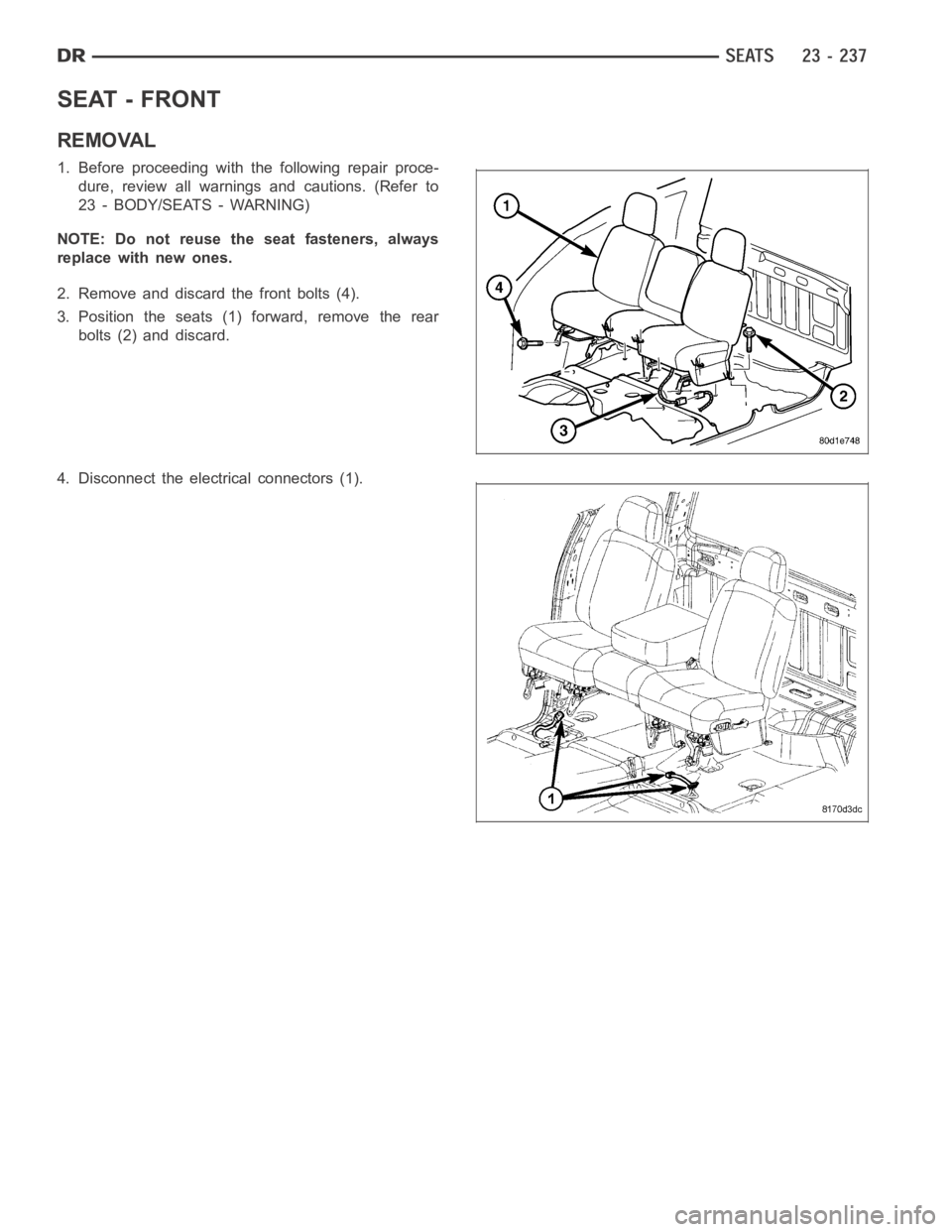
2. Remove and discard the front bolts (4).
3. Position the seats (1) forward, remove the rear
bolts (2) and discard.
4. Disconnect the electrical connectors (1).
Page 4575 of 5267
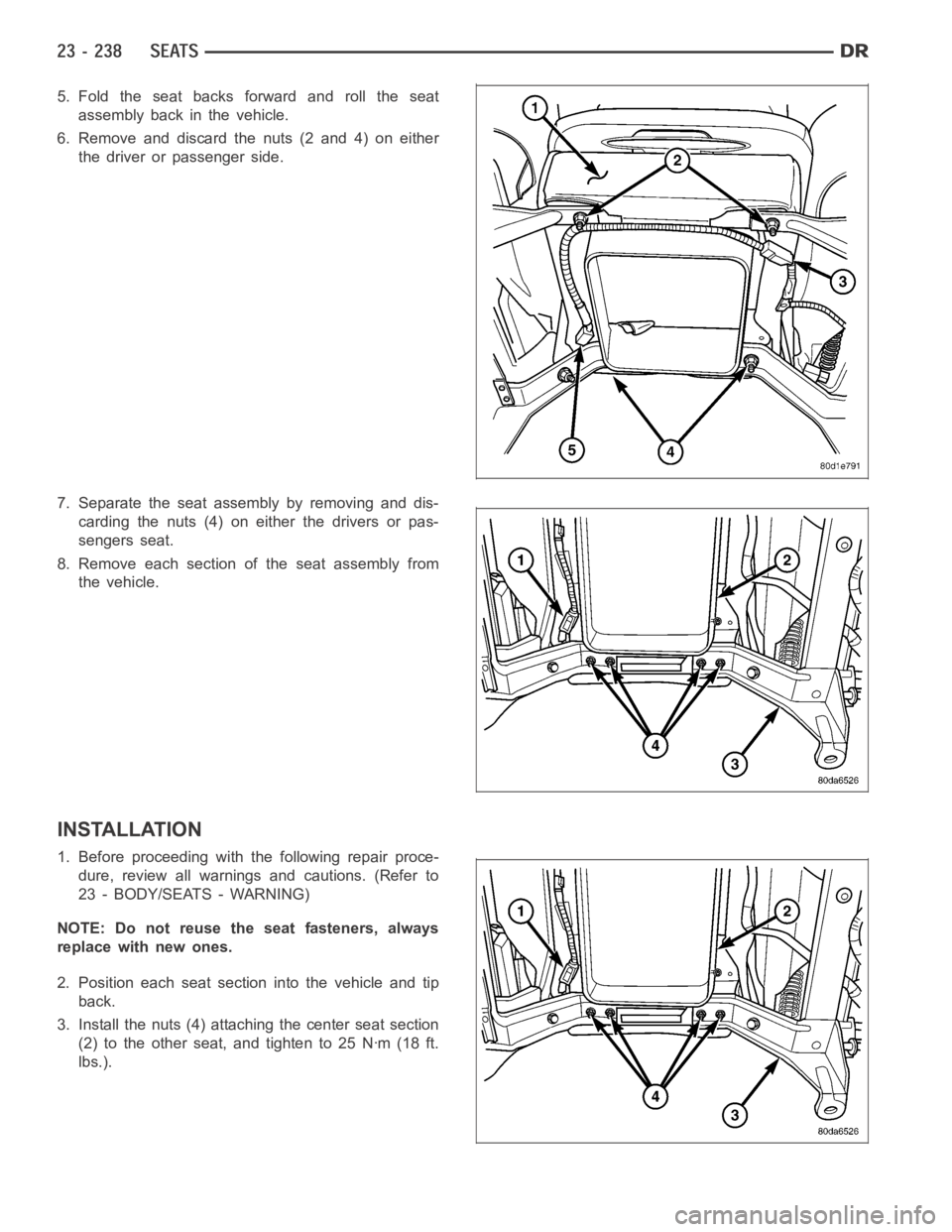
5. Fold the seat backs forward and roll the seat
assembly back in the vehicle.
6. Remove and discard the nuts (2 and 4) on either
the driver or passenger side.
7. Separate the seat assembly by removing and dis-
carding the nuts (4) on either the drivers or pas-
sengers seat.
8. Remove each section of the seat assembly from
the vehicle.
INSTALLATION
1. Before proceeding with the following repair proce-
dure, review all warnings and cautions. (Refer to
23 - BODY/SEATS - WARNING)
NOTE: Do not reuse the seat fasteners, always
replace with new ones.
2. Position each seat section into the vehicle and tip
back.
3. Install the nuts (4) attaching the center seat section
(2) to the other seat, and tighten to 25 Nꞏm (18 ft.
lbs.).
Page 4593 of 5267
page page
BACKLITE
REMOVAL ................................... 257
INSTALLATION .............................. 258
BACKLITE VENT GLASS
REMOVAL ................................... 261
INSTALLATION .............................. 261
WINDSHIELD
WARNING
WINDSHIELD SAFETY PRECAUTIONS ...... 262REMOVAL ................................... 262
INSTALLATION .............................. 264
BACKLITE VENT GLASS - REGULATOR
REMOVAL ................................... 268
INSTALLATION .............................. 269
Page 4599 of 5267
WINDSHIELD
WARNING
WINDSHIELD SAFETY PRECAUTIONS
Do not operate the vehicle within 24 hours of windshield installation. It takes at least 24 hours for urethane
adhesive to cure. If it is not cured, the windshield may not perform properlyinanaccident.
Urethane adhesives are applied as a system. Use glass cleaner, glass prep solvent, glass primer, PVC
(vinyl) primer and pinch weld (fence) primer provided by the adhesive manufacturer. If not, structural
integrity could be compromised.
DaimlerChrysler does not recommend glass adhesive by brand. Techniciansshould review product
labels and technical data sheets, and use only adhesives that their manufactures warranty and will
restore a vehicle to the requirements of fmvss 212. Technicians should also insure that primers and
cleaners are compatible with the particular adhesive used.
Be sure to refer to the urethane manufacturer’s directions for curing timespecifications and do not
use adhesive after its expiration date.
Vapors that are emitted from the urethane adhesive or primer could cause personal injury or death.
Use them in a well-ventilated area.
Skin contact with urethane adhesive should be avoided. Personal injury ordeath may result.
Always wear eye and hand protection when working with glass.
Protect all painted and trimmed surfaces from coming in contact with urethane or primers.
Be careful not to damage painted surfaces when removing moldings or cutting urethane around windshield.
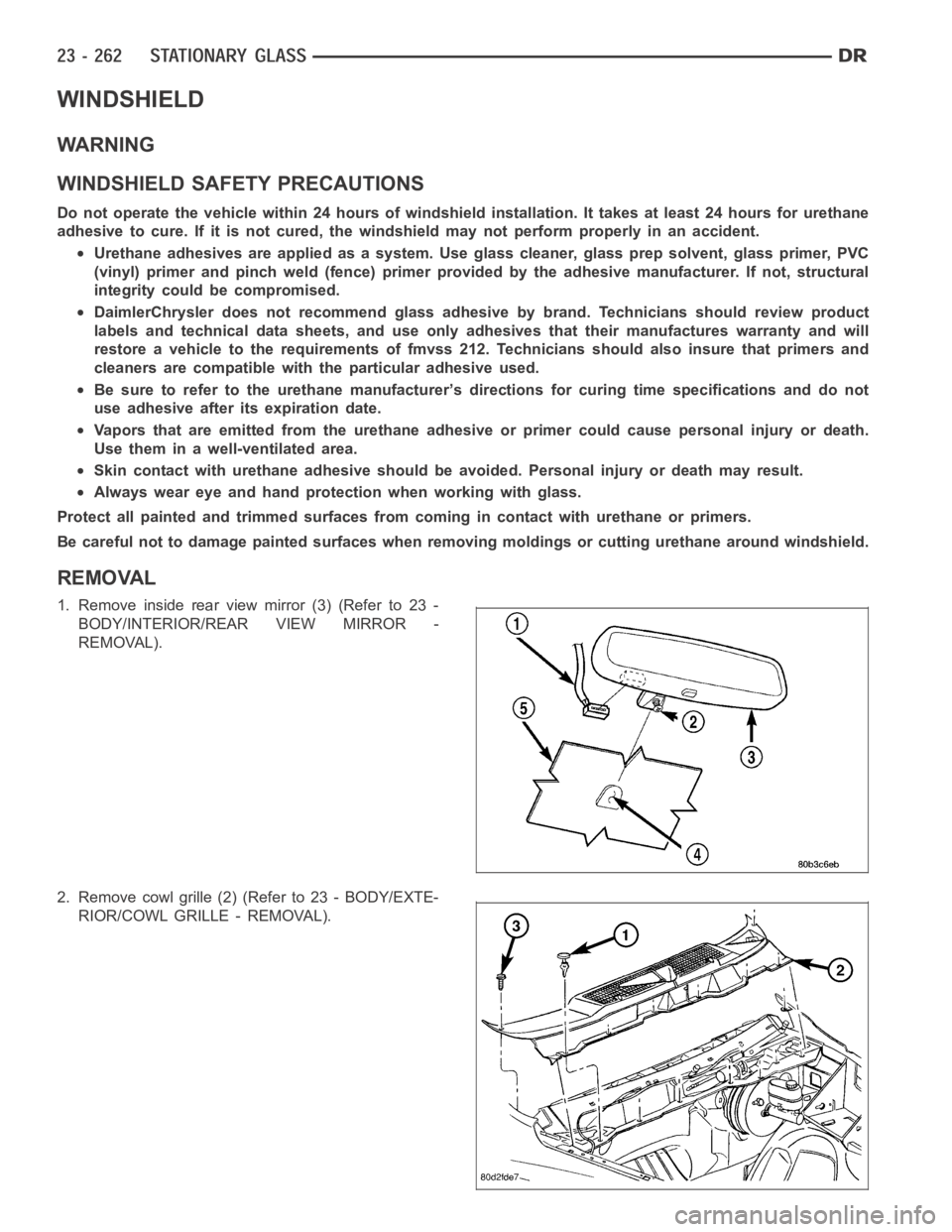
REMOVAL
1. Remove inside rear view mirror (3) (Refer to 23 -
BODY/INTERIOR/REAR VIEW MIRROR -
REMOVAL).
2. Remove cowl grille (2) (Refer to 23 - BODY/EXTE-
RIOR/COWL GRILLE - REMOVAL).
Page 4601 of 5267
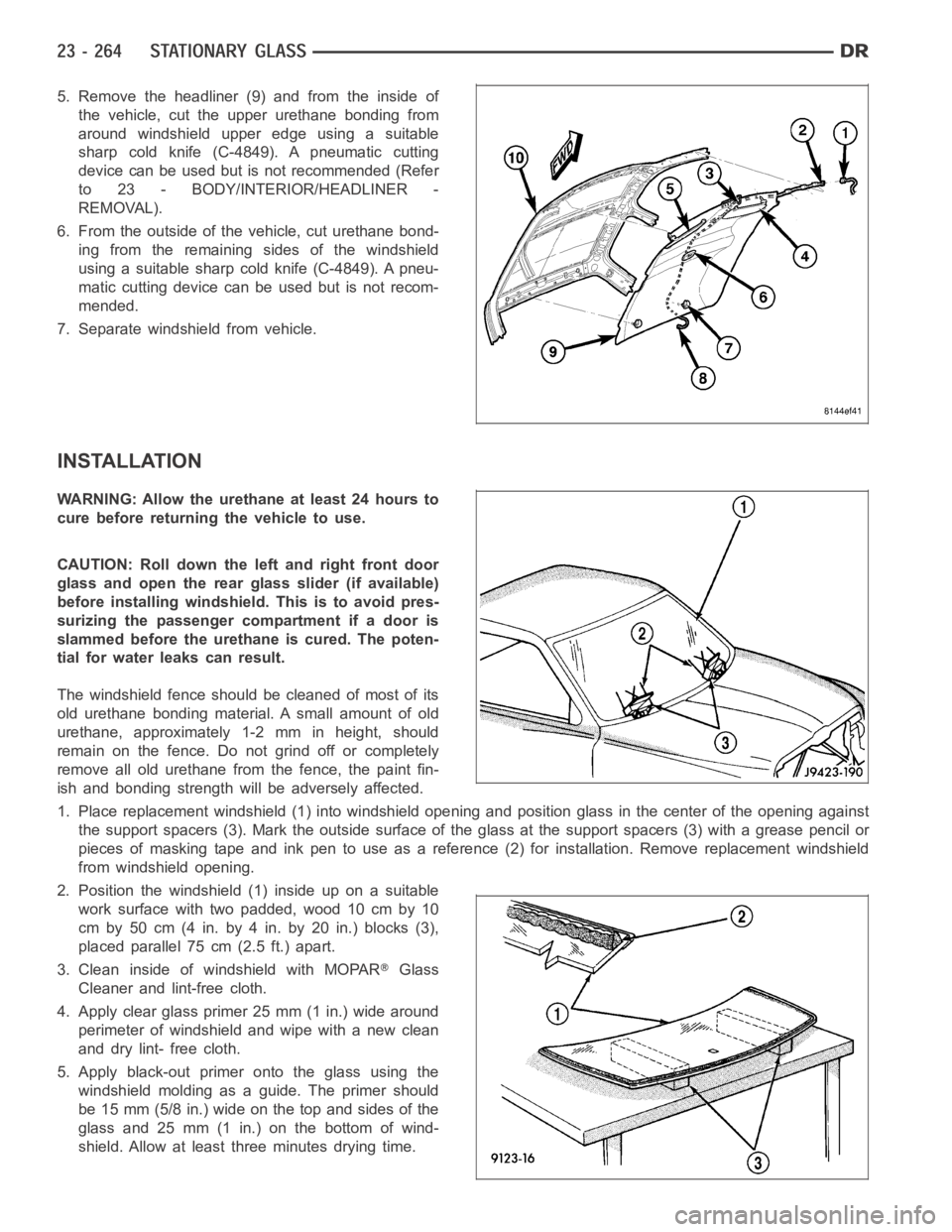
5. Remove the headliner (9) and from the inside of
the vehicle, cut the upper urethane bonding from
around windshield upper edge using a suitable
sharp cold knife (C-4849). A pneumatic cutting
device can be used but is not recommended (Refer
to 23 - BODY/INTERIOR/HEADLINER -
REMOVAL).
6. From the outside of the vehicle, cut urethane bond-
ing from the remaining sides of the windshield
using a suitable sharp cold knife (C-4849). A pneu-
matic cutting device can be used but is not recom-
mended.
7. Separate windshield from vehicle.
INSTALLATION
WARNING: Allow the urethane at least 24 hours to
cure before returning the vehicle to use.
CAUTION: Roll down the left and right front door
glass and open the rear glass slider (if available)
before installing windshield. This is to avoid pres-
surizing the passenger compartment if a door is
slammed before the urethane is cured. The poten-
tial for water leaks can result.
The windshield fence should be cleaned of most of its
old urethane bonding material. A small amount of old
urethane, approximately 1-2 mm in height, should
remain on the fence. Do not grind off or completely
remove all old urethane from the fence, the paint fin-
ish and bonding strength will be adversely affected.
1. Place replacement windshield (1) into windshield opening and positionglass in the center of the opening against
the support spacers (3). Mark the outside surface of the glass at the support spacers (3) with a grease pencil or
pieces of masking tape and ink pen to use as a reference (2) for installation. Remove replacement windshield
from windshield opening.
2. Position the windshield (1) inside up on a suitable
work surface with two padded, wood 10 cm by 10
cm by 50 cm (4 in. by 4 in. by 20 in.) blocks (3),
placed parallel 75 cm (2.5 ft.) apart.
3. Clean inside of windshield with MOPAR
Glass
Cleaner and lint-free cloth.
4. Apply clear glass primer 25 mm (1 in.) wide around
perimeter of windshield and wipe with a new clean
and dry lint- free cloth.
5. Apply black-out primer onto the glass using the
windshield molding as a guide. The primer should
be 15 mm (5/8 in.) wide on the top and sides of the
glass and 25 mm (1 in.) on the bottom of wind-
shield. Allow at least three minutes drying time.
Page 4613 of 5267

ASSEMBLY-MODULE
REMOVAL
WARNING: The Excessive Force Limitation (EFL)
feature must be calibrated any time a sunroof
motor/module is replaced with a new component.
Failure to perform this procedure could result in
vehicle damage and/or personal injury. (Refer to 8
- ELECTRICAL/POWER TOP/MOTOR - STANDARD
PROCEDURE - EXCESSIVE FORCE LIMITATION
(EFL) CALIBRATION) for the appropriate proce-
dure.
1. Move glass panel to the fully closed position.
2. Disconnect and isolate the battery negative cable.
3. Remove headliner (Refer to 23 - BODY/INTERIOR/
HEADLINER - REMOVAL).
4. Disconnect the sunroof wire harness electrical
connector.
5. Disconnect the four drain tubes (1) from sunroof
housing.
Page 4615 of 5267

INSTALLATION
WARNING: The Excessive Force Limitation (EFL) feature must be calibratedanytimeasunroofmotor/mod-
ule is replaced with a new component. Failure to perform this procedure could result in vehicle damage
and/or personal injury. (Refer to 8 - ELECTRICAL/POWER TOP/MOTOR - STANDARD PROCEDURE - EXCES-
SIVE FORCE LIMITATION (EFL) CALIBRATION) for the appropriate procedure.
1. Verify that glass panel is loose and slightly retracted.
2. Raise sunroof module assembly (1) and guide it carefully into position.
3. Hand start the eight screws (2).
4. Line up the locating holes and tighten the attaching screws (2) to 9 Nꞏm (80in.lbs.).
5. Connect the electrical connector (1).
Page 4657 of 5267
page page
WINCH
DESCRIPTION ............................... 321
OPERATION ................................. 321
WARNING ................................... 321
DIAGNOSIS AND TESTING – WINCH .......... 322
REMOVAL ................................... 330
INSTALLATION .............................. 333
BRACKETS
REMOVAL ................................... 336
INSTALLATION .............................. 337
MOTOR
DESCRIPTION ............................... 339
REMOVAL ................................... 339
INSTALLATION .............................. 341
MOTOR-TIE RODS
REMOVAL ................................... 344INSTALLATION .............................. 344
RELAY
REMOVAL ................................... 345
INSTALLATION .............................. 347
RELAY PACK
DESCRIPTION ............................... 349
REMOVAL ................................... 350
INSTALLATION .............................. 352
WIRE ROPE
REMOVAL ................................... 354
INSTALLATION .............................. 355
WIRE ROPE GUIDE ROLLERS
REMOVAL ................................... 356
INSTALLATION .............................. 358
Page 4658 of 5267
WINCH
DESCRIPTION
The winch uses the electrical power from the vehicle charging system to power a motor that winds wire rope into
the winch drum by means of planetary gear reduction.
The winch assembly includes the following:
Motor:The winch motor is powered by the vehicle electrical system and features a thermal protection switch
that automatically stops the motor function in the power-in direction if the motor gets too hot.
Winch Drum:The winch drum allows the wire rope to be stored on the winch and transmits forcetothewire
rope.
Wire Rope:The wire rope allows the winch to be connected to an anchor to provide a pulling force.
Fairlead:The fairlead consists of four rollers and acts as guide for the wire rope andminimizes damage to the
rope.
Automatic Brake:The winch is equipped with an automatic brake that will stop rotation of thewinch drum if
the winch motor is stopped.
Clutch Lever:The clutch lever allows the winch drum to be disconnected from the winch motor to allow the
wire rope to be pulled from the winch by hand.
Remote Socket:The remote socket allows the remote control to be attached to the control pack to allow the
winchtofunction.
Remote Control:The remote control provides the interface between the winch operator and the winch. The
remote control provides the ability to power the winch in, out, and stop thewinch.
OPERATION
Winch:The winch uses the electrical power from the vehicle charging system to power a motor that winds wire rope
into the winch drum via planetary gear reduction. By nature, a winch is capable of generating very high forces and
should be used with care. Do not operate the winch without reading and understanding the complete winch owner’s
manual.
Low Voltage Interrupt:The winch is equipped with a device that will interrupt winch function if the vehicle charging
system voltage drops to a low level. The winch will not power-in or out for 30seconds if this device is tripped. If the
interrupt is tripped, the vehicle should be operated at high idle for a few minutes to allow the vehicle charging sys-
tem to recover before continuing to winch.
Winch Motor Thermal Protection:The winch is equipped with athermalprotectiondeviceinthemotor.Ifthe
winch is operated for an excessive duration, the device may interrupt motor function to protect the winch motor.
During this time the winch will power-out but will not power-in. Allow the winch motor to cool for a few minutes
before continuing operation of the winch. The winch will resume normal function once the motor cools.
Remote Control:Tooperatethewinch,thetoggleswitchispresseddowntopowerthewinchinand up to power
the winch out. The winch will stop if the switch is left in the neutral (center) position.
Clutch Lever:The clutch lever is used to allow free spooling of the winch drum. Rotate theclutch lever on the
winch to disengage the clutch.
WARNING
WARNING: Disconnect and isolate battery negative cable before attempting any troubleshooting or repairs.
Do not disengage the clutch if the winch is under a load or wire rope is under tension.
Do not route electrical cables across sharp edges.
Do not route electrical cables through or near moving parts.
Always wear heavy leather gloves when handling a wire rope.
Never let wire rope slip through your hands.
Always keep hands clear of wire rope, hook loop, hook and fairlead opening during installation, opera-
tion, and when spooling in or out.
Always use supplied hook strap whenever spooling wire rope in or out, during installation or operation.
Failure to follow these instructions may result in personal injury.