warning DODGE RAM SRT-10 2006 Service Repair Manual
[x] Cancel search | Manufacturer: DODGE, Model Year: 2006, Model line: RAM SRT-10, Model: DODGE RAM SRT-10 2006Pages: 5267, PDF Size: 68.7 MB
Page 5179 of 5267
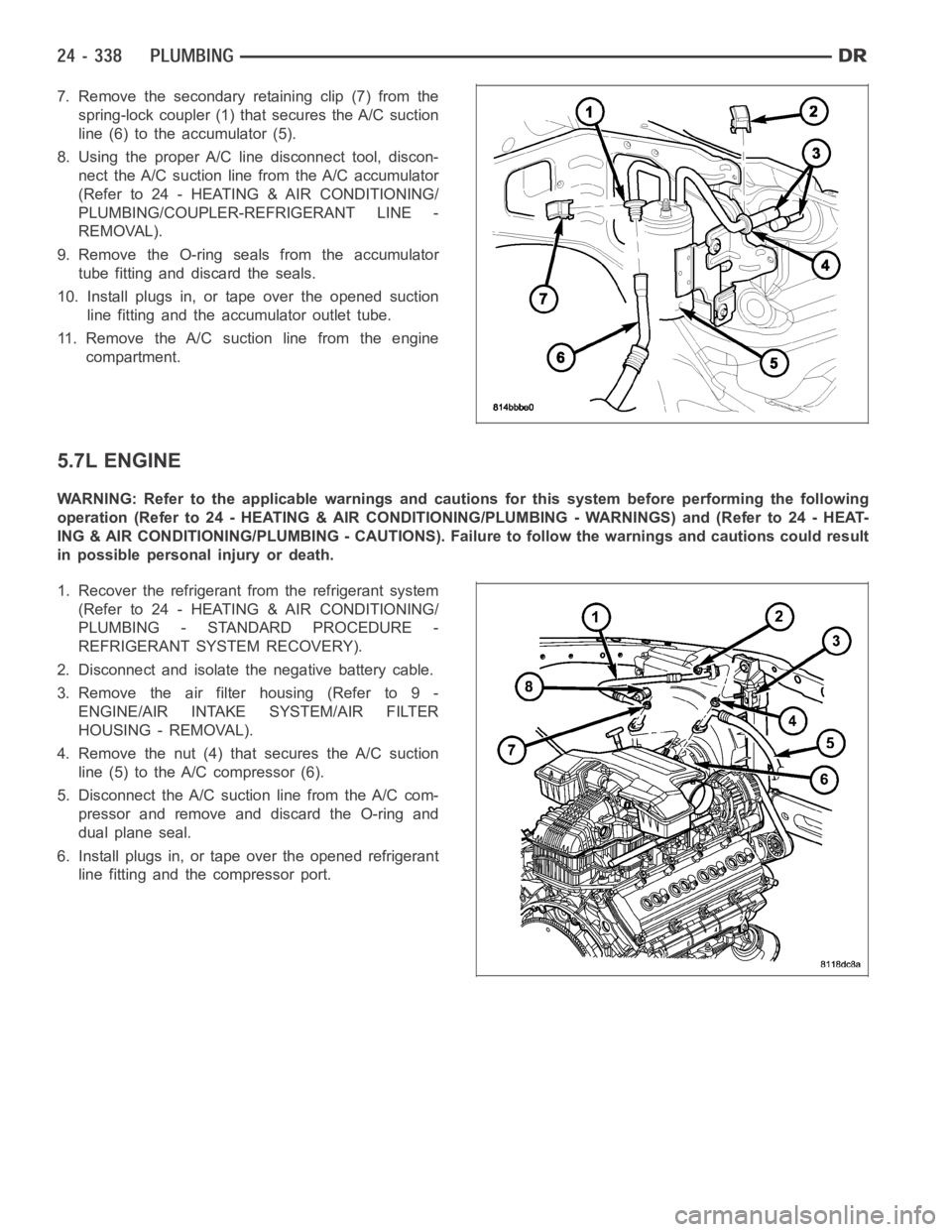
7. Remove the secondary retaining clip (7) from the
spring-lock coupler (1) that secures the A/C suction
line (6) to the accumulator (5).
8. Using the proper A/C line disconnect tool, discon-
nect the A/C suction line from the A/C accumulator
(Refer to 24 - HEATING & AIR CONDITIONING/
PLUMBING/COUPLER-REFRIGERANT LINE -
REMOVAL).
9. Remove the O-ring seals from the accumulator
tube fitting and discard the seals.
10. Install plugs in, or tape over the opened suction
line fitting and the accumulator outlet tube.
11. Remove the A/C suction line from the engine
compartment.
5.7L ENGINE
WARNING: Refer to the applicable warnings and cautions for this system before performing the following
operation (Refer to 24 - HEATING & AIR CONDITIONING/PLUMBING - WARNINGS) and (Refer to 24 - HEAT-
ING & AIR CONDITIONING/PLUMBING - CAUTIONS). Failure to follow the warnings and cautions could result
in possible personal injury or death.
1. Recover the refrigerant from the refrigerant system
(Refer to 24 - HEATING & AIR CONDITIONING/
PLUMBING - STANDARD PROCEDURE -
REFRIGERANT SYSTEM RECOVERY).
2. Disconnect and isolate the negative battery cable.
3.Removetheairfilterhousing(Referto9-
ENGINE/AIR INTAKE SYSTEM/AIR FILTER
HOUSING - REMOVAL).
4. Remove the nut (4) that secures the A/C suction
line (5) to the A/C compressor (6).
5. Disconnect the A/C suction line from the A/C com-
pressor and remove and discard the O-ring and
dual plane seal.
6. Install plugs in, or tape over the opened refrigerant
line fitting and the compressor port.
Page 5180 of 5267
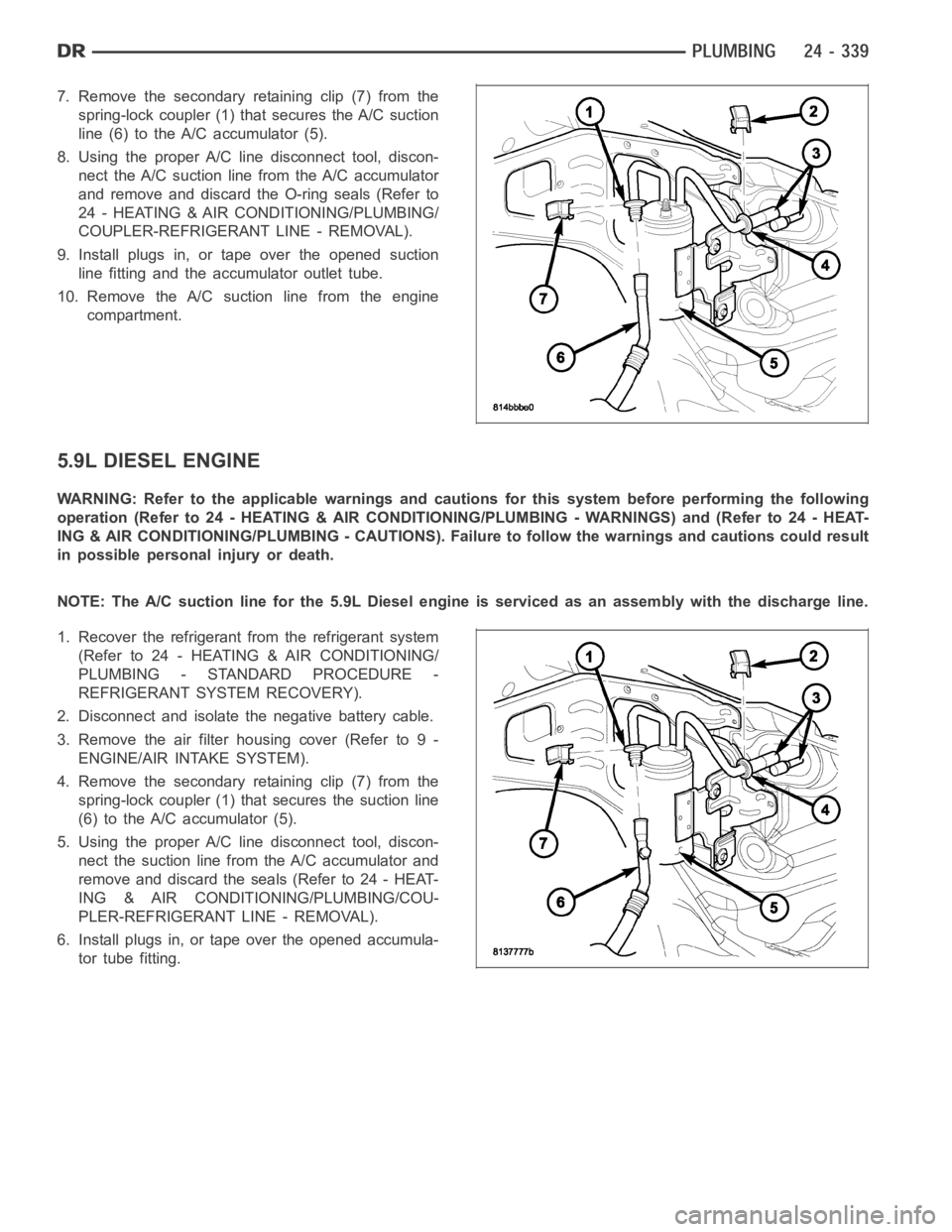
7. Remove the secondary retaining clip (7) from the
spring-lock coupler (1) that secures the A/C suction
line (6) to the A/C accumulator (5).
8. Using the proper A/C line disconnect tool, discon-
nect the A/C suction line from the A/C accumulator
and remove and discard the O-ring seals (Refer to
24 - HEATING & AIR CONDITIONING/PLUMBING/
COUPLER-REFRIGERANT LINE - REMOVAL).
9. Install plugs in, or tape over the opened suction
line fitting and the accumulator outlet tube.
10. Remove the A/C suction line from the engine
compartment.
5.9L DIESEL ENGINE
WARNING: Refer to the applicable warnings and cautions for this system before performing the following
operation (Refer to 24 - HEATING & AIR CONDITIONING/PLUMBING - WARNINGS) and (Refer to 24 - HEAT-
ING & AIR CONDITIONING/PLUMBING - CAUTIONS). Failure to follow the warnings and cautions could result
in possible personal injury or death.
NOTE: The A/C suction line for the 5.9L Diesel engine is serviced as an assembly with the discharge line.
1. Recover the refrigerant from the refrigerant system
(Refer to 24 - HEATING & AIR CONDITIONING/
PLUMBING - STANDARD PROCEDURE -
REFRIGERANT SYSTEM RECOVERY).
2. Disconnect and isolate the negative battery cable.
3. Remove the air filter housing cover (Refer to 9 -
ENGINE/AIR INTAKE SYSTEM).
4. Remove the secondary retaining clip (7) from the
spring-lock coupler (1) thatsecures the suction line
(6) to the A/C accumulator (5).
5. Using the proper A/C line disconnect tool, discon-
nect the suction line from the A/C accumulator and
remove and discard the seals (Refer to 24 - HEAT-
ING & AIR CONDITIONING/PLUMBING/COU-
PLER-REFRIGERANT LINE - REMOVAL).
6. Install plugs in, or tape over the opened accumula-
tor tube fitting.
Page 5181 of 5267
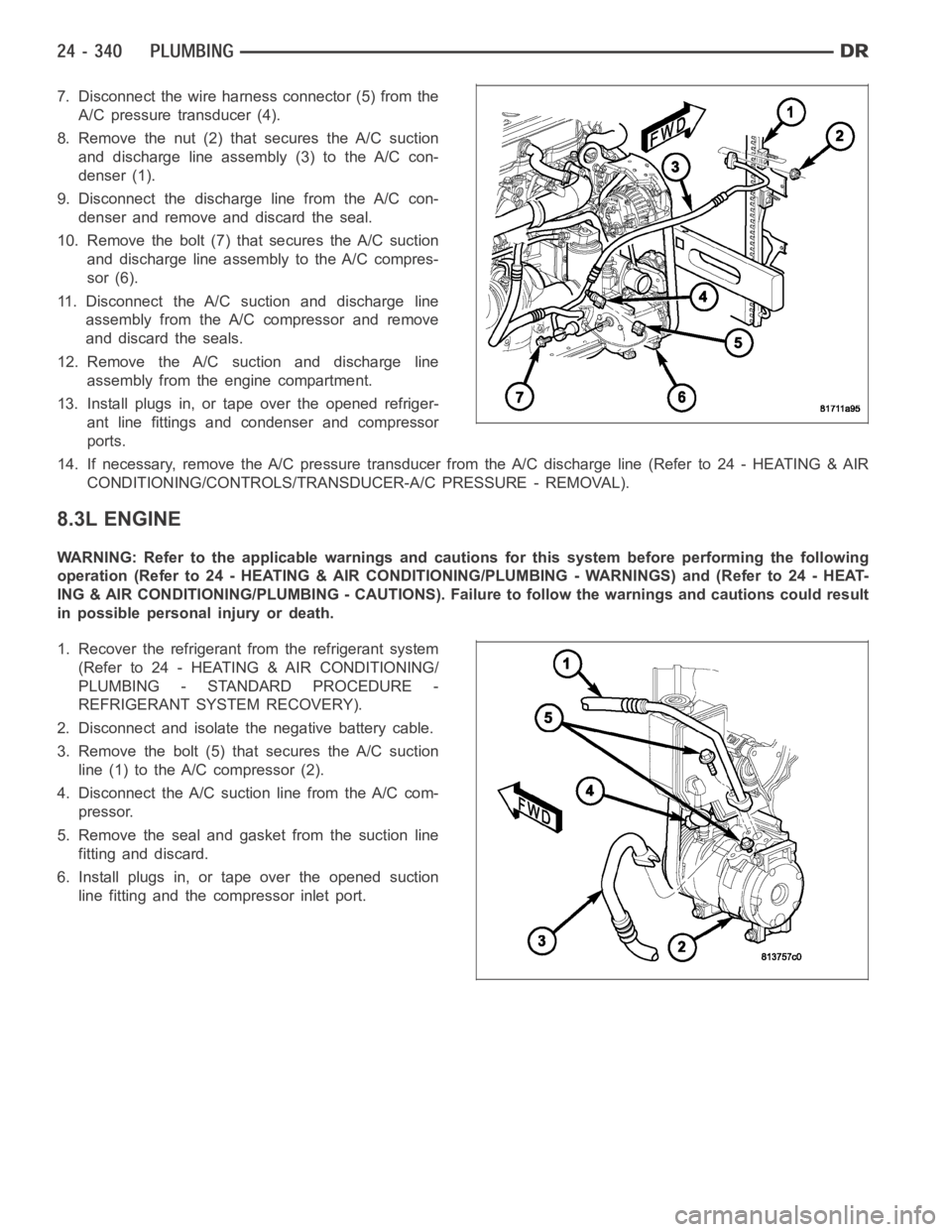
7. Disconnect the wire harness connector (5) from the
A/C pressure transducer (4).
8. Remove the nut (2) that secures the A/C suction
and discharge line assembly (3) to the A/C con-
denser (1).
9. Disconnect the discharge line from the A/C con-
denser and remove and discard the seal.
10. Remove the bolt (7) that secures the A/C suction
and discharge line assembly to the A/C compres-
sor (6).
11. Disconnect the A/C suction and discharge line
assembly from the A/C compressor and remove
and discard the seals.
12. Remove the A/C suction and discharge line
assembly from the engine compartment.
13. Install plugs in, or tape over the opened refriger-
ant line fittings and condenser and compressor
ports.
14. If necessary, remove the A/C pressure transducer from the A/C dischargeline(Referto24-HEATING&AIR
CONDITIONING/CONTROLS/TRANSDUCER-A/C PRESSURE - REMOVAL).
8.3L ENGINE
WARNING: Refer to the applicable warnings and cautions for this system before performing the following
operation (Refer to 24 - HEATING & AIR CONDITIONING/PLUMBING - WARNINGS) and (Refer to 24 - HEAT-
ING & AIR CONDITIONING/PLUMBING - CAUTIONS). Failure to follow the warnings and cautions could result
in possible personal injury or death.
1. Recover the refrigerant from the refrigerant system
(Refer to 24 - HEATING & AIR CONDITIONING/
PLUMBING - STANDARD PROCEDURE -
REFRIGERANT SYSTEM RECOVERY).
2. Disconnect and isolate the negative battery cable.
3. Remove the bolt (5) that secures the A/C suction
line (1) to the A/C compressor (2).
4. Disconnect the A/C suction line from the A/C com-
pressor.
5. Remove the seal and gasket from the suction line
fitting and discard.
6. Install plugs in, or tape over the opened suction
line fitting and the compressor inlet port.
Page 5191 of 5267
TUBE-A/C ORIFICE
DESCRIPTION
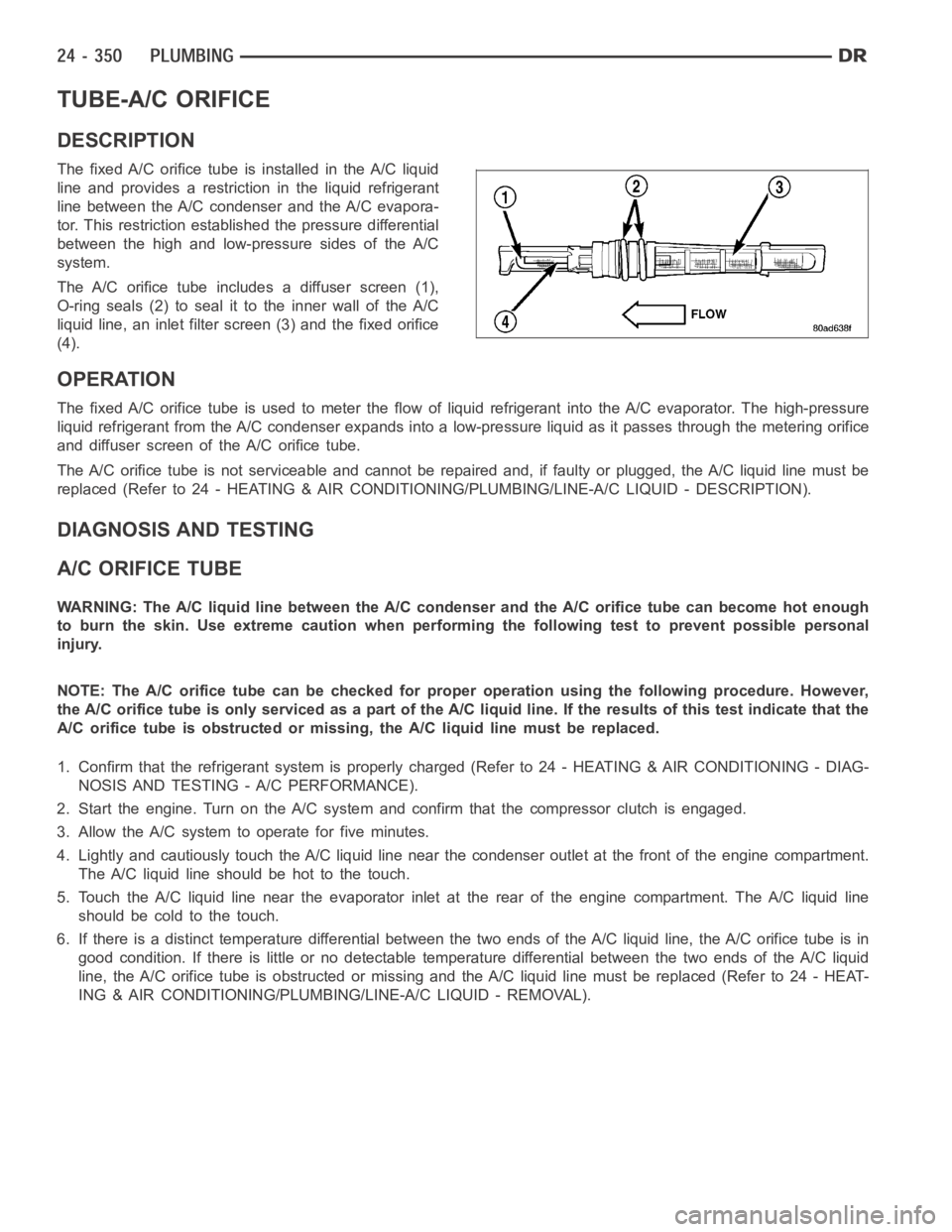
The fixed A/C orifice tube is installed in the A/C liquid
line and provides a restriction in the liquid refrigerant
line between the A/C condenser and the A/C evapora-
tor. This restriction established the pressure differential
between the high and low-pressure sides of the A/C
system.
The A/C orifice tube includes a diffuser screen (1),
O-ring seals (2) to seal it to the inner wall of the A/C
liquid line, an inlet filter screen (3) and the fixed orifice
(4).
OPERATION
The fixed A/C orifice tube is used to meter the flow of liquid refrigerant into the A/C evaporator. The high-pressure
liquid refrigerant from the A/C condenser expands into a low-pressure liquid as it passes through the metering orifice
and diffuser screen of the A/C orifice tube.
The A/C orifice tube is not serviceable and cannot be repaired and, if faulty or plugged, the A/C liquid line must be
replaced (Refer to 24 - HEATING & AIR CONDITIONING/PLUMBING/LINE-A/C LIQUID - DESCRIPTION).
DIAGNOSIS AND TESTING
A/C ORIFICE TUBE
WARNING: The A/C liquid line between the A/C condenser and the A/C orifice tube can become hot enough
to burn the skin. Use extreme caution when performing the following test toprevent possible personal
injury.
NOTE: The A/C orifice tube can be checked for proper operation using the following procedure. However,
the A/C orifice tube is only serviced as a part of the A/C liquid line. If the results of this test indicate that the
A/C orifice tube is obstructed or missing, the A/C liquid line must be replaced.
1. Confirm that the refrigerant system is properly charged (Refer to 24 - HEATING & AIR CONDITIONING - DIAG-
NOSIS AND TESTING - A/C PERFORMANCE).
2. Start the engine. Turn on the A/Csystem and confirm that the compressor clutch is engaged.
3. Allow the A/C system to operate for five minutes.
4. Lightly and cautiously touch the A/C liquid line near the condenser outlet at the front of the engine compartment.
TheA/Cliquidlineshouldbehottothetouch.
5. Touch the A/C liquid line near the evaporator inlet at the rear of the engine compartment. The A/C liquid line
should be cold to the touch.
6. If there is a distinct temperature differential between the two ends of the A/C liquid line, the A/C orifice tube is in
good condition. If there is little or no detectable temperature differential between the two ends of the A/C liquid
line, the A/C orifice tube is obstructed or missing and the A/C liquid line must be replaced (Refer to 24 - HEAT-
ING & AIR CONDITIONING/PLUMBING/LINE-A/C LIQUID - REMOVAL).
Page 5199 of 5267
Diagnostic Trouble Codes (DTCs)
With OBD II, different DTC faults have different priorities according to regulations. As a result, the priorities deter-
mine MIL illumination and DTC erasure. DTCs are entered according to individual priority. DTCs with a higher pri-
ority overwrite lower priority DTCs.
Priorities
Priority 0 —Non-emissions related trouble codes
Priority 1 — One trip failure of a two trip fault for non-fuel system and non-misfire.
Priority 2 — One trip failure of a two trip fault for fuel system (rich/lean)or misfire.
Priority 3 — Two trip failure for a non-fuel system and non-misfire or matured one trip comprehensive com-
ponent fault.
Priority 4 — Two trip failure or matured fault for fuel system (rich/lean) and misfire or one trip catalyst dam-
aging misfire.
Non-emissions related failures have no priority. One trip failures of twotrip faults have low priority. Two trip failures
or matured faults have higher priority. One and two trip failures of fuel system and misfire monitor take precedence
over non-fuel system and non-misfire failures.
DTC Self Erasure
With one trip components or systems,the MIL is illuminated upon test failure and DTCs are stored.
Two trip monitors are components requiring failure in two consecutive trips for MIL illumination. Upon failure of the
first test, the Task Manager enters a maturing code. If the component failsthe test for a second time the code
matures and a DTC is set.
After three good trips the MIL is extinguished and the Task Manager automatically switches the trip counter to a
warm-up cycle counter. DTCs are automatically erased following 40 warm-up cycles if the component does not fail
again.
For misfire and fuel system monitors, the component must pass the test under a Similar Conditions Window in order
to record a good trip. A Similar Conditions Window is when engine RPM is within ±375 RPM and load is within
±10% of when the fault occurred.
NOTE: It is important to understand that a component does not have to fail under a similar window of oper-
ation to mature. It must pass the test under a Similar Conditions Window whenitfailedtorecordaGood
Trip for DTC erasure for misfire and fuel system monitors.
DTCs can be erased anytime with a DRB III. Erasing the DTC with the DRB III erases all OBD II information. The
DRB III automatically displays a warning that erasing the DTC will also erase all OBD II monitor data. This includes
all counter information for warm-up cycles, trips and Freeze Frame.
Trip Indicator
TheTri pis essential for running monitors and extinguishing the MIL. In OBD II terms,atripisasetofvehicle
operating conditions that must be met for a specific monitor to run. All trips begin with a key cycle.
Good Trip
The Good Trip counters are as follows:
Specific Good Trip
Fuel System Good Trip
Misfire Good Trip
Alternate Good Trip (appears as a Global Good Trip on DRB III)
Comprehensive Components
Major Monitor
Warm-Up Cycles
Specific Good Trip
The term Good Trip has different meanings depending on the circumstances:
If the MIL is OFF, a trip is defined as when the Oxygen Sensor Monitor and the Catalyst Monitor have been
completed in the same drive cycle.