warning DODGE RAM SRT-10 2006 Service Repair Manual
[x] Cancel search | Manufacturer: DODGE, Model Year: 2006, Model line: RAM SRT-10, Model: DODGE RAM SRT-10 2006Pages: 5267, PDF Size: 68.7 MB
Page 5098 of 5267
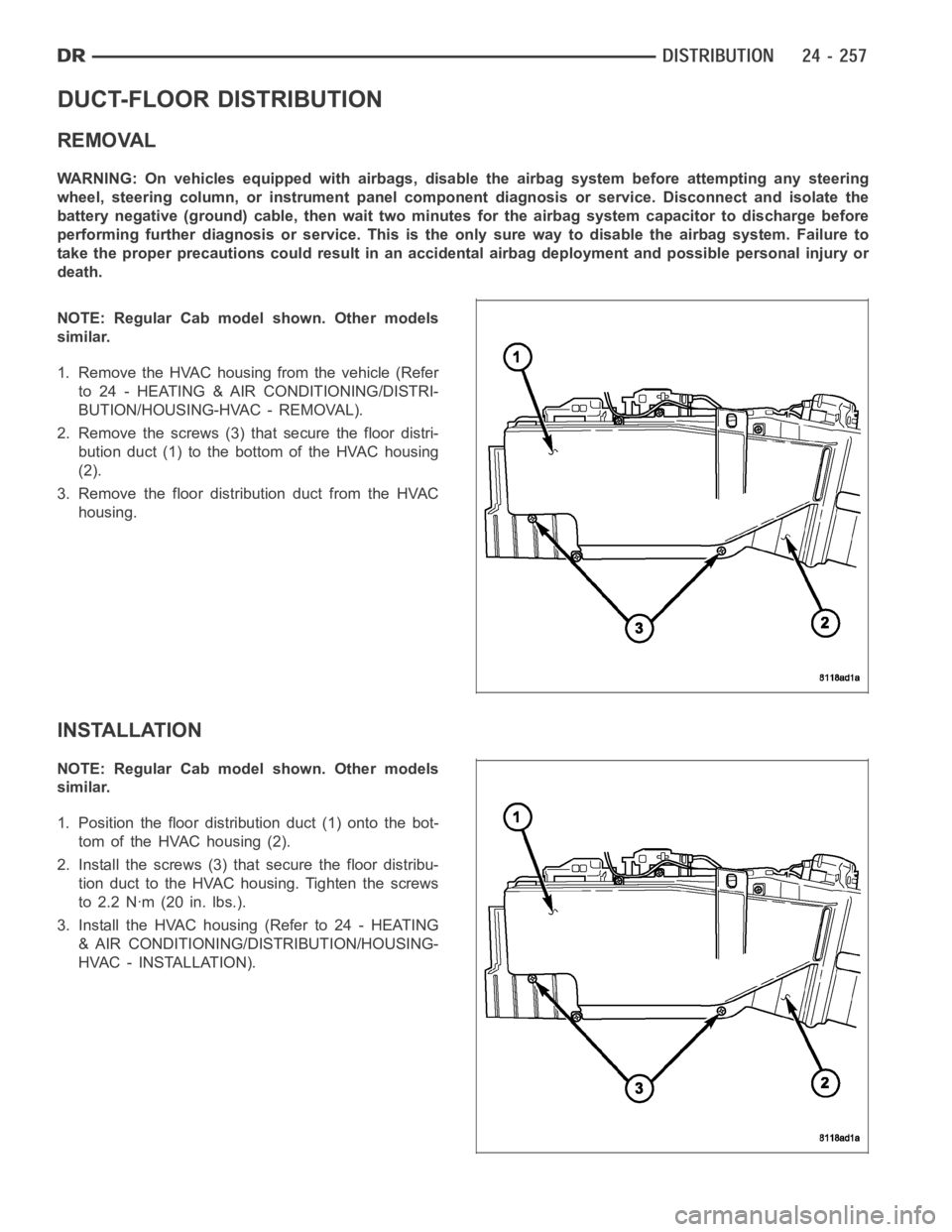
DUCT-FLOOR DISTRIBUTION
REMOVAL
WARNING: On vehicles equipped with airbags, disable the airbag system before attempting any steering
wheel, steering column, or instrument panel component diagnosis or service. Disconnect and isolate the
battery negative (ground) cable, then wait two minutes for the airbag system capacitor to discharge before
performing further diagnosis or service. This is the only sure way to disable the airbag system. Failure to
take the proper precautions could result in an accidental airbag deployment and possible personal injury or
death.
NOTE: Regular Cab model shown. Other models
similar.
1. Remove the HVAC housing from the vehicle (Refer
to 24 - HEATING & AIR CONDITIONING/DISTRI-
BUTION/HOUSING-HVAC - REMOVAL).
2. Remove the screws (3) that secure the floor distri-
bution duct (1) to the bottom of the HVAC housing
(2).
3. Remove the floor distribution duct from the HVAC
housing.
INSTALLATION
NOTE: Regular Cab model shown. Other models
similar.
1. Position the floor distribution duct (1) onto the bot-
tom of the HVAC housing (2).
2. Install the screws (3) that secure the floor distribu-
tion duct to the HVAC housing. Tighten the screws
to 2.2 Nꞏm (20 in. lbs.).
3. Install the HVAC housing (Refer to 24 - HEATING
& AIR CONDITIONING/DISTRIBUTION/HOUSING-
HVAC - INSTALLATION).
Page 5099 of 5267
DUCT-INSTRUMENT PANEL
REMOVAL
WARNING: On vehicles equipped with airbags, disable the airbag system before attempting any steering
wheel, steering column, or instrument panel component diagnosis or service. Disconnect and isolate the
battery negative (ground) cable, then wait two minutes for the airbag system capacitor to discharge before
performing further diagnosis or service. This is the only sure way to disable the airbag system. Failure to
take the proper precautions could result in an accidental airbag deployment and possible personal injury or
death.
NOTE: Take the proper precautions to protect the instrument panel from cosmetic damage.
1. Remove the instrument panel and place it on a
workbench (Refer to 23 - BODY/INSTRUMENT
PANEL/INSTRUMENT PANEL ASSEMBLY -
REMOVAL).
2. Remove the radio (Refer to 8 - ELECTRICAL/AU-
DIO/RADIO - REMOVAL).
3. Remove the defroster duct (Refer to 24 - HEATING
& AIR CONDITIONING/DISTRIBUTION/DUCT-DE-
FROSTER - REMOVAL).
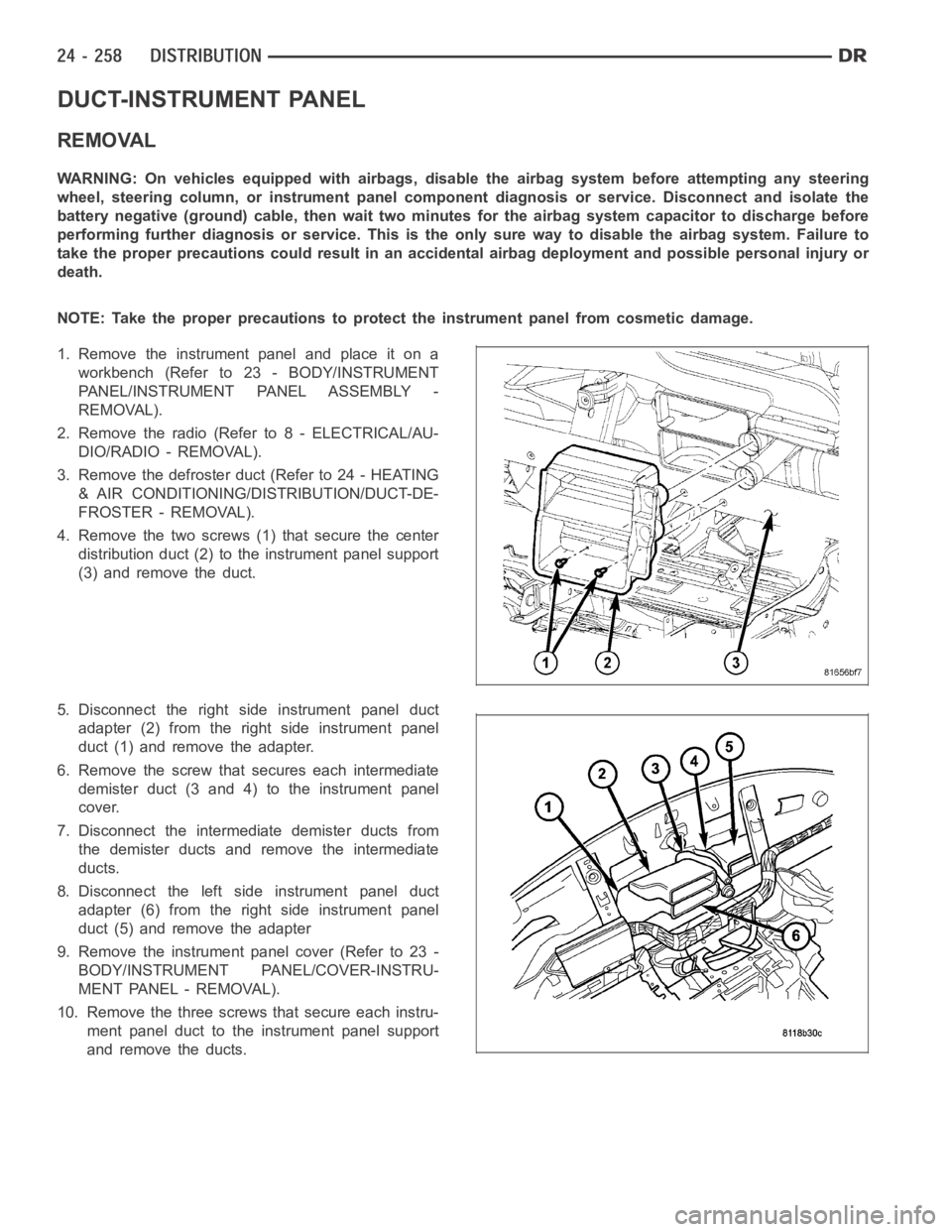
4. Remove the two screws (1) that secure the center
distribution duct (2) to the instrument panel support
(3) and remove the duct.
5. Disconnect the right side instrument panel duct
adapter (2) from the right side instrument panel
duct (1) and remove the adapter.
6. Remove the screw that secures each intermediate
demister duct (3 and 4) to the instrument panel
cover.
7. Disconnect the intermediate demister ducts from
the demister ducts and remove the intermediate
ducts.
8. Disconnect the left side instrument panel duct
adapter (6) from the right side instrument panel
duct (5) and remove the adapter
9. Remove the instrument panel cover (Refer to 23 -
BODY/INSTRUMENT PANEL/COVER-INSTRU-
MENT PANEL - REMOVAL).
10. Remove the three screws that secure each instru-
ment panel duct to the instrument panel support
and remove the ducts.
Page 5101 of 5267
DUCT-INSTRUMENT PANEL DEMISTER
REMOVAL
WARNING: On vehicles equipped with airbags, disable the airbag system before attempting any steering
wheel, steering column, or instrument panel component diagnosis or service. Disconnect and isolate the
battery negative (ground) cable, then wait two minutes for the airbag system capacitor to discharge before
performing further diagnosis or service. This is the only sure way to disable the airbag system. Failure to
take the proper precautions could result in an accidental airbag deployment and possible personal injury or
death.
NOTE: Take the proper precautions to protect the instrument panel from cosmetic damage.
1. Remove the instrument panel and place it on a
workbench (Refer to 23 - BODY/INSTRUMENT
PANEL/INSTRUMENT PANEL ASSEMBLY -
REMOVAL).
2. Remove the radio (Refer to 8 - ELECTRICAL/AU-
DIO/RADIO - REMOVAL).
3. Remove the defroster duct (Refer to 24 - HEATING
& AIR CONDITIONING/DISTRIBUTION/DUCT-DE-
FROSTER - REMOVAL).
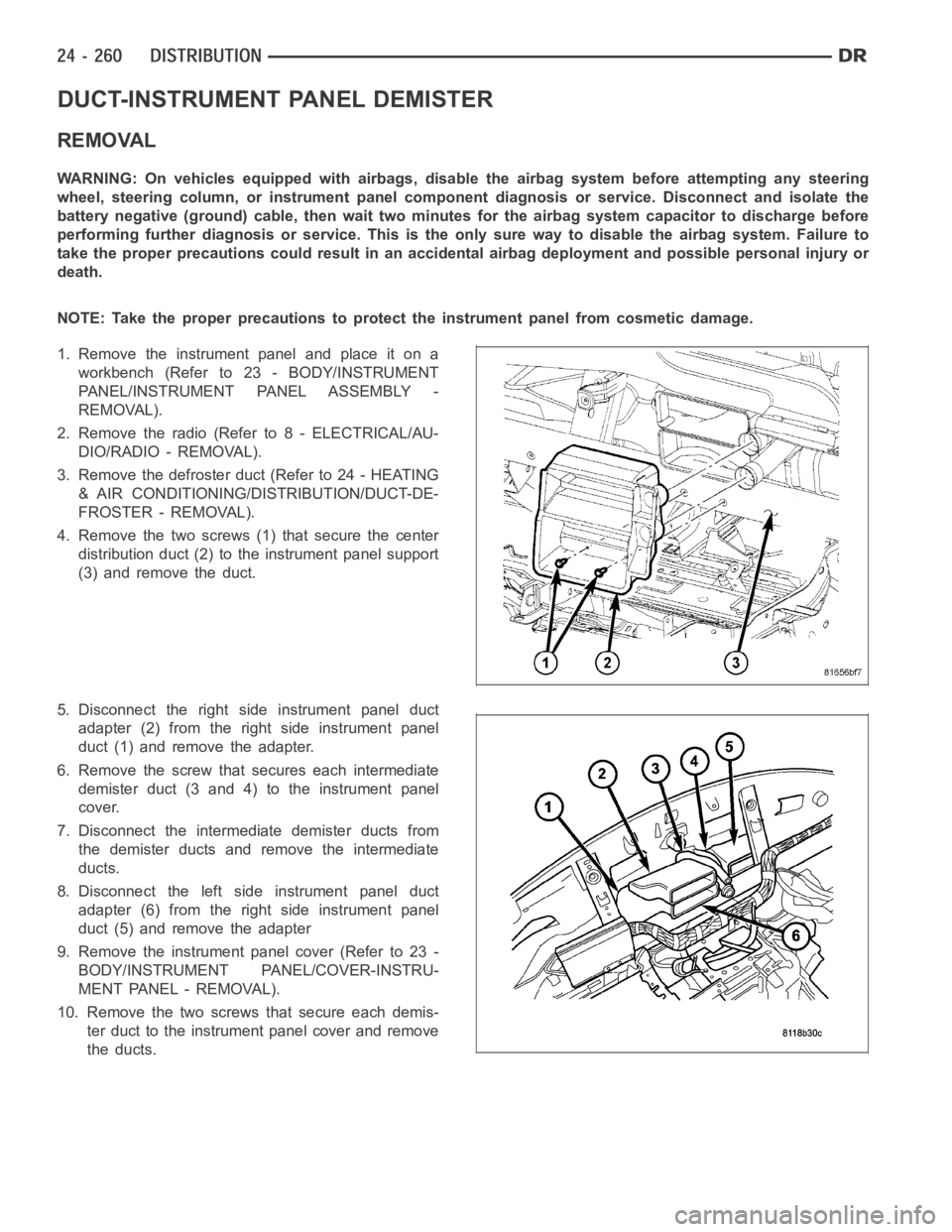
4. Remove the two screws (1) that secure the center
distribution duct (2) to the instrument panel support
(3) and remove the duct.
5. Disconnect the right side instrument panel duct
adapter (2) from the right side instrument panel
duct (1) and remove the adapter.
6. Remove the screw that secures each intermediate
demister duct (3 and 4) to the instrument panel
cover.
7. Disconnect the intermediate demister ducts from
the demister ducts and remove the intermediate
ducts.
8. Disconnect the left side instrument panel duct
adapter (6) from the right side instrument panel
duct (5) and remove the adapter
9. Remove the instrument panel cover (Refer to 23 -
BODY/INSTRUMENT PANEL/COVER-INSTRU-
MENT PANEL - REMOVAL).
10. Remove the two screwsthat secure each demis-
ter duct to the instrument panel cover and remove
the ducts.
Page 5104 of 5267
REMOVAL
HVAC HOUSING ASSEMBLY
WARNING: Refer to the applicable warnings and cautions for this system before performing the following
operation (Refer to 24 - HEATING & AIR CONDITIONING/PLUMBING - WARNINGS) and (Refer to 24 - HEAT-
ING & AIR CONDITIONING/PLUMBING - CAUTIONS). Failure to follow the warnings and cautions could result
in possible personal injury or death.
WARNING: On vehicles equipped with airbags, disable the airbag system before attempting any steering
wheel, steering column, or instrument panel component diagnosis or service. Disconnect and isolate the
negative battery (ground) cable, then wait two minutes for the airbag system capacitor to discharge before
performing further diagnosis or service. This is the only sure way to disable the airbag system. Failure to
take the proper precautions could result in accidental airbag deploymentand possible personal injury or
death.
NOTE: The HVAC housing must be removedfrom the vehicle and disassembled for service of the A/C evap-
orator, evaporator temperature sensor, mode-air and blend-air doors.
1. Recover the refrigerant from the refrigerant system
(Refer to 24 - HEATING & AIR CONDITIONING/
PLUMBING - STANDARD PROCEDURE -
REFRIGERANT SYSTEM RECOVERY).
2. Drain the engine cooling system (Refer to 7 -
COOLING - STANDARD PROCEDURE - COOL-
ING SYSTEM DRAIN).
3. Disconnect and isolate the negative battery cable.
4. Disconnect the A/C liquid line and the A/C accumu-
lator from the A/C evaporator (Refer to 24 - HEAT-
ING & AIR CONDITIONING/PLUMBING/LINE-A/C
LIQUID - REMOVAL) and (Refer to 24 - HEATING
& AIR CONDITIONING/PLUMBING/ACCUMULA-
TOR-A/C - REMOVAL).
5. Disconnect the heater hoses from the heater core
tubes.
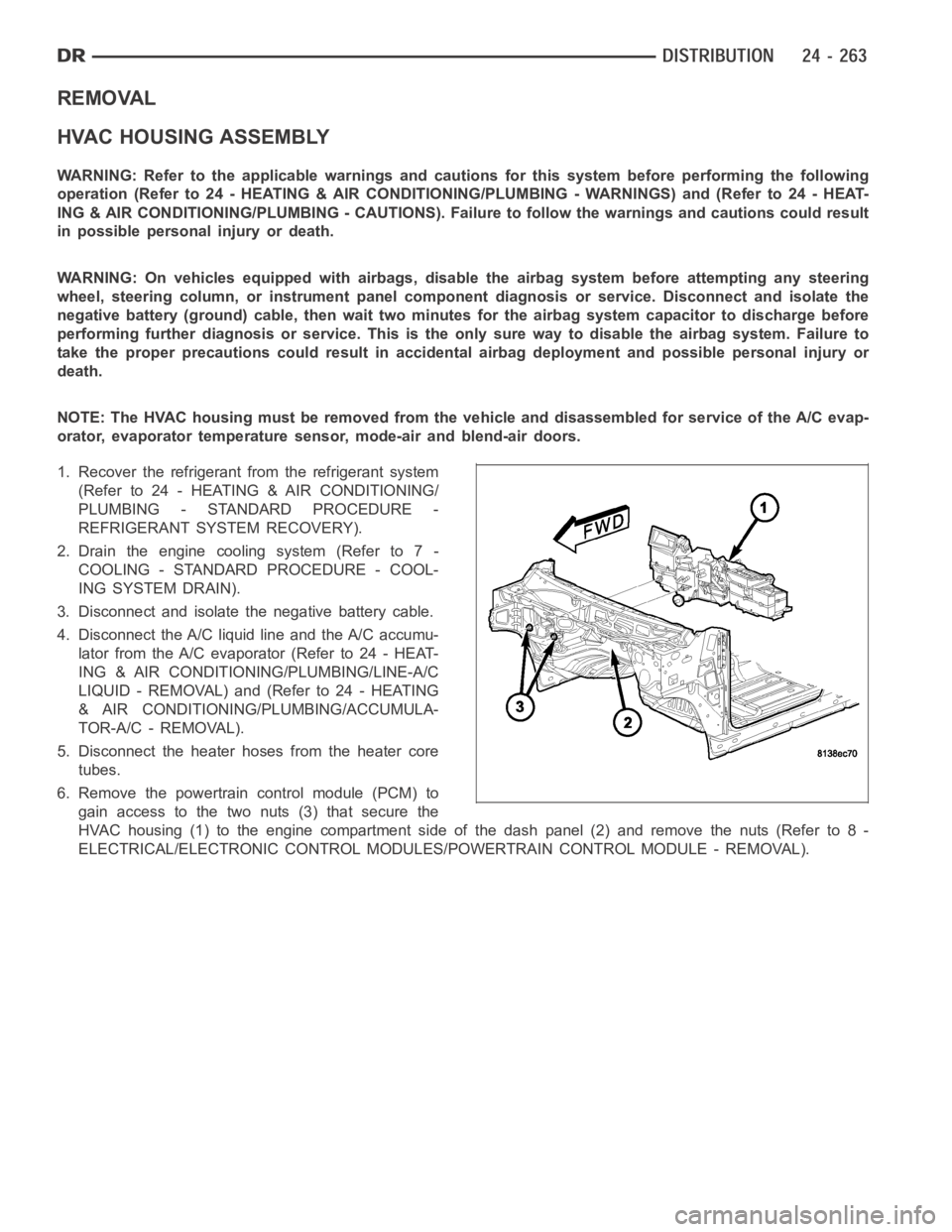
6. Remove the powertrain control module (PCM) to
gain access to the two nuts (3) that secure the
HVAC housing (1) to the engine compartment side of the dash panel (2) and remove the nuts (Refer to 8 -
ELECTRICAL/ELECTRONIC CONTROL MODULES/POWERTRAIN CONTROL MODULE - REMOVAL).
Page 5105 of 5267
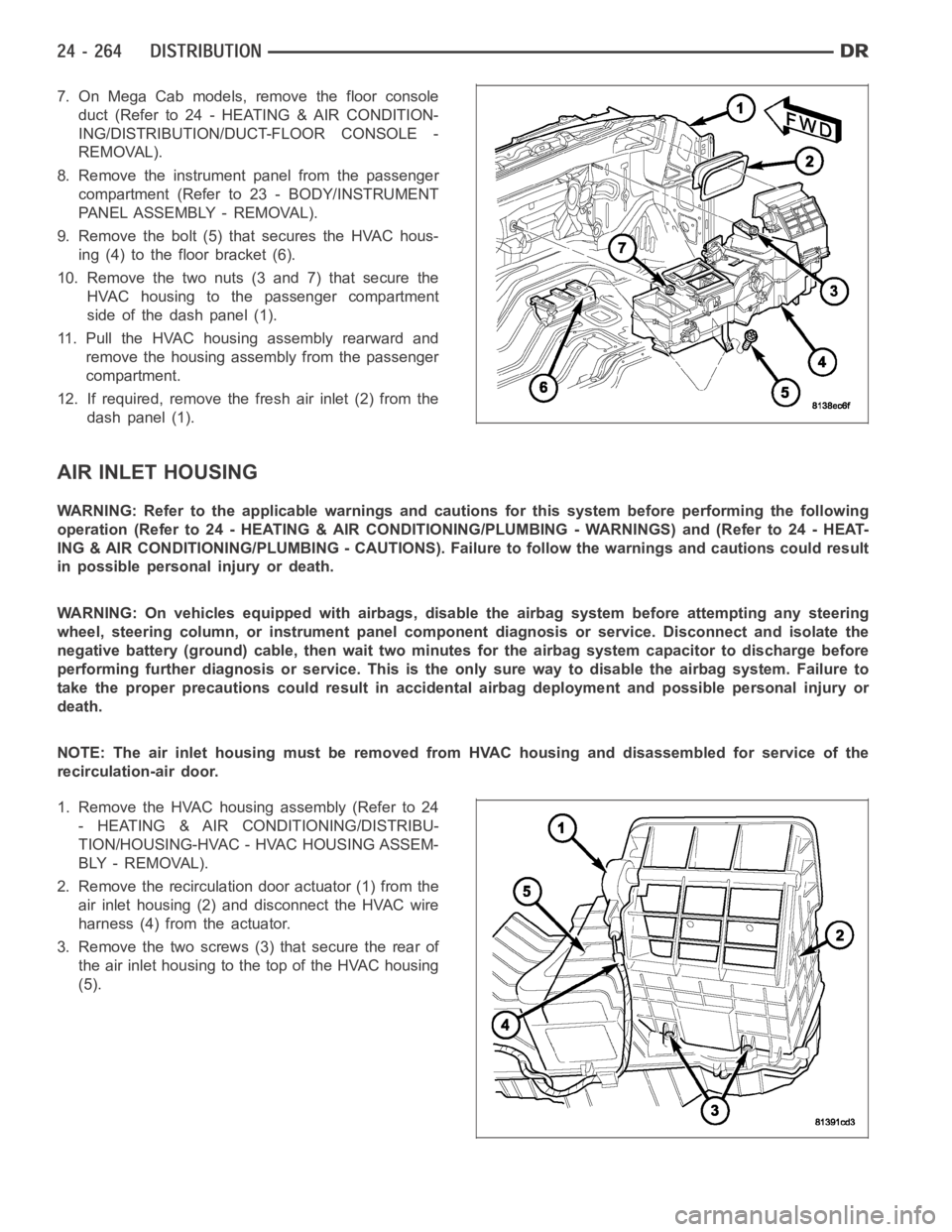
7. On Mega Cab models, remove the floor console
duct (Refer to 24 - HEATING & AIR CONDITION-
ING/DISTRIBUTION/DUCT-FLOOR CONSOLE -
REMOVAL).
8. Remove the instrument panel from the passenger
compartment (Refer to 23 - BODY/INSTRUMENT
PANEL ASSEMBLY - REMOVAL).
9. Remove the bolt (5) that secures the HVAC hous-
ing (4) to the floor bracket (6).
10. Remove the two nuts (3 and 7) that secure the
HVAC housing to the passenger compartment
side of the dash panel (1).
11. Pull the HVAC housing assembly rearward and
remove the housing assembly from the passenger
compartment.
12. If required, remove the fresh air inlet (2) from the
dash panel (1).
AIR INLET HOUSING
WARNING: Refer to the applicable warnings and cautions for this system before performing the following
operation (Refer to 24 - HEATING & AIR CONDITIONING/PLUMBING - WARNINGS) and (Refer to 24 - HEAT-
ING & AIR CONDITIONING/PLUMBING - CAUTIONS). Failure to follow the warnings and cautions could result
in possible personal injury or death.
WARNING: On vehicles equipped with airbags, disable the airbag system before attempting any steering
wheel, steering column, or instrument panel component diagnosis or service. Disconnect and isolate the
negative battery (ground) cable, then wait two minutes for the airbag system capacitor to discharge before
performing further diagnosis or service. This is the only sure way to disable the airbag system. Failure to
take the proper precautions could result in accidental airbag deploymentand possible personal injury or
death.
NOTE: The air inlet housing must be removed from HVAC housing and disassembled for service of the
recirculation-air door.
1. Remove the HVAC housing assembly (Refer to 24
- HEATING & AIR CONDITIONING/DISTRIBU-
TION/HOUSING-HVAC - HVAC HOUSING ASSEM-
BLY - REMOVAL).
2. Remove the recirculation door actuator (1) from the
air inlet housing (2) and disconnect the HVAC wire
harness (4) from the actuator.
3. Remove the two screws (3) that secure the rear of
the air inlet housing to the top of the HVAC housing
(5).
Page 5121 of 5267
MOTOR-BLOWER
DESCRIPTION
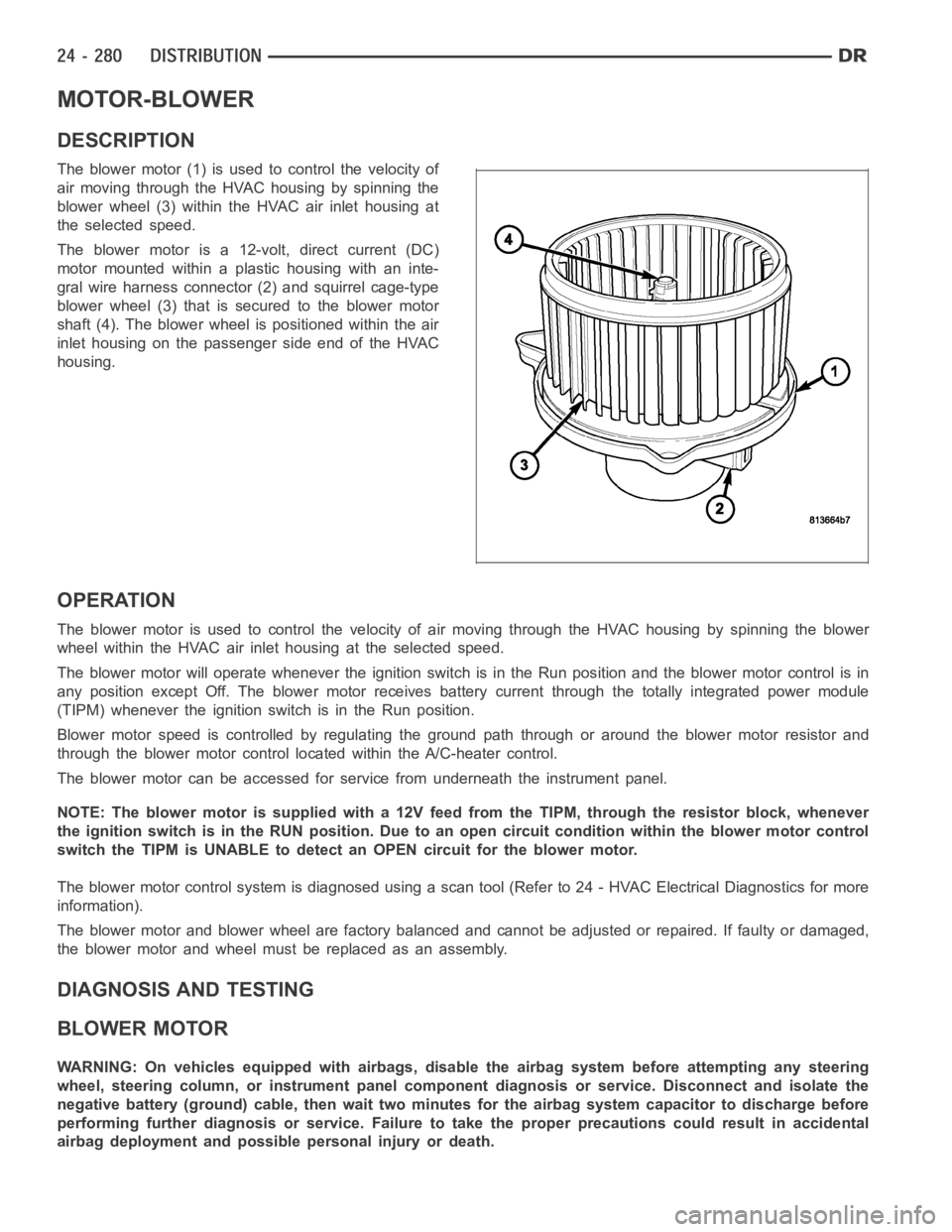
The blower motor (1) is used to control the velocity of
air moving through the HVAC housing by spinning the
blower wheel (3) within the HVAC air inlet housing at
the selected speed.
The blower motor is a 12-volt, direct current (DC)
motormountedwithinaplastichousingwithaninte-
gral wire harness connector (2) and squirrel cage-type
blower wheel (3) that is secured to the blower motor
shaft (4). The blower wheel is positioned within the air
inlet housing on the passenger side end of the HVAC
housing.
OPERATION
The blower motor is used to control the velocity of air moving through the HVAC housing by spinning the blower
wheel within the HVAC air inlet housing at the selected speed.
The blower motor will operate whenever the ignition switch is in the Run position and the blower motor control is in
any position except Off. The blower motor receives battery current through the totally integrated power module
(TIPM) whenever the ignition switch is in the Run position.
Blower motor speed is controlled by regulating the ground path through or around the blower motor resistor and
through the blower motor control located within the A/C-heater control.
The blower motor can be accessed for service from underneath the instrument panel.
NOTE: The blower motor is supplied with a 12V feed from the TIPM, through theresistor block, whenever
the ignition switch is in the RUN position. Due to an open circuit conditionwithin the blower motor control
switch the TIPM is UNABLE to detect an OPEN circuit for the blower motor.
The blower motor control system is diagnosed using a scan tool (Refer to 24 -HVAC Electrical Diagnostics for more
information).
The blower motor and blower wheel are factory balanced and cannot be adjusted or repaired. If faulty or damaged,
the blower motor and wheel must be replaced as an assembly.
DIAGNOSIS AND TESTING
BLOWER MOTOR
WARNING: On vehicles equipped with airbags, disable the airbag system before attempting any steering
wheel, steering column, or instrument panel component diagnosis or service. Disconnect and isolate the
negative battery (ground) cable, then wait two minutes for the airbag system capacitor to discharge before
performing further diagnosis or service. Failure to take the proper precautions could result in accidental
airbag deployment and possible personal injury or death.
Page 5125 of 5267
page page
PLUMBING
DESCRIPTION ............................... 286
OPERATION ................................. 286
WARNING ................................... 286
CAUTION ................................... 287
DIAGNOSIS AND TESTING
REFRIGERANT SYSTEM LEAKS ............ 288
STANDARD PROCEDURE
REFRIGERANT SYSTEM SERVICE
EQUIPMENT............................... 289
REFRIGERANT SYSTEM RECOVERY ....... 290
REFRIGERANT SYSTEM EVACUATE ........ 290
REFRIGERANT SYSTEM CHARGE .......... 291
ACCUMULATOR-A/C
DESCRIPTION ............................... 292
OPERATION ................................. 292
REMOVAL ................................... 292
INSTALLATION .............................. 293
COMPRESSOR-A/C
DESCRIPTION
A/C COMPRESSOR........................ 295
HIGH PRESSURE RELIEF VALVE ........... 295
OPERATION
A/C COMPRESSOR........................ 295
HIGH PRESSURE RELIEF VALVE ........... 295
DIAGNOSIS AND TESTING
A/C COMPRESSOR........................ 296
REMOVAL
3.7L/4.7L ENGINES ........................ 296
5.7L ENGINE .............................. 297
5.9L DIESEL ENGINE ...................... 298
8.3L ENGINE .............................. 299
INSTALLATION
3.7L/4.7L ENGINES ........................ 300
5.7L ENGINE .............................. 301
5.9L DIESEL ENGINE ...................... 302
8.3L ENGINE .............................. 303
CONDENSER-A/C
DESCRIPTION ............................... 305
OPERATION ................................. 305
REMOVAL
3.7L/4.7L/5.7L ENGINES .................... 305
5.9L DIESEL ENGINE ...................... 305
8.3L ENGINE .............................. 306
INSTALLATION
3.7L/4.7L/5.7L ENGINES .................... 307
5.9L DIESEL ENGINE ...................... 307
8.3L ENGINE .............................. 308
CORE-HEATER
DESCRIPTION ............................... 310
OPERATION ................................. 310REMOVAL ................................... 310
INSTALLATION .............................. 311
CORE-VALVE-SERVICE PORT
DESCRIPTION ............................... 312
REMOVAL ................................... 312
INSTALLATION .............................. 313
COUPLER-REFRIGERANT LINE
DESCRIPTION ............................... 314
OPERATION ................................. 314
REMOVAL ................................... 314
INSTALLATION .............................. 315
EVAPORATOR-A/C
DESCRIPTION ............................... 317
OPERATION ................................. 317
REMOVAL ................................... 317
INSTALLATION .............................. 318
FAN-A/C CONDENSER
DESCRIPTION ............................... 319
OPERATION ................................. 319
REMOVAL ................................... 319
INSTALLATION .............................. 320
LINE-A/C DISCHARGE
DESCRIPTION ............................... 321
REMOVAL
3.7L/4.7L ENGINES ........................ 321
5.7L ENGINE .............................. 322
5.9L DIESEL ENGINE...................... 322
8.3L ENGINE .............................. 323
INSTALLATION
3.7L/4.7L ENGINES ........................ 325
5.7L ENGINE .............................. 326
5.9L DIESEL ENGINE...................... 326
8.3L ENGINE .............................. 328
LINE-A/C LIQUID
DESCRIPTION ............................... 330
REMOVAL
3.7L/4.7L/5.7L/5.9L ENGINES ............... 330
8.3L ENGINE .............................. 331
INSTALLATION
3.7L/4.7L/5.7L/5.9L ENGINES ............... 333
8.3L ENGINE .............................. 334
LINE-A/C SUCTION
DESCRIPTION ............................... 337
REMOVAL
3.7L/4.7L ENGINES ........................ 337
5.7L ENGINE .............................. 338
5.9L DIESEL ENGINE...................... 339
8.3L ENGINE .............................. 340
INSTALLATION
3.7L/4.7L ENGINES ........................ 342
5.7L ENGINE .............................. 343
Page 5127 of 5267
PLUMBING
DESCRIPTION
The A/C refrigerant lines and hoses are used to carry the refrigerant between the various A/C system components.
The refrigerant lines and hoses for the R-134a system on this vehicle consist of a barrier-hose design with a nylon
tube sandwiched between rubber layers. The nylon tube helps to contain theR-134a refrigerant, which has a
smaller molecular structure than R-12 refrigerant. The ends of the refrigerant lines are made from lightweight alu-
minum or steel, and commonly use braze-less fittings.
Any kinks or sharp bends in the refrigerant lines and hoses will reduce the capacity of the entire A/C system and
can reduce the flow of refrigerant in the system. The radius of all bends in the flexible hose refrigerant lines should
be at least ten times the diameter of the hose and the refrigerant lines should be routed so they are at least 80
millimeters (3 inches) away from the exhaust manifold(s) and exhaust pipe(s).
OPERATION
High pressures are produced in the refrigerant system when the A/C compressor is operating. Extreme care must
be exercised to make sure that each of the refrigerant system connections is pressure-tight and leak free. It is a
good practice to inspect all flexible hose refrigerant lines at least oncea year to make sure they are in good con-
dition and properly routed.
The refrigerant lines and hoses are coupled to other A/C system componentswith block-type fittings. An O-ring seal,
or a flat steel gasket with an integral O-ring (dual plane seal), is used to mate the refrigerant line fittings with A/C
system components to ensure the integrity of the refrigerant system.
The refrigerant lines and hoses cannot be repaired and, if faulty or damaged, they must be replaced.
WARNING
WARNING: The A/C system contains refrigerant under high pressure. Repairs should only be performed by
qualified service personnel. Severe personal injury or death may result from improper service procedures.
WARNING: Avoid breathing the refrigerant and refrigerant oil vapor or mist. Exposure may irritate the eyes,
nose, and/or throat. Wear eye protection when servicing the A/C refrigerant system. Serious eye injury can
result from direct contact with the refrigerant. If eye contact occurs, seek medical attention immediately.
WARNING: Do not expose the refrigerant to open flame. Poisonous gas is createdwhenrefrigerantis
burned. An electronic leak detector is recommended. Severe personal injury or death may result from
improper service procedures.
WARNING: If accidental system discharge occurs, ventilate the work area before resuming service. Large
amounts of refrigerant released in a closed work area will displace the oxygen and cause suffocation and
death.
WARNING: The evaporation rate of R-134a refrigerant at average temperature and altitude is extremely high.
As a result, anything that comes in contact with the refrigerant will freeze. Always protect the skin or del-
icate objects from direct contact with the refrigerant.
WARNING: The R-134a service equipment or the vehicle refrigerant system should not be pressure tested or
leak tested with compressed air. Some mixtures of air and R-134a have been shown to be combustible at
elevated pressures. These mixtures are potentially dangerous, and may result in fire or explosion causing
property damage, personal injury or death.
Page 5128 of 5267
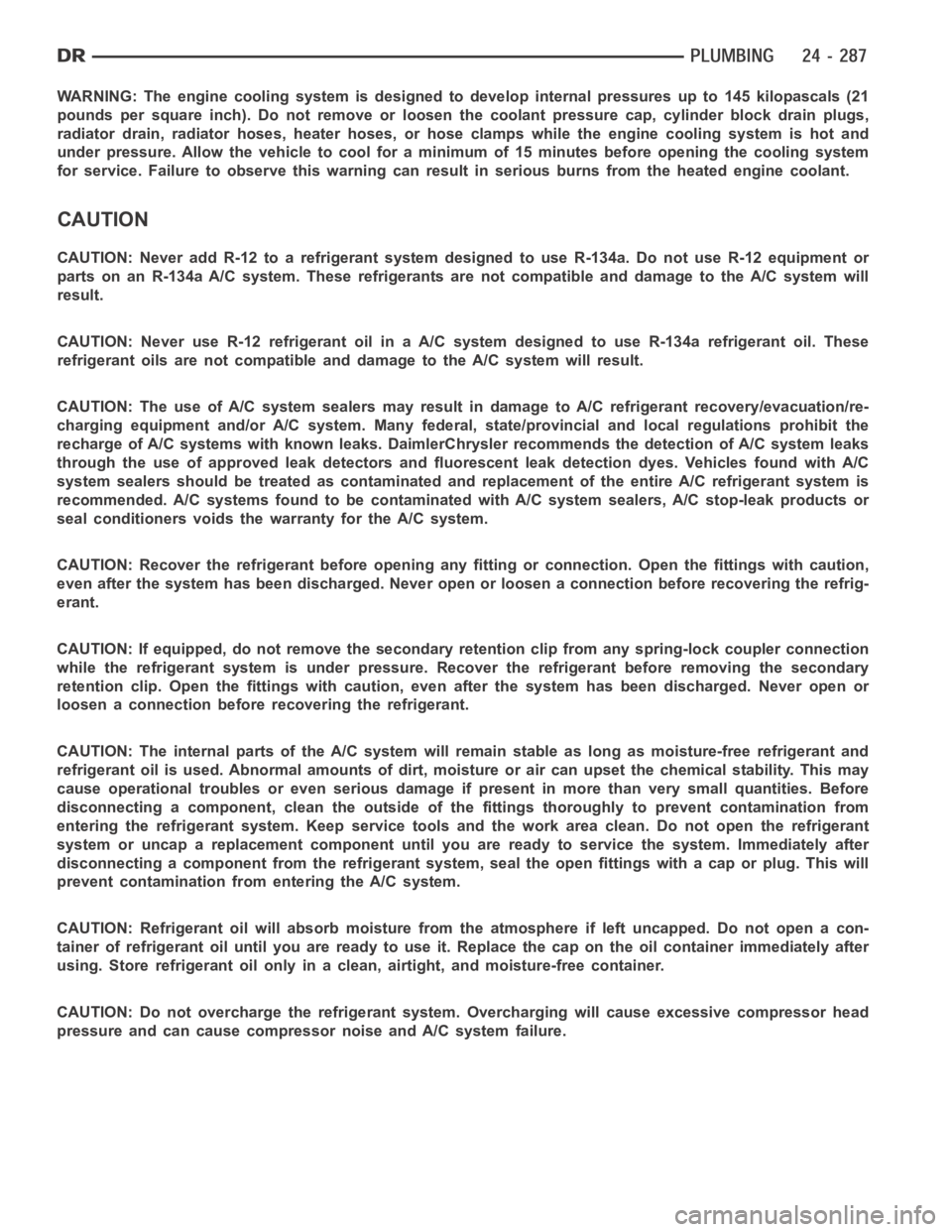
WARNING: The engine cooling system is designed to develop internal pressures up to 145 kilopascals (21
pounds per square inch). Do not remove or loosen the coolant pressure cap, cylinder block drain plugs,
radiator drain, radiator hoses, heater hoses, or hose clamps while the engine cooling system is hot and
under pressure. Allow the vehicle to cool for a minimum of 15 minutes beforeopening the cooling system
for service. Failure to observe this warning can result in serious burns from the heated engine coolant.
CAUTION
CAUTION: Never add R-12 to a refrigerant system designed to use R-134a. Do not use R-12 equipment or
parts on an R-134a A/C system. These refrigerants are not compatible and damage to the A/C system will
result.
CAUTION: Never use R-12 refrigerant oil in a A/C system designed to use R-134a refrigerant oil. These
refrigerant oils are not compatible and damage to the A/C system will result.
CAUTION: The use of A/C system sealers may result in damage to A/C refrigerant recovery/evacuation/re-
charging equipment and/or A/C system. Many federal, state/provincial and local regulations prohibit the
recharge of A/C systems with known leaks. DaimlerChrysler recommends thedetection of A/C system leaks
through the use of approved leak detectors and fluorescent leak detectiondyes. Vehicles found with A/C
system sealers should be treated as contaminated and replacement of the entire A/C refrigerant system is
recommended. A/C systems found to be contaminated with A/C system sealers, A/C stop-leak products or
seal conditioners voids the warranty for the A/C system.
CAUTION: Recover the refrigerant before opening any fitting or connection. Open the fittings with caution,
even after the system has been discharged. Never open or loosen a connection before recovering the refrig-
erant.
CAUTION: If equipped, do not remove the secondary retention clip from any spring-lock coupler connection
while the refrigerant system is under pressure. Recover the refrigerant before removing the secondary
retention clip. Open the fittings with caution, even after the system has been discharged. Never open or
loosen a connection before recovering the refrigerant.
CAUTION: The internal parts of the A/C system will remain stable as long as moisture-free refrigerant and
refrigerant oil is used. Abnormal amounts of dirt, moisture or air can upset the chemical stability. This may
cause operational troubles or even serious damage if present in more than very small quantities. Before
disconnecting a component, clean the outside of the fittings thoroughly to prevent contamination from
entering the refrigerant system. Keep service tools and the work area clean. Do not open the refrigerant
system or uncap a replacement component until you are ready to service the system. Immediately after
disconnecting a component from the refrigerant system, seal the open fittings with a cap or plug. This will
prevent contamination from entering the A/C system.
CAUTION: Refrigerant oil will absorb moisture from the atmosphere if leftuncapped. Do not open a con-
tainer of refrigerant oil until you are ready to use it. Replace the cap on the oil container immediately after
using. Store refrigerant oil only in a clean, airtight, and moisture-freecontainer.
CAUTION: Do not overcharge the refrigerant system. Overcharging will cause excessive compressor head
pressure and can cause compressor noise and A/C system failure.
Page 5129 of 5267
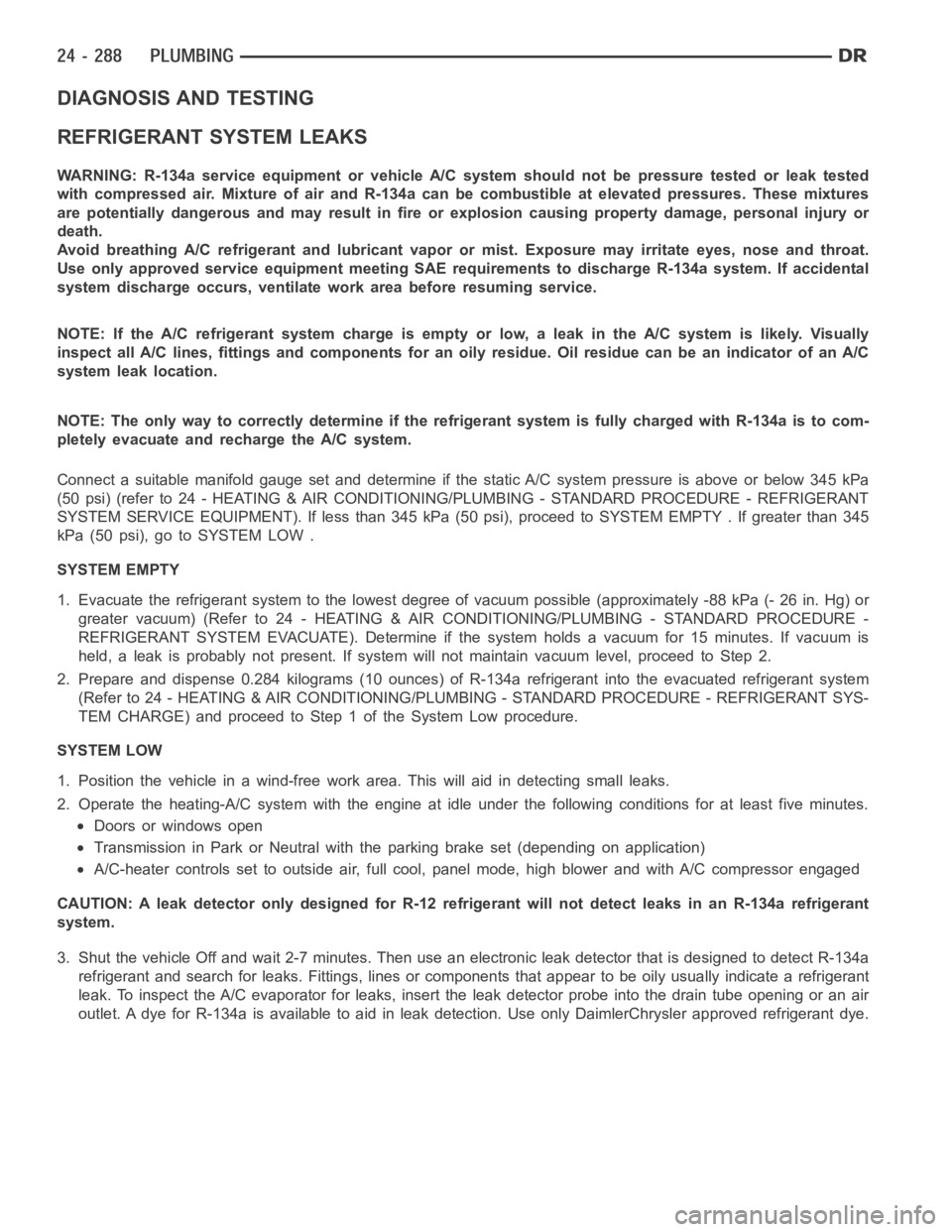
DIAGNOSIS AND TESTING
REFRIGERANT SYSTEM LEAKS
WARNING: R-134a service equipment or vehicle A/C system should not be pressure tested or leak tested
with compressed air. Mixture of air and R-134a can be combustible at elevated pressures. These mixtures
are potentially dangerous and may result in fire or explosion causing property damage, personal injury or
death.
Avoid breathing A/C refrigerant and lubricant vapor or mist. Exposure mayirritate eyes, nose and throat.
Use only approved service equipment meeting SAE requirements to discharge R-134a system. If accidental
system discharge occurs, ventilate work area before resuming service.
NOTE: If the A/C refrigerant system charge is empty or low, a leak in the A/C system is likely. Visually
inspect all A/C lines, fittings and components for an oily residue. Oil residue can be an indicator of an A/C
system leak location.
NOTE: The only way to correctly determine if the refrigerant system is fully charged with R-134a is to com-
pletely evacuate and recharge the A/C system.
Connect a suitable manifold gauge setand determine if the static A/C system pressure is above or below 345 kPa
(50 psi) (refer to 24 - HEATING & AIR CONDITIONING/PLUMBING - STANDARD PROCEDURE - REFRIGERANT
SYSTEM SERVICE EQUIPMENT). If less than 345 kPa (50 psi), proceed to SYSTEMEMPTY . If greater than 345
kPa (50 psi), go to SYSTEM LOW .
SYSTEM EMPTY
1. Evacuate the refrigerant system to the lowest degree of vacuum possible(approximately -88 kPa (- 26 in. Hg) or
greater vacuum) (Refer to 24 - HEATING & AIR CONDITIONING/PLUMBING - STANDARD PROCEDURE -
REFRIGERANT SYSTEM EVACUATE). Determine if the system holds a vacuum for 15 minutes. If vacuum is
held, a leak is probably not present. If system will not maintain vacuum level, proceed to Step 2.
2. Prepare and dispense 0.284 kilograms (10 ounces) of R-134a refrigerantinto the evacuated refrigerant system
(Refer to 24 - HEATING & AIR CONDITIONING/PLUMBING - STANDARD PROCEDURE - REFRIGERANT SYS-
TEM CHARGE) and proceed to Step 1 of the System Low procedure.
SYSTEM LOW
1. Position the vehicle in a wind-freework area. This will aid in detectingsmall leaks.
2. Operate the heating-A/C system with the engine at idle under the following conditions for at least five minutes.
Doors or windows open
Transmission in Park or Neutral with the parking brake set (depending on application)
A/C-heater controls set to outside air, full cool, panel mode, high blowerand with A/C compressor engaged
CAUTION: A leak detector only designed for R-12 refrigerant will not detect leaks in an R-134a refrigerant
system.
3. Shut the vehicle Off and wait 2-7 minutes. Then use an electronic leak detector that is designed to detect R-134a
refrigerant and search for leaks. Fittings, lines or components that appear to be oily usually indicate a refrigerant
leak. To inspect the A/C evaporator for leaks, insert the leak detector probe into the drain tube opening or an air
outlet. A dye for R-134a is available to aid in leak detection. Use only DaimlerChrysler approved refrigerant dye.