warning DODGE RAM SRT-10 2006 Service Repair Manual
[x] Cancel search | Manufacturer: DODGE, Model Year: 2006, Model line: RAM SRT-10, Model: DODGE RAM SRT-10 2006Pages: 5267, PDF Size: 68.7 MB
Page 4660 of 5267
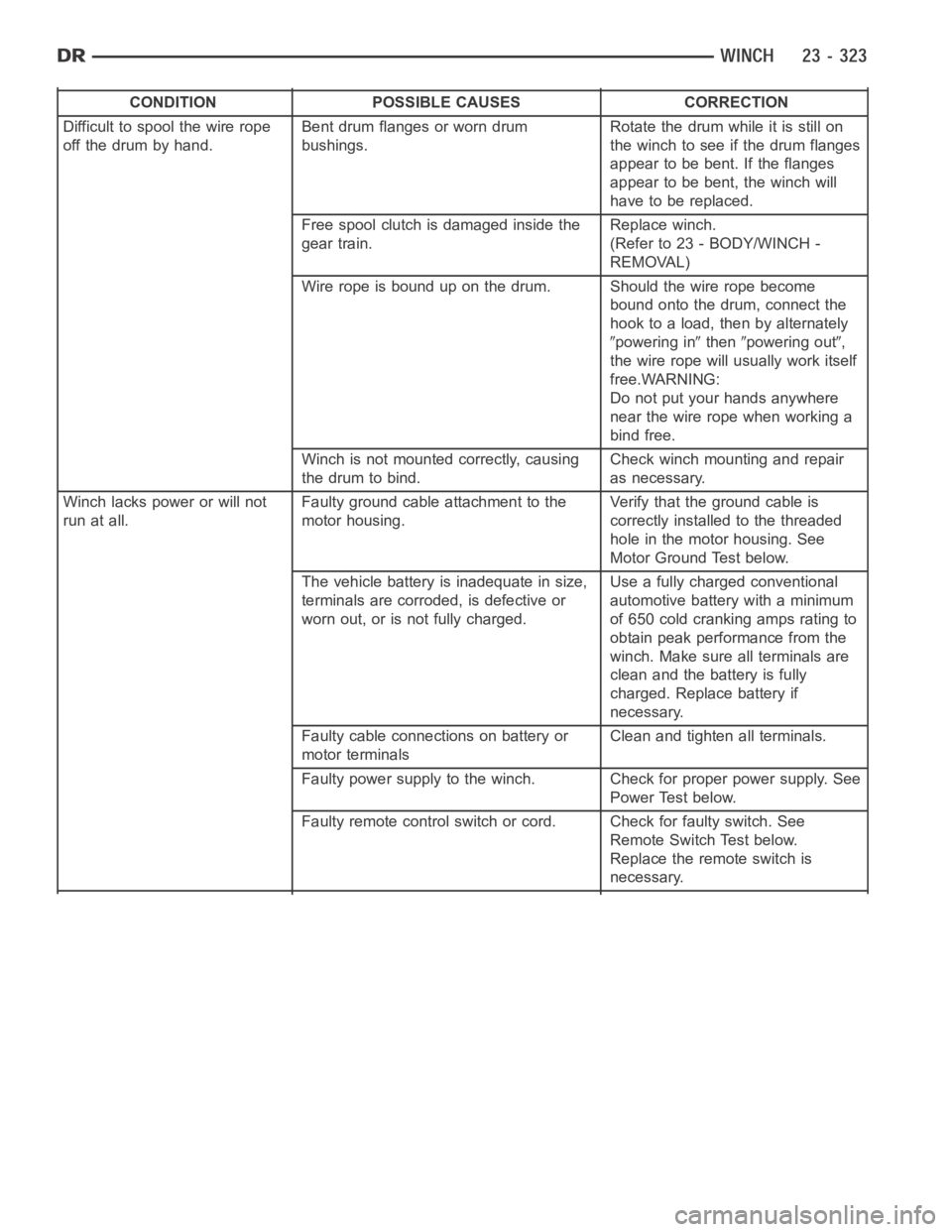
CONDITION POSSIBLE CAUSES CORRECTION
Difficult to spool the wire rope
off the drum by hand.Bent drum flanges or worn drum
bushings.Rotate the drum while it is still on
the winch to see if the drum flanges
appear to be bent. If the flanges
appear to be bent, the winch will
have to be replaced.
Free spool clutch is damaged inside the
gear train.Replace winch.
(Refer to 23 - BODY/WINCH -
REMOVAL)
Wire rope is bound up on the drum. Should the wire rope become
bound onto the drum, connect the
hook to a load, then by alternately
powering inthenpowering out,
the wire rope will usually work itself
free.WARNING:
Do not put your hands anywhere
near the wire rope when working a
bind free.
Winch is not mounted correctly, causing
the drum to bind.Check winch mounting and repair
as necessary.
Winch lacks power or will not
run at all.Faulty ground cable attachment to the
motor housing.Verify that the ground cable is
correctly installed to the threaded
hole in the motor housing. See
Motor Ground Test below.
The vehicle battery is inadequate in size,
terminals are corroded, is defective or
worn out, or is not fully charged.Use a fully charged conventional
automotive battery with a minimum
of650coldcrankingampsratingto
obtain peak performance from the
winch. Make sure all terminals are
clean and the battery is fully
charged. Replace battery if
necessary.
Faulty cable connections on battery or
motor terminalsClean and tighten all terminals.
Faulty power supply to the winch. Check for proper power supply. See
Power Test below.
Faulty remote control switch or cord. Check for faulty switch. See
Remote Switch Test below.
Replace the remote switch is
necessary.
Page 4693 of 5267
INSTALLATION
WARNING: Always keep hands and clothing clear
of the wire rope, hook and fairlead opening during
operation and when spooling. Failure to follow
these instructions may result in personal injury or
death.
CAUTION: Wire rope must spool on the winch
drum in the direction indicated.
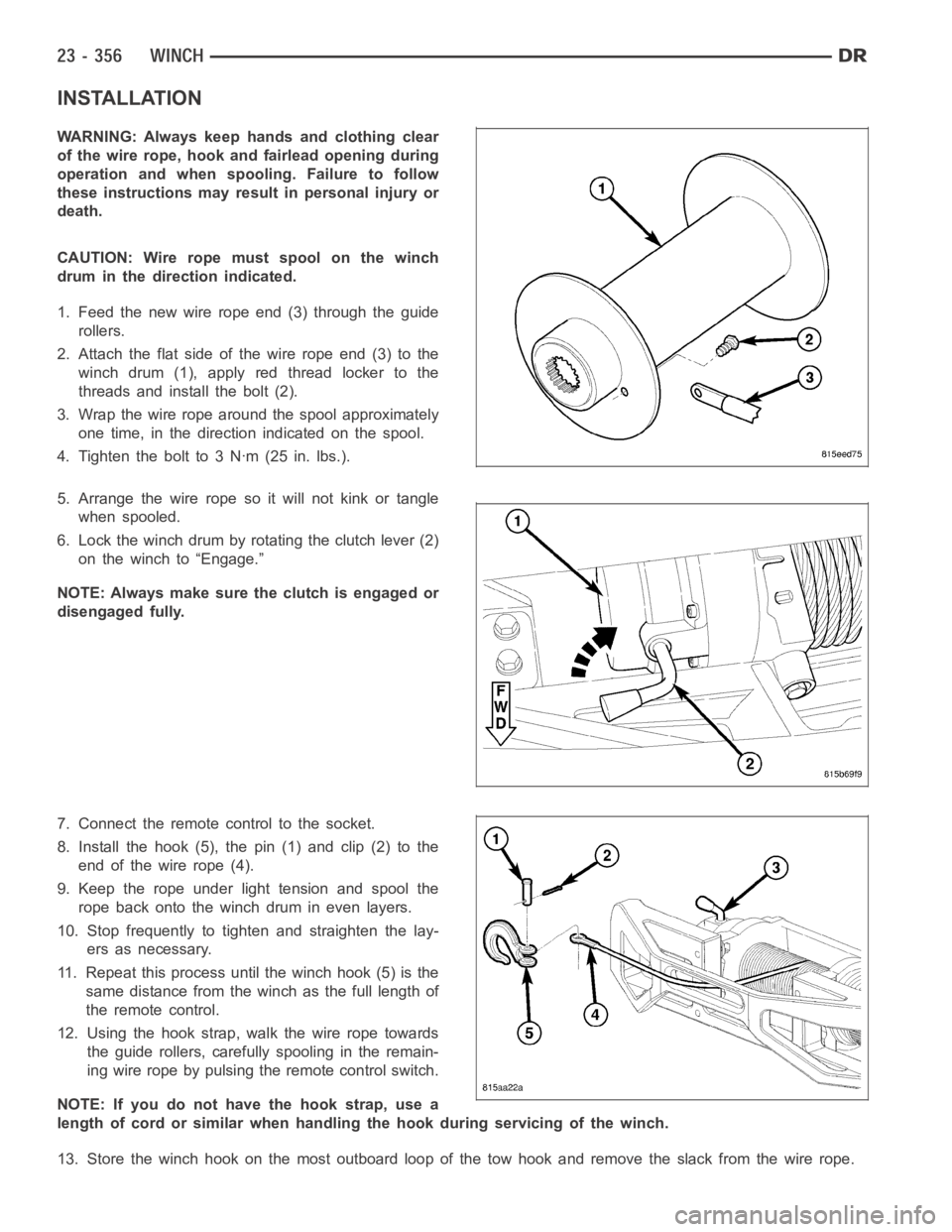
1. Feed the new wire rope end (3) through the guide
rollers.
2. Attach the flat side of the wire rope end (3) to the
winch drum (1), apply red thread locker to the
threads and install the bolt (2).
3. Wrap the wire rope around the spool approximately
one time, in the direction indicated on the spool.
4. Tighten the bolt to 3 Nꞏm (25 in. lbs.).
5. Arrange the wire rope so it will not kink or tangle
when spooled.
6. Lock the winch drum by rotating the clutch lever (2)
on the winch to “Engage.”
NOTE: Always make sure the clutch is engaged or
disengaged fully.
7. Connect the remote control to the socket.
8. Install the hook (5), the pin (1) and clip (2) to the
end of the wire rope (4).
9. Keep the rope under light tension and spool the
rope back onto the winch drum in even layers.
10. Stop frequently to tighten and straighten the lay-
ers as necessary.
11. Repeat this process until the winch hook (5) is the
same distance from the winch as the full length of
theremotecontrol.
12. Using the hook strap, walk the wire rope towards
the guide rollers, carefully spooling in the remain-
ing wire rope by pulsing the remote control switch.
NOTE: If you do not have the hook strap, use a
length of cord or similar when handling the hook during servicing of the winch.
13. Store the winch hook on the most outboard loop of the tow hook and remove the slack from the wire rope.
Page 5053 of 5267
ACTUATOR DTC DETECTION TEST — DUAL-ZONE
The Actuator DTC Detection Test:
is actuated with a scan tool.
clears all actuator related DTCs when the test is actuated.
supplements the continuous diagnostics on the actuator drive system.
monitors for shorted actuator circuits allowing service to easily diagnose and troubleshoot up to three simul-
taneous shorts. Shorted actuator circuit faults (XXX Control Circuit High or XXX Control Circuit Low) will only
display after running the Actuator DTC Detection Test.
After repairing each DTC, cycle the ignition switch, and then run the Actuator DTC Detection Test again to ensure
that no new DTCs exist. If multiple DTCs are present, beginning with the passenger blend door, diagnose and repair
all short high faults and then short low faults. When the test returns passed, clear all faults and run the Actuator
Calibration function as a final check of system health.
ACTUATOR DTC DETECTION TEST — SINGLE-ZONE
The Actuator DTC Detection Test:
is actuated with a scan tool.
clears all actuator related DTCs when the test is actuated.
supplements the continuous diagnostics on the actuator drive system.
monitors for shorted actuator circuits allowing service to easily diagnose and troubleshoot up to three simul-
taneous shorts. Shorted actuator circuit faults (XXX Control Circuit High or XXX Control Circuit Low) will only
display after running the Actuator DTC Detection Test.
After repairing each DTC, cycle the ignition switch, and then run the Actuator DTC Detection Test again to ensure
that no new DTCs exist. If multiple DTCs are present, beginning with the common circuit, diagnose and repair all
short high faults and then short low faults. When the test returns passed, clear all faults and run the Actuator Cal-
ibration function as a final check of system health.
A/C PERFORMANCE
The A/C system is designed to provide the passenger compartment with low temperature and low humidity air. The
A/C evaporator, located in the HVAC housing is cooled to temperatures nearthe freezing point. As warm damp air
passes over the fins of the A/C evaporator, the air transfers its heat to therefrigerant in the evaporator coils and the
moisture in the air condenses on the evaporator fins. During periods of high heat and humidity, an A/C system will
be more effective in the Recirculation mode (max-A/C). With the system in the Recirculation mode, only air from the
passenger compartment passes through the A/C evaporator. As the passenger compartment air dehumidifies, the
A/C system performance levels rise.
Humidity has an important bearing on the temperature of the air delivered to the interior of the vehicle. It is impor-
tant to understand the effect that humidity has on the performance of the A/C system. When humidity is high, the
A/C evaporator has to perform a double duty. It must lower the air temperature, and it must lower the temperature
of the moisture in the air that condenses on the evaporator fins. Condensing the moisture in the air transfers heat
energy into the evaporator fins and coils. This reduces the amount of heat the A/C evaporator can absorb from the
air. High humidity greatly reduces the ability of the A/C evaporator to lower the temperature of the air.
However, evaporator capacity used to reduce the amount of moisture in the air is not wasted. Wringing some of the
moisture out of the air entering the vehicle adds to the comfort of the passengers. Although, an owner may expect
too much from their A/C system on humid days. A performance test is the best way to determine whether the sys-
tem is performing up to design standards. This test also provides valuableclues as to the possible cause of trouble
with the A/C system. The ambient air temperature in the location where the vehicle will be tested must be a mini-
mum of 21° C (70° F) for this test.
A/C PERFORMANCE TEST
WARNING: Refer to the applicable warnings and cautions for this system before performing the following
operation (Refer to 24 - HEATING & AIR CONDITIONING/PLUMBING - WARNINGS) and (Refer to 24 - HEAT-
ING & AIR CONDITIONING/PLUMBING - CAUTIONS). Failure to follow the warnings and cautions could result
in possible personal injury or death.
Page 5062 of 5267
The blend door actuators are diagnosed using a scan tool (Refer to 24 - HEATING & AIR CONDITIONING - DIAG-
NOSIS AND TESTING and to 24 - HVAC Electrical Diagnostics for more information).
The blend door actuators cannot be adjusted or repaired and, if faulty or damaged, they must be replaced.
REMOVAL
WARNING: On vehicles equipped with airbags, disable the airbag system before attempting any steering
wheel, steering column, or instrument panel component diagnosis or service. Disconnect and isolate the
battery negative (ground) cable, then wait two minutes for the airbag system capacitor to discharge before
performing further diagnosis or service. This is the only sure way to disable the airbag system. Failure to
take the proper precautions could result in accidental airbag deploymentand possible personal injury or
death.
NOTE: The single zone heating-A/C system is equipped with a single blend door actuator. The dual zone
system has two blend door actuators, one for the driver side blend-air doorand one for the passenger side
blend-air door.
SINGLE ZONE/DUAL ZONE DRIVER SIDE
1. Disconnect and isolate the negative battery cable.
2. Remove the instrument panel from the vehicle
(Refer to 23 - BODY/INSTRUMENT PANEL/IN-
STRUMENT PANEL ASSEMBLY - REMOVAL).
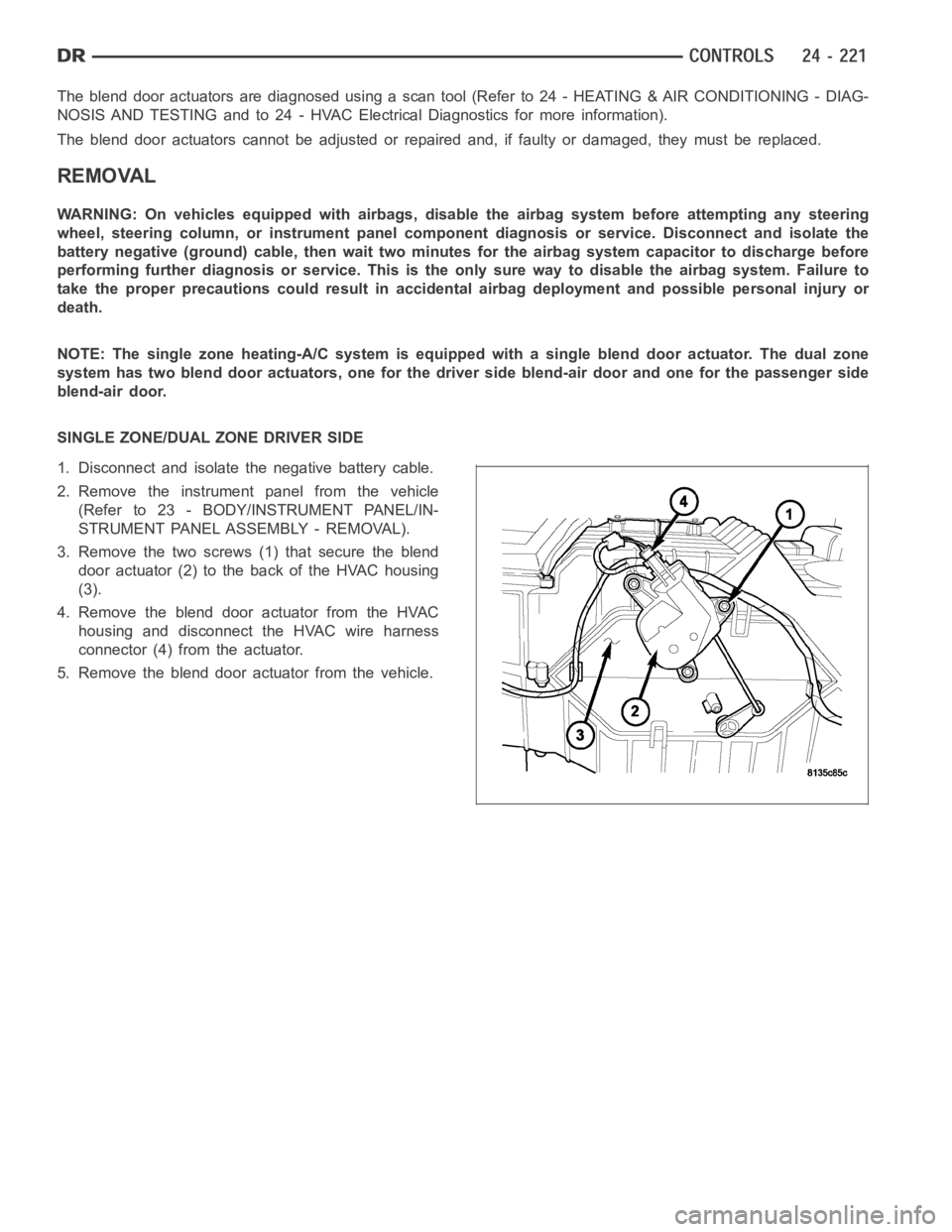
3. Remove the two screws (1) that secure the blend
door actuator (2) to the back of the HVAC housing
(3).
4. Remove the blend door actuator from the HVAC
housing and disconnect the HVAC wire harness
connector (4) from the actuator.
5. Remove the blend door actuator from the vehicle.
Page 5067 of 5267
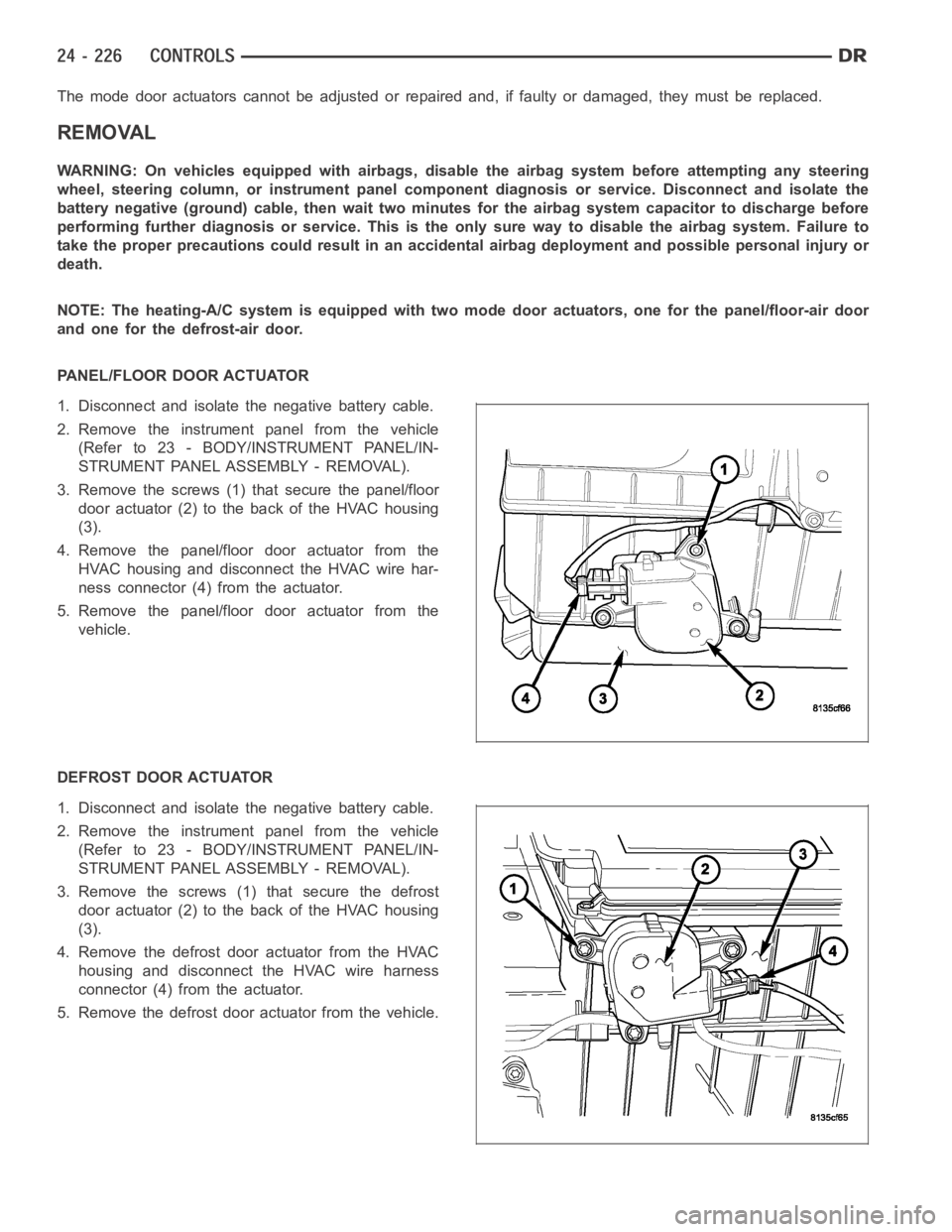
The mode door actuators cannot be adjusted or repaired and, if faulty or damaged, they must be replaced.
REMOVAL
WARNING: On vehicles equipped with airbags, disable the airbag system before attempting any steering
wheel, steering column, or instrument panel component diagnosis or service. Disconnect and isolate the
battery negative (ground) cable, then wait two minutes for the airbag system capacitor to discharge before
performing further diagnosis or service. This is the only sure way to disable the airbag system. Failure to
take the proper precautions could result in an accidental airbag deployment and possible personal injury or
death.
NOTE: The heating-A/C system is equipped with two mode door actuators, onefor the panel/floor-air door
and one for the defrost-air door.
PANEL/FLOOR DOOR ACTUATOR
1. Disconnect and isolate the negative battery cable.
2. Remove the instrument panel from the vehicle
(Refer to 23 - BODY/INSTRUMENT PANEL/IN-
STRUMENT PANEL ASSEMBLY - REMOVAL).
3. Remove the screws (1) that secure the panel/floor
door actuator (2) to the back of the HVAC housing
(3).
4. Remove the panel/floor door actuator from the
HVAC housing and disconnect the HVAC wire har-
ness connector (4) from the actuator.
5. Remove the panel/floor door actuator from the
vehicle.
DEFROST DOOR ACTUATOR
1. Disconnect and isolate the negative battery cable.
2. Remove the instrument panel from the vehicle
(Refer to 23 - BODY/INSTRUMENT PANEL/IN-
STRUMENT PANEL ASSEMBLY - REMOVAL).
3. Remove the screws (1) that secure the defrost
door actuator (2) to the back of the HVAC housing
(3).
4. Remove the defrost door actuator from the HVAC
housing and disconnect the HVAC wire harness
connector (4) from the actuator.
5. Remove the defrost door actuator from the vehicle.
Page 5071 of 5267
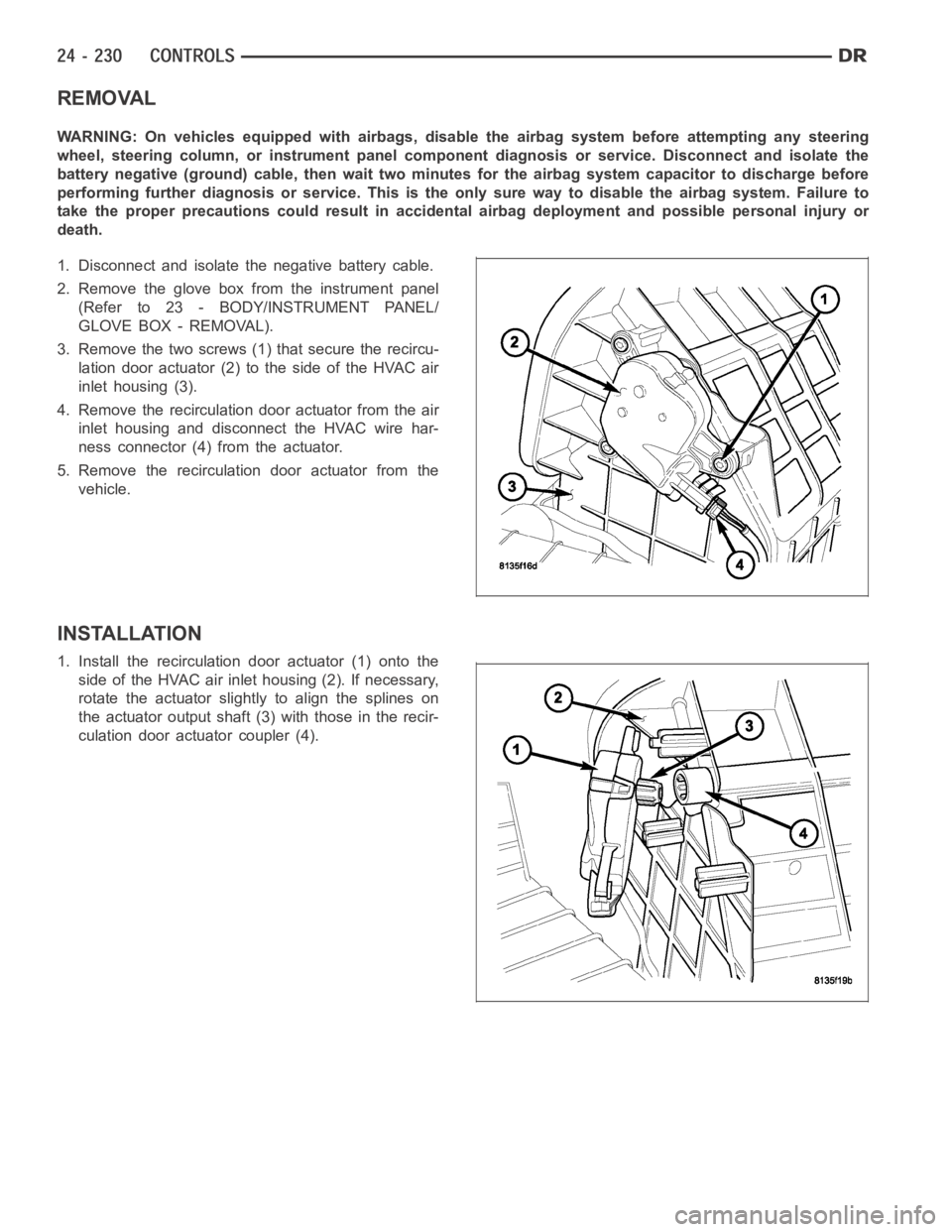
REMOVAL
WARNING: On vehicles equipped with airbags, disable the airbag system before attempting any steering
wheel, steering column, or instrument panel component diagnosis or service. Disconnect and isolate the
battery negative (ground) cable, then wait two minutes for the airbag system capacitor to discharge before
performing further diagnosis or service. This is the only sure way to disable the airbag system. Failure to
take the proper precautions could result in accidental airbag deploymentand possible personal injury or
death.
1. Disconnect and isolate the negative battery cable.
2. Remove the glove box from the instrument panel
(Refer to 23 - BODY/INSTRUMENT PANEL/
GLOVE BOX - REMOVAL).
3. Remove the two screws (1) that secure the recircu-
lation door actuator (2) to the side of the HVAC air
inlet housing (3).
4. Remove the recirculation door actuator from the air
inlet housing and disconnect the HVAC wire har-
ness connector (4) from the actuator.
5. Remove the recirculation door actuator from the
vehicle.
INSTALLATION
1. Install the recirculation door actuator (1) onto the
side of the HVAC air inlet housing (2). If necessary,
rotate the actuator slightly to align the splines on
the actuator output shaft (3) with those in the recir-
culation door actuator coupler (4).
Page 5085 of 5267
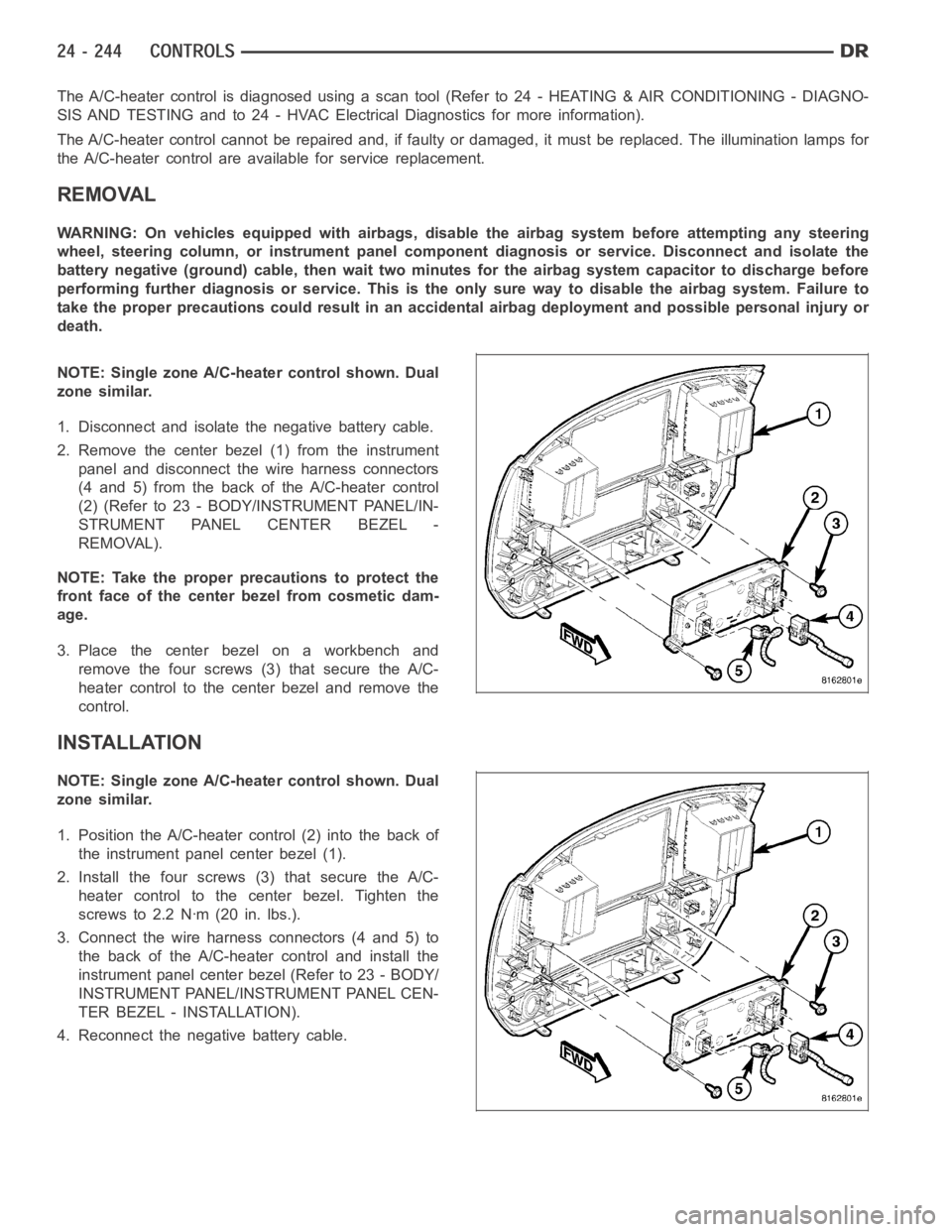
The A/C-heater control is diagnosed using a scan tool (Refer to 24 - HEATING& AIR CONDITIONING - DIAGNO-
SIS AND TESTING and to 24 - HVAC Electrical Diagnostics for more information).
The A/C-heater control cannot be repaired and, if faulty or damaged, it must be replaced. The illumination lamps for
the A/C-heater control are available for service replacement.
REMOVAL
WARNING: On vehicles equipped with airbags, disable the airbag system before attempting any steering
wheel, steering column, or instrument panel component diagnosis or service. Disconnect and isolate the
battery negative (ground) cable, then wait two minutes for the airbag system capacitor to discharge before
performing further diagnosis or service. This is the only sure way to disable the airbag system. Failure to
take the proper precautions could result in an accidental airbag deployment and possible personal injury or
death.
NOTE: Single zone A/C-heater control shown. Dual
zone similar.
1. Disconnect and isolate the negative battery cable.
2. Remove the center bezel (1) from the instrument
panel and disconnect the wire harness connectors
(4 and 5) from the back of the A/C-heater control
(2) (Refer to 23 - BODY/INSTRUMENT PANEL/IN-
STRUMENT PANEL CENTER BEZEL -
REMOVAL).
NOTE: Take the proper precautions to protect the
front face of the center bezel from cosmetic dam-
age.
3. Place the center bezel on a workbench and
remove the four screws (3) that secure the A/C-
heater control to the center bezel and remove the
control.
INSTALLATION
NOTE: Single zone A/C-heater control shown. Dual
zone similar.
1. Position the A/C-heater control (2) into the back of
the instrument panel center bezel (1).
2. Install the four screws (3) that secure the A/C-
heater control to the center bezel. Tighten the
screws to 2.2 Nꞏm (20 in. lbs.).
3. Connect the wire harness connectors (4 and 5) to
the back of the A/C-heater control and install the
instrument panel center bezel (Refer to 23 - BODY/
INSTRUMENT PANEL/INSTRUMENT PANEL CEN-
TER BEZEL - INSTALLATION).
4. Reconnect the negative battery cable.
Page 5086 of 5267
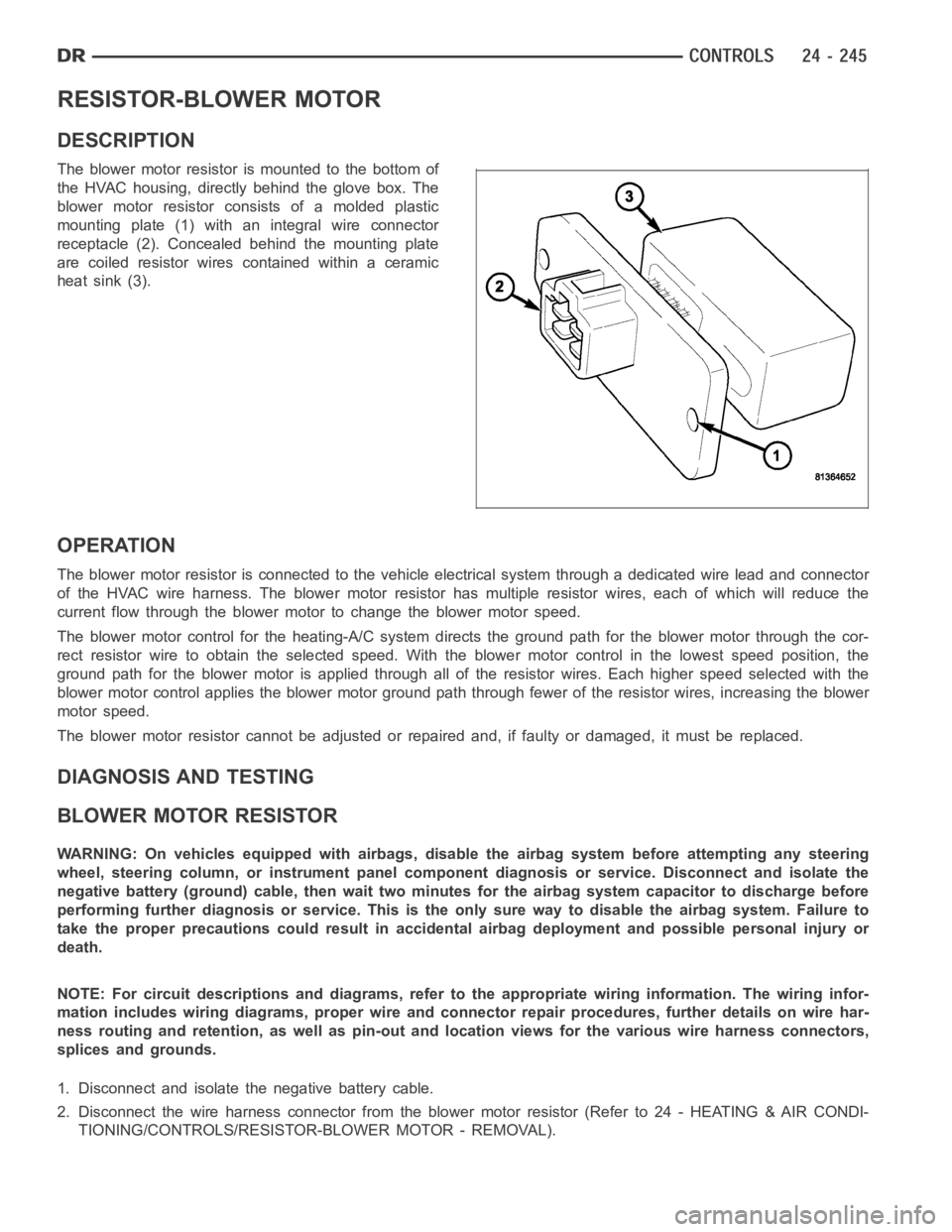
RESISTOR-BLOWER MOTOR
DESCRIPTION
The blower motor resistor is mounted to the bottom of
the HVAC housing, directly behind the glove box. The
blower motor resistor consists of a molded plastic
mounting plate (1) with an integral wire connector
receptacle (2). Concealed behind the mounting plate
are coiled resistor wires contained within a ceramic
heat sink (3).
OPERATION
The blower motor resistor is connected to the vehicle electrical system through a dedicated wire lead and connector
of the HVAC wire harness. The blower motor resistor has multiple resistor wires, each of which will reduce the
current flow through the blower motor to change the blower motor speed.
The blower motor control for the heating-A/C system directs the ground path for the blower motor through the cor-
rect resistor wire to obtain the selected speed. With the blower motor control in the lowest speed position, the
ground path for the blower motor is applied through all of the resistor wires. Each higher speed selected with the
blower motor control applies the blower motor ground path through fewer ofthe resistor wires, increasing the blower
motor speed.
The blower motor resistor cannot be adjusted or repaired and, if faulty or damaged, it must be replaced.
DIAGNOSIS AND TESTING
BLOWER MOTOR RESISTOR
WARNING: On vehicles equipped with airbags, disable the airbag system before attempting any steering
wheel, steering column, or instrument panel component diagnosis or service. Disconnect and isolate the
negative battery (ground) cable, then wait two minutes for the airbag system capacitor to discharge before
performing further diagnosis or service. This is the only sure way to disable the airbag system. Failure to
take the proper precautions could result in accidental airbag deploymentand possible personal injury or
death.
NOTE: For circuit descriptions and diagrams, refer to the appropriate wiring information. The wiring infor-
mation includes wiring diagrams, proper wire and connector repair procedures, further details on wire har-
ness routing and retention, as well as pin-out and location views for the various wire harness connectors,
splices and grounds.
1. Disconnect and isolate the negative battery cable.
2. Disconnect the wire harness connector from the blower motor resistor (Refer to 24 - HEATING & AIR CONDI-
TIONING/CONTROLS/RESISTOR-BLOWER MOTOR - REMOVAL).
Page 5087 of 5267
3. Using an ohmmeter, check for continuity between all of the blower motor resistor terminals. In each case there
should be continuity. If OK, repair the wire harness circuits between the blower motor speed control and the
blower motor resistor or blower motor as required. If not OK, replace the faulty blower motor resistor.
REMOVAL
WARNING: On vehicles equipped with airbags, disable the airbag system before attempting any steering
wheel, steering column, or instrument panel component diagnosis or service. Disconnect and isolate the
battery negative (ground) cable, then wait two minutes for the airbag system capacitor to discharge before
performing further diagnosis or service. This is the only sure way to disable the airbag system. Failure to
take the proper precautions could result in an accidental airbag deployment and possible personal injury or
death.
WARNING: The blower motor resistor may get very hot during normal operation. If the blower motor was
turned on prior to servicing the blower motor resistor, wait five minutes to allow the blower motor resistors
to cool before performing diagnosis or service. Failure to take this precaution can result in possible per-
sonal injury.
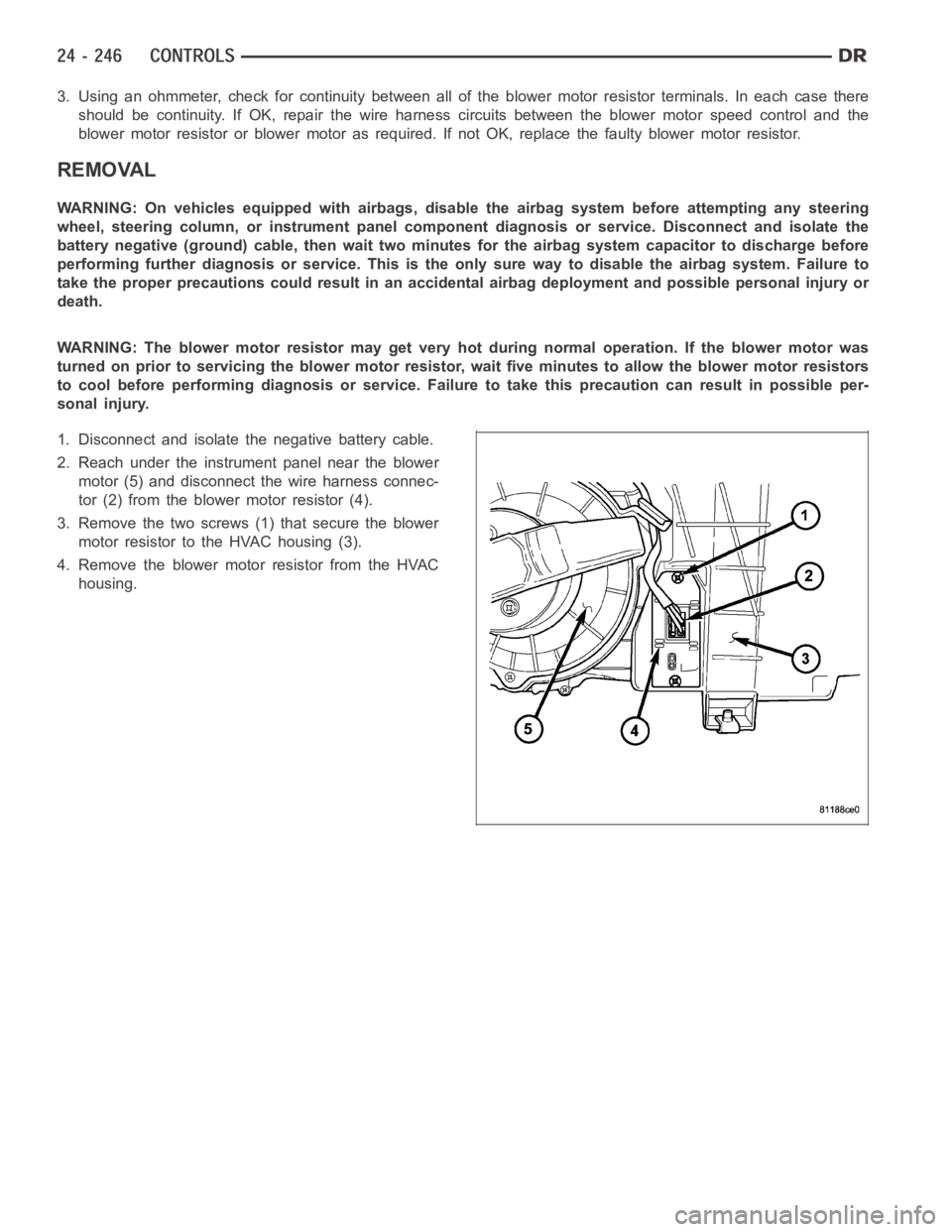
1. Disconnect and isolate the negative battery cable.
2. Reach under the instrument panel near the blower
motor (5) and disconnect the wire harness connec-
tor (2) from the blower motor resistor (4).
3. Remove the two screws (1) that secure the blower
motor resistor to the HVAC housing (3).
4. Remove the blower motor resistor from the HVAC
housing.
Page 5095 of 5267
DUCT-DEFROSTER
REMOVAL
WARNING: On vehicles equipped with airbags, disable the airbag system before attempting any steering
wheel, steering column, or instrument panel component diagnosis or service. Disconnect and isolate the
battery negative (ground) cable, then wait two minutes for the airbag system capacitor to discharge before
performing further diagnosis or service. This is the only sure way to disable the airbag system. Failure to
take the proper precautions could result in accidental airbag deploymentand possible personal injury or
death.
NOTE: Take the proper precautions to protect the instrument panel from cosmetic damage.
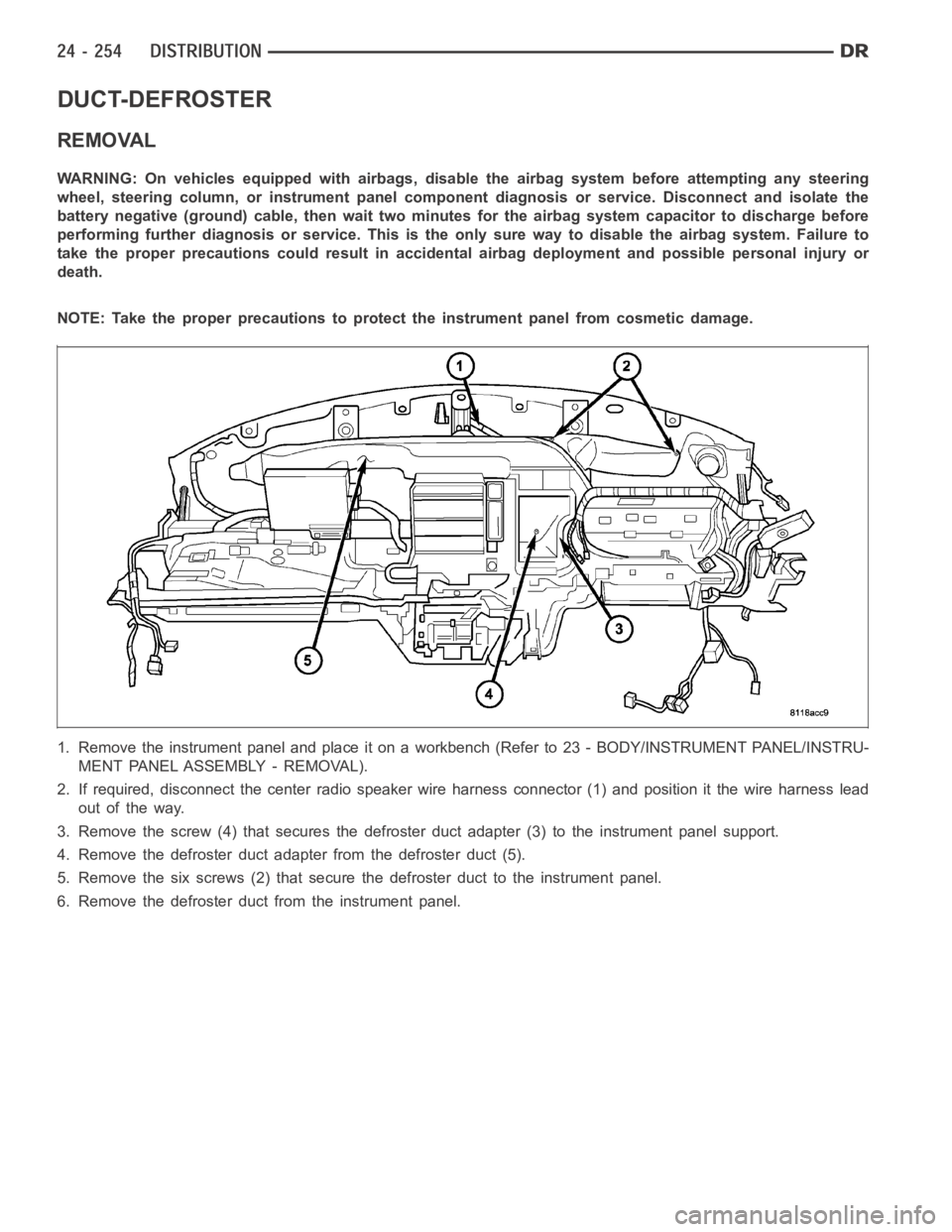
1. Remove the instrument panel and place it on a workbench (Refer to 23 - BODY/INSTRUMENT PANEL/INSTRU-
MENT PANEL ASSEMBLY - REMOVAL).
2. If required, disconnect the center radio speaker wire harness connector (1) and position it the wire harness lead
out of the way.
3. Remove the screw (4) that secures the defroster duct adapter (3) to the instrument panel support.
4. Remove the defroster duct adapter from the defroster duct (5).
5. Remove the six screws (2) that secure the defroster duct to the instrument panel.
6. Remove the defroster duct from the instrument panel.