heating DODGE RAM SRT-10 2006 Service Owner's Guide
[x] Cancel search | Manufacturer: DODGE, Model Year: 2006, Model line: RAM SRT-10, Model: DODGE RAM SRT-10 2006Pages: 5267, PDF Size: 68.7 MB
Page 2200 of 5267
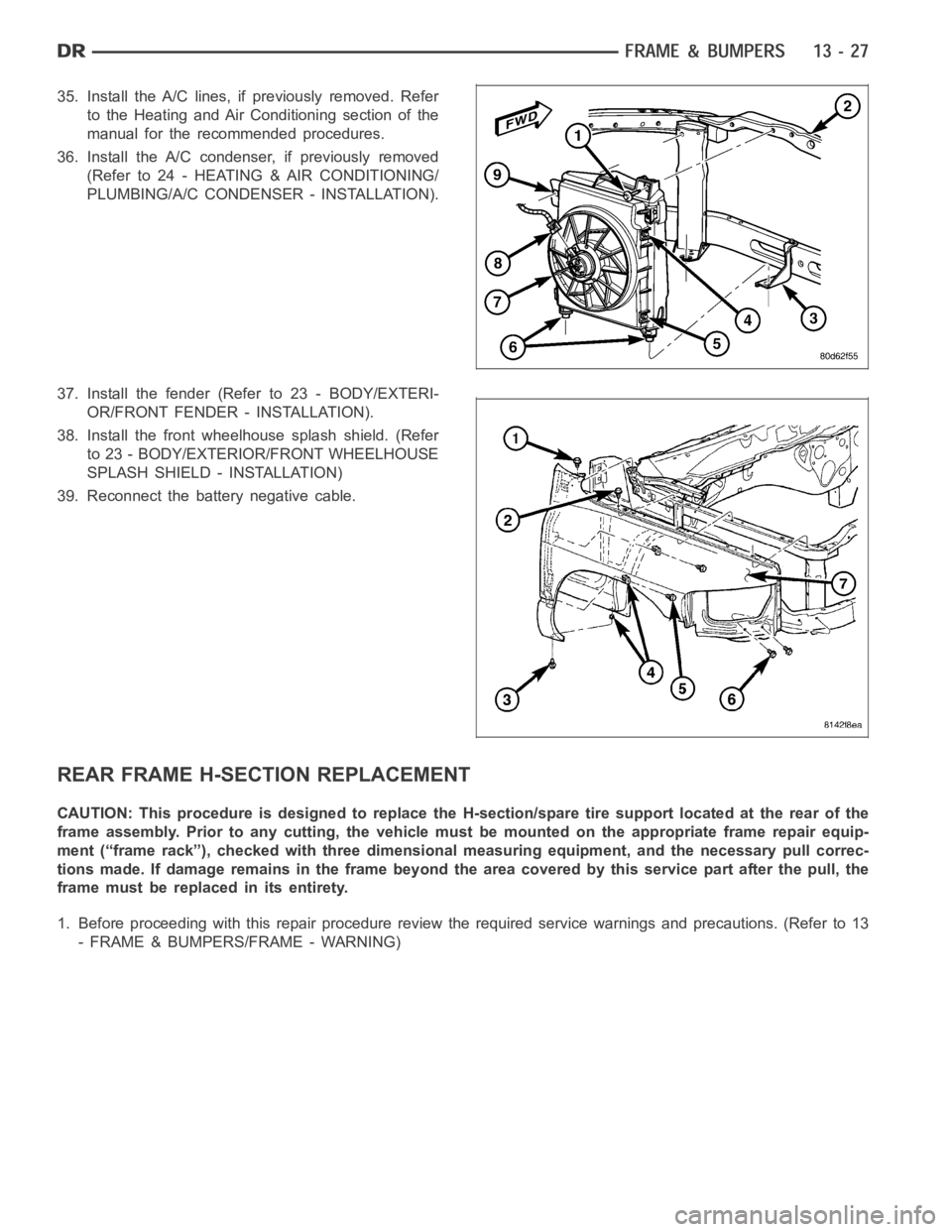
35. Install the A/C lines, if previously removed. Refer
to the Heating and Air Conditioning section of the
manual for the recommended procedures.
36. Install the A/C condenser, if previously removed
(Refer to 24 - HEATING & AIR CONDITIONING/
PLUMBING/A/C CONDENSER - INSTALLATION).
37. Install the fender (Refer to 23 - BODY/EXTERI-
OR/FRONT FENDER - INSTALLATION).
38. Install the front wheelhouse splash shield. (Refer
to 23 - BODY/EXTERIOR/FRONT WHEELHOUSE
SPLASH SHIELD - INSTALLATION)
39. Reconnect the battery negative cable.
REAR FRAME H-SECTION REPLACEMENT
CAUTION: This procedure is designed to replace the H-section/spare tire support located at the rear of the
frame assembly. Prior to any cutting, the vehicle must be mounted on the appropriate frame repair equip-
ment (“frame rack”), checked with three dimensional measuring equipment, and the necessary pull correc-
tions made. If damage remains in the frame beyond the area covered by this service part after the pull, the
frame must be replaced in its entirety.
1. Before proceeding with this repair procedure review the required service warnings and precautions. (Refer to 13
- FRAME & BUMPERS/FRAME - WARNING)
Page 2397 of 5267
HEATER - INTAKE AIR
DESCRIPTION
The intake manifold air heater element assembly is located in the top of theintake manifold.
OPERATION
The air heater element is used to heat incoming air to the intake manifold. This is done to help engine starting and
improve driveability with cool or cold outside temperatures.
Electrical supply for the air heater element is controlled by the Engine Control Module (ECM) through the air heater
relay. Refer to Intake Manifold Air Heater Relay for more information.
One heavy-duty cable connects the air heater element to the air heater relay. This cable will supply 12 volts to an
individual heating element within the heater block assembly.
CAUTION: The heater elements are no longer grounded using an external ground strap. Grounding is now
accomplished using two electrically conductive gaskets. Failure to use these gaskets will result in faulty
heater element operation.
Refer to the Powertrain Diagnostic Procedures manual for electrical operation and complete description of the intake
heaters, including pre-heat and post-heat cycles.
REMOVAL
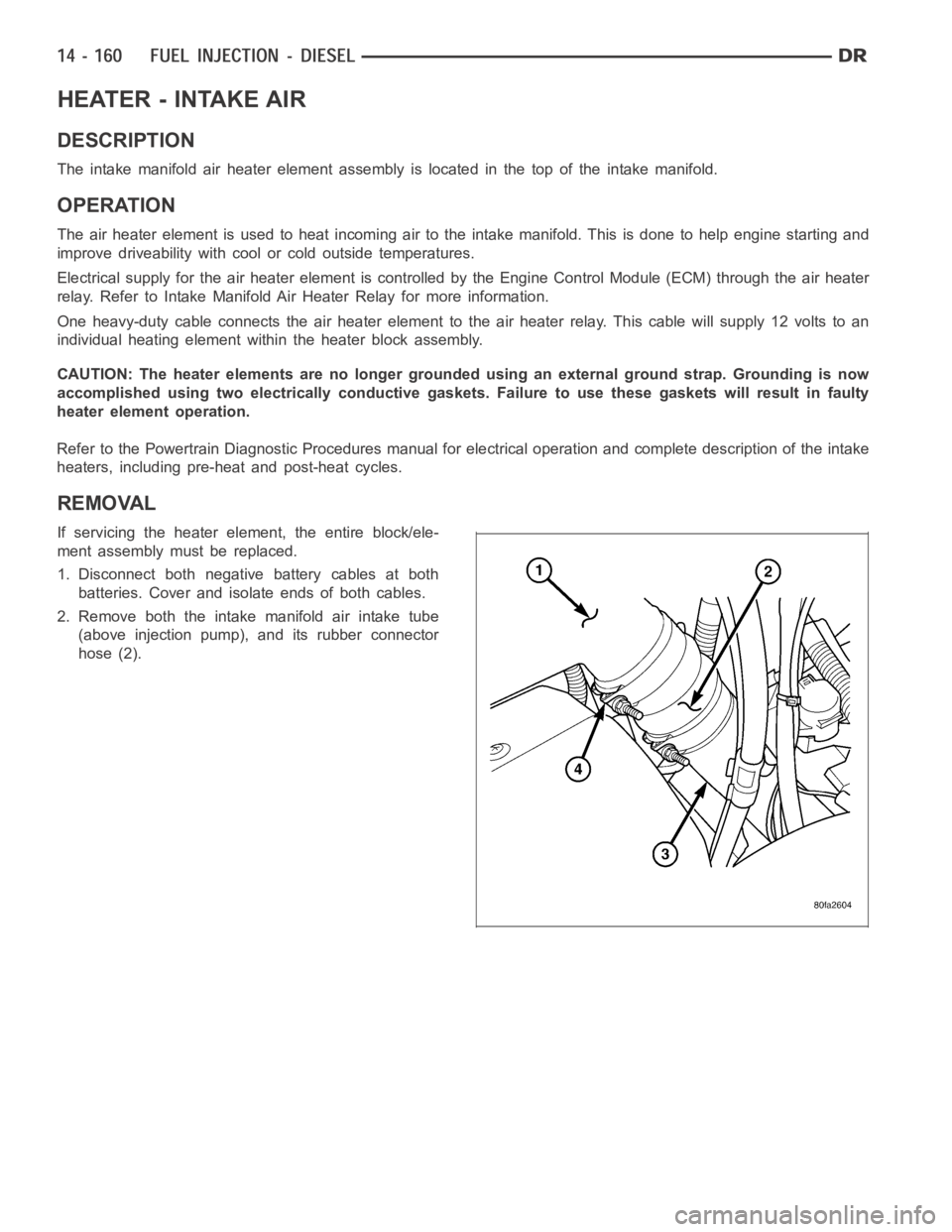
If servicing the heater element, the entire block/ele-
ment assembly must be replaced.
1. Disconnect both negative battery cables at both
batteries. Cover and isolate ends of both cables.
2. Remove both the intake manifold air intake tube
(above injection pump), and its rubber connector
hose (2).
Page 2400 of 5267
RELAY - INTAKE AIR HEATER
DESCRIPTION
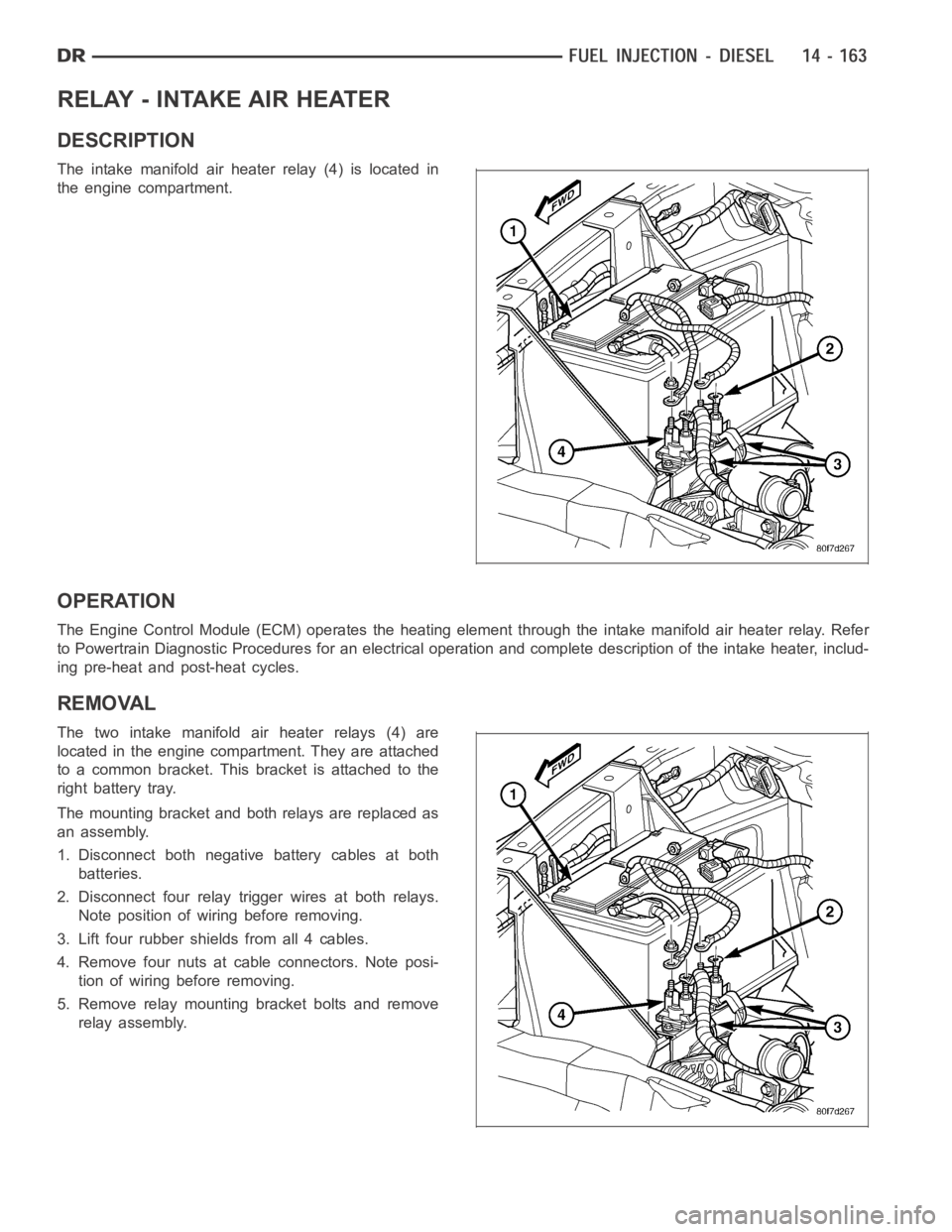
The intake manifold air heater relay (4) is located in
the engine compartment.
OPERATION
The Engine Control Module (ECM) operates the heating element through the intake manifold air heater relay. Refer
to Powertrain Diagnostic Procedures for an electrical operation and complete description of the intake heater, includ-
ing pre-heat and post-heat cycles.
REMOVAL
The two intake manifold air heater relays (4) are
located in the engine compartment. They are attached
to a common bracket. This bracket is attached to the
right battery tray.
The mounting bracket and both relays are replaced as
an assembly.
1. Disconnect both negative battery cables at both
batteries.
2. Disconnect four relay trigger wires at both relays.
Note position of wiring before removing.
3. Lift four rubber shields from all 4 cables.
4. Remove four nuts at cable connectors. Note posi-
tion of wiring before removing.
5. Remove relay mounting bracket bolts and remove
relay assembly.
Page 2523 of 5267
MANUAL TRANSMISSION - G56 - SERVICE INFORMATION
DIAGNOSIS AND TESTING
MANUAL TRANSMISSION - G56
LOW LUBRICANT LEVEL
A low transmission lubricant level is generally the result of a leak, inadequate lubricant fill or incorrect lubricant level
check.
Rear transmission leakswill be from the oil seals or component mating surfaces.
Front transmission leakswill be from the front input shaft retainer seal. Lubricant may drip from theclutchhousing
after extended operation. If leak is severe, it may contaminate the clutchdisc.
Lubricant level checkcan only be made when the vehicle is level and allowing the lubricant to settle for a minute
before checking. This will ensure an accurate check and avoid an under or overfill condition.
HARD SHIFTING
Hard shifting is usually caused by low lubricant level, improper or contaminated lubricants. This will cause noise,
excessive wear, internal bind, and hard shifting. Substantial lubricantleaks can result in gear, shift rail, synchro, and
bearing damage. The first indications of component damage is usually hardshifting and noise.
Shift component damage, clutch adjustment, worn pressure plate or disc are also causes of increased shift effort. If
clutch problem is advanced, gear clash during shifts can result. Worn or damaged synchronizer rings can cause
gear clash when shifting into any forward gear. In some new or rebuilt transmissions, new synchro rings may tend
to stick slightly causing hard or noisy shifts. In most cases, this condition will decline as the rings wear-in.
TRANSMISSION NOISE
Most manual transmissions make some noise during normal operation. Rotating gears generate a mild whine that is
audible, but generally only at extreme speeds.
Severe, highly audible transmission noise is generally the initial indicator of a lubricant problem. Insufficient,
improper or contaminated lubricant will promote rapid wear of gears, synchronizer rings, shift rails, forks and bear-
ings. The overheating caused by a lubricant problem, can also lead to gear and bearing damage.
Page 2550 of 5267
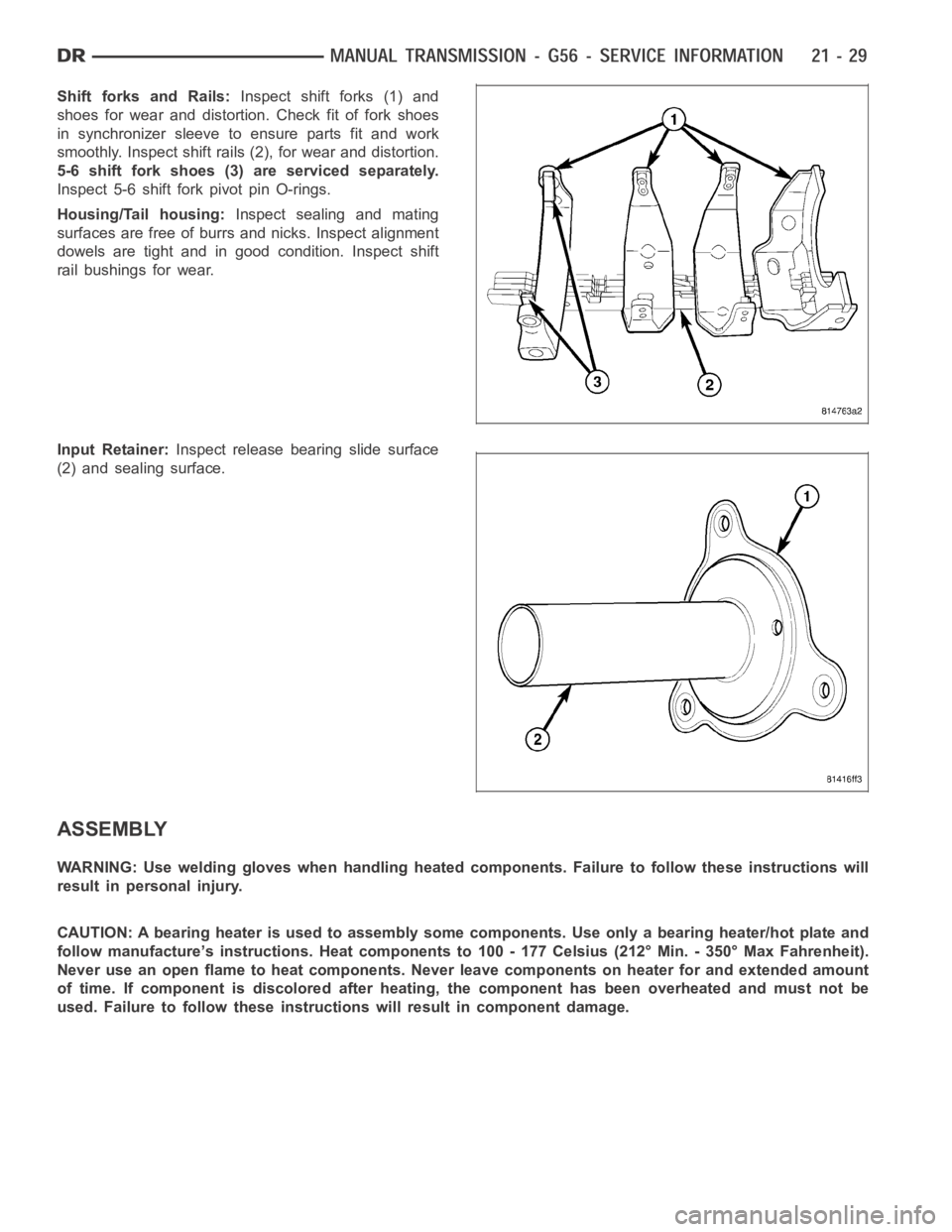
Shift forks and Rails:Inspect shift forks (1) and
shoes for wear and distortion. Check fit of fork shoes
in synchronizer sleeve to ensure parts fit and work
smoothly. Inspect shift rails(2), for wear and distortion.
5-6 shift fork shoes (3) are serviced separately.
Inspect 5-6 shift fork pivot pin O-rings.
Housing/Tail housing:Inspect sealing and mating
surfaces are free of burrs and nicks. Inspect alignment
dowels are tight and in good condition. Inspect shift
rail bushings for wear.
Input Retainer:Inspect release bearing slide surface
(2) and sealing surface.
ASSEMBLY
WARNING: Use welding gloves when handling heated components. Failure to follow these instructions will
result in personal injury.
CAUTION:Abearingheaterisusedtoassemblysomecomponents.Useonlyabearing heater/hot plate and
follow manufacture’s instructions. Heat components to 100 - 177 Celsius (212° Min. - 350° Max Fahrenheit).
Never use an open flame to heat components. Never leave components on heater for and extended amount
of time. If component is discolored after heating, the component has been overheated and must not be
used. Failure to follow these instructions will result in component damage.
Page 2592 of 5267
MANUAL TRANSMISSION - GETRAG 238 - SERVICE INFORMATION
DIAGNOSIS AND TESTING
MANUAL TRANSMISSION - GETRAG 238
LOW LUBRICANT LEVEL
A low transmission lubricant level is generally the result of a leak, inadequate lubricant fill or incorrect lubricant level
check.
Rear transmission leakswill be from the oil seals or transfer case front seal on 4x4.
Front transmission leakswill be from the front input shaft retainer seal. Lubricant may drip from theclutchhousing
after extended operation. If leak is severe, it may contaminate the clutchdisc.
Lubricant level checkcan only be made when the vehicle is level and allowing the lubricant to settle for a minute
before checking. This will ensure an accurate check and avoid an under or overfill condition.
HARD SHIFTING
Hard shifting can be caused by low lubricant level, improper or contaminated lubricants. This will cause noise,
excessive wear, internal bind, and hard shifting. Substantial lubricantleaks can result in gear, shift rail, synchro, and
bearing damage. The first indications of component damage is usually hardshifting and noise.
Shift component damage, clutch adjustment, worn pressure plate or disc, can increased shift effort. If clutch problem
is advanced, gear clash during shifts can result. Worn or damaged synchronizer rings can cause gear clash when
shifting into any forward gear. In some new or rebuilt transmissions, new synchro rings may tend to stick slightly
causing hard or noisy shifts. In most cases, this condition will decline asthe rings wear-in.
TRANSMISSION NOISE
Most manual transmissions make some noise during normal operation. Rotating gears generate a mild whine that is
audible, but generally only at extreme speeds.
Severe, highly audible transmission noise is generally the initial indicator of a lubricant problem. Insufficient,
improper or contaminated lubricant will promote rapid wear of gears, synchronizer rings, shift rails, forks and bear-
ings. The overheating caused by a lubricant problem, can also lead to gear and bearing damage.
STANDARD PROCEDURE
DRAIN AND FILL
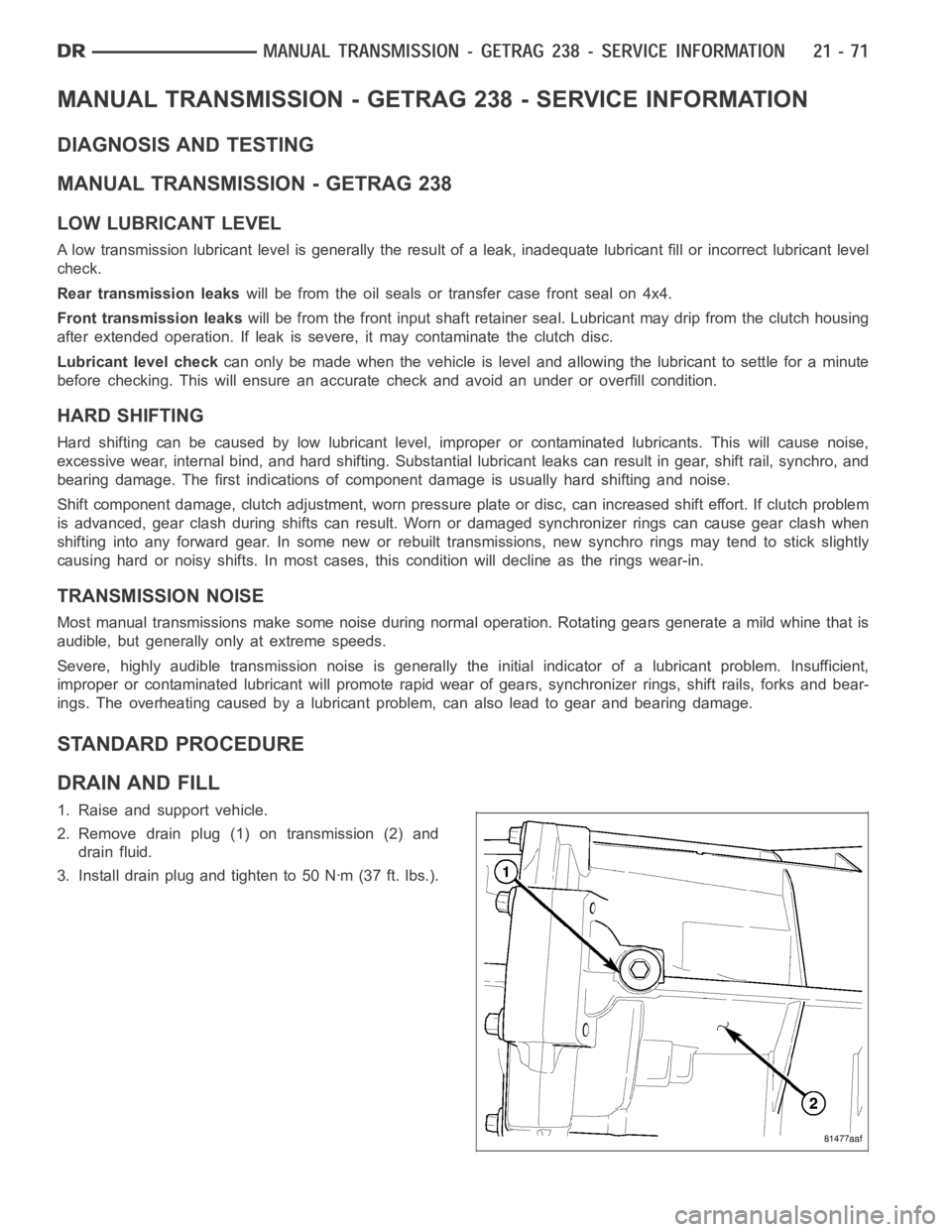
1. Raise and support vehicle.
2. Remove drain plug (1) on transmission (2) and
drain fluid.
3. Install drain plug and tighten to 50 Nꞏm (37 ft. lbs.).
Page 2636 of 5267
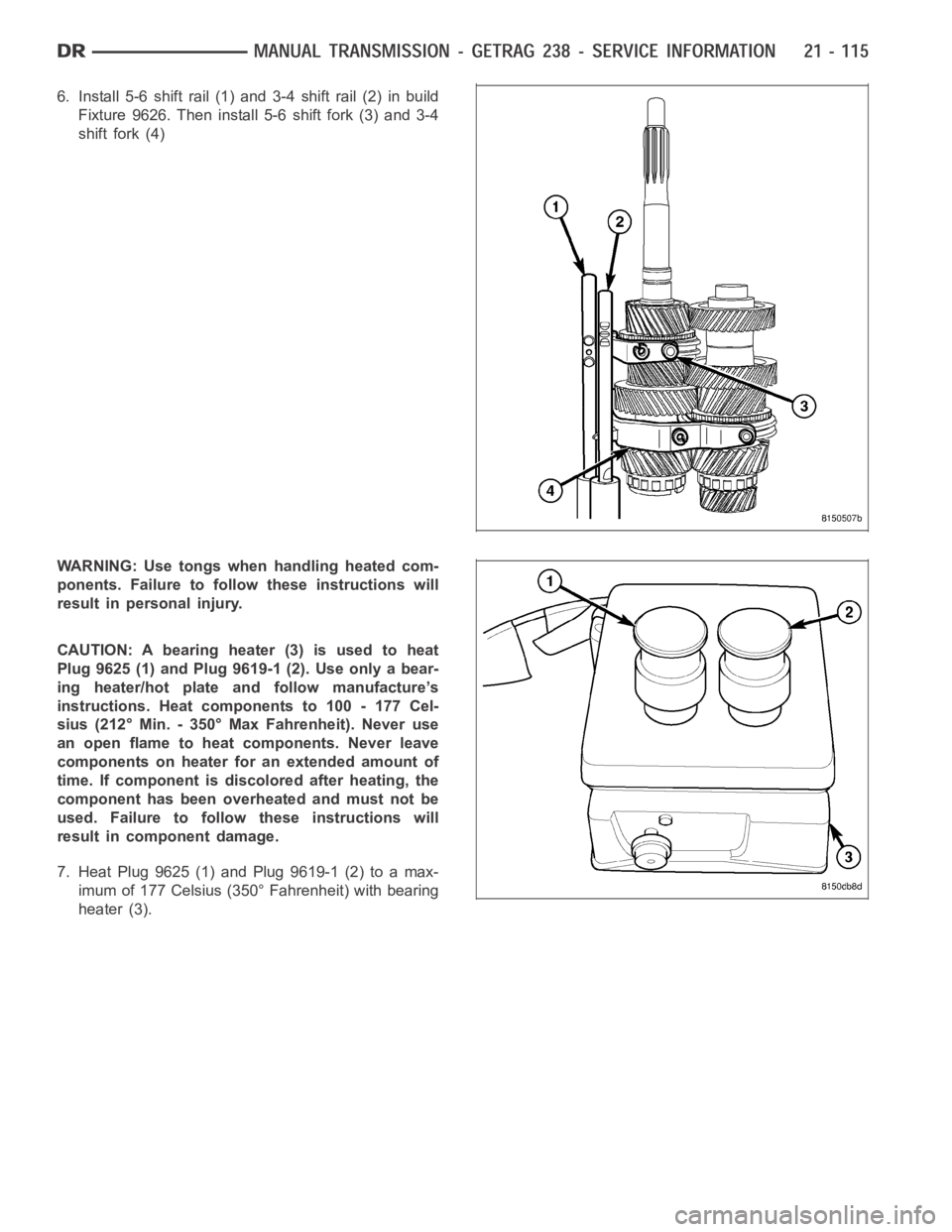
6. Install 5-6 shift rail (1) and 3-4 shift rail (2) in build
Fixture 9626. Then install 5-6 shift fork (3) and 3-4
shift fork (4)
WARNING: Use tongs when handling heated com-
ponents. Failure to follow these instructions will
result in personal injury.
CAUTION: A bearing heater (3) is used to heat
Plug 9625 (1) and Plug 9619-1 (2). Use only a bear-
ing heater/hot plate and follow manufacture’s
instructions. Heat components to 100 - 177 Cel-
sius (212° Min. - 350° Max Fahrenheit). Never use
an open flame to heat components. Never leave
components on heater for an extended amount of
time. If component is discolored after heating, the
component has been overheated and must not be
used. Failure to follow these instructions will
result in component damage.
7. Heat Plug 9625 (1) and Plug 9619-1 (2) to a max-
imum of 177 Celsius (350° Fahrenheit) with bearing
heater (3).
Page 2646 of 5267
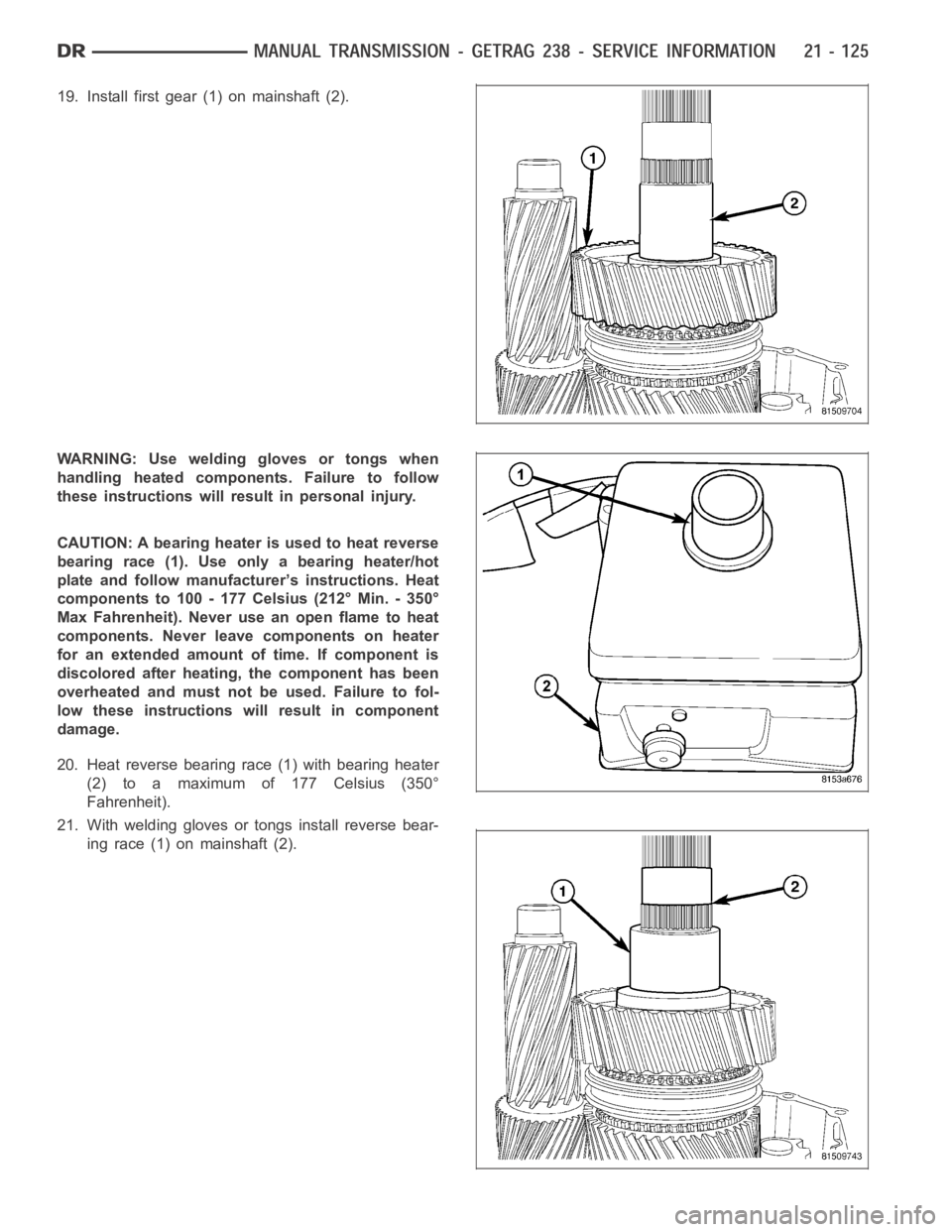
19. Install first gear (1) on mainshaft (2).
WARNING: Use welding gloves or tongs when
handling heated components. Failure to follow
these instructions will result in personal injury.
CAUTION: A bearing heater is used to heat reverse
bearing race (1). Use only a bearing heater/hot
plate and follow manufacturer’s instructions. Heat
components to 100 - 177 Celsius (212° Min. - 350°
Max Fahrenheit). Never use an open flame to heat
components. Never leave components on heater
for an extended amount of time. If component is
discolored after heating, the component has been
overheated and must not be used. Failure to fol-
low these instructions will result in component
damage.
20. Heat reverse bearing race (1) with bearing heater
(2) to a maximum of 177 Celsius (350°
Fahrenheit).
21. With welding gloves or tongs install reverse bear-
ing race (1) on mainshaft (2).
Page 2650 of 5267
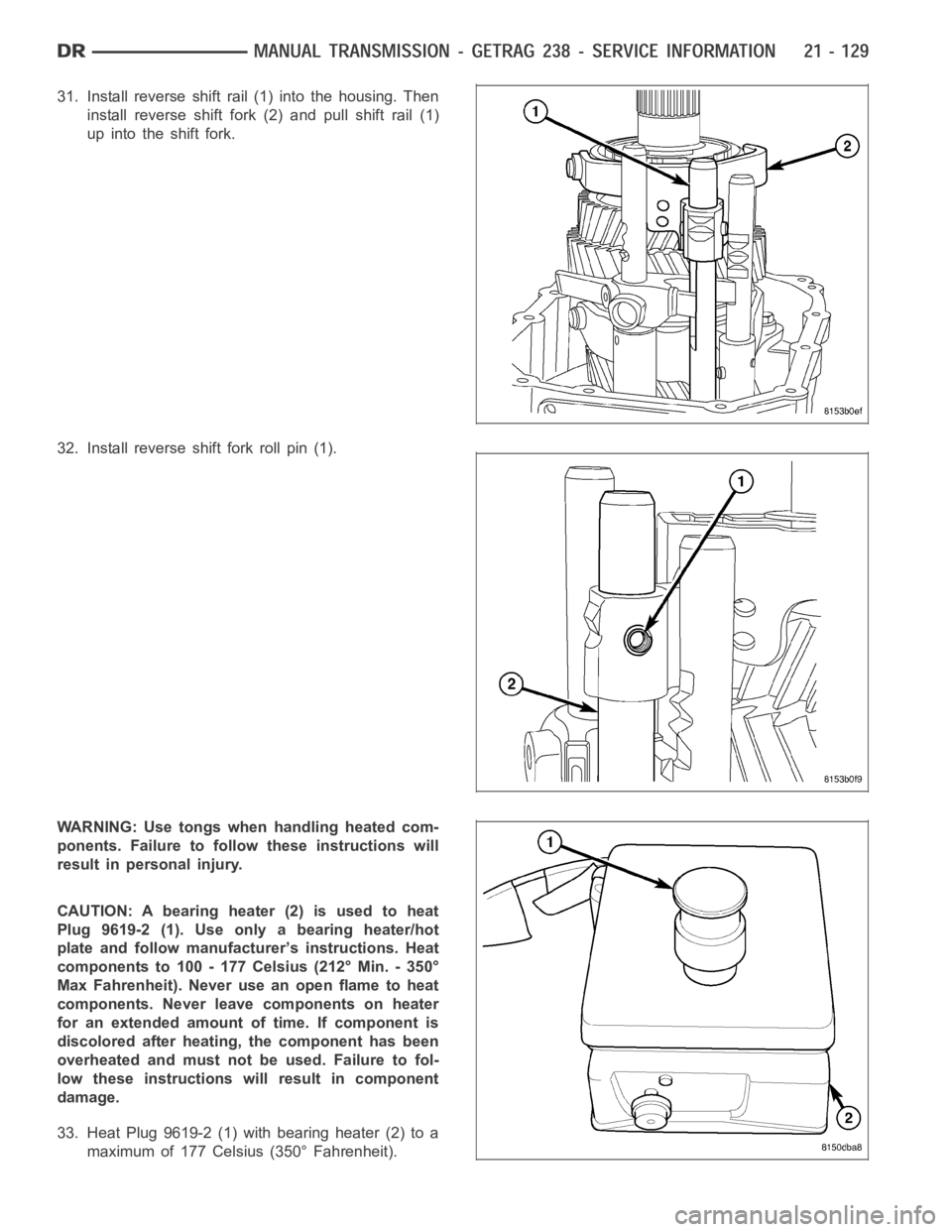
31. Install reverse shift rail (1) into the housing. Then
install reverse shift fork (2) and pull shift rail (1)
up into the shift fork.
32. Install reverse shift fork roll pin (1).
WARNING: Use tongs when handling heated com-
ponents. Failure to follow these instructions will
result in personal injury.
CAUTION: A bearing heater (2) is used to heat
Plug 9619-2 (1). Use only a bearing heater/hot
plate and follow manufacturer’s instructions. Heat
components to 100 - 177 Celsius (212° Min. - 350°
Max Fahrenheit). Never use an open flame to heat
components. Never leave components on heater
for an extended amount of time. If component is
discolored after heating, the component has been
overheated and must not be used. Failure to fol-
low these instructions will result in component
damage.
33. Heat Plug 9619-2 (1) with bearing heater (2) to a
maximum of 177 Celsius (350° Fahrenheit).
Page 2664 of 5267
MANUAL TRANSMISSION-T56 - SERVICE INFORMATION
DIAGNOSIS AND TESTING
MANUAL TRANSMISSION - T56
LOW LUBRICANT LEVEL
A low transmission lubricant level is generally the result of a leak, inadequate lubricant fill or incorrect lubricant level
check.
Rear transmission leakswill be from the oil seals or component mating surfaces.
Front transmission leakswill be from the front bearing retainer or retainer seal. Lubricant may dripfromtheclutch
housing after extended operation. If leak is severe, it may contaminate the clutch disc.
Lubricant level checkcan only be made when the vehicle is level and allowing the lubricant to settle for a minute
before checking. This will ensure an accurate check and avoid an underfillor overfill condition.
HARD SHIFTING
Hard shifting is usually caused by low lubricant level, improper or contaminated lubricants. This will cause noise,
excessive wear, internal bind, and hard shifting. Substantial lubricantleaks can result in gear, shift rail, synchro, and
bearing damage. The first indications of component damage is usually hardshifting and noise.
Shift component damage, clutch adjustment, worn pressure plate or disc are also causes of increased shift effort. If
clutch problem is advanced, gear clash during shifts can result. Worn or damaged synchro rings can cause gear
clash when shifting into any forward gear. In some new or rebuilt transmissions, new synchro rings may tend to stick
slightly causing hard or noisy shifts. In most cases, this condition will decline as the rings wear-in.
TRANSMISSION NOISE
Most manual transmissions make some noise during normal operation. Rotating gears generate a mild whine that is
audible, but generally only at extreme speeds.
Severe, highly audible transmission noise is generally the initial indicator of a lubricant problem. Insufficient,
improper or contaminated lubricant will promote rapid wear of gears, synchros, shift rails, forks and bearings. The
overheating caused by a lubricant problem, can also lead to gear and bearing damage.
STANDARD PROCEDURE - DRAIN AND FILL
1. Raise and support vehicle.
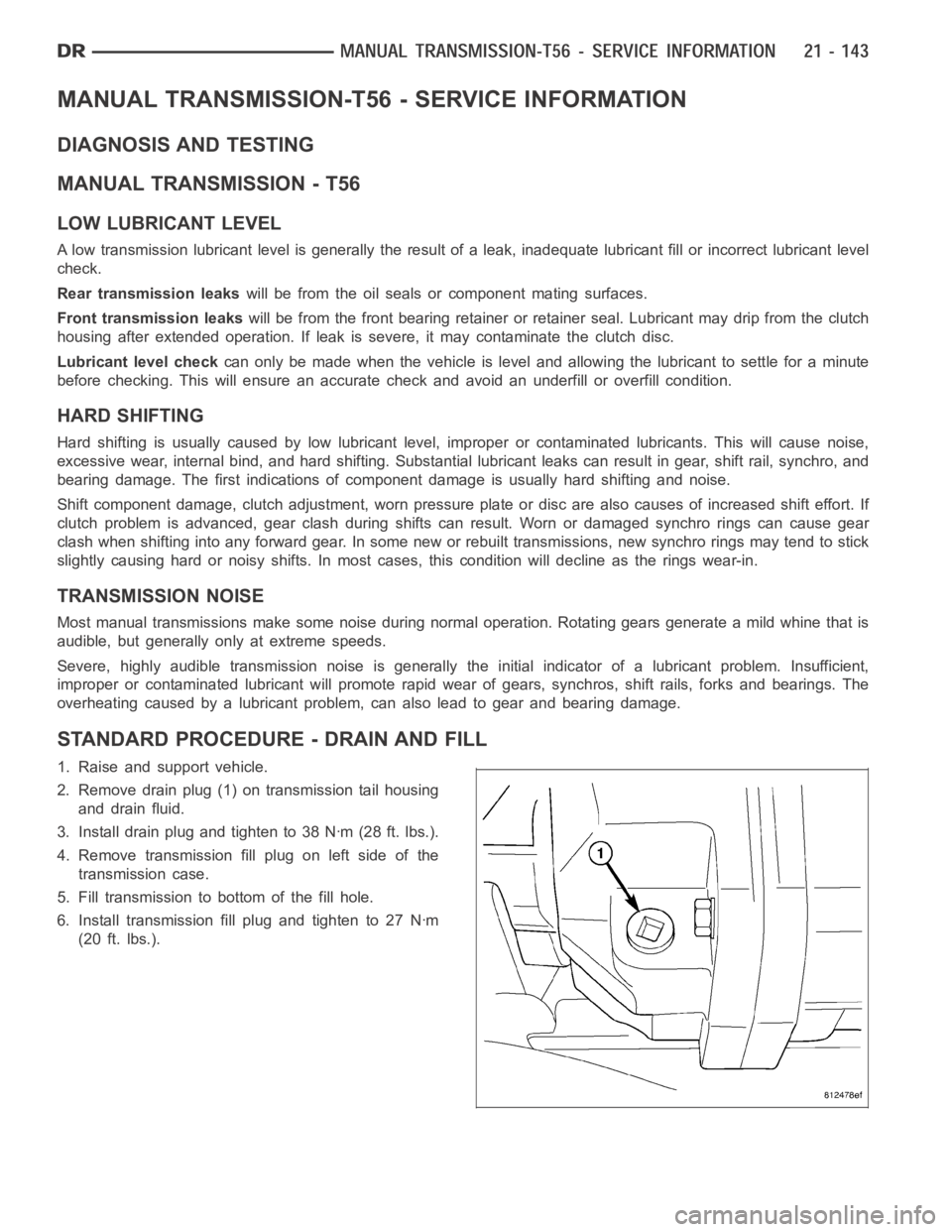
2. Remove drain plug (1) on transmission tail housing
and drain fluid.
3. Install drain plug and tighten to 38 Nꞏm (28 ft. lbs.).
4. Remove transmission fill plug on left side of the
transmission case.
5. Fill transmission to bottom of the fill hole.
6. Install transmission fill plug and tighten to 27 Nꞏm
(20 ft. lbs.).