transmission DODGE RAM SRT-10 2006 Service Service Manual
[x] Cancel search | Manufacturer: DODGE, Model Year: 2006, Model line: RAM SRT-10, Model: DODGE RAM SRT-10 2006Pages: 5267, PDF Size: 68.7 MB
Page 1688 of 5267
ENGINE BLOCK
DESCRIPTION
The cylinder block is made of cast iron.The block is a closed deck design with the left bank forward. To provide
high rigidity and improved NVH an enhanced compacted graphite bedplate isbolted to the block. The block design
allows coolant flow between the cylinders bores, and an internal coolant bypass to a single poppet inlet thermostat
is included in the cast aluminum front cover.
STANDARD PROCEDURE - CYLINDER BORE HONING
Before honing, stuff plenty of clean shop towels under
the bores and over the crankshaft to keep abrasive
materials from entering the crankshaft area.
1. Used carefully, the Cylinder Bore Sizing Hone
C-823, equipped with 220 grit stones, is the best
tool for this job. In addition to deglazing, it will
reduce taper and out-of-round, as well as removing
light scuffing, scoring and scratches. Usually, a few
strokes will clean up a bore and maintain the
required limits.
CAUTION: DO NOT use rigid type hones to remove
cylinder wall glaze.
2. Deglazing of the cylinder walls may be done if the
cylinder bore is straight and round. Use a cylinder
surfacing hone, Honing Tool C-3501, equipped with
280 grit stones (C-3501-3810). about 20-60
strokes, depending on the bore condition, will be
sufficient to provide a satisfactory surface. Using
honing oil C-3501-3880, or a light honing oil, avail-
able from major oil distributors.
CAUTION: DO NOT use engine or transmission oil, mineral spirits, or kerosene.
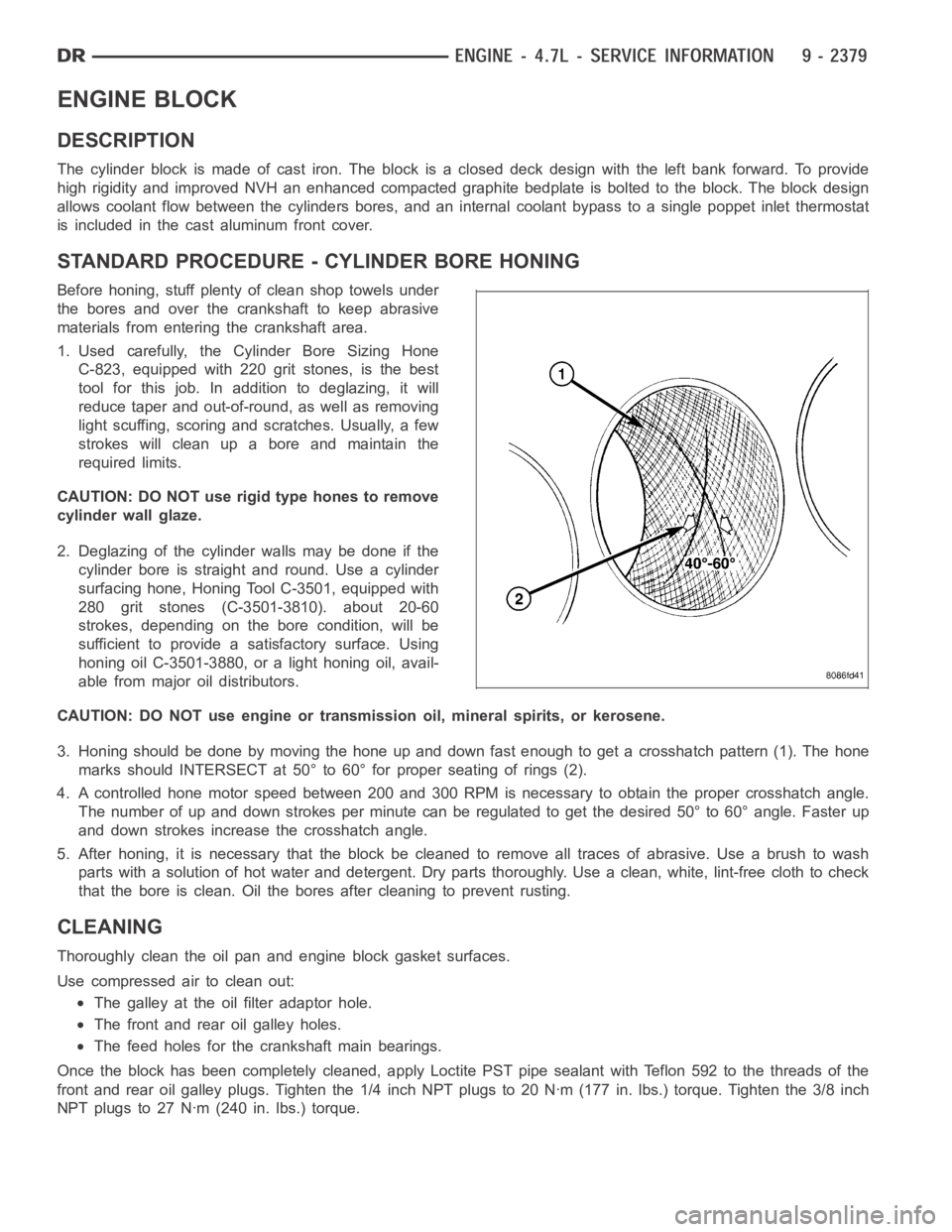
3. Honing should be done by moving the hone up and down fast enough to get a crosshatch pattern (1). The hone
marks should INTERSECT at 50° to 60° for proper seating of rings (2).
4. A controlled hone motor speed between 200 and 300 RPM is necessary to obtain the proper crosshatch angle.
The number of up and down strokes per minute can be regulated to get the desired 50° to 60° angle. Faster up
and down strokes increase the crosshatch angle.
5. After honing, it is necessary that the block be cleaned to remove all traces of abrasive. Use a brush to wash
parts with a solution of hot water and detergent. Dry parts thoroughly. Usea clean, white, lint-free cloth to check
that the bore is clean. Oil the bores after cleaning to prevent rusting.
CLEANING
Thoroughly clean the oil pan and engine block gasket surfaces.
Use compressed air to clean out:
The galley at the oil filter adaptor hole.
The front and rear oil galley holes.
The feed holes for the crankshaft main bearings.
Once the block has been completely cleaned, apply Loctite PST pipe sealantwith Teflon 592 to the threads of the
front and rear oil galley plugs. Tighten the 1/4 inch NPT plugs to 20 Nꞏm (177in. lbs.) torque. Tighten the 3/8 inch
NPT plugs to 27 Nꞏm (240 in. lbs.) torque.
Page 1700 of 5267
SEAL - CRANKSHAFT OIL - FRONT
REMOVAL
1. Disconnect negative cable from battery.
2. Remove accessory drive belt (Refer to 7 - COOL-
ING/ACCESSORY DRIVE/DRIVE BELTS -
REMOVAL).
3. Remove A/C compressor mouning fasteners and
set aside.
4. Drain cooling system (Refer to 7 - COOLING -
STANDARD PROCEDURE).
5. Remove upper radiator hose.
6. Disconnect electrical connector for fan mounted
inside radiator shroud.
7. Remove radiator shroud attaching fasteners.
NOTE: Transmission cooler line snaps into shroud
lower right hand corner.
8. Remove radiator cooling fan and shroud (Refer to
7 - COOLING/ENGINE/RADIATOR FAN -
REMOVAL).
9. Remove crankshaft damper bolt.
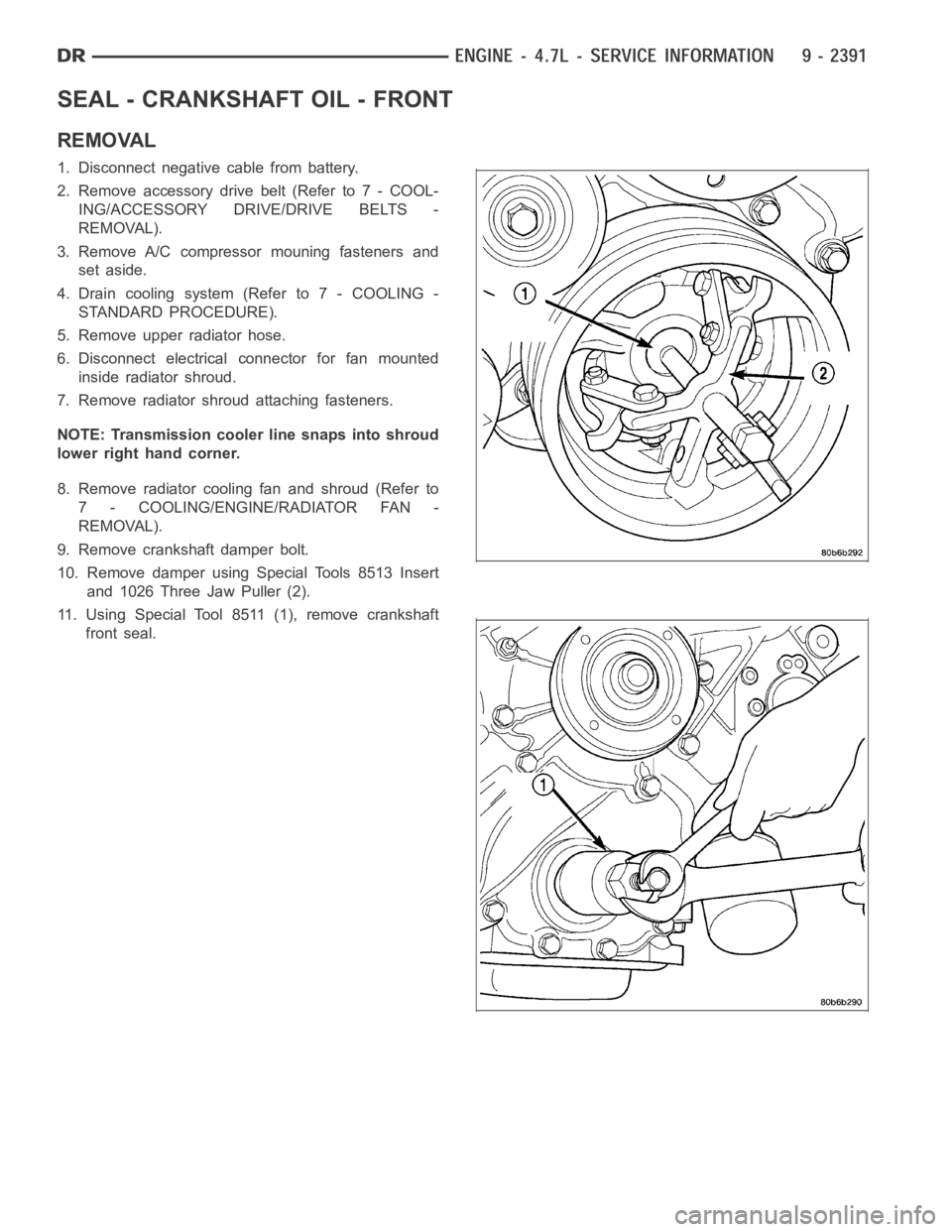
10. Remove damper using Special Tools 8513 Insert
and 1026 Three Jaw Puller (2).
11. Using Special Tool 8511 (1), remove crankshaft
front seal.
Page 1703 of 5267
INSTALLATION
1. Lubricate the crankshaft flange with engine oil.
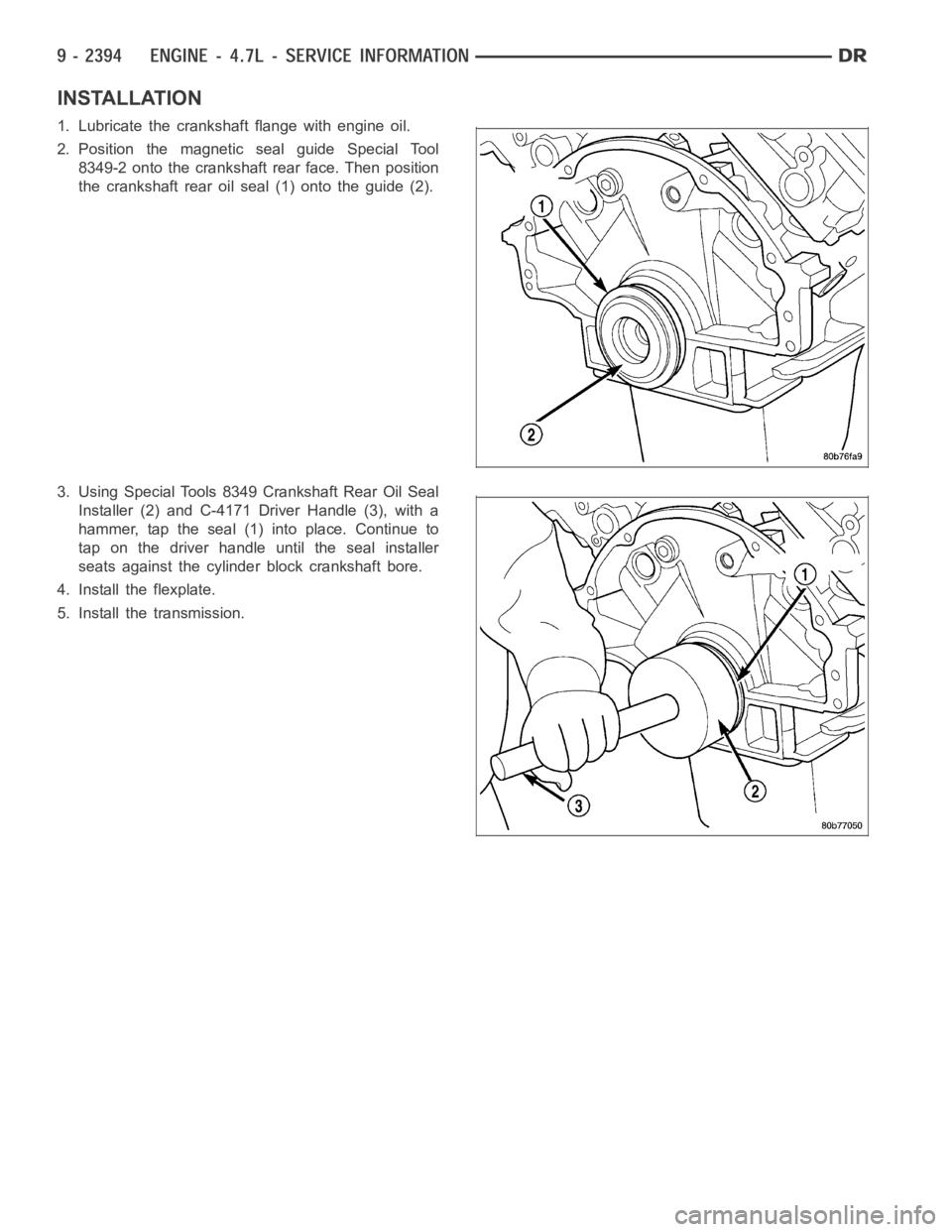
2. Position the magnetic seal guide Special Tool
8349-2 onto the crankshaft rear face. Then position
the crankshaft rear oil seal (1) onto the guide (2).
3. Using Special Tools 8349 Crankshaft Rear Oil Seal
Installer (2) and C-4171 Driver Handle (3), with a
hammer, tap the seal (1) into place. Continue to
tap on the driver handle until the seal installer
seats against the cylinder block crankshaft bore.
4. Install the flexplate.
5. Install the transmission.
Page 1704 of 5267
FLEX PLATE
REMOVAL
1. Remove the transmission. (Refer to 21 - TRANS-
MISSION/TRANSAXLE/AUTOMATIC - 45RFE/
545RFE - REMOVAL).
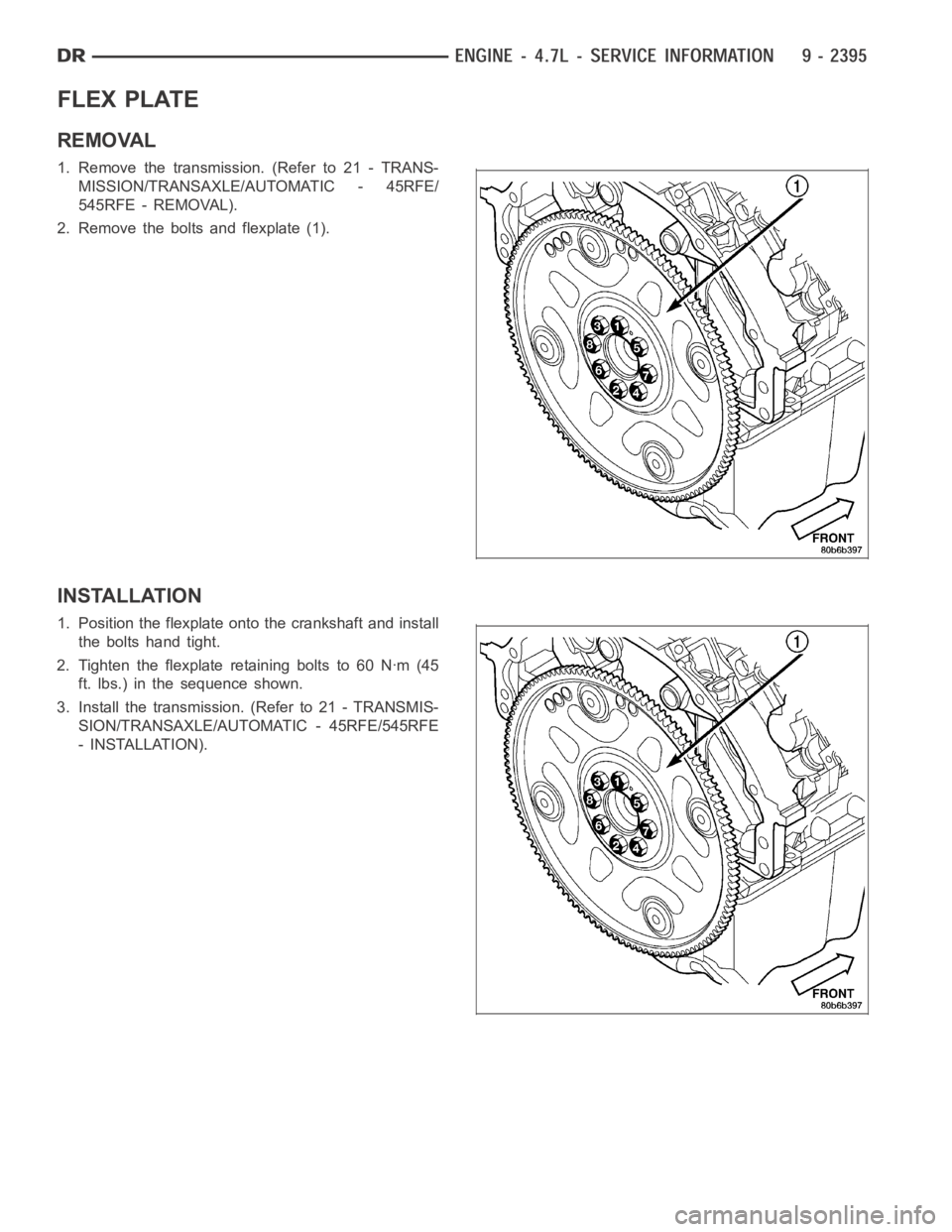
2. Remove the bolts and flexplate (1).
INSTALLATION
1. Position the flexplate ontothe crankshaft and install
the bolts hand tight.
2. Tighten the flexplate retaining bolts to 60 Nꞏm (45
ft. lbs.) in the sequence shown.
3. Install the transmission. (Refer to 21 - TRANSMIS-
SION/TRANSAXLE/AUTOMATIC - 45RFE/545RFE
- INSTALLATION).
Page 1712 of 5267
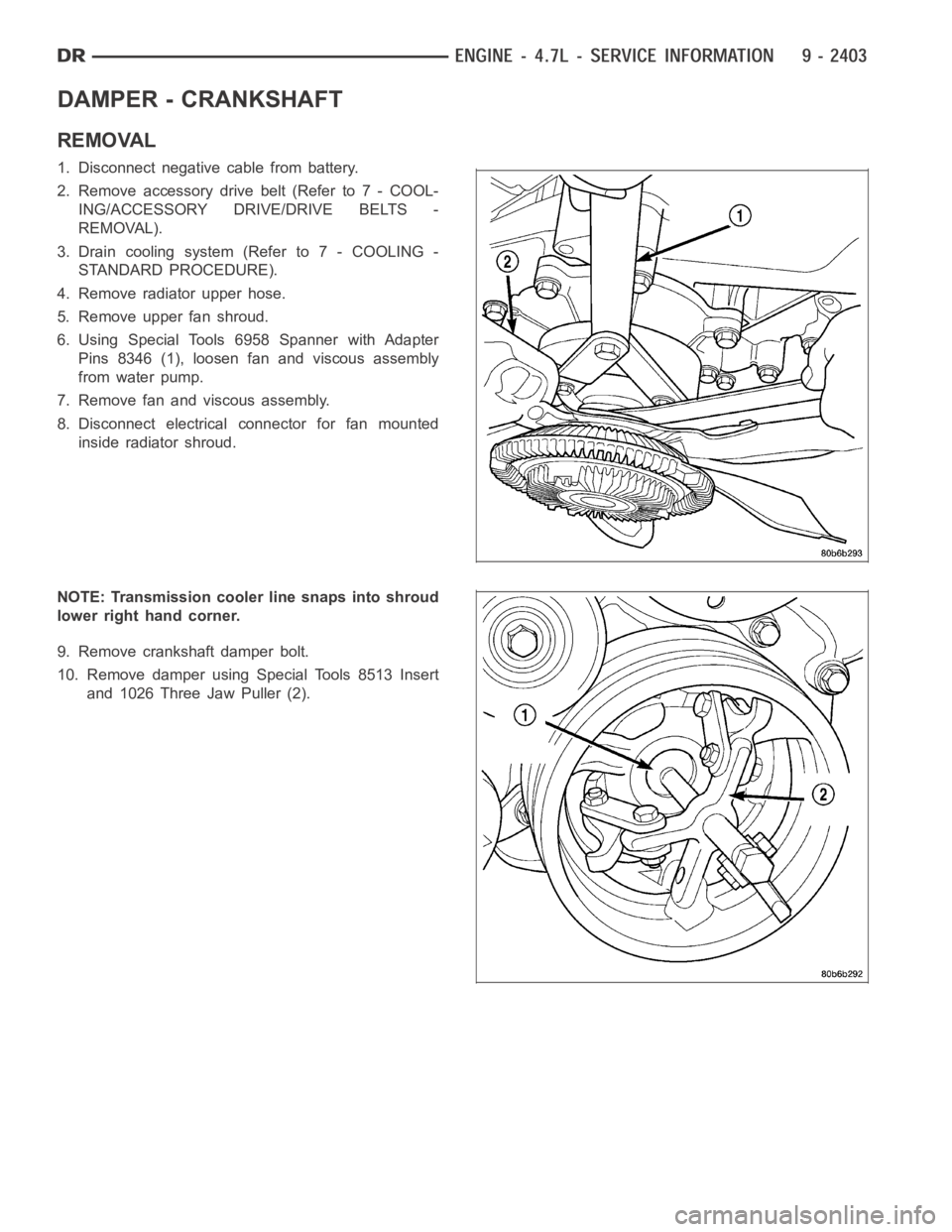
DAMPER - CRANKSHAFT
REMOVAL
1. Disconnect negative cable from battery.
2. Remove accessory drive belt (Refer to 7 - COOL-
ING/ACCESSORY DRIVE/DRIVE BELTS -
REMOVAL).
3. Drain cooling system (Refer to 7 - COOLING -
STANDARD PROCEDURE).
4. Remove radiator upper hose.
5. Remove upper fan shroud.
6. Using Special Tools 6958 Spanner with Adapter
Pins 8346 (1), loosen fan and viscous assembly
from water pump.
7. Remove fan and viscous assembly.
8. Disconnect electrical connector for fan mounted
inside radiator shroud.
NOTE: Transmission cooler line snaps into shroud
lower right hand corner.
9. Remove crankshaft damper bolt.
10. Remove damper using Special Tools 8513 Insert
and 1026 Three Jaw Puller (2).
Page 1714 of 5267
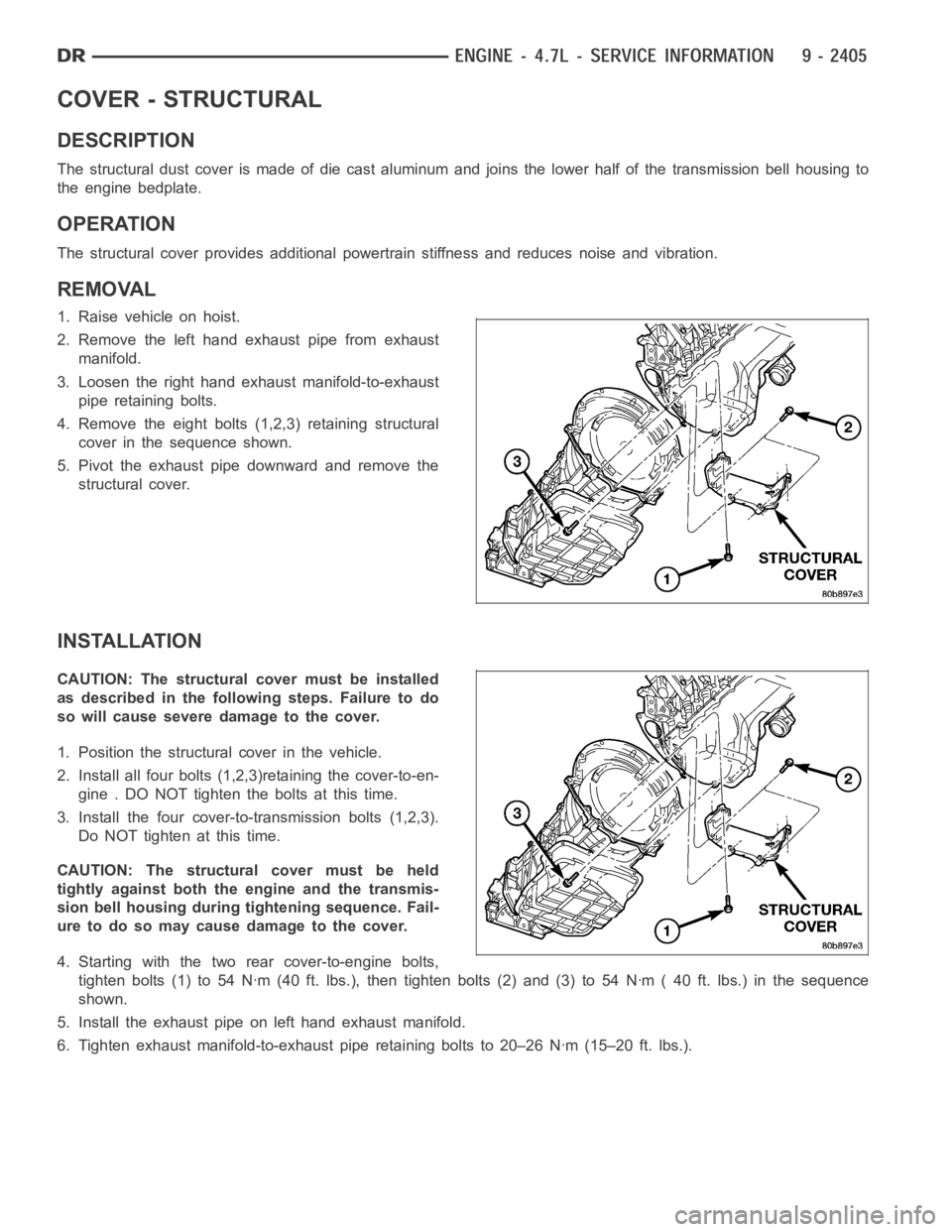
COVER - STRUCTURAL
DESCRIPTION
The structural dust cover is made of die cast aluminum and joins the lower half of the transmission bell housing to
the engine bedplate.
OPERATION
The structural cover provides additional powertrain stiffness and reduces noise and vibration.
REMOVAL
1. Raise vehicle on hoist.
2. Remove the left hand exhaust pipe from exhaust
manifold.
3. Loosen the right hand exhaust manifold-to-exhaust
pipe retaining bolts.
4. Remove the eight bolts (1,2,3) retaining structural
cover in the sequence shown.
5. Pivot the exhaust pipe downward and remove the
structural cover.
INSTALLATION
CAUTION: The structural cover must be installed
as described in the following steps. Failure to do
so will cause severe damage to the cover.
1. Position the structural cover in the vehicle.
2. Install all four bolts (1,2,3)retaining the cover-to-en-
gine . DO NOT tighten the bolts at this time.
3. Install the four cover-to-transmission bolts (1,2,3).
Do NOT tighten at this time.
CAUTION: The structural cover must be held
tightly against both the engine and the transmis-
sion bell housing during tightening sequence. Fail-
ure to do so may cause damage to the cover.
4. Starting with the two rearcover-to-engine bolts,
tighten bolts (1) to 54 Nꞏm (40 ft. lbs.), then tighten bolts (2) and (3) to 54Nꞏm ( 40 ft. lbs.) in the sequence
shown.
5. Install the exhaust pipe on left hand exhaust manifold.
6. Tighten exhaust manifold-to-exhaust pipe retaining bolts to 20–26 Nꞏm(15–20 ft. lbs.).
Page 1719 of 5267
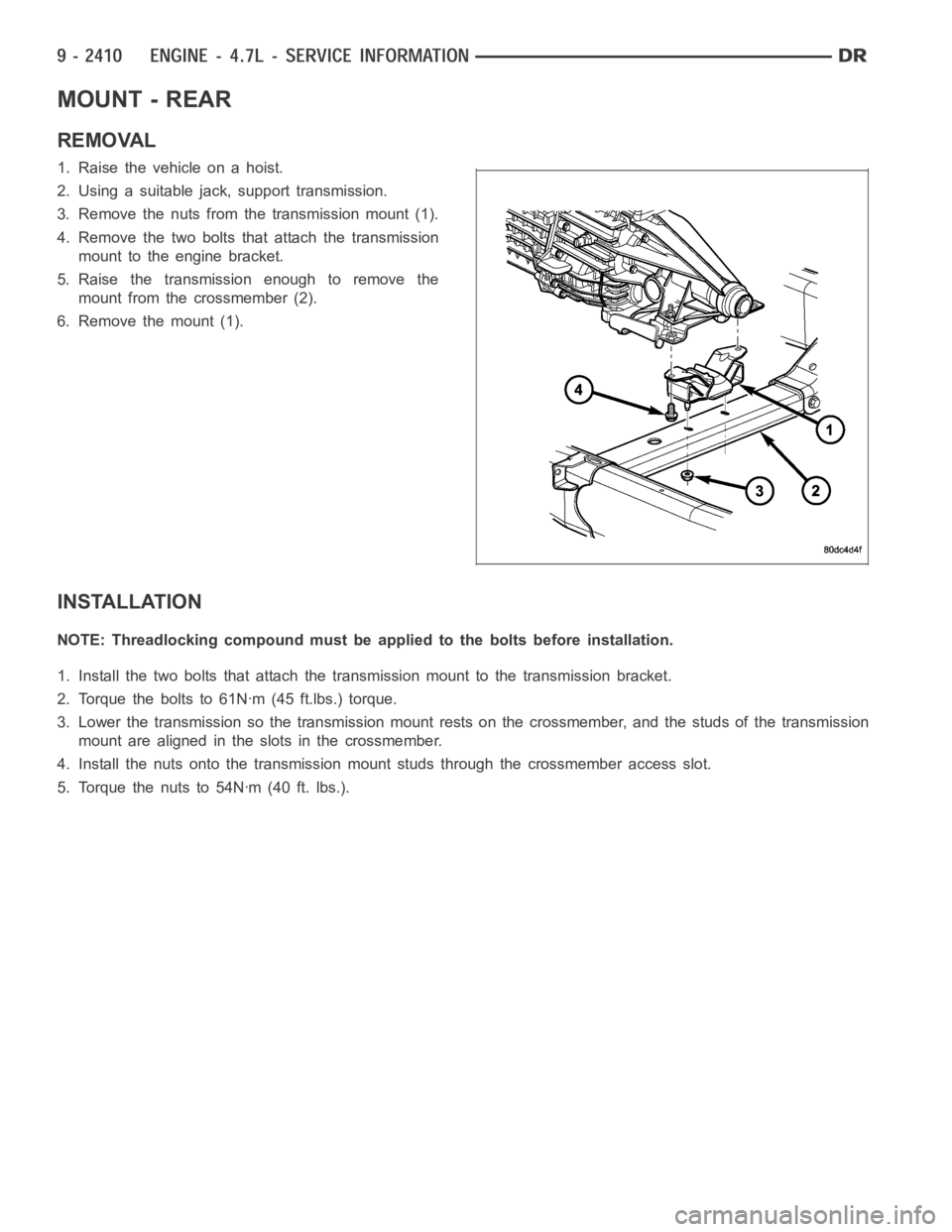
MOUNT - REAR
REMOVAL
1. Raise the vehicle on a hoist.
2. Using a suitable jack, support transmission.
3. Remove the nuts from the transmission mount (1).
4. Remove the two bolts that attach the transmission
mount to the engine bracket.
5. Raise the transmission enough to remove the
mount from the crossmember (2).
6. Remove the mount (1).
INSTALLATION
NOTE: Threadlocking compound must be applied to the bolts before installation.
1. Install the two bolts that attach the transmission mount to the transmission bracket.
2. Torque the bolts to 61Nꞏm (45 ft.lbs.) torque.
3. Lower the transmission so the transmission mount rests on the crossmember, and the studs of the transmission
mount are aligned in the slots in the crossmember.
4. Install the nuts onto the transmission mount studs through the crossmember access slot.
5. Torque the nuts to 54Nꞏm (40 ft. lbs.).
Page 1768 of 5267
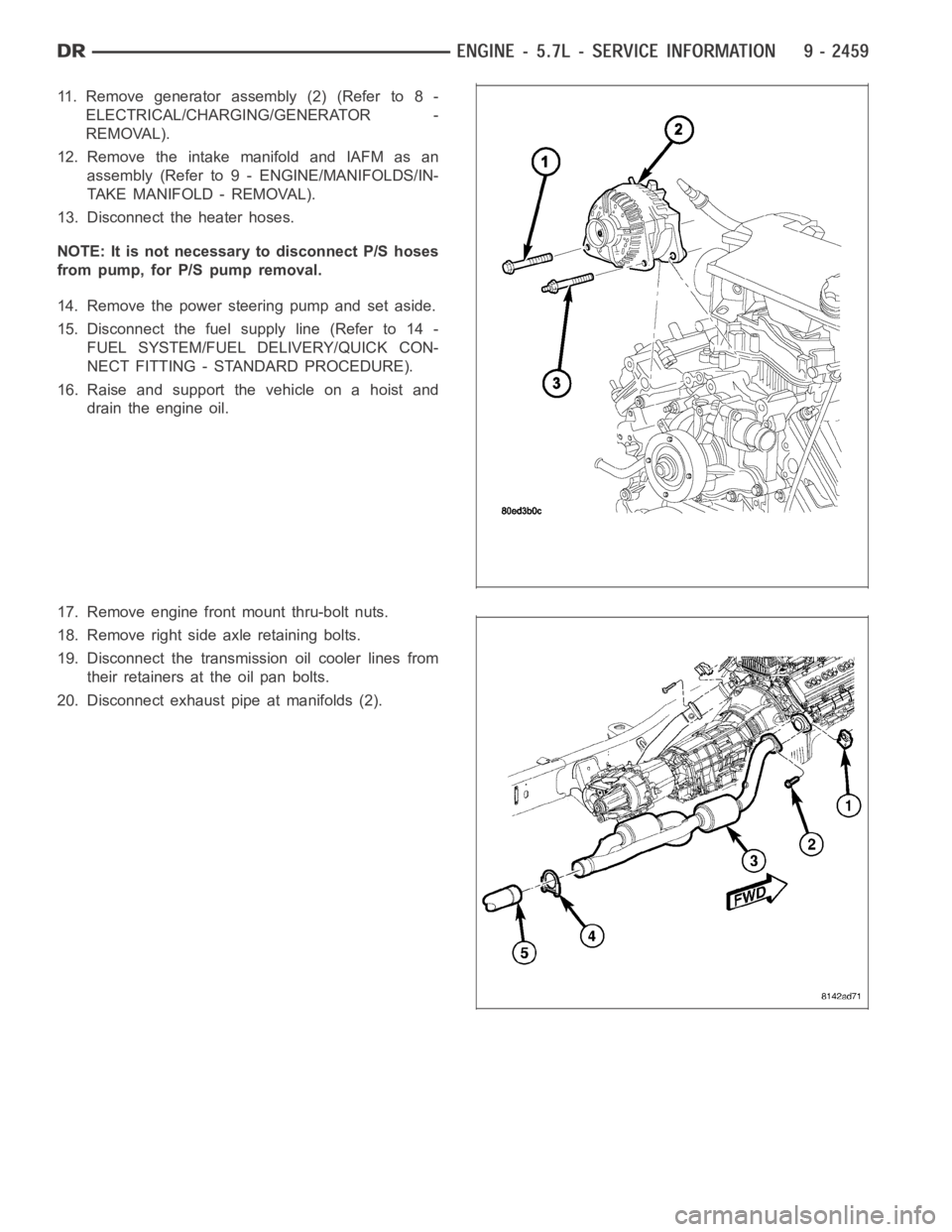
11. Remove generator assembly (2) (Refer to 8 -
ELECTRICAL/CHARGING/GENERATOR -
REMOVAL).
12. Remove the intake manifold and IAFM as an
assembly (Refer to 9 - ENGINE/MANIFOLDS/IN-
TAKE MANIFOLD - REMOVAL).
13. Disconnect the heater hoses.
NOTE: It is not necessary to disconnect P/S hoses
from pump, for P/S pump removal.
14. Remove the power steering pump and set aside.
15. Disconnect the fuel supply line (Refer to 14 -
FUEL SYSTEM/FUEL DELIVERY/QUICK CON-
NECT FITTING - STANDARD PROCEDURE).
16. Raise and support the vehicle on a hoist and
drain the engine oil.
17. Remove engine front mount thru-bolt nuts.
18. Remove right side axle retaining bolts.
19. Disconnect the transmission oil cooler lines from
their retainers at the oil pan bolts.
20. Disconnect exhaust pipe at manifolds (2).
Page 1769 of 5267
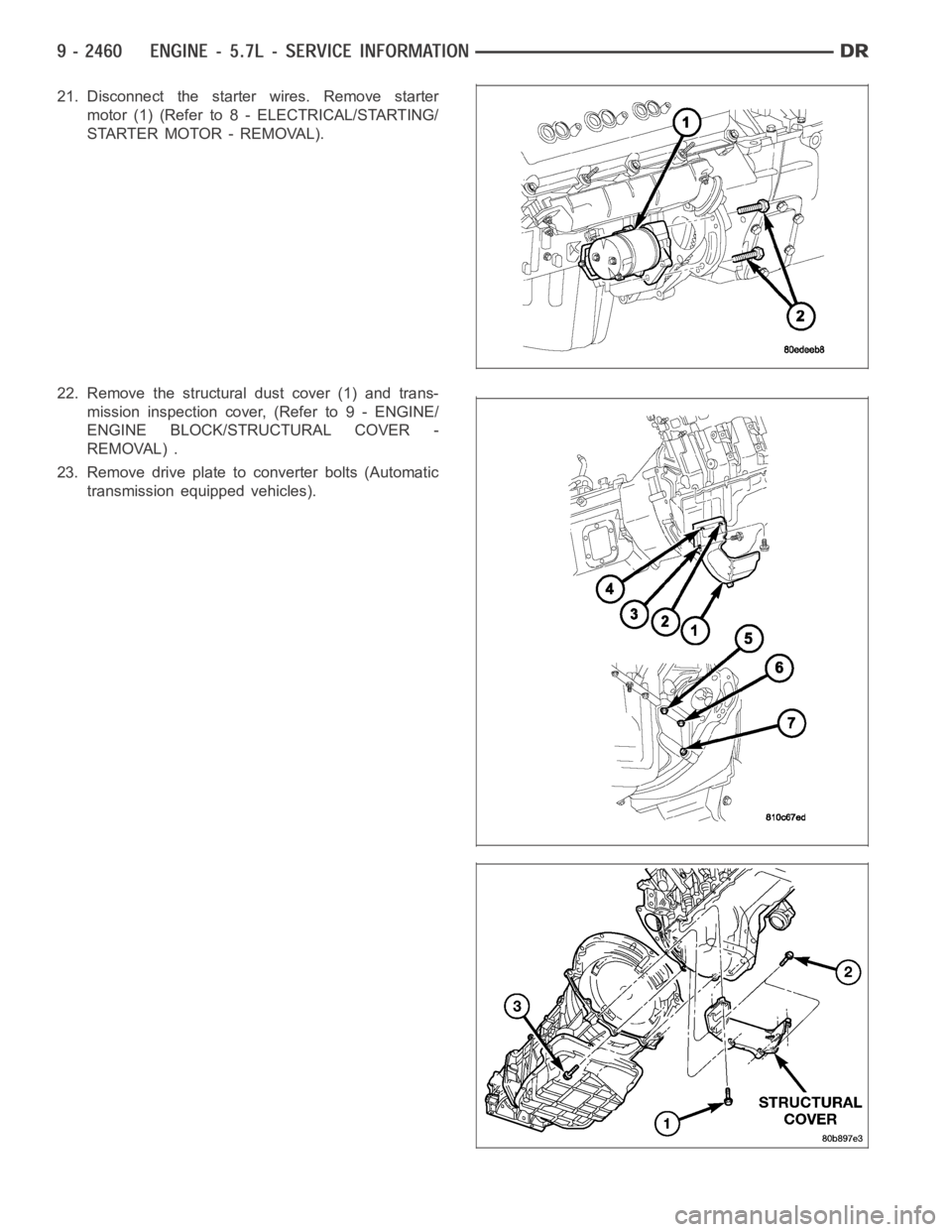
21. Disconnect the starter wires. Remove starter
motor (1) (Refer to 8 - ELECTRICAL/STARTING/
STARTER MOTOR - REMOVAL).
22. Remove the structural dust cover (1) and trans-
mission inspection cover, (Refer to 9 - ENGINE/
ENGINE BLOCK/STRUCTURAL COVER -
REMOVAL) .
23. Remove drive plate to converter bolts (Automatic
transmission equipped vehicles).
Page 1770 of 5267
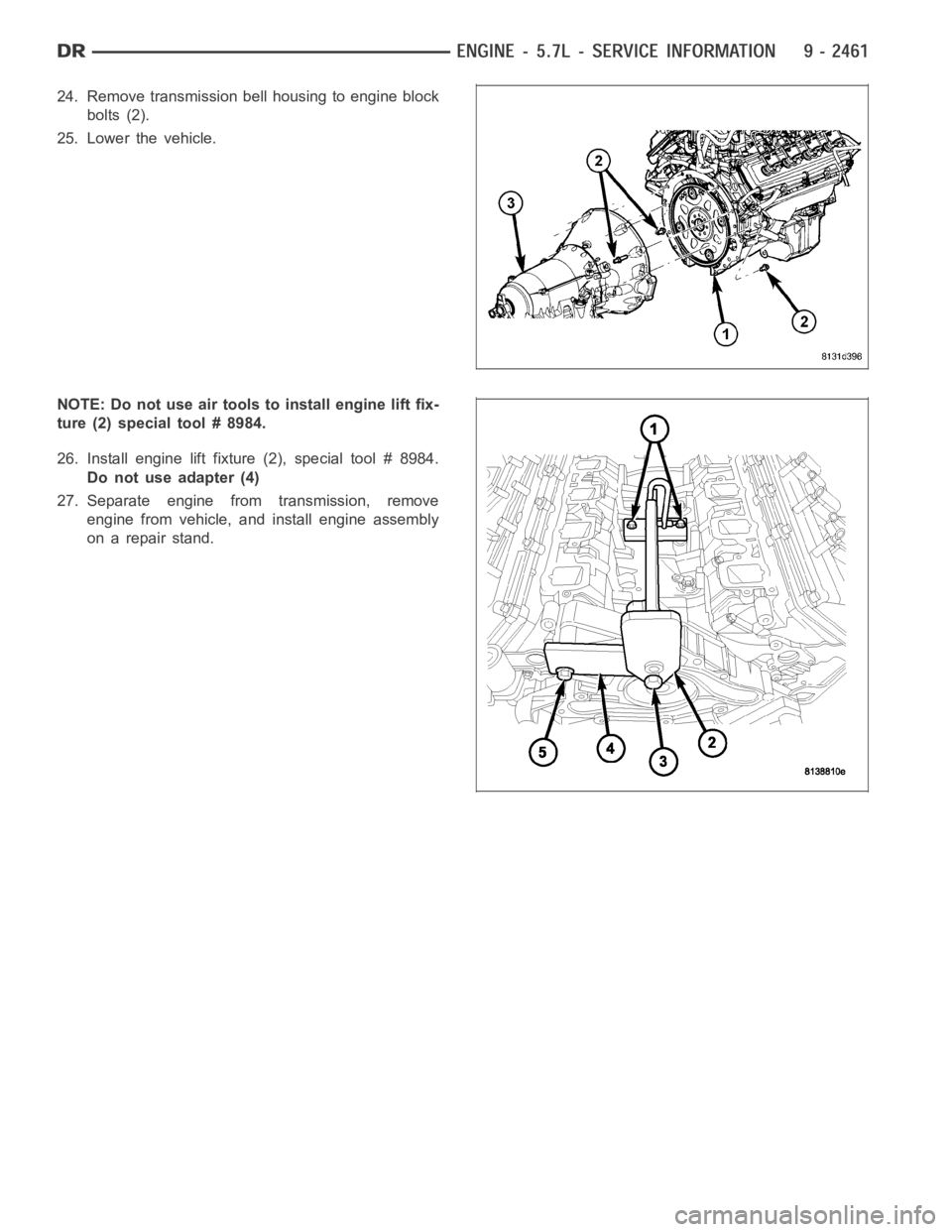
24. Remove transmission bell housing to engine block
bolts (2).
25. Lower the vehicle.
NOTE: Do not use air tools to install engine lift fix-
ture (2) special tool # 8984.
26. Install engine lift fixture (2), special tool # 8984.
Do not use adapter (4)
27. Separate engine from transmission, remove
engine from vehicle, and install engine assembly
on a repair stand.