check engine DODGE RAM SRT-10 2006 Service Repair Manual
[x] Cancel search | Manufacturer: DODGE, Model Year: 2006, Model line: RAM SRT-10, Model: DODGE RAM SRT-10 2006Pages: 5267, PDF Size: 68.7 MB
Page 2298 of 5267
RELAY - FUEL PUMP
DESCRIPTION
The 5–pin, 12–volt, fuel pump relay is located in the Power Distribution Center (PDC). Refer to the label on the PDC
cover for relay location.
OPERATION
The Powertrain Control Module (PCM) energizes the electric fuel pump through the fuel pump relay. The fuel pump
relay is energized by first applying battery voltage to it when the ignition key is turned ON, and then applying a
ground signal to the relay from the PCM.
Whenever the ignition key is turned ON, the electric fuel pump will operate. But, the PCM will shut-down the ground
circuit to the fuel pump relay in approximately 1–3 seconds unless the engine is operating or the starter motor is
engaged.
REMOVAL
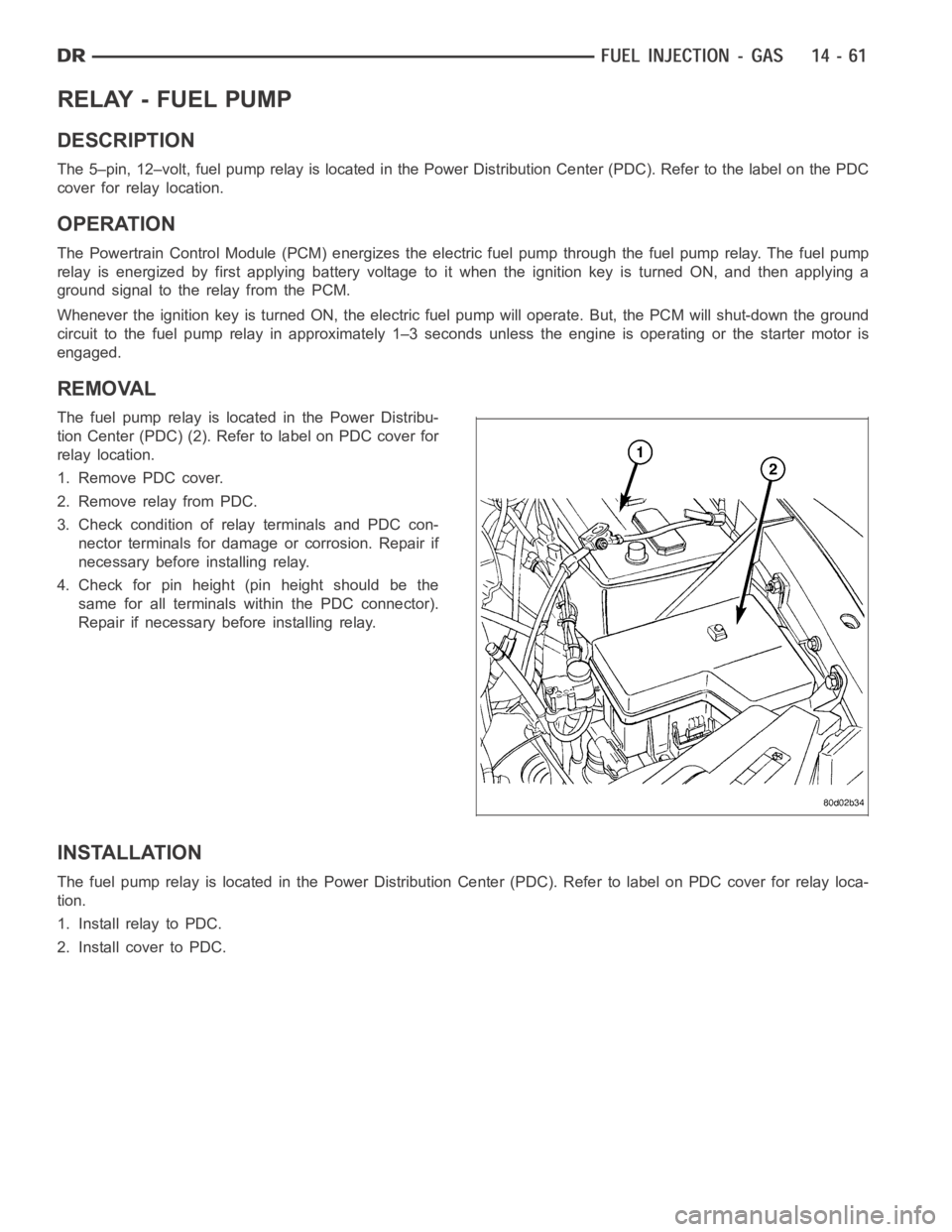
The fuel pump relay is located in the Power Distribu-
tion Center (PDC) (2). Refer to label on PDC cover for
relay location.
1. Remove PDC cover.
2. Remove relay from PDC.
3. Check condition of relay terminals and PDC con-
nector terminals for damage or corrosion. Repair if
necessary before installing relay.
4. Check for pin height (pin height should be the
same for all terminals within the PDC connector).
Repair if necessary before installing relay.
INSTALLATION
The fuel pump relay is located in the Power Distribution Center (PDC). Refer to label on PDC cover for relay loca-
tion.
1. Install relay to PDC.
2. Install cover to PDC.
Page 2326 of 5267
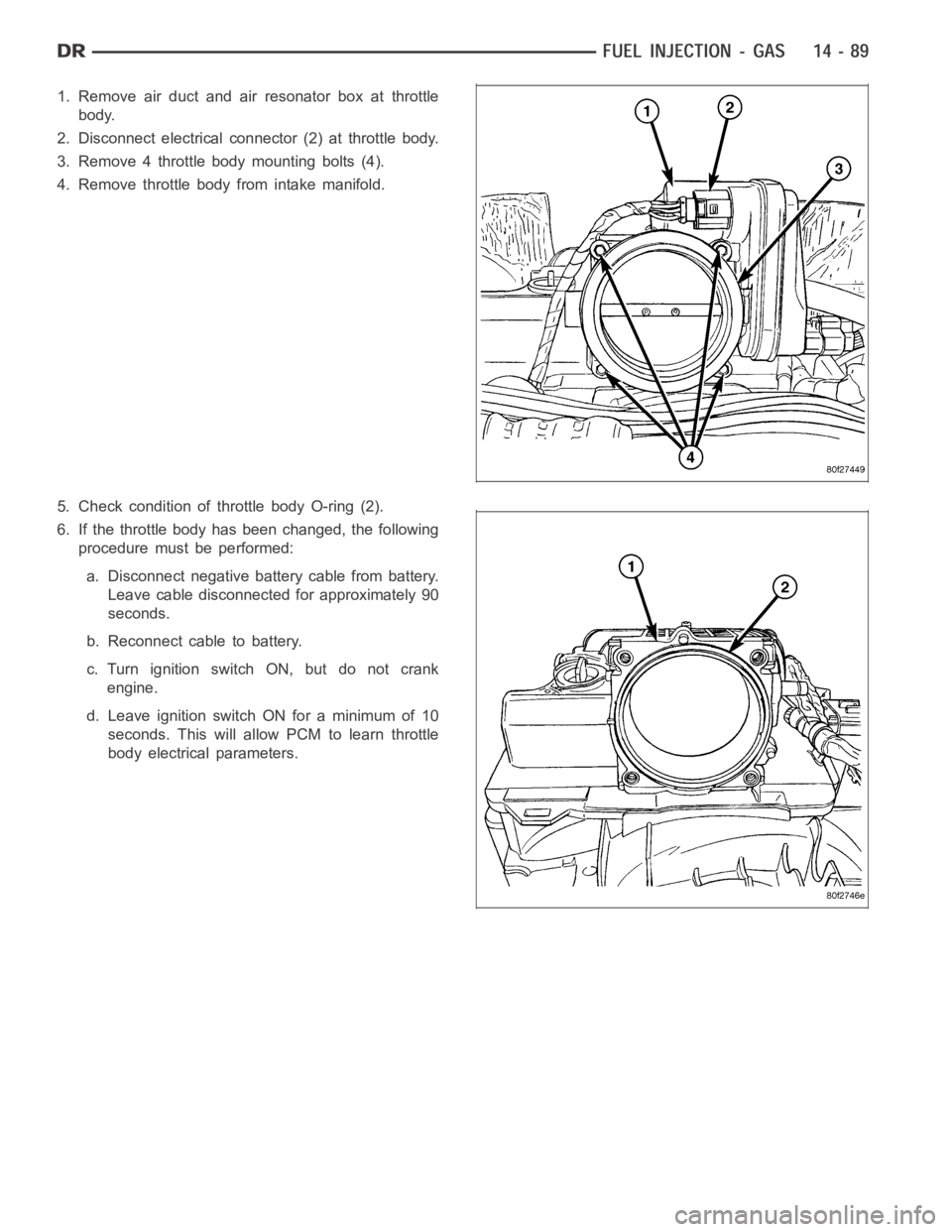
1. Remove air duct and air resonator box at throttle
body.
2. Disconnect electrical connector (2) at throttle body.
3. Remove 4 throttle body mounting bolts (4).
4. Remove throttle body from intake manifold.
5. Check condition of throttle body O-ring (2).
6. If the throttle body has been changed, the following
procedure must be performed:
a. Disconnect negative battery cable from battery.
Leave cable disconnected for approximately 90
seconds.
b. Reconnect cable to battery.
c. Turn ignition switch ON, but do not crank
engine.
d. Leave ignition switch ON for a minimum of 10
seconds. This will allow PCM to learn throttle
body electrical parameters.
Page 2334 of 5267
6. Remove cable housing at APPS bracket by pressing on release tab with a small screwdriver.To prevent cable
housing breakage, press on tab only enough to release cable from APPS bracket.
INSTALLATION
3.7L V-6
1. Slide accelerator cable plastic mount into throttle body mounting bracket. Continue sliding until release tab is
aligned to hole in mounting bracket.
2. Hold throttle in wide open position. While held in this position, slide throttle cable pin into throttle body bellcrank.
3. Push cable housing into rubber grommet and through opening in dash panel.
4. From inside vehicle, install metal clip holding cable to dashpanel.
5. From inside vehicle, slide throttle cable core wire into opening (slot)in top of pedal arm.
6. Push plastic cable retainer (clip) into pedal arm opening until it snapsin place.
7. Install air resonator tube to throttle body.
8. Before starting engine, operate accelerator pedal to check for any binding.
4.7L V-8
1. Slide accelerator cable plastic mount into bracket. Continue sliding until tab is aligned to hole in mounting
bracket.
2. Route accelerator cable over top of cable cam.
3. Connect cable end to throttle body bellcrank pin (snaps on rearward).
4. Slide rubber grommet away from plastic cable housing.
5. Install rubber grommet into dash panel until seated.
6. Push cable housing into rubber grommet and through opening in dash panel.
7. From inside vehicle, install clip holding cable to dashpanel.
8. From inside vehicle, slide throttle cable core wire into opening in top of pedal arm.
9. Push cable retainer (clip) into pedal arm opening until it snaps in place.
10. Snap cable into dashpanel routing clip.
11. Install air resonator tube to throttle body.
12. Before starting engine, operate accelerator pedal to check for any binding.
5.7L V-8
1. Attach cable to Accelerator Pedal Position Sensor (APPS). Refer to APPSRemoval / Installation.
2. Push cable housing into rubber grommet and through opening in dash panel.
3. From inside vehicle, install clip holding cable to dashpanel.
4. From inside vehicle, slide throttle cable core wire into opening in top of pedal arm.
5. Push cable retainer (clip) into pedal arm opening until it snaps in place.
6. Before starting engine, operate accelerator pedal to check for any binding.
7. If necessary, use DRB III
Scan Tool to erase any APPS Diagnostic Trouble Codes (DTC’s) from PCM.
Page 2338 of 5267
INSTALLATION
3.7L V-6
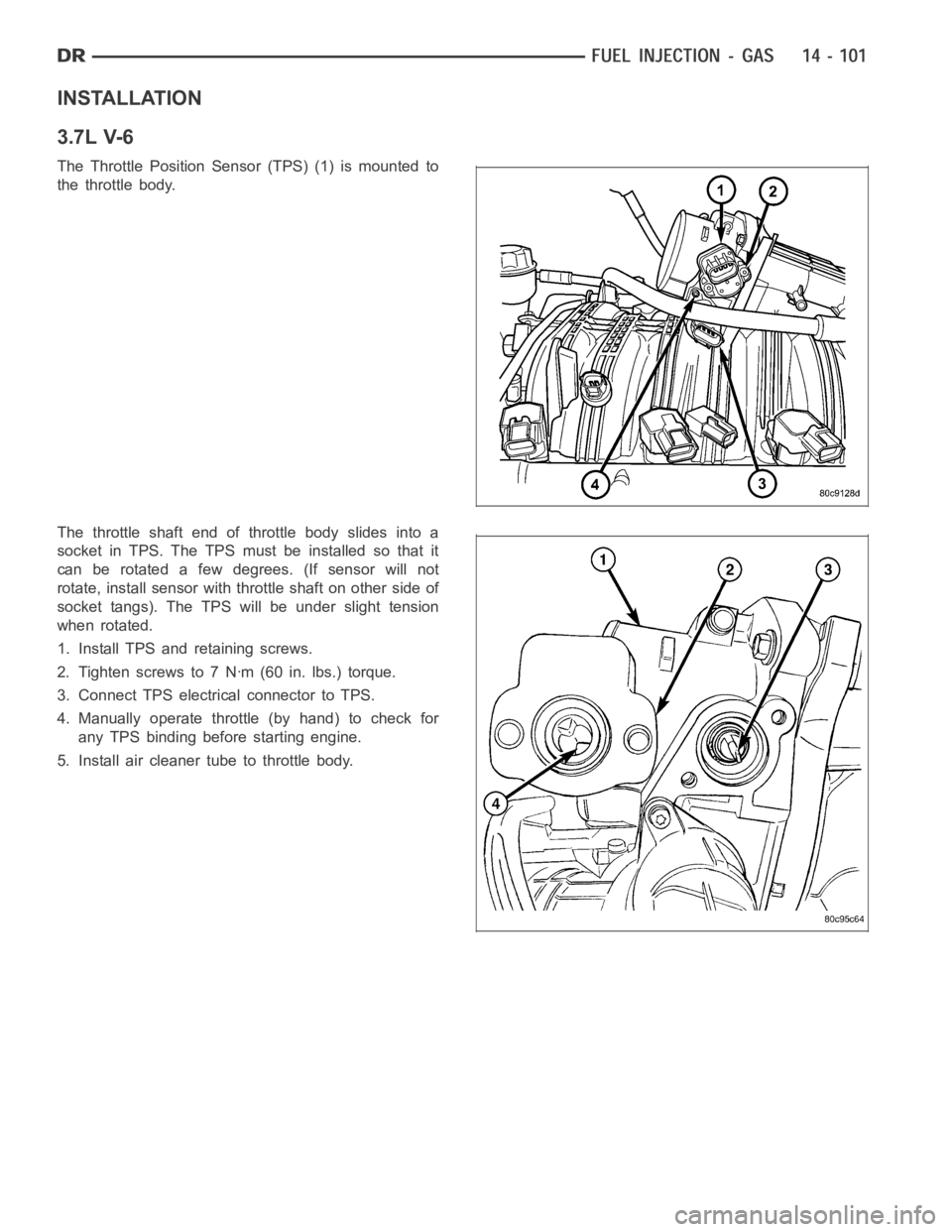
The Throttle Position Sensor (TPS) (1) is mounted to
the throttle body.
The throttle shaft end of throttle body slides into a
socket in TPS. The TPS must be installed so that it
can be rotated a few degrees. (If sensor will not
rotate, install sensor with throttle shaft on other side of
socket tangs). The TPS will be under slight tension
when rotated.
1. Install TPS and retaining screws.
2. Tighten screws to 7 Nꞏm (60 in. lbs.) torque.
3. Connect TPS electrical connector to TPS.
4. Manually operate throttle (by hand) to check for
any TPS binding before starting engine.
5. Install air cleaner tube to throttle body.
Page 2342 of 5267
FUEL DELIVERY - DIESEL
DESCRIPTION - DIESEL FUEL SYSTEM
WARNING: High-pressure fuel lines deliver diesel
fuel under extreme pressure from the injection
pump to the fuel injectors. This may be as high as
160,000 kpa (23,206 psi). Use extreme caution
when inspecting for high-pressure fuel leaks.
Inspect for high-pressure fuel leaks with a sheet of
cardboard. High fuel injection pressure can cause
personal injury if contact is made with the skin.
The fuel system used on the Cummins engine is an electronically controlled, Bosch HPCR (High-Pressure Common
Rail) system. The HPCR system consists of five main components:
Electric Fuel Transfer (lift) Pump Located in the Fuel Tank
Fuel Pump/Gear Pump (attached to fuel injection pump)
High-Pressure Fuel Injection Pump
Fuel Injection Rail
Fuel Injectors
Also to be considered as part of the overall fuel system are:
Accelerator Pedal
Air Cleaner Housing/Element
Check Valve Banjo Fitting at Rear of Cylinder Head
Fuel Connector Tubes
Fuel Drain Manifold (passage)
Fuel Drain Valve (at filter)
Fuel Filter/Water Separator
Fuel Heater
Fuel Heater Relay
Fuel Transfer Pump Relay
Fuel Level (gauge) Sending Unit
Fuel Pressure Limiting Valve
Fuel Tank
Fuel Tank Module (containing a fuel gauge sending unit, separate fuel filter located at bottom of tank module,
and fuel transfer pump)
Fuel Tank Filler/Vent Tube Assembly
Fuel Tank Filler Tube Cap
Fuel Tubes/Lines/Hoses
High-Pressure Fuel Injector Lines
In-Tank Fuel Filter (at bottom of fuel tank module)
Low-Pressure Fuel Supply Lines
Low-Pressure Fuel Return Lines
Overflow Valve
Quick-Connect Fuel Line Fittings
Accelerator Pedal Position Sensor (APPS) Located in Cab
Water Draining (maintenance)
Water-In-Fuel (WIF) Sensor
Screened Banjo Bolt (22)
The fuel injection pump supplies high pressure to the fuel rail independent of engine speed. This high pressure fuel
is then accumulated in the fuel rail. High pressure fuel is constantly supplied to the injectors by the fuel rail. The
Engine Control Module (ECM) controls the fueling and timing of the engine by actuating the injectors.
Page 2344 of 5267
WARNING: The fuel injection pump supplies extremely high fuel pressure toeach individual injector
through the high-pressure lines. Fuel under this amount of pressure can penetrate the skin and cause per-
sonal injury. Wear safety goggles and adequate protective clothing. Do not loosen fuel fittings while engine
is running.
WARNING: Engine may start while cranking starter motor.
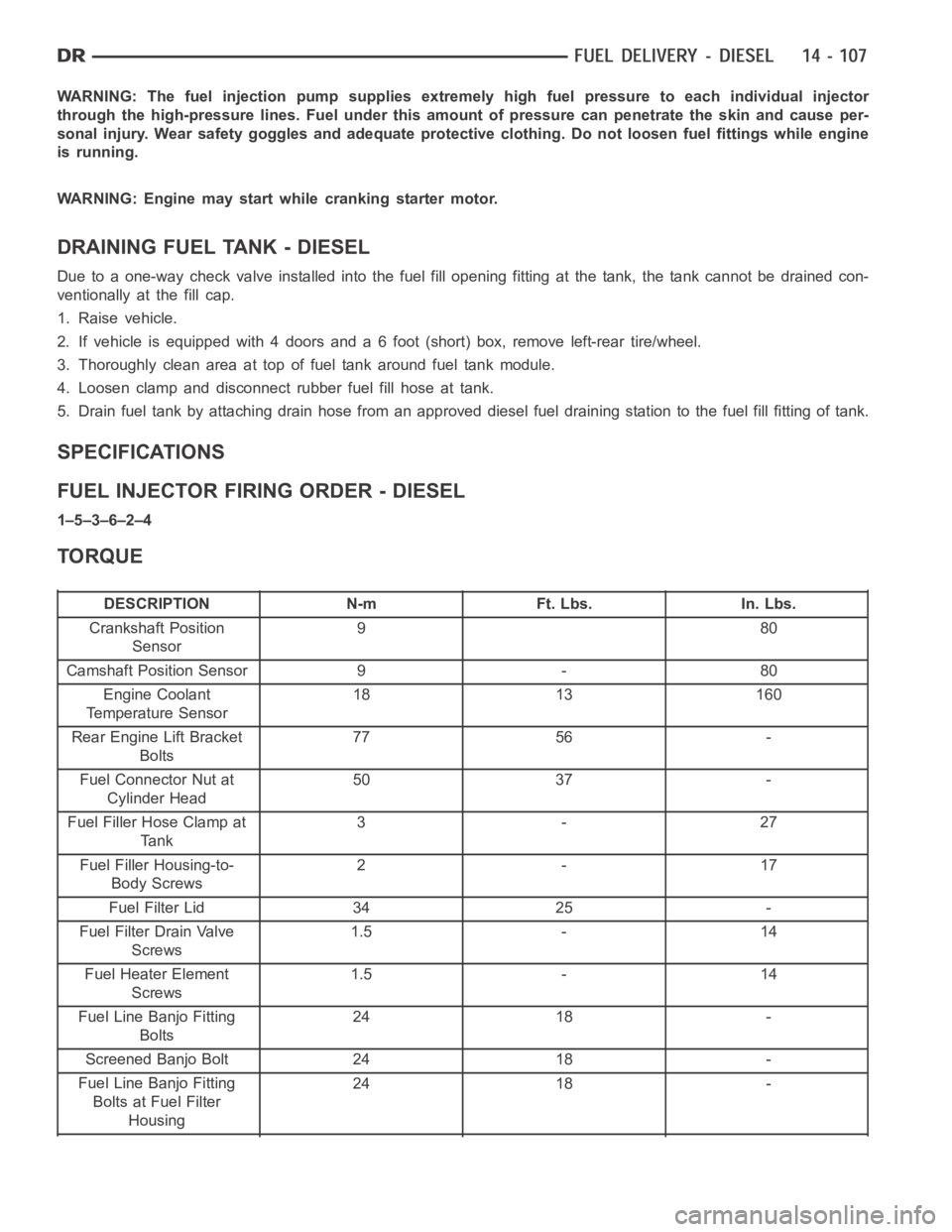
DRAINING FUEL TANK - DIESEL
Due to a one-way check valve installed into the fuel fill opening fitting atthe tank, the tank cannot be drained con-
ventionally at the fill cap.
1. Raise vehicle.
2. If vehicle is equipped with 4 doors and a 6 foot (short) box, remove left-rear tire/wheel.
3. Thoroughly clean area at top of fuel tank around fuel tank module.
4. Loosen clamp and disconnect rubber fuel fill hose at tank.
5. Drain fuel tank by attaching drain hose from an approved diesel fuel draining station to the fuel fill fitting of tank.
SPECIFICATIONS
FUEL INJECTOR FIRING ORDER - DIESEL
1–5–3–6–2–4
TORQUE
DESCRIPTION N-m Ft. Lbs. In. Lbs.
Crankshaft Position
Sensor980
Camshaft Position Sensor 9 - 80
Engine Coolant
Temperature Sensor18 13 160
Rear Engine Lift Bracket
Bolts77 56 -
Fuel Connector Nut at
Cylinder Head50 37 -
Fuel Filler Hose Clamp at
Ta n k3-27
Fuel Filler Housing-to-
Body Screws2-17
Fuel Filter Lid 34 25 -
Fuel Filter Drain Valve
Screws1.5 - 14
Fuel Heater Element
Screws1.5 - 14
Fuel Line Banjo Fitting
Bolts24 18 -
Screened Banjo Bolt 24 18 -
Fuel Line Banjo Fitting
Bolts at Fuel Filter
Housing24 18 -
Page 2348 of 5267
FILTER - FUEL / WATER SEPARATOR
DESCRIPTION
The fuel filter/water separator assembly is located on left side of engineabove the starter motor. The assembly also
includes the fuel heater, Water-In-Fuel (WIF) sensor and a screened banjobolt attached at the bottom of the fuel
filter canister.
OPERATION
The fuel filter/water separator protects the fuel injection pump by removing water and contaminants from the fuel.
The construction of the filter/separator allows fuel to pass through it, but helps prevent moisture (water) from doing
so. Moisture collects at the bottom of the canister.
Refer to the maintenance schedules in the owners manual for the recommended fuel filter replacement intervals.
For draining of water from canister, refer to Fuel Filter/Water SeparatorRemoval/Installation section.
There is a screened banjo bolt that is attached at the bottom of the fuel filter canister. It provides additional filtering
for the high pressure fuel system components.
A Water-In-Fuel (WIF) sensor is attached to the side of fuel filter housing. Refer to Water-In-Fuel Sensor Descrip-
tion/Operation.
The fuel heater is installed into the top of the filter/separator housing.Refer to Fuel Heater Description/Operation.
REMOVAL
Refer to maintenance schedules in this manual, or the
Owner’s Manual for recommended fuel filter replace-
ment intervals.
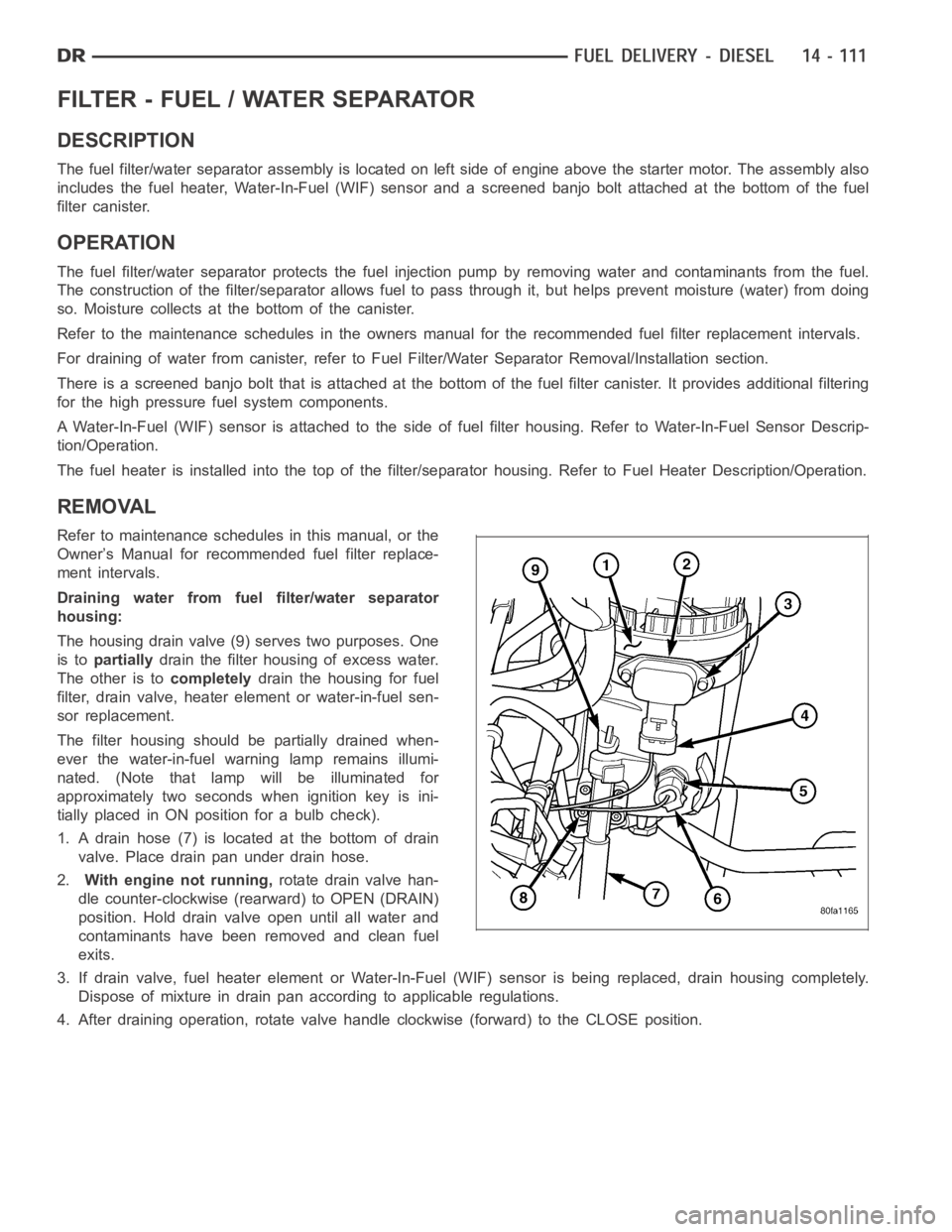
Draining water from fuel filter/water separator
housing:
The housing drain valve (9) serves two purposes. One
is topartiallydrain the filter housing of excess water.
The other is tocompletelydrain the housing for fuel
filter, drain valve, heater element or water-in-fuel sen-
sor replacement.
The filter housing should be partially drained when-
ever the water-in-fuel warning lamp remains illumi-
nated. (Note that lamp will be illuminated for
approximately two seconds when ignition key is ini-
tially placed in ON position for a bulb check).
1. A drain hose (7) is located at the bottom of drain
valve. Place drain pan under drain hose.
2.With engine not running,rotate drain valve han-
dle counter-clockwise (rearward) to OPEN (DRAIN)
position. Hold drain valve open until all water and
contaminants have been removed and clean fuel
exits.
3. If drain valve, fuel heater element or Water-In-Fuel (WIF) sensor is being replaced, drain housing completely.
Dispose of mixture in drain pan according to applicable regulations.
4. After draining operation, rotate valve handle clockwise (forward) to the CLOSE position.
Page 2351 of 5267
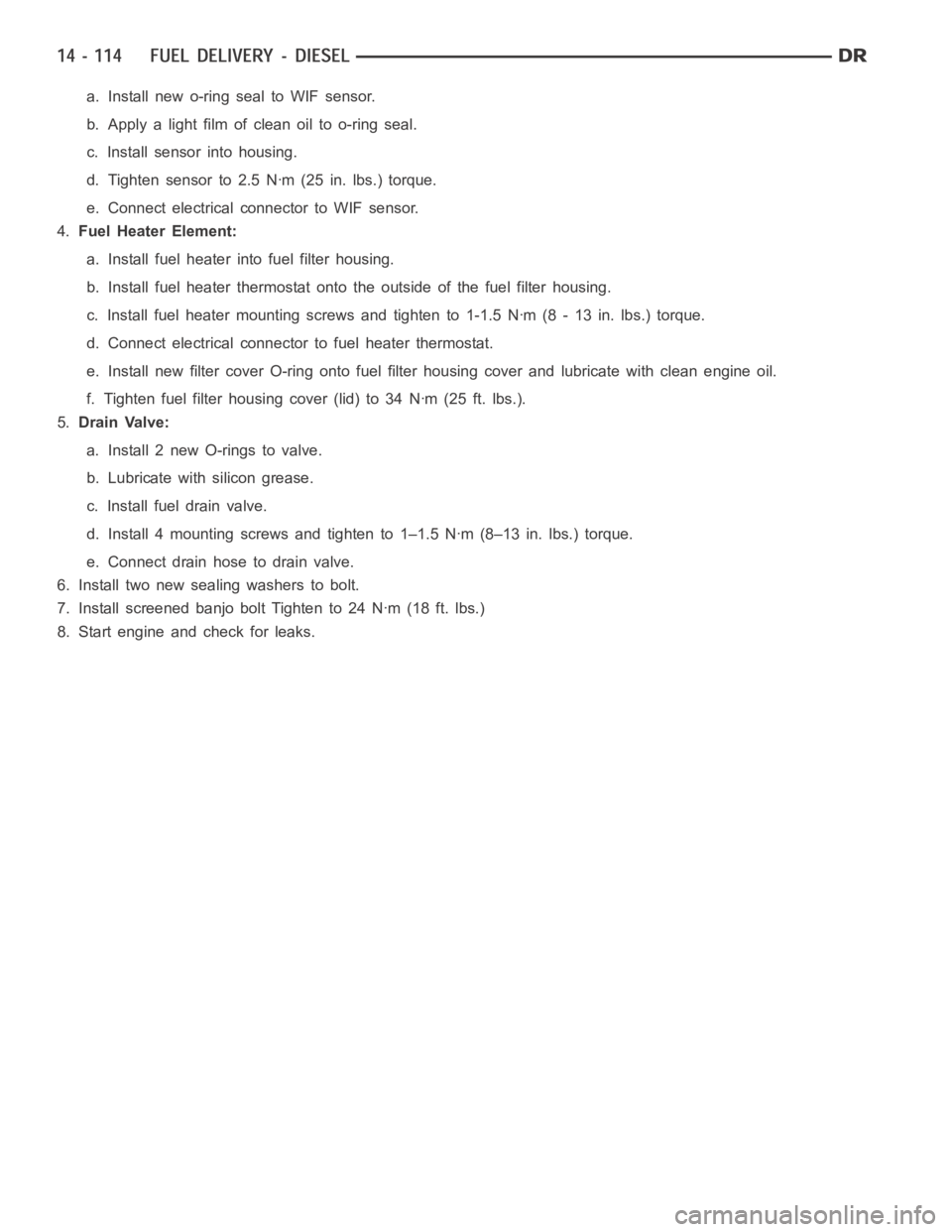
a. Install new o-ring seal to WIF sensor.
b. Apply a light film of clean oil to o-ring seal.
c. Install sensor into housing.
d. Tighten sensor to 2.5 Nꞏm (25 in. lbs.) torque.
e. Connect electrical connector to WIF sensor.
4.Fuel Heater Element:
a. Install fuel heater into fuel filter housing.
b. Install fuel heater thermostat onto the outside of the fuel filter housing.
c. Install fuel heater mounting screws and tighten to 1-1.5 Nꞏm (8 - 13 in. lbs.) torque.
d. Connect electrical connector to fuel heater thermostat.
e. Install new filter cover O-ring onto fuel filter housing cover and lubricate with clean engine oil.
f. Tighten fuel filter housing cover (lid) to 34 Nꞏm (25 ft. lbs.).
5.Drain Valve:
a. Install 2 new O-rings to valve.
b. Lubricate with silicon grease.
c. Installfueldrainvalve.
d. Install 4 mounting screws and tighten to 1–1.5 Nꞏm (8–13 in. lbs.) torque.
e. Connect drain hose to drain valve.
6. Install two new sealing washers to bolt.
7. Install screened banjo bolt Tighten to 24 Nꞏm (18 ft. lbs.)
8. Start engine and check for leaks.
Page 2352 of 5267
HEATER-FUEL
DESCRIPTION
The fuel heater assembly is located on the side of the fuel filter housing and internal to the fuel filter housing .
The heater/element assembly is equipped with a temperature sensor (thermostat) that senses fuel temperature. This
sensor is attached to the fuel heater/element assembly.
OPERATION
The fuel heater is used to prevent diesel fuel from waxing during cold weather operation.
When the fuel temperature is below 45° ±8 F (7°C), the temperature sensor allows current to flow to the heater
element warming the fuel. When the fuel temperature is above 75° ±8 F (24°C), the sensor stops current flow to the
heater element.
Battery voltage to operate the fuel heater element is supplied from the ignition switch and through a solid stated
device in the IPM.The fuel heater element and
solid state device in IPMinstead offuel heater relayare not
computer controlled.
The heater element operates on 12 volts, 300 watts at 0° F (-18° C).
DIAGNOSIS AND TESTING
FUEL HEATER
The fuel heater is used to prevent diesel fuel from waxing during cold weather operation.
NOTE: The fuel heater element,
solid state device in IPMinstead offuel heater relayand fuel heater tem-
perature sensor are not controlled by the Engine Control Module (ECM).
A malfunctioning fuel heater can cause a wax build-up in the fuel filter/water separator. Wax build-up in the filter/
separator can cause engine starting problems and prevent the engine from revving up. It can also cause blue or
white fog-like exhaust. If the heater is not operating in cold temperatures, the engine may not operate due to fuel
waxing.
The fuel heater assembly is located on the side of fuel filter housing and internal to the fuel filter housing.
The heater assembly is equipped with a built-in fuel temperature sensor (thermostat) that senses fuel temperature.
When fuel temperature drops below 45° ± 8° F (7° C), the sensor allows current to flow to built-in heater element
to warm fuel. When fuel temperature rises above 75 °± 8° F (24° C), the sensorstops current flow to heater ele-
ment (circuit is open).
Voltage to operate fuel heater element is supplied from ignition switch, through
solid state device in IPM,tofuel
temperature sensor and on to fuel heater element.
The heater element operates on 12 volts, 300 watts at 0 °F (-18° C). As temperature increases, power requirements
decrease.
A minimum of 7 volts is required to operate the fuel heater. The resistance value of the heater element is less than
1 ohm (cold) and up to 1000 ohms warm.
TESTING
1. Disconnect electrical connector from thermostat.
Ambient temperature must be below the circuit close temperature. If necessary, induce this ambient temperature by
placing ice packs on thermostat to produce an effective ambient temperature below circuit close temperature.
Measure resistance across two pins. Operating range is 0.3 - 0.45 Ohms.
2. If resistance is out of range, remove thermostat and check resistance across terminal connections of heater. The
heater can be checked at room temperature. Operating range is 0.3 - 0.45 Ohms.
3. Replace heater if resistance is not within operating range.
4. If heater is within operating range, replace heater thermostat.
Page 2360 of 5267
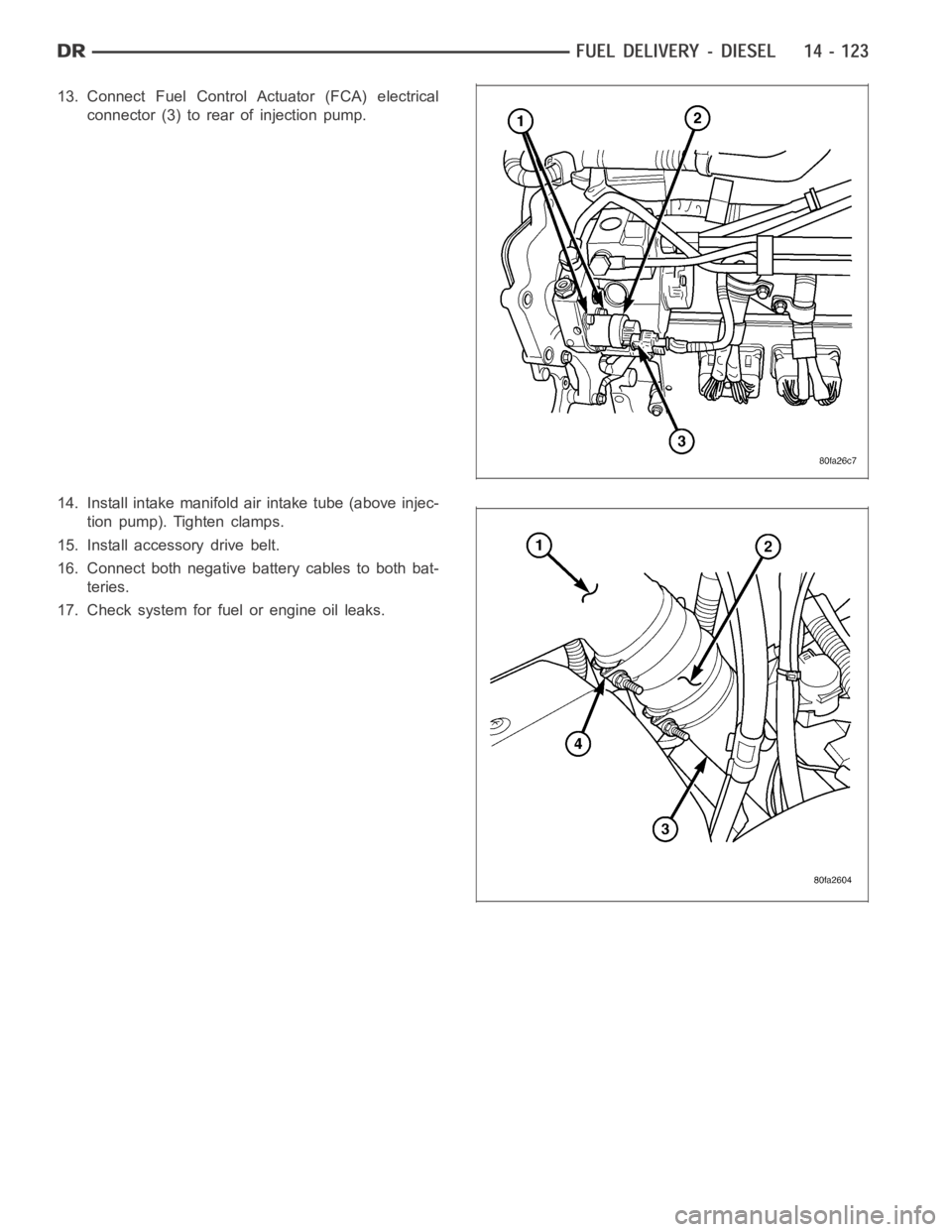
13. Connect Fuel Control Actuator (FCA) electrical
connector (3) to rear of injection pump.
14. Install intake manifold air intake tube (above injec-
tion pump). Tighten clamps.
15. Install accessory drive belt.
16. Connect both negative battery cables to both bat-
teries.
17. Check system for fuel or engine oil leaks.