change time DODGE RAM SRT-10 2006 Service Manual Online
[x] Cancel search | Manufacturer: DODGE, Model Year: 2006, Model line: RAM SRT-10, Model: DODGE RAM SRT-10 2006Pages: 5267, PDF Size: 68.7 MB
Page 4265 of 5267
TRANSFER CASE - NV273 - SERVICE INFORMATION
DESCRIPTION
The NV273 is an electronically controlled part-time transfer case with a low range gear reduction system. The
NV273 has three operating ranges plus a NEUTRAL position. The low range system provides a gear reduction ratio
for increased low speed torque capability.
The geartrain is mounted in two aluminum case halves attached with bolts. The mainshaft front and rear bearings
are mounted in aluminum case halves.
OPERATING RANGES
Transfer case operating ranges are:
2WD (2-wheel drive).
4HI (4-wheel drive).
4LO (4-wheel drive low range).
NEUTRAL.
The 2WD range is for use on any road surface at any time.
The 4HI and 4LO ranges are for off road use only. They are not for use on hard surface roads. The only exception
being when the road surface is wet or slippery or covered by ice and snow.
The low range reduction gear system is operative in 4LO range only. This range is for extra pulling power in off road
situations. Low range reduction ratio is 2.72:1.
SHIFT MECHANISM
Operating ranges are selected with a dash mounted shift selector switch. The shift selector switch provides a input
to the Transfer Case Control Module (TCCM) to indicate the driver’s desireto change operating ranges. The TCCM
uses this input, along with input from the transfer case mounted mode sensor and information from the vehicle’s
bus, to determine if a shift is permitted. If the TCCM decides the shift is permitted, the TCCM controls the shift
motor, mounted to the exterior of the transfer case, to perform the shift.
IDENTIFICATION
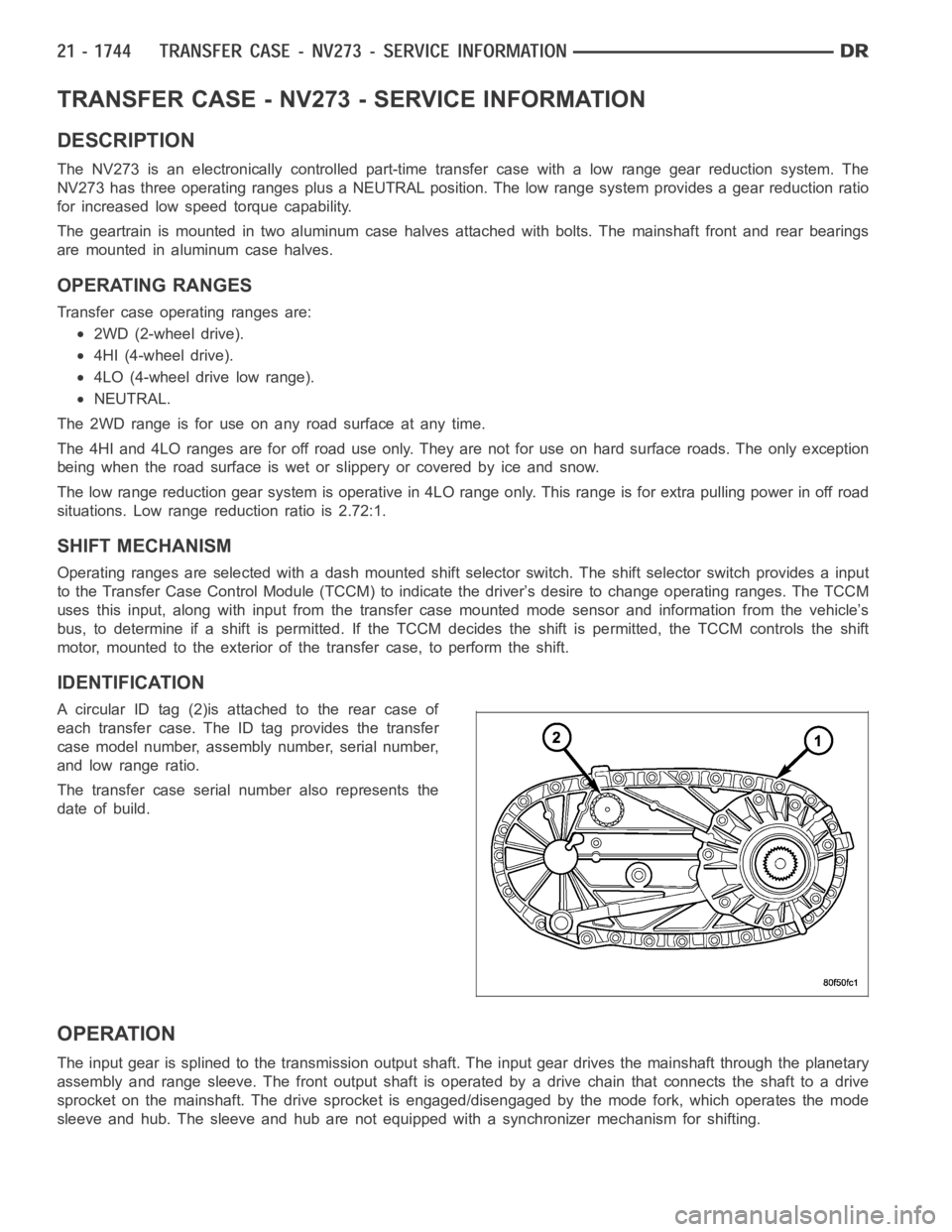
A circular ID tag (2)is attached to the rear case of
each transfer case. The ID tag provides the transfer
case model number, assembly number, serial number,
and low range ratio.
The transfer case serial number also represents the
date of build.
OPERATION
The input gear is splined to the transmission output shaft. The input gear drives the mainshaft through the planetary
assembly and range sleeve. The front output shaft is operated by a drive chain that connects the shaft to a drive
sprocket on the mainshaft. The drive sprocket is engaged/disengaged by themodefork,whichoperatesthemode
sleeve and hub. The sleeve and hub are not equipped with a synchronizer mechanism for shifting.
Page 4559 of 5267
SEATS
WARNING
WARNINGS - RESTRAINT SYSTEM
WARNING: To avoid personal injury or death, during and following any seat beltorchildrestraintanchor
service, carefully inspect all seat belts, buckles, mounting hardware, retractors, tether straps, and anchors
for proper installation, operation, or damage. Replace any belt that is cut, frayed, or torn. Straighten any
belt that is twisted. Tighten any loose fasteners. Replace any belt that has a damaged or ineffective buckle
or retractor. Replace any belt that has a bent or damaged latch plate or anchor plate. Replace any child
restraint anchor or the unit to which the anchor is integral that has been bent or damaged. Never attempt to
repair a seat belt or child restraint component. Always replace damaged orineffective seat belt and child
restraint components with the correct, new and unused replacement parts listed in the DaimlerChrysler
Mopar
Parts Catalog.
WARNING: To avoid personal injury or death, on vehicles equipped with airbags, disable the supplemental
restraint system before attempting any steering wheel, steering column,airbag, seat belt tensioner, impact
sensor, or instrument panel component diagnosis or service. Disconnect and isolate the battery negative
(ground) cable, then wait two minutes for the system capacitor to discharge before performing further diag-
nosis or service. This is the only sure way to disable the supplemental restraint system. Failure to take the
proper precautions could result in accidental airbag deployment.
WARNING: To avoid personal injury or death on vehicles equipped with airbags, before performing any
welding operations disconnect and isolate the battery negative (ground)cable and disconnect all wire har-
ness connectors from the Occupant Restraint Controller (ORC). Failure totake the proper precautions could
result in accidental airbag deployment and other possible damage to the supplemental restraint system cir-
cuits and components.
WARNING: To avoid personal injury or death, do not attempt to dismantle an airbag unit or tamper with its
inflator. Do not puncture, incinerate, or bring into contact with electricity. Do not store at temperatures
exceeding 93° C (200° F). An airbag inflator unit may contain sodium azide and potassium nitrate. These
materials are poisonous and extremely flammable. Contact with acid, water, or heavy metals may produce
harmful and irritating gases (sodium hydroxide is formed in the presence of moisture) or combustible com-
pounds. An airbag inflator unit may also contain a gas canister pressurizedtoover2500psi.
WARNING: To avoid personal injury or death, when handling a seat belt tensioner retractor, proper care
should be exercised to keep fingers out from under the retractor cover and away from the seat belt webbing
where it exits from the retractor cover.
WARNING: To avoid personal injury or death, replace all restraint system components only with parts spec-
ified in the DaimlerChrysler Mopar
Parts Catalog. Substitute parts may appear interchangeable, but internal
differences may result in inferior occupant protection.
WARNING: To avoid personal injury or death, the fasteners, screws, and bolts originally used for the
restraint system components must never be replaced with any substitutes.These fasteners have special
coatings and are specifically designed for the restraint system. Any timea new fastener is needed, replace
it with the correct fasteners provided in the service package or specifiedin the DaimlerChrysler Mopar
Parts Catalog.
WARNING: To avoid personal injury or death, when a steering column has an airbag unit attached, never
place the column on the floor or any other surface with the steering wheel orairbag unit face down.
Page 4853 of 5267
Theory of Operation
The A/C Heater Control drives the Passenger Blend Door Actuator via the (C33) Passenger Blend Door Driver cir-
cuit and the (C34) Common Door Driver circuit. All of the door actuators share the (C34) Common Door Driver
circuit. Inside the A/C Heater Control, each door actuator has its own unique driver, but all share a single common
door driver circuit. Due to the shared circuitry similar DTCs can set at thesame time for multiple actuators depend-
ing upon the location of the open circuit and the direction the actuator is moving when the open is present.
When Monitored:
During actuator calibration.
Set Condition:
If Passenger Blend Door Actuator’s electrical circuit is open. This DTC has a maturing time of 5 seconds and
a de-maturing time of 10 seconds. If the DTC’s status changes from active tostored it will stay in memory for
100 ignition cycles.
Possible Causes
(C33) PASSENGER BLEND DOOR DRIVER CIRCUIT OPEN
(C34) COMMON DOOR DRIVER CIRCUIT OPEN
PASSENGER BLEND DOOR ACTUATOR
A/C HEATER CONTROL
NOTE: This DTC must be active for the results of this test to be valid. Do not perform this test if this DTC
is stored. Refer to HVAC System Test for stored DTC test procedures.
Diagnostic Test
1.CHECK FOR ACTIVE CONTROL CIRCUIT/PERFORMANCE DTCs
Turn the ignition on.
With the scan tool, read active HVAC DTCs.
Does the scan tool display any active: XXXX CONTROL CIRCUIT/PERFORMANCE DTCs?
Ye s>>
Diagnose and repair the DTC(s). Refer to the Table of Contents in this Section for a complete list of
HVAC related symptoms.
No>>
Go To 2
2.CHECK PASSENGER BLEND DOOR ACTUATOR CIRCUIT RESISTANCE
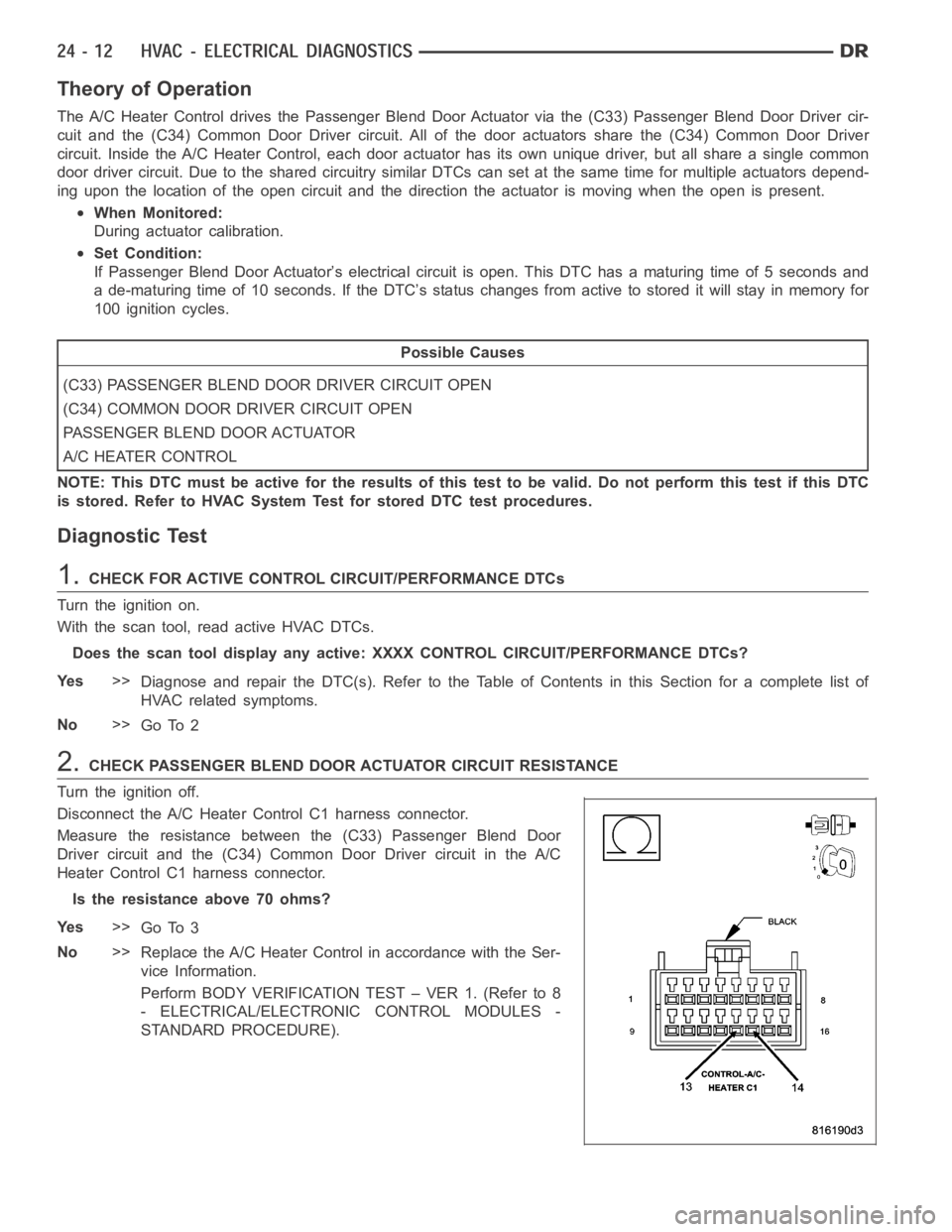
Turn the ignition off.
Disconnect the A/C Heater Control C1 harness connector.
Measure the resistance between the (C33) Passenger Blend Door
Driver circuit and the (C34) Common Door Driver circuit in the A/C
Heater Control C1 harness connector.
Is the resistance above 70 ohms?
Ye s>>
Go To 3
No>>
Replace the A/C Heater Control in accordance with the Ser-
vice Information.
Perform BODY VERIFICATION TEST – VER 1. (Refer to 8
- ELECTRICAL/ELECTRONIC CONTROL MODULES -
STANDARD PROCEDURE).
Page 4859 of 5267
B10A2–LEFT BLEND DOOR CONTROL CIRCUIT/PERFORMANCE (DUAL-ZONE)
For a complete wiring diagramRefer to Section 8W.
Theory of Operation
The A/C Heater Control monitors the door driver circuits during actuator operation for shorts to ground, shorts to
battery, and shorts to other door driver circuits. If detected, the A/C Heater Control reports these types of faults as
Control Circuit/Performance DTCs. It is important to note that Control Circuit/Performance DTCs do not indicate
where or what type of short is present and that additional system testing isnecessary to provide more details about
the reported fault.
When Monitored:
When actuator movement is requested.
Set Condition:
If the A/C Heater Control detects an excessive current draw on any of the door driver circuits while attempting
to drive this actuator. This DTC has a maturing time of 5 seconds and a de-maturing time of 10 seconds. If the
DTC’s status changes from active to stored, it will stay in memory for 100 ignition cycles.
Possible Causes
DOOR DRIVER CIRCUIT(S) SHORTED
NOTE:TheDTCmustbeactivefortheresultsofthistesttobevalid.Donotperform this test if the DTC is
stored. Refer to HVAC System Test for stored DTC test procedures.
Diagnostic Test
1.RUN THE ACTUATOR DTC DETECTION TEST
Turn the ignition on.
With the scan tool in HVAC, erase DTCs.
With the scan tool, select System Tests and then select Actuator DTC Detection. When the test is complete, select
View DTCs.
Repair
Diagnose and repair the DTC(s). If multiple DTCs are present, beginning with the passenger blend door,
diagnose and repair all short high DTCs and then all short low DTCs. Refer tothe Table of Contents in
this Section for a complete list of HVAC related symptoms.
Page 4868 of 5267
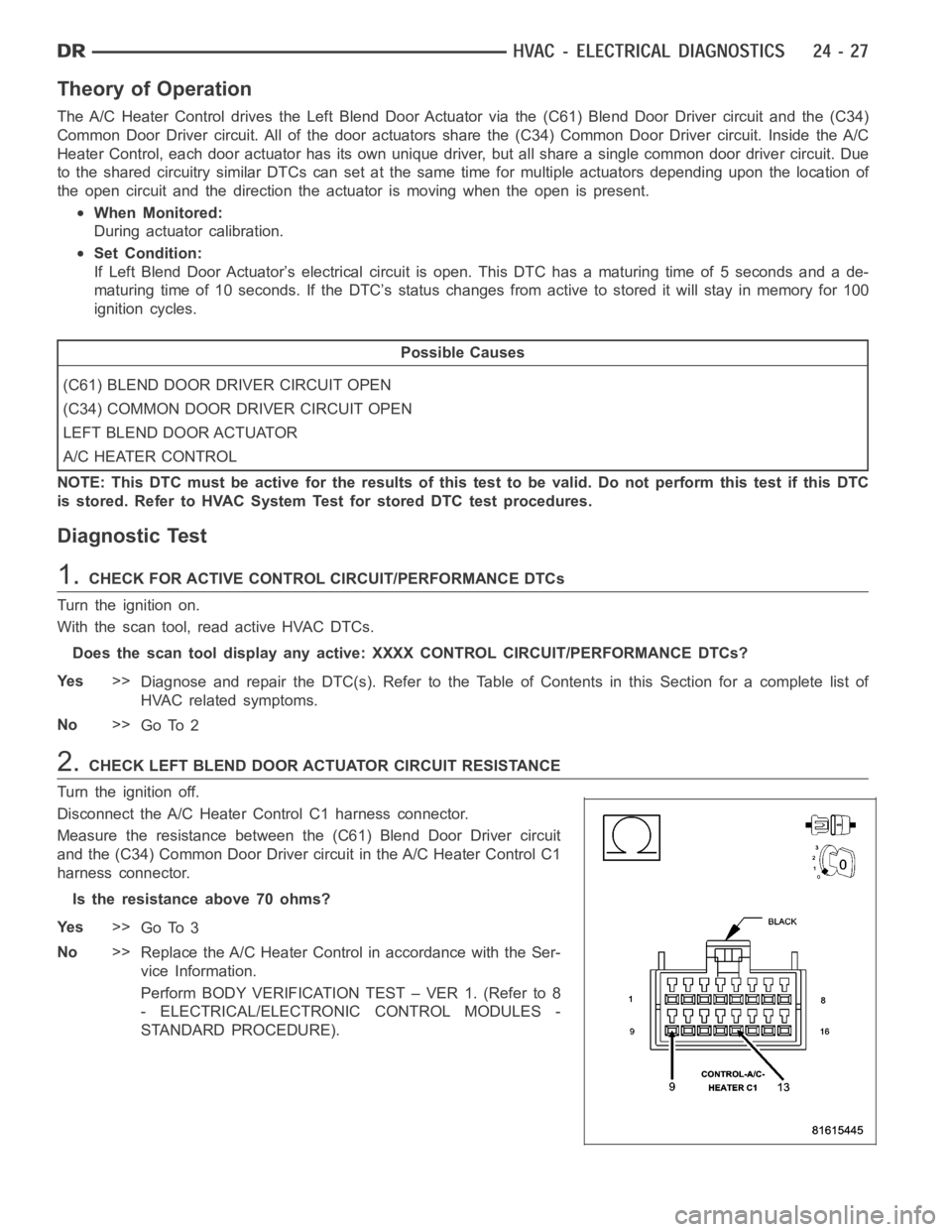
Theory of Operation
The A/C Heater Control drives the Left Blend Door Actuator via the (C61) Blend Door Driver circuit and the (C34)
Common Door Driver circuit. All of the door actuators share the (C34) Common Door Driver circuit. Inside the A/C
Heater Control, each door actuator has its own unique driver, but all sharea single common door driver circuit. Due
to the shared circuitry similar DTCs can set at the same time for multiple actuators depending upon the location of
the open circuit and the direction the actuator is moving when the open is present.
When Monitored:
During actuator calibration.
Set Condition:
If Left Blend Door Actuator’s electrical circuit is open. This DTC has a maturingtimeof5secondsandade-
maturing time of 10 seconds. If the DTC’s status changes from active to stored it will stay in memory for 100
ignition cycles.
Possible Causes
(C61) BLEND DOOR DRIVER CIRCUIT OPEN
(C34) COMMON DOOR DRIVER CIRCUIT OPEN
LEFT BLEND DOOR ACTUATOR
A/C HEATER CONTROL
NOTE: This DTC must be active for the results of this test to be valid. Do not perform this test if this DTC
is stored. Refer to HVAC System Test for stored DTC test procedures.
Diagnostic Test
1.CHECK FOR ACTIVE CONTROL CIRCUIT/PERFORMANCE DTCs
Turn the ignition on.
With the scan tool, read active HVAC DTCs.
Does the scan tool display any active: XXXX CONTROL CIRCUIT/PERFORMANCE DTCs?
Ye s>>
Diagnose and repair the DTC(s). Refer to the Table of Contents in this Section for a complete list of
HVAC related symptoms.
No>>
Go To 2
2.CHECK LEFT BLEND DOOR ACTUATOR CIRCUIT RESISTANCE
Turn the ignition off.
Disconnect the A/C Heater Control C1 harness connector.
Measure the resistance between the (C61) Blend Door Driver circuit
and the (C34) Common Door Driver circuit in the A/C Heater Control C1
harness connector.
Is the resistance above 70 ohms?
Ye s>>
Go To 3
No>>
Replace the A/C Heater Control in accordance with the Ser-
vice Information.
Perform BODY VERIFICATION TEST – VER 1. (Refer to 8
- ELECTRICAL/ELECTRONIC CONTROL MODULES -
STANDARD PROCEDURE).
Page 4874 of 5267
B10A9–RIGHT BLEND DOOR CONTROL CIRCUIT/PERFORMANCE (DUAL-ZONE)
For a complete wiring diagramRefer to Section 8W.
Theory of Operation
The A/C Heater Control monitors the door driver circuits during actuator operation for shorts to ground, shorts to
battery, and shorts to other door driver circuits. If detected, the A/C Heater Control reports these types of faults as
Control Circuit/Performance DTCs. It is important to note that Control Circuit/Performance DTCs do not indicate
where or what type of short is present and that additional system testing isnecessary to provide more details about
the reported fault.
When Monitored:
When actuator movement is requested.
Set Condition:
If the A/C Heater Control detects an excessive current draw on any of the door driver circuits while attempting
to drive this actuator. This DTC has a maturing time of 5 seconds and a de-maturing time of 10 seconds. If the
DTC’s status changes from active to stored, it will stay in memory for 100 ignition cycles.
Possible Causes
DOOR DRIVER CIRCUIT(S) SHORTED
NOTE:TheDTCmustbeactivefortheresultsofthistesttobevalid.Donotperform this test if the DTC is
stored. Refer to HVAC System Test for stored DTC test procedures.
Diagnostic Test
1.RUN THE ACTUATOR DTC DETECTION TEST
Turn the ignition on.
With the scan tool in HVAC, erase DTCs.
With the scan tool, select System Tests and then select Actuator DTC Detection. When the test is complete, select
View DTCs.
Repair
Diagnose and repair the DTC(s). If multiple DTCs are present, beginning with the passenger blend door,
diagnose and repair all short high DTCs and then all short low DTCs. Refer tothe Table of Contents in
this Section for a complete list of HVAC related symptoms.
Page 4902 of 5267
B104C–BLEND DOOR CONTROL CIRCUIT/PERFORMANCE (SINGLE-ZONE)
For a complete wiring diagramRefer to Section 8W.
Theory of Operation
The A/C Heater Control monitors the door driver circuits during actuator operation for shorts to ground, shorts to
battery, and shorts to other door driver circuits. If detected, the A/C Heater Control reports these types of faults as
Control Circuit/Performance DTCs. It is important to note that Control Circuit/Performance DTCs do not indicate
where or what type of short is present and that additional system testing isnecessary to provide more details about
the reported fault.
When Monitored:
With the ignition on.
Set Condition:
If the A/C Heater Control detects a short on any of the door driver circuits while attempting to drive this actua-
tor. This DTC has a maturing time of 5 seconds and a de-maturing time of 10 seconds. If the DTC’s status
changes from active to stored, it will stay in memory for 100 ignition cycles.
Possible Causes
DOOR DRIVER CIRCUIT(S) SHORTED
NOTE:TheDTCmustbeactivefortheresultsofthistesttobevalid.Donotperform this test if the DTC is
stored. Refer to HVAC System Test for stored DTC test procedures.
Diagnostic Test
1.RUN THE ACTUATOR DTC DETECTION TEST
Turn the ignition on.
With the scan tool in HVAC, erase DTCs.
Turn the ignition off, wait 10 seconds, and then turn the ignition on.
With the scan tool, select System Tests and then select Actuator DTC Detection. When the test is complete, select
View DTCs.
Repair
Diagnose and repair the DTC(s). If multiple DTCs are present, beginning with the common circuits, diag-
nose and repair all short high DTCs and then all short low DTCs. Refer to the Table of Contents in this
Section for a complete list of HVAC related symptoms.
Page 4911 of 5267
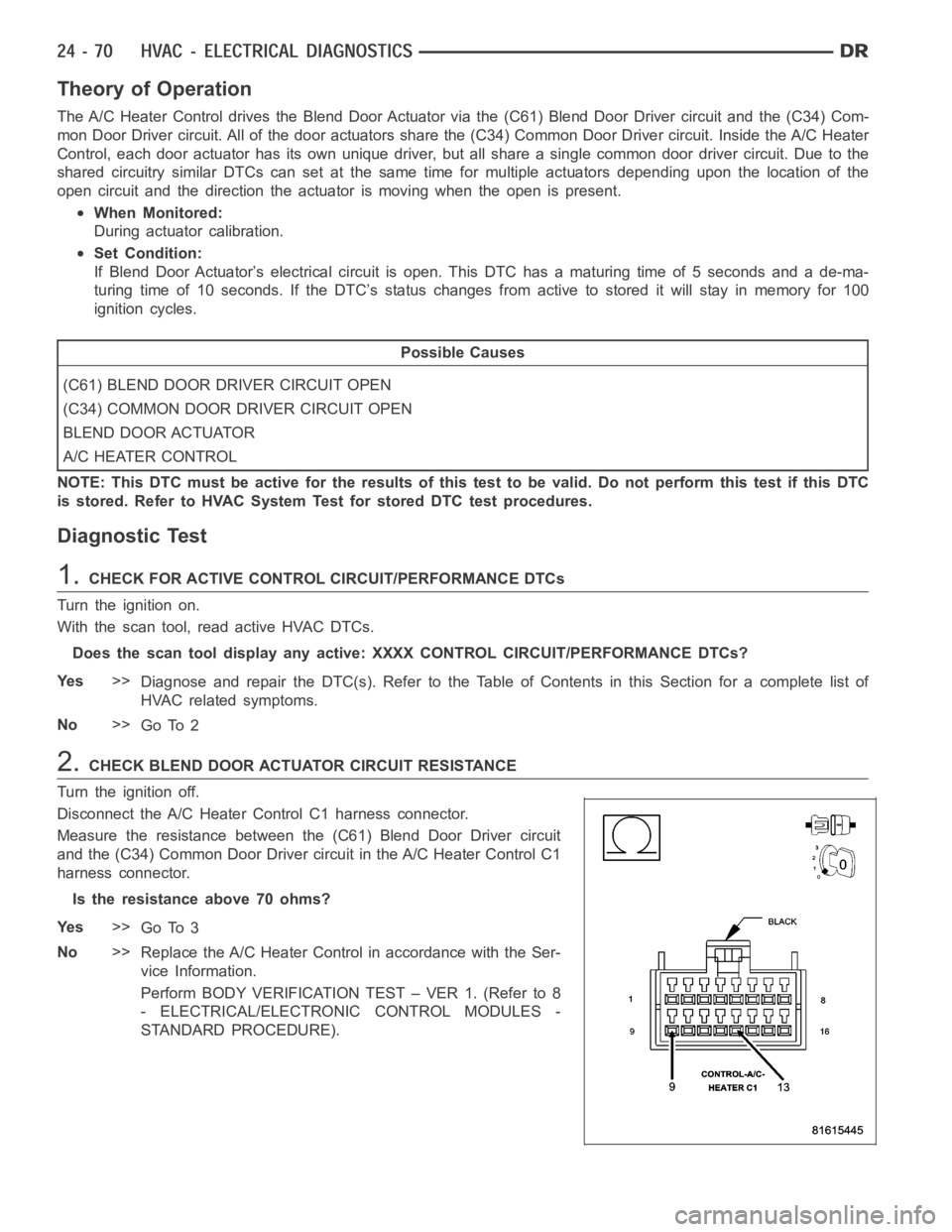
Theory of Operation
The A/C Heater Control drives the Blend Door Actuator via the (C61) Blend Door Driver circuit and the (C34) Com-
mon Door Driver circuit. All of the door actuators share the (C34) Common Door Driver circuit. Inside the A/C Heater
Control, each door actuator has its own unique driver, but all share a single common door driver circuit. Due to the
shared circuitry similar DTCs can set at the same time for multiple actuators depending upon the location of the
open circuit and the direction the actuator is moving when the open is present.
When Monitored:
During actuator calibration.
Set Condition:
If Blend Door Actuator’s electrical circuit is open. This DTC has a maturingtimeof5secondsandade-ma-
turing time of 10 seconds. If the DTC’s status changes from active to storedit will stay in memory for 100
ignition cycles.
Possible Causes
(C61) BLEND DOOR DRIVER CIRCUIT OPEN
(C34) COMMON DOOR DRIVER CIRCUIT OPEN
BLEND DOOR ACTUATOR
A/C HEATER CONTROL
NOTE: This DTC must be active for the results of this test to be valid. Do not perform this test if this DTC
is stored. Refer to HVAC System Test for stored DTC test procedures.
Diagnostic Test
1.CHECK FOR ACTIVE CONTROL CIRCUIT/PERFORMANCE DTCs
Turn the ignition on.
With the scan tool, read active HVAC DTCs.
Does the scan tool display any active: XXXX CONTROL CIRCUIT/PERFORMANCE DTCs?
Ye s>>
Diagnose and repair the DTC(s). Refer to the Table of Contents in this Section for a complete list of
HVAC related symptoms.
No>>
Go To 2
2.CHECK BLEND DOOR ACTUATOR CIRCUIT RESISTANCE
Turn the ignition off.
Disconnect the A/C Heater Control C1 harness connector.
Measure the resistance between the (C61) Blend Door Driver circuit
and the (C34) Common Door Driver circuit in the A/C Heater Control C1
harness connector.
Is the resistance above 70 ohms?
Ye s>>
Go To 3
No>>
Replace the A/C Heater Control in accordance with the Ser-
vice Information.
Perform BODY VERIFICATION TEST – VER 1. (Refer to 8
- ELECTRICAL/ELECTRONIC CONTROL MODULES -
STANDARD PROCEDURE).
Page 4920 of 5267
Theory of Operation
The A/C Heater Control drives the Recirculation Door Actuator via the (C32) Recirculation Door Driver circuit and
the (C34) Common Door Driver circuit. All of the door actuators share the (C34) Common Door Driver. Inside the
A/C Heater Control, each door actuator has its own unique driver, but all share a single common door driver circuit.
Due to the shared circuitry similar DTCs can set at the same time for multiple actuators depending upon the location
of the open circuit and the direction the actuator is moving when the open ispresent.
When Monitored:
During actuator calibration.
Set Condition:
If Recirculation Door Actuator’s electrical circuit is open. This DTC hasa maturing time of 5 seconds and a
de-maturing time of 10 seconds. If the DTC’s status changes from active to stored it will stay in memory for
100 ignition cycles.
Possible Causes
(C32) RECIRCULATION DOOR DRIVER CIRCUIT OPEN
(C34) COMMON DOOR DRIVER CIRCUIT OPEN
RECIRCULATION DOOR ACTUATOR
A/C HEATER CONTROL
NOTE: This DTC must be active for the results of this test to be valid. Do not perform this test if this DTC
is stored. Refer to HVAC System Test for stored DTC test procedures.
Diagnostic Test
1.CHECK FOR ACTIVE CONTROL CIRCUIT/PERFORMANCE DTCs
Turn the ignition on.
With the scan tool, read active HVAC DTCs.
Does the scan tool display any active: XXXX CONTROL CIRCUIT/PERFORMANCE DTCs?
Ye s>>
Diagnose and repair the DTC(s). Refer to the Table of Contents in this Section for a complete list of
HVAC related symptoms.
No>>
Go To 2
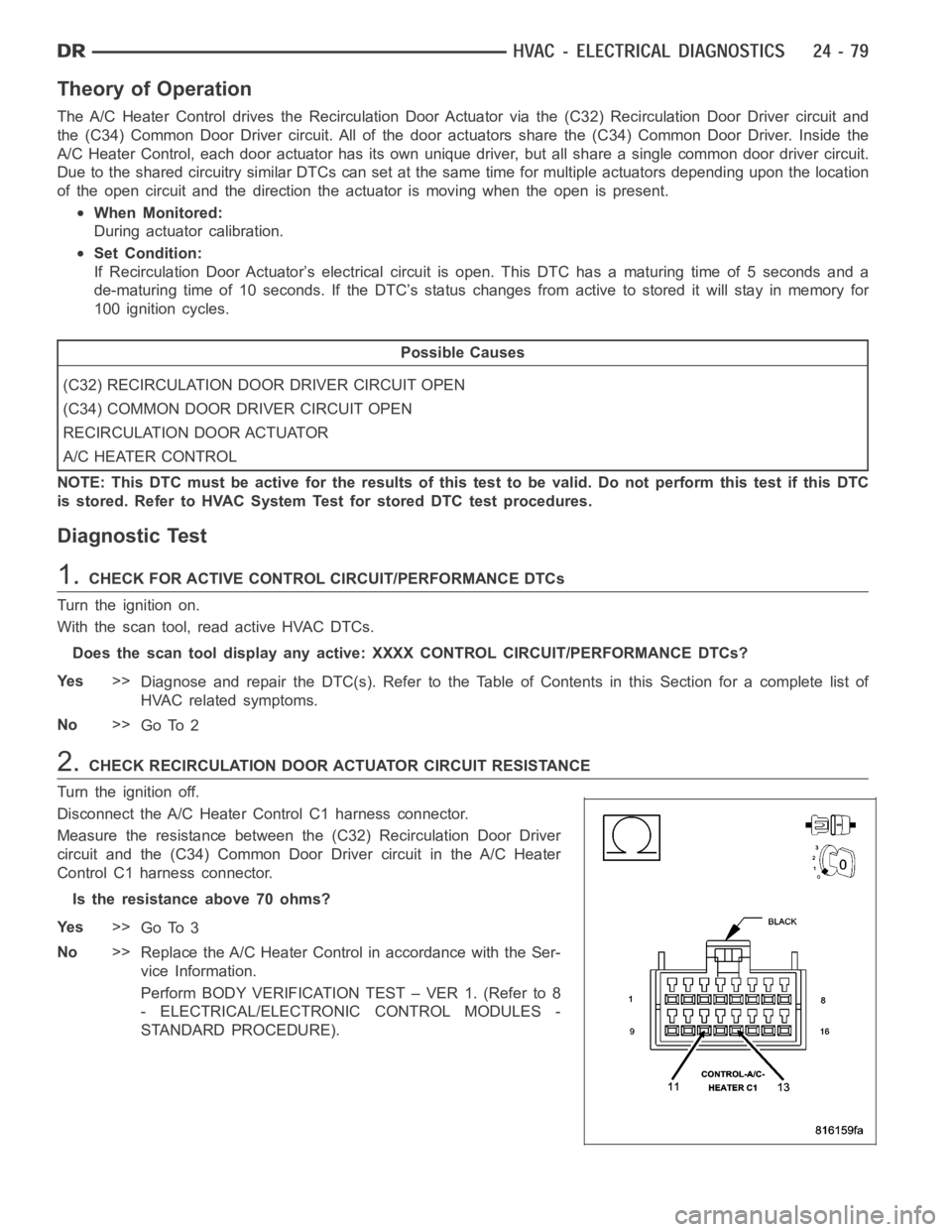
2.CHECK RECIRCULATION DOOR ACTUATOR CIRCUIT RESISTANCE
Turn the ignition off.
Disconnect the A/C Heater Control C1 harness connector.
Measure the resistance between the (C32) Recirculation Door Driver
circuit and the (C34) Common Door Driver circuit in the A/C Heater
Control C1 harness connector.
Is the resistance above 70 ohms?
Ye s>>
Go To 3
No>>
Replace the A/C Heater Control in accordance with the Ser-
vice Information.
Perform BODY VERIFICATION TEST – VER 1. (Refer to 8
- ELECTRICAL/ELECTRONIC CONTROL MODULES -
STANDARD PROCEDURE).
Page 4923 of 5267
Theory of Operation
The A/C Heater Control drives the Recirculation Door Actuator via the (C32) Recirculation Door Driver circuit and
the (C34) Common Door Driver circuit. All of the door actuators share the (C34) Common Door Driver. Inside the
A/C Heater Control, each door actuator has its own unique driver, but all share a single common door driver circuit.
Due to the shared circuitry similar DTCs can set at the same time for multiple actuators depending upon the location
of the open circuit and the direction the actuator is moving when the open ispresent.
When Monitored:
During actuator calibration.
Set Condition:
If Recirculation Door Actuator’s electrical circuit is open. This DTC hasa maturing time of 5 seconds and a
de-maturing time of 10 seconds. If the DTC’s status changes from active to stored it will stay in memory for
100 ignition cycles.
Possible Causes
(C32) RECIRCULATION DOOR DRIVER CIRCUIT OPEN
(C34) COMMON DOOR DRIVER CIRCUIT OPEN
RECIRCULATION DOOR ACTUATOR
A/C HEATER CONTROL
NOTE: This DTC must be active for the results of this test to be valid. Do not perform this test if this DTC
is stored. Refer to HVAC System Test for stored DTC test procedures.
Diagnostic Test
1.CHECK FOR ACTIVE CONTROL CIRCUIT/PERFORMANCE DTCs
Turn the ignition on.
With the scan tool, read active HVAC DTCs.
Does the scan tool display any active: XXXX CONTROL CIRCUIT/PERFORMANCE DTCs?
Ye s>>
Diagnose and repair the DTC(s). Refer to the Table of Contents in this Section for a complete list of
HVAC related symptoms.
No>>
Go To 2
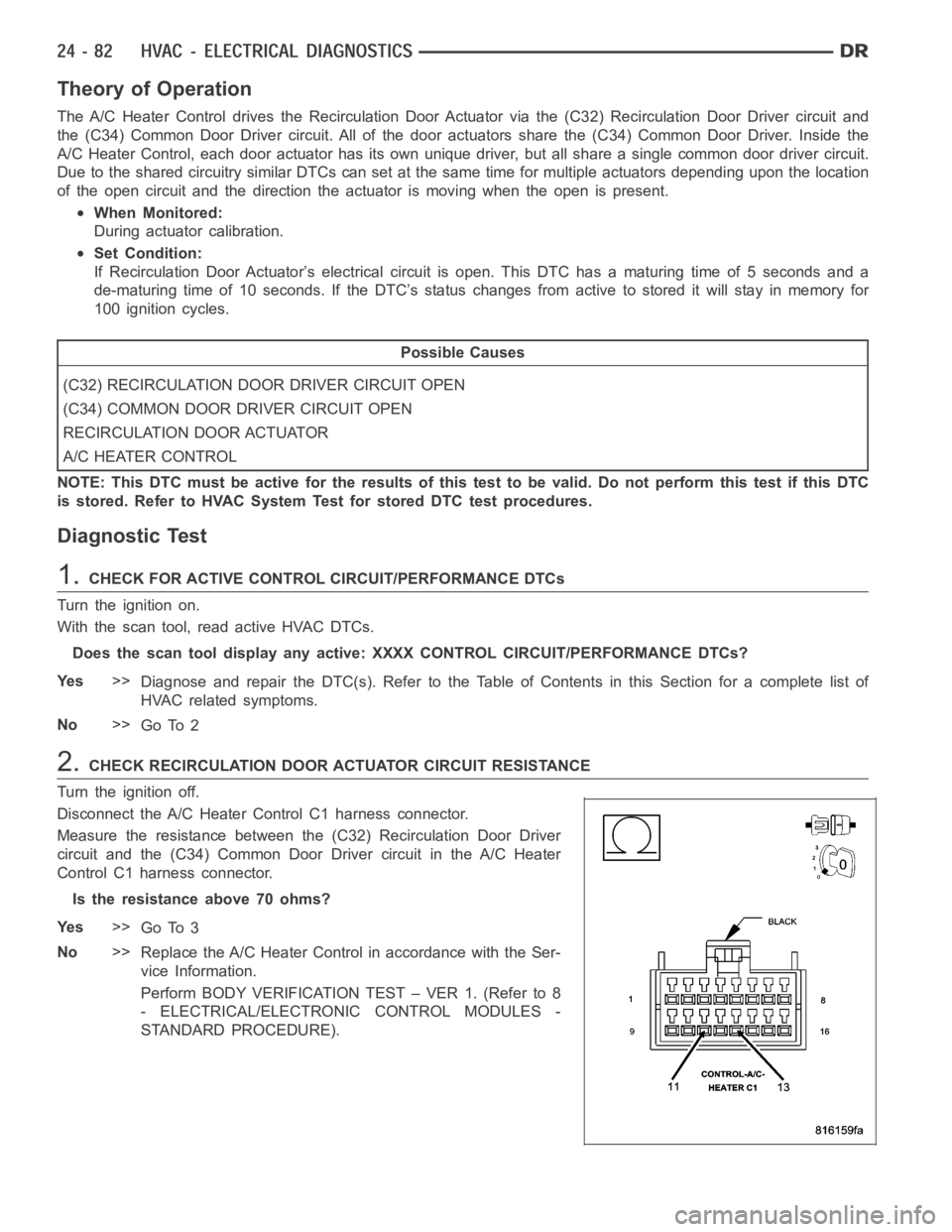
2.CHECK RECIRCULATION DOOR ACTUATOR CIRCUIT RESISTANCE
Turn the ignition off.
Disconnect the A/C Heater Control C1 harness connector.
Measure the resistance between the (C32) Recirculation Door Driver
circuit and the (C34) Common Door Driver circuit in the A/C Heater
Control C1 harness connector.
Is the resistance above 70 ohms?
Ye s>>
Go To 3
No>>
Replace the A/C Heater Control in accordance with the Ser-
vice Information.
Perform BODY VERIFICATION TEST – VER 1. (Refer to 8
- ELECTRICAL/ELECTRONIC CONTROL MODULES -
STANDARD PROCEDURE).