change time DODGE RAM SRT-10 2006 Service Service Manual
[x] Cancel search | Manufacturer: DODGE, Model Year: 2006, Model line: RAM SRT-10, Model: DODGE RAM SRT-10 2006Pages: 5267, PDF Size: 68.7 MB
Page 3124 of 5267
When Monitored:
Continuously with the ignition on and engine running.
Set Condition:
This DTC will set when the desired transmission temperature does not reacha normal operating temperature
within a given time frame. Time is variable due to ambient temperature. Approximate times are starting tem-
perature to warm up time: (-40° F / -40° C - 35 min) (-20° F / -28° C - 25 min) (20°F / -6.6° C - 20 min) (60°
F/15.5°C-10min)
Possible Causes
RELATED DTC’S PRESENT
TRANSMISSION TEMPERATURE SENSOR
POWERTRAIN CONTROL MODULE
Always perform the 45RFE/545RFE Pre-Diagnostic Troubleshooting Procedure before proceeding. (Refer to
21 - TRANSMISSION/TRANSAXLE/AUTOMATIC - 45RFE/545RFE - STANDARD PROCEDURE)
Theory of Operation
The Transmission Temperature Sensor is a variable resistor that changes with temperature, or otherwise known as
a thermister. The temperature of the transmission fluid can affect a variety of electronically controlled transmission
operations such as shift quality, torque converter lock-up, and when and/or if certain OBDII or system self-diagnostic
test are performed. The Powertrain Control Module (PCM) substitutes a calculated transmission temperature value
if a fault is detected in the Transmission Temperature Sensor circuit.
Diagnostic Test
1.DETERMINE IF RELATED DTC’S ARE PRESENT
With the scan tool, check Transmission DTC’s.
Are there any other related Transmission Temperature Sensor DTCs present?
Ye s>>
Refer to the Transmission category and perform the appropriate symptom.
No>>
Go To 2
2.CHECK IF DTC IS CURRENT
With the scan tool, Check the STARTS SINCE SET counter for P0711.
NOTE: This counter only applies to the last DTC set.
Is the STARTS SINCE SET counter 2 or less?
Ye s>>
Go To 3
No>>
Go To 4
3.TRANSMISSION TEMPERATURE SENSOR
Turn the ignition off to the lock position.
Remove the Ignition Switch Feed fuse from the TIPM.
CAUTION: Removal of the Ignition Switch Feed fuse from the TIPM will prevent the vehicle from being
startedingear.
WARNING: The Ignition Switch Feed fuse must be removed from the TIPM. Failure to do so can result in
personal injury or death.
Install the Transmission Simulator, Miller tool #8333.
Ignition on, engine not running.
With the Transmission Simulator, turn the Input/Output switch to OFF.
With the scan tool, monitor the TRANS TEMP VOLTS while turning the ThermistorVoltageswitchtoallthreeposi-
tions on the Transmission Simulator.
Page 3133 of 5267
When Monitored:
Continuously with the ignition on and engine running.
Set Condition:
The DTC will set when the monitored Temperature Sensor voltage fluctuatesor changes abruptly within a pre-
determined period of time.
Possible Causes
RELATED DTC’S PRESENT
TRANSMISSION TEMPERATURE SENSOR
POWERTRAIN CONTROL MODULE
Always perform the 45RFE/545RFE Pre-Diagnostic Troubleshooting Procedure before proceeding. (Refer to
21 - TRANSMISSION/TRANSAXLE/AUTOMATIC - 45RFE/545RFE - STANDARD PROCEDURE)
Theory of Operation
The Transmission Temperature Sensor is a variable resistor that changes with temperature, or otherwise known as
a thermister. The temperature of the transmission fluid can affect a variety of electronically controlled transmission
operations such as shift quality, torque converter lock-up, and when and/or if certain OBDII or system self-diagnostic
test are performed. The Powertrain Control Module (PCM) substitutes a calculated transmission temperature value
if a fault is detected in the Transmission Temperature Sensor circuit.
Diagnostic Test
1.DETERMINE IF RELATED DTC’S ARE PRESENT
With the scan tool, check Transmission DTC’s.
Are there any line pressure sensor or throttle position sensor DTCs present?
Ye s>> Refer to the Transmission category and perform the appropriate symptom.(Referto21-TRANS-
MISSION/TRANSAXLE/AUTOMATIC - 45RFE/545RFE - DIAGNOSIS AND TESTING)
No>>
Go To 2
2.CHECK TO SEE IF DTC IS CURRENT
With the scan tool, Check the STARTS SINCE SET counter for P0714.
NOTE: This counter only applies to the last DTC set.
Is the STARTS SINCE SET counter 2 or less?
Ye s>>
Go To 3
No>>
Go To 4
3.TRANSMISSION TEMPERATURE SENSOR
Turn the ignition off to the lock position.
Remove the Ignition Switch Feed fuse from the TIPM.
CAUTION: Removal of the Ignition Switch Feed fuse from the TIPM will prevent the vehicle from being
startedingear.
WARNING: The Ignition Switch Feed fuse must be removed from the TIPM. Failure to do so can result in
personal injury or death.
Install the Transmission Simulator, Miller tool #8333.
Ignition on, engine not running.
With the Transmission Simulator, turn the Input/Output switch to OFF.
With the scan tool, monitor the TRANS TEMP VOLTS while turning the ThermistorVoltageswitchtoallthreeposi-
tions on the Transmission Simulator.
Page 3307 of 5267
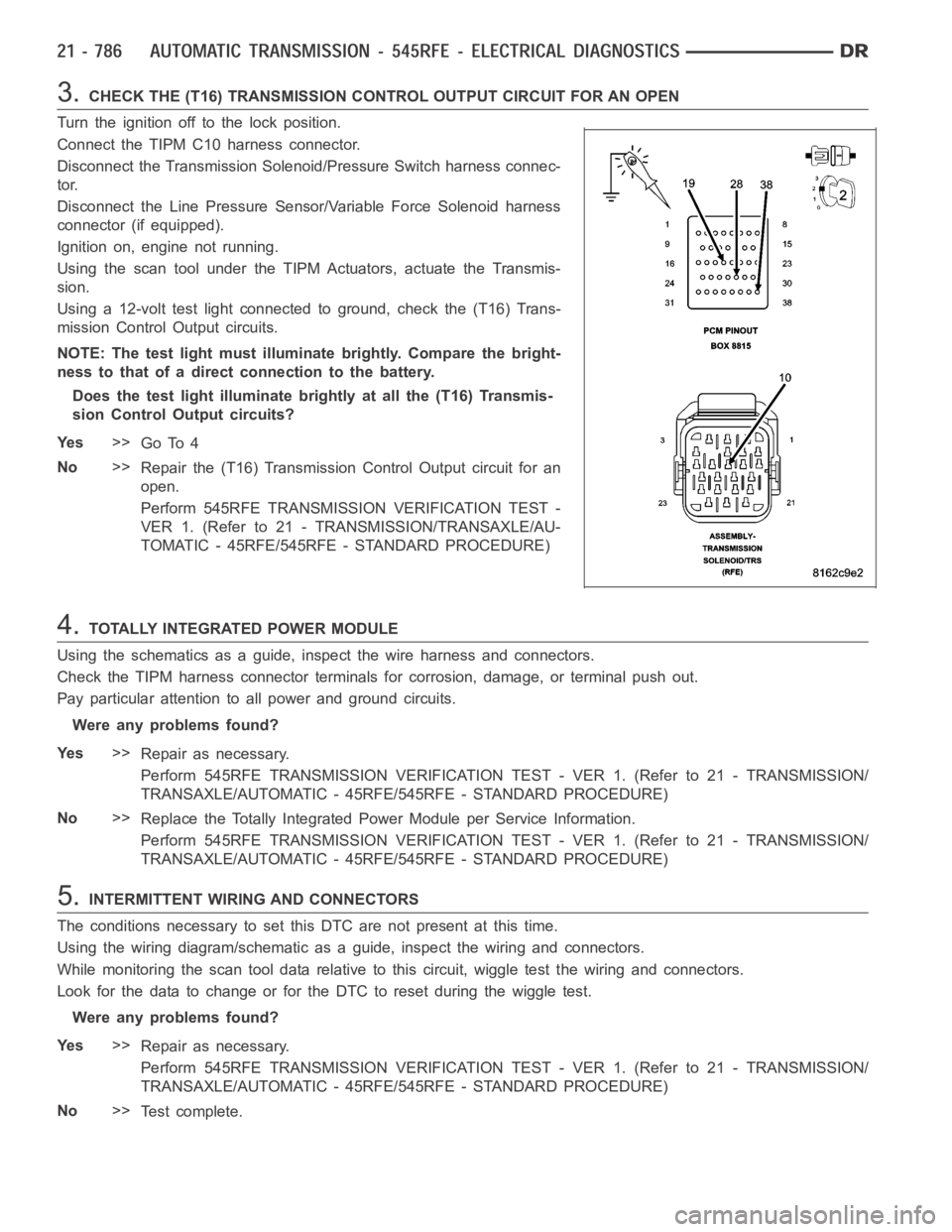
3.CHECK THE (T16) TRANSMISSION CONTROL OUTPUT CIRCUIT FOR AN OPEN
Turn the ignition off to the lock position.
Connect the TIPM C10 harness connector.
Disconnect the Transmission Solenoid/Pressure Switch harness connec-
tor.
Disconnect the Line Pressure Sensor/Variable Force Solenoid harness
connector (if equipped).
Ignition on, engine not running.
Using the scan tool under the TIPM Actuators, actuate the Transmis-
sion.
Using a 12-volt test light connected to ground, check the (T16) Trans-
mission Control Output circuits.
NOTE: The test light must illuminate brightly. Compare the bright-
ness to that of a direct connection to the battery.
Does the test light illuminate brightly at all the (T16) Transmis-
sion Control Output circuits?
Ye s>>
Go To 4
No>>
Repair the (T16) Transmission Control Output circuit for an
open.
Perform 545RFE TRANSMISSION VERIFICATION TEST -
VER 1. (Refer to 21 - TRANSMISSION/TRANSAXLE/AU-
TOMATIC - 45RFE/545RFE - STANDARD PROCEDURE)
4.TOTALLY INTEGRATED POWER MODULE
Using the schematics as a guide, inspect the wire harness and connectors.
Check the TIPM harness connector terminals for corrosion, damage, or terminal push out.
Pay particular attention to all power and ground circuits.
Were any problems found?
Ye s>>
Repair as necessary.
Perform 545RFE TRANSMISSION VERIFICATION TEST - VER 1. (Refer to 21 - TRANSMISSION/
TRANSAXLE/AUTOMATIC - 45RFE/545RFE - STANDARD PROCEDURE)
No>>
Replace the Totally Integrated Power Module per Service Information.
Perform 545RFE TRANSMISSION VERIFICATION TEST - VER 1. (Refer to 21 - TRANSMISSION/
TRANSAXLE/AUTOMATIC - 45RFE/545RFE - STANDARD PROCEDURE)
5.INTERMITTENT WIRING AND CONNECTORS
The conditions necessary to set this DTC are not present at this time.
Using the wiring diagram/schematic as a guide, inspect the wiring and connectors.
While monitoring the scan tool data relative to this circuit, wiggle test the wiring and connectors.
Look for the data to change or for the DTC to reset during the wiggle test.
Were any problems found?
Ye s>>
Repair as necessary.
Perform 545RFE TRANSMISSION VERIFICATION TEST - VER 1. (Refer to 21 - TRANSMISSION/
TRANSAXLE/AUTOMATIC - 45RFE/545RFE - STANDARD PROCEDURE)
No>>
Te s t c o m p l e t e .
Page 3310 of 5267
4.INTERMITTENT WIRING AND CONNECTORS
The conditions necessary to set this DTC are not present at this time.
Using the wiring diagram/schematic as a guide, inspect the wiring and connectors.
While monitoring the scan tool data relative to this circuit, wiggle test the wiring and connectors.
Look for the data to change or for the DTC to reset during the wiggle test.
Were any problems found?
Ye s>>
Repair as necessary.
Perform 545RFE TRANSMISSION VERIFICATION TEST - VER 1. (Refer to 21 - TRANSMISSION/
TRANSAXLE/AUTOMATIC - 45RFE/545RFE - STANDARD PROCEDURE)
No>>
Te s t c o m p l e t e .
Page 3313 of 5267
3.TOTALLY INTEGRATED POWER MODULE
Using the schematics as a guide, inspect the wire harness and connectors.
Check the TIPM harness connector terminals for corrosion, damage, or terminal push out.
Pay particular attention to all power and ground circuits.
Were any problems found?
Ye s>>
Repair as necessary.
Perform 545RFE TRANSMISSION VERIFICATION TEST - VER 1. (Refer to 21 - TRANSMISSION/
TRANSAXLE/AUTOMATIC - 45RFE/545RFE - STANDARD PROCEDURE)
No>>
Replace the Totally Integrated Power Module per Service Information.
Perform 545RFE TRANSMISSION VERIFICATION TEST - VER 1. (Refer to 21 - TRANSMISSION/
TRANSAXLE/AUTOMATIC - 45RFE/545RFE - STANDARD PROCEDURE)
4.INTERMITTENT WIRING AND CONNECTORS
The conditions necessary to set this DTC are not present at this time.
Using the wiring diagram/schematic as a guide, inspect the wiring and connectors.
While monitoring the scan tool data relative to this circuit, wiggle test the wiring and connectors.
Look for the data to change or for the DTC to reset during the wiggle test.
Were any problems found?
Ye s>>
Repair as necessary.
Perform 545RFE TRANSMISSION VERIFICATION TEST - VER 1. (Refer to 21 - TRANSMISSION/
TRANSAXLE/AUTOMATIC - 45RFE/545RFE - STANDARD PROCEDURE)
No>>
Te s t c o m p l e t e .
Page 3556 of 5267
Theory of Operation
The 3-4 Solenoid is used the engage the gear change form 3rd gear to 4th gear.
The solenoids used in transmission applications are attached to valves which can be classified as normally open or
normally closed. The normally open solenoid valve is defined as a valve which allows hydraulic flow when no cur-
rent or voltage is applied to the solenoid. The normally closed solenoid valve is defined as a valve which does not
allow hydraulic flow when no current or voltage is applied to the solenoid.These valves perform hydraulic control
functions for the transmission and must therefore be durable and tolerantof dirt particles. For these reasons, the
valves have hardened steel poppets and ball valves. The solenoids operatethe valves directly, which means that
the solenoids must have very high outputs to close the valves against the sizable flow areas and line pressures
found in current transmissions. Fastresponse time is also necessary to ensure accurate control.
When Monitored:
Continuously with ignition on.
Set Condition:
This DTC will set if the voltage detected on the 3-4 Shift Solenoid Control circuit at the PCM is different then
the expected voltage. Note: To clear this DTC it is necessary to drive the vehicle at a sustained speed which
would allow the TCC and/or Overdrive Clutch to operate
Possible Causes
TRANSMISSION CONTROL OUTPUT DTC PRESENT
(T9) 3-4 SOLENOID CONTROL CIRCUIT OPEN
(T16) TRANSMISSION CONTROL OUTPUT CIRCUIT OPEN
(T9) 3-4 SOLENOID CONTROL CIRCUIT SHORT TO VOLTAGE
(T9) 3-4 SOLENOID CONTROL CIRCUIT SHORT TO GROUND
(T16) TRANSMISSION RELAY OUTPUT CIRCUIT SHORT TO GROUND
(T9) 3-4 SOLENOID CIRCUIT SHORT TO OTHER CIRCUITS
TOTALLY INTEGRATED POWER MODULE
3-4 SHIFT SOLENOID
POWERTRAIN CONTROL MODULE
Always perform the Pre-Diagnostic Troubleshooting procedure before proceeding. (Refer to 21 - TRANSMIS-
SION/TRANSAXLE/AUTOMATIC - 48RE - STANDARD PROCEDURE)
Diagnostic Test
1.CHECK IF THERE ANY TRANSMISSION CONTROL DTCS PRESENT
Ignition on, engine not running.
With the scan tool, read Engine DTCs.
Are there any TIPM TCM Power Control Circuit DTCs also present?
Ye s>>
Refer to the Transmission category, and perform the appropriate symptom(s).
No>>
Go To 2
Page 3573 of 5267
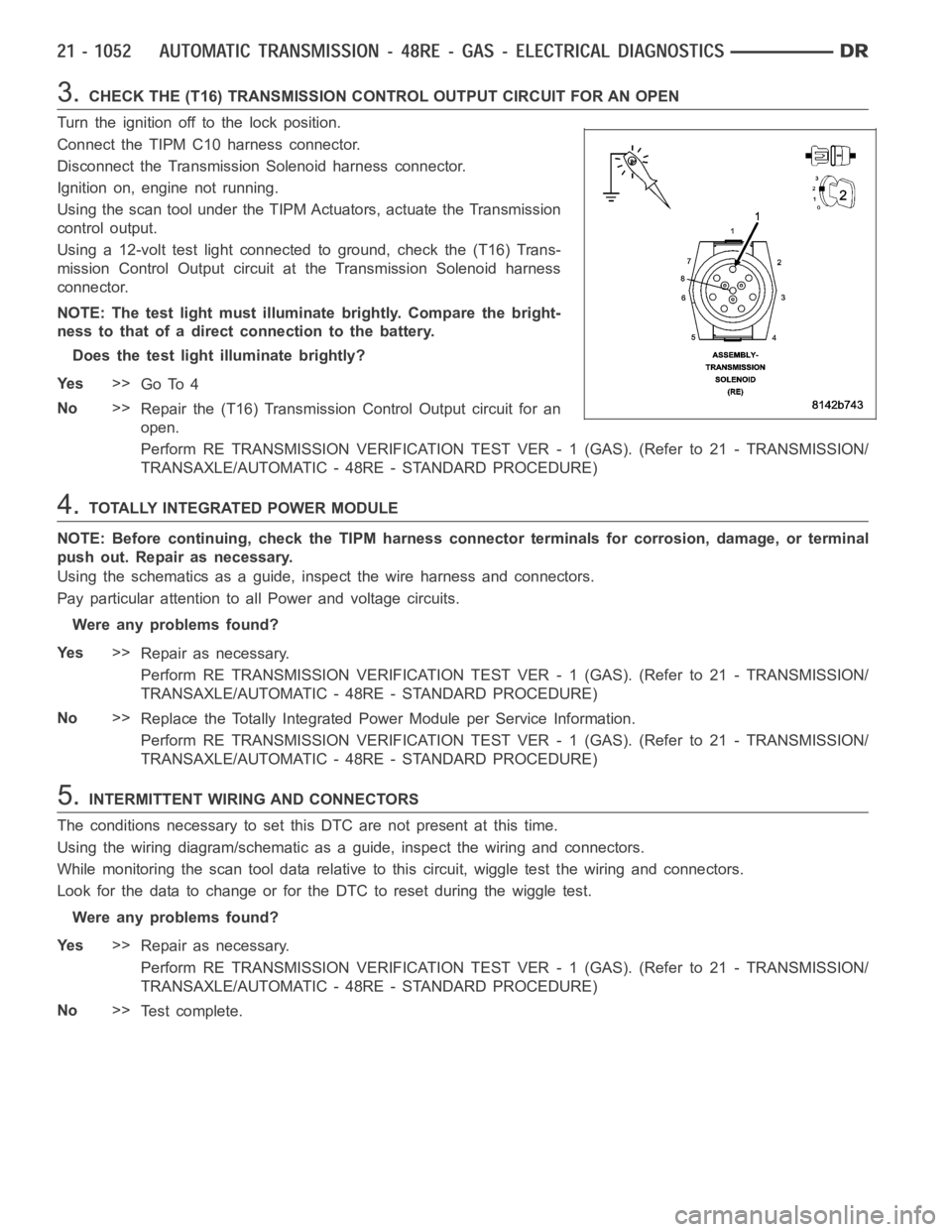
3.CHECK THE (T16) TRANSMISSION CONTROL OUTPUT CIRCUIT FOR AN OPEN
Turn the ignition off to the lock position.
Connect the TIPM C10 harness connector.
Disconnect the Transmission Solenoid harness connector.
Ignition on, engine not running.
Using the scan tool under the TIPM Actuators, actuate the Transmission
control output.
Using a 12-volt test light connected to ground, check the (T16) Trans-
mission Control Output circuit at the Transmission Solenoid harness
connector.
NOTE: The test light must illuminate brightly. Compare the bright-
ness to that of a direct connection to the battery.
Does the test light illuminate brightly?
Ye s>>
Go To 4
No>>
Repair the (T16) Transmission Control Output circuit for an
open.
Perform RE TRANSMISSION VERIFICATION TEST VER - 1 (GAS). (Refer to 21 - TRANSMISSION/
TRANSAXLE/AUTOMATIC - 48RE - STANDARD PROCEDURE)
4.TOTALLY INTEGRATED POWER MODULE
NOTE: Before continuing, check the TIPM harness connector terminals for corrosion, damage, or terminal
push out. Repair as necessary.
Using the schematics as a guide, inspect the wire harness and connectors.
Pay particular attention to allPower and voltage circuits.
Were any problems found?
Ye s>>
Repair as necessary.
Perform RE TRANSMISSION VERIFICATION TEST VER - 1 (GAS). (Refer to 21 - TRANSMISSION/
TRANSAXLE/AUTOMATIC - 48RE - STANDARD PROCEDURE)
No>>
Replace the Totally Integrated Power Module per Service Information.
Perform RE TRANSMISSION VERIFICATION TEST VER - 1 (GAS). (Refer to 21 - TRANSMISSION/
TRANSAXLE/AUTOMATIC - 48RE - STANDARD PROCEDURE)
5.INTERMITTENT WIRING AND CONNECTORS
The conditions necessary to set this DTC are not present at this time.
Using the wiring diagram/schematic as a guide, inspect the wiring and connectors.
While monitoring the scan tool data relative to this circuit, wiggle test the wiring and connectors.
Look for the data to change or for the DTC to reset during the wiggle test.
Were any problems found?
Ye s>>
Repair as necessary.
Perform RE TRANSMISSION VERIFICATION TEST VER - 1 (GAS). (Refer to 21 - TRANSMISSION/
TRANSAXLE/AUTOMATIC - 48RE - STANDARD PROCEDURE)
No>>
Te s t c o m p l e t e .
Page 3576 of 5267
3.TOTALLY INTEGRATED POWER MODULE
NOTE: Before continuing, check the TIPM harness connector terminals for corrosion, damage, or terminal
push out. Repair as necessary.
Using the schematics as a guide, inspect the wire harness and connectors.
Pay particular attention to allPower and voltage circuits.
Were any problems found?
Ye s>>
Repair as necessary.
Perform RE TRANSMISSION VERIFICATION TEST VER - 1 (DIESEL). (Refer to 21 - TRANSMISSION/
TRANSAXLE/AUTOMATIC - 48RE - STANDARD PROCEDURE)
No>>
Replace the Totally Integrated Power Module per Service Information.
Perform RE TRANSMISSION VERIFICATION TEST VER - 1 (DIESEL). (Refer to 21 - TRANSMISSION/
TRANSAXLE/AUTOMATIC - 48RE - STANDARD PROCEDURE)
4.INTERMITTENT WIRING AND CONNECTORS
The conditions necessary to set this DTC are not present at this time.
Using the wiring diagram/schematic as a guide, inspect the wiring and connectors.
While monitoring the scan tool data relative to this circuit, wiggle test the wiring and connectors.
Look for the data to change or for the DTC to reset during the wiggle test.
Were any problems found?
Ye s>>
Repair as necessary.
Perform RE TRANSMISSION VERIFICATION TEST VER - 1 (DIESEL). (Refer to 21 - TRANSMISSION/
TRANSAXLE/AUTOMATIC - 48RE - STANDARD PROCEDURE)
No>>
Te s t c o m p l e t e .
Page 3579 of 5267
4.INTERMITTENT WIRING AND CONNECTORS
The conditions necessary to set this DTC are not present at this time.
Using the wiring diagram/schematic as a guide, inspect the wiring and connectors.
While monitoring the scan tool data relative to this circuit, wiggle test the wiring and connectors.
Look for the data to change or for the DTC to reset during the wiggle test.
Were any problems found?
Ye s>>
Repair as necessary.
Perform RE TRANSMISSION VERIFICATION TEST VER - 1 (DIESEL). (Refer to 21 - TRANSMISSION/
TRANSAXLE/AUTOMATIC - 48RE - STANDARD PROCEDURE)
No>>
Te s t c o m p l e t e .
Page 3685 of 5267
Theory of Operation
The 3-4 Solenoid is used the engage the gear change form 3rd gear to 4th gear.
The solenoids used in transmission applications are attached to valves which can be classified as normally open or
normally closed. The normally open solenoid valve is defined as a valve which allows hydraulic flow when no cur-
rent or voltage is applied to the solenoid. The normally closed solenoid valve is defined as a valve which does not
allow hydraulic flow when no current or voltage is applied to the solenoid.These valves perform hydraulic control
functions for the transmission and must therefore be durable and tolerantof dirt particles. For these reasons, the
valves have hardened steel poppets and ball valves. The solenoids operatethe valves directly, which means that
the solenoids must have very high outputs to close the valves against the sizable flow areas and line pressures
found in current transmissions. Fastresponse time is also necessary to ensure accurate control.
When Monitored:
Continuously with ignition on.
Set Condition:
This code will set if the voltage detected on the 3-4 Shift Solenoid Controlcircuit at the ECM is different then
the expected voltage. Note: To clear this DTC it is necessary to drive the vehicle at a sustained speed which
would allow the TCC and/or Overdrive Clutch to operate
Possible Causes
TRANSMISSION CONTROL DTC PRESENT
(T16) TRANSMISSION CONTROL OUTPUT CIRCUIT OPEN
(T16) TRANSMISSION RELAY OUTPUT CIRCUIT SHORT TO GROUND
(T9) 3-4 SOLENOID CONTROL CIRCUIT SHORT TO GROUND
(T9) 3-4 SOLENOID CIRCUIT SHORT TO OTHER CIRCUITS
(T9) 3-4 SOLENOID CONTROL CIRCUIT OPEN
3-4 SHIFT SOLENOID
TOTALLY INTEGRATED POWER MODULE (TIPM)
ENGINE CONTROL MODULE
Always perform the Pre-Diagnostic Troubleshooting procedure before proceeding. (Refer to 21 - TRANSMIS-
SION/TRANSAXLE/AUTOMATIC - 48RE - STANDARD PROCEDURE)
Diagnostic Test
1.CHECK FOR TRANSMISSION CONTROL RELAY DTCS
Ignition on, engine not running.
With the scan tool, read Engine DTCs.
Are there any Transmission Control Relay DTCs present?
Ye s>>
Refer to the Transmission category, and perform the appropriate symptom(s).
No>>
Go To 2
2.CHECK IF THE DTC IS CURRENT
Ignition on, engine not running.
With the scan tool, read Engine DTCs.
Record the Freeze Frame data for the reported DTC.
With the scan tool, erase DTCs.
Turn the ignition off to the lock position.
Using the Freeze Frame data recorded earlier, try to duplicate the conditions in which the DTC originally set.