clock DODGE RAM SRT-10 2006 Service Manual Online
[x] Cancel search | Manufacturer: DODGE, Model Year: 2006, Model line: RAM SRT-10, Model: DODGE RAM SRT-10 2006Pages: 5267, PDF Size: 68.7 MB
Page 3486 of 5267
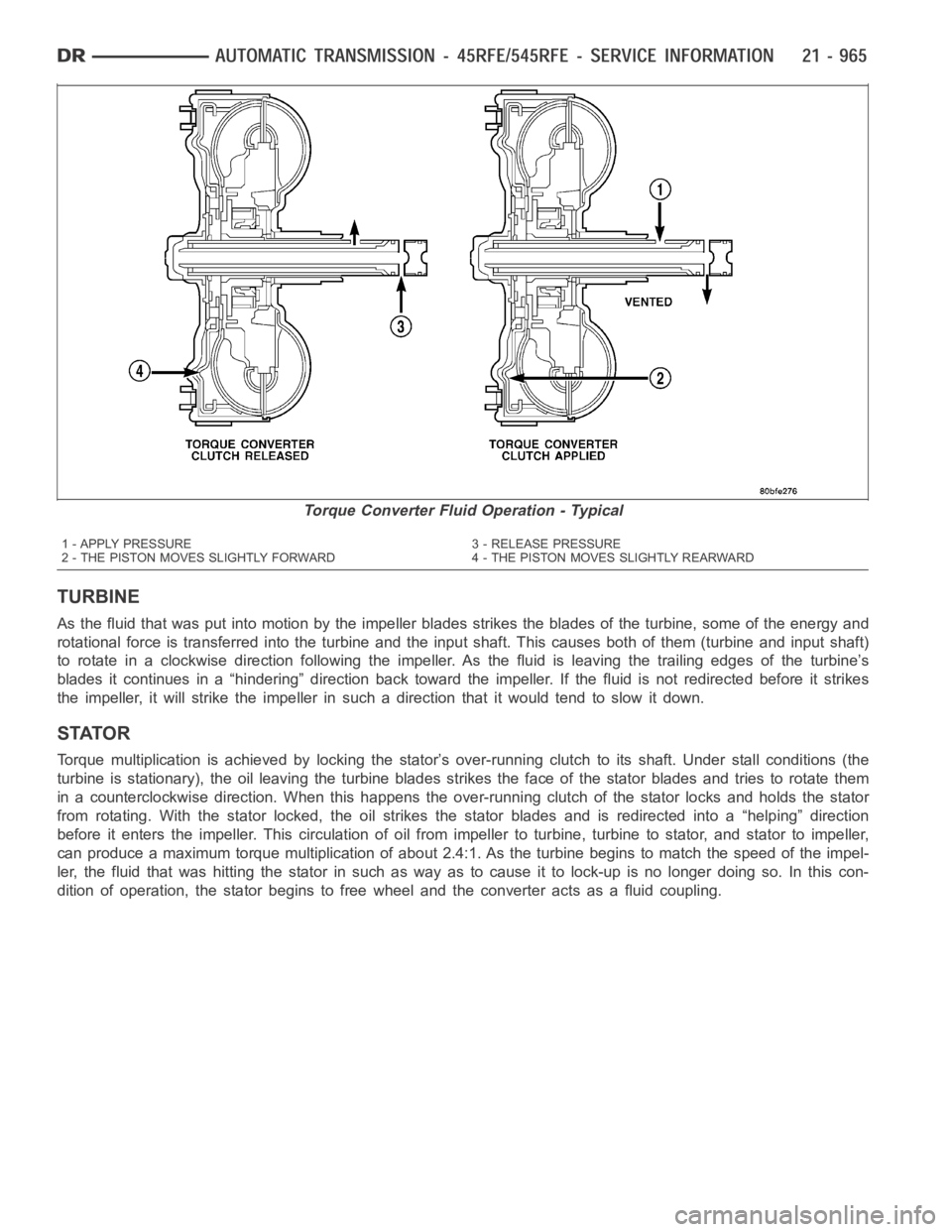
TURBINE
As the fluid that was put into motion bythe impeller blades strikes the blades of the turbine, some of the energy and
rotational force is transferred into the turbine and the input shaft. Thiscauses both of them (turbine and input shaft)
to rotate in a clockwise direction following the impeller. As the fluid is leaving the trailing edges of the turbine’s
blades it continues in a “hindering” direction back toward the impeller. If the fluid is not redirected before it strikes
the impeller, it will strike the impeller in such a direction that it would tend to slow it down.
STATOR
Torque multiplication is achieved by locking the stator’s over-running clutch to its shaft. Under stall conditions (the
turbine is stationary), the oil leaving the turbine blades strikes the face of the stator blades and tries to rotate them
in a counterclockwise direction. When this happens the over-running clutch of the stator locks and holds the stator
from rotating. With the stator locked, the oil strikes the stator blades and is redirected into a “helping” direction
before it enters the impeller. This circulation of oil from impeller to turbine, turbine to stator, and stator to impeller,
can produce a maximum torque multiplicationofabout2.4:1.Astheturbinebegins to match the speed of the impel-
ler, the fluid that was hitting the stator in such as way as to cause it to lock-up is no longer doing so. In this con-
dition of operation, the stator begins to free wheel and the converter actsas a fluid coupling.
Torque Converter Fluid Operation - Typical
1 - APPLY PRESSURE 3 - RELEASE PRESSURE
2 - THE PISTON MOVES SLIGHTLY FORWARD 4 - THE PISTON MOVES SLIGHTLY REARWARD
Page 3792 of 5267
OPERATION
The application of each driving or holding component is controlled by the valve body based upon the manual lever
position, throttle pressure, and governor pressure. The governor pressure is a variable pressure input to the valve
body and is one of the signals that a shift is necessary. First through fourth gear are obtained by selectively apply-
ing and releasing the different clutches and bands. Engine power is thereby routed to the various planetary gear
assemblies which combine with the overrunning clutch assemblies to generate the different gear ratios. The torque
converter clutch is hydraulically applied and is released when fluid is vented from the hydraulic circuit by the torque
converter control (TCC) solenoid on the valve body. The torque converter clutch is controlled by the Powertrain
Control Module (PCM). The torque converter clutch engages in fourth gear,and in third gear under various condi-
tions, such as when the O/D switch is OFF, when the vehicle is cruising on a level surface after the vehicle has
warmed up. The torque converter clutch can also be engaged in the MANUAL SECOND gear position if high trans-
mission temperatures are sensed by the PCM. The torque converter clutch will disengage momentarily when an
increase in engine load is sensed by the PCM, such as when the vehicle beginsto go uphill or the throttle pressure
is increased. The torque converter clutch feature increases fuel economyand reduces the transmission fluid tem-
perature.
Since the overdrive clutch is applied in fourth gear only and the direct clutch is applied in all ranges except fourth
gear, the transmission operation for park, neutral, and first through third gear will be described first. Once these
powerflows are described, the third to fourth shift sequence will be described.
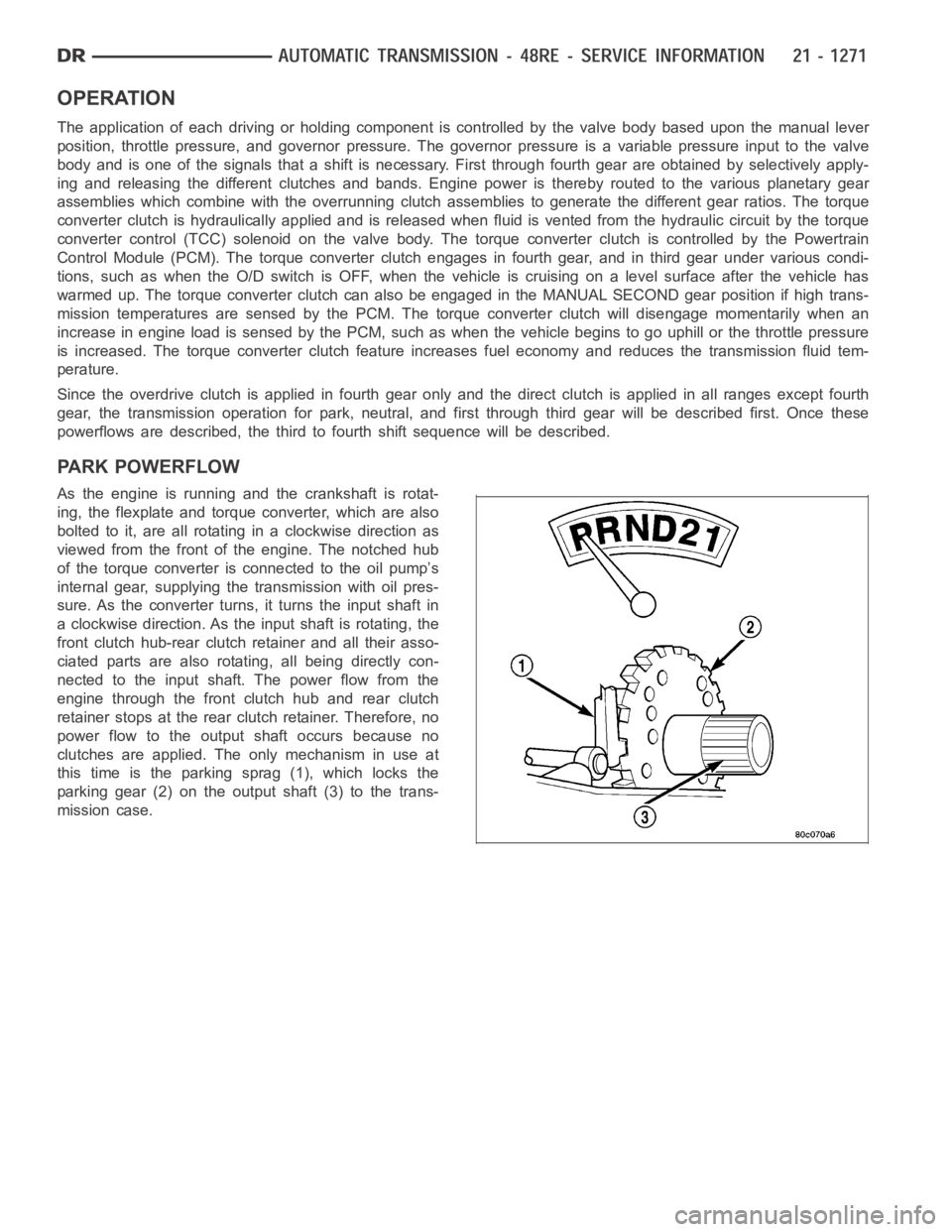
PARK POWERFLOW
As the engine is running and the crankshaft is rotat-
ing, the flexplate and torque converter, which are also
bolted to it, are all rotating in a clockwise direction as
viewed from the front of the engine. The notched hub
of the torque converter is connected to the oil pump’s
internal gear, supplying the transmission with oil pres-
sure. As the converter turns, it turns the input shaft in
a clockwise direction. As the input shaft is rotating, the
front clutch hub-rear clutch retainer and all their asso-
ciated parts are also rotating, all being directly con-
nected to the input shaft. The power flow from the
engine through the front clutch hub and rear clutch
retainer stops at the rear clutch retainer. Therefore, no
power flow to the output shaft occurs because no
clutches are applied. The only mechanism in use at
this time is the parking sprag (1), which locks the
parking gear (2) on the output shaft (3) to the trans-
mission case.
Page 3794 of 5267
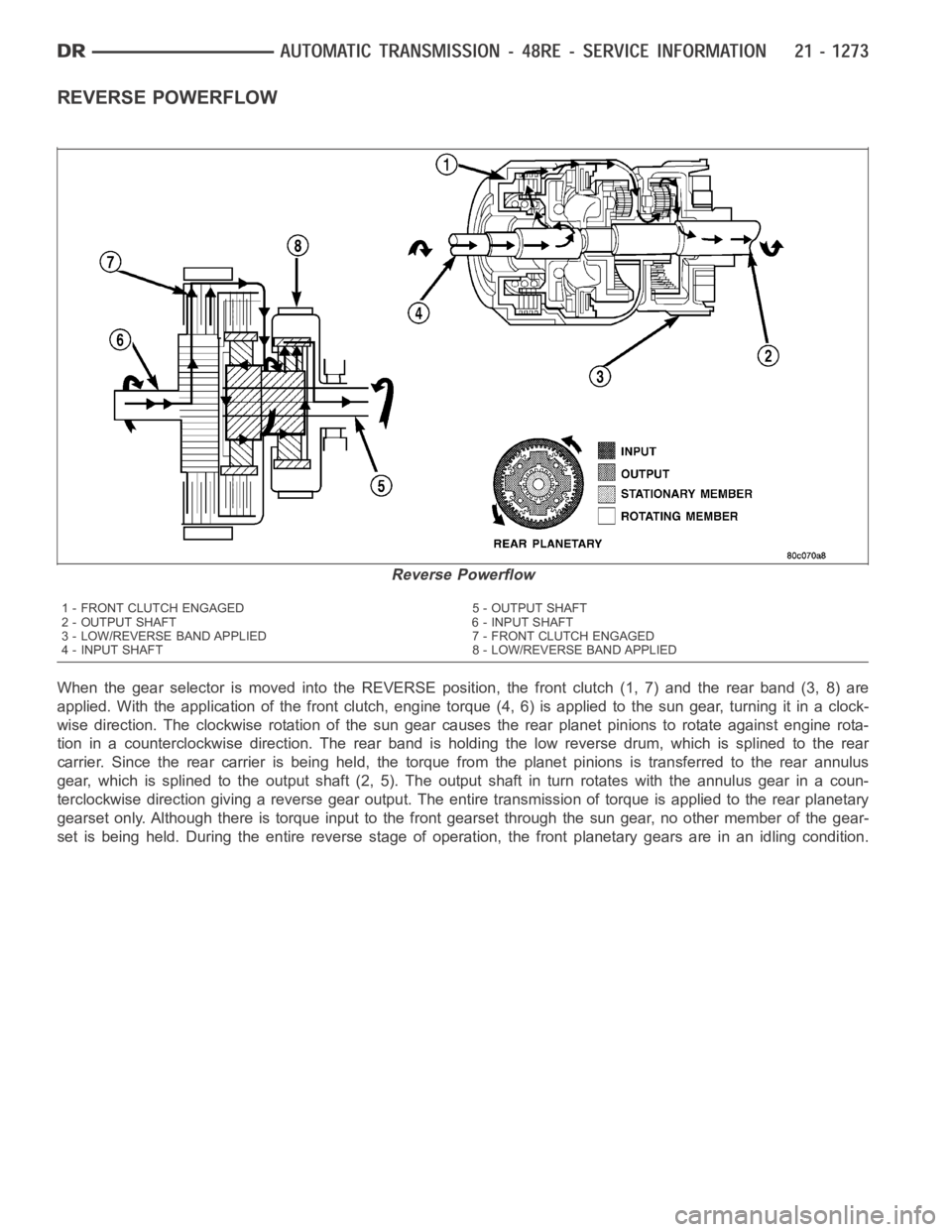
REVERSE POWERFLOW
When the gear selector is moved into the REVERSE position, the front clutch(1, 7) and the rear band (3, 8) are
applied. With the application of the front clutch, engine torque (4, 6) is applied to the sun gear, turning it in a clock-
wise direction. The clockwise rotation of the sun gear causes the rear planet pinions to rotate against engine rota-
tion in a counterclockwise direction. The rear band is holding the low reverse drum, which is splined to the rear
carrier. Since the rear carrier is being held, the torque from the planet pinions is transferred to the rear annulus
gear, which is splined to the output shaft (2, 5). The output shaft in turn rotates with the annulus gear in a coun-
terclockwise direction giving a reverse gear output. The entire transmission of torque is applied to the rear planetary
gearset only. Although there is torque input to the front gearset through the sun gear, no other member of the gear-
set is being held. During the entire reverse stage of operation, the front planetary gears are in an idling condition.
Reverse Powerflow
1 - FRONT CLUTCH ENGAGED 5 - OUTPUT SHAFT
2 - OUTPUT SHAFT 6 - INPUT SHAFT
3 - LOW/REVERSE BAND APPLIED 7 - FRONT CLUTCH ENGAGED
4 - INPUT SHAFT 8 - LOW/REVERSE BAND APPLIED
Page 3795 of 5267
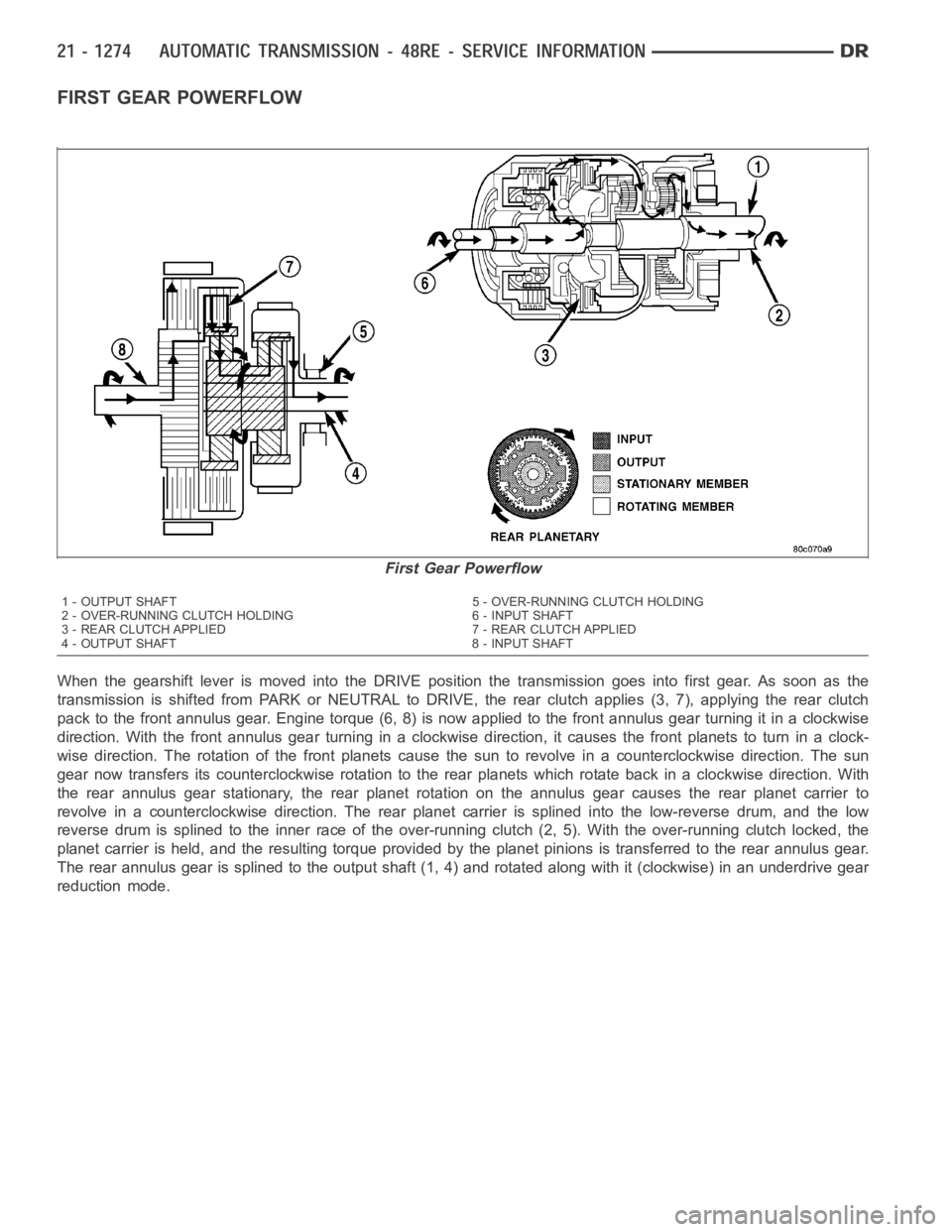
FIRST GEAR POWERFLOW
When the gearshift lever is moved into the DRIVE position the transmissiongoes into first gear. As soon as the
transmission is shifted from PARK or NEUTRAL to DRIVE, the rear clutch applies (3, 7), applying the rear clutch
pack to the front annulus gear. Engine torque (6, 8) is now applied to the front annulus gear turning it in a clockwise
direction. With the front annulus gear turning in a clockwise direction, it causes the front planets to turn in a clock-
wise direction. The rotation of the front planets cause the sun to revolve in a counterclockwise direction. The sun
gear now transfers its counterclockwise rotation to the rear planets which rotate back in a clockwise direction. With
the rear annulus gear stationary, the rear planet rotation on the annulus gear causes the rear planet carrier to
revolve in a counterclockwise direction. The rear planet carrier is splined into the low-reverse drum, and the low
reverse drum is splined to the inner race of the over-running clutch (2, 5).With the over-running clutch locked, the
planet carrier is held, and the resulting torque provided by the planet pinions is transferred to the rear annulus gear.
The rear annulus gear is splined to the output shaft (1, 4) and rotated alongwith it (clockwise) in an underdrive gear
reduction mode.
First Gear Powerflow
1 - OUTPUT SHAFT 5 - OVER-RUNNING CLUTCH HOLDING
2 - OVER-RUNNING CLUTCH HOLDING 6 - INPUT SHAFT
3 - REAR CLUTCH APPLIED 7 - REAR CLUTCH APPLIED
4 - OUTPUT SHAFT 8 - INPUT SHAFT
Page 3796 of 5267
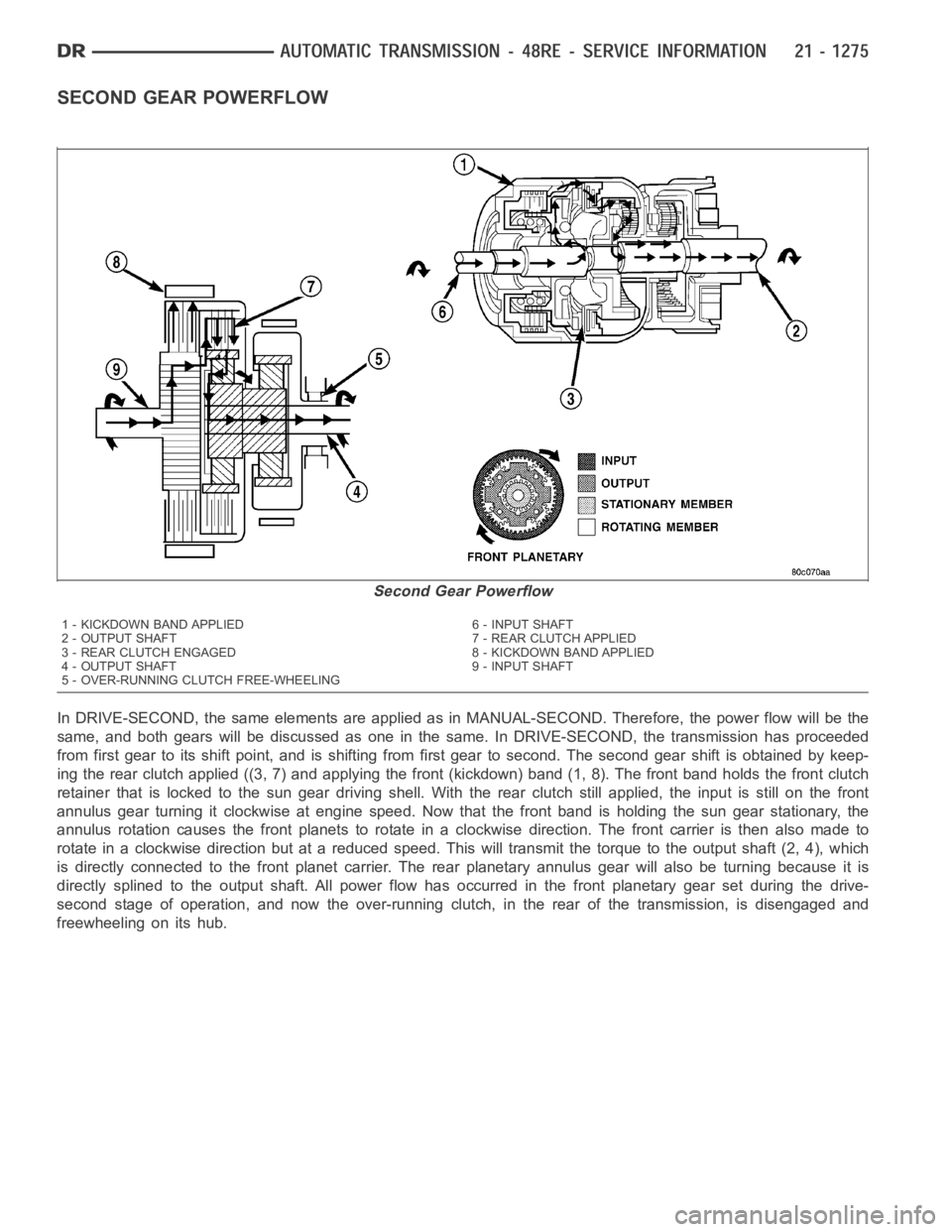
SECOND GEAR POWERFLOW
In DRIVE-SECOND, the same elements are applied as in MANUAL-SECOND. Therefore, the power flow will be the
same, and both gears will be discussed as one in the same. In DRIVE-SECOND, the transmission has proceeded
from first gear to its shift point, and is shifting from first gear to second. The second gear shift is obtained by keep-
ing the rear clutch applied ((3, 7) and applying the front (kickdown) band (1, 8). The front band holds the front clutch
retainer that is locked to the sun gear driving shell. With the rear clutch still applied, the input is still on the front
annulus gear turning it clockwise at engine speed. Now that the front band is holding the sun gear stationary, the
annulus rotation causes the front planets to rotate in a clockwise direction. The front carrier is then also made to
rotate in a clockwise direction but at a reduced speed. This will transmit the torque to the output shaft (2, 4), which
is directly connected to the front planet carrier. The rear planetary annulus gear will also be turning because it is
directly splined to the output shaft. All power flow has occurred in the front planetary gear set during the drive-
second stage of operation, and now the over-running clutch, in the rear of the transmission, is disengaged and
freewheeling on its hub.
Second Gear Powerflow
1 - KICKDOWN BAND APPLIED 6 - INPUT SHAFT
2 - OUTPUT SHAFT 7 - REAR CLUTCH APPLIED
3 - REAR CLUTCH ENGAGED 8 - KICKDOWN BAND APPLIED
4 - OUTPUT SHAFT 9 - INPUT SHAFT
5 - OVER-RUNNING CLUTCH FREE-WHEELING
Page 3797 of 5267
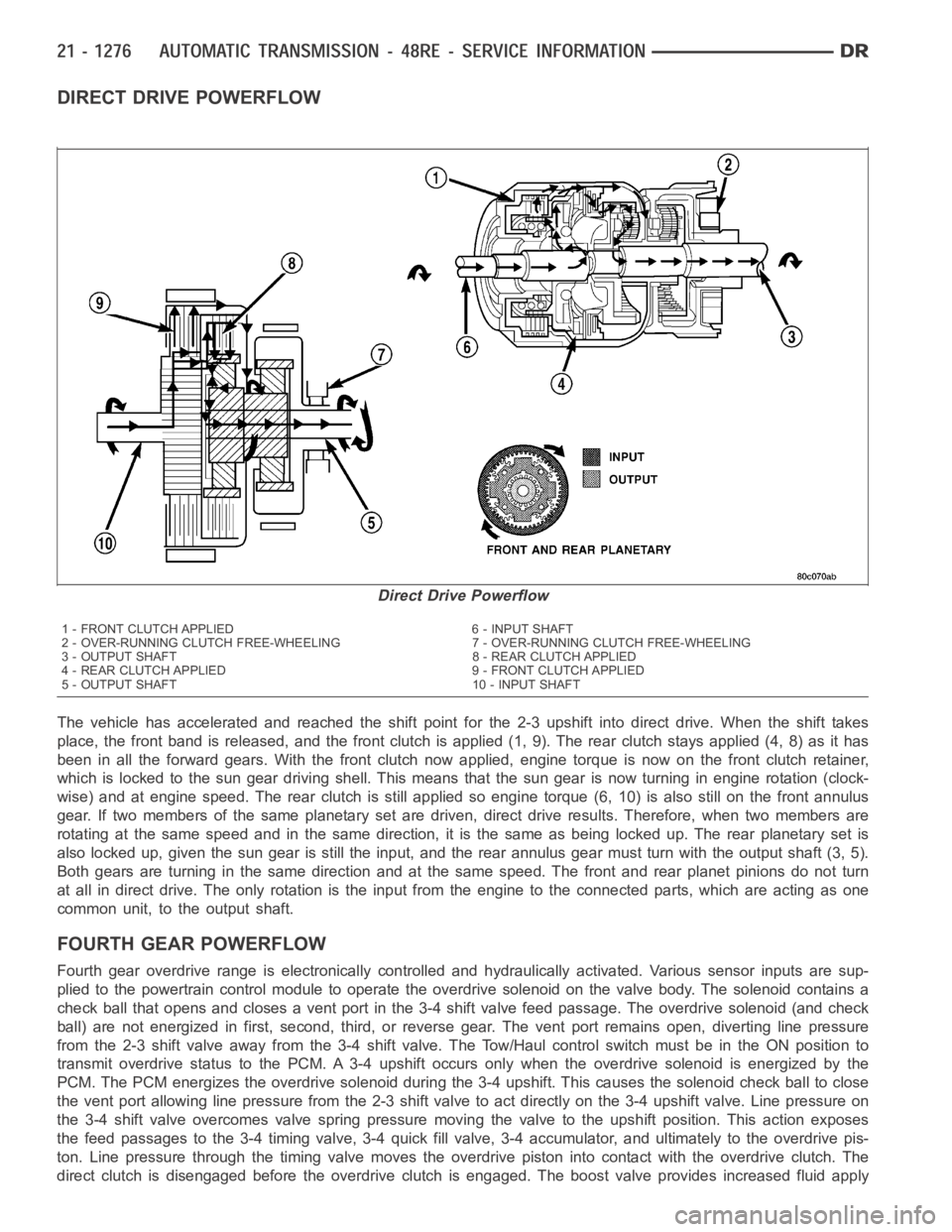
DIRECT DRIVE POWERFLOW
The vehicle has accelerated and reached the shift point for the 2-3 upshiftinto direct drive. When the shift takes
place, the front band is released, and the front clutch is applied (1, 9). The rear clutch stays applied (4, 8) as it has
been in all the forward gears. With the front clutch now applied, engine torque is now on the front clutch retainer,
which is locked to the sun gear drivingshell. This means that the sun gear isnow turning in engine rotation (clock-
wise) and at engine speed. The rear clutch is still applied so engine torque(6, 10) is also still on the front annulus
gear. If two members of the same planetary set are driven, direct drive results. Therefore, when two members are
rotating at the same speed and in the same direction, it is the same as being locked up. The rear planetary set is
also locked up, given the sun gear is still the input, and the rear annulus gear must turn with the output shaft (3, 5).
Both gears are turning in the same direction and at the same speed. The frontand rear planet pinions do not turn
at all in direct drive. The only rotation is the input from the engine to the connected parts, which are acting as one
common unit, to the output shaft.
FOURTHGEARPOWERFLOW
Fourth gear overdrive range is electronically controlled and hydraulically activated. Various sensor inputs are sup-
plied to the powertrain control module to operate the overdrive solenoid on the valve body. The solenoid contains a
check ball that opens and closes a vent port in the 3-4 shift valve feed passage. The overdrive solenoid (and check
ball) are not energized in first, second, third, or reverse gear. The vent port remains open, diverting line pressure
from the 2-3 shift valve away from the 3-4 shift valve. The Tow/Haul controlswitch must be in the ON position to
transmit overdrive status to the PCM. A 3-4 upshift occurs only when the overdrive solenoid is energized by the
PCM. The PCM energizes the overdrive solenoid during the 3-4 upshift. Thiscauses the solenoid check ball to close
the vent port allowing line pressure from the 2-3 shift valve to act directly on the 3-4 upshift valve. Line pressure on
the 3-4 shift valve overcomes valve spring pressure moving the valve to theupshift position. This action exposes
the feed passages to the 3-4 timing valve, 3-4 quick fill valve, 3-4 accumulator, and ultimately to the overdrive pis-
ton. Line pressure through the timing valve moves the overdrive piston into contact with the overdrive clutch. The
direct clutch is disengaged before the overdrive clutch is engaged. The boost valve provides increased fluid apply
Direct Drive Powerflow
1 - FRONT CLUTCH APPLIED 6 - INPUT SHAFT
2 - OVER-RUNNING CLUTCH FREE-WHEELING 7 - OVER-RUNNING CLUTCH FREE-WHEELING
3 - OUTPUT SHAFT 8 - REAR CLUTCH APPLIED
4 - REAR CLUTCH APPLIED 9 - FRONT CLUTCH APPLIED
5 - OUTPUT SHAFT 10 - INPUT SHAFT
Page 3815 of 5267
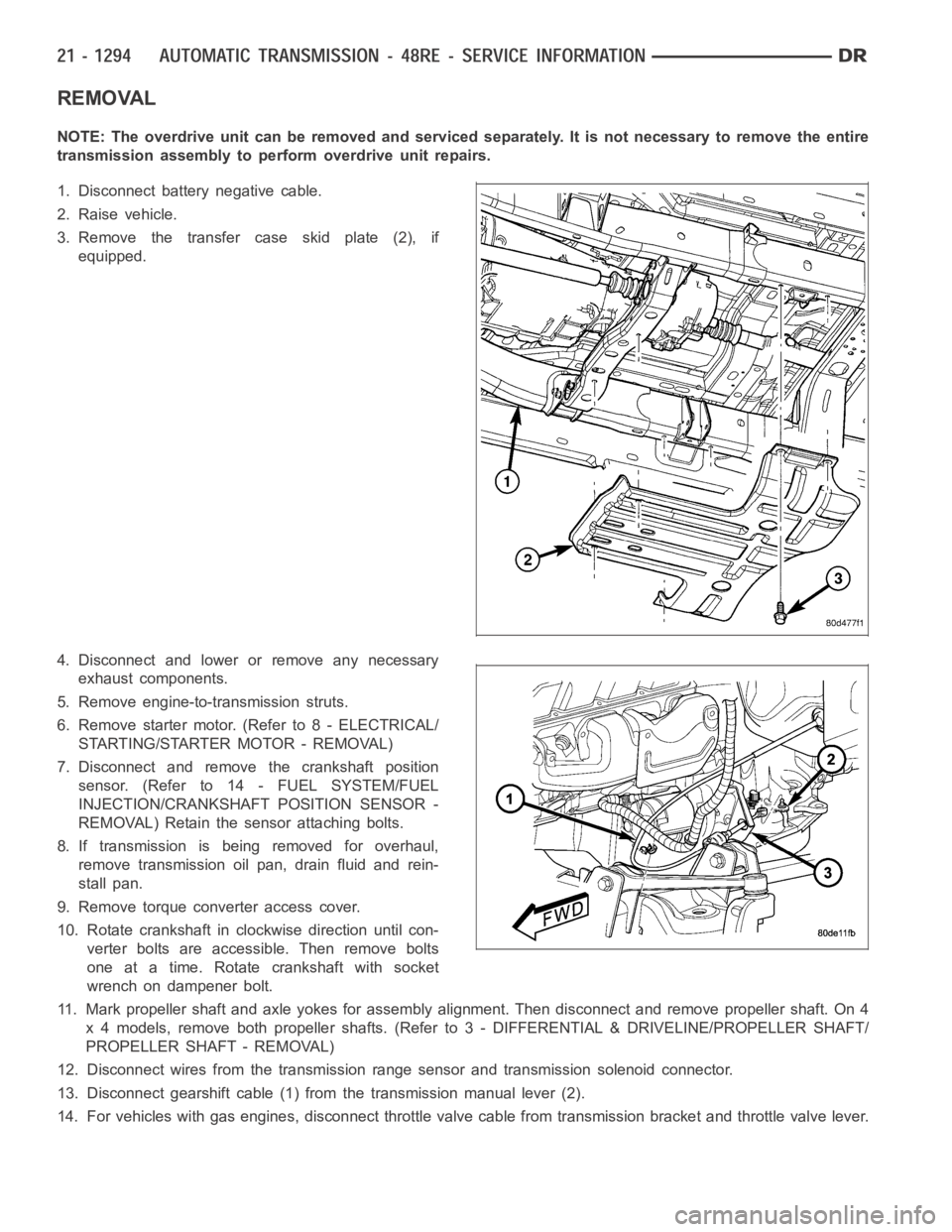
REMOVAL
NOTE: The overdrive unit can be removed and serviced separately. It is not necessary to remove the entire
transmission assembly to perform overdrive unit repairs.
1. Disconnect battery negative cable.
2. Raise vehicle.
3. Remove the transfer case skid plate (2), if
equipped.
4. Disconnect and lower or remove any necessary
exhaust components.
5. Remove engine-to-transmission struts.
6. Remove starter motor. (Refer to 8 - ELECTRICAL/
STARTING/STARTER MOTOR - REMOVAL)
7. Disconnect and remove the crankshaft position
sensor. (Refer to 14 - FUEL SYSTEM/FUEL
INJECTION/CRANKSHAFT POSITION SENSOR -
REMOVAL) Retain the sensor attaching bolts.
8. If transmission is being removed for overhaul,
remove transmission oil pan, drain fluid and rein-
stall pan.
9. Remove torque converter access cover.
10. Rotate crankshaft in clockwise direction until con-
verter bolts are accessible. Then remove bolts
one at a time. Rotate crankshaft with socket
wrench on dampener bolt.
11. Mark propeller shaft and axle yokes for assembly alignment. Then disconnect and remove propeller shaft. On 4
x 4 models, remove both propeller shafts. (Refer to 3 - DIFFERENTIAL & DRIVELINE/PROPELLER SHAFT/
PROPELLER SHAFT - REMOVAL)
12. Disconnect wires from the transmission range sensor and transmissionsolenoid connector.
13. Disconnect gearshift cable (1) from the transmission manual lever (2).
14. For vehicles with gas engines, disconnect throttle valve cable from transmission bracket andthrottle valve lever.
Page 3816 of 5267
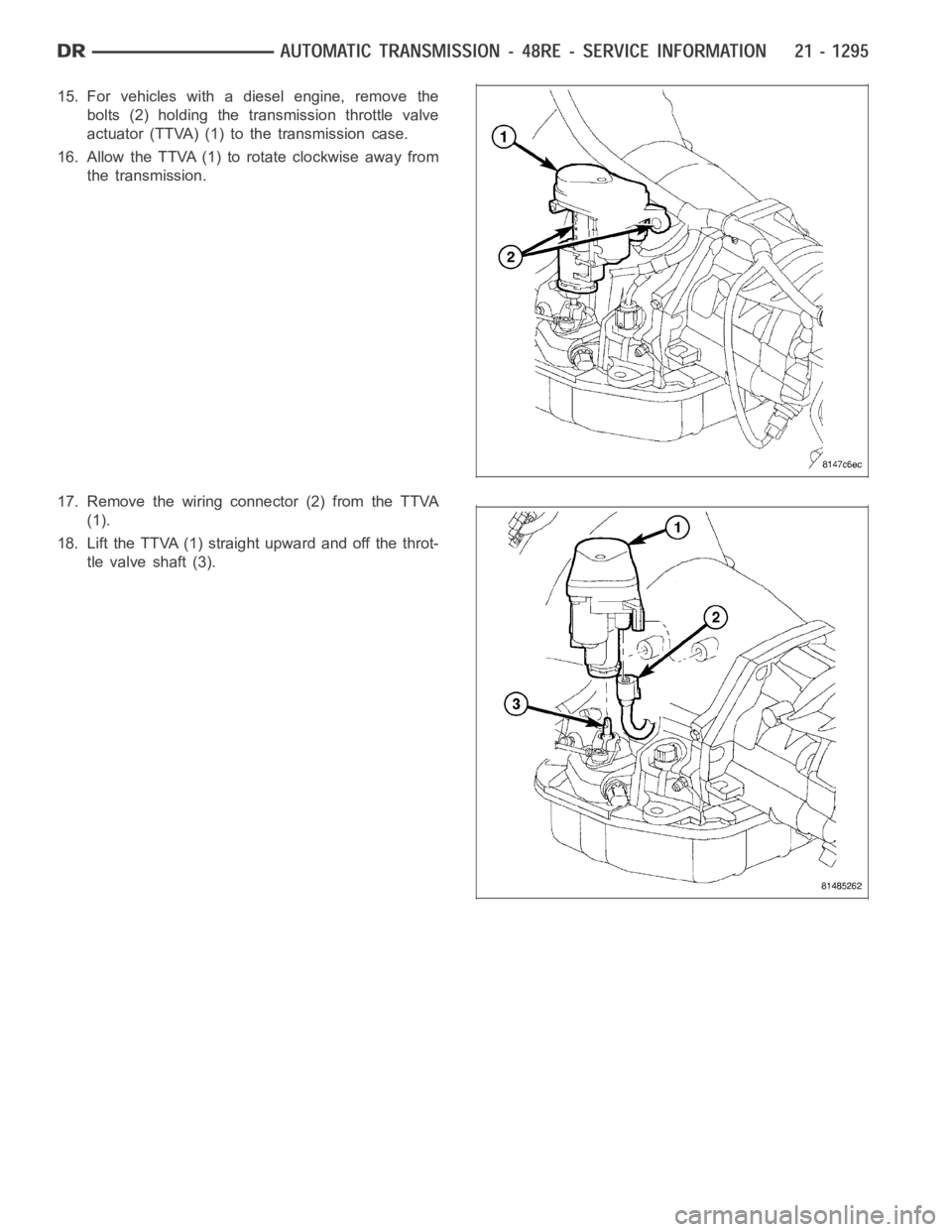
15. For vehicles with a diesel engine, remove the
bolts (2) holding the transmission throttle valve
actuator (TTVA) (1) to the transmission case.
16. Allow the TTVA (1) to rotate clockwise away from
the transmission.
17. Remove the wiring connector (2) from the TTVA
(1).
18. Lift the TTVA (1) straight upward and off the throt-
tle valve shaft (3).
Page 3907 of 5267
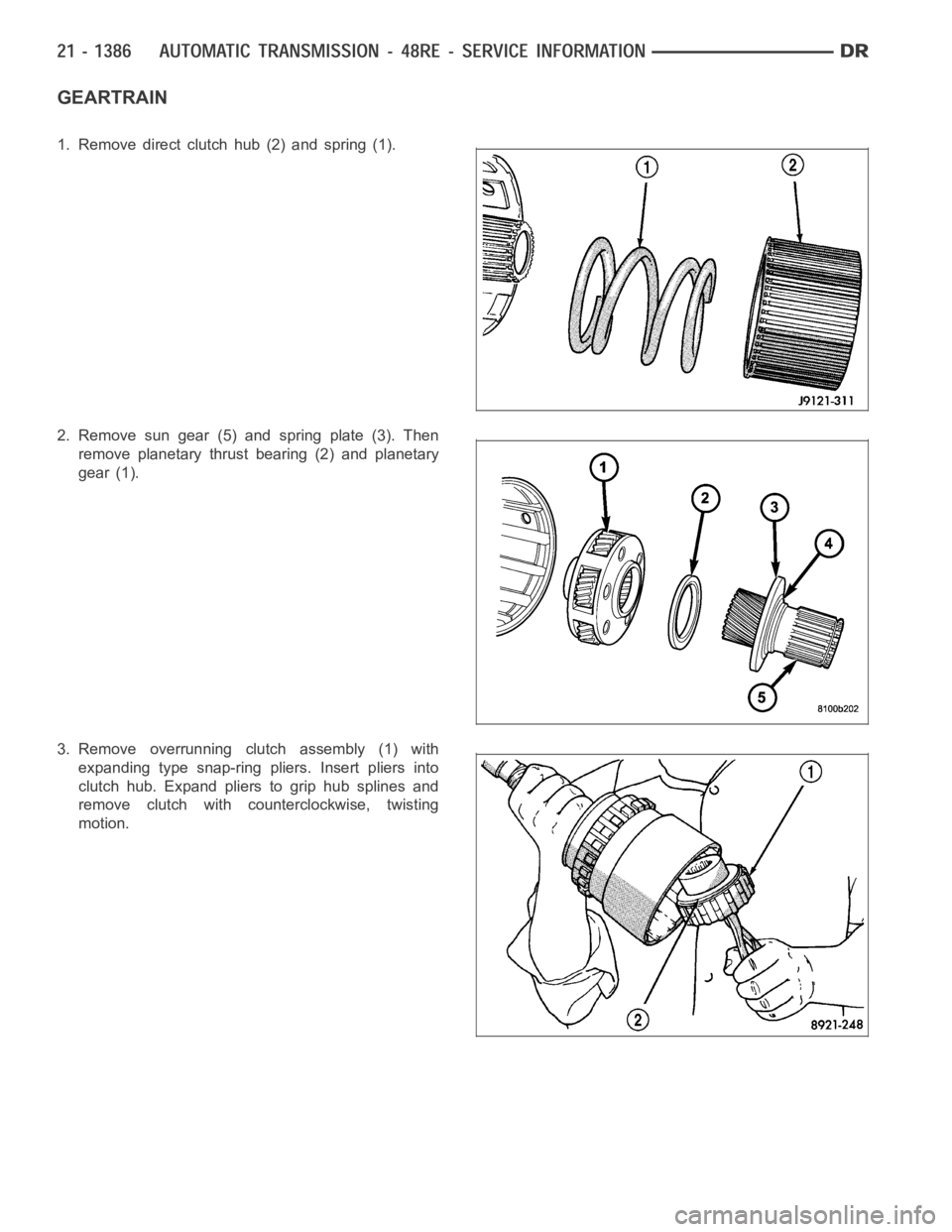
GEARTRAIN
1. Remove direct clutch hub (2) and spring (1).
2. Remove sun gear (5) and spring plate (3). Then
remove planetary thrust bearing (2) and planetary
gear (1).
3. Remove overrunning clutch assembly (1) with
expanding type snap-ring pliers. Insert pliers into
clutch hub. Expand pliers to grip hub splines and
remove clutch with counterclockwise, twisting
motion.
Page 3912 of 5267
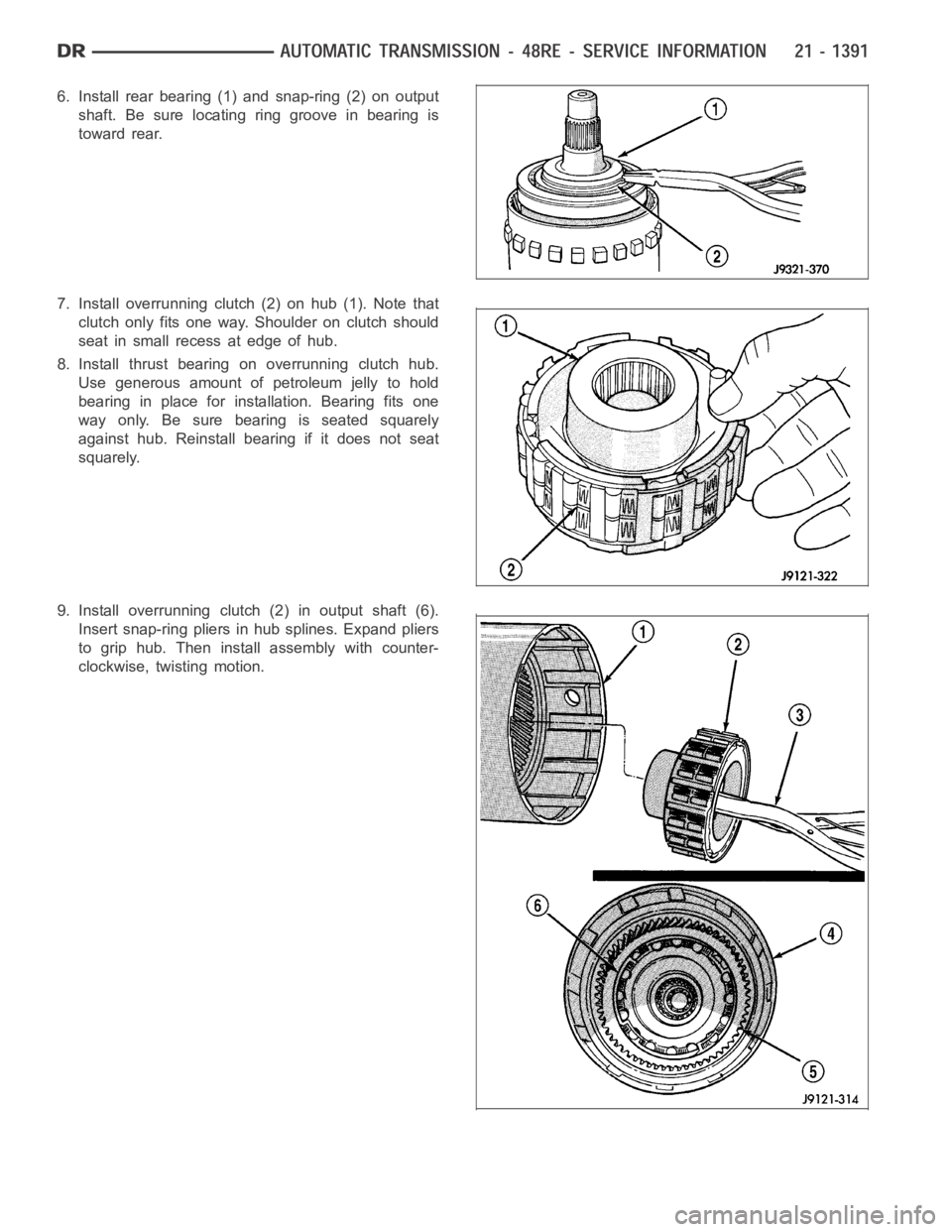
6. Install rear bearing (1) and snap-ring (2) on output
shaft. Be sure locating ring groove in bearing is
toward rear.
7. Install overrunning clutch (2) on hub (1). Note that
clutch only fits one way. Shoulder on clutch should
seat in small recess at edge of hub.
8. Install thrust bearing on overrunning clutch hub.
Use generous amount of petroleum jelly to hold
bearing in place for installation. Bearing fits one
way only. Be sure bearing is seated squarely
against hub. Reinstall bearing if it does not seat
squarely.
9. Install overrunning clutch (2) in output shaft (6).
Insert snap-ring pliers inhub splines. Expand pliers
to grip hub. Then install assembly with counter-
clockwise, twisting motion.