clock DODGE RAM SRT-10 2006 Service Owners Manual
[x] Cancel search | Manufacturer: DODGE, Model Year: 2006, Model line: RAM SRT-10, Model: DODGE RAM SRT-10 2006Pages: 5267, PDF Size: 68.7 MB
Page 3923 of 5267
RETAINER-OVERRUNNING CLUTCH CAM/OVERDRIVE PISTON
DESCRIPTION
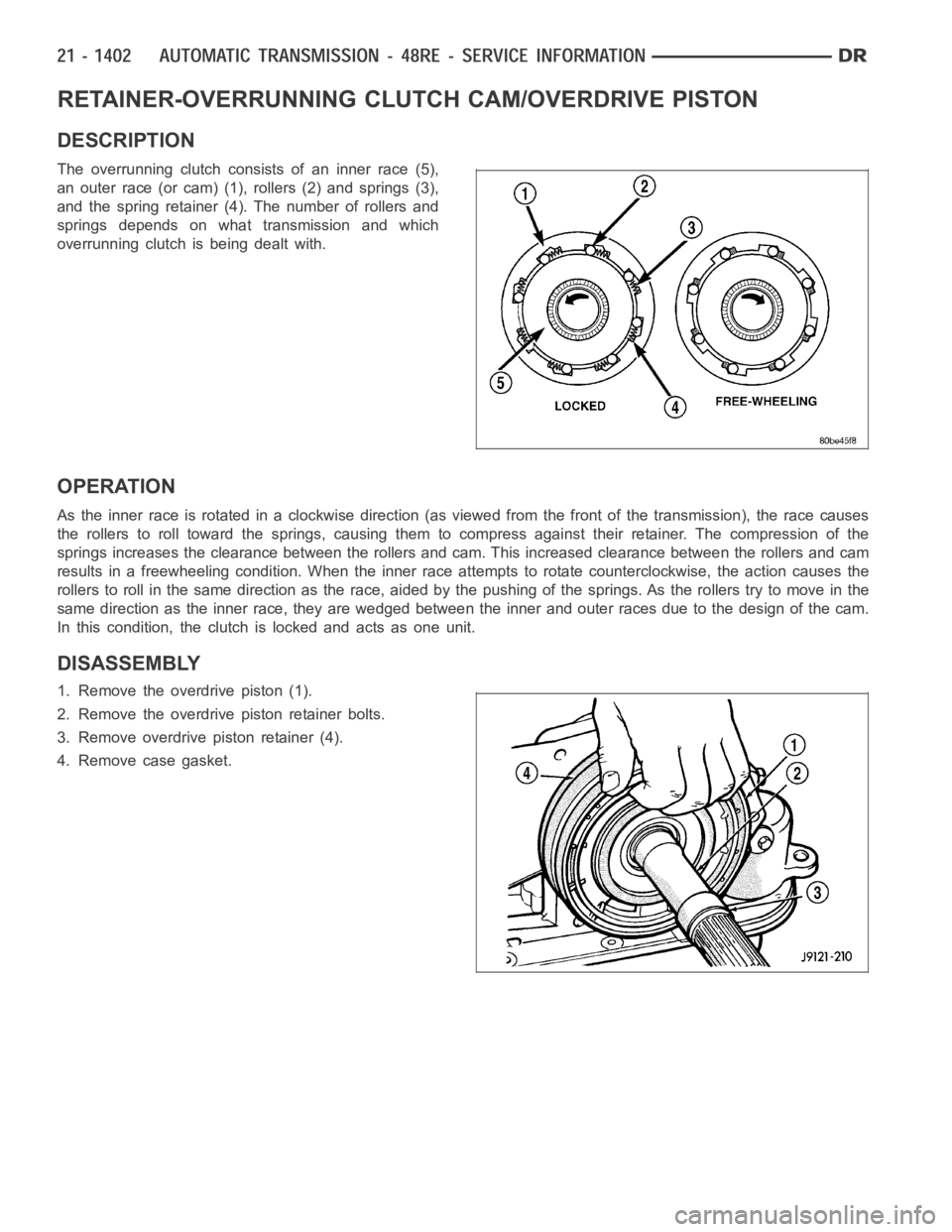
The overrunning clutch consists of an inner race (5),
an outer race (or cam) (1), rollers (2) and springs (3),
and the spring retainer (4). The number of rollers and
springs depends on what transmission and which
overrunning clutch is being dealt with.
OPERATION
Astheinnerraceisrotatedinaclockwisedirection(asviewedfromthefront of the transmission), the race causes
the rollers to roll toward the springs, causing them to compress against their retainer. The compression of the
springs increases the clearance between the rollers and cam. This increased clearance between the rollers and cam
results in a freewheeling condition. When the inner race attempts to rotate counterclockwise, the action causes the
rollers to roll in the same direction as the race, aided by the pushing of thesprings. As the rollers try to move in the
same direction as the inner race, they are wedged between the inner and outer races due to the design of the cam.
In this condition, the clutch is locked and acts as one unit.
DISASSEMBLY
1. Remove the overdrive piston (1).
2. Remove the overdrive piston retainer bolts.
3. Remove overdrive piston retainer (4).
4. Remove case gasket.
Page 3945 of 5267
ACTUATOR-THROTTLE VALVE
DESCRIPTION
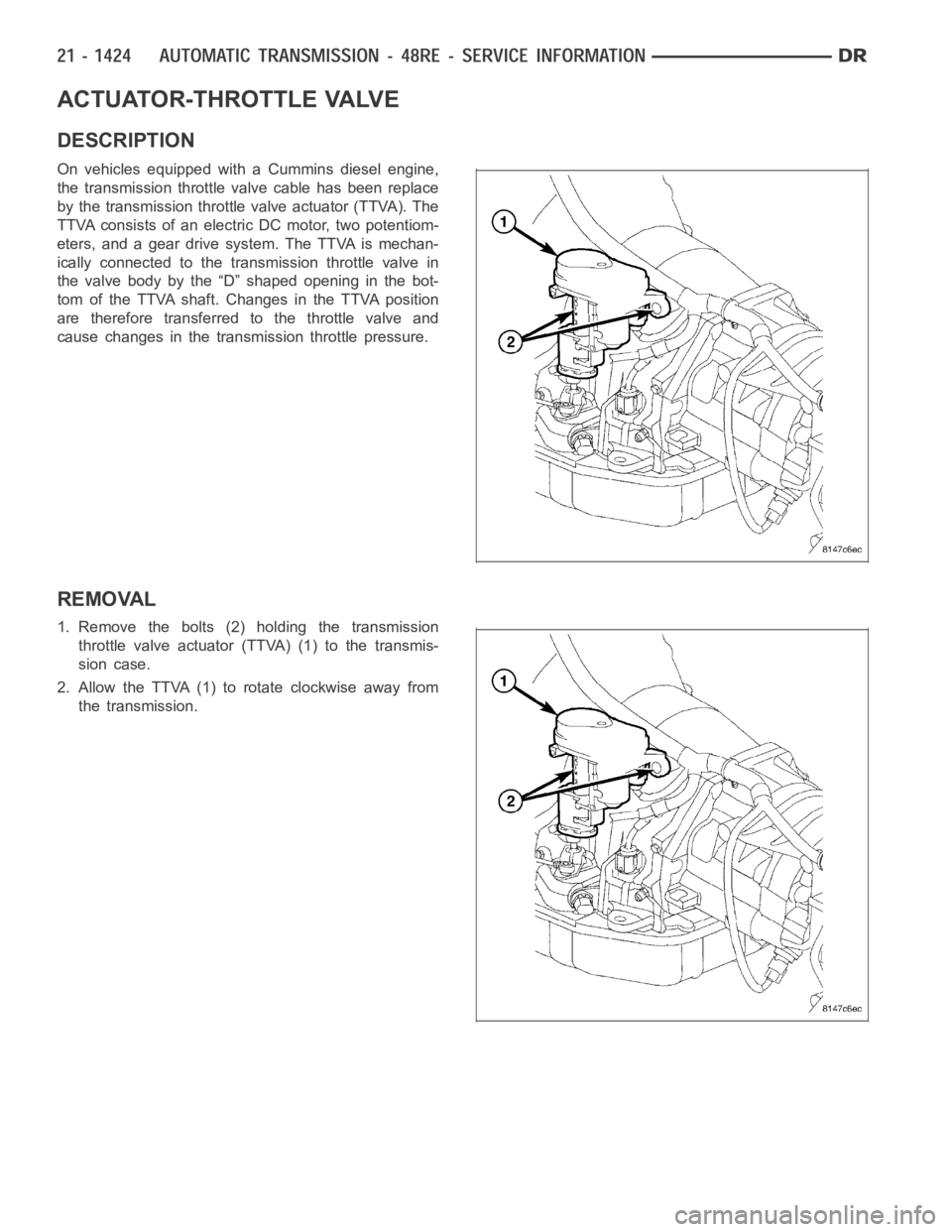
On vehicles equipped with a Cummins diesel engine,
the transmission throttle valve cable has been replace
by the transmission throttle valve actuator (TTVA). The
TTVA consists of an electric DC motor, two potentiom-
eters, and a gear drive system. The TTVA is mechan-
ically connected to the transmission throttle valve in
the valve body by the “D” shaped opening in the bot-
tom of the TTVA shaft. Changes in the TTVA position
are therefore transferred to the throttle valve and
cause changes in the transmission throttle pressure.
REMOVAL
1. Remove the bolts (2) holding the transmission
throttle valve actuator (TTVA) (1) to the transmis-
sion case.
2. Allow the TTVA (1) to rotate clockwise away from
the transmission.
Page 3954 of 5267
TURBINE
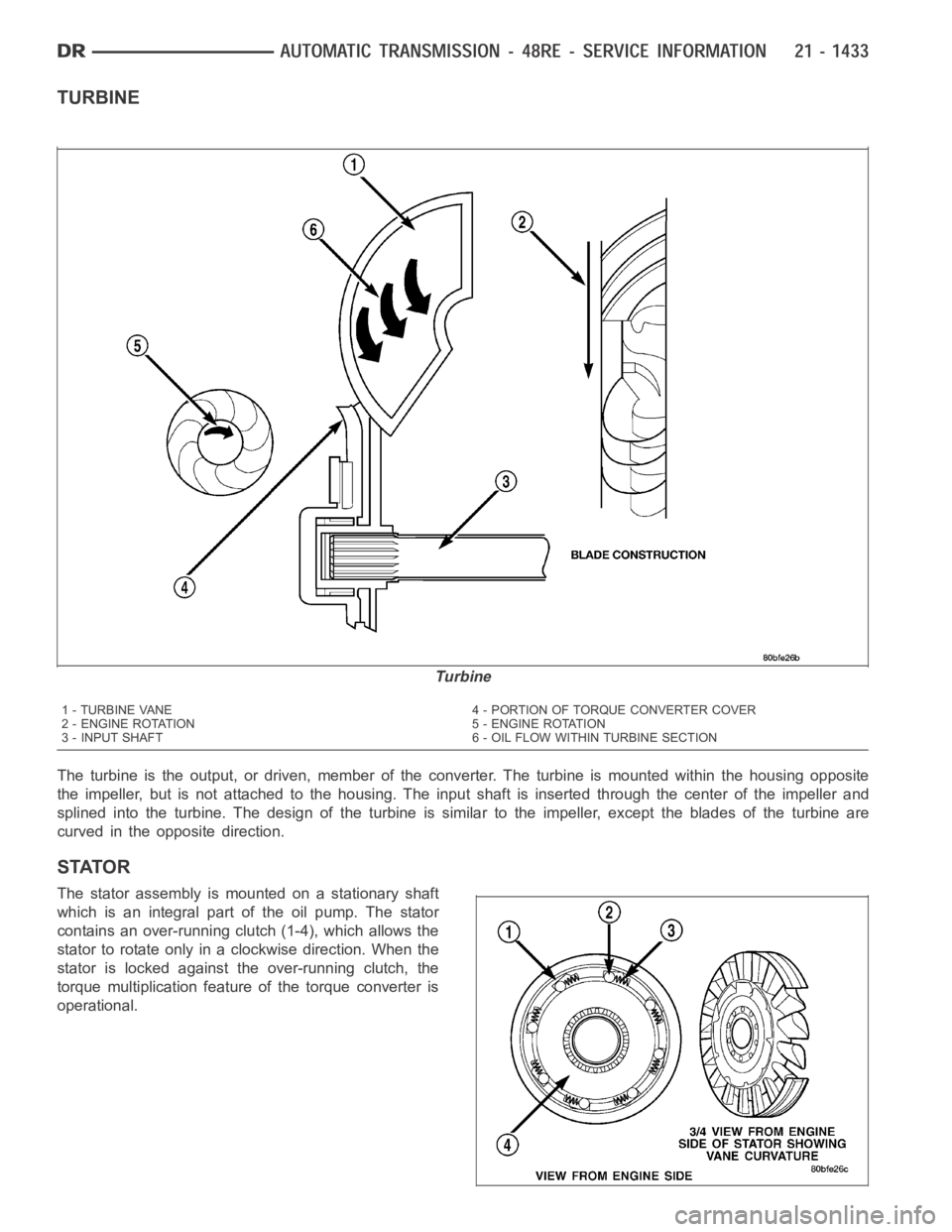
The turbine is the output, or driven, member of the converter. The turbine is mounted within the housing opposite
the impeller, but is not attached to the housing. The input shaft is inserted through the center of the impeller and
splined into the turbine. The design of the turbine is similar to the impeller, except the blades of the turbine are
curved in the opposite direction.
STATOR
The stator assembly is mounted on a stationary shaft
which is an integral part of the oil pump. The stator
contains an over-running clutch (1-4), which allows the
stator to rotate only in a clockwise direction. When the
stator is locked against theover-runningclutch,the
torque multiplication feature of the torque converter is
operational.
Turbine
1 - TURBINE VANE 4 - PORTION OF TORQUE CONVERTER COVER
2 - ENGINE ROTATION 5 - ENGINE ROTATION
3 - INPUT SHAFT 6 - OIL FLOW WITHIN TURBINE SECTION
Page 3956 of 5267
OPERATION
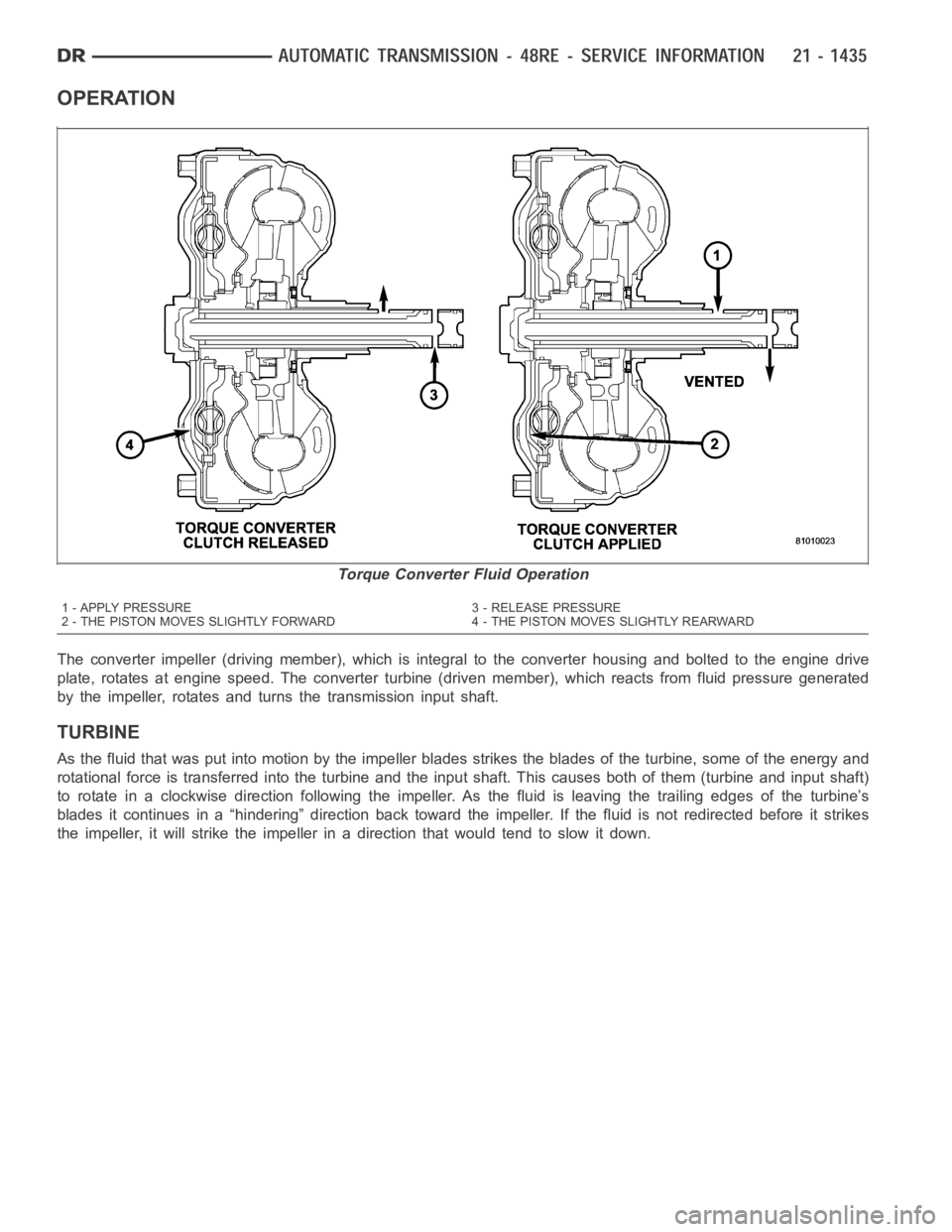
The converter impeller (driving member), which is integral to the converter housing and bolted to the engine drive
plate, rotates at engine speed. The converter turbine (driven member), which reacts from fluid pressure generated
by the impeller, rotates and turns the transmission input shaft.
TURBINE
As the fluid that was put into motion bythe impeller blades strikes the blades of the turbine, some of the energy and
rotational force is transferred into the turbine and the input shaft. Thiscauses both of them (turbine and input shaft)
to rotate in a clockwise direction following the impeller. As the fluid is leaving the trailing edges of the turbine’s
blades it continues in a “hindering” direction back toward the impeller. If the fluid is not redirected before it strikes
the impeller, it will strike the impeller in a direction that would tend to slow it down.
Torque Converter Fluid Operation
1 - APPLY PRESSURE 3 - RELEASE PRESSURE
2 - THE PISTON MOVES SLIGHTLY FORWARD 4 - THE PISTON MOVES SLIGHTLY REARWARD
Page 3957 of 5267
STATOR
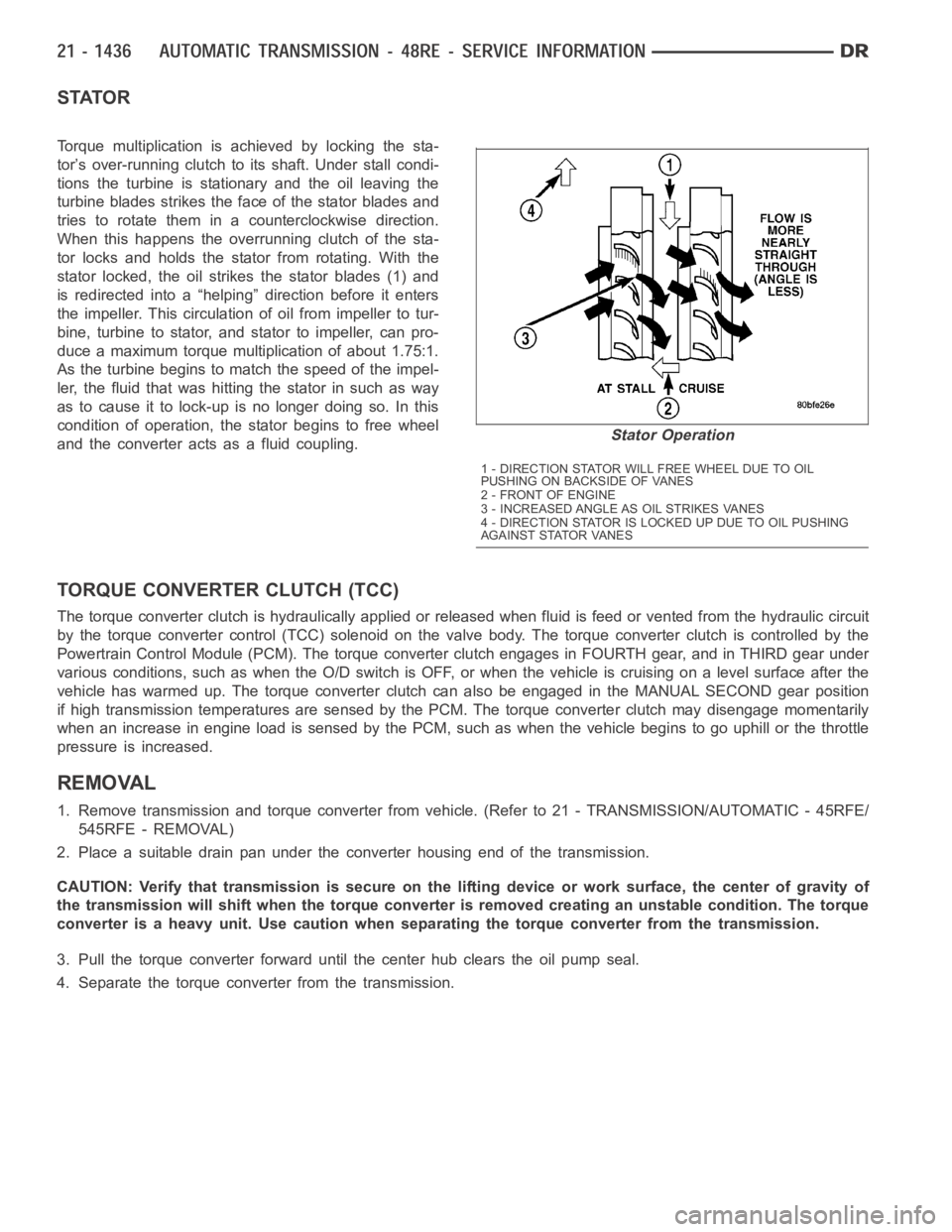
Torque multiplication is achieved by locking the sta-
tor’s over-running clutch to its shaft. Under stall condi-
tions the turbine is stationary and the oil leaving the
turbine blades strikes the face of the stator blades and
tries to rotate them in a counterclockwise direction.
When this happens the overrunning clutch of the sta-
tor locks and holds the stator from rotating. With the
stator locked, the oil strikes the stator blades (1) and
is redirected into a “helping” direction before it enters
the impeller. This circulation of oil from impeller to tur-
bine, turbine to stator, and stator to impeller, can pro-
duce a maximum torque multiplication of about 1.75:1.
As the turbine begins to match the speed of the impel-
ler, the fluid that was hitting the stator in such as way
as to cause it to lock-up is no longer doing so. In this
condition of operation, the stator begins to free wheel
and the converter acts as a fluid coupling.
TORQUE CONVERTER CLUTCH (TCC)
The torque converter clutch is hydraulically applied or released when fluid is feed or vented from the hydraulic circuit
by the torque converter control (TCC) solenoid on the valve body. The torque converter clutch is controlled by the
Powertrain Control Module (PCM). The torque converter clutch engages in FOURTH gear, and in THIRD gear under
various conditions, such as when the O/D switch is OFF, or when the vehicle is cruising on a level surface after the
vehicle has warmed up. The torque converter clutch can also be engaged in the MANUAL SECOND gear position
if high transmission temperatures are sensed by the PCM. The torque converter clutch may disengage momentarily
when an increase in engine load is sensed by the PCM, such as when the vehiclebegins to go uphill or the throttle
pressure is increased.
REMOVAL
1. Remove transmission and torque converter from vehicle. (Refer to 21 - TRANSMISSION/AUTOMATIC - 45RFE/
545RFE - REMOVAL)
2. Place a suitable drain pan under the converter housing end of the transmission.
CAUTION: Verify that transmission is secure on the lifting device or work surface, the center of gravity of
the transmission will shift when the torque converter is removed creatingan unstable condition. The torque
converter is a heavy unit. Use caution when separating the torque converter from the transmission.
3. Pull the torque converter forward until the center hub clears the oil pumpseal.
4. Separate the torque converter from the transmission.
Stator Operation
1 - DIRECTION STATOR WILL FREE WHEEL DUE TO OIL
PUSHING ON BACKSIDE OF VANES
2-FRONTOFENGINE
3 - INCREASED ANGLE AS OIL STRIKES VANES
4 - DIRECTION STATOR IS LOCKED UP DUE TO OIL PUSHING
AGAINST STATOR VANES
Page 4019 of 5267
19. Check and adjust gearshift and throttle valve cables, if necessary.
ADJUSTMENTS - VALVE BODY
CONTROL PRESSURE ADJUSTMENTS
There are two control pressure adjustments on the valve body;
Line Pressure
Throttle Pressure
Line and throttle pressures are interdependent because each affects shift quality and timing. As a result, both
adjustments must be performed properly and in the correct sequence. Adjust line pressure first and throttle pressure
last.
LINE PRESSURE ADJUSTMENT
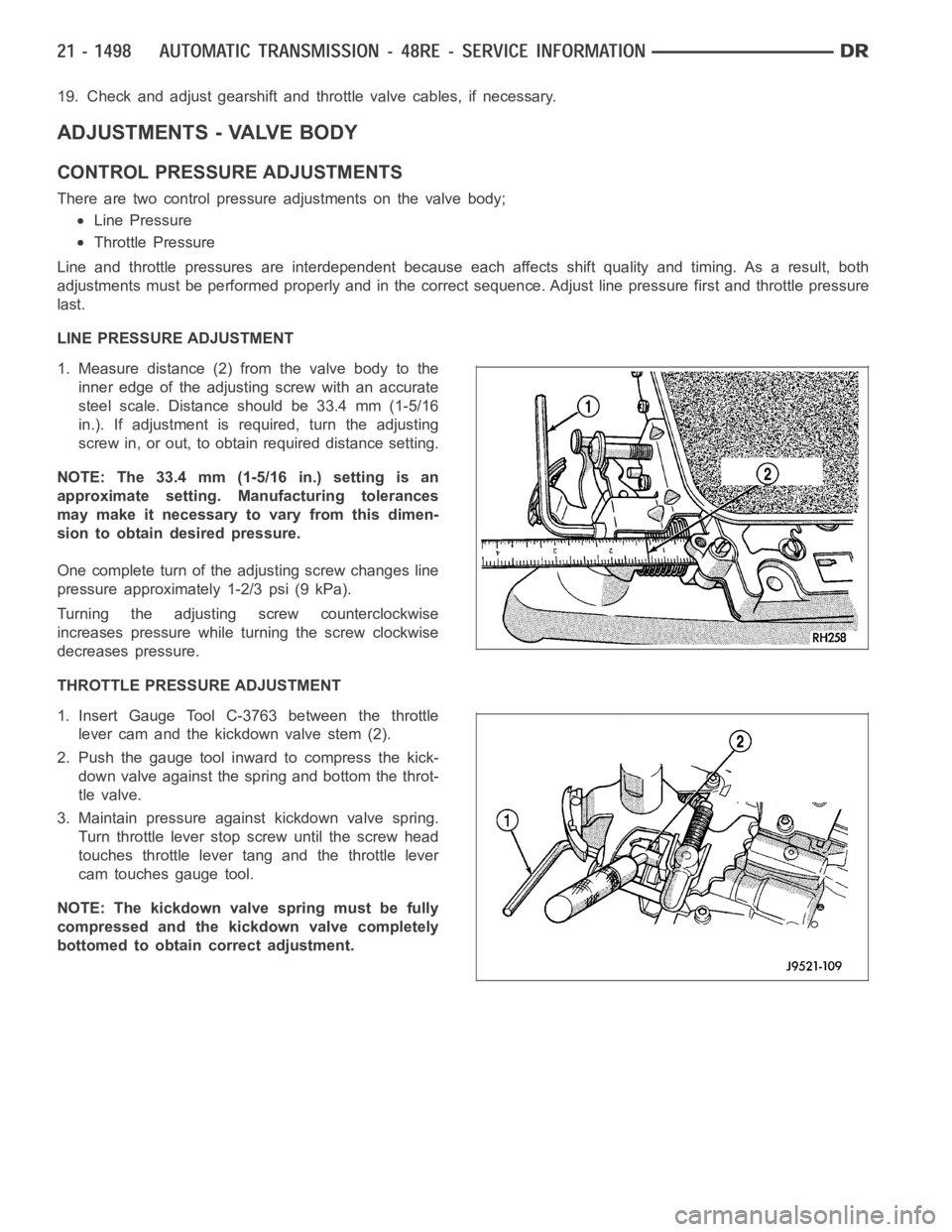
1. Measure distance (2) from the valve body to the
inner edge of the adjusting screw with an accurate
steel scale. Distance should be 33.4 mm (1-5/16
in.). If adjustment is required, turn the adjusting
screw in, or out, to obtain required distance setting.
NOTE: The 33.4 mm (1-5/16 in.) setting is an
approximate setting. Manufacturing tolerances
may make it necessary to vary from this dimen-
sion to obtain desired pressure.
One complete turn of the adjusting screw changes line
pressure approximately 1-2/3 psi (9 kPa).
Turning the adjustingscrew counterclockwise
increases pressure while turning the screw clockwise
decreases pressure.
THROTTLE PRESSURE ADJUSTMENT
1. Insert Gauge Tool C-3763 between the throttle
lever cam and the kickdown valve stem (2).
2. Push the gauge tool inward to compress the kick-
down valve against the spring and bottom the throt-
tle valve.
3. Maintain pressure against kickdown valve spring.
Turn throttle lever stop screw until the screw head
touches throttle lever tang and the throttle lever
cam touches gauge tool.
NOTE: The kickdown valve spring must be fully
compressed and the kickdown valve completely
bottomed to obtain correct adjustment.
Page 5077 of 5267
1. Disconnect and isolate negative battery cable.
2. Remove the accessory drive belt (Refer to 7 -
COOLING/ACCESSORY DRIVE/BELTS-DRIVE -
REMOVAL).
3. Raise and support the vehicle.
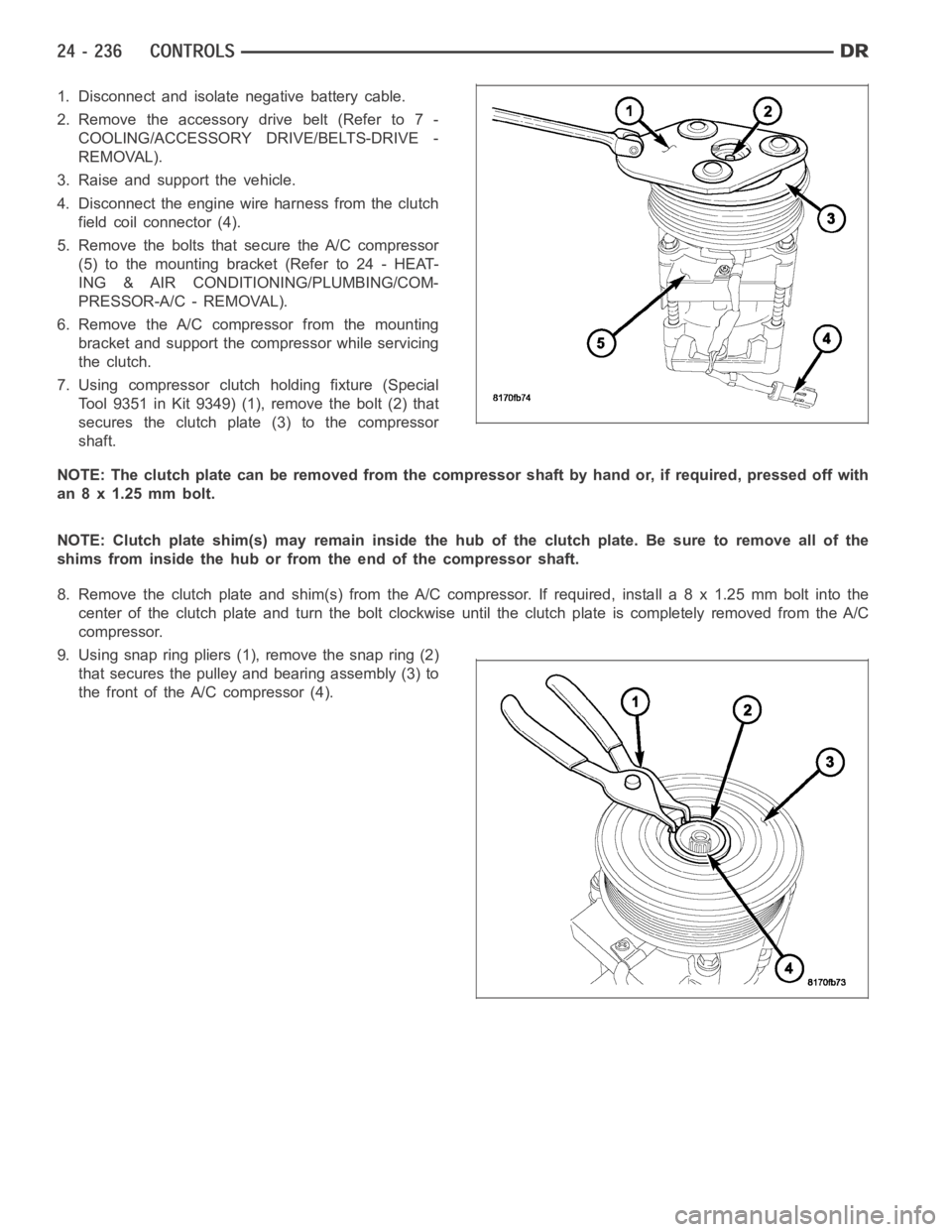
4. Disconnect the engine wire harness from the clutch
field coil connector (4).
5. Remove the bolts that secure the A/C compressor
(5)tothemountingbracket(Referto24-HEAT-
ING & AIR CONDITIONING/PLUMBING/COM-
PRESSOR-A/C - REMOVAL).
6. Remove the A/C compressor from the mounting
bracket and support the compressor while servicing
the clutch.
7. Using compressor clutch holding fixture (Special
Tool 9351 in Kit 9349) (1), remove the bolt (2) that
secures the clutch plate (3) to the compressor
shaft.
NOTE: The clutch plate can be removed from the compressor shaft by hand or, if required, pressed off with
an 8 x 1.25 mm bolt.
NOTE: Clutch plate shim(s) may remain inside the hub of the clutch plate. Besure to remove all of the
shims from inside the hub or from the end of the compressor shaft.
8. Remove the clutch plate and shim(s) from the A/C compressor. If required, install a 8 x 1.25 mm bolt into the
centeroftheclutchplateandturntheboltclockwiseuntiltheclutchplate is completely removed from the A/C
compressor.
9. Using snap ring pliers (1), remove the snap ring (2)
that secures the pulley and bearing assembly (3) to
the front of the A/C compressor (4).
Page 5078 of 5267
NOTE: The pulley and bearing assembly can be
removed from the compressor by hand or, if
required, with a two jaw puller.
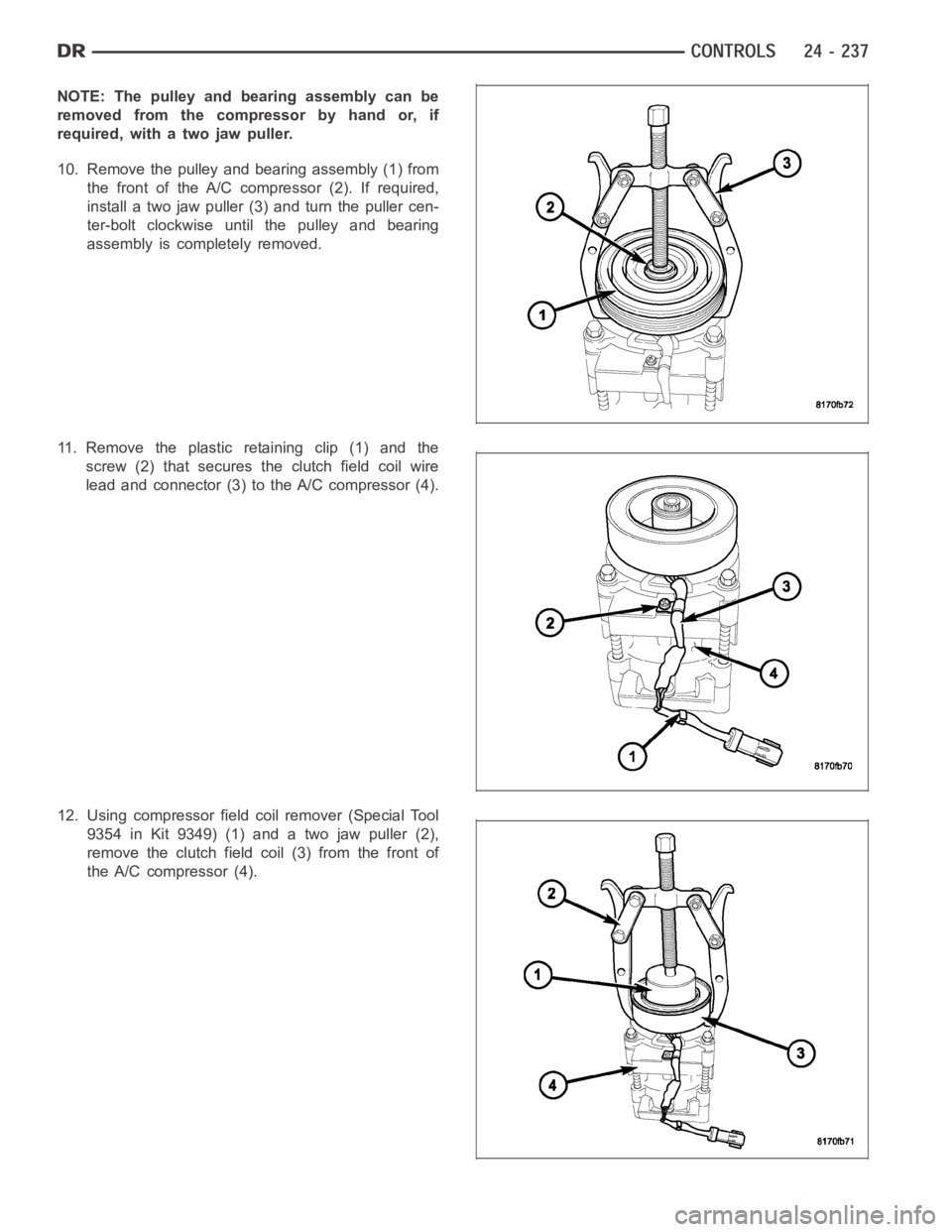
10. Remove the pulley and bearing assembly (1) from
the front of the A/C compressor (2). If required,
install a two jaw puller (3) and turn the puller cen-
ter-bolt clockwise until the pulley and bearing
assembly is completely removed.
11. Remove the plastic retaining clip (1) and the
screw (2) that secures the clutch field coil wire
lead and connector (3) to the A/C compressor (4).
12. Using compressor field coil remover (Special Tool
9354 in Kit 9349) (1) and a two jaw puller (2),
remove the clutch field coil (3) from the front of
the A/C compressor (4).
Page 5130 of 5267
STANDARD PROCEDURE
REFRIGERANT SYSTEM SERVICE EQUIPMENT
WARNING: Eye protection must be worn when servicing an A/C refrigerant system. Turn all valves off
(rotate clockwise) on the equipment being used before connecting or disconnecting service equipment from
the refrigerant system. Failure to observe these warnings may result in personal injury or death.
WARNING: Refer to the applicable warnings and cautions for this system before performing the following
operation (Refer to 24 - HEATING & AIR CONDITIONING/PLUMBING - WARNINGS) and (Refer to 24 - HEAT-
ING & AIR CONDITIONING/PLUMBING - CAUTIONS). Failure to follow the warnings and cautions could result
in possible personal injury or death.
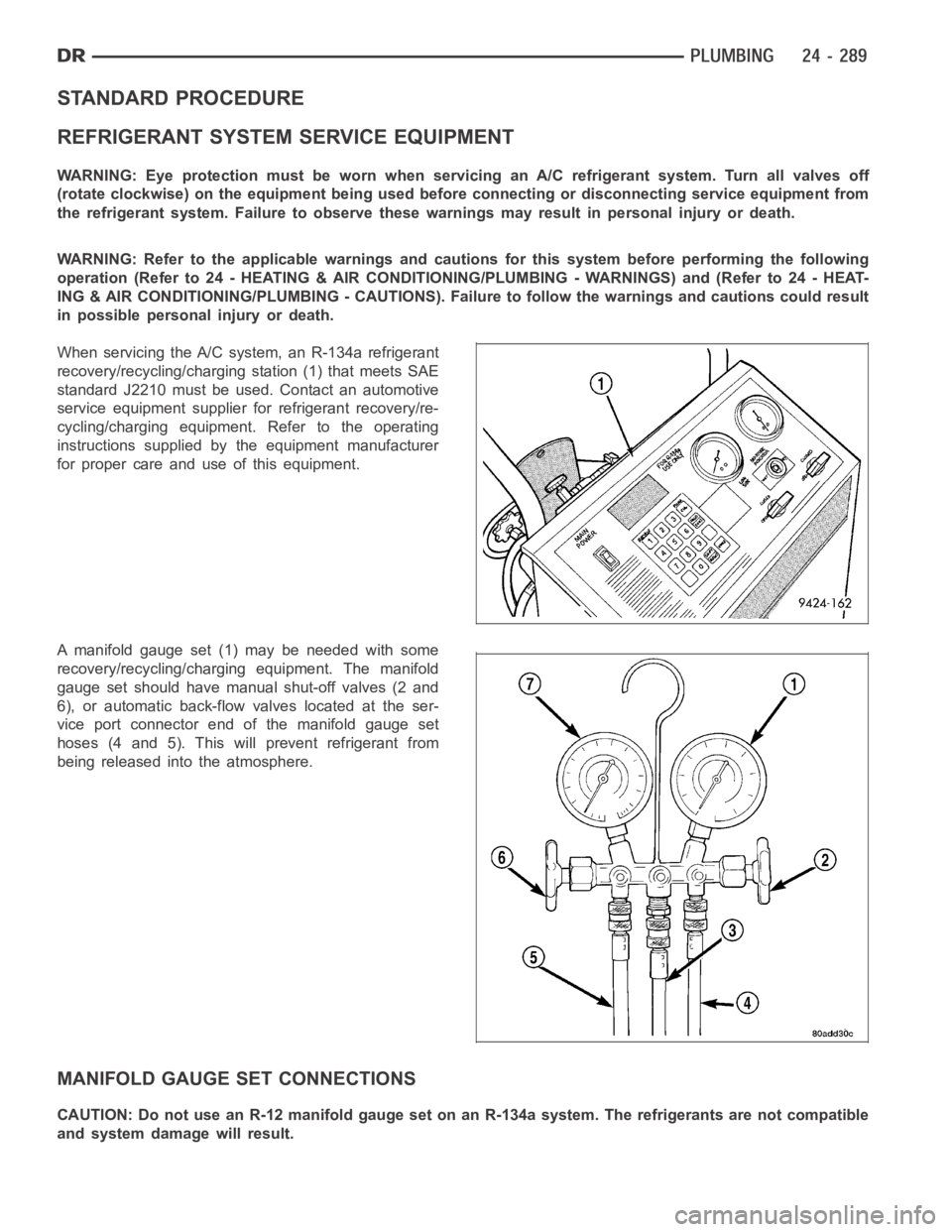
When servicing the A/C system, an R-134a refrigerant
recovery/recycling/charging station (1) that meets SAE
standard J2210 must be used. Contact an automotive
service equipment supplier for refrigerant recovery/re-
cycling/charging equipment. Refer to the operating
instructions supplied by the equipment manufacturer
for proper care and use of this equipment.
A manifold gauge set (1) may be needed with some
recovery/recycling/charging equipment. The manifold
gauge set should have manual shut-off valves (2 and
6), or automatic back-flow valves located at the ser-
vice port connector end of the manifold gauge set
hoses (4 and 5). This will prevent refrigerant from
being released into the atmosphere.
MANIFOLD GAUGE SET CONNECTIONS
CAUTION: Do not use an R-12 manifold gauge set on an R-134a system. The refrigerants are not compatible
and system damage will result.
Page 5195 of 5267
The primary components within the assembly are: A three port solenoid thatactivates both of the functions listed
above; a pump which contains a switch, two check valves and a spring/diaphragm, a canister vent valve (CVV) seal
which contains a spring loaded vent seal valve.
Immediately after a cold start, between predetermined temperature thresholds limits, the three port solenoid is briefly
energized. This initializes the pump by drawing air into the pump cavity and also closes the vent seal. During non
test conditions the vent seal is held open by the pump diaphragm assembly which pushes it open at the full travel
position. The vent seal will remain closed while the pump is cycling due to the reed switch triggering of the three
port solenoid that prevents the diaphragm assembly from reaching full travel. After the brief initialization period, the
solenoid is de-energized allowing atmospheric pressure to enter the pumpcavity, thus permitting the spring to drive
the diaphragm which forces air out of the pump cavity and into the vent system. When the solenoid is energized
and de energized, the cycle is repeated creating flow in typical diaphragmpump fashion. The pump is controlled in
2 modes:
Pump Mode: The pump is cycled at a fixed rate to achieve a rapid pressure build in order to shorten the overall test
length.
Test Mode: The solenoid is energized with a fixed duration pulse. Subsequent fixed pulses occur when the dia-
phragm reaches the Switch closure point.
The spring in the pump is set so that the system will achieve an equalized pressure of about 7.5” H20. The cycle
rate of pump strokes is quite rapid as the system begins to pump up to this pressure. As the pressure increases, the
cycle rate starts to drop off. If there is no leak in the system, the pump would eventually stop pumping at the equal-
ized pressure. If there is a leak, it will continue to pump at a rate representative of the flow characteristic of the size
of the leak. From this information we can determine if the leak is larger than the required detection limit (currently
set at .040” orifice by CARB). If a leak is revealed during the leak test portion of the test, the test is terminated at
the end of the test mode and no further system checks will be performed.
After passing the leak detection phase of the test, system pressure is maintained by turning on the LDP’s solenoid
until the purge system is activated. Purge activation in effect creates a leak. The cycle rate is again interrogated and
when it increases due to the flow through the purge system, the leak check portion of the diagnostic is complete.
The canister vent valve will unseal the system after completion of the testsequence as the pump diaphragm assem-
bly moves to the full travel position.
Evaporative system functionality will be verified by using the stricter evap purge flow monitor. At an appropriate
warm idle the LDP will be energized to seal the canister vent. The purge flowwill be clocked up from some small
value in an attempt to see a shift in the02 control system. If fuel vapor, indicated by a shift in the 02 control, is
present the test is passed. If not, it is assumed that the purge system is notfunctioning in some respect. The LDP
is again turned off and the test is ended.
MISFIRE MONITOR
Excessive engine misfire results in increased catalyst temperature and causes an increase in HC emissions. Severe
misfires could cause catalyst damage. To prevent catalytic convertor damage, the PCM monitors engine misfire.
The Powertrain Control Module (PCM) monitors for misfire during most engine operating conditions (positive torque)
by looking at changes in the crankshaft speed. If a misfire occurs the speedof the crankshaft will vary more than
normal.
FUEL SYSTEM MONITOR
To comply with clean air regulations, vehicles are equipped with catalytic converters. These converters reduce the
emission of hydrocarbons, oxides of nitrogen and carbon monoxide. The catalyst works best when the Air Fuel (A/F)
ratio is at or near the optimum of 14.7 to 1.
The PCM is programmed to maintain the optimum air/fuel ratio of 14.7 to 1. This is done by making short term
corrections in the fuel injector pulse width based on the O2S sensor output. The programmed memory acts as a self
calibration tool that the engine controller uses to compensate for variations in engine specifications, sensor toler-
ances and engine fatigue over the life span of the engine. By monitoring theactual fuel-air ratio with the O2S sen-
sor (short term) and multiplying that with the program long-term (adaptive) memory and comparing that to the limit,
it can be determined whether it will pass an emissions test. If a malfunction occurs such that the PCM cannot main-
tain the optimum A/F ratio, then the MIL will be illuminated.