brake DODGE SPRINTER 2007 2.G User Guide
[x] Cancel search | Manufacturer: DODGE, Model Year: 2007, Model line: SPRINTER, Model: DODGE SPRINTER 2007 2.GPages: 393, PDF Size: 7.61 MB
Page 69 of 393
68 Controls in detailSeats
3
Driver’s and co-driver’s seatsWarning
G
Only adjust the seats when the vehicle is
stationary and the handbrake is applied. You
could otherwise lose control of the vehicle
as a result of the seat moving and cause an
accident.Warning
G
Make sure that nobody can become trapped
as the seat is adjusted. Never place your
hands under the seat or near to moving
parts.
Your seat must be adjusted in such a way
that you can wear the seat belt correctly
(\2page 27).
Observe the following points:
\4Position the backrest as vertically as
possible and sit upright.
\4Avoid seat positions that do not allow
the seat belt to be routed correctly. The
shoulder section of the seat belt must
be routed across the middle of your
shoulder and must fit closely across
your chest. The lap section of the belt
must be routed as low as possible
across your pelvic area, i.e. across your
hip joints. Never drive with the backrest
tilted too far back.
\4Your arms should be slightly bent when
you are holding the steering wheel.
\4The distance from the pedals should be
such that you can depress them fully.
\4Adjust the head restraint in such a way
that the upper edge of the head restraint
is level with your head.
\4Make sure that you hear the seat en-
gage. Otherwise, the seat is not correct-
ly locked in place.
Injuries may be caused if these notes are
not observed.Warning
G
Avoid seat positions in which you cannot
wear your seat belt correctly. They are a
safety hazard and must therefore be
avoided.
Page 71 of 393
70 Controls in detailSeats
3
Seat suspension adjustment*
The seat suspension must be adjusted to
your body weight.
\1Relieve the load on the seat.
\1Select your body weight 88 to 165 lbs
(40 to 120 kg) using thumbwheel6
for optimal seat suspension.
The seat suspension becomes harder
as the load on the seat increases.
Vertical lock*
If the seat bounces up and down frequent-
ly, you can engage the seat in its lowest po-
sition.
\1Turn lever7 downward.
The next time the seat bounces, it will
engage in its lowest position.
\1Turn lever7 upward to release the
seat from the vertical lock.
The seat can now move up and down
again.Swivelling front seats*
The driver’s and co-driver’s seat can be ro-
tated by 180° to be opposite of the direc-
tion of travel.The seats engage in the direction of travel
or opposite the direction of travel as well
as at 50° pointing towards the exit.
!
When rotating the seats, make sure the-
re is sufficient space. If necessary, move
the seat fore or aft to avoid colliding with
adjacent add-on parts.
Fold the handbrake lever down as far as it
will go. You could otherwise damage the
handbrake or the handbrake lever.
i
Move the co-driver’s seat forward as far
as it will go before rotating it (\2page 69).
\1Make sure the handbrake is applied
and the handbrake lever is folded down
as far as it will go (\2page 115).
\1Set the steering wheel so that there is
sufficient clearance for turning and ad-
justing the driver’s seat (\2page 76).
Warning
G
Only adjust the seats when the vehicle is
stationary and the handbrake is applied. You
could otherwise lose control of the vehicle
as a result of the seat moving and cause an
accident.Warning
G
The driver’s and co-driver’s seat must be ad-
justed and properly engaged in the direction
of travel for driving. Otherwise you will not
be able to operate the vehicle safely.The restraint systems in your vehicle will
only function as intended when the driver’s
and co-driver’s seat are engaged in the di-
rection of travel.
Warning
G
Make sure nobody can become trapped
when unlocking and turning the seats. Never
hold your hands under the seat or near mo-
veable parts when turning the seats.
Page 84 of 393
83 Controls in detail
Lighting
3
Load compartment motion detector*
On panel vans equipped with a motion de-
tector in the load compartment, the rear
interior lighting may also switch on if mo-
tion is detected.The rear interior lighting can be switched
on by the motion detector with a delay of
no more than 4 seconds if:
\4the switch on the rear interior lamp
(\2page 82) is set to “automatic con-
trol”
\4the vehicle is stationary, the handbrake
is applied and the service brake is not
applied
or
\4the selector lever is in position P and
the service brake is not applied
\4the vehicle has not been locked from
the outside using the key
iThe rear interior lamps switch off auto-
matically after 20 minutes, even if the
switches on the rear interior lamps
(\2page 82) are in the On position 1.
If you wish to reactivate the rear interi-
or lamps, you must:
\4open a door
\4switch on the ignition again
\4set the rear interior lighting master
control switch to position2 again.
Warning
G
Motion detectors work with invisible infra-
red beams emitted by LEDs (Light Emitting
Diodes).
Do not view invisible infrared radiation, laser
class 1M, directly using optical instruments.
Your eyes could otherwise be injured.iIf the motion detector detects move-
ment in the load compartment when
the vehicle is stationary, the rear interi-
or lighting switches on for approxi-
mately 2 minutes. If new movements
are detected, the duration resumes
from the beginning and the rear interior
lighting remains switched on.
iThe motion detector switches off auto-
matically if no change is detected in the
vehicle for several hours, e.g. door
opened, ignition key turned, etc.
This prevents the battery from dis-
charging.
Page 111 of 393
110 Controls in detailDriving and parking
3
\3 Driving and parking
\1Before each journey, check the vehicle
lighting and the general condition of
the vehicle.
\1Observe the general driving tips at the
end of this section (\2page 116).
You will find information on:
\4regular checks (\2page 181)
\4driving in winter (\2page 235)
\4driving when towing a trailer
(\2page 175)
\4and other driving tips
in the “Operation” section (\2page 173).
Warning
G
T h e m o v e m e n t o f t h e p e d a l s m u s t n o t b e o b -
structed. The vehicle’s operating and road
safety are otherwise jeopardized.
Objects could fall and get caught between
the pedals if you accelerate or brake sud-
denly. You will no longer be able to brake or
accelerate. You could cause an accident,
which could result in injury to yourself and
others.
\4If floor mats and carpets are used, make
sure that these are secured correctly
and cannot slip and that there is suffi-
cient pedal clearance.
\4Do not place any objects in the driver’s
footwell.
\4Store and secure all loose objects so
they cannot get into the driver’s footwell
while the vehicle is in motion.
Warning
G
The doors could open of their own accord
while the vehicle is in motion if they are not
fully closed. For this reason, please make
sure that all the doors are properly closed
and locked before driving off (\2page 52).
Starting the engineWarning
G
Never run the engine in an enclosed space.
The exhaust fumes contain poisonous car-
bon monoxide. Breathing in exhaust fumes
constitutes a health hazard and can lead to
loss of consciousness and death.Warning
G
A seat belt that is worn incorrectly or not at
all, or that is not correctly engaged in the
seat belt buckle, cannot perform its intend-
ed protective function. In certain circum-
stances, you could then be seriously or even
fatally injured. Make sure, therefore, that all
occupants – in particular, expectant moth-
ers – wear their seat belt correctly at all
times.
Page 112 of 393
111 Controls in detail
Driving and parking
3
\1Before starting the engine, make sure
that all vehicle occupants are wearing
their seat belt correctly (\2page 27)
and the handbrake (\2page 115) is ap-
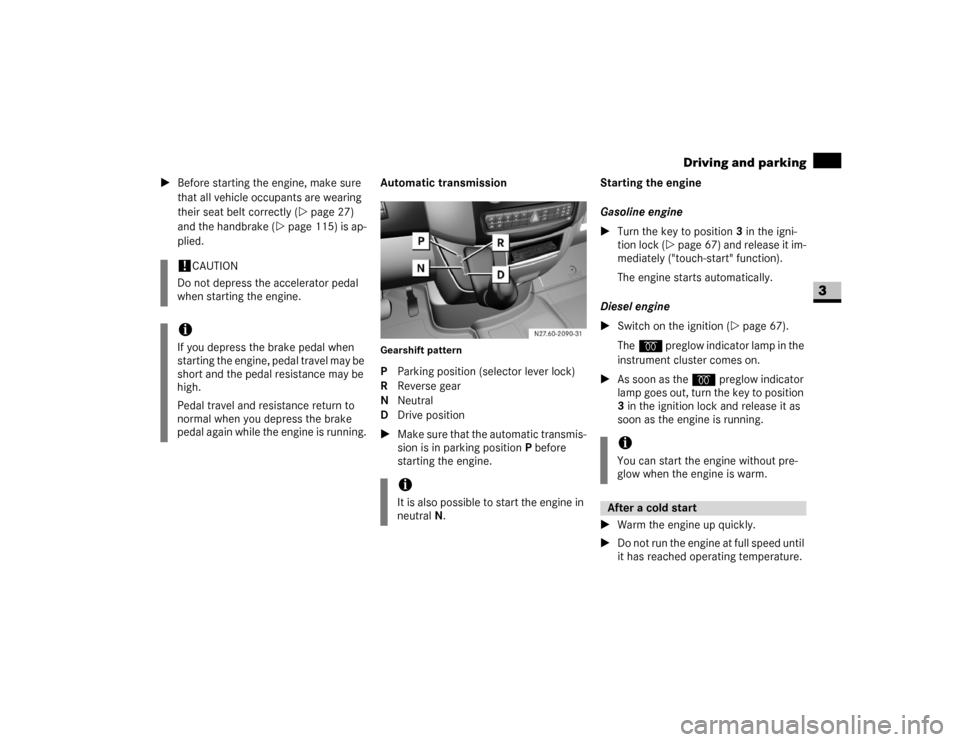
plied.Automatic transmission
Gearshift patternP Parking position (selector lever lock)
R Reverse gear
N Neutral
D Drive position
\1Make sure that the automatic transmis-
sion is in parking position P before
starting the engine.Starting the engine
Gasoline engine
\1Turn the key to position3 in the igni-
tion lock (\2page 67) and release it im-
mediately ("touch-start" function).
The engine starts automatically.
Diesel engine
\1Switch on the ignition (\2page 67).
Theq preglow indicator lamp in the
instrument cluster comes on.
\1As soon as the q preglow indicator
lamp goes out, turn the key to position
3 in the ignition lock and release it as
soon as the engine is running.
\1Warm the engine up quickly.
\1Do not run the engine at full speed until
it has reached operating temperature.
!
CAUTION
Do not depress the accelerator pedal
when starting the engine.
iIf you depress the brake pedal when
starting the engine, pedal travel may be
short and the pedal resistance may be
high.
Pedal travel and resistance return to
normal when you depress the brake
pedal again while the engine is running.
iIt is also possible to start the engine in
neutral N.
iYou can start the engine without pre-
glow when the engine is warm.After a cold start
Page 113 of 393
112 Controls in detailDriving and parking
3
\1Depress the brake pedal and keep it
depressed.
The selector lever lock is released.
\1Release the handbrake (\2page 115).
The7 indicator lamp in the instru-
ment cluster goes out.
\1Move the selector lever to position D or
R.\1Release the brake pedal.
\1Carefully depress the accelerator ped-
al.
You will find more information about selec-
tor lever positions, shift ranges and driving
tips in the “Automatic transmission” sec-
tion (\2page 121).
Pulling awayWarning
G
Do not downshift for additional engine brak-
ing on a slippery surface. The drive wheels
may lose their grip and the vehicle could
skid.!
CAUTION
Only drive at high speeds once the en-
gine has warmed up. This protects the
engine.
When driving on slippery surfaces,
avoid spinning the drive wheels where
possible as this could damage the drive
train.
iOn vehicles with a reverse warning fea-
ture*, an audible warning sounds for
other road users when reverse gear is
engaged (\2page 153).
iDepending on the vehicle's settings,
the vehicle automatically locks itself
centrally after it has driven off, at the
latest (\2page 64). The locking knobs
on the front doors and the sliding door
drop down.
You can open the doors from the inside
at any time.
You can also switch off the automatic
door lock (\2page 64). !
CAUTION
Only select reverse gear when the vehi-
cle is stationary, otherwise you could
damage the automatic transmission.
iWait until the gear selection has com-
pleted before pulling away.iAutomatic transmission upshifts are
made at higher engine speeds after a
cold start. This helps the catalytic con-
verter to reach its operating tempera-
ture more quickly.
Page 114 of 393
113 Controls in detail
Driving and parking
3
Do not accelerate to prevent your vehicle
from rolling backwards on an uphill gradi-
ent. Instead, you should either use the
handbrake or depress the brake pedal.
This prevents excessive wear on the
clutch.
Select a lower gear (shift range 3, 2 or 1)
(\2page 123) in good time on long and
steep downhill gradients, especially if tow-
ing a trailer. This prevents the brakes from
overheating and wearing too rapidly.
It is best not to stop the vehicle immediate-
ly after the brakes have been subjected to
an extreme load; continue driving for a
short time instead. The brakes are cooled
down more quickly in the airflow.The first time the brakes are applied after
a long period of driving in heavy rain with-
out braking, it is possible that:
\4there will be a delayed braking
response
\4you will need to depress the brake
pedal more firmly
You should therefore maintain a greater
distance from the vehicle in front.
Apply the brakes so that you can feel their
response after a journey on wet roads,
especially if the road has been salted. The
brake discs will be warmed, dry more
quickly and be protected against corro-
sion.
If you make only moderate use of the ser-
vice brake, check from time to time that it
is fully functional. To do this, brake more
sharply at a higher vehicle speed. The
brake will grip better as a result.For safety reasons, the manufacturer rec-
ommends that you only have brake pads /
linings installed on your vehicle that have
been approved for the Sprinter.
Brake pads /linings that have not been ap-
proved for the Sprinter could affect your
vehicle’s operating safety.BrakingWarning
G
There is no power assistance for the service
brake when the engine is not running.
You will need to use significantly more force
to brake and could therefore lose control of
the vehicle and cause an accident.
Never switch off the engine while driving.
Warning
G
Make sure that other road users are not put
at risk by your braking.
iIn exceptional cases, the handbrake
can be used for emergency braking if
the service brake fails (\2page 115).
Page 115 of 393
114 Controls in detailDriving and parking
3
ParkingWarning
G
Only remove the key from the ignition lock
when the vehicle is stationary, since it is not
possible to steer the vehicle with the key re-
moved.
Always apply the handbrake after parking
the vehicle.
Never leave children unsupervised in the ve-
hicle. They could release the handbrake.
This could lead to a serious or fatal accident.
Warning
G
Always switch off the engine and apply the
handbrake before leaving the vehicle.
The vehicle could roll away if it is not
secured.
On uphill or downhill gradients steeper than
15%:
\4apply the handbrake
\4secure an unloaded vehicle by chocking
the front axle (\2page 303)
\4secure a loaded vehicle by, for example,
chocking the rear axle (\2page 303)!
CAUTION
Whenever you park the vehicle, always
remove the key to prevent the battery
from excessively discharging.
For vehicles which are out of use for ex-
tended periods and have a battery iso-
lating switch*, switch off the electrical
system (\2page 197).
Warning
G
Make sure that the exhaust system does not
come into contact with highly flammable
materials, e.g. dry grass or gasoline. The
flammable material could otherwise ignite
and set vehicle components on fire.Warning
G
Regulations in some countries require the
parking lamps to be switched on to illumi-
nate the vehicle for other road users if
parked on a public road at night. In built-up
areas, night reflectors can also be used.
Observe legal requirements.
Page 116 of 393
115 Controls in detail
Driving and parking
3
Handbrake
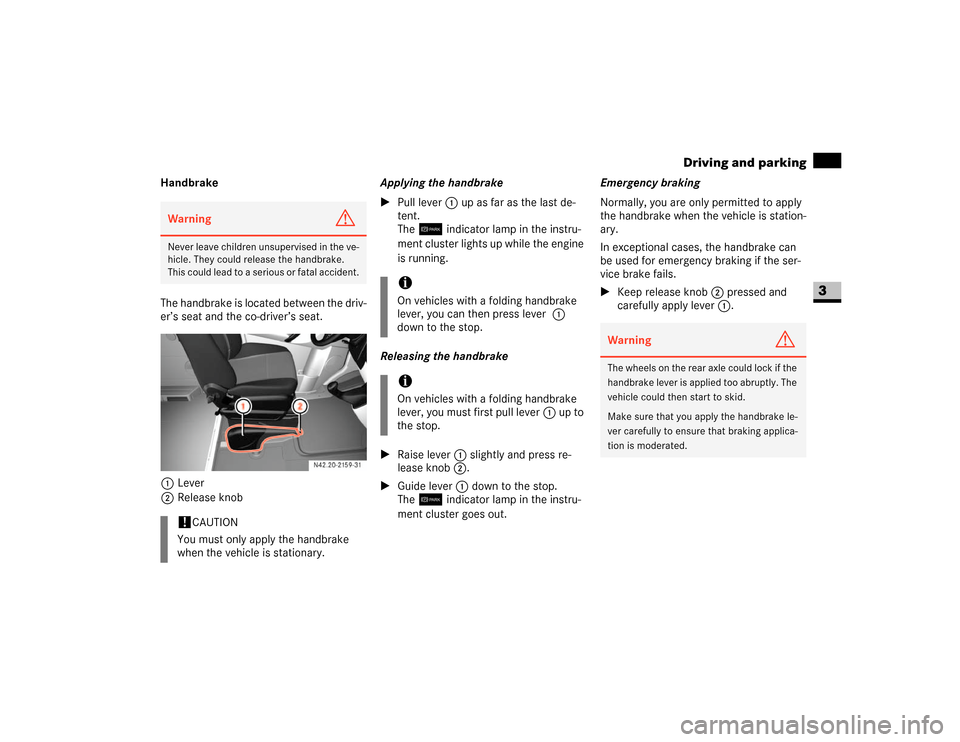
The handbrake is located between the driv-
er’s seat and the co-driver’s seat.
1Lever
2Release knobApplying the handbrake
\1Pull lever1 up as far as the last de-
tent.
The7 indicator lamp in the instru-
ment cluster lights up while the engine
is running.
Releasing the handbrake
\1Raise lever1 slightly and press re-
lease knob2.
\1Guide lever1 down to the stop.
The7 indicator lamp in the instru-
ment cluster goes out.Emergency braking
Normally, you are only permitted to apply
the handbrake when the vehicle is station-
ary.
In exceptional cases, the handbrake can
be used for emergency braking if the ser-
vice brake fails.
\1Keep release knob2 pressed and
carefully apply lever1.Warning
G
Never leave children unsupervised in the ve-
hicle. They could release the handbrake.
This could lead to a serious or fatal accident.!
CAUTION
You must only apply the handbrake
when the vehicle is stationary.
iOn vehicles with a folding handbrake
lever, you can then press lever1
down to the stop.iOn vehicles with a folding handbrake
lever, you must first pull lever1 up to
the stop.
Warning
G
The wheels on the rear axle could lock if the
handbrake lever is applied too abruptly. The
vehicle could then start to skid.
Make sure that you apply the handbrake le-
ver carefully to ensure that braking applica-
tion is moderated.
Page 117 of 393
116 Controls in detailDriving and parking
3
Stopping the engine
\1Apply handbrake (\2page 115).
\1Move selector lever to P.
\1Turn key to position 0 (\2page 67) in
the ignition lock and remove it.
The immobilizer is activated.\1Secure the vehicle at the front axle if
unloaded and at the rear axle if loaded,
e.g. using a chock (\2page 303).
Drinking and drivingSteering
!
CAUTION
If the coolant temperature is raised,
e.g. following driving in mountainous
terrain, run the engine at idling speed
for a further 1 or 2 minutes before you
switch off the engine. This allows the
coolant temperature to return to nor-
mal again.
iWhen parking on steep uphill or down-
hill gradients, turn the front wheels to-
wards the curb.iYou can only remove the key from the
ignition lock when the selector lever is
in positionP.
General driving tipsWarning
G
Drinking and driving and/or taking drugs
and driving are very dangerous combina-
tions. Even a small amount of alcohol or
drugs can affect your reflexes, perceptions
and judgment. The possibility of a serious or
even fatal accident is sharply increased
when you drink or take drugs and drive.
Never drink or take drugs and drive or allow
anyone to drive after drinking or taking
drugs.
Warning
G
There is no power-steering assistance when
the engine is not running.
You will need to use significantly more force
to steer and could therefore lose control of
the vehicle and cause an accident.
Never switch off the engine while driving.!
CAUTION
Do not hold the steering wheel in its
end positions for longer than neces-
sary (e.g. when turning or maneuver-
ing).
The hydraulic pump can be damaged
by the increased temperature of the
hydraulic fluid.