key DODGE SPRINTER 2007 2.G Repair Manual
[x] Cancel search | Manufacturer: DODGE, Model Year: 2007, Model line: SPRINTER, Model: DODGE SPRINTER 2007 2.GPages: 393, PDF Size: 7.61 MB
Page 320 of 393
319 Practical hints
Replacing the wiper blades
5
\3 Replacing the wiper blades
\1Apply the handbrake (\2page 115).
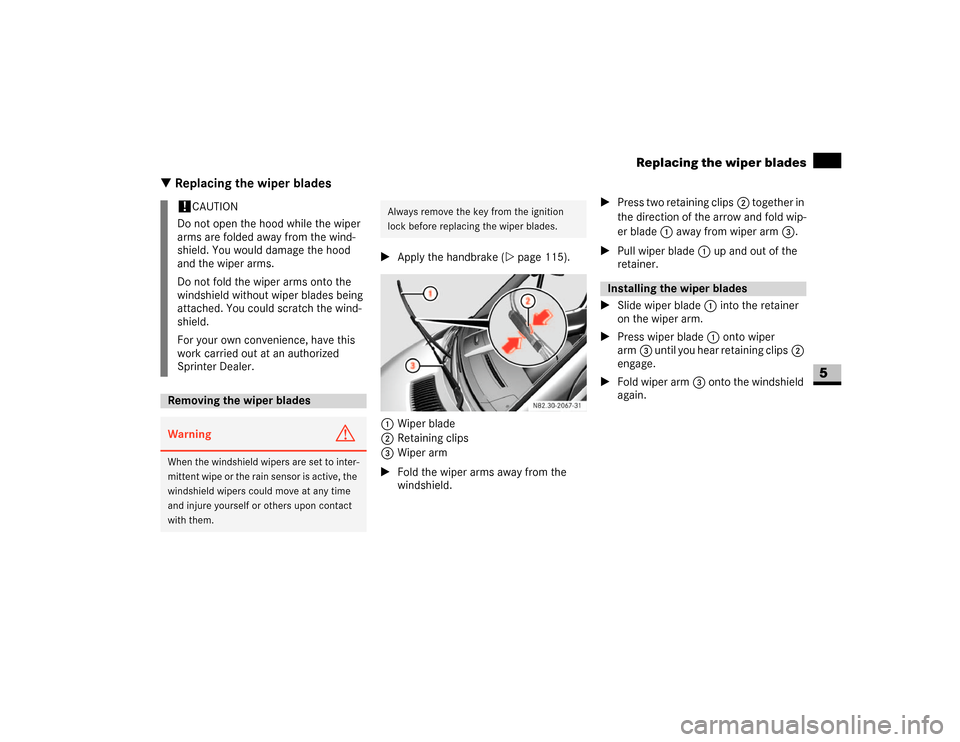
1Wiper blade
2Retaining clips
3Wiper arm
\1Fold the wiper arms away from the
windshield.\1Press two retaining clips2 together in
the direction of the arrow and fold wip-
er blade1 away from wiper arm3.
\1Pull wiper blade1 up and out of the
retainer.
\1Slide wiper blade1 into the retainer
on the wiper arm.
\1Press wiper blade1 onto wiper
arm3 until you hear retaining clips2
engage.
\1Fold wiper arm3 onto the windshield
again.
!
CAUTION
Do not open the hood while the wiper
arms are folded away from the wind-
shield. You would damage the hood
and the wiper arms.
Do not fold the wiper arms onto the
windshield without wiper blades being
attached. You could scratch the wind-
shield.
For your own convenience, have this
work carried out at an authorized
Sprinter Dealer.
Removing the wiper bladesWarning
G
When the windshield wipers are set to inter-
mittent wipe or the rain sensor is active, the
windshield wipers could move at any time
and injure yourself or others upon contact
with them.
Always remove the key from the ignition
lock before replacing the wiper blades.
Installing the wiper blades
Page 334 of 393
333 Practical hints
Flat tire
5
\1Then press0 on electric air pump
switch1.
The electric air pump is switched off.
\1Screw the valve cap onto tire valveb.
\1After filling with tire sealant
(\2page 333).
After filling with tire sealant
\1Turn the pressure release screw on
pressure gauge5 counterclockwise
and bleed the system.
\1Turn the key to position0 in the igni-
tion lock (\2page 67).
\1Pull the electric air pump connector out
of the 12 V socket.
\1Store the electric air pump, tire sealant
bottle 8 with valve core extractorc
and, if used, the warning triangle and
hazard warning lamps inside the vehi-
cle.\1Unscrew and remove angle bracket 2
from valve7 on tire sealant bottle 8
and screw the valve cap onto the valve.
\1Pull away immediately.
This enables the tire sealant to distrib-
ute inside the tire and create a more ef-
fective seal.
\1Stop after about 3 minutes and check
the tire pressure using the electric air
pump, for example.\1Correct the tire pressure accordingly if
it does not correspond to the recom-
mended tire pressure (\2page 210).
Increasing the tire pressure
\1Switch on the electric air pump.
Reducing the tire pressure
\1Open the pressure release screw
on pressure gauge 5.
\1Drive to the nearest workshop and
have the tire repaired or replaced.
\1Clean the valve core extractor using
clean water.
\1Have tire sealant bottle8 replaced as
soon as possible at an authorized
Sprinter Dealer.
iThe tire sealant is water soluble. If tire
sealant escapes, you can wash it away
with water.
Warning
G
Do not exceed the maximum speed of
50 mph (80 km/h).
The "max. 50 mph (80 km/h)" sticker must
be affixed within the driver's field of vision.
The vehicle’s handling characteristics may
be affected.iYou must connect the angle bracket on
hose 3 of the electric air pump direct-
ly to the tire valve on the tire.
Page 336 of 393
335 Practical hints
Battery
5
\3 BatteryYour vehicle may be equipped with two
batteries, depending on the equipment
version:
\4Starter battery in the battery recess in
the driver’s footwell
\4Auxiliary battery* in the engine com-
partmentHave the batteries removed at an autho-
rized Sprinter Dealer which has the neces-
sary specialist knowledge and tools to
carry out the work required.
The manufacturer recommends that you
use an authorized Sprinter Dealer for this
purpose.
\1Switch off all electrical consumers.
iThe auxiliary battery* in the engine
compartment is not suitable for jump-
starting operations. Only use the jump-
starting connection in the engine com-
partment if you require jump-starting
assistance or wish to provide jump-
starting assistance (\2page 340).Warning
G
Observe the safety notes in the “Operation”
section (\2page 195).
Do not place any metal objects on the bat-
tery. Doing so can cause a short circuit.
Use only impact-resistant batteries with a
central gas release cover to prevent corro-
sion damage and to protect occupants from
caustic burns in the event of an accident.Disconnecting the batteryWarning
G
There is a risk of a short circuit if the positive
terminal of the connected battery comes
into contact with vehicle parts. The highly
explosive gas mixture could ignite as a re-
sult. You and others could be seriously in-
jured as a result.
\4Do not place any metal objects or tools
on the batteries.
\4When disconnecting the batteries, al-
ways disconnect the negative terminals
first and then the positive terminals.
\4When reconnecting the batteries, al-
ways reconnect the positive terminals
first and then the negative terminals.
\4Do not loosen or disconnect the termi-
nal clamps on the batteries while the en-
gine is running.!
CAUTION
Switch off the engine and take the key
out of the ignition lock before you loos-
en or disconnect the terminal clamps.
You may otherwise destroy electronic
components such as the alternator.
Always disconnect the starter battery
in the battery recess in the driver’s
footwell first.
Page 341 of 393
340 Practical hintsJump-starting
5
\3 Jump-startingIf the starter battery in the battery recess
in the driver’s footwell is discharged, the
engine can be jump-started from another
vehicle using jump leads.
For this purpose, the vehicle is equipped
with a jump-starting connection point.
Please note:
\4Jump-starting must only be performed
when the engine and catalytic convert-
er are cold.\4Do not start the engine if the battery
has frozen. Let the battery thaw out
first.
\4Only use a battery of the same rated
voltage and of approximately the same
capacity for jump-starting.
\4Only use jumper cables of adequate
cross-section with insulated battery
terminal clamps.
\1Make sure that the two vehicles do not
touch.
\1Apply the handbrake or move the se-
lector lever to positionP.
\1Switch off all electrical consumers.
\1Switch on the battery isolating switch*
if necessary (\2page 197).\1Remove the key from the ignition lock.
\1Open the hood (\2page 185).
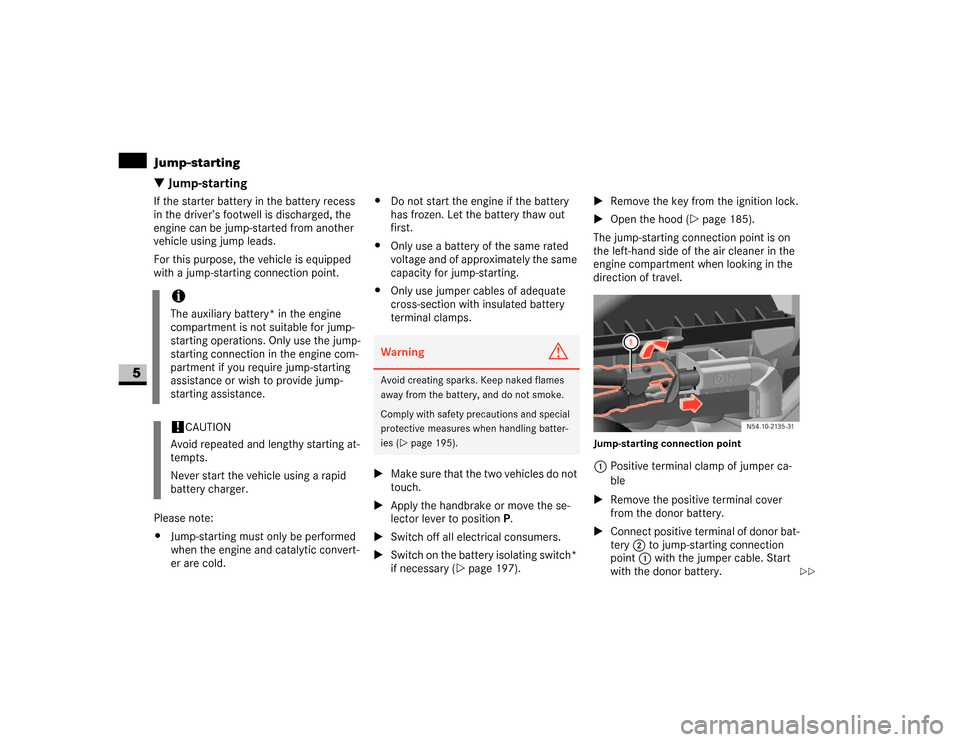
The jump-starting connection point is on
the left-hand side of the air cleaner in the
engine compartment when looking in the
direction of travel.
Jump-starting connection point1Positive terminal clamp of jumper ca-
ble
\1Remove the positive terminal cover
from the donor battery.
\1Connect positive terminal of donor bat-
tery 2 to jump-starting connection
point 1 with the jumper cable. Start
with the donor battery.
iThe auxiliary battery* in the engine
compartment is not suitable for jump-
starting operations. Only use the jump-
starting connection in the engine com-
partment if you require jump-starting
assistance or wish to provide jump-
starting assistance.!
CAUTION
Avoid repeated and lengthy starting at-
tempts.
Never start the vehicle using a rapid
battery charger.
Warning
G
Avoid creating sparks. Keep naked flames
away from the battery, and do not smoke.
Comply with safety precautions and special
protective measures when handling batter-
ies (\2page 195).
\2\2
Page 343 of 393
342 Practical hintsTowing
5
\3 TowingComply with legal regulations when tow-
ing.
Having the vehicle carried away on a trans-
porter or trailer is preferable to towing it
away. We recommend the use of a rigid
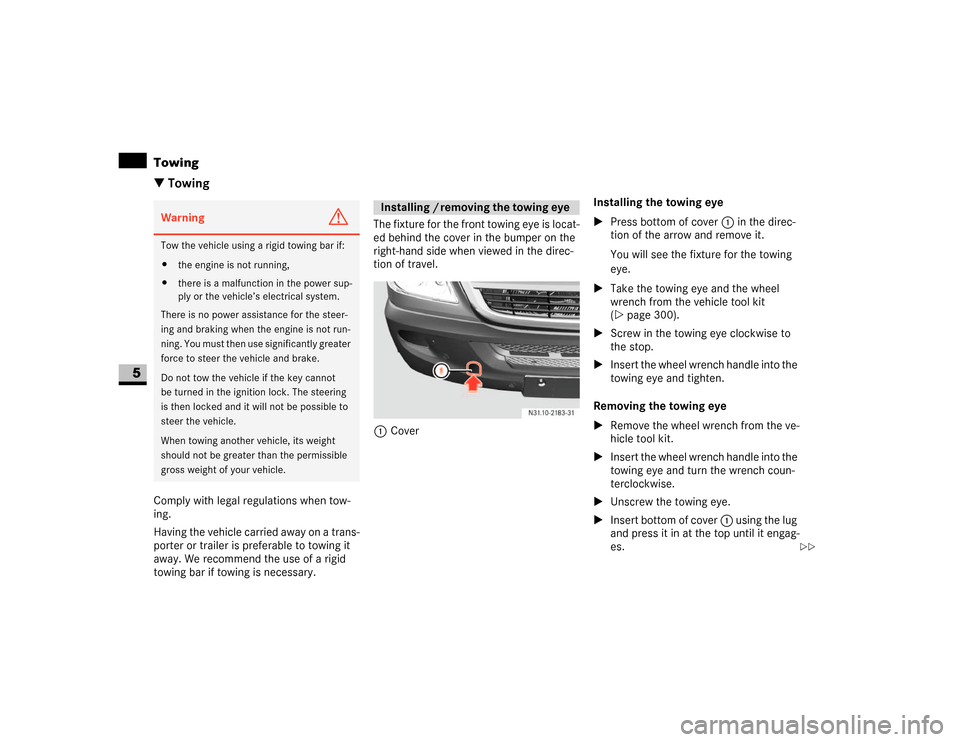
towing bar if towing is necessary.The fixture for the front towing eye is locat-
ed behind the cover in the bumper on the
right-hand side when viewed in the direc-
tion of travel.
1CoverInstalling the towing eye
\1Press bottom of cover1 in the direc-
tion of the arrow and remove it.
You will see the fixture for the towing
eye.
\1Take the towing eye and the wheel
wrench from the vehicle tool kit
(\2page 300).
\1Screw in the towing eye clockwise to
the stop.
\1Insert the wheel wrench handle into the
towing eye and tighten.
Removing the towing eye
\1Remove the wheel wrench from the ve-
hicle tool kit.
\1Insert the wheel wrench handle into the
towing eye and turn the wrench coun-
terclockwise.
\1Unscrew the towing eye.
\1Insert bottom of cover 1 using the lug
and press it in at the top until it engag-
es.Warning
G
Tow the vehicle using a rigid towing bar if:
\4the engine is not running,
\4there is a malfunction in the power sup-
ply or the vehicle’s electrical system.
There is no power assistance for the steer-
ing and braking when the engine is not run-
ning. You must then use significantly greater
force to steer the vehicle and brake.
Do not tow the vehicle if the key cannot
be turned in the ignition lock. The steering
is then locked and it will not be possible to
steer the vehicle.
When towing another vehicle, its weight
should not be greater than the permissible
gross weight of your vehicle.
Installing / removing the towing eye
\2\2
Page 344 of 393
343 Practical hints
Towing
5
\1Return the towing eye and the wheel
wrench to the vehicle tool kit.
\1Switch on the ignition (\2page 67).
\1For a distance of up to 30 miles
(50 km), move the selector lever to po-
sition N.
\1For a distance greater than 30 miles
(50 km), remove the propeller shafts to
the driven axles.Take great care when attempting to tow
the vehicle free if its drive wheels have be-
come embedded in loose earth or mud,
particularly if the vehicle is loaded.
Tow the vehicle smoothly and straight-
ahead. The chassis could otherwise be
damaged.
Do not attempt to tow out the vehicle if a
trailer is coupled up.
Where possible, tow the vehicle out back-
wards along the track made by the vehicle
previously.With transmission damage
\1Always remove the propeller shafts to
the driven axles.
With front axle damage
\1Turn the key to position 1 in the ignition
lock(\2page 67).
iDeactivate the automatic locking while
driving function when towing
(\2page 64). You could otherwise
become locked out when pushing or
towing the vehicle.!
CAUTION
Do not exceed a towing speed of
50 km / h, otherwise the transmission
could be damaged.
Towing out a vehicle that is stuck
Towing the vehicle in the event of
particular malfunctions!
CAUTION
Use new self-securing nuts when in-
stalling the propeller shafts.
!
CAUTION
The vehicle must not be towed with its
front wheels raised and with the key in
position2 in the ignition lock.
Active brake intervention by ESP
® or
ASR could otherwise lock the wheels
and damage the brake system.
Page 374 of 393
373 *Technical data
Vehicle identification labels
6
\3 Vehicle identification labels
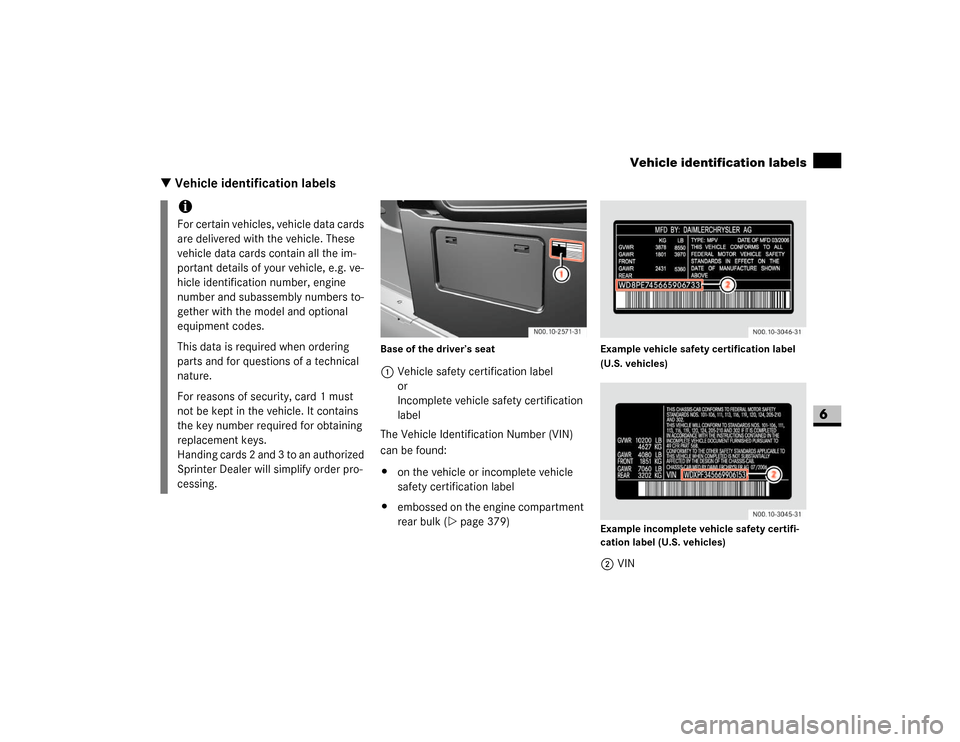
Base of the driver’s seat1Vehicle safety certification label
or
Incomplete vehicle safety certification
label
The Vehicle Identification Number (VIN)
can be found:
\4on the vehicle or incomplete vehicle
safety certification label
\4embossed on the engine compartment
rear bulk (\2page 379)
Example vehicle safety certification label
(U.S. vehicles)
Example incomplete vehicle safety certifi-
cation label (U.S. vehicles)2VIN
iFor certain vehicles, vehicle data cards
are delivered with the vehicle. These
vehicle data cards contain all the im-
portant details of your vehicle, e.g. ve-
hicle identification number, engine
number and subassembly numbers to-
gether with the model and optional
equipment codes.
This data is required when ordering
parts and for questions of a technical
nature.
For reasons of security, card 1 must
not be kept in the vehicle. It contains
the key number required for obtaining
replacement keys.
Handing cards 2 and 3 to an authorized
Sprinter Dealer will simplify order pro-
cessing.
Page 379 of 393
378 Indexmaneuvering
. . . . . . . . . . . . . . . . . 124
one-touch gearshifting
. . . . . . . . . . 122
releasing the parking lock manually
305
selector lever positions
. . . . . . . . . 121
shift ranges
. . . . . . . . . . . . . . . . . . 123
stopping
. . . . . . . . . . . . . . . . . . . . . 124
towing
. . . . . . . . . . . . . . . . . . . . . . 343
trailer towing
. . . . . . . . . . . . . . . . . 124
working on the vehicle
. . . . . . . . . . 124
Auxiliary heating
. . . . . . . . . . . . . . . 139
heater booster function
. . . . . . . . . 137
malfunctions
. . . . . . . . . . . . . . . . . 264
with water heater
changing the remote control
batteries
. . . . . . . . . . . . . . . . . . . 316
remote control
. . . . . . . . . . . . . . 141
selecting a switch-on time
. . . . . 142
setting the switch-on time . . . . . 143
B
Bar
. . . . . . . . . . . . . . . . . . . . . . . . . . 228
BAS
see Brake Assist
Battery
auxiliary
. . . . . . . . . . . . . . . . . . . . . 337
charge indicator lamp
. . . . . . . . . . 273check lamp (auxiliary heating remote
control)
. . . . . . . . . . . . . . . . . . . . . 141
display message
. . . . . . . . . . . . . . . 289
in the auxiliary heating remote
control
. . . . . . . . . . . . . . . . . . . . . . 316
in the engine compartment
. . . . . . 337
in the key
. . . . . . . . . . . . . . . . . . . . 315
indicator lamp (key)
. . . . . . . . . . . . . 53
isolating switch
. . . . . . . . . . . . . . . 197
recharging
. . . . . . . . . . . . . . . . . . . 339
reconnecting . . . . . . . . . . . . . . . . . 339
removing
. . . . . . . . . . . . . . . . . . . . 337
safety notes . . . . . . . . . . . . . . . . . . 195
starter battery
disconnecting
. . . . . . . . . . . . . . . 336
Bead
. . . . . . . . . . . . . . . . . . . . . . . . . 228
Belt force limiters
. . . . . . . . . . . . . . . 30
Bi-xenon headlamps . . . . . . . . . . . . 307
driving abroad
. . . . . . . . . . . . . . . . 180
Body builder guideline
. . . . . . . . . . . . 6
Bottle holder
see Cup holders
Brake Assist (BAS)
. . . . . . . . . . . . . . 43
display message
. . . . . . . . . . . . . . . 291
indicator lamp
. . . . . . . 268
, 269
, 270
malfunction
. . . . . . . . . . . . . . . . . . 270Brake fluid
. . . . . . . . . . . . . . . . . . . . 362
checking the brake fluid level
. . . . 192
display message
. . . . . . . . . . . . . . . 290
Brake lamp
. . . . . . . . . . . . . . . . . . . . 309
changing bulbs
. . . . . . . . . . . . . . . . 310
high-mounted third brake lamp
. . . 309
Brake pads/linings
display message
. . . . . . . . . . . . . . . 289
wear indicator
. . . . . . . . . . . . . . . . 273
Brake system
brake pad/lining wear
indicator
. . . . . . . . . . . . . . . . . 273
, 289
indicator lamp
. . . . . . . . . . . . 268
–269
malfunction
. . . . . . . . . 270
, 271
, 291
Braking
driving tips
. . . . . . . . . . . . . . . . . . . 113
Breaking in . . . . . . . . . . . . . . . . . . . . 174
Bulbs
changing
see Changing bulbs
display message
. . . . . . . . . . . 292
, 293
C
Capacities
. . . . . . . . . . . . . . . . . . . . 365
Cards holder . . . . . . . . . . . . . . . . . . 165
Care
. . . . . . . . . . . . . . . . . . . . . . . . . 241
automatic car wash
. . . . . . . . . . . . 242
B
C
Page 382 of 393
381 Index
driving in wet conditions
. . . . . . . . 117
driving on flooded roads . . . . . . . . 117
in winter
. . . . . . . . . . . . . . . . . . . . . 235
overrun cut-off
. . . . . . . . . . . . . . . . 117
programmed maximum speed
. . . . 180
pulling away
. . . . . . . . . . . . . . . . . . 112
steering
. . . . . . . . . . . . . . . . . . . . . 116
E
EBV
see Electronic brake force distribution
Electric sliding door
. . . . . . . . . . . . . 57
programming the key . . . . . . . . . . . . 59
Electrical heater booster system
. 138
Electrical system
fuses
. . . . . . . . . . . . . . . . . . . . . . . 345
switching on/off
. . . . . . . . . . . . . . 197
Electrical/electronic equipment
. . 183
retrofitting
. . . . . . . . . . . . . . . . . . . 354
Electronic brake force distribution
(EBV)
. . . . . . . . . . . . . . . . . . . . . . . . . . 46
malfunction
. . . . . . . . . . . . . . . . . . 269
Electronic
brake force distribution (EBV)
indicator lamps
. . . . . . . . . . . . . . . . 46
Electronic Stability Program (ESP
®)
display message
. . . . . . . . . . . . . . 286warning lamp
. . . . . . . . . . . . . . . . . 268
Electronic Stability
Program (ESP®)
indicator lamp . . . . . . . . . . . . 268
, 269
Electronic Stability
Program (ESP
®) . . . . . . . . . . . . . . . . . 43
Electronic Stability
Program (ESP
®)
display message . . . . . . . . . . . 286
–??
indicator lamp
. . . . . . . . . . . . . . . . 272
malfunction
. . . . . . . . . . . . . . . . . . 272
Electronic
brake force distribution (EBV)
display message
. . . . . . . . . . 289
–290
malfunction
. . . . . . . . . . . . . . . . . . 268
Emergency mode
automatic transmission
. . . . . . . . . 256
Emergency tensioning retractors
. . 30
Emission control
. . . . . . . . . . . . . . . 182
Engine
diagnostic, indicator lamp
. . . . . . . 277
engine power output, modifying
. . . . 6
malfunctions
. . . . . . . . . . . . . . . . . 253
not running smoothly
. . . . . . . . . . . 254
number
. . . . . . . . . . . . . . . . . . . . . 373
operating safety
. . . . . . . . . . . . . . . . . 6
starting
. . . . . . . . . . . . . . . . . . . . . . 67
starting problems
. . . . . . . . . . . . . . 253switching off
. . . . . . . . . . . . . . . . . 116
Engine cleaning . . . . . . . . . . . . . . . . 243
Engine electronics
tampering with . . . . . . . . . . . . . . . . 354
Engine oil
. . . . . . . . . . . . . . . . . 187
, 356
adding
. . . . . . . . . . . . . . . . . . . . . . 190
checking the level
. . . . . . . . . . . . . 188
display message
. . . . . . . . . . 296
–297
warning lamp
. . . . . . . . . . . . . . . . . 274
Environmental protection
. . . . . . . . . 3
ESP
®/ASR warning lamp
. .16
, 44
, 268
Exterior lighting
additional bulbs
. . . . . . . . . . . . . . . 311
Constant headlamp mode
(vehicles with steering wheel
buttons)
. . . . . . . . . . . . . . . . . . . . . 102
delayed switch-off
(vehicles with steering wheel
buttons) . . . . . . . . . . . . . . . . . . . . . 104
front bulbs . . . . . . . . . . . . . . . . . . . 307
locator lighting
(vehicles with steering wheel
buttons)
. . . . . . . . . . . . . . . . . . . . . 103
rear bulbs . . . . . . . . . . . . . . . . . . . . 309
Exterior mirrors
. . . . . . . . . . . . . . . 125
Eyeglasses compartment
. . . . . . . . 166
E
Page 385 of 393
384 IndexK
Key
battery check lamp
. . . . . . . . . . . . . 53
buttons
. . . . . . . . . . . . . . . . . . . . . . . 53
changing the batteries
. . . . . . . . . . 315
lost
. . . . . . . . . . . . . . . . . . . . . . . . . 260
malfunction
. . . . . . . . . . . . . . 259
–261
problems
. . . . . . . . . . . . . . . . . . . . 259
Key no.
. . . . . . . . . . . . . . . . . . . . . . . 373
Key positions
Kickdown . . . . . . . . . . . . . . . . . . . . . 123
Kilopascal . . . . . . . . . . . . . . . . . . . . 229
L
Language
display
(vehicles with steering wheel
buttons)
. . . . . . . . . . . . . . . . . . . . . 100
Lashing eyes . . . . . . . . . . . . . . . . . . 158
mounting
. . . . . . . . . . . . . . . . . . . . 161
permissible tensile load
. . . . . . . . . 371
Lashing eyes/rails
. . . . . . . . . . . . . 158
Lashing points
maximum load-bearing capacity
. . 371
Lashing points and aids
. . . . . . . . . 158
permissible tensile load . . . . . . . . . 371LATCH type child restraint system
. 39
License plate lamp
. . . . . . . . . . . . . 309
changing bulbs
. . . . . . . . . . . . . . . . 312
Light-alloy wheels . . . . . . . . . . . . . . 243
Lighting
changing bulbs
. . . . . . . . . . . . . . . . 306
exterior – see Exterior lighting
instrument
. . . . . . . . . . . . . . . . . . . . 85
interior, front . . . . . . . . . . . . . . . . . . 80
interior, rear . . . . . . . . . . . . . . . . . . . 82
Lights
automatic headlamp control
. . . . . . 78
front foglamp indicator lamp . . . . . . 77
headlamp flasher
. . . . . . . . . . . . . . . 77
low-beam headlamps
. . . . . . . . . . . . 77
reading lamp
. . . . . . . . . . . . . . . . . . 81
rear foglamp indicator lamp
. . . . . . . 77
Limit speed
flat tire
. . . . . . . . . . . . . . . . . . . . . . 333
Load distribution
. . . . . . . . . . . . . . . 158
Loading guidelines . . . . . . . . . . . . . 156
Locator lighting
setting (vehicles with steering wheel
buttons)
. . . . . . . . . . . . . . . . . . . . . 103
Locking button (key)
. . . . . . . . . . . . . 53
Locking knob
. . . . . . . . . . . . . . . . . . . 55
Low-beam headlamps
. . . . . . . . 77
, 307
automatic headlamp control
. . . . . . 78changing bulbs
. . . . . . . . . . . . . . . . 307
constant headlamp mode
(vehicles with steering wheel
buttons)
. . . . . . . . . . . . . . . . . . . . . 102
driving abroad
. . . . . . . . . . . . . . . . 180
M
Magnetic door retainer
. . . . . . . . . . . 61
Malfunction memory
(vehicles with steering wheel
buttons)
. . . . . . . . . . . . . . . . . . . . . . . 95
Maximum engine speed
. . . . . . . . . . 85
Maximum load rating, tires . . . . . . 229
Maximum loaded vehicle weight,
tires
. . . . . . . . . . . . . . . . . . . . . . . . . 229
Maximum roof load
. . . . . . . . . . . . . 372
Maximum speed
programmed
. . . . . . . . . . . . . . . . . . 180
Menu (vehicles with steering wheel
buttons)
audio
. . . . . . . . . . . . . . . . . . . . . . . . 94
malfunction memory
. . . . . . . . . . . . 95
operation
. . . . . . . . . . . . . . . . . . . . . 93
overview . . . . . . . . . . . . . . . . . . . . . . 91
settings . . . . . . . . . . . . . . . . . . . . . . 96
telephone . . . . . . . . . . . . . . . . . . . . 107
trip computer
. . . . . . . . . . . . . . . . . 106
LM K