light DODGE SPRINTER 2007 2.G Repair Manual
[x] Cancel search | Manufacturer: DODGE, Model Year: 2007, Model line: SPRINTER, Model: DODGE SPRINTER 2007 2.GPages: 393, PDF Size: 7.61 MB
Page 179 of 393
178 OperationDriving tips
4
Attaching a trailer
Please observe the maximum permitted
trailer dimensions (width and length).
Most states and all Canadian provinces re-
quire safety chains between your tow vehi-
cle and the trailer. The chains should be
crisscrossed under the trailer tongue. They
must be attached to the hitch receiver, and
not to the vehicle’s bumper or axle. Be sure
to leave enough slack in the chains to per-
mit turning corners.Towing a trailer
There are many different laws, including
speed limit restrictions, having to do with
trailer towing. Make sure that your vehicle-
trailer combination will be legal, not only
for where you reside, but also for where
you will be driving. A good source for this
information can be the police or local au-
thorities.
Before you start driving with the trailer,
check the trailer hitch, break-away switch,
safety chains, electrical connections, light-
ing and tires. Also adjust the mirrors to
permit an unobstructed view beyond the
rear of the trailer.
If the trailer has electric brakes, start your
vehicle and trailer moving slowly, and then
apply only the trailer brake controller by
hand to be sure that the brakes are work-
ing properly.
When towing a trailer, check occasionally
to be sure that the load is secure, and that
lighting and trailer brakes (if so equipped)
are functioning properly.
iMost states and all Canadian provinces
require a separate brake system at var-
ious trailer weights.
Warning
G
Do not connect a trailer brake system (if
trailer is so equipped) directly to the vehi-
cle’s hydraulic brake system as your vehicle
is equipped with antilock brakes. If you do,
neither the vehicle’s brakes nor the trailer’s
brakes will function properly. This could
cause an accident resulting in property dam-
age, injury or death to you or others.
The provided vehicle electrical wiring har-
ness for trailer towing has a brake signal
wire for hook-up to a brake controller.
Most states and all Canadian provinces re-
quire a break-away switch on trailers with a
separate brake system. The switch activates
the trailer brakes in the possible event that
the trailer might separate from the tow vehi-
cle.
You should consider using a trailer sway
control system. For further information, see
your authorized Sprinter Dealer.
Page 180 of 393
179 Operation
Driving tips
4
Always secure items in the trailer to pre-
vent load shifts while driving.
Take into consideration that when towing a
trailer, the handling characteristics are dif-
ferent and less stable from those when op-
erating the vehicle without a trailer. It is
important to avoid sudden maneuvers.
The vehicle and trailer combination is
heavier, and therefore is limited in acceler-
ation and climbing ability, and requires
longer stopping distances. It is more prone
to reacting to side wind gusts, and requires
more sensitive steering input.
In order to gain skill and an understanding
of the vehicle’s behavior, you should prac-
tice turning , st opping and backing up in a n
area which is free from traffic.
If possible, do not brake abruptly, but rath-
er engage the brake slightly at first to per-
mit the trailer to activate its brake. Then
increase the braking force.
Warning
G
Take into consideration that when towing a
trailer, the handling characteristics are dif-
ferent and less stable from those when op-
erating the vehicle without a trailer.
It is important to avoid sudden maneuvers.
Sudden maneuvers may lead to loss of con-
trol over the vehicle-trailer combination.
This could cause an accident resulting in
property damage or injury to you or others.!
CAUTION
If the transmission hunts between
gears on inclines, manually shift to a
lower gear (select
"4", "3", "2" or
"1").
A lower gear and reduction of speed re-
duces the chance of the engine over-
loading and / or overheating.
When going down a long hill, shift into
a lower gear and use the engine’s brak-
ing effect. Avoid riding the brakes, thus
overheating the vehicle and trailer
brakes.
If the engine coolant rises to an ex-
tremely high temperature (coolant tem-
perature needle approaching the red
zone) when the air conditioner is on,
turn off the air conditioner. Engine
coolant heat can be additionally vented
by opening the windows, switching the
climate control fan speed to high and
setting the temperature control to the
maximum hot position.
Extreme care must be exercised since
your vehicle with a trailer will require
additional passing distance ahead than
when driving without a trailer. Because
your vehicle and trailer is longer than
your vehicle alone, you will also need to
go much farther ahead of the passed
vehicle before you can return to your
lane.
Page 182 of 393
181 Operation
Driving tips
4
Check regularly, e.g. weekly or when refu-
eling:
\4the vehicle lighting
\4the condition of the tires (\2page 201)
and the tire pressures (\2page 210)
\4the engine oil level (\2page 187)
\4the brake fluid level (\2page 192)
\4the fluid level in the windshield washer
system / headlamp cleaning system
reservoir (\2page 193)
\4the contamination level of the rear air-
conditioning air cleaner (\2page 240)
Your vehicle is equipped with monolithic-
type catalytic converters, an important el-
ement in conjunction with the oxygen sen-
sors to achieve substantial control of the
pollutants in the exhaust emissions. Keep
your vehicle in proper operating condition
by following our recommended mainte-
nance instructions as outlined in your Ser-
vice Booklet.Your vehicle is equipped with an oxidation
catalyst, an important element in conjunc-
tion with the oxygen sensors to achieve
substantial control of the pollutants in the
exhaust emissions. Keep your vehicle in
proper operating condition by following
our recommended maintenance instruc-
tions as outlined in your Service Booklet.Regular checksCatalytic converter (gasoline engine)
!
CAUTION
To prevent damage to the catalytic con-
verters, only use premium unleaded
gasoline in this vehicle.
Any noticeable irregularities in engine
operation should be repaired promptly.
Otherwise, excessive unburned fuel
may reach the catalytic converter,
causing it to overheat and potentially
start a fire.
Warning
G
As with any vehicle, do not idle, park or op-
erate this vehicle in areas where combusti-
ble materials such as grass, hay, or leaves
can come into contact with the hot exhaust
system, as these materials could be ignited
and cause a vehicle fire.
Oxidation catalyst (diesel engine)Warning
G
As with any vehicle, do not idle, park or op-
erate this vehicle in areas where combusti-
ble materials such as grass, hay, or leaves
can come into contact with the hot exhaust
system, as these materials could be ignited
and cause a vehicle fire.
Page 188 of 393
187 Operation
Engine
4
If the hood can be raised slightly, it
is not properly engaged.
\1Open it again and allow it to drop from
a slightly greater height.
Mechanical elements and the lubricants
used for them must be carefully matched.
For this reason, only brands tested and ap-
proved by the manufacturer should be
used. Please contact your Sprinter Dealer
to obtain the necessary information. No lu-
bricant additives should be used.
The use of such additives could affect your
warranty rights. Information is available
from any authorized Sprinter Dealer.
For specifications of engine oils, coolant
and brake fluid, see "Service products and
capacities" (\2page 355) and contact your
authorized Sprinter Dealer.The vehicle consumes a maximum of
1 US qt (1.0 l) oil per 620 miles (1000 km),
depending on your driving style.
Engine oil consumption may even be high-
er if:
\4the vehicle is new
\4you mainly operate the vehicle under
arduous operating conditions
\4you often drive at high engine speeds
The engine oil consumption can only be
judged after a lengthy distance has been
covered.Check the engine oil level on a regular ba-
sis, for example weekly or each time you
refuel.!
CAUTION
Do not use your hands to push the
hood down. Doing so could damage it.
Service products
Warning
G
If handled incorrectly, service products can
constitute a health risk f o r p e o p l e a n d a n e n -
vironmental hazard.
Always observe relevant guidelines for han-
dling, storing and disposing of service prod-
ucts.Engine oil
iIf the oil level exceeds the maximum
level several times during operation,
have the malfunction rectified immedi-
ately at an authorized Sprinter Dealer.
Page 197 of 393
196 OperationBattery
4
The batteries must always be sufficiently
charged so that they achieve their intend-
ed service life.
Have the battery charge status checked
more frequently if you use the vehicle
mainly for short trips or if you leave it
parked up for a long period.
If you intend to leave your vehicle parked
up for a long period, seek advice from an
authorized Sprinter Dealer and switch off
the electrical system at the battery isolat-
ing switch (\2page 197).
You will find further information in the
“Practical hints” section (\2page 335).
!
CAUTION
Switch off the engine and wait for
approximately 20 seconds before you
loosen or disconnect the terminal
clamps. You could otherwise damage
electrical system components.
Care of batteries!
CAUTION
Dirty terminal clamps and battery sur-
faces cause leakage current, leading to
battery discharge. Always keep the ter-
minal clamps and battery surfaces
clean and dry. Lightly grease the termi-
nal clamps, particularly the undersides,
with acid-proof grease.
Cleaning agents containing fuel can
corrode the battery casing. Only clean
with commercially available cleaning
agents and clean the battery casing
with the cell caps screwed in.
Page 205 of 393
204 OperationTires and wheels
4
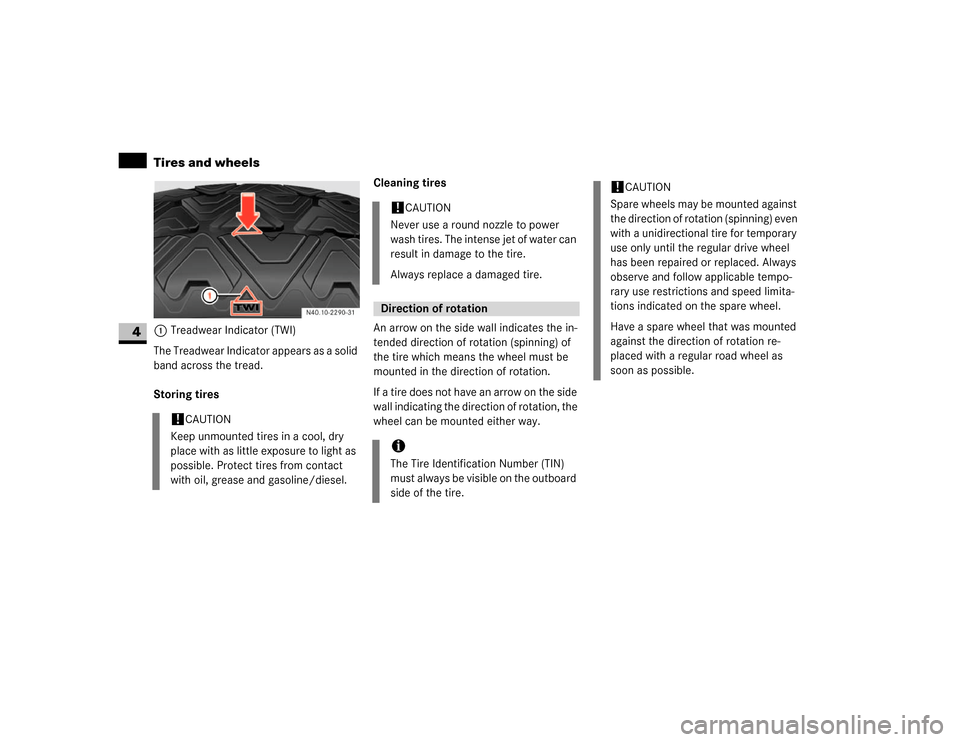
1Treadwear Indicator (TWI)
The Treadwear Indicator appears as a solid
band across the tread.
Storing tiresCleaning tires
An arrow on the side wall indicates the in-
tended direction of rotation (spinning) of
the tire which means the wheel must be
mounted in the direction of rotation.
If a tire does not have an arrow on the side
wall indicating the direction of rotation, the
wheel can be mounted either way.
!
CAUTION
Keep unmounted tires in a cool, dry
place with as little exposure to light as
possible. Protect tires from contact
with oil, grease and gasoline/diesel.
!
CAUTION
Never use a round nozzle to power
wash tires. The intense jet of water can
result in damage to the tire.
Always replace a damaged tire.
Direction of rotationiThe Tire Identification Number (TIN)
must always be visible on the outboard
side of the tire.
!
CAUTION
Spare wheels may be mounted against
the direction of rotation (spinning) even
with a unidirectional tire for temporary
use only until the regular drive wheel
has been repaired or replaced. Always
observe and follow applicable tempo-
rary use restrictions and speed limita-
tions indicated on the spare wheel.
Have a spare wheel that was mounted
against the direction of rotation re-
placed with a regular road wheel as
soon as possible.
Page 224 of 393
223 Operation
Tires and wheels
4
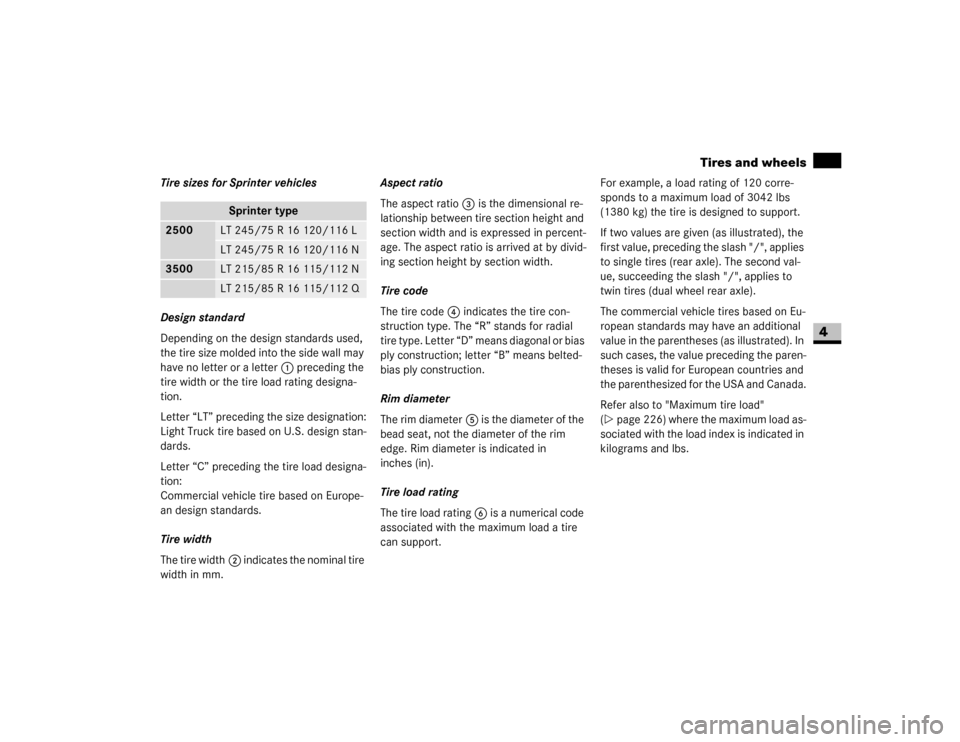
Tire sizes for Sprinter vehicles
Design standard
Depending on the design standards used,
the tire size molded into the side wall may
have no letter or a letter1 preceding the
tire width or the tire load rating designa-
tion.
Letter “LT” preceding the size designation:
Light Truck tire based on U.S. design stan-
dards.
Letter “C” preceding the tire load designa-
tion:
Commercial vehicle tire based on Europe-
an design standards.
Tire width
The tire width2 indicates the nominal tire
width in mm.Aspect ratio
The aspect ratio3 is the dimensional re-
lationship between tire section height and
section width and is expressed in percent-
age. The aspect ratio is arrived at by divid-
ing section height by section width.
Tire code
The tire code4 indicates the tire con-
struction type. The “R” stands for radial
tire type. Letter “D” means diagonal or bias
ply construction; letter “B” means belted-
bias ply construction.
Rim diameter
The rim diameter5 is the diameter of the
bead seat, not the diameter of the rim
edge. Rim diameter is indicated in
inches (in).
Tire load rating
The tire load rating6 is a numerical code
associated with the maximum load a tire
can support.For example, a load rating of 120 corre-
sponds to a maximum load of 3042 lbs
(1380 kg) the tire is designed to support.
If two values are given (as illustrated), the
first value, preceding the slash "/", applies
to single tires (rear axle). The second val-
ue, succeeding the slash "/", applies to
twin tires (dual wheel rear axle).
The commercial vehicle tires based on Eu-
ropean standards may have an additional
value in the parentheses (as illustrated). In
such cases, the value preceding the paren-
theses is valid for European countries and
the parenthesized for the USA and Canada.
Refer also to "Maximum tire load"
(\2page 226) where the maximum load as-
sociated with the load index is indicated in
kilograms and lbs.
Sprinter type
2500
LT 245/75 R 16 120/116 LLT 245/75 R 16 120/116 N
3500
LT 215/85 R 16 115/112 NLT 215/85 R 16 115/112 Q
Page 236 of 393
235 Operation
Winter driving
4
Drive with particular care on icy roads.
Avoid sudden acceleration, steering move-
ments and braking.If it seems likely that the vehicle is about to
enter a skid or cannot be stopped at a low
speed:
\4Move the selector lever to position N.
\4Try to maintain control of the vehicle
using light corrective steering.
Road salt may adversely affect braking ef-
ficiency. It may therefore be necessary to
apply the brakes more forcefully in order to
achieve the same braking force as normal.
Apply the brakes regularly when making
longer journeys on gritted or salted roads.
This will have the effect of restoring the
brakes to their normal level of perfor-
mance.
When stopping the vehicle after traveling
on roads that have been salted, check that
the brakes are fully functional before pro-
ceeding further.
Warning
G
If you use your spare tire when winter tires
are fitted on the other wheels, be aware that
the difference in tire characteristics may im-
pair turning stability and overall driving sta-
bility may be reduced. Adapt your driving
style accordingly.
Have the spare tire replaced with a winter
tire at the nearest authorized Sprinter Deal-
er.iWhen they have been removed, store
wheels and tires in a cool, dry, and if
possible dark place. Protect the tires
from oil, grease, and gasoline / diesel.
Driving in winterWarning
G
Downshifting to brake could cause the drive
wheels to lose grip on a slippery surface due
to the increased difference in speed be-
tween the engine and the drive wheels at
this time.
Do not downshift for additional engine brak-
ing on a slippery surface. Use the service
brake in accordance with road conditions.
Only downshift to a lower gear when travel-
ing at a low engine speed.
Page 244 of 393
243 Operation
Cleaning and care of the vehicle
4
Steps
Engine cleaningLight-alloy wheels*
Clean light-alloy wheels on a regular basis.
Outside of windshield and wiper blades
\1Turn key to position1 in ignition lock
(\2page 67).
\1Switch on windshield wipers
(\2page 126).
\1When the wiper arms are vertical, turn
key to position0 in the ignition lock or
remove the key.
\1Fold the wiper arms away from the
windshield until you feel them engage
in place.\1You can now clean the windshield and
the wiper blades.
\1Fold the windshield wipers back again
before you switch on the ignition.Warning
G
Dirty or iced-up steps and entrances create
a risk of slipping or falling.
Keep steps, entrances and footwear free
from dirt (e.g. mud, clay, snow and ice).!
CAUTION
Do not allow water to enter the intake
and ventilation openings.
When cleaning with high-pressure wa-
ter or steam cleaners, the spray must
not be aimed directly at electrical com-
ponents or at the end of electrical
lines.
Treat the engine with preservative
agents after cleaning. Protect the belt
drive system from the preservative
when you do so.
!
CAUTION
Do not use any acidic or alkaline clean-
ing agents. They can cause corrosion of
the wheel bolts (wheel nuts) or the bal-
ancing weight retainers.
!
CAUTION
Do not fold the windshield wipers away
from the windshield unless the hood is
closed. You will otherwise damage the
hood.
Warning
G
Switch off the ignition before cleaning the
windshield or the wiper blades. The wind-
shield wipers could otherwise move and in-
jure you.
Page 246 of 393
245 Operation
Cleaning and care of the vehicle
4
\1Clean the camera lens 1 using water
and a soft cloth only.
Be careful not to apply wax to the camera
lens 1 when waxing the vehicle. If neces-
sary, remove the wax using shampoo with
plenty of water.!
Do not use dry, coarse or hard cloths
and aggressive cleaning agents. Do not
scrub or use high pressure. You will other-
wise scratch or damage the lens or the ca-
mera.
If you clean the vehicle with a high-pressu-
re cleaner or steam cleaner, maintain a mi-
nimum distance of 1.6 ft (50 cm) to the
rear view camera. To prevent damage, do
not aim directly at the rear view camera or
at the microphone openings on the under-
side of the rear view camera.
Plastic trimsLight soiling
\1Wipe plastic parts with a damp, lint-
free cloth (e.g. a micro-fiber cloth).
Heavy soiling
\1Wipe plastic parts with a damp, lint-
free cloth (e.g. a micro-fiber cloth). Dashboard and padded boss of the
steering wheel
\1Moisten a clean and lint-free cloth with
water and clean the plastic parts and
the dashboard.
\1Use a mild soap solution for particularly
stubborn dirt.!
CAUTION
Do not use dry, coarse or hard cloths
and do not scrub. You will otherwise
scratch or damage the surfaces.
!
CAUTION
Use a low-foaming grease solvent (e.g.
washing-up liquid) diluted in water as a
cleaning agent.
The surface color may temporarily
change shade during cleaning. Simply
wait for the surface to dry.
!
CAUTION
Use a solvent-free and non-caustic
cleaning agent. The manufacturer
recommends that you use a
Mercedes-Benz product.
The surface color may temporarily
change shade during cleaning. Simply
wait for the surface to dry.
Warning
G
Do not use cleaners or cockpit care sprays
containing solvents to clean the dashboard
or the padded boss of the steering wheel.
Cleaners containing solvents can make the
surface porous, which could lead to serious
injuries if plastic parts were to come loose
when an airbag is triggered.