steering wheel DODGE SPRINTER 2007 2.G Repair Manual
[x] Cancel search | Manufacturer: DODGE, Model Year: 2007, Model line: SPRINTER, Model: DODGE SPRINTER 2007 2.GPages: 393, PDF Size: 7.61 MB
Page 206 of 393
205 Operation
Tires and wheels
4
The following labels on the vehicle show
how much weight it may properly carry.
\4Only vehicles with a gross weight ca-
pacity less than 10,000 lbs (4500 kg)
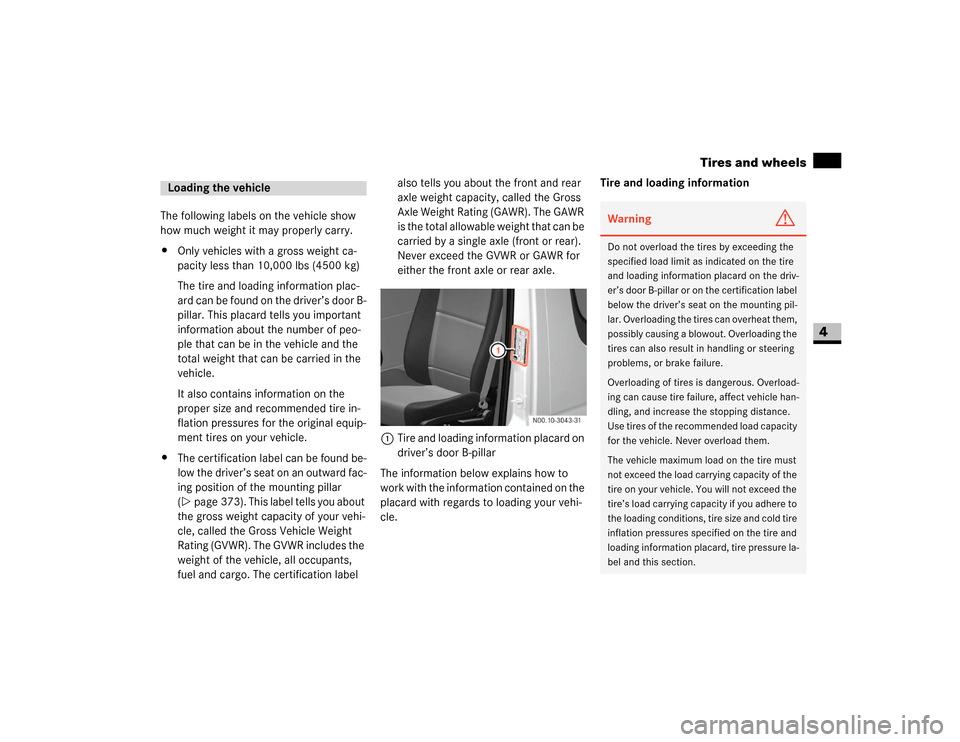
The tire and loading information plac-
ard can be found on the driver’s door B-
pillar. This placard tells you important
information about the number of peo-
ple that can be in the vehicle and the
total weight that can be carried in the
vehicle.
It also contains information on the
proper size and recommended tire in-
flation pressures for the original equip-
ment tires on your vehicle.
\4The certification label can be found be-
low the driver’s seat on an outward fac-
ing position of the mounting pillar
(\2page 373). This label tells you about
the gross weight capacity of your vehi-
cle, called the Gross Vehicle Weight
Rating (GVWR). The GVWR includes the
weight of the vehicle, all occupants,
fuel and cargo. The certification label also tells you about the front and rear
axle weight capacity, called the Gross
Axle Weight Rating (GAWR). The GAWR
is the total allowable weight that can be
carried by a single axle (front or rear).
Never exceed the GVWR or GAWR for
either the front axle or rear axle.
1Tire and loading information placard on
driver’s door B-pillar
The information below explains how to
work with the information contained on the
placard with regards to loading your vehi-
cle.Tire and loading informationLoading the vehicle
Warning
G
Do not overload the tires by exceeding the
specified load limit as indicated on the tire
and loading information placard on the driv-
er’s door B-pillar or on the certification label
below the driver’s seat on the mounting pil-
lar. Overloading the tires can overheat them,
possibly causing a blowout. Overloading the
tires can also result in handling or steering
problems, or brake failure.
Overloading of tires is dangerous. Overload-
ing can cause tire failure, affect vehicle han-
dling, and increase the stopping distance.
Use tires of the recommended load capacity
for the vehicle. Never overload them.
The vehicle maximum load on the tire must
not exceed the load carrying capacity of the
tire on your vehicle. You will not exceed the
tire’s load carrying capacity if you adhere to
the loading conditions, tire size and cold tire
inflation pressures specified on the tire and
loading information placard, tire pressure la-
bel and this section.
Page 215 of 393
214 OperationTires and wheels
4
\1Repeat this procedure for each tire.
Checking tire pressure electronically
with the Tire Pressure Monitoring Sys-
tem (TPMS)* (vehicles without steering
wheel buttons)
Vehicles without steering wheel buttons
are equipped with the Tire Pressure Moni-
toring System.The TPMS only functions on wheels that
are equipped with the proper electronic
sensors. It monitors the tire inflation pres-
sure, as selected by the driver, in all four
tires. A warning is issued to alert you to a
decrease in pressure in one or more of the
tires.
!
CAUTION
After inspecting or adjusting the tire in-
flation pressure, always reattach the
valve cap if equipped.
This will prevent moisture and dirt from
entering the valve stem, which could
damage the valve stem.
iUSA only:
The Tire Pressure Monitoring System
(TPMS) is equipped with a combination
low tire pressure/TPMS malfunction
telltale in the instrument cluster
(\2page 14). Depending on how the
telltale illuminates, it indicates a low
tire pressure condition or a malfunction
in the TPMS system itself:
\4If the telltale illuminates continu-
ously, one or more of your tires is
significantly underinflated. There is
no malfunction in the TPMS.
\4If the telltale flashes for 60 seconds
and then stays illuminated, the
TPMS system itself is not operating
properly.
iCanada only:
The Tire Pressure Monitoring System
(TPMS) is equipped with a low tire pres-
sure telltale in the instrument cluster
(\2page 14). If the telltale illuminates,
one or more of your tires is significantly
underinflated.Warning
G
The TPMS does not warn you against incor-
rectly selected tire inflation pressure and
does not warn you when the tire pressure is
not properly selected for the respective ve-
hicle load. It warns you only when the pres-
sure of one or more tires decreases
significantly below the reference inflation
\2\2
Page 216 of 393
215 Operation
Tires and wheels
4
pressure which was stored at the time of
calibration of the TPMS after you inflated the
tires.
Always ensure that you re-calibrate the
TPMS after you inflated the tires to the rec-
ommended cold inflation pressure.
Always adjust tire inflation pressure accord-
ing to the tire and loading information plac-
ard on the driver’s door B-pillar.
Underinflated tires wear excessively and/or
unevenly, adversely affect handling and fuel
economy, and are more likely to fail from be-
ing overheated.
Overinflated tires can adversely affect han-
dling and ride comfort, wear unevenly, in-
crease stopping distance, and result in
sudden deflation (blowout) because they are
more likely to become punctured or dam-
aged by road debris, potholes etc.
The TPMS is not able to issue a warning due
to a sudden dramatic loss of pressure (e.g.
tire blowout caused by a foreign object). In
this case bring the vehicle to a halt by care-
fully applying the brakes and avoiding
abrupt steering maneuvers.
Warning
G
Each tire, including the spare (if provided),
should be checked monthly when cold and
inflated to the inflation pressure recom-
mended by the vehicle manufacturer on the
tire and loading information placard. (If your
vehicle has tires of a different size than the
size indicated on the vehicle placard or the
tire inflation pressure label, you should de-
termine the proper tire inflation pressure for
those tires).
As an added safety feature, your vehicle has
been equipped with a Tire Pressure Monitor-
ing System (TPMS) that illuminates a low tire
pressure telltale when one or more of your
tires is significantly underinflated. Accord-
ingly, when the low tire pressure telltale illu-
minates, you should stop and check your
tires as soon as possible, and inflate them to
the proper pressure. Driving on a significant-
ly underinflated tire causes the tire to over-
heat and can lead to tire failure.
Underinflation also reduces fuel efficiency
and tire tread life, and may affect the vehi-
cle’s handling and stopping ability. Please
note that the TPMS is not a substitute for
proper tire maintenance, and it is the driv-
er’s responsibility to maintain correct tire
pressure, even if underinflation has not
reached the level to trigger illumination of
the TPMS low tire pressure telltale.
USA only:
Your vehicle has also been equipped with a
TPMS malfunction indicator to indicate
when the system is not operating properly.
The TPMS malfunction indicator is com-
bined with the low tire pressure telltale.
When the system detects a malfunction, the
telltale will flash for approximately 1 minute
and then remain continuously illuminated.
This sequence will continue upon subse-
quent vehicle start-ups as long as the mal-
function exists. When the malfunction
indicator is illuminated, the system may not
be able to detect or signal low tire pressure
as intended.
\2\2
Page 218 of 393
217 Operation
Tires and wheels
4
\1Press the ,menu button on the instru-
ment cluster.
The following message is displayed:
OK TPMSThe tire pressure monitor activation
process has begun.
The tire pressures of the individual
wheels are stored as the new reference
values if they are determined to be
plausible for the tire pressure monitor.
If you wish to cancel the activation pro-
cess:
\1Press the .button or the 5menu button
on the instrument cluster.
The activation process is canceled au-
tomatically if 30 seconds elapse with
no input.Checking tire pressure electronically
with the Tire Pressure Monitoring Sys-
tem (TPMS)* (vehicles with steering
wheel buttons)
Vehicles with steering wheel buttons are
equipped with the Advanced Tire Pressure
Monitoring System.
The TPMS only functions on wheels that
are equipped with the proper electronic
sensors. It monitors the tire inflation pres-
sure, as selected by the driver, in all four
tires. A warning is issued to alert you to a
decrease in pressure in one or more of the
tires.
Tire pressure inquiries are made using the
multifunction display. The present inflation
pressures are displayed only after a few
minutes’ travel time.
iUSA only:
The Tire Pressure Monitoring System
(TPMS) is equipped with a combination
low tire pressure/TPMS malfunction
telltale in the instrument cluster
(\2page 14). Depending on how the
telltale illuminates, it indicates a low
tire pressure condition or a malfunction
in the TPMS system itself:
\4If the telltale illuminates continu-
ously, one or more of your tires is
significantly underinflated. There is
no malfunction in the TPMS.
\4If the telltale flashes for 60 seconds
and then stays illuminated, the
TPMS system itself is not operating
properly.
iCanada only:
The Tire Pressure Monitoring System
(TPMS) is equipped with a low tire pres-
sure telltale in the instrument cluster
(\2page 14). If the telltale illuminates,
one or more of your tires is significantly
underinflated.
Page 220 of 393
219 Operation
Tires and wheels
4
Always adjust the tire inflation pressure ac-
cording to the tire and loading information
placard on the driver’s door B-pillar.
Underinflated tires wear excessively and/or
unevenly, adversely affect handling and fuel
economy, and are more likely to fail from be-
ing overheated.
Overinflated tires can adversely affect han-
dling and ride comfort, wear unevenly, in-
crease stopping distance, and result in
sudden deflation (blowout) because they are
more likely to become punctured or dam-
aged by road debris, potholes etc.
The TPMS is not able to issue a warning due
to a sudden dramatic loss of pressure (e.g.
tire blowout caused by a foreign object). In
this case bring the vehicle to a halt by care-
fully applying the brakes and avoiding
abrupt steering maneuvers.
Warning
G
Each tire, including the spare (if provided),
should be checked monthly when cold and
inflated to the inflation pressure recom-
mended by the vehicle manufacturer on the
vehicle placard or the tire inflation pressure
label. (If your vehicle has tires of a different
size than the size indicated on the vehicle
placard or the tire inflation pressure label,
you should determine the proper tire infla-
tion pressure for those tires).
As an added safety feature, your vehicle has
been equipped with a Tire Pressure Monitor-
ing System (TPMS) that illuminates a low tire
pressure telltale when one or more of your
tires is significantly underinflated. Accord-
ingly, when the low tire pressure telltale illu-
minates, you should stop and check your
tires as soon as possible, and inflate them to
the proper pressure. Driving on a significant-
ly underinflated tire causes the tire to over-
heat and can lead to tire failure.
Underinflation also reduces fuel efficiency
and tire tread life, and may affect the vehi-
cle’s handling and stopping ability. Please
note that the TPMS is not a substitute for
proper tire maintenance, and it is the driv-
er’s responsibility to maintain correct tire
pressure, even if underinflation has not
reached the level to trigger illumination of
the TPMS low tire pressure telltale.
USA only:
Your vehicle has also been equipped with a
TPMS malfunction indicator to indicate
when the system is not operating properly.
The TPMS malfunction indicator is com-
bined with the low tire pressure telltale.
When the system detects a malfunction, the
telltale will flash for approximately 1 minute
and then remain continuously illuminated.
This sequence will continue upon subse-
quent vehicle start-ups as long as the mal-
function exists. When the malfunction
indicator is illuminated, the system may not
be able to detect or signal low tire pressure
as intended.
\2\2
Page 221 of 393
220 OperationTires and wheels
4
Reactivating Advanced TPMS
The TPMS must be reactivated when you
have adjusted the tire inflation pressure to
a new level (e.g. because of different load
or driving conditions). The TPMS is then
recalibrated to the current tire inflation
pressures.\1Using the tire and loading information
placard on the driver’s door B-pillar
(\2page 206), make sure the tire infla-
tion pressure of all four tires is correct.
\1Press buttonè orÿ on the mul-
tifunction steering wheel repeatedly
until the standard display menu ap-
pears in the multifunction display
(\2page 93).
TPMS malfunctions may occur for a variety
of reasons, including the installation of in-
compatible replacement or alternate tires or
wheels on the vehicle that prevent the TPMS
from functioning properly. Always check the
TPMS malfunction telltale after replacing
one or more tires or wheels on your vehicle
to ensure that the replacement or alternate
tires and wheels allow the TPMS to continue
to function properly.iIf a condition causing the TPMS to mal-
function develops, it may take up to 10
minutes for the system to signal a mal-
function using the TPMS telltale flash-
ing and illumination sequence.
The telltale extinguishes after driving a
few minutes if the malfunction has
been corrected.
iOperating radio transmission equip-
ment (e.g. wireless headsets, two-way
radios) in or near the vehicle could
cause the TPMS to malfunctionWarning!
G
It is the driver’s responsibility to calibrate
the TPMS on the recommended cold infla-
tion pressure. Underinflated tires affect the
ability to steer or brake the vehicle. You
might lose control over the vehicle.
iReactivate the TPMS after adjusting
the tire inflation pressure to the infla-
tion pressure recommended for the ve-
hicle operating condition. Tire pressure
should only be adjusted on cold tires.
Observe the recommended tire infla-
tion pressure on the tire and loading in-
formation placard on the driver’s door
B-pillar (\2page 206).
Page 222 of 393
221 Operation
Tires and wheels
4
\1Press thej or kbutton repeat-
edly until you see the current inflation
pressures for each tire appear in the
display or the following message ap-
pears in the display
Tire pres. displayed
after driving
for several minutes
\1Press reset button0 on the instrument
cluster (\2page 14).
The following message will appear in
the multifunction display:
Tire pres.
Adjust pres.
\1Press æbutton.
The following message will appear in
the multifunction display:
Tire pres. monitor
reactivatedAfter a few minutes' driving, the cur-
rent tire inflation pressure values are
accepted as reference values and then
monitored.If you wish to cancel activation:
\1Press çbutton.
Potential problems associated with un-
derinflated and overinflated tires
Proper tire inflation pressure is essential to
the safe and satisfactory operation of your
vehicle. Three primary areas are affected
by improper tire inflation pressure:
1. Safety
2. Economy
Improper inflation pressures can cause un-
even wear patterns to develop across the
tire tread. These abnormal wear patterns
will reduce tread life resulting in a need for
earlier tire replacement. Underinflation
also increases tire rolling resistance and
results in higher fuel consumption.
Warning
G
Follow recommended tire inflation pres-
sures.
Do not underinflate tires. Underinflated tires
wear excessively and/or unevenly, adverse-
ly affect handling and fuel economy, and are
more likely to fail from being overheated.
Do not overinflate tires. Overinflated tires
can adversely affect handling and ride com-
fort, wear unevenly, increase stopping dis-
tance, and result in sudden deflation
(blowout) because they are more likely to
become punctured or damaged by road de-
bris, potholes etc.Warning
G
Improperly inflated tires are dangerous and
can cause accidents.
Unequal tire inflation pressures can cause
steering problems. You could lose control of
your vehicle.
Unequal tire inflation pressures from one
side of the vehicle to the other can cause
the vehicle to drift to the right or left. Always
drive with each tire inflated to the recom-
mended cold tire inflation pressure.
\2\2
Page 225 of 393
224 OperationTires and wheels
4
Tire speed rating
The tire speed rating6 indicates the ap-
proved maximum speed for the tire.
The commercial vehicle tires based on Eu-
ropean standards may have an additional
index in the parentheses. In such cases,
the index preceding the parentheses is val-
id for European countries and the paren-
thesized for the USA and Canada.
Warning
G
The tire load rating must always be at least
h a l f o f t h e G A W R o f y o u r v e h i c l e . O t h e r w i s e ,
tire failure may be the result which may
cause an accident and/or serious personal
injury to you or others.
Always replace rims and tires with the same
designation, manufacturer and type as
shown on the original part.Warning
G
Do not overload the tires by exceeding the
specified load limit as indicated on the plac-
ard located on the driver’s door B-pillar.
Overloading the tires can overheat them,
possibly causing a blowout. Overloading the
tires can also result in handling or steering
problems, or brake failure.
iTire load rating6 and tire speed
rating7 are also referred to as “ser-
vice description”.
Warning
G
Even when permitted by law, never operate
a vehicle at speeds greater than the maxi-
mum speed rating of the tires.
Exceeding the maximum speed for which
tires are rated can lead to sudden tire fail-
ure, causing loss of vehicle control and pos-
sibly resulting in an accident and/or
personal injury and possible death, for you
and for others.iAlways observe the speed rating of the
winter tires installed on your Sprinter
vehicle. If the maximum speed for
which your tires are rated is below the
speed rating of your Sprinter vehicle,
you must place a notice to this effect
where it will be seen by the driver.
Such notices are available at your tire
dealer or any authorized Sprinter Deal-
er.
Page 228 of 393
227 Operation
Tires and wheels
4
For more information on tire load rating,
refer to "Tire size designation, load and
speed rating" (\2page 222).
For information on calculating total and
cargo load capacities, refer to "Tire and
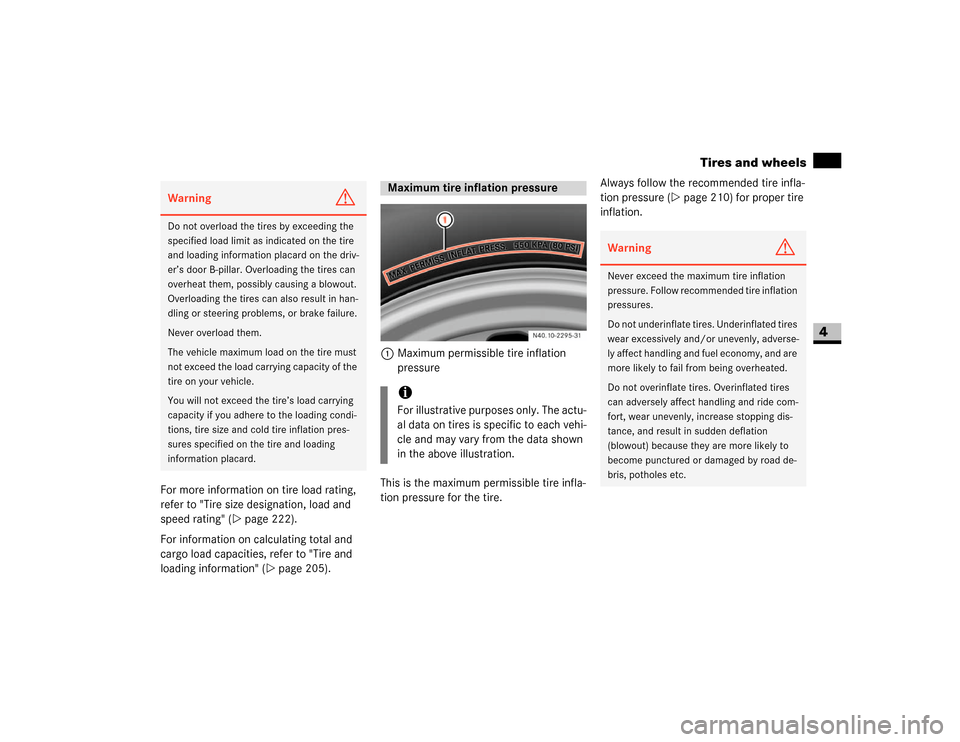
loading information" (\2page 205). 1Maximum permissible tire inflation
pressure
This is the maximum permissible tire infla-
tion pressure for the tire.Always follow the recommended tire infla-
tion pressure (\2page 210) for proper tire
inflation.Warning
G
Do not overload the tires by exceeding the
specified load limit as indicated on the tire
and loading information placard on the driv-
er’s door B-pillar. Overloading the tires can
overheat them, possibly causing a blowout.
Overloading the tires can also result in han-
dling or steering problems, or brake failure.
Never overload them.
The vehicle maximum load on the tire must
not exceed the load carrying capacity of the
tire on your vehicle.
You will not exceed the tire’s load carrying
capacity if you adhere to the loading condi-
tions, tire size and cold tire inflation pres-
sures specified on the tire and loading
information placard.
Maximum tire inflation pressureiFor illustrative purposes only. The actu-
al data on tires is specific to each vehi-
cle and may vary from the data shown
in the above illustration.
Warning
G
Never exceed the maximum tire inflation
pressure. Follow recommended tire inflation
pressures.
Do not underinflate tires. Underinflated tires
wear excessively and/or unevenly, adverse-
ly affect handling and fuel economy, and are
more likely to fail from being overheated.
Do not overinflate tires. Overinflated tires
can adversely affect handling and ride com-
fort, wear unevenly, increase stopping dis-
tance, and result in sudden deflation
(blowout) because they are more likely to
become punctured or damaged by road de-
bris, potholes etc.
Page 229 of 393
228 OperationTires and wheels
4
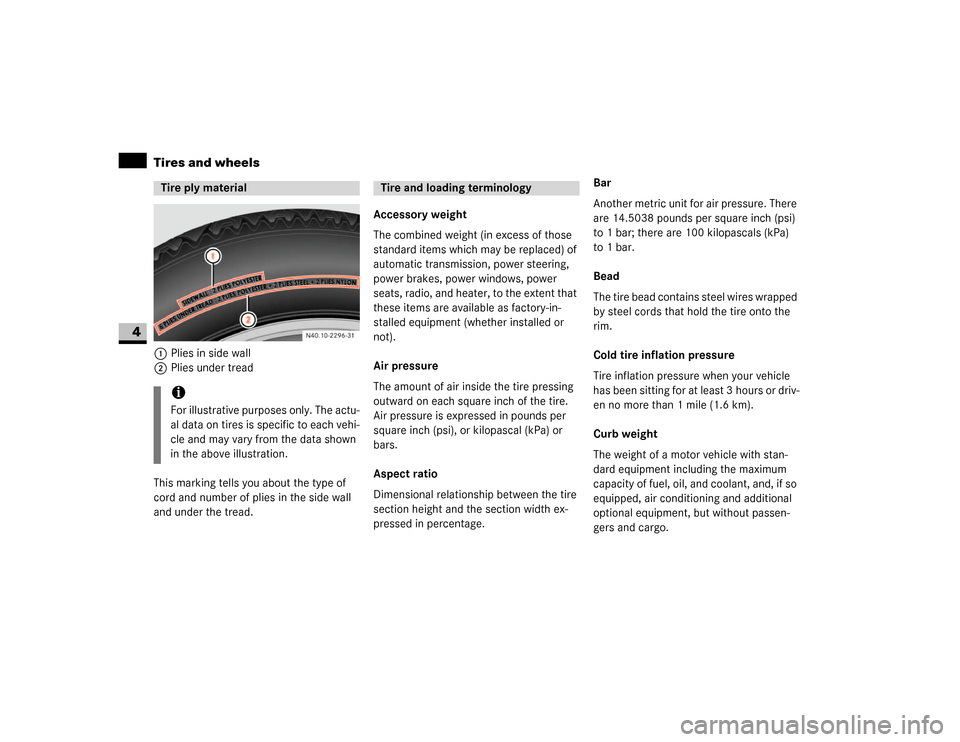
1Plies in side wall
2Plies under tread
This marking tells you about the type of
cord and number of plies in the side wall
and under the tread.Accessory weight
The combined weight (in excess of those
standard items which may be replaced) of
automatic transmission, power steering,
power brakes, power windows, power
seats, radio, and heater, to the extent that
these items are available as factory-in-
stalled equipment (whether installed or
not).
Air pressure
The amount of air inside the tire pressing
outward on each square inch of the tire.
Air pressure is expressed in pounds per
square inch (psi), or kilopascal (kPa) or
bars.
Aspect ratio
Dimensional relationship between the tire
section height and the section width ex-
pressed in percentage.Bar
Another metric unit for air pressure. There
are 14.5038 pounds per square inch (psi)
to 1 bar; there are 100 kilopascals (kPa)
to 1 bar.
Bead
The tire bead contains steel wires wrapped
by steel cords that hold the tire onto the
rim.
Cold tire inflation pressure
Tire inflation pressure when your vehicle
has been sitting for at least 3 hours or driv-
en no more than 1 mile (1.6 km).
Curb weight
The weight of a motor vehicle with stan-
dard equipment including the maximum
capacity of fuel, oil, and coolant, and, if so
equipped, air conditioning and additional
optional equipment, but without passen-
gers and cargo.Tire ply materialiFor illustrative purposes only. The actu-
al data on tires is specific to each vehi-
cle and may vary from the data shown
in the above illustration.
Tire and loading terminology