mileage DODGE TRUCK 1993 Service User Guide
[x] Cancel search | Manufacturer: DODGE, Model Year: 1993, Model line: TRUCK, Model: DODGE TRUCK 1993Pages: 1502, PDF Size: 80.97 MB
Page 218 of 1502
•
BRAKES
5 - 31 board lining. Also check condition of the caliper pis
ton dust boot. If leakage is evident or if the boot is
cut, torn, or damaged in any way, it will be necessary to overhaul the caliper.
Remove the O-ring from the caliper adapter and clean
the slide surfaces of the adapter and the machined ways on the caliper with a wire brush and sandpaper.
DISC
BRAKESHOE
INSTALLATION
(1) Install inboard brakeshoe in adapter (Fig. 8).
(2) If new brakeshoes are being installed, remove
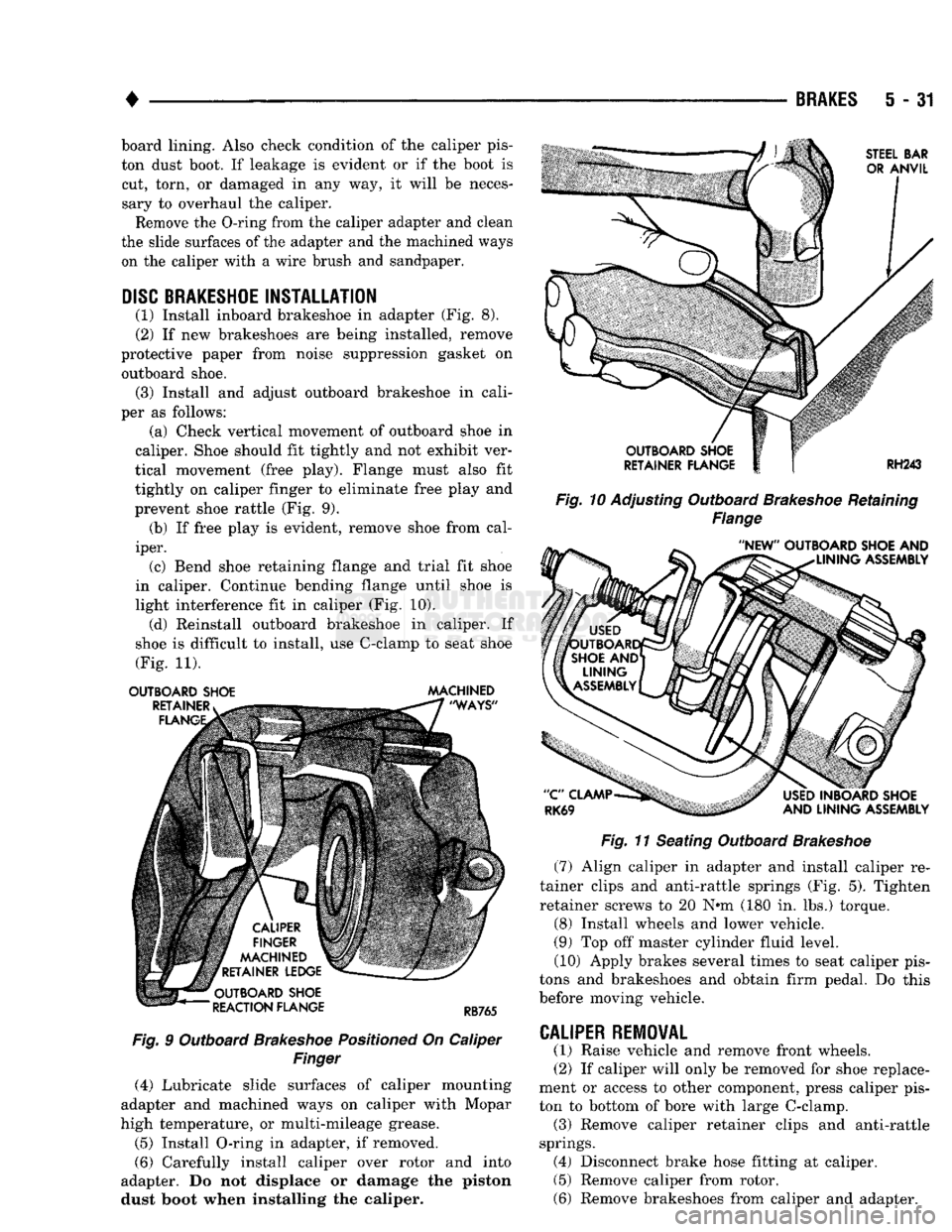
protective paper from noise suppression gasket on outboard shoe. (3) Install and adjust outboard brakeshoe in cali
per as follows: (a) Check vertical movement of outboard shoe in
caliper. Shoe should fit tightly and not exhibit ver
tical movement (free play). Flange must also fit
tightly on caliper finger to eliminate free play and
prevent shoe rattle (Fig. 9). (b) If free play is evident, remove shoe from cal
iper. (c) Bend shoe retaining flange and trial fit shoe
in caliper. Continue bending flange until shoe is
light interference fit in caliper (Fig. 10). (d) Reinstall outboard brakeshoe in caliper. If
shoe is difficult to install, use C-clamp to seat shoe
(Fig. 11).
OUTBOARD SHOE MACHINED
Fig.
9 Outboard
Brakeshoe
Positioned
On Caliper
Finger
(4) Lubricate slide surfaces of caliper mounting
adapter and machined ways on caliper with Mopar
high temperature, or multi-mileage grease.
(5) Install O-ring in adapter, if removed.
(6) Carefully install caliper over rotor and into
adapter. Do not displace or damage the piston dust boot when installing the caliper.
Fig. 10
Adjusting Outboard
Brakeshoe
Retaining
Flange
Fig.
11 Seating Outboard
Brakeshoe
(7) Align caliper in adapter and install caliper re
tainer clips and anti-rattle springs (Fig. 5). Tighten
retainer screws to 20 N«m (180 in. lbs.) torque.
(8) Install wheels and lower vehicle.
(9) Top off master cylinder fluid level. (10) Apply brakes several times to seat caliper pis
tons and brakeshoes and obtain firm pedal. Do this
before moving vehicle.
CALIPER
REMOVAL
(1) Raise vehicle and remove front wheels.
(2) If caliper will only be removed for shoe replace
ment or access to other component, press caliper pis
ton to bottom of bore with large C-clamp. (3) Remove caliper retainer clips and anti-rattle
springs. (4) Disconnect brake hose fitting at caliper. (5) Remove caliper from rotor.
(6) Remove brakeshoes from caliper and adapter.
Page 220 of 1502
•
BRAKES
5
- 33
BLEEDER
CALIPER
INBOARD
ANTI-RATTLE
PISTON
SPRING
RH242A
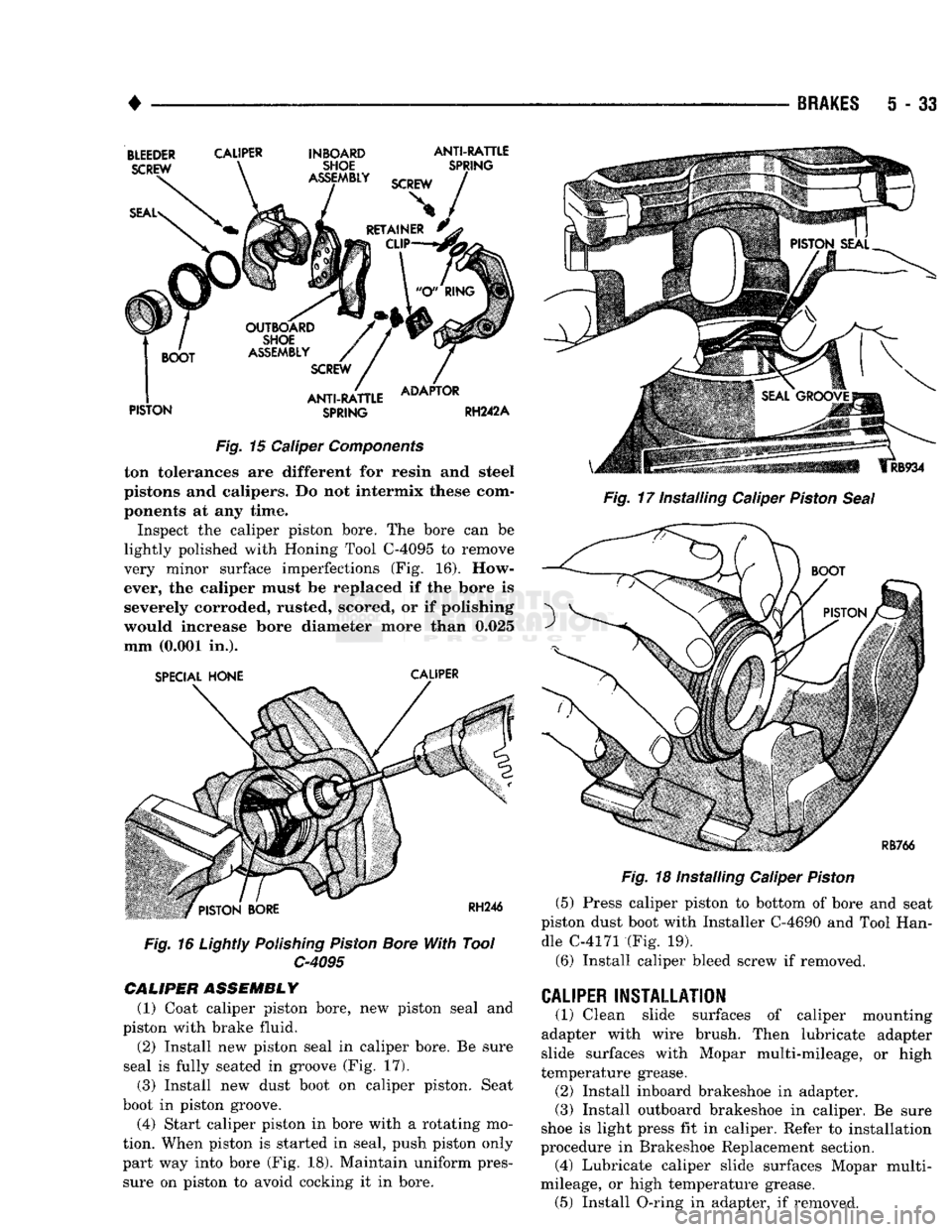
Fig.
15
Caliper Components ton tolerances
are
different
for
resin
and
steel
pistons
and
calipers.
Do not
intermix these com
ponents
at any
time. Inspect
the
caliper piston bore.
The
bore
can be
lightly polished with Honing Tool C-4095
to
remove
very minor surface imperfections
(Fig. 16).
How
ever,
the
caliper must
be
replaced
if the
bore
is
severely corroded, rusted, scored,
or if
polishing
would increase bore diameter more than 0.025
mm (0.001
in.).
Fig. 16 Lightly Polishing Piston Bore With Tool
C-4095
CALIPER ASSEMBLY (1) Coat caliper piston bore,
new
piston seal
and
piston with brake fluid.
(2) Install
new
piston seal
in
caliper bore.
Be
sure
seal
is
fully seated
in
groove
(Fig. 17).
(3) Install
new
dust boot
on
caliper piston. Seat
boot
in
piston groove.
(4) Start caliper piston
in
bore with
a
rotating
mo
tion. When piston
is
started
in
seal, push piston only
part
way
into bore
(Fig. 18).
Maintain uniform pres sure
on
piston
to
avoid cocking
it in
bore.
Fig.
17 Installing Caliper
Piston
Seal
Fig.
18 Installing Caliper
Piston
(5) Press caliper piston
to
bottom
of
bore
and
seat
piston dust boot with Installer C-4690
and
Tool Han dle C-4171
(Fig. 19).
(6) Install caliper bleed screw
if
removed.
CALIPER
INSTALLATION
(1) Clean slide surfaces
of
caliper mounting
adapter with wire brush. Then lubricate adapter
slide surfaces with Mopar multi-mileage,
or
high
temperature grease.
(2) Install inboard brakeshoe
in
adapter.
(3) Install outboard brakeshoe
in
caliper.
Be
sure
shoe
is
light press
fit in
caliper. Refer
to
installation
procedure
in
Brakeshoe Replacement section. (4) Lubricate caliper slide surfaces Mopar multi-
mileage,
or
high temperature grease. (5) Install O-ring
in
adapter,
if
removed.
Page 226 of 1502
BRAKES
5 - 39
DISC BRAKE LINING WEAR COMPENSATION
Normal lining wear is compensated for by exten
sion of the caliper piston and by lateral movement of
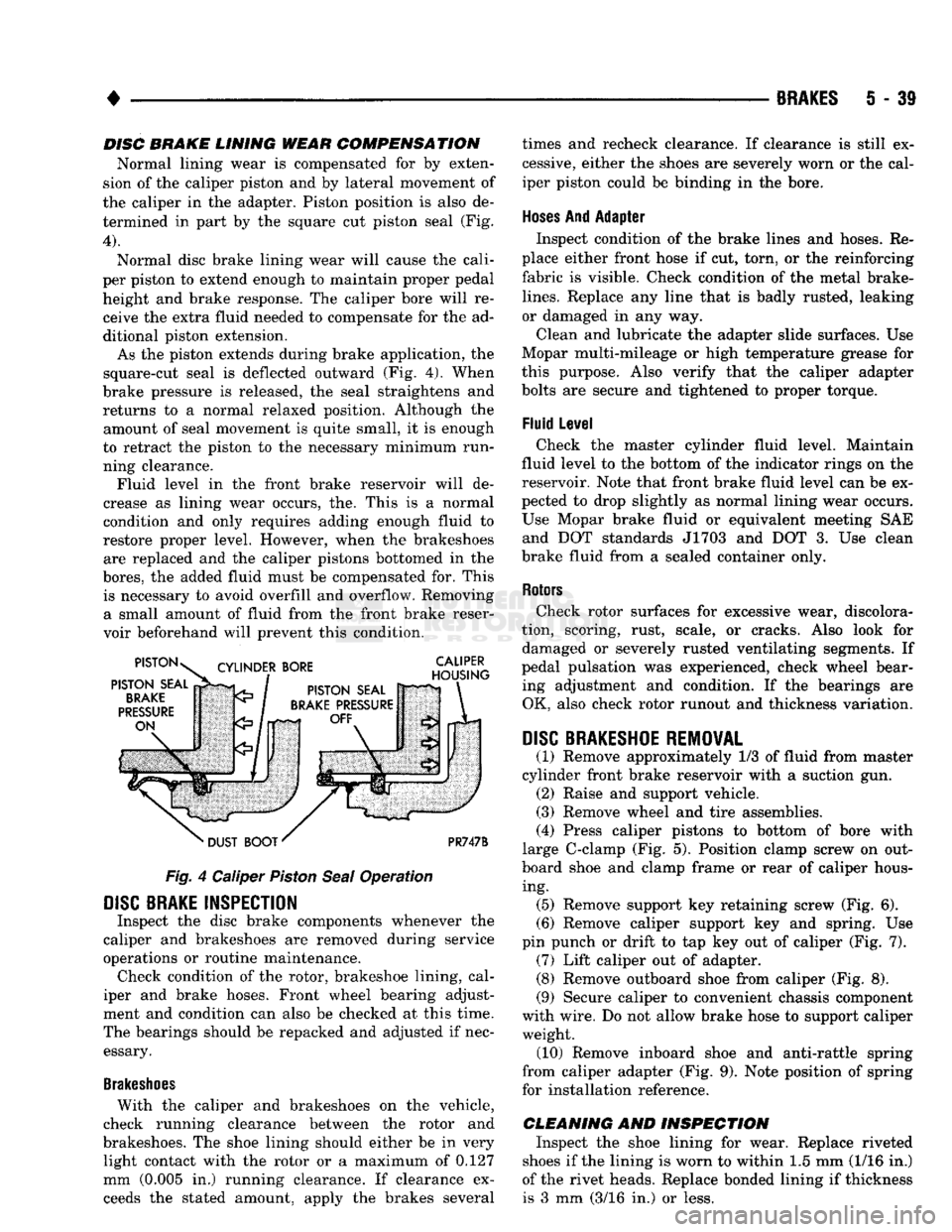
the caliper in the adapter. Piston position is also de termined in part by the square cut piston seal (Fig.
4).
Normal disc brake lining wear will cause the cali
per piston to extend enough to maintain proper pedal height and brake response. The caliper bore will receive the extra fluid needed to compensate for the ad
ditional piston extension.
As the piston extends during brake application, the
square-cut seal is deflected outward (Fig. 4). When
brake pressure is released, the seal straightens and returns to a normal relaxed position. Although the amount of seal movement is quite small, it is enough
to retract the piston to the necessary minimum run ning clearance. Fluid level in the front brake reservoir will de
crease as lining wear occurs, the. This is a normal
condition and only requires adding enough fluid to
restore proper level. However, when the brakeshoes are replaced and the caliper pistons bottomed in the
bores,
the added fluid must be compensated for. This is necessary to avoid overfill and overflow. Removing a small amount of fluid from the front brake reser
voir beforehand will prevent this condition.
Fig.
4 Caliper
Piston
Seal
Operation
DISC
BRAKE INSPECTION
Inspect the disc brake components whenever the
caliper and brakeshoes are removed during service
operations or routine maintenance. Check condition of the rotor, brakeshoe lining, cal
iper and brake hoses. Front wheel bearing adjust
ment and condition can also be checked at this time.
The bearings should be repacked and adjusted if nec essary.
Brakeshoes
With the caliper and brakeshoes on the vehicle,
check running clearance between the rotor and
brakeshoes. The shoe lining should either be in very light contact with the rotor or a maximum of 0.127
mm (0.005 in.) running clearance. If clearance exceeds the stated amount, apply the brakes several times and recheck clearance. If clearance is still ex
cessive, either the shoes are severely worn or the cal
iper piston could be binding in the bore.
Hoses
And Adapter Inspect condition of the brake lines and hoses. Re
place either front hose if cut, torn, or the reinforcing
fabric is visible. Check condition of the metal brake-
lines.
Replace any line that is badly rusted, leaking
or damaged in any way.
Clean and lubricate the adapter slide surfaces. Use
Mopar multi-mileage or high temperature grease for
this purpose. Also verify that the caliper adapter
bolts are secure and tightened to proper torque.
Fluid Level Check the master cylinder fluid level. Maintain
fluid level to the bottom of the indicator rings on the
reservoir. Note that front brake fluid level can be ex
pected to drop slightly as normal lining wear occurs.
Use Mopar brake fluid or equivalent meeting SAE and DOT standards J1703 and DOT 3. Use clean
brake fluid from a sealed container only.
Rotors
Check rotor surfaces for excessive wear, discolora
tion, scoring, rust, scale, or cracks. Also look for damaged or severely rusted ventilating segments. If
pedal pulsation was experienced, check wheel bear ing adjustment and condition. If the bearings are OK, also check rotor runout and thickness variation.
DISC
BRAKESHOE REMOVAL
(1) Remove approximately 1/3 of fluid from master
cylinder front brake reservoir with a suction gun. (2) Raise and support vehicle.
(3) Remove wheel and tire assemblies.
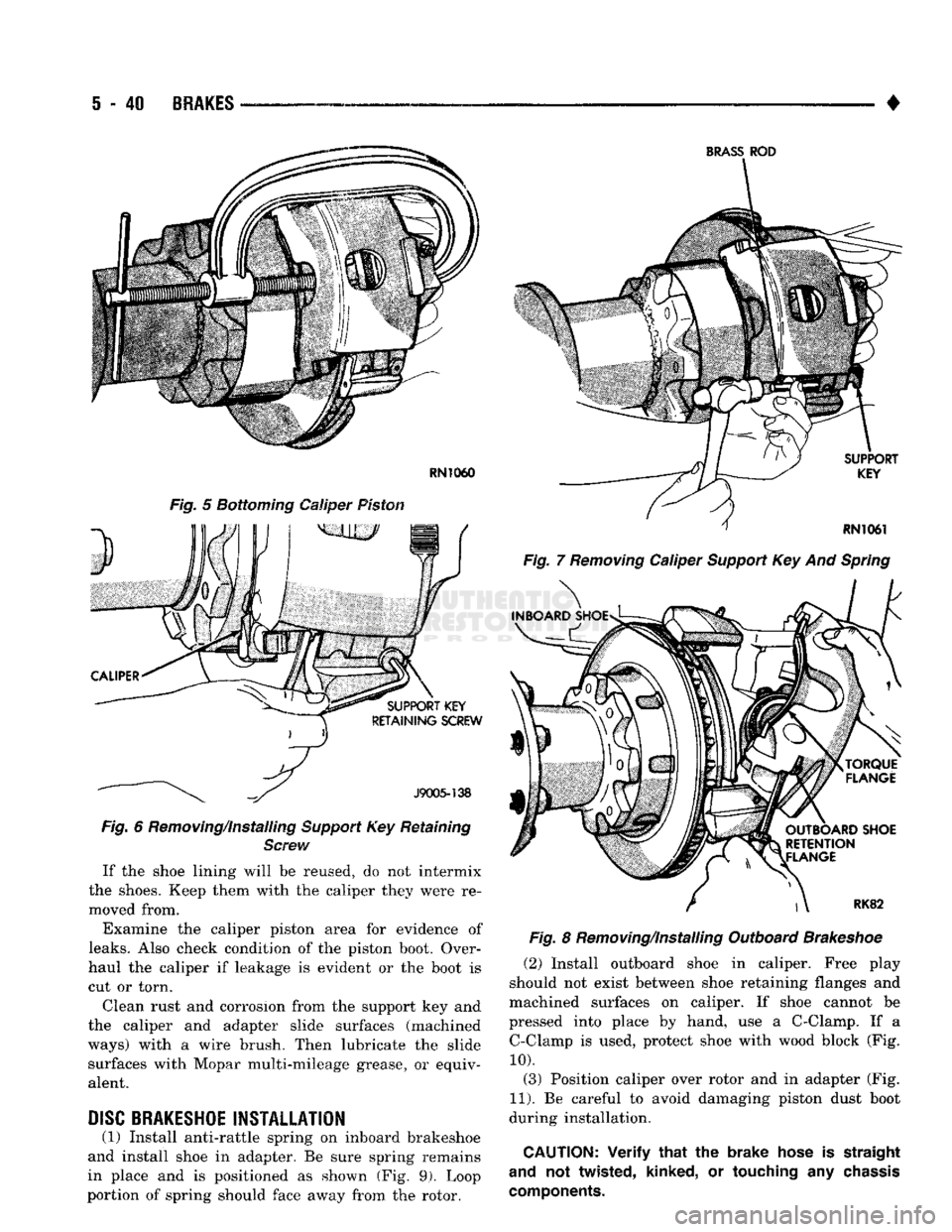
(4) Press caliper pistons to bottom of bore with
large C-clamp (Fig. 5). Position clamp screw on out
board shoe and clamp frame or rear of caliper hous ing. (5) Remove support key retaining screw (Fig. 6).
(6) Remove caliper support key and spring. Use
pin punch or drift to tap key out of caliper (Fig. 7). (7) Lift caliper out of adapter. (8) Remove outboard shoe from caliper (Fig. 8).
(9) Secure caliper to convenient chassis component
with wire. Do not allow brake hose to support caliper weight. (10) Remove inboard shoe and anti-rattle spring
from caliper adapter (Fig. 9). Note position of spring
for installation reference.
CLEANING AND INSPECTION Inspect the shoe lining for wear. Replace riveted
shoes if the lining is worn to within 1.5 mm (1/16 in.)
of the rivet heads. Replace bonded lining if thickness is 3 mm (3/16 in.) or less.
Page 227 of 1502
5
- 40
BRAKES
•
Fig.
6 Removing/Installing
Support
Key Retaining
Screw
If the shoe lining will be reused, do not intermix
the shoes. Keep them with the caliper they were re moved from.
Examine the caliper piston area for evidence of
leaks.
Also check condition of the piston boot. Over
haul the caliper if leakage is evident or the boot is
cut or torn.
Clean rust and corrosion from the support key and
the caliper and adapter slide surfaces (machined
ways) with a wire brush. Then lubricate the slide surfaces with Mopar multi-mileage grease, or equiv
alent.
DISC
BRAKESHOE
INSTALLATION
(1) Install anti-rattle spring on inboard brakeshoe
and install shoe in adapter. Be sure spring remains
in place and is positioned as shown (Fig. 9). Loop
portion of spring should face away from the rotor.
BRASS
ROD
Fig.
7
Removing
Caliper
Support
Key And
Spring
Fig.
8 Removing/Installing Outboard
Brakeshoe
(2) Install outboard shoe in caliper. Free play
should not exist between shoe retaining flanges and
machined surfaces on caliper. If shoe cannot be
pressed into place by hand, use a C-Clamp. If a C-Clamp is used, protect shoe with wood block (Fig.
10).
(3) Position caliper over rotor and in adapter (Fig.
11).
Be careful to avoid damaging piston dust boot
during installation.
CAUTION:
Verify
that
the brake
hose
is straight
and
not twisted, kinked, or
touching
any
chassis
components.
Page 270 of 1502
•
CLUTCH
6-17
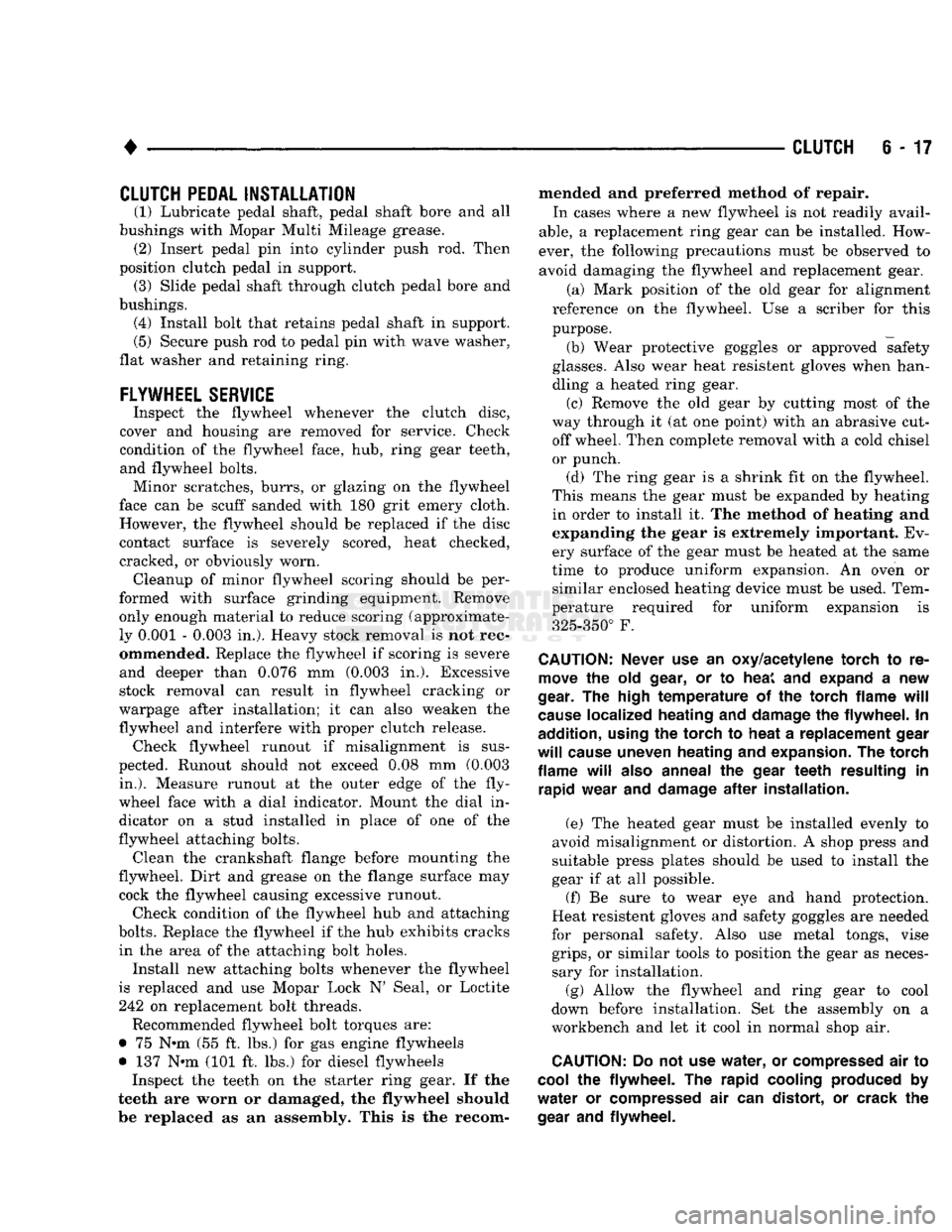
CLUTCH PEDAL INSTALLATION
(1) Lubricate pedal shaft, pedal shaft bore and all
bushings with Mopar Multi Mileage grease. (2) Insert pedal pin into cylinder push rod. Then
position clutch pedal in support. (3) Slide pedal shaft through clutch pedal bore and
bushings. (4) Install bolt that retains pedal shaft in support.
(5) Secure push rod to pedal pin with wave washer,
flat washer and retaining ring.
FLYWHEEL SERVICE
Inspect the flywheel whenever the clutch disc,
cover and housing are removed for service. Check
condition of the flywheel face, hub, ring gear teeth,
and flywheel bolts. Minor scratches, burrs, or glazing on the flywheel
face can be scuff sanded with 180 grit emery cloth. However, the flywheel should be replaced if the disc
contact surface is severely scored, heat checked,
cracked, or obviously worn. Cleanup of minor flywheel scoring should be per
formed with surface grinding equipment. Remove
only enough material to reduce scoring (approximate
ly 0.001 - 0.003 in.). Heavy stock removal is not rec
ommended. Replace the flywheel if scoring is severe
and deeper than 0.076 mm (0.003 in.). Excessive
stock removal can result in flywheel cracking or
warpage after installation; it can also weaken the flywheel and interfere with proper clutch release. Check flywheel runout if misalignment is sus
pected. Runout should not exceed 0.08 mm (0.003
in.).
Measure runout at the outer edge of the fly
wheel face with a dial indicator. Mount the dial in
dicator on a stud installed in place of one of the
flywheel attaching bolts. Clean the crankshaft flange before mounting the
flywheel. Dirt and grease on the flange surface may cock the flywheel causing excessive runout. Check condition of the flywheel hub and attaching
bolts.
Replace the flywheel if the hub exhibits cracks in the area of the attaching bolt holes. Install new attaching bolts whenever the flywheel
is replaced and use Mopar Lock N' Seal, or Loctite
242 on replacement bolt threads.
Recommended flywheel bolt torques are:
• 75 N»m (55 ft. lbs.) for gas engine flywheels
• 137 N*m (101 ft. lbs.) for diesel flywheels Inspect the teeth on the starter ring gear. If the
teeth are worn or damaged, the flywheel should
be replaced as an assembly. This is the recom mended and preferred method of repair.
In cases where a new flywheel is not readily avail
able,
a replacement ring gear can be installed. How
ever, the following precautions must be observed to
avoid damaging the flywheel and replacement gear.
(a) Mark position of the old gear for alignment
reference on the flywheel. Use a scriber for this
purpose.
(b) Wear protective goggles or approved safety
glasses. Also wear heat resistent gloves when han
dling a heated ring gear. (c) Remove the old gear by cutting most of the
way through it (at one point) with an abrasive cut off wheel. Then complete removal with a cold chisel
or punch. (d) The ring gear is a shrink fit on the flywheel.
This means the gear must be expanded by heating in order to install it. The method of heating and expanding the gear is extremely important. Ev
ery surface of the gear must be heated at the same
time to produce uniform expansion. An oven or
similar enclosed heating device must be used. Tem
perature required for uniform expansion is 325-350° F.
CAUTION:
Never
use an
oxy/acetylene torch
to re
move
the old
gear,
or to
heat
and
expand
a new
gear.
The
high temperature
of the
torch flame
will
cause
localized heating
and
damage
the
flywheel.
In
addition,
using
the
torch
to
heat
a
replacement gear
will
cause uneven heating
and
expansion.
The
torch
flame
will
also
anneal
the
gear
teeth
resulting
in
rapid wear
and
damage
after
installation.
(e) The heated gear must be installed evenly to
avoid misalignment or distortion. A shop press and
suitable press plates should be used to install the
gear if at all possible.
(f) Be sure to wear eye and hand protection.
Heat resistent gloves and safety goggles are needed
for personal safety. Also use metal tongs, vise
grips,
or similar tools to position the gear as necessary for installation.
(g) Allow the flywheel and ring gear to cool
down before installation. Set the assembly on a
workbench and let it cool in normal shop air.
CAUTION:
Do not
use water,
or
compressed
air to
cool
the
flywheel.
The
rapid cooling produced
by
water
or
compressed
air can
distort,
or
crack
the
gear
and
flywheel.
Page 277 of 1502
7 - 6
COOLING
SYSTEM
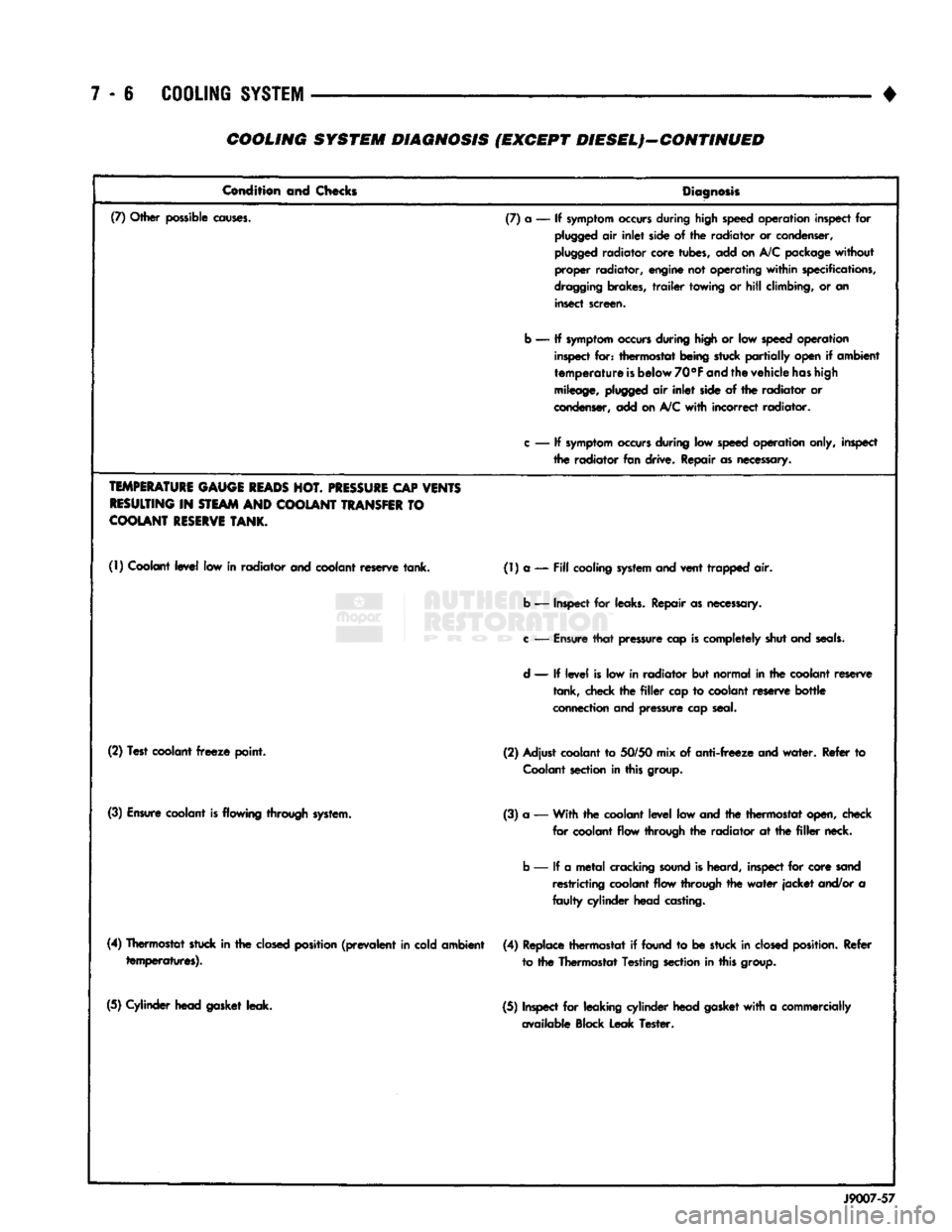
• COOLING SYSTEM DIAGNOSIS (EXCEPT DIESEL)—CONTINUED
Condition and Checks
Diagnosis
(7) Other possible
causes.
(7) a — If
symptom
occurs
during high speed operation inspect for
plugged
air
inlet
side of the radiator or condenser,
plugged
radiator core tubes, add on A/C package
without
proper radiator, engine not operating
within
specifications,
dragging
brakes,
trailer
towing or
hill
climbing, or an insect screen.
b — If
symptom
occurs
during high or low
speed
operation inspect for: thermostat being stuck
partially
open if ambient
temperature
is
below
70°F
and
the vehicle
has
high
mileage,
plugged
air
inlet
side of the radiator or
condenser, add on
A/C
with
incorrect radiator.
c
— If
symptom
occurs
during low
speed
operation only, inspect the radiator fan drive. Repair as necessary.
TEMPERATURE
GAUGE
READS
HOT.
PRESSURE
CAP
VENTS
RESULTING
IN
STEAM
AND
COOLANT
TRANSFER
TO
COOLANT
RESERVE
TANK.
(1) Coolant
level
low in radiator and coolant reserve tank. (1) a —
Fill
cooling
system
and vent trapped air.
b — Inspect for leaks. Repair as necessary.
c
—
Ensure
that
pressure cap
is
completely shut and
seals.
d
— If
level
is low in radiator but normal in the coolant reserve tank, check the
filler
cap to coolant reserve
bottle
connection and pressure cap seal.
(2) Test coolant
freeze
point. (2) Adjust coolant to
50/50
mix of
anti-freeze
and
water.
Refer to
Coolant
section in this group.
(3)
Ensure
coolant
is
flowing through system. (3) a — With the coolant
level
low and the thermostat open, check
for coolant flow through the radiator at the
filler
neck.
b — If a
metal
cracking
sound
is heard, inspect for core sand restricting coolant flow through the
water
jacket
and/or a
faulty
cylinder head casting.
(4) Thermostat stuck in the
closed
position
(prevalent
in cold ambient temperatures). (4) Replace thermostat if found to be stuck in
closed
position.
Refer
to the Thermostat Testing section in this group.
(5) Cylinder head gasket leak. (5) Inspect for leaking cylinder head gasket
with
a commercially
available Block Leak Tester.
J9007-57
Page 282 of 1502
•
COOLING
SYSTEM
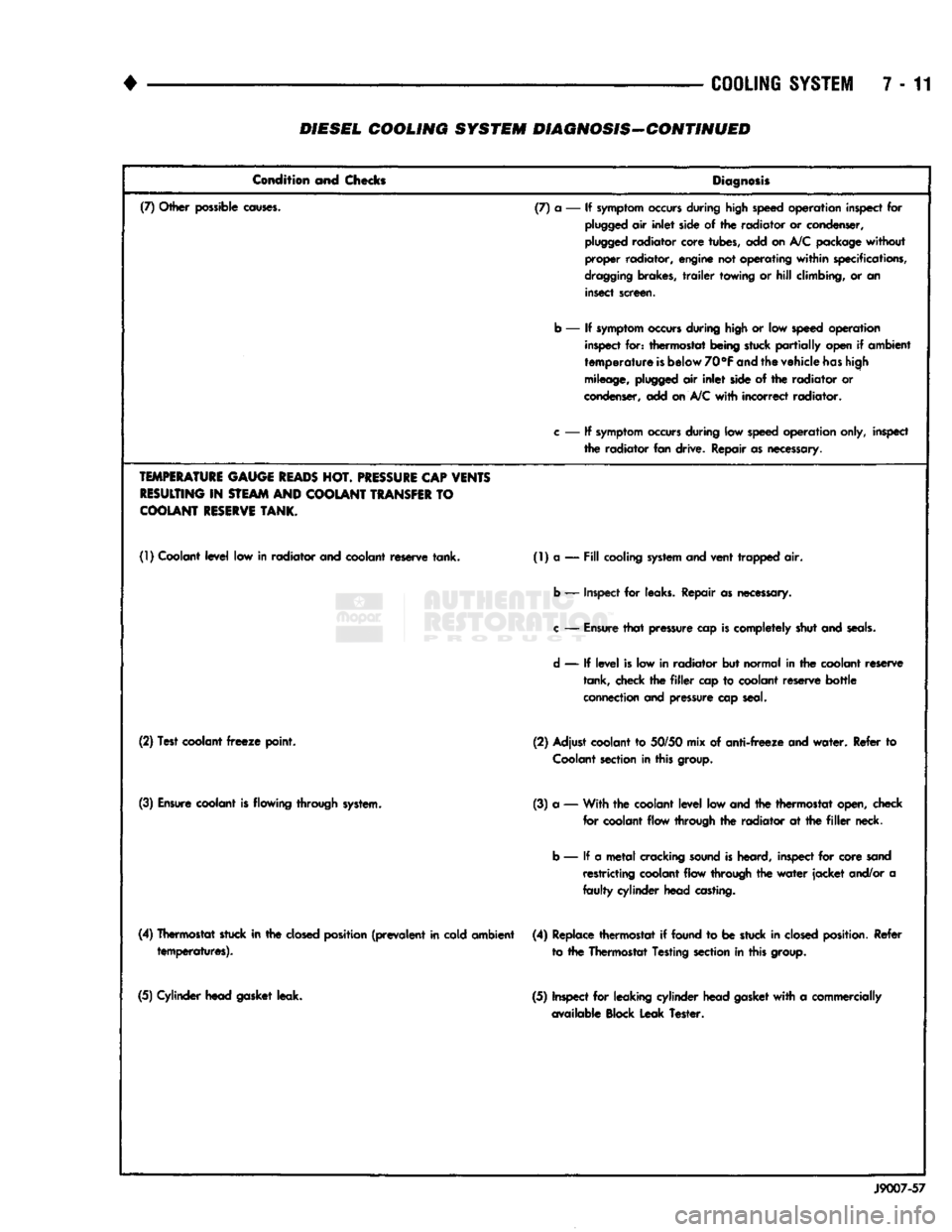
7-11 DIESEL COOLING SYSTEM DIAGNOSIS-CONTINUED
Condition and Chocks
Diagnosis
(7) Other possible
causes.
(7) a — If
symptom
occurs
during high speed operation inspect for
plugged
air
inlet
side of the radiator or condenser,
plugged
radiator core tubes, add on
A/C
package without
proper radiator, engine not operating
within
specifications,
dragging
brakes,
trailer
towing or
hill
climbing, or an insect screen.
b — If
symptom
occurs
during
high
or low speed operation inspect for: thermostat being stuck
partially
open if ambient
temperature
is
below 70°F
and
the vehicle
has
high
mileage,
plugged
air
inlet
side of the radiator or
condenser, add on
A/C
with
incorrect radiator.
c
— If
symptom
occurs
during low
speed
operation only, inspect the radiator fan drive. Repair
as
necessary.
TEMPERATURE
GAUGE
READS
HOT.
PRESSURE
CAP VENTS
RESULTING
IN
STEAM
AND COOLANT
TRANSFER
TO
COOLANT
RESERVE
TANK.
(1)
Coolant
level
low in radiator and coolant reserve tank. (1) a —
Fill
cooling
system
and vent trapped air.
b — Inspect for leaks. Repair as necessary.
c
—
Ensure
that
pressure cap
is
completely shut and
seals.
d
— If
level
is low in radiator but normal in the coolant reserve tank, check the
filler
cap to coolant reserve
bottle
connection and pressure cap seal.
(2) Test coolant
freeze
point. (2) Adjust coolant to 50/50 mix of
anti-freeze
and
water.
Refer to
Coolant
section
in this group.
(3)
Ensure
coolant
is
flowing through system. (3) a — With the coolant
level
low and the thermostat open, check
for coolant flow through the radiator at the
filler
neck.
b — If a
metal
cracking
sound
is
heard, inspect for core sand restricting coolant flow through the
water
jacket
and/or a
faulty
cylinder head casting.
(4) Thermostat stuck in the
closed
position (prevalent in cold ambient temperatures). (4) Replace thermostat if found to be stuck in
closed
position. Refer
to the Thermostat Testing section in this group.
(5) Cylinder head gasket leak. (5) Inspect for leaking cylinder head
gasket
with
a commercially
available Block Leak Tester.
J9007-57
Page 352 of 1502
•
IGNITION
SYSTEMS
8D
- 1
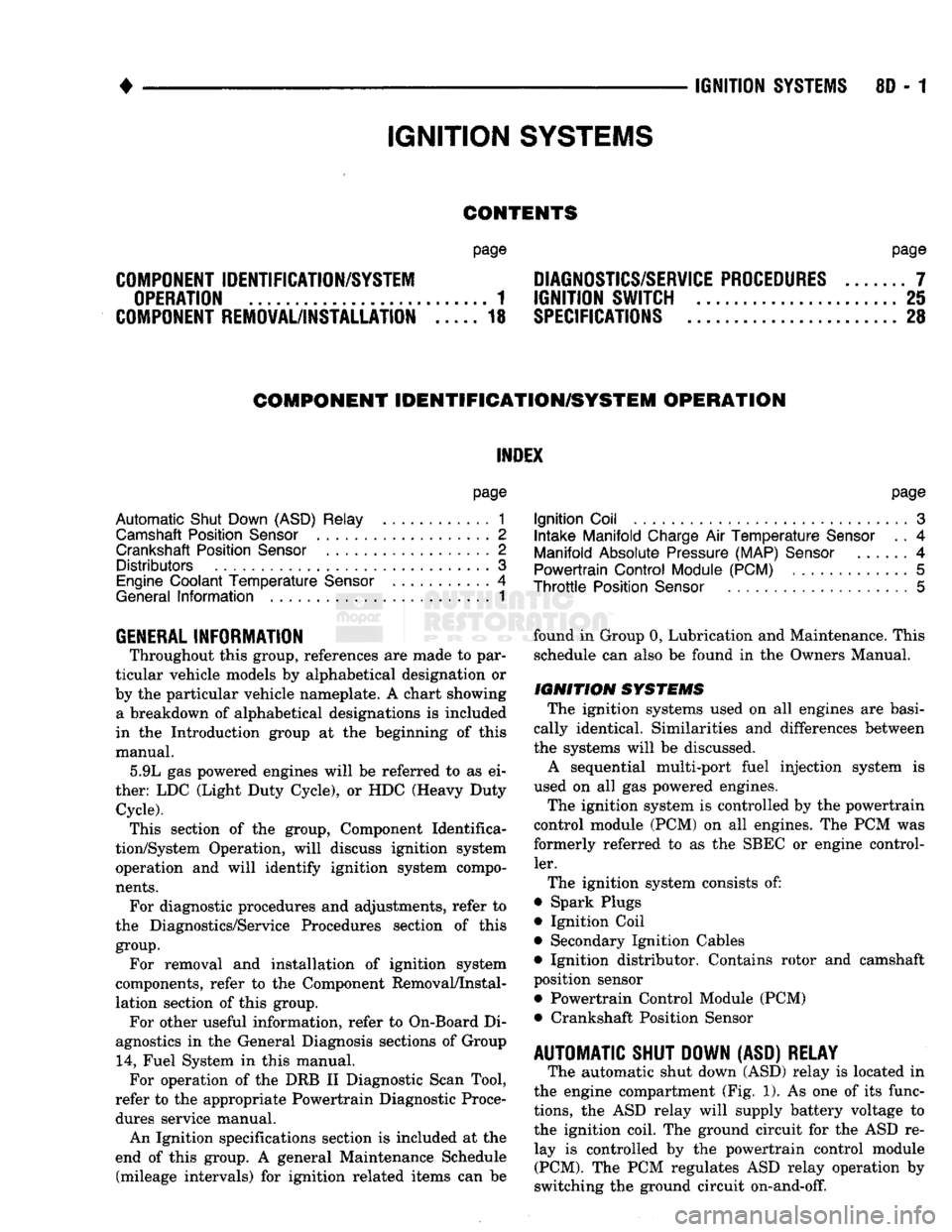
CONTENTS
page page
COMPONENT IDENTIFICATION/SYSTEM DIAGNOSTICS/SERVICE PROCEDURES
7
OPERATION
1
IGNITION SWITCH
25
COMPONENT REMOVAL/INSTALLATION
..... 18
SPECIFICATIONS
28
COMPONENT
IDENTIFICATION/SYSTEM OPERATION
INDEX
page
Automatic
Shut Down (ASD) Relay
1
Camshaft Position Sensor
2
Crankshaft Position Sensor
2
Distributors
3
Engine Coolant
Temperature
Sensor
...........
4
General
Information
1
page
Ignition
Coil
3
Intake
Manifold Charge
Air
Temperature
Sensor
. . 4
Manifold Absolute Pressure (MAP) Sensor
4
Powertrain
Control
Module (PCM)
. 5
Throttle
Position Sensor
5
GENERAL
INFORMATION
Throughout this group, references
are
made
to
par
ticular vehicle models
by
alphabetical designation
or
by
the
particular vehicle nameplate.
A
chart showing a breakdown
of
alphabetical designations
is
included
in
the
Introduction group
at the
beginning
of
this
manual. 5.9L
gas
powered engines will
be
referred
to as ei
ther: LDC (Light Duty Cycle),
or
HDC (Heavy Duty Cycle). This section
of the
group, Component Identifica
tion/System Operation, will discuss ignition system operation
and
will identify ignition system compo
nents.
For diagnostic procedures
and
adjustments, refer
to
the Diagnostics/Service Procedures section
of
this
group.
For removal
and
installation
of
ignition system
components, refer
to the
Component Removal/Instal
lation section
of
this group. For other useful information, refer
to
On-Board
Di
agnostics
in the
General Diagnosis sections
of
Group
14,
Fuel System
in
this manual. For operation
of the DRB II
Diagnostic Scan Tool,
refer
to the
appropriate Powertrain Diagnostic Proce
dures service manual.
An Ignition specifications section
is
included
at the
end
of
this group.
A
general Maintenance Schedule (mileage intervals)
for
ignition related items
can be
found
in
Group
0,
Lubrication and Maintenance. This
schedule
can
also
be
found
in the
Owners Manual.
IGNITION
SYSTEMS
The ignition systems used
on all
engines
are
basi
cally identical. Similarities
and
differences between
the systems will
be
discussed.
A sequential multi-port fuel injection system
is
used
on all gas
powered engines.
The ignition system
is
controlled
by the
powertrain
control module (PCM)
on all
engines.
The
PCM
was
formerly referred
to as the
SBEC
or
engine control ler.
The ignition system consists
of:
• Spark Plugs
• Ignition Coil
• Secondary Ignition Cables
• Ignition distributor. Contains rotor
and
camshaft
position sensor • Powertrain Control Module (PCM)
• Crankshaft Position Sensor
AUTOMATIC SHUT DOWN (ASD) RELAY
The automatic shut down (ASD) relay
is
located
in
the engine compartment (Fig.
1). As one of its
func
tions,
the ASD
relay will supply battery voltage
to
the ignition coil.
The
ground circuit
for the
ASD
re
lay
is
controlled
by the
powertrain control module (PCM).
The PCM
regulates
ASD
relay operation
by
switching
the
ground circuit on-and-off.
IGNITION
SYSTEMS
Page 365 of 1502
8D
- 14
IGNITION SYSTEMS
• (5) Test the MAP sensor ground circuit at sensor
connector terminal-A (Fig. 19) and PCM connector
terminal-4. Repair the wire harness if necessary.
(6) Test the MAP sensor ground circuit at the
PCM connector between terminal-4 and terminal-11
with an ohmmeter. If the ohmmeter indicates an
open circuit, inspect for a defective sensor ground
connection. Refer to Group 8W, Wiring for location of
this connection. If the ground connection is good, re
place the PCM. If terminal-4 has a short circuit to 12 volts +, correct this condition before replacing the
PCM.
POWERTRAIN
CONTROL MODULE {PCM)
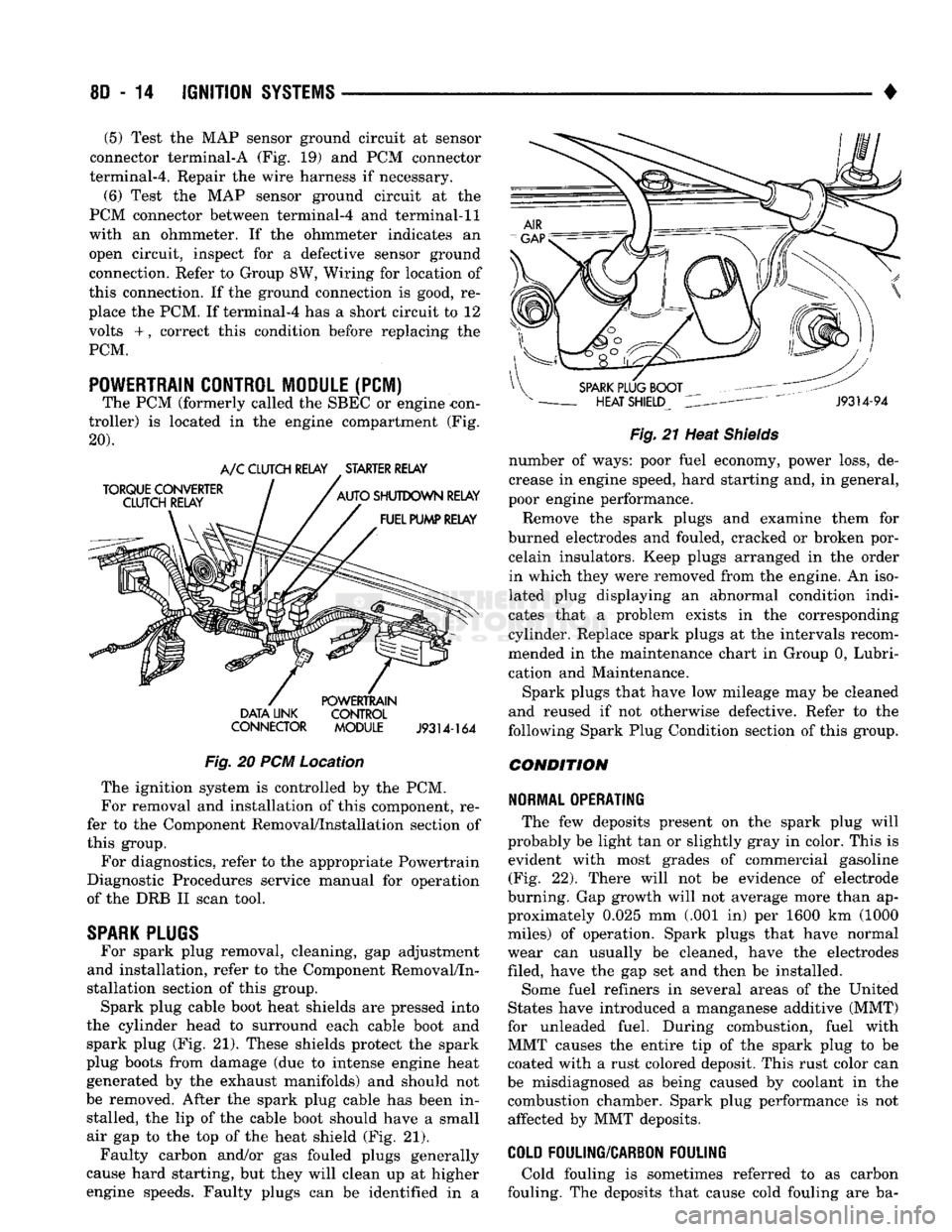
The PCM (formerly called the SBEC or engine -con
troller) is located in the engine compartment (Fig.
20). DATA UNK CONTROL
CONNECTOR MODULE
J9314-164
Fig.
20 PCM Location The ignition system is controlled by the PCM.
For removal and installation of this component, re
fer to the Component Removal/Installation section of
this group.
For diagnostics, refer to the appropriate Powertrain
Diagnostic Procedures service manual for operation
of the DRB II scan tool.
SPARK
PLUGS
For spark plug removal, cleaning, gap adjustment
and installation, refer to the Component Removal/In
stallation section of this group. Spark plug cable boot heat shields are pressed into
the cylinder head to surround each cable boot and
spark plug (Fig. 21). These shields protect the spark
plug boots from damage (due to intense engine heat
generated by the exhaust manifolds) and should not
be removed. After the spark plug cable has been in stalled, the lip of the cable boot should have a small
air gap to the top of the heat shield (Fig. 21). Faulty carbon and/or gas fouled plugs generally
cause hard starting, but they will clean up at higher
engine speeds. Faulty plugs can be identified in a
Fig.
21 Heat
Shields
number of ways: poor fuel economy, power loss, de
crease in engine speed, hard starting and, in general,
poor engine performance.
Remove the spark plugs and examine them for
burned electrodes and fouled, cracked or broken por celain insulators. Keep plugs arranged in the order
in which they were removed from the engine. An iso
lated plug displaying an abnormal condition indi
cates that a problem exists in the corresponding
cylinder. Replace spark plugs at the intervals recom
mended in the maintenance chart in Group 0, Lubri
cation and Maintenance.
Spark plugs that have low mileage may be cleaned
and reused if not otherwise defective. Refer to the
following Spark Plug Condition section of this group.
CONDITION
NORMAL OPERATING
The few deposits present on the spark plug will
probably be light tan or slightly gray in color. This is evident with most grades of commercial gasoline (Fig. 22). There will not be evidence of electrode
burning. Gap growth will not average more than ap proximately 0.025 mm (.001 in) per 1600 km (1000
miles) of operation. Spark plugs that have normal
wear can usually be cleaned, have the electrodes filed, have the gap set and then be installed.
Some fuel refiners in several areas of the United
States have introduced a manganese additive (MMT)
for unleaded fuel. During combustion, fuel with
MMT causes the entire tip of the spark plug to be coated with a rust colored deposit. This rust color can
be misdiagnosed as being caused by coolant in the combustion chamber. Spark plug performance is not affected by MMT deposits.
COLD
FOULING/CARBON FOULING
Cold fouling is sometimes referred to as carbon
fouling. The deposits that cause cold fouling are ba-
Page 464 of 1502

•
POWER
WINDOWS
8S - 3
FROM PIN
SIDE
OF
SWITCH
MASTER
WINDOW
LIFT
SWITCH
SWITCH
POSITION CONTINUITY
BETWEEN
OFF
PINS
1 & 2
PINS
2 & 3
PINS
2 &4
PINS
2 & 6
DRIVER'S
MP
PINS
3 & 5
PINS
2 & 6
PASSENGER'S
PINS
1 & 5
PINS
2 &4
DRIVER'S
PINS
5 & 6
PINS
2 & 3
TOWN
PASSENGER'S
PINS
1 & 2
PINS
4 & 5 898S-11
Fig.
1 Master Window
Lift
Switch
Continuity
(b) Likewise, motor connected to DOWN direc
tion rotation, no movement will be observed if win
dow is already in full down position.
PIN IDENTIFICATION SHOWN
FROM
PIN
SIDE
OF
SWITCH
SWITCH CONTINUITY
POSITION
BETWEEN
PINS
1 & 4
OFF
PINS
2 & 5
PINS
3 & 4
UP
PINS
2 & 5
PINS
2 & 3
DOWN
PINS
1 & 4
898S-12
Fig.
2
Passenger's Door
Mounted
Switch
Continuity
(4) Reverse battery leads (opposite to steps 1 and
2) and window should now move. If window does not
move, remove motor. Refer to Service Procedures for
motor removal from vehicle for bench test.
If window moved completely up or down, motor
should be reversed one more time (reverse leads from
step 4) to complete a full window travel inspection.
SERVICE
PROCEDURES
GEAR
AND PINION
REPLACEMENT
AND
LUBRICATION
If gear and pinion assembly are replaced in gear
box, lubrication of gear box, gear pinion and seal is necessary. In the event there is no lubricant in gear box, fill
with MOPAR, multi-mileage lubricant or equivalent. Apply a liberal amount of lubricant to inside area of seal and sealing surface at center area of gear and
pinion coupling. Also lubricate center housing shaft and worm gear.
REGULATOR
AND
MOTOR
ASSEMBLY
REMOVAL To repair or inspect the entire electric window reg
ulator, remove from door as follows: (1) Remove remote control handle (Fig. 3).
(2) Remove power window/lock switch by inserting
a standard blade screwdriver into notch on forward
end of switch housing. Push screwdriver to depress
locking tab. Pull bezel out and forward to remove
from door panel.
(3) Remove screws at bottom front and rear of trim
panel.
(4) Remove screw behind remote handle.
(5)
Using a device such as a trim stick, pry trim
panel away from door around perimeter and remove
trim panel. (6) Roll door watershield away from bottom of door
to reveal inside panel access opening. (7) Remove speaker if equipped.
(8) Lower glass to full down position.
(9) Disconnect wiring connectors from motor.