mileage DODGE TRUCK 1993 Service Owner's Manual
[x] Cancel search | Manufacturer: DODGE, Model Year: 1993, Model line: TRUCK, Model: DODGE TRUCK 1993Pages: 1502, PDF Size: 80.97 MB
Page 978 of 1502
•
STEERING
19 - 17
STEERING
LINKAGE
SERVICE
INFORMATION
The tie-rod end ball stud seals should be inspected
during all oil changes. A damaged ball stud seal requires removal of the
seal. Inspect the tie-rod end ball stud at the throat
opening. Check for lubricant loss, contamination, ball
stud wear or corrosion. If these conditions exist, re
place the tie-rod. A replacement seal can be installed if lubricant is in good condition. Otherwise, a com
plete replacement tie-rod end should be installed. Lu
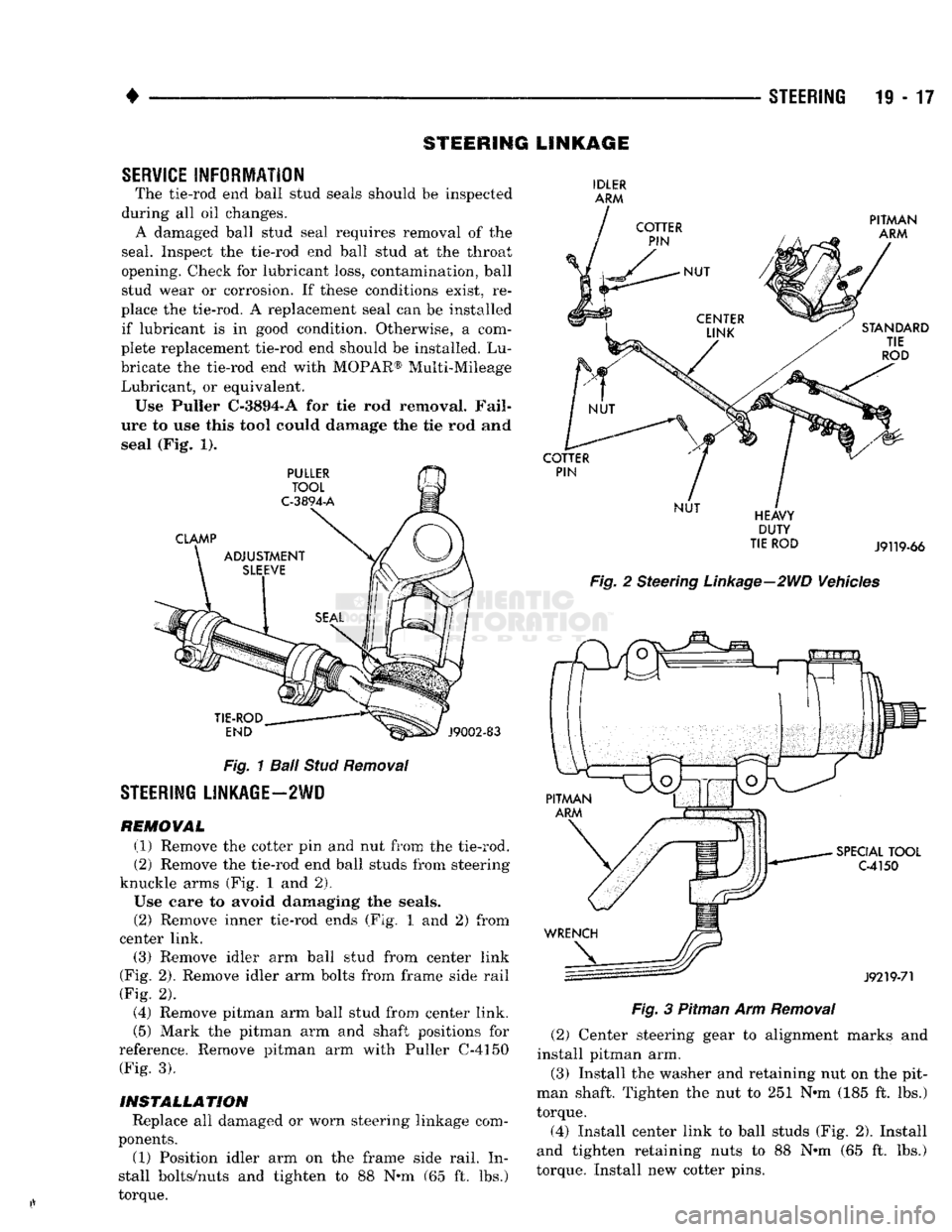
bricate the tie-rod end with MOPAR® Multi-Mileage Lubricant, or equivalent. Use Puller C-3894-A for tie rod removal. Fail
ure to use this tool could damage the tie rod and seal (Fig. 1).
Fig.
1
Ball
Stud
Removal
STEERING
LINKAGE—2WD
REMOWAL (1) Remove the cotter pin and nut from the tie-rod.
(2) Remove the tie-rod end ball studs from steering
knuckle arms (Fig. 1 and 2),
Use care to avoid damaging the seals. (2) Remove inner tie-rod ends (Fig. 1 and 2) from
center link. (3) Remove idler arm ball stud from center link
(Fig. 2). Remove idler arm bolts from frame side rail
(Fig. 2). (4) Remove pitman arm ball stud from center link.
(5) Mark the pitman arm and shaft positions for
reference. Remove pitman arm with Puller C-4150 (Fig. 3).
INSTALLATION
Replace all damaged or worn steering linkage com
ponents.
(1) Position idler arm on the frame side rail. In
stall bolts/nuts and tighten to 88 N-m (65 ft. lbs.)
torque.
IDLER
ARM
DUTY
TIE
ROD
J9119-66
Fig.
2 Steering
Linkage—2WD
Vehicles
Fig.
3 Pitman Arm
Removal
(2) Center steering gear to alignment marks and
install pitman arm.
(3) Install the washer and retaining nut on the pit
man shaft. Tighten the nut to 251 N-m (185 ft. lbs.)
torque. (4) Install center link to ball studs (Fig. 2). Install
and tighten retaining nuts to 88 N-m (65 ft. lbs.)
torque. Install new cotter pins.
Page 1370 of 1502
•
WHEELS
AND
TIRES
22 - 1
CONTENTS
page page
TIRES
1
VEHICLE VIBRATION
11
TORQUE SPECIFICATIONS
13
WHEELS
6
TIRES INDEX
page
Cleaning
of
Tires
2
General
Information
1
Pressure
Gauges
. 2
Repairing Leaks
3
Replacement Tires
2
GENERAL
INFORMATION
Tires are designed for each specific vehicle. They
provide the best overall performance for normal op eration. The ride and handling characteristics match
the vehicle's requirements. With proper care they
will give excellent reliability, traction, skid resis
tance, and tread life. These tires have specific load carrying capacities. When correctly inflated, they
will operate properly.
Tires used in cool climates, and with light loads
will have a longer life than tires used in hot climates
with heavy loads. Abrasive road surfaces will accel erate tire wear.
Driving habits have more effect on tire life than
any other factor. Careful drivers will obtain much
greater mileage than careless drivers.
Driving habits that shorten the life of any tire;
• Rapid acceleration and deceleration
• Severe application of brakes • High-speed driving
• Taking turns at excessive speeds
• Striking curbs and other obstacles It is very important to follow the tire rotation in
terval
IDENTIFICATION Tire type, size, aspect ratio and speed rating are
encoded in the letters and numbers imprinted on the
side wall of the tire. Refer to the chart to decipher
the tire identification code (Fig. 1). Performance tires will have a speed rating letter
after the aspect ratio number. The speed rating is
page
Rotation
. 3
Tire
Inflation
Pressures
2
Tire
Noise
or
Vibration
4
Tire
Wear
Patterns
4
Tread Wear
Indicators
3
not always printed on the tire side wall. The letter S
indicates that the tire is speed rated up to 112 mph.
• Q up to 100 mph
• T up to 118 mph
• U up to 124 mph
• H up to 130 mph
• V up to 149 mph
• Z more than 149 mph (consult the tire manufac
turer for the specific speed rating)
An All Season type tire will have either M + S, M
& S or M—S (indicating mud and snow traction) im
printed on the side wall.
RADIAL-PLY TIRES Radial-ply tires improve handling, tread life, ride
quality and decrease rolling resistance. Radial-ply tires must always be used in sets of
four. Under no circumstances should they be used on
the front only. They may be mixed with temporary spare tires when necessary, but reduced speeds are
recommended.
Radial-ply tires have the same load-carrying capac
ity as other types of tires of the same size. They use
the same recommended inflation pressures.
SPARE TIRE (TEMPORARY) The compact spare tire is designed for emergency
use only. The original tire should be repaired and re
installed at the first opportunity. Refer to Owner's
Manual for complete details.
WHEELS
AND
TIRES
Page 1478 of 1502
•
EMISSION
CONTROL
SYSTEMS
25
- 1
CONTENTS
page page
AIR INJECTION
SYSTEM-o
9L
HDC-GAS EVAPORATIVE EMISSION CONTROLS
6
ENGINE
15
EXHAUST EMISSION CONTROLS
10
COMPONENT
REMOVAL/INSTALLATION
17
GENERAL INFORMATION
1
GENERAL
INFORMATION
Throughout this group, references are made
to
par
ticular vehicle models
by
alphabetical designation
or
by the particular vehicle nameplate.
A
chart showing a breakdown
of
alphabetical designations
is
included
in
the
Introduction section
at
the
beginning
of
this
manual.
The 5.9L (V-8) gas powered engine will
be
referred
to
in
this group
as
either the: LDC (Light Duty Cy cle)
or
HDC (Heavy Duty Cycle) engine.
The
HDC
engine can
be
easily identified
by
the
use
of
an en
gine mounted
air
injection pump. The 3.9L/5.2L/5.9L
LDC engine will not use
an
air
injection pump.
Maintenance requirements for LDC and HDC emis
sion systems differ because
of
different load
and
op
erating conditions. This section will cover emission control systems
for
the 3.9L (V-6), 5.2L (V-8), 5.9L LDC (V-8), 5.9L HDC (V-8) and 5.9L (in-line six cylinder) diesel engines.
SERVICE
REMINDER INDICATOR
(SRI)
LIGHT
The instrument panel mounted SRI light was for
merly referred
to as the
emission maintenance
re
minder (EMR) light.
It is
used with 5.9L HDC-gas
powered engines only.
It is
not
used with diesel
en
gines.
The SRI system
is
incorporated into the powertrain
control module (PCM)
(the
PCM
was
formerly
re
ferred
to as the
engine controller
or
SBEC).
The
PCM records
the
vehicles mileage and stores
it
into
memory every
8
miles. At that time, the PCM checks
for the 60,000 and 82,500 mileage trip points. When
the current mileage matches one
of
the above men
tioned trip points,
the
SRI light
is
activated.
The following parts are
to
be replaced
at
either the
indicated mileage
or
when the SRI light remains
on
when the key
is in
the ON position. After performing
the required maintenance,
the
SRI light must
be
re set
to
turn the light
off.
96,000
km
(60,000 miles):
• Replace EGR Valve
• Clean EGR passage • Replace PCV Valve
132,000
km
(82,500 miles):
• Replace Oxygen Sensor
Refer
to
Group
0,
Lubrication and Maintenance
for
all required maintenance schedules.
Failure
to
perform
the
required maintenance
and
only reset the SRI light may be
a
violation of federal
law. Only after performing
the
required mainte
nance, should the SRI light
be
reset.
RESETTING
SRI
LIGHT
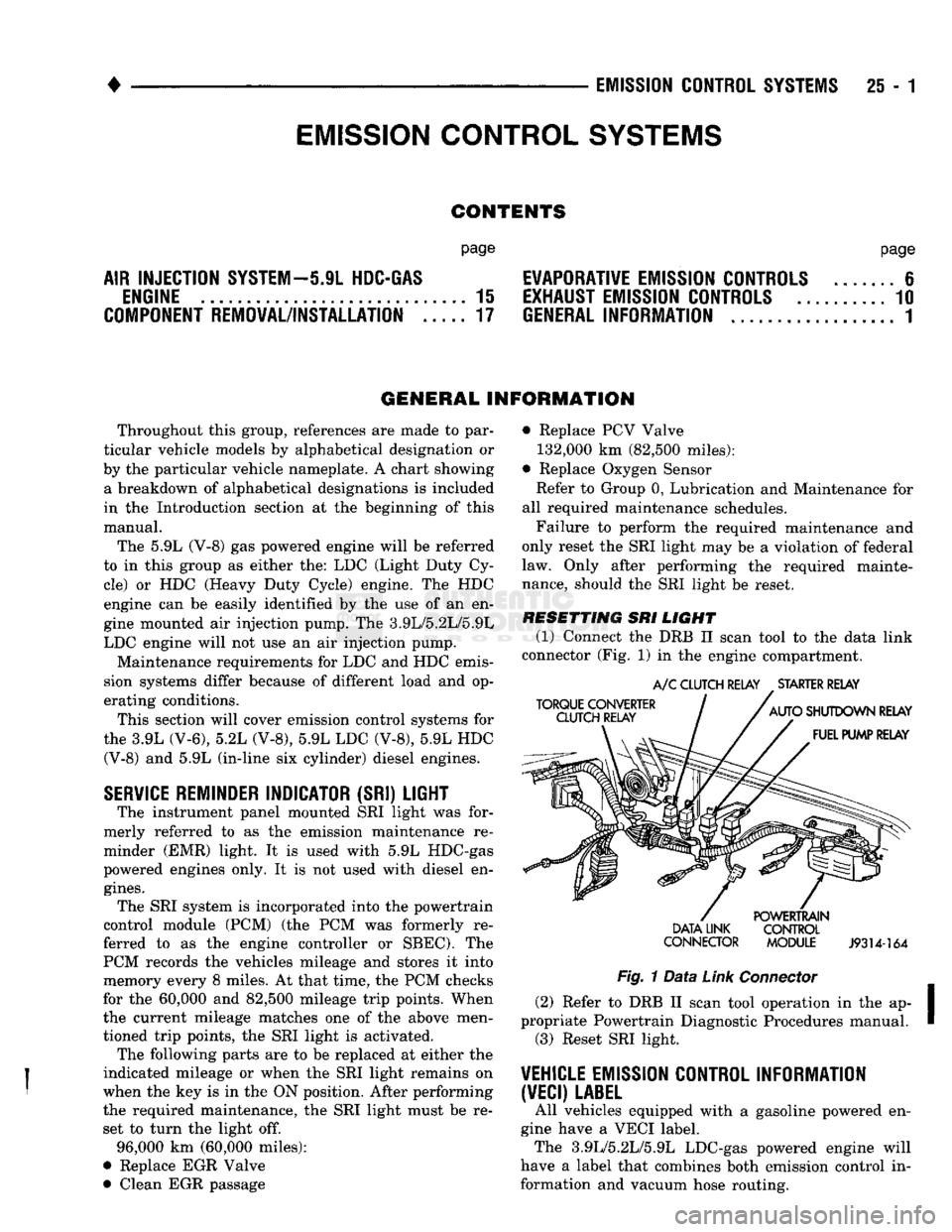
(1) Connect
the
DRB
II
scan tool
to
the
data link
connector (Fig.
1)
in
the engine compartment.
TORQUE CONVERTER
CLUTCH RELAY
A/C
CLUTCH RELAY
.
STARTER RELAY
AUTO
SHUTDOWN RELAY FUEL PUMP RELAY DATA LINK
CONNECTOR POWERTRAIN
CONTROL
MODULE
J9314-164
Fig.
1
Data
Link
Connector
(2) Refer
to
DRB
II
scan tool operation
in
the ap
propriate Powertrain Diagnostic Procedures manual. (3) Reset SRI light.
VEHICLE
EMISSION CONTROL INFORMATION
(VECI)
LABEL
All vehicles equipped with
a
gasoline powered
en
gine have
a
VECI label. The 3.9L/5.2L/5.9L LDC-gas powered engine will
have
a
label that combines both emission control
in
formation and vacuum hose routing.
EMISSION CONTROL
SYSTEMS