fuel pump DODGE TRUCK 1993 Service Owner's Manual
[x] Cancel search | Manufacturer: DODGE, Model Year: 1993, Model line: TRUCK, Model: DODGE TRUCK 1993Pages: 1502, PDF Size: 80.97 MB
Page 602 of 1502
•
WIRING
DIAGRAMS
8W - 127
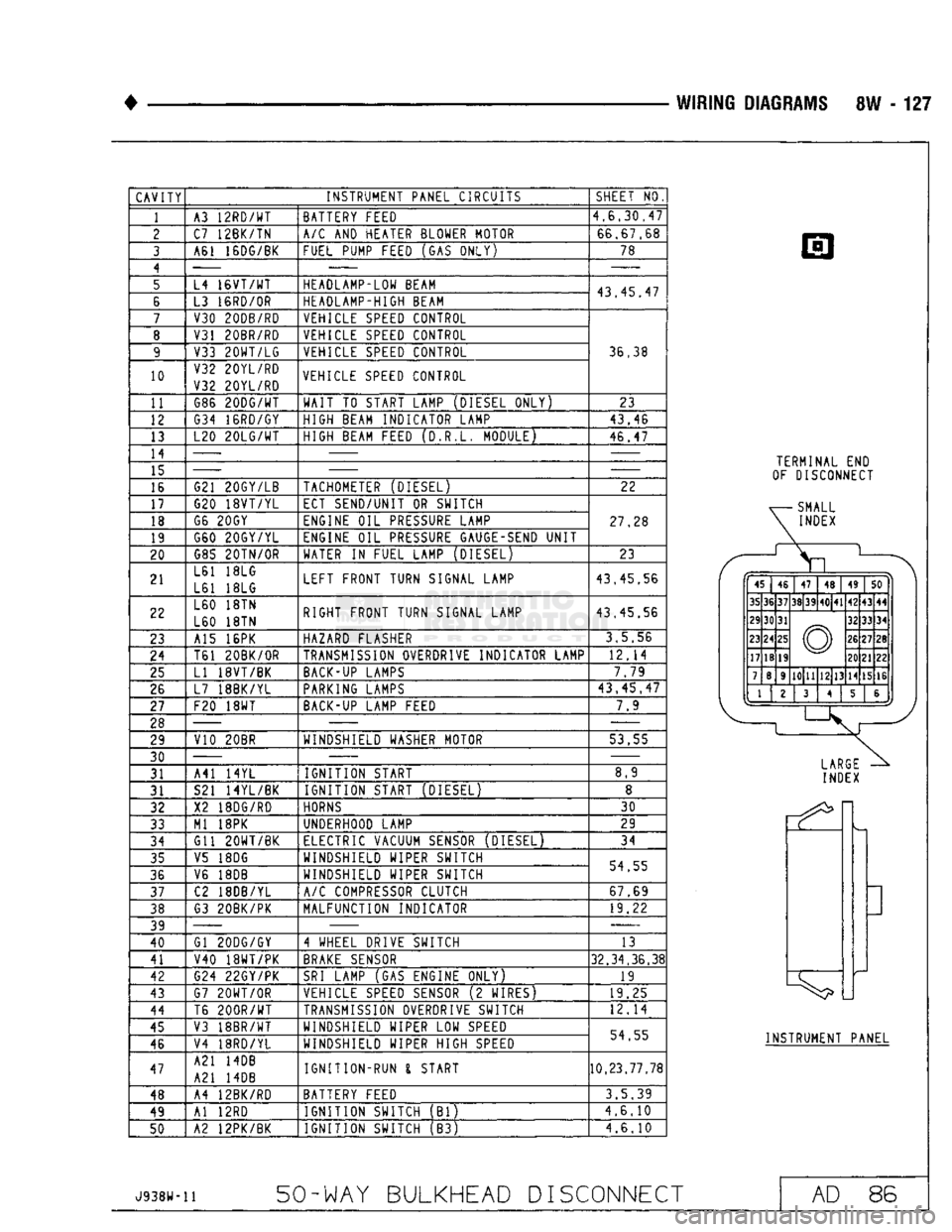
CAVITY
INSTRUMENT PANEL CIRCUITS
1
10
11
12
13
14
15
16
17
18
19
20
21
22
23
24
25
26
27
28 29
30 31
31
32
33
34
35
36
37
38
39
40
41
42
43
44
45
46
47
48
49
50
A3
12RD/WT
C7 12BK/TN
A61 16DG/BK
L4
16VT/WT
L3
16RD/0R
V30 20DB/RD
V31 20BR/RD
V33
20WT/LG
V32 20YL/RD
V32 20YL/RD G86
20DG/WT
G34 16RD/GY
L20
20LG/WT
G21 20GY/LB
G20
18VT/YL
G6
20GY
G60 20GY/YL G85
20TN/0R
L61
18LG
L61
18LG
L60
18TN
L60
18TN
A15
16PK
T61 20BK/OR
LI
18VT/BK
L7 18BK/YL
F20
18WT
V10 20BR
A41
14YL
S21 14YL/BK
X2
18DG/R0
Ml
18PK
Gil
20WT/BK
V5
18DG
V6
18DB
C2 18DB/YL
G3 20BK/PK
Gl 20DG/GY
V40
18WT/PK
G24 22GY/PK
G7
20WT/0R
T6
200R/WT
V3 18BR/WT
V4 18RD/YL
A21
14DB
A21
14DB
A4 12BK/RD
Al
12RD
A2 12PK/BK BATTERY FEED
A/C
AND
HEATER BLOWER MOTOR
FUEL PUMP FEED
(GAS
ONLY)
HEADLAMP-LOW BEAM
HEADLAMP-HIGH BEAM VEHICLE
SPEED
CONTROL
VEHICLE
SPEED
CONTROL VEHICLE
SPEED
CONTROL
VEHICLE
SPEED
CONTROL
WAIT
TO
START LAMP (DIESEL ONLY)
HIGH BEAM INDICATOR LAMP
HIGH BEAM FEED (D.R.L. MODULE)
TACHOMETER (DIESEL)
ECT SEND/UNIT
OR
SWITCH
ENGINE
OIL
PRESSURE
LAMP
ENGINE
OIL
PRESSURE
GAUGE-SEND
UNIT
WATER
IN
FUEL LAMP (DIESEL)
LEFT FRONT TURN SIGNAL LAMP
RIGHT FRONT TURN SIGNAL LAMP
HAZARD FLASHER
TRANSMISSION
OVERDRIVE INDICATOR LAMP
BACK-UP
LAMPS
PARKING
LAMPS
BACK-UP
LAMP FEED
WINDSHIELD WASHER MOTOR
IGNITION START
IGNITION START (DIESEL)
HORNS
UNDERHOOD LAMP
ELECTRIC VACUUM
SENSOR
(DIESEL) WINDSHIELD WIPER SWITCH
WINDSHIELD WIPER SWITCH
A/C
COMPRESSOR CLUTCH
MALFUNCTION INDICATOR
4 WHEEL DRIVE SWITCH
BRAKE
SENSOR
SRI
LAMP
(GAS
ENGINE ONLY)
VEHICLE
SPEED
SENSOR
(2
WIRES)
TRANSMISSION
OVERDRIVE SWITCH
WINDSHIELD WIPER
LOW
SPEED
WINDSHIELD WIPER HIGH
SPEED
IGNITION-RUN
I
START
BATTERY FEED IGNITION SWITCH
(Bl)
IGNITION SWITCH
(B3)
SHEET
NO
4,6.30,47
66,67,68 78
43,45,47
36,38
23
43,46
46,47
22
27,28
23
43.45,56
43,45.56
3,5,56
12,14 7.79
43,45,47
7.9
53.55 8,9
30
29
34
54,55 67,69 19,22
13
32,34,36,38
19
19,25
12,14
54.55
10,23.77,78
3.5.39
4,6.10
4.6.10
TERMINAL
END
OF DISCONNECT
ff
p
45 46
47
48 49
50
35 36 37
38 39
40 41
42
43 44
29 30 31
© 32
33 34
23 24
25
© 26
27 28
17 18
19 ©
20 21 22
7 8 9
10 11
12 13
14 15 16
1
^
1.
2
3
4 5 &
J *j
LARGE
INDEX
INSTRUMENT PANEL
J938W-11
50-WAY BULKHEAD
DISCONNECT
AD
86
Page 605 of 1502
8W - 130
WIRING
DIAGRAMS
•
1 2 3
A 4
5 6
7
8
/
9
10
11
/
12 13
14
15 16
/
17
18
19
20
21
u
22
23
24
25 26
u
27
28 29
30
31
u
32 33
34
u
35 36
37
38 39
u
40
41 42
u
VIEW FROM WIRE
END
HEADLAMP
I
DASH
WIRING
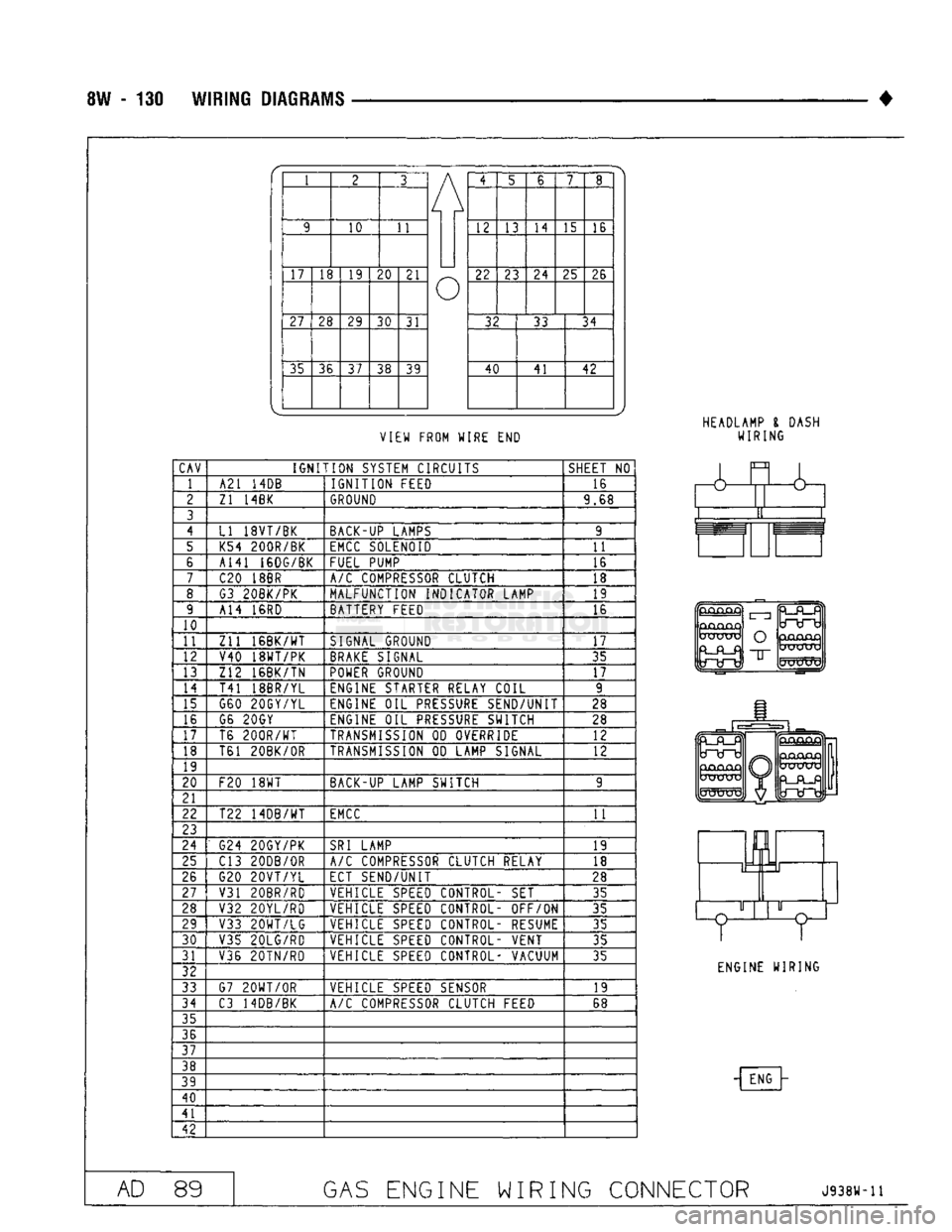
CAV
IGNITION
SYSTEM CIRCUITS
SHEET
NO
1 A21
14DB
IGNITION
FEED 16
2
Zl 14BK
GROUND
9.68
3
4
LI 18VT/BK BACK-UP LAMPS 9
5 K54 200R/BK
EMCC
SOLENOID
11
6 A141 16DG/BK
FUEL PUMP 16
7
C20
18BR
A/C
COMPRESSOR CLUTCH 18
8 G3 20BK/PK MALFUNCTION INDICATOR LAMP 19
9 A14
16RD
BATTERY FEED 16
10
11
Zll
16BK/WT
SIGNAL GROUND
17
12 V40 18WT/PK
BRAKE
SIGNAL 35
13 Z12 16BK/TN
POWER
GROUND
17
14
T41 18BR/YL ENGINE STARTER RELAY COIL 9
15 G60 20GY/YL ENGINE
OIL
PRESSURE
SEND/UNIT 28
16 G6 20GY
ENGINE
OIL
PRESSURE
SWITCH 28
17 T6
200R/WT
TRANSMISSION
OD
OVERRIDE 12
18 T61 20BK/0R
TRANSMISSION
OD
LAMP SIGNAL
12
19
20
F20
18WT
BACK-UP LAMP SWITCH 9
21
22 T22 14DB/WT
EMCC
11
23
24
G24 20GY/PK
SRI
LAMP
19
25 C13 20DB/0R
A/C
COMPRESSOR CLUTCH RELAY
18
26 G20
20VT/YL
ECT SEND/UNIT
28
27
V31 20BR/RD VEHICLE
SPEED
CONTROL-
SET
35
28 V32 20YL/RD VEHICLE
SPEED
CONTROL- OFF/ON
35
29 V33
20WT/LG
VEHICLE
SPEED
CONTROL- RESUME 35
30
V35 20LG/RD VEHICLE
SPEED
CONTROL- VENT
35
31 V36 20TN/RD VEHICLE
SPEED
CONTROL- VACUUM
35
32
33 G7
20WT/0R
VEHICLE
SPEED
SENSOR 19
34
C3 14DB/BK
A/C
COMPRESSOR CLUTCH FEED 68
35
36
37
38
39
40
41
42
&
GjCUQjQ
UXJUXj
O
"IT
mJKXTV
ENGINE WIRING
- ENG
AD
89
GAS
ENGINE WIRING CONNECTOR
J938W-11
Page 607 of 1502
9
- 2
ENGINES
rial surrounds each mounting hole. Excess material
can easily be wiped off. Components should be
torqued in place within 15 minutes. The use of a lo cating dowel is recommended during assembly to pre
vent smearing the material off location.
ENGINE PERFORMANCE
To provide best vehicle performance and lowest ve
hicle emissions, it is most important that the tune-up
be done accurately. Use the specifications listed on
the Vehicle Emission Control Information label found on the engine compartment hood.
(1) Test cranking amperage draw (refer to Group
8B,
Battery/Starter/Generator Service for the proper
procedures).
(2) Tighten the intake manifold bolts (refer to
Group 11, Exhaust System and Intake Manifold for
the proper specifications). (3) Perform cylinder compression test:
(a) Check engine oil level and add oil, if neces
sary.
(b) Drive the vehicle until engine reaches normal
operating temperature. (c) Select a route free from traffic and other
forms of congestion, observe all traffic laws and
briskly accelerate through the gears several times. The higher engine speed may help clean out valve seat deposits which can prevent accurate compres
sion readings.
CAUTION:
DO NOT
overspeed
the
engine.
(d) Remove all spark plugs from engine. As
spark plugs are being removed, check electrodes for
abnormal firing indicators - fouled, hot, oily, etc.
Record cylinder number of spark plug for future
reference.
(e) Disconnect coil wire from distributor and se
cure to good ground to prevent a spark from start
ing a fire.
(f) Be sure throttle blades are fully open during
the compression check. (g) Insert compression gage adaptor into the
No.l spark plug hole. Crank engine until maxi
mum pressure is reached on gauge. Record this
pressure as No.l cylinder pressure.
(h) Repeat Step 3g for all remaining cylinders.
(i) Compression should not be less than 689 kPa
(100 psi) and not vary more than 172 kPa (25 psi)
from cylinder to cylinder.
(j) If cylinder(s) have abnormally low compres
sion pressures, repeat steps 3a through 3h. (k) If the same cylinder(s) repeat an abnormally
low reading, it could indicate the existence of a
problem in the cylinder.
The recommended compression pressures are
to be used only as a guide to diagnosing engine
problems. An engine should NOT be disassem bled to determine the cause of low compression
unless some malfunction is present. (4) Clean or replace spark plugs as necessary. Ad
just gap (refer to Group 8D, Ignition System for gap adjustment and torque).
(5) Test resistance of spark plug cables (refer to
Group 8D, Ignition System.
(6) Inspect the primary wire. Test coil output volt
age,
primary and secondary resistance. Replace parts as necessary (refer to Group 8D, Ignition System and
make necessary adjustment).
(7) Set ignition timing to specifications (refer to
Specification Label on engine compartment hood).
(8) Perform a combustion analysis.
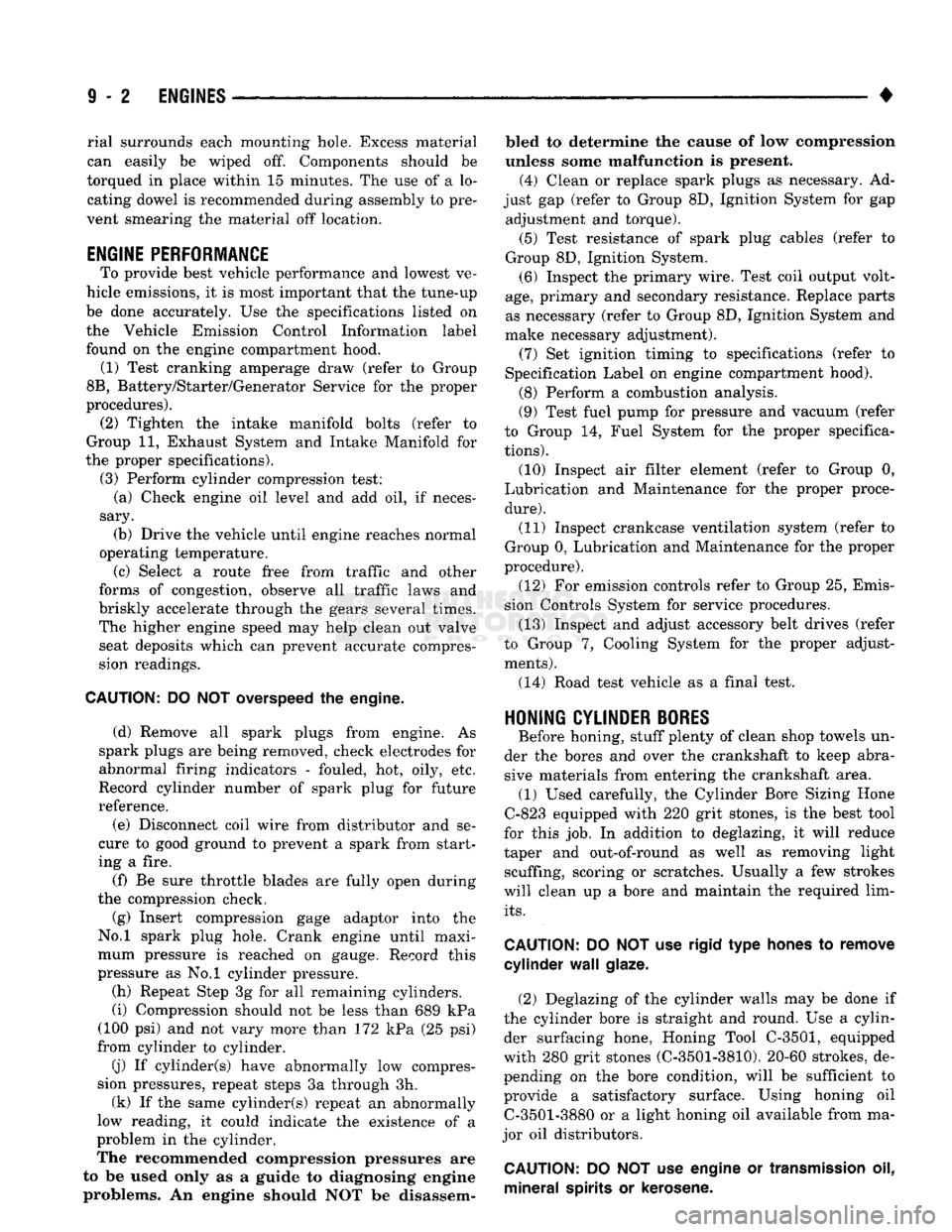
(9) Test fuel pump for pressure and vacuum (refer
to Group 14, Fuel System for the proper specifica
tions).
(10) Inspect air filter element (refer to Group 0,
Lubrication and Maintenance for the proper proce
dure).
(11) Inspect crankcase ventilation system (refer to
Group 0, Lubrication and Maintenance for the proper
procedure).
(12) For emission controls refer to Group 25, Emis
sion Controls System for service procedures.
(13) Inspect and adjust accessory belt drives (refer
to Group 7, Cooling System for the proper adjust
ments).
(14) Road test vehicle as a final test.
H0NIN6
CYLINDER
BORES
Before honing, stuff plenty of clean shop towels un
der the bores and over the crankshaft to keep abra sive materials from entering the crankshaft area.
(1) Used carefully, the Cylinder Bore Sizing Hone
C-823 equipped with 220 grit stones, is the best tool
for this job. In addition to deglazing, it will reduce
taper and out-of-round as well as removing light scuffing, scoring or scratches. Usually a few strokes
will clean up a bore and maintain the required lim
its.
CAUTION:
DO NOT use rigid type
hones
to remove
cylinder
wall
glaze.
(2) Deglazing of the cylinder walls may be done if
the cylinder bore is straight and round. Use a cylin
der surfacing hone, Honing Tool C-3501, equipped
with 280 grit stones (C-3501-3810). 20-60 strokes, de
pending on the bore condition, will be sufficient to
provide a satisfactory surface. Using honing oil C-3501-3880 or a light honing oil available from ma
jor oil distributors.
CAUTION:
DO NOT use engine or
transmission
oil, mineral
spirits
or
kerosene.
Page 610 of 1502
•
ENGINES
9 - S
ENGINE
DIAGNOSIS
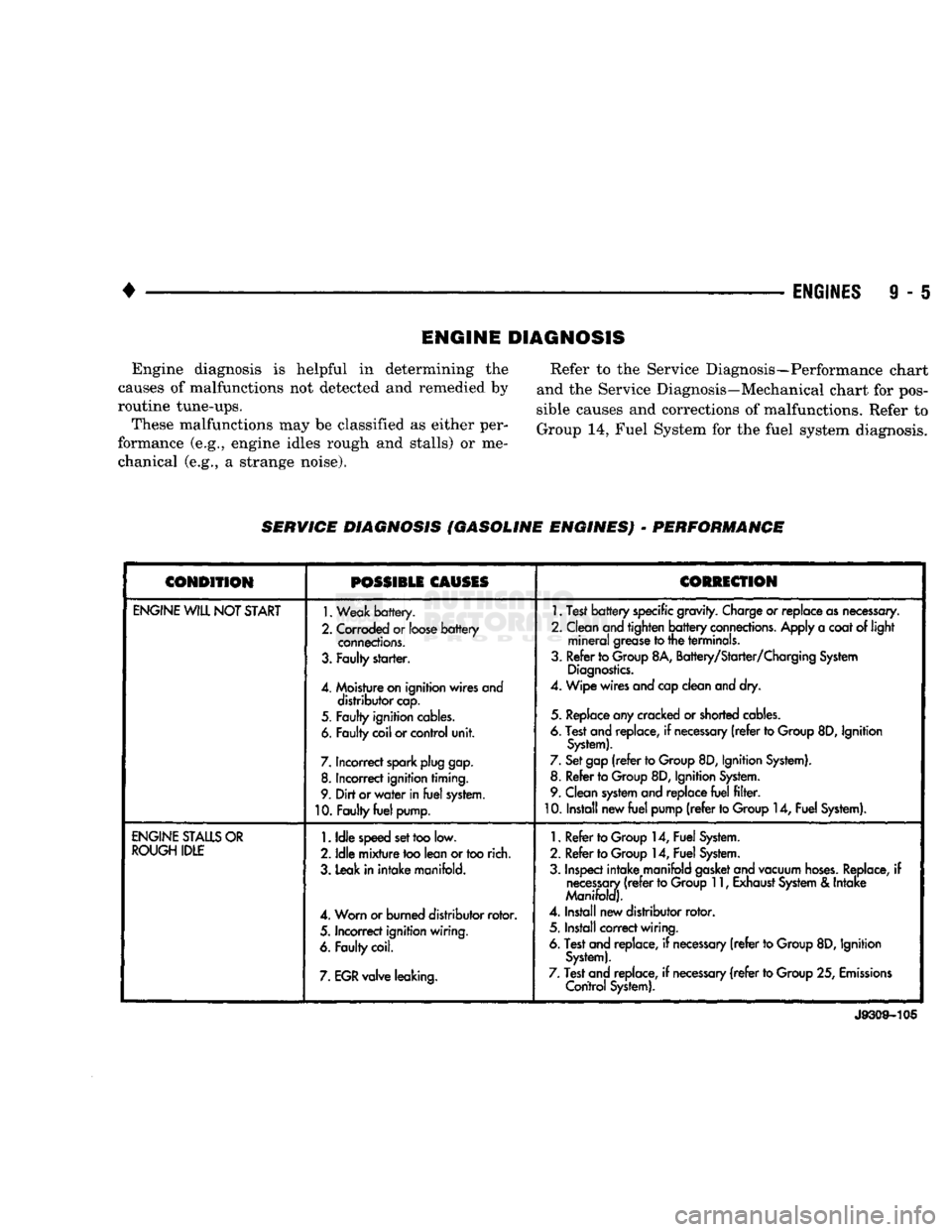
Engine diagnosis is helpful in determining the
causes of malfunctions not detected and remedied by
routine tune-ups. These malfunctions may be classified as either per
formance (e.g., engine idles rough and stalls) or me chanical (e.g., a strange noise). Refer to the Service Diagnosis—Performance chart
and the Service Diagnosis—Mechanical chart for pos
sible causes and corrections of malfunctions. Refer to
Group 14, Fuel System for the fuel system diagnosis.
SERWIGE DIAGNOSIS (GASOLINE ENGINES)
-
PERFORMANCE
CONDITION
POSSIBLE
CAUSES
CORRECTION
ENGINE
WILL
NOT
START
1.
Weak
battery.
2.
Corroded
or
loose
battery
connections.
3.
Faulty
starter.
4.
Moisture
on
ignition wires and distributor
cap.
5.
Faulty
ignition
cables.
6.
Faulty
coil
or
control
unit.
7.
Incorrect
spark
plug
gap.
8.
Incorrect
ignition timing.
9.
Dirt
or
water
in
fuel
system.
10.
Faulty
fuel
pump.
1.
Test
battery
specific
gravity.
Charge
or
replace
as
necessary.
2. Clean
and
tighten
battery
connections.
Apply
a
coat
of light
mineral
grease
to
the terminals.
3. Refer to
Group
8A, Battery/Starter/Charging
System
Diagnostics.
4. Wipe
wires
and
cap
clean
and
dry.
5.
Replace
any
cracked
or
shorted
cables.
6.
Test
and
replace,
if
necessary
(refer
to
Group
8D,
Ignition
System).
7.
Set
gap
(refer
to
Group
8D, Ignition
System).
8. Refer to
Group
8D, Ignition
System.
9. Clean
system
and
replace
fuel
filter.
10. Install new
fuel
pump
(refer
to
Group
14,
Fuel
System).
ENGINE
STALLS
OR
ROUGH
IDLE
1.
Idle
speed
set
too
low.
2.
Idle
mixture
too
lean
or
too
rich.
3. Leak in
intake
manifold.
4. Worn or burned distributor
rotor.
5.
Incorrect
ignition wiring.
6.
Faulty
coil.
7.
EGR
valve leaking.
1.
Refer to
Group
14,
Fuel
System.
2. Refer to
Group
14,
Fuel
System.
3.
Inspect
intake
manifold
gasket
and
vacuum
hoses.
Replace,
if
necessary
(refer
to
Group
11,
Exhaust
System
&
Intake
Manifold).
4.
Install new distributor
rotor.
5. Install
correct
wiring.
6.
Test
and
replace,
if
necessary
(refer
to
Group
8D,
Ignition
System).
7.
Test
and
replace,
if
necessary
(refer
to
Group
25,
Emissions
Control
System).
J9309-105
Page 611 of 1502
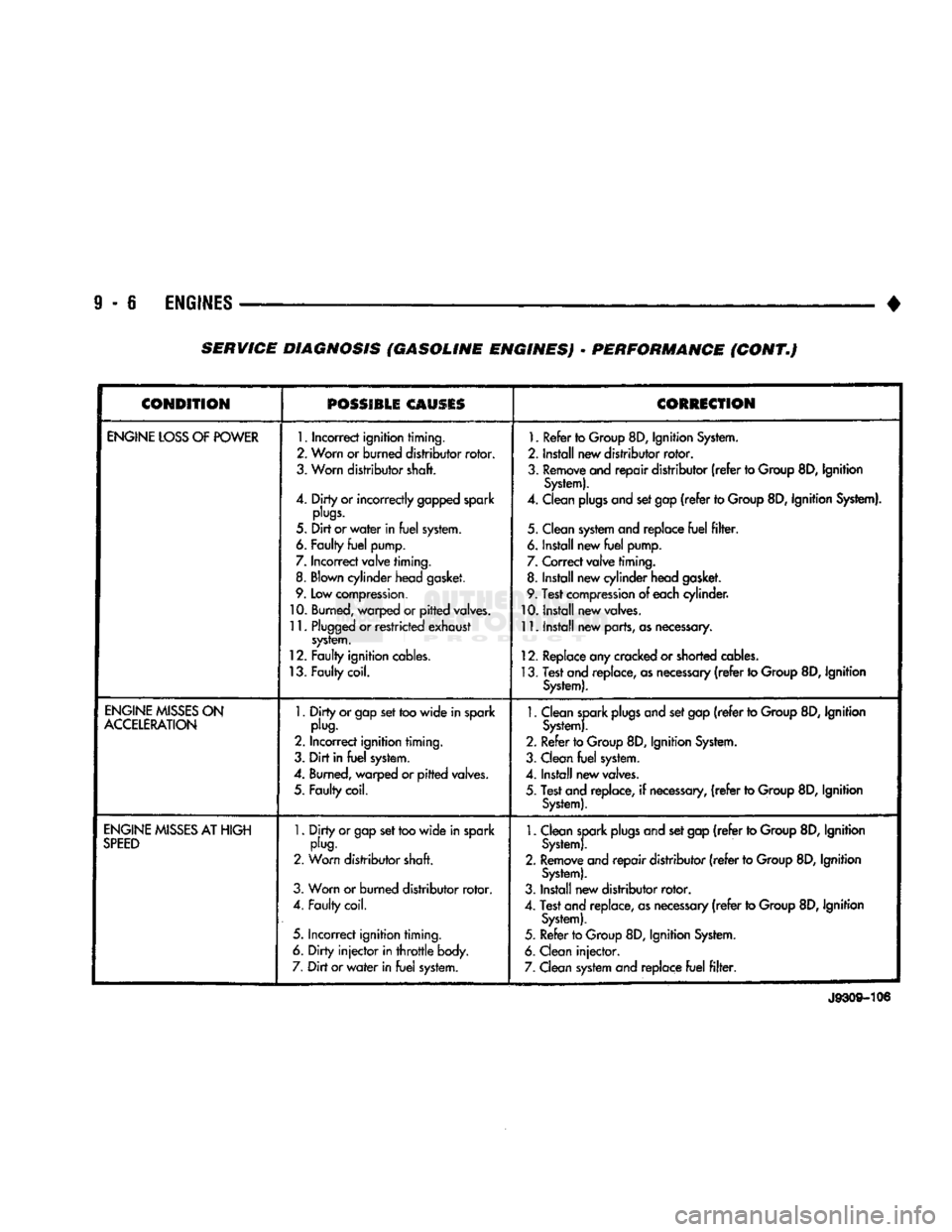
9
- 6
ENGINES
•
SERVICE DIAGNOSIS (GASOLINE ENGINES)
•
PERFORMANCE (CONT.)
1
CONDITION
POSSIBLE
CAUSES
^
CORRECTION
1
ENGINE
LOSS
OF
POWER
1.
Incorrect ignition timing.
2. Worn or burned distributor
rotor.
3. Worn distributor shaft.
4.
Dirty
or
incorrectly
gapped
spark
plugs.
5.
Dirt
or
water
in
fuel
system.
6.
Faulty
fuel
pump.
7.
Incorrect valve timing.
8.
Blown
cylinder head
gasket.
9.
Low
compression.
10.
Burned,
warped or
pitted
valves.
11.
Plugged
or
restricted
exhaust
system.
12. Faulty ignition
cables.
13. Faulty coil.
1.
Refer
to
Group
8D, Ignition
System.
2. install new distributor
rotor.
3.
Remove
and
repair
distributor
(refer
to
Group
8D, Ignition
System).
4.
Clean
plugs
and
set gap
(refer
to
Group
8D, Ignition
System).
5. Clean
system
and replace
fuel
filter.
6. Install new
fuel
pump.
7.
Correct
valve
timing.
8. Install new cylinder head
gasket.
9.
Test
compression
of
each
cylinder.
10.
Install new
valves.
11.
Install new
parts,
as
necessary.
12.
Replace
any cracked or
shorted
cables.
13.
Test
and
replace,
as
necessary
(refer
to
Group
8D, Ignition
System).
ENGINE
MISSES
ON
ACCELERATION
1.
Dirty
or
gap set
too
wide
in spark
plug.
2. Incorrect ignition timing.
3.
Dirt
in
fuel
system.
4.
Burned,
warped or
pitted
valves.
5. Faulty coil.
1.
Clean spark
plugs
and set gap
(refer
to
Group
8D, Ignition
System).
2. Refer to
Group
8D, Ignition
System.
3. Clean
fuel
system.
4.
Install new
valves.
5.
Test
and
replace,
if
necessary,
(refer
to
Group
8D, Ignition
System).
ENGINE
MISSES
AT HIGH
SPEED
1.
Dirty
or
gap set too
wide
in spark
plug.
2. Worn distributor shaft.
3. Worn or burned distributor
rotor.
4. Faulty
coil.
5. Incorrect ignition timing.
6.
Dirty
injector
in
throttle
body.
7.
Dirt
or
water
in
fuel
system.
1.
Clean
spark
plugs
and
set gap
(refer
to
Group
8D, Ignition
System).
2.
Remove
and
repair
distributor
(refer
to
Group
8D,
Ignition
System).
3. Install new distributor
rotor.
4.
Test
and replace,
as
necessary
(refer
to
Group
8D, Ignition
System).
5.
Refer
to
Group
8D, Ignition
System.
6.
Clean
injector.
7.
Clean
system
and replace
fuel
filter.
J9309-106
Page 613 of 1502
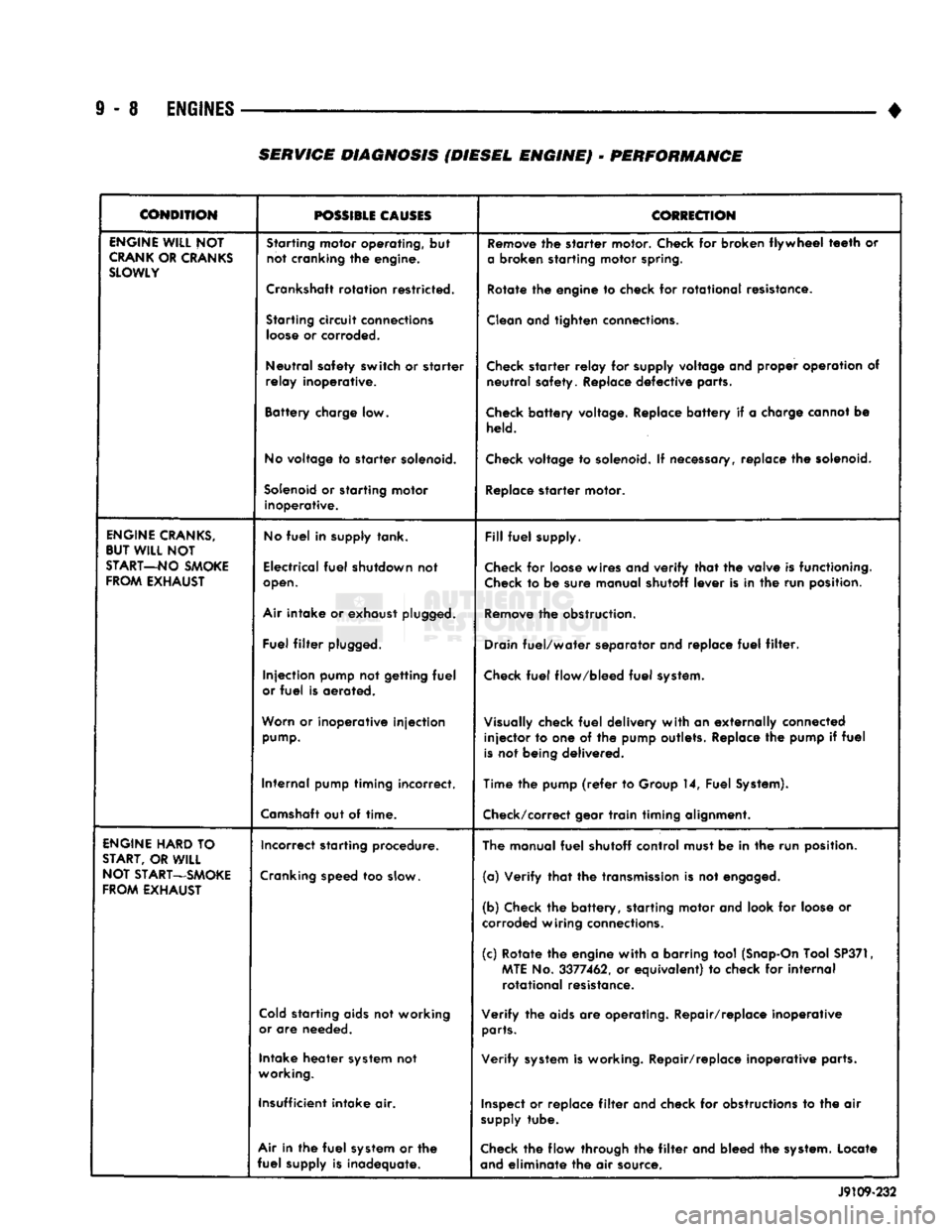
9
- 8
ENGINES
• SERVICE DIAGNOSIS (DIESEL ENGINE) - PERFORMANCE
CONDITION
POSSIBLE
CAUSES
COtiECTION
ENGINE
WILL
NOT
CRANK
OR
CRANKS
SLOWLY
Starting
motor operating, but
not cranking the engine.
Crankshaft
rotation restricted.
Starting
circuit
connections
loose
or corroded.
Neutral safety switch or starter
relay inoperative.
Battery charge low.
No
voltage to starter
solenoid.
Solenoid
or starting motor inoperative.
Remove
the starter motor. Check for broken flywheel
teeth
or
a
broken starting motor
spring.
Rotate the engine to check for rotational resistance.
Clean
and tighten
connections.
Check
starter relay for
supply
voltage and proper operation of neutral safety. Replace defective parts.
Check
battery voltage. Replace battery if a charge cannot be
held.
Check
voltage to
solenoid.
If
necessary,
replace the
solenoid.
Replace
starter motor.
ENGINE
CRANKS,
BUT
WILL
NOT
START—NO
SMOKE
FROM
EXHAUST
No
fuel
in supply tank.
Electrical
fuel
shutdown not
open.
Air
intake or exhaust
plugged.
Fuel
filter
plugged.
Injection pump not getting
fuel
or
fuel
is aerated.
Worn
or inoperative injection
pump.
Internal pump timing incorrect.
Camshaft
out of time.
Fill
fuel
supply.
Check
for
loose
wires and verify that the valve is functioning.
Check
to be sure manual shutoff lever is in the run position.
Remove
the obstruction.
Drain
fuel/water separator and replace
fuel
filter.
Check
fuel
flow/bleed
fuel
system.
Visually
check
fuel
delivery with an externally connected injector to one of the pump outlets. Replace the pump if
fuel
is
not being delivered.
Time the pump
(refer
to Group 14, Fuel
System).
Check/correct
gear train timing alignment.
ENGINE
HARD
TO
START,
OR
WILL
NOT
START—SMOKE
FROM
EXHAUST
Incorrect starting procedure.
Cranking
speed too
slow.
Cold
starting
aids
not working
or
are needed.
Intake heater
system
not
working.
Insufficient intake air.
Air
in the
fuel
system
or the
fuel
supply is inadequate. The manual
fuel
shutoff control must be in the run position.
(a) Verify that the
transmission
is not
engaged.
(b) Check the battery, starting motor and look for
loose
or
corroded
wiring
connections.
(c) Rotate the engine with a barring tool
(Snap-On
Tool
SP371,
MTE
No. 3377462, or equivalent) to check for internal rotational resistance.
Verify the
aids
are operating. Repair/replace inoperative
parts.
Verify
system
is working. Repair/replace inoperative parts.
Inspect
or replace
filter
and check for
obstructions
to the air
supply
tube.
Check
the flow through the
filter
and bleed the
system.
Locate
and
eliminate the air source. J9109-232
Page 614 of 1502
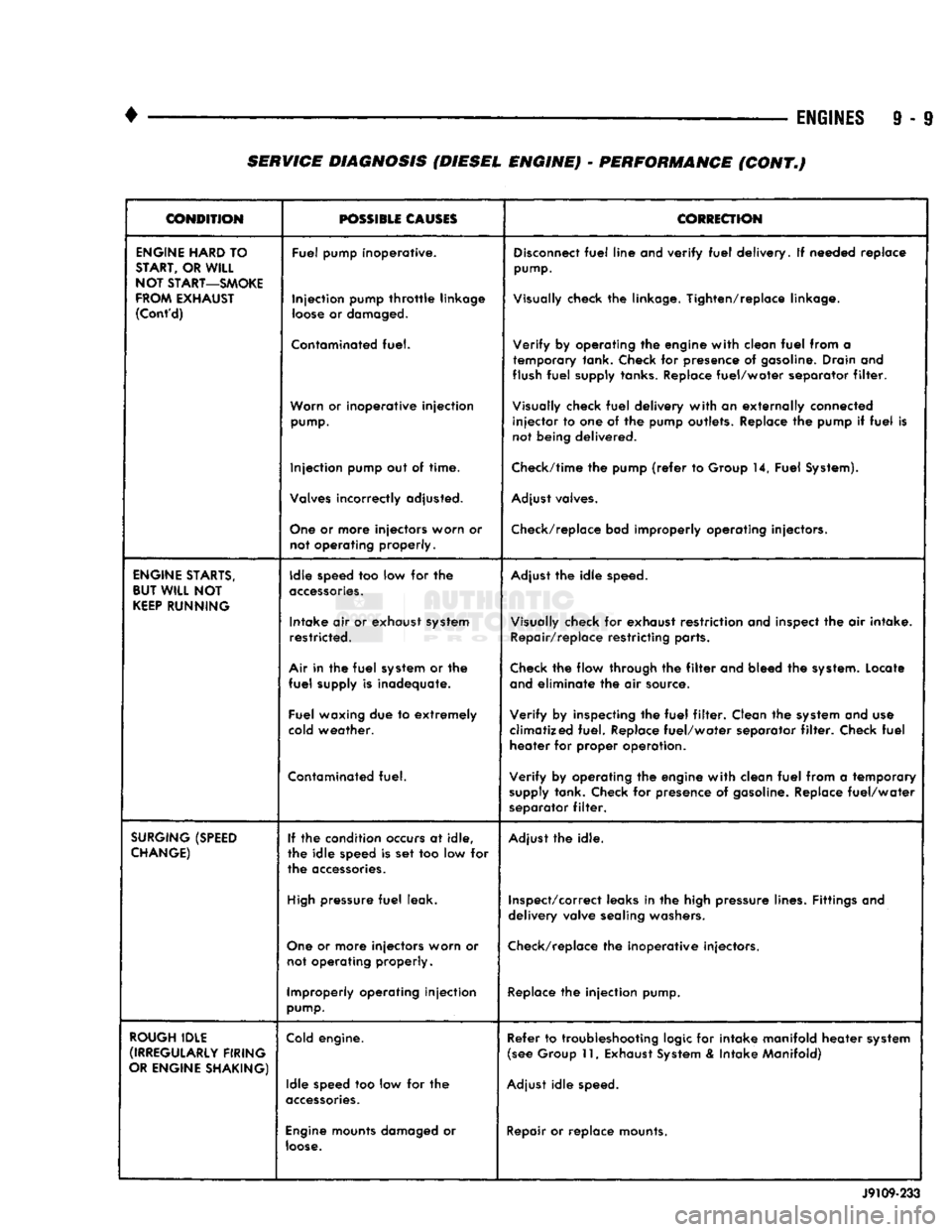
•
ENGINES
9 - 9 SERVICE DIAGNOSIS (DIESEL ENGINE) • PERFORMANCE (CONT.)
CONDITION
POSSIBLE
CAUSES
CORRECTION
ENGINE
HARD
TO
START,
OR
WILL
NOT
START—SMOKE
FROM
EXHAUST
(Cont'd)
Fuel pump Inoperative.
Injection pump
throttle
linkage
loose
or
damaged.
Contaminated
fuel.
Worn
or inoperative injection
pump.
Injection pump out of time.
Valves
incorrectly adjusted.
One
or more injectors worn or not operating properly.
Disconnect
fuel
line and verify
fuel
delivery. If needed replace
pump.
Visually
check the linkage. Tighten/replace linkage.
Verify by operating the engine with clean
fuel
from a temporary tank. Check for presence of
gasoline.
Drain and
flush
fuel
supply tanks.
Replace
fuel/water separator
filter.
Visually
check
fuel
delivery with an externally connected injector to one of the pump outlets. Replace the pump if
fuel
is
not being delivered.
Check/time
the pump
(refer
to Group 14, Fuel
System).
Adjust
valves.
Check/replace
bad improperly operating injectors.
ENGINE
STARTS,
BUT
WILL
NOT
KEEP
RUNNING
Idle speed too low for the
accessories.
Intake air or exhaust
system
restricted.
Air
in the
fuel
system
or the
fuel
supply is inadequate.
Fuel waxing due to extremely
cold
weather.
Contaminated
fuel.
Adjust
the idle
speed.
Visually
check for exhaust restriction and inspect the air intake.
Repair/replace restricting parts.
Check
the flow through the
filter
and bleed the
system.
Locate
and
eliminate the air source.
Verify by inspecting the
fuel
filter.
Clean the
system
and use
climatized fuel. Replace fuel/water separator
filter.
Check
fuel
heater for proper operation.
Verify by operating the engine with clean
fuel
from a temporary
supply
tank. Check for presence of
gasoline.
Replace fuel/water
separator
filter.
SURGING
(SPEED
CHANGE)
If the condition
occurs
at idle,
the idle speed is set too low for
the
accessories.
High
pressure
fuel
leak.
One
or more injectors worn or not operating properly.
Improperly operating injection
pump.
Adjust
the idle.
Inspect/correct
leaks in the high pressure lines. Fittings and
delivery valve
sealing
washers.
Check/replace
the inoperative injectors.
Replace
the injection pump.
ROUGH
IDLE
(IRREGULARLY
FIRING
OR
ENGINE
SHAKING)
Cold
engine.
Idle speed too low for the
accessories.
Engine
mounts
damaged
or
loose.
Refer to troubleshooting
logic
for intake manifold heater
system
(see
Group 11,
Exhaust
System
& Intake Manifold)
Adjust
idle
speed.
Repair
or replace mounts. J9109-233
Page 615 of 1502
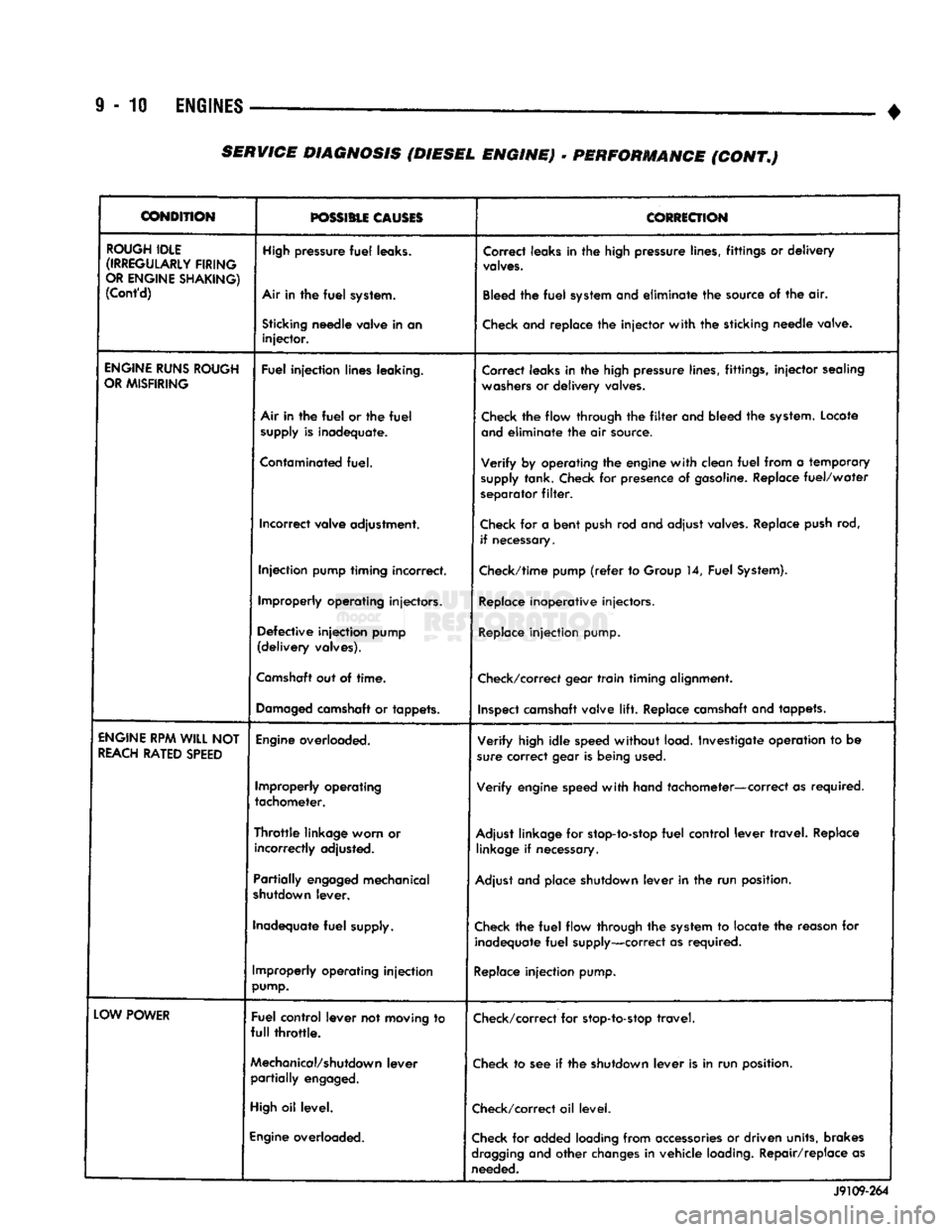
9
- 10
ENGINES
— _
•
CONDITION
possmu
CLOSES
CORRECTION
ROUGH
IDLE
(IRREGULARLY
FIRING
OR
ENGINE
SHAKING)
(Cont'd)
High
pressure
fuel
leaks.
Air In the
fuel
system.
Correct leaks in the high pressure lines, fittings or
delivery
valves.
Bleed the
fuel
system and
eliminate
the source of the air.
Sticking
needle
valve
in an
injector.
Check and replace the
injector
with
the sticking
needle
valve.
ENGINE
RUNS
ROUGH
OR
MISFIRING
Fuel
injection
lines
leaking.
Correct leaks in the high pressure lines, fittings,
injector
sealing
washers
or
delivery
valves.
Air in the
fuel
or the
fuel
supply
is
inadequate.
Check the flow through the
filter
and bleed the system. Locate
and
eliminate
the air source.
Contaminated
fuel.
Verify
by operating the engine
with
clean
fuel
from a temporary
supply
tank. Check for presence of gasoline. Replace
fuel/water
separator
filter.
Incorrect
valve
adjustment.
Check for a
bent
push rod and adjust valves. Replace push rod,
if necessary.
Injection
pump
timing
incorrect.
Check/time pump
(refer
to Group 14,
Fuel
System).
Improperly
operating
injectors.
Replace inoperative injectors.
Defective
injection
pump
(delivery
valves).
Replace
injection
pump.
Camshaft
out of
time.
Check/correct gear
train
timing alignment.
Damaged
camshaft or
tappets.
Inspect camshaft valve
lift.
Replace camshaft and tappets.
ENGINE
RPM WILL NOT
REACH
RATED
SPEED
Engine
overloaded.
Verify
high
idle
speed
without
load. Investigate operation to be
sure correct gear is being used.
Improperly
operating
tachometer.
Verify
engine speed
with
hand tachometer—correct as required.
Throttle
linkage
worn
or
incorrectly
adjusted.
Adjust linkage for stop-to-stop
fuel
control
lever
travel.
Replace
linkage if necessary.
Partially
engaged
mechanical
shutdown
lever.
Adjust and place shutdown
lever
in the run position.
Inadequate
fuel
supply. Check the
fuel
flow through the system to locate the reason for
inadequate
fuel
supply—correct as required.
Improperly
operating
injection
pump.
Replace
injection
pump.
LOW
POWER
Fuel
control
lever
not
moving
to
full
throttle.
Check/correct for stop-to-stop
travel.
Mechanical/shutdown
lever
partially
engaged.
Check to see if the shutdown
lever
is in run position.
High
oil
level.
Check/correct oil level.
Engine
overloaded.
Check for added loading from accessories or driven units, brakes
dragging
and
other
changes in vehicle loading. Repair/replace as
needed.
J9109-264
SERVICE
DIAGNOSIS (DIESEL ENGINE)
•
PERFORMANCE (CONT.)
Page 616 of 1502
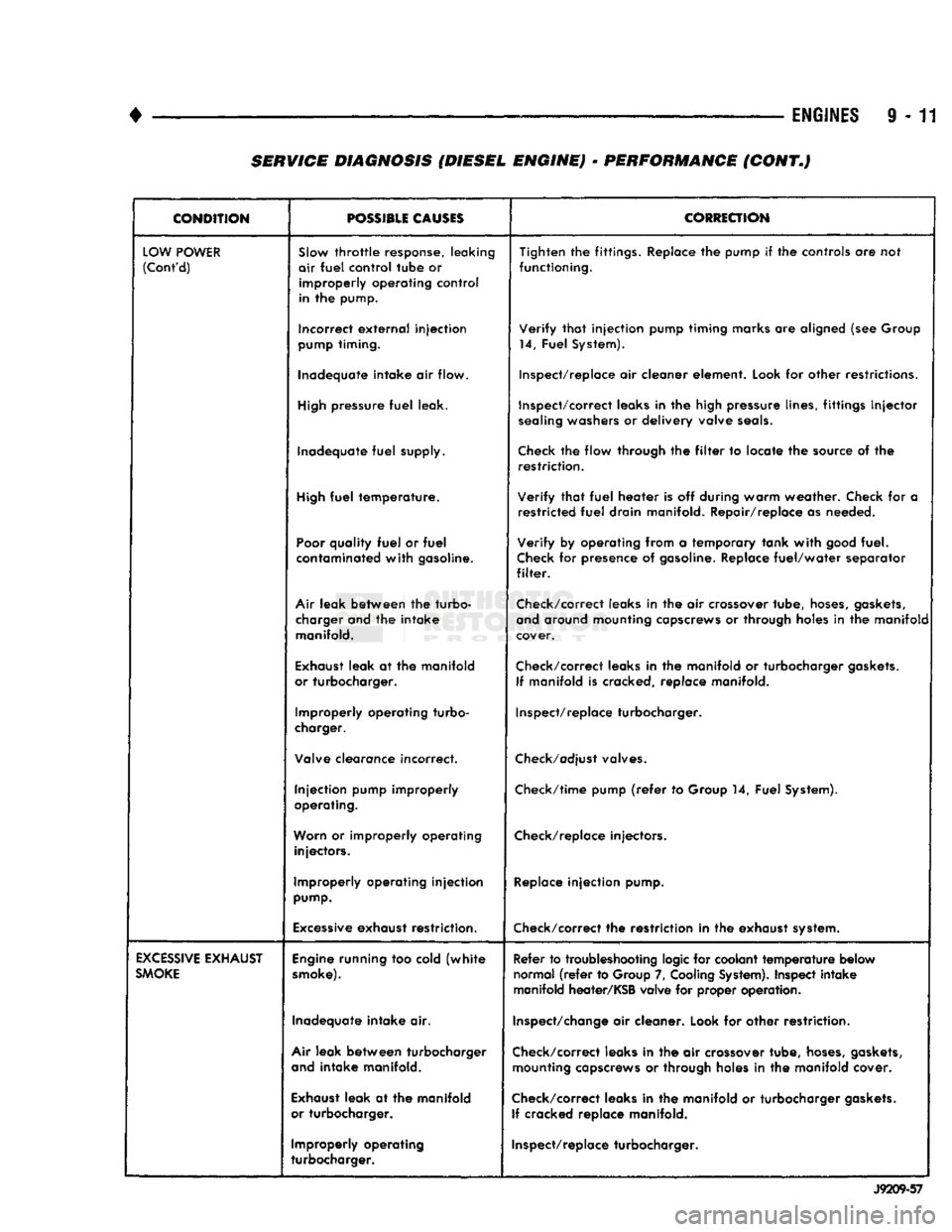
•
ENGINES
9 - 11 SERVICE DIAGNOSIS (DIESEL ENGINE) - PERFORMANCE (CONT.)
CONDITION
POSSIBLE
CAUSES
CORRECTION
LOW
POWER
(Cont'd)
SJow
throttle
response, leaking
air
fuel
control
tube
or
improperly
operating
control
in the pump. Tighten the fittings. Replace the pump if the controls are not
functioning.
Incorrect
external
injection
pump
timing. Verify
that
injection pump timing marks are aligned (see Group
14, Fuel System).
Inadequate intake air flow. Inspect/replace air cleaner element. Look for other restrictions.
High
pressure
fuel
leak. Inspect/correct leaks in the high pressure lines, fittings
injector
sealing
washers or delivery valve
seals.
Inadequate
fuel
supply.
Check
the flow through the
filter
to locate the source of the
restriction.
High
fuel
temperature. Verify
that
fuel
heater is off during warm weather. Check for a
restricted
fuel
drain manifold. Repair/replace as needed.
Poor
quality
fuel
or
fuel
contaminated
with
gasoline. Verify by operating from a temporary tank
with
good
fuel.
Check
for presence of
gasoline.
Replace
fuel/water
separator
filter.
Air
leak between the turbo- charger and the intake manifold. Check/correct leaks in the air crossover tube,
hoses,
gaskets,
and
around mounting capscrews or through holes in the manifold
cover.
Exhaust
leak at the manifold
or turbocharger. Check/correct leaks in the manifold or turbocharger
gaskets.
If manifold is cracked, replace manifold.
Improperly operating turbo-
charger. Inspect/replace turbocharger.
Valve clearance incorrect.
Check/adjust
valves.
Injection pump improperly
operating. Check/time pump
(refer
to Group 14, Fuel System).
Worn
or improperly operating injectors. Check/replace injectors.
Improperly operating injection
pump.
Replace
injection pump.
Excessive
exhaust restriction. Check/correct the restriction in the exhaust system.
EXCESSIVE
EXHAUST
SMOKE
Engine
running too cold
(white
smoke).
Refer to troubleshooting logic for coolant
temperature
below
normal
(refer
to Group 7,
Cooling
System).
Inspect intake
manifold heater/KSB valve for proper operation.
Inadequate intake air.
Inspect/change
air cleaner. Look for other restriction.
Air
leak between turbocharger
and
intake manifold. Check/correct leaks in the air crossover tube,
hoses,
gaskets,
mounting capscrews or through holes in the manifold cover.
Exhaust
leak at the manifold
or turbocharger. Check/correct leaks in the manifold or turbocharger
gaskets.
If cracked replace manifold.
Improperly operating
turbocharger. Inspect/replace turbocharger.
J9209-57
Page 617 of 1502
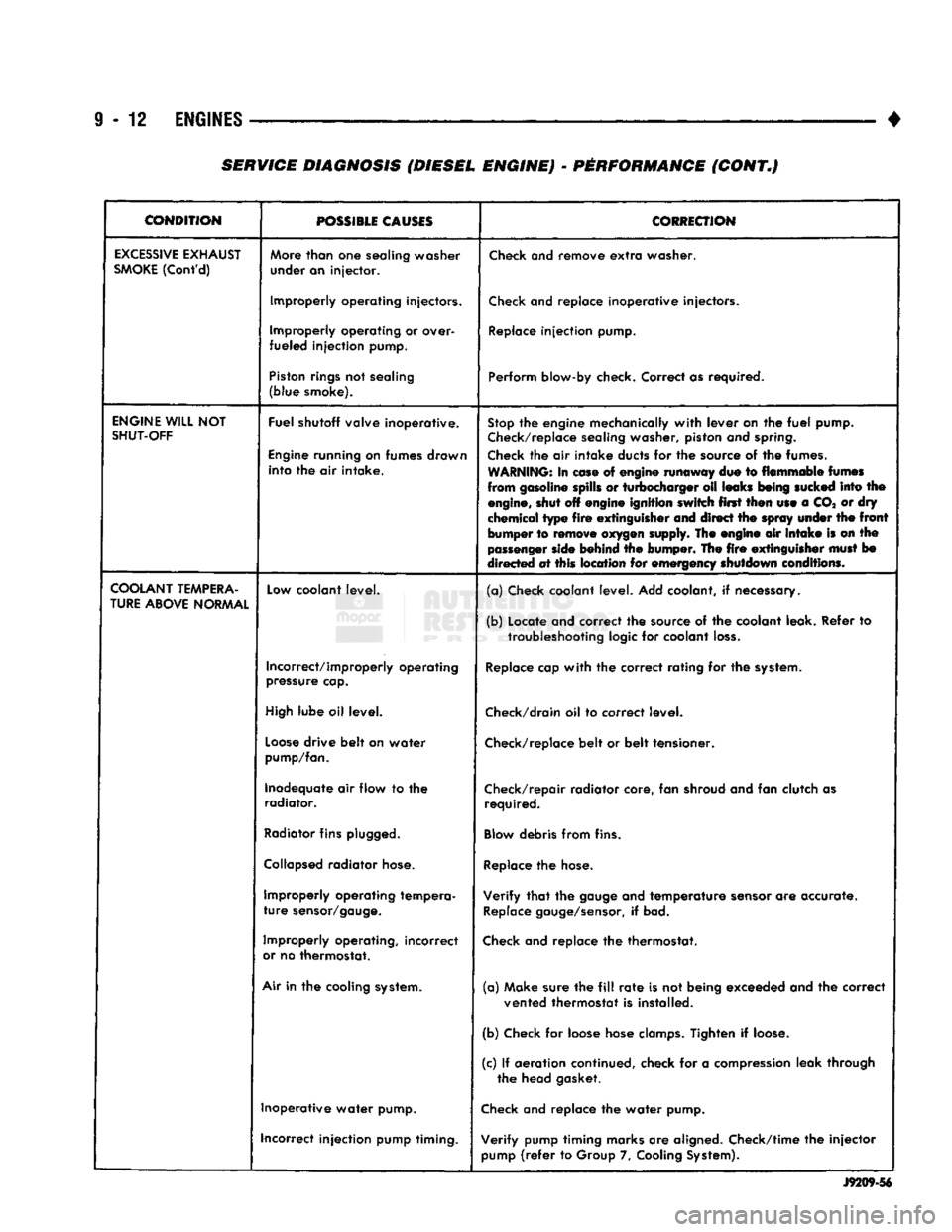
9
- 12
ENGINES
•
CONDITION
POSSIBLE
CAUSES
CORRECTION
EXCESSIVE
EXHAUST
SMOKE
(Cont'd)
More
than
one
sealing washer
under an injector.
Check
and remove
extra
washer.
Improperly operating injectors.
Check
and replace inoperative injectors.
Improperly operating or over-
fueled injection pump.
Replace
injection pump.
Piston
rings
not sealing
(blue smoke). Perform blow-by check. Correct as required.
ENGINE
WILL
NOT
SHUT-OFF
Fuel shutoff valve inoperative.
Engine
running on fumes drawn into the air intake.
Stop
the engine mechanically
with
lever on the
fuel
pump.
Check/replace
sealing washer, piston and
spring.
Check
the air intake ducts for the source of the fumes.
WARNING:
In
ease
of engine runaway due to flammable
fumes
from gasoline spills or turbocharger oil leaks
being
sucked
into the
engine,
shut off engine ignition switch first then use a CO* or dry
chemical type
fire
extinguisher
and direct the
spray
under
the
front
bumper to
remove
oxygen
supply. The engine air
intake
is on the
passenger
side
behind the bumper. The
fire
extinguisher
must
bo
directed at this location for emergency shutdown conditions.
COOLANT
TEMPERA
TURE
ABOVE
NORMAL
Low
coolant level.
(a) Check coolant level. Add coolant, if necessary.
(b) Locate and correct the source of the coolant leak. Refer to
troubleshooting
logic for coolant
loss.
Incorrect/improperly operating
pressure
cap.
Replace
cap
with
the correct rating for the
system.
High
lube oil level.
Check/drain
oil to correct level.
Loose
drive belt on water
pump/fan.
Check/replace
belt or belt tensioner.
Inadequate air flow to the radiator. Check/repair radiator core, fan shroud and fan clutch as
required.
Radiator
fins
plugged.
Blow
debris from fins.
Collapsed
radiator
hose.
Replace
the
hose.
Improperly operating tempera
ture
sensor/gauge.
Verify
that
the
gauge
and temperature
sensor
are accurate.
Replace
gauge/sensor,
if bad.
Improperly operating, incorrect
or
no thermostat.
Check
and replace the thermostat.
Air
in the cooling
system.
(a) Make sure the
fill
rate
is not being exceeded and the correct
vented thermostat is installed.
(b) Check for loose hose
clamps.
Tighten if
loose.
(c) If aeration continued, check for a
compression
leak through the head gasket.
Inoperative water pump.
Check
and replace the water pump.
incorrect injection pump timing. Verify pump timing marks are aligned. Check/time the injector
pump
(refer
to Group 7,
Cooling
System).
J9209-56
SERVICE DIAGNOSIS (DIESEL ENGINE) - PERFORMANCE (CONT.)