fuel pump DODGE TRUCK 1993 Service Owner's Guide
[x] Cancel search | Manufacturer: DODGE, Model Year: 1993, Model line: TRUCK, Model: DODGE TRUCK 1993Pages: 1502, PDF Size: 80.97 MB
Page 618 of 1502
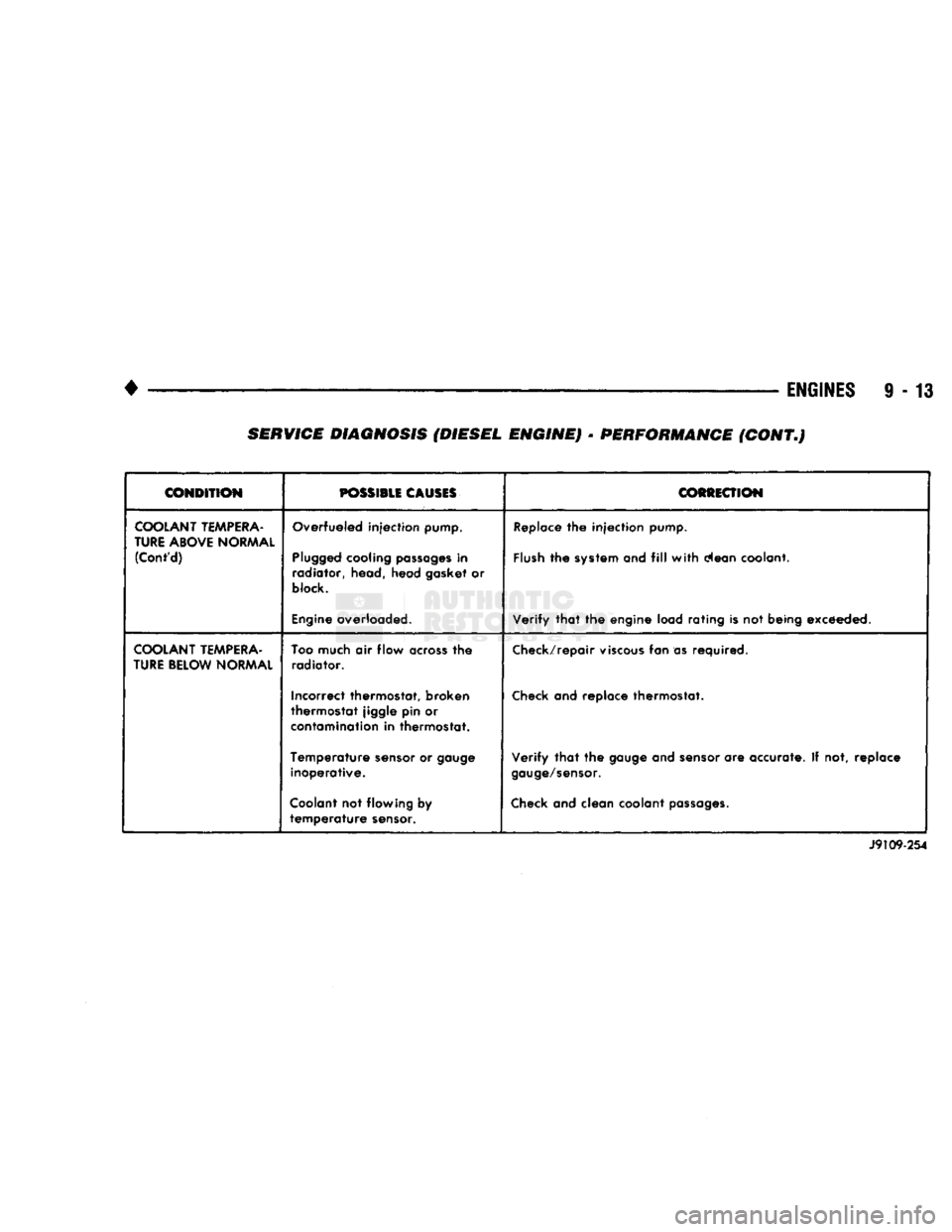
•
ENGINES
9 - 13
CONDITION
POSSIBLE
CAUSES
COfiiiECTION
COOLANT
TEMPERA
TURE
ABOVE
NORMAL
(Cont'd)
Overfueled injection pump.
Plugged
cooling
passages
in
radiator, head, head gasket or
block.
Engine
overloaded.
Replace
the injection
pump.
Flush
the
system
and
fill
with
clean coolant.
Verify
that
the engine load rating is not being exceeded.
COOLANT
TEMPERA
TURE
BELOW
NORMAL
Too
much air flow
across
the
radiator.
Incorrect thermostat, broken
thermostat jiggle pin or
contamination
in thermostat.
Temperature
sensor
or
gauge
inoperative.
Coolant
not flowing by
temperature
sensor.
Check/repair
viscous
fan as required.
Check
and replace thermostat.
Verify
that
the
gauge
and
sensor
are accurate. If not, replace
gauge/sensor.
Check
and clean coolant
passages.
J9109-254
SERVICE DIAGNOSIS (DIESEL ENGINE) • PERFORMANCE (CONT.)
Page 620 of 1502
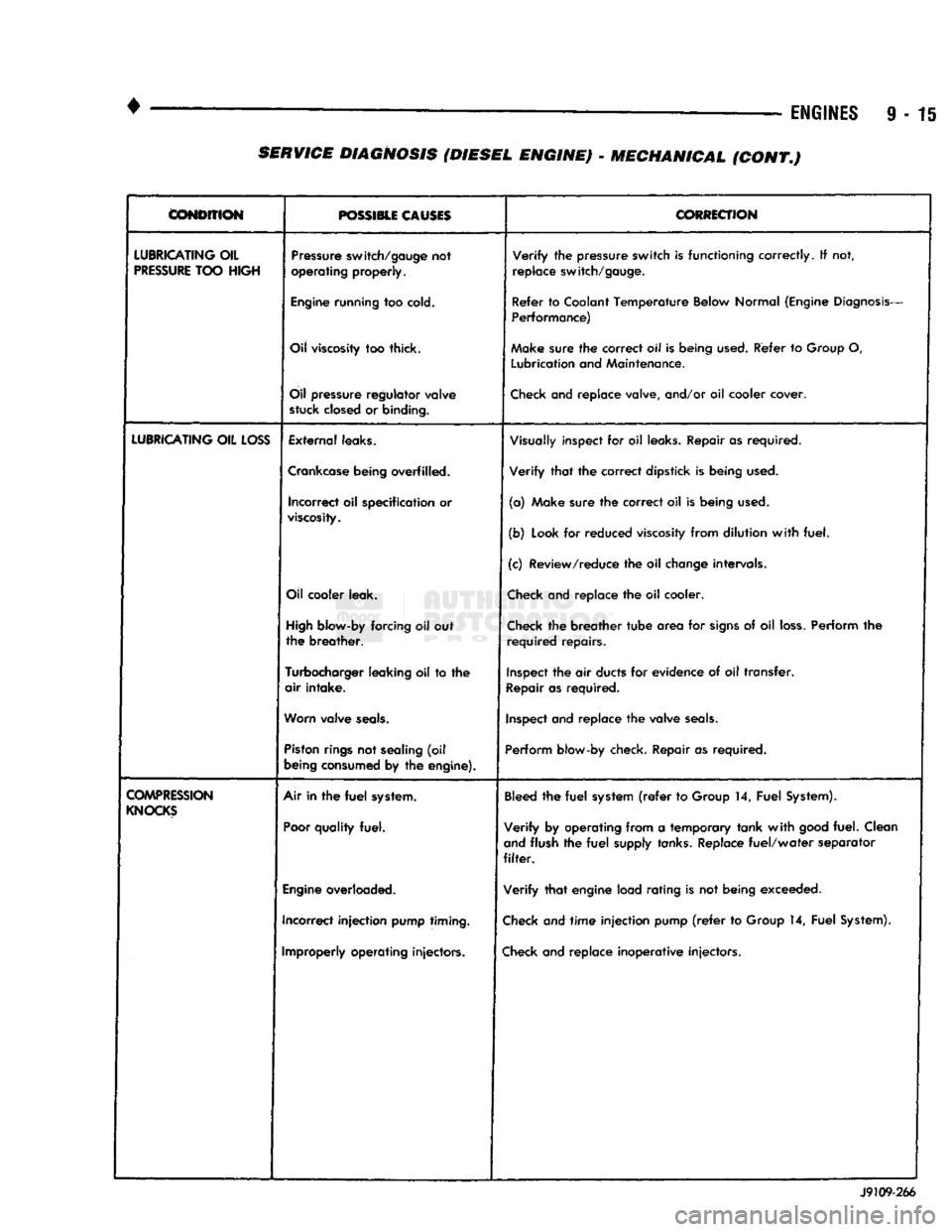
•
• —
ENGINES
9 - 15
CONDITION
POSSIBLE CAUSES
CORRECTION
LUBRICATING
OIL
PRESSURE
TOO
HIGH
Pressure
switch/gauge
not
operating
properly.
Verify
the
pressure
switch
is
functioning
correctly.
If not,
replace
switch/gauge.
Engine
running
too
cold.
Refer
to
Coolant
Temperature
Below
Normal
(Engine
Diagnosis-
Performance)
Oil
viscosity
too thick. Make
sure
the
correct
oil Is
being
used.
Refer
to
Group
O,
Lubrication
and
Maintenance.
Oil
pressure
regulator
valve
stuck
closed
or
binding.
Check
and replace valve, and/or oil cooler cover.
LUBRICATING
OIL
LOSS
External
leaks.
Visually
inspect for oil
leaks.
Repair as required.
Crankcase
being
overfilled. Verify that the correct dipstick is being
used.
incorrect
oil specification or
viscosity.
(a) Make sure the correct oil is being
used.
(b)
Look
for reduced
viscosity
from dilution with fuel.
(c) Review/reduce the oil
change
intervals.
Oil
cooler
leak.
Check
and replace the oil cooler.
High
blow-by
forcing oil out
the breather.
Check
the breather tube area for
signs
of oil
loss.
Perform the
required repairs.
Turbocharger
leaking
oil to the
air intake.
Inspect
the air
ducts
for evidence of oil transfer.
Repair
as required.
Worn
valve
seals.
Inspect
and replace the valve
seals.
Piston
rings
not
sealing
(oil
being
consumed
by the
engine).
Perform
blow-by check. Repair as required.
COMPRESSION
KNOCKS
Air in the
fuel
system.
Poor
quality
fuel.
Bleed
the fuel
system
(refer
to
Group
14, Fuel
System).
Verify by operating from a temporary tank with
good
fuel. Clean
and
flush the fuel
supply
tanks.
Replace fuel/water separator
filter.
Engine
overloaded. Verify that engine load rating is not being exceeded.
Incorrect injection
pump
timing.
Check
and time injection pump
(refer
to
Group
14, Fuel
System).
Improperly
operating
injectors.
Check
and replace inoperative injectors. J9109-266 SERVICE DIAGNOSIS (DIESEL ENGINE) - MECHANICAL (CONT.)
Page 622 of 1502
•
3.9L ENGINE
9 - 17
3.9L
ENGINE SERVICE PROCEDURES
INDEX
page
Camshaft
31
Crankshaft
38
Crankshaft Main Bearings
39
Crankshaft Rear
Oil
Seals
. 40
Cylinder Block
41
Cylinder Head Cover
. , 21
Cylinder Heads
. 22
Distributor
33
Engine
Assembly .........................
20
Engine
Front Mounts
17
Engine
Rear Mount
18
Front Crankshaft
Oil
Seal Replacement ........
31
GENERAL INFORMATION
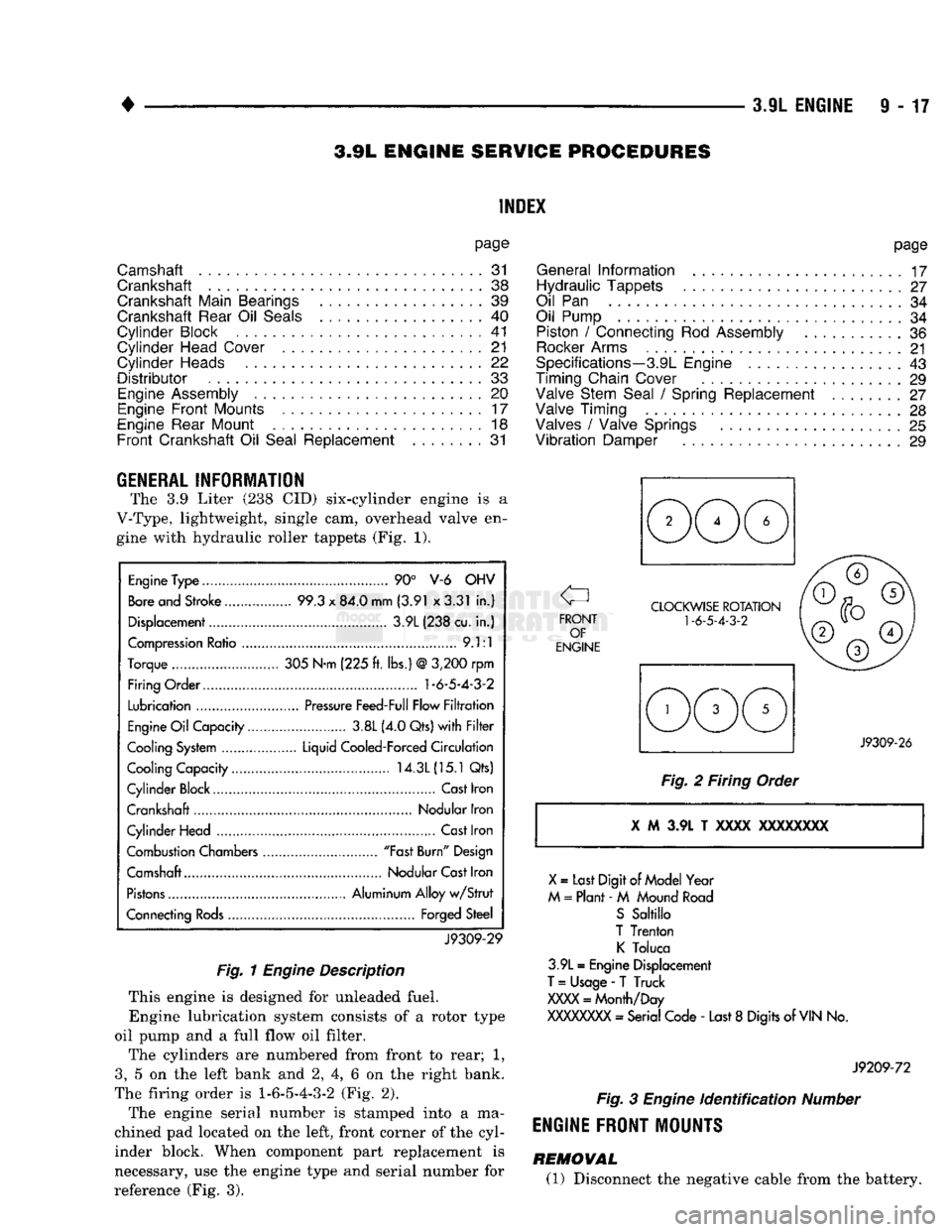
The 3.9 Liter (238 CID) six-cylinder engine is a
V-Type, lightweight, single cam, overhead valve en gine with hydraulic roller tappets (Fig. 1).
Engine
Type
90° V-6 OHV
Bore
and Stroke 99.3
x
84.0 mm (3.91 x3.31
in.)
Displacement 3.9L (238 cu.
in.)
Compression
Ratio
9.1:1
Torque 305 N-m (225
ft.
lbs.)
@
3,200
rpm
Firing Order.... 1-6-5-4-3-2
Lubrication
Pressure
Feed-Full Flow
Filtration
Engine
Oil
Capacity 3.8L (4.0 Qts)
with Filter
Cooling
System
Liquid Cooled-Forced
Circulation
Cooling Capacity 14.3L
(15.1
Qts)
Cylinder Block Cast Iron
Crankshaft Nodular Iron
Cylinder Head
Cast
Iron
Combustion Chambers "Fast
Burn"
Design
Camshaft Nodular
Cast
Iron
Pistons
Aluminum Alloy
w/Strut
Connecting
Rods
Forged Steel
J9309-29
Fig.
1
Engine
Description
This engine is designed for unleaded fuel. Engine lubrication system consists of a rotor type
oil pump and a full flow oil filter.
The cylinders are numbered from front to rear; 1,
3,
5 on the left bank and 2, 4, 6 on the right bank.
The firing order is
1-6-5-4-3-2
(Fig. 2).
The engine serial number is stamped into a ma
chined pad located on the left, front corner of the cyl
inder block. When component part replacement is
necessary, use the engine type and serial number for
reference (Fig. 3).
page
General
Information
17
Hydraulic Tappets
27
Oil
Pan 34
Oil Pump
34
Piston
/
Connecting
Rod
Assembly
36
Rocker
Arms
21
Specifications—3.9L Engine
43
Timing Chain Cover
29
Valve Stem Seal
/
Spring Replacement ........
27
Valve Timing
28
Valves
/
Valve Springs
25
Vibration
Damper
29
J9309-26
Fig.
2 Firing Order i M 3.9L T xxxx
XXXXXXXX
X
=
Last Digit
of
Model Year
M
=
Plant -
M
Mound
Road
S
Sabillo
T Trenton
K
Toluca
3.9L
=
Engine Displacement
T
=
Usage
-
T Truck
XXXX
=
Month/Day
XXXXXXXX
- Serial Code -
Last
8
Digits of
VIN
No.
J9209-72
Fig.
3
Engine
identification
Number
ENGINE FRONT MOUNTS
REMOVAL (1) Disconnect the negative cable from the battery.
Page 634 of 1502
•
3.9L
ENGINE
I - 21
VIBRATION
DAMPER
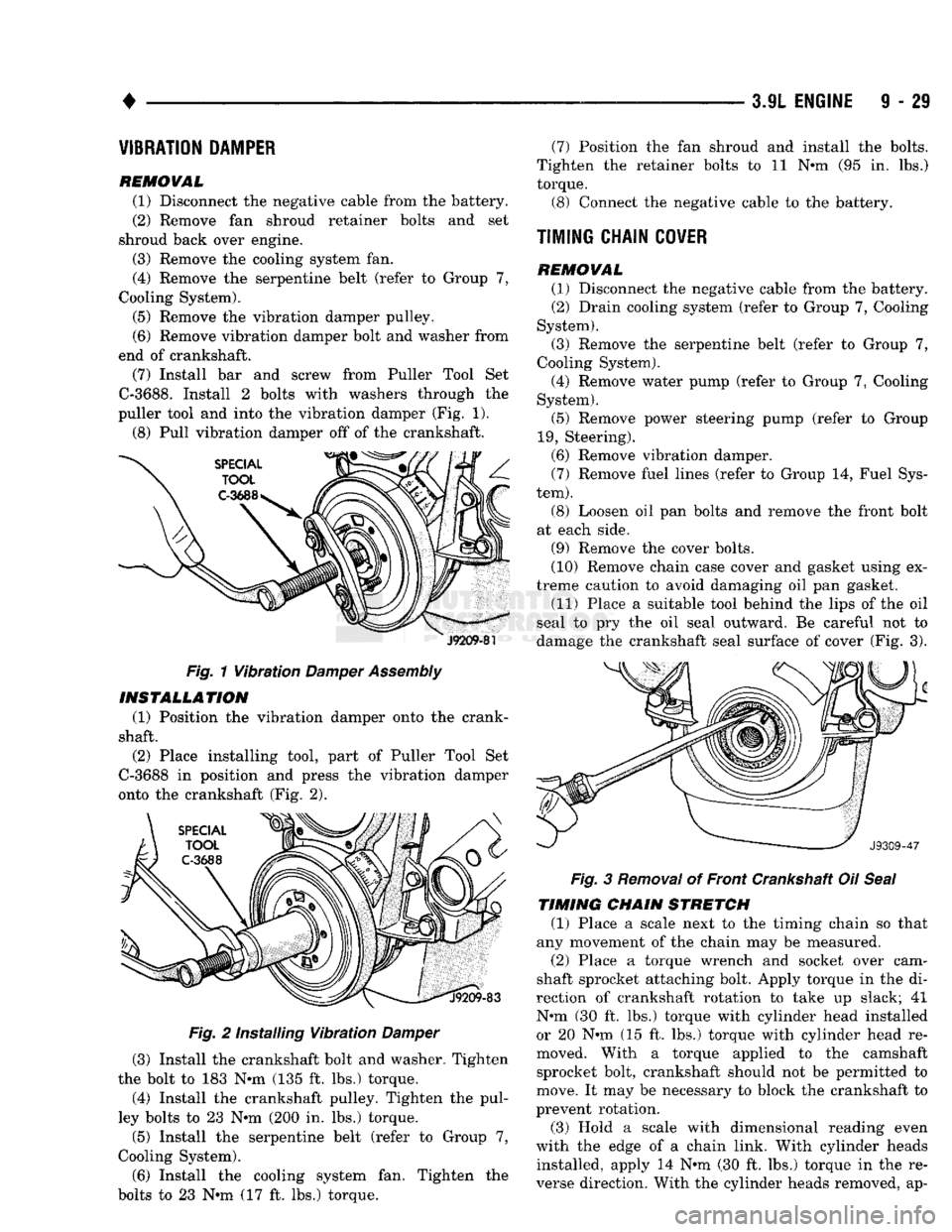
REMOVAL
(1) Disconnect the negative cable from the battery,
(2) Remove fan shroud retainer bolts and set
shroud back over engine.
(3) Remove the cooling system fan.
(4) Remove the serpentine belt (refer to Group 7,
Cooling System).
(5) Remove the vibration damper pulley.
(6) Remove vibration damper bolt and washer from
end of crankshaft.
(7) Install bar and screw from Puller Tool Set
C-3688.
Install 2 bolts with washers through the
puller tool and into the vibration damper (Fig. 1).
(8) Pull vibration damper off of the crankshaft.
J9209-81
Fig. 1 Vibration
Damper
Assembly INSTALLATION
(1) Position the vibration damper onto the crank
shaft.
(2) Place installing tool, part of Puller Tool Set
C-3688 in position and press the vibration damper
onto the crankshaft (Fig. 2).
Fig. 2 Installing Vibration Damper
(3) Install the crankshaft bolt and washer. Tighten
the bolt to 183 N*m (135 ft. lbs.) torque.
(4) Install the crankshaft pulley. Tighten the pul
ley bolts to 23 N*m (200 in. lbs.) torque.
(5) Install the serpentine belt (refer to Group 7,
Cooling System).
(6) Install the cooling system fan. Tighten the
bolts to 23 N*m (17 ft. lbs.) torque. (7) Position the fan shroud and install the bolts.
Tighten the retainer bolts to 11 N*m (95 in. lbs.)
torque.
(3)
Connect the negative cable to the battery.
TIMING CHAIN
COVER
REMOVAL (1)
Disconnect the negative cable from the battery.
(2)
Drain cooling system (refer to Group 7, Cooling
System).
(3)
Remove the serpentine belt (refer to Group 7,
Cooling System).
(4)
Remove water pump (refer to Group 7, Cooling
System).
(5)
Remove power steering pump (refer to Group
19,
Steering).
(6)
Remove vibration damper. (7) Remove fuel lines (refer to Group 14, Fuel Sys
tem).
(8) Loosen oil pan bolts and remove the front bolt
at each side.
(9)
Remove the cover bolts.
(10)
Remove chain case cover and gasket using ex
treme caution to avoid damaging oil pan gasket.
(11)
Place a suitable tool behind the lips of the oil
seal to pry the oil seal outward. Be careful not to
damage the crankshaft seal surface of cover (Fig. 3). Fig. 3 Removal of Front Crankshaft Oil Seal
TIMING CHAIN STRETCH
(1) Place a scale next to the timing chain so that
any movement of the chain may be measured.
(2)
Place a torque wrench and socket over cam
shaft sprocket attaching bolt. Apply torque in the di
rection of crankshaft rotation to take up slack; 41
N#m (30 ft. lbs.) torque with cylinder head installed or 20 N»m (15 ft. lbs.) torque with cylinder head re
moved. With a torque applied to the camshaft sprocket bolt, crankshaft should not be permitted to
move. It may be necessary to block the crankshaft to
prevent rotation.
(3)
Hold a scale with dimensional reading even
with the edge of a chain link. With cylinder heads installed, apply 14 N*m (30 ft. lbs.) torque in the re
verse direction. With the cylinder heads removed, ap-
Page 636 of 1502
•
3.9L
ENGINE
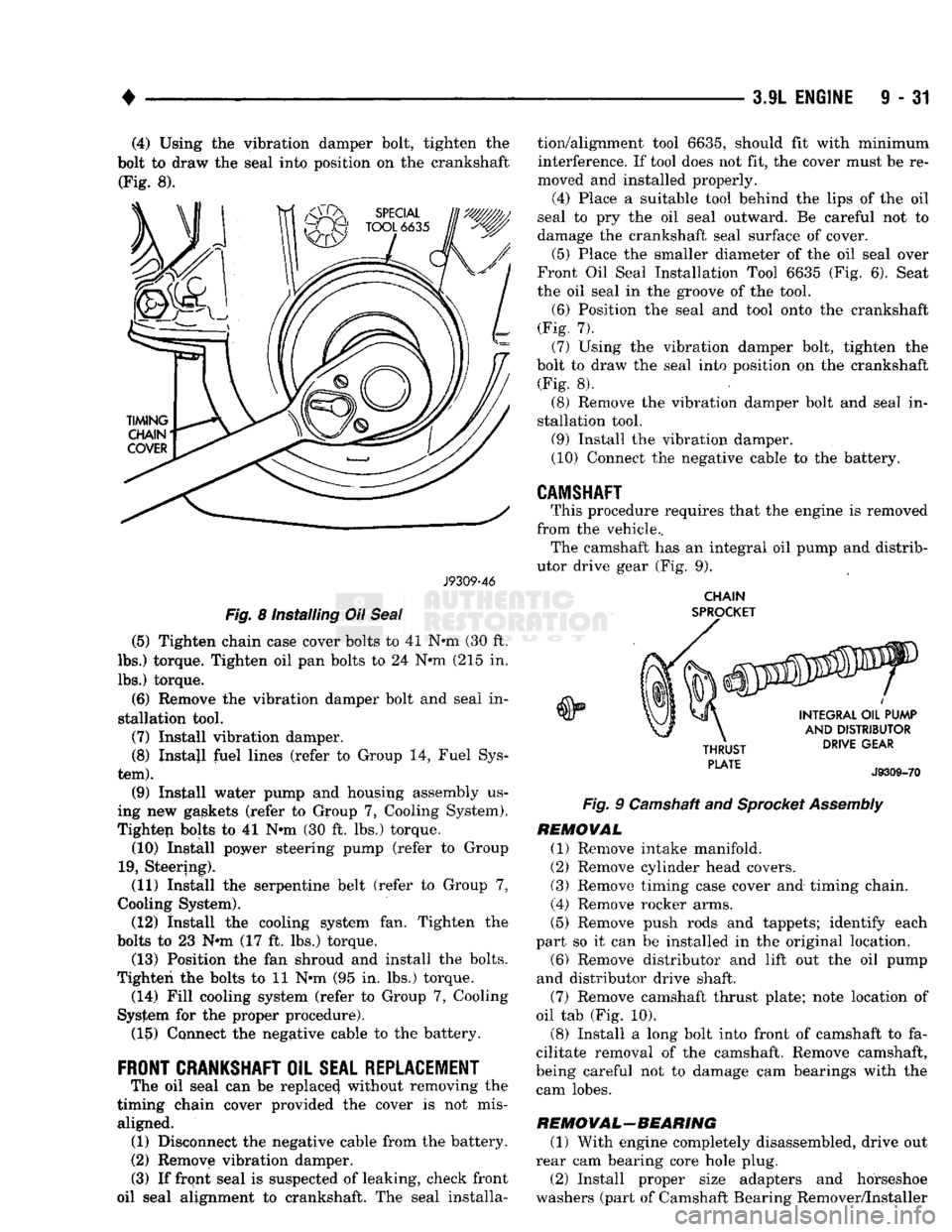
9 - 31 (4) Using the vibration damper bolt, tighten the
bolt to draw the seal into position on the crankshaft (Fig. 8).
J9309-46
Fig.
8 installing Oil
Seal
(5) Tighten chain case cover bolts to 41 N-m (30 ft.
lbs.) torque. Tighten oil pan bolts to 24 N*m (215 in.
lbs.) torque.
(6) Remove the vibration damper bolt and seal in
stallation tool.
(7) Install vibration damper. (8) Instajl fuel lines (refer to Group 14, Fuel Sys
tem).
(9) Install water pump and housing assembly us
ing new gaskets (refer to Group 7, Cooling System).
Tighten bolts to 41 N-m (30 ft. lbs.) torque. (10) Install power steering pump (refer to Group
19,
Steering). (11) Install the serpentine belt (refer to Group 7,
Cooling System). (12) Install the cooling system fan. Tighten the
bolts to 23 N-m (17 ft. lbs.) torque. (13) Position the fan shroud and install the bolts.
Tighten the bolts to 11 N-m (95 in. lbs.) torque. (14) Fill cooling system (refer to Group 7, Cooling
System for the proper procedure). (15) Connect the negative cable to the battery.
FRONT
CRANKSHAFT
OIL
SEAL REPLACEMENT
The oil seal can be replaced without removing the
timing chain cover provided the cover is not mis aligned. (1) Disconnect the negative cable from the battery.
(2) Remove vibration damper.
(3) If front seal is suspected of leaking, check front
oil seal alignment to crankshaft. The seal installa tion/alignment tool 6635, should fit with minimum
interference. If tool does not fit, the cover must be re
moved and installed properly.
(4)
Place a suitable tool behind the lips of the oil
seal to pry the oil seal outward. Be careful not to
damage the crankshaft seal surface of cover.
(5) Place the smaller diameter of the oil seal over
Front Oil Seal Installation Tool 6635 (Fig. 6). Seat
the oil seal in the groove of the tool.
(6) Position the seal and tool onto the crankshaft
(Fig. 7). (7) Using the vibration damper bolt, tighten the
bolt to draw the seal into position on the crankshaft (Fig. 8).
(8) Remove the vibration damper bolt and seal in
stallation tool. (9) Install the vibration damper.
(10) Connect the negative cable to the battery.
CAMSHAFT
This procedure requires that the engine is removed
from the vehicle.. The camshaft has an integral oil pump and distrib
utor drive gear (Fig. 9).
CHAIN
SPROCKET
Fig.
9 Camshaft and
Sprocket
Assembly
REMOVAL
(1) Remove intake manifold.
(2) Remove cylinder head covers. (3) Remove timing case cover and timing chain.
(4) Remove rocker arms.
(5) Remove push rods and tappets; identify each
part so it can be installed in the original location. (6) Remove distributor and lift out the oil pump
and distributor drive shaft.
(7) Remove camshaft thrust plate; note location of
oil tab (Fig. 10).
(8) Install a long bolt into front of camshaft to fa
cilitate removal of the camshaft. Remove camshaft,
being careful not to damage cam bearings with the cam lobes.
RE
MO
VAL-BEA RING
(1) With engine completely disassembled, drive out
rear cam bearing core hole plug.
(2) Install proper size adapters and horseshoe
washers (part of Camshaft Bearing Remover/Installer
Page 652 of 1502
5.2L
ENGINE
9 - 47
S.2L ENGINE
SERVICE
PROCEDURES
INDEX
page
Camshaft
. , . 61
Crankshaft
68
Crankshaft Main Bearings
69
Crankshaft Rear
Oil
Seals
...... ........
70
Cylinder Block ...........................
71
Cylinder Head Cover
. . . . 51
Cylinder Heads
52
Distributor
62
Engine
Assembly
. 50
Engine
Front Mounts
47
Engine
Rear Mount ...............
48
Front Crankshaft
Oil
Seal Replacement
. . 61
GENERAL
INFORMATION
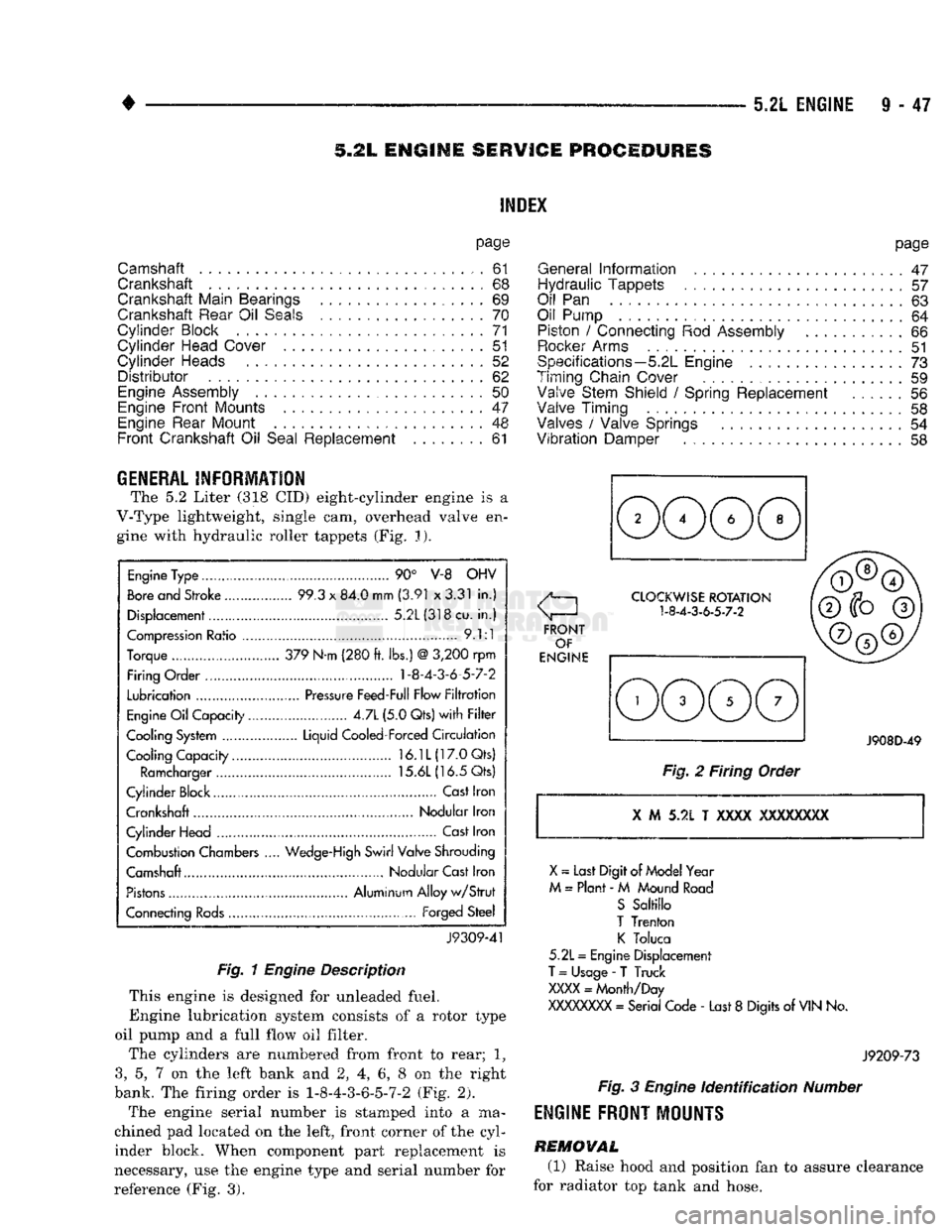
The 5.2 Liter (318 CID) eight-cylinder engine is a
V-Type lightweight, single cam, overhead valve en gine with hydraulic roller tappets (Fig. J).
Engine
Type ....
90° V-8 OHV
Bore
and Stroke .....
99.3
x
84.0 mm
(3.91
x
3.31
in.)
Displacement................
5.2L(318cu.
in.)
Compression
Ratio ....... .
9.1:1
Torque .. 379 N-m (280
ft.
lbs.)
@
3,200
rpm
Firing Order .... 1-8-4-3-6-5-7-2
Lubrication
.......
Pressure
Feed-Full Flow
Filtration
Engine
Oil
Capacity......
4.7L
(5.0 Qts)
with Filter
Cooling System ...... Liquid Cooled-Forced
Circulation
Cooling Capacity..........
16.1L(17.0Qts)
Ramcharger
15.6L
(16.5 Qts)
Cylinder Block
,
Cast
Iron
Crankshaft Nodular Iron
Cylinder Head ..............
Cast
Iron
Combustion Chambers
..
Wedge-High
Swirl Valve Shrouding
Camshaft Nodular Cast Iron
Pistons
Aluminum Alloy
w/Strut
Connecting
Rods...........
Forged
Steel
J9309-41
Fig. 1
Engine
Description
This engine is designed for unleaded fuel.
Engine lubrication system consists of a rotor type
oil pump and a full flow oil filter.
The cylinders are numbered from front to rear; 1?
3,
5, 7 on the left bank and 2, 4, 6, 8 on the right
bank. The firing order is 1-8-4-3-6-5-7-2 (Fig. 2).
The engine serial number is stamped into a ma
chined pad located on the left, front corner of the cyl
inder block. When component part replacement is
necessary, use the engine type and serial number for
reference (Fig. 3).
page
General
Information
.......................
47
Hydraulic Tappets
57
Oil
Pan . 63
Oil Pump
. 64
Piston
/
Connecting
Rod
Assembly
66
Rocker
Arms
51
Specifications—5.2L Engine
73
Timing Chain Cover ................
59
Valve Stem Shield
/
Spring Replacement
56
Valve Timing
. 58
Valves
/
Valve Springs
54
Vibration
Damper
. . 58
J908D-49
Fig.
2 Firing Order
X
M 5.2L T
XXXX
XXXXXXXX
X
~
Last Digit of
Model
Year
M
=
Plant
- M
Mound
Road
S
Saltillo
T
Trenton
K
Toluca
5.2L
=
Engine Displacement
T
=
Usage
-
T Truck
XXXX
=
Month/Day
XXXXXXXX
=
Serial Code
-
Last
8
Digits
of
VIN
No.
J9209-73
Fig.
3
Engine
Identification
Number
ENGINE
FRONT
MOUNTS
REMOVAL
(1) Raise hood and position fan to assure clearance
for radiator top tank and hose.
Page 664 of 1502
•
5.2L
ENGINE
9 - 59
INSTALLATION
(1) Position the vibration damper onto the crank
shaft. (2) Place installing tool, part of Puller Tool Set
C-3688 in position and press the vibration damper
onto the crankshaft (Fig. 2).
Fig.
2 Installing
Vibration
Damper
(3) Install the crankshaft bolt and washer. Tighten
the bolt to 183 N*m (135 ft. lbs.) torque.
(4) Install the crankshaft pulley. Tighten the pul
ley bolts to 23 Nin (200 in. lbs.) torque.
(5) Install the serpentine belt (refer to Group 7,
Cooling System).
(6) Install the cooling system fan. Tighten the
bolts to 23 N*m (17 ft. lbs.) torque.
(7) Position the fan shroud and install the bolts.
Tighten the retainer bolts to 11 N»m (95 in. lbs.)
torque.
(8) Connect the negative cable to the battery.
TIMING
CHAIN
COVER
REMOVAL (1) Disconnect the negative cable from the battery.
(2) Drain cooling system (refer to Group 7, Cooling
System).
(3) Remove the serpentine belt (refer to Group 7,
Cooling System).
(4) Remove water pump (refer to Group 7, Cooling
System).
(5) Remove power steering pump (refer to Group
19,
Steering). (6) Remove vibration damper.
(7) Remove fuel lines (refer to Group 14, Fuel Sys
tem).
(8) Loosen oil pan bolts and remove the front bolt
at each side.
(9) Remove the cover bolts.
(10) Remove chain case cover and gasket using ex
treme caution to avoid damaging oil pan gasket.
(11) Place a suitable tool behind the lips of the oil
seal to pry the oil seal outward. Be careful not to
damage the crankshaft seal surface of cover (Fig. 3).
Fig.
3
Removal
of Front Crankshaft Oil
Seal
TIMING
CHAIN
STRETCH
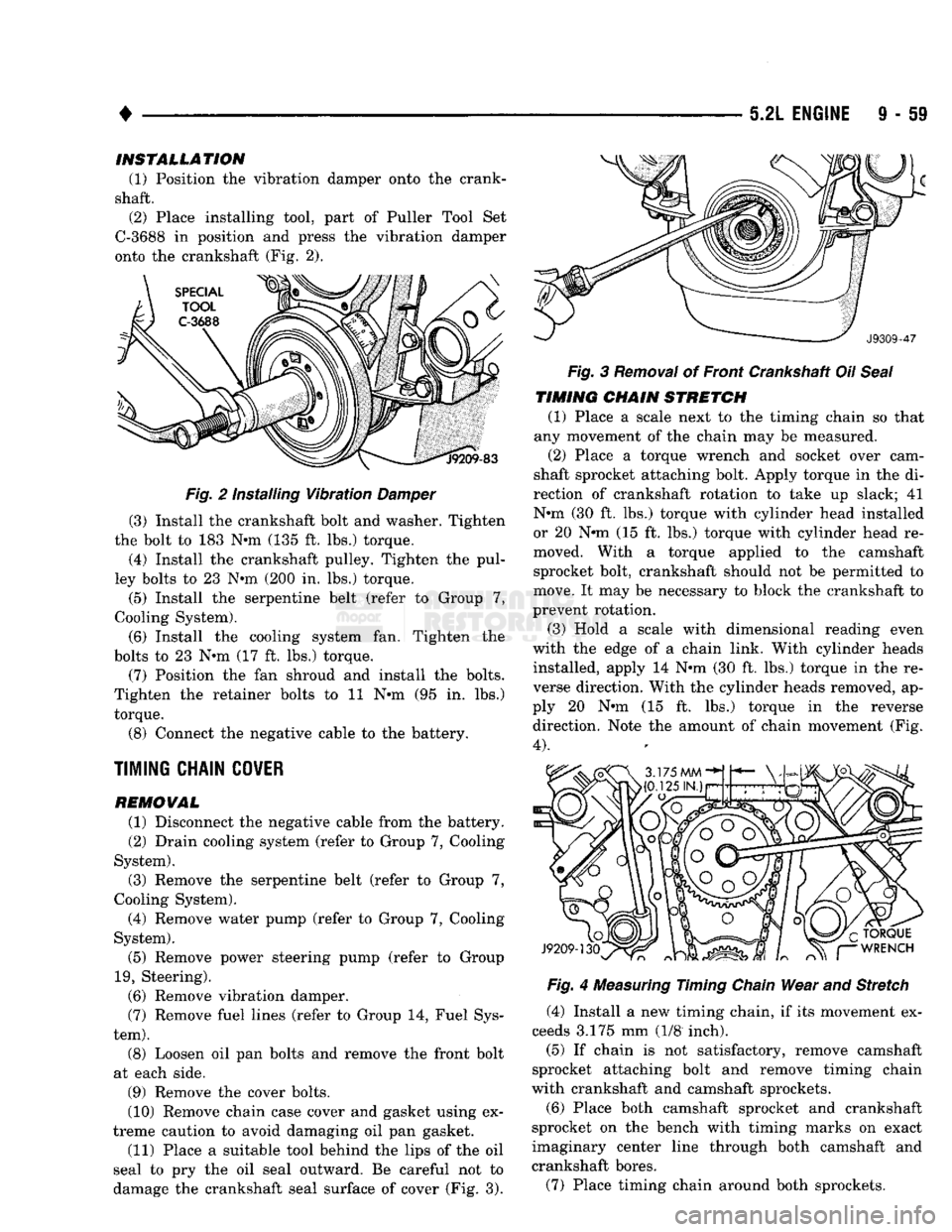
(1) Place a scale next to the timing chain so that
any movement of the chain may be measured.
(2) Place a torque wrench and socket over cam
shaft sprocket attaching bolt. Apply torque in the di
rection of crankshaft rotation to take up slack; 41
N»m (30 ft. lbs.) torque with cylinder head installed
or 20 N»m (15 ft. lbs.) torque with cylinder head re
moved. With a torque applied to the camshaft sprocket bolt, crankshaft should not be permitted to
move. It may be necessary to block the crankshaft to
prevent rotation.
(3) Hold a scale with dimensional reading even
with the edge of a chain link. With cylinder heads installed, apply 14 Nnn (30 ft. lbs.) torque in the re
verse direction. With the cylinder heads removed, ap
ply 20 N»m (15 ft. lbs.) torque in the reverse direction. Note the amount of chain movement (Fig.
4).
Fig.
4
Measuring
Timing
Chain
Wear and Stretch
(4) Install a new timing chain, if its movement ex
ceeds 3.175 mm (1/8 inch). (5) If chain is not satisfactory, remove camshaft
sprocket attaching bolt and remove timing chain
with crankshaft and camshaft sprockets.
(6) Place both camshaft sprocket and crankshaft
sprocket on the bench with timing marks on exact
imaginary center line through both camshaft and
crankshaft bores.
(7) Place timing chain around both sprockets.
Page 665 of 1502
9
- 60 5.2L
ENGINE
(8) Turn crankshaft and camshaft to line up with
keyway location in crankshaft sprocket and in cam shaft sprocket.
(9) Lift sprockets and chain (keep sprockets tight
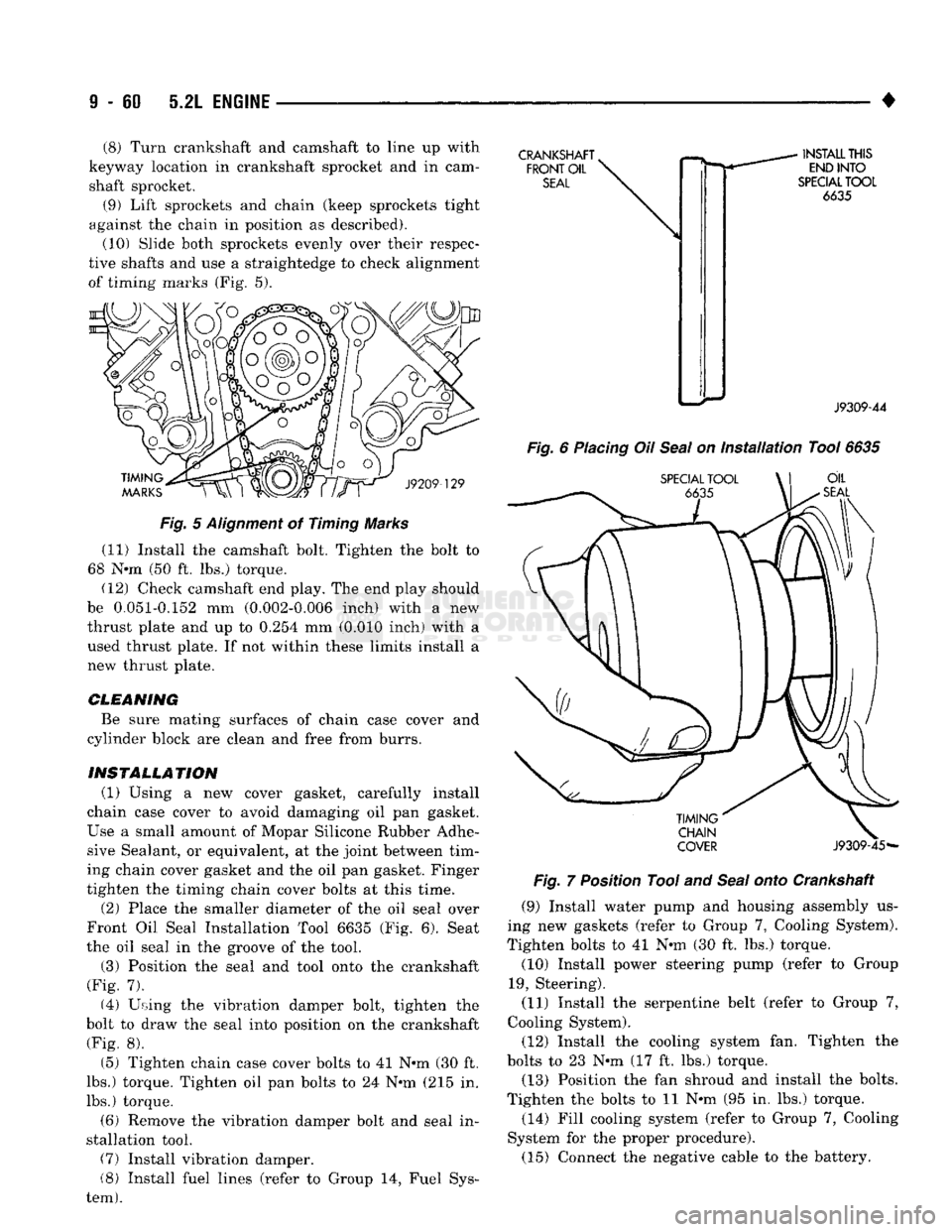
against the chain in position as described). (10) Slide both sprockets evenly over their respec
tive shafts and use a straightedge to check alignment
of timing marks (Fig. 5).
TIMING
MARKS
J9209-129
Fig.
5
Alignment
of Timing Marks (11) Install the camshaft bolt. Tighten the bolt to
68 Nnn (50 ft. lbs.) torque. (12) Check camshaft end play. The end play should
be 0.051-0.152 mm (0.002-0.006 inch) with a new
thrust plate and up to 0.254 mm (0.010 inch) with a used thrust plate. If not within these limits install a
new thrust plate.
CLEANING Be sure mating surfaces of chain case cover and
cylinder block are clean and free from burrs.
INSTALLATION (1) Using a new cover gasket, carefully install
chain case cover to avoid damaging oil pan gasket.
Use a small amount of Mopar Silicone Rubber Adhe sive Sealant, or equivalent, at the joint between tim
ing chain cover gasket and the oil pan gasket. Finger
tighten the timing chain cover bolts at this time.
(2) Place the smaller diameter of the oil seal over
Front Oil Seal Installation Tool 6635 (Fig. 6). Seat
the oil seal in the groove of the tool.
(3) Position the seal and tool onto the crankshaft
(Fig. 7). (4) Using the vibration damper bolt, tighten the
bolt to draw the seal into position on the crankshaft (Fig. 8).
(5) Tighten chain case cover bolts to 41 Nnn (30 ft.
lbs.) torque. Tighten oil pan bolts to 24 Nnn (215 in.
lbs.) torque.
(6) Remove the vibration damper bolt and seal in
stallation tool. (7) Install vibration damper.
(8) Install fuel lines (refer to Group 14, Fuel Sys
tem).
CRANKSHAFT
k
FRONT
OIL
SEAL
INSTALL
THIS
END
INTO
SPECIAL
TOOL
6635
J9309-44
Fig.
6
Placing
Oil
Seal
on
Installation
Tool
6635
SPECIAL
TOOL
\ | OIL
SEAL
TIMING
CHAIN
COVER
J9309-45*-
Fig.
7 Position Tool and
Seal
onto Crankshaft
(9) Install water pump and housing assembly us
ing new gaskets (refer to Group 7, Cooling System).
Tighten bolts to 41 Nnn (30 ft. lbs.) torque.
(10) Install power steering pump (refer to Group
19,
Steering).
(11) Install the serpentine belt (refer to Group 7,
Cooling System).
(12) Install the cooling system fan. Tighten the
bolts to 23 Nnn (17 ft. lbs.) torque. (13) Position the fan shroud and install the bolts.
Tighten the bolts to 11 Nnn (95 in. lbs.) torque.
(14) Fill cooling system (refer to Group 7, Cooling
System for the proper procedure).
(15) Connect the negative cable to the battery.
Page 682 of 1502
5.9L
ENGINE SERVICE PROCEDURES
INDEX
page
Camshaft
91
Crankshaft
98
Crankshaft Main Bearings
99
Crankshaft Rear
Oil
Seals
100
Cylinder
Block
101
Cylinder
Head Cover
81
Cylinder
Heads
82
Distributor
92
Engine Assembly
80
Engine
Front
Mounts
77
Engine Rear Mount
78
Front
Crankshaft
Oil
Seal Replacement
91
page
General
Information
77
Hydraulic
Tappets
87
Oil
Pan 93
Oil Pump
. 94
Piston
/
Connecting
Rod
Assembly
96
Rocker Arms
81
Specifications—5.9L
Engine
103
Timing
Chain Cover
89
Valve Stem Shield
/
Spring Replacement
86
Valve
Timing
. 88
Valves
/
Valve Springs
84
Vibration
Damper
88
GENERAL
INFORMATION
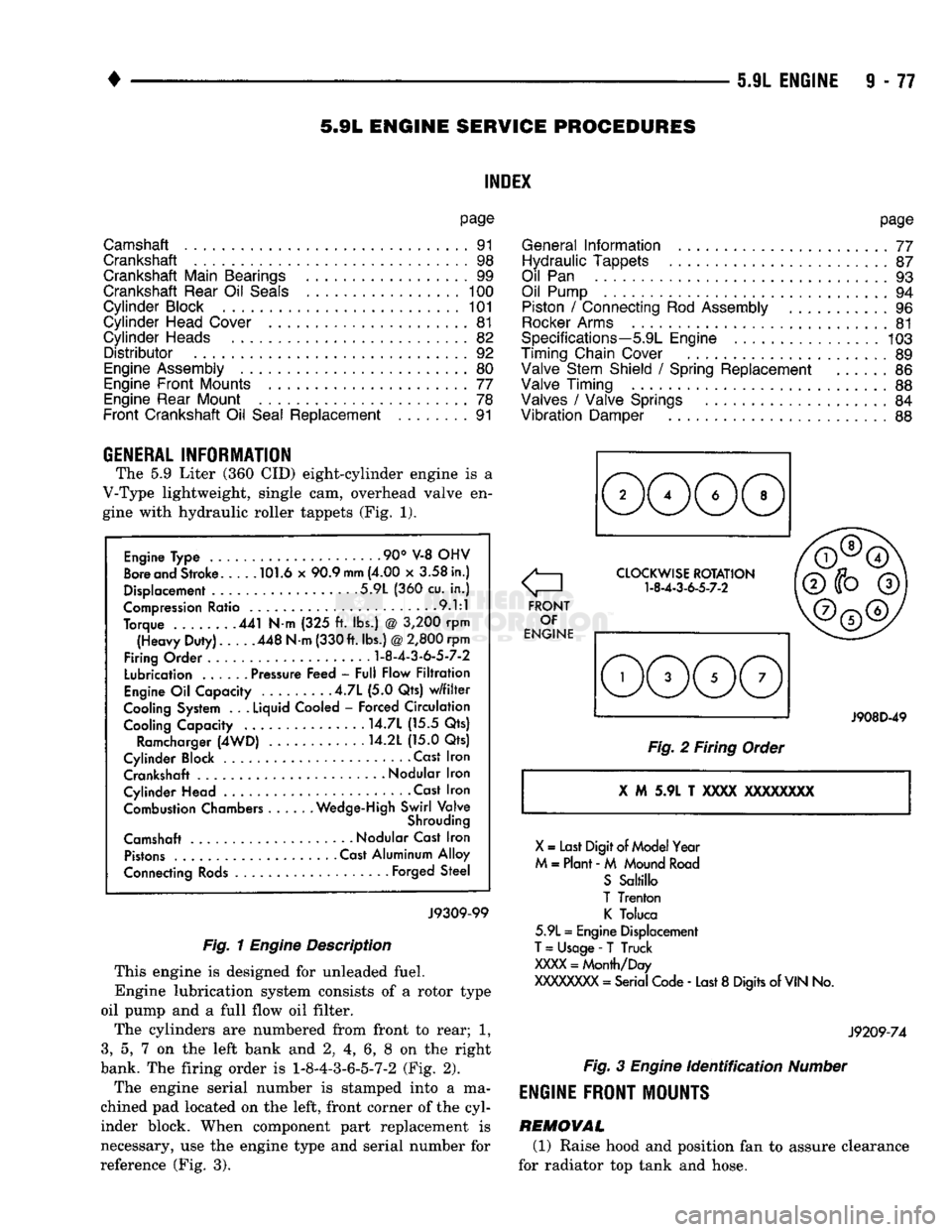
The 5.9 Liter (360 CID) eight-cylinder engine is a
V-Type lightweight, single cam, overhead valve en
gine with hydraulic roller tappets (Fig. 1).
Engine Type .90° V-8 OHV
Bore and Stroke 101.6 x 90.9
mm
(4.00 x 3.58 in.)
Displacement 5.9L (360 cu. in.)
Compression Ratio 9.1:1
Torque 441 N-m (325 ft. lbs.) @ 3,200 rpm (Heavy Duty). 448 N-m (330 ft. lbs.)
@
2,800 rpm
Firing Order
1-8-4-3-6-5-7-2
Lubrication ...... Pressure Feed - Full Flow Filtration
Engine Oil Capacity .4.7L (5.0 Qts) w/filter
Cooling System . .
.
Liquid Cooled - Forced Circulation Cooling Capacity ..... . . 14.7L (15.5 Qts)
Ramcharger (4WD) 14.2L (15.0 Qts)
Cylinder Block Cast Iron Crankshaft
-
Nodular Iron
Cylinder Head • . Cast Iron Combustion Chambers Wedge-High Swirl Valve
Shrouding
Camshaft Nodular Cast Iron Pistons Cast Aluminum Alloy
Connecting Rods Forged Steel
J9309-99
Fig. 1
Engine
Description
This engine is designed for unleaded fuel.
Engine lubrication system consists of a rotor type
oil pump and a full flow oil filter.
The cylinders are numbered from front to rear; 1,
3,
5, 7 on the left bank and 2, 4, 6, 8 on the right
bank. The firing order is
1-8-4-3-6-5-7-2
(Fig. 2).
The engine serial number is stamped into a ma
chined pad located on the left, front corner of the cyl
inder block. When component part replacement is
necessary, use the engine type and serial number for
reference (Fig. 3).
o
FRONT OF
ENGINE CLOCKWISE ROTATION
1-8-4-3-6-5-7-2
J908D-49
Fig. 2 Firing Order
X
M 5.9L T
XXXX
XXXXXXXX
X
= Last Digit of Model Year
M = Plant - M Mound Road S Saltillo
T Trenton K Toluca
5.9L = Engine Displacement
T
= Usage -
T
Truck
XXXX
= Month/Day
XXXXXXXX
= Serial Code - Last 8 Digits of
VIN
No.
J9209-74
Fig.
3
Engine
identification
Number
ENGINE
FRONT MOUNTS
REMOVAL (1) Raise hood and position fan to assure clearance
for radiator top tank and hose.
Page 694 of 1502
•
5.9L
ENGINE
9 - 89
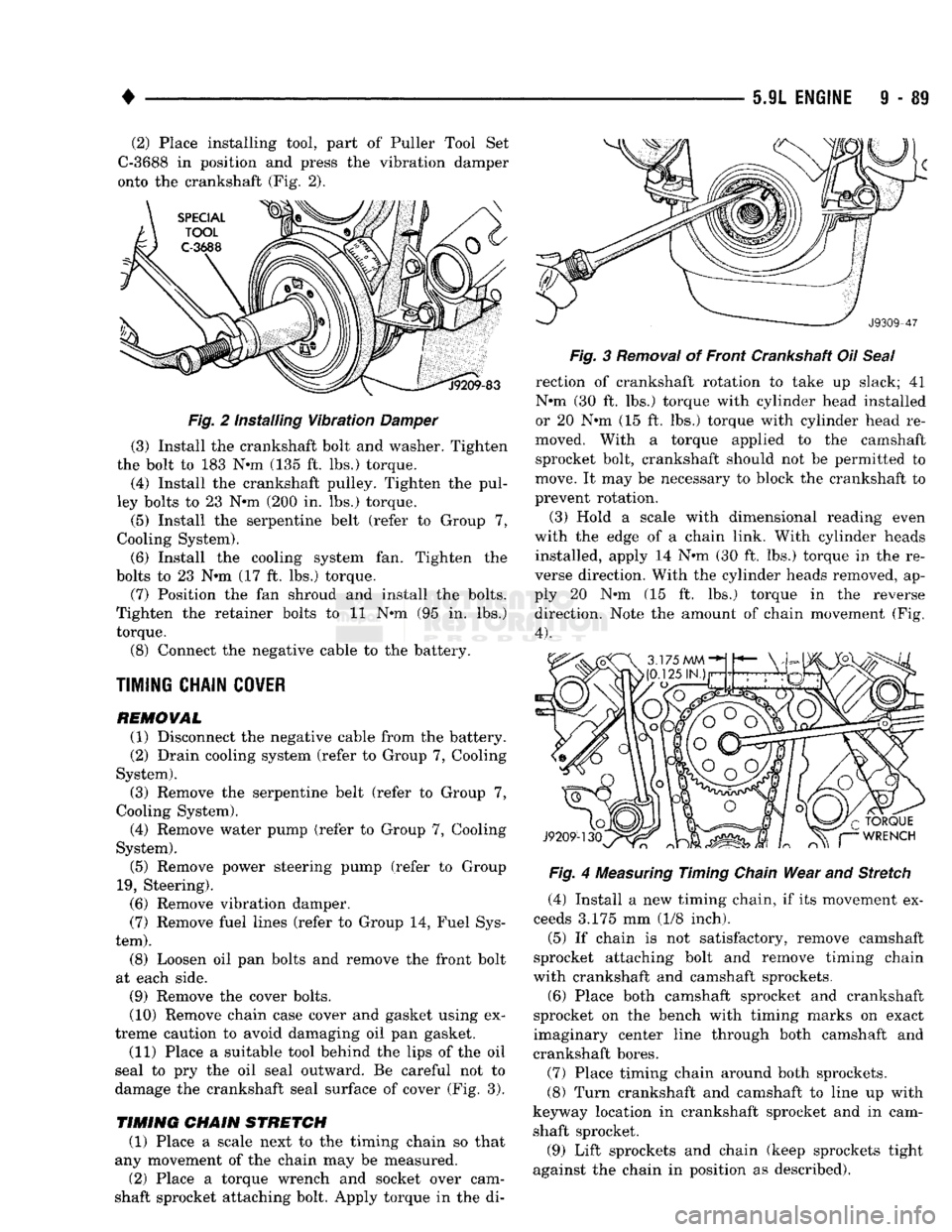
(2) Place installing tool, part of Puller Tool Set
C-3688 in position and press the vibration damper
onto the crankshaft (Fig. 2).
Fig. 2 Installing Vibration Damper (3) Install the crankshaft bolt and washer. Tighten
the bolt to 183 N-m (135 ft. lbs.) torque.
(4) Install the crankshaft pulley. Tighten the pul
ley bolts to 23 N-m (200 In. lbs.) torque.
(5) Install the serpentine belt (refer to Group 7,
Cooling System). (6) Install the cooling system fan. Tighten the
bolts to 23 N-m (17 ft. lbs.) torque.
(7) Position the fan shroud and install the bolts.
Tighten the retainer bolts to 11 N-m (95 in. lbs.)
torque.
(8) Connect the negative cable to the battery.
TIMING CHAIN COWER
REMOVAL
(1) Disconnect the negative cable from the battery.
(2) Drain cooling system (refer to Group 7, Cooling
System).
(3) Remove the serpentine belt (refer to Group 7,
Cooling System). (4) Remove water pump (refer to Group 7, Cooling
System).
(5) Remove power steering pump (refer to Group
19,
Steering). (6) Remove vibration damper.
(7) Remove fuel lines (refer to Group 14, Fuel Sys
tem).
(8) Loosen oil pan bolts and remove the front bolt
at each side. (9) Remove the cover bolts.
(10) Remove chain case cover and gasket using ex
treme caution to avoid damaging oil pan gasket.
(11) Place a suitable tool behind the lips of the oil
seal to pry the oil seal outward. Be careful not to
damage the crankshaft seal surface of cover (Fig. 3).
TIMING
CHAIN
STRETCH
(1) Place a scale next to the timing chain so that
any movement of the chain may be measured.
(2) Place a torque wrench and socket over cam
shaft sprocket attaching bolt. Apply torque in the di- Fig. 3 Removal of Front Crankshaft Oil Seal
rection of crankshaft rotation to take up slack; 41
N-m (30 ft, lbs.) torque with cylinder head installed
or 20 N-m (15 ft. lbs.) torque with cylinder head re
moved. With a torque applied to the camshaft sprocket bolt, crankshaft should not be permitted to
move. It may be necessary to block the crankshaft to
prevent rotation.
(3) Hold a scale with dimensional reading even
with the edge of a chain link. With cylinder heads installed, apply 14 N-m (30 ft. lbs.) torque In the re
verse direction. With the cylinder heads removed, ap
ply 20 N-m (15 ft. lbs.) torque In the reverse direction. Note the amount of chain movement (Fig.
4).
Fig. 4 Measuring Timing Chain Wear and Stretch
(4) Install a new timing chain, if its movement ex
ceeds 3.175 mm (1/8 inch). (5) If chain is not satisfactory, remove camshaft
sprocket attaching bolt and remove timing chain
with crankshaft and camshaft sprockets,
(6) Place both camshaft sprocket and crankshaft
sprocket on the bench with timing marks on exact
imaginary center line through both camshaft and
crankshaft bores.
(7) Place timing chain around both sprockets.
(8) Turn crankshaft and camshaft to line up with
keyway location in crankshaft sprocket and in cam
shaft sprocket.
(9) Lift sprockets and chain (keep sprockets tight
against the chain in position as described).