check engine FIAT 500 2018 Owner handbook (in English)
[x] Cancel search | Manufacturer: FIAT, Model Year: 2018, Model line: 500, Model: FIAT 500 2018Pages: 224, PDF Size: 3.89 MB
Page 201 of 224
199(CONTINUES)
PERSONAL SAFETY
(CONTINUED)
• The electronic Cruise Control can be dangerous if the system is
unable to maintain a constant speed. In specific conditions speed
may be excessive, resulting in the risk of losing control of the
vehicle and causing accidents. Do not use the device in heavy
traffic or on winding, icy, snowy or slippery roads.
39) SERVICING - CHECKING FLUID LEVELS
•Never smoke while working in the engine compartment: gas
and inflammable vapours may be present, with the risk of fire.
•Be very careful when working in the engine compartment when
the engine is hot: you may get burned. Remember that when the
engine is hot, the fan may operate: danger of injury. Scarves, ties
and other loose clothing might be pulled by moving parts.
•The cooling system is pressurised. If necessary, only replace
the plug with another original or the operation of the system may
be adversely affected. Do not remove the reservoir plug when the
engine is hot: you risk scalding yourself.
•Do not travel with the windscreen washer fluid reservoir empty:
the windscreen washer is essential for improving visibility.
•Some commercial windscreen washer additives are flammable.
The engine compartment contains hot components which may
set it on fire.
•Brake fluid is poisonous and highly corrosive. In the event of
accidental contact, immediately wash the affected parts with
water and mild soap. Then rinse thoroughly. Call a doctor
immediately if swallowed.
•Symbol
πon the contain indicates a synthetic brake fluid,
which is different from a mineral fluid.
Use of a mineral type fluid will damage the special rubber seals of
the braking system beyond repair.
•Battery fluid is poisonous and corrosive. Avoid contact with skin
and eyes. Keep naked flames and sources of sparks away from
the battery: risk of explosion and fire. •Before towing, turn the ignition key to MAR and then to STOP
without removing it. The steering column will automatically lock
when the key is removed and the wheels cannot be steered.
•When towing, remember that without the help of the brake
servo and electric power steering, a greater effort is required on
the pedal and steering wheel.
•Do not use flexible cables when towing and avoid jerky
movements.
•During towing, make sure that the trailer hitch does not
damage any components it is touching.
•When towing the vehicle, you must comply with all specific
traffic regulations, both in terms of the towing device and
behaviour on the road.
•Do not start the engine while towing the car.
•The (front/rear) tow hook must be used exclusively for
roadside assistance operations.
You are allowed to tow the vehicle for short distances using an
appropriate device in accordance with the highway code (a rigid
bar), to move the vehicle on the road in readiness for towing or
transport via a breakdown vehicle.
The tow hook MUST NOT be used to tow vehicles off the road
or where there are obstacles and/or for towing operations using
cables or other non-rigid devices. In compliance with the above
conditions, towing must take place with the two vehicles (one
towing, the other towed) aligned as much as possible along the
same centre line.
38) ELECTRONIC CRUISE CONTROL
•Never move the shift lever to neutral when driving with the
device active.
• In the event of device malfunction or failure, contact a Fiat
Dealership.
Page 205 of 224
203
•Never use alcohol, petrol, chemical products, detergents,
stain removers, wax, solvents and “wash and polish” products.
•Rinse immediate to remove soap to prevent stains. Repeat
the operation if needed.
•Rinse immediately, and repeat this operation if necessary.
If you choose to waterproof the soft top, strictly follow the
instructions on the package of the waterproofing product you
have selected in order to obtain optimal results.
•The rubber seals on the soft top must be cleaned exclusively
with water. If you notice that this trim is dry or is sticking, apply
talcum powder or products specifically for rubber trim (silicone
spray).
7) ROOF RACK/SKI RACK
The use of transversal bars on longitudinal ones prevents the
use of the sunroof, because the latter, while opening, interferes
with the bars. Therefore do not move the sunroof if transversal
bars have been fitted.
8) EOBD SYSTEM
If, when the ignition key is turned to the MAR position, the
Uwarning light either does not come on or, when driving, it
comes on constantly or flashing (along with a message in the
display, for versions/markets, where provided) contact a Fiat
Dealership as soon as possible. The operation of the
Uwarning light may be checked by traffic police using appropriate
equipment. Comply with the laws and regulations of the country
where you are driving.
9) DOORS
Make sure to take the key with you once a door or the tailgate
is locked, to prevent locking the same key inside the vehicle.
If the key has been locked in, it can only be recovered using
the second provided key.10) MULTIMEDIA
• Only clean the front panel and the display lens with a soft,
clean, dry, anti-static cloth.
Cleaning and polishing products may damage the surface. Never
use alcohol, petrols and derivatives.
• Do not use the display as a base for supports with suction pads
or adhesives for external navigators or smartphones or similar
devices
11) REFUELLING YOUR DIESEL ENGINE VEHICLE
Vehicles with a diesel engine must only be filled with diesel fuel for
motor vehicles, in compliance with European Standard EN 590.
The use of other products or mixtures may damage the engine
beyond repair and consequently invalidate the warranty, due to
the damage caused. If you accidentally introduce other types of
fuel into the tank, do not start the engine. Empty the tank. If the
engine has been run for even an extremely limited amount of time,
you must not only drain the fuel tank, but the rest of the supply
circuit as well.
12) SEAT BELTS - PRETENSIONERS
Operations which lead to impacts, vibrations or localised heating
(over 100°C for a maximum of six hours) in the area around the
pretensioner may damage or deploy it. Contact a Fiat Dealership
should intervention be necessary on these components.
13) STARTING AND STOPPING THE ENGINE
• It is advisable not to demand maximum performance from your
car (e.g. excessive accelerations, long distances at top rpm,
excessive intense braking, etc.) as soon as the engine is started.
• When the engine is switched off never leave the key turned to
MAR to prevent useless current absorption from draining the
battery.
VEHICLE SAFETY
(CONTINUES) (CONTINUED)
Page 206 of 224
IMPORTANT INFORMATION AND RECOMMENDATIONS
204(CONTINUES)
• Warning light mwill blink for 60 seconds after starting or
during prolonged cranking to indicate a fault to the glow plug
heating system.
Use the car normally if the engine starts and go to a Fiat
Dealership as soon as possible.
• Never bump start the engine by pushing, towing or coasting
downhill. This could cause fuel to flow into the catalytic
converter and damage it beyond repair.
• Never use a fast battery-charger to start the engine as this could
damage the electronic systems of your vehicle, particularly the
ignition and engine fuel supply control units.
• Do not connect the cable to the negative terminal (–) of the flat
battery. The following spark could lead to battery explosion and
cause serious harm.
Only use the specific earth point; do not use
any other exposed metallic part.
• A quick burst on the accelerator before turning off the engine
serves absolutely no practical purpose; it wastes fuel and is
especially damaging to turbocharged engines.
14) USING THE GEARBOX: MANUAL AND DUALOGIC
• Do not drive with your hand resting on the gear lever as the
force exerted, even if slight, could lead over time to premature
wear of the gearbox internal components.
• If the gearbox is faulty, contact a Fiat Dealership as soon as
possible to have the system checked.
• Avoid keeping your hand placed on this lever in between
gear changes or Auto/Manual mode.
• Using the paddles incorrectly (paddles pushed towards the
dashboard) could break them.• In order to safeguard the efficiency of the clutch, do not use the
accelerator to keep the car still (for example:
stopped on a hill); the clutch could overheat and be damaged;
use the brake pedal and only operate the accelerator pedal when
you decide to set off.
• If the messages continue to be shown in the display, contact a
Fiat Dealership.
15) SNOW CHAINS
• Keep the vehicle’s speed down when snow chains are fitted;
never exceed 50 km/h.
• With snow chains, use the accelerator with extreme care to
prevent, or to limit as much as possible, slipping of the drive
wheels that could cause chain breakage, resulting in damage to
the car body or mechanical components.
• Avoid potholes, steps and pavements and avoid driving long
distances on roads not covered with snow to avoid damaging the
car and the roadbed.
16) POWER SOCKET
Only accessories with a maximum power of 180 W (maximum
absorption 15 A)
can be connected to the socket.
17) DIESEL FILTER
The presence of water in the supply circuit may cause severe
damage to the injection system and irregular engine operation.
If the warning light or the symbol
Eon the colour display turns
on, contact a Fiat Dealership as soon as possible to have the
system bled.
VEHICLE SAFETY
(CONTINUED)
Page 207 of 224
205
VEHICLE SAFETY
(CONTINUES) (CONTINUED)
If the above indication occurs immediately after refuelling,
water may have entered the tank: turn the engine off
immediately and contact a Fiat Dealership.
19) BULBS AND FUSES
• Halogen bulbs must be handled holding the metallic part
only. Touching the transparent part of the bulb with your
fingers may reduce the intensity of the emitted light and even
compromise duration of the lamp. In the event of accidental
contact, wipe the bulb with a cloth moistened with alcohol and
let the bulb dry.
• Where possible, it is advisable to have bulbs changed at a
Fiat Dealership.
The correct operation and direction of the external lights are
absolutely essential for the safety of the car and of compliance
with the law.
• The intervention must be carried out taking all precautions
necessary to avoid damaging the bodywork (use a sufficiently
rigid and appropriately thick plastic card).
• If you need to wash the engine compartment, take care not
to directly hit the engine compartment fuse box
with the water jet.
20) LIFTING THE CAR
For versions equipped with side-skirts, pay particular attention
when positioning the lift arms at the workshop.
21) SCHEDULED SERVICING PLAN
• Petrol versions: If the vehicle is used mainly around town or
is driven less than 10,000 km annually, the engine oil and
engine oil filter must be changed every 12 months. • Diesel versions: If the car is used mainly for town driving, the
engine oil and filter should be changed every 12 months.
22) SERVICING: CHECKING LEVELS
• When topping up, take care not to mix up the various types of
fluids: they are not compatible with each other and could
seriously damage the car.
• Do not add oil with specifications other than those
of the oil already existing in the engine.
• The use of products with specifications other than those
indicated above could cause damage to the engine not covered
by the warranty.
• Prevent brake fluid, which is highly corrosive, from coming into
contact with painted parts while checking.
Should it happen, immediately wash with water.
23) PARAFLU
UP
PARAFLUUPanti-freeze is used in the engine cooling system.
Use the same fluid as in the cooling system when topping up.
PARAFLU
UPcannot be mixed with any other type of fluid.
If this occurs, do not start the engine and contact your Fiat
Dealership immediately.
24) BATTERY REPLACEMENT
Incorrect installation of electric and electronic devices may cause
severe damage to your car. After purchasing your vehicle, if you
wish to install any accessories (anti-theft, etc.), go to a Fiat
Dealership, which will suggest the most suitable devices and
advise you whether a higher capacity battery needs to be
installed.
Page 209 of 224
207
• Although the LPG system has numerous safety features, it is
advisable to proceed as follows every time the vehicle is not in
use for a long period or moved in an emergency as a result of a
breakdown or accident:
unscrew the fastening devices, then remove the cover B. Close
the LPG valve rotating the ring nut C clockwise; refit the cover and
tighten the fixing devices.
• It is strictly forbidden to use any additive in the LPG.
• Periodically (at least once every six months) it is advisable to
let the LPG in the tank run out and, at the first refuelling, check
that it does not exceed the maximum capacity of 30.5 litres
(including reserve). If the level is above 30.5 litres (reserve
included) contact a Fiat Dealership immediately.
In special usage conditions:
• starting up and operation at low ambient temperature
• LPG supply with low propane content: the system may
switch temporarily to petrol operation, without any indication.
In the case of:
• low LPG levels in the tank
• request for high performance (e.g. overtaking, car fully laden,
steep hills): the system can automatically switch to petrol
operation to guarantee the required engine performance; in this
event, the performed switching is shown by the orange (petrol)
LED lit and the green (LPG) LED off on the switch. When the
above conditions stop, the system automatically restores the
LPG operation; the orange (petrol) LED turns off and the green
(LPG) LED is lit on the switch.
(CONTINUED)
VEHICLE SAFETY
• To achieve the automatic switching described above, make sure
that there is always enough fuel in the petrol tank.
• There must therefore always be enough petrol in the tank to
protect the petrol pump and to guarantee temporary switching
from LPG to petrol operation.
30) CHANGING A WHEEL
When turning the jack handle make sure that it can turn freely
without scraping your hand against the ground. The moving
components of the jack (“worm screw” and joints) can also cause
injuries: avoid touching them. If you come into contact with
lubricating grease, clean yourself thoroughly.
31) FIX&GO QUICK TYRE REPAIR KIT
• The sealant fluid is effective with external temperatures between
-40°C and +55°C. The sealant has an expiry date. It is possible to
repair tyres which have been damaged on tread up to a diameter
of 6 mm. Show the cartridge and the label to the personnel
charged with handling the tyre treated with the tyre repair kit.
Page 210 of 224
IMPORTANT INFORMATION AND RECOMMENDATIONS
208
1) KEYS - REMOTE CONTROL
Used batteries should be disposed of, as specified by law, in
the special containers, otherwise take them to a Fiat
Dealership, which will deal with their disposal.
2) CLIMATE CONTROL SYSTEM
The system uses R1234yf coolant, which is compatible with
the laws in force in the countries where the vehicle is sold.
When charging, only use the gas indicated on the plate in the
engine compartment. The use of other coolants affects the
efficiency and condition of the system. The lubricant used for
the compressor is also strictly linked to the refrigerant gas type,
refer to the Fiat Dealership.
3) SERVICING - CHECKING FLUID LEVELS
• Used engine oil and oil filters contain substances which are
harmful to the environment. To change the oil and filters, we
advise you to contact a Fiat Dealership.
• Used transmission fluid contains substances that are harmful
to the environment. It is advisable to have the oil changed by a
Fiat Dealership where it will be disposed of respecting the
environment and according to legal requirements.
•Batteries contain substances which are very dangerous for the
environment. It is advisable to contact a Fiat Dealership for
battery replacement.
ENVIRONMENTAL PROTECTION
4) MAINTENANCE - BODYWORK
Detergents pollute the environment. Only wash your vehicle in
areas equipped to collect and treat wastewater from this type of
activity.
Page 219 of 224
217
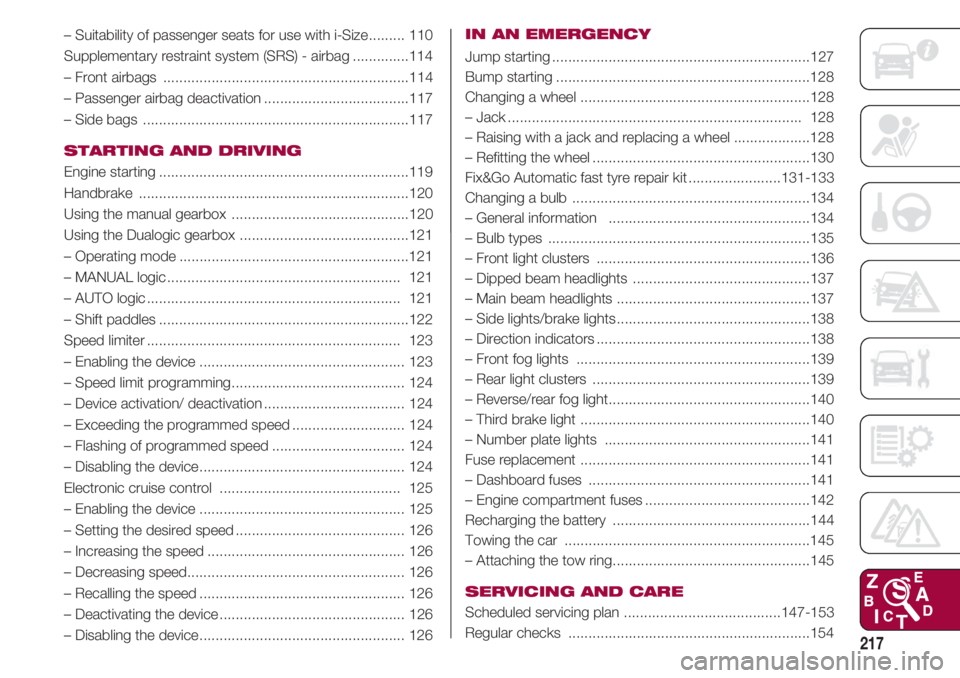
– Suitability of passenger seats for use with i-Size......... 110
Supplementary restraint system (SRS) - airbag..............114
– Front airbags .............................................................114
– Passenger airbag deactivation....................................117
– Side bags ..................................................................117
STARTING AND DRIVING
Engine starting..............................................................119
Handbrake ...................................................................120
Using the manual gearbox ............................................120
Using the Dualogic gearbox ..........................................121
– Operating mode .........................................................121
– MANUAL logic.......................................................... 121
– AUTO logic............................................................... 121
– Shift paddles..............................................................122
Speed limiter............................................................... 123
– Enabling the device................................................... 123
– Speed limit programming........................................... 124
– Device activation/ deactivation................................... 124
– Exceeding the programmed speed............................ 124
– Flashing of programmed speed................................. 124
– Disabling the device................................................... 124
Electronic cruise control ............................................. 125
– Enabling the device................................................... 125
– Setting the desired speed.......................................... 126
– Increasing the speed................................................. 126
– Decreasing speed...................................................... 126
– Recalling the speed................................................... 126
– Deactivating the device.............................................. 126
– Disabling the device................................................... 126
IN AN EMERGENCY
Jump starting................................................................127
Bump starting...............................................................128
Changing a wheel .........................................................128
– Jack......................................................................... 128
– Raising with a jack and replacing a wheel ...................128
– Refitting the wheel......................................................130
Fix&Go Automatic fast tyre repair kit.......................131-133
Changing a bulb ...........................................................134
– General information ..................................................134
– Bulb types .................................................................135
– Front light clusters .....................................................136
– Dipped beam headlights ............................................137
– Main beam headlights ................................................137
– Side lights/brake lights................................................138
– Direction indicators.....................................................138
– Front fog lights ..........................................................139
– Rear light clusters ......................................................139
– Reverse/rear fog light..................................................140
– Third brake light .........................................................140
– Number plate lights ...................................................141
Fuse replacement .........................................................141
– Dashboard fuses .......................................................141
– Engine compartment fuses.........................................142
Recharging the battery .................................................144
Towing the car .............................................................145
– Attaching the tow ring.................................................145
SERVICING AND CARE
Scheduled servicing plan .......................................147-153
Regular checks ............................................................154
Page 220 of 224
CONTENTS
218
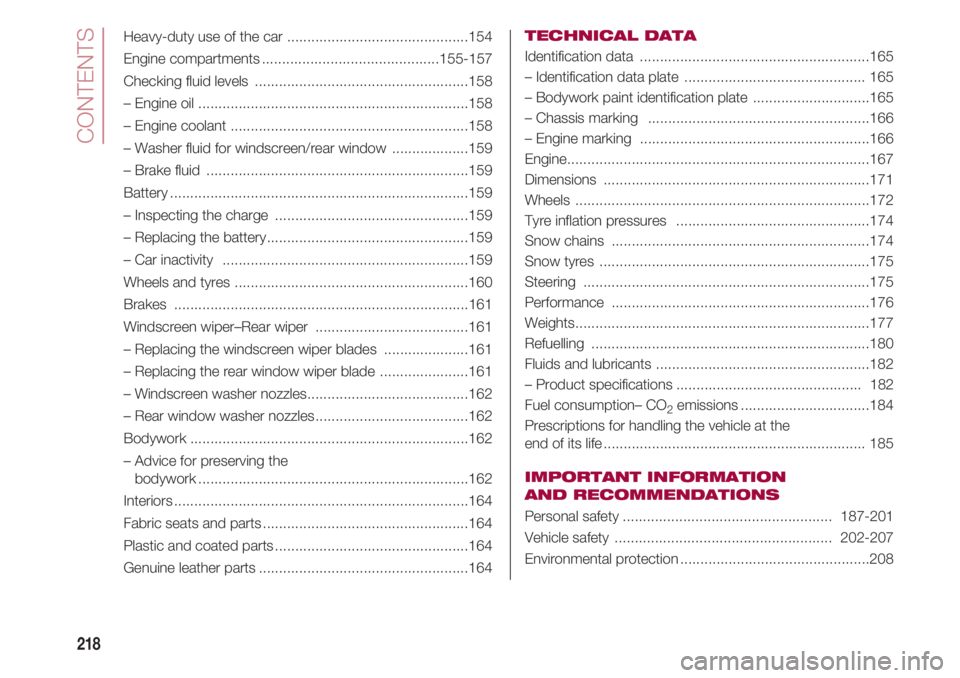
Heavy-duty use of the car .............................................154
Engine compartments............................................155-157
Checking fluid levels .....................................................158
– Engine oil ...................................................................158
– Engine coolant ...........................................................158
– Washer fluid for windscreen/rear window ...................159
– Brake fluid .................................................................159
Battery..........................................................................159
– Inspecting the charge ................................................159
– Replacing the battery..................................................159
– Car inactivity .............................................................159
Wheels and tyres ..........................................................160
Brakes .........................................................................161
Windscreen wiper–Rear wiper ......................................161
– Replacing the windscreen wiper blades .....................161
– Replacing the rear window wiper blade ......................161
– Windscreen washer nozzles........................................162
– Rear window washer nozzles......................................162
Bodywork.....................................................................162
– Advice for preserving the
bodywork...................................................................162
Interiors.........................................................................164
Fabric seats and parts...................................................164
Plastic and coated parts................................................164
Genuine leather parts....................................................164TECHNICAL DATA
Identification data .........................................................165
– Identification data plate ............................................. 165
– Bodywork paint identification plate .............................165
– Chassis marking .......................................................166
– Engine marking .........................................................166
Engine...........................................................................167
Dimensions ..................................................................171
Wheels .........................................................................172
Tyre inflation pressures ................................................174
Snow chains ................................................................174
Snow tyres ...................................................................175
Steering .......................................................................175
Performance ................................................................176
Weights.........................................................................177
Refuelling .....................................................................180
Fluids and lubricants .....................................................182
– Product specifications.............................................. 182
Fuel consumption– CO
2emissions................................184
Prescriptions for handling the vehicle at the
end of its life................................................................. 185
IMPORTANT INFORMATION
AND RECOMMENDATIONS
Personal safety....................................................187-201
Vehicle safety ......................................................202-207
Environmental protection...............................................208